Tag Archives: Orestes

My bloody brain

Yup, it tends to happen. I am out here trying to insert a side of the story to my script Engonos and also the script to Vitam Exhaurire and as it happens I suddenly have another idea. I am working on three scripts at the moment (the third will be on the back burner for a little while) there is no way I am starting another script. I’ll end up with a dozen of scripts and only one finished. Still, the idea has merit. So perhaps I can give it to Matt Damon. He might be busy, but it could help the students involved in Project Greenlight, an American documentary television series focusing on first-time filmmakers being given the chance to direct a feature film. Perhaps it would be useful for them. On the other hand, first time film makers tend to have their ideas on a rope, as such. I am not sure if it would be of any help. I’m thinking that any idea that hits a director (or visionary) who sees the idea might think that he (or she) could make something of this and I was never unwilling to give assistance to the creative mind. Beside that I am already working on projects 2 and 3 (4 comes later) and in that instance this idea would be redundant in my mind as I am focussing on something else.

The Idea
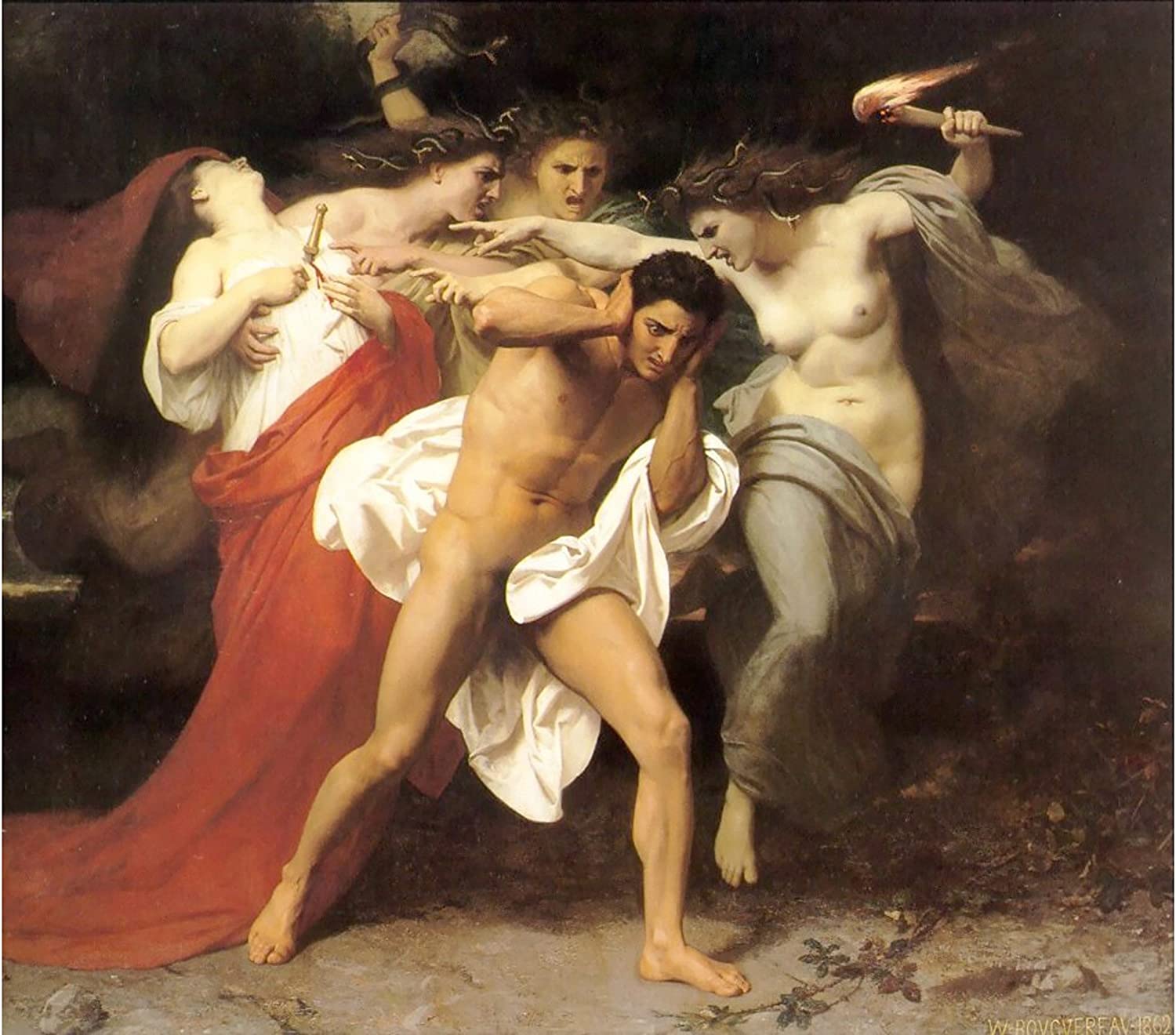
The idea is surrounding Euripides, the Greek writer and a Greek tragedian of classical Athens. He lived between 480 BC and 406 BC and is said to have voiced over 90 plays and several were made into movies (after he died). So I got to thinking. What is this movie is about Euripides. Starting as a young Greek (around 455 BC) and from there we get to see two settings. The first is his daily life and set this in an authentic looking life (at that time) and in between he goes on dream quests and envisions some of his works like Orestes and how he envisions how the Furies to be. We see him thinking through grief in Hecuba and how he sees the unfold through grief over the death of her daughter Polyxena and the revenge she takes for the murder of her youngest son, Polydorus. We see him shape Children of Heracles and how he opposes war. And in that setting and these plays he shapes tragedy as we know it to be now. You see, we see his plays and the versions that made it to the movies, but we don’t ever see Euripides himself and how this darkness is shaped into the massive hit it is now and has been for over 2000 years. There is also the thought that he might have been a doom sayer, brought to the surface in his plays and how it shapes him and darkens his soul. He died at an age over 70, in those days a real rarity. As such, the end of the movie should include The Bacchae which was published after he died, yet that part is ‘performed’ in the movie whilst we see Euripides as a ghost between the people watching his work lighting his should up. As we see The Dionysus in Euripides’ tale is a young god, angry that his mortal family, the royal house of Cadmus, has denied him a place of honor as a deity. His mortal mother, Semele, was a mistress of Zeus; and while pregnant, was tricked by a jealous Hera to request Zeus to come to her in his true form. But in the movie Dionysus is the ghost of Euripides, showing him angered by the people who mocked him in his life. And he is taken by three women Clotho (the spinner), Lachesis (the allotter), and Atropos (the inevitable, a metaphor for death) telling him that his work will survive thousands of years and he did well and Zeus will congratulate his efforts and the inspiration he was to greeks until time ends. 

This was the idea I had an hour ago. The plays are a bit open, but The Bacchae is essential to be at the end as it was published after he died. 

So that one is for Matt Damon to use in Project Greenlight.

Well, that is my creatively created $0.02, not bad for a 02:00 piece of work. Time to catch some snores as I prepare for the day ahead which starts in 3 hours. Have a great day.
Leave a comment

Filed under Media, movies, Stories

Franchise to the left

And legend to the right, we all have been in that setting; we all have had grander then life dreams and imaginations. For me it started when some British bloke brought a new level of fear to the cinema (Alien), it could be the American that made us afraid to go swimming (Jaws), yet for the most we all have had that moment. For some reason that feeling got awake again with the setting of Kristen Stewart and Vincent Cassel, directed by William Eubank. I am talking about the movie Underwater. I am trying to make sure that I am not giving away the plot, because the movie is well worth watching. We all have made fun of Kristen Steward, not because of the girl, but because of the franchise. I have nothing against the franchise and even as I have never read the works of the writer, I get the feeling that she is well worth reading, I got that sense when I saw the movie the Host. Anyway, I got the limited Twilight edition of Charlie’s Angels (one additional romantic scene, ha ha ha) and that was that. But she shines like a well cut diamond in Underwater, the cast is awesome and the movie is a lot better then anyone realises, because in my case Underwater took me back to the original feeling of unease that Jaws and Alien instilled, I actually missed that feeling and it got me thinking. We all look at the Middle East, we all saw Aladdin, but there is a lot more than the proverbial Argo. What if we dispense with the musical dreaded scene of the room in the dark, what if the dark becomes a much larger stage, a stage where you will not sleep, never ever again with the lights off?

That was the setting I contemplated, but it never gave me the idea, the idea was already there, yet in this case the idea altered a little. I am talking about the concept of the Ifrit. Then today (yesterday as well) when I was replaying AC Origins, I stumbled upon the idea again, it was when (in the game) I entered the city of Letopolis (and the story behind it) and it gave me the idea in more degrees. Yet I was contemplating the city of Per-Amun and the Battle of Pelusium (525 BC). A stage where we see the confrontation of Egypt and the Achaemenid Empire. Now consider that an Ifrit was held captive in Per-Anum, it was taken and moved to the western province of their domain in the city of Gerrha, in a secret tomb under houses the prison of the Ifrit was kept and lost when the caretakers fell ill and it was forgotten, that prison is found after 2500 years by a western teacher exploring his connection to Islam and he is filled with the rage of a demon held captive for 3000 years. We now have a stage where Islamic doctrine might hold a solution, but the wielder is in doubt of his faith and in the mean time the rage of the Ifrit takes on a turn of another nature. When we consider that the larger stage of the Achaemenid Empire is now Iran, Gerrha is (now) in Saudi Arabia and we are confronted with a demon, not merely in thirst of blood, but also a stage of intrigue setting up a war of Saudi Arabia against Iran we get a new stage, one never seen (as far as I know). We look at horror, but what if horror is set (drenched) in political settings, as well as religious ones? Especially when we consider “In the latter account, the “ifrit among the jinn” threatens Muhammad with a fiery presence, whereupon the archangel Gabriel taught Muhammad a Du’a (Islamic prayer) to defeat it.” A stage which we get from ‘Heavenly Journeys, Earthly Concerns: The Legacy of the Mi’raj in the Formation of Islam Routledge, 2004’ by Brooke Olson Vuckovic. We have all the markings of what could be an awesome franchise, yet as far as I can tell, no one looked in that directions, I wonder why. 

5 large streaming houses, a dozen large studio’s and no one looked or contemplated this direction of ideas? I merely watch movies, I am not (and never really had the notion of becoming) a movie director, I am for the most a storyteller and an analyst. Yet the idea of creating something totally new (not the first time) is both appealing and overwhelming. So as I (and others too) consider looking to the left hoping we have created a new franchise, we also look towards the right hoping to see the shimmer of the ‘legendary label’ in this all storytellers are the same, we love the idea of any new story we create, but to create one that becomes legendary as other great storyteller did before us is always in the back of all our minds, we all want to become the next Rowling, Tolkien, Hubbart, Sheckley or Clarke. We always want to measure how close we got to our idols, as far as I can tell, there is no exception to that rule and every storyteller has his or her own idol, the achieved person that drives us. All that and the thought of knowing the person who overhauled the Necropolis of the Via Triumphalis and whatever they found under there is always the wink towards the unknown. Some merely see the “outstanding example of an ancient Roman burial ground”, yet what if this happened before and what if we ignore the old saying to keep buried what was buried? What happens when you open the door to someone who can traverse the seven stages of the Jahannam? And what happens when someone figures out that there is more to The Remorse of Orestes?

The Remorse of Orestes

We see overlaps and connections in Islamic stories that connects to Christianity (Gabriel) and Greek (Furies), what if this is not a casual link? You see most film makers never seemingly looked deeper into that side of things, why not? If they are more becoming about streaming and franchises, I think the Middle East has a whole range of stories that open up more and optionally also a larger audience. 

#JustSaying

Leave a comment

Filed under movies