That is what I saw this morning. Ekathimirini (at https://www.ekathimerini.com/culture/1314309/how-do-you-teach-the-odyssey-to-a-12-year-old/) gave us an interesting question. ‘How do you teach ‘The Odyssey’ to a 12-year-old?’and I have an optionally better one. Where is the literature for the young? I am not talking about children’s books, but the need to keep the young at the edge of their seats and knowledge has been largely abandoned. I actually touched on the subject 1-2 years ago when I wrote my first film script, it was called ‘How to assassinate a politician’ and I considered down the track that it was too long and gave it the alternative title ‘Essay’ I offered it to the Dubai Media Corporation who was not interested (fair enough). The story is set in the Netherlands and Saudi Arabia (Dammam) and I touched on the setting of children’s literature, although I wasn’t doing it aware or intentional. The setting was a film script and that was what is was. It was my first film script. There is plenty of literature for the young. The two most famous writers are JRR Tolkien (the Hobbit) and JK Rowling about a boy with his scar (aka Harry Potter) and now a new generation will get that influx of near perfection in the upcoming HBO TV series. There are others, the Netherlands has Anne de Vries ‘Journey through the night’ and Jan Terlouw with Oorlogswinter (Winter in Wartime), but there are the ‘classics’ from Hector Malot who wrote Nobody’s Boy in 1878. There is a gap and it needs to be filled fast. There are new writers and Rowling might be the most famous one, but she is not alone, still the harvest on literature for the young is meek, very meek. So, as I saw the article, I kinda rejoiced, because that might be the start of a new generation of literature for the young.
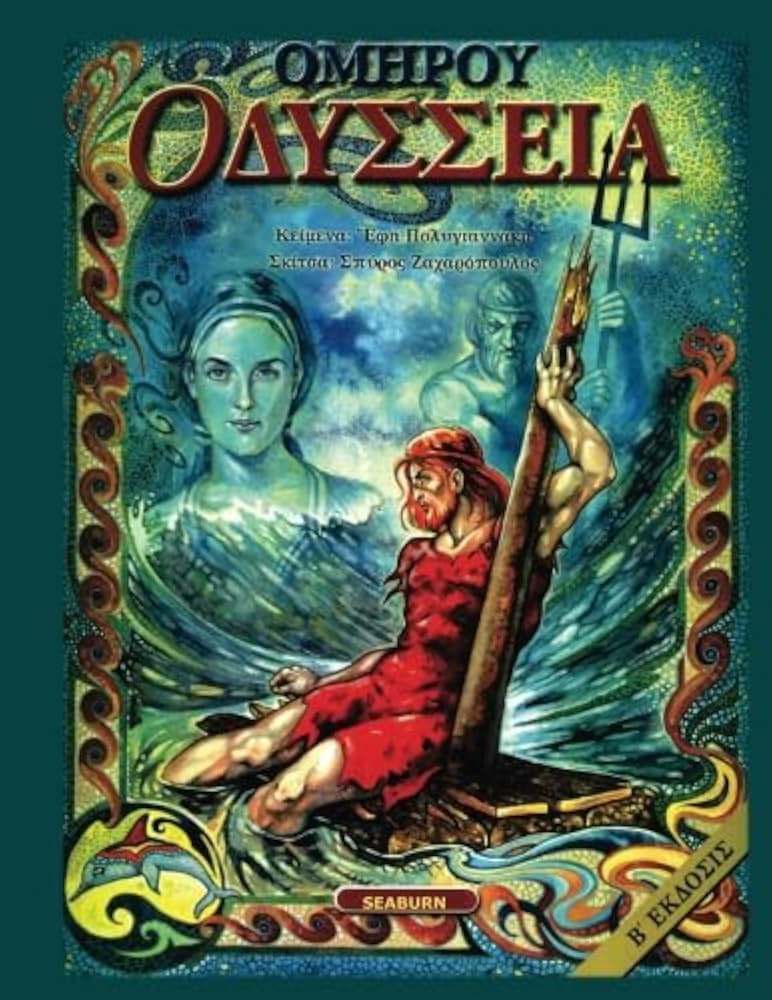
As we see “When, in 2018, BBC Culture asked 108 writers, academics, critics, journalists and translators from 35 countries to choose the stories that shaped the world, Homer’s Odyssey came in first place. Among the reasons cited by participants were the power of a story full of gods and monsters, its influence on the narratives that followed, but also the questions the work still raises about heroism, war and homecoming. Almost three millennia after it was written, The Odyssey continues to be read, adapted and giving birth to new narratives.” And the larger issue is shown with ““When the Odyssey is taught in the classroom, it often loses its narrative momentum. It is broken up into small fragments, interrupted by constant questions and loaded with terms, figures of speech and ‘correct’ interpretations,” says Dr Christos Tsagalis, professor of Ancient Greek Literature at the Aristotle University of Thessaloniki, who has been studying Homeric poetry for years. “Thus, the child stops wondering what will happen next and starts wondering what he needs to memorize.”” And the next issue pops up with ‘Did they watch the movie, or actually read the story? Pops up in me. As for Harry Potter, I might be one of the few people who saw the movie before reading the book. I was attending a showing of Sleepy Hollow in Stockholm when I was given a teaser. I heard the words “There is no such thing as magic!” and the entire audience went insane. That was my introduction to Harry Potter and after seeing the movie I read the first novel. Thinking “Kids read this?” I had heard of Harry Potter, I have friends and they have kids. So the name was familiar, but nothing more than that. So as we now see ““I would put the narrative at the center, not the quiz tests,” answers Tsagalis. “The students would first learn the entire course of the journey through a short, well-crafted narrative map and then delve into selected episodes. I would combine reading aloud, dramatization, journey mapping, creative writing and discussion about hospitality, loss, the desire to return and the responsibility of one’s choices.” By the end of the school year, “every child should have read the prologue, basic parts of Telemachy, Calypso and Nausicaa, the Cyclops, Circe, Nekyia, the Sirens, Penelope’s recognition of Odysseus, the slaying of the suitors, and the final reconciliation,” he continues. More than memorizing individual episodes, it is more important to have the overall picture. “Most importantly, being able to understand the coherence of the story and being able to narrate how suffering transforms people.”” I am willing to go with Rowling and Tolkien as storytellers. There is even the idea of other writers having a firm grasp of these settings, but Homer was largely meant to be orated in the Theater of Epidaurus (or something likewise) and the world moved on (not in a good way), don’t get me wrong, the world needs its share of mindless drones and they can get their jollies filled with writings from ChatGPT. But if we are to protect the next generations of leaders and insightful people, we will need to create literature for you young and someone needs to take over from JK Rowling. And If you want to stay in the greek phase, we have Rick Riordan and the Burton fans could look towards Ransom Riggs who wrote an entire chain of books starting with Miss Peregrine’s Home for Peculiar Children. But the settings of Hector Malot and likeminded people is seemingly lost and that could be resolved by todays writers. Creativity is key in all this (which is why ChatGPT will never be a solution) and it was never my cup of tea, I have my own style, but what style appeases the youthful reader?
It is a question that is meant to be resolved by actually smart people (which leaves me out of that equation). I believe that writing or narrating Homer for the Young is a path that is worthy of exploiting for some, but so are the writings of Aurelius and Virgil if we want to steer clear of Greek writings. There are plenty of writings to be found all over Europe and that is also the curse. You see, Hollywood changed the bulk of those seeking funding and there is no criticism here from me, those were the times that brought the books to the audience. But the original works suffered through them and they need to be rediscovered and as I see it, the path of literature for the young might be a worthy new path to take to reintroduce these original writings. But what is the best path? I am not the one to tell anyone what the best path is, there is no best path, I think there is only a most complete path the align to. Because writings and opinions are two of the most versatile settings anyone will ever seen. And I think that Clint Eastwood had that one right (or his scriptwriter) “Opinions are like arseholes, everyone has one” but we can agree that there is a more or mostly complete path to introducing literature to the young and that could also be done through new and original IP (taking ChatGPT out of that equation).
The best path out there and someone will find it or write about it. I don’t feel that I am wise enough to be the one to do that. But the question remains and it is a good one “How do you teach ‘The Odyssey’ to a 12-year-old?”, I merely appreciate ‘How to create literature for the young’ a little more, Homer was yesterday (actually it was 1,032,196 yesterdays ago), we can and should keep these works in the highest regard, but we also need todays literature to appease the young and that takes creativity and a writer that is a little more today, unlike Homer, Aurelius, and a few others. So the question that Ekathimirini voices is pretty true, but there is more and that needs to be addressed too, preferably before most of our youth has become too stupid to care.
It is merely a question to voice, but that is how I see it. Have a great day.