Tag Archives: Grayling

Insomnia Rules, OK?

It is 3:30, for some weird reason, I cannot fall asleep and I have no intentions to play a game until I get tired, so what do you do? You start looking a little more intense at twitter and that’s how I got into the twitter tweets with a Human Rights Lawyer. Now, I am all for human rights, were it not for that pesky HRA at times, but that is not the issue. There actually is no issue. You see the tweet that got this all started was :
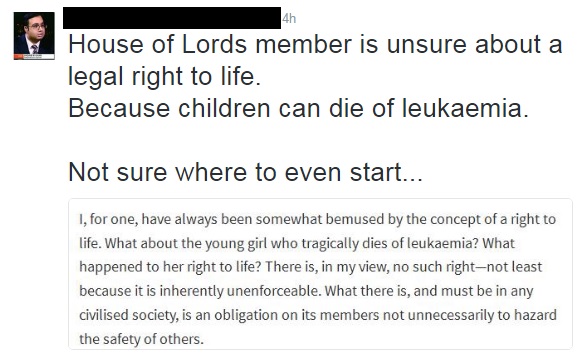
hr_tweet

The issue given was “I, for one, have always been somewhat bemused by the concept of a right to life. What about the young girl who tragically dies of leukemia? What happened to her right to life?” To be that made sense. You see, I am not against a right to life at all, I just wonder how you can set a phrase like that to law. You see, I have been on the other side of matters, so the right to life as seen as a concept where it is not under scrutiny of capital punishment, war, abortion, euthanasia and justifiable homicide is very much the core of the matter, The one part some add, mainly ‘public health care‘ is not in question in this case (it should be a given right no matter when, how or who). I am not against capital punishment and war allows for the situation where lives are lost, hence the right to life is not a given here. I feel different about abortion and euthanasia. You see, I do not agree with either pro-abortion or pro-life. They are stigmatised and polarised opposites of different currencies at time. Pro-lifers are all willing to hang an abortion doctor at the nearest tree, whilst pro-abortion seems to see it as a solution for unadulterated sex (read: exaggeration for dramatic effect), which is how I see these two players. In my view the truth is in the middle.

There are clear cases where abortion needs to be valid, yet I feel uncertain on the wisdom to where the line should be drawn, on the same issue, I see that pro-life doesn’t always have a clear case beyond their conviction. That view tends to be smitten with parts of religion and natural law, yet the full acceptance of both cannot be maintained, so a blanket pro-life abolishing abortion as a whole is equally unthinkable to me.

The best term is the worst classification

You see, for the most I am not against the concept of right to life, but the title itself is unrealistic in a few ways, making me side with the member that started ‘House of Lords member is unsure about a legal right to life‘. You see as stated, my issue makes the ‘right’ almost null and void. In that same setting, the quote “An obligation on its members not unnecessarily to hazard the safety of others” comes as a light in the dark. For the most, we have an obligation not to endanger the lives of others, we get this for the most when we consider the military. They get to endanger themselves and defend that life by taking the lives of those who endanger that life. In this age of terrorism and extremism (like that place you can find on historical maps, namely Aleppo).

A pro-life polarisation cannot survive, and as such the right to life comes under attack and whilst the attack on it might seem correct, the sentiment itself should never be under attack. We all have a right to life and at some point some people throw that right away and the blanket ‘right to life‘ cannot correctly deal with that situation, which is why the House of Lord member makes perfect sense. Yet telling all this in 144 characters was never a possibility, which is why today is all about that tweet.

The strongest opponents in all this is Capital Punishment and Euthanasia. At times I have had a much polarised view on those proclaiming justice here. You see, from my point of view, those who cannot hand out the death penalty might be hypocritical cowards. This is way too strong an expression, so let me explain this (I think I did in a much older blog). You see, we all adhere to the law. Now let’s say that we have a rounded 70% lawful and 30% criminal population, the law will take care of that, and for the most, all laws, even those who have no death penalty do that. I am fine with that. Yet the crime part is not 30%, within that group is a 0.000001% sub group that is so extreme, so willing to take the lives of others (like terrorists) that the law can never properly deal with them. So we either wait for that person to get in a court of law (which could be after the death of many more lives). So where was the right to life for those victims? We have a duty to hunt those extreme cases down and put them to death if need be, either by death penalty or by targeted killings. Now consider the number I gave. On this world, that would amount to 8,000 people. When you consider that as per last year 2,984 were on death row in the United States, the number I grasped at is not that far a reach. You see, when we holster the ‘right to life’ and the Crimes Act as golden calves onto our field of vision, worshipping that principle beyond all, is it not fair to say that these people are willing to set the victims of these extreme criminals as human sacrifices? How is human sacrifice seen in view of a right to life? As for Euthanasia, how much suffering should a person endure until he is either constantly drugged or died from pain and suffering? I am not stating that I have the wisdom, but I reckon that at times physicians need to be able to offer such an option, especially when there is no option to manage the pain or outcome.

In this regard I now need to address the issue that some call ‘justifiable homicide’. You see, just like ‘right to life’ I have an issue with that term. I am all for targeted killing, because it comes with a switch. Targeted killing is not the same and I am not sure if ‘justifiable homicide’ is legally acceptable as homicide is a clear crime in the 1900 Crimes Act (or other Common Law equivalent). You see, the term comes with this dictionary explanation: ‘the killing of a person in circumstances which allow the act to be regarded in law as without criminal guilt‘, that could apply to the act of a Sociopath or a Psychopath. Some could proclaim: “homicide is justified when it prevents greater harm to innocents“, you see, we now get dangerously close to Ridley Scott’s Kingdom of Heaven where we hear: “killing an infidel is not murder. It is the path to heaven“, which is not the only quote, I reckon that Ridley got part of one characters dialogue from Pope Urban II, who at the Council of Clermont in 1095 is witnessed to have stated: “Deus lo vult! – ‘God wills it!’“, which is my issue, as religion needs to stay far away from today’s Laws. I just feel too uneasy on something that can be ‘justified’ especially when a militant mass comes with hate speech and offs people to safe others. Targeted killing is not like that and as far as I can tell, from my legal point of view, ‘Justifiable Homicide‘ should not be allowed either. The fact that a valid action (like that of a policeman) resulted in the death of a person would always be investigated and the officer would either be prosecuted or be cleared from prosecution, these events have clear mechanics and when we resort to targeted killings, that too comes with a machine of checks and balances. Justifiable homicide could theoretically avoid some of these checks and balances and I really have an issue with that.

So as we are splitting hairs on murder versus killing, we are not digressing from the right to life, I am establishing (or trying to do so) that there is a right to life, yet people can act in ways to negate that right. This is why the member of the House of Lords struck a chord within me. I find myself in the same situation when I consider ‘right to family life’, to which I have had an issue or two in the past. I agree that a person should have the right to a family life. Yet in the same way as he/she has that right, he/she can also squander that right. It could be squandered through abuse, either sexual, physical or psychological, which now gets me on my issue with the HRA. You see, if the HRA was a piece with teeth, then there should be a majority who would allow for domestic abuse to be set within article 3 (torture) as it is a clear form of physical and psychological torture. The fact that this will not happen (and is unlikely to do so) makes me wonder why we have an HRA (or at least one lacking teeth under certain conditions), which might clearly be a short-sighted view and position from my side, yet as I saw my mother getting beaten to death when I was young, my sentiment remains to be on the right path as I personally see it.

All these thoughts resurfaced as that one tweet hit my eyes. Now, I have been following this Human Rights Lawyer and he makes great cases and sets the bar of Human Rights realistically high and it is always a delight when he has a go at everyone’s favourite piñata in the UK, Grayling.

So, I still feel that the tweet as exposed has an issue and I personally feel that I remain on the side of the member of the House of Lords, yet merely in the fact that the sentiment on right to life should exist, but I am not sure if that is what we should call it and in addition, we need to realise and accept that this right can be lost by the actions of the person who lost it. It has nothing to do with a child suffering from Leukaemia as stated, but from the acts of a person who does not respect the right to life of another, or the sanctity of a family without harm or suffering. Both laws, humane, yet I feel too humane and therefor I found them personally to be flawed.

I needed 7429 characters more than the 144 twitter offered.


Leave a comment

Filed under Law, Media, Politics, Religion

Cleaning house!

This issue has been in the back of my head for some time. It was 2011 when this happened. The ruling hit the news (and the most colourful version was in the Daily Mail as per usual), where a rapist could not get deported because he was entitled to a family life. The article angered me and to some extent, I was then and I am still now on the side of the Daily Mail approach.

Why are criminals granted a lot more freedoms then their victims?

The more preposterous part is: “This is despite him not having a wife, long-term partner or children in the UK“, so what family life? He could try to get one in Nigeria for all I care.

The convention can be found here: http://www.echr.coe.int/Documents/Convention_ENG.pdf

The actual text: “ARTICLE 8 Right to respect for private and family life, 1. Everyone has the right to respect for his private and family life, his home and his correspondence.
2. There shall be no interference by a public authority with the exercise of this right except such as is in accordance with the law and is necessary in a democratic society in the interests of national security, public safety or the economic well being of the country, for the prevention of disorder or crime, for the protection of health or morals, or for the protection of the rights and freedoms of others.”

It sounds nice enough, but it is time for some tough love, so I recommend adding the following:

3. In case of conviction of a serious crime, that nation can decide to ignore rule 1, providing a connection to a long term partner and the existence of biological off spring, born in that nation, not criminally conceived has been established.

So, we got rid of the rapist, if the mother is a pro-life woman, that will not protect him and moreover, he cannot hide behind an adoption either. Whether this is altered for the UK or it is accepted within the EEC as a whole is of course the crux. It is also time to stop tailoring from a weak point of view. Yes, at this point, a Human Rights point of view is a weak view (I accept that many disagree here)!

Let’s be clear here. I am all for human rights, but these rights also come with responsibilities and accountability, without these two rights pretty much go out of the window. It should also be clear that if a nation independently decides to not enforce paragraph 3, then this is fine too as I added “that nation can decide“, I am all for the right to choose and Like some should not judge the UK, the UK should not judge France, Germany or the Netherlands.

We are not done yet. There is still Article 12 to consider. We can’t have criminals ‘suddenly’ fall in love and get hitched and therefor avoid deportation (where applicable), hence the following would change

ARTICLE 12 Right to marry, Men and women of marriageable age have the right to marry and to found a family, according to the national laws governing the exercise of this right“.

Would change into:

ARTICLE 12 Right to marry,
1. Men and women of marriageable age have the right to marry and to found a family, according to the national laws governing the exercise of this right
2. The right to marry is temporary postponed if one or both persons have been deprived of his/her liberty by arrest or detention, until 6 months after release and was not been deported because of these events
3. Paragraph 2 will not be valid, if a court has ordered the release of the involved parties due to non-lawful detention
“.

We keep number three there, as there is always a chance a person was convicted innocently and as such; we must definitely protect their rights too, as I stated we will give all quarter to those who abided by law as we should.

So, it took me almost 45 minutes to get to these conclusions after going over certain papers. The question becomes why these steps had not been made before? Well, let’s take a look at the Guardian (at http://www.theguardian.com/law/2013/dec/22/britain-european-court-human-rights). Here we see another view when we consider the following paragraph:

Grayling said last week the ECHR did not ‘make this country a better place’. David Cameron has said the court risks becoming a glorified ‘small claims court’ buried under a mountain of ‘trivial’ claims , and suggested Britain could withdraw from the convention to ‘keep our country safe’. The home secretary, Theresa May, has pledged the party’s next manifesto will promise to scrap the Human Rights Act, which makes the convention enforceable in Britain

I am not sure I can agree with the Home Secretary there. I see her point, but it took me only 45 minutes to alter the convention into something a lot less hassle, without actually changing that much. Those who come to Europe, fighting for a better life, not resorting to crime can still do that. My issue is that the rape victim, who was 13 at the time seems to have fallen of the view of the world (which might be good for her), yet in the dozens upon dozens of documents trying to protect the rapist, how much concern was given to the victim of his crime?

This is at the heart of my reasoning. Some judges talk a good talk, but then they seem to refuse to walk the walk (if it pleases the court and with all due respect). Consider the paper ‘Women in an unsecure world‘ (at http://www.unicef.org/emerg/files/women_insecure_world.pdf). A paper edited by Marie Vlachova and Lea Biason. If we are TRULY going to do anything to make their future safe, then we must begin in our own country. By making the consequence of transgression so high, that considering it will no longer be an option, that is the point where we all move forward and we can slowly start to actually eradicate the violence against women. I will not and cannot state that I have a true solution there, or that my solution will work. The issues are not overly complex, but it is a problem that is massively larger than most realise (including me), I just believe that if we send a strong signal that those transgressors will never be opted any life in any land of opportunity, we might, just might start to turn the tide a little. Is that not at the heart of Humanitarian rights too? If not, then what is Article 14 doing in the ECHR in the first place.

The only part that is laughable in the earlier mentioned PDF is the following statement “The Russian Government estimates that 14,000 women were killed by their partners or relatives in 1999, yet the country still has no law specifically addressing domestic violence“, the ‘comical‘ side there is that the UK did not have a serious option until the ‘Domestic Violence, Crime and Victims Act 2004, I am not ignoring the ‘Family Law Act 1996’, yet the issue remains if we see the data (at http://www.womensaid.org.uk/domestic_violence_topic.asp?section=0001000100220041) that apparently the UK faces 1 call on domestic violence every minute. So, it is not just a Russian issue, the more data I see, the more that part should be stated as a global problem, with the Russian terminal numbers being a mere outlier in this entire debacle.

If we accept that not all women call for help, then there is a massive problem and governments all over the Commonwealth will need to make some clear, visible and drastic changes. When we start seeing newscasts on how immigrants have been evicted because of violence against women, how long until the local male population starts to realise that their number is up too?

This view is only amplified after seeing this article (at http://www.theguardian.com/society/2014/jun/08/police-fear-rise-domestic-violence-world-cup), is this for real? I wonder if a name and shame option would work. You know, we take his picture and place poster sized pictures close to ‘his’ watering holes. I wonder how happy such a person would feel in the local pub when they all knew what he was (apart from being an absolute wanker).

In several regards Theresa May was correct, the ECHR is a problem, but she was in my humble opinion incorrect to think that this issue was just in the UK, the Netherlands has numbers that indicate that violence against women is a lot higher there, or is it? Research seemed to indicate that Dutch women are more likely to report these crimes with the police, which makes the violence against women in the UK a lot higher than expected (at http://www.rtlnieuws.nl/nieuws/binnenland/geweld-tegen-vrouwen-nederland-een-stuk-hoger-dan-eu). Is that last part true? Without better data I cannot tell, but the chance that 4 out of 10 women are under direct threat of violence sickens me to my stomach, which makes the ECHR a larger joke then we are willing to admit to.

I think altering (best), or rejecting it (not that great an option) could be the next step, however, not doing anything should no longer be any option, not in the UK and not anywhere in the EEC, or anywhere else for that matter. Should we go after immigrants first? That is of course a valid question too. I think it is, as stated before, when these transgressors realise that crime gets you deported, a clear signal is given and not just in the UK either. I believe that once these events start, the signal is given all over Europe that a person is welcome as long as they abide by the law. There is of course the question where to add the bite we need. If too much is added to the ECHR, the bigger the chance that we create loopholes because of it and that makes any act or law bill toothless. The strongest bite is found in simplicity (as I see it). In that regard I would like to add something to Article 3 of the ECHR, changing it into:

ARTICLE 3, Prohibition of torture
1. No one shall be subjected to torture or to inhuman or degrading treatment or punishment.
2. Domestic violence will be regarded as inhuman and degrading treatment of a person and is as such subject to local criminal law.

So, now that Domestic Violence is set on the same scope as torture. How soon until the local population realises that the ‘game’ is up and this kind of violence will get them into jail, out of house and home, an automatic granted divorce to the victim with all rights given to the victim, hence the victim gets the house, the children and what else and those who regarded domestic violence as an option would get the short end of every stick. I am willing to bet that the face of domestic violence is changed within a year after the courts start handing out these verdicts.

It would be nice to see such a change in mentality and I will (again) humbly accept my knighthood and cottage (especially as I concocted a solution after breakfast and before lunch).

I do agree that the solution is not that simple, but giving these victims additional protection with real teeth is likely a much better approach then has been attempted this far. Knowing that the other approach has not worked, is it not time to start opting for a more direct approach?


1 Comment

Filed under Law, Politics