Tag Archives: The Big Short

My Bond is my word

That is the expression, but it came from a time when a word meant something. Far before the idiom of marketing and business practices. That word is a temporary setting towards to goal to do no harm to the shareholders and the business need of the few. In essence, the old “is an idiom that means a person’s promise or word is as good as a formal agreement. It suggests a commitment to honesty and reliability in one’s dealings, and is frequently used to signify that a person’s word is a reliable substitute for a written contract” it is said that a word is merely a mirror of the intent of the person speaking it. And when you look at bonds, we see “A bond is a form of debt security, essentially a loan made by an investor to a company or government for a set period of time in return for regular interest payments. When you invest in bonds, you are lending money and receive back your principal plus interest at a specified future date” Now here we get the problem. You see, as it stands “an investor to a government for a set period of time in return for regular interest payments” and now as it seems that government (America) can soon no longer make these “regular interest payments” and the investors are backing away. We saw last week
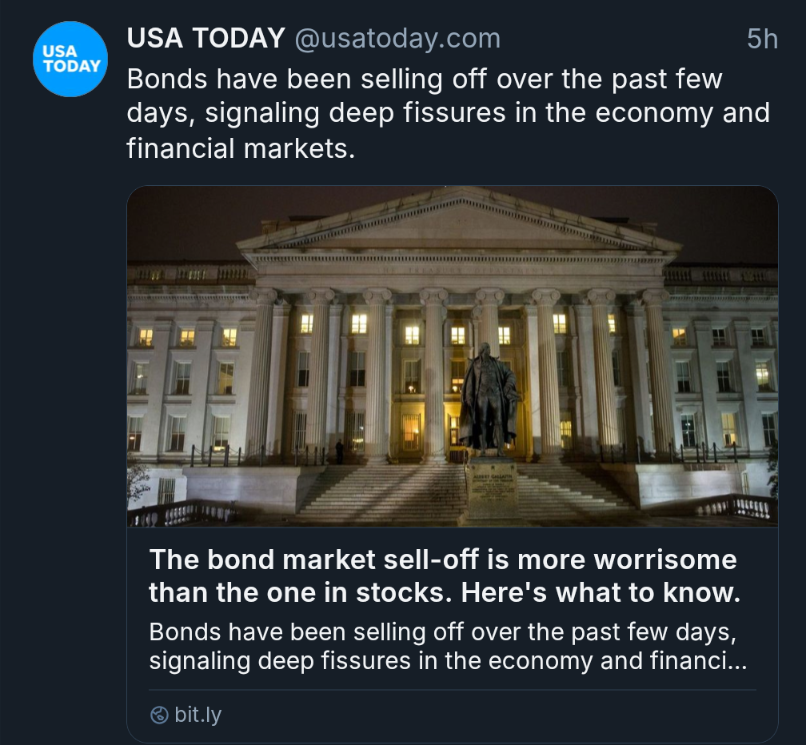
and we have seen a few of these settings and again today we see a continuance of these messages. The stage is not really as clear. As bonds are sold before maturity the investors are losing money and you know how they lose money. Yet the setting for that is when will we lose it all? And there is the crunch. Lose some now or a lot later and these happy wuzzes are weaseling out before it is too late. So as such we see
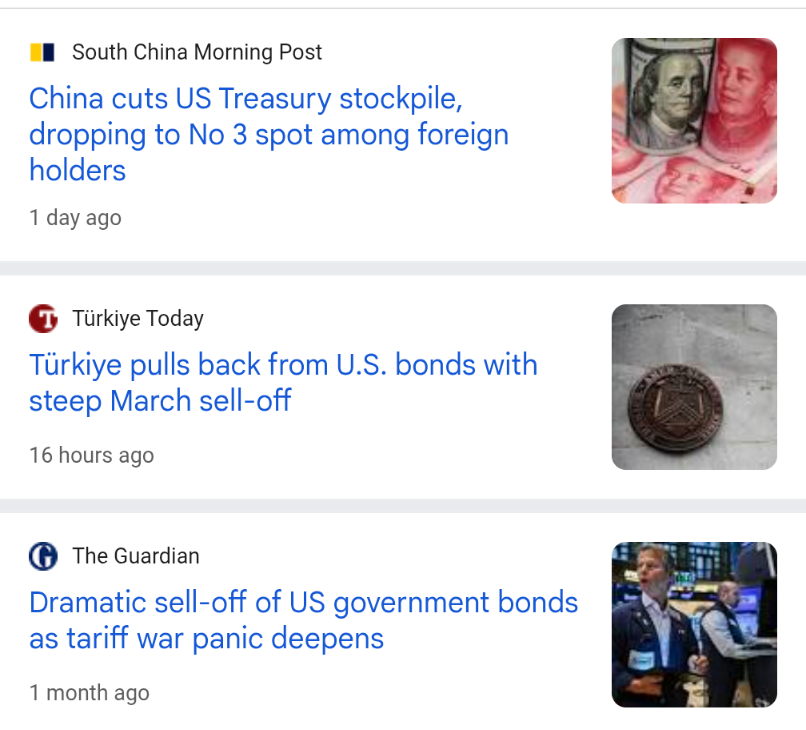
If you think that I feel sorry, you would be wrong. I saw this as early as 2018, but the people called me and idiot, a fool and a cowardly weasel. That’s fine, they are merely words. As we see the dumping of bonds these high and mighty wannabe’s will get the limelight shining on them and as they hide like the little cockroaches shouting “it’s more complex then I thought” and I giggle because all I needed was an abacus, this contraption (which preceded the computer and the slide ruler) was invented somewhere between 2700 and 2300 BC, so there was time to learn the essentials.

I don’t know how much the damage is at present, but with every sell off, the burden of America deepens, which as of April 30, 2025, there were $28.575 trillion in outstanding U.S. Treasury securities. So we do not know how much is sold of and I doubt America will divulge that information and as I stated in March 2023, when I speculated that the SVB had too many bonds in there possession and could not deal with a bank run, I asked whether the media would ever look into how many bonds they had and they never did (I wonder why), but a more large setting was seen in the movie The Big Short (2015), an American biographical comedy-drama where we see the implied setting of Janet Yellen in her role at the federal reserve. Now, this is a mere movie, but when movies get to close to reality, there is the chance that there might be correlation. And as the Federal Reserve kept close eyes on the SVB bank, my thoughts wondered whether there wasn’t anything more going on. It is merely one bank, but was it? This also set my mind in a certain direction. The media was no longer to be trusted and they are too often a spokes vessel for stakeholders with political and personal plans. This time around the gap is a lot larger, a lot more than merely one bank. So how many bonds are being sold off (read: dumped)? We don’t know and the investigating party (read: the media) is being told to stand down as I see it. There is no way they are all being sold but to which amount of the $28.575 trillion is being sold off, we just don’t know. In the end America will face a brunt of invoices due to be paid. Yet consider that a bond is a certainty of income through interest and now these investors are bailing. How much is being bailed on is unknown to me and to many others.

But the media isn’t asking the hard questions, isn’t that interesting? They are so busy to chase digital dollars for their own good, whilst at the same time pleasing the shareholders and stake holders  making the audience a distant fourth or even fifth party. So how do you feel about getting actually informed? 

Don’t ask me for the information because I have close to none. I can merely see the issues, but the actual facts are not visible to me and to many others. But there is an issue and the idea of weaponized bonds is decently new, it came after the settings that these foundations are based on and as the bottom line is now marketed for the needs of the investors, we might not know in time what needs to be done. Will it be done in time? I have no idea, the people in charge of the information have their own game to play and usually it is for the betterment of themselves, not the audience at large.

I reckon that the tariff war set a few cogs in motion. Did the current administration consider this when they named the Golf of America and cast Canada into hostile party by calling it the 51st state? Did they consider the impact of a possible annexation of Greenland? It pissed off Europe and the Commonwealth and now their actual enemies is seeing the optional setting of selling off a huge part of the bonds and as such America sinks under their own debts, no actual war required. Didn’t the Art of War teach us (approximately 500BC) that “The supreme art of war is to subdue the enemy without fighting. If you know the enemy and know yourself, you need not fear the result of a hundred battles” I wonder, how clever it was to set a chicken stage of tariffs when these people wrote this book over 2500 years ago, seems folly to me. The best the west has to offer in contemplation is On War by Carl von Clausewitz (1820), which is called a decidingly lesser work 2300 years later. Isn’t that the opposite of evolution? Both books on the philosophy of war, but called “a lesser setting”, so what is the stage and what is missing? Both miss out of the war setting of economies. There was a setting of economic in the application of logistics in WW2, but a rather slimline one. Now there is a need on the war on the economics of any enemy and when as deeply in debt as America is, they are quite literally fighting against the edge of an abyss and that abyss does not give way to anything, it is not the premise of an abyss. 

I have no idea what comes next, or what could be done next. This requires clear and reliable data and we do not have any, or aren’t given even the indication of clear data. That is the result of a media that is no longer to be trusted. So how bad is the news? It is dependent on the actual amount of bonds being sold off, because that is the hard setting of the decreased revenue that America faces in 2025 (and 2026). 

So this is one day that I don’t go for the casual ‘have a great day’ but a much larger setting of make sure your families are safe, because when the dollars stay away there will be a price to pay.

Leave a comment

Filed under Finance, Media, Military, Politics

It’s a kind of Euro

In Italy things are off the walls, now we see ‘New elections loom in Italy‘ (at https://www.theguardian.com/world/2018/may/27/italys-pm-designate-giuseppe-conte-fails-to-form-populist-government), where it again is about currency, this time it is Italy that as an issue with ‘country’s Eurozone future‘. In this the escalation is “the shock resignation of the country’s populist prime minister-in waiting, Giuseppe Conte, after Italy’s president refused to accept Conte’s controversial choice for finance minister“, there is a setting that is given, I have written about the folly of the EU, or better stated, the folly it became. I have been in favour of Brexit for a few reasons, yet here, in Italy the setting is not the same. “Sergio Mattarella, the Italian president who was installed by a previous pro-EU government, refused to accept the nomination for finance minister of Paolo Savona, an 81-year-old former industry minister who has called Italy’s entry into the euro a “historic mistake”“, now beside the fact that an 81 year old has no business getting elected into office for a number of reasons, the issue of anti-Euro Paolo Savona have been known for a long time. So as pro-EU Sergio Mattarella decides to refuse anyone who is anti-EU in office, we need to think critical. Is he allowed to do that? There is of course a situation where that could backfire, yet we all need to realise that Sergio Mattarella is an expert on parliamentary procedure, highly educated and highly intelligent with decades of government experience, so if he sets his mind to it, it will not happen. Basically he can delay anti-EU waves for 8 months until after the next presidential elections. If he is not re-elected, the game changes. The EU has 8 months to satisfy the hearts and minds of the Italian people, because at present those options do not look great. The fact that the populist choices are all steering towards non-EU settings is a nightmare for Brussels. They were able to calm the storm in France, but Italy was at the tail end of all the elections, we always knew that, I even pointed it out 2 years ago that this was an option. I did mention that it was an unlikely one; the escalating part is not merely the fact that this populist setting is anti-EU; it is actually much stronger anti Germany, which is a bigger issue. Whether there is an EU or not, the European nations need to find a way to work together. Having the 2 larger players in a group of 4 large players is not really a setting that works for Europe. Even if most people tend to set Italy in a stage of Pizza, Pasta and Piffle, Italy has shown to be a global player and a large one. It has its social issues and the bank and loan debts of Italy don’t help any, but Italy has had its moments throughout the ages and I feel certain that Italy is not done yet, so in that respect finding common ground with Italy is the better play to make.

In all this President Sergio Mattarella is not nearly done, we now know that Carlo Cottarelli is asked to set the stage to become the next Prime Minister for Italy. The Italian elections will not allow for an anti-EU government to proceed to leave the Euro, Sergio’s response was that: “he had rejected the candidate, 81-year-old Eurosceptic economist Paolo Savona, because he had threatened to pull Italy from the single currency “The uncertainty over our position has alarmed investors and savers both in Italy and abroad,” he said, adding: “Membership of the euro is a fundamental choice. If we want to discuss it, then we should do so in a serious fashion.”” (at http://news.trust.org//item/20180527234047-96z65/), so here we all are, the next one that wants to leave the Euro and now there is suddenly an upheaval, just like in France. Here the setting is different, because the Italian President is Pro-EU and he is doing what is legally allowed. We can go in many directions, but this was always going to be an unsettling situation. I knew that for 2 years, although at that stage Italy leaving the EU was really small at that stage. Europe has not been able to prosper its economy, it merely pumped 3 trillion euro into a situation that was never going to work and now that 750 million Europeans realise that they all need to pay 4,000 Euro just to stay where they are right now, that is angering more and more Europeans. the French were warned ahead, yet they decided to have faith in an investment banker above a member of Front Nationale, Italy was not waiting and is now in a stage of something close to civil unrest, which will not help anyone either. Yet the economic setting for Italy could take a much deeper dive and not in a good way. The bigger issue is not just that Carlo Cottarelli is a former International Monetary Fund director. It is that there are more and more issues shown that the dangers are rising, not stabilising or subsiding and that is where someone optionally told President Sergio Mattarella to stop this at all costs. Part of this was seen in April (at https://www.agoravox.fr/actualites/economie/article/a-quand-l-eclatement-de-la-203577). Now the article is in French, so there is that, but it comes down to: “Bridgewater, the largest hedge fund (investment fund – manages $ 160 billion of assets) of the world has put $ 22 billion against the euro area  : the positions down (“sellers”) of the fund prove it bet against many European (Airbus), German (Siemens, Deutsche Bank) French (Total, BNP Paribas) and Italian (Intesa Sanpaolo, Enel and Eni) companies, among others. The company is not known to tackle particular companies, but rather to bet on the health of the economy in general“. So there is a partial setting where the EU is now facing its own version that we saw in the cinema in 2015 with The Big Short. Now after we read the Intro, we need to see the real deal. It is seen with “Since 2011, € 4 billion has been injected into the euro zone (that is to say into commercial banks) by the European Central Bank (ECB), which represents more than a third of the region’s GDP. The majority of this currency is mainly in Germany and Luxembourg, which, you will agree, are not the most difficult of the area. More seriously, much of this liquidity has not financed the real economy through credit to individuals and businesses. Instead, the commercial banks have saved € 2,000bn of this fresh money on their account at the ECB until the end of 2017 (against € 300bn at the beginning of 2011) to “respect their liquidity ratio” (to have enough deposit in liquid currency crisis).As in the United States, quantitative easing allowed the central bank to bail out private banks by buying back their debts. In other words, the debts of the private sector are paid by the taxpayer without any return on investment. At the same time, François Villeroy de Galhau, governor of the Banque de France, called for less regulation and more bank mergers and acquisitions in the EU, using the US banking sector as a model.” Here we see in the article by Géopolitique Profonde that the setting of a dangerous situation is escalating, because we aren’t in it for a mere 4 billion, the Eurozone is in it for €3,000 billion. An amount that surpasses the economic value of several Euro block nations, which is almost impossible to keep with the UK moving away, if Italy does the same thing, the party ends right quick with no options and no way to keep the Euro stable or at its levels, it becomes a currency at a value that is merely half the value of the Yen, wiping out retirement funds, loan balances and credit scores overnight. The final part is seen with “The ECB also warns that the Eurozone risks squarely bursting into the next crisis if it is not strengthened. In other words, Member States have to reform their economies by then, create budget margins and integrate markets and services at the zone level to better absorb potential losses without using taxpayers. A fiscal instrument such as a euro zone budget controlled by a European finance minister, as defended by President Emmanuel Macron, would also help cope with a major economic shock that seems inevitable. Suffice to say that this is problematic given the lack of consensus on the subject and in particular a German reluctance. The European Central Bank has issued the idea late 2017, long planned by serious economists, to abolish the limit of € 100,000 guaranteed in case of rescue operation or bankruptcy bank (Facts & Document No. 443, 15/11 / 17-15 / 12/17 p.8 and 9)” (the original article has a lot more, so please read it!

It now also shows (read: implies) a second part not seen before, with ‘The European Central Bank has issued the idea late 2017, long planned by serious economists, to abolish the limit of € 100,000 guaranteed in case of rescue operation or bankruptcy bank‘, it implies that Emmanuel Macron must have been prepped on a much higher level and he did not merely come at the 11th hour, ‘the idea issued late 2017’ means that it was already in motion for consideration no later than 2016, so when Marine Le Pen was gaining and ended up as a finalist, the ECB must have really panicked, it implies that Emmanuel Macron was a contingency plan in case the entire mess went tits up and it basically did. Now they need to do it again under the eyes of scrutiny from anti-EU groups whilst Italy is in a mess that could double down on the dangers and risks that the EU is facing. That part is also a consideration when we see the quote by Hans-Werner Sinn who is currently the President of the Ifo Institute for Economic Research, gives us “I do not know if the euro will last in the long run, but its operating system is doomed“, yet that must give the EU people in Brussels the strength they need to actually fix their system (no, they won’t). The question becomes how far will the ECB go to keep the Eurozone ‘enabled’ whilst taking away the options from national political parties? that is the question that matters, because that is at play, even as Germany is now opposing reforms, mainly because Germany ended up in a good place after they enforced austerity when it would work and that worked, the Germans have Angela Merkel to thank for that, yet the other nations (like 24 of them), ignored all the signs and decided to listen to economic forecast people pretending to be native American Shamans, telling them that they can make it rain on command, a concept that did not really quite pan out did it? Now the reforms are pushed because there were stupid people ignoring the signs and not acting preventively when they could, now the Eurozone is willing to cater to two dozen demented economists, whilst pissing off the one economy that tighten the belt many years ago to avoid what is happening right now. You see, when the reform goes through Berlin gets confronted with a risk-sharing plan and ends up shouldering the largest proportion of such a machine, that mechanism will avoid the embarrassment of those two dozen Dumbo’s (aka: numnuts, or more academically stated ‘someone who regularly botches a job, event, or situation’), whilst those people are reselling their idea as ‘I have a way where you need not pay any taxes at all‘ to large corporations getting an annual 7 figure income for another 3-7 years. How is that acceptable or fair?

So we are about to see a different Euro, one losing value due to QE, due to Italian unrest and against banks that have pushed their margins in the way US banks have them, meaning that the next 2 years we will most likely see off the wall bonus levels for bankers surpassing those from Wall Street likely for the first time in history, at the end of that rainbow, those having money in Europe might not have that much left. I admit that this is pure speculation from my part, yet when you see the elements and the settings of the banks, how wrong do you think I will be in 2019-2020?

So when we go back to the Guardian article at the beginning and we take a look at two quotes, the first “As the European commission unveiled its economic advice to member states last week, the body’s finance commissioner, Pierre Moscovici, said he was hoping for “cooperation on the basis of dialogue, respect and mutual trust”“. I go with ‘What trust?‘ and in addition with ‘cooperation on the basis of dialogue merely implies that Pierre Moscovici is more likely not to answer question and bullshit his way around the issue‘ and as former French Minister of Economy he could do it, he saw Mark Zuckerberg get through a European meeting never answering any questions and he reckons he is at least as intelligent as Mark Zuckerberg. when we see “Cecilia Malmstöm, said “there are some things there that are worrying” about Italy’s incoming government“, she sees right, the current Italy is actually a lot less Euro minded than the setting was in 2016-2017, so there is a setting of decreased trust that was never properly dealt with, the EU commissions left that untended for too long and now they have an even larger issue to face. So that bright Svenska Flicka is seeing the issues rise on a nearly hourly basis and even as we see the play go nice for now, they will change. I think that in this Matteo Salvini played the game wrong, instead of altering an alternative for Paolo Savona and replace him after Sergio Mattarella is not re-elected, the game could have continued, now they are busting head to head where Matteo is nowhere near as experienced as Sergio is, so that is a fight he is unlikely to win, unless he drops Italy on a stage of civil unrest, which is not a good setting for either player.

We cannot tell what will happen next, but for the near future (June-September), it is unlikely to be a pretty setting, we will need to take another look at the Italian economic setting when the dust settles.


Leave a comment

Filed under Finance, Media, Politics