
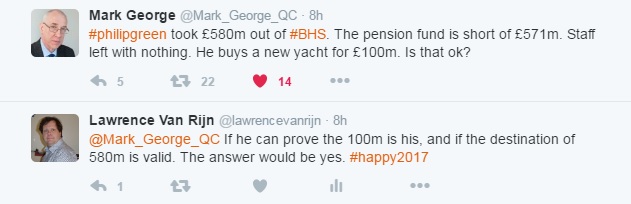
 This all started yesterday when the honourable Mark George QC sent a tweet (see picture), which was followed by my answer, and that one was given because I was feeling frisky. When you are done killing people in Constantinople as Ezio Auditore, I relied on Twitter to see some of the news messages on the air. His was one of the first ones I saw.
Was he wrong, was I? At that point it did not matter, the image that is given was based on three different matters and they could very well be valid, so I decided to dig today and see what is exactly going on. The first thing I am noticing is how much emotions are going all over the place, it is all about the wealthy getting bashed. Now, this might not be wrong, but what is actually happening? First was the Week, who referred to an article in the Guardian, so I am looking at that one (at https://www.theguardian.com/business/2016/dec/21/sir-philip-green-bhs-mps-pension-schemes). The title is catchy enough ‘Sir Philip Green could face £1bn BHS fine under MPs’ plan‘, yet is this going anywhere? The first quote is “BHS collapsed into administration in April, leading to the loss of 11,000 jobs and leaving a £571m deficit. The regulator has started legal proceedings against Green and Dominic Chappell, the former owners of BHS, in an attempt to fill the deficit. They collected millions of pounds from the retailer“. You see, the issue behind all this goes a little further and of course, the red cloth of the bull became very visible. The Accountant Online (at http://www.theaccountant-online.com/features/comment-bhs-and-the-silence-of-the-auditors-4923573/) gives us the news that the Guardian was unwilling to give us here. When the Accountant gives us “The Accountant magazine professor Prem Sikka painstakingly analyses PwC’s role as auditor of UK failed retailer BHS“, so the same group of less capable reviewers (read: idiots) connected to the entire Tesco disaster are also linked to BHS? Can anyone explain to me why Pricewaterhouse Coopers is still accredited to work anywhere in the UK at present? The additional quote gives us “Recurring losses and negative equity should have encouraged auditors to issue an emphasis of matter type of audit report which might have alerted employees, pension scheme members, pension regulators and others of the possible inability of BHS to correct deficits, but PwC did no such thing“, is that not odd? The fact that everyone is in emotional state, including the one person that should feel the strike of shame too. You see the right honourable Frank Field, Labour MP for Birkenhead and Chairman of the Work and Pensions Select Committee makes no mention of the PwC side either. I find that very odd, the fact that such large companies do not get red flagged by the auditor should actually have been higher on his list than Philip Green was. So Frankie’s response in the Guardian on £1000 million instead of £350 million is (as I personally see it) merely a load of rubbish, something to set at ease the engine of anger from the 11,000 people without a job, because if he had actually cared PwC would have been on his list in that interview in massive 350 feet letters, sending shock-waves through that decrepit organisation of abacus users.
This is not nearly the end of it. When we look at the Guardian in November, We see (at https://www.theguardian.com/business/2016/nov/02/philip-green-may-be-forced-to-pay-money-into-bhs-pension-scheme) that Graham Ruddick and Kevin Rawlinson have more to say on the matter (at an earlier stage) as we see ‘Pensions Regulator begins legal proceedings against Sir Philip Green‘, still the PwC stays unmentioned. Is that not weird? When I see ‘regulator‘ and ‘legal proceedings‘ I see, in my mind, in equal measure the need to look at the books and at that point the auditors. You see a £571 million deficit should not have been unnoticed, more interestingly anything over £100 million should have instantly called for a pension check, the fact that the Accountant online gives us “Page 1 of BHS Limited 2011 accounts stated that “The directors believe that preparing the financial statements on the going concern basis is appropriate due to the continued financial support of the Company’s ultimate parent company Taveta Investments Limited”. This statement is repeated on page 1 of the 2012 and 2013 accounts. Page 1 of the 2014 accounts stated that “during the year, the company was a wholly owned subsidiary of Taveta Investments Limited“, this should have been more than one moment where the senior abacus users at PwC should have been ringing the bells of red flags, the quote “BHS and its controllers had persistently failed to eradicate pension scheme deficit. In the light of that why did PwC have confidence in management assertions that it would provide financial support to ensure that BHS would remain a going concern“, shows what I personally believe to be a massive level of negligence, one that at this point is missing from the Guardian and several other news media. Can anyone explain how PwC seems to be receiving this level of non-accountability? Is this the price of hiring cheap graduates in places where seniors need to work? So as we see the massive amounts of deficits in place, we see that “since 2009, PwC collected £2.282 million in audit fees and £9.04 million in consultancy fees from Taveta Investments Limited, which included BHS“, which gives me the fact that in total (including Tesco), PwC received £25 million for what I personally regard to be overly negligent, that whilst I over my life for being capable and overly service oriented have never received anywhere near 0.3% of that amount annually pre taxation. So we can state that whilst the emotional and feigned state of anger by Frank Field sounds nice, but it is merely charades and the man should remain quiet until he actually achieves anything in regards to the pension schemes.
Now let’s get back to the original part, because there is a lot more than PwC in this matter. The quote “As part of any deal, it is understood that Green wants the regulator to ensure that Chappell pays into the pension scheme as well. The billionaire tycoon believes he was misled by Chappell about his track record in business and the money that Retail Acquisitions was paid by BHS“, which can easily be rectified, because if this was done properly there would have been records, like mail messages with attachments (resume amongst others), there would have been reference checks with phone numbers and annual statements showing the track record of Dominic Chappell, who according to some is seen as a former racing driver lacking 100% of retail experience. I cannot vouch for that, yet simple investigation should be able to set that one straight in mere minutes. If Philip Green cannot show any mail messages with evidence, my message to him would be “If it isn’t written down, it does not exist“, one of the oldest golden rules in administration, I reckon a billionaire should know small things like that. In this there is a third side of the problem. This side comes in the form of Lesley Titcomb, who is the current Chief Executive and former COO of The Pensions Regulator (TPR), in the shape that “it was yet to receive “sufficiently credible and comprehensive offer” to bail out the BHS pension scheme, which has more than 20,000 members, despite Green pledging to fix the problems facing it“, she too remains mindlessly numb on any mention of PwC. A pension hole this big should have raised questions years ago. They all remain silent on the auditor which gives pause as to why the hell that firm is:
1: Allowed to be in business in the first place; and
2: Able to cash in on 25 million (including Tesco).
We see that continuation in “The regulator said that after a “complex investigation” and months of talks with Green about a rescue deal for the pension scheme it was sending warning notices to the billionaire tycoon, Chappell and their companies“, the auditor that facilitated for all this remains out of sight, out of mind and out of mention in all this. I have a massive problem with that part, especially as the Guardian has stated more than once to be such an ‘investigative entity‘.
In all this we now see the final part leading to the wise tweet that the honourable Mark George QC made and it makes him a lot more honourable than anything that the UK Labour party has to offer. In my view, I questioned whether the £580 had been a valid destination. The Guardian quote gives “Green controlled BHS between 2000 and 2015, during which time his family and other shareholders collected more than £580m“, so he did not get all the cash, so there is the smallest of discrepancies here on the statement of the Honourable Mark George QC, yet he only had 144 characters to make it. I would want to see 15 annual statements of all the payments towards the Green family and shareholders. Because in that regard, a firm that had a pension scheme in deficit for 11 years and negative equity for at least 7 years, how would it have been possible for shareholders to get anything at all, in addition, how much did Philip Green actually receive as payments from the BHS side of his businesses?
There is a growing list of concerns, concerns that should also be used against PwC, the TPR as well as HM Revenue & Customs. I think that it is safe to say that the days of ‘Walk softly and carry a beagle‘ (Charlie Brown) are over and we need to look at ‘Shout loudly and carry a machine gun with the safety off‘ (Rambo) as an actual deterrent for the non-actions of all these players. In addition, I think we need to put Lord Grabiner in the spotlight who was a former Chairman of both Taveta companies. You see, what Frankie Fields did carefully avoid to mention is that Lord Grabiner is linked to the Arcadia group, also owned by Taveta Investments, as is his family member Ian Grabiner, in all this Baron Grabiner might be seen as an academic administrator, but there is nothing academic about this half a billion pound mess and with Labour members remaining very silent on their peers, it seems that the 1 billion pound levy threat is merely a hollow action giving the implied value of £0 towards Frank Fields and his valued point of view, especially when we look at a non-actioned and non-mentioned gap of 11. One person (@the_MourningSun) gave me the answer to my tweet that this was down to a difference between the letter and the spirit of the law. I think both have failed miserably for well over half a decade when the larger players get to play the game the way that the BHS was played. In the end, it will be for a court to decide whether Philip Green broke any laws or failed anyone he cares for (read: implied view he only cares for himself). What is overly clear is that too many parties are leaving the auditors in the shadows, away from the peering and prying eyes of the public, which is a massive failure on every level.
So as you think that the TPR is currently on the ball, you all better take notice of the Guardian quote “By the standard measure used by the PPF, 4,272 defined benefit schemes are in deficit and the size of the black hole is £195bn“, so as we see that part, I wonder when we get a list of those 4000+ schemes, who is auditing them. I wonder when we look at 2 pie charts, one based on the deficit amount against the auditors involved, and one based on the number of schemes against the auditors involved. I wonder which auditor will end up being the most prominent one. Would you like to hazard a guess?
Let’s see if we can revisit this part somewhere this quarter and see how many spins the media and Lesley Titcomb (Executive Officer TPR) will end up doing.
 Lawrence van Rijn - Law Lord to be