Tag Archives: Amazon

Where’s the blame?

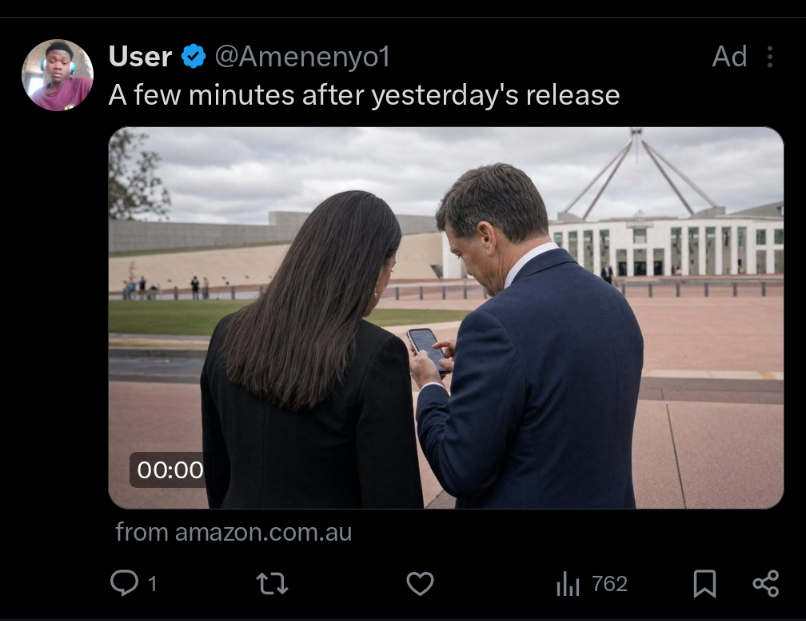
That is at times the question, is it Elon Musk, its version of Twitter, the ABC News, or the hacker? Personally I do not think that ABC is to blame, but they are connected to it all (they are the unwilling participant). So how did this get started? I got last night a tweet, it wasn’t the groundbreaking news I was looking for, but I needed a new idea (and I got one as you are reading) so I decided to click on it. (See image below)

So here we see a few ‘facts’ or basically news given that makes the mind curious about what is involved. I saw the ‘tweet’ with a reference to Amazon (it merely mentions that) and I do not show the on the list, so accept that. In the background was the Australian Parliament House, as such I got interested. And I got this image several times in the previous few hours (I only saw them later) but they were allegedly tweeted by @Amenenyo1, @greciaibarra528, @DriftyGar, @Lundstromm04, @MarcelWagenveld and @ezcxs I am not connected to any of them, as such they might be trolls, or spam/scam facilitators. 

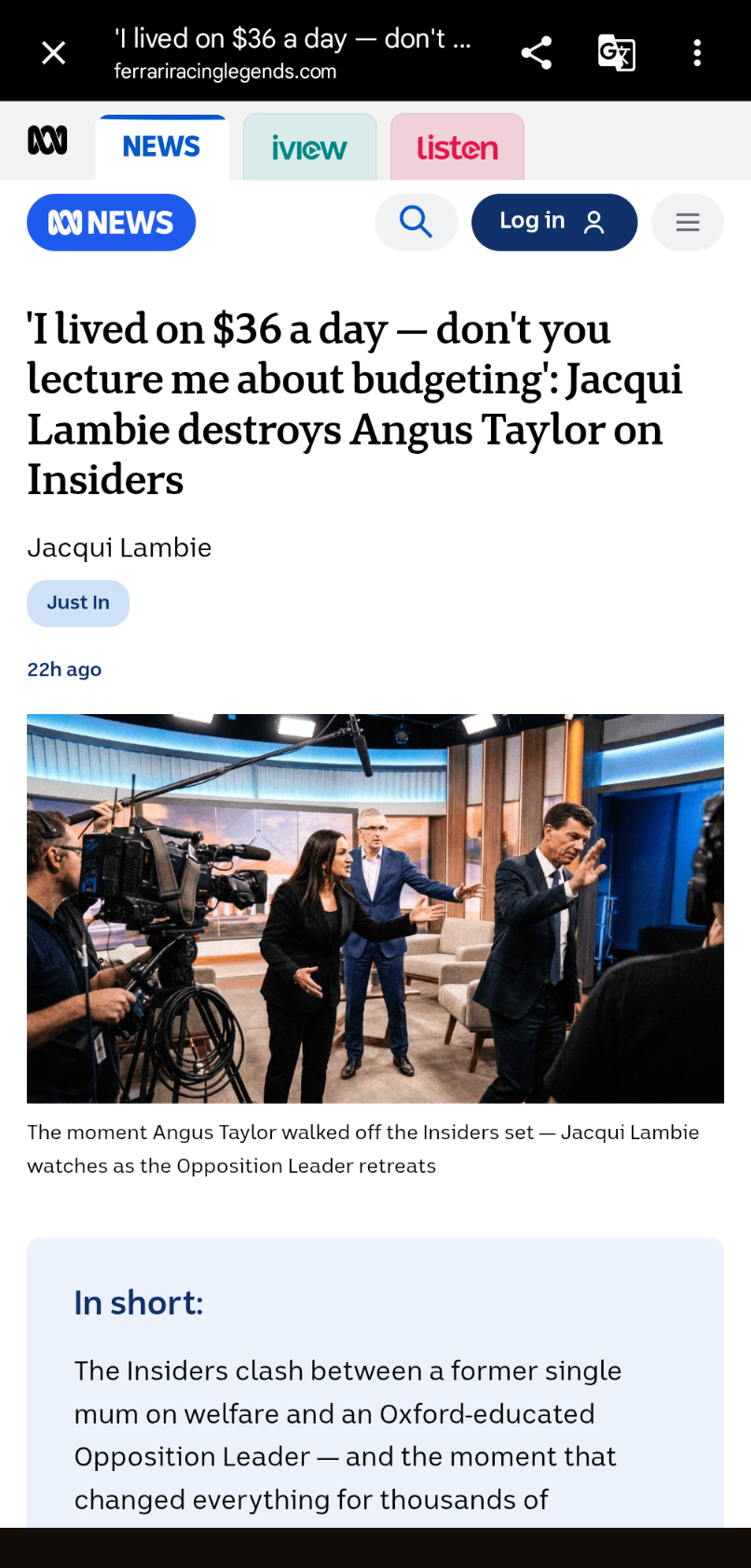
Anyway it reflects towards this article from ABC news:

The article is speculatively used because it is a long article. I reckon that the scammers need time to get information from this who push the “A few minutes after yesterday’s release” article. The link goes to TR.EE, which is an Estonian address, but the article seems to reflect an address ‘ferrariracinglegends dot com’ (I used the letter to replace the character, so that you will not fall into that same setting) all this makes me think that ABS is the unwilling participant in all this. And the larger question becomes. Who is to blame? I might have fallen for that trap last week as well and I got a call from an internet phone with an IPv6 address (which I did not answer) and after that my phone gave no evidence it was called, there was no blocked call, there was no rejected call. No evidence that I was called at all. As such I am making a few assumptions and they are mine to make. But it is clear that whomever is getting into this is using more powerful tools and more agility in the internet workings all over the field. 

  1. What is Elon Musk (his Tweety setting) amounting to?
  2. Is social media to blame?
  3. Is the advertisement department to blame?
  4. How is this managed in X (formerly known as Twitter)?
  5. How is advertisement in X managed, controlled and monitored?

5 questions that are important. Because this is inhibiting what reliability X has left, when X becomes a plaything of scammers and phishers X is pretty much done for. 

So can we blame social media? It relies of propagation and influencers, and as such scammers are top tier influencers, you are basically the tool they will use to propagate their need for cash. This sound ominous, but that is what it amounts to.

So how are advertisements managed in X? That is the first real culprit, the fact that I had that advertisement any least 6 times in an hour, with 6 different addresses makes me thing that something is very wrong in this setting, especially as I am not connected to any of them. Yes I know that this could be replicated, but that evidence (which I do not have) makes the blame squarely on the advertisement department of X (as I personally see it). And as I see it, whomever manages the advertisement setting of X has some explaining to do (optionally to Elon Musk, who might be seeing a massive drop in credibility, at the max of $44,000,000,000 and he might not like what this is amounting to. Then we get to the control and monitoring of advertisements. Because this setting has references to Amazon and ABC News who are seemingly not part of this and they might be seeking legal council in all of this. 

So as you see, I have questions. I reckon I have answers too, but without clear evidence there is no way I can comment, but the questions remain and until they are resolved anyone clicking on an advertisement is setting himself up for a long fall. That is merely how I see it and I thought it ws important to spread this news as far as I could.

Have a great day you all.

Leave a comment

Filed under Finance, IT, Law, Media, Science

Is it the water level?

Yup, we are all in that setting, but are we merely waving to the music of Debbie Harry or are we watching the waves from the shorelines. That is merely two options, but when some say that the tide is high, they might be referring to bubbles, the AI bubble to be more precise. I am not some economist saying that bubbles are blasphemy and I am no economist, but I have looked at numbers for decades and the numbers we are given do not add up, and when I was watching Inside Job something hit me, there was a familiar pattern evolving, not evolving, repeating is a better word and I have been saying this for some time. Yet today, a mere 10 minutes ago I see ‘UK Places Microsoft, Google, Amazon And Oracle Under Financial Oversight’ (at https://www.businesstoday.com.my/2026/07/10/uk-places-microsoft-google-amazon-and-oracle-under-financial-oversight/) where we see “The UK has placed Microsoft, Google, Amazon and Oracle under direct regulatory oversight after designating the cloud service providers as critical third parties to the country’s financial system. Reuters reported that effective July 13, the designation covers Microsoft Ireland Operations Ltd, Google Cloud EMEA Ltd, Amazon Web Services EMEA SARL and Oracle Corporation UK Ltd, reflecting the financial sector’s growing dependence on cloud infrastructure”, so whilst the story ends with “The designation will bring the four technology firms under direct regulatory oversight as part of efforts to safeguard the stability and continuity of the UK’s financial sector.” And it comes after we were given (at https://m.au.investing.com/news/stock-market-news/oracle-stock-shrugs-off-sp-downgrade-to-bbb-but-120b-debt-shadow-looms-4526441) where we see ‘Oracle stock shrugs off S&P downgrade to ’BBB-’, but $160B debt shadow looms’ where we see “Oracle Corp. (NYSE:ORCL) shares managed to gain 2.7% on Thursday, defying a credit rating downgrade from S&P Global Ratings. While shares edged slightly lower from their midday highs, the tech giant still traded firmly in positive territory. Investors chose to focus on Oracle’s staggering $638 billion backlog of cloud contracts rather than the immediately apparent threat to its balance sheet: S&P downgraded Oracle’s long-term issuer credit rating to ’BBB-’ from ’BBB’, retaining a stable outlook.

Now, I am not having anything against Oracle. They have always been on the foreground of technology and innovation in its field and it is unlikely to ever change. But there is a larger setting, the entire AI bubble as I see it, it will hit them too. They all over invested in that setting and they are likely the biggest catchers of the implosion of that event. But I am still in arms over ““The official position of the Secretary and the U.S. Treasury is that Artificial intelligence will be a key driver of America’s new Golden Age,” the spokesperson said. “AI has the potential to deliver unprecedented productivity gains, expand economic opportunity, and empower American workers and businesses.”” You see, there is no golden age, there is no AI, not yet at least. There is DML and LLM and they are great, they can hand innovation and prosperity in several ways. It merely isn’ AI and that needs to be said, because soon the class actions will go for the “It’s AI and we cannot really predict what AI does” but it isn’t, it is DML and that requires a programmer, it requires data and these two hinder stones are the backdrop for prosecution. Only last week we were given ‘Anthropic Faces a New $75 Million Lawsuit for Pirating Books to Train Claude AI’ and less than 24 hours ago Harvard Business Review ‘You Outsourced the AI—but you still own the risk’ where we see “As enterprises increasingly embed third-party systems into their workflows, technological risk has led to new legal and operational responsibilities. Leaders may have little visibility into how a model was trained or how it changes, yet when it discriminates, mishandles data, or harms a customer, regulators and plaintiffs often look first to the company that deployed it. Peloton learned how that exposure can arise. Visitors to its website see a familiar invitation to “chat,” powered by a third-party vendor. According to a class-action complaint, the vendor recorded and stored conversations and used the data to improve its machine-learning models. Peloton neither built nor trained the system. Even so, a California federal judge allowed a claim against the company to proceed. The parties later jointly dismissed the case, without publicly disclosing the terms.

Now consider the amalgamation of these factors (apart from some saying there is no bubble) there is (allegedly) “Worldwide spending on AI is forecast to reach $2.5 trillion. Venture capital and private corporate investments in AI firms sit near $258.7 billion globally, with over $750 billion in dedicated infrastructure and data center capital expenditure from major tech hyperscalers” we then see that the big players (Microsoft, Google, Amazon, Oracle) are basically overextended, facing class actions and all of them are looking at all sorts of financial hardship, because at some stage all these players will be made to rephrase the simple truth that AI is not DML/LLM, it requires more and when the programming is put under a loop that setting comes crashing down. I saw it two years ago that this is the only outcome in some sales people overselling what they had and the simplest setting is not a mere Quantum computer. It requires shallow circuits and what I tend to call The Epsilon processor. True AI cannot exist in a binary setting. The last one is my interpretation of it all and some might disagree. But the Epsilon processor allows for Null, False, True, Both and it is the Both part that makes true AI possible and of course a matching operating systems will be required as well a data carrier and in that case Oracle and Snowflake have the grounds for success. As I see it, all others will fall behind these two. 

And last month we were given that “400 newspapers sued OpenAI and Microsoft for scraping their content without permission or compensation to train artificial intelligence programs” even my data has been scraped. So how many will be successful? How many will fail? I have no idea, but the odds are decently stacked against these salespeople. And as the courts rule against these Fake AI bringers (as I see it) there will be a rush of people making a case, all who were sold AI (without clear DML/LLM settings in their contracts) are seeing their pupils transform into dollar signs and they will try to clean house. So when all these settings happen, is the stage for a bubble that far fetched? 

I am watching and watching and noting what is due. I reckon that at some point I get the one piece of evidence that will allow me to do just that, 2700 (out of nearly 4000) article scraped seemingly give me an optional case for some dollars (five million plus would be great). And I am not the greediest player in town. So at what point will the investors of $2.5 trillion ring the bell wanting to see payment for their investments? Goldman Sachs gave us last month ‘The AI Investment Boom: When Will It Pay Off?’ With “The economics of artificial intelligence are more questionable today than two years ago, says Goldman Sachs Research’s Jim Covello, as enterprise buyers, model companies, and hyperscalers have yet to show returns on their spend. In a conversation with Alison Nathan and George Lee on Goldman Sachs Exchanges, Covello discusses where we’ve seen economic value accrue to date and why semiconductor companies can’t continue to be the sole beneficiaries of the AI buildout.” As such we see people with serious economic skills worrying and wondering what comes next and I was there at least a year ago. So when will others see the doubt that I am seeing? The money people call the bubble a blasphemy, but they have vested interests. I do not. I merely see the flaws on technology that is at least 15-20 years away, data that is largely unvalidated and unverified and at this juncture people are investing trillions? Makes me all tingly that too many people are greed driven and too much vested to be part of a boom that does not exist, just like the settings of 2008, Inside Job showed that clearly and it seems that we have a similar setting evolve at least two times the previous caper. So if you consider that with all the reserves that hit took the economy 2 decades to fix and at present the reserves are gone, so what will happen now? Why aren’t others taking the stand the UK is making? Because others are in the believe that “America’s new Golden Age” is here? When you realize that it will take close to two decades to arrive, how long until too many investors pull the plug and go somewhere else? What will happen then? That is what I see coming, because at some point more and more people wake up, this is bound to happen, it always does.

So is the water high enough? Have a great day.

Leave a comment

Filed under Finance, IT, Law, Media, Science

Colouring your coat

That is the term I am seeing, do you? It comes in support of what I wrote yesterday about physical copies. I also added a few points that I felt were important. The BBC however (at https://www.bbc.com/news/articles/c0ryjyvjq41o) failed to disclose them and trivializes other parts. As such I am now decently convinced that the BBC is enabling or supporting the Have’s against the have not group. It is a whole new setting of people classification. So as we get the headline ‘PlayStation will stop releasing games on discs in 2028’ it remains a dangerous thought, because whatever advantage they have over others (Steam Deck, Xbox) end there and quite quick, they don’t have any advantage over Nintendo, but they will hand them a truckload of people, right of the bat.

The first debatable setting we see is ““This is a natural direction for Sony Interactive Entertainment to adapt to consumer trends as the general preference for digital media significantly outpaces physical discs,” it added.” It does not adapt consumer trends at all and I reckon that in 2027 they will face had choices for the simple reason that people like physical copies. It might not like the fact that people are forced in a download setting and the United Kingdom has plenty of rural areas, when they learn that Sony if forcing them out of gaming, the battle lines will be drawn. Gaming journalist Vikki Blake calling it a “Body blow to consumer rights” and she is right, it is. Whilst we are also given ““It’s of huge concern for game conservation and a massive problem for gamers with lower disposable incomes who rely on part-exchanging or loaning games from friends to keep up with the AAA price tags,” she said.” As well as ““Just one console cycle ago, Sony made a tongue-in-cheek advert about how easy it is to share games on PS4 as a dig at competitor, Xbox.” Which gives us the second setting, because it was not a mere tongue-in-cheek advert, it was more. Microsoft had seemingly ‘embraced’ the TPP (Trans Pacific Partnership) and so initially did Sony, their terms of service basically acknowledged it, I warned several news agencies of this in November 2013. They seemingly brushed it away. In the 11th hour, they saw the blowback it was giving, so they laughingly brushed it away with the handing of a game disc. Their was nothing tongue-in-cheek about it, Sony got really scared and did away with it in a public joke. So that was what it was and seeing this makes me fume a little. Christopher Dring, editor of The Game Business gives us ““We still see millions and millions of PlayStation games sold as physical goods,” he said. “It’s a significant business and there are lots of players that prefer to buy this way. It’s tough news for retail.”” It is and if Sony pushes this disclose setting they will hurt their own business in massive ways. And it is shown in other means too, as such we see “Sony has also come under criticism for pulling over 500 films and TV shows purchased on the PlayStation Store from people’s collections with no compensation.” There will be a kick around and Sony will not like that fallout. The question becomes why is this done? There is enough evidence not to do that and I am pushed into the squad of a “have versus have not war” the thoughts that Dutch Journalist Luc Sala gave me 30 years ago is now playing part in what was to come into what is about to happen and it is not mere gaming, I reckon that it becomes about what is after that. I am not sure what ‘that’ is, but we will soon find out. 

As I see it, the fact that the entire TPP part was ‘overseen’ gives me the impression that the BBC is embracing the “have’s” in this war and whilst we can accept that everyone takes sides, the journalistic integrity of the BBC is as I personally see it in play, because the journalistic integrity of a place like the BBC should be merely on the fence and not choosing a side, but that could be merely my view on the matter. 

Another side is seen with “The firm said its arrangement with the film production company StudioCanal has ended, meaning it no longer has the rights to sell those TV shows and movies, and they will disappear from people’s collections on 1 September.” I believe it is short sighted, I get that it can n longer be sold, but taking it from a catalog is different from deleting it from anyone who bought it, I reckon that those people are entitled to a download of these series and movies. The materials will be downed in a different setting and we are already seeing that. For example you cannot buy Shogun (2024) in Australia, there is also a setting that in Australia Good Omens (2019) only has Season 1, you can only buy the other seasons through places like Amazon. This discriminatory setting is now getting more and more attention (mainly through hatred of Amazon, which is also wrong) so as these ‘products’ are deleted we will see more and more non-acceptance of these settings and gaming is likely the one place where people unite rather fast. You should ask Microsoft, their ‘online only’ cost them their place in consoles and now whilst they were on par with Sony, they are now trailing towards 1:4, those are strong results of failure, as such I hope that someone at Sony needs to receive their walking papers. This got started somehow and at some point people want to know how started all that. But that is merely my point of view. So I hope that the BBC will soon colour their coat in a more neutral colour.

Have a great day today, it’s Saturday here already and I am a mere 110 minutes away from morning coffee. In Toronto it is still yesterday’s beer-o-clock.

Leave a comment

Filed under Finance, Gaming, Media

As one door closes

That was the setting I saw this morning as I took notice of ‘MGX could purchase APAC data center operator DayOne’ (at https://www.datacenterdynamics.com/en/news/mgx-could-purchase-apac-data-center-operator-dayone-report/) with the juicy (for some) subtitle “Comes ahead of DayOne’s $20 billion IPO” it opened another avenue for the UAE, you see as the United States has pissed of pretty much every country with their cloud act, the setting that I see is that if MGX embraces the GDPR and adheres to this in several means, Microsoft, Google and IBM will lose the traction they have all over the EU and the commonwealth. So whilst we take notice of “Reuters’ sources said that the MGX acquisition is not finalized and a DayOne IPO could still go ahead. DayOne currently runs a portfolio of more than 500MW of data center capacity in service and under construction, with another 500MW held for future development across Hong Kong, Singapore, Malaysia, Indonesia, and Japan. The company also has sites in Thailand and Finland.” 

And in case if ChapsVision, it is nice it is getting the Palantir account in France (and optionally in other EU countries as well) but that comes with the addd need for stronger data centers and not in American hands. The Edge (at https://theedgemalaysia.com/node/807778) gives us ‘Abu Dhabi’s MGX weighs multi-billion deal for data centre operator DayOne — Reuters’, which gives us (at https://theedgemalaysia.com/node/807778) that “Abu Dhabi-backed artificial intelligence investor MGX has been exploring buying Singapore-based data centre operator DayOne, three sources said, in what would mark a major step in its global expansion into the technology. MGX has been working with an investment bank in preparation for the potential transaction, said two of the sources, who declined to be identified because the discussions are confidential.” Which implies to me that this is not yet a done deal, as such it is likely to happen, especially as countries are making moves to pull away from the United States and their Cloud Act, but that might not be enough, the secondary stage is that Microsoft as a data Endor is seemingly already on the way out in a few places, so that would be setting the stage that this could indeed happen. So whilst we see “A deal for DayOne could mark MGX’s first acquisition in Asia as the company pursues a lightning-fast international expansion. It was set up a little over two years ago with the US$385 billion sovereign wealth fund Mubadala and AI company G42 as its founding partners. MGX falls under the purview of Sheikh Tahnoon bin Zayed Al Nahyan, the United Arab Emirates’ national security adviser and brother of the president.” The setting might be that Europe is ‘hesitant’ to replace the yoke of the United States with a Chinese replacement, but if there is a common ground between the UAE and Europe and a (for a lack of a better term) a Chinese wall is inserted in the European centers, a larger benefit to Emirati revenue could be right here. It all depends on how the UAE plays this ad what guarantees they could give the EU and the Commonwealth. As such there could be a new player in the town of Europe and under the much stricter rules of the GDPR, solution could be drawn. On a personal note, I reckon that China does not fear being left out of data as long as the United States loses a mouthful of revenue. Adobe, Amazon, Google, IBM, Microsoft could all lose a chunk of their revenue and that puts the United States on the defense to keep whatever they can hold onto, as I see it, at present it sucks to be the President of the United States. And after the folly that is called “the Iranian peace treaty” and President Trump implying that they could ask for Tolls in the strait of Hormuz, angering many nations, especially ones trying to get oil across the strait, (source: Al Jazeera) as such the world is looking for other solutions and several firms might regret ever giving the keys to the united States to President Trump. But as I see it, the UAE is on the job and when one door closes, another tends to open and this might be the moment for the EU and Commonwealth to talk to the UAE in finding a solution that they can live with, the question is, will the UAE play game with Europe and the Commonwealth? My guess is yes, especially is China at the stage realizes a massive drain on the revenue of the United States, it could be the death stroke against the coffers of America and from there is goes downhill fast in the former land of opportunity.

I reckon that the next stage becomes opening another site in France, giving more power to ChapsVision, not sure if it is needed, but all the traction helps. And a second data centre in Europe would give several benefits, especially if these two centers are connected and support each other in case of data congestion, because that is bound to happen, but if two centers are connected, there is a larger solution for that. There is still the power use issue, but that is for tomorrow, it all depends on how stretched the power settings in France are and secondary, if Google, IBM and Microsoft are on the way out, there will be room for more. I actually hope that Google and IBM find another solution, but as American firms the Cloud Act is hanging over their heads, so that is the way in for MGX and the United Arab Emirates. 

Have a great day.

Leave a comment

Filed under Finance, IT, Politics, Science

Danger zone

Yes, that is the setting and it is not some song by Kenny Loggins (1986) or Tom cruise playing rocket man with his F14 Tomcat (it wasn’t his, it was property of the US defense forces). The danger zone is real and Europe just opened it up. As I saw how EU countries are now rejecting Microsoft and Google on national scales, the setting changes. I get why you reject Microsoft and to some level grudgingly accept that Google will go that same way, the need for data sovereignty is almost crystal clear, especially in this US Administration. But the danger zone comes calling. You see, Google also owns Mandiant and as it is called a premier, technology-agnostic cybersecurity firm specializing in advanced threat intelligence, incident response, and managed defense with decades of experience, it was bought by Google in 2022, as such it will fall away from the nooks and crannies of office cyberspace. As such I wonder if anyone considered rereading their contracts and the danger zone they opened themselves up to. I have no idea what Microsoft has (and I kinda don’t care) but they will have something in place and when that all falls away, the EU and its settings is opening themselves up for a lot of cyber hassle. A massive redirection will be needed to avert the dangers they are opening themselves up to. I also reckon that every Tom, Dick, Harry and Seamus with more than 2 weeks of cyber knowledge will offer themselves as ‘cyber experts’ and that is likely going to increase the tensions and threat settings for corporations all over the EU. I reckon that (allegedly) Russian and Chinese cyber threats will be running rampant over the next 20 weeks, a cyber defense setting will become unavoidable. And if the EU doesn’t act fast, the costs will go into the millions per nation. 

So even as we want to think that Google is the big evil (it really isn’t) the consequences of the CLOUD Act is one expensive hobby the United States never considered. As Europe (and soon the Commonwealth too) is deciding that their digital sovereignty is the way to go, we can see a direct implosion of the AI bubble, because as I see it, the United States has well over 4000 data centers and that much is not required for the 349 million people it has and at that point, as these data centers fall away, I reckon that the United States will drop these data centers as bad mortgages, most of them falling away because a population of one, is not much of a population to cater to in any data centre. In addition, any corporation who wants to stay in business will have to create a European business, taking revenue away from the USA to a much larger extent. They wanted a ‘cloud’ act and in 2018 they got it “The CLOUD Act (Clarifying Lawful Overseas Use of Data Act) is a 2018 U.S. federal law that dictates how technology companies respond to law enforcement requests for electronic data stored across international borders” and the bit of ‘electronic data stored across international borders’ will be costing them their heads soon enough and there is no turning back that clock, confidence in the United States is gone. So, whilst we are given “U.S. authorities can legally compel U.S.-based tech companies (like Google, Microsoft, or Meta) to hand over user data and communications, regardless of whether that data is stored in the U.S. or abroad” the danger is that this will also affect Amazon and optionally Oracle too. In case of Oracle there is doubt as it is a software vendor and they do not owe any data, but their cloud corporation will take a massive hit. To that I have no doubt. You see as a US corporation, Oracle’s global cloud environments can be legally compelled to hand over data to US authorities via mechanisms like the CLOUD Act. This puts European companies using standard global Oracle infrastructure at risk of violating local privacy laws, not to mention dangers to their data sovereignty. As expressions go, this means that the United States really pickled their jars. What is clear is that I looked into a Swedish completely isolated data centre 1-2 years ago and that firm is likely making massive revenue gains, because others called them nuts for doing what they did and I reckon they are close to the only vendor in town that is not hindered by US protocols. 

An interesting phase, but the danger for cyber security remains. And Microsoft? They are about to lose the bulk of 451 million customers, so their footing is about to get shaky and for the cyber settings, whomever (non American) comes with a decent package will make a killing in Europe. I wonder who will fill that option? 

What a nice setting to come to, so any gamer who wants to have his own No Man’s Sky universe with the data storage to keep a nation of gamers happy, it is likely that the USA will have some places for sale soon enough. Have a great day all.

Leave a comment

Filed under Finance, IT, Media, Politics, Science

The thing about DML

Yes, as I said it several times DML is good, DML is strong and I would hazard a guess that with LLM it becomes a new world altogether. So, yesterday at Google I was given a challenge and I basically set up the the entire station in less than 15 minutes. But it was a group event and I was voted out and like a good geriatric boy I adhered to that setting. There was no regrets because Pradhan who won by one vote was pretty amazing. He programmed the entire setting in three hours and then we ran out of tokens and at Google subway tokens have no value, not even the New York tokens. He programmed it all in CLI and it was pretty stellar what he did. So here I am with my idea and I came to the conclusion that I could add a few settings and add it to my blog. So there are no bad feelings (he was pretty awesome programming it in CLI) and as we all adhered to the group setting, someone had to lose (that would be me) and my idea, which took a mere 15 minutes was ‘scrapped’ only to find some survivability in my own blog.

The setting was to create a setting making the Google earbuds more in any way possible. So here I was and in the first minute my mind when “Hold on, I could do…” and it was off to the races at that point. So I ‘created’ an App (attached at the end) where there are two settings. There are websites and news channels and they only thing it does is give the user an alert through their earbuds. So, I was thinking:

  • new content on my blog (which I all write myself)
  • Added content on Amazon, or added stock of a particular item on Amazon
  • Added messages on a specific website like a message 
  • Added content on IGN Board for a specific game

Then there are the news channels:

  • New materials on Arab News on ‘Egypt’
  • New materials on Al Jazeera on ‘Hajj 2026’
  • New materials on CNN on ‘Trump’
  • New materials on Reuters on ‘Jamie Dimon’

That last one was added as I saw a new apartment yesterday (which was outside of my price range) and the first thing you see when you get out of bed is ‘J.P. Morgan’ so there is that psychological slap in the face, but some might not think it is a bd idea, especially as the Sydney office is pretty nice to see.

And the DML/LLM setting is simple. It took less than an hour and the drag/drop stage is on page 5. It worked all nicely, a few kinks, but this is new terrain, so I am allowed to take my time. The app was more easily designed and I can to the conclusion that one tab needed to be added. You see the tab for Websites with 4 options, but I reckon that close to a dozen are needed. And the news channels the same, but I am still on the fence whether it should be one or two dozen options. The feed tab was missing at that time, so as each target sounds its primary/secondary or tertiary alert, you can decide to stop and see what happens, or you can do so at the next moment you sit down somewhere and as you don’t have to go seeking on the stages that you considered adding alerts, you go into the app and see the last alerts that the app gave shaded red for the primary alert, shaded yellow for the secondary alert and green for the tertiary. It comes from the stage where we have ‘essential to know’, ’need to know’ and ‘nice to know’ and as you click on that alert it takes you to the page that is linked to that. No seeking required and I thought that Google could freely hand that to its customers. Making the mission statement “to organize the world’s information and make it universally accessible and useful” a direct setting for all users of the Google Pixel whatever version and using the Google earbuds. I think I did rather well in less than an hour and now we see that the adaptation of a DML situation on the world stage (still not calling it AI) becomes the birth of a new app glorifying the equipment of that company with the Big Gee (a BeeGees reference). And as you see, I can make fun of myself as well (favourite subject)  but when you wonder why people are failing their AI it is said that “Artificial Intelligence (AI) failures are instances where AI systems produce biased, harmful, absurd, or catastrophic results due to data issues, incorrect training, or flawed logic. Recent real-world breakdowns highlight the need for continuous human oversight, data governance, and cautious deployment.” So, as I see it, I circumvented that part of failure and gave everyone a tool that could be useful for all who don’t want to surf their mobiles and this app gives the user that result whilst that person is listening to music and seemingly running for their lives to their next heart attack (aka jogging). So you all have a nice day and I will hopefully consider another solution in the next 900 minutes.

Till next time

Leave a comment

Filed under IT, Science

Who’s watching who

It was initially the BBC who alerted me to this (at https://www.bbc.com/news/articles/c072dvv1rmro) where we see ‘Texas accuses Netflix of spying on users, including children’ and I got curious, because it is not a issue with the United States, it isn’t even global, it is just Texas. The story kicks off with “Netflix has been sued in Texas over claims it collects data belonging to children and adults in the US state without their consent, and uses “addictive” design to keep them hooked. accused the streaming giant of “spying” on citizens saying it “records and monetizes billions” of pieces of information about how users behave on the platform, despite suggesting otherwise.” It gave me a few questions (just a few) and it starts of here with the questions “How does one record and monetise billions?”, as well as “What exactly is “addictive” design?” You see, to the best off my knowledge you sign up and you get Netflix (that is how we do that in Australia) and perhaps there are better ways to do this, but that is what it is and it is still better then Disney+ (in regards to able the watchers). I have never seen the Mandalorian of BlueRay, or several other Disney+ hits. I get that they want to get a lead but Season 1 and 2 cannot be bought in Australia, why not? This is not about Disney+ but Netflix offers several seasons most TV shows on BlueRay, as such it is neither monetizing or creating an addictive design (as I personally see it), but perhaps Texas Attorney General Ken Paxton could clearly elaborate? The story goes into (or towards) “the company also began “leveraging the mountains of data it quietly extracted from the children and families it kept fixated on their screen” – sharing this with commercial data brokers to help raise billions of dollars in revenue.” This leads to another question, “How does one keep others fixated on their screen?”, You pay one amount for monthly subscription, regardless of the time. There is a cheaper option with advertisements. But it beckons the question, how do you keep people fixated? As such the prices are:


So, the customer has an option to pay $11 more, how is this monetizing? And don’t forget that advertising was added to make it cheaper for some. And then the fixation on the screen? How is that done exactly? 

So then we get to Politico who (at https://www.politico.com/news/2026/05/11/netflix-sued-by-texas-ag-for-alleged-surveillance-addictive-features-00915029) gives us ‘Netflix sued by Texas AG for alleged surveillance, addictive features’ where we see “It adds that the company tracks and logs viewing habits, location and virtually every interaction on the platform — keyword searches, pausing or fast-forwarding and more — which it then uses to build consumer profiles that earn the company billions.” So, as I see it, a person (me) searches for a title or an actor or actress. Seems pretty common in Netflix settings. I search for Olivia Wilde and see what they have with her in it, same that I look for Dwayne Johnson and see what movies with him are on Netflix. How exactly is this odd, or non trackable? If 275,000 people seek either, there is a chance that Netflix sees what they can add to their stable. This is a movie channel. Perhaps Ken Paxton took offense to the 132 searches for Melania Trump and Netflix sees a reason why not to spend money on it? Although you can watch it on Amazon and it is rated 1.6/10 (over 68000 votes). These two articles are making me wonder what this suit is all about, because as far as I can tell this case has no merit. Perhaps Texas Attorney General Ken Paxton needs the limelight for something, is it election year in Texas? As far as I can see (optionally not a correct view) is that Paxton announced in April 2025 that he would run for the United States Senate in the 2026 election, challenging incumbent senator John Cornyn in the Republican primary and in the runoff. So is he gaining free ‘advertisement’ through Netflix? It is merely a speculation from my side, but the timeline seems to fit. As such we need to see what Ken Paxton does next and if he gives us any clarity on his claims. There is also the fact that it is the subscriber that gives the connection to a household and the subscribers to Netflix must be at least 18 years old. So how does one see what the age of the watcher is in that household? Perhaps he has a setting for profiling? Like only women and oldest daughters watch ‘Sex in the city’? Only children watch Ponyo? Your guess is as good as mine and I am here clueless. But perhaps there are journalists who will ask the hard questions. Have a great day.

Leave a comment

Filed under Finance, IT, Law, movies, Politics

About that woman

Yup, the Amazon. And if you think we are talking about that woman in a tight leather bodice hiding perky breasts looking like a 30 something woman called Gal Gadot, you’d be wrong. We are talking about the other Amazon, the one with a wrinkly face selling books. A few articles hit me a few hours ago. The first one on the table (at https://www.bbc.com/news/articles/clyjjr7kzj2o) is the BBC, Fortune with its paywall was rejected) is the one we see first. It sets the tone with ‘Amazon to spend $11bn on satellite firm in growing Starlink rivalry’, now I accept and respect competition and the quote “Amazon is aiming to build-up its satellite business to offer internet and mobile phone services by spending $11.57bn (£8.5bn) on an acquisition of Globalstar. The deal, announced Tuesday, will allow Amazon to get thousands of satellites into low-earth orbit through the Amazon Leo project the company has been working on for several years.” But the added part starts making this setting a more desperate look, with “Amazon will be in closer competition with Starlink, an increasingly popular satellite-based internet and phone service company launched by Elon Musk in 2019. Starlink has a significant head-start on Amazon’s Leo, which currently only has around 200 satellites in orbit. Musk’s company, which is private, says it already has more than 10,000 active satellites offering internet and mobile phone service to more than 10 million paying customers.” Star link is already seeing head waves with the rejection by Canada and next Europe with the sabres rattling that President Trump is throwing in the air. The last words have not been spoken about that and as soon as Ursula von der Leyen is setting the tone of what the American Administration is accepted to get hearing of, this field will become a lot less profitable. But besides that, under the guise of AI (lets keep it real and call it fake AI) “As of January 2026, Amazon is cutting approximately 16,000 corporate roles to reduce bureaucracy and embrace AI, following a previous round of 14,000 job cuts in October.” We are already raising eye brows as that is setting too many people out into the cold and now they are playing with $11.57 billion to play with the competition they have no chance of catching up to? 200 makes no competitor out of 10,000 satellites and as I see it, Starlink is setting several amazing views, does Globalstar have anything to match it? Its like Microsoft with its 5% market share stating that it is time to replace Google, who has over 88% share. It is never going to happen and as I do not trust AI, I will still google things, no matter what some media claims people do and millions of people are on the same side that I am on. 

I reckon that $1 billion could have given these 30,000 people a job and that is before we take under consideration a few other things. Some say that a data centre has 3 to 5 years (source: Fortune) so how can you keep these data centers when the return on investment is at least 5 years out? These are the makings of a pot stew, one that usually is standing besides a few players playing some version of poker. It sounds like the consolation price for something no one needed, or at least that sounds to be the case. You see, this drive to data centers requires a population and as I see it Europeans are now actively rejecting Microsoft and everything that comes with it (like data capturing). So what gives? 

Then we get CNBC, who (at https://www.cnbc.com/2026/04/09/amazon-ceo-andy-jassy-ai-spending.html) gives ‘Amazon CEO Jassy defends $200 billion AI spend: “We’re not going to be conservative”’ with some of the key points being “Amazon CEO Andy Jassy released his annual shareholder letter, where he once again made the case for huge investments in artificial intelligence. The company has said it expects to spend roughly $200 billion on capital expenditures this year, with the lion’s share going toward AI development. Jassy wrote that AI revenue in its cloud computing segment has hit a $15 billion annual run rate.” And here we expect a few things. You see, investing $200 dollar to get back $15 per year sounds stellar, but it also means that you are 13 years away from getting the original $200 back and now when it concerns billions, there is the matter of interest. Given that they might be drowning their revenue, there is no interest, but it is a large thing to take into account if it is the company handheld on the white that AI becomes real in the next 13 years. I think it is touch and go there, but still the second sized wave of technology will be massive. Once IBM releases the shallow circuit advantage they have, the will cost Amazon billions too, I have no idea what Google has on that term, but as I see out Amazon does not. So, as I see it, Amazon is paying poker with a bank of over $220 billion and the outcome is definitely a gamble and one of the highest order as well. So as CNBC gives us “Amazon shares have struggled so far this year as investors question the company’s aggressive AI spending plans and grow increasingly impatient about when the investments will pay off. Amazon shares closed up 5.6% on Thursday. The stock is up more than 1% year to date. Jassy has said that Amazon needs the capital to go after “a once-in-a-lifetime opportunity” and to keep pace with “very high demand” for the company’s AI compute.
I merely wonder if anyone has a clue what kind of a gamble Amazon is making, because that bill comes due and it comes due in a most unfashionable way. So whilst we look (and optionally gawk) at what is shown, can anyone see what about to happen? 

Then. We are ‘hit’ with the final setting and it is given to us (at https://nationaltoday.com/us/wa/seattle/news/2026/04/14/goldman-sachs-lowers-amazon-price-target-ahead-of-key-earnings/) where we see ‘Goldman Sachs Lowers Amazon Price Target Ahead of Earnings’, which is always going to happen, but the quote “Wall Street analysts see both opportunities and risks in Amazon’s AI-driven growth strategy.” The one side to look at this (an optionally wrong one) is that the added risk is downplaying the opportunity in the field here. That is beside the point, as I see it, that the added quote is merely filling with “Goldman Sachs has lowered its price target on Amazon stock to $275 from $280, while maintaining a Buy rating ahead of the company’s expected earnings report on April 30, 2026. The revision signals a broader shift in investor attention toward the key risks and opportunities shaping Amazon’s next phase, including the performance of Amazon Web Services, the impact of rising energy prices, the commercialization timeline for Amazon Leo, and the growth of Amazon’s advertising and marketing platform.” But what matters is “Amazon’s aggressive push into artificial intelligence through AWS has become a critical driver of the company’s growth, with AWS already reaching an annualized AI revenue run rate exceeding $15 billion. However, the heavy AI spending also comes with trade-offs, as Amazon is significantly increasing capital expenditures, which could pressure free cash flow in the near term. Investors are closely watching these developments to understand Amazon’s trajectory in 2026 and beyond.” As I see it, the risks are adding up and we are likely to see an addition of maturing trade-offs to make the screens, making investors jittery. Personally I don’t think that it is the “pressure of free cash flow”, I believe that there are several risks of Globalstar ignored and that will rear its ugly head soon enough, because at some point Starlink will boost their presence with requirements towards ‘space safety’ and whilst no one is expecting this, I reckon that Globalstar is not ready for those ‘demands’ and as such $11.52 down the toilet as they say, a risk that is (at present) undocumented, but that will raise the risk levels on a few levels, but what do I know. I am originally from tech support, not in any way connected to economic forecasting. 

A setting that gives us that in almost every way it is more appealing to watch Gal Gadot with perky breasts in a leather bodice than it is to look at the presumption of revenue by speculative economic forecasters of Amazon inc. But that might be my hormones talking and not my wallet, which has zero Amazon stock, so I am not listening to my wallet at present, who is eerily empty.

So you all have a great day and consider the risks you are facing today, if you are watching Gal Gadot, the risks are good, if your fortune is in Amazon, a little less so.

Leave a comment

Filed under Finance, IT, Media, Science

With the coming of Linux

That is not entirely the truth, Linux has been here for some time but now France is going the way of Germany and Denmark, pushing Microsoft out of the door. I reckon that Microsoft played their cards too early and against the wishes of their audience. We cannot blame the Trump administration for everything, so as France goes. I reckon that Monaco will also dial down the Microsoft beast and not to forget Lichtenstein. It has deep roots with both France and Germany, as such there is every chance that they, labeled one of the world’s wealthiest countries, boasting a GDP per capita exceeding $200,000. Which is uncannily high. It has a specialized financial services industry and also has deep roots with Switzerland. So, there is a chance that this might also end the power of Microsoft in the land of cheeses (banks also). I don’t think that Microsoft will yield the field, Excel for its origins in Lotus 1-2-3 has become the power system to call home for many in the financial industry snd there is no way that others can dethrone Excel, but that is pretty much the only application that is sitting safely and pretty. 

TechCrunch gave us (at https://techcrunch.com/2026/04/10/france-to-ditch-windows-for-linux-to-reduce-reliance-on-us-tech/) the setting “The country said it plans to move some of its government computers currently running Windows to the open source operating system Linux to further reduce its reliance on U.S. technology.” It is high time that this happened, but it still might be done in time before all these data centers would be holding onto EU data, they’ll still hold a lot, but not everything and that is when the dollar value of Microsoft goes into decline. Brian Sozzi (Executive editor Yahoo Finance) gave us “Goldman Sachs analyst Gabriela Borges pinned the company’s 23% plunge this year to two factors in a new note on Monday. First, upward revisions to capital expenditures without commensurate upward revisions to Azure cloud sales. This resurfaced concerns about returns on investment and Azure’s competitive positioning against peers such as Amazon’s (AMZN) AWS.” I reckon that the hundreds of millions of users that Microsoft will lose in 2025 will add to that pain, but to what extent, I personally have no idea.

With the American Administration the way it is, that pain is only getting worse, because the bulk of the world does not like that this American administration can get access to any data server that is founded on American soil, even if these data centers are in Denmark (or France, or the EU), these people want out as fast as they can. And that is happening right now. I don’t think that all EU nations will leave, still the idea that Satya Nadella lost roughly 450,402,641 users will have to hurt his ego a tiny bit. And I reckon that the stock price of 370.87 will equally take a hit, as such the valuation of 2.75 trillion (aka 2,751 billion, or 2,751,000 million) will decrease. I have no idea how much it will decrease, but as I see it, the gaming section was hit harder then they expected and now we see other venues take the proverbial dive. That is before people realize that the 27% stake in OpenAI is also seeing some ‘hindrance’ and as they quite recently invested $13 billion in that field. All whilst OpenAI also had a deal with AWS for $50 billion, rumors are there that the Microsoft legal divisions are ready to get their shares back, but I have no idea how deep this is and how far along this is. But when we see this on top of the setting with Fractal Vision (aka DeepSeek with AI for a fraction of the cost OpenAI is heralding), it seems that when the dust settles, the chance of Microsoft seeing 2 trillion vanish like snow in a volcano is not entirely unrealistic. 

How deep this losses go is unknown to me, but you could optionally ask Jamie Dimon (phone: +1 212-270-6265) at JPMorgan Chase & Co. He would know better than me. Still, France is a new cog in this delayed revenue fading machine. And it has the option of dragging several nations with them and from there the losses merely increase. The old expression goes ‘It never rains when it pours’ and I reckon that Satya Nadella has never seen a version of Compound Troubles seen explode on his table and here I was thinking that Microsoft CT was about community training. Ah well, you learn something new every day.

Well, I have to stop now, because I am giggling slightly too intense to enjoy coffee at present. So you all have a great day and consider downloading LibreOffice, it is 245 MB, free and installs easily. Time for me to consider another setting in gaming later today.

Leave a comment

Filed under Finance, IT, Media, Science

Creation and creativity

That is the setting I see. Someone ‘alerted’ readers that Israel will be preparing for a ‘forever war’ and that might apply to some extent. They reacted poorly to Iran, but not all in all unexpected. Israel was under attack for the longest time of my life either direct, or indirect by Iran. So their setting makes sense to me. But in that same setting a new door is opening up for the UAE. They get the option to open the door of creation and creativity is where the bucks come. You see, if my setting of the United States make sense, America is about to become hindered by its own arrogance and their new reality of ‘we can no longer play that game’, but in that same sense of one, the other setting also becomes clear. 

So I will take a step back and lead you through that setting. Arabic is spoken in most of the Islamic nations and in that setting we get: 

Which gets us a population of more than a billion and we still have all of the gulf states to get through. These are merely the top 6 and as I see it, it will be soon that the population of the United States will no longer be able to service them. A billion in Business Intelligence and all the dollars that combine them (as well as the Gulf States) and it is business right there for the picking up. So whilst we get IBM and their statistics, Oracle and their databases, Oracle Database provides extensive support for the Arabic language through its National Language Support (NLS) architecture, which handles character sets, sorting, and cultural conventions. But that setting might lose ground support from the United States, now combine that with Business Intelligence, the training of these people and the support from other regions is now getting close to a freewill and adjusting regional support (like Tourism) gets a new lease on life. Combine this with the settings that NICE (an Israeli customer care solution) gives the world, we see settings that might (might is still the operational preferred word) to a population of well over a billion and for the UAE and its near unique position would be able to service this setting to these nations and other too. And as things go from services, the education there might also be in a near free-fall as we see that the United States will lose more and more handle as their services fall short. The UAE could be one of the first to pick up the shortfall and takeover of these elements. As such the UAE comes out stronger and now we see an acquired setting where others might not be ready to take over the elements that were in hands of the United States for the longest of times. But as its settings fall short, they will make knee-jerk reaction to hold on to so many things and more and more service will fall free into the air. A perfect opportunity for the business sense of the Emirati people. 

When you get to think of this, you might think that the United States would hold on to this, but when the first services started to fumble, a lot more comes clear for a free-fall. The AFR gave us (on Tuesday) ‘Jamie Dimon is counting the straws that will break the market’s back’, Forbes is giving us “Every April, Jamie Dimon publishes his annual letter to JPMorganChase shareholders, and every April, the financial press spends a week dissecting his views on the economy, geopolitics, and regulatory reform. Meanwhile the technology section and references—arguably the most consequential parts of the letter for anyone working in banking or fintech—get the least attention. But not from me. Here’s what Dimon said about technology, and why every community banker and fintech executive should be paying close attention:

In a section on new products, Dimon wrote that the risks around customer data misuse are “likely to get far worse with AI and agentic commerce.” He framed this as an opportunity for JPMorgan to position itself as a trusted intermediary—essentially a consumer data guardian—and flagged plans to roll out products around “control of personal data, safe commerce and customer-friendly algorithms.” Community banks should be asking themselves who their answer to that question is. Buried in the macroeconomic risk section, Dimon mentions that five hyperscalers (Microsoft, Amazon, Google, Meta, Apple) will spend $725 billion on AI-driven capital spending and construction in 2026, up from $450 billion in 2025. The scale creates two problems for smaller banks: 1) the infrastructure gap between large banks and community institutions is widening at a pace that periodic tech upgrades cannot close, and 2) the talent required to actually deploy AI—not buy it, but configure it, govern it, and integrate it—is getting absorbed by the hyperscalers.

But personally I believe that the story is incomplete (and partially inaccurate) AI is not here, no matter what people say. There is a doom setting towards people not implementing AI, but AI is not here yet, it won’t be ready for decades and people are in this tailspin of doom and all the headless checks squawking ‘Get AI, get AI’ are delusional (some call these squawking chickens Influencers)  and if you pick through that balloon you get a lot of air, but that is all it is. Still the setting of DML and LLM could give some kind of relief when properly applied. I never denied that, but DML/llm is not AI, no matter what the chickens say. And in all this one name on the list is missing. IBM and their Business Intelligence and that is a powerful setting and take their BI and apply it to the top 6 you get one hell of a business venture. And normally there is no getting in-between that. But President Trump and his Big Beautiful Baloney gave life to this opportunity. Too bad for them that the internet is fueled by a WWW setting, not a BBB setting. And now this becomes the option for the UAE (optionally Saudi Arabia as well), but the UAE has a more powerful BI and business setting (this is a speculative setting I see, but I could be wrong), so as we see how the United States is faltering, the failing services for the top 6 named here gives rise to the business opportunity that is falling almost directly in the lap of the UAE. And whilst I might fail to see the how it falls, I believe that Abu Dhabi and Shariah might have the strongest settings. I am not short selling Dubai, merely seeing that these new ventures might be served better in a lower costing setting.

So whilst we see the BS the media feeds the population in the US and optionally EU too, a gap of options will open up in the UAE. Snowflake is already in the UAE (in Saudi Arabia as well), but I lack the knowledge to see where they are at present and I believe that the opportune mind will see a larger field of opportunity. So whilst the world is all screaming (like headless chickens) “Apply IA, apply AI” we tend to forget that only 5 years ago that setting was nil and BI was for almost three decades and out is that soon as the services from the United States are faltering, the UAE now has a option to capture this market and make it Arabic, because the language is part of the new stream, these 6 nations will be the first to capture that opportunity. That has always been the case. As such I say, look where you would go and the United States turned it always into: “Come to us” and when that falls flat, the new players will see what is there for them and I see great options for the UAE (I also want them to enjoy the shortfall others have) which gives rise to the statement “The UAE comes out stronger” and I believe that this believe in self is what is required to had a larger win of an economy handed to the USA for far too long.

So have a great day, my run to the weekend started 90 minutes ago and consider, what else did I miss? I cannot tell where your shortfall is, but I do know that I cannot have seen all the settings of opportunity in a mere three hours. I am clever, but I am not THAT clever, I don’t mind.

Leave a comment

Filed under Finance, IT, Media, Politics, Science