Tag Archives: Die Welt

And now for something new

I tire of the news of the world, I have been looking at it for too long and suddenly I had a spark. I was looking at some library apparently in Greece and it had a globe, not the one I show you now.
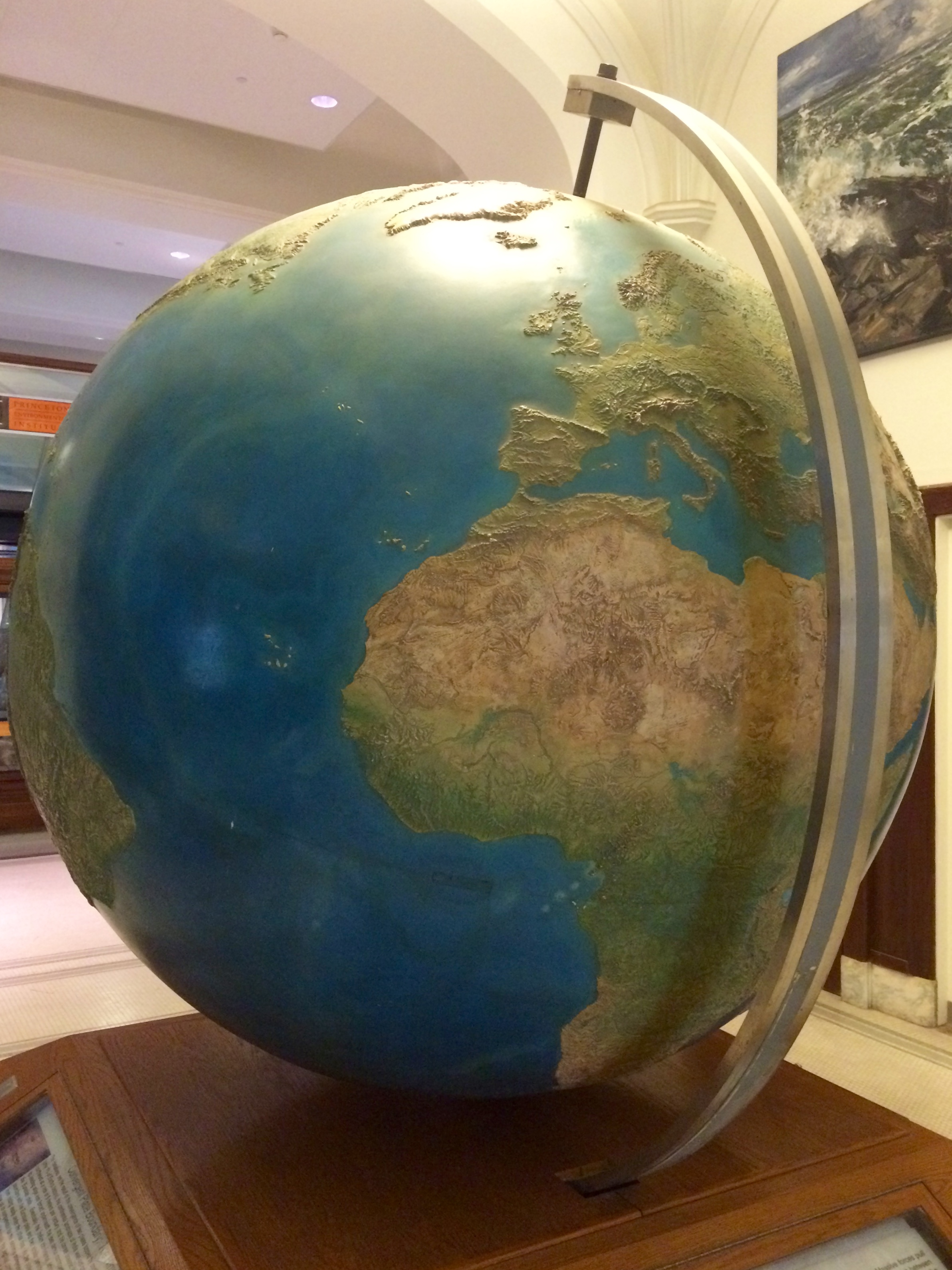
A globe by by any other name remains a sphere and that was when a few ideas hit me at the same time. You see, some ‘undermine’ or ‘undervalue’ geospatial intelligence, but that is exactly where the new news needs to go. Consider a sphere and that sphere is like the top of a tablet. We can interact with this and it is already possible to do that. We can look at a globe and see what is happening out there and we can interact with these events and show them on our tablet, our mobile or our computer. And we can select what news we get, in most cases we are subscribed to it and out paper gets us the information with icons on our globe, which is also linked to our devices and we see the events we are connected to. So in the home and in the office we do not have a sizable globe, but we have a smaller one.
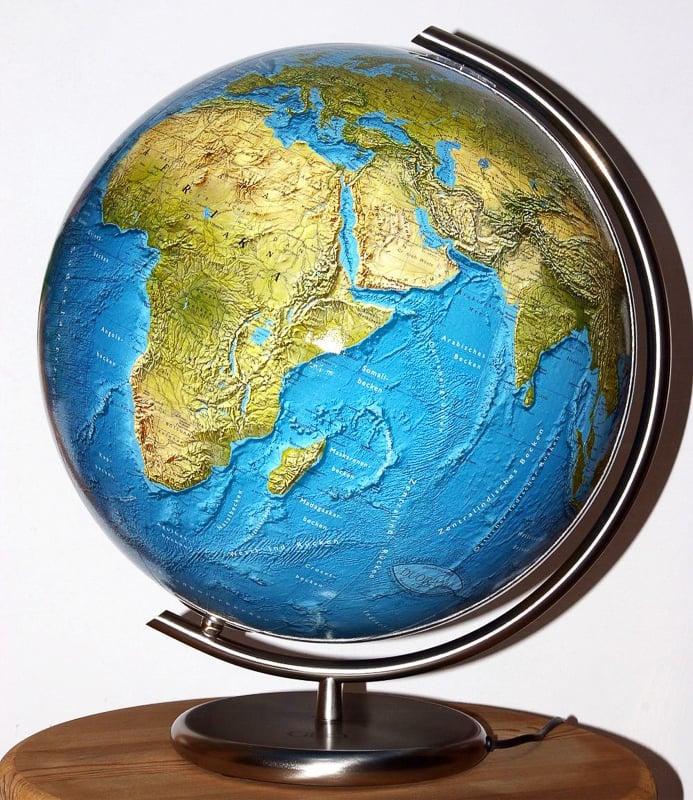
And it has the same function, but it goes further. Geospatial news can be shown on a TV, or one of those new paper thin displays, we used to call them maps and they are still that, but there is a difference. Local government has their own maps, shown on a display, optionally also shown in a home with a set focal point of a local map. For example someone in Riyadh might merely see the initial news of Saudi Arabia or Riyadh Province, or even merely Riyadh. Events that will pop up on this maps, other settings like the Netherlands, South Holland, or perhaps Delft, Rotterdam or The Hague. And this already exists. The news is given with connected metadata and we merely don’t think of that, but apart from the new TV (which is already out there (old ones work too) and the globes, which is al based on existing technology is out there, mere merely never refocused to this optional standard, because the newspapers like selling news papers. But digital data transformed that and it is time that the news is altered accordingly. I reckon that the first ones being Al Arabiya, Al Jazeera, BBC, and a few more will start offering this and soon enough others will follow. And I get that most of them will offer this in a subscription, optionally linked to their newspaper like Aftonbladet, Die Welt, or Le Monde. There are many providers and so many options to see rising to the occasion and the news needs to evolve if they want to exist tomorrow (its not that immediate a risk).

And with the new displays, the settings for local governments become more and more pressing and they will want to see these geospatial presentations in their government buildings, because we all think global, but it is all a collection of local news. And that is where the next technology comes from and that is where we need to look. 

I think that this new setting of news will catch on, because in the end we are all local lifers in a global community and the term ‘Think local act global’ has been taken out of proportions by some to make their global footprint more distinct, but in all this we forgot the local person and he cares about what happens around him/her, so why not cater to that because news that is read by the 1.17 people in Amsterdam is still news worthy of being read and there is every indication that this will transfer to a much larger audience, because these people have friends and family optionally not in the Netherlands. Same could be said of all the 8 billion out there. 

Well that is all I have to say on the subject. It was nice getting my noggin in a more creative setting, I missed that. So who will start this setting? I wonder how much longer other news agencies will try too hold onto the old phase and how they will be replaced by the news givers with a much larger scope. And the fun part? Advertisers will likely fail here, no one is interested in that and they will be barred to a much larger degree and this who try will drag the media not wanting to ‘separate’ news from advertisement with them, as such I will get two bangs for one shot. Lucky me. Have a great day.


Leave a comment

Filed under IT, Media, Science

The arbitrary Echidna

Yes, we all have arbitrary moments, this is not mine. Yet something woke up in me when Reuters gave me ‘Google’s advertising tech targeted in European publishers’ complaint’ (at https://www.reuters.com/technology/googles-advertising-tech-targeted-european-publishers-complaint-2022-02-11/) and I took a look. So there were a few issues and the part of “alleging Google has an adtech stranglehold over press publishers” is merely window dressing. So as I went to a few of these sites, I saw German, Swedish and no English. Now, this is not a stranglehold for me, so I dug deeper. And I looked in a few publications, seeing that there advertisements were a mess, I could not even apply for advertisements in Die Welt, Das Bild and so on. I did not check them all, but the laughable setting is that they seemingly have no idea what they are doing. See the image below

I go to www.google.com and this is the first thing I get in the left lower corner. It was not rocket science, it was precise and clear. And the Advertising gives you:

Simple, precise and direct, NONE of the publications I saw offered anything like that. I got to a page on advertising with Das Bild (I needed Google search to find it), these players are hopelessly lost, they are conceited and running after the facts. Advertising should be a main option at the bottom of Das Bild and Die Welt and it is not there (or better stated, I never found it). The most basic of settings and two of Germans largest circulations are lost beyond hope. So as I personally see it, it is not ‘Google has an adtech stranglehold over press publishers’, as I personally see it, it has become ‘press publishers are hopelessly outdated in the digital environment’, the ‘information’ page I found had one mention of pricing and no relevant actual pricing information. How is that possible in this day and age? Google Ads gives you options, Price per click, price per impression, and many other options and you can select your preference and set how much you are willing to pay. And the Google system is unsurpassed. You might bid $20, yet in the end you ONLY pay one cent more than the previous bid winner. So if we see the following bids:

BidCharged
1$ 20$ 0.54
2$ 5$ 0.53
3$ 3$ 0.52
4$ 1$ 0.51
5$ 0.50$ 0.50

Before Google the advertiser was NEVER given this and it changed the game, the ‘exploiters’ suddenly lost all traffic, they lost their customers and they lost their revenue. This is not a stranglehold, this is giving the customer proper treatment, perhaps EPC Chairman Christian Van Thillo might take notice of that. If we publicly set the advertisement prices over the last six years from Axel Springer, News UK, Conde Nast, Bonnier News and Editorial Prensa Iberica, what will we see then? Even now I could not find precise advertising prices in Die Welt and Das Bild. I get a presentation who they work with, but a consumer wants to know what it will cost them. So when you all go cry at the desk of the European Commission consider that the consumer and the consumer advertiser is given a clear picture and a clear understanding and the stage of what comes next. In addition, when we take “When publishers choose to use our advertising services, they keep the majority of revenue and every year we pay out billions of dollars directly to the publishing partners in our ad network” and we set that against “Google has achieved end-to-end control of the ad tech value chain, boasting market shares as high as 90-100% in segments of the ad tech chain” it is because Google offered and showed value for money from the very beginning, something most advertising agencies have never done. In addition, Google Ads has driven technology that made the advertisers more clever in the way they advertised, something others have never done. 

And in all this, when we see the EPC make claims like: ‘Freedom to earn advertising revenue’ and ‘Freedom to innovate’ whilst two of the partner clearly are lost on innovation, they might embrace earn advertising revenue, but without innovation it becomes meaningless and in that, the advertisers that require visibility see that Google Ads delivers whilst keeping cost down, optionally setting a stage to a new path that is cheaper for the advertiser, so how did the EPC approach that? This is not stranglehold, this is as I see it the path of exploitation and many advertisers have had enough of that and they were willing to try Google Ads and those who did remained in Google Ads, clearly the EPC needs to look up the word innovation, let me help them out: “the introduction of something new”, so where is that innovation in Die Welt and Das Bild? 

Seems that it is another chihuahua crying that they no longer matter, a waste of my time as I see it, not the people that could ever qualify for my 5G solution, that is (as I personally see it) true advertising power, in the hands of the retailer. 

Leave a comment

Filed under Finance, IT, Media, Science