Tag Archives: Energy

Trillion dollar Musk

I got some questions thrown at me in the last few days, they were pretty much all about me over valuing Elon Musk, but am I? I stated before that in the next 3-4 years his value will increase to roughly $1.2 trillion dollars, or in a less shorthand version $1,200,000,000,000, yes that is where he is heading and he already has most of the IP in his possession to do so. The second part I get is what do I get out of it. Nothing, well, like most I would like a 3.75% commission on the increase with a maximum of €5 B (a man is allowed to dream) and it would amount to less than one percent of his gain, I am not overly filled with confidence I will see a penny, but his increase is almost set in stone. 

Why set in stone?
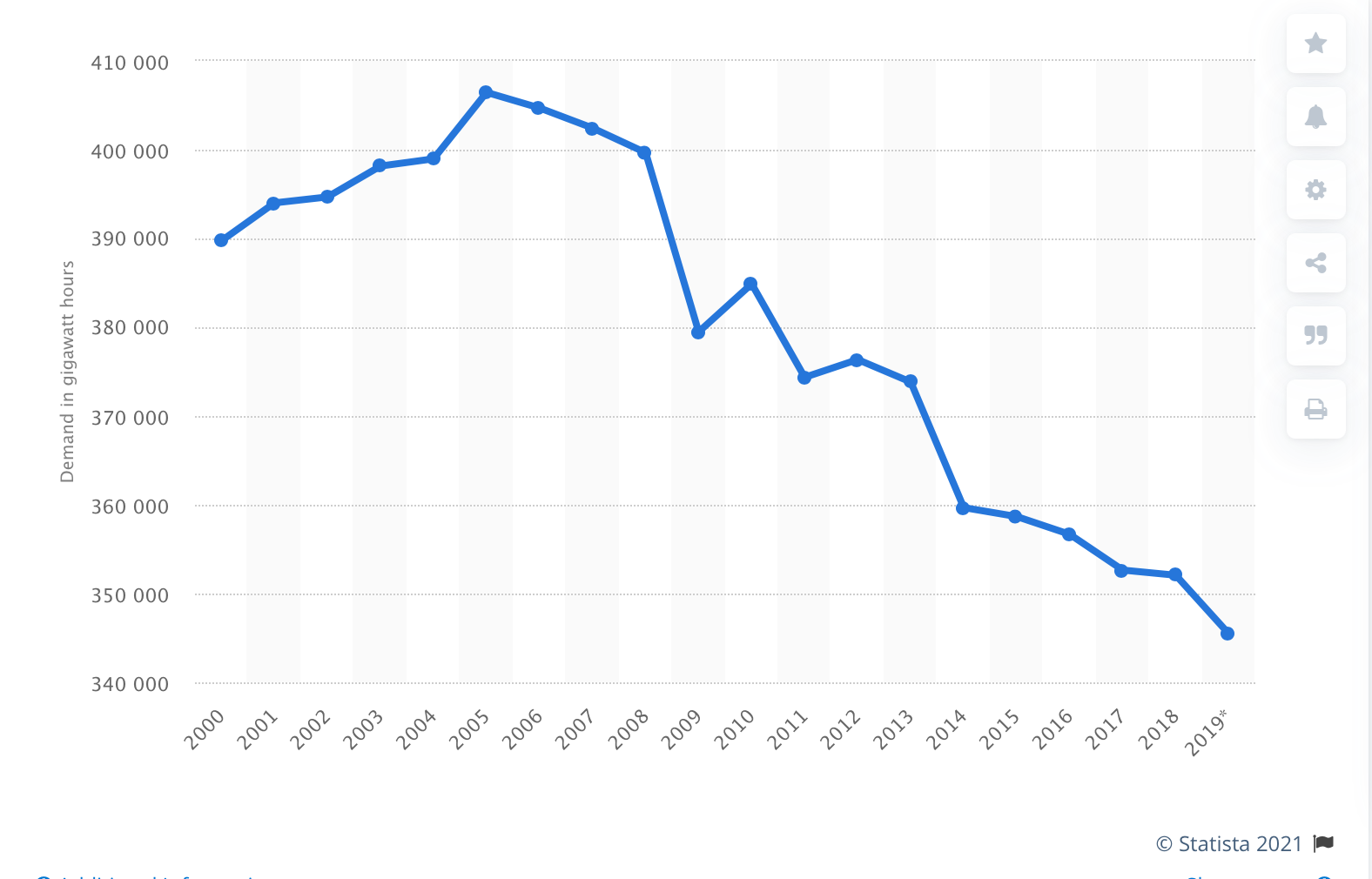
The UK (via the Guardian) inform us of “Britain’s electricity will be in short supply over the next few days after a string of unplanned power plant outages and unusually low wind speeds this week”, the UK has an increasing need for Scandinavian power and soon it cannot be met. I reckon that in the next 2-3 years that shortage will be close to systemic all over the EU.

Why?
Consider most houses and apartments. Only a decade ago our power needs were not that high, now many houses have more than one gaming console. The fridges are 200%-400% in size, PC’s that had a 300 watt power supply now has a 600-1200 watt supply, if it was one apartment it was a small issue, but this is now covering millions of places all over Europe and millions op places in the US. I reckon that in 3 years the political screaming starts for Carbon Neutral houses and apartments, and Elon Musk has the battery. It is more than the battery, the larger need for an individual solar and wind power base will increase, you see in 2-3 years the power outages will start to really hit, so as infrastructure (like hospitals) will need protection, houses will see power cost go through the roof and political parties will all unite to vie for subsidies on a larger scale and Elon Musk has the larger base of goods. 

Yet he cannot do it alone, DC appliances, like lights is easy and not the larger bulk, yet the fridges, the freezers, the water boilers and heaters, they take up a much larger part and new houses will all be outfitted with carbon neutral settings, as the houses has either via new tiles based on recycled plastic, with the high end having solar cells in the tiles, we will see a growth setting where people have a cell foundation and a growing amount of tiles with solar cells, some will also have wind fans, all generating the house power, all captured in the Musk battery. It will grow slowly, the harder hit area’s first, but it will grow and at some point there will be a near exponential growth for a little while. Germany and France (rural parts) are the most likely area’s, the UK and Belgium. But it will grow into the US as well. Even as the US seems to hide behind “A report by the US Department of Energy site weather-related power outages as the leading cause of power outages in the United States. The report and the Pew research both also acknowledge an aging infrastructure as part of the problem. Some of the US power grid dates back to the earliest onset of electricity”, the actual problem is near systemic, power needs have grown well over 10% annually in the last 5-10 years. Computers, AC systems, larger fridges and the list goes on. TV’s less so, yet in many ig not most households, from 11 Mega Watt a month, we see that many houses are now on 1100-1800 Watt per hour for a larger part of the day, each day and that is starting to add up, as such when the Musk Battery becomes the stretch of time that nations need his value goes through the roof and in that the $1.2T might be a conservative cautious number at present. It is a lot depending on the larger power needs that the EU, UK and US are staging, but the growing need cannot be hidden, even as we see that the weather is ‘apparently’ the larger cause as some claim it, it is not the only cause and when the people see the musk solution as a larger stage for resolving brown out damage, the people will push for that solution as well. So when the GeGaLo Index can no longer supply to the needs the buyers want it, energy prices will quite literally go through the roof and the Musk battery is only one element but it is his IP and it is for too many a solution. 

That is what will soon set the beginning of Elon Musk becoming the first trillionaire, and optionally over time it will make him the first multi trillionaire. I reckon that bad boy Billy Gates never considered being passed to this degree (or would that be bing passed), but I reckon that he will not care. 

4 Comments

Filed under Finance, Science

A Label for Labour

If we can use the information (to some extent) that the Guardian gave us this morning, then the first reference would be ‘Whinging’ 1. To complain, whine 2. A message from the labour party! So, the second one actually explains part of the newscast. The story was how according to Miliband, Cameron was losing control over the energy policy. (At http://www.theguardian.com/politics/2013/oct/24/edmiliband-davidcameron) How does he figure that?

The facts are not that unclear. There once was a non-fairy tale involving 6 commercial enterprises, who to some degree had to make a profit. In addition, the following headline should be interesting “Every UK home to face 15pc energy price rise” (Jan 2008)

Not to mention that parliament had an interesting document (at www.parliament.uk/briefing-papers/sn04153.pdf ). There are two issues, one, several sources mention an average 16% annual increase during 3 terms of labour. I mention it, but some numbers are sketchy, so I have some reservations how correct those numbers were, even though the parliament briefing papers do show a spike in that time frame.

It does not matter what the direct cause was, however, in three labour terms, nothing was done to limit that price increase, so labour’s nagging whilst the honourable Ed Miliband is on the non-winner side of the isle is rather fishy to say the least. Yes, we should acknowledge that The Electricity Act 1989 was enacted under the conservatives by Baroness Thatcher, then Prime Minister Thatcher. I reckon that there should always be a certain amount of questions when we privatise any form of utility. Commerce is the quickest attack on any wallet (a life lesson that is universally accepted).

So, even though there are questions, the one involving 3 terms of labour and energy prices should remain high on that list.

The article has a few other points of attention, Miliband’s quote “But this prime minister is too weak to stand up for the consumer and he always takes the side of the big six companies.” Really Edward? You do remember the greed issues involving a commercial enterprise? Or perhaps the London School of Economics classes (the ones on Economy) had a different focus? ;-), you party animal you! 🙂

Anyway, we can nag on the last three terms (but then we might sound like labour), in this term there needs to be an actual focus not on stopping (which is slightly non-realistic), but to some extent limiting price increases. Although allowing the French and the Chinese into the UK energy game might put a limit on price hikes to some extent, but it remains to be left in the hands of non-government, hence at that point, it remains a commercial play. What are the options?

There is actually an idea that might work. The idea was not mine; I picked it up in Sweden around 2001. The idea was that sound stable firms started to buy and install wind farms (in this case 1-3 turbines per firm). There are plenty of places to do that. The UK and Scotland could offer such areas too. Yes, in many places people might complain on the view, and they could select to pay £100-£200 a year more, or just accept the ‘lesser’ view. Consider that these people will get some tax benefits, but more importantly, they could lessen the power grid pressure and at times contribute to the net inviting refunds. There is an additional benefit. As the net gets a power feed, all over the place, losing power points would not have the blackout results other solutions have. So consider that through whatever non-governmental funding these windmills are added, the UK grid could end up getting a solid power addition by 1500-3000 turbines.

In the past I have ALWAYS spoken out against the irresponsible investment of retirement funds. If we accept that these turbines would prove to be a stable return on investment, keep price hikes down and allow for alternative ways to stabilise power needs, then why not look into such an adoption?

I never heard anything mentioned in that regard in the House of Commons (I do admit, I dozed off at some point, but it was 02:00 when that happened). So perhaps we can all look for a solution together? Because no matter where you live, we all need water and power, having alternatives when greed driven elements strike is NEVER a bad idea.

Leave a comment

Filed under Politics, Science

Scolding Labour’s Energy call

In the UK Ed Milliband is at it again. Of course, as Labour is getting closer to the elections, more interesting offers will be made to the electorate in a hope to get the votes up by a lot. As Mr Milliband is not polling to strong, more is needed.

Sky News reported on the notion that Ed Milliband has voiced options to freeze energy prizes, should Labour make it as the new tenant, getting the keys to that famous door on Downing Street (I think it was number 10).

Yes, freezing prices. It is an option to offer, but as Sky news showed in more than one way, it is not a very realistic one. I reckon that all parties need to realise that the next 3 terms will be about cutting the deficit. If the economy is to have ANY kind of a chance to get stronger and to get the UK back on some level of forward momentum, then the deficit and the debt need to go. Not realising that this is to be the number one priority is the party that has self, not the nation in mind.

The Dutch are dealing with this in a bad way. They have to cut 6 billion, or face a billion in fines. The survival of ALL the European players is to cut outstanding debts. It is a lesson the USA is currently not willing to face and it is about to get a lot harder for them.

Labour has more issues, but about that more soon. If we focus (not just UK) on these options, then we have options to strengthening all our economies. When we consider the option to unite the labour surplus and shortage of Australia, Canada, New Zealand and UK then we might cancel out a few shortages. If the world is a global workforce then the Commonwealth has one of the most global covering work force on the planet. Why is this not more strongly investigated? if we can get work flowing, then we get revenue moving and the reduction on welfare could be the start of it all. If we believe the news then there are many young workers looking for a job. Why not enable that workforce to work in any of these nations in certain areas? Even, if it is only for 1-2 years. That means hundreds of thousands could end up having an income. And the nice part is except for Quebec they all speak English (in Quebec they speak an additional language, so you could end up learning a second language there).

Anyway, this is not about language. Or is it?

The language of Labour has been off in several nations. In the UK the language is stretched for the votes, yet that could change sooner rather than later. In Australia Labour lost on message and on a public getting sick to watch the labour bickering. First there was Kevin Rudd, then Julia Gillard, then Kevin Rudd again and now after the Labour defeat the new ringleaders are in a rope pulling match between Anthony Albanese and Bill Shorten. Watching the ‘who gets to be in charge fight’ is immensely less entertaining to the labour supporters, if nothing (I mean way too little) is getting accomplished.

Ed Milliband has a different power struggle. His is about energy and the non-reality that these prices can get frozen. The margins are not that great when investments and infra structures are considered. If we believe the Guardian, then the energy moguls are in the market for cold blooded profiteering, which came from an article they published in April 13th 2013. Is this about profit? Who pays for the investments? We all are so nice about carbon emissions, getting green energy and such, but how does that get paid for?

Let us not forget that these are Commercial energy providers and they live on that pesky little thing called profit. British Energy is part of EDF, a combination that pays for almost 20,000 people. So if the income in Pounds is set to an average of 26,500, then they need to make a profit of over half a billion to just pay the average income (and this is only one of the six providers). Where will all that money come from?

So, apart from the workforce there are the plants, which need gas, oil, Uranium or other materials to create the energy. Not really a high yielding profit margin. I know about those ‘cheaper’ options, but for now a water powered fusion reactor remains a non-reality.

So as Ed Milliband makes this vow to freeze prices and as we know everything gets more expensive and these workers want a raise at some point. How can this promise be met? I do apologise for playing the realistic focussed pragmatist. It is just not a reality to see that happen. Not without adding to the debt by large steps, which in the end will be the UK downfall, missing whatever small curve of industry they could get.

So I remain, to be honest, as a conservative in a mindset that the UK alone might not hack it (not because they do not want to), but because the negative waves are too strong. Yet, the UK does not stand alone, we are all together the commonwealth. I prefer the old name, we ARE the British Empire. If Australia has such shortages in engineering (Western Australia), and healthcare in the UK is falling short, can we not slam our hands together? There is also Canada. With these three, we cover the entire global timeline. So many companies promise 24:7 support and then outsource it to India (also a Commonwealth nation), which gave many all kinds of language issues at times (not all the time mind you).

If labour needs a strong message, then why not focus on solutions, especially those not in the box. That part is shown with the NHS that does not fit into any box (apart from a coffin it might soon end up in, if nothing gets done right quick).

We should not rephrase messages, we should not change messages and we all need to look into new messages. Not doing so is a disservice to all constituents. The US to some extent still goes for the message “In god we trust all others pay cash“, Let our message not be some political clarion call, but a message that reverberated strongly throughout India, driving it to independence and turning it into a world power in less than 65 years. Not the worst example to follow! We all need to embrace both Mahatma Ghandi’s and Jawaharlal Nehru’s call for Global Cooperation. As they were both honourable members of the Inner Temple, we could see their view as one that had British foundations (that’s me thinking wishfully) and remains one that is worthy of pursuing.

Leave a comment

Filed under Uncategorized