Tag Archives: Murdoch

When is news not news?

Yup, the news is overwhelmingly misdirecting. Now, I have no issue with stupid people, these politicians are to the larger extend greed driven and not the greatest source of reliable information. This has always been the case, you see politicians are all about constituents, yet an industrial constituent beats ten unemployed constituent, that is because the unemployed version does not prolong his or her career, the industrial could be a donor and set the politician up for life, that has always been the largest setting, it was for the longest time most visible in the US, but now it seems, Australia is about to follow suit. This is seen in a few ways, but let’s take a look at the first.

ABC gives us (at https://www.abc.net.au/news/2021-01-22/google-stop-search-engine-australia-news-media-code/13079912) “Prime Minister Scott Morrison has pushed back against a threat by Google to stop making its search engine available in Australia if it is forced to pay news outlets for showing links to their websites and stories under a new media code”, you think that this is a simple thing, but the less intelligent person (currently prime minister), is not looking through his glasses, they are merely spectacles. In all this, it is about paying for news, yet the silly people (read: politicians) are being played a fool. This is seen when we Google ‘Google Australia’ looking for this news.

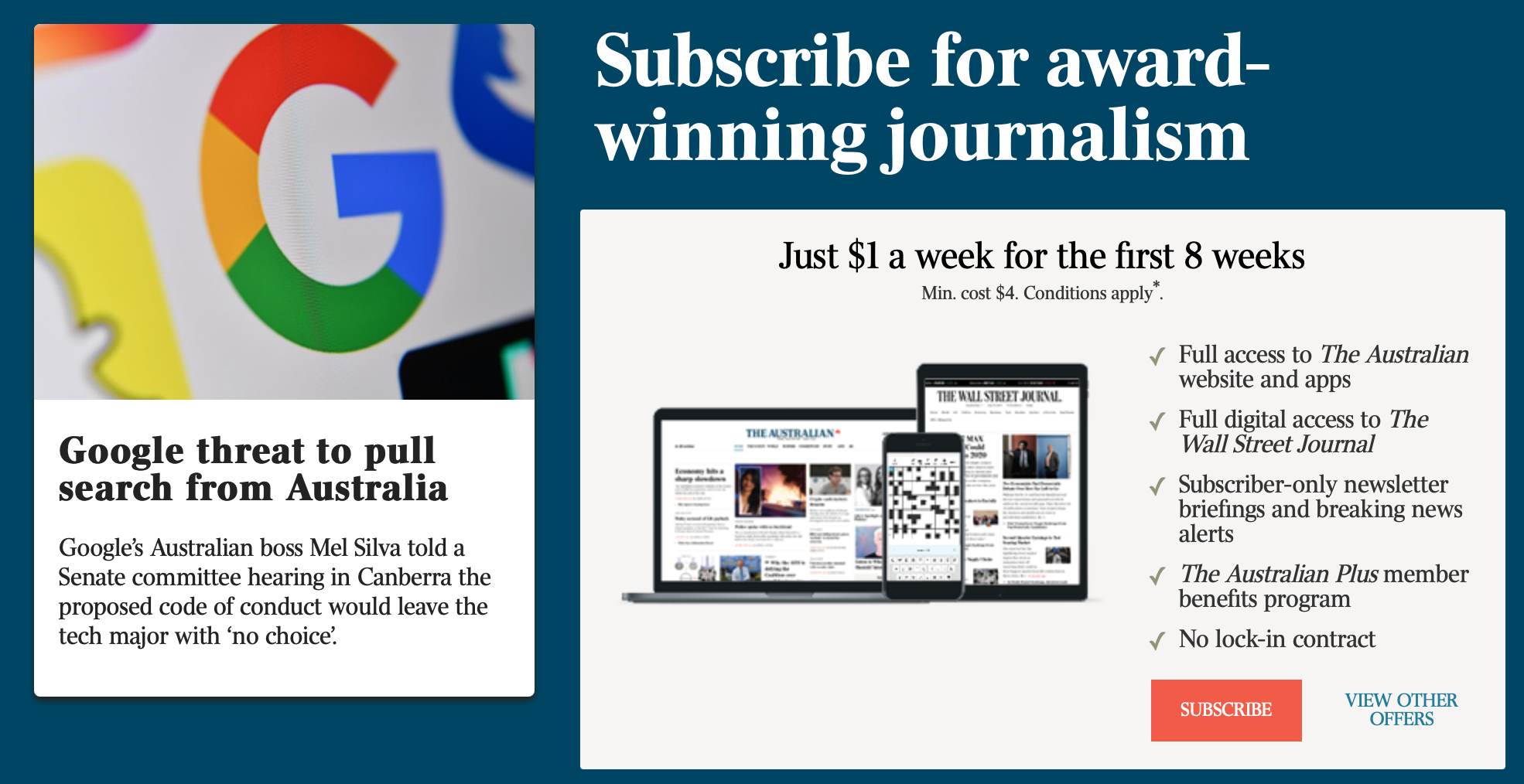
We are given the link, which gives us a subscription image and this paper is not the only one doing that, they are using news items for advertisement, so why exactly does goole have to pay for THAT privilege?

You might be Prime Minister Scott, but you do not have a fucking clue what you are tainting with adjusted media laws, perhaps you need to cater less to Murdoch wannabe’s and consider the larger frame (which you do not fathom). And in all this, your team (as well as the Labor team) to overhaul tax laws in a just way, your greed driven friends did not allow for that, did they? So you created a digital ship that is not is not waterproof, not sea worthy and optionally is unaware of the setting called liquid. So when the impact of no Google hits Australian businesses they will all scream and then you are shown to be the loser you really are.

And this is not new, I mentioned this before and over that time no true investigation was done. And when we consider “The two companies are fighting against legislation currently before the parliament which would force the digital platforms to enter into negotiations with news media companies for payment for content”, I wonder why, consider that the news media has the option not to be digital, not to be online, not to show content, but that is just too much for them and Scott Morrison knows this, so like a Dick (Turpin) he goes from digital firm to digital firm like a highway robber, all whilst the setting of the news outlets are debatable at best and they have been for several years (ABC and SBS excluded), and as such why should Google pay? These links are offered, so tell the news media to stop offering these links, I reckon that when the Courier Mail and the Australian can no longer advertise in that way, they too will cry like little girls. 

Did I oversimplify the issue here?

So when we consider “forced to pay news outlets for showing links to their websites and stories under a new media code”, Google can just block all the Australian news sources and offer BBC, Al Jazeera, Fox News, Guardian UK and CNN links. Let not forget that the bulk of Australian news is shoddy at best and most of them all copy and paste from an American source (Reuters), when you make a tally, we see a setting (as I personally see it) where the news in Australia is not news, it is filtered content to appease shareholders, stake holders and advertisers in Australia, as such, when they lose their Google links the game will get rather interesting soon enough, but that is merely my $0.02 on the matter.

Leave a comment

Filed under Finance, IT, Law, Media

The wrong side of news

We all have those moments where we get stopped by news. Not because it was shocking, or because it was some breaking event, we all have those moments. Yet, how often did news stop you because it raised a few too many red flags?

That was the case with me this morning when I saw ‘News Corp wants limits on ABC to prevent ‘advantaged’ competition‘. The article (at https://www.theguardian.com/media/2018/jul/23/news-corp-wants-limits-on-abc-to-prevent-advantaged-competition) might be fair enough. Yet when we get treated to the story that is (at https://www.theguardian.com/australia-news/commentisfree/2018/jul/16/news-corps-promotion-of-lauren-southern-is-disturbing), merely a week ago, giving us ‘News Corp Australia’s promotion of Lauren Southern is disturbing‘ with the quote: “Her speaking engagements with rightwing YouTuber Stefan Molyneux will go ahead, as will the top-dollar dinner engagements with those willing to shell out $750. But if the notion that she might be prevented from entering Australia was credible, it’s because Southern has been banned from entering a country before“, what is an issue is that News Corp seems to be about creating visibility, but what part of all this was the news? It might be relevant, it might even fit, but all these resource draining tantrums that we get with “A temporary setback was re-purposed as precious publicity, and News Corp papers continued to unfurl the red carpet ahead of her visit“, seems to indicate that as a ‘commercial provider‘ they seem to be wasting loads of energy and resources. All these events are on their turf, so when I see “Rupert Murdoch’s Australian arm has told a government inquiry the internet has transformed the ABC and SBS into “news publishers” who have the advantage of being taxpayer-funded, while denying commercial competitors revenue” as ABC (and SBS), whilst the question on News Corp, whether it should exist at all is on the mind of many people. It’s like watching a butter salesman stating that a Brioche with margarine just tastes better. I am asking whether the limelight seeking News Corp, by their own actions (against ABC, SBS and Facebook) made their own existence debatable. As that comes into focus and people are more and more shying away from anything News Corp brings, they are now in a silly position. They painted themselves into a corner and now that they are in that corner being immobile for the time being, they are telling all the painters to stop, so that those painters will not get an actual lead on the amount of painting done.

One source gave me a partial interesting view. It is the setting of Sinclair broadcasting next to News Corp. This is seen in the Washington Post, where we get: “The Company is the largest owner of local television stations in the country, with 173 stations in 81 broadcast markets that stretch from coast to coast and just about everywhere in between, at a time when local news outpaces national news outlets both in overall viewership and trust. About 85 percent of Americans trust local news outlets, more than the 77 percent for family or friends, according to the Pew Research Center“. The article (at https://www.washingtonpost.com/news/style/wp/2018/04/02/get-to-know-sinclair-broadcast-group-the-conservative-local-news-giant-with-a-growing-reach) shows a very different setting. You see, when we see those two, we get the setting: “using local voices and optionally celebrities to push a national and even an international agenda, in this pushing any other media as an enemy creating market penetration that is set on the foundations of a political required brand or view“. When we see that places like the Sinclair Broadcast Group (headquartered in Hunt Valley, MD), we start seeing that there is a larger play, in this light we do not see ABC or SBS in an advantaged playing field, we see two players bringing newsworthy events that oppose the playing field that News Corp relies on. We see a setting of opposition in a place where News Corp can’t stomach any. Now we get a very different light and in all this we need to wonder what the hell anyone is doing allowing and paving the way for News Corp.

In addition we see the Washington Post also give us: “Interest in Sinclair picked up recently after reports exposed a seemingly Trump-friendly script the company ordered its anchors nationwide to read, lambasting “irresponsible, one-sided” and “fake” news stories. The one-minute-long script, which appeared to echo Trump’s efforts to attack the reporting he has disagreed with as “fake news,” brought to the fore long-standing critiques about what many view as the company’s rightward tilt. The fake stories promo, which was first reported by CNN in March, drew wide attention after Deadspin published a video Saturday that layered dozens of the company’s anchors around the country reading the script over one another, creating a visceral portrait of corporate message control“, now we have ourselves a party, because if that is the future of News that News Corp is bringing us, then we are a lot better off keeping ABC and SBS enshrined in the places they are now.

One source gave us regarding a similar setting: “It should feel familiar; our very own News Corp has employed these strategies“, from that point of view we need to become extra careful.

It was the Sydney Moring Herald that gave us (at https://www.smh.com.au/business/companies/news-corp-s-war-on-facebook-is-a-decade-in-the-making-20180511-p4zet3.html) the article ‘News Corp’s war on Facebook is a decade in the making‘, yet it is the quote “The company has made it very clear it thinks Facebook and Google should pay publishers “carriage fees” for running their stories. This would be a similar economic construct to the American cable television industry, where distributors such as Comcast and Time Warner Cable pay programming suppliers such as Murdoch’s Fox and Disney to carry their channels” gives a different light. You see, Murdoch took a path (one that he is allowed to. Whenever you share a story (like a link) you get transferred. In this example Google search gave me: ‘Daily Telegraph editorial: It’s time to embrace our freedoms and fight …’, which comes with the quote: “DURING the 1960s and into the 1970s, when waves of post-war Baby Boomers came of age and began to exert their demographic influence”, it might have been an interesting read, yet when we go there, we get pushed to ‘myaccount.news.com.au’, asking to log in, or take a subscription, which is fair enough. But now, all those papers like the Daily Telegraph, the Courier Mail and others are no longer used. People link others to the Sydney Morning Herald, the Guardian, the Independent, and the Financial Times. Social media is about sharing and an interesting article remains interesting when you share it with a like-minded person. So now News Corp is getting less and less traction, as others get the limelight. That is the effect on users trying to keep friends alerted. that is very much also the path and the entire ‘the foundations of a political required brand or view‘ is all about emotion (well mostly), so now as people regard News Corp to be less and less relevant, as people are relying on ‘any other source‘, we see that the long game as spoken about in the SMH, as well as the setting that the Guardian gives us is becoming more and more unacceptable to the people. for a lack of a better view, Murdoch dug his own grave and even as the coffin he has for the plot will be massively comfortable, once we cover it with dirt at roughly 6 feet deep, he starts becoming a ‘forgotten item’ from the era of the Jurassic age where the loud voice carries weight. At 6 feet deep no one can hear you scream (I just had to add some Alien factor).

So as SBS and ABC are all about sharing news, it opposes the agenda and revenue of News Corp, so now they cry like (for a lack of a better term) ‘prissy little bitches’. When we look at the Parliament page (at https://www.aph.gov.au/About_Parliament/Parliamentary_Departments/Parliamentary_Library/pubs/rp/BudgetReview201617/Publicbroadcasting), we see: “The ABC is to receive revenue of $3.1 billion in base operating funding over the three years to 2018–19“, as well as “Base funding for Special Broadcasting Service (SBS) is also included in the Portfolio Budget Statements. The broadcaster will receive $271.9 million in 2016–17, $269.8 million in 2017–18 and $272.4 million in 2018–19“, when we realise some sources giving us: “The company reported total revenue of US$8.14 billion (AU$10.35 billion) last year“, which seems to be in line of previous reporting, although there is a shift and that hurts News Corp, I think considering the waste of resources when we look at events like Lauren Southern, how much was the entire bill for News Corp?

I am not saying that they should not have done that, but this is about creating emotion, not about reporting news. News Corps creating news (through their promotions) and that makes it another matter entirely. In all this, when I see: “She believes Australia should close its borders and that there “are only two sexes — male and female”“, it is my personal view that there is one poster that does give us the actual goods. So, what do you think? Should we all revert to Aboriginalism? At that point I do wonder who would embrace Pauline Hanson as a sister (but that is merely my evil sense of humour). I would never attack freedom of speech and freedom of expression, she is allowed her views, yet from my point of view, she’s a Canadian, a British Columbian. Her views are extreme right (or is that extremely incorrect), but pushed through the internet, a libertarian with a populist focus. A 23 year old not hit with the ugly stick and those factors make her an internet personality. The issue I also see is that she is seen as a Journalist, yet she never graduated University (University of the Fraser Valley). I am a blogger and I refuse to call myself a Journalist, even as I have a Masters in IP Law as well as two other postgraduate degrees from the University of Technology Sydney, I never graduated in Journalism, so I refuse to call myself a Journalist, even as I have publications going back to 1988 in several magazines, being a reviewer of multimedia products does not make me a journalist, plain and simple.

In this case Lauren Southern matters. You see, when you consider her education, the fact that we see that in March 2017, Lauren Southern left Rebel Media to become an independent journalist (without a degree in journalism I might add), this whilst she still additionally gained access to White House press briefings, so how is that even possible? In addition, News Corp is promoting her events making the entire matter even more debatable. So in that setting, when I see the Guardian giving us: “The publisher of the Australian and Daily Telegraph wants the ABC to be barred from promoting its news stories online using Google ads“, I am of the mind that someone stupid enough to promote a non-Journalist and giving the limelight to “News Corp papers continued to unfurl the red carpet ahead of her visit“, they should realise that there are places where people (and actual Journalists) actually focus on the news, reporting on events not creating hypes through: she chose Luton because it is the home of Tommy Robinson, the currently imprisoned founder of the English Defence League. In May, Robinson was sentenced to 13 months in prison for contempt of court after broadcasting details of a trial from outside Leeds crown court that risked causing it to collapse“.

News Corp is showing to be on the wrong side of the News, their approach on spreading news, I apologise! I meant spreading the subscription page is valid. They are allowed to do that and their tactic that they should be paid by places like Facebook is a fair choice to make, but they forget that actual reliable sources (BBC, the Guardian, SBS, ABC) are allowing such a path (without subscription), and when it comes to results, the people sharing stories want to share the story, not the subscription page. Add the entire Lauren Southern promotion and we don’t get news, we get the acceleration of emotional hype’s and we have had quite enough of that.

The question becomes, will political need buckle to their needs via News Corp, and once that is out and in the open, when we investigate those politicians who allowed for this, will we tolerate answers like ‘It was a complex setting‘ and ‘there appeared to have been a level of miscommunication‘, when those quotes are given, will we be able to demand their eviction from any political seat? I am asking these questions because all those shouting on how our privacy is gone and how we are all monitored whilst the political setting is in a stage where smothering real news is a reality that we are optionally allowing for. In that part we are actively allowing for media outlets to create fake news. When we are not allowed to see the whole story, when we merely see a carefully scripted partial side, are we not in the foundation where we are being fed fake news?


Leave a comment

Filed under Finance, Media, Politics

The Sound of silence

Hello accountant, my dark fate
your books are bloated as of late
the need for bonus loudly creeping
to be deposited so fleeting
and the greedy that are filling
their domain, they always gain
it is the need for money

The P W C accounting firm
will gain support, another turn
you see the press is staying quiet
we wonder now who got them hired
see the news is remaining just the same, it’s such a shame
and they should all be fired

You might think why this rewritten song of Simon and Garfunkel? You see, it has been almost 50 years exactly that Simon and Garfunkel took this to paper, 50 years later we would see quite the different ballad, one that would see repercussions in ways never seen before, yet both instances unique. That part was made clear today when we see ‘Tesco posts record loss: what the experts say‘ (at http://www.theguardian.com/business/2015/apr/22/tesco-posts-record-loss-what-the-experts-say). So when we see “Tesco reports record £6.4bn loss” and when we see ‘these experts’, you and me alike should ask a series of questions the press is not asking. It has not been asking them for 2 quarters now (well an absolute minimum).

Consider the following quote: “Soon after his arrival, Lewis unveiled a £263m accounting scandal caused by overoptimistic recording of payments made to Tesco by suppliers. Tesco is under investigation by the Serious Fraud Office and the supermarket regulator over the affair“, this is what got it all started, what the publishing pussies refer to as ‘overoptimistic recording of payments‘ turned out to be nothing less than a systematic issue as we saw some of the news from DeLoitte. It is shown in my ‘adjusted lyrics’:

Will gain support, another turn
you see the press is staying quiet
we wonder now who got them hired

You see, there is the Sound of Silence, an actual silence. Try finding anything regarding Tesco in 2015 regarding PricewaterhouseCoopers. You will find very very little, pretty much the absolute minimum. Perhaps you remember the wild allegations on the ‘MH370 suicide flight‘, in addition, all those claims regarding the World Cup soccer in Qatar 2022. Yet, in regards to PwC the Murdoch machine stays very quiet. I regard that this makes Rupert Murdoch the biggest pussy in newspaper publication since the newspaper concept started in the 17th century.

It took just less than two hours to realise that PwC needed investigation, the papers made close to zero mention on it, there were some casual mentions regarding ‘asking questions’, but it was as low key as technologically possible. In December 2014 it pretty much stops, feel free to try and Google it for yourself. You will find articles on how Sainsbury switches from PwC to Ernst and Young (January 16th 2015), but for the rest there is too much nothing. Not just the Murdoch groups, but in equal measure, you will find little to nothing regarding PricewaterhouseCoopers. Is that not strange? Especially as we now see how £263m inflation, caused a £6.4bn deflation. A result 24:1, it became such an interesting long term bet to make, especially by those involved. Yet many of those players are shrouded in silence.

You see another matter suddenly dawned on me. I reckon you all remember Julian Assange, from all those cables regarding the Afghan war. 5 days ago, they decided to also go public on all those Sony hacked cables. We see the quote: “This archive shows the inner workings of an influential multinational corporation. It is newsworthy and at the centre of a geopolitical conflict. It belongs in the public domain“. No Mr Assange! You decided to play god with stolen data and you decided the fate of this corporation by hanging out the laundry, in addition, you handed the power they wielded and threw it up in the air to be taken over by any competitor who can grow in directions they never bothered to look, because they could not be bothered taking the effort.

And as we are talking into the public domain Julian, what happened to your ‘bravery’ when you made the quote “In November, WikiLeaks founder Julian Assange told Forbes the site has a ‘mega leak’ on an unnamed major US bank exposing an ‘ecosystem of corruption’ that will be released early this year?” I am pretty sure that this never went public. I searched high and low and your WikiLeaks page shows nothing there either. It seems to me that many parties are too scared when it comes to banks and financial institutions.

The question should be Did Julian Assange have anything ever regarding his claims on an ‘ecosystem of corruption’ in regards to a US bank. Should I not ask that question? You see, when the press at large ignores the PwC issue, many should ask questions, especially as both Tesco and Greece fill pages of text in the Guardian and several other newspapers, yet the hunt for information regarding PwC is not moving forward.

In the first article mentioned, where we see the dubious term ‘what the experts say’, NO MENTION AT ALL on PricewaterhouseCoopers (or PwC), is that not strange? The question how 10 million in costs (which I converted to 199 full time accountants working on Tesco for a full year alone) did not reveal anything in time, so how could such a managed event stay hidden? In several articles we see a similar quote as I am adding here, a quote that in many cases was the very first paragraph of articles late October 2013. “DELOITTE has completed its review of Tesco’s overstated half-yearly results and confirmed that its black hole is even bigger than the £250m previously declared and goes back even further than the supermarket group had originally stated“, which means that these auditors ‘missed’ it for a longer period of time. A thought I had in the first few hours, was confirmed a month later (which is fair enough, they hard to check many numbers before stating anything), yet I saw and reported on this (as well as my thoughts), having no economic degree, just me as an analyst saw what the press has been ignoring ever since.

One of the more revealing articles was in the Financial Times named ‘UK accountancy watchdog hits PwC with two separate probes‘ (at http://www.ft.com/cms/s/0/98e02452-89c8-11e4-9dbf-00144feabdc0.html#axzz3Y3cymr54), which was in late December 2014, after that the news and the hunt for the Priced and watered Coopers stops on nearly all media fronts. I wonder how they pulled that one of. The fact that there is almost no visibility on the two probes is only more cause for concern, but those experts all have ‘something’ to say in this matter. Isn’t it nice that they did not have anything to say, or did not say it out loud before the calamity was seen. All those Tesco projects, ready to roll, not one came with the considerations ‘Tesco is spreading itself too thin‘, which is nice before the fact, but pointless, bordering on clueless after the fact. I especially liked the quote from Mike Dennis from Cantor Fitzgerald, you know, one of those after the facts proclaimers. “We believe Tesco should consider closing 200 underperforming supermarkets/superstores and focus on growing the more profitable remaining 700 stores (excluding Express); in addition, this should also allow for £40m of cost-savings from the closure of a distribution centre“, you see, my issue is twofold.

The first is where the ‘under’ performing line lies. Is underperforming, working at a loss, or at a minimal profit? The reality remains that people need groceries, so if an ‘underperforming’ shop is closed another will open with a different label and now that lost revenue will go somewhere else. My second issue is that 40 million in savings. You see, if those 200 shops are spread all over, that distribution centre will still be needed, even if the amount of stores decreases, someone will need to open a grocery store and this distribution centre could service independent supermarkets to some degree, meaning a small additional revenue. Then we get the second set of debatable solutions “Matt Davies, Tesco’s UK CEO as of 1 June, should consider a further reduction in staff and a significant simplification of central functions and category management. Aldi UK today generates twice the sales per full-time employee compared to Tesco UK and is expected to report higher trading profits“, reduction on staff? Where? You see, it is nice to ‘opt’ for simplification, but in my experience in 100% of the cases, simplification was not a bad thing, but it came at some expense, what is that expense and will it hurt down the line? The biggest fun can be seen when you read the part of Philip Benton. It all reads nice, but the issue I have is at the end in this case. “The retailer is in the midst of a huge restructuring after selling off much of its portfolio including Blinkbox and Tesco Broadband as well as the forthcoming sale of market research unit Dunnhumby and undergoing a complete overhaul of its leadership“, my issue is the possible ‘inflated’ that Dunnhumby represents. You see, it could be regarded as inflated as its value is determined by what the buyers will offer. In the end Dunnhumby represents well over 140 million a year and it also represents undocumented savings. You see, if a lot of the marketing and visibility research is done at market value, Tesco will face that they either deal with additional costs (not small ones) or not do the research. Both are bad ideas. None of these ‘experts’ are looking into the amalgamation of services that Dunnhumby could offer via Tesco and/or for Tesco. Dunnhumby is a massive data warehouse and it should have loads of options. Moreover offering these additional services (in the trend that Google has done with ‘Gmail for work’ could open up new capital gaining opportunities. Now, as the economy is slowly starting over the next 3 years, those who grow could need data insight that is currently available via Dunnhumby. This means financial and revenue growth that shows a healthy future, giving that away in some sale to recoup 2 billion, from a 6 billion loss that was all based upon degraded value seems like a very bad idea to me. Even if most of that 2 billion is recovered, the invoices that follow will put pressure for a larger part on Tesco.

Consider that the interest on 2 billion is 70,000,000, now consider that not only are them making 100 million plus, they are also the centre of data, a place Tesco will desperately need in the coming 2-5 years. Not having it could imply more costings for Tesco. No one seemed to be considering that part of the equation at all.

So, reality now, will stores be closed? That seems unavoidable, yet closing stores also means no more revenue, dumping the location at a loss and a few other items linked to this. Tesco needs to grow again, but the method remains debatable. I would have thought that moving more towards an Aldi/Lidl margin might make a difference, will it be enough? Whatever move it will make, it will need data to support and test the foundations with, so I personally feel that this requires the non-sale of Dunnhumby (for now). You see, I still see the centre with Dunnhumby for another reason. When you look at their site, you see a list of the large corporations, that is all good (and it brings home the bacon), but they are also sitting on loads of Tesco data as well. What if aggregated parts could be linked to small firms, smaller firms who end up with a dashboard solution, where their limited data is linked to that massive Tesco Data Warehouse, where these smaller companies, for a small fee get a dashboard uniting their data with Tesco demographics. Now we have a whole new clientele in a business setting, so before those supermarkets get closed, they should see if a small corner of it could be an added business venture. Likely those prospective clients will be in larger area’s where Tesco remains operational, but we now have an added service and Dunnhumby has an optional new suite (based on for example SAP dashboard) that opens up new ventures and even added consultancy and training. In these times the innovators will cause growth to evolve, selling off things only makes for lost market share (even though some non-profit ventures should always be considered for scrapping).

Are my ideas so outlandish? You must always consider that part, for the simple reason that the sceptical approach causes no harm and the proof that follows will only create futures. The following quote is as old as the hills, so it should not be a surprise to anyone in this field: “Sales will blame Marketing for the lack of quality leads with repetitive precision, whilst Marketing will blame Sales for not acting on the leads on time, or at all. When nobody has any reliable stats to back up their ‘verdict’, the arguments go on forever and nothing gets done”. Now, consider all these new firms, those new start-ups, or just one man companies like for example Electricians, Plumbers and Painters. They have no Sales or Marketing at all in most cases, would it not be nice if they had a simple dashboard based option that can help them focus on where possible opportunities lie? Not to mention usual retail like family bookshops and leagues of small pharmacy places that could do better. The solution I suggested could help them focus on where to look next. The great thing is that for the most, the same basic solution will work for all, they would only need a set of very specific filters in addition to the demographical ones. A solution that could be automated to the larger extent. One simple market, there for the taking. Did anyone consider that?

And as we look into these possibilities, we get back to the beginning, how could all the financial data be so opaque that it escaped the view of PwC, when we look at all these claims by experts, how did none of the warning lights light up, especially when we consider the words of Deloitte “these auditors ‘missed’ it for a longer period of time“, now I have brought you from the premise, past the innuendo to the basic view on how data can be new business too. Finally, when we consider the following quote that was in the Guardian “Further positives include that Tesco did in fact make a bigger trading profit than the market believed was possible (£1.4bn v. £760.86m consensus)“, this reads, they did twice as good, this means that Tesco is getting back on its feet. Yes, I did read that it is less than it was, but still, they got one dot four billion in, which is a lot better than Greece and most traders want them to get 7 billion regardless, so I think we should consider that many are willing to dump 7 billion on a location of non-cooperation, whilst they will drown a corporation fight to achieve and collect ACTUAL revenue. What a double standard we live by!

If we go by the simplest stats (not an accurate one), then we see that Tesco exceeded by £700M, which is 23% of the £3 billion loss, Greece cannot even raise 10% of what is due shortly, so it is time to look at what is real and look at why the press seems to be ‘avoiding’ (read not actively digging) into Pricewaterhouse Cooper either. But I will leave that to what I would currently regard to be the ‘Pussy’ family (Witherow, Rusbridger, Murdoch et al). Should you consider the path I walked here to be ‘inappropriate’ then Google ‘Tesco+scandal+2015‘ (837.000) and Google ‘PwC+scandal+2015‘ (271.000), now look at the amount of Newspaper links we find in the second one (almost none and many of these links are 2014). I think I made my case here, I just wonder what scared the press to this extent away from a story.

So as we see the quotes “Over the full year, the profit margin in the UK was 1.1%, a far cry from the impossible 5.2% that Lewis’s predecessor, Philip Clarke, ridiculously attempted to defend” and “Lewis must show that the ‘early encouraging signs from what we have done so far’ will produce a discernible improvement in profits“, yet no mention on the previous directors, regarding ‘cooking’ the books and still no mention of the Auditor either. It seems that everyone knows that the dice are loaded but no one is willing to say it out loud.

What else is not reported on regarding the 24:1 loss?


Leave a comment

Filed under Finance, IT, Law, Media, Politics

Conroy’s freedom of Speech

Conroy’s freedom of Speech

There have always been reasons to check out the front page banner of any newspaper. Some make us curious, some make us angry and some make us realise that the budgie cage needs cleaning. Whatever we think, we do tend to react to a banner.
So, like most people I also reacted. Now, personally I have a slightly less positive view on the Telegraph. So when a politician gets compared to Stalin, Jong-un, Mao Zedong and Castro, it tends to wake me up. My first thought being, now what is the media trying to get away with?

So I first took a little jump into what other media’s are stating and quoting. ABC quoted the following “He also announced plans to establish a new watchdog to ensure that media companies comply with independent journalism standards.
In addition another newscast from ABC stated “The Federal Government has unveiled the long-awaited details of its proposal which enshrines media standards and tightens ownership regulation through an arms-length advocate to assess media mergers.

This does not sound too bad, does it?

There is however opposition. ABC also mentioned the following “But independent MPs Andrew Wilkie and Rob Oakeshott have raised concerns about the laws. Mr Wilkie flagged the proposed public interest test for media ownership, saying the area is open to political interference.

Both sides make clear arguments, yet, what is really at stake?

You see, from my point of view we need to do whatever we can so that we do not have to live and listen to the world according to Fairfax/Murdoch only. When there is a chance to keep the little ones in the field so that multiple views can be heard, the views we hear remain to be from a fair collection of voices.

For me there is another side that is not mentioned at present anywhere (or so at least it seems). Stronger self-regulations and stronger watchdogs were also clearly stated by Lord Justice Leveson. This issue is out far beyond the borders of Australia. The Leveson report is attacked by so many, yet this report shows how out of control the media is. Even though the report is focussed on the UK, there is a clear indication that the issue is playing FAR beyond those borders, and it is even an issue in nations NOT part of the Commonwealth where ‘Freedom of the press’ is nothing less than freedom to harass, freedom to stalk and freedom to display at the expense of everything and everyone for the need of profit and circulation. They however, refer to it as ‘the people have a right to know’.

The media seemed to be upset when the trials started, however I personally think that they seem to be more upset about the fact that they got found out mainly due to a trivial newscast in my humble opinion, than a ground breaking case of journalism.

Professor Ivor Gaber, professor of political journalism at City University London stated the following in his book ‘After Leveson’: “Many people have had much to say about the Leveson report, most of it pretty negative, but in his broad sweep of the relationship between the press and politicians, the good judge gets more right than wrong“.

As stated, the UK is in the middle of reforms halting and talks are breaking down at present. This was reported by the Guardian yesterday March 12th. So what is Senator Stephen Conroy about?
Well, first of all he is a politician and he is trying to get certain reforms in place. I would think that there is an Ego factor in place as well (let us not forget that he is a politician). If he pulls of certain reforms then not only will he look good to many many people. He will also be known as the man who was able to get reforms done, unlike his English counterparts, who are locked in a stalemate at present. So, I would say ‘Well done Stephen!’ at that point.

So is he a media dictator, or is he just in the way of a small group of upper level directors who need to fuel their altars devoted to money? That fair question is not really asked by the press is it?

He is quoted stating that the Australian people want the press to be held accountable. Is that so wrong? One side of the plans is to cut licensing fees in some instances so that the small players get a fair chance in this game. That part is supported by Independent senator Nick Xenophon. Xenophon mentioned in the same ABC story I quoted earlier that this part of the plan has merit. I reckon we can all agree that if the fees are too high, then the voice of Murdoch and Fairfax are all that remain at that point. This is NOT a good idea! Australians might agree that the small new players could bring us fresh artistic views in both news and media in general.

Consider the history of Oporto restaurant which was founded in 1986 by António Cerqueira. By media standards without the changes Conroy proposes, people like him might not exist in the future. We would be limited to Mac Donald and Hungry Jack. By giving smaller players a fair chance we get options, we will get to read and watch other opinions.

The plan of Conroy allows small media groups to reach a much larger audience in open honesty. That is one of his sides. So let us take a look at that. On the Department of broadband, Communication and Digital Economy the following issues were stated:

1. A press standards model which ensures strong self-regulation of the print and on-line news media.

2. The introduction of a Public Interest Test to ensure diversity considerations are taken into account for nationally significant media mergers and acquisitions.

3. Modernising the ABC and SBS charters to reflect their on-line and digital activities.

4. Supporting community television services following digital switchover by providing them a permanent allocation of a portion of Channel A.

5. Making permanent the 50% reduction in the licence fees paid by commercial television broadcasters, conditional on the broadcast of an additional 1460 hours of Australian content by 2015.

The first one is a good one. Giving the press some minimum standards cannot be a bad thing. He is NOT impeaching freedom of the press; he is basically stating that a minimum standard is required. In addition there is the part that the press would be held accountable. So when those ‘implied’ newsbytes, which call for rage and later are stated that they were ‘mis-communications’ might come to an end. I see this in the light of reading a newspaper and getting a much higher quality than a Facebook gossip byte. Is that a bad thing? In addition, do not forge that this is about self-regulation, not about government interference. Labor wants a real watchdog with teeth in place that monitors, not one that is government controlled. They want something better than a Chihuahua lapdog that yaps at time.

The second one is likely the one that keeps the big bosses of media awake for some time to come. This is about more than just the fear of big boys buying out the small ones and drown out smaller voices with the voice of the agenda of the big media owner. Make no mistake, that big media owner has an agenda. If you doubt that take a look at the front page of web search giant Yahoo. It is filled and almost drowning us with the Channel 7 views. Their branding, their ruling kitchen, their sunrise. Compare it to the American Yahoo page and see how small THAT American page is. Channel 7 is not the only one, make no mistake, they all do it in one form or another. When I personally interpret the second rule, I see a voice that states that diversity is always considered. This is to ensure that the smaller interest is never forgotten or ignored. Also, do not forget that no laws are broken here, the steps that Senator Conroy tries to implement is to make sure that the small voices are never lost.

The third one is the only one without a voice from me. I watch SBS, I seldom watch ABC, so I have no idea how out of touch their charter is. C’est la vie!

The fourth one is one I believe in. I never watch them, so why do I care? Because community is about just that, communities! There should be space for all, and to guarantee a space for them is just fair dinkum. Is that not the Australian way?

The fifth should be for us all, making it economically interesting for Australian content to be added to their channels. This is about more than just our voice. It will also grow the view of Australian arts. Australian made shows that might even grow our broadcasting interests on an international level.
If this drives us to get us new original drama that could equal shows like New Zealand’s achievement Top of the Lake, which by the way includes our own David Wenham and Thomas M. wright, as well as a respectable groups of high quality playing kiwi’s, then this is not a bad thing.
The fact that ABC pulled out of the funding here is a nice example (for whatever that reason was) and whether it was valid or not.

Now, I will be the first to admit that these issues should be looked at by more than just the mere blogger (like me). And in this regard I have very good company (as does Senator Conroy). We seem to be voicing the Clarion call of Lord Justice Leveson, who said pretty much the same thing and more (he did it in a document sized over 1900 pages). So that is where item’s one and two come from. Three is a local thing, so I will step over that one. Items 4 and 5 seem to be double edged. Not only do they imply to give strength and fair dinkum to the small fish. In addition it will give additional limit to the bigger boys. If they push diversity from within (whether it is for a discounted license fee or not), it will give a diversified voice and one that is not placed on the pedestal of other US/UK sitcoms. So people a lot wiser then me agree with me (OK, in honesty, I agree with them, but my ego requires a little nourishment at times), and the only ones out for the blood of Conroy seem to be those who dislike accountability.

Yet, is there validity from the other side? In all the articles that paint Senator Conroy in a not to favourable light, I actually found one voice that brought a decent point across. It was by Tom Morton at the Australian. (http://www.theaustralian.com.au/national-affairs/opinion/the-onus-of-the-media-is-to-adopt-decent-standards/story-e6frgd0x-1226297524636)

He has concerns and opposes certain views, but he does address a fear we hold. A journalist SHOULD be held accountable. That is perhaps the biggest fear we have. From what we have seen in the past, most journalists seem to be too shielded with the slogan ‘the people have a right to know’. The fact that most Journo’s seem to get away with murder (figuratively speaking) is why the people would be empowering the acts of Senator Stephen Conroy.

The funny part is that if the press (especially in the UK) had dealt with these issues themselves much stronger, then the current changes might never have had a chance and the British taxpayer could have saved themselves many millions on an extremely chunky sized report.

Leave a comment

Filed under Law, Media