Tag Archives: Alex Salmond

From faith to fate

Yes, this is a story that comes after the fact. This is not about what has been proven or what has been established. I did not win because the Nay’s for now have it in Scotland and I was in the ‘stronger together’ park. I will only feel victorious if we make the referendum about the next stage. It is clear that the economy remains a Scottish issue, it is clear that the current deficit of 11% is not going anywhere, but the new dangers about less oil will be an issue, so it is up to all of us, not just Scotland, to find ways to make us all stronger as a whole. I truly believe that in light of current escalations, this is the one thing that ALL Commonwealth politicians need to take home. In response to the article in the Guardian (at http://www.theguardian.com/politics/2014/sep/19/david-cameron-devolution-revolution-uk-scotland-vote), I say “Shame on you Prime Minister!“, yes, we do not deny the issues on “We have heard the voice of Scotland and now the millions of voices of England must be heard“, the final count has not even been completed (as far as I know). The next general Elections are 8 months away. Would it truly hurt THAT much to take a few moments and recognise the need to build a stronger Scotland? In light that Scotland is still part of the UK; that issue should matter a great deal.

To Alex Salmond, first minister of Scotland I say “you may not have won now, but change is a certainty! How can the other members of the Commonwealth help in making the Scottish economy stronger?” Where is there shortage and where is their surplus? I have more messages, especially after the statement from the Spanish Prime Minister stating: “Mariano Rajoy has said an independent Scotland would have to apply from scratch for EU membership and the application process could take eight years“. Perhaps it is time to recognise the fact that the European deficit as it is set at half a trillion for 2013 has shown what an abysmal failure their budget keeping has been (I will accept the fact that 25% of that deficit is the UK), yet overall, we have seen an abundance of non-UK issues, which is why UKIP has grown the way it has. David Cameron will need to consider a clear tactical approach, not only towards the current economy, but especially on how to reduce the debt, which is a heavy chain for the Britons to carry, if they had been sins, then Jacob Marley could not have fathomed the weight, size and the number of shackles they represent.

It is only now that I hear that Alex Salmond has resigned. I believe it to be a mistake, but it is his choice to make. He was not a bad person, he did not let Scotland down, and he did however put a clear need of many changes on the table, in that he has left a strong legacy. As stated, I remained in the ‘better together’ camp, but Alex had on several occasions drawn on my doubts, which means he did not just talk to the hearts of man and woman, he talked to the rational of the people too. I feel certain that Alex Salmond will be missed; he was a politician and a gentleman, which is a rare combination to find in any person.

David Cameron has a few other issues to consider and UKIP is only one of the factors. There is a clear sign that too many actions have been about the status quo, whilst we know that these changes will not get us anywhere at present. We must acknowledge that the economic course taken two years ago has resulted in a better positioning of the UK, but more needs to be done. I believe that it is time to take another look at the Commonwealth Business Council and include the function to set a task of ‘preferred job exchange’ where it will be easier to get a quick track of working VISA’s for commonwealth nations. If social expenditure is so high, would a solution for exchange be so far-fetched? When social services pays for one unemployed person in Canada and one in the UK, if there is an option to find work for both in the other nation, to allow for that? Work permits for 6-12 months that can easily be prolonged if the work is there is not a stretch. In the 90’s, several corporations started to implement the ‘think global, act local‘ approach to the situation, in several cases it became too much about travelling all over the world and meeting virtually everywhere. I do not think that this is what the term defines, yet overall this approach will work in a workforce under these economic conditions. We all need to be a lot more fluidic in our approach of work, especially where we work. When we see the shortages of IT in Scotland (at http://www.bbc.com/news/uk-scotland-19529703), one must wonder why there are so many people in Sydney and London without a technology position. Important to note that this BBC article was from 2012, but the overall need for certain skills have been proven again and again. It is time to take a different look at these options and more important, find additional ways to solve them.

How does that relate back to Scotland? It does not specifically point to Scotland, yet if we pool all the resources, Scotland would be added to this, which has long term repercussions for all the linked nations, not just Scotland. What if we take the words of Work and pensions secretary Iain Duncan Smith, using his 6% and we could lower this by another percent? What if the shortage of medical personnel in Scotland could be filled by people from Australia and Canada? If we have forward momentum, it will always impact an economy in a positive way.

This approach shows two things, one, the fact that the status quo approach has not worked for a long time and the fact that ‘better together’ and ‘stronger together’ will actually work if we focus on the ‘together part’, I just think that ‘together’ is more than the UK and Scotland, I think it is linked to ALL Commonwealth nations.

It is now Sunday; I decided to let things simmer for a little as we have seen a few changes, it is important to see that this one article is not a static one, based upon the information of a moment. I have seen the disgrace under which some act (at http://www.theguardian.com/uk-news/2014/sep/19/violence-glasgow-scotland-loyalists-attack-independence-supporters), that what describes themselves as loyalists, are nothing of the sort. Violence whilst singing ‘Rule Britannia’ does not make you a loyalist, it makes you a goon with the ability to retain sentences. But the positive part of this article is that as an Australian (with British and a wee bit of Scottish blood) had never heard of the song ‘flower of Scotland’ (the sing-along version is found here https://www.youtube.com/watch?v=RPaJhlIIYjM).  The article showed another side, the quote “The city is divided by religion already and to be honest I think the union jacks and saltires are a bit of an excuse”, was from an engineer. Which is shown by the passage: “Sam Tonks, an engineer from Uddingston, said he had driven into the city with his wife and daughter because he wanted to celebrate the referendum victory with other no supporters, but had been greeted by something much uglier”. This is perhaps the part of the aftermath we all hope will go away soon, small issues are now huge chords of discord in a place that has been a proud heritage seeking an independent nationality. I feel that no one debates this, but at present, in this economy, that independence will be short lived, until we strengthen the bonds between all brethren of the Commonwealth.

Yet in all this, I also (as a conservative minded person) speak out against Gordon Brown (at http://www.theguardian.com/politics/2014/sep/20/gordon-brown-scotland-labour-party-strategy). Let’s face it, he made a good presence and he had an excellent show, but let’s not forget the fact that he is a politician. The promises he makes do sound nice, but what happens when he is back in power?  This is at the centre of the entire issue. The only massive reason why the ‘stronger together’ and the ‘better together’ got the majority that we all see the economic disaster heading our way and there would be no survival if Scotland faced it as an independent nation. You see, one part of the article is an issue: “It is, perhaps, of no surprise that the Scottish media now calls Brown the “fourth man” of British politics, alongside David Cameron, Nick Clegg and Ed Miliband. In the past week, events and the force of his personality have made this the case.” The intent sounds nice, but the article makes Gordon Brown a running mate with Ed Miliband, whilst they would both be contending for the same group. There is more and more evidence that Ed Miliband has made its share of mistakes which will lead to Gordon Brown returning to his old post. The actual fourth person is Nigel Farage. The press made the mistake at least TWICE already in underestimating Nigel Farage, yet the abundance of mistakes and choices which led to the current economic weakness is at the heart of the strength of Nigel Farage. That what stopped Scottish independence is also fuelling the UKIP machine. The press making light of that is exactly why too many people are voting for Farage. We have given up hope on the Murdoch machine ever becoming a respectable paper, but I am strongly advising Alan Rusbridger to not make that same mistake. Having Nigel Farage written off at present is the biggest mistake you can make at present. I saw the same mistake in the Netherlands in the 90’s. The man Hans Janmaat was ignored. He was discriminatory in his conviction against all immigrant matters and was called racist on several occasions, which in the end gives us: “Meindert Fennema, Emeritus Professor of Political Theory of Ethnic Relations at the University of Amsterdam, argued in 2006 that Janmaat was convicted for statements that are now commonplace due to changes in the political climate”. The Dutch newspaper article (at http://www.trouw.nl/tr/nl/4324/Nieuws/archief/article/detail/1784000/2003/05/21/Met-excuses-aan-Janmaat.dhtml) shows a shifting cultural issue, by ignoring these factors the British newspapers are making the same fatal (and as I consider it a ‘dumber then dumb’ approach) to an actual issue people are confronted with, the press and political silence towards Nigel Farage only contributes to his untimely success. Linked to this is the fact that Nigel Farage had been bringing forth actual issues, which had been ignored by both Labour and Tories alike and they need to be properly addressed within the next few months before the Nigel campaign truly takes off, after which, half-baked carefully phrased words of denial will only hurt whomever speaks them.

This reflects in several ways. If we are not careful in this environment, we are all in danger of segregation though polarisation. That what Scotland is currently dealing with is something they need to get past, true loyalists will need to accept that Scotland will remain Scotland, whilst realising that over time it will be their ‘new’ neighbour Scotland. How you aid them now will reflect on your future later. Shine light on the actual matters and we will all prosper through it all.

If we keep the faith in a stronger Commonwealth and if we actually act on doing so, then we will end up with the fate of the Commonwealth being a lot stronger then it currently is. We have several heavy seas ahead of us and if we are as strong as our weakest link, then we need to make all commonwealth nations a lot stronger then they currently are.
 

Leave a comment

Filed under Finance, Law, Media, Politics

About that drink?

It has been a week now and I have to wonder how paranoid the week had made me. You see, the revelations of Natixis and how large its financial power is, still boggles the mind for now. This also has a lesser effect on my sanity. Whenever I see any political ‘advice’ from a bank, I wonder whether there is a Natixis link and for the top banks they are all linked. So, when I saw the article of the RABO show up, I just had to wonder (at http://www.theguardian.com/business/2014/sep/16/scotch-whisky-scottish-independence).

So, how does yesterday’s news affect Scotland? Well, the issue now is how trade affects a new nation when it becomes independent. The first issue is “Whisky is Scotland’s second-largest export behind oil and gas and is worth £4.3bn a year to the local economy, but sales could be hit if the country loses access to the EU’s free trade area and to markets in the rest of the world where Brussels has forged trade deals“. First of all is that information true and/or correct? You see, we the people (most of us) want to drink Whiskey and real Whiskey comes from Scotland. If it does not come from Scotland, it is called bourbon (at http://www.woodfordreserve.com/)! The rest tends to make it to the menu as an ‘alternative’, as some might say.

So, should we have a go at the Rabo?

It is never a bad idea to have a go at a bank, but they do have a point here. What is a major issue is the fact that we see these 11th hour messages, of feigned pressure. Why is Scotland (if they select independence), not immediately allowed a temporary membership into the trade agreements the UK is already a member of? The quote “A new Scottish government would face ‘a mountainous task’ in striking trade deals beyond Europe. Scotch is exported to about 200 countries, with major markets in the US, Singapore and South Africa, while Chinese consumers are also getting a taste for it“. You see, this article sounds nice, but the term ‘Chinese consumers are also getting a taste for it‘ means that if they get the bulk of the shipment, European customers will not be happy at all. Instead of embracing a new European adult as it left the arms of mother Britannia is just good business. Legally seen, the Rabo is absolutely right; Scotland will be its own master now and as such will have to apply for trade agreements. Yet, if we look at several sources, we see that the US is the number one destination and Singapore (with all over Asia) is on number three, if these two markets could be ‘enticed’, we would see a shifting balance. With France in second place, Spain in fourth (but due to economic issues decreasing vastly and Germany in fifth position, we see a market in motion. The spirited market is not an easy one and the Chinese changes on ‘gifts’ would also hit the drinkable gifts department and as such Whisky will get a painful dip. So, is there an option for the golden juice of the highlands? I believe that if an economy is truly about improving then this unique situation should receive its own merit. The BBC view (at http://www.bbc.com/news/uk-scotland-26987262), which they made last April shows that this ‘stalling’ need is partially on economy and partially on events and none of them are linked to the independence of the Saltire.

But I am also a person who needs to take a step back. The issues for Scotland are not small and several are out in the open, but these issues should have been resolved or at least addressed to some extent long before the vote was days away. When I looked at the initial facts and wrote the blog ‘The cradle of Whiskey‘ the issues discussed and read from both Professor Sir Donald MacKay and Ronald McDonald show no issues on trade agreements whatsoever. With their golden ambrosia so high on the export list, I feel uncertain why there was no more visibility on this. I do not remember seeing it on any decently regarded news site. Now in the 11th hour a Dutch bank comes with this? Is this intentional demoralisation or is this a case of clear cut evidence that Scotland is not ready to be independent? I remain on the fence. I have been in the ‘stronger together‘ camp for several reasons, but that has always been for pressure from outside economic issues. This is a first clear internal reason for not going independent.

So, as we see the articles piling up in the papers in the UK, the Guardian foremost, how come that several serious issues did not get the forefront until now?

It is nice to see quotes like “Alex Salmond urged tens of thousands of yes activists to ‘get to it’ by seizing the extraordinary chance for a “new dawn for Scotland”, as the final batch of polls before the vote confirmed the referendum hung on a knife-edge” (at http://www.theguardian.com/politics/2014/sep/17/scottish-independence-alex-salmond-david-cameron-resign), yet the issues of trade as well as the 11% deficit Scotland could face in year zero are no laughing matters. There are other issues that come to mind too. What happens to Scottish students in tertiary education? What of their international placements? If we look at the legal ramifications of trade, then we should also look at any long term plans that were there for the Scottish students, if they fall away, then Scotland will soon face economic bashing on more than one level. It is possible that these issues were looked at, yet the guardian piece as the Rabo bank is quoted implies that these matters seem to have been ‘stalled’ until after the elections, yet this impact has not clearly be shown on several fronts, which beckons the question, ‘why not?’.

Forbes have been active too (at http://www.forbes.com/sites/chriswright/2014/09/15/if-scotland-goes-a-mistake-as-big-as-the-great-depression/), they are showing other sides that did not make the news in several ways. One massive point is one that has definitely been kept from the Scottish voters: “Deutsche says the symbiotic relationship between Scotland and the rest of the UK is older and deeper than the Yes camp dares to admit. Five, it says that the idea of replicating something like Norway and Denmark – similar population sizes, links to oil (particularly in Norway) – is disingenuous. Norwegian oil and gas fields are deeper and expected to last much longer than Scotland’s which are already in decline, and Norway has its own currency; Denmark’s economy is totally different, and has a better fiscal position”, so not only is Scotland depending on oil, which still keeps them 11% in deficit, but the decline of their fields will soon become a more visible issue, then what happens? So, I remain in favour of Scotland becoming one nation (just not now), but in light of these mounting issues, we must ask the question, why is Alex Salmond not openly dealing with the issues we see here and as such, why are these facts kept from the voters?

This gets me to the final point and perhaps the only truly unacceptable view that the Guardian is giving us (at http://www.theguardian.com/politics/2014/sep/17/scots-final-call-rallying-political-engagement-votes). The headline “Scots’ final call: can rallying beneath the radar save the day?”, first of all, as this massive change hits 5.3 million wavers of the Saltire, this should be out in the open. Below the radar implies dealings for the benefit of a few, which is the one thing the Scots should not allow for. There is genuine anguish in the article as we see a few emotional turns, yet it is the end of it that should grip us all. “As Patrick Harvie, the Scottish Green party co-convenor, told Wednesday morning’s rally: ‘Nothing is going to be the same again, whichever way it goes.’”, I disagree,

I think that it is out in the open in new ways that Scotland is getting ready to be the new adult at the Commonwealth table, we the other members Australia, Canada, India and New Zealand should aid in setting in motion that transition, by allowing Scotland to sign trade agreements with all the perks of growing their economy to become solid. In addition, I still believe that India could be a large key player here, as I stated in my blog ‘the Cradle of Whiskey’ on the 16th of August. “As a solution, I still believe that India has options here. As the Indian generic pharmaceutical industry grows for Europe, it will need alternatives for both manufacturing, shipping (read distribution) and perhaps to a smaller extent research. Whilst everyone seems to stare blindly to London area’s where prices are through the roof, Edinburgh offers a much cheaper and no less sturdy solution”. This could still be a long term option for Scotland and if there is any truth in the statement that Scotland’s oil production was in decline, it is no longer a maybe, it is a given and an essential step to get several industrial changes going as well as opt for a few new ones. We just need to make sure that those ‘new’ players are not coming in under the flag of ‘friendship’ whilst collecting under the banner of greed, because that will never be a solution.

We have looked at shortages and surpluses for so long; it is time to see how those two can be connected to find the balance leading to progress. There has however been too many drum beating under the ‘honest’ statements on how bad it all is for others and how bad it is for Scotland, even the IMF weighed in on that. I think these people were slightly off the boil and I feel that the wording in Forbes was better, more sincere and a lot more correct “But if it happens, economies and investment patterns will adjust as they always have done. Deutsche is right that there are greater challenges facing the Scottish economy under independence than most people there have probably understood. But the idea of national pride is a powerful one, and some people are prepared to compromise a great deal to achieve it”. This is definitely true and it feels more sincere. It also seems to indicate how ‘flawed’ David Folkerts-Landau was when he stated “A ‘Yes’ vote for Scottish independence on Thursday would go down in history as a political and economic mistake as large as Winston Churchill’s decision in 1925 to return the pound to the Gold Standard or the failure of the Federal Reserve to provide sufficient liquidity to the US banking system, which we now know brought on the Great Depression in the US”, is that true Mr DFL? (the fact that he was stated in the Urban Dictionary was just a coincidence). We could see him, not as ‘flawed’, but as ‘shoddy’, ‘scant’ or ‘lacking’, but I leave that up to the readers. There were several issues involving the Great Depression of the US, and gold was there too, yet it was the inaction of President Herbert Hoover that were at the centre of this, he did set up the groundwork that led to the acts by President Roosevelt that would create the new deal and fix a lot of the issues that were around then. Now, as economies are a lot more intertwined the issue of trade pacts and the delay in signing up nations seem to be at the centre of this, so as Scotland ends up in the ‘stronger together’ field, we must acknowledge the need for change, the need for an independent Scotland, it is a side of freedom we all deserve. Is it so bad to help our sibling into becoming the stronger partner? That is what I find missing at the core of all the newscasts, the option to enable Scotland to become independent, preferably when economies are moving in a better direction, as to ensure the long term health of the land below the waving Saltire.


Leave a comment

Filed under Finance, Law, Media, Politics

The cradle of Whiskey

There is a matter that is of interest to the commonwealth at large. As time progresses we see more and more in regards to the Commonwealth upcoming baby brother Scotland. For now still part of the motherland of the British Empire, our baby sibling is about to stretch its own feet. The need for junior to become its independent member is one that has been voiced (especially by the local population) for a long time. I in all honestly remain on the fence. I have nothing against this change, but as I state before, the timing is not right. However, in all fairness, it is likely never to be a great timing is it?

Yet, the Guardian will give us our daily ‘need’ for information. There are however a few issues that also rise at those events. Let’s take a look.

The first one is in regards to yesterday’s news with former PM Gordon Brown (at http://www.theguardian.com/politics/2014/aug/15/gordon-brown-independent-Scotland-neocolonial-ties-uk).

Here it is stated “An independent Scotland that kept the pound would have a neo-colonial relationship with the rest of the UK because it would have no say over key economic and monetary decisions, Gordon Brown said on Friday“. I find it had to disagree with that. And let us be fair, would we want this? Absolutely not! Yet, will Scotland start its own currency? It is the statement from Professor Ronald McDonald (yes, the economist, not the clown) which is the strongest voice “Professor Ronald MacDonald, a currency expert who advises the International Monetary Fund and the European Central Bank, said the Scottish government’s plans to use sterling after a yes vote were fundamentally flawed, even if Alex Salmond’s proposals for a currency union were accepted by the UK. The Scottish economy would shrink by up to £100bn by 2023, MacDonald said” (at http://www.theguardian.com/politics/2014/aug/14/independent-Scotland-economy-crash-sterling-ronald-macdonald).

It is in opposition to this quote “During ill-tempered exchanges in the Scottish parliament, Salmond cited evidence from Sir Donald MacKay, a former economic adviser to the UK government, that a currency union was ‘perfectly possible’ and was in the UK’s long-term interests” I am not sure how Sir Donald got to this, and his history in economy is a lot stronger than mine (my economic education level is ZERO). Yet, as an analyst I foresee several issues, logistics being the strongest but not the biggest one. If any currency union was to occur, then it can only happen as Scotland and the UK are 100% open about ALL economic events. How about (even if we ignore little issues like ego), that the chance of this happening is absolutely 0%?

There is also the small notion that independence is about, being by yourself, a currency union is not that. So I tend to agree with Gordon Brown. There are other issues where unions are to be maintained to some degree, so is there true independence or a new ‘state’ of autonomy?

This is on the front of my mind. I am pretty sure that Mr McDonald, or to take the image of the bad food clown away let us call him the Behavioural Equilibrium Exchange Rate Model Expert (BEERME for short, I need to avoid becoming too serious here), then there are several other issues that I have not even begun to comprehend and are likely secondary reasons on this man’s mind.

logUsScotland

If the professor is even half right, then a 50 billion shrinkage of Scotland’s economy would sink it, which is also extremely counterproductive, so what can Scotland do?


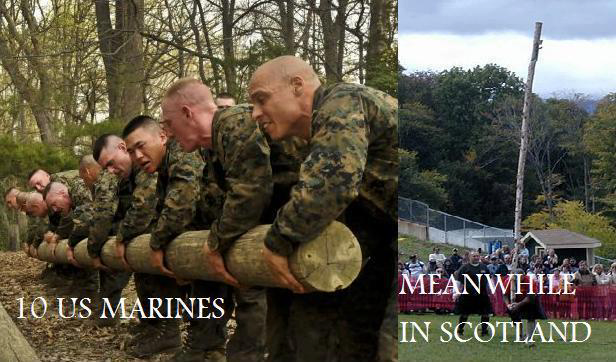
Delay for another few years? Even though this is the most likely event, Scotland would not be Scotland if it stopped without a massive fight, considering that one Scotsman tends to toss a log that requires 10 US Marines to carry is not a nation that whinges at the first hurdle.

So what if it uses the UK coin for now? Is that such a large issue, as Scotland grows its independent economic power? Consider this final quote from the article “They were already different, he said. Excluding oil revenues, Scotland had an average trade deficit of 11% over the last 15 years, which became a trade surplus of 2.7% if a geographic share of North Sea oil was included”. So the grace of Scotland is their oil reserves and what happens afterwards? This needs to be tackled first, because if Scotland is to avoid falling apart in the first setback (oil issues being just that when it happens), then Scotland must take care of its 11% deficit. In my view, that deficit must be turned to a 3% surplus (without oil) for Scotland to be a contender at the Commonwealth table, so how to go about it?

First it needs to change its political look on matters (not change its politicians). I will admit that the next part will sound a little dicey, but please hear me out. The headline “Scottish Tory leader Ruth Davidson: ‘I’m quite a cussed person’” (at http://www.theguardian.com/theguardian/2014/aug/15/ruth-davidson-interview-Scotland-tories-leader) reads nice, but there is a massive issue when we read the first part “Ruth Davidson is 35, a working-class Glaswegian, a kick boxer and a lesbian. Are these unlikely credentials just what the party needs to rescue it from 25 years of stagnation?” Why was there a reference to her Lesbianism? I personally do not care what her life’s choices are, truly I do not. But is this a political lesbian or a lesbian politician? Why could she not have been just a conservative? Did we see a headline on “Gordon Brown is a 63, working class sport less hetero sexual” Did we ever see that headline?

It seems that Ruth Davidson has supported state-funded Roman Catholic schooling in Scotland, and she also seems to believe (as far as I could tell) that the Church of Scotland should open its own faith schools as well, which seems a decently pragmatic approach to the ‘dangerous’ controversy called ‘Churches in the UK and Scotland’.

Because she is only 35, her most important events and achievements are still in front of her. She could be the inspiration the Scots need. Time will tell whether this is so. Yet there are issue with this article, there is little on her stance in regards to Scottish independence. If that is next on the agenda, should Scottish Tories not be outspoken about her views in that future? It seems to me that the journalist doing that interview kept the interview way too shallow, especially in this day and age.

There are a few other issues, like Ferguson, the last of the Scottish shipbuilders to shut down, so where are the economic options for Scotland, when we ignore oil. You see, I have nothing against the oil, yet the fact that a new nation will be totally dependent on only ONE product, such a place would need to have several alternatives if something went wrong there, so that is why it should not rely on the oil industry.

As a solution, I still believe that India has options here. As the Indian generic pharmaceutical industry grows for Europe, it will need alternatives for both manufacturing, shipping (read distribution) and perhaps to a smaller extent research. Whilst everyone seems to stare blindly to London area’s where prices are through the roof, Edinburgh offers a much cheaper and no less sturdy solution. Its harbour would allow for direct access to the Netherlands (Rotterdam), which would then grant access to Germany and Eastern Europe, there is access to Scandinavia as well as the option to nurture South American trade routes. All of them are markets that India could become the main supplier to.

It could change the Scottish deficit from 11%, to less than 3% in one blow, once the South American routes are a given, the deficit would turn to surplus. The stronger the growing need for generic medication, the more powerful this branch will grow in Scotland. After that, the tax breaks this industry could have would turn the UK into a much stronger market making for an entirely new dynamic in the pharmaceutical economy. Am I overly optimistic? Perhaps a little, yet so far, my predictions have held up and the current course is not getting us anywhere. It only takes one innovator to truly change the game, Scotland is roaring to be its own wielder of futures and India is roaring to be master of generic medication. Two innovators, a match, which is definitely not made in heaven, but as both want to make it work, the created future could be one that stands long and tall.

But is that with or without an independent Scotland? This is where the shoe starts getting a little tight for the dance floor. I personally do believe that this is not the best moment to become independent. I do believe that for now ‘better together‘ is the way to go. Consider the despair when Scotland does go it alone and within 24 months, both Japan in full and US in part become insolvent? I still believe that the US course is one that will sink its future, especially as the mention of well over 500 billion in undocumented spending in healthcare could set America well over the 18 trillion mark (the fact whether the healthcare billions were part of the deficit could not be confirmed), which makes for a dangerously unstable situation. So whether these facts stop Scotland from going independent is to be determined, yet that should not stop Scotland to become a lot more autonomic in growing its economy into the strong version it requires when the Scotland becomes one independent nation under this sky within our large Commonwealth.

Whether in the end there is a yes or no to independence, the fair question remains how to grow the Scottish economy, which will be a good thing for the entire Commonwealth.


Leave a comment

Filed under Law, Politics