Tag Archives: Whiskey

Never American

That is the setting we are given and it starts with (that nasty Canadian) CBC. I merely added the TNC mention so that the people in the United States see what I am talking about. It all started yesterday when I was given (at https://www.cbc.ca/news/business/buy-canadian-movement-coming-back-9.7321802) ‘Consumers say ‘resolve is strengthened’ to buy Canadian, bringing patriotic shopping movement back to life’ and I am not surprised, whilst that person (an apparent joker) named Jamieson Greer wanted dairy access and booze access for American to Canada. I already states (I think it was last week) that this access does not guarantee that the Canadians will buy it and behold, we see “Since the U.S. first imposed tariffs on Canada in early 2025, Francine Piché has made a point not to buy American products. “The rule in our house,” said the Burlington, Ont., resident, “is Canada first, non-U.S. second, and never American, if we can avoid it.”” And there you have it from the mouth of an Ontarian (who now has to allegedly swim in Lake America) Never American. 
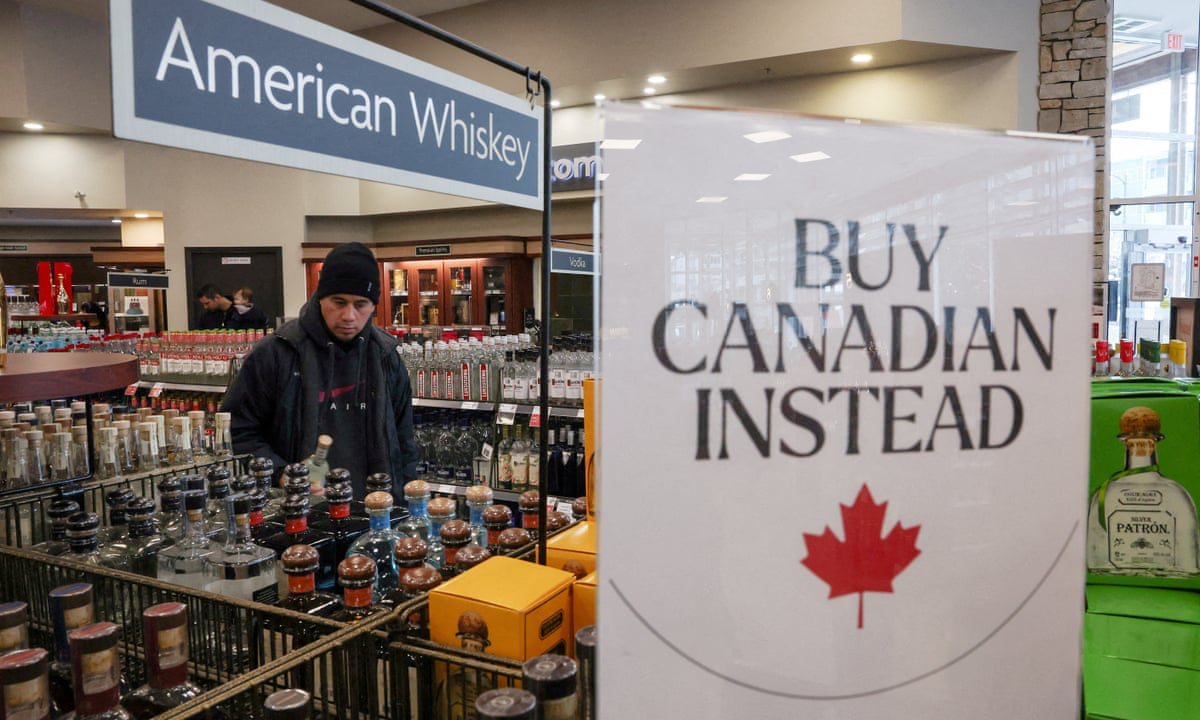
And when we get to “Piché has switched her personal care product brands, cancelled her Amazon membership and abandoned plans for a trip to New York in an effort not to give her dollars to the States, except when she can’t find another alternative.” You will see that the impact is a lot worse than some people think it is. So whilst tourism is in partial denial that there is an issue, over 75% of all Canadians went to the USA in 2024. This was settled in an unconfirmed way into ‘Canadian travelers spent roughly US$20.5 billion and supported 140,000 U.S. jobs’ as such the job market is taking a beating, billions that went into the USA is now going into the EU, the Commonwealth  and the gulf States. You still think I am beating around the bush? And for the booze section, as the Commonwealth has several options. Rum from Bundaberg, Gin from London, Vodka from Sweden, Whiskey from the UK and Scotland, as such when we see that “U.S. distilled spirits exported globally reached $2.37 billion in 2025, with major markets including the European Union, the United Kingdom, and Australia” I reckon that these three importers will now take the largest part of the American export share. So when we see more billions in sport being denied from the United States, the message becomes clear. We have had it with the administration of the United States and don’t think that it ends when someone kicks him out of the White House, this will take the better part of a decade to fix and there is no real expectation that it is going to get better any day soon, so when the tourists are gone and the booze is no longer accepted, what do you think will happen to what was at some point called ‘the land of the free?’ It is shackled to a burden that no one ever wanted. So when you get to the small stuff (like Approximately $41.6 million of maple sugar and maple syrup was exported by the United States in recent international trade data) how much is left after this is settled that people will prefer Canadian? So when Australia, the UK and other commonwealth nations will exclusively import from Canada, the larger setting is reached. And whilst I advocated for Tourism to abandon the United States, the larger groups of goods from the United States should be rejected from 2027 onwards. So there goes the economy of Vermont and Maine. As we see this happen, we need to take heed of another setting that the Conversation  gave us. (At https://theconversation.com/why-the-us-canada-trade-war-could-change-how-american-farmers-grow-their-crops-for-years-290504) where we see ‘Why the US‑Canada trade war could change how American farmers grow their crops for years’ and important section might be overlooked by a lot of people. Until yesterday I was not aware either. You see “Canada’s list includes dairy products and agricultural equipment, and there is an unspoken threat that it could expand to a crucial component in fertilizer that U.S. farmers rely on. I have studied agriculture and water quality for more than a decade, including whether trade rules change how farmers manage their land. In my assessment, the enduring effect of this trade war on U.S. agriculture, if it continues to escalate, won’t be a single bad season. Across thousands of farms, farmers may have to reduce their fertilizer use as prices – already high from supply disruptions because of the war in Iran – rise. It may have little visible consequence at first, but the lasting impact could emerge later in smaller future harvests if this trade war continues.” Do you have any idea what happens with a population when these harvest settings are thrown in turmoil? My father lived through the settings of hunger in WW2, the impact that it had on the population was enormous. Although, some will say that the female population was near 100% size zero, it is no way healthy and that is the setting that the United States has coming towards them, that is beside the point that the tariffs on power could trow the settings of this coming winter into a much larger state of animosity. I reckon that the Trump family will be a lot less safe in New York from 2027 onwards, New York largely relies on power from Canada, not to mention a few other states. Even states like California get part of their power through Canada. I guess that when power on the tariff that it fees, Hollywood productions will shut down really fast. All revenue lost and lets not forget the one anchor that comes every year the interest and it is now set to approximately $1,200,000,000,000 and as the setting is reduced to the United States, that bill will take on the shape of a behemoth. So whilst we get denial (through the CBC) where we saw ‘Trump’s top trade negotiator disputes Canadian assertion that U.S. made last-minute demands’ we can think that he lied, what is likely to have happened that he tried to slip in small settings on day one and when they come to the surface at the end of the talks, Ottawa pulled the plug on it all and as I see it, Canada isn’t the needy one, the United States are with their reduced revenue and increased interest payments. Canada has options and as I see it, the United States had to play a very different game here, but it is likely that the playbook Jamieson Greer was working with what handed to him by the White House who is great at bankrupting business, but not so good in maintaining a decent revenue setting and we are seeing this all over the field.

So whilst some say I am a doom speaker, consider that I have been making mentions of these elements for months and now that they all come to bare (not bear) at the same time, we will see politicians crying on how nasty Canada is. Well, they haven’t seen anything, because as the entire Commonwealth comes to the support of Canada the game changes and I was kind enough to hand the UAE and Saudi Arabia options for tourism and there’s more to come soon enough. So whilst some fake AI give you that “Total travel spending in the United States is projected to reach $1.42 trillion in 2027, marking a steady 3.4% growth from the previous year” all whilst the world is rejecting what the United States has to offer, so as you consider how fake the AI has become. This level of AI can only work with data it has and when it is fed preconceived data? The old GIGO law comes into effect (Garbage In, Garbage Out). A setting that was clear in 1984. 

Have a nice day you all and consider that these settings are of American makings. 350 million people make sure that Trump was elected president, take that in your pipe and smoke it, and when the infrastructure collapses, make sure you look in a mirror, because for over 50% of all Americans that is where you see the guilty party.
Leave a comment

Filed under Gaming, IT, Media, Politics, Science, Tourism

It’s not the smell

During today’s pre-morning (last night) I was alerted to a story on the BBC (at https://www.bbc.com/news/articles/ckglnk6yxlko). Now, I get the sentiment, but there is something off about it all. 

It is about Bourbon and the headline gives us ‘How Kentucky bourbon went from boom to bust’ and we get a few issues in this article. But first (famous last words). I am not a great drinker. I have a sip every now and then and my personal favourite is Cognac XO. I am driven towards Martell or Hennessy. I had a Cognac booklet on Cognac Brands at some point and these two were set to 95.2 and 95.1 (I honestly forgot which got which) there was also a brand (forgot the name) that scored a little higher (around 97.4) and it was almost twice the price. I had one glass and I could not tell the difference and why pay twice as much when my tastebuds cannot differentiate? So I kept to these two and budget driven as I tend to be, the cheapest of the two. Beyond that I drink Rum, Glenfiddich single malt and the last bottle of Rum I bought was three years ago and I still haven’t finished the bottle. So, you can say I am not much for drinking, but I am not anti-alcohol (except when driving a car). 

So what gives?
We are given the quote “President Donald Trump’s global tariffs have been the final straw. The EU has announced retaliatory tariffs against US goods, including Kentucky bourbon and Californian wine, although implementation has been delayed for six months. Meanwhile, most provinces in Canada have stopped importing American alcoholic beverages in retaliation. The country accounts for about 10% of Kentucky’s $9bn (£6.7bn) whiskey and bourbon business.” And to this (in part) I say ‘Yay Canada’ but that is not the part that ‘bothers’ me. The response was nice to read, but it wasn’t it either ““That’s worse than a tariff, because it’s literally taking your sales away, completely removing our products from the shelves … that’s a very disproportionate response,” Lawson Whiting, the CEO of Brown-Forman, which produces Jack Daniels, Woodford Reserve and Old Forester, said back in March when Canadian provinces announced their plan to stop buying US booze.” (That will teach yanks not to mess with our Canadian brethren and the BS quote of “Canada would make a great 51st state”) The issue is seen down the article. It starts off with:

It is the setting I gave above. What business model is set to “The country accounts for about 10% of Kentucky’s $9bn (£6.7bn) whiskey and bourbon business.” To set the stage where one country is responsible for 10% of its revenue and we see businesses go into receivership. That part does not make sense. As I see it, there are more places where US drinks are starting to get banned, or the reason of bankruptcy is not what we read here. So where one country stops drinking and we see the setting of a ‘bust economy regarding Whiskey sours?’ Perhaps not the most eloquent setting, but the stage seems to be ‘rigged’ in some way.

So as we are focussing on the smell, I will ‘plagiarize’ Shakespeare and hide behind William’s  quote “Something is rotten in the state of Kentucky” There is a chance that these distillers were barely making the revenues and that is fine. But for one nation (named Canada) to have this big an impact all while we see drops in revenue around 10% does not make sense to me. I reckon that America needs to ‘embrace’ its local product and not hide behind the sour grapes from France (ok, that’s funny).

I am not a drinker, but I know what I like and it is a distinct taste and it includes bourbon, which I haven’t drunk in years and at present I support my Canadian brethren (sisters too) and I stopped buying American Drinks (sorry Ryan Reynolds) for now. Fortunately for me Cognac is French and Glenfiddich is Scottish, so for the next few years I’m good. 

Did anyone else pick up on the skewness of this setting? And if we are not given the right parts in this equation, what else in America’s economy is not sounding right to you?

Anyway, I am now 240 minutes from breakfast, but whose counting? Canada has its own versions of Whiskey, Rum and even a butter tart vodka. So look hard and you’ll find a reason to support Canada, so Commonwealthian’s unite.

Have a great day and consider Rum from Quebec (just learned about this, I never knew).

Leave a comment

Filed under Finance, Media

About that drink?

It has been a week now and I have to wonder how paranoid the week had made me. You see, the revelations of Natixis and how large its financial power is, still boggles the mind for now. This also has a lesser effect on my sanity. Whenever I see any political ‘advice’ from a bank, I wonder whether there is a Natixis link and for the top banks they are all linked. So, when I saw the article of the RABO show up, I just had to wonder (at http://www.theguardian.com/business/2014/sep/16/scotch-whisky-scottish-independence).

So, how does yesterday’s news affect Scotland? Well, the issue now is how trade affects a new nation when it becomes independent. The first issue is “Whisky is Scotland’s second-largest export behind oil and gas and is worth £4.3bn a year to the local economy, but sales could be hit if the country loses access to the EU’s free trade area and to markets in the rest of the world where Brussels has forged trade deals“. First of all is that information true and/or correct? You see, we the people (most of us) want to drink Whiskey and real Whiskey comes from Scotland. If it does not come from Scotland, it is called bourbon (at http://www.woodfordreserve.com/)! The rest tends to make it to the menu as an ‘alternative’, as some might say.

So, should we have a go at the Rabo?

It is never a bad idea to have a go at a bank, but they do have a point here. What is a major issue is the fact that we see these 11th hour messages, of feigned pressure. Why is Scotland (if they select independence), not immediately allowed a temporary membership into the trade agreements the UK is already a member of? The quote “A new Scottish government would face ‘a mountainous task’ in striking trade deals beyond Europe. Scotch is exported to about 200 countries, with major markets in the US, Singapore and South Africa, while Chinese consumers are also getting a taste for it“. You see, this article sounds nice, but the term ‘Chinese consumers are also getting a taste for it‘ means that if they get the bulk of the shipment, European customers will not be happy at all. Instead of embracing a new European adult as it left the arms of mother Britannia is just good business. Legally seen, the Rabo is absolutely right; Scotland will be its own master now and as such will have to apply for trade agreements. Yet, if we look at several sources, we see that the US is the number one destination and Singapore (with all over Asia) is on number three, if these two markets could be ‘enticed’, we would see a shifting balance. With France in second place, Spain in fourth (but due to economic issues decreasing vastly and Germany in fifth position, we see a market in motion. The spirited market is not an easy one and the Chinese changes on ‘gifts’ would also hit the drinkable gifts department and as such Whisky will get a painful dip. So, is there an option for the golden juice of the highlands? I believe that if an economy is truly about improving then this unique situation should receive its own merit. The BBC view (at http://www.bbc.com/news/uk-scotland-26987262), which they made last April shows that this ‘stalling’ need is partially on economy and partially on events and none of them are linked to the independence of the Saltire.

But I am also a person who needs to take a step back. The issues for Scotland are not small and several are out in the open, but these issues should have been resolved or at least addressed to some extent long before the vote was days away. When I looked at the initial facts and wrote the blog ‘The cradle of Whiskey‘ the issues discussed and read from both Professor Sir Donald MacKay and Ronald McDonald show no issues on trade agreements whatsoever. With their golden ambrosia so high on the export list, I feel uncertain why there was no more visibility on this. I do not remember seeing it on any decently regarded news site. Now in the 11th hour a Dutch bank comes with this? Is this intentional demoralisation or is this a case of clear cut evidence that Scotland is not ready to be independent? I remain on the fence. I have been in the ‘stronger together‘ camp for several reasons, but that has always been for pressure from outside economic issues. This is a first clear internal reason for not going independent.

So, as we see the articles piling up in the papers in the UK, the Guardian foremost, how come that several serious issues did not get the forefront until now?

It is nice to see quotes like “Alex Salmond urged tens of thousands of yes activists to ‘get to it’ by seizing the extraordinary chance for a “new dawn for Scotland”, as the final batch of polls before the vote confirmed the referendum hung on a knife-edge” (at http://www.theguardian.com/politics/2014/sep/17/scottish-independence-alex-salmond-david-cameron-resign), yet the issues of trade as well as the 11% deficit Scotland could face in year zero are no laughing matters. There are other issues that come to mind too. What happens to Scottish students in tertiary education? What of their international placements? If we look at the legal ramifications of trade, then we should also look at any long term plans that were there for the Scottish students, if they fall away, then Scotland will soon face economic bashing on more than one level. It is possible that these issues were looked at, yet the guardian piece as the Rabo bank is quoted implies that these matters seem to have been ‘stalled’ until after the elections, yet this impact has not clearly be shown on several fronts, which beckons the question, ‘why not?’.

Forbes have been active too (at http://www.forbes.com/sites/chriswright/2014/09/15/if-scotland-goes-a-mistake-as-big-as-the-great-depression/), they are showing other sides that did not make the news in several ways. One massive point is one that has definitely been kept from the Scottish voters: “Deutsche says the symbiotic relationship between Scotland and the rest of the UK is older and deeper than the Yes camp dares to admit. Five, it says that the idea of replicating something like Norway and Denmark – similar population sizes, links to oil (particularly in Norway) – is disingenuous. Norwegian oil and gas fields are deeper and expected to last much longer than Scotland’s which are already in decline, and Norway has its own currency; Denmark’s economy is totally different, and has a better fiscal position”, so not only is Scotland depending on oil, which still keeps them 11% in deficit, but the decline of their fields will soon become a more visible issue, then what happens? So, I remain in favour of Scotland becoming one nation (just not now), but in light of these mounting issues, we must ask the question, why is Alex Salmond not openly dealing with the issues we see here and as such, why are these facts kept from the voters?

This gets me to the final point and perhaps the only truly unacceptable view that the Guardian is giving us (at http://www.theguardian.com/politics/2014/sep/17/scots-final-call-rallying-political-engagement-votes). The headline “Scots’ final call: can rallying beneath the radar save the day?”, first of all, as this massive change hits 5.3 million wavers of the Saltire, this should be out in the open. Below the radar implies dealings for the benefit of a few, which is the one thing the Scots should not allow for. There is genuine anguish in the article as we see a few emotional turns, yet it is the end of it that should grip us all. “As Patrick Harvie, the Scottish Green party co-convenor, told Wednesday morning’s rally: ‘Nothing is going to be the same again, whichever way it goes.’”, I disagree,

I think that it is out in the open in new ways that Scotland is getting ready to be the new adult at the Commonwealth table, we the other members Australia, Canada, India and New Zealand should aid in setting in motion that transition, by allowing Scotland to sign trade agreements with all the perks of growing their economy to become solid. In addition, I still believe that India could be a large key player here, as I stated in my blog ‘the Cradle of Whiskey’ on the 16th of August. “As a solution, I still believe that India has options here. As the Indian generic pharmaceutical industry grows for Europe, it will need alternatives for both manufacturing, shipping (read distribution) and perhaps to a smaller extent research. Whilst everyone seems to stare blindly to London area’s where prices are through the roof, Edinburgh offers a much cheaper and no less sturdy solution”. This could still be a long term option for Scotland and if there is any truth in the statement that Scotland’s oil production was in decline, it is no longer a maybe, it is a given and an essential step to get several industrial changes going as well as opt for a few new ones. We just need to make sure that those ‘new’ players are not coming in under the flag of ‘friendship’ whilst collecting under the banner of greed, because that will never be a solution.

We have looked at shortages and surpluses for so long; it is time to see how those two can be connected to find the balance leading to progress. There has however been too many drum beating under the ‘honest’ statements on how bad it all is for others and how bad it is for Scotland, even the IMF weighed in on that. I think these people were slightly off the boil and I feel that the wording in Forbes was better, more sincere and a lot more correct “But if it happens, economies and investment patterns will adjust as they always have done. Deutsche is right that there are greater challenges facing the Scottish economy under independence than most people there have probably understood. But the idea of national pride is a powerful one, and some people are prepared to compromise a great deal to achieve it”. This is definitely true and it feels more sincere. It also seems to indicate how ‘flawed’ David Folkerts-Landau was when he stated “A ‘Yes’ vote for Scottish independence on Thursday would go down in history as a political and economic mistake as large as Winston Churchill’s decision in 1925 to return the pound to the Gold Standard or the failure of the Federal Reserve to provide sufficient liquidity to the US banking system, which we now know brought on the Great Depression in the US”, is that true Mr DFL? (the fact that he was stated in the Urban Dictionary was just a coincidence). We could see him, not as ‘flawed’, but as ‘shoddy’, ‘scant’ or ‘lacking’, but I leave that up to the readers. There were several issues involving the Great Depression of the US, and gold was there too, yet it was the inaction of President Herbert Hoover that were at the centre of this, he did set up the groundwork that led to the acts by President Roosevelt that would create the new deal and fix a lot of the issues that were around then. Now, as economies are a lot more intertwined the issue of trade pacts and the delay in signing up nations seem to be at the centre of this, so as Scotland ends up in the ‘stronger together’ field, we must acknowledge the need for change, the need for an independent Scotland, it is a side of freedom we all deserve. Is it so bad to help our sibling into becoming the stronger partner? That is what I find missing at the core of all the newscasts, the option to enable Scotland to become independent, preferably when economies are moving in a better direction, as to ensure the long term health of the land below the waving Saltire.


Leave a comment

Filed under Finance, Law, Media, Politics