
We all hope to make certain milestones, some through fantasy, some through luck and some through anticipation. Your first threesome, the moment you joined the mile high club and for governments they have their own achievements, for example when they join the 100% debt club. So when we realise that Japan has well over 200% of GDP in debt, the US has passed the 100% marker and it joins those they looked down on for the longest of times. Italy, Iceland, Granada, Eritrea, Greece, Jamaica and Lebanon, all members of that 100% debt club, so when we see the Arabian Business (at http://www.arabianbusiness.com/politics-economics/395741-100-debt-club-set-to-get-new-member-from-oil-rich-gulf), treat us to the facts that Bahrain will soon join Libya and the Sudan as their debt exceeds their 100% GDP. We see more and more messages at present and even the IMF is setting a different atmosphere. We see part of that in equities.com. There we see “IMF (Page 10): Against a backdrop of mounting vulnerabilities, risky asset valuations appear overstretched, albeit to varying degrees across markets, ranging from global equities and credit markets, including leveraged loans, to rapidly expanding crypto assets.
MY TRANSLATION: In the last two major bubbles, the problems were mostly contained to dot-com stocks and housing. That is 100% not the case now. Almost every single asset on the planet – from stocks to bonds to loans and more – is wildly overpriced. There is zero room for error with prices at such dizzying heights“. This is merely one setting; the field is expanding on a larger field and in all this, the nations that are passing the debt bar. France is set at 99%, so if they cannot contain the debt growth they will pass it this following financial year, leaving only Germany as one of the four large economies that is in a containable situation and there is where we get a partial ‘I told you so!‘ You see I wrote on part of this 5 years ago. (at https://lawlordtobe.com/2013/05/15/a-noun-of-non-profit/), I made a reference in regards to Brexit, but the setting of it all was a lot larger than merely Brexit. So as you get to contemplate “Consider a large (really large) barge, that barge was kept in place by 4 strong anchors. UK, France, Germany and Italy. Yes, we to do know that most are in shabby state, yet, overall these nations are large, stable and democratic (that matters). They keep the Barge EU afloat in a stable place on the whimsy stormy sea called economy. If the UK walks away, then we have a new situation. None of the other nations have the size and strength of the anchor required and the EU now becomes a less stable place where the barge shifts. This will have consequences, but at present, the actual damage cannot be easily foreseen. Any claim that there is no consequence and they predict no issues, remember this moment! The Barge (as is), will lose stability and the smaller members thinking they are on a big boat are now thrown left to right then left again as the storm rages on. The smaller nations will get damaged and in addition, the weaker ones (Cyprus and Greece) could still collapse, especially if the UK takes a non EU gander“, this was predominantly regarding Brexit. Yet the implications are larger as I stated. The UK is taking on Brexit and now we see that the German anchor it the only anchor giving some stability, the UK is taken away, Italy has lost its footing as it surpassed the 100% debt and now France is pushing that boundary as well. All because it was easier to play the popular fool than taking a hard stance on their debts, France is not alone, Italy and the UK are all there, the smaller ones have no options to give strength to the large 4 and as the UK figured out that going it alone is much better for the economy, we see a dangerous setting.
Even now, when we merely consider Spain in all this (not the smallest economy), we see (at https://www.southeusummit.com/europe/spain/spanish-economy-returns-grade/) that Standard & Poor’s is still playing (what I personally see) as ‘their little game’. Perhaps you remember ‘S&P reaches $1.5 billion deal with U.S., states over crisis-era ratings‘ (at https://www.reuters.com/article/us-s-p-settlement-idUSKBN0L71C120150203) the one quote (one of many) needs to be considered “S&P parent McGraw Hill Financial Inc MHFI.N said it will pay $687.5 million to the U.S. Department of Justice, and $687.5 million to 19 states and the District of Columbia, which had filed similar lawsuits over the ratings“. So when I see “S&P notes that Spain’s overall economic and budgetary performance has not been hampered by political tensions in Catalonia, as many had feared. The country’s GDP increased by 3.1% in 2017 and last week the Bank of Spain raised its economic forecast for this year to 2.7%, up from a December forecast of 2.4%“, you see, the numbers are not really in question, yet when we see the image below (source: Trading Economics).
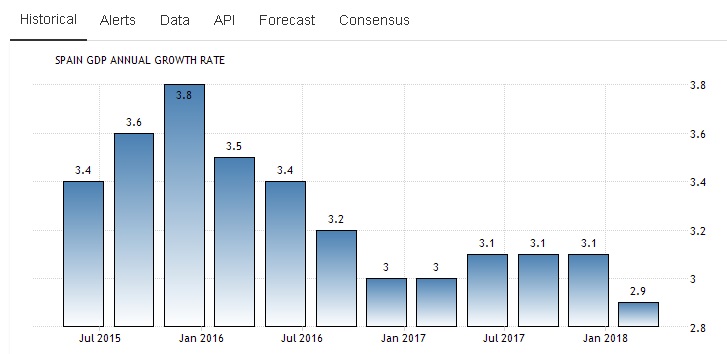 When we realise that none of the EU nations has a grasp on their debts, in addition, the GDP for Spain went down whilst it is still below the numbers of 2016 and before, there is actually no reason to see the credit rating for Spain go up. I am personally speculating that the EU will be so much more hardship when France hits the 100% debt marker. It matters, because this will soon become the academic exercise that the question: ‘What is the difference between cooking the books and creating a false positive wave through inflated credit scores?‘ I actually do not have the answer here, but I guarantee you that the quality of life in Europe is not moving forward any day soon, not until some issues are seriously reconsidered. In addition, the US-China trade war isn’t helping anyone, not even the Europeans so that will also become a factor of debate soon enough. It partially relates to “We have revised upwards our GDP forecasts, with an intense rate of employment creation and an economic model based on the external competitiveness of our companies. With this scenario, we will achieve our objective for 20 million employed people by 2020“, the issue is that it is misrepresentation, you cannot rely on the unemployment figures and then state we will have 20 million employed, because on a population of 46 million, he might be implying that the unemployment numbers will skyrocket from 17.4% in 2017 to 56%, that would be crazy, yet that is what we are told, is it not? The best lies (read: miscommunications) are done through statistics, so that the feather matches the bird one would say. Still, back to my speculation, I believe that Spain is not the only nation in this setting; I think that some numbers in pretty much every EU nation are beefed, weighted and set to make Europe (or basically themselves in the European setting) look much better, so when the UK leaves they will not look as weak and feeble as they have actually become. It is a setting that is way too dangerous. There is no way that Mario Draghi is not part of this, so when we look at the Financial Times of last week we see ‘Mario Draghi acknowledges ‘moderation’ in Eurozone growth‘ (at https://www.ft.com/content/3e20b49e-4939-11e8-8ee8-cae73aab7ccb). So with “Analysts said that Mr Draghi’s guarded language suggested that the ECB may wait until July — a month later than previously expected — to provide the markets with updated “forward guidance” on its plans to phase out the crisis-era stimulus“. I am a little less optimistic in regards to the quotes, and when we see ““Better safe than sorry was the motto of the day,” said Dirk Schumacher, economist at Natixis“. I personally tend to see that as:
Better safe than sorry
It allows for another day without worry
As we pile the worries and woes
To a stack we can blame on crows
Those at the London Tower are best
Because when they leave the EU we can make them the jest
And when our barge is no longer secure
We move to Wall Street where we can endure
You might think that I am merely making light of all this. The issue is that people in Europe seem to ignore that over €2,000,000,000,000 was printed without the validation of treasuries or consent of the people whose funds got devaluated even further. Do you think that printing money has no cost? It is money that the EU never had, so why did you think it came without consequence?
This partially (and I mean partially) is seen in different ways when we look at an article from Reuters merely two weeks earlier (at https://uk.reuters.com/article/uk-ecb-policy-draghi/stock-volatility-no-big-factor-for-ecb-so-far-draghi-idUKKBN1HG1VR) ‘Stock volatility no big factor for ECB so far – Draghi‘, now I agree that volatility will come and go, so the ‘so far’ part is perfectly fine. When we see ““While we remain confident that inflation will converge towards our aim over the medium term, there are still uncertainties about the degree of slack in the economy,” Draghi said in the ECB’s annual report“, now I can agree with that. There will always be a certain amount of uncertainty, that is all good, no issues there, but it is set on a certain premise. When we see that Spain (the only visible one) suddenly in opposition of what I see as real has its credit score increased and as such we see the start of an optional bubble, when others do the same we see the forecast on unreal values, so we see the bubble is not set to the reality of the actuality, at that point, when a lot more start realising that some numbers do not make sense, the uncertainty grows and the closer the UK is to leaving the stronger that uncertainty becomes. At that point we see a run and a total collapse, when that happens, when the people realise that pensions before 78 is no longer optional, do you think that the people will remain calm? When they realise the impact of €2 trillion printed cash is impacting the 26 nations, how much value decline will they face? When that happens, how will people react in all this? Now we get to two elements, one is the mention in the Financial Times where we see: “But the weak economic data for the first quarter have triggered increasing speculation that the first interest rate rise will be delayed until later in 2019. A smaller number of analysts are expecting the bank to continue QE into the new year“, the second is that the entire stimulus was to set the economy right, which did not happen, now set that against inflated credit scores, inflated economies and the downturn that follows, that will happen, it can no longer be contained, merely delayed to some extent. When it does hit Europe would not have a penny left to balance against and it will leave the bulk of Europe destitute. There would be no defence against the next downturn and that is when disaster will truly strike. So as the story is pushing towards ‘protectionism’ and ‘patent values’, we should also consider that impact. Now, as a University graduated Master on Intellectual Property rights, I do comprehend some of the issues, yet I am not a patent attorney, so there are parts that I will ignore or not look at. Consider that a national economy is now more and more dependent on the national patents and the represented value that they hold. Now we get European Patents, the Unified Patent Court (UPC) allows for a simpler way to get it all registered and to some extent enforced. So it is a good thing overall, there was never too much fuss about that side, yet the one strong economy (Germany) is now setting the stage to oppose the UPC, we see this (at http://www.ippropatents.com/ippropatentsnews/europenewsarticle.php?article_id=5725), where we also see “Alternative für Deutschland (AFD) has called for the repeal of the convention on a Unified Patent Court (UPC). AFD “rejects the EU patent law reform”, according to the German Bundestag, which announced the motion on 7 March“, I believe that overall the UPC is a good thing, but there will always be small interests that are not perfect, no EU setting is 100% positive, yet overall, to get one filing for all EU nations, in light that even the UK agreed (and ratified) is a good thing. So when we see “It was based on three grounds, mainly how the UPC Agreement violates EU law, the majority requirements of basic law, and does not comply with the rule of law principle related to judicial impartiality. The complaint was scheduled to be heard in 2018 by the second Senate, appearing as the 11th item on its agenda. In Germany’s 2017 federal election, the AFD won 12.6 percent of the vote and received 94 seats, the first time it had won seats in the Bundestag“, there is an academic setting, yet with 12.6 of the council in hands of the AFD, a very Brexiting minded party, or is that Berlout or Deutchleave, we need to realise that the patent issue is a lot more biting in Germany and that cannot be ignored, as they give rise to uncertainties. So when we get back to the uncertainty there, as well as other uncertainties, and whilst we saw Mario Draghi accept that uncertainty results in stagnation, how much more stagnations are required for the next downturn, even a short term one, whilst the economic reserves have been already been drained.
Now we have a much larger setting, the EU was never about everyone agreeing on everything and the economic setting that requires that to happen at present is also making the dangers of waves that sinks the barge called EU. Now, that seems like an exaggeration, but when you realise that the German anchor is the only one giving stability, you can see the dangers the EU faces and more important, the dangers of no reserves and an utter lack to keep proper budgets in place, a setting now in more danger for the reasons that I gave supported by the economic views of many others. I believe some are downplaying the impact, yet when we realise that EVERY European Union government is downplaying the economic impact (as every nation always wants to look as good as possible, which is a PowerPoint setting of the human ago) we get a much more dangerous setting. We accept that the smaller nations have a negligible impact on the whole, but on a ship that can only remain truly stable with four anchors, losing three is a much bigger disaster than anyone realises, and that downplay will hurt all the players that are part of the EU, so when the downturn starts, we will see kneejerk movements from all the nations, all the big players and we can only speculate the fear mongering speculations that the IMF will treat the European audience to. I have no idea what form it will take, but when it happens I will take a deeper look. In a setting where every negative economic milestone could lay waste to whatever reserves its citizens wrongfully thought they had in the first place.
 Lawrence van Rijn - Law Lord to be