
I was rudely awakened by something that suddenly hit me. You see, nothing in life is free, it is almost a given certainty, even the rising of the sun now comes at a price as we see it. So my brain woke up by the image I show you below
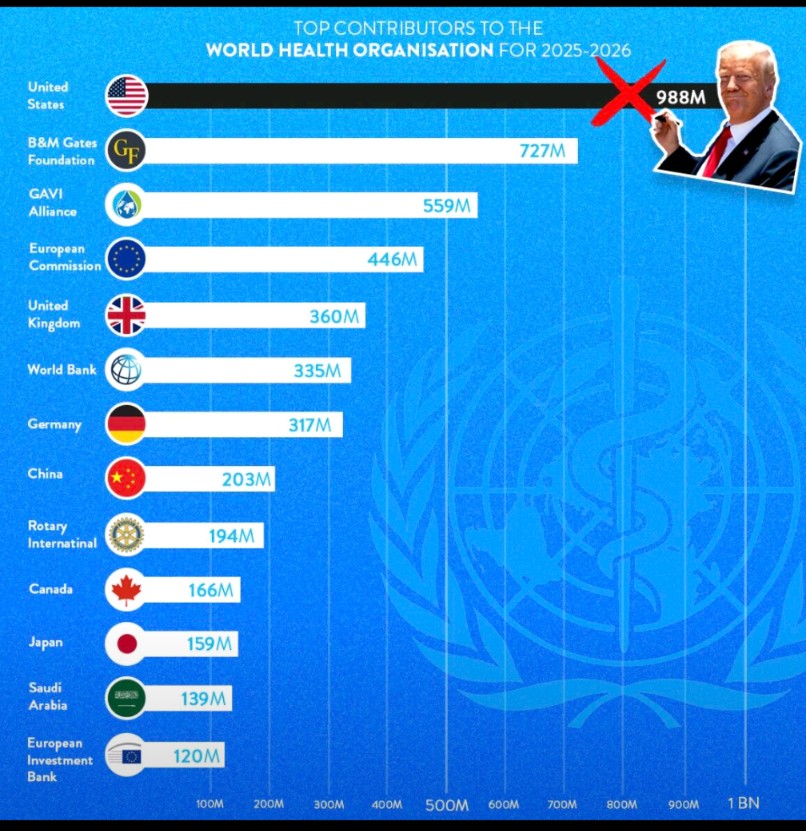
So, here we see that President Trump nullified its America contribution of 988 million dollars, but that money doesn’t come for free. I get that and I believe that the ‘hidden’ revenue is out in the open now. Consider that the World Health Organisation is ‘heralding’ the following “The World Health Organization (WHO) promotes comprehensive national medicines policies to ensure safe, quality, and affordable medication use. The “Medication Without Harm” initiative aims to reduce severe, avoidable medication-related harm by 50% globally, focusing on high-risk situations, polypharmacy, and transitions of care.” I am willing to bet the house that American pharmacies is pushing some rules to keep in business, as such it would be prudent that all these contracts are now null and void. President Trump opened that door. I am willing to be that Indian pharmacies are roaring to fill that place as such they would be starting a tremendous 2026.
Now lets be clear, this is pure speculation and I reckon that the White House will be shouting that these ‘donations’ were just that ‘donations’, but the world is a lot more complex and the thread unravelled will open up all ready seeking partners is revenue and America seemingly closed that door yesterday. Now we need to know and to find out what the 988 million dollars enable America to rely on and close that off, the media is no use here as they are mostly under control by American stakeholders. And they are suddenly worried that they have to reside in other corners now. The pharmacies who were ‘enjoying’ this speculative advantage is losing that advantage. They relied on the status quo and president Trump obliterated that. And as I see it, The World Health Organization (WHO) Model List of Essential Medicines (EML) contains over 350+ safe, effective, and cost-effective medicines for priority health conditions, the question is who is pushing these 350+ names, so what is involved? Those who create that list will have some order of importance as to the ‘origin’ of that medication, it is updated every two years to guide national health systems. The list, including the EMLc for children, covers essential drugs like antibiotics, painkillers, and vaccines, with the 2025 update focusing on diabetes and cancer care. But what makes that list? I am asking as I do not know and how many generic Indian pharmacies are involved? It is the largest nightmare for American pharmacies. So as some are ‘hammering’ the ‘policies to ensure safe, quality, and affordable medication use’ but President Trump just blew away that setting, as such the Indian pharmacies now get a way in. What a lovely setting the White House allowed for. As such I foresee that Johnson & Johnson, Eli Lilly, AbbVie, Pfizer, Merck & Co, Amgen, Gilead Sciences, and Bristol Myers Squibb are facing (a few) grey days now, perhaps not all of them, but some of them will and it is hard on the settings they now face as they are short in donations, about $988,000,000 short. And who exactly decides on “Medication Without Harm”? What are the foundational markers that make it medication without harm?
So this is pure speculation, but the easiest option is the greed track, it tends to go in foretelling ways and the foretelling way of greed is the easiest to read and to predict. But it also comes with the setting that I might easily be wrong. It is all set that America over the years have made demands for the $988,000,000 they are currently paying. If my premise is wrong, so is the viewpoint that I am creating here. So take care with accepting this point of view, because it is speculative and might be easily disproven, the question is, will it and is my point of view wrong? And if (a big if) I am right what will the American Pharmacies in 2026, 2027 and 2028 face? And if that is set, what more revenue will America be forced out of?
Have a great day today, time to see where the diner is coming from (answer: Rice and beads, with Salmon and hot sauce from my kitchen).

 Lawrence van Rijn - Law Lord to be