Tag Archives: Ronald McDonald

Ronald McDonald died!

Today’s event is not from the papers, not from some newscast and not from some special operations guide. This is just me, having a few dollars in my pocket and at some point I was hungry as hell. I needed some food, desperately. So, as I was passing by McDonald’s I made the bad call to enter that place, I had passed Hungry Jacks for the simple reason that the queue looked way too long there, it was lunchtime after all. Now, Macca’s was never the cheapest of places and when we take a look at their website we see that it is all about ‘the message’, it has always been about the ‘message’, but how should we react when we see their quote: ‘Quality ingredients for quality food’. The ingredients do not mention bacon, perhaps there are no quality requirements for bacon?

When looking at their menu, the triple cheeseburgers is not even mentioned, so again, perhaps there are no quality requirements for that ‘food option’?

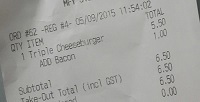
What brought this about? Well, as the images show, I ordered a triple cheeseburger and as I like a cheeseburger to have some bacon, I decided to add bacon to that order, added $1. Seemed a little large, but, I was hungry, so as the receipt shows, my lunch $6.50.  FoodReceipt
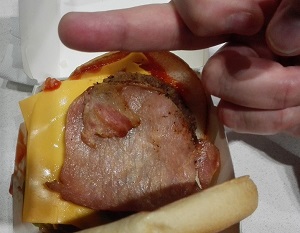
My lunch got served, here we have the kicker, look at the size of that….Whatever that was. Take a look, I used my middle finger, just to show how the burger is barely a finger long (honestly!) and we have to be fair and take the longest finger. So, even though it is called a triple cheeseburger with bacon, it looks like finger food, one finger squared, just one piece of finger food at $6.50.  Fingerfood

Now let’s take a look at the reality with the last part.

Take a look at that lovely bacon, a little less than $12 a Kilogram. Yes, all that bacon, whilst the piece shown in the previous picture is likely to be no more than 25 grams, so McDonald’s has a 400% margin (roughly) on bacon (likely more as they get a much better price deal then consumers do).  OinkyBacon

Now, for the most I have no issue with shops having margins, but consider that lately, we see an army of non-McDonald’s people make claims in many places (like the Huffington post) ‘Commenting in the New York Times Kyle Smith says that those opposing the idea of the McDouble’s nutritional worth, are ignoring the fact that it is great value-for-money for customers‘ (a 2013 article). Now for some cold logic, when a company offers an addition with a margin of over 400%, the idea ‘value for money‘ is something we can ignore from day one. In addition, when se see (at http://www.forbes.com/companies/mcdonalds/), stated to have a 92 billion market cap, with the ‘achievement’ #124 in Profit, we can again throw ‘value for money‘ into the wind. You see, value for money requires something to be well under 400% profitable to be allowed that title. I have nothing against Macca’s making money, for the most I never spend money there, so if others want to buy that food, than that is just fine with me. Value for money means a sizeable (or really cheap) portion. KFC with their deals lately (last month fries for $1 and this month 24 nuggets for $10), now that is actual ‘value’, not too nutritious, but still value. A burger the size of one finger squared is not good value, that is food at a higher price than the average tapas place would offer it (I consider Tapas to be actual finger food of decent quality) which is at times at least genuinely nutritious (as far as tapas can be nutritious).

You see, these ‘junk food vendors’ are now moving into another direction. Now we see a very dangerous development when papers, not just the Huffington post, where this quote came from (at http://www.huffingtonpost.co.uk/2013/07/30/mdonalds-mcdouble-cheapest-nutritious-food-in-history_n_3675128.html) state: “Junk food costs as little as $1.76 per 1,000 calories, whereas fresh veggies and the like cost more than 10 times as much, found a 2007 University of Washington survey for the Journal of the American Dietetic Association. A 2,000-calorie day of meals would, if you stuck strictly to the good-for-you stuff, cost $36.32, said the study’s lead author, Adam Drewnowski” You see, obesity and other problems tend to be caused by junk food, not by vegetables.

Professor Adam Drenowski knows this, hence it is my personal opinion that he has been misquoted in a massively unacceptable way. In his article ‘Obesity, diets, and social inequalities’ (attached at the end) we see “As incomes drop, energy-dense foods that are nutrient poor become the best way to provide daily calories at an affordable cost. By contrast, nutrient-rich foods and high-quality diets not only cost more but are consumed by more affluent groups“, in addition there is “given economic constraints, especially among lower income groups, not all consumers have the same degree of choice when it comes to purchasing healthful fresh produce, fruit, lean meats, and fish. For many, the choice was removed long ago by economic and employment policies“, which is what is at the heart of this (source: Wiley Online Library: Drewnowski, A. (2009), Obesity, diets, and social inequalities. Nutrition Reviews, 67: S36–S39. doi: 10.1111/j.1753-4887.2009.00157.x).

You see News Corp (at http://www.news.com.au/finance/business/mcdonalds-sending-profits-to-singapore-to-dodge-497-million-in-tax-according-to-report/story-fnkgdftz-1227361248667) stated that ‘McDonald’s sending profits to Singapore to dodge $497 million in tax, according to report‘, the quote “McDonald’s uses its franchising model to generate most of its revenue through royalty payments which are then siphoned off into offshore tax subsidiaries, the majority of which it does not disclose in its annual reports” should not be a surprise, yet is McDonalds to blame? In the end business is business and if the population is unwilling to pass Maccas by, do we have a right to complain? The additional quote “McDonald’s “operates an extensive network of subsidiaries in tax havens, the majority of which it does not disclose, and is not required to disclose under SEC rules, in its annual report”“, is all about the ’emotion’ but the reality is that McDonald’s is not breaking any laws! Politicians have again and again refused to close some of these loopholes. These are acts not achieved on both sides of the political aisle, which means that none of them get to sling any mud!

Which gets us to: ““There is no excuse for governments to cut public services like health and education when they let companies like McDonald’s shift billions of dollars in taxes offshore,” Public Service International general secretary Rosa Pavanelli said in a statement“, yet Miss Pavanelli seems to skate around the issue that until GOVERNMENTS close the taxation loopholes they have, large corporations can continue their ‘business as usual’. That is the part many players have remained silent on. Australian SBS ‘the Backburner’ (Australian version of the Onion) gave us the reality in another way. They stated “International fast food chain McDonald’s has defended its poor taxation record saying that it should be exempt as it does a public good of slowly killing the population” (at http://www.sbs.com.au/comedy/article/2015/05/20/mcdonalds-ceo-we-may-not-pay-tax-least-were-killing-you). This could be truer than we bargained for, especially when we consider the paper by Professor Adam Drewnowski. Still, McDonalds has not done anything wrong, or have they? OK, they did not break any laws (at present), as far as I can tell. Yet, questions need to be asked and it is time that certain issues are dealt with. You see, as I personally see it, our time is wasted by both politicians and the press. The article from last May in the Guardian (at http://www.theguardian.com/business/2015/may/05/mcdonalds-tax-avoidance-investigation-europe) gives us the quote “The European Union competition commissioner Margrethe Vestager said on Tuesday that she was examining claims, made by trade unions, that McDonald’s paid just €16m of tax on royalties worth €3.7bn between 2009 and 2013“, and only now this is investigated? In addition we see “Heidi Barker, a spokeswoman for McDonald’s, which on Monday promised to transform itself into a more modern, progressive and transparent burger company, said: “We will decline to comment on your inquiry.”“, invoking emotion against McDonald’s, yet nowhere do we see the statement: “The European Union is investigating required changes to the European tax system so that EEC governments will receive taxation due“. That part is missing in equal measure from most of the Commonwealth nations, which beckons the question ‘Who is serving who in the end?’ and why has it taken so long and so many administrations for any government to truly address it? Questions the press at large does not seem to be asking either, just hands us ‘emotional’ editorial on how evil a food place could be.

In addition, we should address one final part. It is the statement involving former CEO Jim Skinner (2004 – 2012) “However McDonald’s CEO Jim Skinner defended Ronald McDonald by saying that he is an ambassador for good and “it’s all about choice”“, so if it is about choice and the choice of McDonald’s has become exploiting maximised profit (which is not a crime), can we accept that the ‘original’ Ronald McDonald is truly dead and will the next McDonald’s clown we see be spotted wearing a Gieves & Hawkes suit?

I’ll let you decide!

Drewnowski-2009-Nutrition_Reviews


1 Comment

Filed under Finance, Law, Media, Politics

About that drink?

It has been a week now and I have to wonder how paranoid the week had made me. You see, the revelations of Natixis and how large its financial power is, still boggles the mind for now. This also has a lesser effect on my sanity. Whenever I see any political ‘advice’ from a bank, I wonder whether there is a Natixis link and for the top banks they are all linked. So, when I saw the article of the RABO show up, I just had to wonder (at http://www.theguardian.com/business/2014/sep/16/scotch-whisky-scottish-independence).

So, how does yesterday’s news affect Scotland? Well, the issue now is how trade affects a new nation when it becomes independent. The first issue is “Whisky is Scotland’s second-largest export behind oil and gas and is worth £4.3bn a year to the local economy, but sales could be hit if the country loses access to the EU’s free trade area and to markets in the rest of the world where Brussels has forged trade deals“. First of all is that information true and/or correct? You see, we the people (most of us) want to drink Whiskey and real Whiskey comes from Scotland. If it does not come from Scotland, it is called bourbon (at http://www.woodfordreserve.com/)! The rest tends to make it to the menu as an ‘alternative’, as some might say.

So, should we have a go at the Rabo?

It is never a bad idea to have a go at a bank, but they do have a point here. What is a major issue is the fact that we see these 11th hour messages, of feigned pressure. Why is Scotland (if they select independence), not immediately allowed a temporary membership into the trade agreements the UK is already a member of? The quote “A new Scottish government would face ‘a mountainous task’ in striking trade deals beyond Europe. Scotch is exported to about 200 countries, with major markets in the US, Singapore and South Africa, while Chinese consumers are also getting a taste for it“. You see, this article sounds nice, but the term ‘Chinese consumers are also getting a taste for it‘ means that if they get the bulk of the shipment, European customers will not be happy at all. Instead of embracing a new European adult as it left the arms of mother Britannia is just good business. Legally seen, the Rabo is absolutely right; Scotland will be its own master now and as such will have to apply for trade agreements. Yet, if we look at several sources, we see that the US is the number one destination and Singapore (with all over Asia) is on number three, if these two markets could be ‘enticed’, we would see a shifting balance. With France in second place, Spain in fourth (but due to economic issues decreasing vastly and Germany in fifth position, we see a market in motion. The spirited market is not an easy one and the Chinese changes on ‘gifts’ would also hit the drinkable gifts department and as such Whisky will get a painful dip. So, is there an option for the golden juice of the highlands? I believe that if an economy is truly about improving then this unique situation should receive its own merit. The BBC view (at http://www.bbc.com/news/uk-scotland-26987262), which they made last April shows that this ‘stalling’ need is partially on economy and partially on events and none of them are linked to the independence of the Saltire.

But I am also a person who needs to take a step back. The issues for Scotland are not small and several are out in the open, but these issues should have been resolved or at least addressed to some extent long before the vote was days away. When I looked at the initial facts and wrote the blog ‘The cradle of Whiskey‘ the issues discussed and read from both Professor Sir Donald MacKay and Ronald McDonald show no issues on trade agreements whatsoever. With their golden ambrosia so high on the export list, I feel uncertain why there was no more visibility on this. I do not remember seeing it on any decently regarded news site. Now in the 11th hour a Dutch bank comes with this? Is this intentional demoralisation or is this a case of clear cut evidence that Scotland is not ready to be independent? I remain on the fence. I have been in the ‘stronger together‘ camp for several reasons, but that has always been for pressure from outside economic issues. This is a first clear internal reason for not going independent.

So, as we see the articles piling up in the papers in the UK, the Guardian foremost, how come that several serious issues did not get the forefront until now?

It is nice to see quotes like “Alex Salmond urged tens of thousands of yes activists to ‘get to it’ by seizing the extraordinary chance for a “new dawn for Scotland”, as the final batch of polls before the vote confirmed the referendum hung on a knife-edge” (at http://www.theguardian.com/politics/2014/sep/17/scottish-independence-alex-salmond-david-cameron-resign), yet the issues of trade as well as the 11% deficit Scotland could face in year zero are no laughing matters. There are other issues that come to mind too. What happens to Scottish students in tertiary education? What of their international placements? If we look at the legal ramifications of trade, then we should also look at any long term plans that were there for the Scottish students, if they fall away, then Scotland will soon face economic bashing on more than one level. It is possible that these issues were looked at, yet the guardian piece as the Rabo bank is quoted implies that these matters seem to have been ‘stalled’ until after the elections, yet this impact has not clearly be shown on several fronts, which beckons the question, ‘why not?’.

Forbes have been active too (at http://www.forbes.com/sites/chriswright/2014/09/15/if-scotland-goes-a-mistake-as-big-as-the-great-depression/), they are showing other sides that did not make the news in several ways. One massive point is one that has definitely been kept from the Scottish voters: “Deutsche says the symbiotic relationship between Scotland and the rest of the UK is older and deeper than the Yes camp dares to admit. Five, it says that the idea of replicating something like Norway and Denmark – similar population sizes, links to oil (particularly in Norway) – is disingenuous. Norwegian oil and gas fields are deeper and expected to last much longer than Scotland’s which are already in decline, and Norway has its own currency; Denmark’s economy is totally different, and has a better fiscal position”, so not only is Scotland depending on oil, which still keeps them 11% in deficit, but the decline of their fields will soon become a more visible issue, then what happens? So, I remain in favour of Scotland becoming one nation (just not now), but in light of these mounting issues, we must ask the question, why is Alex Salmond not openly dealing with the issues we see here and as such, why are these facts kept from the voters?

This gets me to the final point and perhaps the only truly unacceptable view that the Guardian is giving us (at http://www.theguardian.com/politics/2014/sep/17/scots-final-call-rallying-political-engagement-votes). The headline “Scots’ final call: can rallying beneath the radar save the day?”, first of all, as this massive change hits 5.3 million wavers of the Saltire, this should be out in the open. Below the radar implies dealings for the benefit of a few, which is the one thing the Scots should not allow for. There is genuine anguish in the article as we see a few emotional turns, yet it is the end of it that should grip us all. “As Patrick Harvie, the Scottish Green party co-convenor, told Wednesday morning’s rally: ‘Nothing is going to be the same again, whichever way it goes.’”, I disagree,

I think that it is out in the open in new ways that Scotland is getting ready to be the new adult at the Commonwealth table, we the other members Australia, Canada, India and New Zealand should aid in setting in motion that transition, by allowing Scotland to sign trade agreements with all the perks of growing their economy to become solid. In addition, I still believe that India could be a large key player here, as I stated in my blog ‘the Cradle of Whiskey’ on the 16th of August. “As a solution, I still believe that India has options here. As the Indian generic pharmaceutical industry grows for Europe, it will need alternatives for both manufacturing, shipping (read distribution) and perhaps to a smaller extent research. Whilst everyone seems to stare blindly to London area’s where prices are through the roof, Edinburgh offers a much cheaper and no less sturdy solution”. This could still be a long term option for Scotland and if there is any truth in the statement that Scotland’s oil production was in decline, it is no longer a maybe, it is a given and an essential step to get several industrial changes going as well as opt for a few new ones. We just need to make sure that those ‘new’ players are not coming in under the flag of ‘friendship’ whilst collecting under the banner of greed, because that will never be a solution.

We have looked at shortages and surpluses for so long; it is time to see how those two can be connected to find the balance leading to progress. There has however been too many drum beating under the ‘honest’ statements on how bad it all is for others and how bad it is for Scotland, even the IMF weighed in on that. I think these people were slightly off the boil and I feel that the wording in Forbes was better, more sincere and a lot more correct “But if it happens, economies and investment patterns will adjust as they always have done. Deutsche is right that there are greater challenges facing the Scottish economy under independence than most people there have probably understood. But the idea of national pride is a powerful one, and some people are prepared to compromise a great deal to achieve it”. This is definitely true and it feels more sincere. It also seems to indicate how ‘flawed’ David Folkerts-Landau was when he stated “A ‘Yes’ vote for Scottish independence on Thursday would go down in history as a political and economic mistake as large as Winston Churchill’s decision in 1925 to return the pound to the Gold Standard or the failure of the Federal Reserve to provide sufficient liquidity to the US banking system, which we now know brought on the Great Depression in the US”, is that true Mr DFL? (the fact that he was stated in the Urban Dictionary was just a coincidence). We could see him, not as ‘flawed’, but as ‘shoddy’, ‘scant’ or ‘lacking’, but I leave that up to the readers. There were several issues involving the Great Depression of the US, and gold was there too, yet it was the inaction of President Herbert Hoover that were at the centre of this, he did set up the groundwork that led to the acts by President Roosevelt that would create the new deal and fix a lot of the issues that were around then. Now, as economies are a lot more intertwined the issue of trade pacts and the delay in signing up nations seem to be at the centre of this, so as Scotland ends up in the ‘stronger together’ field, we must acknowledge the need for change, the need for an independent Scotland, it is a side of freedom we all deserve. Is it so bad to help our sibling into becoming the stronger partner? That is what I find missing at the core of all the newscasts, the option to enable Scotland to become independent, preferably when economies are moving in a better direction, as to ensure the long term health of the land below the waving Saltire.


Leave a comment

Filed under Finance, Law, Media, Politics