We all have our limits, we all have parts we look at it and it just does not make sense. I am no different in that regard. I cannot fathom how a business survives at times. We all get that. I grew up having to walk to the grocer, the butcher and the general goods store when I was young. I got beef from one, I got cabbage from the other, we even had a potato vendor on a street called Vierambachtstraat (Rotterdam); this potato man had half a dozen of different kind of potatoes, sweet, non-sweet, large and small. We would pick up a bag 3-4 KG and it would be more than enough for a week (household of 5). At some point he left us, he stopped, the grocer remained for a while, yet I was still around when he left and it was replaced for a record store. The general goods store had already left. You see, a Supermarket called Albert Heijn had taken over and the other stores could no longer remain there. The butcher remained, yet over time he too would fall away it is now a furniture store I believe. My house is still there, yet none of the shops remained, over time they were replaced by other shops, a mere sign of the times.
So when I was confronted with ‘Interserve shares fall as growing debt sparks fears over its finances‘, I initially merely glanced. An outsourcer called Interserve; it seems to be something trivial. That is, until you realise the part “The Company, which carries out building work and provides services such as cleaning, said debts would be between £625m and £650m by the end of the year, having earlier said debts would be £575m to £600m“. So even if we would trivialise all this, in which universe would a company have any chance to survive with an initial debts of ‘£575m to £600m‘? The fact that it will be fifty million pounds more should be the fuel to the fire. A company will be in debt for well over half a billion pounds and people are worried? Why on earth were the members of that board of directors and their children (and grandchildren) not sold into white slavery on a market in Marrakech? You see, I get it, any company will have downturns and we should allow for repairs on that, yet when a company is the pressure on the existence of small companies, whilst it act as a behemoth with a workforce of an estimated 75,000 people worldwide, we need to up the ante. These people are pushing the envelope hoping that they would be like any bank ‘too big to fail‘ leaving it up to politics and wheeling and dealing to get them out of the hot waters, to save and saviour their hot potatoes some might say.
Even as we see: “It comes a week after Interserve was forced to comment on the state of its finances, after shares tumbled to a 30-year low over fears it was heading the same way as Carillion, the rival outsourcing firm that collapsed in January“, was that not a wakeup call to set the stage to push for oversight much faster?
We are also introduced by Russ Mould, investment director at AJ Bell to: “Chief executive Debbie White and her team are clearly doing their best to steady the ship at Interserve but the admission that net debt will end the year higher than expected, not helped by how the cash inflow from the troubled energy-from-waste business will be lower than hoped, means the company has yet to reassure shareholders and potential investors about the key issues that face it.” I am not sure how we should see this, in view of: ‘how the cash inflow from the troubled energy-from-waste business will be lower than hoped‘. When should we accept ‘lower than hoped‘? That implies speculative investment with funds that they never had and playing the gamble card in corporate expectations. So when these debts hit full on, who gets to pay for that, the taxpayer? It is my personal believe that until the debt is gone, none of the board of directors should be allowed any income above £100,000 with in addition all bonuses scrapped until the company goes out of the red. In addition, there should be no weight to the claim: “Interserve, which provides a range of services for schools, hospitals and government departments across the UK, agreed a £300m rescue plan in March, at a time of heightened pressure on the outsourcing sector and in the wake of Carillion’s collapse under a mountain of debt.” From my personal point of view, they took jobs and under-priced them forcing the small fish out of the water of revenue, and then they use that shortfall to push taxation to zero whilst walking that path too often in too many divisions. That is how I personally see this and I might be wrong. Yet in all this, that is seemingly the path too many large players play it, undermining services for the longer time whilst the others have no option to get into the business. The government might like the short sold services as it looks good on their costing spreadsheet, yet when group of 75,000 people end up to the larger extent being unemployed, the damage will merely increase for all the parties involved. Russ Mould also gives us: “some investors would wonder why Interserve was waiting until 2019 to unveil a new plan designed to reduce debt, whilst the share price slide suggests the company’s situation remains acute“. In light of that we see the urgent need for players like that to suffer a lot more oversight, the withdrawal of all bonuses and capping of income. In a state where we see an escalating stage of danger to staff members on almost every level (I did say almost), we see (at https://www.interserve.com/docs/default-source/investors/financial-reports/integrated-reporting/2017/2017-full-year-pdf’s/governance-report.pdf) the mention of something I will address shortly, whilst we see (at https://www.constructionnews.co.uk/companies/contractors/interserve/interserve-ceo-set-for-125-bonus-for-2017/10030955.article). Can anyone explain to me how well over half a billion shortfall gives rise to: ‘Interserve CEO set for 125% bonus for 2017‘, you might think that this was merely last year, yet consider that one company has a shortfall of well over half a billion in one year. That does not happen, this has been going on for a much longer time and whilst we accept that any company gets to have a hard time, it seems utterly unacceptable that its board of failures in managing that get to go home with £525,897 (the bonus of Chief executive Debbie White) for 4 months of work and if things go really south, to sit at home on the sofa optionally watching Netflix and porn for 5 years whilst the market ‘restores’ itself. It gets to be even less tasteful when we also see: “This includes an annual variable pay (AVP) bonus of £270,089, which is 125 per cent of her pro-rata base salary of £216,667 since she joined in September 2017 – the maximum available under the AVP scheme” are you feeling betrayed yet? She should be regarded as HMRC positive and kept in isolation, removed from income until the company is again in the non-red numbers zone.
Was that over the top?
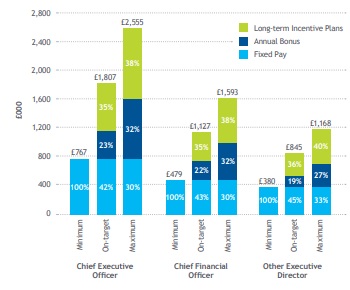
 When we consider the first report which is 62 pages, we see that plenty of space was used to give rise to bonuses where three people get to go home (in a best case scenario) with £2.555, £1.593 and £1.168 million. In a setting where we see that a company minus zero setting, towards the one billion mark in the red, how is there even a case for a best case scenario? How is it that we see all kinds of share and cash deals whilst there is a real issue with this type of company? Should we not see a whole range of other questions holding the HMRC responsible for allowing this situation in the first place? Whilst the cheapest of the three (other executive director), optionally being a figure of speech for a lot more than one person the issue merely intensifies. Their minimum pay is £380K, which is close to 1,800% of the average annual UK income; giving rise that one year would enable a person to afford a person to go on a holiday for close to 10 years. I never had that option, not in two decades of loyal service, interesting how some people are just not held accountable for bad turns is it?
So whilst these high and mighty desk jockeys get to relax over Christmas, considering on how to tackle it all in 2019, as per ‘Interserve to roll-out £650m debt reduction plan‘, they will leave staff in pressure and under threat of being laid off. It gets to be even worse when they ‘hide’ behind “This deepened due to additional cash outflows on Energy from Waste as well slow payments in certain Middle Eastern markets“. If they have been there they know what the cycles of payments are. They know on what is to be expected. So if there is plenty coming in, there should not be an issue. When jobs fall through, it is known as well, so even as there is a slack from the energy from waste, it seems that merely lose statements are given and they might not hold water under accountancy scrutiny here.
As for the books
There we see that PwC are to be the financial advisors, some sources give rise to other parts. The independent report (at https://www.interserve.com/docs/default-source/investors/financial-reports/integrated-reporting/2017/2017-full-year-pdf’s/financial-reports.pdf) talks about ‘we’, but who is ‘we’? The report is 100 pages and it was set for the December 2017 point, yet there too we see a few things. If we are to accept certain previous statements, we see “We performed targeted procedures over component entities in Guernsey, Oman, Qatar, the United Arab Emirates, Saudi Arabia, Australia, Hong Kong, the Philippines and the United States of America. We performed analytical procedures over component entities in all other geographical locations“, so when we see the larger picture, how does the ‘Middle East’ reference hold water? This would imply they’re UAE, Qatar, Oman and Saudi Arabia customers. There are still plenty of other locations, even if it is largely weighted to those 4, the mention “as well slow payments in certain Middle Eastern markets” seems less valid. The shortfall of well over half a billion does not hold up, because if it was all due to investment, there would not be a shortfall to report, those debts are different. That is where the report on page 114 seems to give a little light. We see: “A further update was given to the market on 21 March 2018, indicating that short-term facilities had been extended for a further month to 30 April 2018. The Group announced that it had concluded refinancing negotiations and had arranged access to committed borrowing facilities of £834 million on 27 April 2018.“, on the other side of that page, we see: “assessing the appropriateness of sensitivities applied to the Adjusted Cash Flow Forecast to evaluate whether liquidity headroom and covenant compliance had been subjected to appropriate stress tests;” when they come up short by another £50 million, one might argue that either the stress test was wrong, or elements were unknown or merely ignored. I cannot tell what, why, who or which, yet it does not seem to add up.
So as that page ends with: “As a result of our work, we concluded that there were no matters in relation to going concern to which the ISAs (UK) require us to report to you“, I will offer that the news is giving us a £50 million reason proving that statement to be wrong (or at least partially). There is also increasing consideration that the auditing firms needs additional scrutiny, as jobs are handed over from one firm to another, there is the option that it speculatively gives rise to nepotism, as well as the danger that they all play the same game in what should not be required to be reported. The last is also highly speculative, yet the shortfall over 50 million as well as the debt surpassing half a billion proves me at least partially correct.
The question is how to move forward. There is a point of view that gives rise to a lot more than merely changing the laws towards outsourcing. There should be a long term accountability system in place, as it might all seem to be nice and correct on the balance sheet, the mere worry is that there is a long term impact. Should we see additional pressures where Interserve goes the way of Carillion, there might be a pressing point to start considering making that change. In an age of global accountancy where the costs are stored local, whilst indirectly the booked profits are staged to go to the land of the shareholder (wherever that is) we see an imbalance of accountancy that is seemingly all fine, yet makes no logical sense altogether. That might be one of the biggest settings that governments are facing in Europe and on a global stage.
Perhaps I will take tomorrow to give you a clear picture on what I mentioned here in examples. At that point I will be bringing graphics to the table as well.


 Lawrence van Rijn - Law Lord to be