Tag Archives: API

Honestly, I have a question

It doesn’t happen that often, but the Middle East Eye left me with a question this morning. The headline ‘UAE ambassador’s firm linked to Bangladesh airports data deal’ was nothing strange. These things happen and if it helps Bangladesh, why worry? It was the setting of “Top diplomat’s business links to Emirati-backed project to upgrade passenger information systems prompt conflict of interest concerns”, it was the setting of “prompt conflict of interest concerns” made me wonder why there were conflicts of interests? Perhaps I am seeing the role of Ambassador incorrectly, perhaps I am simply thrown for a loop (I get an abundance of data every 24 hours), so it might be me. Yet when I see “An Emirati state-owned business appointed to set up a new passenger information system at Bangladeshi airports sub-contracted part of the project to a company co-owned by the UAE’s own ambassador to the country. Documents seen by Middle East Eye appear to raise questions about whether the arrangement delivers value for money for the Bangladeshi government or travelers facing higher prices as a consequence of inflated costs linked to the new system.” The first question that comes to mind is “Does the press get to see it all?” I reckon that perhaps the Bangladeshi media sees more (or perhaps a lot more) and as such, is there even an issue? You see, the term “value for money” tends to have ramifications, like how was this amount arrived at? Then we do get the goods in “Iftekhar Zaman, the executive director of Transparency International Bangladesh, called for an investigation into the deal, which he said appeared to amount to “a clear case of conflict of interests and an abuse of power”. Zaman told MEE: “As a public servant, an ambassador cannot be involved in any business activity without specific approval of the government.” OK, I can get along with this. The two settings that Iftekhar Zaman gives us are “an ambassador cannot be involved in any business activity without specific approval of the government” and “an abuse of power”. So first the abuse of power. The question becomes does any foreign ambassador have the ability to abuse power in any foreign country? I would state that this ambassador paints a rather nasty large target on his or her own back. An ambassador (as I see it) promotes his own country and offers stronger ties with that country (as an ambassador paints the picture why its own country is the best option). That is how I see it. As I personally see it, the ambassador is merely a pass through option for any Emirate business and as I am personally considering, the only stated ‘abuse’ would be to the business that Iftekhar Zaman prefers. As such that is the second setting. The first setting of “an ambassador cannot be involved in any business activity without specific approval of the government” this is a larger issue. In the first it is his involvement with the company he owns 34% of. As I see it the only issue is that other Emirati corporations might optionally be taken off the table. This is not on Bangladesh, but this might be on the table in the UAE (if this situation exists) and how many contenders were there for that position? American firms need to ‘scold’ their ambassador for letting this opportunity slip by as do the British, French and German corporations. So how many contenders were there? Aside from this setting was the Bangladeshi government involved? Did it need to be involved? If this is a logistic setting for a private airport, the government might not even be involved. All questions that the Middle East Eye had to lay out in this article. As for the “They also raise questions about a potential conflict of interest on the part of the UAE’s ambassador in Bangladesh, Abdulla Ali Alhmoudi, who has promoted closer ties between the aviation sectors in the two countries.” As such the job of an Ambassador is to promote its countries options and considerations that his (or her) nation has. As such Abdulla Ali Alhmoudi seems to be doing his job, that he owns 34% of that company is merely icing on the cake. And as the airport is concerned he brought a yummy cake to the attention of the airport. As such a “an investigation into the deal” seems one, but I ask you. Shouldn’t the executive director of Transparency International Bangladesh be involved? That is if this setting had to be on his desk to decide on. The fact that the airport hadn’t ‘involved’ him might require an answer, yet if the answer is that this was not his responsibility, is this case not merely a setting that gets limelight, the limelight that Iftekhar Zaman wants more spotlight? I am asking this as MEE didn’t give you “Iftekhar Zaman, the executive director of Transparency International Bangladesh, the organisation that is responsible for all information system at Bangladeshi airports” and MEE didn’t give anything on the vetting process, or who else was involved. I see a lot of questions and not much answers. And wouldn’t it be fun if the honorable Abdulla Ali Alhmoudi makes a claim for damages because of this article? There is no issue on freedom of the press. The article missed a few balls and ignored other balls and that has consequences in a lot of settings. You see, the setting of “The new passenger information system is being implemented in order to bring Bangladeshi airports in line with international standards requiring the collection of Advance Passenger Information (API) and Passenger Name Record (PNR) data.” The question is what was the competition? I don’t know but airports all have systems and several are national based, some have IBM systems and others have other systems. So what was the pool of contenders? Then we get “Alhmoudi was serving as the UAE’s charge d’affaires in Dhaka – the second-highest diplomatic post in the country – raising questions about whether he was already using his position to advance business interests.” Ehh, small question. Isn’t that his job as Ambassador? The setting of “advance business interests” should be seen as “advance Emirati business interests” and that is seemingly what he is doing. The only setting that could evolve is the setting that he didn’t advance business interests of OTHER Emirati corporations to promote the setting of Emirates Technology Solutions (Etek) based in Fujairah, a company that is Emirati state-owned. As such it seems like he was doing his job. As such there are questions but they would be pointed at MEE and optionally Iftekhar Zaman. Then we do get some other players, but there are also issues, but as I see it MEE is off the hook (as the expression goes) and we are left with “A CAAB official, speaking on condition of anonymity, told the newspaper that the aviation authority planned to implement SITA through a company charging a “comparatively higher cost” than the ICAO recommendation of $3.50 per passenger, and raised concerns that the additional burden would fall on passengers, namely Bangladeshi labourers working abroad.” And there we have the setting “A CAAB official, speaking on condition of anonymity” yes, I have seen that setting before (in other   cases) and that tends to be someone who wants fame, or wants to promotes a third person, or that person wants to be seen as ‘in the know’, which gives us all matters of issues. There is another setting. You see “comparatively higher cost” is a loaded case. You see, when we have this setting we have two issues, the initial cost let’s say a initial million setting and a pass through cost. So if corporation one charges $125,000,000 and $4 per passenger and corporation two charges $15,000,000 and $5.50 per passenger the setting goes to how many passengers pass through this setting (these are fictive numbers) only if the airport has more than 110,000,000 passengers it becomes an actual issue, and that is a whole truckload of passengers. Then there are the service fees and maintenance costs of an IT system and we see none of that here. 

As such, why are these facts missing? Did the anonymous person not have this data? As such my question to MEE is” ‘Where are these missing facts?’ And that is the question I am confronted with. 

So do with this what you want and have a great day, my Sunday breakfast is now a mere 215 minutes away.

Leave a comment

Filed under Finance, Law, Media, Tourism

Don’t take my word

That is serious, especially in this case. My inner paranoia hit overdrive at the sight of an image. They have been pasting sales pitches all over LinkedIn and they are clever about it. Yet, I believe they left a dangerous premise on the floor and that was where I came up and basically said ‘Are you serious?’

The image below started all this.

The added text 

Drove my paranoia into overdrive. Why you ask? Well simple. 2023 had (according to some sources) a mentioned total of 2,814 breaches. This converts towards 8,214,886,660 breached records. There is no clear OS or system and it is nowhere near the total. The amount of people deciding not to report this because of no coverage is apparently astounding. Now consider the image above and now a hacker doesn’t just get access to one stream. That hacker suddenly gets access to ALL streams. This is a hackers wet dream in development.

The issue that I state that you cannot take my word is that I am unaware just how good (or how bad) their cyber security is. They are so driven to create awareness that they seemingly forgot to hand cyber awareness the limelight it deserves. Microsoft has been the target of hackers for a long time and this is NOT in Microsoft. This is a whole range of issues (some Microsoft) and that is the problem. Now we see a solution that links all these social media connectors? I shover at the thought.

Now what I would have done is to create 2-3 white papers on how secure that solution is. How (to some degree) the protection plays. I get that we do not need to feed hackers, but I missed a large setting of marketing effort to keep IT people at rest on this solution. For example, the Optus breach of 2022 was set in three stages. One was a public-facing API. Two, the open API facilitated access to very sensitive customer data and three was the use of incrementing customer identifiers. Three settings that have hackers a way to 2.1 million of its customers and their identity documents. Now consider that you have a funnel API linking ALL your social media data. Can you even comprehend the possible damage that this ‘luxury’ brings? Now, perhaps the security of Funnel is top-notch. Yet in this, I would have started with this, especially as hackers got access to almost 3,000 systems comprising over 8 billion breached records. It isn’t merely that I would have done it differently. It is essential for everyone to become cyber savvy and no capturing emails. Send this out to whomever wants to read it. So don’t take my word for this, check the data, check the company and check their claims. Security is important. Marketing gets paid to do their job and making things easy for them is optionally making things easy for hackers.

You really don’t want to do that. You see hackers created a total income for themselves of $20,000,000,000 in 2021, which is 5700% more than in 2015. You see why hackers do what they do? You really want to make it ‘easier’? Now if Funnel does have top notch security (and I hope they do), lets hope they wisen up and make sure everyone sees that too because their solution does look appealing, but until I am certain, anyone installing that solution on my corporate server gets to be hung until death from the chandelier in the board of directors meeting room. Safety and security, there is no substitute.

Enjoy your weekend.

Leave a comment

Filed under Finance, IT, Media

Cutting corners

Something did not sit well with me yesterday. I have been mulling things over for most of today and it all started with Politico (at https://www.politico.com/news/2023/09/12/pentagon-cyber-command-private-companies-00115206) where we are given ‘The U.S. is getting hacked. So the Pentagon is overhauling its approach to cyber.

This setting comes in a few stages. Lets start with the given that I have no opposition to the Pentagon getting involved. But the stage is not that simple. So we start with the quote “attacks on critical U.S. companies and federal agencies, and as the Pentagon eyes Chinese hacking efforts with increasing concern.” The first issue is that I would have said “Chinese and Russian hacking efforts”, it would be more accurate. There is an additional side to all this. If American corporations had done their job BETTER, this issue would not be the critical issue it currently is. 

Equifax (2017)
Marriott International (2018)
Capital One (2019)
First American (2019)
Solarwinds (2020)
Colonial Pipeline (2021)
LikedIn (2021)
Microsoft Exchange Server (2021)
Twitter (2022)

This is merely a small grasps, this grasp has millions of records online for each of these cases, In this Linked in stood out with “Personal records of over 700 million users – 92% of the user base – were scraped from the platform and put up for sale in a hacker forum. Why did this happen? Attackers found a public API without authentication and breached it to scrape content.” This case is also the larger issue (beside the fact that it was an API and I wrote about that risk in ‘A simpleminded A, B, C’ On August 30th (at https://lawlordtobe.com/2023/08/30/a-simpleminded-a-b-c/) a simple setting now out in the open. People still think I was grasping at straws? Now here we see (in the LinkedIn case) “Attackers found a public API without authentication”, as such couldn’t they do their bloody jobs? I understand the setting of the Pentagon, but there needs to be a bill for utter stupidity and a link to your data without authentication is definitely one.

Corporations have been cutting corners on cost and staff and now that the consequences are out in the open, the Pentagon needs to rescue them? Screw that!

It is nice that the Pentagon comes to the rescue, but every rescue needs to come with an audit of that company and a hefty bill for the action. Consider a pointless rescue by coast guard and Marine rescue, these people get a hefty fine, I see that someone employs an API without authentication in pretty much the same way.

Yet the article is merely the start. You see, we can all agree on “Hackers are increasingly infiltrating private companies and government agencies far outside the Pentagon’s usual purview, and the hacks are being perpetrated by cybercriminals who honed their strategies abroad before striking the United States.” OK, that is fine and the fact that the Pentagon and its digital weapon systems are brought to bear is fine, but the utter stupid setting by corporations that cut corners is part one and that is on those corporations. I am even willing to accept that it took a disgruntled employee to hand visibility to the wrong people. Yet that also implies that these corporations have a larger problem and THEY have to pay for that. 

So about Three weeks ago, we were handed the 2023 DoD Cyber Strategy guide. The PDF (see bottom) is a nice piece of work. My issue is with page 6 where we are given “The Department will continue to persistently engage U.S. adversaries in cyberspace, identifying malicious cyber activity in the early stages of planning and development. We will track the organization, capabilities, and intent of malicious cyber actors. We will leverage these insights to bolster the cyber resilience of the Nation and will coordinate with interagency partners to publicize this information as circumstances permit.” As I personally see it, it should say “The Department will continue to persistently engage U.S. adversaries in cyberspace, identifying malicious cyber activity in the early stages of planning and development. We will track the organisation, capabilities, and intent of malicious cyber actors, whilst registering corporate shortcomings. We will leverage these insights to bolster the cyber resilience of the Nation and will coordinate with interagency partners to publicise this information as circumstances permit, where corporate shortcomings will not be silenced.” In this case some will state that this is not the job of the DoD and they would be correct, but Corporate America fell short and they now want help, that shortcoming needs to be illuminated as well. You cannot have it both ways.

The document gives us a lot to think about and I agree with 99% of it all, especially when it comes to the Department of Defense Information Network. 

I created the Hub+1 intrusion solution in 2014 (or 2015). As far as I know, no one is at this time ready for that creative little caper. I got there shortly after the Sony hack. The information never added up to me and I started to wonder how it could have been done (always a nice way to find the issue by re-engineering the possibilities). And all this is long before we consider issues like non-repudiation, a simple setting I learned about in UTS (University of Technology Sydney) about 3 years before the Sony hack and corporations have been cutting corners ever since. Consider the routers of the FBI, DoD, DMV, Department of Homeland Security and the postal services. Now check EVERY router and tally the ones where the password was Cisco123. I reckon you will find close to a dozen routers. I know it is more presumption than speculation on my side, but that is the larger failure and that is BEFORE we check all the corporate routers. People in IT have been too lazy (for many obvious reasons) and most of them involve resource shortages and why should the Pentagon pay for that bill?

I see that corporate America needs to pay for their cutting corners, the Pentagon has enough issues to work through and when it needs to step in (and when shortcomings are found) that corporation needs to get billed. This is specific. Corporate players cannot shield themselves from top tier hackers, that is BS. But letting the Pentagon pay for corporate stupidity is equally stupid and that needs to be out in the open. 

So this was my rant on stupidity, enjoy the day.

Leave a comment

Filed under IT, Media, Military, Politics, Science

A simpleminded A, B, C

It started yesterday when I saw a message pass by on LinkedIn. (See below). 

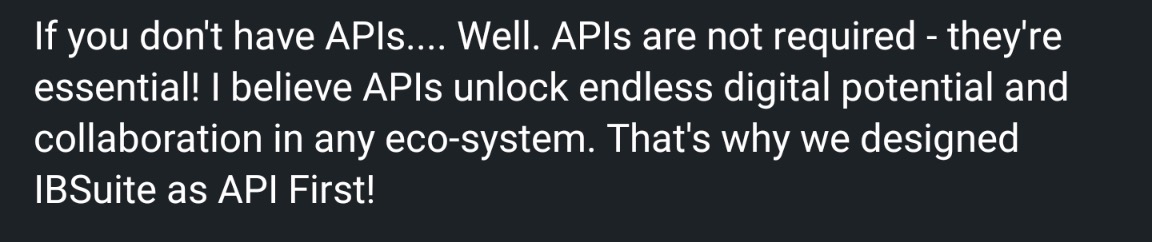
The honest first thing I thought was ‘Are you effing kidding me?’ It was like an episode of comedy capers. I thought that this level of shortsightedness was a thing of the past, but it seems to me that people will get themselves into heaps of troubles for the longest of times. And what was that term “endless digital potential?” A call to arms for the stupid people? 

So here I am educating the wannabes and the short of cash people, because it is essential. An API is an Application Programming Interface. It is a set of definitions and protocols for integrating application software, or to ‘simplify’ this “a software intermediary that allows two applications to talk to each other.” It is a way for others to talk to your software or data. It allows access. To give another reference. You are about to connect an anchor to your boat. But there are Danforth anchors, plow anchors, fluke anchors and several others. It depends on the size of the boat and WHERE you tend to park that dinghy, that largely decides what kind of anchor you need, not what is the prettiest anchor, that tends to be a factor in losing your boat. 

To put it in a better way “digital potential” will be seen when you connect YOUR data to anyone else’s data. Did you consider that? You see this blinders approach to information is nice and those with dollar shaped pupils take notice and want to race to that digital potential, yet the reality is something less nice. It is the chapter of risk.

RISK
Risk is the number one consideration, there is no other. Is it worth doing ‘approach A’ to get to the finish of revenue? 

Bad coding
This is perhaps the largest foe. Right off the bat, if you start off with the premise of bad coding, you are exposing yourself to serious API security risks and that is an issue. But fear not this person thought of that. We are given “That’s why we designed IBSuite as API First!” Yes, really? Security risks are still a massive danger. Unrestricted access to sensitive business flows is the stuff nightmares are made of and a security risk will bring that to your front door. 

Inadequate validation
A security researcher discovered an API payload that would send invalid data to their own user process, which would repeatedly fail to be handled correctly. This error handling loop prevented further access to their user account. This is perhaps the smallest issue, the problem is that failure to handle something correctly implies that something goes somewhere else. Do you know where that somewhere else is? Consider that your former colleagues spend decades optimising the data you have now, would you like others to enjoy that hard work, or keep that in house? 

Hesitating over API utilisation
Some state that in big companies, sometimes management can neglect to track APIs and their utilisation numbers. From this point, you can incur many charges and leave yourself open to security risks due to exposed APIs. So not only are you in danger to hand over your data, you can get charged for it too. Utilisation of data and greed in one nice compact solution, who would have thought it possible? 

Accountability
This does sound like the odd duck out, but in reality it often connects to data loss, Since API’s connect external users and applications with a firm’s internal applications, they are potential paths to a firm’s data. If access to these paths is not controlled, data can reach the wrong hands – and can be stolen, modified, or even irretrievably deleted. So data could get copied and then deleted, to make sure it does not hinder YOUR storage. I wonder if they will charge you to hand the data back? Just a thought.

Risks of XML
I admit, this is the hardest one for me. It is not always easy to put your finger on XML, its usage is too widespread, in the 90’s it was never an issue, more of a fab for some. Yet, 3rd party APIs could be compromised and leveraged to attack other API services. Attacks such as SQL injection, XML External Entity injection, and more, should be considered when handling data from other APIs. This part tends to be tedious but essential. It is time consuming ground work, but it must be done. 

APl incompetence
This is harder for me, I have a massive lack of knowledge here, it is specific niche knowledge that the experts have, yet it amounts to the ability to have a fault-tolerant system. Consider that in the 90’s there was accounting software. If I used a specific expression, the program would crash. No biggie you would think, but at that point I ended being in THAT system, now completely open with supervisor privileges. I had access to the entire mainframe with access to everything. This was a specific setting that was solved 3 weeks later. But what happened when it was not found? Consider that your system is open to anyone that employs such a solution and they get access to everything including the porn pics of your wife and your data. I am willing to bet that option one was a lot more upsetting to you, weird that.

Lack of security
You would think that this is covered, but it is not. Akamai (a US cybersecurity firm) reported “Of note, fewer than 50% of respondents have API security testing tools in place. Even fewer have deployed API discovery tools. Although the survey results suggest enterprises recognise the security risks of widespread API usage, there is no clear consensus on where to prioritise investments”, this matters. Security should be everything when it is about your house and your data. 

This is all mere top-line header consideration. So consider the intro I reacted to and the lack of risks that it shows. So how much risk are you willing to take with your house and your data? If I was inclined to be that short sighted in promoting ‘digital potential’ I would have gone with “APIs are not required, but if you consider and adhere to the risks in a proper way, they are the safest way to connect and explore digital potential. Any eco-system has risks, which is why we designed IBSuite to be a safety first option in exploring the digital oceans for revenue you cannot see now, but to get there in a digitally safe way, one that keeps your data YOURS.” Is it as good? Perhaps not, but it instills value that you as a customer and the data YOU have is used for safe navigation and that matters.

This was a functional boat once, they chose the wrong anchor and in the wrong place that cost them their livelihood. What will you do? Look deeper, look better, look elsewhere? All good questions and it all started by understanding the risks of an API because everything has a risk, not looking at it implies you are taking too many risks with something you can only lose once. 

1 Comment

Filed under Finance, IT, Science

The ice and the icing

Ah, it is the environment that was taking a hit yesterday. The Guardian (at https://www.theguardian.com/environment/2019/jun/18/arctic-permafrost-canada-science-climate-crisis) is giving us: ‘Scientists shocked by Arctic permafrost thawing 70 years sooner than predicted‘, and at this point, we can all agree that we have a really serious problem. I know, the people at Wall Street would more likely than not be in a stage to dismiss and debunk the news, yet this is not about merely melting ice, this is about permafrost melting. This is no small matter; you see the Arctic and Antarctic both have places where the ice never melts, that ‘never melting’ ice is now actually melting. Consider if you can, a piece of ice on Antarctic, twice the size of the state of Texas, close to half a mile high, that is now becoming water (which in Antarctic terms does not seem much). Now we also know that ice loses volume when it melts, yet it is only 10%, so over the foreseeable future we end up with a water mass 800 meter high and the size of Texas being added to the oceans. Water levels will rise and to a decent amount, in all this, there is also the arctic to consider, it is not land, it is all water and they too will add levels of water to it all.

Then there is a new development, which we see at (https://www.theguardian.com/environment/2019/jun/19/himalayan-glacier-melting-doubled-since-2000-scientists-reveal), the problem is are we have been sold for too long and too often a package of goods? Is it such a stretch that the media ‘suddenly’ has a whole range of ‘revelations’? I am not stating that these are fabricated, but the timing is an issue. As I personally see it the people have been ‘handled’ for far too long, giving less and less reliability on what we see. Even as we see ‘Himalayan glacier melting doubled since 2000, spy satellites show‘, more important, why did it require a spy satellite? Yes, I get it when we see “more than a quarter of all ice lost over the last four decades, scientists have revealed“, so when was that revealed? It gets to be worse when we see: “This is the clearest picture yet of how fast Himalayan glaciers are melting since 1975, and why“. Fair enough the work ‘Acceleration of ice loss across the Himalayas over the past 40 years‘ published in Science Advances 19 Jun 2019: Vol. 5, no. 6, eaav7266; DOI: 10.1126/sciadv.aav7266 is seemingly an academic work by J. M. Maurer, J. M. Schaefer, S. Rupper and A. Corley might be good and it might all be top notch work, but the timing of it all gives it a little bit of a bitter taste. Now, this is not some hidden attack, the work looks really good (at https://advances.sciencemag.org/content/5/6/eaav7266), it has uncertainty assessments, how it was dealt with, how the data was captured, this is a real piece of academic work with references and all (a lot of references), yet timing is everything we know that and it still feels like we are being handled. Part of me is speculating that this game is not by the scientists, but that certain previous white house players have been suppressing or delaying certain reports. It is highly speculative and I have no evidence, but that is what it feels like, the more the political player gets into bed with big business, the less environmental consideration we tend to see.

The entire matter increases when we consider: “The analysis shows that 8bn tonnes of ice are being lost every year and not replaced by snow, with the lower level glaciers shrinking in height by 5 meters annually” this implies another part which we see in the National Geographic (at https://www.nationalgeographic.com/environment/global-warming/sea-level-rise/). When we see: “Rising seas is one of those climate change effects. Average sea levels have swelled over 8 inches (about 23 cm) since 1880, with about three of those inches gained in the last 25 years. Every year, the sea rises another .13 inches (3.2 mm)“, we see the other part of the coin, so how about your beachfront property in 2045?

We can go long on the yay and nay sayers, but in all this, the media needs to stop facilitating to their shareholders, their stake holders and their advertisers, because the bulk of them are clearly in denial of environmental changes, as well as clearly opposing change. In 2012, the Guardian (https://www.theguardian.com/environment/2012/may/30/companies-block-action-climate-change) gave us: “An analysis of 28 Standard & Poor 500 publicly traded companies by researchers from the Union of Concerned Scientists exposed a sharp disconnect in some cases between PR message and less visible activities, with companies quietly lobbying against climate policy or funding groups which work to discredit climate science“, I believe that this is still going on, however these companies have become more clever in their actions and acting indirectly. In 2014 we see a Journalist names Mark Green giving us (at https://www.api.org/news-policy-and-issues/blog/2014/10/21/americas-oil-and-natural-gas-industry-be) “97 percent of all oil and natural gas company stock – held by millions of Americans across the country. These include retirees and middle-class Americans saving for retirement“, it is now less about the opposition it is that being ‘in favour’ is dooming the middle class a reversed reverse psychology if you will.

Do you still think that shareholders and stake holders are a stretch? How many financial institution advertisement have YOU seen in the last week alone? And when it comes to the sceptical and the 197 excuses they have, let me add utterly bogus excuse 198: “Women warm the hearts of men and with 4 billion men one woman can raise the planetary temperature by at least 1 degree, so what about the other 99 in the hot 100 (graphic evidence added)?” We see lists of excuses yet to overall need to take a serious look at the matter and give serious airtime to those trying to warn us is also a topic for debate.

When we pass over that episode and we add to the matter (Antarctica, Himalaya, Arctic, Greenland) there is a stage where we have surpassed essential milestones, milestones that can no longer be undone (not within the next two generations). Me, I am still all in favour of culling the human population by 85%, and fortunately for me this time around, the politicians are actually helping me.

It’s the Icing

When it is about the icing we can go in two directions, in the first it is about the topping of a cake, we all have tried it, yummy chocolate icing, marzipan topping, our sweet tooth desires a scrumptious load of icing and the larger your slice of the cake, the better the sugar rush. The second direction is mostly for Canadians (LOL), it is seen in hockey when a player shoots the puck from behind the centre red line, across the opposing team’s goal line, whilst the puck remains untouched. It is a rule to oppose a quick win, netball has a similar option; you need to win by being the better player in each segment of the field. It nullifies a play like Matt Prater of the Denver Broncos achieved in 2013 by kicking that piece of air filled leather for 64 yards, an achievement for sure, but at that point the game becomes about the kickers and it becomes less about the full game. An icing stops this option, making it about the game and this matters as we see in: ‘Diplomatic offensive aims to dissuade Tehran from breaching uranium limits‘ (at https://www.theguardian.com/world/2019/jun/19/uk-france-germany-last-ditch-effort-save-iran-deal), you see I am slightly less convinced that they are not their yet (or disgracefully close to it). When I see: ““We want to unify our efforts so there is a de-escalation process that starts,” Le Drian said. “There is still time and we hope all the actors show more calm. There is still time, but only a little time.”” to be honest I wonder what drugs Jean-Yves Le Drian is on (and can I have some please?) The idea that Iran adheres to any kind of agreement is short sold to begin with, the entire Hezbollah proxy war counts as evidence in that matter.

So when I see: “We need to de-escalate through dialogue. It is a time of ‘diplomacy first’ and that’s what we are committed to” I merely wonder who is fooling who. It is seen when the most stupid of all actions is given with: “If Iran did breach the uranium limits, the deal, known as the joint comprehensive plan of action, gives both sides time to go into a disputes mechanism before it is declared void“, is it really that bad, after the ‘breach’ Europe still wants to talk? Did you learn nothing from the Adolph Hitler European tour of 1939-1945? We could ask the State of Israel with its 15 million votes, oh sorry, there are apparently 6 million absentee ballots, they can no longer vote; does anyone remember that little fact in the entire equation?

If it is slightly too crude, then it is intentional. We have facilitated for tea parties and long winded talks going nowhere for too often and for far too long. It is now time to act before it is too late, or merely accept the culling that comes afterwards, which will be good for the environment as well.

Ice and Icing, all events linking to intentional violations to norms, to boundaries and to standards of life and living, how many more violations will we endure until we are given the sad reality our children and grand children face soon enough, we have left them nothing and for too long we would not adhere to that reality until it was too late for the next generation. We are shown too much pieces of evidence that we are doing this, whilst denying the facts presented. This might be the best evidence that we are bad parents and that we are unworthy of titles of parent and custodian, the evidence is all out there in colour, in black and white, on all levels including the academic one.

If this was a match, then it would be the face-off between the two Global Hockey teams: the Bogusses versus the Professinators, the problem is that no matter who wins, the people lose, this game has been on for too long and time is a luxury we actually no longer have and the media have been all about getting the limelight and the time to let all the voices be heard letting exploitation reign (aka circulation and clicks). The Great Barrier Reef with over 50% now bleached to death (source: National Geographic), is merely one casualty of all talk and no actions, I wonder how many more needs to be lost for people to finally force actions against politicians and corporations. In opposition we see the New York post giving us (at https://nypost.com/2018/09/12/the-great-barrier-reef-was-never-dead/) “Australia’s Great Barrier Reef is “showing signs of recovery,” a new study shows, after massive bleaching events in 2016 and 2017 threatened the world’s largest living structure”. It is time to properly vet the media for what they publish and cater to on a much larger scale, because in this age of strife they win, as do their advertisers. We could of course accept the second option and allow for the culling, it will solve both matters at hand as it means that there are too few left to advertise to.

6 of one, half a dozen of the other is a term we see, and we think that it is the same, yet we are too often not told that it was no longer about apples or oranges, it was relabeled as an issue about fruit, now we get to deal with fruit whilst our individual preference of apples and oranges is no longer an option to cater to, did you realise that small part of the equation as well?


1 Comment

Filed under Finance, Media, Politics, Science