Tag Archives: Gordon Brown

Show me the money!

That is what I wanted to shout out loud today, not because of a scene between Tom Cruise and Cuba Gooding Jr, but because of the story written by Larry Elliot (the Guardian economics editor). He is not wrong, probably with his insights and degrees he is more right than anyone else so why am I all up in arms about it? You see, if he is right then there is something extremely wrong with this world. Here is the crux, either he is wrong, or the bulk of the planet has become demented. What will it be?

Why do I consider this to be my view?

The view evolves when we consider the following aspects of the British economy. First there is “The budget deficit will be almost £100bn this year and is rising. It was supposed to be below £40bn. If the current Treasury chief secretary, Danny Alexander, is foolish enough to leave a little note for his successor, he will only need to insert one word into the one penned by Byrne: still” and “Britain currently enjoys the sort of growth rate that Germany, France and Italy can only dream about. The economy should expand by 3% this year, making the UK the fastest growing G7 nation. Jobs are being created at a record rate, a development that explains why Britain is proving a magnet for migrants from the rest of the EU“, we have seen this. Yet, as immigration is not capped to the extent it should be, jobs go to the cheap Polish workers, whilst we see a massive +50 workforce unable to get jobs, which we get from the Guardian (at http://www.theguardian.com/society/2013/nov/13/unemployment-fall-masks-jobless-over-50s). “Bennett is one of more than 400,000 people over 50 in the UK who is registered as unemployed, according to the latest official jobs data released yesterday“, you see, the mature experienced workforce is deemed useless in many areas and as such, the economy will take two hits. The first one is that these people in the end still cost money, in the second that as companies rely on cheap labour; we see that they go three steps forward, two steps back; it is getting them nowhere fast and at great expense too. So as those people have an income, the companies are just scraping by, having therefor the dubious benefit of living at tax level zero. That keeps the Osborne coffers (also known as the UK treasury) pretty empty.

Let’s take a look at some events linked here “Former BBC director general Mark Thompson has said sorry for the £100m failure of the BBC’s Digital Media Initiative (DMI)“, “Siren police IT project’s £15m failure a ‘debacle’” and not to forget “Abandoned NHS IT system has cost £10bn so far“. There is a level of sheer incompetence that is beyond measure. Yet, I think it goes further than that, I think that as areas have cut back and scrapped from the bottom of the barrel, we see cogs of non-comprehension that just twirl having no connection to any other cogs. Companies, which are no longer structured in the old ways, but still presented as such, they are niches into rooms, where only the manager has access. Like the American cubicles, that only one person oversees, absent of checks and balances, whilst the people no longer talk to each other, no clear communication. That represents the new era of work. The 50+ population have seen why there are issues with the cubicle approach and the manager who needs to get the task short-sightedly done is barring 50+ from being hired, this results in a sliding slope of minimised success.

What do they have to do with one another?

Let’s get back to the writing of Larry Elliot at this point “It took until 2013, however, for the level of output to get back to its pre-recession level, the slowest recovery of the post-second world war era. Osborne thought the economy would cope with austerity better than it did. He underestimated the impact of higher VAT and cuts in spending on growth. The chancellor thought his tough deficit reduction plan would boost growth by generating more confidence in the private sector that the books were being balanced. He was wrong. The upshot was weaker growth, lower than expected tax revenues and higher than expected borrowing. Half way through the coalition’s term in office, Osborne abandoned the idea of sorting the deficit in one parliament, and reverted to a more modest plan akin to that drawn up by his predecessor, Alistair Darling

The crux is “The upshot was weaker growth, lower than expected tax revenues and higher than expected borrowing“. I think that it is not entirely correct! Yes, Elliot writes the truth, but behind the curtains we see projects failing due to bad decision making (like the headlines mentioned earlier), in addition we see mergers of an unparalleled size “The chemist chain Boots is being sold to the American retail company Walgreens in a £10bn deal that is delivering a huge pay-day for its private equity owners“, which sounds nice, but how does that fill taxation coffers? It does not!

Corporate choices are made to avoid taxation like “U.S. Treasury Seen Loser in Tax-Avoiding Pfizer Move to U.K.” is at the heart of the second tier of failures. Not a failure by George Osborne, but a failure by their corporations that bleed nations dry, whilst not being held accountable, there the nations have failed themselves by not alter the proper legislations to avoid these acts of non-taxability. Whatever happens next will happen too late, the coffers are empty and those who walked away will do so in non-taxable luxury for the rest of their lives and the lives of the next 3 generations of their family to come.

The next part has a few issues (none of them are Larry Elliot) “The foundation notes that two-thirds of people who have moved from unemployment into work in the last year are paid below the living wage, the average self-employed person earns 13% less than they did five years ago and there are around 1.4m contracts not guaranteeing a minimum hours. Over half of them are in the lower-paying food, accommodation, retail and administrative sectors” Many of these lower paid jobs are all about areas where we see high rent, a massive drive to turn around orders and well above counted hours are needed. Life in London (as well as in Sydney) has become a life not unlike hyenas. These bosses are trying to stay afloat, which they do by hiring the weak, the cheap and the manipulative. One waitress mentioned this in a forum “Now I understand I am competing with people on the dole who can be near enough forced to work for free but it still sounds a bit shady“, the mention has bearing, as people are pushed more into unpaid extra hours, less rights, less options and less energy, we see a community that has devolved from symbiotic into parasitic, with only one winner in the end, the landlord!

Both the UK and Australia have been unwilling to deal with this entity, leaving the people at large to fend for themselves without any support.

The next part is a statement of fact, there is nothing against it in any way “If it is taking longer than expected to knock the budget deficit back into shape, the same can be said of Osborne’s other objective – to boost exports from a re-invigorated manufacturing sector so that Britain once again pays its way in the world

How to go about it is at the heart of it and several options are open as they always are, but consider that out of a dozen avenues, one is a solution, three are deadly and the rest tend to have a costly non solving effect. Several parties in play, not Just George Osborne, but in that same view, Alistair Darling and Gordon Brown all had the same flaw (as I personally see it). Instead of finding a solution that is a mere band aid, they all failed to seek the solution which had the visionary idea to include the next generation. I had that idea on two instances; the one that matters here is the article ‘What’s in a health system?‘ on June 29th 2014, where I state “When people ask which company will do this, the answer should be ‘None!’. The UK is filled with universities, some of them regarded as the most prestigious and brightest on the planet. Consider that most IT people, might claim experience, yet their drama skills are the only ones that improved for the most, is it not up to the Universities, those who are introduced to the newest ideas, design a solution that would make the work of the doctors and nurses at the NHS better, slightly more efficient and a truckload of less hassle! Is that such a tall order?

Like a regional solution for a independent Scottish IT environment, the visionary approach is to bring this to the universities, to develop a new system, not just a mere frame that goes on top of something else, but an actual new system, LINUX based option, a security enhanced LINUX for healthcare, one that is designed, not for 2016, or 2017, but for the next generation. Why not give the universities access to design their new future, not leave it to these current so called executives that waste up to 20 billion not delivering anything. That visionary approach is missing and it could be the death of us all (UK and Australia alike), we have so many similar issues, why not tackle them together, open up avenues that have never been considered. If you want visionary, then look at the Netherlands, they decided to change the bicycle lanes into solar panels, do you have ANY idea how many bicycle lanes the Netherlands has? It is actually a visible percentage of that nation’s surface. Now, they decided to give it a second function, which means generating electricity, without needing any space at all, illuminating the bicycle road through fluoresces, making it safer at night. They decided to attack road safety and energy issues all at the same time. That is the level of innovation we need to see, preferably without spending another 20 billion pounds. So how about changing, or better stated evolving universities and giving them a real hand in innovation and solving future problems we have ignored and left dead for granted (like the NHS).

The last part is seen here “Ed Balls, the shadow chancellor, said: “I am not that bothered about being behind on economic competence. In opposition, we are always behind on economic competence. Brown and Blair were at this point before the 1997 election. “I would rather we were further ahead in the polls but the Tories are leaving it a bit late for a feel-good surge. That’s why Cameron is talking about red lights flashing on the dashboard. Maybe he thinks he can scare people into voting Tory.”

I disagree, Ed Balls needs to get scared shitless real fast! George Osborne needs to do something similar! Economic competence is not something that is behind, the indicators are that they are close to non-existent. As numbers are hidden behind the statistics of ‘% of GDP‘ we are diluting ourselves that we have a handle on things, once the message is that the total debt has decreased below 750 billion, we have an actual message, but for now, that 25% decrease is nowhere in sight. Life in the UK is all about meeting the payment of the interest debt, whilst none are tackling any solution regarding the total debt for the future. That danger has been voiced by several players all over the field. The message now is that ‘Investors Underpricing Risk May Threaten Growth, IMF Says‘ (at http://www.bloomberg.com/news/2014-09-17/investors-underpricing-risk-may-threaten-growth-imf-says.html) as well as ‘Flug Flags Underpriced Risk as Investors Drop Corporates‘ (at http://www.bloomberg.com/news/2014-09-30/flug-flags-underpriced-risk-as-investors-drop-corporates.html), which gets a punch from today’s news ‘New York Hops on $15 Billion Israeli Corporate Bond Boom‘ (at http://www.bloomberg.com/news/2014-11-30/new-york-hops-on-15-billion-israeli-corporate-bond-boom.html). Like the housing in Hackney through Westbrook Partners and Round Hill Capital in the Netherlands, we see again a change in markets (like they always will), but this is different. Like Greece (again) last week with “A Greek official says the country is under pressure from rescue creditors to impose new austerity measures to resolve an ongoing budget disagreement worth a reported 2 billion euros ($2.5 billion)” (at http://www.cnbc.com/id/102222375), we see a market that keeps on getting pushed whilst there is no money left. By the way, those two players (Westbrook Partners and Round Hill Capital), did you consider combining these facts?

Have you considered when Westbrook goes market value and they merge with 2-3 other players (perhaps Round Hill Capital as one of them), when they merge, how much taxation will be missed out then, also, what danger will these tenants be placed in at that point?

So back to Greece and their dwellings, Greece should both be dissolved and offered to Turkey (just to make it sting a little more) or they need to clean up their act, including dealing with these massive strikes. Let’s not forget that Greeks themselves did this to Greece (partially through Goldman Sachs). We see cogs of greed interacting, finding new connections not to be held accountable, whilst its population gets the bill, blaming Germany for all of this. In that same light we see how we are now confronted with underpriced risks. So, not unlike the 2008 crash with all these “sub-prime” borrowers and bailing on 8 trillion, we now see governments trying to intervene by ‘forcing’ banks to make low cost loans to the underprivileged “sub-prime” borrowers, trying to create a fake boom, whilst at the same time, they have created a more likely than not risk that it will only explode in their faces, whilst imploding their economy (this is as I personally see it). Here in the end, we see that the bank wins no matter what, either the government pays them, or they just own it all. Like the landlords of London, it will destroy the quality of life for more and more people, whilst not showing any resolution in solving the actual problems.

This all comes together when we consider the IMF part on underpricing risk (mentioned earlier), there we see the part that is truly linked to all our woes: “Policy makers from the Group of 20 nations meet this week in Cairns, Australia, to discuss ways of boosting global demand. The Fed today maintained a commitment to keep interest rates near zero for a “considerable time.” At the same time, Fed officials raised their median estimate for their policy interest rate at the end of 2015 to 1.375 percent, compared with the 1.125 percent estimate made in June“. The crux: “ways of boosting global demand” it is at the heart of the failures we see. It is worse than bad marketing. The last thing we need to do is boost demand. We need to resolve debts. Yes, the US wants to see demands boosted, as it was one step away from bankruptcy 5 steps ago. They are trying to bluff into a new era of not being dead, whilst they have been unsuccessful in dealing with their debts, having no solution and even less options. We must find another way. If the Netherlands, one of the smallest nations in the world can turn around an age of innovation to their advantage in a novel way never seen before, then so can we! If you wonder how this linked, then consider how their solution can become a new era of energy independence all over South America, parts of America and all over Europe and Africa. Solar panelled roads, a patented solution that can change the face of the earth in one mere step. Once the high pressure solution is done for cars, we will see a new era of energy. Not bad for a place that is famous for wooden shoes and a leaky dike! So where are we in the Commonwealth? Where is our innovation?

In the end Larry Elliott spoke the facts, the truth and wrote an excellent article, I just disagree with the views they link to, in the end, it might be me who was wrong and it is all in the eye of the beholder!

In this age of debt, innovation and Intellectual Property are soon to become the only currency that will have any true value! The Commonwealth needs its own share of those, less it becomes as desperate as America currently is.


Leave a comment

Filed under Finance, IT, Law, Media, Politics, Science

From faith to fate

Yes, this is a story that comes after the fact. This is not about what has been proven or what has been established. I did not win because the Nay’s for now have it in Scotland and I was in the ‘stronger together’ park. I will only feel victorious if we make the referendum about the next stage. It is clear that the economy remains a Scottish issue, it is clear that the current deficit of 11% is not going anywhere, but the new dangers about less oil will be an issue, so it is up to all of us, not just Scotland, to find ways to make us all stronger as a whole. I truly believe that in light of current escalations, this is the one thing that ALL Commonwealth politicians need to take home. In response to the article in the Guardian (at http://www.theguardian.com/politics/2014/sep/19/david-cameron-devolution-revolution-uk-scotland-vote), I say “Shame on you Prime Minister!“, yes, we do not deny the issues on “We have heard the voice of Scotland and now the millions of voices of England must be heard“, the final count has not even been completed (as far as I know). The next general Elections are 8 months away. Would it truly hurt THAT much to take a few moments and recognise the need to build a stronger Scotland? In light that Scotland is still part of the UK; that issue should matter a great deal.

To Alex Salmond, first minister of Scotland I say “you may not have won now, but change is a certainty! How can the other members of the Commonwealth help in making the Scottish economy stronger?” Where is there shortage and where is their surplus? I have more messages, especially after the statement from the Spanish Prime Minister stating: “Mariano Rajoy has said an independent Scotland would have to apply from scratch for EU membership and the application process could take eight years“. Perhaps it is time to recognise the fact that the European deficit as it is set at half a trillion for 2013 has shown what an abysmal failure their budget keeping has been (I will accept the fact that 25% of that deficit is the UK), yet overall, we have seen an abundance of non-UK issues, which is why UKIP has grown the way it has. David Cameron will need to consider a clear tactical approach, not only towards the current economy, but especially on how to reduce the debt, which is a heavy chain for the Britons to carry, if they had been sins, then Jacob Marley could not have fathomed the weight, size and the number of shackles they represent.

It is only now that I hear that Alex Salmond has resigned. I believe it to be a mistake, but it is his choice to make. He was not a bad person, he did not let Scotland down, and he did however put a clear need of many changes on the table, in that he has left a strong legacy. As stated, I remained in the ‘better together’ camp, but Alex had on several occasions drawn on my doubts, which means he did not just talk to the hearts of man and woman, he talked to the rational of the people too. I feel certain that Alex Salmond will be missed; he was a politician and a gentleman, which is a rare combination to find in any person.

David Cameron has a few other issues to consider and UKIP is only one of the factors. There is a clear sign that too many actions have been about the status quo, whilst we know that these changes will not get us anywhere at present. We must acknowledge that the economic course taken two years ago has resulted in a better positioning of the UK, but more needs to be done. I believe that it is time to take another look at the Commonwealth Business Council and include the function to set a task of ‘preferred job exchange’ where it will be easier to get a quick track of working VISA’s for commonwealth nations. If social expenditure is so high, would a solution for exchange be so far-fetched? When social services pays for one unemployed person in Canada and one in the UK, if there is an option to find work for both in the other nation, to allow for that? Work permits for 6-12 months that can easily be prolonged if the work is there is not a stretch. In the 90’s, several corporations started to implement the ‘think global, act local‘ approach to the situation, in several cases it became too much about travelling all over the world and meeting virtually everywhere. I do not think that this is what the term defines, yet overall this approach will work in a workforce under these economic conditions. We all need to be a lot more fluidic in our approach of work, especially where we work. When we see the shortages of IT in Scotland (at http://www.bbc.com/news/uk-scotland-19529703), one must wonder why there are so many people in Sydney and London without a technology position. Important to note that this BBC article was from 2012, but the overall need for certain skills have been proven again and again. It is time to take a different look at these options and more important, find additional ways to solve them.

How does that relate back to Scotland? It does not specifically point to Scotland, yet if we pool all the resources, Scotland would be added to this, which has long term repercussions for all the linked nations, not just Scotland. What if we take the words of Work and pensions secretary Iain Duncan Smith, using his 6% and we could lower this by another percent? What if the shortage of medical personnel in Scotland could be filled by people from Australia and Canada? If we have forward momentum, it will always impact an economy in a positive way.

This approach shows two things, one, the fact that the status quo approach has not worked for a long time and the fact that ‘better together’ and ‘stronger together’ will actually work if we focus on the ‘together part’, I just think that ‘together’ is more than the UK and Scotland, I think it is linked to ALL Commonwealth nations.

It is now Sunday; I decided to let things simmer for a little as we have seen a few changes, it is important to see that this one article is not a static one, based upon the information of a moment. I have seen the disgrace under which some act (at http://www.theguardian.com/uk-news/2014/sep/19/violence-glasgow-scotland-loyalists-attack-independence-supporters), that what describes themselves as loyalists, are nothing of the sort. Violence whilst singing ‘Rule Britannia’ does not make you a loyalist, it makes you a goon with the ability to retain sentences. But the positive part of this article is that as an Australian (with British and a wee bit of Scottish blood) had never heard of the song ‘flower of Scotland’ (the sing-along version is found here https://www.youtube.com/watch?v=RPaJhlIIYjM).  The article showed another side, the quote “The city is divided by religion already and to be honest I think the union jacks and saltires are a bit of an excuse”, was from an engineer. Which is shown by the passage: “Sam Tonks, an engineer from Uddingston, said he had driven into the city with his wife and daughter because he wanted to celebrate the referendum victory with other no supporters, but had been greeted by something much uglier”. This is perhaps the part of the aftermath we all hope will go away soon, small issues are now huge chords of discord in a place that has been a proud heritage seeking an independent nationality. I feel that no one debates this, but at present, in this economy, that independence will be short lived, until we strengthen the bonds between all brethren of the Commonwealth.

Yet in all this, I also (as a conservative minded person) speak out against Gordon Brown (at http://www.theguardian.com/politics/2014/sep/20/gordon-brown-scotland-labour-party-strategy). Let’s face it, he made a good presence and he had an excellent show, but let’s not forget the fact that he is a politician. The promises he makes do sound nice, but what happens when he is back in power?  This is at the centre of the entire issue. The only massive reason why the ‘stronger together’ and the ‘better together’ got the majority that we all see the economic disaster heading our way and there would be no survival if Scotland faced it as an independent nation. You see, one part of the article is an issue: “It is, perhaps, of no surprise that the Scottish media now calls Brown the “fourth man” of British politics, alongside David Cameron, Nick Clegg and Ed Miliband. In the past week, events and the force of his personality have made this the case.” The intent sounds nice, but the article makes Gordon Brown a running mate with Ed Miliband, whilst they would both be contending for the same group. There is more and more evidence that Ed Miliband has made its share of mistakes which will lead to Gordon Brown returning to his old post. The actual fourth person is Nigel Farage. The press made the mistake at least TWICE already in underestimating Nigel Farage, yet the abundance of mistakes and choices which led to the current economic weakness is at the heart of the strength of Nigel Farage. That what stopped Scottish independence is also fuelling the UKIP machine. The press making light of that is exactly why too many people are voting for Farage. We have given up hope on the Murdoch machine ever becoming a respectable paper, but I am strongly advising Alan Rusbridger to not make that same mistake. Having Nigel Farage written off at present is the biggest mistake you can make at present. I saw the same mistake in the Netherlands in the 90’s. The man Hans Janmaat was ignored. He was discriminatory in his conviction against all immigrant matters and was called racist on several occasions, which in the end gives us: “Meindert Fennema, Emeritus Professor of Political Theory of Ethnic Relations at the University of Amsterdam, argued in 2006 that Janmaat was convicted for statements that are now commonplace due to changes in the political climate”. The Dutch newspaper article (at http://www.trouw.nl/tr/nl/4324/Nieuws/archief/article/detail/1784000/2003/05/21/Met-excuses-aan-Janmaat.dhtml) shows a shifting cultural issue, by ignoring these factors the British newspapers are making the same fatal (and as I consider it a ‘dumber then dumb’ approach) to an actual issue people are confronted with, the press and political silence towards Nigel Farage only contributes to his untimely success. Linked to this is the fact that Nigel Farage had been bringing forth actual issues, which had been ignored by both Labour and Tories alike and they need to be properly addressed within the next few months before the Nigel campaign truly takes off, after which, half-baked carefully phrased words of denial will only hurt whomever speaks them.

This reflects in several ways. If we are not careful in this environment, we are all in danger of segregation though polarisation. That what Scotland is currently dealing with is something they need to get past, true loyalists will need to accept that Scotland will remain Scotland, whilst realising that over time it will be their ‘new’ neighbour Scotland. How you aid them now will reflect on your future later. Shine light on the actual matters and we will all prosper through it all.

If we keep the faith in a stronger Commonwealth and if we actually act on doing so, then we will end up with the fate of the Commonwealth being a lot stronger then it currently is. We have several heavy seas ahead of us and if we are as strong as our weakest link, then we need to make all commonwealth nations a lot stronger then they currently are.


Leave a comment

Filed under Finance, Law, Media, Politics

The cradle of Whiskey

There is a matter that is of interest to the commonwealth at large. As time progresses we see more and more in regards to the Commonwealth upcoming baby brother Scotland. For now still part of the motherland of the British Empire, our baby sibling is about to stretch its own feet. The need for junior to become its independent member is one that has been voiced (especially by the local population) for a long time. I in all honestly remain on the fence. I have nothing against this change, but as I state before, the timing is not right. However, in all fairness, it is likely never to be a great timing is it?

Yet, the Guardian will give us our daily ‘need’ for information. There are however a few issues that also rise at those events. Let’s take a look.

The first one is in regards to yesterday’s news with former PM Gordon Brown (at http://www.theguardian.com/politics/2014/aug/15/gordon-brown-independent-Scotland-neocolonial-ties-uk).

Here it is stated “An independent Scotland that kept the pound would have a neo-colonial relationship with the rest of the UK because it would have no say over key economic and monetary decisions, Gordon Brown said on Friday“. I find it had to disagree with that. And let us be fair, would we want this? Absolutely not! Yet, will Scotland start its own currency? It is the statement from Professor Ronald McDonald (yes, the economist, not the clown) which is the strongest voice “Professor Ronald MacDonald, a currency expert who advises the International Monetary Fund and the European Central Bank, said the Scottish government’s plans to use sterling after a yes vote were fundamentally flawed, even if Alex Salmond’s proposals for a currency union were accepted by the UK. The Scottish economy would shrink by up to £100bn by 2023, MacDonald said” (at http://www.theguardian.com/politics/2014/aug/14/independent-Scotland-economy-crash-sterling-ronald-macdonald).

It is in opposition to this quote “During ill-tempered exchanges in the Scottish parliament, Salmond cited evidence from Sir Donald MacKay, a former economic adviser to the UK government, that a currency union was ‘perfectly possible’ and was in the UK’s long-term interests” I am not sure how Sir Donald got to this, and his history in economy is a lot stronger than mine (my economic education level is ZERO). Yet, as an analyst I foresee several issues, logistics being the strongest but not the biggest one. If any currency union was to occur, then it can only happen as Scotland and the UK are 100% open about ALL economic events. How about (even if we ignore little issues like ego), that the chance of this happening is absolutely 0%?

There is also the small notion that independence is about, being by yourself, a currency union is not that. So I tend to agree with Gordon Brown. There are other issues where unions are to be maintained to some degree, so is there true independence or a new ‘state’ of autonomy?

This is on the front of my mind. I am pretty sure that Mr McDonald, or to take the image of the bad food clown away let us call him the Behavioural Equilibrium Exchange Rate Model Expert (BEERME for short, I need to avoid becoming too serious here), then there are several other issues that I have not even begun to comprehend and are likely secondary reasons on this man’s mind.

logUsScotland

If the professor is even half right, then a 50 billion shrinkage of Scotland’s economy would sink it, which is also extremely counterproductive, so what can Scotland do?


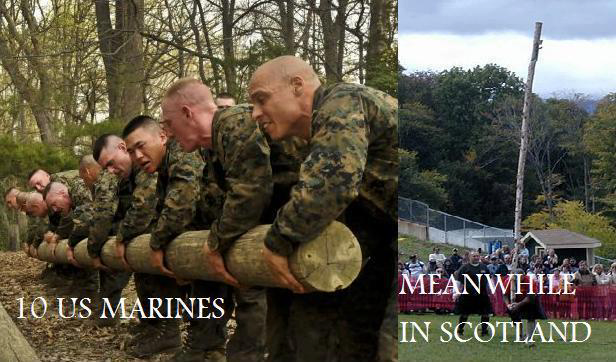
Delay for another few years? Even though this is the most likely event, Scotland would not be Scotland if it stopped without a massive fight, considering that one Scotsman tends to toss a log that requires 10 US Marines to carry is not a nation that whinges at the first hurdle.

So what if it uses the UK coin for now? Is that such a large issue, as Scotland grows its independent economic power? Consider this final quote from the article “They were already different, he said. Excluding oil revenues, Scotland had an average trade deficit of 11% over the last 15 years, which became a trade surplus of 2.7% if a geographic share of North Sea oil was included”. So the grace of Scotland is their oil reserves and what happens afterwards? This needs to be tackled first, because if Scotland is to avoid falling apart in the first setback (oil issues being just that when it happens), then Scotland must take care of its 11% deficit. In my view, that deficit must be turned to a 3% surplus (without oil) for Scotland to be a contender at the Commonwealth table, so how to go about it?

First it needs to change its political look on matters (not change its politicians). I will admit that the next part will sound a little dicey, but please hear me out. The headline “Scottish Tory leader Ruth Davidson: ‘I’m quite a cussed person’” (at http://www.theguardian.com/theguardian/2014/aug/15/ruth-davidson-interview-Scotland-tories-leader) reads nice, but there is a massive issue when we read the first part “Ruth Davidson is 35, a working-class Glaswegian, a kick boxer and a lesbian. Are these unlikely credentials just what the party needs to rescue it from 25 years of stagnation?” Why was there a reference to her Lesbianism? I personally do not care what her life’s choices are, truly I do not. But is this a political lesbian or a lesbian politician? Why could she not have been just a conservative? Did we see a headline on “Gordon Brown is a 63, working class sport less hetero sexual” Did we ever see that headline?

It seems that Ruth Davidson has supported state-funded Roman Catholic schooling in Scotland, and she also seems to believe (as far as I could tell) that the Church of Scotland should open its own faith schools as well, which seems a decently pragmatic approach to the ‘dangerous’ controversy called ‘Churches in the UK and Scotland’.

Because she is only 35, her most important events and achievements are still in front of her. She could be the inspiration the Scots need. Time will tell whether this is so. Yet there are issue with this article, there is little on her stance in regards to Scottish independence. If that is next on the agenda, should Scottish Tories not be outspoken about her views in that future? It seems to me that the journalist doing that interview kept the interview way too shallow, especially in this day and age.

There are a few other issues, like Ferguson, the last of the Scottish shipbuilders to shut down, so where are the economic options for Scotland, when we ignore oil. You see, I have nothing against the oil, yet the fact that a new nation will be totally dependent on only ONE product, such a place would need to have several alternatives if something went wrong there, so that is why it should not rely on the oil industry.

As a solution, I still believe that India has options here. As the Indian generic pharmaceutical industry grows for Europe, it will need alternatives for both manufacturing, shipping (read distribution) and perhaps to a smaller extent research. Whilst everyone seems to stare blindly to London area’s where prices are through the roof, Edinburgh offers a much cheaper and no less sturdy solution. Its harbour would allow for direct access to the Netherlands (Rotterdam), which would then grant access to Germany and Eastern Europe, there is access to Scandinavia as well as the option to nurture South American trade routes. All of them are markets that India could become the main supplier to.

It could change the Scottish deficit from 11%, to less than 3% in one blow, once the South American routes are a given, the deficit would turn to surplus. The stronger the growing need for generic medication, the more powerful this branch will grow in Scotland. After that, the tax breaks this industry could have would turn the UK into a much stronger market making for an entirely new dynamic in the pharmaceutical economy. Am I overly optimistic? Perhaps a little, yet so far, my predictions have held up and the current course is not getting us anywhere. It only takes one innovator to truly change the game, Scotland is roaring to be its own wielder of futures and India is roaring to be master of generic medication. Two innovators, a match, which is definitely not made in heaven, but as both want to make it work, the created future could be one that stands long and tall.

But is that with or without an independent Scotland? This is where the shoe starts getting a little tight for the dance floor. I personally do believe that this is not the best moment to become independent. I do believe that for now ‘better together‘ is the way to go. Consider the despair when Scotland does go it alone and within 24 months, both Japan in full and US in part become insolvent? I still believe that the US course is one that will sink its future, especially as the mention of well over 500 billion in undocumented spending in healthcare could set America well over the 18 trillion mark (the fact whether the healthcare billions were part of the deficit could not be confirmed), which makes for a dangerously unstable situation. So whether these facts stop Scotland from going independent is to be determined, yet that should not stop Scotland to become a lot more autonomic in growing its economy into the strong version it requires when the Scotland becomes one independent nation under this sky within our large Commonwealth.

Whether in the end there is a yes or no to independence, the fair question remains how to grow the Scottish economy, which will be a good thing for the entire Commonwealth.


Leave a comment

Filed under Law, Politics