Tag Archives: pharmaceuticals

The promised example

In light of all the outsourcing we saw yesterday, it is time to show you just how lucrative it can be to set the outsourcing stage. In this example I will go with a software example, as I have seen this myself. You see, sometimes a place is profitable for the mother company no matter how you slice it and with this example we see this in action.

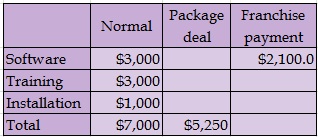
Let’s take a software vendor, selling some software solution. Normally that entire path will set you back $7,000. The software, training, installation and personalising the solution. At this point you might think, well, it is all tax deductible for the company, so what gives?

Well, some of these players still have budgets to adhere to (unless you are in Italy), and when we look at that the procurement department will state that it is too expensive. So, the sales team has an idea. They say: ‘You know what! We can (if you take all three) the entire as a package for $5250, and that is a nice discount‘. So the company takes all this and accepts the deal. So the software is bought, there was a trainer on the spot educating the staff for 2 days and they set up whatever needed to be set up and the entire delivery is complete.

It all seems straight forward. Yet, it is not to be. You see that outsourcers often have a main office outside of that country and they want their franchise fee, which could be 70% of the software, yet they will always get FULL PRICE. So they will get 70% of $3,000, no matter what the discounted invoice was. Now that company has to make due with $3,150 for training, training materials, travel expenses, training hardware and staff. And for every deal they make the cost remain high, yet the revenue has been siphoned off and the cream went somewhere else. Now we get the stage where there was still a profit, yet the staff members are still costing thousands of dollars, as is the office and all other goods. There is not taxation as the revenue was too low and this is where we see the problems for a lot of these companies. They are now in debt, governments having to make deals and I cannot vouch for Interserve, Carillion, Serco Group Plc and Capita Plc, because where I know it was happening was not one of these. Yet I feel certain that others have been playing similar games and it has been going on for over 20 years that I am aware of that tactic.

So does the entire Interserve part now make sense? A debt of well over half a billion and its board members are still up for millions in bonus? I cannot tell what the reason is for the entire Interserve issue, yet what I have seen in the past, we should take a long hard look at what some consider to be debt and what some consider to be an optional approach to deferred invoicing.

We might see partial support when we see the article in the Morningstar (at http://www.morningstar.co.uk/uk/news/AN_1542962437936788100/interserve-expects-higher-operating-profit-despite-construction-loss.aspx). Here we see: “Interserve posted a pre-tax loss of GBP244.4 million on revenue of GBP3.25 billion in 2017. It then recorded a pre-tax loss of GBP6.0 million on GBP1.67 billion in revenue in the first half of 2018“, others sources had a similar setting, yet here we also see the headline ‘News Interserve Expects Higher Operating Profit Despite Construction Loss‘, now we see operating profits versus construction loss? Does it now seem more and more that we are given a half a billion birdie, whilst some are showing to be receiving massive bonus payments? How is this not tackled? How come that for 20 years we have seen the impact of creative bookkeeping, whilst the European governments have been unable to fix anything?

When we see the Financial Times (at https://www.ft.com/content/b2c9fdd2-eeed-11e8-8180-9cf212677a57) giving us: “Interserve employs 80,000 people worldwide — 25,000 in the UK — in jobs that range from cleaning the London Underground to maintaining army bases and building a shopping centre in Dubai.” Giving me the speculative thought ‘How long until we see the Dubai part sold off (including equipment) at roughly 5 pennies to the pound? How would that screw over the 25,000 staff in the UK when Interserve folds? We will not know until the Interserve lawyers and accountants finalise they optimised plan in 2019, but I fear that the impact of outsourcing is going to be felt on a very large area. You see, outsourcing growth is through the roof and it is growing in a sphere of influence that has not been seen before. Fintech, Meditech, Pharmaceutics. It seems like the golden calf, yet it is a treacherous field. It might be a temporary field at best. I think that the construction companies have good weather now, yet the crash of the 80’s is still with them, Communications is all about outsourcing, yet when those outsourcers do not finance the training of staff, their usefulness will decline in 3-4 years as the companies are focussing on 5G. In that same light, we see a pharmaceutical growth, yet the setting is that many patents will fall over in the next 5 years. At that point these companies outsourcing can discontinue the renewal of contracts and the staff issue will not be their problem, it will be the problem of the outsourced company and that is starting to push a wave to a much larger degree than we have seen before.

So as we return to the Financial Times article we get “Interserve said profit growth for the year so far had been as expected, and it anticipated “a significant operating profit improvement” for the full year. The group, which swung to a loss in the half-year, did not provide figures“, we knew that, many sources had it. Yet we also get “It has revenues of £3.25bn but is valued by the stock market at just £75m and is already under close watch by the British government in case of collapse“, when a 3 billion revenue company is merely valued at merely 2% of that, there is a lot more going on than mere sneaky keeping of books and that needs to be seen as well. So when we consider: “Interserve’s update attempted to “sugar coat” the increase in net debt and “to deflect from the news” that the Cabinet Office is making sure it has alternative suppliers to take the place of Interserve should it fail. “The operational developments are not good reading either,” he added“, a part given to us by the independent analyst Stephen Rawlinson, we need to look deeper. You see, if the UK does get confronted with: “alternative suppliers“, we need to accept that for a chunk of those 25,000 British workers it will not spell good news, even more so, there is every chance that it gives a larger level of turmoil to those people whilst some board members end up going home with a payout that is between £380K and £2.25M, making sure that they can live in a sea of porn and Netflix for the longest of times, possibly even until the day they die.

Is it that bad?

Well, that is not certain, yet the issue that the UK accounting watchdog had to quit over criticism regarding Carillion (source: the Guardian), they give us the quote: “Stephen Haddrill will depart after nine years in charge of the Financial Reporting Council, which is subject to multiple inquiries into its effectiveness and independence” we get one thought, yet in light of “a committee of MPs described the FRC as “chronically passive” in an excoriating report into the construction group’s failure, condemning the regulator as “too timid to make effective use of the powers they have”” we should consider that there is every chance that Interserve might have been on that same side of the page making the issue larger and more critical. Is it not interesting that too often we see terms like ‘too timid‘ when it comes to dealing with the rich? The entire Sir Philip Green’s £1 sale of BHS is a nice example to keep in mind. The setting where the people behind BHS are apparently not in prison in a stage where “the settlement will not fully restore the retirement income they had been promised by BHS” (source: Financial Times). One of many failings where we see the creativity of applied accountancy and the improper use of non-committal prison sentences to those employing these fast and loose solutions. At present there is a speculative chance that Interserve might be on a similar track, but that is pure speculation, we will not know until the solution is offered, which according to the papers will not happen until somewhere in 2019, until that point arrives thousands of employees at Interserve will likely be in a state of stress. It is one hell of a way to approach Christmas.

Humbug!


Leave a comment

Filed under Finance, Law, Media, Politics

Goodness redirected

Even as I got shocked to the core yesterday with news on how certain Biological Agent accusations are going in the wrong direction (turning my paranoid into overdrive in 7.2 seconds flat), I was also slightly bewildered a few hours later on how a greed driven industry is now getting a rather large shake up. It was the Washington Post that treated us to ‘Hospitals are fed up with drug companies, so they’re starting their own‘ (at https://www.washingtonpost.com/national/health-science/hospitals-are-fed-up-with-drug-companies-so-theyre-starting-their-own/2018/09/05/61c27ec4-b111-11e8-9a6a-565d92a3585d_story.html?utm_term=.8362898ab1fe). It is a not for profit pharmaceutical company that works exclusively for hospitals. That is the first really good unbiased news of 2018. I truly wish I was part of that place. The report by Carolyn Y. Johnson gives us “A group of major American hospitals, battered by price spikes on old drugs and long-lasting shortages of critical medicines, has launched a mission-driven, not-for-profit generic drug company, Civica Rx, to take some control over the drug supply“. And even as it is for now merely the generic side of it all. We need to realise that in the UK, the NHS gives us (at https://www.nao.org.uk/wp-content/uploads/2018/06/Investigation-into-NHS-spending-on-generic-medicines-in-primary-care.pdf) and that they spend £3.5B in 2016-2017. I am using that data for the mere reason that it is more up to date and more reliable at present. Consider that an ‘island’ with only 20% of the population of the US has that bill, yet to a larger extent, they have a similar aging issue and several similarities in health care. Now consider that this is a NFP situation, so basically, we see the optional saving of close to a billion pounds a year, implying that the savings for the US should increase drastically. It is also important to see that this is merely the beginning.

So as the too laid back greed driven US pharmaceutical industry is confronted with two nightmares, the first is not merely the current generic medication part, it is that if the US and UK unite the damage increases for the pharmaceuticals. In addition to that, the Pharmaceutical industry is confronted with well over a hundred patents maturing over the next 5 years, so the generic part is increasing with leaps before 2023 and so far a lot of them cannot be ‘reset’ by altering the patent slightly and forcing exclusivity for another 15-20 years.

So there is light at the end of the tunnel, it will not happen overnight, but there is a setting that the US could remove medicine cost pressures by a much larger amount then even before. So even as we are given “Backed by seven large health systems and three philanthropic groups, the new venture will be led by an industry insider who refuses to draw a salary. The company will focus initially on establishing price transparency and stable supplies for 14 generic drugs used in hospitals, without pressure from shareholders to issue dividends or push a stock price higher“, we need to realise that this is merely the start of something much better in two directions. The first is that if the costs go down, there is more money for other hospital needs and also in the other direction, when people get affordable medication more will work on healing and in addition with added funds, the chance increases that they will adopt a healthier lifestyle and actually get better and more energised in their old age, which might change a few other things too.

Civica Rx

Yes, that will be a name to remember for a long time, especially when they start showing the results that their goals are set for. Yet this is merely the beginning. Let’s not forget that given a set of greedy hungry swine’s, when they get hungry they tend to let go of ‘morals’ and limitations, so unless severe warnings and protection is given to Civica Rx, they still have an uphill battle to fight. Forbes gives us (at https://www.forbes.com/sites/elliekincaid/2018/09/05/that-nonprofit-generic-firm-has-a-name-100-million-and-a-ceo-who-will-work-for-free/#38015e44ce06), gives us the name of the CEO Martin VanTrieste, he was also quoted with: “has agreed to work without compensation“. Now, I could never do that (due rent and such), but that shows a system where we would love to be a part of, does it not?

So when I see: “The healthcare systems involved: Catholic Health Initiatives, HCA Healthcare, Intermountain Healthcare, Mayo Clinic, Providence St. Joseph Health, SSM Health, and Trinity Health. The philanthropies: the Laura and John Arnold Foundation, the Peterson Center on Healthcare, and the Gary and Mary West Foundation“, I am actually surprised that the Bill Gates foundation has not (yet) knocked on that door offering a nice 8 figure amount, but you know, 2018 is not over yet.

So even as they start with 14 generic drugs, there is every indication that this can evolve to a number in the triple digits in the next 3-4 years making life a lot more affordable fast.

So what is the setting? Why is this given so important? Well, again we need to the UK numbers (as they are more reliable). It is not merely the setting of ‘cheaper’ that we need to realise, it is the attached setting of ‘proportion of spending on generic medicines that is in primary care, 2016-17’, which was 81% at that point. The second part is the logistics, a number that is even scarier than the margins and the exploded prices involved. You see there were 3,000 concessionary pricing requests made by pharmacists in November 2017, a few months earlier, basically before May 2017 the amount of requests made were less than 150, so an increase of 2000% of concessionary pricing requests. The impact of diminished budgets had that much a drain on logistical support for hospitals and NHS departments. When that pressure falls away, so much more can be done and that part is not visible to a much larger extent. there will remain a much larger issue when we look at the branded versus generic setting in both primary and secondary care, no one doubts that and that setting will remain, but over time that equation will change as well as speed up as the life cycle of branded patents end.

It becomes a little scarier when you consider that in the UK, Ten medicines accounted for £134 million of the net spend on price concessions. Topping this is Amlodipine 5mg, a medication for high blood pressure. This becomes important when we translate that to US numbers we can use. You see, in the United States, about 77.9 million, almost 1 out of every 3 adults have high blood pressure. Now consider when that becomes affordable and less of a drain for any health facility, the savings on this one drug could change the game for hospitals all over the US and at the same time prolong life for Americans. When we see that 18 out of 134 million is for that one prescription drug only, we start seeing the essential needs that Civica Rx is bringing to the table, and it has a much a much better impact than a salad (especially when reading about the McDonald Salads this morning).

SO what will come next? Well, they are off to a start, but I never trust anyone merely giving up their golden parachutes (referring to the current pharmaceuticals having to spread the negative news to their shareholders) and in light of the pharmaceutical patent escalations in India, I feel certain that Civica Rx is likely to face dozens of injunction meetings before the end of this year alone. After that the political engine will be turned against them as much as possible. I think it is important at that point to make sure that EVERY senator and congressman (m/f), will get the limelight set upon them to make the people aware of the elected officials that will make their lives more expensive.

Yet that is not the only part, the NHS report gives us the part that Civica Rx is trying to address as well, when the reporters investigated the underlying causes of pricing, the following parts were given on that report (attached here) on page 21.

The immediate cause of concessionary pricing is pharmacies being unable to purchase a generic medicine at, or below, the Drug Tariff price“, as well as “The Department identified three main underlying causes of the 2017-18 increase in concessionary pricing, and those three causes were:

  • The Medicines and Healthcare products Regulatory Agency and European regulators partially suspending the licences of three manufacturers of generic medicines;
  • A fall in the value of sterling; and
  • Governments and insurers in other countries putting downward pressure on the price of generic medicines, resulting in lower returns and manufacturers withdrawing from some markets or medicines: the reduced capacity and competition then increased prices within the UK market.

Now, the first is only an issue when it keeps on occurring and until more evidence is seen, the solution is not easy in this, the second is an impact, yet short lives and the US might not face that issue as it produced its own need, the UK is much more reliant on American pharmaceuticals. The setting of Civica Rx would when effective take away the cause of that element, making that a non-issue over time, it might initially still be a short term factor for Civica Rx to consider.

And it must also be stated that the elements could not be verified or quantified. There were too many elements in play in all this, but the significance on the factors seemed to clearly shown, but to the extent of how much remains a question that can only be proven over time (and with a lot more precise data).

It is my personal view that the report by Sir Amyas Morse KCB is quite extraordinary and even as it leaves us with questions (as any report does), it also raised the curtain on several issues, not merely showing the essential need of Civica Rx in any nation that is getting drained by healthcare costs, it sets the stage that the report empowers the existence of Civica Rx as well as the essential need for their sponsoring and protection ‘against’ some of the pharmaceutical companies, because generic medication or not, you introduce me to a commercial board of directors who do not care about lessened profits and I will introduce you to a group of people lying to you, it is basically that simple.

So we enter Friday with goodness form another direction, today brought to you by the Washington Post, a paper that still states that ‘Democracy dies in Darkness‘, I say that this is not entirely true, it is currently actively getting smothered with a pillow by the needy for greed and those who get their coins from a similar direction, but again, that is just me thinking with temporarily a few paranoid clouds overhead.

#MondayMorningIsOnly60HoursAway

#HappyFriday


Leave a comment

Filed under Finance, Media, Politics, Science

The German domino

The Guardian is giving us another view of what seems to be blunt misdirection, in this case misdirection from the German industrials. The title ‘German industry warns UK not to expect help in Brexit talks‘ (at https://www.theguardian.com/politics/2017/jul/08/german-industry-warns-uk-over-brexit) might seem true, might sound true and by their own admittance be hopeful and true, yet in all this, we know that the statement is one that they cannot hold on to. You see, with every step that the UK gets into a slightly better stand, with every step where the UK economy gets a little better slowly yet certainly, it is in that phase that we need to recognise that the Germans are all merely facilitators to their own boards of directors (in multi plural ways). So, when we consider an EU population of 508 million and 13.5% of that population is British, do you actually think that they are willing to throw overboard a 13.5% consumer base? Who are you kidding? So as we see the words from certain players who apparently are trying to remain anonymous the quote “Two of Germany’s biggest industry groups have told the Observer that their main concern during the Brexit process is protecting the single market for the remaining 27 members, even if this harms trade with Britain“, which is a lot of bogus. The other 27 members can openly be single market as much as they like! The issue is that certain players are not part of THAT discussion. You see, do you think that Bayer, the large pharmaceutical wants a situation where they lose a large chunk of 68 million people who are aging? Do you think that they want to offer that multi million unit customer base to Indian generic pharmaceuticals or to American pharmaceuticals? The US loves that prospect, let me tell you that. In addition, once the US and India get a chunk of that base, they will have the foundation to grow stronger into the Netherlands, Belgium and Scandinavia. So suddenly 13.5% becomes 31% and that 31% is actually spending a fair amount compared the the lower 15 on that same EU list. Places like Solingen for metal ware and a few other German players are in that same neck of the woods. In addition there is the car industry; I reckon that Volkswagen is truly looking forward to losing that part to Saab, Volvo or its French equivalent. The UK will happily take decent trade deals with many of them.

So when we consider all this, the amount of bluff we see in the article could be costing the German economy a 2% drop, would that not push THEM into recession? So as I read about Dieter Kempf, president of the BDI, the federation of German industries, I actually wonder how he got his math done. When we see: “The UK will remain a very important partner for us, but we need a fair deal for both sides respecting this principle. The cohesion of the remaining 27 EU member states has highest priority.” This might be true, yet when you consider that the lower 15 are not much of any consumer and that your growth does not exist there, how soon until you weasel your way back into the shadows relying on the quote “I was merely voicing the issues our members were“, which is very likely to be true. Yet when we ask names, how many will you be allowed to phrase? How many members will step forward as the train wreck you yourself created is showing the levels of damage it incurred? At that point they will all hide in the shadows, and we will find their statements to be part of the loom of those weaving their personal private needs, not the ones of any of the industries you claim to represent.

In this the quote “While we will be leaving the single market and the EU customs union, we want to achieve a comprehensive free trade agreement that allows for the most frictionless possible trade. The government has been clear that we want to ensure a smooth implementation of our new partnership with the European Union that is in the interests of businesses in the UK and across the EU.” that part makes perfect sense, yet that comes from the UK side and there is the ball a little smoother. There is a difference between wanting an actual trade deal and others trying to force you into some trade deal that benefits certain people the most. Wanting trade versus bullies and opportunists is never a trade deal. In all this Markus Beyrer, director general of the Business Europe group gives us an interesting side, or better stated, he phrases it almost identical. He states “We want a good deal for business, which means an orderly Brexit and an orderly transition to the future relationship, while fully protecting the integrity of the single market“, this actually sounds good, yet in all this the issue is more and more becoming about the validity of the ‘single market‘. You see if this single market is so awesome the fact that the UK is staying in it is not a problem, in that this same ‘single market‘ would shrug their shoulders, making some ‘their loss‘ statement and move on. Yet did this happen, no it did not! We have seen all levels of bulling, statements of near blackmail and a level of almost feudalistic statements in the air of ‘remain or else’. You see, it is almost like the old communism, ‘be a member of the party or else‘, did you not notice that? So what is it that they do not want the UK and others to learn and find out? Did you not once consider that part? It started when the initial UK economy was going up a little, now it is about 27 members trying to oppose the UK at every turn. It is almost like watching a physician making the patient sick so that he can sell medication.

When was the single market ever about that?

John Longworth, the former director-general of the British Chambers of Commerce who campaigned for Brexit, is on my side. When we look at his quote “The European project is so important to the Germans politically and economically, that the German political establishment are prepared to sacrifice even their own car industry for that outcome“, I wonder if that is true. You see, when the car industry (read: Volkswagen) gets the first dips in their results and when those boards will miss out on several millions of Euros in bonuses, they will call other people and someone will get axed really soon thereafter. You only need to take the revenue from a pimp once for that person to take a less optimistic view of life and the health of his opponents the moment it happens. We have plenty of long term evidence in that regard. In all, the only thing the German industry would do is alienate the British who don’t like to be told by any German, any day of the week, so there is that to consider.

In all this the EU made one colossal error. Even as we have all been ignoring it, the opportunity offered which was quoted in the Economic Times: “India is one of the fastest-growing large economies and is expected to surpass Germany and Japan to become the third-largest economy by 2025. India has become the land of possibilities, and when you consider that the country offers a growing market of 1.25 billion consumers you can see why“, so as this market grows import, it will be on the edge of a razor to grow its export, preferably larger that their import, so as the EU markets are playing hard sale, India is ready to come in and offer all kinds of deals with the UK. With a growing Indian population, the UK (Australia in second place), are the two markets where India has options and opportunity to grow. Once the Germans learn the hard way that they gave away a chunk of their market, how long until the other EU nations come running for some kind of a trade deal?

You see, in all this the UK always had options and as the Europeans are posturing themselves into the UK alienating from them, we will see growing amounts of evidence that these posturing parties were only hurting their own cause.

The most interesting quote comes from Albrecht Ritschl, an economic history professor at the London School of Economics. He states “One thing German industry is clearly worried about is the potential disruption on the way to a free trade agreement because it cannot be negotiated within the two-year timeframe“, which is interesting because why not start to negotiate today with the UK with the start date of that trade deal to be the day after Brexit is complete. Anyone stating that this is not an option is lying to you. The entire industrial industry from 1918 onwards has been set on the smoking cadavers of those who ruined what was before. We see this in the Marshall plan. Even as we see that the plan was in operation for four years beginning on April 8, 1948. There is clear evidence that the preparations started as early as April 5th 1946, these were not the first players, but their reference to the meeting on the ‘preceding Monday’ gives light that actions had been planned for much longer. The Marshall plan, a plan that involved the two players Mr Cohen and Mr C.P. Kindleberger, the appointed member of the US Treasury.

In all this Germany could have been starting their own industrial conversations with the leading UK industrials. It is really weird that they have not actively done so from day one. If this was to gain the UK banking votes that they went about it the wrong way, if it was to continue the old track that is was more than merely stupid, it only shows that the ‘one market’ path is flawed for many players and it seems that too many players want to keep that side of the story between the sheets, yet for what reason I cannot say. I can speculate that this was merely about greed, but that would be too simple and the greed that holds in contempt other players tends to see the light of day quicker than we realise, so I honestly cannot say what we are prevented to see. What I can say is that the entire German boast of them sitting on their hands was not too bright and in the long term they are very likely to hurt themselves a lot more than others.


Leave a comment

Filed under Finance, Media, Politics

The other side of sickness

Sky News gave me the idea last night. I was half awake (hence: half asleep) when the news (at http://news.sky.com/story/de-niro-offers-100k-reward-to-media-for-truth-about-controversial-childrens-vaccine-10771445), when de news stating ‘De Niro offers $100k reward‘ became visible. When I woke up completely (a few hours later), I saw the full Monty: “De Niro offers $100k reward to media for ‘truth’ about controversial children’s vaccine“, which was a little more descriptive. Now I am not media, but I have decided to take a look at it. First off, it is never a good idea to meet your idol when he is still alive, but I think Robert got through it OK. What more is there on the article?

The first part is “willing to publicise criticism of a controversial children’s vaccine“, which is an odd start, so the important part is Thimerosal, which is the medication part that needs to be scrutinised. The other part we get is “a substance containing mercury, in the generalised MMR vaccine, which protects children against measles, mumps and rubella“, now we are off to the races. You see, Mercury is toxic, so is Arsenic. Yet Arsenic was used in the past as a treatment (in very small doses) against Syphilis. It is not the only example. In small doses it is used against Osteoarthritis, which contains a substance that got someone ‘accidently’ poisoned to death in the 60’s, yet in those days Boron (the substance in question) was not tested for, because the body will have it. It is merely the concentration that took care of the non-breathing part in the end.

So what is the story with Thimerosal? Let’s start at the beginning.

last_case_07Vaccines go all the way back to 1798 (roughly) when a man named Edward Jenner decided to pioneer a solution against Smallpox. The solution he came up with was to infect a person with the cow version of the disease so that the human body would see the weaker version as a threat and the body would be fast and more effective fighting the actual disease. So I grew up in the 60’s getting all kinds of vaccines and injections, the conclusion in my case was that I have had no real dangerous diseases for well over 35 years. The World Health Organisation proclaimed that after vaccination campaigns throughout the 19th and 20th centuries, the WHO certified the global eradication of smallpox in 1979.

So vaccines are seen as a good thing, so what changed our minds?

There are a few issues that have grown that give voice to the anti-vaccination feelings. Yet, there is documentation out in the open showing exactly the opposite. I witnessed this in the Netherlands (at https://www.cdc.gov/mmwr/preview/mmwrhtml/mm4914a2.htm), in the time frame between April 1999 and January 2000, which gives us the quote “a cluster of five cases of measles was reported among the 390 students attending a religion-affiliated elementary school in the Netherlands. Persons belonging to this religious denomination routinely do not accept vaccination. Municipal health services (MHSs) investigated and found 160 suspected measles cases among children attending the school. By February 4, 2000, 2961 measles cases, including three measles-related deaths, had been reported by 35 MHSs to the national registry. This report summarizes the investigation of the measles outbreak in the Netherlands, which indicated that measles can be a severe disease among unvaccinated populations in the Netherlands“. This alone should clearly show the essential support for vaccines.

Yet now we see the second element in this. You see, the population on a global scale is getting wearier and less trusting of vaccines. It is a $26 billion market and is expected to grow to $61 billion in the next 3 years. We are confronted with flu vaccines and there is no clear proof or documentation that they are actually a benefit. Even as the 60’s were a clear indication that the foundation of vaccines was sound and essential, the movement of big pharma and the essential need for profit has given vaccines the place where it potentially leaves too bad a taste in the mouths of too many people. This is the place where Thimerosal finds itself in. Mistrusted because of the makers and mistrusted due to a lack of proper information and in similar size the massive misinformation that we now see on the lack of benefits that other medications (like Multi vitamins) find themselves in, and to some extent, the media has been too often, little to no help at all. To a larger extent, they are chasing facts, or not showing the dangers ahead of time in too many cases. At http://www.globalresearch.ca/big-pharma-and-big-profits-the-multibillion-dollar-vaccine-market/5503945, the Canadian Centre for Research on Globalization (CRG) gives us “While the main fixation of anti-vaccine groups is an old, discredited study linking vaccination to autism, another is a conspiracy theory circulated online that both doctors and pharmaceutical companies stand to profit financially from vaccination—which supposedly leads to perverse incentives in advocating for the public to vaccinate. But that argument is historically unfounded. Not only do pediatricians and doctors often lose money on vaccine administration, it wasn’t too long ago that the vaccine industry was struggling with slim profit margins and shortages. The Economist wrote that “for decades vaccines were a neglected corner of the drugs business, with old technology, little investment and abysmal profit margins. Many firms sold their vaccine divisions to concentrate on more profitable drugs“, at this point I offer in opposition, if that was true, why would there be a sudden rush to get into vaccines? If certain diseases have been eradicated, would the need for vaccines not decrease? If the flu cannot be cured through vaccines, what is its benefit? Two question that have not been properly addressed ever. The press have remained on the surface too often and too long. There is too much profit in advertisements for the media, too many concessions and the people notice, the people at large deduce their own wisdom and facts in what they see. Are they wrong?

What is Thimerosal?

The National Centre for Immunisation Research & Surveillance (NCIRS) gives the following Factsheet where we see “There is no evidence that thiomersal in vaccines has caused any health problems except minor reactions, such as redness at the injection site“, another fact shown, a part that seems to be ignored in a few points of visibility. It is “Methyl mercury is more potent; it accumulates in the body because the time taken for the body to eliminate it (known as the ‘half-life’) is about 50 days. Ethyl mercury (in thiomersal) does not accumulate in the body to such an extent, because its half-life is only about 7–10 days“, the dangerous side I was aware of, or the danger I perceived is not a factor here.

  • Thimerosal is also known as thiomersal, hence the quotes from different sources have these two names.

Now we get the issue that is also a cause for concern and it is not the controversial accusation of autism. The issue is that if we accept the initial fact, then why are we given “the American Academy of Paediatrics (AAP) asked vaccine makers to remove thiomersal from vaccines as quickly as possible as a precautionary measure“, when we look (at http://pediatrics.aappublications.org/content/131/1/149) the quote “Overwhelmingly, the evidence collected over the past 15 years has failed to yield any evidence of significant harm, including serious neurodevelopmental disorders, from use of thimerosal in vaccines“, personally I would love to see that data! There is also “Dozens of studies from countries around the world have supported the safety of thimerosal-containing vaccines. Specifically, the Institute of Medicine, and others have concluded that the evidence favours rejection of a link between thimerosal and autism“. The AAP publications show 7 links to academic papers confirming this.

There is also: “Although there are clear neurotoxic effects of methyl mercury absorption, ethyl mercury has not been associated with those consequences“, so one mercury is not another, yet how deep has this been investigated? As we see that ethyl mercury might have been a massive push for the profitability that vaccines became, there is still the question on the need for vaccines. I am not debating that the larger good exist, that evidence was given in the Netherlands, a place where Measles suddenly resurfaced, in a place where vaccination was rejected on religious reasons. As we reject ‘en mass’ to a larger extent on flu-vaccines and on the pharmaceuticals that need too much profit and as it is seen by many at the expense of them all.

Projection, publication against the interpreted fear and rejection through despise of the pharmaceutical community.

Yet in all this thimerosal is just an element, the actual vaccine in all this is the MMR vaccine. Robert De Niro did not oppose the MMR vaccine, just the use of thimerosal. When it comes to vaccines, there is one paper that does have an impact. It is a paper by Ami Schattner published in 2005 called ‘Consequence or coincidence?: The occurrence, pathogenesis and significance of autoimmune manifestations after viral vaccines‘, which could be seen as alarming (at http://www.sciencedirect.com/science/article/pii/S0264410X05003506) giving us “Very few patients may develop some autoimmune diseases following viral vaccination (in particular — arthropathy, vasculitis, neurological dysfunction and thrombocytopenia). For the overwhelming majority of people, vaccines are safe and no evidence linking viral vaccines with type 1 diabetes, multiple sclerosis (MS) or inflammatory bowel disease can be found“, with the emphasis on “The occurrence and significance of autoimmune manifestations after the administration of viral vaccines remain controversial“. Now, if you picked up on it, you will state that Autism is not an autoimmune disease, then you are right. Now for my speculation in this part, if the creation of a Immune system disorders is rare, I am speculating that the creation of autism through vaccination is even more rare than that. A vaccine is the introduction of a disease to the body, so the immune system is actually directly attacked. If that does not abnormally react, the consideration that another disease like Autism, which is a neuro developmental disorder seems extremely unlikely unless the vaccine was specifically for a neuro based disease, and at present it seems less and less likely that it is the case.

An escalation that we are confronted with all due to a fraudulent paper from Andrew Wakefield et al, who decided that 1998 was a good year to misrepresent facts and opposing the MMR vaccine in support of a competing vaccine. It would be my speculated assumption that greed got in the way of his better angels and more likely than not, to an even larger extent by that competing brand as well. It is that competitive approach, with support of a former academic that the mistrust has grown in the people, especially the parents on a global scale. There it is that we find thimerosal, removed in many places as a mere precaution. That against a large supported foundation that thimerosal is not dangerous. So does this make the view of Robert De Niro incorrect?

No!

I believe that he is asking valid question, in addition, let it be sad that his view as stated: ‘he just wants a safer way to prevent diseases‘ is a noble one, especially in an age where the profit needs are pushed through too often and too fast. Procon.org gives us (at http://prescriptiondrugs.procon.org/view.resource.php?resourceID=005528) a list of 35 FDA approved drugs that were later pulled from the market. This includes Accutane that was on the market for 27 years, Cylert for 30 years and Darvon & Darvocet for 55 years. Now, we have to accept that the tests then were not on a level we have nowadays, yet when we read the effect of serious toxicity to the heart, with a death toll of well over 2100 deaths between 1981 and 1999, there is an issue and as such, the request from Robert De Niro is not that outrageous. In opposition we see that the overall testing is a lot better, and if there is enough support that the half-life of Ethyl mercury is 7-10 days, there should be clear warnings with using it, but if there is enough support for the safety, what is the problem? I see it to some extent in ‘does not accumulate in the body to such an extent‘, to what extent does it accumulate? That is the serious question that needs a clear answer. Are there exceptions? Is there an issue to the parts that do accumulate? Questions that are not available at present (as far as I can tell), so in all this Robert De Niro is asking the right question and it gives concern, because is the AAP consideration we see in ‘removing thimerosal use in preservatives as a precautionary measure‘ also a misrepresentation? Is it a precaution, or was this released in 2013, in the time of the Obama Administration, voiced as such to prevent an anti-vaccine panic from happening?

Is that so far out of bounds? The problem is that for the most the media does not have the knowledge, the many who do have the knowledge tend to work for pharmaceutical companies, or they work for government installations working for politicians who depend on the support of pharmaceuticals. It seems that in no way will the people be more likely than not be properly and correctly informed, that part has been proven for almost two decades.

The only part that worries me is that in the end, it is the $100K payment from Robert De Niro for the media to take an optional serious (opposition) stand. When you google FDA you see very little actual news, when you Google Pharmaceuticals you get loads of news, and 99% linked to awards, pricing, acquisition and profit performance. This is exactly why the people are getting less and less trusting of pharmaceutical companies. It is not merely a marketing thing, it is a distrust that comes from several paths of information.

Here we get to Vexxed, a movie by no one else than the debunked and fraud driven Andrew Wakefield who became writer director of the movie after he was gutted in court. A five-member statutory tribunal of the GMC found three dozen charges proven, this was on 28th January 2010. It includes 4 counts of dishonesty. In addition the panel ruled that Wakefield had “failed in his duties as a responsible consultant” which tends to be a very serious charge. The 1998 publication was, on the findings of the GMC’s, noting that elements of the manuscript had been falsified, fully retracted.

The fear the paper brought by Andrew Wakefield have had consequences, a false paper that led to vaccine mistrust and resulting in serious illness and deaths, which now beckons the question, if this result repeats after the movie, can Andrew Wakefield be arrested and convicted of murder? The paper has issues that there was no intent to endanger lives, but the movie is a repeat of the previous event, intent can be the natural acceptance of a repeated fact. The issue I see is that pharmaceutical companies have actively created waves of mistrust fuelling the existence of conspiracy theories, the movie Vaxxed could be seen as such. I have not seen the movie, so I am keeping an open mind, yet the truth is that I am a child of vaccines in the old age, in this new age, where it is less about health, and more about profit, the voice of conspiracy theorists might have valid views. I say again ‘might’, I wonder how these people look at a movie like Contagion, the masterpiece of Steven Soderbergh who shows in a fictional setting the nightmare that the CDC faces in an ongoing fight to find solutions of some of the most contagious and in some cases still incurable diseases. I reckon that if you feel you want the truth, seeing Vaxxed, whilst never seeing Contagion will never ever get you the truth. Because the fear we see in Contagion was a reality after WW2. Millions in a weakened state and diseases like the measles were running freely all over the world, now we see statistics from 1980 with 851,849 European cases, to 16,899 cases in 2014, a clear decrease due to the vaccine regime of the 50’s and 60’s. Now see a mortality rate of 0.1% – 0.2%, whilst in 1900 the mortality rate in the US was 4% for measles. Smallpox in the periods 1900-1904, had a mortality rate of around 11.5%, we can claim (to some extent) that even though there were mitigating circumstances (like hygiene), vaccinations have been a great success. There is little to no opposing debate on that.

So how is this for the MMR vaccine and thiomersal?

This is the issue that Robert De Niro is raising and in addition to him raising this he is asking very valid questions. It is however equally important that a person like Andrew Wakefield should not be taken at his word. This is not merely him versus the world, when you look at all the information, the competitor he promoted remained silent for all this time as far as I have been able to ascertain, there was no open outrage of this competitor coming with academics showing valid numbers in opposition of the tribunal findings, in addition no evidence that there was a danger, that part has never ever been shown. Did the news dig there, did we get a clear low down from the World Health Organisation (WHO)? Is it that far-fetched that as the Andrew Wakefield scandal caused an increase in morbidity due to lower vaccinations that both the WHO and the CDC would have a clear need to intervene with facts? Are these questions so strange?

In that same part we see the Huffington Post in 2014 giving us, via columnist Lawrence Solomon quotes like “Merck, the pharmaceutical giant, is facing a slew of controversies over its Measles-Mumps-Rubella (MMR) vaccine following numerous allegations of wrongdoing from different parties in the medical field, including two former Merck scientists-turned-whistle-blowers. A third whistle-blower, this one a scientist at the Centers for Disease Control, also promises to bring Merck grief following his confession of misconduct involving the same MMR vaccine“, from that point of view, the moment Vexxed was announced, the CDC should have a clear voice stating the issues (if there are any) regarding the MMR vaccine, in equal measure, if Lawrence Solomon is ‘merely’ a columnist, why this news did not make it to the front pages on a global scale, and if this was not true, why did the Huffington Post run with it? (at http://www.huffingtonpost.ca/lawrence-solomon/merck-whistleblowers_b_5881914.html), it even has links with the court documents, which is even more of a concern.

In conclusion I need to state that if we accept that the Andrew Wakefield disaster came with deaths when the paper was published, the deaths that could be proven to stem from Vexxed require the courts on a global scale to indict Andrew Wakefield with attempted murder for those who get sick and murder for those who die due to non-vaccination. This is not a ‘maybe’ or a ‘freedom of speech’ issue. When it causes the intentional deaths of others it is murder, plain and simple!

As for Robert De Niro, he does make a case to get medical solutions to the people in a safer way, but which way cannot be stated, because it is a track that takes a long time, he has the option to get the support of the media and the medical profession to take another really serious look at thiomersal. I still had questions and next to Robert De Niro, I am the clever one (read: nothing wrong with my ego)!

This gets us to the final part that the Washington Post gave us in May 2016. The quote “create an impression that there was a link by falsifying the data“, which we basically covered earlier, yet to see it this harsh is still important and it changes the taste of the movie by a lot. In here we also see “Actor Robert De Niro, who has an autistic son, originally lobbied to put the film on the schedule for the Tribeca Film Festival in March. But several days later, he said he had a change of heart“, which is another matter, in that that his questions and the fact that he puts up $100K is still valid, perhaps even more valid. It is my interest that gets piqued with “Dozens of top journals — including the New England Journal of Medicine, the Journal of Paediatric Infectious Diseases and the Journal of Autism and Developmental Disorders — have published papers that looked into a possible link and found none“, with the part that the visibility of all this has not been that high, it is my believe that whomever puts the Robert De Niro story out (as it is valid news) should also show all links to these journals, because as it is, Andrew Wakefield gets, due to the global scepticism of pharmaceuticals, a little too much consideration.

So as we gave the smallest consideration for the other side, we must give vision to what is an actual solution for the children of the world, in that the questions of Robert De Niro remain valid, we need to get solution to the people in a safer way and some questions regarding thimerosal remain, perhaps the journalists who are vetting to get a $100K bonus will take another look and answer those questions too. It is not some conspiracy theory thing, it is merely how the AAP decided to voice it, not wrong, just in a way that left us with questions.

 

Leave a comment

Filed under Law, Media, Politics, Science

The cradle of Whiskey

There is a matter that is of interest to the commonwealth at large. As time progresses we see more and more in regards to the Commonwealth upcoming baby brother Scotland. For now still part of the motherland of the British Empire, our baby sibling is about to stretch its own feet. The need for junior to become its independent member is one that has been voiced (especially by the local population) for a long time. I in all honestly remain on the fence. I have nothing against this change, but as I state before, the timing is not right. However, in all fairness, it is likely never to be a great timing is it?

Yet, the Guardian will give us our daily ‘need’ for information. There are however a few issues that also rise at those events. Let’s take a look.

The first one is in regards to yesterday’s news with former PM Gordon Brown (at http://www.theguardian.com/politics/2014/aug/15/gordon-brown-independent-Scotland-neocolonial-ties-uk).

Here it is stated “An independent Scotland that kept the pound would have a neo-colonial relationship with the rest of the UK because it would have no say over key economic and monetary decisions, Gordon Brown said on Friday“. I find it had to disagree with that. And let us be fair, would we want this? Absolutely not! Yet, will Scotland start its own currency? It is the statement from Professor Ronald McDonald (yes, the economist, not the clown) which is the strongest voice “Professor Ronald MacDonald, a currency expert who advises the International Monetary Fund and the European Central Bank, said the Scottish government’s plans to use sterling after a yes vote were fundamentally flawed, even if Alex Salmond’s proposals for a currency union were accepted by the UK. The Scottish economy would shrink by up to £100bn by 2023, MacDonald said” (at http://www.theguardian.com/politics/2014/aug/14/independent-Scotland-economy-crash-sterling-ronald-macdonald).

It is in opposition to this quote “During ill-tempered exchanges in the Scottish parliament, Salmond cited evidence from Sir Donald MacKay, a former economic adviser to the UK government, that a currency union was ‘perfectly possible’ and was in the UK’s long-term interests” I am not sure how Sir Donald got to this, and his history in economy is a lot stronger than mine (my economic education level is ZERO). Yet, as an analyst I foresee several issues, logistics being the strongest but not the biggest one. If any currency union was to occur, then it can only happen as Scotland and the UK are 100% open about ALL economic events. How about (even if we ignore little issues like ego), that the chance of this happening is absolutely 0%?

There is also the small notion that independence is about, being by yourself, a currency union is not that. So I tend to agree with Gordon Brown. There are other issues where unions are to be maintained to some degree, so is there true independence or a new ‘state’ of autonomy?

This is on the front of my mind. I am pretty sure that Mr McDonald, or to take the image of the bad food clown away let us call him the Behavioural Equilibrium Exchange Rate Model Expert (BEERME for short, I need to avoid becoming too serious here), then there are several other issues that I have not even begun to comprehend and are likely secondary reasons on this man’s mind.

logUsScotland

If the professor is even half right, then a 50 billion shrinkage of Scotland’s economy would sink it, which is also extremely counterproductive, so what can Scotland do?


Delay for another few years? Even though this is the most likely event, Scotland would not be Scotland if it stopped without a massive fight, considering that one Scotsman tends to toss a log that requires 10 US Marines to carry is not a nation that whinges at the first hurdle.

So what if it uses the UK coin for now? Is that such a large issue, as Scotland grows its independent economic power? Consider this final quote from the article “They were already different, he said. Excluding oil revenues, Scotland had an average trade deficit of 11% over the last 15 years, which became a trade surplus of 2.7% if a geographic share of North Sea oil was included”. So the grace of Scotland is their oil reserves and what happens afterwards? This needs to be tackled first, because if Scotland is to avoid falling apart in the first setback (oil issues being just that when it happens), then Scotland must take care of its 11% deficit. In my view, that deficit must be turned to a 3% surplus (without oil) for Scotland to be a contender at the Commonwealth table, so how to go about it?

First it needs to change its political look on matters (not change its politicians). I will admit that the next part will sound a little dicey, but please hear me out. The headline “Scottish Tory leader Ruth Davidson: ‘I’m quite a cussed person’” (at http://www.theguardian.com/theguardian/2014/aug/15/ruth-davidson-interview-Scotland-tories-leader) reads nice, but there is a massive issue when we read the first part “Ruth Davidson is 35, a working-class Glaswegian, a kick boxer and a lesbian. Are these unlikely credentials just what the party needs to rescue it from 25 years of stagnation?” Why was there a reference to her Lesbianism? I personally do not care what her life’s choices are, truly I do not. But is this a political lesbian or a lesbian politician? Why could she not have been just a conservative? Did we see a headline on “Gordon Brown is a 63, working class sport less hetero sexual” Did we ever see that headline?

It seems that Ruth Davidson has supported state-funded Roman Catholic schooling in Scotland, and she also seems to believe (as far as I could tell) that the Church of Scotland should open its own faith schools as well, which seems a decently pragmatic approach to the ‘dangerous’ controversy called ‘Churches in the UK and Scotland’.

Because she is only 35, her most important events and achievements are still in front of her. She could be the inspiration the Scots need. Time will tell whether this is so. Yet there are issue with this article, there is little on her stance in regards to Scottish independence. If that is next on the agenda, should Scottish Tories not be outspoken about her views in that future? It seems to me that the journalist doing that interview kept the interview way too shallow, especially in this day and age.

There are a few other issues, like Ferguson, the last of the Scottish shipbuilders to shut down, so where are the economic options for Scotland, when we ignore oil. You see, I have nothing against the oil, yet the fact that a new nation will be totally dependent on only ONE product, such a place would need to have several alternatives if something went wrong there, so that is why it should not rely on the oil industry.

As a solution, I still believe that India has options here. As the Indian generic pharmaceutical industry grows for Europe, it will need alternatives for both manufacturing, shipping (read distribution) and perhaps to a smaller extent research. Whilst everyone seems to stare blindly to London area’s where prices are through the roof, Edinburgh offers a much cheaper and no less sturdy solution. Its harbour would allow for direct access to the Netherlands (Rotterdam), which would then grant access to Germany and Eastern Europe, there is access to Scandinavia as well as the option to nurture South American trade routes. All of them are markets that India could become the main supplier to.

It could change the Scottish deficit from 11%, to less than 3% in one blow, once the South American routes are a given, the deficit would turn to surplus. The stronger the growing need for generic medication, the more powerful this branch will grow in Scotland. After that, the tax breaks this industry could have would turn the UK into a much stronger market making for an entirely new dynamic in the pharmaceutical economy. Am I overly optimistic? Perhaps a little, yet so far, my predictions have held up and the current course is not getting us anywhere. It only takes one innovator to truly change the game, Scotland is roaring to be its own wielder of futures and India is roaring to be master of generic medication. Two innovators, a match, which is definitely not made in heaven, but as both want to make it work, the created future could be one that stands long and tall.

But is that with or without an independent Scotland? This is where the shoe starts getting a little tight for the dance floor. I personally do believe that this is not the best moment to become independent. I do believe that for now ‘better together‘ is the way to go. Consider the despair when Scotland does go it alone and within 24 months, both Japan in full and US in part become insolvent? I still believe that the US course is one that will sink its future, especially as the mention of well over 500 billion in undocumented spending in healthcare could set America well over the 18 trillion mark (the fact whether the healthcare billions were part of the deficit could not be confirmed), which makes for a dangerously unstable situation. So whether these facts stop Scotland from going independent is to be determined, yet that should not stop Scotland to become a lot more autonomic in growing its economy into the strong version it requires when the Scotland becomes one independent nation under this sky within our large Commonwealth.

Whether in the end there is a yes or no to independence, the fair question remains how to grow the Scottish economy, which will be a good thing for the entire Commonwealth.


Leave a comment

Filed under Law, Politics