Tag Archives: Deloitte

Fine, Finer, Fined

My mother always told me (when I was young) that I was allowed to swear, as long as I did it grammatically correct. Little did I know that mommy made me paint myself into a corner! Ah well, the innocence of youth!

So when the board of directors of the Royal Bank of Scotland learned their usage of adjectives, comparatives and superlative was only correct in theory. First the bank was doing fine, then its position was much finer, only to get fined in the end. Did they realise that the year 10 student in the corner, the one who did not get it, was the one person making an accurate prediction? I’ll bet you tuppence that they never realised that Mr Dunsel was an actual fortune teller.

So, why am I going in this direction?

Well, consider the article ‘RBS share sale explainer: why has Osborne started selling taxpayer’s stake at a loss?‘ (at http://www.independent.co.uk/news/business/news/rbs-share-sale-explainer-why-has-osborne-started-selling-the-taxpayers-stake-at-a-loss-10437095.html), whilst we heard that the taxpayer lost another billion, due to, I reckon you know what comes after this uncomfortable break: “RBS shares are still trading 33 per cent lower than the Labour government paid for them, which means selling them has incurred a loss for the government of around £1 billion on the first sale of 600m shares“.

As the Guardian reported last week that ‘RBS expects further fines with no let-up from regulators‘ (at http://www.theguardian.com/business/2015/jul/30/royal-bank-of-scotland-expects-further-fines-dividend-delay), we see that not only is the selling of shares costing the taxpayers a billion, the £1.3bn of charges to cover fines and compensation payouts seem to sting a little more than we bargained for. A few of the reasons why the buyback of shares will not happen until 2017, with a decent chance that more hardship will be burdened upon them payers of taxation. So when I see a quote from Sir Philip Hampton stating “The industry as a whole has got a poor track record in predicting these [provisions]. We’ve consistently under-called them”. Can anyone explain to me why the people at RBS are allowed to nag? Consider the quote “the long list of mistakes from the past continued to catch up with the bank” and compare it to the BBC article (at http://news.bbc.co.uk/2/hi/business/8392147.stm), which was from 2009 which gave us ‘RBS board could quit if government limits staff bonuses‘ with the quote “they say they have to remain competitive in the market in recruiting senior executives“, which is nice when it deals with the bonuses that go into the millions, but when we see that it is linked to years of inadequacy, mistakes, fines and prosecutions, we need to tailor a solution where some of these bankers need to be barred for life from entering the financial sector. So when we learned in February 2014 that ‘RBS pays out £588m in bonuses despite suffering £8.24bn loss‘, we need to ask a few really serious questions, now that the shares are sold at a massive loss and the total sale could result in total loss of  £15bn. I feel certain that I could do a better job, whilst not having any economic degree.

So as a large portion of the UK is in a state of hardship, the failing RBS constituency still makes over half a billion in bonuses. The aftertaste is far beyond bitter, so why get back to all these matters, which in some case is a repetition of events that had passed?

In the first, as I see it, these board members failed, the value of the company is down and as such, in sight of “We’ve consistently under-called them“, they are not due any bonuses until December 2016 and only if the value of the bank is back on par with the share value at which the government bought them. In addition, the news ‘Hedge funds make quick buck after getting wind of RBS stake sale’ from the Financial Times only adds to the bitterness of the taste of shares with pepper and salt. In my view another reason why the bonus of board members and RBS bankers should be set to £0. In addition, as Sir Philip has been around since 2009, whilst getting a not too uncomfortable £750,000. The need for not letting up on allowing the bankers any extras should be considered. So if they would like to retry their bluff of December 2009, where they stated “threatening to resign“, let them. Why does the RBS have any need for employees “consistently under-called them“, whilst at the same time fines for ‘rigging’ are banging the corporate coffers of the RBS, leading to damages that total into billions.

So when did you have a job where the company needs 45 billion from the taxpayer, they have not returned into a state of grace and they still get a 7 figure Christmas present? I never had a job like that. To change my luck, could Sir Philip kindly give me one? I need £8m over the next 3 years (for reasons of retirement). I am willing to do anything legal, including working my bud off to return the RBS to profit. From my point of view, I offer something more than the RBS board ever delivered (well, since 2009), so we can agree that my value is better than their value, ain’t it?

But this is not about me, this is also to a lesser extent not about the board members. This is about the engine behind it and the changes they are about to face. You see the sounds have been there, the rumours have almost forever been there and on the sidelines the links have been there, but what is this linking?

I am referring to the following events ‘Auditors go high-tech to win new business‘ (at http://www.ft.com/intl/cms/s/0/183cb13c-2557-11e5-bd83-71cb60e8f08c.html), where we see “Auditors have a newfound zest. Rapid developments in digital technology and new rules requiring large companies to invite bids for auditing work at least once a decade have forced accounting firms to refocus on winning new business” and ‘Accountants warn on audit market reforms‘ from last November where we see “Within the “big four” accountancy firms, market share has been shifting. EY has overtaken Deloitte as the third biggest auditor to FTSE 100 clients, behind PwC and KPMG in first and second place, respectively. This month Royal Bank of Scotland announced it had appointed EY as its auditor from 2016, ending a 14-year contract with Deloitte” (at http://www.ft.com/intl/cms/s/0/f22383ca-6410-11e4-bac8-00144feabdc0.html). This is actually more than just the shaking of the trees and the stirring of the gravy bowl. You see this is a shifting picture where the big four are now pushing for data analytics, the Wall Street Journal have been slowly filling the spaces in that regard. The headline ‘Accountants Increasingly Use Data Analysis to Catch Fraud‘ states it, but what do they state? At http://www.wsj.com/articles/accountants-increasingly-use-data-analysis-to-catch-fraud-1417804886, we see “When a team of forensic accountants began sifting through refunds issued by a national call center, something didn’t add up: There were too many fours in the data. And it was up to the accountants to figure out why“. Yes on the night of St. Nicholas the presents are handed out to all and especially the bankers, because analytics are here, the secret sauce of the needy to quench those who want to solve and hide those in the shadows. You see Benford’s Law is here and everything will be OK now! Is that so? Let’s take a look at ‘The Irrelevance of Benford’s Law for Detecting Fraud in Elections‘ (at http://www.vote.caltech.edu/sites/default/files/benford_pdf_4b97cc5b5b.pdf), where we see: “Detecting and measuring fraud is much like any criminal investigation and requires a careful gathering of all available data and evidence in conjunction with a “theory of the crime” that takes into account substantive knowledge of the election being considered, including the socio-economic and geographic correlates of voting“. This is about voting, so how does this apply? Consider the quote on page 23 “The operant clause here, though, is “in otherwise homogeneous data” since this indicator is intended to detect the heterogeneity introduced by a specific form of fraud“, now we get to those two parts, when we see “In statistics, homogeneity and its opposite, heterogeneity, arise in describing the properties of a dataset, or several datasets. They relate to the validity of the often convenient assumption that the statistical properties of any one part of an overall dataset are the same as any other part” (quick Wiki reference). So as we contemplate “the statistical properties of any one part of an overall dataset are the same as any other part“, ehhh, when has that ever been the case in keeping financial books? It is a balancing act, which means half on one side, means half on the other side (does that not prove the point?) No, because they are two sides of the same coin, double elements so to speak, so what to include, what not, the formula becomes unbalanced even further. Consider that banking is all about specifics, I will stay away from that element for a while, because the element of specifics is the issue, consider the graphs below.
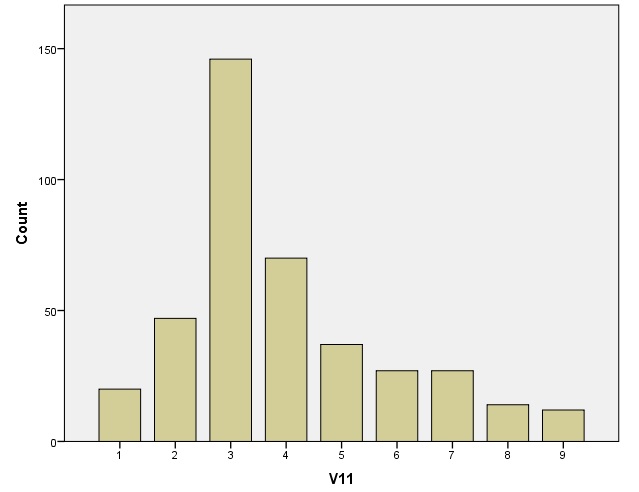
Benford


I can tell you now that I violated loads of rules. It comes from a list of 400 movies, their revenue. So, it spans several year, 400 numbers and those are the most visible reasons why Benford does not apply. The books of Tesco have similar issues. Dozens of accounts, interactions, loads of numbers spanning a time zone, but at times those numbers are also of a small count. Could this work with a ‘grocery’ store? Consider the amount of articles at 99c and £1.99. The amount of special offers going on, day to day (Tesco example), from that, if we use EVERY transaction, we will see skewing, giving us the problem, banks have similar issues, but now more often with seriously large numbers. If we ‘Benford’ the hell out of all the commissions, will they stand the ‘fraud’ test? If not, will the bank see that cash returned, or will we suddenly see a ‘rationalisation’ of non-valid application?


This is at the heart “in otherwise homogeneous data“, which gave the Call-centre a ‘ding-dong’, yet I feel that overall numbers could have shown the issue as well. Too many issues do not hold water here, yet the end of the article gives us what matters “Benford’s Law isn’t a magic bullet. It’s only one approach. It isn’t appropriate for all data sets. And when it is a good tool for the job, it simply identifies anomalies in data, which must be explained with further investigation“, ah the common sense. That did not take long did it?

So as there are serious options for investigating Fraud, the watchers of Tesco are still not in the limelight of the press, they have been given the ‘shade’ by the press at large. In one moment we see Tesco getting replaced by DeLoitte and recently we see Santander bank replacing DeLoitte for PwC and the SFO is nowhere to be seen. So are the Elves of Statistics and the Serious ‘eff’ Ogres in a state of non-war? Perhaps the SFO is too busy and whilst those auditors give new presentations on those yummy statistics, but as I personally see it, it is basically another presentation to lull groups of people to sleep. There is a mess in front of the people and those who should look and act, seem to be too busy and many can slightly fall asleep again.

Just 6 weeks ago, the UK got the message ‘RBS, once the world’s largest bank, is using analytics technology to go back to the era of personal customer service‘, with a promise to invest £100m in data analytics technology. I personally believe in analytics, it is a great tool, but in light of many factors, unless you get the people who have been consistently under-called them a job with a competitor bank, the institution will be paying a lot by those currently not doing their job right.

That final statement can be easily proven.

In the first, if data analytics was key, those involved should have known this for well over 3 years, some in charge have been there long enough, which means that no action was taken and they should not be in a position where they remain idle.

In the second, if data analytics is not key in solving some of the matters, why are they buying it? It could be for very valid other reasons, but that does not solve the ‘under-calling’ issue, it does not solve several other issues, even though it solves some, so at best, data analytics will diminish losses, which is good, but should we not get rid of the dead weight (read significant reasons for large losses).

All this comes to blows soon enough, because if the RBS does not get its results, new articles will appear all over the place regarding ‘miscommunication’, times of deployment and infrastructure issues, in the meantime ‘managed bad news’ prevails and more waves of issues will be swept under the covers of a dark carpet. As accounts are handed over between the 4 big auditors, the sum in the end gives us that overall none of them will make any serious losses. Slightly beyond the short term it evens out for the big four, which might be the largest miscarriage of justice of all.


Leave a comment

Filed under Finance, IT, Law, Media, Politics, Uncategorized

Spelling fraud with a ‘T’

So, after we see the events in Tesco, which has taken its billions in toll from September 2014 onwards, we now learn that Japan has its own version of Tesco, which we read in ‘Toshiba boss quits over £780m accounting scandal‘ (at http://www.theguardian.com/world/2015/jul/21/toshiba-boss-quits-hisao-tanaka-accounting-scandal).

Here it is not the meagre 263 million that Deloitte discovered would only be the tip of the Titanic sinker, in the case of Japan, it is three times the amount, which initially might beckon the question whether the fall out for Toshiba could be 9 times worse. Is it that simple?

The Guardian gives us the following “Tanaka and Sasaki knew about the profit overstatement and created a pressurised corporate culture that prompted business heads to manipulate figures to meet targets, the investigators found“, the other one is “Improper accounting at Toshiba included overstatements and booking profits early or pushing back the recording of losses or charges. Those actions often resulted in still higher targets being set for business divisions in the following period“.

These two are aimed at one side of a picture, but what some sales people will know is that this is already a disjointed part. Before I go into this, there is one more quote that needs to be mentioned. It is “Despite its shares losing almost a quarter of their value since the irregularities surfaced in April, it is still Japan’s 10th biggest company by market value. It was created by a merger in 1938 but its roots date back to 1875 and it was one of the companies that turned Japan into an industrial power“, so these irregularities have been part of something already for months, in addition, from an article one day earlier we get “The report said much of the improper accounting, stretching back to fiscal year 2008, was intentional and would have been difficult for auditors to detect“.

The last paragraph alone implies that like with Tesco, this system could not be done without massive ‘support’ from accountancy firms, moreover in all this, we have to wonder if anything will be achieved, especially as PwC (Pricewaterhouse Coopers) seems to have fallen off the view of journalists, and as we have seen no news from the SFO (Serious Fraud Office) since December 2014, we can ask in equal measure, whether the now sparkly news on Toshiba will go anywhere at all. Is it not interesting that PwC added 64 new partners three weeks ago, they get all the limelight as we read “Luke Sayers, chief executive of PwC Australia, congratulated the new partners on their appointment, praising their outstanding professional expertise“, whilst at the same time we get “IOOF has hired accounting giant PwC to review its regulatory breach reporting policy and procedures within the firm’s research division“, whilst in all this, PwC should still be regarded as the number one problem, as for a long time Tesco’s ‘issues of monetary matters‘ ended up getting overstated by well over a quarter of a billion, and so far it seems that either the SFO is nowhere, it is hushed or it seems to pussyfoot around PwC as the PwC marketing engine goes on like there was never a glitch in their seamless sky to begin with.

Now it is important that the entire PwC issue hits the UK, so a global company like PwC should not get hindered by one rotten basket, especially as they have dozens of baskets. Yet as one basket was regarded to have gone ‘rotten through’, the fact that there remains a system of silence, gives way to ask the question why PwC should be trusted at all and in that light, in the case of Toshiba, how intensely damaged the accounting business has become, you see Tesco and if we go by the words of Sheldon Ray of the Financial times we see “non-GAAP earnings per share that were more than 100 per cent higher than its GAAP numbers in the last quarter. Another reported 2 cents a share non-GAAP profit vs $1.41 per share loss under GAAP in one quarter” (at http://www.ft.com/intl/cms/s/0/f07720d4-c9b1-11e4-b2ef-00144feab7de.html#axzz3gWXJGSSF), so how deep goes all this? This grows in light when we consider ‘Richard Bove on Fannie Mae’s Accounting Irregularities‘ (at http://www.valuewalk.com/2015/07/fannie-mae-accounting/). Not a number one source, yet consider the quote “The result of their work is a conspiracy theory concerning the government takeover of Fannie Mae in which the public has been lied to concerning Fannie Mae’s financial condition in 2008 and in subsequent years“, this is linked to the work by Adam Spittler CPA, MS, and Mike Ciklin JD, MBA, MRE. Spittler is a Senior Associate at KPMG and Ciklin is an investor in a number of start-up digitally based companies, so we see that there is at least some Gravitas with these people, now add to that the information from the Washington Times (at http://www.washingtontimes.com/news/2015/mar/11/fannie-mae-recklessness-risks-future-financial-cri/), where we see ‘Mortgage giant hired unqualified auditor with conflict of interest for critical position‘ and “Nearly seven years after it was bailed out from the housing market crash, mortgage giant Fannie Mae is still engaging in behaviour that could precipitate future financial crises and taxpayer losses, a government watchdog warns in a report to be released Wednesday“, which was an article from last March. Now, the fact that this is not ‘new’ news is not the issue, what is the issue is that there is an almost Global act of blatant disregard, leaving the people the feeling that accounting seems to be set to levels of intentional misrepresenting companies for the need of bonuses and the ‘Holy Dow’. The fact that the activity against such transgressions is seemingly kept of the table in these economic times will only grow stronger unrest.

Yet, is my view correct, is it not me that is in error? Let’s face it, One in the US, one in Japan and one in UK does not a conspiracy make, it does not reflect on some non-existing criminal empire based on the quill, ink and parchment (as accounting used to go in the old days). What is an issue is how on a global scale governments seem to act or not act is matter for discussion, yet in all this external forces have been at work too, let’s face it that the US in 2008 was a place of desperation, even as it is now still on the ‘to-be-regarded-as-bankrupt’ even governments will make weird leaps when they are pushed into a corner. In my view, the fact that the bulk of global accounting is pretty much in the hands of half a dozen accounting firms remains cause for alarm and PwC is in the thick of many events. Including the 40 million property scandal surrounding Xu Jiayin last march.

Yet back we go to Japan, the land of yummy Sushi and as it seems shady bookkeeping. You see, there is no way to tell how deep Toshiba will get gutted, if Tesco is any form of indication, there will be a massive backlash, If 256 million leads to a well over 3 billion drop in value, what will it do to Toshiba? More important, with Japan so deep in debt, would it push Japan over the edge of bankruptcy? Let’s not forget that Japan hung over that Abyss a few times and the US seemed to have ‘intervened’ in favour of Japan in the past, in this case, that might not ever be an option again. For those who think that I overreact, think again. Tesco lost value factor 12. Now, we all agree that this is extremely unlikely to hit Toshiba to that degree, but what happens when stockholders walk out? Now consider that Toshiba is amongst the 10 largest Japanese companies with a global reach that equals IBM, that whilst Japan has a debt of $10 trillion, the fallout will hit Japan (again). To give view to the next part, I need to revisit a part I mentioned in the past. Let us take a look at the following example:

In week 10 a salesperson makes a sale, knowing it will not be a solution, during the next week that customer gets managed all over support and after a week, they escalate and communicate with the customer on solving it, a week after that the customer gets the apology that there is no solution, but that the customer will get a full refund, case closed.

Week 10 Sale made
Week 11  Support starts
Week 12 Escalation
Week 13 No resolution
Week 15 Refund

Now the part, the sale was made, in Week 13 no resolution, now we leave one quarter and go into the new quarter, the refund will not affect the sales person’s bonus, nor will the sales target be affected due to negative sale.

This is based on actual events, now think of the impact when this is not mere sales, but 1.2 billion in sales. Did this happen? I cannot state that all of the funds were done in that way, but consider the impact of increased sales and the people who enjoyed their bonuses from that (if that happens in Japan).

Consider the quote “blamed on management’s overzealous pursuit of profit“, which we get from the ABC article (at http://www.abc.net.au/news/2015-07-21/toshiba-top-executives-quit-over-us12-billion-scandal/6637976). Now add to that the quote “underlings could not challenge powerful bosses who were intent on boosting profits at almost any cost“, so how was the profit boosted? You see, this is not just an auditing issue, when we look at these large companies and the way that sales are arranged and forecasted, consider the events involved. To name but a few

  1. Leads
  2. Contacts (the consequence of a lead)
  3. Forecasting (the consequence of contact and the push for sale)
  4. Sales registration (Scopus, Salesforce, SAP)
  5. Accounting
  6. Reporting

Six iterations of paper and electronic trails that had to handle 1.2 billion in virtual revenue to some extent. Even if the leads cycle was avoided (by going through existing customers), there are other divisions that needed to be aware of a large non existing sale. You see, twelve hundred million dollars makes for a massive amount of monitors, laptops and other items Toshiba makes. Even over time, flags should have been raised on several levels, so when I read “The report said much of the improper accounting, which stretched back to 2008, was intentional and would have been difficult for auditors to detect“, which implies that the intentional misdirection was done over 6 iterations, which means that the group involved was a bit larger than we read in the articles at present. More important, how well did the Auditors seek in this regard? Which now takes me back to the reference I made earlier regarding “PwC added 64 new partners“, so how good are these ‘senior’ players? Making someone a partner, so that they can be misdirected by a senior partner would be equally disturbing. The fact that Toshiba falls through just like Olympus did, in a place where these events are regarded as ‘shocking’ according to investigating lawyer Koichi Ueda does not make me any less nervous. How institutionalised is overstating revenues on a global scale? You see, this is happening a lot more than many realise and even though many are not found, it does not mean it is not happening next to your own place of business. Now we get back to the issue I raised regarding Fannie Mae. The fact that it is not unrealistic that the government looked the other way here is still a fact we must consider. More important, are the two parts not mentioned in any of this. The first is linked to the issue I reported on January 30th 2013 (yes over 2 years ago at https://lawlordtobe.com/2013/01/30/time-for-another-collapse/) in my article ‘Time for another collapse‘, I questioned the way the Dow did not just recover, it did so whilst places all around us were remaining below par for a very long time after that. Now consider the following speculative theory:

What if places like Fannie Mae used the ‘leave one in’ approach. So there were mortgage packages and derivatives. So, we have four properties that are doing fine and we add one worthless one to the mix. The package deal as the salesperson states. So the buyer ends up with a ‘value’ and whilst one part is ‘given’ without value, that person has a good deal, now consider that this one place is no longer a lost place, it is no longer a write off. Over time the market would recover with less losses, so is this truly an action that is virtually impossible? Moreover, if such a thing truly happens, would it be fraud? How could an auditor ever find the event in the first place?

This now links back to Toshiba, not just in how you push up 1.2 billion, but how to get it passing the view of a ton of auditors. In the case of Tesco, I personally considered the involvement of PwC from the first moment the news came out, there it was a less murky place because as supermarket chain their product goes to Joe and Jolene Public. That is not the case with Toshiba. Not only are they global, but with a power plant division (including the one that makes you grow in the dark) as well as medical equipment (likely needed for previous mentioned division), Toshiba deals with consumers, corporations and governments, which on one side requires a lot more administration, but that administration would have the ability to go murky on an exponential level, which gives added value to the claim “difficult for auditors to detect” yet that gives option to two parts, is there a questionable level of administration, or are we confronted that the auditing partner in this case was a 28 year old recently promoted individual who now gets his/her first real large account?

Why these statements?

You see in all this, on a global scale, the law has failed. It fails because the rewards are just too good to pass up for those playing that game, the chance to get away with it and the option to keep at least a decent part of these earnings safe makes the option to do this again and again almost a certainty. The law has no bite and the corporations involved are too powerful to get smitten down, so this avenue will continue for a long time to come. In addition to this we ask what else is affected and why is there a tendency from the press to not keep these matters a lot more visible? Consider how much the Guardian and others reported in 2014, if you now Google ‘PwC Fraud SFO Tesco‘ we get nothing after December 22nd, what a Christmas present that is! What is funny that one other part showed up, which is Keith McCarthy, now director at PwC London, who was Chief Investigator with the UK Serious Fraud Office before that, so would it be mere speculation that the best way to avoid prison is to hire the police officer so you know where they will be looking? #JustAsking

I am only asking!

Anyway, with a wish for a better lifestyle, I will consider helping Toshiba to retrench their IP and Patents for a mere 0.4% of the value, now if I could only persuade my Law Professor to help me out, 0.3% for her and 0.1% for me, I should end up with enough to buy http://www.cooperbrouard.com/St-Peter-Port/Ridge-House-property/3835453 and retire in a relaxing way!

I agree that I could do better, but then I was never a greedy person, which is a failing the Toshiba executive clearly lacked.


Leave a comment

Filed under Finance, IT, Law, Media, Politics

The old way?

I was about to finish my assignment last night, when this article hit me square in the face ‘Farmers feel the squeeze from supermarket deals‘ (at http://www.theguardian.com/environment/2015/may/10/farmers-feel-squeeze-supermarket-deals), first part. I am not anti-Aldi, anti-Tesco or anything like that. I know things ‘need’ to be cheap. I am feeling the brunt just like anyone else, yet in this day and age when we need jobs and when we need commerce, why settle? When I see “At some point we’re going to be forced to retire because of the prices”, I worry. I worry because I want a decent income to live and feed the family (the family being just me in this case). So why is the supermarket requiring cheaper food? So that it can waste most of it on infrastructure?

In my view, let the supermarkets go elsewhere!

In my view, Steve from Worcestershire’s Vale needs to talk to a driver and a few people. Start the old grocery stores again. When we can get decent groceries, whilst under those conditions, places like Woolworths can brag about making a net profit of 2.45 billion, then they obviously do not need to sell groceries. Let them fall back to second rate products. Let them waste away, whilst the people return to the grocery store. It will be a challenge, but in my days we went to the markets, we went to the grocery stores. You only need one central point where these people can get their wares and the people like Steve might have a better deal here. When I read “It showed that the number of small and medium-sized businesses supplying supermarkets and in “significant” distress has doubled in a year from 728 to 1,414“, I honestly wonder why people continue on this route?

When suppliers state, 5% more or get it somewhere else, yes, the supermarkets will change supplier, but it will take one bad one to make a supermarket lose their customers. Once the groceries go somewhere else, we will see that the shop next door might be the butcher or the milk and cheese shop. I say support your local shop in all manners, and getting the smaller places to reinvent decentralisation could go a long way in raising the UK economy in a much better way. In the end, a place like Woolworths only tickles its own board of directors with 2.45 billion, over 5000 shops this amounts to half a million each. So, yes, that was only profit and the story of cost will change, but it seems to me that 5000 shops implies 15000-25000 people working, that will also do the economy a lot of good. We have been enabling larger players too much and for too long.

Consider I mentioned 5000 stores, consider that Aldi has 560 stores and Tesco has 2,614 stores. That is a little more than 3150 stores. If they all lose the butcher baker and grocer, which means that we need close to 10,000 locations. (not even including the other supermarkets), in addition transport is needed, so it seems to me that even though my calculation is extremely skewed, we must consider that the day of mega markets are over. We need to start thinking differently if we are to face the challenges ahead in a survivable and in a more humane way. I am willing to forego supermarkets as long as there is a decent alternative (not too expensive). I feel that here in Australia that has been proven with Bakers delight and Lüneburger. If the baker can do that and move me away from supermarket bread then I feel certain that a butcher, grocer and cheese and dairy shop (or just a plain milkman) can do that too.

So as I see this quote “According to Jack Ward, chief executive of the British Growers’ Association, producers will have to get used to the new supermarket landscape“, I say Nay! Especially when he adds the quote “this has racked up the pressure on the supermarkets. They are fighting for their lives and have to go somewhere to get better prices“. When I see a supermarket chain making proud of 2.45 billion, your statement Mr Ward, is widely incorrect.

In addition there is the quote “Christine Tacon, whose job is to rein in some of the methods used by retailers to apply pressure on suppliers, such as charging for display space and delaying payment. In February the adjudicator announced an investigation into Tesco over its relationship with suppliers“, really. it seems to me (and to Deloitte) that certain paths had been going on for a while, so if that is true, then Miss Tacon had been asleep at the wheel and we should seriously look at new ways of moving forward on the way consumers get their stuff. There is also the other end. Bal Padda grows strawberries in the Vale of Evesham and she has a good relationship with Asda. This I do not oppose, there are clearly issues and over 1400 under such pressure is a clear indication that things are not well. The question is how to fix it. Perhaps in the end, a shift will happen and the supermarkets will have to change their way, perhaps fresh foods is no longer a guarantee, perhaps that must go outside those places (as likely must beef). By the way, when you buy fresh at the butcher it is also extremely conceivable that Equine Burgers are a thing of the past, just saying!

Consider the following: “I was making more money per kilo of lettuce 20 years ago. A box of courgettes went for £4 to £5.20 years ago; now it’s £1.80 to £2” Yet, Tesco online shows baby Courgettes to be £7 per Kg and other courgettes around £2 per Kg and lettuce at 50p each. Even when I was young prices were higher. I am all for affordability, but is this the way we should go? At the expense of our farmers? How unjust is that? It goes beyond that, the baker, the butcher the prices at Tesco (not the cheapest one) are indecently insane.

So, what is the solution?

That is the question I fail to answer this, perhaps some of the numbers needed to see the chessboard more completely are missing. You see, I stick by what I wrote earlier, I will go to non-supermarkets in a heartbeat, but in this economy I wonder if I can afford it, the only question remains. If some places get to place this quote “The UK’s biggest supermarket chain said group trading profit fell 6% to £3.3bn, with like-for-like sales down 1.4%“, we must wonder how we can make a fairer option for the farmers. They are not alone here (so is dairy and meat) yet they all should have a decent affordable solution that gives them a slightly better deal than they get now.

I wonder if anyone else has a better solution. It is my fear that if the UK is in the old proverbial stage of ‘bread and games’, what is being kept off the radar and what can we do to better the plight of some? Once a nation can no longer grow its own food, it becomes slave to whomever feeds them, which is something we never ever want to face.


Leave a comment

Filed under Finance

The Sound of silence

Hello accountant, my dark fate
your books are bloated as of late
the need for bonus loudly creeping
to be deposited so fleeting
and the greedy that are filling
their domain, they always gain
it is the need for money

The P W C accounting firm
will gain support, another turn
you see the press is staying quiet
we wonder now who got them hired
see the news is remaining just the same, it’s such a shame
and they should all be fired

You might think why this rewritten song of Simon and Garfunkel? You see, it has been almost 50 years exactly that Simon and Garfunkel took this to paper, 50 years later we would see quite the different ballad, one that would see repercussions in ways never seen before, yet both instances unique. That part was made clear today when we see ‘Tesco posts record loss: what the experts say‘ (at http://www.theguardian.com/business/2015/apr/22/tesco-posts-record-loss-what-the-experts-say). So when we see “Tesco reports record £6.4bn loss” and when we see ‘these experts’, you and me alike should ask a series of questions the press is not asking. It has not been asking them for 2 quarters now (well an absolute minimum).

Consider the following quote: “Soon after his arrival, Lewis unveiled a £263m accounting scandal caused by overoptimistic recording of payments made to Tesco by suppliers. Tesco is under investigation by the Serious Fraud Office and the supermarket regulator over the affair“, this is what got it all started, what the publishing pussies refer to as ‘overoptimistic recording of payments‘ turned out to be nothing less than a systematic issue as we saw some of the news from DeLoitte. It is shown in my ‘adjusted lyrics’:

Will gain support, another turn
you see the press is staying quiet
we wonder now who got them hired

You see, there is the Sound of Silence, an actual silence. Try finding anything regarding Tesco in 2015 regarding PricewaterhouseCoopers. You will find very very little, pretty much the absolute minimum. Perhaps you remember the wild allegations on the ‘MH370 suicide flight‘, in addition, all those claims regarding the World Cup soccer in Qatar 2022. Yet, in regards to PwC the Murdoch machine stays very quiet. I regard that this makes Rupert Murdoch the biggest pussy in newspaper publication since the newspaper concept started in the 17th century.

It took just less than two hours to realise that PwC needed investigation, the papers made close to zero mention on it, there were some casual mentions regarding ‘asking questions’, but it was as low key as technologically possible. In December 2014 it pretty much stops, feel free to try and Google it for yourself. You will find articles on how Sainsbury switches from PwC to Ernst and Young (January 16th 2015), but for the rest there is too much nothing. Not just the Murdoch groups, but in equal measure, you will find little to nothing regarding PricewaterhouseCoopers. Is that not strange? Especially as we now see how £263m inflation, caused a £6.4bn deflation. A result 24:1, it became such an interesting long term bet to make, especially by those involved. Yet many of those players are shrouded in silence.

You see another matter suddenly dawned on me. I reckon you all remember Julian Assange, from all those cables regarding the Afghan war. 5 days ago, they decided to also go public on all those Sony hacked cables. We see the quote: “This archive shows the inner workings of an influential multinational corporation. It is newsworthy and at the centre of a geopolitical conflict. It belongs in the public domain“. No Mr Assange! You decided to play god with stolen data and you decided the fate of this corporation by hanging out the laundry, in addition, you handed the power they wielded and threw it up in the air to be taken over by any competitor who can grow in directions they never bothered to look, because they could not be bothered taking the effort.

And as we are talking into the public domain Julian, what happened to your ‘bravery’ when you made the quote “In November, WikiLeaks founder Julian Assange told Forbes the site has a ‘mega leak’ on an unnamed major US bank exposing an ‘ecosystem of corruption’ that will be released early this year?” I am pretty sure that this never went public. I searched high and low and your WikiLeaks page shows nothing there either. It seems to me that many parties are too scared when it comes to banks and financial institutions.

The question should be Did Julian Assange have anything ever regarding his claims on an ‘ecosystem of corruption’ in regards to a US bank. Should I not ask that question? You see, when the press at large ignores the PwC issue, many should ask questions, especially as both Tesco and Greece fill pages of text in the Guardian and several other newspapers, yet the hunt for information regarding PwC is not moving forward.

In the first article mentioned, where we see the dubious term ‘what the experts say’, NO MENTION AT ALL on PricewaterhouseCoopers (or PwC), is that not strange? The question how 10 million in costs (which I converted to 199 full time accountants working on Tesco for a full year alone) did not reveal anything in time, so how could such a managed event stay hidden? In several articles we see a similar quote as I am adding here, a quote that in many cases was the very first paragraph of articles late October 2013. “DELOITTE has completed its review of Tesco’s overstated half-yearly results and confirmed that its black hole is even bigger than the £250m previously declared and goes back even further than the supermarket group had originally stated“, which means that these auditors ‘missed’ it for a longer period of time. A thought I had in the first few hours, was confirmed a month later (which is fair enough, they hard to check many numbers before stating anything), yet I saw and reported on this (as well as my thoughts), having no economic degree, just me as an analyst saw what the press has been ignoring ever since.

One of the more revealing articles was in the Financial Times named ‘UK accountancy watchdog hits PwC with two separate probes‘ (at http://www.ft.com/cms/s/0/98e02452-89c8-11e4-9dbf-00144feabdc0.html#axzz3Y3cymr54), which was in late December 2014, after that the news and the hunt for the Priced and watered Coopers stops on nearly all media fronts. I wonder how they pulled that one of. The fact that there is almost no visibility on the two probes is only more cause for concern, but those experts all have ‘something’ to say in this matter. Isn’t it nice that they did not have anything to say, or did not say it out loud before the calamity was seen. All those Tesco projects, ready to roll, not one came with the considerations ‘Tesco is spreading itself too thin‘, which is nice before the fact, but pointless, bordering on clueless after the fact. I especially liked the quote from Mike Dennis from Cantor Fitzgerald, you know, one of those after the facts proclaimers. “We believe Tesco should consider closing 200 underperforming supermarkets/superstores and focus on growing the more profitable remaining 700 stores (excluding Express); in addition, this should also allow for £40m of cost-savings from the closure of a distribution centre“, you see, my issue is twofold.

The first is where the ‘under’ performing line lies. Is underperforming, working at a loss, or at a minimal profit? The reality remains that people need groceries, so if an ‘underperforming’ shop is closed another will open with a different label and now that lost revenue will go somewhere else. My second issue is that 40 million in savings. You see, if those 200 shops are spread all over, that distribution centre will still be needed, even if the amount of stores decreases, someone will need to open a grocery store and this distribution centre could service independent supermarkets to some degree, meaning a small additional revenue. Then we get the second set of debatable solutions “Matt Davies, Tesco’s UK CEO as of 1 June, should consider a further reduction in staff and a significant simplification of central functions and category management. Aldi UK today generates twice the sales per full-time employee compared to Tesco UK and is expected to report higher trading profits“, reduction on staff? Where? You see, it is nice to ‘opt’ for simplification, but in my experience in 100% of the cases, simplification was not a bad thing, but it came at some expense, what is that expense and will it hurt down the line? The biggest fun can be seen when you read the part of Philip Benton. It all reads nice, but the issue I have is at the end in this case. “The retailer is in the midst of a huge restructuring after selling off much of its portfolio including Blinkbox and Tesco Broadband as well as the forthcoming sale of market research unit Dunnhumby and undergoing a complete overhaul of its leadership“, my issue is the possible ‘inflated’ that Dunnhumby represents. You see, it could be regarded as inflated as its value is determined by what the buyers will offer. In the end Dunnhumby represents well over 140 million a year and it also represents undocumented savings. You see, if a lot of the marketing and visibility research is done at market value, Tesco will face that they either deal with additional costs (not small ones) or not do the research. Both are bad ideas. None of these ‘experts’ are looking into the amalgamation of services that Dunnhumby could offer via Tesco and/or for Tesco. Dunnhumby is a massive data warehouse and it should have loads of options. Moreover offering these additional services (in the trend that Google has done with ‘Gmail for work’ could open up new capital gaining opportunities. Now, as the economy is slowly starting over the next 3 years, those who grow could need data insight that is currently available via Dunnhumby. This means financial and revenue growth that shows a healthy future, giving that away in some sale to recoup 2 billion, from a 6 billion loss that was all based upon degraded value seems like a very bad idea to me. Even if most of that 2 billion is recovered, the invoices that follow will put pressure for a larger part on Tesco.

Consider that the interest on 2 billion is 70,000,000, now consider that not only are them making 100 million plus, they are also the centre of data, a place Tesco will desperately need in the coming 2-5 years. Not having it could imply more costings for Tesco. No one seemed to be considering that part of the equation at all.

So, reality now, will stores be closed? That seems unavoidable, yet closing stores also means no more revenue, dumping the location at a loss and a few other items linked to this. Tesco needs to grow again, but the method remains debatable. I would have thought that moving more towards an Aldi/Lidl margin might make a difference, will it be enough? Whatever move it will make, it will need data to support and test the foundations with, so I personally feel that this requires the non-sale of Dunnhumby (for now). You see, I still see the centre with Dunnhumby for another reason. When you look at their site, you see a list of the large corporations, that is all good (and it brings home the bacon), but they are also sitting on loads of Tesco data as well. What if aggregated parts could be linked to small firms, smaller firms who end up with a dashboard solution, where their limited data is linked to that massive Tesco Data Warehouse, where these smaller companies, for a small fee get a dashboard uniting their data with Tesco demographics. Now we have a whole new clientele in a business setting, so before those supermarkets get closed, they should see if a small corner of it could be an added business venture. Likely those prospective clients will be in larger area’s where Tesco remains operational, but we now have an added service and Dunnhumby has an optional new suite (based on for example SAP dashboard) that opens up new ventures and even added consultancy and training. In these times the innovators will cause growth to evolve, selling off things only makes for lost market share (even though some non-profit ventures should always be considered for scrapping).

Are my ideas so outlandish? You must always consider that part, for the simple reason that the sceptical approach causes no harm and the proof that follows will only create futures. The following quote is as old as the hills, so it should not be a surprise to anyone in this field: “Sales will blame Marketing for the lack of quality leads with repetitive precision, whilst Marketing will blame Sales for not acting on the leads on time, or at all. When nobody has any reliable stats to back up their ‘verdict’, the arguments go on forever and nothing gets done”. Now, consider all these new firms, those new start-ups, or just one man companies like for example Electricians, Plumbers and Painters. They have no Sales or Marketing at all in most cases, would it not be nice if they had a simple dashboard based option that can help them focus on where possible opportunities lie? Not to mention usual retail like family bookshops and leagues of small pharmacy places that could do better. The solution I suggested could help them focus on where to look next. The great thing is that for the most, the same basic solution will work for all, they would only need a set of very specific filters in addition to the demographical ones. A solution that could be automated to the larger extent. One simple market, there for the taking. Did anyone consider that?

And as we look into these possibilities, we get back to the beginning, how could all the financial data be so opaque that it escaped the view of PwC, when we look at all these claims by experts, how did none of the warning lights light up, especially when we consider the words of Deloitte “these auditors ‘missed’ it for a longer period of time“, now I have brought you from the premise, past the innuendo to the basic view on how data can be new business too. Finally, when we consider the following quote that was in the Guardian “Further positives include that Tesco did in fact make a bigger trading profit than the market believed was possible (£1.4bn v. £760.86m consensus)“, this reads, they did twice as good, this means that Tesco is getting back on its feet. Yes, I did read that it is less than it was, but still, they got one dot four billion in, which is a lot better than Greece and most traders want them to get 7 billion regardless, so I think we should consider that many are willing to dump 7 billion on a location of non-cooperation, whilst they will drown a corporation fight to achieve and collect ACTUAL revenue. What a double standard we live by!

If we go by the simplest stats (not an accurate one), then we see that Tesco exceeded by £700M, which is 23% of the £3 billion loss, Greece cannot even raise 10% of what is due shortly, so it is time to look at what is real and look at why the press seems to be ‘avoiding’ (read not actively digging) into Pricewaterhouse Cooper either. But I will leave that to what I would currently regard to be the ‘Pussy’ family (Witherow, Rusbridger, Murdoch et al). Should you consider the path I walked here to be ‘inappropriate’ then Google ‘Tesco+scandal+2015‘ (837.000) and Google ‘PwC+scandal+2015‘ (271.000), now look at the amount of Newspaper links we find in the second one (almost none and many of these links are 2014). I think I made my case here, I just wonder what scared the press to this extent away from a story.

So as we see the quotes “Over the full year, the profit margin in the UK was 1.1%, a far cry from the impossible 5.2% that Lewis’s predecessor, Philip Clarke, ridiculously attempted to defend” and “Lewis must show that the ‘early encouraging signs from what we have done so far’ will produce a discernible improvement in profits“, yet no mention on the previous directors, regarding ‘cooking’ the books and still no mention of the Auditor either. It seems that everyone knows that the dice are loaded but no one is willing to say it out loud.

What else is not reported on regarding the 24:1 loss?


Leave a comment

Filed under Finance, IT, Law, Media, Politics

A basket full of trash

Have you ever had this? I am not talking about the Christmas or the hospital basket. No, I am talking about those ‘greeting’ baskets you get. One of these: ‘welcome new member’ baskets. You accept them with a smile, whilst you know you are getting a bag full of goodies that have value that is close to zero. Now we get these baskets from book clubs and other longer term commitment places, none of this is a big mystery to many people, because at some point, we all get confronted with this basket. Now, let’s change the game a little, now we consider the same basket, but in this case we don’t look at some two bit online retail vendor, now we look at Price Waterhouse Coopers.

That part is seen in the Guardian as per today. Let me refresh you on some of the facts, for that I will take you back to my blog from October 25th 2014 called ‘Price Waterfall Blooper‘. In there I wrote the following “Consider that PwC had (a reported by the Guardian in an earlier blog) last year; PwC was paid £10.4m by Tesco for its auditing services and a further £3.6m for other consultancy work (a newer version at http://www.theguardian.com/commentisfree/2014/oct/23/guardian-view-tesco-auditing-debacle-pwc-systemic-shambles)“. Now when we add today’s information, information I quite honestly never considered: “The Groceries Code Adjudicator, Christine Tacon, announced the move, saying she had formed a “reasonable suspicion” that the retailer has breached the Groceries Supply Code of Practice“. Now, let’s take a quick look at this so called ‘code of practice’. First of all, the information is found here: https://www.gov.uk/government/publications/groceries-supply-code-of-practice. The fact that this is on a dot Gov dot UK site should indicate that this is the serious stuff. So this code of conduct states at 4.1 PART 4—PRICES AND PAYMENTS, the following: 5. No delay in Payments and at 9. We see Limited circumstances for Payments as a condition of being a Supplier. This is just two of a long list of a code of conduct. The reason to mention these two is the question that follows. ‘How come the auditor was not aware of these facts?’. These are not just simple facts, they are codes of conduct, and can someone please explain to me how this is not raised by the firm charging close to 14 million pounds for one year of work? There are two other parties who are about to see the limelight. Party one is the Press. You see, I was following part of this since last year October, yet, I do not remember seeing the press being awake on these facts. I have a decent excuse living on the other side of the planet and the fact that these elements are not part of my Master of Intellectual Property education, yet the press, Pricewaterhouse Coopers as well as whatever legal aid is out there in UK farmland, it seems to me that too many people were not paying attention at all. There is actually a third side to this. I missed it initially, but when you look at the Guardian on October 23rd (at http://www.theguardian.com/business/2014/oct/23/tesco-black-day-profits-down-92), we see the following: “Tesco claimed that the rogue accounting practices – which relate to how the supermarket banks payments from suppliers – dated back at least two years“. Now consider again the government side that states ‘Guidance Groceries Supply Code of Practice, Published 4 August 2009’, so the statement and the fact that there was a code of conduct out for half a decade, did no one consider that there were additional issues that might rise?

Who on earth is running PwC in London? More important, what on earth is mentoring these wannabe’s? I have good right to speak in this manner. This took me 5 minutes to figure out when I got wind of this small fact, the fact that PwC, the Press and others were not all over this from day one is a little too weird for words. Consider the people that quickly left Tesco when the water got slightly too uncomfortable. Should they have known? I’ll let you answer this question for yourself, but now also consider that the auditors did not make mention in reports on some of these parts, they DEFINITELY should have known about the codes of conduct for the simple reason that part of this is linked to the pesky rules regarding payments and so on. What else did these people miss? More important, consider the date I mentioned (October 23rd), now consider the Deloitte report, was this part in that report? If not, consider that they had to check on these ‘miscalculations’, as we see the mention ‘rogue accounting practices‘ and ‘payments from suppliers‘, did no one consider looking under rock number two? Granted that Deloitte did not get much time, but as we see that suppliers were part of the mix, did no one mention the question ‘What about the Groceries Supply Code of Practice? Do we need to consider any issues there?‘ Did that question seriously not come up?

Now consider my blog from October 13th called ‘A matter of Jurisprudence‘, there I wrote the following “company secretary Jonathan Lloyd, who advises the board on legal and governance issues, had resigned and was serving out his notice until March 2015”, the second one “Ken Hanna, chairman of Tesco’s audit committee, is also set to step aside as a non-executive director as the company’s chairman reshuffles his management team”, which was shown from several sources. Now consider the fact that we see Jonathan on legal issues and Ken as part of the audit committee, they should have known about the ‘Groceries Supply Code of Practice’, which now gives an entirely different light into their departures. So was PwC completely in the dark about this? If the answer is yes, then my next question should be ‘why are they allowed to be auditors?’ Is that such a weird question to ask? It is a code of practice, not a fraternity paper on how to score, so I reckon, especially as it has financial sides, the auditors should have taken a look, moreover, Deloitte should (they might) have reported on this. The fact that the press is only now revealing these events calls for additional questions, but their fumbling is not part of this article, the fumbling of accountancy firms a lot more, for the mere reason that the code states at 5. “A Retailer must pay a Supplier for Groceries delivered to that Retailer’s specification in accordance with the relevant Supply Agreement, and, in any case, within a reasonable time after the date of the Supplier’s invoice“, which should have been part of the financial checks, can we all agree on that part?

And as we take a better look at this basket (have you figured it out yet), we see that the players were in a lot deeper than initially suggested. This cesto, has harboured information, misinformation and above all else, a lack of illumination of the facts as is. First there is Tesco themselves, the latest information shines a harsh light on several members who have vacated their office, in addition there is the case I made on October 13th in my blog ‘A matter of Jurisprudence‘, where I mentioned one person (Rebecca Shelley) who would have been at the centre. The mention on the Birchwood Knight site was “As part of her corporate affairs role, Rebecca will be responsible for government and media relations, investor relations, internal communications and corporate social responsibility“. Rebecca’s job hits ‘government relations’ and ‘social responsibility’. How come that this ‘Groceries Supply Code of Practice’ remained so below the radar?

So when we see months of reporting and we see the lack of mention of this so called ‘code of practice’ we also see the mention in today’s article “Business secretary Vince Cable said: “This is an historic day for the groceries code adjudicator and shows we have created a regulator that has real teeth“. Who is this Vince Cable catering for? You see, if this statement had been given before December 1st 2014, then there might have been a case, at present the act of mentioning it months after going live is just another presentation of a sad story on how some people could be seen by many others as some parties remaining silent hoping to make a bundle down the track.

So I reckon that Tesco will have to sweat the small stuff for some time to come, however, the more we get to see at present, the less clean the image of PwC seems to be. In the case of PwC it will become a case that is worrying on several levels. Not only are the looking for hardship over what was done, as per now it seems that PwC will be scrutinised for the things they did not do, not properly oversee or missed altogether, as per today it sucks to be the senior account holder of the Tesco account, because the fallout will continue for a decently long time to come.

So as we see the basket (also known as a cesto) filled with the trash of information, wrongful acts and none acts, can we all agree that we got a whole lot of nothing, an act that will have severe repercussions and not just legal ones! Does anyone remember this Warren Buffett fellow and how he lost 2 billion in value? If we combine what we have seen so far and add the part that I discussed in October regarding the Chadbourne papers, I can repeat that quote: “that directors of companies must make certain disclosure statements in the directors’ reports. This applies not only to information which the officer actually knew of but also information he would have known about if he had conducted a reasonable enquiry. However, the provision goes further and requires the director to confirm that, so far as the director is aware, there is no relevant audit information of which the company’s auditors are unaware”. This now brings an entirely different light to the Groceries Supply Code of Practice, moreover, it could be suggested that Warren Buffett now has a clear case in legally reclaiming his losses, consider that the US has the Sarbanes–Oxley Act, after Enron, which took care of the power players real fast. The UK has the Corporate Governance Code. I reckon that it is not too far-fetched that Mr Warren Buffett could be offered a deal for his lost two billion. If so Warren, remember this poor blogger and I feel so much better getting to work in a new Jaguar XK, in British racing green of course.


Leave a comment

Filed under Finance, Law, Media

Price Waterfall Blooper

I am sad to say, I am sorry to report
we have not seen any fraud of this sort
not a win or a gain, but just sadness and pain
are the man plainly vain, they do not travel by train
it will not go to court, yet the profits fall short

as my profits progress to the basement below
as executives go, with no exit fee show
we will wonder awhile, what results they proclaim
as we now still decide, should we name, should we shame
where is the pee double you sea and its dough

So, yes, is this the beginning of arts, the limericks and the consequences of non-accountability?

You see, there is no doubt in my mind that the initial investigation is only the beginning for both Tesco and PwC. Whatever we may think, we can be certain that if Dave Lewis had NOT rung the bell, the mess would be a lot larger then it is at present. I think we should also ring the bell of honour for the whistle blower, because without it Christmas would have been the grimmest of experiences in the UK.

Let’s take a look to the last two days, when Deloitte got its report out (to some extent) as reported (at http://www.theguardian.com/business/2014/oct/23/tesco-profits-black-hole-bigger), we see a few things that do not add up.

  1. He dismissed the idea that fraud may have been involved in the accounting blunder: “Nobody gained financially as a consequence of the overstatement of performance.”“, is that so? You see, there are a few issues that we have; I will step over one of them because I prefer to tackle that part a little further down.
  2. Laurie McIlwee (former CFO) as well as Mike Iddon require closer scrutiny. Mike was a group finance director, planning, treasury and tax. When we see tax, we see a person who will dig, trying to find any cent that is deductible, as a good FD should be, and in 13 years at Tesco, he had not seen anything? Seems rather clumsy doesn’t it? The fact that the accounting hole is a little bigger (15 million is not much when you say it fast), also came with the knowledge from Deloitte that the hole was there for a longer while, so basically, the inflated 265 million, means an inflated payment of taxation, how is that ever a good idea?
  3. So consider Tesco, the size and scope of it. They lose a CFO and a FD, and all along NO ONE at Tesco, I state again, NO ONE seemed to offer to pick up the baton for those months? Even if it was at no extra pay and only for 3-4 months, 99% of the financial industry would be chomping at the bit to pick up the baton, so that they can add this to their resume, it gets even better. It is a win won for whomever picks it up, because if that person does well, then the value of that person goes up by a lot and his/her future, whether within or not with Tesco would be a few steps on the large corporate ladder, even with nothing to gain it ends up being a win/win.

Let’s just face it, I am nowhere near next in line to take command of the 591 Signals Unit at Digby, but if I get the chance because the current commander was on the list to become Air vice-marshal, I would get there running, even if I was still in my pyjamas and was holding only a toothbrush. No matter how well my performance would be, if I made it I would be eligible for a nice challenge at GCHQ, a seriously cool way to skip half a dozen steps on that ladder, now consider that NO ONE had these levels of ambition at Tesco? I truly believe that beside the whistle blower a few more had a clear picture that taking that seat from within would turn out to be nothing less than poisoning their career.

  1. He dismissed the idea that fraud may have been involved in the accounting blunder: “Nobody gained financially as a consequence of the overstatement of performance.”“, now we get to the issue that I have had since day 1.
  2. Consider that PwC had (a reported by the Guardian in an earlier blog) last year; PwC was paid £10.4m by Tesco for its auditing services and a further £3.6m for other consultancy work (a newer version at http://www.theguardian.com/commentisfree/2014/oct/23/guardian-view-tesco-auditing-debacle-pwc-systemic-shambles). This article now shows the following quote: “At the very least, this is a very cosy and lucrative relationship“, which slightly debunks the statement of Dave Lewis via Deloitte regarding ‘Nobody gained financially’; it depends on ‘how’ we regard ‘gain’, when the alternative is losing revenue, remaining at status quo is clearly a gain.
  3. So as we see these two numbers, let’s do a little math, let’s say an auditor makes £65,000 a year (a little less usually), so we now see that the annual fee gives us 153 auditors for a year and an additional 46 auditors for the consultancy for a year, that gives us 199 people going over the books, checking it all. No one saw anything? Now, the reality is not exactly like this, but considering that PwC is one of the big 4, we now have a clear case for some serious questions for 25% of all the large audited companies in the UK, how much taxation was not collected, how many large bonuses and incomes were honoured in such a symbiotic incestuous relationship? No wonder George Osborne has such a hard time, the deck seems to be seriously stacked against him.
  4. There is one more thought that comes to mind, but this one is, as I will happily admit, based on shallow grounds. This was all found by Deloitte in a little over a month, mainly because they knew WHERE to look. But, it is entirely plausible that the whistle-blower just knew about that one thing, what else is there and what has not been found yet?

This is important for two reasons. The first is that it then debunks the statement from Lewis, likely via Deloitte who said ‘He dismissed the idea that fraud may have been involved’, I am not convinced! It took Deloitte to find the obvious over the period of a month. We can consider that the fact brought by a whistle-blower gives weight to intently hiding, if not than this person would have stepped forward internally and the old crowd would have solved it, that did not happen. It is not unlikely that those involved hoped for a quick brush under the carpet, this circus was unlikely anything they ever desired. What was signed off on, by the equivalent of 199 auditors remains a serious issue.

This part we can see in the Guardian quote “The making up of the profits figures was not in a report signed off by PwC. That happened in August – three months after PwC had given the supermarket chain’s figures a clean bill of health. Even then, it noted that there was something potentially funny with the numbers, and expressly warned about “the risk of manipulation” – but allowed them to pass anyway“, so something potentially funny does not warrant digging? Let’s not forget they had the equivalent of 199 people for the year, so plenty of digging resources. If we add the following “It is one of the primary ways in which investors, business partners and regulators can tell the true state of the company they are dealing with“, so not only is there a link to possible fraud, the implied length of this gives reason to suspect intentional misdirection towards investors, which makes the news releases all over the papers on class actions against Tesco a plausible worry for some time to come.

It becomes a much finer point of debate when we consider the following abstract ‘Misreporting in our model covers all actions, whether legal or illegal, that enable managers of firms with low value to make statements that mimic those made by firms with high value. We show that even managers who cannot sell their shares in the short-term might misreport in order to improve the terms under which their company would be able to raise capital for new projects or acquisitions‘ (at http://www.law.harvard.edu/faculty/bebchuk/pdfs/2003.Bebchuk-Bargill.Misreporting.pdf). It comes from a paper by Oren Bar-Gill and Lucian Bebchuk, published at Harvard in 2003.

Now we add what they wrote on page 21 “3.4 Creating Opportunities to Misreport, at T=1 managers decide how much to invest in creating opportunities to misreport earnings. The equilibrium level of this investment decision is characterized in the following proposition“. after that it becomes increasingly mathematical, but behold, the initial text ‘whether legal or illegal’, so if the old Tesco gang focussed on ‘legal’, was that the reason they needed to pay an additional 3 million in consultancy (a clear and admitted assumption on my side), yet is that really too weird a thought? Let’s face it PwC signed off on books containing an additional quarter of a billion, which took some time to create.

I know that incestuous is all about keeping it in the family, but the fact that this could possible all be legal is just a little too hard to swallow.

Could it be that both Corporate Law and Taxation Law within the Commonwealth are in dire need of an overhaul? Some might say that it could be an idea to do this before Christmas, to them I say “Bah! Humbug!“, Monday the 5th of January 2015 will be soon enough. It will give Lord Blackwell, Lord Goodhart, Baroness Goudie and Lord Haskel something to look forward to as some might be enjoying a large roast with potatoes, Yorkshire pudding and thick gravy. The Rt Hon Lord Millett has done more than his share in his long career and his Lordship, as right honourably retired can enjoy a second helping of Christmas plum pudding with custard (unless his lordship prefers the challenge of making corporations a little more accountable then the currently seem to be). I would, as blogger Lawlordtobe be happy to lend a helping hand, but I never studied economy or taxation laws, so I would only get in the way, yet I remain available for assistance if need be. I do reckon that the members of the House of Lords who are members of the Joint Committee on Tax Law Rewrite Bills should consider their calendars, especially if the investigation turns out that the Financial Reporting Council (FRC) will be unable to press any criminal charges, to me and likely to all it should be clear that such levels of orchestration must be addressed!


Leave a comment

Filed under Finance, Law, Media, Politics

Debt and …?

This is a story I find hard to write. Is it a story? That will always depend on your point of view. You see, there is a danger to blindly sight with one person, one group or one vision. We all have it. We think of a certain path being the only one and as such treading of that beaten path is always a dangerous one because we as people do not walk off the path. Some know the horrors that this beaten path protects us from.

This is the story of Israel and an ally, who due to impending bankruptcy had to make a leap of faith. This is how I see the Iran issue. Let me be clear. I have nothing against Iranians. I remain in the belief that Ahmadinejad was an utter idiot and as such no trust could go to Iran. The image of its current President Hassan Rouhani is entirely different, yet, I still have an issue with the dangers to Israel. No matter how good Rouhani is. He will be up for re-election and after two terms, what will Iran get? Will it get another Ahmadinejad? Until the Muslim nations all acknowledges the existence of the state of Israel, giving them nuclear abilities is just too dangerous in many cases. In my mind Ahmadinejad wanted immortality, to be remembered in prayer for all eternity. To get that, he only needed to destroy Israel, something that could be achieved with only one successful nuclear missile strikes. Would Ahmadinejad do this, if he had nuclear abilities during his reign? In a heartbeat! Now, I am fully aware that most Muslims are not like this. But it only takes one elected one to take that step. This is a very real danger! So, I personally do not expect that Hassan Rouhani is like that at all (it is just the image I have of that man). But if we consider that to be elected in Iran, that three of several elements are: administrative capacity and resourcefulness, a good past record, trustworthiness and piety. If Ahmadinejad passed these, then who else will be able to pass these checkpoints?

So what is this about debt?

Well, the US has too much of it and it needs billions each day to stay afloat because the US cannot get a grip on its spending. With an oil filled Iran, the US will be willing to do business and it desperately needs money! If you doubt that reasoning, then consider the Cuban issue. Why after decades is there still so much pressure, both economically and technologically? Consider this pdf from the US military: “Policy Options for a Cuban Spring” (at http://usacac.army.mil/CAC2/MilitaryReview/Archives/English/MilitaryReview_20120630_art014.pdf)

I wonder if this stand-off approach would be there if there were large oil fields under Cuba. A Cuban response, even though I find it slightly too ‘propagandistic’ (is that a real word?) is at http://www.cuba.cu/gobierno/alarcon-tvi.html, where it states as they quoted US senator Warner “The current policy treats Cuba more cruelly than Iraq and North Korea, where US embargoes are less restrictive.” I cannot vouch whether that was said, whether that person quoted it, but there seems to be a ring of truth in the sentence. It seems that Iran still supports Hamas, a known terrorist organisation, but as this endangers Israel and not the United States, the US will deal with Iran. So, is this an act of betrayal against its long term ally Israel? That depends on several matters, but that is how many would see it. That view is endorsed even more if we consider that Cuba is still under the heaviest of sanctions.

So is the US being sanctimonious? Considering the pressures that remain it does look that way. Whatever you think of the Cuban regime that is in place. It has been there for 50 years. So, the approach of half a century that did not work has to change. There are additional questions. This quote gives one view “Human rights advocacy groups have criticized Castro’s administration for committing human rights abuses. Human Rights Watch stated that his government constructed a ‘repressive machinery’ which deprived Cubans of their ‘basic rights’ “. Another view could be that the US had strangled Cuban Economy for half a century and as such certain developments could never take place. It is possible that my view is the wrong one, yet as we see how the pressure on Iran is now faltering, where they endured economic sanctions less than half the time Cuba had, additional questions must be asked. Israel has been placed in a dangerous situation and I wonder what promises John Kerry will make on his visit when serious questions will be asked of him. I wonder if the Cuban situation will enter the discussion at some point.

As for my added label of ‘sanctimonious’?

Consider that the US Tax evasion law (FATCA) which was initially supposed to start in January 2013, has now been delayed until July 2014. There is an interesting read (at http://www.deloitte.com/assets/dcom-unitedstates/local%20assets/documents/tax/us_tax_fatca_faqs_061711.pdf). So as Reuters reported another delay (at http://www.reuters.com/article/2013/10/29/usa-tax-fatca-idUSL1N0IJ1N020131029) the question becomes, who does the US government serve? More and more evidence comes to light that it is not all US citizens, but mostly the Rich and corporate ones. So when things get out of hand, consider the reason why things got out of hand and not just the ‘who’ dropped the bomb (if that happens). Those who allowed for the dangers will have plenty of blood on their hands and history must record and openly name and shame those involved too.

It could be the only true historical manifest to stop greed (nothing else seems to work).

There is a third side to this, if America would be willing to allow for indirect terrorist support (Iran supporting Hamas) through economic windfall, then are we not obliged to pronounce the US bankrupt? If freedom is only gotten through ledgers and by approval of the banks and the wealthy, then how free are US citizen really?


Leave a comment

Filed under Uncategorized

Billion Euro Fine

It seems that the Dutch government has painted itself in a corner. The parties involved are now back into all levels of talks to find a situation where a majority can be found that can live with the situation. This means that there is every chance that the 6 Billion Euro in cut backs will not be met. This means that an additional Billion Euro in fines will go to the Dutch treasury. So, is this a continuing level of evidence that the Dutch administration had been handing out funds it could not pay for in the end?

There is no excuse that can validly be used.

In the first degree, there is no excuse to use the economy or the recession. There are in my mind clear levels of visibility that there had been levels of ‘bad news management’. I had voiced my concerns on several occasions that the economy was nowhere near what was ‘predicted’ by the CBS. I was proven correct on more than one occasion and that whilst I have no advanced mathematics degree. It makes one wonder how those high priced calculators get to their numbers, doesn’t it?

When Germany started to tighten its belt from 2009 onwards, too many were on that horse of optimism where many stated that such rigorous cut backs were not needed. Now, four years later the cutbacks required are a lot more then would have been and that bill cannot be paid. On all sides minorities cry out that the cut backs on one side and/or tax increases on the other side are not proportional and that these actions will not benefit the economy.

I expect one more jolt of bad news and certain parties will stand up opening the retirement funds for the benefit of now. Which means that the economy will now need to rely on a jolt of ‘annexed funds’! Why am I stating this? I see these funds as the ownership of those now working. Whether you start or whether you are at the end of your working life. The funds of you and me are used to steer away from the actual issue of a parliament not able to control its spending. There are additional issues linked to this.

A Dutch blogsite called http://huizenmarkt.blog.nl from Juul Dijkhuis stated “De huizenprijzen zijn inderdaad kunstmatig hoog gehouden, maar mede hierdoor zijn de economische zorgen in Nederland ook kleiner dan bij de ons omringende landen. De gevolgen van een flinke daling kunnen namelijk groot zijn.

[translated]: The house prices are indeed kept high through artificial means, because of this the economic worries are not as high as those for the surrounding nations. The consequences of a sizeable reduction in value could be severe

This is just the first one I found and this statement does not stand alone in this matter. This article came from 2011, after the crash and in the timespan when bad news management (as I see it) was already in place. So consider the issue that the Dutch are not dealing with one issue on economy, but on additional issues in that same year we see SNS Reaal Property Finance, which is no longer here, was already dealing with minus a quarter of a billion for 2011. The Dutch site Calcasa (www.calcasa.nl), which is an independent technology firm, specialised in property value assessment reported in 2012 that in 2011 Dutch property value went down by 17 billion. As stated residential (-1.3%), offices (-1.9%), shops (-5.9%) en corporate spaces (-3.5%)
(At: http://www.calcasa.nl/nl/over-calcasa/nieuws/detail/kwartaalbericht-waarde-nederlands-vastgoed-met-17-miljard-afgenomen-in-2011/105).

So was this just another form of ‘bad news’ management? There is a lack of clarity here, yet consider that already in 2011 we see that different separate branches are trying to keep the good view, and from all indications the government did not intervene, did not (so it seems) openly correct the events. As stated, events that would have impacted the Dutch population in more than one way.

In support we see issues that are linked, but from another side altogether. If we look back to 2011 and if we look at the minister of Education, culture and Science, the honourable Mariëtte Bussemaker We see the following:

In de brief aan de Tweede Kamer «Meer dan kwaliteit: een nieuwe visie op cultuurbeleid» van 10 juni 2011 (Kamerstuk 32 820, nr. 1) wordt aangekondigd dat het kabinet wil onderzoeken of het mogelijk en wenselijk is het eigendom van de gebouwen van de rijksmusea aan deze instellingen over te dragen.

[Paraphrased] House document 32 820 nr 1, Parliament will investigate whether it is possible and desirable to transfer ownership of states museums could be transferred to the institutions that occupy them” This is fair enough, yet in that same document the next part gives us part of the light.

DTZ Zadelhoff heeft voor het vastgoed van de vier door Deloitte onderzochte Rijksmusea de taxatiewaarde onafhankelijk vastgesteld (waarde in het vrije economisch verkeer). Daaruit blijkt dat er een aanzienlijk verschil bestaat tussen de (hogere) boekwaarde van de vier musea op de balans van de Rgd enerzijds en de (lagere) marktwaarde van het vastgoed anderzijds (circa 25%). Dit verschil, dat voor een belangrijk deel kan worden verklaard door bewuste keuzes in het verleden voor maatschappelijke investeringen in een stabiele museale omgeving, kan zich openbaren wanneer er besloten wordt tot overdracht van het eigendom aan de Rijksmusea.

[Paraphrased] Zadelhoff has ascertained an independent value of four the investigated state museums by Deloitte. From there we found that there is a difference approaching 25% between the free economic value and the value in the books. The booked value is a lot higher than the actual market value. The difference, which can be explained through choices in the past of social inclined investments, could become visible when these properties are transferred.

So when we look at the links, then we see a government that is already visibly aware that there is, what I deem to be a surreal over valuation of properties. It could be that the values are actually a lot lower than what the books incline them to be. How far does this stretch? Because, if that is true and it had been known, then certain measure would have had to be taken long before July 2012. If actions were not made, then we see that the economy, linked to the value of a nation gives us a different percentage. So which additional levels of management are in play? (I actually do not know). But it seems to me that the more issues are linked, the more the evidence indicates that non-acts are beyond acceptable. Those parties now bickering over scraps to avoid hunger are either ignoring or not mentioning that the scraps will not make up for a meal to begin with. So instead of finding solutions, we witness debates (read bickering), where the result of the conversation will not be solution no matter how much a party gives in, which means that the only treasure left are the retirement funds, or more aptly put, the family silver!

That will result in the situation where all are left with less, whilst the political parties seem to remain in cycles of ‘bad news management’. When we look at the annual reports of some of these museums we see the text “De stichting beoordeelt op iedere balansdatum of er aanwijzingen zijn dat een De stichting beoordeelt op iedere balansdatum of er aanwijzingen zijn dat een vast actief aan een bijzondere waardevermindering onderhevig kan zijn.

[Paraphrased] the foundation decides on every balance date, whether indications exist that a fixed-asset is linked to a value decrease” so was it? From the parliamentary paper we saw mention that at least 4 have this issue. Was this indicated, or are we now dealing with a time zone issue where the moments of report and ‘enlightenment’ of value reduction seem to miss one another?”

Again, I actually do not know, yet we do not see too much information in this regard. So the active question of linked values are an issue not to ignore, especially if the value had gone too far down, the consequence is that cutting back 6 billion, an amount they are not able to manage now, would not have been enough. This is important to know, because there are two elements not illustrated. The Dutch government place its economy in the European rankings in the top 5 (I reckon it is within the top 10) (at http://www.rijksoverheid.nl/nieuws/2013/03/26/nederland-in-top-5-slimste-economieen-van-europa.html), in addition, the Dutch Newspaper ‘Trouw’ stated last February (at http://www.trouw.nl/tr/nl/4504/Economie/article/detail/3399005/2013/02/23/Triple-A-natie-Nederland-vergeleken-met-Groot-Brittannie-het-land-zonder-AAA.dhtml) that the Dutch economy is in a decent place, yet it also illustrates that the debt would rise until 2018, whilst at that point the UK debt would already be lowering. So why is this important?

Well, if this is about a percentage of the GDP, then the Dutch treasures, which includes its Gross investment and ‘net additions to capital assets’ plus ‘investments in inventories’. So, what happens then the net additions to Capital assets becomes an increasing negative number? Net fixed capital formation is linked to depreciation (and loss of value). It seems to me that if the net value of its treasures become increasingly large, then the mentioned 25% lowering would be disastrous. Especially when we see that investments toward these areas do nothing to increase net value that is linked to the GDP. The view is heavily coloured as the initial paper was only on 4 buildings, yet if we see and accept the levels of bad news management that has been in play, what else is intervening with the correct value of the GDP?

So as this (for now) is about the realistic upcoming 1.2 billion Euro additional fine the Dutch will face if they cannot keep their budget (at http://www.trouw.nl/tr/nl/4500/Politiek/article/detail/3516791/2013/09/26/Moet-Nederland-straks-echt-1-2-miljard-in-Brussel-afrekenen.dhtml), what other information is currently missing?

What if the Dutch need to face a revaluation of their GDP and of the elements of information that are now being ‘managed’, what will the consequence be of such a new valuation? Will the Dutch cutbacks be as severe, or worse in 2014?

What ‘managed’ information will people learn about after the retirement funds are drained?

The views I gave are important beyond the Dutch borders as well. It is a ‘sauce for the goose, sauce for the gander’ approach. From my point of view Dutch parliament is not evil, or corrupt, or criminal (there is a massive spot called grey area though). So, when these issues are detected with the Dutch, then it is important to know that others might be doing exactly the same, to some degree. The UK opposition system makes this situation unlikely but not impossible. The underlying similar dangers would then be coming from both France AND Italy (both in the economic top 5 and higher than the Netherlands). We all know that the waters of the Euro are murky. These matters might illustrate that they are also a lot less safe than we imagined them and if we accept that whatever happens in each of these nations hits all of them as it impacts the Euro, we could see this as a sign that the European economic troubles are far from over. When we have to take into account issues that were non-issues before, once this all comes out, how much damage will the Euro suffer?


Leave a comment

Filed under Finance, Media, Politics