Tag Archives: SFO

She was not ready

As subtlety goes, I am happy to throw it out of the window this morning (a lack of coffee does this to me). You see, when we get the situation that the guy states that it did not matter whether she was ready or not, mainly because it only costs him $50, regardless what comes (or is that who). You might wonder where this is going, this is not going there, we are talking about banking. It does not matter who you screw and how you screw people over, when ‘she’ is not ready (or willing), it potentially constitutes a crime and you can throw ‘potentially’, as I personally see it straight out of the window. So why are we not getting angry? Why are we confronted with ‘TSB plunges to £107.4m loss as bill for IT chaos reaches £176m‘ (at https://www.theguardian.com/business/2018/jul/27/tsb-plunges-to-107m-loss-as-bill-for-it-chaos-reaches-176m). When we see: “bank has resolved only a third of 135,403 complaints“, why is there not a front page leading with the CPS investigating issues at the TSB? When we are confronted with “The payouts that followed a botched IT transfer from its former parent Lloyds to the new owner, Sabadell, a Spanish bank, in April pushed TSB into a first-half loss of £107.4m, compared with a profit of £108.3m in the same period last year“, we see a dangerous setting and there is no investigation? When we see the Financial Times on June 22nd 2018 (at https://www.ft.com/content/32749936-7561-11e8-aa31-31da4279a601), giving us the “customer of Bank of Scotland last month asked to withdraw £5,000 at her local branch in Leven, north of Edinburgh, the cashier thought the amount was unusual and asked her to speak to the branch manager. The pensioner explained that she needed the cash to pay workmen who had asked if she would like some half-price work on her driveway. Spotting a potential scam, the branch manager called the police, invoking a scheme that came into effect last year dubbed the “banking protocol”. Officers responded immediately and arrested six men at the customers’ house“, so in that case we go all out on 6 men, but we now see a setting where ‘135,403 complaints‘ are a potential issue involving many millions, and we are not looking deeper and setting the limelight on a level of negligence close to unique in banking. So what gives?

This does not come lightly, you see, when you take a scalpel to the quote: “The bank admitted that while it’s mobile app, online and telephone banking services are “much improved”, problems remain. The chief executive, Paul Pester, who defied calls to resign over the handling of the meltdown, said: “We’re making progress in resolving the service problems customers experienced following our IT migration and we will continue to work tirelessly until we have put things right.”“, we get the following:

  • The bank admitted that with its mobile app, problems remain.
  • The bank admitted that with its online banking services, problems remain.
  • The bank admitted that with its telephone banking services, problems remain.
  • The chief executive, Paul Pester has been called to resign over the handling of the meltdown.
  • We have been currently unable to resolve the service problems customers experienced.

Reread the previous quote and you can see that it is all there.

This setting does not merely impact some parts of the IT setting; it involves failure on the levels of

  1. Documenting the changes required.
  2. Verifying the document is accurate and confirmed form the UK and Spanish side
  3. Presenting the required steps to the board members letting it be scrutinised
  4. Analysing the migration test run and testing it for the setting of trial version against the live databases
  5. Doing a small segment live run to test for optional missed failures
  6. The QA report on the path to see if any issues were missed.

These are merely 6 steps in the most shallow of tests required to see if the changes would hold, yet in all this, with the setting of ‘135,403 complaints‘, there is a clear indication that more than just a few issues were missed.

It gets to be a larger issue with “Savings balances fell by nearly £1bn, while 26,000 account holders switched to other banks. Breaking down the £176m bill, TSB has so far paid £115.8m in direct customer redress, £30.7m to fix “operating defects” and £29.9m in lost income after it waived fees and charges to customers“, when I am confronted with ‘£30.7m to fix “operating defects”‘, we are confronted with a much larger issue than the 6 points show, It implies that the preparation and QA was close to completely missed. Even as we also see the implied £0.02 from TSB Marketing towards the Guardian, the truth of the presented “TSB said it remains one of the most financially secure banks in the UK and despite the highly publicised problems it had attracted 20,000 new customers“, you see, an actual secure bank does not lose £1,000 million, and neither does it stage the setting where 26,000 account holders do the ‘Nintendo Switch’ towards another bank. In addition, there is no verification for the quality of the implied ‘20,000 new customers‘, yet the loss of optional 26,000 loyal account holders might prove to be a much larger loss down the track. That is not given and the Guardian is not giving us those goods here (because we can accept that this loss is for now unknown).

The setting intensifies with “TSB was heavily criticised for its initially slow response to the crisis but has since hired 1,800 people and redeployed 700 staff internally to help stabilise its services“, so not only are people redeployed, 1,800 staff members need to be trained (I have done that for years, so I can already see the additional dangers not shown yet), there will be a learning curve, in addition the added stresses might make the chance of introducing new flaws and errors larger.

Even as TSB is for all settings decently adapt in shifting blame, with “On 22 April 2018 TSB moved from an IT system rented from Lloyds Banking Group to a new IT system provided by Sabis. As TSB outlined to the Treasury select committee in June, from internal investigations it appears that the design of the platform itself is robust but that the deployment on to the technical infrastructure led to many of the problems. TSB and Sabis therefore shifted the focus of the internal investigation towards the testing regime in Sabis and its providers“, the mere fact that a shift like that requires a shadow run of no less than 1 quarter, even if that means hiring 60 people trailing 6,000-10,000 accounts, that would have revealed a lot of the issues. So the evidence we see with ‘the deployment on to the technical infrastructure led to many of the problems‘, the 6 points mentioned earlier, the test runs and the shadow phase would have shown this. Now we have a, what I would personally regard as a setting of corporate negligence. You see, TSB cannot shift the blame, they are part of this and the proper testing was required on both sides. I would never want a CTO who had not been in the depth of the transfer from beginning to end, and if TSB had no proper CTO, continuing should not have been an option.

It gets even worse, when we see the Independent (at https://www.independent.co.uk/news/business/news/tsb-bank-losses-it-fiasco-cost-paul-pester-a8466856.html), who gives us “some reported being able to see other people’s financial details“, it’s a phishing hackers dream to get that far in any bank, for the bank to directly allow the viewing of this is just beyond normal comprehension. So as even the Independent is slightly soft on Paul Pester, they end with “The chief executive will not receive a £2m bonus he was due to collect for successful completion of the integration between TSB and its parent company Sabadell“, which would have been the straw that breaks the camel’s back. You see, the issue is larger than you think, when you consider the additional flaws that were revealed in publications going all the way back to February 2018. The Business Insider gave us the TSB goods on Crypto currency. So consider the IT failure and the setting of: “We don’t block payments for customers wishing to purchase crypto currencies when they use a TSB credit card or debit card, however we continue to monitor the use of crypto currencies and we will review our position on an ongoing basis“, which would have required additional testing on any system moving for one to the other, so additional tests were either not done, or not properly reported on. Now also consider the IBM report mention from June 2018. Here we see (at http://www.cityam.com/287976/ibm-report-suggests-tsb-testing-not-rigorous-enough-before), when we see: “Consultants from IBM told the embattled bank’s board that it had not seen evidence of the kind of testing it would expect of the risky migration process. The meltdown started on 22 April, when TSB had planned to complete a migration of its systems to a new system, away from a platform run by former owner Lloyds Banking Group“, as well as “IBM has not seen evidence of the application of a rigorous set of go-live criteria to prove production readiness,” according to the report, which was created as an update to the TSB board on 29 April, four days after IBM was hired and almost a week after the first signs of problems at the bank. IBM would expect “world class design rigour, test discipline, comprehensive operational proving” for a task of similar complexity and scale, the report said. However, the bank’s testing before the launch may have not given enough evidence to proceed, the report suggested. Previous examples have taken place over a longer time frame, with multiple trials, and did not attempt to migrate the entire customer base simultaneously“.

Now consider that the IBM report was given on April 29th, yet the making of the report suggests that part of this visibility was there as early as March. When you consider these events, how come that the SFO and the CPS is not all over this? It will not matter whether there is a case in the end, their absence is a setting that shows that there is a much larger issue at the banks and TSB might not be alone, but merely the most visible and stupid player.

So even as the TSB hides behind the spokesperson giving us: “The IBM document contained a preliminary work plan with very early hypotheses based on observations to date, that were produced after only three days of engagement with TSB. The content is therefore now very much out of date, really? My 6-point list took a mere 5 minutes, I am certain that IBM has a lot more than I have, and for the ‘out of date‘ part? 26,000 customers leaving and 135,403 complaints, shows that the issues is a lot larger than a trivialised IBM report.

So when I see: “nor were they a validated view of what went wrong or of the actions that have subsequently been taken. Without this context, this document could be misinterpreted to the detriment of TSB’s customers“, I would like to tell this spokesperson (who seems to not be named anywhere) that ‘actions that have subsequently been taken‘, are actions when it was already too late, they should have been prevented! In addition, with well over one hundred and thirty five thousand complaints, the detriment of TSB customers have been achieved by internal actions alone, the IBM report might merely show how stupid these yet to be presented documented actions have been.

There is one additional part in this, and even as we see it as a sign for some crucifixions on banking levels, yet the given Financial Times in May that gives us ‘TSB turned down help from Lloyds during IT failure‘, with the additional “Lloyds had made an open-ended offer to use its own expertise to help TSB, but TSB declined. TSB has since recruited a team from technology group IBM to help it identify and fix the problems“, we see a path that TSB could validly have taken, yet to not include the one provider with years of experience on the TSB account and system usage seems not too great a decision. In addition, we see this (at https://www.ft.com/content/7159ae84-5798-11e8-b8b2-d6ceb45fa9d0), yet what we equally need to consider is that with “TSB’s new system was unable to cope with the volume of customers when it went live“, we see another failure, something that comes with the preparation before things transfers, the entire data load and bandwidth requirement that the new systems require to have, In my personal view it needs to be the current load +50%, not merely because customers tend to get nervous when ‘a new system‘ comes into play, the fact that there are moments when peaks come play (like Christmas shopping), systems tend to get tested to the max, not in April when no one has anything special in mind. In addition, it seems that TSB is relying again and again on ‘Our teams have continued to work around the clock‘, so how long until those teams get a burnout? The same excuse is reused for months now, so either they have been paying triple rates to staff members, or TSB ends up not even being close to a legal setting where they can walk away from anything. That view is seen in the Guardian the April edition, where we saw “Sabadell was warned in 2015 that its ambitious plan was high risk and that it was likely to cost far more than the £450m Lloyds was contributing to the effort. “It is not overly generous as a budget for that scale of migration,” John Harvie, a director of the global consultancy firm Protiviti, told the Financial Times in July 2015. But the Proteo system was designed in 2000 specifically to handle mergers such as that of TSB into the Spanish group, and Sabadell pressed ahead” that part alone should have been the setting where the board of TSB would have required to be up in arms every step of the way. So who were the board members, and which of them have actual IT, Technology and data quality experience? Is that not the weirdest question to ask when we are confronted with crash issues that should have been clearly identified in the preparation and identification phase of a project like this?

So whilst you are lulled to sleep with: ‘we will continue to work tirelessly until we have put things right‘, continue to think what else a bank could lose, or publicly propagate that impacts your life. In the end, the damage is not over and when we see the imbalance not be resolved, IBM might actually end up advising that for now, the return move towards Lloyd’s will be the only remaining sane act in play. How much more is that going to cost both TSB and Sabadell?

A setting that took a mere 5 minutes to see and I haven’t even had my first cup of coffee yet.

In the end, how ready was the bank? It seems not very ready, not ready at all.
Leave a comment

Filed under Finance, IT, Law, Media, Politics, Science

Matt Damon’s Quote

You could wonder what Matt Damon has been up to, there will always be reason to do this, not because he is an exceptional actor, even a celebrity on Mars. No, the reason here is his connection to documentaries. He was the narrator on ‘Inside Job‘, which got a well-deserved Oscar in 2011. I personally feel that this is the best documentary on the financial crises ever created. So let’s get started. Today, we see a number of news items reach the twilight of dawn.

The first one (at https://www.theguardian.com/world/2016/nov/08/panama-papers-22-people-face-tax-evasion-investigations-in-uk), gives us ‘Panama Papers: 22 people face tax evasion investigations in UK‘, with the added text “Philip Hammond also said a further 43 wealthy individuals were under review while their links to the offshore files were investigated further. He made the comments in a written answer to the House of Commons explaining what had happened since the offshore tax files emerged“. Now we might go all huffy and puffy on these tax evaders, yet when you consider the news from August (at http://www.bloomberg.com/news/articles/2016-08-31/ex-tesco-finance-chief-mcilwee-probe-closed-by-u-k-regulator), where we see “The U.K. accounting regulator closed an investigation into Tesco Plc’s former Chief Financial Officer, Laurie McIlwee, saying there wasn’t a “realistic prospect” that misconduct would be found in the case“, with the added “The Financial Reporting Council closed its case into McIlwee Wednesday, according to a statement from the regulator. It is still investigating the grocer’s auditor, PricewaterhouseCoopers LLP, and other individuals involved in Tesco’s accounts“.

This has been going on since 2014, they have not been able to find anything after two years and now you are going after ‘simple’ tax evaders?

My initial message (with all due respect) to the Chancellor of the Exchequer is “Mr Philip Hammond, are you out of your bloody mind?” You are still trying to get anything real on PwC, or were you ordered to let it die down?

When a company suddenly loses billions in value (also due to their own stupidity) and you cannot find anyone to prosecute and go to jail for overstating profits by £263 million ($345 million), whilst we also know that for that year PwC gave Tesco a 10 million pound invoice for auditing (annual) with an additional 3 million pounds for consultancy that year (Source: the Guardian). You cannot find anything and now you are going after people, where you cannot state whether they broke the law and you will rely on illegally obtained papers. How stupid is this?

How about you making the following change as per immediate!

a. Until the Tesco case has been satisfied, PwC and its senior employees cannot undersign any accountancy venue, or corporate balance for any UK corporation for 2016, 2017 and 2018 until the matter is solved.
b. In case wrongdoing by PwC employees is proven beyond reasonable doubt, PwC will not be allowed to operate within the UK.

How about them apples?

So far we have seen massive leeway by the press and the SFO has not achieved anything at all regarding Tesco. So it is time to adjust regulations and legal premises, until that point comes PwC will have to operate on non-British companies. Now, we can all understand that when we see the quote “McIlwee resigned as Tesco’s CFO in April 2014, prior to the discovery of the accounting errors, amid reports of disagreements with then-Chief Executive Officer Philip Clarke” seems to imply that McIlwee was not privy to, and not guilty of any wrongdoings, yet the fact that the SFO got nowhere in two years means that there is something massively wrong. When we know that so many millions were overstated, we seem to have a decently clear case of fraud, yet no one goes to jail. In addition, we also know that PwC was in on it (at least to some degree) and in addition, the subsequent Deloitte investigation showed more than initially was found means that there is no scenario where PwC can be absent from guilt in the first or second degree.

The SFO gave that Carl Rogberg, Christopher Bush and John Scouler were charged (source: BBC), they pleaded not guilty and at present the court dates are set for September 2017. It is my opinion that until all that is settled, the Chancellor of the Exchequer has no business whatsoever to dig into cases based on illegally obtained papers, whilst his branch as well as the SFO has no flipping ability at present to close a 2 year old case for at least another year (if ever). And as reported by the Times in September (at http://www.thetimes.co.uk/article/tesco-auditor-slips-back-into-retailers-aisles-0gm9xt8md) that “Tesco has appointed PwC as an independent adviser, despite replacing it as auditor with Deloitte“, which gives my emotional and slightly inappropriate response “Are you fucking kidding me?

So, whilst the PwC issues were kept very low key by nearly all the press, whilst there is no condemnation on a daily basis by the press and even less success by the SFO, we should agree that PwC has no business being in the UK to begin with, especially as “Last week the FRC cleared Laurie McIlwee, Tesco’s former chief financial officer, of wrongdoing over the scandal, but added that its investigation into PwC and other unnamed individuals continued“, we could go by once bitten twice shy, or we could go by the fact that as the SFO is either unable or unwilling to prosecute PwC, why would we even consider their presence? In case some are considering a specific rebuttal, to them I would respond with the April article (at https://www.theguardian.com/business/2016/apr/14/brexit-could-lead-to-loss-of-100000-financial-services-jobs-report-warns), where they stated ‘PwC report estimates 70,000-100,000 fewer jobs in 2020 compared with estimated number if Britain stays in EU‘, so let’s start with theirs and let smaller accountancy firms continue and allow for growth. In addition, when we accept the news by the BBC in Feb 2015 (at http://www.bbc.com/news/business-31147276), where we see “We believe that PricewaterhouseCoopers’s activities represent nothing short of the promotion of tax avoidance on an industrial scale,” said Margaret Hodge, chairwoman of the Public Accounts Committee (PAC)“, so in that light, we could just send PricewaterhouseCoopers (PwC) packing, giving light that the facilitator of tax evasion have been dismissed from the country and as such the UK will see a decline in Tax evasion, no need for illegally held papers, no long and expensive investigation and the thorn in the UK economies side is equally removed. It will not mean that tax evasion is a thing of the past, but if PwC is send packing now, the other three might do a 180 degree on that clientele, which would at that point make the tax evasion issue moot, or at least deprive it from many options, which would amount to the same in the end.

So, you like apples?

If I am accused from persecuting PwC, then I would plead that I am not entirely innocent in that regard. I would bring the defence that the SFO has not gotten anywhere in 2 years and they are supposed to have the ability to find those culprits. Yet, as John Crace pointed out in the Guardian on April 5th that “Only last year, the public accounts committee reported that the accountancy firm PricewaterhouseCoopers (PwC) was promoting tax avoidance on an industrial scale. To make things worse, it was first in the frame to benefit from administering the windup of Tata’s steel operations in the UK. So where was David Cameron? At PwC’s offices in Birmingham. Some might call it a brave choice“, in that light, there is an additional reason to give PwC their walking papers.

In all this the exchequer has one final issue to deal with, you see, accountant at large, including (read: especially) those at PwC are really clever with what they do, meaning that there could be no broken laws to begin with, making the actions from certain parties from 2014 until 2018 even more questionable, with a strong need to truly scrutinise the rules that accountancy firms applied and how they were applied. As I see it, there is nothing worse than to paint a lovely target on a person only to learn that the laws fell short and none were ever broken. If you question that, then consider the following two options.

  1. The SFO has, as it embraced corruption onto a new level decided not to dig into PwC on the levels needed to secure evidence for the prosecution regarding Tesco.
  2. The SFO has found that even as it is clear that PwC assisted in these levels of Fraud and Misreporting, yet when the books and memos were investigated for these transgressions, there was more than a reasonable doubt that PwC was not fully aware, in addition, there are no papers filed by PwC to implicate them in any way in fraud or misrepresentation. As well as the established fact that no laws were broken at present.

When you look at the two options, which one is more likely than not the situation regarding PwC?

In my book, the fact that a person is not guilty, does not mean that they are innocent. I remain of mind that shutting PwC down in the UK is not the worst idea at present, yet is that point of view valid when we consider premise 2, which is actually the most likely scenario? When we consider that the spirit of the law has been violated by PricewaterhouseCoopers, at that point we still have the issue that no literal laws were broken. Here we could set forth that the government (read: parliament) created the foundations and the setting where industrialised tax evasion and fraud became legalised options. Even as we saw that there was a clear case for fraud, the law has been altered to the degree that the facilitators cannot be held accountable, as such, an issue was created and until that is resolved, and PwC cannot be prosecuted (which is wrong in many ways from the point of a simple taxpaying labourer).

So, we now have the issue of the letter of the law versus the spirit of the law, which should be seen as grammatical opposites, not just in grammar, it is that they are also opposites of the soul (read: soul of the law). When one obeys the letter of the law but not the spirit, one is obeying the literal interpretation of the words (the “letter”) of the law, but not necessarily the intent of those who wrote the law. Which is what black letter lawyers (and accountants) tend to do, because a nation of laws is about a nation with rules of playing the game. In our case, in Common Law, until a case is set as a precedent in law, there will be no adjustment and this can go on ‘ad infinitum’ and Intentionally following the letter of the law but not the spirit may be accomplished through exploiting technicalities, loopholes, and ambiguous language (at times a mere comma does the trick too).

Yet, when one obeys the spirit of the law but not the letter, one is doing what the authors of the law intended, though not necessarily adhering to the literal wording, which could get them automatically prosecuted if the District Attorney woke up on a Monday morning with a really foul mood.

So, whilst we might agree with Margaret Hodge, stating “We believe that PricewaterhouseCoopers’s activities represent nothing short of the promotion of tax avoidance on an industrial scale“, the fact that they are not breaking the law, implies that no corrections to the law have been made to correct for this. As such, you only have yourself to blame and admittance of this failure to the public at large is an essential second step. As I see it, making a lot of noise going after people who might have done something like this, whilst papers are absent and whilst all parties know that this is because of illegally obtained papers from the law firm Mossack Fonseca is even less intelligent, as the people behind this have leaked these papers for their own personal interest and ‘late taxation’ was not their goal, so to adhere to the promotion of such crimes is not the best way to get results.

Now that we see claims rising towards Tesco for misrepresentation from their investors for the amount of £100 million, which comes on top of the diminished value, so I feel that no matter what, there should be a negative impact on PwC one way or another, yet within the confines of the law of course. This takes us to ‘The letter versus the spirit of the law: A lay perspective on culpability‘ by Stephen M. Garcia, Patricia Chen and Matthew T. Gordon (paper here). The part that gives us the cakes are found in study 5 on page 486. “Study 5 sought to examine another instance in which the letter of the law is not broken but the spirit of the law may have been violated“, which is where I for the most stand with PwC in the Tesco matter as stated “We also wanted to control for various counter-explanations that underlie culpability such as violations of social and moral norms“, with references to Bicchieri & Chavez, 2010 as well as Mazar, Amir, & Ariely, 2008. Yet in the first there is Tonry, 2010, where he argues that “the foundations for disparity causing policy choices lie in the cultural and social forces that combined historically to shape U.S. society“, which is interesting as this implies that the policymaker and not PwC is the actual culprit and my rage was misguided. Yet, is that actually true? The spirit of the law is not equipped, or better stated should not be equipped to manage the input of self-interest, because the spirit of the will assume the setting for all people and as such will force the text and derail the letter of the law (as I see it). Tonry goes on into the racial destabilising side, yet in my view the racial part is not the real instance, I believe that the division is that we see two groups One is the (white) social enabled group who is set to the game with preparation (read: legal advice) to break the spirit of the law and not the letter of the law as long as self-interests are served. This setting will at that same time destabilise the (black) group, a group that is suffocating on the lack and lapse of social options and opportunities, where without proper and affordable advice the letter and the spirit of the law will be adhered to, yet at a massive cost through loss of opportunity. This now makes PwC a facilitator for the wealthy to avoid breaking the letter of the law and to optionally, when unavoidable adhere to the spirit of the law. From one point, can the facilitator be held to account? I believe so, yet the area is slightly too grey for my comfort. It is the policymaker that requires to shift the grey area, so that breaking the law is a more clear setting and as such the SFO could actually create a situation where conviction (let alone prosecution) becomes a reality.

I still believe that PwC has done great wrongs, yet as far as we can establish, not in the letter of the law. I find them guilty of knowingly set the stage for managed ‘breaking’ of the law. The spirit is as much a factor as the letter, either should be seen as breaking the law. Yet there is diminishment as the policymaker is seemingly also guilty, yet the reasoning for that flaw can never be easily determined, so we can tell it was wrong, yet to what degree is not a given, but an essential issue to address. When we look at the policymakers, we need to ascertain the application that the paper discusses. “This framework broaches a new language to understand complex situations such as those that are not technically illegal but seem wrong“, we can see that this applies to multiple incidents. In those cases it needs to be clear that these levels of protection do not make the cake edible. It makes for a sour venue where those with legal advice can abort too many payments whilst the underprivileged groups end up without support, protection and options. I am speculating here that this is the (read: speculated intentional) creation of the haves and have not, which is a policy drip down effect when you implement a prismatic system, which policymakers from business and sociological fields seemed to have resorted to as they (tried to) implement laws, on the premise of a non-legal mind. Which is what is pushing the issues. The political field needed the business view of opportunity and the resulting laws are toothless against larger corporations who end up getting a free pass here with PwC as the facilitating office.

In the end I am more correct than even I thought I was, yet this should not digress from handing out the penalties that are needed to give a clear signal that the party is over. We have learned the hard way from 2004 onwards that unless we make a massive shift, this will continue a few more decades, as such stronger language and harsher penalties are required, because continuing on this path is far too rewarding for all the players that can afford to play this game, which gave me the idea to give PwC their marching orders out of the UK. I don’t believe it is too harsh, especially as they made 35 billion last year alone. So the question to you becomes, do you have any idea how much taxation they paid? I have no idea how much exactly, but we do know that PwC was elemental in avoiding Lehman Brothers to pay an addition £1.2 billion in taxation, due to inconsistencies, we see the quote by Mr Justice Hildyard: “It is of real importance, both in terms of good governance and a fair market, that HMRC should make every effort to ensure that this sort of thing does not happen again“, (at http://www.theweek.co.uk/lehman-brothers/77510/lehman-brothers-creditors-to-avoid-12bn-tax-bill) giving rise that larger changes are needed to bring back fairness to all tax paying people, who have not seen a whole lot of fairness in that regard these last 12 years.

Judges will soon have to science the shit out of these tax laws, making them actually fair to all, not just large corporations, who seem to be judged on ‘the Principle of least accountability’.


Leave a comment

Filed under Finance, Law, Media, Politics

Medici decided to do Shakespear

All the world’s a stage, and all the men and women merely players; they have their exits and their entrances. This is what went through my mind when I saw ‘Phone hacking: CPS may bring corporate charges against Murdoch publisher‘ (at http://www.theguardian.com/uk-news/2015/aug/28/phone-hacking-cps-may-bring-corporate-charges-rupert-murdoch-publisher) this morning. You see, the phone hacking scandal is not new, this started in 2011, and now, 4 years later the CPS decides to get a clue (or was that gives a toss?).  It matters not where they are at, the news as given seems to be the aftermath to the party someone seemed to have missed. The question becomes, who is the mad hatter? Is it the one giving the party? Perhaps that label is attached to a notion, a gimmick or even an organisation. It does not seem to be an individual. Let’s take a look at the story, you see, this is the fact of writing on the mad hatter “The Hatter explains to Alice that he and the March Hare are trapped in a never-ending tea party because, when he tried to sing for the Queen of Hearts at a celebration, she sentenced him to death for ‘murdering the time’. He escaped this fate, but Time, out of anger at his attempted to ‘murder’, has halted himself for the Hatter, keeping him and the March Hare at 6:00 pm forever“. If we paraphrase ‘murdering time’, we could get ‘wasting time’. But whose time was wasted? Is one of the players really a mad hatter? We no longer use Mercury in the fabrication of hats, but the issue remains, this article reads like it is something else entirely. I could go on with the March hare, but I think I am already getting through to you. The question becomes, who is Alice and why is she at this party?

There are two quotes, one following the other that gives way to my thoughts “The Metropolitan police handed over a file of evidence on News International – now renamed News UK – to the CPS for consideration after an investigation stretching back to 2011, when the News of the World was closed at the height of the scandal“, which gives us, why is the CPS only now taking a ‘better’ look? 4 years later, is that not odd? Then we get “We have received a full file of evidence for consideration of corporate liability charges relating to the Operation Weeting phone-hacking investigation”, which implies that the CPS and other players never looked at corporate liability charges the way it should have been looked at. This now gives us loads of questions and it should leave you with the question ‘What exactly was behind the looking glass?’ Who was looking, or better stated, who was NOT looking.

The quote “The CPS decision comes six months after the US department of justice told Murdoch’s company it would not face charges in the US” leaves the impression that the actions of the CPS have been in very bad taste, the rights of the people had been violated with impunity and only after the press at large felt the impending dangers that their time of abuse was over (due to the Levison report) did they dress up like debutantes, eager to take whatever was ‘thrusted’ into them to avoid losing ‘their’ power base. All the efforts in how they claimed that they would be worthy of self-administration, worthy to remain ‘unaccountable’. The ink had not even dried on the verdict when we got to read about the ‘suicide mission’ of Malaysia Airlines Flight 370.

Only now do we see that Murdoch’s company ‘could’ be prosecuted (that does not mean it will be successful) regarding corporate liability. I am not buying it. When we consider the subtitle ‘The Serious Fraud Office (SFO) is set to interview former Tesco chief executive Philip Clarke as part of its criminal investigation into the supermarket chain‘ (at http://economia.icaew.com/news/august-2015/sfo-questions-former-tesco-ceo), whilst the news remains massively silence regarding linked party Pricewaterhouse Coopers, we have to start asking a few very serious questions. Yet, the article also tells us: “the Financial Reporting Council launched a probe into the roles of PwC and various members of the accountancy profession involved in the preparation, approval and audit of its accounts“, we should worry if any of this will go anywhere. The entire Tesco matter was a six billion plus pound drop on the economy. Not the smallest of events, yet no serious investigations, or if there is, the press is steering clear of all this, which is another oddity entirely.

Yet 10 days ago, we see “The FCA has dropped its probe into Quindell after the Serious Fraud Office launched a criminal investigation into the business and accounting practices at the insurance technology firm” with the added “In May Quindell announced that PricewaterhouseCoopers had completed an independent review of a number of its accounting policies”, as well as “PwC also identified that some policies were not appropriate. Quindell’s own review confirmed PwC’s findings“. Are the involved players playing footsie (the use of involved is intentional, this game had more than two players), or are we seeing the start of a new dance, one where in the end, no one goes to jail and no one loses anything, other than a few slapping of the wrists.

So how does this all links? Well, it doesn’t link, they are separate entities, but the given is that we are watching several plays where pretty much all the actors will get away with murder and as the cadavers on stage are real, the people go home reflecting on how realistic it all looked, not realising that we watched games with actual casualties.

Are we facing the beginning of a new Machiavellian play here?

The quote “A source familiar with the original investigation said there could be an element of politics in the transfer of the file. “My best guess is because nobody in the police has the bottle to draw the line under this, they have just passed the buck on the CPS” gives us something to ponder. The CPS website gives us this: “The statutory role of the Crown Prosecution Service is to advise the police in certain circumstances, and to conduct criminal prosecutions. The police provide evidence and information to enable the CPS to carry out these statutory functions“, which gives us the thought ‘if it is statutory, why was this not done sooner?‘ So why did this happen after such a long time, why was the CPS not chomping at the bits on day one that there was a clear issue with the news of the world? In my view, we need to consider that there are more elements in play. Political elements. It is merely a speculation from my side. I would think that cases like Rolf Harris and Jimmy Savile prosecution elements would have learned their lesson, but that does not seem to be the case and face it, this is about money, nothing sexual sexy about it, so the press does not seem to care.

The only question becomes is this truly about going after Murdoch, or is this about tying down resources so that they do not have to go after PricewaterhouseCoopers? My side on this is purely speculative, but consider the fact that the CPS has 8000 man and the fact that the SFO would be (read should be) looking at PwC, the fact that the press steers clear of it is weird to say the least. The Tesco mess will take a long time to unravel, the fact that it is kept away from everywhere is a matter of concern to all.

That is where we are at. So there was no typo at the start, we are watching certain people wield a spear, it is thrust at certain players who will most likely survive and it seems to be for the benefit of theatrics and ‘non-convictions’. Even now, as we see PwC named in linking to Quindell, the press steers clear form PwC regarding Tesco. So in all this, what is wrong with the picture we see, moreover, why is there ‘suddenly’ (implied it is sudden, it is not a given) an investigation 4 years later, one that seems to have been activated as the Americans pull away, which beckons the question why the CPS waited for the American parts in the first place.


Leave a comment

Filed under Finance, Law, Media, Politics

Fine, Finer, Fined

My mother always told me (when I was young) that I was allowed to swear, as long as I did it grammatically correct. Little did I know that mommy made me paint myself into a corner! Ah well, the innocence of youth!

So when the board of directors of the Royal Bank of Scotland learned their usage of adjectives, comparatives and superlative was only correct in theory. First the bank was doing fine, then its position was much finer, only to get fined in the end. Did they realise that the year 10 student in the corner, the one who did not get it, was the one person making an accurate prediction? I’ll bet you tuppence that they never realised that Mr Dunsel was an actual fortune teller.

So, why am I going in this direction?

Well, consider the article ‘RBS share sale explainer: why has Osborne started selling taxpayer’s stake at a loss?‘ (at http://www.independent.co.uk/news/business/news/rbs-share-sale-explainer-why-has-osborne-started-selling-the-taxpayers-stake-at-a-loss-10437095.html), whilst we heard that the taxpayer lost another billion, due to, I reckon you know what comes after this uncomfortable break: “RBS shares are still trading 33 per cent lower than the Labour government paid for them, which means selling them has incurred a loss for the government of around £1 billion on the first sale of 600m shares“.

As the Guardian reported last week that ‘RBS expects further fines with no let-up from regulators‘ (at http://www.theguardian.com/business/2015/jul/30/royal-bank-of-scotland-expects-further-fines-dividend-delay), we see that not only is the selling of shares costing the taxpayers a billion, the £1.3bn of charges to cover fines and compensation payouts seem to sting a little more than we bargained for. A few of the reasons why the buyback of shares will not happen until 2017, with a decent chance that more hardship will be burdened upon them payers of taxation. So when I see a quote from Sir Philip Hampton stating “The industry as a whole has got a poor track record in predicting these [provisions]. We’ve consistently under-called them”. Can anyone explain to me why the people at RBS are allowed to nag? Consider the quote “the long list of mistakes from the past continued to catch up with the bank” and compare it to the BBC article (at http://news.bbc.co.uk/2/hi/business/8392147.stm), which was from 2009 which gave us ‘RBS board could quit if government limits staff bonuses‘ with the quote “they say they have to remain competitive in the market in recruiting senior executives“, which is nice when it deals with the bonuses that go into the millions, but when we see that it is linked to years of inadequacy, mistakes, fines and prosecutions, we need to tailor a solution where some of these bankers need to be barred for life from entering the financial sector. So when we learned in February 2014 that ‘RBS pays out £588m in bonuses despite suffering £8.24bn loss‘, we need to ask a few really serious questions, now that the shares are sold at a massive loss and the total sale could result in total loss of  £15bn. I feel certain that I could do a better job, whilst not having any economic degree.

So as a large portion of the UK is in a state of hardship, the failing RBS constituency still makes over half a billion in bonuses. The aftertaste is far beyond bitter, so why get back to all these matters, which in some case is a repetition of events that had passed?

In the first, as I see it, these board members failed, the value of the company is down and as such, in sight of “We’ve consistently under-called them“, they are not due any bonuses until December 2016 and only if the value of the bank is back on par with the share value at which the government bought them. In addition, the news ‘Hedge funds make quick buck after getting wind of RBS stake sale’ from the Financial Times only adds to the bitterness of the taste of shares with pepper and salt. In my view another reason why the bonus of board members and RBS bankers should be set to £0. In addition, as Sir Philip has been around since 2009, whilst getting a not too uncomfortable £750,000. The need for not letting up on allowing the bankers any extras should be considered. So if they would like to retry their bluff of December 2009, where they stated “threatening to resign“, let them. Why does the RBS have any need for employees “consistently under-called them“, whilst at the same time fines for ‘rigging’ are banging the corporate coffers of the RBS, leading to damages that total into billions.

So when did you have a job where the company needs 45 billion from the taxpayer, they have not returned into a state of grace and they still get a 7 figure Christmas present? I never had a job like that. To change my luck, could Sir Philip kindly give me one? I need £8m over the next 3 years (for reasons of retirement). I am willing to do anything legal, including working my bud off to return the RBS to profit. From my point of view, I offer something more than the RBS board ever delivered (well, since 2009), so we can agree that my value is better than their value, ain’t it?

But this is not about me, this is also to a lesser extent not about the board members. This is about the engine behind it and the changes they are about to face. You see the sounds have been there, the rumours have almost forever been there and on the sidelines the links have been there, but what is this linking?

I am referring to the following events ‘Auditors go high-tech to win new business‘ (at http://www.ft.com/intl/cms/s/0/183cb13c-2557-11e5-bd83-71cb60e8f08c.html), where we see “Auditors have a newfound zest. Rapid developments in digital technology and new rules requiring large companies to invite bids for auditing work at least once a decade have forced accounting firms to refocus on winning new business” and ‘Accountants warn on audit market reforms‘ from last November where we see “Within the “big four” accountancy firms, market share has been shifting. EY has overtaken Deloitte as the third biggest auditor to FTSE 100 clients, behind PwC and KPMG in first and second place, respectively. This month Royal Bank of Scotland announced it had appointed EY as its auditor from 2016, ending a 14-year contract with Deloitte” (at http://www.ft.com/intl/cms/s/0/f22383ca-6410-11e4-bac8-00144feabdc0.html). This is actually more than just the shaking of the trees and the stirring of the gravy bowl. You see this is a shifting picture where the big four are now pushing for data analytics, the Wall Street Journal have been slowly filling the spaces in that regard. The headline ‘Accountants Increasingly Use Data Analysis to Catch Fraud‘ states it, but what do they state? At http://www.wsj.com/articles/accountants-increasingly-use-data-analysis-to-catch-fraud-1417804886, we see “When a team of forensic accountants began sifting through refunds issued by a national call center, something didn’t add up: There were too many fours in the data. And it was up to the accountants to figure out why“. Yes on the night of St. Nicholas the presents are handed out to all and especially the bankers, because analytics are here, the secret sauce of the needy to quench those who want to solve and hide those in the shadows. You see Benford’s Law is here and everything will be OK now! Is that so? Let’s take a look at ‘The Irrelevance of Benford’s Law for Detecting Fraud in Elections‘ (at http://www.vote.caltech.edu/sites/default/files/benford_pdf_4b97cc5b5b.pdf), where we see: “Detecting and measuring fraud is much like any criminal investigation and requires a careful gathering of all available data and evidence in conjunction with a “theory of the crime” that takes into account substantive knowledge of the election being considered, including the socio-economic and geographic correlates of voting“. This is about voting, so how does this apply? Consider the quote on page 23 “The operant clause here, though, is “in otherwise homogeneous data” since this indicator is intended to detect the heterogeneity introduced by a specific form of fraud“, now we get to those two parts, when we see “In statistics, homogeneity and its opposite, heterogeneity, arise in describing the properties of a dataset, or several datasets. They relate to the validity of the often convenient assumption that the statistical properties of any one part of an overall dataset are the same as any other part” (quick Wiki reference). So as we contemplate “the statistical properties of any one part of an overall dataset are the same as any other part“, ehhh, when has that ever been the case in keeping financial books? It is a balancing act, which means half on one side, means half on the other side (does that not prove the point?) No, because they are two sides of the same coin, double elements so to speak, so what to include, what not, the formula becomes unbalanced even further. Consider that banking is all about specifics, I will stay away from that element for a while, because the element of specifics is the issue, consider the graphs below.

Benford


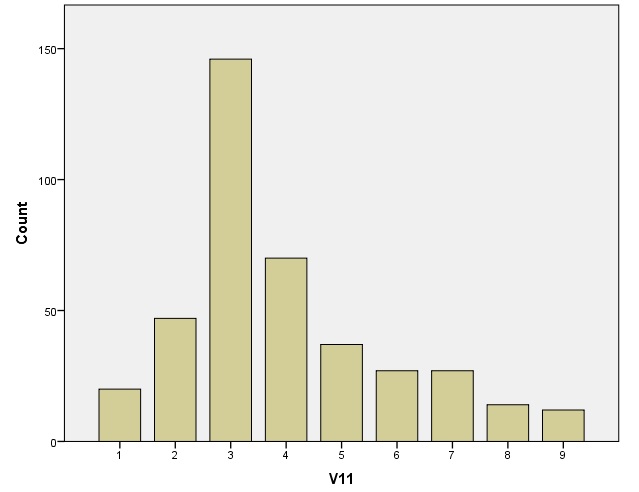
I can tell you now that I violated loads of rules. It comes from a list of 400 movies, their revenue. So, it spans several year, 400 numbers and those are the most visible reasons why Benford does not apply. The books of Tesco have similar issues. Dozens of accounts, interactions, loads of numbers spanning a time zone, but at times those numbers are also of a small count. Could this work with a ‘grocery’ store? Consider the amount of articles at 99c and £1.99. The amount of special offers going on, day to day (Tesco example), from that, if we use EVERY transaction, we will see skewing, giving us the problem, banks have similar issues, but now more often with seriously large numbers. If we ‘Benford’ the hell out of all the commissions, will they stand the ‘fraud’ test? If not, will the bank see that cash returned, or will we suddenly see a ‘rationalisation’ of non-valid application?


This is at the heart “in otherwise homogeneous data“, which gave the Call-centre a ‘ding-dong’, yet I feel that overall numbers could have shown the issue as well. Too many issues do not hold water here, yet the end of the article gives us what matters “Benford’s Law isn’t a magic bullet. It’s only one approach. It isn’t appropriate for all data sets. And when it is a good tool for the job, it simply identifies anomalies in data, which must be explained with further investigation“, ah the common sense. That did not take long did it?

So as there are serious options for investigating Fraud, the watchers of Tesco are still not in the limelight of the press, they have been given the ‘shade’ by the press at large. In one moment we see Tesco getting replaced by DeLoitte and recently we see Santander bank replacing DeLoitte for PwC and the SFO is nowhere to be seen. So are the Elves of Statistics and the Serious ‘eff’ Ogres in a state of non-war? Perhaps the SFO is too busy and whilst those auditors give new presentations on those yummy statistics, but as I personally see it, it is basically another presentation to lull groups of people to sleep. There is a mess in front of the people and those who should look and act, seem to be too busy and many can slightly fall asleep again.

Just 6 weeks ago, the UK got the message ‘RBS, once the world’s largest bank, is using analytics technology to go back to the era of personal customer service‘, with a promise to invest £100m in data analytics technology. I personally believe in analytics, it is a great tool, but in light of many factors, unless you get the people who have been consistently under-called them a job with a competitor bank, the institution will be paying a lot by those currently not doing their job right.

That final statement can be easily proven.

In the first, if data analytics was key, those involved should have known this for well over 3 years, some in charge have been there long enough, which means that no action was taken and they should not be in a position where they remain idle.

In the second, if data analytics is not key in solving some of the matters, why are they buying it? It could be for very valid other reasons, but that does not solve the ‘under-calling’ issue, it does not solve several other issues, even though it solves some, so at best, data analytics will diminish losses, which is good, but should we not get rid of the dead weight (read significant reasons for large losses).

All this comes to blows soon enough, because if the RBS does not get its results, new articles will appear all over the place regarding ‘miscommunication’, times of deployment and infrastructure issues, in the meantime ‘managed bad news’ prevails and more waves of issues will be swept under the covers of a dark carpet. As accounts are handed over between the 4 big auditors, the sum in the end gives us that overall none of them will make any serious losses. Slightly beyond the short term it evens out for the big four, which might be the largest miscarriage of justice of all.


Leave a comment

Filed under Finance, IT, Law, Media, Politics, Uncategorized

Spelling fraud with a ‘T’

So, after we see the events in Tesco, which has taken its billions in toll from September 2014 onwards, we now learn that Japan has its own version of Tesco, which we read in ‘Toshiba boss quits over £780m accounting scandal‘ (at http://www.theguardian.com/world/2015/jul/21/toshiba-boss-quits-hisao-tanaka-accounting-scandal).

Here it is not the meagre 263 million that Deloitte discovered would only be the tip of the Titanic sinker, in the case of Japan, it is three times the amount, which initially might beckon the question whether the fall out for Toshiba could be 9 times worse. Is it that simple?

The Guardian gives us the following “Tanaka and Sasaki knew about the profit overstatement and created a pressurised corporate culture that prompted business heads to manipulate figures to meet targets, the investigators found“, the other one is “Improper accounting at Toshiba included overstatements and booking profits early or pushing back the recording of losses or charges. Those actions often resulted in still higher targets being set for business divisions in the following period“.

These two are aimed at one side of a picture, but what some sales people will know is that this is already a disjointed part. Before I go into this, there is one more quote that needs to be mentioned. It is “Despite its shares losing almost a quarter of their value since the irregularities surfaced in April, it is still Japan’s 10th biggest company by market value. It was created by a merger in 1938 but its roots date back to 1875 and it was one of the companies that turned Japan into an industrial power“, so these irregularities have been part of something already for months, in addition, from an article one day earlier we get “The report said much of the improper accounting, stretching back to fiscal year 2008, was intentional and would have been difficult for auditors to detect“.

The last paragraph alone implies that like with Tesco, this system could not be done without massive ‘support’ from accountancy firms, moreover in all this, we have to wonder if anything will be achieved, especially as PwC (Pricewaterhouse Coopers) seems to have fallen off the view of journalists, and as we have seen no news from the SFO (Serious Fraud Office) since December 2014, we can ask in equal measure, whether the now sparkly news on Toshiba will go anywhere at all. Is it not interesting that PwC added 64 new partners three weeks ago, they get all the limelight as we read “Luke Sayers, chief executive of PwC Australia, congratulated the new partners on their appointment, praising their outstanding professional expertise“, whilst at the same time we get “IOOF has hired accounting giant PwC to review its regulatory breach reporting policy and procedures within the firm’s research division“, whilst in all this, PwC should still be regarded as the number one problem, as for a long time Tesco’s ‘issues of monetary matters‘ ended up getting overstated by well over a quarter of a billion, and so far it seems that either the SFO is nowhere, it is hushed or it seems to pussyfoot around PwC as the PwC marketing engine goes on like there was never a glitch in their seamless sky to begin with.

Now it is important that the entire PwC issue hits the UK, so a global company like PwC should not get hindered by one rotten basket, especially as they have dozens of baskets. Yet as one basket was regarded to have gone ‘rotten through’, the fact that there remains a system of silence, gives way to ask the question why PwC should be trusted at all and in that light, in the case of Toshiba, how intensely damaged the accounting business has become, you see Tesco and if we go by the words of Sheldon Ray of the Financial times we see “non-GAAP earnings per share that were more than 100 per cent higher than its GAAP numbers in the last quarter. Another reported 2 cents a share non-GAAP profit vs $1.41 per share loss under GAAP in one quarter” (at http://www.ft.com/intl/cms/s/0/f07720d4-c9b1-11e4-b2ef-00144feab7de.html#axzz3gWXJGSSF), so how deep goes all this? This grows in light when we consider ‘Richard Bove on Fannie Mae’s Accounting Irregularities‘ (at http://www.valuewalk.com/2015/07/fannie-mae-accounting/). Not a number one source, yet consider the quote “The result of their work is a conspiracy theory concerning the government takeover of Fannie Mae in which the public has been lied to concerning Fannie Mae’s financial condition in 2008 and in subsequent years“, this is linked to the work by Adam Spittler CPA, MS, and Mike Ciklin JD, MBA, MRE. Spittler is a Senior Associate at KPMG and Ciklin is an investor in a number of start-up digitally based companies, so we see that there is at least some Gravitas with these people, now add to that the information from the Washington Times (at http://www.washingtontimes.com/news/2015/mar/11/fannie-mae-recklessness-risks-future-financial-cri/), where we see ‘Mortgage giant hired unqualified auditor with conflict of interest for critical position‘ and “Nearly seven years after it was bailed out from the housing market crash, mortgage giant Fannie Mae is still engaging in behaviour that could precipitate future financial crises and taxpayer losses, a government watchdog warns in a report to be released Wednesday“, which was an article from last March. Now, the fact that this is not ‘new’ news is not the issue, what is the issue is that there is an almost Global act of blatant disregard, leaving the people the feeling that accounting seems to be set to levels of intentional misrepresenting companies for the need of bonuses and the ‘Holy Dow’. The fact that the activity against such transgressions is seemingly kept of the table in these economic times will only grow stronger unrest.

Yet, is my view correct, is it not me that is in error? Let’s face it, One in the US, one in Japan and one in UK does not a conspiracy make, it does not reflect on some non-existing criminal empire based on the quill, ink and parchment (as accounting used to go in the old days). What is an issue is how on a global scale governments seem to act or not act is matter for discussion, yet in all this external forces have been at work too, let’s face it that the US in 2008 was a place of desperation, even as it is now still on the ‘to-be-regarded-as-bankrupt’ even governments will make weird leaps when they are pushed into a corner. In my view, the fact that the bulk of global accounting is pretty much in the hands of half a dozen accounting firms remains cause for alarm and PwC is in the thick of many events. Including the 40 million property scandal surrounding Xu Jiayin last march.

Yet back we go to Japan, the land of yummy Sushi and as it seems shady bookkeeping. You see, there is no way to tell how deep Toshiba will get gutted, if Tesco is any form of indication, there will be a massive backlash, If 256 million leads to a well over 3 billion drop in value, what will it do to Toshiba? More important, with Japan so deep in debt, would it push Japan over the edge of bankruptcy? Let’s not forget that Japan hung over that Abyss a few times and the US seemed to have ‘intervened’ in favour of Japan in the past, in this case, that might not ever be an option again. For those who think that I overreact, think again. Tesco lost value factor 12. Now, we all agree that this is extremely unlikely to hit Toshiba to that degree, but what happens when stockholders walk out? Now consider that Toshiba is amongst the 10 largest Japanese companies with a global reach that equals IBM, that whilst Japan has a debt of $10 trillion, the fallout will hit Japan (again). To give view to the next part, I need to revisit a part I mentioned in the past. Let us take a look at the following example:

In week 10 a salesperson makes a sale, knowing it will not be a solution, during the next week that customer gets managed all over support and after a week, they escalate and communicate with the customer on solving it, a week after that the customer gets the apology that there is no solution, but that the customer will get a full refund, case closed.

Week 10 Sale made
Week 11  Support starts
Week 12 Escalation
Week 13 No resolution
Week 15 Refund

Now the part, the sale was made, in Week 13 no resolution, now we leave one quarter and go into the new quarter, the refund will not affect the sales person’s bonus, nor will the sales target be affected due to negative sale.

This is based on actual events, now think of the impact when this is not mere sales, but 1.2 billion in sales. Did this happen? I cannot state that all of the funds were done in that way, but consider the impact of increased sales and the people who enjoyed their bonuses from that (if that happens in Japan).

Consider the quote “blamed on management’s overzealous pursuit of profit“, which we get from the ABC article (at http://www.abc.net.au/news/2015-07-21/toshiba-top-executives-quit-over-us12-billion-scandal/6637976). Now add to that the quote “underlings could not challenge powerful bosses who were intent on boosting profits at almost any cost“, so how was the profit boosted? You see, this is not just an auditing issue, when we look at these large companies and the way that sales are arranged and forecasted, consider the events involved. To name but a few

  1. Leads
  2. Contacts (the consequence of a lead)
  3. Forecasting (the consequence of contact and the push for sale)
  4. Sales registration (Scopus, Salesforce, SAP)
  5. Accounting
  6. Reporting

Six iterations of paper and electronic trails that had to handle 1.2 billion in virtual revenue to some extent. Even if the leads cycle was avoided (by going through existing customers), there are other divisions that needed to be aware of a large non existing sale. You see, twelve hundred million dollars makes for a massive amount of monitors, laptops and other items Toshiba makes. Even over time, flags should have been raised on several levels, so when I read “The report said much of the improper accounting, which stretched back to 2008, was intentional and would have been difficult for auditors to detect“, which implies that the intentional misdirection was done over 6 iterations, which means that the group involved was a bit larger than we read in the articles at present. More important, how well did the Auditors seek in this regard? Which now takes me back to the reference I made earlier regarding “PwC added 64 new partners“, so how good are these ‘senior’ players? Making someone a partner, so that they can be misdirected by a senior partner would be equally disturbing. The fact that Toshiba falls through just like Olympus did, in a place where these events are regarded as ‘shocking’ according to investigating lawyer Koichi Ueda does not make me any less nervous. How institutionalised is overstating revenues on a global scale? You see, this is happening a lot more than many realise and even though many are not found, it does not mean it is not happening next to your own place of business. Now we get back to the issue I raised regarding Fannie Mae. The fact that it is not unrealistic that the government looked the other way here is still a fact we must consider. More important, are the two parts not mentioned in any of this. The first is linked to the issue I reported on January 30th 2013 (yes over 2 years ago at https://lawlordtobe.com/2013/01/30/time-for-another-collapse/) in my article ‘Time for another collapse‘, I questioned the way the Dow did not just recover, it did so whilst places all around us were remaining below par for a very long time after that. Now consider the following speculative theory:

What if places like Fannie Mae used the ‘leave one in’ approach. So there were mortgage packages and derivatives. So, we have four properties that are doing fine and we add one worthless one to the mix. The package deal as the salesperson states. So the buyer ends up with a ‘value’ and whilst one part is ‘given’ without value, that person has a good deal, now consider that this one place is no longer a lost place, it is no longer a write off. Over time the market would recover with less losses, so is this truly an action that is virtually impossible? Moreover, if such a thing truly happens, would it be fraud? How could an auditor ever find the event in the first place?

This now links back to Toshiba, not just in how you push up 1.2 billion, but how to get it passing the view of a ton of auditors. In the case of Tesco, I personally considered the involvement of PwC from the first moment the news came out, there it was a less murky place because as supermarket chain their product goes to Joe and Jolene Public. That is not the case with Toshiba. Not only are they global, but with a power plant division (including the one that makes you grow in the dark) as well as medical equipment (likely needed for previous mentioned division), Toshiba deals with consumers, corporations and governments, which on one side requires a lot more administration, but that administration would have the ability to go murky on an exponential level, which gives added value to the claim “difficult for auditors to detect” yet that gives option to two parts, is there a questionable level of administration, or are we confronted that the auditing partner in this case was a 28 year old recently promoted individual who now gets his/her first real large account?

Why these statements?

You see in all this, on a global scale, the law has failed. It fails because the rewards are just too good to pass up for those playing that game, the chance to get away with it and the option to keep at least a decent part of these earnings safe makes the option to do this again and again almost a certainty. The law has no bite and the corporations involved are too powerful to get smitten down, so this avenue will continue for a long time to come. In addition to this we ask what else is affected and why is there a tendency from the press to not keep these matters a lot more visible? Consider how much the Guardian and others reported in 2014, if you now Google ‘PwC Fraud SFO Tesco‘ we get nothing after December 22nd, what a Christmas present that is! What is funny that one other part showed up, which is Keith McCarthy, now director at PwC London, who was Chief Investigator with the UK Serious Fraud Office before that, so would it be mere speculation that the best way to avoid prison is to hire the police officer so you know where they will be looking? #JustAsking

I am only asking!

Anyway, with a wish for a better lifestyle, I will consider helping Toshiba to retrench their IP and Patents for a mere 0.4% of the value, now if I could only persuade my Law Professor to help me out, 0.3% for her and 0.1% for me, I should end up with enough to buy http://www.cooperbrouard.com/St-Peter-Port/Ridge-House-property/3835453 and retire in a relaxing way!

I agree that I could do better, but then I was never a greedy person, which is a failing the Toshiba executive clearly lacked.


Leave a comment

Filed under Finance, IT, Law, Media, Politics

Losing Blatter control

I initially dreaded today, not just because I had heard earlier that FIFA will get a few more years of bladder control, but because of the news waves that would come after. The first one that came to view was the Guardian (of course). So this is what the Guardian had to say: “The re-elected FIFA president, Sepp Blatter, has said he was “shocked” at the way US authorities targeted football’s world body and slammed what he called a “hate” campaign by Europe’s football leaders“.

Dear Mr. Blatter, are you (allegedly) insane? This is not a little get together, this is a structural failing of an organisation, where over 150 million went to personal gains. All this whilst you were in control! I suggest you wake up and consider the fact that possible events calling for criminal negligence with Sepp Blatter in the next indictment has not been ruled out yet! As for the statement “arrests were timed to interfere with Zurich congress” could be regarded as misdirection, when you send in the ferrets, you send them into the hole when all the rabbits are together!

Let’s re-attach the original indictment: fifa-indictment-webb-etal

Then we see the comment: “The FIFA president condemned comments made by US officials including the attorney general, Loretta Lynch, who said corruption in football was “rampant, systemic and deep-rooted, both abroad and here in the United States”” Is that the fact Mr Blatter? The indictment specifies 13 criminal schemes, so if you want to condemn anything, it should be your choice of organisation and your inability to prevent any of this. The articles have not even looked at the implications on the overturned appeal to release Michael Garcia’s original full report. Consider the votes who blocked this and the people who are now indicted for corruption. How many influence was there?

Consider the appeal response by FIFA (at FIFA.com) “The FIFA Appeal Committee, chaired by Larry Mussenden, has concluded that the appeal lodged by the chairman of the investigatory chamber, Michael J. Garcia, against the statement of the chairman of the adjudicatory chamber of the independent Ethics Committee, Hans-Joachim Eckert, is not admissible“, the people want to know what actually was found. So, in all this, with this much money involved the three top dogs: Larry Mussenden, Hans-Joachim Eckert and Sepp Blatter. They are all in awe and shock that there was corruption? I mentioned it yesterday Andrew Jennings with ‘The Beautiful Bung: Corruption and the World Cup’, consider that this was 2006, we get two parts “A few days later we encountered Warner at Trinidad’s international airport and tried again to ask him about his ticket rackets and the fact that he steers lucrative FIFA contracts to his two sons Daryll and Daryan. After the World Cup Andrew obtained two confidential Ernst & Young reports from FIFA sources revealing that Warner had illicitly obtained 5,400 ticket for Germany and sold them to package tour companies in Japan, Mexico and Britain” as well as “FIFA vice president Jack Warner makes threatening gestures to Andrew’s cameraman“. Now we see that the sons have been arrested, Jack Warner proclaims his innocence and now we see reports that in the statements from the sons that their father is mentioned as being involved.

I think that Mr Blatter needs to take a long hard look at his own indignation and consider what he will do next, because his legacy has been burned down, it happened on his watch. In my view he has no one to blame but himself. Not because this unfolds now, but because there has been a decade of clear indications that things were amiss and no corrective steps had been made (as far as I can tell).

So when we see the Guardian part where we see the Defence of Blatter, which is shown at “But Blatter also appeared to discount his own responsibility for the scandal. “We can’t constantly supervise everyone in football,” he insisted. “You can’t just ask people to behave ethically just like that.”“, is that so? So, when we see the events from 2006 onwards, what did you do Mr Blatter?

Now, before people start overreacting, or trivialising on how large FIFA is, let’s not forget that amongst the arrested people were Jeffrey Webb and Eugenio Figueredo, both Vice Presidents of FIFA, so the list takes us to one step from the very top, which gives additional weight to both the inactions from Sep Blatter as well as the overturned appeal from Michael Garcia. Not to mention the fear they NOW have as they are fighting extradition, it does not matter what rank you have in FIFA, once you are a member of the State Penal League, those ‘rich’ boys will end up becoming somebodies bitch, how will that feel?

A side fact to mention is that I talked to dozens of people today regarding the FIFA corruption, not one person, I say again, not one person was surprised. So Mr Blatter, how truly undignified can you be, when there is almost a decade of presented evidence, as well as the press coverage over the years. It seems that in my humble view, Mr. Blatter should currently be presented with an Oscar for best theatrics, 2015!

Now let’s take a look at the part that matters, not just the press, not the ‘opinions’ from people (or from me for that matter), let’s look at the allegations in the indictment.

The enterprise is set as FIFA. It only has a written Code of Ethics in October 2004, revised in 2006 and 2009, it states that ‘that soccer officials were prohibited from accepting bribes or cash gifts and from otherwise abusing their positions for personal gain‘. On page 32 we see: ‘The Initial Corruption of the Enterprise’, here we see “WARNER worked closely thereafter with Co-Conspirator #1, whose fortunes rose with WARNER’s and who was appointed to be WARNER’s general secretary at CONCACAF. Following his appointment, Co-Conspirator #1 transferred CONCACAF’s administrative headquarters to New York, New York. WARNER established the president’s office in his home country of Trinidad and Tobago“, in addition we see “the defendant JACK WARNER established and controlled numerous bank accounts and corporate entities in which he mingled his personal assets and those of CONCACAF, CFU, and TTFF. Beginning in the early 1990s, WARNER, often with the assistance of Co-Conspirator #1, began to leverage his influence and exploit his official positions for personal gain. Among other things, WARNER began to solicit and accept bribes in connection with his official duties, including the selection of the host nation for the World Cups held in 1998 and 2010, which he participated in as a member of the FIFA executive committee“. Even though we can all understand that these people are making a nice amount of coinage. The growth in real estate by ‘family members‘ should have spurted questions on a few levels. the fact that the indictment states “with money drawn from an account held in the name of a soccer facility that was ostensibly affiliated with CONCACAF and was supported in part through FAP funds” gives voice to additional questions on how the books were kept, who was keeping the books and how can a FIFA president remain ignorant of these situations as they are now being documented?

I keep on going back to the work of Andrew Jennings ‘The Beautiful Bung: Corruption and the World Cup’. You see, Jennings is an investigative reporter, he worked for the Sunday Times and BBC Radio 4. He is not some glossy wannabe on the Telegraph or on any Murdoch shouting-wannabe-outrageous press view. This man did a decent job, looked at the issues and this all is reasonably nothing compared to ‘FIFA’s Dirty Secrets’ (November 2010). These are several clear-cut allegations that should have been points of action into investigation and adaption of rules and regulations within FIFA, yet all indications are that nothing was done, which makes the position of Sep Blatter a lot more worrying. Now we get to the one defence Blatter gave that does make sense “At the end of my term I will be able to hand over a strong FIFA – one that is integrated and will have enough safeguards to not need political interventions” (at http://www.bbc.com/news/world-europe-32925227). In my view, the only way to do this is to be open and strict investigative. So, that did not include, or should it have allowed for the statement “the way US authorities targeted football’s world body and slammed what he called a “hate” campaign by Europe’s football leaders“.

In my view Sep Blatter is off to a negatively rocky start.

Additional evidence for questions on how finances are managed. Even FIFA.com is massively unclear on all of it. It that not strange for a multi-billion dollar industry? The fact that there is one president and then there are committee members, no clear CFO, of head of Finances, at least not clearly stated on their website. That does not raise any questions? Something this widespread should have a clear list of names and functions, especially financial ones. So when you see the Governance part of FIFA and we see “According to article 69, paragraph 2 of the FIFA Statutes, FIFA’s revenue and expenditure “shall be managed so that they balance out over the financial period”. Furthermore, “FIFA’s major duties in the future shall be guaranteed through the creation of reserves”“, when we see that line and we should all wonder on how some of these operations are in play. Consider the representation (at http://www.martingrandjean.ch/data-visualization-the-fifa-budget-2015-2018/), I cannot attest to the accuracy of it all, but it shows something interesting. With 5 billion coming in and when we look at the massive amounts of projects in funds going out, whilst leaving 100 million in profit, now consider posts like ‘competitive management‘, ‘Football governance‘, ‘Human resources‘ so many involved projects, linked people and other elements, can we now see that Sep Blatter should have acted in many regards a lot sooner, especially when we see the allegations thrown at the members of governance of FIFA?

This graph might be debatable for the amounts, but what is clearly shown are the amount of venues linked in all this and I feel decently certain, that considering where the 500,000 dollar from the Football Federation Australia went. If that went to ‘a stadium upgrade in Trinidad and Tobago’, if so, where is the accounting? Apart from the payment calling in to all kinds of questions, there are logistic issues. Something this big, this complex requires accountants and oversight. Can anyone explain why we see a second Tesco evolve? If you think that this is an exaggeration, then consider the data visualisation and all those projects costing millions, some totalling hundreds of millions out of a cash flow of 5 billion. You still think I am exaggerating?

When you look at these ‘facts’, I state facts loosely, because the source and quality of the data visualisation cannot be validated/verified (even though the source ‘FIFA Financial Report 2013’ is mentioned). But overall it shows several paths and many of them are known entities, so when we ignore the amount except for the two elements adding to 5 billion, which are publicly known. Can you even imagine how weird and unacceptable the ignorance of Sep Blatter is, how totally out of place of is for a president of an organisation the size of FIFA?

I let you decide, but consider the stories we see, the information we are not seeing and how the FBI was the one acting at present. In addition, as I requoted the 500,000, which was according to sources for a ‘stadium upgrade in 2010’. The information I found was that it was to upgrade the Marvin Lee Stadium. In 2007, the Stadium became the first in the Caribbean to have an artificial playing surface, costing TT$8 million, which was made possible through a FIFA development grant. This comes to AU$ 1.6 million, or £824,000. So where did the 2.4 million TT$ go to in 2010? And why did a stadium needed that much for an upgrade? Interesting on http://stadiumdb.com/stadiums/tri/marvin_lee_stadium is the fact that we see there that renovations were made in 2007, there is no mention of the 2010 upgrade as was stated. I am certain that some upgrades were made, but for how much? In addition we see all the artificial turf, but who costs it and is it competitively costed (especially when it sets someone 1.6 million back)? I do not know the answer, I am asking, I wonder who else if any are asking these questions in plight of the corruption allegations as well as the arrests made.

There is one final part. It puzzles me, hence I mention it. Especially in light of what is now visibly passing. The indictment, criminal counts three and four involve two wire transfers totalling 13 million in name of CONMEBOL at Banco do Brasil in Asunción, Paraguay. In light of the financial hardship Paraguay has had, with the crises of 1995, reforms demanded by the IMF due to corruption, with the banks having a long time history of laundering. Why would FIFA act in such a naive way? It is a fact that the HQ of CONMEBOL is in Paraguay, so there is a valid reason for the transfer, In 2013 Chile had one of the 50 safest banks, and Paraguay does not get mentioned on that list at all. Even if we accept the validity of the bank transfer (which seems to be the case), but what happened to the money after that? You see, that becomes the question. In addition, we see that apart from the Australian ‘donation’ counts 10 and 11 where additional donations went to the CFU Trinidad. Again, it seems valid, but what happened after that? The indictment is now 11 days old. Any quality CFO could have gone public stating where the money had gone to, in effect blowing the entire indictment out of the water. The fact that we see that certain FIFA members are fighting the extradition, in addition to the fact that conference and election or not, clarity on several points could have been able to give (read: should) in matters of hours give added question to what is going on.

My issue is not the ‘what next’ part, it is the ‘what did they not yet find’ part.

You see the indictments are on the transfers and payments, in the first degree. we see over time that CFU got two payments of a little over half a million, which should not be a blip on a 5 billion dollar radar, but for the indictment, it is, so what information is not shown at present (the trial will bring that out)? You see, are counts 10 and 11 a clear indication that they have certain evidence, or are these counts the crowbar to open up other issues, issues that could come up in ‘operational expenses and services‘ which the data visualisation sets at 990 million. I reckon that true digging into ‘building and maintenance’, ‘human resources’, ‘other’ and one element not even named could be the field where the FBI knows the issues are, the question now, does FIFA have a correct and precise account, if not, why not? If so then the comparison will leave a few highlighted fish, which will put Jeffrey Web in an uncertain location. The CFU will get into other waters as well as this is all British terrain (artificially grassed or not), the Serious Fraud Office (SFO) will soon get additional work, because they will now have their own investigation as well and as I see it, it will go a lot further than just a few banks.

FIFA might be all about the ball, but it seems that Sep Blatter has not been on it, not for a while now.


Leave a comment

Filed under Finance, Gaming, Law, Media, Politics