Tag Archives: Lord Sainsbury of Turville

It is the same coin

I got alerted to something via Twitter. It has two sides and a friend of mine had one side, as such I give you the tweet below. This of course made me look at the YouTube by Simon Pegg (the Hot Fuzz man). 
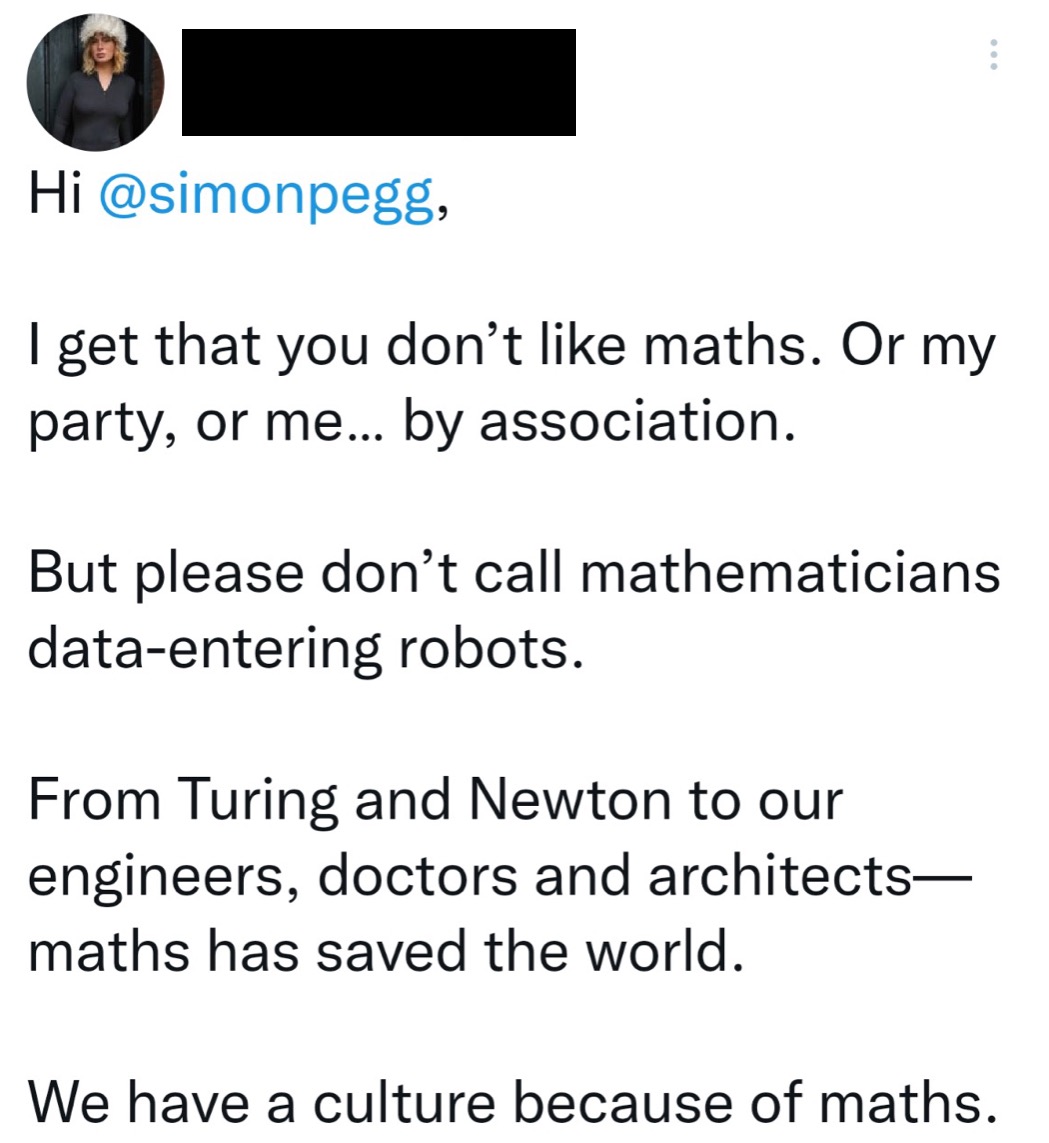
He was emotional and he has a point, but so does my friend. Optionally they do not realise that they are both a side of the same coin, one cannot exist without the other. It is a flaw in those heralding science as the one solution, it never is. It merely becomes some Theranos creation, all science and too much of it debatable. You see my friend had the answer in her tweet. Alan Turing created something from nothing. A setting that is utterly impossible. He got there through an artsy side in him. Alan Turing created the foundations of computers and AI, both required an art element to get there. You see, even when we realise it was all science, his brain had to make some leap of faith and that requires art, science alone will not let you do that. He created these two and his foundation of AI is still used today, over half a century later, with all the elements of evolved science, his artsy side overcame what did not yet exist. It is one of the reasons that (even if I was not eligible), I would have voted for Brian Blessed to become Chancellor of Cambridge in 2011, but I was not eligible. It became Lord Sainsbury of Turville, my issue here is that science was taking too big a chunk of what was almost an even Steven setting. I personally believe that Science without art is pointless, art without science is useless. It is not completely true, but as an axiom it often works. Science without art cannot grow because science for the most relies on previous data and as such NEW technologies cannot evolve. Alan Turing created (for the most) the foundations of electronics. It required investigations into the electron as well, but when you see that Alan Turing created AI half a century before we had any partial foundation of that is optionally evidence enough. 

The other side needs to be illuminated as well. Simon Pegg did this (at https://www.youtube.com/watch?v=rHEpywFCtwA) in his own emotional way and he does have a point, but so did my friend. The artsy people tend to ignore that science is their friend. Take any movie, the lights are set up to maximise the effect, it is not art, that foundation is science, science created the camera and a lot of other parts. They use that technology and they use it well. But it supports art and that is forgotten. That being said that children need maths, but they need art too and the science pushers are all about ‘forgetting’ the art and that power. You see, if you have all science and no art, you end up creating Theranos minded creators. The ones that are convicted for fraud and end up well over 11 years in prison. Art might have prevented this (and created an actual solution). In that same setting it might be the flaw that created FTX and the $33,000,000,000 losses it ensued. 

I myself tend to grasp back to an old Market research credo. “The scientist, or mathematician will show you the course of best margins of profit, or best results. The presenter, or politician makes sure that you look forward to the attached invoice” it is a bit artsy but therefor not any less true. We need to realise that art and science are to sides of the same coin. Science made it circular and the artsy people gave it a nice image. We need another and there is one part we should all agree to, if Rishi Sunak wants to imbue a sense of science, he better be ready to imbue an equal measure of art in these people, because Simon Pegg is right about that part. Science without the art will have far reaching negative impacts. We need one another to see it, one shows us, one presents it and that has been the case from before that writer William Shakespeare became a reality. It goes back all the way to the outdoor Theatre of Dionysius where in 500BC Sophocles, Euripides, Aeschylus, and Aristophanes performed, but we forget that science created the stage for over 15,000 people to enjoy, that part was science, not art. And it was there centuries before Christianity became reality.

Leave a comment

Filed under Finance, IT, Media, Politics, Science

Where we disagree

There is another article in the Guardian; it was published almost 12 hours ago (at http://www.theguardian.com/business/2014/dec/14/deficit-problem-crisis-productivity-george-osborne). It is a good story, it gives a decent view, but I feel that I cannot agree. It must be said that this is all in the eyes of the beholder. The article is good and sound and many will adhere to this idea. Yet, I do not completely agree. Yes, all the facts are right, the view is not incorrect, but it feels incomplete. The first quote “The most important issue is the poor performance of the nation’s productivity, which, far from being improved, has almost certainly been exacerbated by the constant emphasis on the putative need for austerity”, now this is a decent view to have, it is an optional view, yet in my view the following com up:

  1. Productivity relies on orders; the UK is competing with its baby brother India where daily labour rates are decently below the hourly rate of a UK worker. That in itself is not enough, the EEC overall is pretty broke, no less than one in 10 has no job, it is driven up by Spain and Greece, yet after a long term most Europeans are very careful about where money is spend on. So which manufacturing industry is getting the few coins that do get spend?
  2. There is no reputed need to austerity; there is an overspending in excess of 1 trillion that needs to be addressed. We can bark high and low on the reasoning for it, but that water passed the bridge a long time ago, now the debt needs to be taken care of. The US, Japan and UK have a combined debt of 30 trillion of national debt, the UK is a little over 3% of all this, let’s make sure that when the two behemoths stumble into nothingness, the UK does not end up being the biggest debt of all (again just my view), yet I feel certain that the banks will be in charge of a nation with such debts.

Yes, productivity will take care of all it, but I believe that the debt needs more then productivity. It needs innovation and IP. They will drive true productivity. People forget about the innovators. Alan Turing is still regarded as the man behind the concept of Artificial intelligence. What was a fab in the 40’s became the driving power for the planet from the 90’s onward; let’s not forget the foundations for the computer. We seem to herald IBM and others, yet Professor Sir F.C. Williams was at the foundation of the driving force that became the behemoth for almost half a century and this wave is still going strong.

The new currency will be IP; innovation will drive the places of work, the places of sales and the filling of coffers (the empty bags currently in a corner of George Osborne’s office).

People keep on ignoring the need for innovation; I tried it twice in a previous job. The response remained almost the same ‘it works as it is, so leave it‘, that is the drive stopper that ends a future, although the early 1900’s did not have the need for IP, consider the history of the paperclip and Gem Manufacturing Ltd, a British company. They had the better design, but never registered the patent, which is why Johan Vaaler is often seen as the inventor. I am not debating the validity, yet he registered his patent. In those days the rights were approached a lot more liberal then now. Nowadays our lives are all about IP, patents and who it is registered to. Haven’t we learned anything in 115 years? No matter that we now enjoy an article that is not patented, in nice contrast to people who enjoy a life because the man behind finding a cure (read vaccine) for polio did intentionally decide not to patent it (Dr Jonas Salk, who deserves a sainthood for that act), our future for certain, our survival to some exaggerated extent is depending on IP. Need drives production, but who owns the article that is needed? That part I see ignored again and again.

William Keegan does not look at the IP side, because he focuses on the steps following it, yet those in this real rat race seems to silence the need to look at it as they talk about productivity and manufacturing, but the innovator behind it, the one designing the IP, that person is worth gold. Consider Microsoft paying 2 billion for a piece of IP called Minecraft. A simple game, looking the way Minecraft does, is worth the revenue the high end looking GTA-5 made. It is all about IP in gaming; it should be the same in nearly any industry, not just the one that got kicked off by Alan Turing and Professor Sir F.C. Williams. IP drives every computer industry, it became the centre piece in the jewel that is now called ‘Business Intelligence‘ and ‘Predictive Analytics‘, but we broke the system after that.

Why was the system broken?

It is a broken system that is now illuminated in its flaws by people like Sir Kenneth Robinson and Brian Blessed. We ignored for too long that IP and innovation requires creativity. As Universities have been pushing logic and business, they forgot that the future tends to be created in the arts. Creativity is the driving force for any future, whatever is produced after this required a need for IP. It is a chicken and the egg issue, will the thought create the idea or is the idea the drive for creation? As I see it, this drive needs an artistic side, a side I was never any good in, but the best futures will need an artistic hand. It is shown into the massive amounts of IP the gaming industry manages. People might wonder why I keep on coming back to the gaming industry.

The answer is simple Games have driven a trillion dollar industry (totalled). Commodore Business Machines (C-64, Amiga) Atari (2600,800, ST), Creative Labs (soundcard), The consoles that followed by Nintendo, Sony, SEGA and Microsoft and the list goes on and on, all from creativity. Even the military sees the essential need of creativity. Consider the text “Space-based Missile Defense: Advancing Creativity“, it is at the heart of everything, so many forgot about that, those in charge forgot about that part. It is why my vote for Cambridge chancellor would not have been for Lord Sainsbury of Turville, but for Brian Blessed. Lord Sainsbury is not a wrong person, or a bad choice. As I see it, all our futures require a much stronger drive towards the arts and creativity. In my crazy creative view photography was invented in 1642 by a Dutchman named Rembrandt van Rijn; his visionary view came 200 years before the chemicals were invented, if you want evidence? It is in the Rijksmuseum and they call it ‘the Nightwatch’.


Leave a comment

Filed under Finance, Gaming, IT, Science