Tag Archives: CIO

The real deal

So this happened yesterday. I was at first a little out of sort. I was surprised by a head line in the Australian giving me ‘capitalizing on a $266m IT fiasco that fueled Birmingham’s bankruptcy’ this is a setting that happens to be a weird fiasco. You see the words uniting fiasco and Oracle is nothing short of a miracle. Oracle does not usually make these kind of mistakes EVER. And this sounds like an Australian kind of advisement towards their paid wall of settings. As I am not some Australian weirdo approach to their paid wall, I had to take another look and soon enough some f the words got me to the real deal and theft that it was merely one article gave me the setting that this wasn’t real. 

The article that gave me the ‘real’ deal was found at (at https://www.cio.com/article/3830277/how-birminghams-48m-oracle-erp-project-turned-into-an-epic-failure.html) here we get the deal. It was set by ‘How Birmingham’s $48M Oracle ERP project turned into an epic failure’ which was given on February 25th 2025. Still, to see Oracle combined with ‘epic failure’ was news, so I needed to know more. And the story start ‘strong’ with “A Grant Thornton audit reveals systemic governance, expertise, and vendor management failures led to catastrophic ERP rollout.” Shows us the little setting that this tends to go the road of Birmingham and not Oracle. With the hindsight “Birmingham City Council’s (BCC) troubled enterprise resource planning (ERP) system, built on Oracle software, has become a case study of how large-scale IT projects can go awry. The system, intended to streamline payments and HR processes, is now “unlikely” to function correctly before 2026 — four years after its 2022 launch. The project involved replacing the city council’s long-standing SAP system with Oracle Cloud.” So as we see it, the setting is now set towards another setting. That setting is “The catastrophic failure of the project, which has ballooned from an initial $48 million (£38 million) investment to an estimated $114 million (£90 million) after including re-implementation costs, stands as a stark reminder of how large-scale enterprise software projects can spiral out of control.” As I see it, it is another setting. We have saw something like this in 2016 min ‘The excuse from a failed politician’ (at https://lawlordtobe.com/2016/03/27/the-excuse-from-a-failed-politician/) where the Labor government pretty much wasted £11 BILLION on a non-working NHS system, as such this is not new in political povernment (funny typo), so we have seen this before. I see this as someone in government sees this as the ‘golden’ opportunity to make his (or her) grind in the way of things and let this grow this out of hand into the behemoth the eats them alive.

So while CIO gives the right question, but they might go ‘lightly’ over the failure of the setting. And they give us “The audit revealed that the project’s budget ballooned from an initial £19 million to over £90 million, with delays pushing the system’s full functionality to 2026—four years beyond the planned 2022 launch.” As I see it, I have seen this kinda before decades ago where we get two elements together a sales person who wants to make an entry and someone in government wants to appeal to ‘their’ friends by giving the entire collective a setting that is not entirely manageable. The salesperson wants this deal as it makes his collective revenue shine and the other side as they have no clue what they are doing, but they have ‘friends’ who wants a player like Oracle to strike out. So the sales person contact everyone in support until they find that person who signs off on it (I didn’t) and they go from person to person until they get the ‘willing’ support person who gives them the heads up. I opposed as it would never work, but the sales person found the one support person who signed off on it and he avoided my assessment. You see, when the deal comes through he merely needs to keep me away from it (didn’t work) because after the quarter was finished he pays the person back but his commission is no longer touchable. And that is not how I believe things should work. The second setting is the ‘friend’ tactic. As such someone feeling ‘blue’ (subtle hint) gets to say make sure it includes A, B and C (they know it all never work) and as such Oracle goes down and they become the winner as they ‘suddenly’ have an option. This is how the players in the wrong setting are thrust upon the daily lives of government. 

Did that happen here?

Can’t tell, but the more you read here, the more you see that It was NOT the flaw that Oracle introduce, it was another flaw and you might see this when you see ““Integration with Oracle’s systems proved more complex than expected, leading to prolonged testing and spiraling costs,” the report stated. Payroll integration issues, combined with the volume and quality of data migration, required extensive retesting, further inflating costs. BCC’s heavy reliance on Oracle and external consultants became a double-edged sword. While third-party expertise was essential, it also weakened internal control over the project’s financial and operational outcomes.

So we get there with the next part. 

CIO media gives us “The governance-expertise gap

The investigation uncovered a governance structure plagued by fundamental weaknesses.  At the heart of Birmingham’s ERP crisis lies what we might term the “governance-expertise gap” – a critical disconnect between oversight responsibilities and technical understanding. The absence of Oracle expertise within the council’s digital department created a dangerous scenario where those responsible for governance lacked the technical foundation to evaluate and challenge their implementation partners effectively.” As I see it, the initial Australian setting was wrong in the very least and I recon (especially as the headline changed) that the Australian headline (which was thrust upon me on LinkedIn) as 
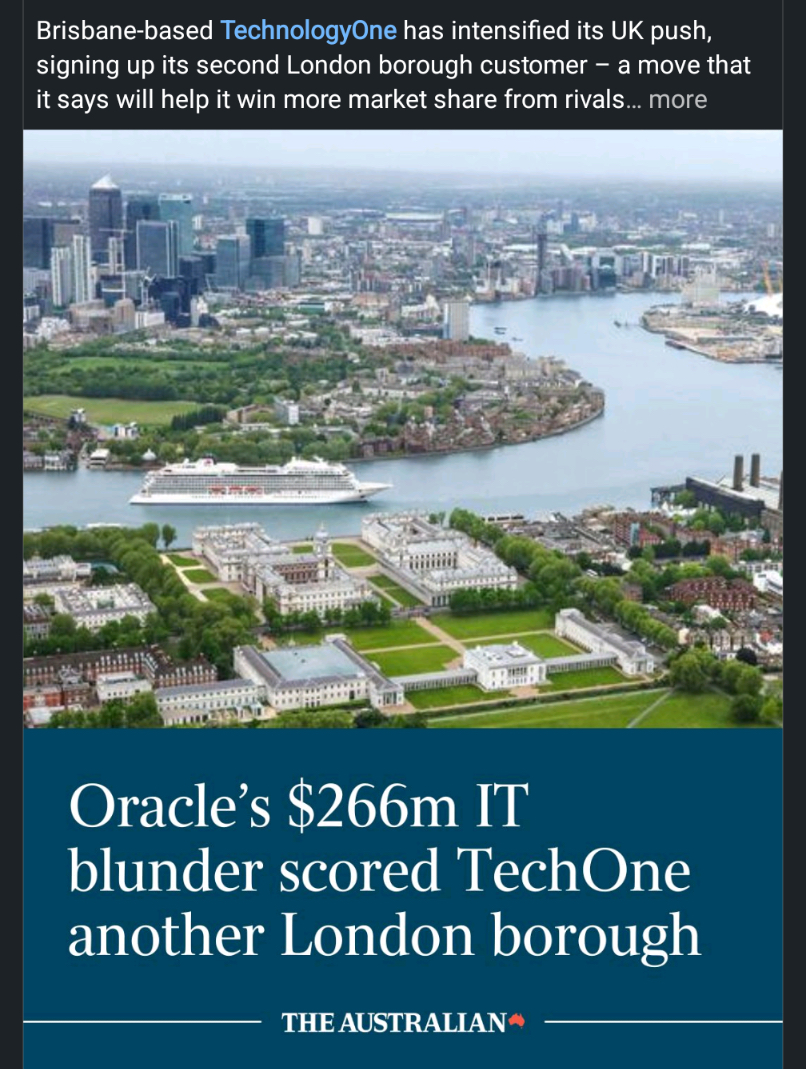
I added the image on how I was ‘misinformed’ and perhaps Oracle wants to have a go at these people too. 

So as CIO is giving it a realistic brush (by painting IT environment of Birmingham stupid) we see the second setting and as we approach that ‘critically’ we might see an Oracle failure or two, They did not make the actual flaw. It is seen in 

Moreover, the lack of technical oversight led to the acceptance of extensive customizations that violated their own “adopt not adapt” principle, accepting extensive customizations to align with existing business processes based on their legacy SAP system. Change requests affecting critical aspects of the solution were accepted late in the implementation cycle, creating unnecessary complexity and risk.” Where we see the adherence to a legacy system and for a council their data is their strength and “The council’s approach to governance showed a startling lack of independent oversight. Despite the program’s complexity and critical nature, no review was undertaken by Internal Audit until just before go-live.” Which is an actual failure, but not by Oracle, it is the Birmingham government that should have acted when possible, I reckon that the people involved saw the golden rainbow markers as their golden opportunity. If there is an Oracle failure it is at this point where the Oracle head honcho should have applied all breaks and talk to the Lord Mayor of Birmingham bringing his attention to the initial $48 million (£38 million) investment to an estimated $114 million (£90 million) after including re-implementation costs. I reckon that when the £60 million tag was reached someone should have drawn attention to this (perhaps they did)

It is when CIO brings attention to ‘Culture of silence and suppression’ that I wonder who was at fault, nothing here shows the flaw of Oracle, As I personally see it, the blundering setting of a seemingly absent Omnibus, a written account of what or who did what and how it was received in that office setting might be at risk of showing the real audit failure and I am willing to bet that Oracle has nothing to do with it. 

A mere collective feeling, but I have seen Oracle set the trends and projects for decades and this does not feel like an Oracle flaw, It might be as simple as Australian fear mongering advertisement settings, but there you have it. With little effort we see that the ‘Oracle Blunder’ was omitted by simple tracking and perhaps I am tracking the ‘wrong’ setting but there you have it, Australian is now getting into hot water by paid wall settings and fear mongering. So be it.

Have a great day today. It is time for some snoring if possible. Feeling a little tired today.

Leave a comment

Filed under Finance, IT, Media

And there was more

You see three days ago (merely two days and change) I wrote ‘A story in two parts’ (at https://lawlordtobe.com/2025/01/17/a-story-in-two-parts/) where I laird bare a few of the ‘shortcomings’ of Microsoft. However there was more. I had initially chosen the title ‘The color is blue’ yet I decided that the premise is not about Azure, there is more to it all. You see Fierce Network gives us ‘Google Cloud could overtake Microsoft’s No. 2 cloud position this year’, which sounds nice. However there are a few issues with that. We will all love ““Google Cloud is already nearly equal to Microsoft Azure in revenues, and has a higher revenue growth rate than Microsoft Azure,” Gold wrote in a research note. “By the end of the next four years of revenue growth, we project Google Cloud’s revenues will be 55% greater than Azure at current growth rates.”” The research note gives the proper “Based on the Average of Past Two Years Revenue Growth Rate

Assuming Same Growth Rate Going Forward” so that is good, but it does not despair from “By the end of the next 4 years of revenue growth, we project Google Cloud’s revenues will be 55% greater than Azure at current growth rates.” Yet this setting does not account that someone at Microsoft ‘suddenly’ takes an innovative step towards (who knows), the second setting is that the technology premise stays where it is. Huawei with their HarmonyOS is another factor, the Chinese factor. In this I predict that they might use Microsoft down the line and might step away from Google (speculative). We have little insight in what places like the UAE does and they have a large investment in their approach to AI and in this Microsoft has the inner track there. So I love the premise, but I have thoughts of consideration on how the future unfolds. There is a chance that AWS will clear house, but there are reservations on that front too. 

Still, Azure has issues. You see the Register (at https://www.theregister.com/2025/01/13/azure_m365_outage/) gives us ‘Azure, Microsoft 365 MFA outage locks out users across regions’ with the added “Microsoft’s multi-factor authentication (MFA) for Azure and Microsoft 365 (M365) was offline for four hours during Monday’s busy start for European subscribers.” I understand that it comes with “It’s fixed, mostly, after Europeans had a manic Monday” now I wonder why we see the use of ‘mostly’ there are perhaps a few gaps in the solution and that happens, but how many of these events will Microsoft cater to until a user like Coca Cola gets a tap on the shoulder to start looking for alternatives? Do you think that a man like James Quincey keeps his sense of humor when his bottom line is under fire? And that is only the beginning.

Still Microsoft has its own ‘defense’ knee jerk operation, we are informed of that by Techi where we see (at https://www.techi.com/microsoft-files-suit-against-hundreds-abuse-azure-openai-services/) with the headline ‘Microsoft Files Suit Against Hundreds for Abuse of Azure OpenAI Services’, so not only is their OpenAI ‘flawed’, it is open to abuse (apparently). We are given “API Key Theft and Hacking-as-a-Service”where we see “As per Microsoft, the defendants systematically and through their deceitful acts stole API keys, the fundamental means of authentication to its AI services. The hacked accounts were allegedly pivotal in creating an act of “hacking-as-a-service” One main ingredient for that operation would be De3u, a software that enabled one to convert images synthesized by OpenAI’s DALL-E without the necessity of writing an actual code.” I kinda covered that on September 8th 2024 in ‘Poised to give critique’ (at https://lawlordtobe.com/2024/09/08/poised-to-deliver-critique/). Michael Bargury gave us a small example of how bad things can get.  Here the operational setting is given through “A former security architect demonstrates 15 different ways to break Copilot: “Microsoft is trying, but if we are honest here, we don’t know how to build secure AI applications”” and here is the premise now consider what (under Torts) customers will do, for example Coca Cola. Do you think they go after the so called hacker with not enough money to afford his/her own place or Microsoft with access to several bank vaults? Take the fortune 500 clients with claims of transgressions, do you really think there will be even a penny left in those Microsoft vaults when their legal teams are done with them? It might not be fair on Microsoft, but the setting of the use of the term AI opens up a whole new can of worms.

Then the Business Times (at https://www.businesstimes.com.sg/companies-markets/microsoft-openai-partnership-raises-antitrust-concerns-ftc-says) gives us ‘Microsoft-OpenAI partnership raises antitrust concerns, FTC says’ in this I might actually be a bit on the side of Microsoft. They give us “MICROSOFT’S US$13 billion investment in OpenAI raises concerns that the tech giant could extend its dominance in cloud computing into the nascent artificial intelligence (AI) market, the Federal Trade Commission (FTC) said in a report released on Friday (Jan 17).” My issue here is that there is a setting we had in the past and in countries they created their version of the FTC. It was a power for good then, but there is now the setting that LLM’s and Deeper Machine Learning has grown to a scope that the FTC cannot really fathom. This IT solution goes beyond what they know or understand and all the tech companies face this. So either they grow their ‘programming with barricades’ side of it all, giving tech companies the flaws that the law imbued in whatever country it is based. And that for global companies will set a larger flawed premise. It is like parties are limited to what others have. As such all criminals will come to us with BB-guns, because that is what the police have. Does that sound realistic? I don’t think so. But this also falls straight into the premise that Fierce Networks gave us. It works out fine for Google, until Google gets barricaded I reckon. So this is a setting that the tech firms are set to whatever the wannabe’s can do, that is a direct strangling of commerce and innovation and it sets whomever develop the trigital computer system and if you think that these systems are fast now? The next level system develops with a trinary operating system running on that hardware will astound the world. As I see it should diminish the IBM Deep Blue to a simple calculator. The difference will be THAT much, so who will innovate that when the FTC strangles innovation?

And finally we get the CIO (at https://www.cio.com/article/3802745/microsoft-commits-to-ai-integration-but-delivers-no-particulars-to-differentiate-from-rivals.html) who gives us ‘Microsoft commits to AI integration, but delivers no particulars to differentiate from rivals’ and as I see it, it was already lagging too much against AWS, and now apparently Google is coming up fast and under these settings we get this headline? And the part that matters is given with “Analysts, however, agreed that the statement reflected no meaningful changes to Microsoft’s AI strategy. The bluntest assessment came from Ryan Brunet, a principal research director at the Info-Tech Research Group: “This is classic Microsoft. It’s very much the same old garbage.”” It reminded my towards an old premise from the late 80’s when the PC was exciting and new ‘Garbage in, Garbage out’ in the age when everyone considered themselves a Market Research executive and these wannabe’s had not even mastered the basic needs of data quality. It was a Gender versus Shoe size and they thought that the solution was add the Lambda test (I think it was Lambda). And I get it, Satya Nadella talks his own street side, the problem is that there are too many unknowns at present and he hopes to get all the others onboard before they have thoroughly selected their options and in light of the selected abuses, that setting is not a given, especially as Google seemingly doesn’t have these flaws (as far as I know neither does IBM or whatever AWS wields). 

A setting that was more and could set a lot of people in the liable column of choices. And some of this has been known for at least a quarter. When you add this with part one, you see why I predicted the downfall of Microsoft three years ago. And as I see it Microsoft walked to dotted line in a near perfect manner, too bad they never read the byline ‘this way to the crevice you will not avoid when getting too close’.

It is as some say ‘the way the cookie crumbles’. Darn still 4 hours until breakfast. Time to find a new story. Have a great Monday and if you cannot get into Azure today, feel free to investigate alternatives.

Leave a comment

Filed under Finance, IT, Law, Media, Science

Tesco, the Lehman way

It’s all the buzz
It’s all the rage
What Lehman did once
On a grocery stage

So cabbage that cherry
and settle that sprout
and if you want balance
you’ll fall on your snout

So be not afraid
for them closing the doors
bring coins to Tesco
250 million and it’s yours!

Yes, another day in the works for the CFO’s of the world. Did anyone imagine, when the Lehman brothers had their methods of inflating their economy it would be all the rage. So much so that it would even come to a grocery near you?

Well, as we see the Guardian (at http://www.theguardian.com/business/2014/sep/22/tesco-investigators-overstating-profit-250m) announces how Tesco overestimated their profit. Let’s be honest, 250,000,000 is just a number, if you say it really fast it doesn’t seem like much (you should actually really try to say it fast 5 times).

Now, they will fork out additional costs as they have requested DeLoite and Freshfields to take a look at all this.

It would be nice to bash them ‘board’ members around a little more, but it seems unfair because when we see Dave Lewis and how open he is on what has transpired, we should wonder what comes next. The fact that he was alerted by the CLO only adds to the confusion here. Not confusion in a bad way, but actual confusion. First of all, let’s have a round of applause (seriously!), for Dave Lewis to bring this out into the open. I believe that it will remove pressures and I feel certain that the body blow the stock gave them will settle and likely return, perhaps even a little stronger. We should expect a Chief Legal Officer to act in this way and seeing it so is just a builder of confidence. Yet, I stated confusion, which I remain true to.

Even though these matters are in place and also the fact that the new CFO is not joining them until December 1st, we should ask what elements were in play with the old CFO leaving. The BBC throws a few more logs on the fire (at http://www.bbc.com/news/business-29306444). There are facts between the emotions of people. When I read “Professor Ajay Bhalla of Cass Business School said ‘things could not be worse for Tesco’s management and shareholders’“. Sounds nice BBC! Was this the only expert you could find willing to speak out? What do the people at the London School of Business say?

I have other questions too. Where were Chris Bush (Managing director UK) and Mike McNamara (CIO)? Did they not notice the 250 million ‘offset’? Let’s not forget that this 250 million pound caper represents 10% of the ENTIRE Tesco Group profit. That is way too large a number to be this unnoticed by too many on the high level. In regards to the CIO questions will also rise on what data was used, how it was collected and how it was ‘mined’ for the ‘information’ nuggets in the end. Be very wary of what I state here. I am not accusing, or considering their involvement or guilt. Yet, if reports are based upon numbers, which comes from data files, how was all this achieved? There is an entire internal track that should be examined and not just by the two fore mentioned ‘guests’ of the Tesco system. The list of the members of the executive committee seems unbalanced as well, we see all these commercial players, marketeers and even a Chief Creative Officer, however on the other end there is only one Chief Information Officer. Where is the CTO? Where is the CDO (Chief Data Officer)? As I see it, when you have your global groceries and your banks, one CIO just does not cut it, you need two more to create a wall to ‘prevent’ these commercial boys (and three girls) into becoming a little too over enthusiastic. Hurray for Dave Lewis (not Dave Allen), for taking the Bull by the horns and acting the right way. The Guardian informs us of a few other interesting choices, but the two parts that did raise a few issues were “He said the problem was not in the ordinary course of events and that rules may have been broken” and “Analysts pressed Tesco’s chairman, Sir Richard Broadbent, about how the accounting problem went undiscovered until just over a week before the planned announcement of first-half results. Clive Black, an analyst at Shore Capital, said Broadbent’s position was untenable because he had left the board without a finance director“.

Was it that simple? You see, the Lehman reference is there for a reason, they did all these naughty things, yet never actually ‘broke’ the law. a better quote in that regard is one I read a little while ago “Just because an action is legal does not always mean that it is ethical“, which is at the heart of this here. There are two sides, not just that Tesco was without a CFO, but this situation implies that those directly below the CFO, who have been there until now (my assumption) is that they either did not know or did not care what was going on. These are questions that clearly need additional investigation. It is also cause for my opposition to Clive Black, the Shore Capital analyst. A good machine should be able to continue running if a head falls away (for whatever reason); if the machine is sound this would not have happened. So as Mr Black looks at one person, it is my personal believe that the machine itself is not up to scrap. This is partially due to the lacking presence of a CTO and a CDO, the last one is essential when you see someone like Tesco, where the grocery and banking branch are now intertwining. That issue will be more and more essential to other areas where larger players are now doing much more, whether it is banking, insurances or mobile communication. The overlap makes the need for a Chief Data Officer more than just essential.

Even though four people have been suspended there is one more person that needs to be looked at. When I say this I mean not as in suspension, but an investigation into her role seems to be essential as well. In this case I am referring to Rebecca Shelley, the Group corporate affairs director. If we look at the Tesco Governance structure where it states “We have two Committees responsible for ensuring that we live up to our commitments and responsibilities. Our Social Responsibility Committee (see below) is led by our Chief Executive, Philip Clarke, and is responsible for driving our strategy and monitoring our progress. Our Corporate Responsibility Committee, which includes Non-executive Directors, defines our corporate and social obligations as a responsible business. As outlined in his introduction to this report, Sir Richard Broadbent has handed over the Chair of this Committee to Jacqueline Tammenoms Bakker“, which is at http://www.tescoplc.com/index.asp?pageid=168. The role of Rebecca Shelley, in my view should have been more central with inclusion in the financial matters as well (perhaps she was). Even though her role would only have been ‘to be aware‘ it is likely that whatever game was played could not have lasted, or remained this hidden if she would have been part of the reporting side. Is that not a corporate affair?

So as we look at what happened and how to stop it, I think it is also important on how things were meant to run and how they should be run in light of the branching of Tesco. It also lights one other aspect. I reckon the outspoken actions of Dave Lewis might be rare, which means that Tesco is not the only one where there has been an issue of overstating. Who else played and how is compartmentalising in these events is a lot more dangerous than people outside and inside the circle regard them to be.

In the end we should all form our own minds on events when they take place and I hope that this blog raised several questions on things some got away with and more important how things can get better when people like Dave Lewis pick up the issues and goes for them, camera’s and image be damned!


Leave a comment

Filed under Finance, IT, Law, Media