Tag Archives: GDP

When politicians become delusional

That is what I saw two days ago when the BBC gave us (at https://www.bbc.com/news/articles/cq8dq47j5y8o) ‘South Africa hits back after Trump says US won’t invite it for G20 next year’ the article gives us the setting “South Africa’s President Cyril Ramaphosa has described as “regrettable” the announcement by US President Donald Trump that South Africa would not be invited to take part in next year’s G20 summit in Florida. In a social media post, Trump said South Africa had refused to hand over the G20 presidency to a US embassy representative at last week’s summit in Johannesburg.” As well as “Ramaphosa said in a statement that the US had been expected to participate in the G20 meetings, “but unfortunately, it elected not to attend the G20 Leaders Summit in Johannesburg out of its own volition”. He however noted that some US businesses and civil society entities were present. He said that since the US delegation was not there, “instruments of the G20 Presidency were duly handed over to a US Embassy official at the Headquarters of South Africa’s Department of International Relations and Cooperation”.” There is as I personally see as I see it a second reason. Is the reason perhaps that America is in such a disastrous financial situation that he felt compelled to evade the G20? He can approach the entire setting to the press with ‘Quiet piggy’ settings, but the 15 strongest economies can not be answered in that same manners. There he has to answer and his department of War and the house of missing coins can’t shield him from that. This year Canada took home the beef, the champagne and the bacon. Next year? That is something he is unwilling to face at present. He needs to be reinsured that all the trillions that are changing between hands over 7 companies will do him good and at present the setting of Stargate is currently set at a economic windfall of minus 500 billion and that was not what he advertised a year ago and it is merely one of several failures. And at present these 7 big bloated companies are at best bringing in 3% of what is required (an inaccurate presumption) but that setting is what he is looking at and at present there is no upside to the numbers of 2027 and 2028. 
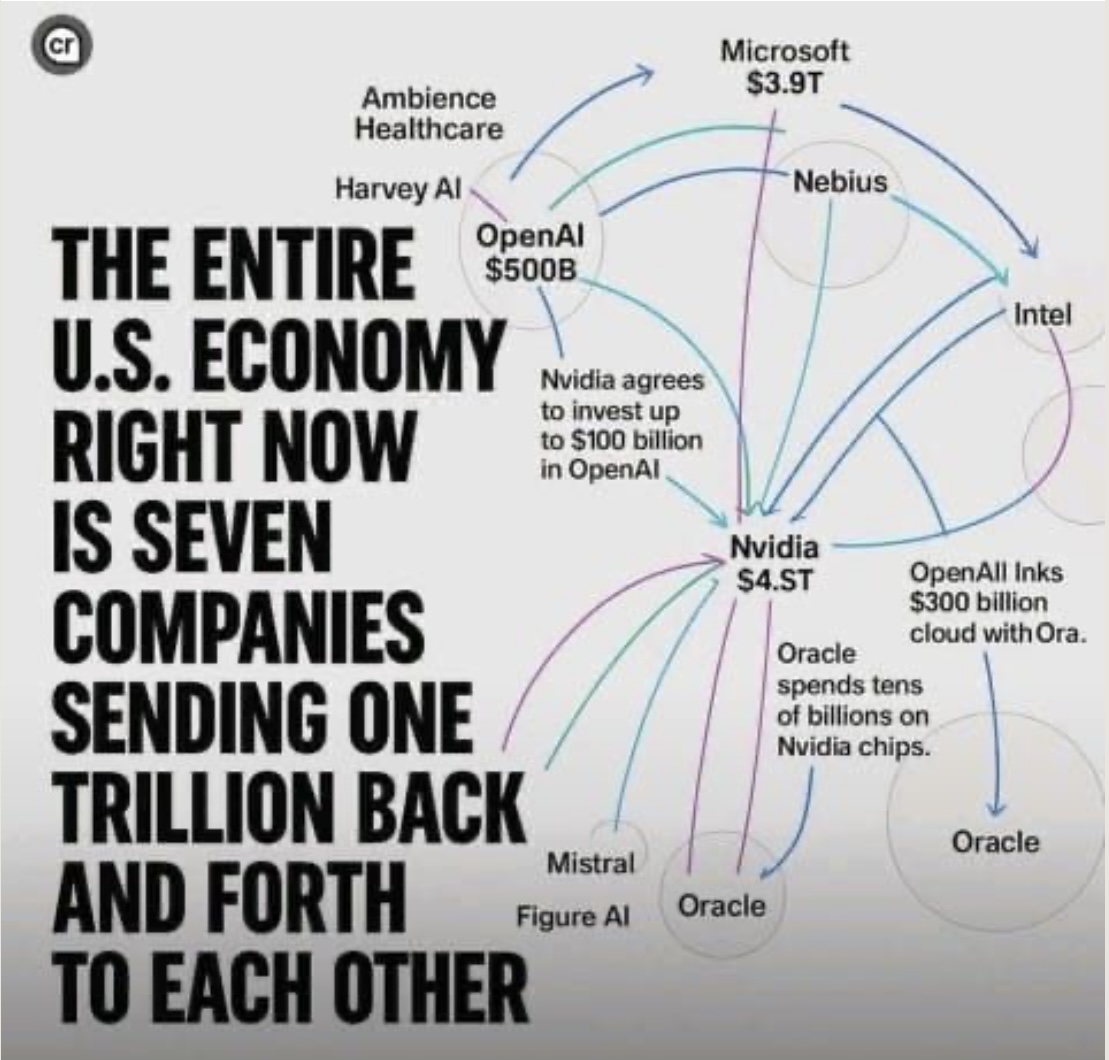
The image above was shown in LinkedIn, I never thought of it this way, where we see “The entire U.S. economy right now is seven companies sending one trillion back and forth to each other” that is how it could be seen (credit of image unknown) but is that GDP revenue? I reckon that some might validly disagree and that is before you consider what OpenAI is costing America and Microsoft (at 3% revenue it isn’t really an asset is it?)

And beyond that tourism is falling flat, and America is representing itself to be nothing more than a third world country, the president of the United States is likely to be marginally better than South Africa or Argentina, making it 17th place at best. The GDP setting in December 2024 (which was 29185) will be seen as a jolly time, by next year America is likely (a clear speculation) to be less than 13913 making it a little more fortunate than India which manages this at 5 times the population. Would you gathers in that crowd after you proclaimed year after year that America was doing so well? The defense industry is losing revenue, tourism is down massively and that Oxford Economics report stating that it is costing America $50 billion, which is 400% worse than the numbers we see thrown in the media. Then jobs are down and as I see it retail is massively down. in addition we see Aluminum smelters are down, only 4 in 24 are operating. They cannot deal with the unsustainable operating cost and that list goes on. So what happens when soda cans become an issue? American dream states are set to operate a soda can, opening it and drinking it (in the Miami sun), so I reckon that 2026 will bring its own entertainment to behold and at present , I reckon that President Trump is merely showing up to do some photo moments, so who will be ‘advocating’ how well America is doing?

I reckon it sucks to be the the man in charge at the Federal Reserve. And only 8 hours we were given “Federal Reserve has managed to push up bank reserves for 4 weeks now, but they’re running out of tools in the toolbox and will soon have to resume asset purchases, euphemistically called “QE” for quantitative easing, i.e., money printing:” (source: E.J. Antoni, Ph.D.) so as we accept that Jerome Powell is (for now) the Chair of the Federal Reserve of the United States. I cannot recall that America has given any voice to the effects (or benefits) of Quantitive Easing. So is it real? What is Jerome Powell up to? It is a fair question as President Trump doesn’t really understand economics, optionally even less than me. As I see it, he filed for bankruptcy 6 times, the last time was due to the 2008 mess, so if people argue 5 times I would accept that. As I see it, he needed to make Jerome Powell his best friend and seek his assistance in avoiding the setting America is facing these days. And my smirking sense of humor (an evil one) is wondering if America can even afford hosting the 2026 G20 summit. As I see it (and I might definitely be wrong) is that America is using South Africa to get the 2026 setting taken away from them. As I see it, Canada or the EU is a much better place in 2026. There might be a reason to hope for Canada, as he will see it as a reason to make the speculative statement that he is leaving the G20 to his 51st state (making Canadians angry to say the least). 

But as I see it, I actually don’t know. And I reckon that most DML systems cannot either as this setting has never taken place before, the American economy is in an mess and not a good one.

This is what you call the perfect setting to be hosting the G20 in 2026, apparently in Miami, so order your sodas in advance. 

Is there more bad news, is countered by me with ‘Does there need to be?’ A setting that is voiced by many. As I see it, the GDP in 2023 The gross domestic product (GDP) for the Los Angeles metro area was approximately $1.30 trillion in 2023, now we know that Los Angeles had dreadful fires, but the current situation isn’t helping and what will California report in revenue for 2024 and 2025? We will know some of these numbers in December, giving a lot more visibility to the hardship America is facing and there is no hiding from those numbers (playing them will be worse). America is stopping to be a great place to be and as I see it, there aren’t too many countries lining up to be their friend at present. Trump squashed that route of healing too.

Have a great day, I am almost late for breakfast.

Leave a comment

Filed under Finance, IT, Media, Politics

When the credit card stops

That is the setting for the US of A. The BBC gives us ‘US debt would increase under Harris and soar under Trump – study’ (at https://www.bbc.com/news/articles/ce81g9593dro). We are given that there is basically no escape for America, I have articles going back to 2018 where I give sight of what is coming. Oh, and by the way at what point do you cancel someones credit card? We are given “Donald Trump’s campaign proposals would increase the US national debt by double the amount Kamala Harris’s would, according to a new analysis by a non-partisan group.” We are also given “Trump would add $7.5tn” now consider that the interest on this would be around 450 billion, just on the increase alone. Now consider that the total debt is 500% larger and now consider that the US economy needs to come up 2.25 Trillion EACH YEAR to deal with the interest alone and I saw that coming 5 years ago and the news media and these so called financial experts never saw this? I do not believe this. We were all told and presented a story. And they are about to lose whatever leeway they thought they could hang over us. The media was the tool some were able to use (with what I speculatively see) as stake holders to ‘bring’ the presentation. And the media seemingly was left in the dark, or were they?

The problem is that we cannot see or prove any of this. But consider that I saw this coming for over 5 years and I do NOT have an economic degree. What makes you think that I am more clever than these financial wizard in the media (CNN, BBC, WSJ, the Guardian) and many more? Do you really think that they made a miscalculation? They isn’t nickel and dime stuff, this is about 35 trillion dollars. How much sneaky bookkeeping is involved to put such an amount under the tables? This would require the cooperation of media, banks and governments. So when your retirement falls away, who will you blame? The media? The Banks? The Governments? Seems ludicrous, almost some crazy conspiracy. But consider the facts. Consider the evidence and the avoidance of the media to address certain economic facts. That is not some cooky setting, the evidence is out there on the internet. Consider all the media and consider what the media never gave us. I can tell you more, but it is time to consider what I am telling you here and make your own mind up. 

Now consider that the EU had six trillion euros in taxable revenue in 2022. Now we see that America is optionally about to increase its debt more that the taxable income of 27 countries and it does not raise an issue? Now we know that plenty of EU countries have a GDP that equals an apple and an egg. But together they should amount to a fair amount considering that these countries have a total population of 449.2 million, which is a lot more than America (about 34%). Now consider that people pay taxation, companies pay taxation as well. But the tax breaks are mostly for companies. As such I look at the people. There is a baseline that extremely roughly applies and when that baseline is applied the numbers do not match up as I personally see it and I have seen this setting for over 5 years and the media ignores it all. 

Could I be wrong?
Yes definitely, but overall certain numbers create levels of equilibrium and I see that these numbers aren’t here at the moment. And the media seeing these debt levels fail them could also be seen as optional evidence. So how does it work? It seems clear that the media can no longer be trusted (in my opinion). So how to get the numbers? I cannot give you my sources, so you are a little on your own in that regard.

Have a great day.

Leave a comment

Filed under Finance, Law, Media

History, repetition mode

This is a little harder to write about. It actually started in 2017 when I wrote ‘The finality of French freedom’, the story (at https://lawlordtobe.com/2017/03/17/the-finality-of-french-freedom/) makes a few accusations as I personally saw them. We got some kind of a warped excuse towards ‘we made a mistake’ a year later, but I reported it as I saw it, fear mongering by the IMF. Yes, all those people filling their pockets on the Credit Card of the United Kingdom were missing out on exquisite lunches. This was (as I personally saw it) starting to happen again on February 1st when I wrote ‘Insecure Masturbation Fraternisers (IMF)’ (at https://lawlordtobe.com/2023/02/01/insecure-masturbation-fraternisers-imf/), there we were given via the BBC (no allegations towards them), that the ‘UK expected to be only major economy to shrink in 2023’, ‘expected’ and ‘major’ being key elements there. Now we see “53% of business leaders in France said they expect a recession in 2023”, it is important to note that this does not make that true. All this whilst Reuters reports ‘Meloni: Italy could be in recession in 2023, faces tough times’, here too we see ‘could’ and that is important, but that gives us that there is a case that the IMF is nothing more than a stupid political tool, fear mongering yet again. So we return to the January 31st BBC story where we see “The IMF said the economy will contract by 0.6% in 2023, rather than grow slightly as previously predicted”, now it is time to look at the story now 17 hours old. Here we see (at https://www.bbc.com/news/business-64584295) ‘UK economy avoids recession but not out of woods – Hunt’, where we are given “the ONS revised up its figures for the July to September quarter, to show that the economy shrank by 0.2% instead of the previous estimate of a 0.3% fall”, as well as “some think the UK will avoid a technical recession completely”, as such I also admit that what some admit does not constitute evidence. Yet the fact that the IMF (yet again) makes an error of 0.6% which amounts to almost 23 billion. It is hard to put a number on anything and the flaw seems small, but the 0.6% seems more dangerous than that. The problem is, who is right. One cannot be regarded as wrong because of the negativity, the other cannot be regarded as wrong because of the lessened negative setting. But I can tell you this. The EU credit card is tapped out, the only way to get a handhold on that is by adding the UK back to it, there is no care on how the UK does, it is that if the UK rejoins the EU (after all that bullying) that the EU credit card is back in business and that (especially after the Mario Draghi fiasco’s) should not be allowed. I always stated that things would get worse before they get better and when they get better it becomes a lot better in a hurry, there aren’t 21 countries dragging the UK economy down, as well as their budgets. 

There is a much larger field and serious questions might have to be asked about the seeming incompetent acts of the IMF. I would state that a player like the BBC needs to clearly show sources regarding some of their reports, but I get that this might not be possible, yet the time for questions grow ever larger, especially after I showed issues on at least three events. In the end it might be me, but I was right the first time, I have questions the second time and we need to ask questions, especially when the Bremain bullies are out in force and there are indications (not evidence)  that the IMF is aiding them. But that is merely my point of view on the matter.

Leave a comment

Filed under Finance, Media, Politics

A social direction

This happens, in all the stupidity, the harshness and the fatalities of war, we look in other directions, we look for the good in places, in people, in foods and in entertainment. Our bodies and our souls can only take so much negativity until we start seeking out positivity in any way we can. This is pretty much on all of us. The problem for some is that they CANNOT avoid the negativity. Through war, through social issues, through personal issues. It is a clambake of barriers that we set up and that keep us in place. We all have these moments and these time stages. We can try to avoid them, but the negativity draws in, just like positivity when it happens. So there I was sitting on the couch watching Blindspot season 4 on dvd when I saw ‘Saudi Arabia ranks 25th in UN World Happiness Report’ (at https://www.arabnews.com/node/2045881/saudi-arabia). Of all the things I expected to see, that was not one of them. To be honest  I have no idea where they were, but they moved up one step from 26 in a year. The full report (at https://happiness-report.s3.amazonaws.com/2021/WHR+22.pdf) gives us more. You see the numbers show that they are one place behind the UAE and both are really close to the scores of France, Belgium, UK and US. Yet there is also the setting that Arab News gives us “The report has been based on two key ideas: That happiness or life evaluation can be measured through opinion surveys, and that we can identify key determinants of well-being and thereby explain the patterns of life evaluation across countries,” That is a little more than I bargained for. I am not disputing the approach but how many people? The PDF does give us that. 156 countries and 1853 observations (per nation I guess). Yet if that is the case and we know Saudi Arabia has 35 million people, we might see that stage. Yet Belgium has 12 million people and the US has 330 million people, so how is there a stage of equality? How can 1853 people be a genuine stage for happiness in the US? How is the stage of opinions towards regression become a scale of happiness? How were these numbers created? Technical box 2 gives us more (page 20), but there is a larger issue. We see 2017 World Development Indicators (WDI) that came BEFORE covid. They use GDP time series from the OECD economic outlook no. 110 (edition December 2021) with the added ‘or if missing’ and there the problem lies. Statistical result connected to other statistical results. I once learned (1992) that this is a really wrong setting to work from. Apart from the stage that it could be based on very different people, there were different economic boundaries and other issues in play. But overall it took me three minutes to combine data into questions and reservations on this report. It is nice to see all these happy people pictures, but it is window dressing, and it makes me more apprehensive of the report then less. There is a feeling of orchestration. The image of a man wearing an ‘offline hustler’ t-shirt with the small caption of ‘every move won’t be posted’, it merely brings out the negativity in me. And it is ‘consistency of emotion changes across countries in the 5 weeks after the outbreak’, you see what date was used for the 5 week stage? December in China? When? It matters because covid hit us at different times, there seems to be no real explanation there. So how was Twitter used for these 1853 people? Is twitter separate, how many twitter observations per nation? The list goes on and grows. Still, it is an impressive piece of work, if there was a way to get better and more complete explanations it could work. But I hesitate when page 144 gives me “we approached the analyses by 2 interlinked hypotheses. (1) balance/harmony matter to all people; and (2) balance/harmony are dynamics at the heart of well-being. As we have seen, both hypotheses were corroborated to some extent” Really? 1853 observations out of 330 million Americans? How does that show any level of corroboration? 

The more of the report I saw, the more questions I ended up with. I wonder who else have a serious set of questions and I wonder when the media will ask Gallup more questions, Personally I doubt they will ever bother.

Leave a comment

Filed under IT, Media, Politics, Science

The deal

There is a deal out there, at least in the UK. There are all kind of deals out there, the consideration is all in the eye of the beholder, yet what is the deal?

The independent has a few views, the first one is ‘Labour and the Tories are both desperate for a taxpayer-funded spending spree – I don’t trust either of them‘ (at https://www.independent.co.uk/independentpremium/labour-conservatives-general-election-spending-plans-economy-a9195736.html), yet its by-line has an interesting thought ‘makes me wonder who is actually monitoring the books? Who is in charge of the economy?‘ Yet that is he issue and it has been n issue for close to a decade. Another article is focussing on ‘Which chancellor would you prefer to ruin your life? Sajid Javid or John McDonnell?‘ (at https://www.independent.co.uk/voices/sajid-javid-john-mcdonnell-general-election-chancellor-brexit-labour-a9192161.html), yet in the guardian we see: ‘Labour derides £1.2tn Tory costing claims as ‘work of fiction’‘ (at https://www.theguardian.com/politics/2019/nov/10/labour-derides-12tn-tory-costing-claims-as-work-of-fiction-corbyn) there is a larger issue at play, there is no doubt that both sides have parts that make sense, yet both are as the Guardian states ‘Both parties have promised significant increases in public investment, funded by government borrowing‘, this is however not a great time.

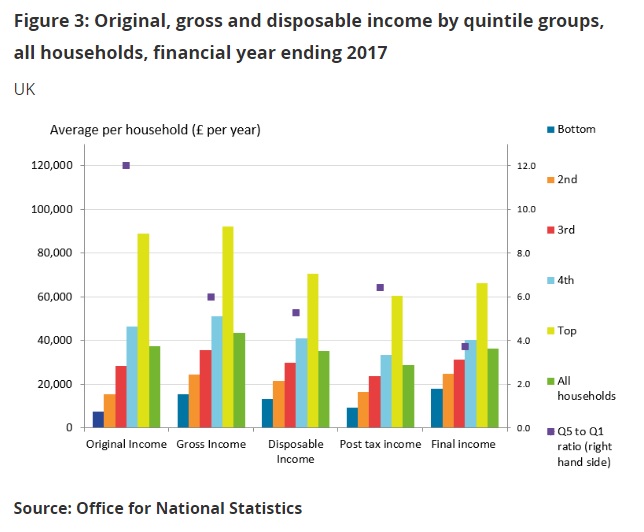
The dangers that are out there is the fact that Austerity is a path that is slow and cannot be fast, there is still a decade of austerity at the very minimum and this spending spree will add half a decade. The Guardian also gives us “The independent Institute for Fiscal Studies (IFS) has said the Conservatives’ investment plans would amount to an extra £20bn a year, and Labour’s to £55bn a year” whilst tempering this with “Javid declined to say whether the Conservatives would implement promises made by Boris Johnson during his campaign to become leader, which included an increase in the threshold for higher-rate tax to £80,000 a year“, the problem with that part can be seen through the numbers giving by the government (at https://www.ons.gov.uk/peoplepopulationandcommunity/personalandhouseholdfinances/incomeandwealth/bulletins/theeffectsoftaxesandbenefitsonhouseholdincome/financialyearending2017), and that is merely two years ago, so when we look at the chart, how much of that collected money will give any kind of relief towards austerity?

The problem is that the people are sick and tired of austerity, but that was going to be the controlling majority to deal with debt, we can call it ‘austerity’ or we can call it ‘debt control’ the UK cannot continue the spending it had done for the longest case, not if they do not want to be vassals of banks, and the problem is that the largest collection of banks are those out of the UK, the only way is to fall below that spending spree and that is not a popular solution to listen to. Yet the numbers are clear and I get to laugh out loud for almost a year as Labour made these promises whilst the budget just didn’t allow for it, and the funnier part was that the proper taxation was key, not merely the richer people all people and more important corporations, yet Labour did not really give any of us the view that corporations were to properly taxed, were they? And the one chart I gave you shows that taxing the right will not give us anywhere near the funds required, so why is Labour connecting to its members with fairy tales and a conundrum of stories that could be minimised to a level that gives them the reality of a magical roundabout (the one with Eric Thompson doing the narration). The situation is that bad and we are just not catching on, why is that?

In that case the Libdems get closest to it by “The Liberal Democrats’ central spending pledge is a radical increase in childcare, which they said would be free for all working parents from when their child turns nine months old, at a cost of almost £15bn a year. They said they would fund it by reversing corporation tax cuts and increasing capital gains tax“, I wonder how much you can tax capital gains tax, and I have questions on how you will ‘reversing corporation tax cuts‘ but they do have the right idea in part, as I see it ‘reversing corporation tax cuts‘ is the better stage, and what do you think will happen? Apple will suddenly decide to reduce new locations from 15 to 10 (no great loss there) and others will follow suit, when the going is less profitable they will all vacate towards ‘bonus share’ percentages and all of it out of the UK, I personally believe that it is time to stop giving into the need of corporations, but that is just me. And the most important part remains, you cannot do any of the spending until taxation is clearly established, All parties need to learn that inescapable truth, because it is already too late for alternatives, the UK, the US, Japan and the EU have been playing the spend card for too long and whilst collections have been delayed and outstanding the world has no reserves left, this generation is the first one handing out money that was means for the grandchildren, and we all let them do it. And whilst we read ‘Javid has adopted a considerably more relaxed approach to balancing the books‘ with empty persuasion we forget that they already ended up spending the money that was meant for our children and now they are busy spending the funds meant for the grandchildren and I wonder what excuse they will use to let that continue?

There is a larger inequality and that inequality is not addressed, why is that?

And when it comes to excuses “The Brexit minister Kwasi Kwarteng also sought to defend the Conservatives’ calculations on Sunday, but refused to give an equivalent for his own party’s spending plans. “I’m not going to bandy around figures,”” The question is what is worse, not being into the act of bandy, or giving us fairy tale figures? I honestly cannot decide, omission or denial, both seem to be keeping the voters away from having a judged informed decision and as far as I can tell, none have any idea of where they will get the money from to fund whatever they need to get elected. At present the UK has a debt that amounts to 86% of GDP, whilst Germany has one that is a mere 62% of GDP, now there is an additional side, Germany has a much larger GDP as they are supplying for the need of many, the UK does not have that option, As such it amounts to £2.265 trillion and that amount grows well over £5,000 per second, as such the debt might seem a mere £62,500 per taxpayer, but when we look at a debt of £36,400 per citizen do you think I was kidding when we are currently spending the money that was meant for the grandchildren? With a debt of £2.265 trillion, the interest cannot be below £225 billion a year, so when you look at the total collected taxation, did you think that the previous chart gets anywhere near that amount? Oh and for Germany (in comparison) €1,990 trillion Euro, yet their debt is diminishing, it has been that case from 2010 onward when it was at €2.035 trillion Euro. Germany is ahead of the UK there, and for now it might be €48,000 per taxpayer and €24,000 per person they are merely seemingly in a worse place, yet their total debt is still going down every second, the UK debt is still increasing and until that comes around the UK has no cause for cheering or for some debatable spending spree.

The rich cannot fill that gap, anyone who says differently is lying to you, it is time to fill the gaps, reversion tax gaps is one part and making corporations accountable for whatever scheme they have next is another part, it is time to let corporations pay for their mistakes, as we need to hold the ruling parties accountable, the clear path seen is the fact that whatever is available for your grandchildren is diminishing and your vote is a clear path in stopping that. So make sure you follow the right party, I’ll let you figure out who that is.

Oh and one small consideration, when the entire EU, the UK, the US and Japan, Russia and China all have debts in the trillions, where do you believe the wealth of the world is?

Leave a comment

Filed under Finance, Law, Media, Politics

As an election looms

Finally, we get some words on the Labour manifesto, the Guardian has been on top of it and whilst they are presenting a good part, I have a few issues as they went a little light on labour as I personally see it. Again, it is a personal side and as a conservative you should take into consideration that the flaw is on my side, and I would accept it, but let me give you the goods.

The entire review is at https://www.theguardian.com/politics/2017/may/16/labour-manifesto-analysis-key-points-pledges, so you have the option to completely disagree and seek your own version of their vision. The first part “a short note on a new £250bn “national transformation fund” implies that these costs will be funded through capital borrowing” shows their intent on rail, which is a quarter of a trillion through borrowing. So off the bat we are considering electing someone who wants to add a quarter of a trillion to a debt that went off the handles due to the Labour party in two previous administrations. How is that ever a good idea? a chunk of all the other parts is supposedly coming by adding a new tax group of 50% for those earning above £123K. A marginal addition for the ‘fat cat’ group. So those making more than that will be charged for the amount above and I have a hard time accepting and believing that this will get them the ‘speculated‘ £6.4 billion. It reads more like wishful thinking in an age where rationalism will not ever get you that amount. Consider, as mentioned before, something that any excel user can check with the numbers the UK tax office (HMRC) offers, the super wealthy, those making well over a million is limited to less than 5000 people. So how is this billion pound extra achieved? Let’s not forget they only get the 5% extra over the amount over £123K, as such the income will not get close, yet after the election they will come with excuses, whilst we already knew that this was never realistic. In addition, how many are close to the threshold? In this those making £123K – £199K, they might feel safer setting apart certain investment reserves into retirement, if they get that done, the £6.4B will drop fast by a lot. In addition, the Guardian gives us: “But recent evidence from the imposition of a 50p rate in 2010 shows that the measure could spark mass avoidance by the individuals affected and raise no extra funds for the exchequer“, so there is that part too! Remember Jeremy Corbyn and his nurses? The 10,000 nurses pledge? When we consider the already announced part “Health and social care reform at a cost of £7.7bn, as part of a package that includes a guarantee of A&E treatment within four hours and the end of the NHS pay cap“, and the “Free lunches for pupils as part of £6.3bn school package“, that’s another 14 billion, where is that coming from? Remember the tax increase part? When we tally, we see that the NHS part is already leaving the tax increase at minus a billion, all the other multi billion pound parts are not even close to being addressed. This is simple tally stuff that many in their final year in primary school can achieve from their calculus lessons and Jeremy Corbyn and his ‘raunchettes’ cannot deliver, a mere exercise in lewd offensive spending. Choices without proper merit and ignoring the consequences of the deep debt they got the UK in in the first place. I am all for some level of social levy, yet any social act requires to consider the impact, something that UK Labour is clearly not doing. It is even more upsetting that simple calculus gets us to a place where this would never have been a reality to begin with. Are you seriously considering voting for such a failed attempt?

When we consider the added Cyber security, and the promise to the security agencies, we see items that are promised without any claim to the cost. Now we might accept that part, yet their own £11.2 NHS IT fiasco should clearly show that they haven’t got a clue on how to tackle it because the limitations they imposed through failed IT is part of the reason that NHS IT is not up to date in the most meagre of ways which is also exactly part of the reason that the NHS hacks were successful in the first place. In addition the entire pension part is flawed, that is a given not because of what it states, but when you compare it against the Australian need to already up the retirement point to 67, with a population of 20 million, that is a retirement change already needed now, the fact that the age wave will hit with almost 4 times the intensity in the UK and the retirement age will not significantly up for another 6 years is delusional and as I see it set so that the current Labour electorate can ignore the issue until the next election, at that point it will be way too late and they will offer some diluted solutions using capital borrowing adding another . I see it as we now need an estimated £75bn a year, it is anticipated a near doubling before 2025. You see, some of the statistics have been placing comparison of life expectancy and percentage of retirement, yet as I see it, the quality of life for those born in the 30’s and those born in the 60’s is vastly different. the difference of those two groups is that maximum life is more likely to be in excess of 20 years, so those born in the 60’s and onward have a much higher chance of requiring a pension for close to 20 years longer, on a population of millions, that would equate to an additional pile of billions that would be required. In this the setbacks that the financial meltdowns gave all the people and government institutions, it shows that the shortage will increase and the pension deficit will increase annually by a lot over the next 5 years alone, so not seeing any repair actions is just weird. So as labour proclaims to be ‘social‘ their social unawareness and unpreparedness is just a little too upsetting. Now, the Tories are not innocent either. There is a given shortage and getting rid of the debt is a first step in solving it, so as we see that Labour is now willing to add close to half a trillion to the total shortage and that is just the added shortage of what they want to do to look cool. The added deficit will go straight through the roof adding overall a lot more debt than anyone is willing to consider.

And it is Labour of all others who have no welfare support. they promise a future policy paper, but the overall issue is not that paper (it will be though), it is “There are no spare funds in Labour’s calculations for extra welfare spending. To counteract the effects of planned cuts, under Labour’s current plans it would need to increase borrowing“, so that implies even more borrowing, whilst they amount needed is already through the roof. I did voice a change, I offered a view where there might be some additional ‘fat cat’ costs, even though that is not what I call it, it was a need to increase the second tax tier by 2% and the third one by 1%, whilst increasing the 0% tax group. so basically the lowest people get £100 a month more and the highest (45% tier) loses about £150 a month (as they also have the higher 0% part, they lose a little in the end), around £100 for tier 2 and £50 on the tier 3 part which I saw as a very social thing to do. And all that without burdening towards extra debt. I am not stating that the lowest group did not deserve more, I was working from a 0 balance difference for taxation, so that the coffer would not be denied more coins to address the massive debts it has now. It was a simple exercise in Excel and perhaps my method is flawed, my intention was pure, that is a lot more than I can state for the McDonnell-Corbyn group who will happily max out the UK credit card and leave others to solve the matter after they leave office, just like the two previous labour governments did.

Yet in all this it is not just the Labour party that needs a look, the Lib Dems are also due a little concern. In that I actually like the entire ‘rent to buy‘ pledge. I cannot say if it would work because the ground materials are not a given at present. What homes would be offered? Consider what the foundation is. New houses, would b great, but when we see where, there will be an optional issue. It is of course a way to get the younger generation out of London and perhaps towards other places where a younger population would be a good thing. However, would they embrace life in Essex, Suffolk, Norfolk, Lincolnshire or Kent? What happens when that is not an option, what if the social houses in London does not get resolved? Those elements make the Lib Dems an issue that might not come to pass, yet for every person accepting a place outside of the greater London area, the pressure will go down a little, enough little’s will make for a moment of relief, yet will it work, time will tell. In all this I personally found the second ‘referendum’ offensive. So, because people did not like the outcome, because some didn’t bother voting, the people in the UK get to vote again? I wonder how the Lib Dems will be seen when the EU gets the bill of what Wall Street does, when the UK gets the pounding because the US could not get their house in order, I wonder how those second referendum people will be seen. Even as the US is ‘suddenly’ doing great again, whilst their debt is increasing by trillions of dollars a year, as well as their inability of dealing with their deficit, how will that push others? The US now with almost 20 trillion in national debt, they stated the 1st half of 2016 a collected taxation of 1.48 trillion. now, if we do something not entirely valid, but what if we double it? (the second half is never as much as the first half, yet for argument sake), this now implies that the US would collect a maximum of $3 trillion for 2016, that whilst at present, federal spending is at almost $4 trillion and the deficit is now approaching $600 billion for this year. The deficit, no matter what they report is not getting properly addressed and has not been or over a decade. What do you think will happen when that well ends? Do you think that export to the US will continue? At that point, who would be the trade partner that remains? I do not proclaim to have then answer, yet when we see that at present US total Interest paid is set at $2.5 trillion, where do you think that goes? Who is paid interest on debts that seem to be mainly virtual? Do not think it is a simple picture, because this part is as complex as anything could ever get. Machiavelli could not design something this complex. Yet at the end of the day, the taxpayer is left with the invoice. As such lowering debt is the only safety net that would allow the people in general to have any life. I have always stated and truly believed that once it collapses, it will hit whomever is in debt. I still believe that Japan is the first domino to fall, yet that also means that the US dollar gets a hit that will be a terminal one and Wall Street will falter almost immediately after that, after which the Euro will go straight out of the window, its value less than the German Deutschmark in 1923. Japan has a debt that is close to 240% of GDP, a group of nations that includes the US, Japan, the UK and several other European nations have a budget deficit that is surpassing $9 trillion, how is that allowed to continue? This is not me, this comes from Martin Weiss, PhD. Although his PhD is in cultural anthropology from Columbia University, not in economics. Yet we can agree that at least he has a few degrees which includes degrees from Columbia and NYU, so he is not the most uneducated tool we know, unlike some in politics nowadays. The problem is not the total deficit or the total debt. It is the fact that some players like the Rothschild’s, Wall Street and even the IMF are wanting this game to continue. A push it forward game that benefits the political and financial engine operators and 0.1% of the population. Would it be fair to call this a legalised form of slavery? Is the one option allowed to have the same as a freedom of choice? That is what is more and more at stake. When the people in the UK were allowed this freedom, they chose Brexit, now we see all these players trying to undo that one part, because it is the fear of the players with too much to lose. We get more and more weighted information from the press and that engine is less and less reliable. So what remains? Well, the people in the UK are about to make their selection, whilst we see certain manifesto’s that are debatable to say the least. Some parts are just not realistic at all, yet the people must elect someone. I will not tell you who to vote for, I am merely wondering if the people will ever be properly informed.

This is mainly because there is an election looming and those not governing will make whatever promise they can just to get into office. So what will happen after that? Remember Emmanuel Macron? Making all those statements on how Europe must reform, or else there would be a referendum? Well, merely an hour ago we see: “Both pro-Europe leaders were keen to show solidarity concerning the Eurozone and have broken with previous statements by discussing potential changes to EU treaties. The move is seen by both nations as a way of healing ongoing EU upheaval, combating the rise of the far right and showing a united front in the wake of Brexit negotiations” healing whom? the ECB spending spree recipients? When we see “Visiting Berlin on Monday, Macron ‘did not push for major, ambitious reforms (of the EU) because he knows the chancellor cannot deliver until the elections in September’“, I merely see the fact that the French people have been lied to again, and those people voting have elected a new Wall Street tool (as I personally see it), and the fact that he was a former investment banker was pretty much a clear giveaway. I expect to see some kind of ‘compromise’ that gets no one anywhere any time soon around the end of August or early September, implying that the European gravy train will move along with full speed ahead for another 4-5 years. When you realise this, do you still think my Brexit support was weird? If someone had effectively muzzled Mario Draghi, that might have been a first piece of evidence that reform of the Eurozone would have been a far fetched optional reality, yet so far, that has not and is unlikely to happen.


Leave a comment

Filed under Finance, IT, Media, Politics

The shrinking EEC

It has been in the papers and the paperwork for some time now. It is getting close to a certainty that the EEC is now in jeopardy of losing the UK as an EEC member.

And my reasoning is?

Well there is more than one reason, but the number one spot at present would be Ukip. As the EEC courts are adding legalisations into the mix of the UK stemming the influx of illegal wannabe residents, they are only fuelling the Ukip engine that will denounce membership to the EEC, it should be clear that this is getting to be an increasing view of consequence. I wonder how large the panic will be when the EEC GDP gets downgraded by 15%, which must be the stuff of legendary nightmares for Wall Street and several other zip codes that are managed by an abundance of financial institutions. Where their ‘survival’ depends on posting a +0.015%, -14.5% is ample reasoning for speculators of all shapes and sizes to leave the building via the exit in their windows (opposed to taking the stairs or elevator). Well, that at least might open up affordable housing for some, so there will be winners there too. That downgrade would potentially buckle two currencies and around half a dozen nations in one step.

So as we see these ‘humanitarians’ fight for the rights of those misusing their rights at the earliest convenience, be aware that once your savings are gone, feel free to thank those human rights courts as well. Now, let me be frank, I am all for human rights, I think that Human rights are essential, but what we now consider to be a Human Rights ‘issue’ should be regarded as debatable too. It is almost like faced with a group that will settle for any small ‘victory’ whilst ignoring the massive issues that should be on their actual radar. One could even speculate that these people and those judges will do ANYTHING to avoid making the changes that actually matter in a Human Rights environment.

The first issue linked in all this is the article we see titled ‘Migrant overstayer figures swell to more than 300,000, watchdog reveals‘ (at http://www.theguardian.com/uk-news/2014/dec/17/migrant-overstayer-figures-swell-watchdog-reveals). We see the quotes “John Vine, the chief inspector of borders and immigration, revealed the existence of a further 223,600 records of foreign nationals who have overstayed their visas, all dated before December 2008, in a report published on Wednesday”, as well as “fewer than 1% had left the country as a result of their intervention“, so we have a quarter of a million people, using a system where possible, where the system is not equipped to deal with such additional numbers. We can go all huffy and puffy on the quote “even killers had been given British passports because of lax Home Office character checks“, where were these crimes committed? And if the home office checks are lax, should we blame immigration, the system or the pressure of papers? I am asking as I am not certain where and if there is blame to dish out at that point. What is clear is that this system is broken and people have had enough. We do however need to take into mind the last quote there which is ““New powers in the Immigration Act are restricting access to work, housing, benefits, healthcare, bank accounts and driving licences of illegal migrants, making it far tougher for those with no right to be in the country to stay here.”“, which of course will further drive up crime and disease issues. I know I am just stating the obvious, but at large I have seen people ignore the obvious for a decent long time, so there!

The second article ‘Non-EU family members do not need visa to enter UK, says European court‘ (at http://www.theguardian.com/uk-news/2014/dec/18/non-eu-family-members-visa-uk-european-court) is what is driving issues on several parts. If they do not require a visa, that means that they can enter whenever, which also means that they get limited access to services already stretched to the point of collapse as it is now. Ukip gets a lot of support when they translate the Dutch writings of R.H.J.M. Staring called ‘Reizen onder regie: het migratieproces van illegale Turken in Nederland‘, the migration of illegal Turks into the Netherlands. If we believe Geert Wilders from the Dutch party PVV, we see a cost in the Netherlands close to 13 billion for 2010 (when the article was written) against a total 200 billion for the 4 decades as mentioned. there is no real defining number, giving us no real inside whether these numbers are true or not, yet the fact that the Dutch government has abstained to truly investigate this, gives rise to the fact that the costs are a lot higher, and the consequence of those numbers becoming a factual dimension is what scares the current government, the numbers might be high enough for people to seriously regard the PVV as a party, as such that same fear would hit the UK as those shown costs would give further rise to the increasing growth of Ukip, one thing all three parties are truly scared of. So as we see the national population spread to a solution that lowers their costs, gives better care and reduce the abuse of a social system, the illegal immigrant is soon to become the new pariah in nearly any nation. As such, this European court finding is not just a nuisance, it is the tinderbox to a powder keg too many ignored for too long.

So as we see judgement on one case that might have been ignored, as an issue, where we see the quote “Colombian wife of Sean McCarthy, a dual British and Irish national living in Spain, did not need a UK visa or family permit to visit Britain“, we are confronted with the realistic fear of non-manageable influx. So the fear of what legal and valid immigrants like: 730,000 from India, 465,000 from Pakistan, 640,000 Polish, 180,000 Nigerians and 100,000 Romanians will bring the UK, if one in ten brings over a relative, the UK will be confronted with an additional quarter of a million, whilst this is only 5 from the top 20, that number could end up being a lot higher, well past the Home Offices ability to clean up a system, which might have been regarded as out-dated less than a decade ago, and the UK is not the only nation where this issue plays.

So overall this verdict could be the coffin nail, financial institutions has tried to avoid, hoping that they could leverage a ‘survivable’ solution for themselves, when this goes pear shaped, the courts will have an entirely different scope of horrors to contemplate. If we consider the consequences of the events in Martin Place in Sydney, where we see the unacceptable abuse of Muslims whilst in prayer (at http://www.bbc.com/news/world-asia-29781967), we see a change to actual Human Rights that are not looked at to the extent they should be. It is a worry. When one crazy individual with a gun can get this started in Australia, what happens when the social system in the UK gets pushed beyond breaking? We have seen plenty of shouted claims against these 5 groups in the past, when the illegal immigration goes beyond a certain point, how safe will the legal and valid immigrants be? That is the worry some part that is overlooked at present. It is a part that Ukip cannot (and might not) ignore, but the fallout and the timeline of that fallout will push a lot of people and families in danger. As the European courts considered and possible did the legally right thing, they might end up not having done the correct thing.

In the end the EEC is an economic thing, the European Union is at its foundation a set of economic rules, the imposing of changed laws for nations, whilst it core is adhering to an economy is faulty at best (even more faulty when that economy collapses to the extent it has). By removing areas of self-governing the EEC is setting a different precedence, one must then wonder whether the identity of any nationality will allowed for the EEC to continue, once that is answered in the negative, those members might not want an EEC future, a danger that is not just contained within the United Kingdom, there is a growing wave of concern that France is getting to that consideration point a lot faster than most economies can correct for, France might not wait until 2017, the main reason is not just Marine Le Penn, it is French pride, which is not in light with the foundation of the EEC and we can add the lack of catering to French Pride by President Hollande, it only gives additional worry to all involved. We can admit that the economic slump was not due to Hollande, but not resolving it will be blamed on him. This beckons additional fears for the economy, once that critical point is surpassed all bets will be off and those with invested life savings might not have any savings left soon thereafter. So buy that house, that vineyard and that business, because owning what you have without debts will soon be a better position than having the status quo with your investments junked, the one fear Wall Street pushed forward too often with less and less options of keeping that value intact.

When people are in fear of losing the simple parts of life, parts that were always there, when that continuation is endangered, they will act in unexpected directions; Nigel Farage and Marine Le Penn are pretty much counting on that and so far they have yet to be proven wrong.

Leave a comment

Filed under Uncategorized

Billion Euro Fine

It seems that the Dutch government has painted itself in a corner. The parties involved are now back into all levels of talks to find a situation where a majority can be found that can live with the situation. This means that there is every chance that the 6 Billion Euro in cut backs will not be met. This means that an additional Billion Euro in fines will go to the Dutch treasury. So, is this a continuing level of evidence that the Dutch administration had been handing out funds it could not pay for in the end?

There is no excuse that can validly be used.

In the first degree, there is no excuse to use the economy or the recession. There are in my mind clear levels of visibility that there had been levels of ‘bad news management’. I had voiced my concerns on several occasions that the economy was nowhere near what was ‘predicted’ by the CBS. I was proven correct on more than one occasion and that whilst I have no advanced mathematics degree. It makes one wonder how those high priced calculators get to their numbers, doesn’t it?

When Germany started to tighten its belt from 2009 onwards, too many were on that horse of optimism where many stated that such rigorous cut backs were not needed. Now, four years later the cutbacks required are a lot more then would have been and that bill cannot be paid. On all sides minorities cry out that the cut backs on one side and/or tax increases on the other side are not proportional and that these actions will not benefit the economy.

I expect one more jolt of bad news and certain parties will stand up opening the retirement funds for the benefit of now. Which means that the economy will now need to rely on a jolt of ‘annexed funds’! Why am I stating this? I see these funds as the ownership of those now working. Whether you start or whether you are at the end of your working life. The funds of you and me are used to steer away from the actual issue of a parliament not able to control its spending. There are additional issues linked to this.

A Dutch blogsite called http://huizenmarkt.blog.nl from Juul Dijkhuis stated “De huizenprijzen zijn inderdaad kunstmatig hoog gehouden, maar mede hierdoor zijn de economische zorgen in Nederland ook kleiner dan bij de ons omringende landen. De gevolgen van een flinke daling kunnen namelijk groot zijn.

[translated]: The house prices are indeed kept high through artificial means, because of this the economic worries are not as high as those for the surrounding nations. The consequences of a sizeable reduction in value could be severe

This is just the first one I found and this statement does not stand alone in this matter. This article came from 2011, after the crash and in the timespan when bad news management (as I see it) was already in place. So consider the issue that the Dutch are not dealing with one issue on economy, but on additional issues in that same year we see SNS Reaal Property Finance, which is no longer here, was already dealing with minus a quarter of a billion for 2011. The Dutch site Calcasa (www.calcasa.nl), which is an independent technology firm, specialised in property value assessment reported in 2012 that in 2011 Dutch property value went down by 17 billion. As stated residential (-1.3%), offices (-1.9%), shops (-5.9%) en corporate spaces (-3.5%)
(At: http://www.calcasa.nl/nl/over-calcasa/nieuws/detail/kwartaalbericht-waarde-nederlands-vastgoed-met-17-miljard-afgenomen-in-2011/105).

So was this just another form of ‘bad news’ management? There is a lack of clarity here, yet consider that already in 2011 we see that different separate branches are trying to keep the good view, and from all indications the government did not intervene, did not (so it seems) openly correct the events. As stated, events that would have impacted the Dutch population in more than one way.

In support we see issues that are linked, but from another side altogether. If we look back to 2011 and if we look at the minister of Education, culture and Science, the honourable Mariëtte Bussemaker We see the following:

In de brief aan de Tweede Kamer «Meer dan kwaliteit: een nieuwe visie op cultuurbeleid» van 10 juni 2011 (Kamerstuk 32 820, nr. 1) wordt aangekondigd dat het kabinet wil onderzoeken of het mogelijk en wenselijk is het eigendom van de gebouwen van de rijksmusea aan deze instellingen over te dragen.

[Paraphrased] House document 32 820 nr 1, Parliament will investigate whether it is possible and desirable to transfer ownership of states museums could be transferred to the institutions that occupy them” This is fair enough, yet in that same document the next part gives us part of the light.

DTZ Zadelhoff heeft voor het vastgoed van de vier door Deloitte onderzochte Rijksmusea de taxatiewaarde onafhankelijk vastgesteld (waarde in het vrije economisch verkeer). Daaruit blijkt dat er een aanzienlijk verschil bestaat tussen de (hogere) boekwaarde van de vier musea op de balans van de Rgd enerzijds en de (lagere) marktwaarde van het vastgoed anderzijds (circa 25%). Dit verschil, dat voor een belangrijk deel kan worden verklaard door bewuste keuzes in het verleden voor maatschappelijke investeringen in een stabiele museale omgeving, kan zich openbaren wanneer er besloten wordt tot overdracht van het eigendom aan de Rijksmusea.

[Paraphrased] Zadelhoff has ascertained an independent value of four the investigated state museums by Deloitte. From there we found that there is a difference approaching 25% between the free economic value and the value in the books. The booked value is a lot higher than the actual market value. The difference, which can be explained through choices in the past of social inclined investments, could become visible when these properties are transferred.

So when we look at the links, then we see a government that is already visibly aware that there is, what I deem to be a surreal over valuation of properties. It could be that the values are actually a lot lower than what the books incline them to be. How far does this stretch? Because, if that is true and it had been known, then certain measure would have had to be taken long before July 2012. If actions were not made, then we see that the economy, linked to the value of a nation gives us a different percentage. So which additional levels of management are in play? (I actually do not know). But it seems to me that the more issues are linked, the more the evidence indicates that non-acts are beyond acceptable. Those parties now bickering over scraps to avoid hunger are either ignoring or not mentioning that the scraps will not make up for a meal to begin with. So instead of finding solutions, we witness debates (read bickering), where the result of the conversation will not be solution no matter how much a party gives in, which means that the only treasure left are the retirement funds, or more aptly put, the family silver!

That will result in the situation where all are left with less, whilst the political parties seem to remain in cycles of ‘bad news management’. When we look at the annual reports of some of these museums we see the text “De stichting beoordeelt op iedere balansdatum of er aanwijzingen zijn dat een De stichting beoordeelt op iedere balansdatum of er aanwijzingen zijn dat een vast actief aan een bijzondere waardevermindering onderhevig kan zijn.

[Paraphrased] the foundation decides on every balance date, whether indications exist that a fixed-asset is linked to a value decrease” so was it? From the parliamentary paper we saw mention that at least 4 have this issue. Was this indicated, or are we now dealing with a time zone issue where the moments of report and ‘enlightenment’ of value reduction seem to miss one another?”

Again, I actually do not know, yet we do not see too much information in this regard. So the active question of linked values are an issue not to ignore, especially if the value had gone too far down, the consequence is that cutting back 6 billion, an amount they are not able to manage now, would not have been enough. This is important to know, because there are two elements not illustrated. The Dutch government place its economy in the European rankings in the top 5 (I reckon it is within the top 10) (at http://www.rijksoverheid.nl/nieuws/2013/03/26/nederland-in-top-5-slimste-economieen-van-europa.html), in addition, the Dutch Newspaper ‘Trouw’ stated last February (at http://www.trouw.nl/tr/nl/4504/Economie/article/detail/3399005/2013/02/23/Triple-A-natie-Nederland-vergeleken-met-Groot-Brittannie-het-land-zonder-AAA.dhtml) that the Dutch economy is in a decent place, yet it also illustrates that the debt would rise until 2018, whilst at that point the UK debt would already be lowering. So why is this important?

Well, if this is about a percentage of the GDP, then the Dutch treasures, which includes its Gross investment and ‘net additions to capital assets’ plus ‘investments in inventories’. So, what happens then the net additions to Capital assets becomes an increasing negative number? Net fixed capital formation is linked to depreciation (and loss of value). It seems to me that if the net value of its treasures become increasingly large, then the mentioned 25% lowering would be disastrous. Especially when we see that investments toward these areas do nothing to increase net value that is linked to the GDP. The view is heavily coloured as the initial paper was only on 4 buildings, yet if we see and accept the levels of bad news management that has been in play, what else is intervening with the correct value of the GDP?

So as this (for now) is about the realistic upcoming 1.2 billion Euro additional fine the Dutch will face if they cannot keep their budget (at http://www.trouw.nl/tr/nl/4500/Politiek/article/detail/3516791/2013/09/26/Moet-Nederland-straks-echt-1-2-miljard-in-Brussel-afrekenen.dhtml), what other information is currently missing?

What if the Dutch need to face a revaluation of their GDP and of the elements of information that are now being ‘managed’, what will the consequence be of such a new valuation? Will the Dutch cutbacks be as severe, or worse in 2014?

What ‘managed’ information will people learn about after the retirement funds are drained?

The views I gave are important beyond the Dutch borders as well. It is a ‘sauce for the goose, sauce for the gander’ approach. From my point of view Dutch parliament is not evil, or corrupt, or criminal (there is a massive spot called grey area though). So, when these issues are detected with the Dutch, then it is important to know that others might be doing exactly the same, to some degree. The UK opposition system makes this situation unlikely but not impossible. The underlying similar dangers would then be coming from both France AND Italy (both in the economic top 5 and higher than the Netherlands). We all know that the waters of the Euro are murky. These matters might illustrate that they are also a lot less safe than we imagined them and if we accept that whatever happens in each of these nations hits all of them as it impacts the Euro, we could see this as a sign that the European economic troubles are far from over. When we have to take into account issues that were non-issues before, once this all comes out, how much damage will the Euro suffer?


Leave a comment

Filed under Finance, Media, Politics