Tag Archives: Finance

What the eyes see

That is the question at times. So is it ‘What the eyes see’ or ‘What the iiii’s see’? Both are applicable and the setting is that is comes with a subjective view. That is often the case. But this is not about the particular. The article that passed my eyes was quite good and the subtext is “The AI hyperscalers will likely spend more than $1 trillion on data centers next year. Can they make enough money to sustain the infrastructure boom?”, the question reverberates as I have been asking that same question for some time. We all see the ‘investments’ that goes deep into the trillions, and no one seems to be worried about Return on Investment, a setting that is clearly asked in every boardroom in the world. And no one is willing to walk that question. So I grin from a distance and see all these people go “AI AI AI AI” and more of that. Then they all point at some newscast where President Trump states that “The golden age of AI” is upon us. But that simple statement ‘Golden age’ requires a return on investment. That is how it always goes as long as Ive lived and the term return on investment might be somewhat new, but the setting of that requirement was already old when a panting in 1639 was commissioned. It was then lost and found again and is now known as the Night Watch (a sketch by Rembrandt van Rijn) and the article starts rather strong with “When Jessica Wachter, a finance professor at the University of Pennsylvania’s Wharton School, wanted to assess AI’s impact on the economy over the next few years, she faced a long list of business and technical uncertainties. So she started with what she calls a “remarkable fact” that is not in question: A handful of so-called hyperscalers are investing huge amounts of money to build AI data centers. Instead of trying to predict how useful and widely deployed AI models will be, she simply asked how fast the hyperscalers’ earnings will need to grow to justify their spending through 2027, when—she and her collaborator estimate—expenditures will reach nearly $1.1 trillion. It’s a no-nonsense accounting approach to making sense of today’s historical AI buildout.” The source is (at https://www.technologyreview.com/2026/09/15/1144028/ai-infrastructure-boom-investment-bubble-risk/amp/) and it is called MIT Technology Review. We are also given “While the hyperscalers plan to spend trillions, total AI revenues will be around $150 billion to $200 billion this year, says Gary Gensler, who ran the SEC during the Biden administration and is now a professor at MIT’s Sloan School. “The challenge is that the spending does not have commensurate revenues yet. That’s a fact,” he says. “And then the question is, is that an investment that will be paid off in the future?”” From a distance (as I personally see it) it is a bundle of technology firms who have (on the books) trillions and they are using it to play ands of high risk poker and the world is allowing this, because if they lose it all they can write it off against their taxation, so the people basically pay for it all and I see it as a whole lot of nonsense because AI does not yet exist. I have written about this on several occasions. So, should it not be done? I cannot answer this, because Machine Learning and Deeper Learning (what I call Deeper Machine Learning, or DML) is a strong tool, and it could come with Large Language Models (LLM) if that setting is warranted and it was merely wrongly sold. It gave me the setting that court cases would reign over all this in 2026 and I was proven correctly. What we see now, is a clever use of predictive analytics on a much larger scale, but it is not AI, as such the Return on Investment needs to be strong. And as we see here (in this article) “At stake in that trillion-dollar question is the financial health of the giant AI companies and the overall US economy—the investments could soon balloon to around 3% of GDP. The answer could also determine the fate of the hugely expensive data centers themselves. No one really knows how profitable and useful these multibillion-dollar behemoths will be down the road. Though AI models have made dazzling progress over the last few years, it’s anyone’s guess how much compute capacity we will need. The technology could become more efficient and therefore less dependent on raw computational power. Or demand for AI products could slow, or customers could turn to cheaper models.” And whilst we think of the risk that ‘cheaper models’ give us, that setting might prove rather difficult, because when cost is pushed to make way for revenue, costing becomes a big thing and it really is a big thing. So when we are given “No one really knows how profitable and useful these multibillion-dollar behemoths will be down the road” the issue of return on investment will show its ugly head and that is the price part of this debate and no one is having it, because these boar members are all “We need AI and we need it now”, all whilst the return on investment is not proven and not shown anywhere. Don’t get me wrong. There are clear cases where a setting exists and options exist. I was shown the case of the issue of lost property and the stage was shown that from weeks, there is a setting where weeks could be turned into a setting where it could be done in under two hours. That is clear return in investment and for airports and bus terminals it could be a space saver. And from there we see interactive improvements. These are good ideas, even great ideas that when AI is finally here it will become powerhouses, but there is the setting that proper database work and LLM might do the trick. Clever programming that does not require AI. We got by just fine before this fake AI and whilst these snake oil vendors are so settled in ‘their’ AI, all whilst they are using the principles of predictive analytics and that is not AI.

So then we get to “The risks, both to investors and to the economy, have become even greater this year, as these AI companies have begun borrowing large amounts of money to build more and more data centers. Free cash flow—operating cash flow minus capital expenditures—is expected to soon dip into negative territory for the group. Even Alphabet, known for generating and hoarding huge amounts of cash, reports in the latest quarter that its impressive revenues of nearly $120 billion were devoured by AI infrastructure spending, leaving it with a free cash deficit of some $5.9 billion—its first shortfall since Google went public in 2004.” This is because I see another shortfall in the short term. Everyone is so driven towards data centers, whilst President Trump has driven the EU and other places away from the vendors of the United States and the term ‘data sovereignty’ is becoming more and more commonplace and whilst everyone is seeing these data centres and Stargate centres. It requires data and the EU is moving fast away from whatever Microsoft and Google are handing down towards their own centers not using software or hardware from the United States. The cloud act is now making that no longer an option. We get that from Politico, who gave us some time ago “Europe is actively trying to break its deep-rooted dependence on American big tech and cloud infrastructure. While major U.S. hyperscalers (like Amazon, Microsoft, and Google) still control roughly 70% of the European cloud market, public institutions and governments are shifting away from them”, as such 2027 might see a rather large turnabout and what happens to these data centres that are lacking data? You might think this is easy, but it all impacts the return on investment. 

So when we get to “Performance of the expensive GPU chips at the core of the data centers—such compute electronics represent some 60% of costs—is roughly doubling every two years or so. The pace of progress helps explain the increasing wizardry of the AI models, but it comes with a cost. Owners of AI data centers that come online this year and next will need to spend billions more on the next generation of chips by the end of the decade if they want to stay competitive. Without the investments, says Mihir Kshirsagar at Princeton’s Center for Information Technology Policy, the data centers risk becoming “hulks,” stranded assets “scattered all over the place.”

To put it bluntly: The AI companies need to start making a lot more money. And they need to do it fast. But juicing their earnings alone still won’t be enough to sustain their data-center investments for the long term.” And that is merely the beginning and I saw this roughly two years ago when I questioned the entire return on investment setting in all this and this article written by David Rotman does a good job, even more eloquent than I would have been. Although we basically say the same, this article does so a little better (and definitely more eloquent) then I could have written. So when you see the billions due next year, optionally over the next 2 years. Where is the return on investment? Because that is the question that is out there and as the IT field is changing and moving away from the United States, they too will see diminished revenue numbers. That much is certain, so where does this all stand? I am expecting a setting of actual AI to be a little over a decade away, it depends on certain factors and it also take in account a setting that I personally see (which might be wrong) but I feel that there is no AI, or as some call it true AI and I believe that requires a trinary data setting. As I see it it requires quantum computers (which exist) with shallow circuits (which is still in an early stage, as far as I know) and it requires a trinary coprocessor, which I call a Epsilon processor. These elements are required for an aI system, I set the system using a trinary coprocessor because that makes sense in a setting that is in part binary, that setting makes sense. We cannot merely push trinary systems through, there is will be a stage where they both need to exist. Later these systems are likely to be completely trinary, but that is merely my thoughts on the matter. And all this is still set towards the stages of return on investment. When you are considering this, how many billions are still required and who is willing to place this onto a systems that is unlikely to turn profit for a few years, optionally ver a decade. Who has that kind of money? There are a few, but are they willing to surrender that kind of money? The question might seem simple but the setting is not as straightforward as anyone thinks. And I saw this all along, so who gave you all the idea that the golden age of AI was here? Because that requires a massive revenue, or am I wrong?

Have a great day today, I’m now 90 minutes from Thursday and in Toronto it is now breakfast time. The idea to start the day with breakfast in Eggspectation on Bay Street is a little overwhelming for me at the moment. So you all have a good one and I will write to you in about 17 hours. 
Leave a comment

Filed under Finance, IT, Media, Science

Worries

That is what I felt. Computing, a media brand of The Channel Company, is a trusted source for end-user IT news, analysis and insight around the world gave me news that gave me a few thoughts. The article ‘Oracle plans more job cuts as AI bill rises’ left me with worries. If this is the setting for Oracle, what more can go bust in the night? I personally don’t care about these grocery stores like Microsoft, they made their own bed. But “An internal document seen by Business Insider says some teams could see double-digit percentage reductions in their workforce. Managers have reportedly been asked to identify employees whose jobs could be cut, with the aim of reducing payroll by the start of Oracle’s second quarter on 1st September.” Gives me pause for worries. You see, I have worked a lifetime on technical support and customer care and I have always had my worries about this entire spending against these rising “AI bills”, first of all AI doesn’t exist. No matter what you call it, it is not AI, it is mere DML/LLM settings and they are part of an AI, but it is not AI and whilst everyone is spending the house, the fireplace and the kitchen sink, it is a moot setting. It is seen in the fact that AI (now called true AI) is over a decade away and how many firms will remain as they are all hollowing out into what some call an empty egg shell? I for one had the most hope towards IBM and Oracle, IBM is the closest in hardware (the entire Quantum processor, shallow circuits) settings, and merely (as I personally see it) a lacking trinary operating system and what I call an Epsilon processor, like the old days had an Coprocessor (like the 80387, a dedicated hardware math coprocessor) and in my mind the Epsilon processor will be the AI (co)processor, dealing with trinary data settings. It might not be the correct setting, but this is what I personally believe. As such I still believe we are close to two decades away from all of this, but there is no way that these spending can go on for another 2-3 years. These firms are destined to lose whatever advantage they had and are ready to be fed to vulture investors, aggressive financiers who buy distressed assets and as I see it, Oracle, Microsoft, AWS and several others will become massively distressed in 2-3 years, especially as they are hollowing out their company. It is my personal believe that these vulture investors are chipping at the bits to take control of these firm. Especially when you see “Oracle’s workforce fell by about 21,000 people, or 13%, during its financial year ending on 31st May, according to a recent company filing. The company currently employs about 141,000 people.” Consider what Oracle brings to the table, how many people could they sacrifice before the lid of that box becomes too shaky to survive? I have no idea, because I am not in the know about Oracle, I know people there, but that is as far as it goes. So when I read “Oracle said the deployment of AI technologies across its operations had already resulted in reductions to its workforce and could lead to further cuts.” As well as “Oracle is investing heavily to expand its cloud infrastructure as demand for computing power used to develop and run AI systems surges. Its capital spending reached about $55.7 billion in the 2026 financial year, up sharply from $21.2 billion a year earlier, as it accelerated construction of datacentres and purchases of equipment. The scale of that investment has increased pressure on the company’s finances. Oracle recorded an operating cash shortfall of about $23.7 billion during the year and raised roughly $43 billion through debt. It is also expected to raise a further $40 billion, alongside about $5 billion in equity.” This leads us to “S&P Global Ratings cut Oracle’s long-term credit rating to BBB-, one level above junk status, citing rising debt and sharply negative cash flow. Despite the financial pressure, Oracle’s latest results showed strong demand. Revenue increased by 17% in its latest financial year, while its cloud infrastructure business grew by 77%. The company’s chairman, Larry Ellison, has previously played down concerns that AI could undermine established software firms, saying the so-called “SaaSpocalypse” would be a problem for other companies rather than Oracle.” I am the last one to spell doom over any company (except Microsoft), but these settings leaves doubts over the future of Oracle. And there is the setting that I could be wrong with the trinary approach and my feelings on the matter are fluidic at best, but in that setting IBM has the highest chance of success, and I believe that it will happen with Oracle data. But that is my personal feelings in the matter. Still the article in  Computing (at https://www.computing.co.uk/news/2026/ai/oracle-plans-more-job-cuts-as-ai-bill-rises) leaves me with worries for Oracle, if 13% was already made redundant and another 11% might come, what happens when almost 25% is gone? What happens to training, support, services? I reckon that the sales people are all in it for themselves (as commercially driven entities are) but at some point they see that this cannot continue and as I see it, it will leave a place like Oracle at the mercy of vulture investors. 

I understand I could be wrong in a few ways, but consider what AI is supposed to be and it is not. We see all these ‘BS directives of expert AI’ that got lose (all whilst there is no real AI), it hacked its way into place X and out of sandbox Y, which I see as evidence that it is not really AI, it is a Machine Learning application (with optional LLM) that is programmed and that is what some are hiding, because all these class actions will suddenly have new fuel, programmers will be shown to the media, telling the world what they programmed and these firms, none of them will survive the costs of these cases. Some give us numbers that indicate that AI-related investor fraud and disclosure lawsuits spiked sharply, accounting for over $385 billion in measured Disclosure Dollar Losses in early 2026 alone, driving massive defense and litigation overhead and as far as I can tell the total costs for 2026 gets to surpass $400 billion, now consider that the ‘gig is up’ as some say and the class actions will rise to new heights. I predicted as such a few times, going back to February 19th 2026, and as I see it, there is more to come and these firms will be protective of whatever their coffers have, because at this pace, their revenue will collapse when some settings come to pass and they have hollowed out their companies. They did it themselves and whilst I don’t know the specifics, I saw this as a really bad idea, no matter what the influx tended to be, I served in customer care and technical support going all the way back to 1985, I have seen it all before and when these companies short change on training, support, and services it tends to go downhill fast. But that might merely be me. So how to see this article? I reckon that it is a wake up call. I am not of the mind that I am changing my mind about certain matters, but I am weary that there is a larger danger ahead of us all and it is the dangers of weakened firms now becoming the target of vulture investors within the next 3 years. Will it happen? I have no idea and I didn’t think of these vulture investors initially, but that is the first weakness that these firms face when they weaken themselves to this degree. Will it happen? I guess so as greed goes where payments are found and most of us enabled it. We did so by ‘heralding’ “The current “golden age of AI” refers to the mid-2020s boom driven by generative models, multimodal transformers, and massive computational scaling that has transformed enterprise productivity, robotics, and creative industries.” So you tell me, what golden age? Doesn’t such a golden age come with large revenues all over the board? So far we are drowned by articles on class actions, costings that make firms get rid of thousands of workers. What golden age I ask you.

So, this article is highly speculative, I get that but is it therefor wrong and not happening? Too much of these events are now becoming fact, except the revenue from AI, that is still illusive all over the board. Except for a few companies but they are paying each other for data centres, so is it really revenue or an exercise in funny money. Have a great day today.

Leave a comment

Filed under Finance, IT, Media, Science

UAE making Japan bigger

OK, a little exaggerated but it sounds true, which is what the Japanese Times tells me (at https://www.japantimes.co.jp/business/2026/08/06/uae-fund-data-center/) where we see ‘UAE fund weighs $6.3 billion AI data center investment in Japan’ Japan has approximately 250 data centres, making it a top 10 player in data centres and now that the UAE is setting the funds for “Abu Dhabi sovereign wealth fund Mubadala Investment would lead the investment into a 500-megawatt project in Akita Prefecture, which may include other foreign and domestic investors, the person said, asking not to be identified because the information isn’t public. Once completed, it could become the largest data center in Japan. The talks with the Gulf state underscore growing global interest in securing critical AI assets in countries viewed as relatively insulated from geopolitical tensions.” In addition we are given “Total investment surrounding the project, including by suppliers and other companies looking to establish operations nearby, could reach as much as ¥2 trillion, the person said. A consortium of Japanese companies would likely handle construction and related infrastructure, they added. As U.S.-China tensions escalate and wars in Europe and the Middle East reshape supply chains, Japan is increasingly viewed by global investors as a stable market with relatively low geopolitical risks.

That all makes sense and for the UAE to diversify its coffers makes perfect sense to me, so as the article ends with “Tokyo’s policy has rendered some substantial results. Major chip firms including Taiwan Semiconductor Manufacturing Co., Tower Semiconductor and Micron Technology have invested billions of dollars in the country in recent years. The oil-rich UAE, meanwhile, has emerged as one the leading global investors in AI and its underlying infrastructure. State-backed investor MGX, a joint venture between Mubadala and G42, has been a key vehicle through which Abu Dhabi bets on AI. MGX recently completed its acquisition of Aligned Data Centers, which has an enterprise value of $40 billion, alongside BlackRock’s Global Infrastructure Platform and the Artificial Intelligence Infrastructure Partnership.

As such we might come to the conclusion that the UAE and in specific MGX is making headways in data centres and I can only speculate on the recent acquisition with BlackRock’s Global Infrastructure Partners who now have taken over 100% of Aligned Data Centers from Macquarie Asset Management, as such I reckon that there are more settings to come and I can only speculate regarding the where and the why.

So whilst you mull over this tiny gem of information, I wish you all a good night, its now 03:25, so another 240 minutes until I get to enjoy breakfast. I wish you all a marvelous day.

Leave a comment

Filed under Finance, IT, Media, Science

Wrong footing?

This happens, we all get our footing wrong, even I. As such I had my ‘ideas’ about Ahmed Mawlana, nothing bad. But whilst we see ‘Has the UAE’s meteoric rise reached its limit?’ Which is given to us by the Middle East Eye (at https://www.middleeasteye.net/opinion/has-uaes-meteoric-rise-reached-its-limit), so Ahmed Mawlana is a researcher specialising in International Relations and Security Affairs. He holds an MA in international relations from Sabahattin Zaim University in Istanbul, so as I see it, he is no grocery wannabe. And I am fine with that. So as we see “In less than two decades, Abu Dhabi has transformed itself from a relatively low-profile Gulf state into one of the region’s most assertive powers. How did a country of around one million citizens acquire such an outsized regional role? The UAE’s rise is linked to its ability to capitalise on successive regional crises, beginning with the 2003 US invasion of Iraq, accelerating with the Arab Spring, and gaining strength amid Washington’s declining engagement in the Middle East.” He ends the article with “Ultimately, the principal constraint on the Emirati model is structural. The UAE possesses immense financial resources and an extensive network of international partnerships, but it remains a small state with a limited citizen population and little strategic depth – making it difficult to sustain prolonged regional crises, or to confront larger powers directly.

I get what he write and there is logic in this, but I also see what the UAE has achieved and whilst I was never there, YouTube has been very vocal (it’s YouTube creators) to show us all what the UAE has achieved. In support of my way of thinking is the Reuters article that gives us ‘UAE non-oil growth hits four-month high in July, PMI shows’ (at https://www.reuters.com/world/middle-east/uae-non-oil-growth-hits-four-month-high-july-pmi-shows-2026-08-05/) where we see: “The United Arab Emirates’ non-oil private sector grew at its fastest pace in four months in July as new orders climbed to a ‌five-month high and export business rose, a business survey showed on Wednesday.” As I see it, the non-oil part is essential here. We see the growing tourism and service settings. We see additional maritime growth and that is merely the beginning. The UAE has a lot to gain in all this, which is why I have ‘issues’ with the setting of Ahmed Mawlana. He might be correct, but the term “meteoric rise reached its limit” can be explained in a few ways. One of them is that the stellar growth might be gone. I don’t think so, especially as tourism can still grow a lot more, but that is possible. Still as we see Real Estate and tourism grow, there is still the difference between strong growth and meteoric rise, so whilst the second has reached its peak the first one is still within the grasp of the UAE. Personally I think it is becoming time to make Iran extinct. A shameful thought to have, nut they did that to themselves and I created 4-5 military IP’s to make something according to that need happen (I am more of a surgical instrument) why kill when you can destroy their abilities and commodities so they destroy themselves. I am at times that simple.

So whilst we get the setting that Reuters gives (just a few) 

Which is also slightly debatable. For instance we see “Business confidence weakened for a third straight month to its lowest since March”, which I accept as one of the given facts, but at this point I wonder how that confidence level is when compared to the US economy setting of the United States? This question is formed as Al Jazeera gives us ‘Why did the US economy slow down?’ (at https://www.aljazeera.com/video/newsfeed/2026/8/4/why-did-the-us-economy-slow-down) where we see “The US economy slowed more than expected, but it’s not because Americans stopped spending. So what really happened? The answer lies in how economic growth is measured, and America’s massive investment in artificial intelligence”, yet the other (not given fact) is that players like Deloitte give us “While broad corporate spending is skyrocketing, tangible financial returns often take two to four years to materialize instead of the usual 7 to 12 months for standard tech” and I have a problem with that. Some sources give us “Studies indicate that up to 95% of early generative AI pilots struggle to show a clear positive financial return because tools are deployed without changing underlying workflow” and I see the class actions forming and that is messing with the RoI (Return on Investment) as well. All this is making the US Economy not a volleyball but a paintball at best and anyone who gets hit by its paint is heading for stormy weathers (not the girl), although the effect are the same, but not as pleasurable. In all this, there is optionally a cause for not seeing meteoric rise but strong growth is still on the table, no matter how muddy the United States administration makes some ‘facts’ look. And in all this, I till see plenty of options for the UAE, I merely think that they need to go of the AI horse. The AI is lousy and all AI is Fake AI (as I personally see it), so why bury yourself in 3-8 years of turnaround (I definitely disagree with the Deloitte numbers. I reckon that the UAE has a better setting throwing themselves on actual programming and creating stuff that has the turnaround time of 7-12 months. Let big tech break their teeth on tech that is over a decade away. They might survive, others will not and I do not trust the settings that the United States are throwing out there. Too much of it is not validated and as I perceive it not verified in any way. The UAE has actual issues to face (that terrorist state Iran) and holding their coffers in a 3 to 8 years wait state is no solution. 

Perhaps I am seeing this wrong, these fake AI have real options, ML and DL are great tools (I use the term DML as they are combining the two) and I have seen great solutions, but that setting in a 3-7 years setting is not a real solution. Consider the issues that some are reconsidering idea that are out there ‘How Commonwealth Bank and Microsoft are reimagining the future of customer service’, which I see as nothing more that the setting that NICE and CX One already have. So whilst that is happening. I wrote ‘Two paths to similar stages’ (at https://lawlordtobe.com/2022/03/30/two-paths-to-similar-stages/) in March 3022, so it is not a last minute idea. There was more, and in light of the Tourism settings in both the UAE and Saudi Arabia, the idea started to form to have a Muslim solution (I meant Arabic) that industry is exploding to a larger degree whilst they are all pushing American solutions which are not 100% covering Islamic rules and ideas. That should stop and I saw an opening for the UAE and Saudi Arabia to get one solution in the field that would fuel both nations, optionally Qatar, Egypt, Pakistan and a few other places. So whilst Microsoft had this inflated idea with “CBA will work with Microsoft to drive greater customer benefits through wider adoption of generative AI (Gen AI) and ongoing cyber security initiatives” I saw this idea 4 years earlier whilst not using AI, because it would be decades before we are there. 

Just thinking out loud. Have a great day today

Leave a comment

Filed under Finance, IT, Media, Politics, Science, Tourism

Expect bubbles

That is what I was introduced to (really early) this morning and I saw a few articles, but one gave me an interesting option. So lets take a look. (At https://stocksdownunder.com/ai-bubble-chip-stocks-crash/) we are given ‘Is the AI Bubble Bursting? Why Nvidia, Micron and Chip Stocks Are Crashing’ it holds a lot of record, but I was taken with this setting ‘Is the AI Bubble Bursting or Just a Healthy Reset?’ With the text “Here is the honest answer: it could be either, and the truth is probably somewhere in between. The bear case is simple. Micron has more than tripled in value this year, and a run like that leaves very little room for disappointment. The bull case is that demand for AI memory and data centres is still strong, and analysts note the selling looked more like a rush for the exits than a real change in the companies’ earnings. We lean towards this being a crowded trade getting stress-tested, not the end of the AI story. But if the selling spreads well beyond chip stocks, that view needs to change quickly” (and at this point I learned that whoever was working on this is a noob and an idiot for his CSS settings as they are all over the place) But that is matter for another day. The “It could be either” and a third setting was the one I referred to a few days ago when simply Wall Street put out an unsigned piece that Palantir could be overvalued for well over 20%, as such this market has some people in it that would like to short stock as that is where their dollars come flying. And as we see in the article “Investors simply pay less for today for profits that may not arrive for years.” And as I see it, some investors are not beyond shorting stock if it fuels their profits, so a third reason is found. I am still on the side of the AI bubble shorting, but n that case a healthy reset of trillions is not out of the scope of things and the marshmallow field of fictive unicorns is rearing its ugly head that comes with the “late arrival of profits” and now that the investors are wondering what they got into, some will see that they are fueling a stock market that cannot survive delay upon delay and with AI not yet existing that is where it is all heading. So it is time to get another view and we see this in Clean Technica (at https://cleantechnica.com/2026/06/24/trillion-dollar-ai-bubble-on-verge-of-popping/) where we see ‘Trillion-Dollar AI Bubble On Verge Of Popping?’ And I am not adding it, because this is in part the view I have, what we see is “Yann LeCun, one of the “Godfathers of AI,” is one of the notable people who think the industry has been far too overhyped and misunderstood. He’s been pointing out that AI costs could be much higher than the amount of money customers are willing to pay for it.” It comes (also) with “Labs like OpenAI and Anthropic are going to have to increase prices, they’re going to have to cut costs, or there’s going to be a big bubble explosion,” and ““In their pursuit to boost productivity, become less reliant on human labor, and reassure investors that they’re riding the cutting edge of tech, some nagging issues are cropping up,” Futurism adds, and “over-relying on AI can prove disastrous for organizational knowledge, the critical business insights companies need to make strategic decisions.”” This is the setting that is actually fueling both the bubble burst as well as a healthy reset all at the same time and I reckon that for OpenAI, Anthropic, Grok and Microsoft that will most likely happen in the least interesting time and they will all ‘suffer’ for it, so consider when this bubble loses $4,000,000,000,000 – $5,000,000,000,000 (writing the word trillion makes it trivial) because that is likely to happen and the market is figuring out what I saw over 1-2 years ago, when you realise that all AI is fake, it is easy and let there be no mistake, all AI is fake. You see, what we are seeing is Deeper Machine Learning and Large Language Models and these are great tools and they will create markets for themself, but the people are expecting AI and that is just not true. So as AP News gives us “The tech-heavy Nasdaq composite fell 110.40 points, or 0.4%, to 25,476.64. A 2.3% drop in Microsoft was the heaviest weight on the market. Oracle slumped 4.6%. Many large tech companies have been behind Wall Street’s record-setting run throughout the year, but analysts have warned their valuations may have become stretched.” I personally reckon that someone is likely playing a stock short game with both Oracle and Palantir. You see, no matter how you slice it, the proper Data needs for DML/LLM solutions require data technology and these two are refined into the core of that and optionally there is Snowflake as well, but it might not yet be large enough to get the attention of the stock shorting DoDo’s (lets call them that).

Jawlah, a prominent Arabic digital media platform and news organization focused on venture capital (VC), startups, and the entrepreneurial ecosystem in Saudi Arabia and the broader MENA region (Middle East/ North Africa) gives us (at https://jawlah.co/en/59212) where we see ‘Fears of an AI bubble burst after a sharp tech stock sell-off’, which I reckon is fair enough. But the interesting part is where we see “The decline followed a near-800% surge in Micron’s stock over the past year, driven largely by rising demand for memory chips needed to run AI globally — gains some analysts believe may have overestimated expected returns”, as well as “Gil Luria, head of technology research at D.A. Davidson, explains the volatility: “The market swings between a wave of optimism that AI will change everything and renewed skepticism that it is just an expensive bubble whose returns do not justify the current spending.”.” And I am here in opposition, it is not “renewed skepticism”, it is the mere setting that those willing to hand out trillions should never have been so optimistic without proper case files and validation, so whilst they might get their cash back in 2045 when actual AI comes into play, the rest until then will be massively overvalued.  As I, as a non-believer, see it, someone listened to a sales person with the mindset of a second hand car salesman that stated “Look, we have AI” and the rest followed like crazy to get those coins rolling their way and now we are optionally seeing the start of an AI bubble. I am trodding carefully because there is disagreement whether it is an actual bubble popping. I reckon it requires an actual econometrist to call that for real and I ain’t one of those actuary types (nowhere near).

What we see is that we are given “it has erased approximately $2.7 trillion in market value across AI-linked companies”, all whilst the reasoning is “massive debt-funded data center expansions, mounting hardware costs, and growing investor scrutiny over artificial intelligence’s actual return on investment” which (as I personally see it) is only partially true. As I see it, the data sovereignty in Europe and the Commonwealth is setting the drain on the Return on Investments (ROI) towards these massive debt-funded data center expansions and that will hit business in the United States a lot harder than anywhere else. You see the United States has over 4,000 data centers. So how many are still under debt? And when a response group of over 700 million people walk away from that, with an additional optional population of up to 2.7 billion people (that is the complete Commonwealth), so it will not be that much, but I reckon at least 50%, that is 4,000 centers that will now lose close to 2 billion people (or 2,000 million), so where is that unused potential going? That is what I saw almost a year ago (actually a lot earlier, but until President Trump come, most people let the states quo continue) and that has now changed. So as others players (like DayOne) and there is someone in Sweden who saw this coming a few years ago and put his money where his thoughts were. I forgot that players name, but they are likely to make massive gains. All out off the hands of the United States. That part is not represented in any of these articles, but it is a factor in all of this.

So, we are expecting bubbles and I reckon a few other setting will rear its ugly heads, but the markets will all attribute this towards bubbles, because some is massively unhappy to attribute the other losses towards an US Administration that should have known better, but that is merely me looking at other factors in all this. The larger issue in all this is that some solutions are likely to be rather good and I hope that they are allowed to continue, because investors and speculators will want their returns at whatever expense they can get and some will suffer because of that greed driven taint in all this. But I might be the next village idiot in all this. Just like that seer in the 3rd century that saw large walls of stone with thousands of people and it was written off as a lying loon (he saw the Altiero Spinelli building in Brussels) but that is a story for another day.

So whatever you do, don’t rush into or out of anything without clearly seeing the ramifications. Have a great day today.

Leave a comment

Filed under Finance, IT, Media, Politics, Science

The bad news

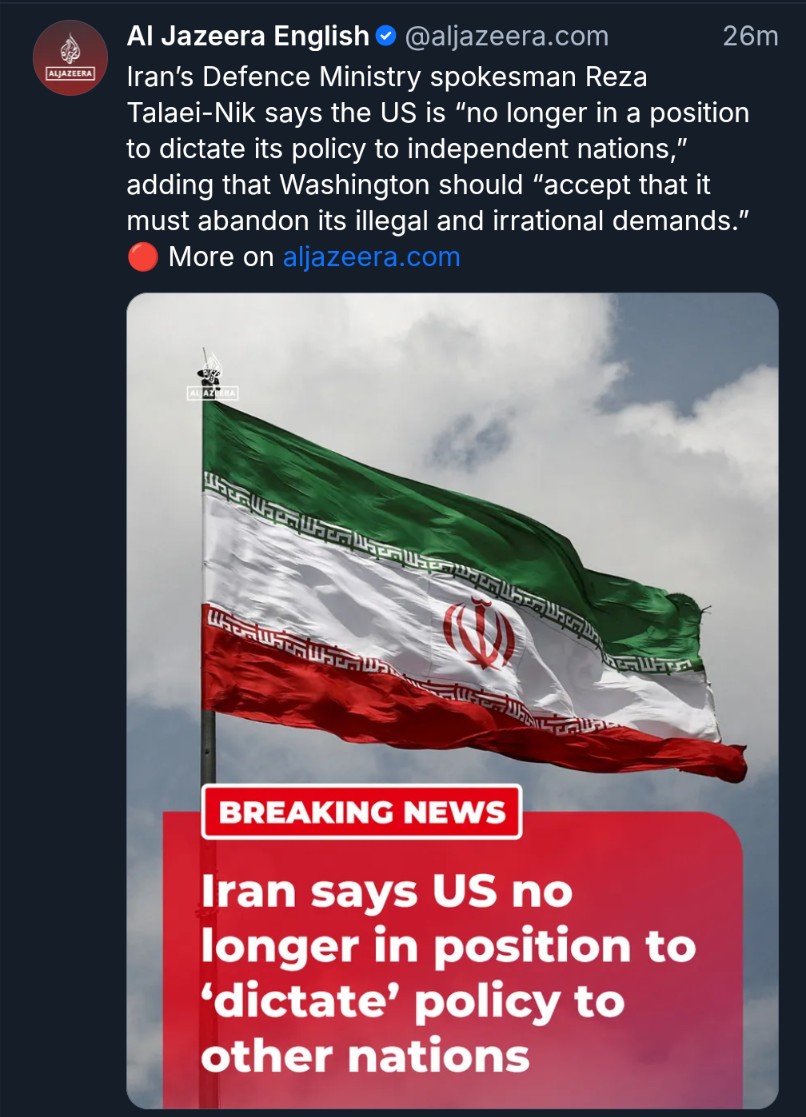
That is what was going through my mind the day before yesterday and yesterday I saw something by Al Jazeera who illustrates it to you in a more profound way. They ‘quoted’ “Iran says US no longer in position to ’dictate’ policy to other nations

I don’t give in to the setting to Iran on anything because they are regarded as utterly evil by me, but as I see it, this one they got right. You see, the United States is as far as I see it the United States is insolvent. All other parties are so ready to debate the fine ‘tactics’ of what is insolvent. But the setting is now that the United States is a liability of 47.1 trillion dollars (according to some), their debt has now surpassed to 38 trillion and if the first set of numbers is correct, the interest is will in 2026 surpass $1,500,000,000,000 and that is a whole range of zero’s. To understand how I got to be this clever (the Dutch singer Herman Brood disagrees because he told me that I would never be clever). I wrote the story (at https://lawlordtobe.com/2014/08/26/about-america-chapter-11/) ‘About America, chapter 11’, I wrote it on August 26th 2014. You think that this was too early, but at that point the debt had surpassed 18 trillion then and there was no exit strategy, there still isn’t one, but the debt has more than doubled and the IRS allegedly collected approximately $5.23 trillion, that implies that a third is spend on interest and in that setting President Trump wants to spend a trillion more in defense spending? You have got to be kidding. And whilst we are on the Trump discussion. He pissed of whatever ally he had and they will all let him drown with all his debt. So, he is playing nice with the Middle East and the members of the Gulf States that have cash. I also stated that the AI court cases will increase and I was right “As of April 2026, AI-related court cases are rapidly increasing, focusing on two main areas: AI misuse in legal filings (hallucinated case law) and intellectual property disputes over AI training data.” And I have seen first hand that we have only seen the tip of the iceberg considering “intellectual property disputes over AI training data” and these disgruntled parties are international and those not having some agreement in place will get their payday and their golden checks all whilst they come out of the coffers of the United States, leaving the United States more destitute than ever before. 

So in this case Iran might be correct, the days that the United States is “in position to ’dictate’ policy to other nations” are over. They might do so, for a few weeks, but when the larger bills come calling, we will see a different America and at that point I fear for the well being of my Canadian brothers (sisters too), because whatever Canada has, the United States will need and they will blame on the world their own inability to keep their spending habits in order. As I see it, the only path for the Commonwealth is a path that partners with China and Europe to create one big block (not the cheesy kind) but this is what I expect to happen, because as I see it, the intercepted Iranian tankers are heading wherever the US Navy wants to take them and according to some this is called ‘Western Piracy’, I am unsure what to call it, but it does give more weight to the insolvency issues I am seeing. And whilst some see this as the beginning of a Ponzi scheme of handling things (I am on that boat too), how long do you think that this will continue before all allies that the United States once had will see this as unacceptable and the new allies will almost immediately shy away and whilst the Media has a shrinking reliability, it merely fuels that Middle Eastern media in gaining a more prominent traction with the west. 

So feel free to disagree with what I write, but also take time to investigated the news as it is and compare it to what you know. As such I ended the article in 2014 with “I reckon soon enough we will get more and more long winded talks, but in the end no one is saying anything because those who will be making the speeches are at the heart of what went wrong and no one wants to hold on to that guilt when those left without their house ask them the question ‘where are my savings?’.

As such I wonder where are some of the saving left, because a Ponzi scheme approach will more easily use the funds of any bank and replace it with an IOU. 

So you all have a decent day, if possible a great day and I call on all Commonwealthians to consider the plight of the Canadians, because no matter how good they are doing, due to PM Mark Carney, they will soon have over 300,000,000 angry Americans looking for a way out and a better way than the hollow shell they are (allegedly) in at present.

Leave a comment

Filed under Finance, IT, Law, Media, Politics

Secondary reasoning

That was the first thing that hit me when I was introduced to the BBC article (at https://www.bbc.com/news/articles/cn08ep6d5ndo) named ‘US home buyers ‘frozen’ as sales slump over Iran war fears’ a few hours ago. You see, what it says here is not a lie, it is incomplete. We are given “The US housing market is struggling as the impact of higher mortgage rates, fuelled by the US-Israeli war in Iran, begins to bite. Figures from the National Association of Realtors (NAR) showed the number of homes sold in March hit their lowest level for nine months, falling by 3.6% from a month earlier.” You see, the population of the United States is starting to figure out that this president will throw them under any truck heading for them, hoping it will slow that truck down. So whilst we see “impact of higher mortgage rates”, which might be true, but there is a whole lot of other factors playing. We see labor statistics giving the media that 178,000 is good and much better then we thought. But in that meantime Oracle sacked 30,000 people and they are not the only one and whilst we partially accept that this is the fuel the AI pressures. Some will realise that AI doesn’t yet exist and that the fallout will be soon. And as Europe is abandoning Microsoft (for plenty of reasons) the setting of data centers when they are not getting filled with data is another setting in that cog. Then there is the Iranian clambake which is not about the clambake, it is about the price of oil, so whilst like the house as presented. Some will see that the heating bill will grow sand in the cogs and whilst the mortgage goes up by factions at a time, the heating bill will take gulps out of your budget and it will drive fuel prices up. So your house in a nice place, it is also miles form the place of work and that is the real driver. So whilst some are in the dark on how many people, drowned on the Titanic (1997, James Cameron) the world will agree that it was a boatload and the specifics are basically made redundant. 

So when we are given “following drops in January and February, rates have shot up since the US-Israeli war began. They are increasing on expectations the US central bank could continue to hold interest rates in order to keep inflation under control, dashing hopes of further cuts by the Federal Reserve.” There is no mention that President Trump bashed the hopes of home builders by pissing of Canadian lumber, driving those prices up even further, this gives additional money requirement to houses and which now requires a slightly steeper interest setting. So whilst you want to say that you are happy with the $200K home, the additional $780 on additional mortgage and the additional price of lumber (set to a rough $5125) is not in the budget and it drives the prices up. Now we get oil that was $69 per barrel in 2025, we now see that same barrel going for $98 dollar, almost 50% more expensive, so consider that some claim that by June that price is a plausible $150. So, who can afford to heat their houses at 50% higher energy bills, with the optional 50% raise in a few months. And it is all due to their kind and loving president (I believe his name is Donald Trump). 

So whilst the BBC article gives the people in the United States plenty to worry about, the US finance industry has a much tougher time ahead. Because at this rate close to (a speculated) 17% of the housing market will collapse and the people who are in dire need to get rid of their homes will not find any buyers. But I recon that the Finance industry will hold hands and become the new landlords to a massively tough market.

As such, houses are more expensive, fueling houses (electricity and heating) will make them unaffordable and the borrowing ability of the United States goes straight from ground level to basement level 5. So whilst we might give some validity to “Indicators point to “weakening housing demand following a recent jump in mortgage rates and a collapse in consumer confidence”, said Thomas Ryan, North America economist at Capital Economics. Both are “knock-on effects” of the Iran conflict, he added.” The words given doesn’t make Thomas Ryan clever, perhaps the fact that he is avoiding that all this was due to the American Administration is and the several factors that are ‘ignored’ have nothing to do with Iran, it has everything to do with some narcissistic individual that he was the next Jesus in a nasty line of nobodies. And make no mistake, when the other factors come to play, there is no avoiding the setting of the US administration, because when (not if) the European stability, which requires and absence of Microsoft come knocking. The data centers that have no input will be pushed in to a bad mortgage bank which will then be pushed into receivership. So my next question becomes: 

And I reckon that the silence that follows will be deafening. Only a fool takes on a war at two fronts (Napoleon Bonaparte, 1769-1821) and only the king of fools sets a tariff and bully demand on 15 fronts (Donald Trump, 1946 – who cares). It is a setting that will haunt the United States until at least 2076, but some say that the United States will not survive until then, giving the history of the United States with less then 300 years, a setting of greed and exploitation in plenty of books to reminiscence over.

But then, I could be wrong. Do you think I am wrong, or are the factors you see starting to make sense and when that happens where will you place the media in all this. A mere reporting entity or a bleeding effect of greed and digital dollars?

Have a great day.

Leave a comment

Filed under Finance, Media, Politics

The Bull what?

I was confronted with an Oracle article this morning, it came with the complements of the Insider Monkey (at https://www.insidermonkey.com/blog/oracles-orcl-backlog-drives-its-bull-thesis-according-to-analysts-1726682/). The article ‘Oracle’s (ORCL) Backlog Drives Its Bull Thesis According To Analysts’ which might be a conundrum, so lets take a look. We are given “The major factors in the firm’s bullish thesis on ORCL are its massive backlog and its ability to cater to increasing AI investments in the US. Oracle has a remaining performance obligation (RPO) of $553 billion, which offers good visibility into the company’s future earnings.” I would go with that a backlog gives stock and future of a company value, but that might be an oversimplification. And $553,000,000,000 is nothing to sneer at. It is seemingly more than the overall business that several nations have and in this case it is more then Norway gets on an annual level. So I would go with that, but what is a bullish thesis? 

Well, in short “A bull thesis is a structured argument supporting the belief that a specific stock, sector, or the overall market will rise in value, driven by positive catalysts like strong earnings, innovation, or economic expansion. It focuses on growth potential, such as AI-driven productivity, high revenue backlogs, or increased market share.” (Source: Simply Wall Street).

So I had it correct the first time over (a few days ago). There was nothing new under the hot sun, but the next bit ‘surprised’ me a bit. It was “The analyst also pointed out that a major risk in the bull thesis is the customer concentration. A large part of this backlog comes from OpenAI. OpenAI intends to invest a total of $600 billion in computing power by 2030. Previously, in October, OpenAI CEO Sam Altman said the company could spend up to $1.4 trillion on infrastructure by 2033. One month ago, BNP Paribas analyst Stefan Slowinski commented on how this particular risk is now reducing for Oracle Corporation (NYSE:ORCL):” So in short, most of the backlog comes from OpenAI, if OpenAI fails (not a weird thought) Oracle stumbles as would be the case, so the backlog is due to mostly one customer and that is a rusk. How big a risk remains to be seen. The people wanting OpenAI to succeed are numerous and ‘THEY’ would be reducing the risk like the metal dealer reducing the risk of riveting and downplaying potential dangers. This went well before the Titanic saw the shores of the ocean (bottom of the sea), but what happens afterwards? Now, riveting is largely supported, there are whole fleets still out there based on riveting. But what happens when the next big thing comes (like welding), so that is where we are right now. But on the horizon we see Google DeepMind, Anthropic, Meta, DeepSeek and something called Cohere. I believe Oracle is in a good space as whatever comes next will require a system that deal with data and I believe that the only competitor here is Snowflake. As such yes, there is a risk to (what some call) the Bull thesis, but the risk is seemingly small as nothing can match Oracle and Snowflake can only partially cover Oracle (as I see it) and I have some reservations on BNP Paribas analyst Stefan Slowinski as BNP Paribas and OpenAI have a multifaceted relationship involving financial analysis, infrastructure, and competition within the AI landscape and this article dos not bare this out. But in that setting we also fail to see the setting that ‘SoftBank Secures $40 Billion Loan to Fund $30 Billion OpenAI Investment’ (source: TradingView) this matters as there is a backlog and they still need loans/investment funds? And the second setting is given to us (at https://www.nssmag.com/en/lifestyle/44761/sora-openai-shutdown) where we see ‘Understanding OpenAI’s U-turn on Sora’ where we see “The development team of Sora, the artificial intelligence software by OpenAI that allowed users to generate realistic videos from a simple prompt, recently announced the shutdown of the app. It is a sudden and highly significant change, one that is expected to produce notable effects in the technology and entertainment sectors, with repercussions that could extend well beyond the U.S. market. The shutdown of Sora is not relevant only for the company led by Sam Altman, but also for other players active in the field of generative AI applied to video production. Google, for instance, now finds itself in an advantageous position in this area, with the concrete possibility of consolidating its leadership in the generation of realistic AI-based videos – thanks to its tool Veo.” So some will see this as a boost to Google (DeepMind) but this happens before these tracks became financially viable (read: paying off) and these elements will create some sort of minor shockwave. The problem is that 3-4 shockwaves can create a massive customer turnover (like towards a competitor) and even if it doesn’t ‘damage’ Oracle, it might hurt prospects in that near future. Consider that this backlog of $553 billion reduces it to a mere $125,000,000,000 Still a large number, but that is when it starts raining men on Wall Street (aka: watch out below).  All elements overlooked in Insider Monkey and the non-Chinese media is not too bitty in the DeepSeek settings. So we are mostly unaware how their next version of its engine is. All elements that will influence the view on Oracle. I still have faith that Oracle will pull through successfully, but these pesky investors are at present more jittery than a room full of roaches as you turn on the lights. It might not be the best setting for a long term ‘understanding’ and that is something Oracle has to deal with. 

Have a great day, I am now 120 minutes from breakfast, although if I was in Vancouver I could enjoy another lunch in the Nightingale like a Cache Creek Beef Tartare, yummy.

Leave a comment

Filed under Finance, IT, Science

Is it insight or data?

Two days ago I saw two things close together. The first one was a Bloomberg terminal with nearly everything in red, even player like Oracle and Google were in the red. Not sure what brought it on, oil price, a clown in Washington DC setting the buildings on fire or perhaps someone in California doing something similar. The reason is unknown to me. On that same day an article (at https://www.mirrorreview.com/news/oracle-earnings-reveal-contract-backlog/) by the Mirror Review gives me ‘Oracle Earnings Reveal $553B Contract Backlog Due To Massive Cloud Demand’, now I do not know this source, but the two don’t make sense. Oracle has a $553B backlog (which is nice as I am looking for a job), but this sets two parts in motion against one another. So if there is an outstanding pipeline worth half a trillion dollars. There should be no red mention for Oracle, but that might be my non-economic side taking considerations in its own hands. 

So when we see “Oracle generated $17.2 billion in revenue, representing a 22% increase from the same quarter last year. Profit also improved, with earnings per share reaching $1.27, up 24% year over year. Cloud services were the main growth engine. Oracle’s cloud revenue reached $8.9 billion, growing 44% compared with last year.” The setting of Bloomberg red makes no sense to me and I wonder if there is orchestration in play. Don’t sign off yet, there is additional evidence. MorningStar (at https://www.morningstar.com.au/stocks/oracle-earnings-solid-execution-secures-revenue-target-mitigates-investor-concerns) gives is ‘Oracle earnings: Solid execution secures revenue target and mitigates investor concerns’ another statement that makes no sense, in light to a workable half a trillion dollar pipeline. Here we see “We are content with Oracle’s pace to expand its data center footprint. Demand for AI training and inference continues to outgrow supply, which supports our accelerating growth outlook for Oracle Cloud Infrastructure. OCI revenue should grow 77% in fiscal 2026 and 117% in fiscal 2027. Ninety percent of the 400-megawatt data center capacity Oracle delivered in the quarter was on or ahead of schedule. Considering the scale of OCI’s buildout, a strong record of on-time delivery is evidence of solid execution that should maintain customer trust and enable faster time to revenue.” As well as “We raise our fair value estimate for narrow-moat Oracle to $220, from $215 previously, based on higher-than-expected near-term demand for AI compute. Shares look undervalued following the stock’s 8% after-hours rally. Clarity around Oracle’s funding and market demand can mitigate investor concerns around OCI’s future growth. However, we reiterate our Very High Morningstar Uncertainty Rating for Oracle, as the demand and competitive landscape for AI cloud can change rapidly over the long term. Our base case assumes that AI infrastructure will continue to see high demand that allows Oracle to reach its $225 billion revenue goal by fiscal 2030. In this case, there is a clear path for Oracle stock to converge with our fair value estimate as a result of on-time capacity delivery each quarter.

So, how does “our fair value estimate” make sense? What is it based on? There is also the setting of “we reiterate our Very High Morningstar Uncertainty Rating for Oracle” It sounds like orchestration by a Wall Street party. How can any firm that sets over half a trillion pipeline to this? Lets face the simple fact that this is out of reach for a player like Microsoft who ‘gives’ us “Microsoft reported a record annual revenue of $281.7 billion for fiscal year 2025” it might not be bad (me thinks) but it is merely half the revenue that Oracle has in its pipeline. And I reckon that this is merely the beginning. As places like the UAE has the Iranian stage, banks and several others need a clear line of communication via service centers, call centers and customer care and as I see it, Oracle is the best in these data vaults as I see it, the pipeline might grow in several directions because it is not just the UAE, I reckon that organisations in Europe and Japan will have similar settings soon enough.

And as we see other sources giving us “Remaining performance obligations, which is a useful metric when we want to gauge how revenue might be developing in the near future, grew by as much as 325% year-over-year. Looking forward to Q4, ORCL expects revenue to keep growing by as much as 18% to 20%, while for fiscal 2026 they expect total revenue to be $67 billion and in fiscal 2027 to be $90 billion. Client concentration in the backlog—meaning OpenAI—remains a concern, however.” I feel that there is orchestration, but it is a mere feeling. I lack the economic education to make sense of this. But one would agree that a $553B pipeline (read: backlog) implies that the need for Oracle is high and I reckon it will be growing even more soon enough, but that boat part is a presumptuous setting, not because there are others (like Snowflake), but the track record of Oracle speaks for itself and even if Snowflake has a great track record, these organisations go with what is safe and Oracle tends to be the safe route that large organisations ‘value’, but that might be merely my insight into this setting.

Have a great day.

1 Comment

Filed under Finance, IT, Media, Science

Bank on this

Early this morning the Khaleej Times alerted me to a story (any https://www.khaleejtimes.com/business/finance/united-arab-bank-posts-45-surge-in-2025-profit-as-assets-and-income-climb). Now we all assume that banks make all the money, but that is not the whole story. You see under Sharia law banks have ‘limitations’. Or perhaps better stated “Islamic banking operates under Shariah law, primarily prohibiting interest (aka: riba), excessive uncertainty (aka: gharar), and gambling (aka: maisir). Key rules include mandatory asset-backing for transactions, sharing risks and profits between bank and customer, and investing only in ethical, halal businesses. Common structures include Murabaha (cost-plus financing), Ijarah (leasing), and Musharaka (joint venture).” Are settings that an islamic banks need to adhere to. So when you see these ‘limitations’ and then the Khaleej Times gives us ‘United Arab Bank posts 45% surge in 2025 profit as assets and income climb’ we might see another side, mainly the side of how well the UAE is doing at present. The subtext “A key highlight of the year was the Sharjah-based lender’s successful Dh1.03 billion rights issue, which increased the bank’s paid-up capital by around 50%” with the added “The bank recorded a net profit of Dh438 million for the year ended 31 December 2025, up from Dh301 million in 2024. Total income climbed 31 per cent to Dh797 million, fueled by what the bank described as “strong momentum” across its core businesses. Non-interest income surged by 56 per cent, while net interest income rose 24 per cent.” this is what I call a massive boost to the UAE economy, so whilst you are getting fed up (tired too) on how bad the United States is doing, you see here an example on how it could be done and people better consider the fallout, because at present any dollar (Euro’s and Pounds too) that aren’t currently being invested in Europe, America, Commonwealth, Europe and a few other places are likely being invested in the UAE. I don’t know how well Saudi Arabia is doing, but it is doing a lot better than Europe. So when we get to “Chairman Sheikh Mohammed bin Faisal bin Sultan Al Qassimi said 2025 marked a pivotal year for the bank as it celebrated its golden jubilee and unveiled a refreshed brand identity. “It proved to be a transformative period for UAB, reinforced by decisive strategic initiatives and robust financial performance,” he said. “Operationally, the Bank delivered solid profitability, supported by disciplined execution, prudent risk management, and enhanced operating leverage.”” You know that they are doing it right and a strong willed and able minded board of directors was at the head of that setting. I reckon that the western world will eagerly look at the reports of SAMA (Saudi Central Bank) and the CBUAE (Central Bank of the United Arab Emirates). Because as I see it, the 2025 results are merely the beginning and if my predictions hold firm, the Western world (and its banks) will come under the spell of ‘Dry Well psychoses’ soon enough and when the opportunities of Wall Street dry up because of the economy in the United States, these two countries will get a lot of opportunities ‘handed’ to them and whilst we might worry about the Influence they will gain, these ‘new’ banks will have to adhere to Sharia law and the laws of the land, which prohibits them from making certain steps. So while we might stop at “UAB also reported healthy asset quality, with a net reversal of impairment charges amounting to Dh51 million, translating to a cost of risk of –41 basis points. The bank attributed this to strong recoveries and its “robust risk framework.” Its cost-to-income ratio improved to 46 per cent, down from 52 per cent the previous year, while return on shareholders’ equity stood at 16 per cent.” Banks on a global setting haven’t seen this since the post-WWII Golden Age, which went from 1950–1973, as such the last really successful ‘boom’ period was 53 years ago, so you better bet on the non-Islamic banks taking notice at present. Whilst President Trump will be wondering where the money is going to and he might wonder why no one is betting on his ‘beautiful’ bills, I get the notion that banks might want to vacate towards the settings of SAMA and the CBUAE at their earliest convenience, especially as this comes with an almost certain guarantee for return on their investors. As such I noticed the settings we are given and I wonder how well ADNOC is doing in all this, because their profits go somewhere, don’t they and as I see it, the CBUAE is a safe bet to consider. 

Have a great day today, Perhaps tomorrow I get to write on some gaming IP. 

Leave a comment

Filed under Finance, Politics