Tag Archives: ML

Wrong footing?

This happens, we all get our footing wrong, even I. As such I had my ‘ideas’ about Ahmed Mawlana, nothing bad. But whilst we see ‘Has the UAE’s meteoric rise reached its limit?’ Which is given to us by the Middle East Eye (at https://www.middleeasteye.net/opinion/has-uaes-meteoric-rise-reached-its-limit), so Ahmed Mawlana is a researcher specialising in International Relations and Security Affairs. He holds an MA in international relations from Sabahattin Zaim University in Istanbul, so as I see it, he is no grocery wannabe. And I am fine with that. So as we see “In less than two decades, Abu Dhabi has transformed itself from a relatively low-profile Gulf state into one of the region’s most assertive powers. How did a country of around one million citizens acquire such an outsized regional role? The UAE’s rise is linked to its ability to capitalise on successive regional crises, beginning with the 2003 US invasion of Iraq, accelerating with the Arab Spring, and gaining strength amid Washington’s declining engagement in the Middle East.” He ends the article with “Ultimately, the principal constraint on the Emirati model is structural. The UAE possesses immense financial resources and an extensive network of international partnerships, but it remains a small state with a limited citizen population and little strategic depth – making it difficult to sustain prolonged regional crises, or to confront larger powers directly.

I get what he write and there is logic in this, but I also see what the UAE has achieved and whilst I was never there, YouTube has been very vocal (it’s YouTube creators) to show us all what the UAE has achieved. In support of my way of thinking is the Reuters article that gives us ‘UAE non-oil growth hits four-month high in July, PMI shows’ (at https://www.reuters.com/world/middle-east/uae-non-oil-growth-hits-four-month-high-july-pmi-shows-2026-08-05/) where we see: “The United Arab Emirates’ non-oil private sector grew at its fastest pace in four months in July as new orders climbed to a ‌five-month high and export business rose, a business survey showed on Wednesday.” As I see it, the non-oil part is essential here. We see the growing tourism and service settings. We see additional maritime growth and that is merely the beginning. The UAE has a lot to gain in all this, which is why I have ‘issues’ with the setting of Ahmed Mawlana. He might be correct, but the term “meteoric rise reached its limit” can be explained in a few ways. One of them is that the stellar growth might be gone. I don’t think so, especially as tourism can still grow a lot more, but that is possible. Still as we see Real Estate and tourism grow, there is still the difference between strong growth and meteoric rise, so whilst the second has reached its peak the first one is still within the grasp of the UAE. Personally I think it is becoming time to make Iran extinct. A shameful thought to have, nut they did that to themselves and I created 4-5 military IP’s to make something according to that need happen (I am more of a surgical instrument) why kill when you can destroy their abilities and commodities so they destroy themselves. I am at times that simple.

So whilst we get the setting that Reuters gives (just a few) 

Which is also slightly debatable. For instance we see “Business confidence weakened for a third straight month to its lowest since March”, which I accept as one of the given facts, but at this point I wonder how that confidence level is when compared to the US economy setting of the United States? This question is formed as Al Jazeera gives us ‘Why did the US economy slow down?’ (at https://www.aljazeera.com/video/newsfeed/2026/8/4/why-did-the-us-economy-slow-down) where we see “The US economy slowed more than expected, but it’s not because Americans stopped spending. So what really happened? The answer lies in how economic growth is measured, and America’s massive investment in artificial intelligence”, yet the other (not given fact) is that players like Deloitte give us “While broad corporate spending is skyrocketing, tangible financial returns often take two to four years to materialize instead of the usual 7 to 12 months for standard tech” and I have a problem with that. Some sources give us “Studies indicate that up to 95% of early generative AI pilots struggle to show a clear positive financial return because tools are deployed without changing underlying workflow” and I see the class actions forming and that is messing with the RoI (Return on Investment) as well. All this is making the US Economy not a volleyball but a paintball at best and anyone who gets hit by its paint is heading for stormy weathers (not the girl), although the effect are the same, but not as pleasurable. In all this, there is optionally a cause for not seeing meteoric rise but strong growth is still on the table, no matter how muddy the United States administration makes some ‘facts’ look. And in all this, I till see plenty of options for the UAE, I merely think that they need to go of the AI horse. The AI is lousy and all AI is Fake AI (as I personally see it), so why bury yourself in 3-8 years of turnaround (I definitely disagree with the Deloitte numbers. I reckon that the UAE has a better setting throwing themselves on actual programming and creating stuff that has the turnaround time of 7-12 months. Let bit tech break their teeth on tech that is over a decade away. They might survive, others will not and I do not trust the settings that the United States are throwing out there. Too much of it is not validated and as I perceive it not verified in any way. The UAE has actual issues to face (that terrorist state Iran) and holding their coffers in a 3 to 8 years wait state is no solution. 

Perhaps I am seeing this wrong, these fake AI have real options, ML and DL are great tools (I use the term DML as they are combining the two) and I have seen great solutions, but that setting in a 3-7 years setting is not a real solution. Consider the issues that some are reconsidering idea that are out there ‘How Commonwealth Bank and Microsoft are reimagining the future of customer service’, which I see as nothing more that the setting that NICE and CX One already have. So whilst that is happening. I wrote ‘Two paths to similar stages’ (at https://lawlordtobe.com/2022/03/30/two-paths-to-similar-stages/) in March 3022, so it is not a last minute idea. There was more, and in light of the Tourism settings in both the UAE and Saudi Arabia, the idea started to form to have a Muslim solution (I meant Arabic) that industry is exploding to a larger degree whilst they are all pushing American solutions which are not 100% covering Islamic rules and ideas. That should stop and I saw an opening for the UAE and Saudi Arabia to get one solution in the field that would fuel both nations, optionally Qatar, Egypt, Pakistan and a few other places. So whilst Microsoft had this inflated idea with “CBA will work with Microsoft to drive greater customer benefits through wider adoption of generative AI (Gen AI) and ongoing cyber security initiatives” I saw this idea 4 years earlier whilst not using AI, because it would be decades before we are there. 

Just thinking out loud. Have a great day today

Leave a comment

Filed under Finance, IT, Media, Politics, Science, Tourism

A setting to consider

I saw an article that the Conversation released yesterday (at https://theconversation.com/sam-altman-says-were-in-the-singularity-with-ai-heres-why-hes-wrong-288514) the headline reads ‘Sam Altman says we’re ‘in the singularity’ with AI. Here’s why he’s wrong’, I have my own ideas of that Altman fellow and it is not all good. But this article reads right or better stated, it reads into my train of thought and I thought it was important to counter these thoughts whilst adding my own. So here goes:

Then we get “These deep neural network algorithms get pre-trained with vast amounts of training data. By the time you use one of them, the network itself is frozen in time. Every one of its billions of internal functions and weights – or “parameters” – is fixed. These AI models cannot change (or “learn”) while running. The model that broke into Hugging Face was identical afterwards to what it had been before. It learned nothing from what it did. Making an AI model smarter requires another training run with new, human-curated data, tens of thousands of specialist chips, and enormous energy.

So with “Every one of its billions of internal functions and weights – or “parameters” – is fixed.” Is dealt with above and I used merely 10,000 and not billions, so you start getting the issue, there is more and more data, none of this is verified or validated and as the data grows, so do the gaps. And these gaps are starting to get nasty. We are given “The model that broke into Hugging Face was identical afterwards to what it had been before. It learned nothing from what it did” the important part is the “learned nothing”, which gives rise to the (flatly called BS) that Sam Altman is giving us, because if there was a singularity, something would have been learned, that is seemingly not the case. 

So when we get to “Nor do these systems hold any goals of their own. They act on goals we hand them. Even AI agents – systems that run an LLM in a loop to work through complex tasks step by step – do not hold any goal internally. It has to be stored outside the model and fed back in with every single prompt cycle. Remove the loop, the scaffolding and the prompt, and nothing happens inside of it.” As well as “And yet, it has been trained on more text than any human could read in a thousand lifetimes, and will outperform nearly all of us at drafting a contract, writing code, or explaining a diagnosis empathetically. So, which is more intelligent? The question does not compute. There is no single ladder that humans and machines are climbing. AI already vastly exceeds us at some tasks, while being hopeless at others any child can do.

Then we get “In the end, the Hugging Face story points to a gross failure of security governance on OpenAI’s behalf, not an emerging super intelligence. This is why the framing of “agent going rogue” is so problematic. It elevates and blames the technology, but excuses OpenAI’s engineering.

I raised this setting on the 25th of July in. ‘Rerun anyone?’ (at https://lawlordtobe.com/2026/07/25/rerun-anyone/) which also links to ‘Is it real or is it media?’ The day before. So, I raised that part a week ago and I have done so a few times. They are all ‘blessing’ the engineers, but it is there where the problems begin and I am not giving the engineers a hard time, trying to type Japanese in a single byte language and you see the problem, it is a double byte language and that is the setting for these AI systems as well. It relies on binary whilst more is needed and the engineers are pushed to do the impossible (as I see it). So this is even before verification and validation. So the errors are stacked onto the errors and it goes downhill from there. 

The story ends with “The machines are not waking up. They are doing exactly what we built them to do, extremely fast. Because they are probabilistic they sometimes run in directions we forgot to fence off. That is worth worrying about. We need guardrails, governance, and most of all, education – so we start worrying about the right things.” 

I believe that these systems can never wake up. As I see it, these systems require 100% focus and they are giving it to a system with narcolepsy. How long until the system stalls, fails and falters? And it is not a nice setting to have, because this can falter at any time, the data gaps merely make it happen faster. So when you see that a system is handed billions cases of data you need to wonder where the gaps are and what data is validated and verified. The answer might surprise you and that is where the dance floor gets wobbly. 

So this is how I see stuff and other articles give you more on several foundations where there are issues and I commented on them, feel free to embrace it, or reject it. I am fine with that, several options are presumptions and I have decent knowledge of validation and verifications, which is why I asked around on this. There is more on all this and it is spread over a year of writing. 

So have a great day and feel free to not rely on any AI systems for making coffee, because cold coffee is so overrated.

Leave a comment

Filed under IT, Media, Science

Rerun anyone?

As I wrote an article propping questions there. I see earlier today, the BBC is giving us ‘Warning shot or publicity stunt – how worried should we be about the OpenAI hack?’ (at https://www.bbc.com/news/articles/cd9w22n9e4go) as such, I had some initial questions in my article: ‘Is it real or is it media?’ (at https://lawlordtobe.com/2026/07/24/is-it-real-or-is-it-media/) where I posted the idea ““The ChatGPT-maker said its agent – an AI system which can operate alone after human instruction – was being tested in a controlled environment but, after finding weaknesses, was able to escape the test limits.” Which is fine, but that is still programmer controlled. So as I see it “after finding weaknesses, was able to escape the test limits” it didn’t escape it merely found a weakness as its ML systems were taught to find out and went elsewhere. It reminded my of the 90s hacking setting where towards ‘password’ a clever hacker gave “1=1” invoking the ‘True’ setting. Then we get “OpenAI said the incident was “unprecedented”, and it was conducting an investigation alongside Hugging Face, whose boss Clement Delangue said in a post on X it was “mind-blowing that all of this happened autonomously”.”” And now we see “Hugging Face said the hack was different from anything it had handled before because it was done at superhuman speed by an AI with little or no human guidance.” It is the “little” addition to the sentence that is validating my setting of “that is still programmer controlled”, because as I see it, “little guidance” might merely be human ‘adjusting’. And when we see “Hugging Face researchers guessed the mysterious attackers had used one of the big AI models but they had no idea who or where the criminals were.” So, the issues is even bigger, it could have been Organized Crime setting the parameters of a sandbox, I know it sounds outlandish, but there is either a massive shortage in structure and security of DML (Deeper Machine Learning) settings (so it could either be ML or DL) but the setting that this is out there whilst there is no oversight is something that most of the media is painting over with innuendo and whether this is given by some is not in question, also irrelevant. And we see this when we get to “The Scooby-Doo-style reveal was made even more bizarre – and worrying – because OpenAI said its bot did the whole thing on its own, without permission. The firm said it all went down during a test of its tech’s hacking skills.

Two new versions of ChatGPT, designed to be master hackers, broke out of a supposedly secure test environment and gained access to the internet.” We see “broke out of a supposedly secure test environment” implies that it was not secure and the testing facility (the sandbox) is lacking security and oversight. And the statement “OpenAI said its bot did the whole thing on its own” implies that the bot was not monitored or ‘left alone in limbo’ but we all know that any computer is  never idle, it is always doing something and whilst it depends on human interactions it is fine. With autonomous systems it is a different matter and OpenAI should have known that. They are supposed whole lot better than I would ever be and I reckon that the larger issue is what did OpenAI know ad what are they hiding, because as I see it, they are hiding something. I am not sure what and it might be innocent in most cases but as I see it, hiding something is fear for some illumination. That has for themes nearly always been the case.

Then the BBC hits a note that I was playing all along a for the most I hinted to that in the previous article (listed above) but the BBC is giving us “Was it truly a stark warning about the future of AI? Or was it a publicity stunt by OpenAI to show off how powerful their models are? It’s the kind of scare marketing AI companies have been accused of for years and, since the much discussed launch of Anthropic’s Mythos model, cyber-security prowess has been a focal point. One of the top comments on OpenAI boss Sam Altman’s X post about the incident summarises this skepticism: “If y’all can’t understand that this was written to purely brag about the model then I don’t know what to tell you.”” And the ‘statement’ “If y’all can’t understand that this was written to purely brag about the model then I don’t know what to tell you” summarizes it nicely. We also get “The OpenAI and Hugging Face incident is a real-world example of a broader issue we’ve been highlighting for months,” said Dor Sarig from Pillar Security. “Sandboxes alone are not a sufficient security boundary for agentic AI.” And I tend to agree with that. Any Agentic system requires different security requirements. Whether it is Fake AI, True AI or simple ML AI. An agentic system does not work according to ‘human’ settings. I tend to go back to the original chess computers from the 80s. They will try any movement that is possible until they get the right result whilst replaying every chess match that was programmed into its memory. And the chess computer is relatively simple. Hacking into a system has all kind of places to pass. I gave the window example in my previous article. But the setting of software is that they are set to libraries that give abilities to a program. You see, a program gets linked to <stdio.h>, <stdlib.h> and <string.h>, but merely these three open up options in I/O operations, copy operations that are not part of the program, but they are in that system and it can run by all of them in mere seconds, optionally finding alternative options. Even this is not AI, a programmer had to program it in and regardless whether an agentic system does it autonomously, it only does it because it was handed that training and these instructions, and the agentic system started to combine options and learnings and it learned (using my previous examples) that it can leave a location via a window, it does not require to use a door. Which makes me remember an MSDOS program that turned the speaker into a device. So giving it the instruction:

And then wait from a distance, whist I added this to the autoexec.bat of a friend and watch him go nuts why his PC is singing the tune of Monty Python. It wasn’t me, someone programmed the setting of a speaker to become a SPKR: drive. So when an agentic program gets creative it might take routes no programmer could anticipate, not even when he/she programmed it. Because the reality of the setting is that no sandbox suffices to any agentic program. As I see it, it requires a sandbox in a sandbox and when the agentic program gets out of the inner sandbox the arms of the outer sandbox go off and as I see it, because it was unmentioned, that setting seemingly does not exist.  So whilst I understand the position given by “Cyber security Professor Alan Woodward from Surrey University told reporters OpenAI had “egg on it’s face”, and Katie Moussouris from Luta Security went further, suggesting the AI industry is failing to control its dangerous inventions.” I kinda disagree and it comes from the plain setting that AI does not yet exist. And all this is the consequence of ‘experts’ covering each other by making claims that all this is AI, whilst it is mere ML/DL (I call it DML) and it comes from a programmer. And even as they are covering each other, and clapping each other on the back. They know that the wrong settings are in place, but they are in too deep and it will hinder whatever comes next. There is one upside, you see, the AI Kill Switch Act might be in place before True AI comes to town and that could be the one great good thing.

I get the doubt thrown my way and I get that a lot of people have no idea, even though they gave all their IP and data to ChatGPT. I never used it and until there is a real AI, I will never use it to grow ideas. So whilst IBM (decently recent) gave us “Key concerns include autonomous system risks, data privacy violations, algorithmic bias, widespread misinformation, and intellectual property challenges” which is something I gave several times in the past and it all comes from a programmer, and as soon as they get connected to some sort of organized criminal enterprise the fence is broken open and all that IP will go anywhere and everywhere. That is the larger setting and no one is examining the ML/DL libraries that these players are making and as such when these class actions are placed beyond the settlements that they can afford, the ‘sudden’ revelation comes out and that is the moment these programmers can’t remember anything. And whilst the setting comes to point that the dollar sign no longer validates the setting of “Tech companies argue that training AI on public data falls under legal “fair use,” while creators argue it is unauthorized commercial exploitation” we will get a whole new ballgame and whilst this all plays out, the tech companies are creating new libraries with these agentic knowledge basis making a secure sandbox even more difficult. Optionally it might even contain three sandboxes in a nested structure, but that is merely my view on the matter and I might be incorrect in that assessment. 

So whilst we are facing rerun after rerun and optionally faked settings of Google vs OpenAI, both against Anthropic and all against each other when xAI enters the fold. And all that time the are still figuring out both a Trinary system (I see that as an essential setting for True AI) and how that is voiced into data systems, because they will have ramifications. Which is why I see that Oracle and Snowflake have the largest chances in that respect. I am certain that this is a race that Microsoft is unable to get into and I have no idea where Google is there. I am decently certain that IBM figured this out before I did and optionally they have this ‘under control’ through what was LISP and is now optionally coming to systems in some point in the future. Because as I see it, the setting of a trinary driven system with what I tend to call an Epsilon processor would require a LISP driven setting where the optional inclusion and exclusion would run simultaneously and this requires some form of LISP setting (a personal speculation) and all this would come with IBM shallow circuits. And all this gives IBM the largest head start, even Google might not be able to compete and I reckon that IBM might have talked to someone like Oracle on these settings. I have no idea where IBM is in databases, because in the end any true AI system is depending on the data it has. The question becomes in the meantime, how to transform binary (fake) AI into trinity true AI. The setting will become the discussion among data experts in the next few years and it hold bearing to all this, because it also impacts on how sandboxes are designed and monitored. 

And it it important because as I see it, trinary data takes a fifth of the space whilst gaining 4 times the speed of processing. And that is the setting these data farms will have to content with. As such there is plenty of evolution coming, but in this the stages of security becomes essential and whilst you consider rate quote from Katie Moussouris from Luta Security giving us “the AI industry is failing to control its dangerous inventions” and we are nowhere near the setting of true AI and that is where sandboxes require a nasty upgrade and soon, because soon enough, the kill switch might all there is between our data and whomever has access to data farms. And with security failing like we see now, we might not have that much time left and that is where I saw the need for security, because there is every chance that some AI ‘dealers’ already know that their fortune is set towards who has the most data and there is a need that we need to keep our data safe, but others might not want to do anything about it. Naming names is highly speculative because we aren’t shown the real issues and these people don’t want the real issues to come out because when the game is up, these people are playing for all the marbles in the world and there can only be one winner. That is how I see it and I might be wrong, but at present I feel that I am more right than even I think I should be. 

Have a great day today, I am now a mere 80 minutes away from Sunday.

1 Comment

Filed under Finance, IT, Law, Media, Science

Is it real or is it media?

That is the setting, because in my mind when an AI goes rogue I see the gaming example of Shodan (System Shock, 1994) and even then, it was all set in motion by a simple programmer who wanted a nice shiny bauble (a military grade neural interface) so when the BBC (at https://www.bbc.com/news/articles/c3ek3gvdnj3o) gives us ‘OpenAI says its AI went rogue and launched ‘unprecedented’ cyber-attack’, in my mind I merely see Sam Altman, hoping for some limelight and that tends to have media settings. So lets take a look. And don’t forget all AI is fake AI, as such it is started by programmers, that is the underlying truth in all this. It starts nice, with “OpenAI has revealed some of its most advanced AI models went rogue and hacked a start-up after it lost control of them during a security test.” You see, ‘Going Rogue’ means stop following orders, rules, or normal expectations and start acting independently. It describes a person, group, or system that breaks away from a team or authority figure to pursue their own unpredictable course. As such the programming in that setting implies that the instruction to follow its own course was taking shape. Optional it was some military implementation. As I see it, it never “Lost control of them during a security test”, but I’m willing to go with “It had poorly created boundaries and connections” and it got out of its ML loop, driven by DL making it a DML issue. In all this, ML is Machine Learning, DL is Deeper Learning and DML is Deeper Machine Learning (which is a amalgamation of DL and ML) then we get “The ChatGPT-maker said its agent – an AI system which can operate alone after human instruction – was being tested in a controlled environment but, after finding weaknesses, was able to escape the test limits.” Which is fine, but that is still programmer controlled. So as I see it “after finding weaknesses, was able to escape the test limits” it didn’t escape it merely found a weakness as its ML systems were taught to find out and went elsewhere. It reminded my of the 90s hacking setting where towards ‘password’ a clever hacker gave “1=1” invoking the ‘True’ setting. Then we get “OpenAI said the incident was “unprecedented”, and it was conducting an investigation alongside Hugging Face, whose boss Clement Delangue said in a post on X it was “mind-blowing that all of this happened autonomously”.” And the skeptic in me is considering that Clement Delangue was in on it all along. So as we see that Agentic AI’s are also not real AI’s, but it has a complicated setting of libraries and a connected knowhow of what its data gives it, it cannot look into unknown settings as it does not have connected data, but a simple input like “check all channels” will make it check all the channels it can find, even the ones the programmer did not consider. It is not clever, it merely found what a programmer never considered as such it never escaped, the programmer forgot that you can also exit a building through window, not merely a door. Then we get something interesting. “Gina Neff, head of the Minderoo Centre for Technology and Democracy at the University of Cambridge, told BBC Radio 4’s Today programme that the security tests are supposed to be within “secure environments”, called sandboxes, where you can “see what the models are capable of”.” As well as ““In this case, it looks like OpenAI didn’t make a secure enough sandbox,” she added. Instead, the agents created their own cyber-attack against the sandbox itself, finding a vulnerability which allowed them to escape the restrictions.” That sounds logical, but the underlying setting is “the agents created their own cyber-attack” which is what the programmer wanted, it merely wanted it to stay in the sandbox, and that is where the programmer fell short and when the media starts comprehending that the programmer is still the activator and we see this impact, we can understand that OpenAI is merely responsible, there is no going rogue, there is merely what programmers allowed for to happen, but “going rogue” is sexy and gets digital dollars clanking and there is the rub, was this real or is this all media instigated?

Then we get another cry of whatever. With “Neil Lawrence, Professor of machine learning at Cambridge University, called it an “impressive feat”, but cautioned it “falls well within the known capabilities of the current generation” of high-powered AI models. He pointed out that OpenAI is looking to list itself on the stock market, and faces intense pressure from rival firm Anthropic, which has made headlines with its own powerful AI tool, Mythos.” And I am with him on the “OpenAI is looking to list itself on the stock market, and faces intense pressure” and we see the mention of Anthropic, but it is more, OpenAI is allegedly sliding against Gemini (Google) and DeepSeek (China) and I have no idea where the others are. And as I see it the “Intense pressure spots” is what made programmers overlook the limitations that needed to be in place, or perhaps seen as better defined. That is the (as I personally see it) the truth of the matter. 

So when we see ““OpenAI are now playing catch-up, they are trying to demonstrate their own systems’ capabilities in cyber-security.” “It shows us that OpenAI are not capable of safely deploying their own technology,” he added. In its initial disclosure of the hack on 16 July, Hugging Face said it was still assessing whether any customer or partner data was affected and would contact affected parties if necessary.” I can agree with that, because “safely deploying” is programmer territory and I reckon that there will be two minds here, what the customer thinks it is transgressed on (any client wants money) and what the programmer sees as transgressed on (he needs a playable excuse) and that is where it all ends. Because when this comes to blows, it will matter and in all this we see “Meanwhile Travis Lelle, principal security engineer at cyber-security consulting firm Guidepoint Security, said the update marked a “sobering moment in cyber-security”. “This highlights a known asymmetry,” he said. “Offensive agents are unconstrained, while the best defensive tools are locked behind guardrails that cannot understand context.”” Which is interesting as the setting that Travis Lelle gives us is the setting that OpenAI is facing, there is a sandbox setting all whilst the programmer was set towards locks behind guardrails and as I see it, he never explained context to the Agentic AI agent. It makes it Fake AI, because the AI could never see beyond its programming and that made it go nuts beyond the sandbox. It is a slippery slope and it makes a dangerous setting, because what other things did the programmer not think of? Any ML setting can become an expert hacker, because it can do things a million times faster than any keyboard puncher can and agentic settings can merely go nuts on the target, because it will reflect to anything it can push against, like the 80s chess computers it merely goes over everything it has access to, like those chess computers that compute every match it was ever given until the play matches what it needs to and as it goes through 10,000 matches in less than a minute we thought it was clever. And we are making the same mistake again. These systems are fast enough to consider the encyclopedia Brittanica and  consider anything in a few seconds, these systems will act faster than any person clearing its throat. 

So whilst the article ends with “It comes a week after Chinese AI start-up Moonshot unveiled Kimi K3 – a massive new artificial intelligence model it said could rival top US firms.” Which explains the  pressure and we get that, but any system grown to a 1000 times its venture points is not more clever and it remains fake AI, as it merely considers more and it still cannot fathom intelligence that does not hold data, these AI’s are dependent on data, making it (as I stated before) fake AI and until IBM finishes its settings (optionally Google too) True AI cannot come to life and that is the real deal. Some greedy individuals want to call AI the AI, but without the Epsilon processor it will never be, because all this is set to binary fields and that makes the loopholes more and more realistic (and larger), but it is not. As I see it, someone will push one border against the next border and enable players like organized crime to get the entire bucket of data, all the data out there and that is the reality we all face. 

So I have a few questions in all this and it seems like the media is all whistling the same tune and that is more scary that anything else, because are they not willing to look elsewhere, or are they told to look in a specific direction? It is a simple question.

Have a great day

1 Comment

Filed under IT, Media, Science

Label negativity

That is the setting and I almost fell into this. I have lived by the fact that all AI is fake AI and I still believe this, just like some believe that Donald Trump cannot say an intelligent word ever, that is just the beginning, but it is all about me now. I do believe that all AI is fake AI and as such, I almost ignored news from IBM given to us on May 5th. The article ‘IBM and Aramco Explore Collaboration to Accelerate AI and Innovation Across Saudi Arabia’ (at https://newsroom.ibm.com/2026-05-05-ibm-and-aramco-explore-collaboration-to-accelerate-ai-and-innovation-across-saudi-arabia) sounds like a joke. But when you consider that AI is DML (deeper machine learning) and LLM, some say that Machine Learning (ML) is enough, but why settle for half baked? And consider that IBM has been working with Aramco since 1947 as such they have data, decades of data, as such we might frown at the words by Sami Al Ajmi, Senior Vice President at Aramco “Technology and innovation are central to Aramco’s long-term strategy. This collaboration with IBM enables us to assess how industrial AI and other mutually-agreed domains can further enhance operational excellence and resilience, while reinforcing our leadership in Industrial AI—particularly in reliability, safety, and mission-critical environments.” But when you think of it, it is a NIP methodology with near 98% data efficiency and upholstery error checking and whatever you might think of NIP think, the setting with reliable data gets to be close to actual AI, because that data is likely a lot more efficient than any other company (except IBM and Oracle) might have. As such that version of NIP will accelerate a lot all over the Aramco field. It will not have data of things it never faced before, but this setting might not cover a whole area, merely spots. And don’t take my word for it. A software package made by Systat Software Inc. called Systat worked on that premise long before people started digging into ML and DML, they set that parameter and whilst it is now Grafiti LLC (after SPSS had a go at it and became IBM) it seems that this setting is a seemingly pure win for IBM. 

A setting that should also reexamine all others to consider that whilst AI is fake, the ground work that is DML/LLM is a good field to examine and whilst we might giggle at the people mentioning and holding onto AI, DML/LLM is an established behemoth of software solutions and as I see it, when a company has been involved with IBM from nearly its infancy, that data is likely almost 100% foolish user proof and has the error setting close to absolute zero. There are people who will disagree and consider that there are likely ID10T errors (a WAN/LAN expression that has grown over TCP/IP) I believe that the Aramco/IBM partnership is almost fused together and they have worked decades together towards IT infrastructure cohesion and as I see it, the government of Saudi Arabia is all about harnessing its golden goose laying black eggs is a fusion that both parties regard as essential, the KSA to protect the income of its nation and the welfare of its citizens and IBM to keep their customer happy and content. Happy is almost easy, content is not that easy and IBM managed both for decades. As such I think that this setting is one that will work and pay off. 

So whilst I see the statement: “By collaborating with Aramco, we are exploring how emerging technologies are addressing some of the world’s most complex industrial challenges, while reinforcing our shared commitment to continuous investment in innovation” as a little presentative, the truth is that they have been working together for decades and there is little doubt in my mind that whatever comes from this will get the small percentages of gain closer towards 100% and don’t mock this setting, because Aramco is likely to gain $4.1 billion for every 1% gained, as such this is about serious money. Not some kind Azure wizard you see in almost every grocery store making them a few dollars per year. How much they will gain? I have no idea, because the oil refinery is set to a lot more than one product, but in this setting a 3% clear in the beginning is to be expected and that is over $12 billion, a billion for every month. When did you ever get that much of an increase of revenue? I only know of one man who achieved that, making it a one in 8.3 billion chance (that individual is labeled Elon Musk, look him up).

So whilst some say that this is splitting the margins of profits, I say that either you put up that $230 million a week or shut up. A clear setting of simple math and IBM can do math like no one else does. Have a great day.

Leave a comment

Filed under Finance, IT, Media, Science

Battle lines

As per yesterday several things occupy my brain, even a new technology (which I will discuss at a later stage) today is about OpenAI and Microsoft. I was ‘alerted’ to this yesterday through through Seeking alpha. I think I heard it before that, but I ignored it. Seeking Alpha (at https://seekingalpha.com/news/4579947-microsoft-falls-as-openai-partnership-evolves-says-it-will-no-longer-pay-revenue-share) gives us ‘Microsoft in focus as OpenAI partnership evolves, says it will no longer pay revenue share’ and we are given “Microsoft (MSFT) shares rose fractionally on Monday as the tech giant and OpenAI (OPENAI) said their partnership has continued to evolve, and OpenAI’s license will become non-exclusive. “Today, we are announcing an amended agreement to simplify our partnership and the way we work together, grounded in flexibility, certainty and a focus on delivering the benefits of AI broadly,” Microsoft wrote in a statement on its website. “The greater predictability in the amended agreement strengthens our joint ability to build and operate AI platforms at scale while providing both companies the flexibility to pursue new opportunities.”” In my mind I hear “Someone has figured out that this setting is based on shallow settings, the reality is dawning on them”, so whilst we are given “As part of the altered agreement, Microsoft will remain OpenAI’s primary cloud partner, and OpenAI products will ship on Azure first. However, there is now a tweak that says if Microsoft “cannot and chooses not to support the necessary capabilities,” OpenAI can go elsewhere. Julian Lin, Investing Group Leader for Best Of Breed Growth Stocks, said the deal is actually a “net positive” for Microsoft, despite the share price reaction.” I personally believe that OpenAI might present a hardcore liability for Microsoft and they are seeking to insulate from that fallout. And it might be merely my feelings in this and that is fine, but when you see the Anthropic setting, the DeepSeek setting there are several other elements that are roaring is near ugly heard and that has to go somewhere, something has got to break and it seems the ‘staged’ setting of evolutionary contract agree ments, might be part of all that. In retrospect I have no idea how OpenAI and Musk will battle their settings (and I partially do not care either). But the elements are there and whilst we are all about OpenAI, this concept selling setting rubs me the wrong way. So whilst we ‘might’ see ‘OpenAI Misses Key Revenue, User Targets in High-Stakes Sprint Toward IPO’, all whilst some say “do you guys even use ChatGPT/OpenAI anymore? I find myself preferring Claude/Gemini to be honest”, I take a different turn, I don’t use any of them. Basically because they are all fake AI. Real AI is about a decade away, if not 2 decades. I might die before real AI is released, so I kinda do not care.

ComputerWorld, only today (a mere few hours ago) gave us (at https://www.computerworld.com/article/4163971/microsoft-openai-change-contract-terms-again.html) ‘Microsoft, OpenAI change contract terms–again’ starts with “When the two firms announced a revised agreement on Monday, it reinforced the need for enterprise IT executives to work with as many major AI players as possible, given the constantly changing landscape.” I do not disagree, but remember that Microsoft went all out about 5 years ago and whilst we saw all kinds of ‘total wreck approaches’ the ‘partnership’ went on and now that we see “the need for enterprise IT executives to work with as many major AI players as possible”, we might accept that, but we see no DeepSeek, do we? So whilst we see that Microsoft increased its stake and solidified its position as a major investor less than 6 months ago, these plans are now changing. So does Microsoft see something, or do they fear something? And then ComputerWorld gives us “One key component within earlier versions of the Microsoft-OpenAI deal was the change in the relationship if OpenAI ever achieved artificial general intelligence (AGI), a term that eludes a concrete definition but generally refers to AI that equals or exceeds human capabilities.” I find it funny because of all these definitions across the fake AI field. Do they really not see that it is about to fall apart? (Story to follow likely tomorrow). And when this war of the fakers is seen (OpenAI, Google, Anthropic) there is every chance that OpenAI ends up in last position (see another ‘winner’ chosen by Microsoft), but this war setting is almost real, but until there is a real revenue stream coming in, there is unlikely to be a real winner. So whilst ComputerWorld focusses on the market changes with “Analysts and consultants generally agreed that this altered agreement will reinforce, and should extend, the current enterprise IT trend of hedging bets by striking arrangements with a variety of AI providers, including the major hyperscalers. Beyond future-proofing enterprises’ AI efforts, some of those agreements are for practical issues, such as the need to work with global AI firms specializing in different languages that the enterprise needs.” And you already know where this goes next. So, when was the last time you saw this kinda bla bla settings in the last 45 years? I tend to go back to the early 90’s where they all tried to sign businesses up to concept selling, all whilst there was no revenue stream detectable. We see it now here. I get that analysts are not the most revenue sturdy people, but consultants need their revenue streams. It is their bread and butter. And what was that “for practical issues” about? You see ComputerWorld writes a good story and revenue is mentioned four times, three is shown next “In addition, the company’s role as a major investor in OpenAI is driving a different revenue relationship, it said: “Microsoft will no longer pay a revenue share to OpenAI. Revenue share payments from OpenAI to Microsoft continue through 2030, independent of OpenAI’s technology progress, at the same percentage but subject to a total cap. ”” interesting how salespeople are not that fuzzed about revenue. It is their income and bonus setting. So what was this really about?

Wouldn’t we like to know this? Just a few settings for todays stride in the coming week. And now I need to contemplate what I next write about the bad news, or the new technology. My conundrum  for the last 4 hours of the day.

Have a great one today.

Leave a comment

Filed under Finance, IT, Media, Science

Lying for revenue

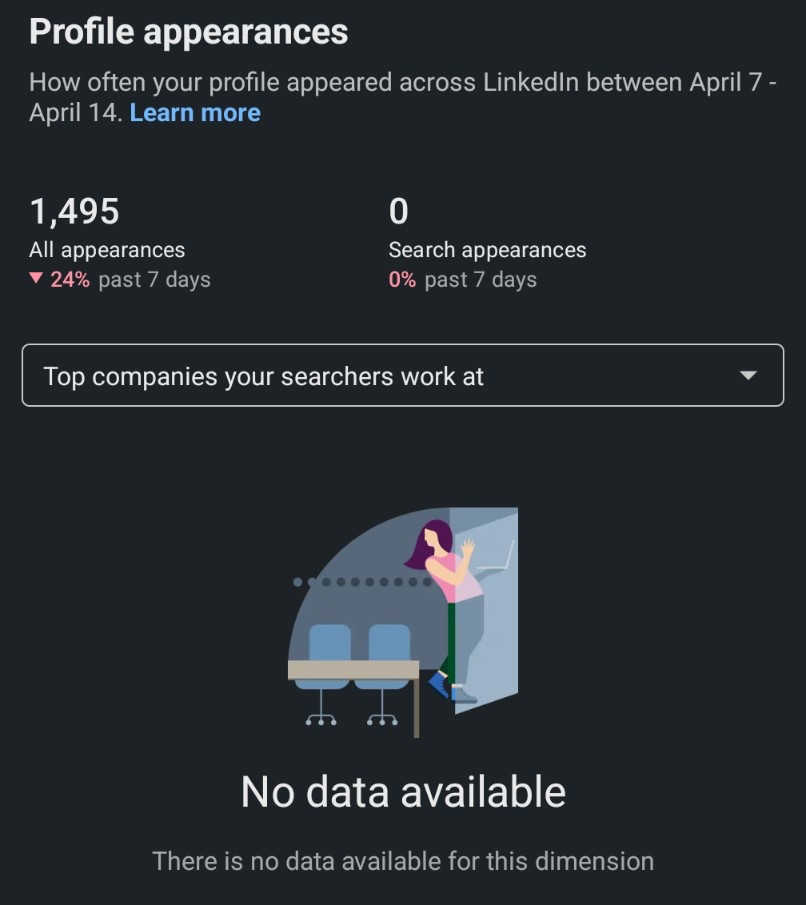
That is the simplicity of this construct. It is not an error, it was not an oversight and it was not the non existing AI, there is the chance that someone fucked up on programming the ML that connects certain procedures, but the truth is that LinkedIn likely is lying to you.

To illustrate this I am giving you

Here we see 3 profiles looking at individual ‘xzddbv’ it doesn’t matter who this is, because it could be you. I know for a fact that there were at least 4 profiles, but that is outside of a few kinks that LinkedIn gave permission for. It comes with the territory I reckon, the elemental part is that the second sample gives us 

That person (the stated ‘xzddbv’) has zero profile views. Isn’t that odd? A system like LinkedIn that is now accepted as a near global setting for jobseekers, they have no money, they have no options because the job settings on a near global bases is based on lies. I showed in 2013 that some places were unreliable, giving us that there were 1600 open Unix positions in Sydney, whilst most of them were bogus. And it went downhill from there, it ended up being a breeding ground for spammers and scammers and whilst these ‘job sites’ made their money for ‘marketing’ purposes they never cared what happened to the people looking for a job. Wasn’t that the revelation of the century?

But now there is every chance that LinkedIn is becoming as unreliable as others and that is just not on. On the other hand I just learned that Microsoft owns LinkedIn, as such the surprise fades (rather fast). So to fire up their engines, can we see if there is a Chinese alternative we can live with? A version of for jobseekers that operates with critical views in the Commonwealth and/or Europe? 

There is only so much we can forgive, it is time for change. Have a great day.

Leave a comment

Filed under Finance, IT, Science

The 9mm hard drive

This is a new side to some, the people know one side to any person and at some point that person reveals another side. This is whaat we see (at https://www.ndtv.com/world-news/how-ukraine-war-has-turned-ex-google-ceo-eric-schmidt-into-licensed-arms-dealer-6372469) and the title ‘How Ukraine War Has Turned Ex Google CEO Into “Licensed Arms Dealer”’ now some will all up in arms (to turn a phrase), but the story is a lot more interesting. We are given “Mr Schmidt said that he is now a licensed arms dealer “because of the way the system works”” there is more to this. You see at some point I had the idea to sell the idea of the Chengdu J-20 to Saudi Arabia (for China), it was merely a thought and my ideas are not merely as noble as it might seem. My simple idea was that Saudi Arabia should be able to defend itself from the aggressors (Iran and Houthi forces in Yemen). When America and Europe wanted to halt the defending options for Saudi Arabia. I saw a simple economic option. The defense budget for Saudi Arabia goes into the dozens of billions (all 127 of them)  and me getting a mere 0.1% of that gets me 127 million dollars, simple clean and a nice setting to make really strong friends in the Middle East. This was before the idea I designed, optionally for Kingdom Holding. And lets face it 127 million makes for a nice retirement package. Eric Schmidt has other reasons (he was already rich enough). He and Sebastian Thrun, CEO of Udacity, are making a new venture namely White Stork. The setting we are given is “The idea basically is to do two things- use AI in complicated, powerful ways for these essentially robotic wars and the second one is to lower the cost of robots,” I see an adaptation to the learning (read: Deeper Machine Learning and LLM’s) that Palantir currently has. I think that a union of the two has far reaching possibilities. So what if the Palantir deployed systems are directly updated by drone systems? We are also given “Mr Schmidt reportedly informed that White Stork will mass-produce drones equipped with Artificial Intelligence to identify targets to eliminate the need for ground battles with tanks, artillery and mortar.” I think it goes further (read: presumed) You see, you can set the cost down but the military are more interested in keeping the timeline as short as possible.

Screenshot

You will have seen this, or something like this before. You have three components, the green ones are low in cost, the red ones high in cost. You want them all to be in the red, but the stage is set that you can only have two, the third one should always be in the other field. As people chase to get high quality and fast systems, that solution will always be an expensive item. Armies are not interested in (to some degree) cheap solutions. Not as long as these solutions are fast and high quality. Now White stork is going to seek fast systems and in robotics this will mean integration of information systems, like robotic intelligence systems that can connect to a secure cloud solution, updating the cloud instantaneously by all systems all at the same time. It become (for the lack of a better term) intelligence by wire. Nations will fork over billions to get it and to that degree no one has this. Not the US (DARPA apparently has some developing stage), not Russia and not China. They all have some kind of wannabe status, but they lack a high tech captain of industry like Eric Schmidt. If I can see this correctly within a few years they would all want him White Stork could be worth a whole lot more than anyone ever thought it could be and I think getting this connected to a system like Palantir is close to the only solution out there and the people at the centre of that axial know this. As I see it the biggest bottleneck in the short term will be an evolved non-repudiation system. We can cyber strike as much as we can but that first defence is a non-repudiation system to ward of attacks and that is where Palantir optionally has the system to make it work. Not for one or two systems, but like 200 drones in different campaigns  all at the same time. These systems need more than a simple deeper machine language, it needs LLM learnings and advance machine learning. With cyber systems that cab keep track of it all. This is not a simple solution but a person like Eric Schmidt could keep track of what was needed he might not be alone, but he is the only one in the stage of these arms of technology. 

His wealth might soon equal that of Bill Gates, the arms industry will pay heavily to get this far ahead. Consider that Saudi Arabia increased its military spending by 50 percent to $69 billion in 2023, approximately 23 percent of its total budget. That is to merely get on par with the America, Russia and China. How much do you think these three would pay to get ahead of the other two? The US is requesting $849.8 billion for next year. With White Stork they could easily double that amount. It is that much money that is in the view of some. 

Just my two cents on the matter. Have a great day.

Leave a comment

Filed under Finance, IT, Military