
There are three events happening, three events that made the limelight. Only two seem to have a clear connection, yet that is not true, they all link, although not in the way you might think.
Telstra Calling
The Guardian (at https://www.theguardian.com/business/2018/jun/20/telstra-to-cut-8000-jobs-in-major-restructure) starts with ‘Telstra to cut 8,000 jobs in major restructure‘. Larger players will restructure in one way or another at some point, and it seems that Telstra is going through the same phase my old company went through 20 years ago. The reason is simple and even as it is not stated as such, it boils down to a simple ‘too many captains on one ship‘. So cut the chaff and go on. It also means that Telstra would be able to hire a much stronger customer service and customer support division. Basically, it can cut the overhead and they can proclaim that they worked on the ‘costing’ side of the corporation. It is one way to think. Yet when we see: “It plans to split its infrastructure assets into a new wholly owned business unit in preparation for a potential demerger, or the entry of a strategic investor, in a post-national broadband network rollout world. The new business unit will be called InfraCo“. That is not a reorganisation that is pushing the bad debts and bad mortgages out of the corporation and let it (optionally) collapse. The congestion of the NBN alone warrants such a move, but in reality, the entire NBN mess was delayed for half a decade, whilst relying on technology from the previous generation. With 5G coming closer and closer Telstra needs to make moves and set new goals, it cannot do that without a much better customer service and a decently sized customer support division, from there on the consultants will be highly needed, so the new hiring spree will come at some stage. The ARNnet quote from last month: “Shares of Australia’s largest telco operator Telstra (ASX:TLS) tumbled to their lowest in nearly seven years on 22 May, after the firm was hit by a second major mobile network service outage in the space of a month“, does not come close to the havoc they face, it is not often where one party pisses off the shareholders, the stakeholders and the advertisers in one go, but Telstra pulled it off!
A mere software fault was blamed. This implies that the testing and Q&A stage has issues too, if there is going to be a Telstra 5G, that is not a message you want to broadcast. The problem is that even as some say that Telstra is beginning to roll out 5G now, we am afraid that those people are about to be less happy soon thereafter. You see, Telstra did this before with 4G, which was basically 3.5G, now we see the Business Insider give us ‘Telstra will roll out 2Gbps speeds across Australian CBDs within months‘, but 2Gbps and 10Gbps are not the same, one is merely 20%, so there! Oh, and in case you forgot the previous part. It was news in 2011 when ABC gave us (at http://www.abc.net.au/technology/articles/2011/09/28/3327530.htm) “It’s worth pointing out that that what Telstra is calling 4G isn’t 4G at all. What Telstra has deployed is 1800MHz LTE or 3GPP LTE that at a specification level should cap out at a download speed of 100Mb/s and upload speed of 50Mbps [ed: and the public wonders why we can’t just call it 4G?]. Telstra’s sensibly not even claiming those figures, but a properly-certified solution that can actually lay claim to a 4G label should be capable of downloads at 1 gigabit per second; that’s the official 4G variant known as LTE-A. Telstra’s equipment should be upgradeable to LTE-A at a later date, but for now what it’s actually selling under a ‘4G’ label is more like 3.7-3.8G. “3.7ish G” doesn’t sound anywhere near as impressive on an advertising billboard, though, so Telstra 4G it is“, which reflects the words of Jeremy Irons in Margin Call when he states: “You can be the best, you can be first or you can cheat“. I personally think that Telstra is basically doing what they did as reported in 2011 and they will market it as ‘5G’, giving premise to two of the elements that Jeremy Irons mentioned.
This now gives a different visibility to the SMH article last week (at https://www.smh.com.au/business/companies/how-a-huawei-5g-ban-is-about-more-than-espionage-20180614-p4zlhf.html), where we see “The expected ban of controversial Chinese equipment maker Huawei from 5G mobile networks in Australia on fears of espionage reads like a plot point from a John le Carre novel. But the decision will have an impact on Australia’s $40 billion a year telecoms market – potentially hurting Telstra’s rivals“, as well as “The Sydney Morning Herald and The Age reported in March that there were serious concerns within the Turnbull government about Huawei’s potential role in 5G – a new wireless standard that could be up to 10 times as powerful as existing mobile services, and used to power internet connections for a range of consumer devices beyond phones“, you see I do not read it like that. From my point of view I see “There are fears within the inner circle of Telstra friends that Huawei who is expected to offer actual 5G capability will hurt Telstra as they are not ready to offer anything near those capabilities. The interconnectivity that 5G offers cannot be done in the currently upgradable Telstra setting of a mere 2bps, which is 20% of what is required. Leaving the Telstra customers outside of the full range of options in the IoT in the near future, which will cost them loads of bonus and income opportunities“. This gives two parts, apart from Optus getting a much larger slice of the cake, the setting is not merely that the consumers and 5G oriented business is missing out, private firms can only move forward to the speed that Telstra dictates. So who elected Telstra as techno rulers? As for the entire Huawei being “accused of spying by lawmakers in the US“, is still unfounded as up to now no actual evidence has been provided by anyone, whilst at the same speed only a week ago, the Guardian gave us ‘Apple to close iPhone security gap police use to collect evidence‘, giving a clear notion that in the US, the police and FBI were in a stage where they were “allowed to obtain personal information from locked iPhones without a password, a change that will thwart law enforcement agencies that have been exploiting the vulnerability to collect evidence in criminal investigations“, which basically states that the US were spying on US citizens and people with an iPhone all along (or at least for the longest of times). It is a smudgy setting of the pot calling the kettle a tea muffler.
The fact that we are faced with this and we prefer to be spied on through a phone 50% cheaper is not the worst idea. In the end, data will be collected, it is merely adhering to the US fears that there is a stronger setting that all the collected data is no longer in the US, but in places where the US no longer has access. That seems to be the setting we are confronted with and it has always been the setting of Malcolm Turnbull to cater to the Americans as much as possible, yet in this case, how exactly does Australia profit? I am not talking about the 37 high and mighty Telstra ‘friends’. I am talking about the 24,132,557 other Australians on this Island, what about their needs? If only to allow them than to merely get by on paying bills and buying food.
Short term and short sighted
This gets us to something only thinly related, when we see the US situation in ‘Nato chief warns over future of transatlantic relationship‘. The news (at https://www.theguardian.com/world/2018/jun/19/transatlantic-relationship-at-risk-says-nato-chief) has actually two sides, the US side and the side of NATO. NATO is worried on being able to function at all. It is levied up to the forehead in debts and if they come to fruition, and it will they all drown and that requires the 27 block nation to drastically reduce defence spending. It is already trying to tailor a European defence force which is a logistical nightmare 6 ways from Sunday and that is before many realise that the communication standards tend to be a taste of ‘very nationally’ standard and not much beyond that point. In that regard the US was clever with some of their ITT solutions in 1978-1983. Their corn flaky phones (a Kellogg joke) worked quite well and they lasted a decent amount of time. In Europe, most nations were bound to the local provider act and as such there were all kinds of issues and they all had their own little issues. So even as we read: “Since the alliance was created almost 70 years ago, the people of Europe and North America have enjoyed an unprecedented period of peace and prosperity. But, at the political level, the ties which bind us are under strain“, yup that sounds nice, but the alliances are under strain by how Wall Street thinks the funding needs to go and Defence is not their first priority, greed is in charge, plain and simple. Now, to be fair, on the US side, their long term commitment to defence spending has been over the top and the decade following September 11 2001 did not help. The spending went from 10% of GDP up to almost 20% of GDP between 2001 and 2010. It is currently at about 12%, yet this number is dangerous as the economy collapsed in 2008, so it basically went from $60 billion to $150 billion, which hampered the infrastructure to no end. In addition we get the splashing towards intelligence consultants (former employees, who got 350% more when they turned private), so that expenditure became also an issue, after that we see a whole range of data gathering solutions from the verbose (and not too user friendly) MIIDS/IDB.
In CONUS (or as you might understand more clearly the contiguous United 48 States; without Alaska and Hawaii), the US Army Forces Command (FORSCOM) Automated Intelligence Support Activity (FAISA) at Fort Bragg, NC, has access to the MIIDS and IDB by tactical users of the ASAS, and they maintain a complete copy of DIA’s MIIDS and IDB and update file transactions in order to support the tactical user. So there are two systems (actually there are more) and when we realise that the initial ASAS Block I software does not allow for direct access from ASAS to the FAISA System. So, to accomplish file transfer of MIIDS and IDB files, we are introduced to a whole range of resources to get to the data, the unit will need an intermediate host(s) on the LAN that will do the job. In most cases, support personnel will accomplish all the file transfers for the unit requesting that intel. Now consider 27 national defence forces, one European one and none of them has a clue how to get one to the other. I am willing to wager $50 that it will take less than 10 updates for data to mismatch and turn the FAISA system into a FAUDA (Arabic for chaos) storage system, with every update taking more and more time until the update surpasses the operational timeframe. That is ample and to the point as there is a growing concern to have better ties with both Israel and Saudi Arabia, what a lovely nightmare for the NSA as it receives (optionally on a daily basis) 9 updates all containing partially the same data (Army-Navy, Army-Air force, Army-Marines, Navy-Air force, Navy-Marines, Air force-Marines, DIA, DHS and Faisa HQ). Yes, that is one way to keep loads of people employed, the cleaning and vetting of data could require an additional 350 hours a day in people to get the vetting done between updates and packages. In all this we might see how it is about needing each other, yet the clarity for the US is mostly “Of the 29 Nato members, only eight, including the US and the UK, spend more than 2% of their GDP on defence, a threshold that the alliance agreed should be met by all the countries by 2024. Germany spent €37bn (£32.5bn), or 1.2% of GDP, on defence last year“, it amounts to the US dumping billions in an area where 28 members seem to have lost the ability to agree to standards and talk straight to one another (a France vs Germany pun). In all this there is a larger issue, but we will now see that in part three
Sometimes a cigar is an opportunity
you see, some saw the “‘Commie cadet’ who wore Che Guevara T-shirt kicked out of US army” as an issue instead of an opportunity. The article (at https://www.theguardian.com/us-news/2018/jun/19/west-point-commie-cadet-us-army-socialist-views-red-flags) gives light to some sides, but not to the option that the US basically threw out of the window. You see the Bill of rights, a mere piece of parchment that got doodled in 1789 offering things like ‘freedom to join a political party‘, as we see the setting at present. The issue as I see it is the overwhelming hatred of Russia that is in play. Instead of sacking the man, the US had an opportunity to use him to see if a dialogue with Cuba could grow into something stronger and better over time. It might work, it might not, but at least there is one person who had the option to be the messenger between Cuba and the US and that went out of the window in a heartbeat. So when we see: “Spenser Rapone said an investigation found he went online to advocate for a socialist revolution and disparage high-ranking officers and US officials. The army said in a statement only that it conducted a full investigation and “appropriate action was taken”“. Was there a full investigation? To set this in a proper light, we need to look at NBC (at https://www.nbcnews.com/news/us-news/sexual-assault-reports-u-s-military-reach-record-high-pentagon-n753566), where we see: “Service members reported 6,172 cases of sexual assault in 2016 compared to 6,082 last year, an annual military report showed. This was a sharp jump from 2012 when 3,604 cases were reported“, we all should realise that the US defence forces have issues, a few a hell of a lot bigger than a person with a Che Guevara T-Shirt. So when we ask for the full investigations reports of 6172 cases, how many have been really investigated, or prosecuted on? NBC reported that “58 percent of victims experienced reprisals or retaliation for reporting sexual assault“, so how exactly were issues resolved?
Here we see the three events come together. There is a flawed mindset at work, it is flawed through what some might call deceptive conduct. We seem to labels and when it backfires we tend to see messages like ‘there were miscommunications hampering the issues at hand‘, standards that cannot be agreed on, or after there was an agreement the individual players decide to upgrade their national documents and hinder progress. How is that ever going to resolve issues? In all this greed and political needs seem to hinder other avenues though players that should not even be allowed to have a choice in the matter. It is the setting where for close to decades the politicians have painted themselves into a corner and are no longer able to function until a complete overhaul is made and that is the problem, a solution like that costs a serious amount of funds, funds that are not available, not in the US and not in Europe. The defence spending that cannot happen, the technology that is not what is specified and marketing will merely label it into something that it is not, because it is easier to sell that way. A failing on more than one level and by the time we are all up to speed, the others (read: Huawei) passed us by because they remained on the ball towards the required goal.
So as we are treated to: “A parliamentary hearing in Sydney got an extra touch of spice yesterday, after the chief executive of NBN Co appeared to finger one group of users supposedly responsible for congestion on NBN’s fixed wireless network: gamers“, whilst the direct setting given is “Online gaming requires hardly any bandwidth ~10+ megabytes per hour. A 720p video file requires ~ 500+ megabytes per hour. One user watching a YouTube video occupies the same bandwidth as ~50 video gamers“, we can argue who is correct, yet we forgot about option 3. As was stated last week we see that the largest two users of online games were Counterstrike (250MB/hour) add Destiny 2 (300 MB/hour), whilst the smallest TV watcher ABC iView used the same as Destiny 2, the rest a multitude of that, with Netflix 4K using up to 1000% of what gamers used (in addition to the fact that there are now well over 7.5 million Netflix users, whilst the usage implies that to be on par, we need 75 million gamers, three times the Australian population). Perhaps it is not the gamers, but a system that was badly designed from the start. Political interference in technology has been a detrimental setting in the US, Europe and Australia as well, the fact that politicians decide on ‘what is safe‘ is a larger issue when you put the issues next to one another. If we openly demand that the US reveal the security danger that Huawei is according to them, will they remain silent and let a ‘prominent friend‘ of Telstra speak?
When we look one tier deeper into NATO, they themselves become the source (at https://www.nato-pa.int/document/2018-defence-innovation-capitalising-natos-science-and-technology-base-draft-report) with: ‘Capitalising on Nato’s Science and Technology Base‘. Here we see on page 5: “In an Alliance of sovereign states, the primary responsibility to maintain a robust defence S&T base and to discover, develop and adopt cutting-edge defence technologies lies with NATO member states themselves. Part of the answer lies in sufficient defence S&T and R&D budgets“. It is the part where we see: ‘adopt cutting-edge defence technologies lies with NATO member states themselves‘ as well as ‘sufficient defence S&T and R&D budgets‘. You introduce me to a person that shows a clear partnership between the needs of Philips (Netherlands) and Siemens (Germany) and I will introduce you to a person who is knowingly miscommunicating the hell out of the issue. You only need to see the 2016 financial assessment: “After divesting most of its former businesses, Philips today has a unique portfolio around healthy lifestyle and hospital solutions. Unlike competitors like GE Healthcare and Siemens Healthineers, the company covers the entire health continuum” and that is merely one field.
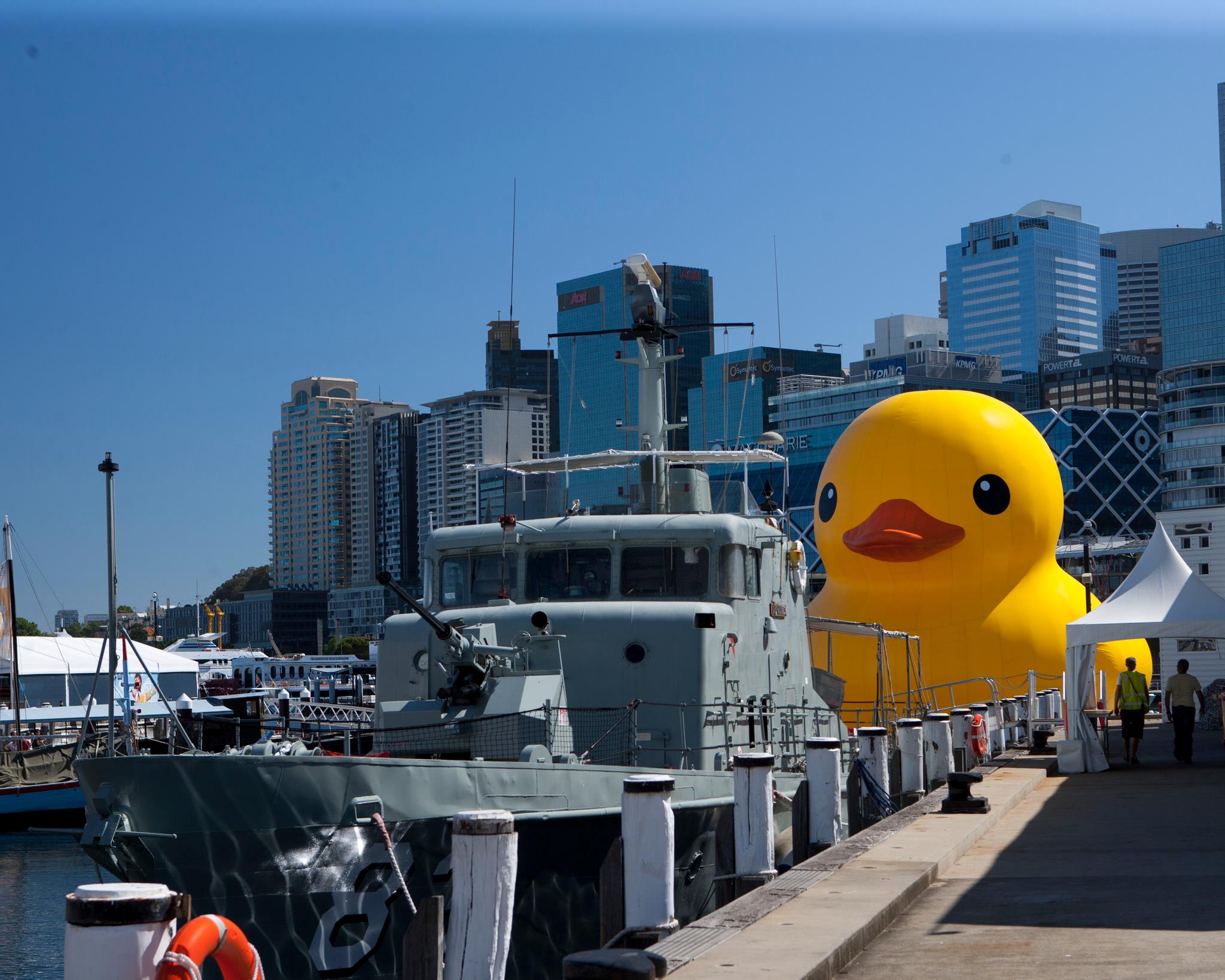
Rubber Duck closing in on small Destroyer.
In that consider a military equivalent. The 5th best registered CIWS solution called MK15 Phalanx (US), the 3rd position is for the Dutch Goalkeeper (Thales Netherlands) and the 2nd best CIWS solution comes from the US with the Raytheon SeaRAM. Now we would expect every nationality would have its own solution, yet we see the SeaRAM was only adopted by Germany, why is it not found in the French, Italian, Spanish and Canadian navy? Belgium has the valid excuse that the system is too large for their RIB and Dinghy fleet, but they are alone there. If there is to be true connectivity and shared values, why is this not a much better and better set partnership? Now, I get that the Dutch are a proud of their solution, yet in that entire top list of CIWS systems, a larger group of NATO members have nothing to that degree at all. So is capitalising in the title of the NATO paper actually set to ‘gain advantage from‘, or is it ‘provide (someone) with capital‘? Both are options and the outcome as well as the viability of the situation depending on which path you take. So are the Australians losing advantage from Telstra over Huawei, or are some people gaining huge lifestyle upgrades as Huawei is directed to no longer be an option?
I will let you decide, but the settings are pushing all boundaries and overall the people tend to not benefit, unless you work for the right part of Palantir inc, at which point your income could double between now and 2021.
2018 – DEFENCE INNOVATION – ALLESLEV DRAFT REPORT – 078 STC 18 E
 Lawrence van Rijn - Law Lord to be