Tag Archives: Stratfor

Conjecture

To understand this piece, we need to consider the meaning, when we use conjecture we imply and mean “an opinion or conclusion formed on the basis of incomplete information”, the media tens to be in this state well over 90% of the time. They call it something else, something like ‘from sources who revealed this under condition of anonymity’, or perhaps you have heard the statement ‘people close to the matter revealed to us’, yet it remains conjecture, the information was not complete, it almost never is. So when the Middle East Eye handed its readers the headline ‘Can Saudi Arabia develop a major domestic arms industry by 2030?’ Early this morning (18 hours ago), I had to think this through. I saw the setting last year, or the year before and I shrugged at it. You see ‘a major domestic arms industry’ is generic, too generic. Yet the setting is interesting as it will remove billions in revenue from the EU and the US. This after all the BS the US and the European nations gave them is actually refreshing. But the generic side remains. It is hand weapons, armoured vehicles, naval vessels, airforce crates (an old term for airplanes) the list goes on and they cannot have it all, but a nation like Saudi Arabia could set in motion armoured vehicles and hand weapons. I want to continue, yet lets take a look the article (at https://www.middleeasteye.net/news/saudi-arabia-develop-national-arms-industry-vision-2030) first. We get to see “Saudi Arabian Military Industries (SAMI) – a state-owned defence company – set up a joint venture with the US aerospace and defence giant Lockheed Martin, which, according to a SAMI statement, “will develop localised capabilities by transferring technology and knowledge, and by training a Saudi workforce in manufacturing products for, and providing services to, the Saudi armed forces”” is point number one. Then we get “Riyadh has successfully been able to divert some money formerly earmarked for imports to developing domestic alternatives and has reaped the benefit in terms of Saudis employed, but the goal of going from two percent domestic spending in 2018 to 50 percent domestic spending by 2030 is unrealistic if Riyadh wants to maintain its capabilities and maintain an arsenal of the best equipment,” she said” which they get from Emily Hawthorne, Stratfor’s Middle East and North Africa analyst. Yet I am not entirely convinced. I agree that 50% will be a tall order, I am not sure if 50% can be reached by 2030, too much needs to happen. Yet 2035? Is that out of reach? I am not convinced. You see, we all focus on one side, but this entire enterprise has two sides and we seemingly forget that. You see point one gives us ‘training a Saudi workforce in manufacturing products’,  my issue is that this is a focal point not a destination. You see, the military is a destination, The focal point of that workforce needs to grow beyond that. To see this we need to look back at WW1, yes that long back! You see no matter how amazing the Sopwith Camel was (I think the New Zealand Airforce still might have a few), it came from the Sopwith Pup. A plane that was introduced by Sopwith Aviation Company in 1916, during the war, yet the company was founded  on 15 December 1913 before WW1, implying that the design was altered for war, which makes perfect sense. That timeline shows that there is a larger stage to any plane, often used for war later on, that premise changed as the arms industry saw the massive benefits of wealth during WW2. It changed nearly everything. The arms industryu continued, but came from something else and it also came from a direct need. For the Kingdom of Saudi Arabia (as my personal conjecture goes), it is in one part to strengthen national defence and it needs to diminish import in this area. A stage the others never had, they were always about the export. I tried to hide that clue in an earlier story named ‘The impact of insanity’ on January 20th 2019 (at https://lawlordtobe.com/2019/01/20/the-impact-of-insanity/), the clue was “The idea came from a famous Dutch bank robber named Aage M (70’s)”, it was a clue, because outside of the Netherlands this man and his book would be widely unknown. I used an engineering solution and made it into a stealth weapon (we all have a bit of Alfred Nobel in us). The secondary clue is seen now (which was unintended), but in the original story I did write “Yet, the brain needs nourishment, in my case it is music, I found out that different scores, will set my mind in different directions and it is not set in the style of music, Whilst one album gave me the brain jump to get me to find the Zumwalt pounder (initially merely a solution to take down the Iranian navy), it was David Bowie, and his album ‘the Next day’ that pushed me to make an initial design of the Elder Scrolls X (formerly known as ES6). I never figured out why it happened, merely that it does”, the underlying part I that other elements drive us to push other areas forward, the Military push is NEVER from the military, it comes from somewhere else, and in this case it is most often civilian needs. We look at the internet and decentralised computing (as DARPA brought it), but the stage is almost never in that direction. It is a business need that fuels a consumer drive and it then becomes a military option. That is more often the case. So look and consider Saudi Arabia, or as the fat cats say, a lovely large sandbox. This sandbox has it own approach, its own needs, elements and drives. We in the west think we know, but there is too much we do not and cannot know. 

So I give you an alternative, we tend to seek an understanding of what is available, yet what is the stage of observation? We look at planes, we look at drones, but what if we take this in another direction? What if we redesign a much older concept?
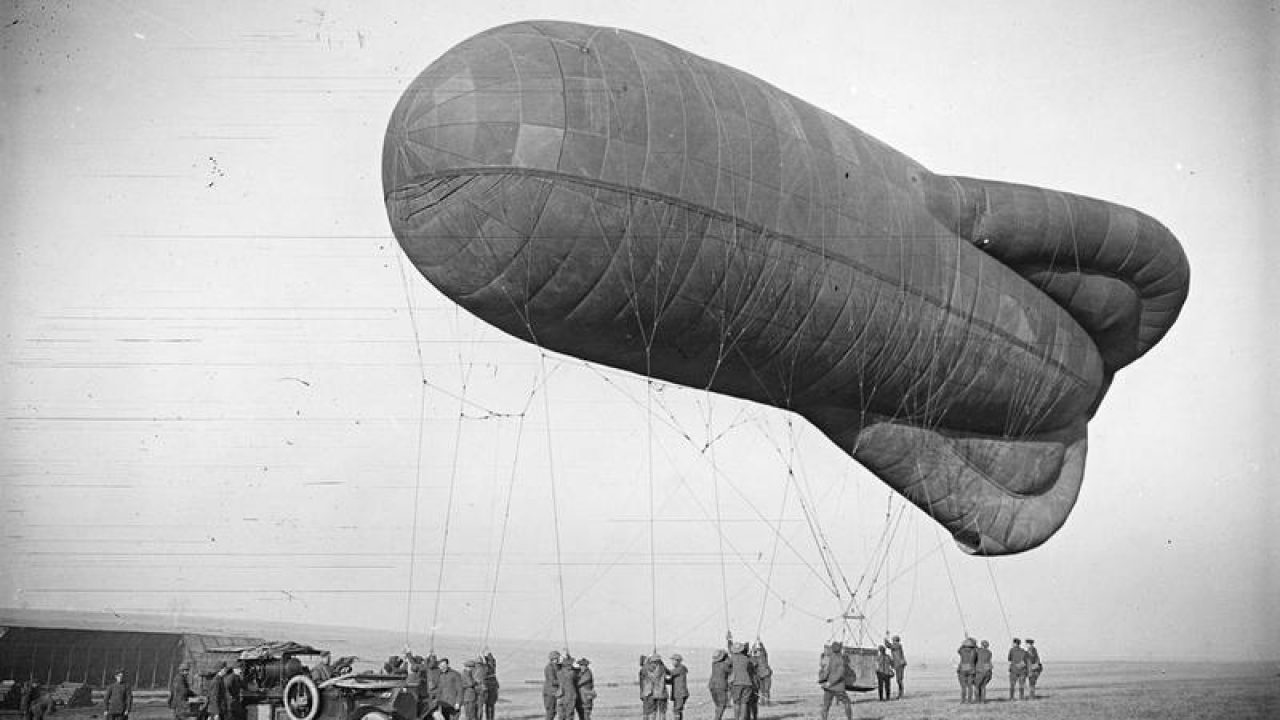
So consider the previous image and consider the Battle of Fleurus (1794) where they were used first. In those days they had to be big, but today, with what we have in electronics, we could suffice with something that could be found at Toys-R-Us. Did SAMI ever consider (perhaps they did) to use a whole range of stealth kites? We tend to look at it as something like 

Yet that was then, that was civilian, so who considered redesigning that kite in dark colours, make it more stealth like and give it its lightweight electronics that allow for a 25 mile observation with a 5G connection to its base station? No fuel, a silent observer in the night and one most ground forces will not see until it is too late. The Middle East is a different stage, its theatre of war is on grounds seldom seen in the west, as such different solutions will work. A thought that I have not seen explored by DARPA (speculatively) and Raytheon/Northrop Grumman (less speculatively). We all need to consider that the offered information comes from conjecture (even mine) as such I have n clear image of what actually is, but I can see where others did not look (which gave me my 5G IP) and now SAMI has another venue for investigations on what could be done to spend less in other nations (feel free to financially support this poor poor blogger) and consider what else no one has been looking at, because in one of the other stories I left another link, which involves two valves that apparently do not yet exist and that opens up other venues of export. It even gave me a third idea just now. It reflects on an old premise that started the origin of Ceramic glaze, it had different functions, now consider the two-part epoxy adhesive, consider that if it is in two parts, it is an adhesive, yet what if the container it holds has two liquids as well, separate innocent, but if you remove the separation you get a secondary reaction, a chemical reaction that does something else, we now have a nice little chemical detonator, no danger there, until it changes the compound it reacts too, we now have a different setting. All elements that have been abandoned for larger and more accurate electronics. Yet what happens when we change the need of electronics? They need batteries and they tend to have their own flaws, chemicals do not, we are all about relying on the latest ‘electronic’ solutions all whilst the people forgot to look at the other solutions. You see “It has some disadvantages too, e.g. higher cost per detonator and the need for intensive training for users”, when timing is not essential, chemical detonators have their own benefits and in mass production they are cheaper and the need for a larger trained workforce and assembly environment becomes less so, all elements that are not what the seller wants to give you, but the buyer can rejoice when it is faced that way. It does not apply all over the place, but the question becomes, what allows for a different curve that allows for a real application of reducing the investment a cost of developing an arms industry that is applicable to the Kingdom of Saudi Arabia by 2030, there were two elements, the first is ‘develop a major domestic arms industry by 2030’, the second is ‘spending around 50 percent of its military budget on local sources’, yet that could be seen in two parts as well, spend 50% less of its budget and spend amount X on local sources. If $10B is spend in the US and you can reduce it by Spending $7B less and $2B on local sources the trip is near complete. Consider in that the cost of a US drone (like the MQ-1 Predators) all whilst a refurbishes Kite might cost no more than $15,000. So we get $40,000,000 versus $15,000. Yes the MQ-1 Predators can do a lot more, but how effective is that in Saudi Arabia? Most look at how cool you can fly for $40,000,000, all whilst 15 kites can cover a lot more ground and these groups merely have to observe and guide the MQ-1 Predators to its destination. It is conjecture that we know what is out there, all whilst the term conjecture implies we never knew. Be honest, how many of you considered the deployment of a stealth Kite? A device that uses no fuel, makes no sound and in the dark desert is seemingly as invisible as the night. 

All this whilst we need to consider that as SAMI becomes more successful, the US and the EU will miss out on billions each year, a station that they themselves had a hand in creating. In that time I came up with two additional novel ideas (that might not work). Have a great day!

Leave a comment

Filed under Finance, Military, Politics, Science

Listen to Caesar

There is a lesson I learned a long time ago, the lesson was given in 59BC, the importance of the installation of defences against enemy retaliations. A lesson 2,000 years old and now we see that the Kingdom of Saudi Arabia was not ready. We can argue how ready they were supposed to be, but the stage is clear, with the attacks by Iran, we see the beginning of an open war with Iran and Iran must be destroyed, we have no other option in this, they played the same game for too long and we have facilitated long enough.

There is an additional benefit for many in the west as well, as we are getting drowned by Corporatocracy, Caesarism opposes that and nullifies it to a larger extent and that is OK too. These corporations will get a direct impact on their bottom line towards government policy facilitation and the impact it has when an actual war is added to the mix.

The problem has become too large to ignore and even when we see people like President Trump shout (read: tweet) loudly, there are no actions, bankruptcy tends to do that, yet we can wage war on Iran. If we get Israel and Saudi Arabia on the path to attack, we will be almost there. Yes, we will get figureheads like Hassan Nasrallah make loud claims, yet like all those corporate types, he wants to shout, an actual full army carpet bombing them is not what he signed up for, he will want to hide behind any UN skirt hoping for talks, yet I think we can all agree that it is too late for that step.

Omar Lamrani, Stratfor’s golden boy (a strategic analysis firm) is correct, not only was the use and usefulness of drones underestimated, the fact that there was a 360 degree strategy in play, was equally not anticipated. For the longest time, there was a proxy stage in play, yet the timeline for Iran is ending, the nuclear treaty option they want to hide behind is falling apart in 40 days, 40 days is all they have left to play this game and without that treaty Europe and America will have to turn on Iran and that is what they still fear. As such a direct attack on Iran is what remains. Any person thinking that there is time for diplomacy is too delusional for words. All the papers are now on the stage where I was a week ago; my views have so far been close to 100% correct, in some cases a week ahead of several alphabet group players. I understand that the New York Times is still employing the stage of ‘Where the strikes originated remains unclear‘, I get that, but when we look at who could have done it and who don’t have the means and technology (optionally missing skill set too) at that point the list is reduced to one, Iran!

There is one part I had not considered earlier to the degree I see it, the New York Times gives us an indication of ‘Approx. orientation of impact points‘, it gives a larger credibility to my view of ‘painting the target‘, it implies that Iran had boots on the ground (read: tools in place) painting the target, most likely by laser giving the drone operators a clear target to head for, it gives a much larger credibility on the amount of drones, amount of hits and accuracy of hit targets.

In the Guardian article Becca Wasser, a policy analyst at the Rand Corporation gives a good view too (at https://www.theguardian.com/world/2019/sep/19/how-did-attack-breach-saudi-defences-and-what-will-happen-next) the Saudi infrastructure that was perfectly workable in the past is to be considered a hindrance in this war stage. As the water and oil targets are shown to be visible targets the need for security changes for Saudi Arabia and as such the existence of Iran has become a clear and present danger to the world. The problem in all this is the question becomes: ‘Who is willing to stand with the Kingdom of Saudi Arabia?

I personally am sick of this Iranian bully, I am unwilling to facilitate to a bully, I never was willing to do that. In this case we agree with the stage of ‘a limited military response, delicately calibrated to deter Iran from raising the bar again without sparking an all-out conflict‘, yet the size of the stage is another matter, I would want to hit several oil fields in Iran, in my view the tactical attacks should include Gachasaran and Yadavaran. If the hits are precise and strong enough the Iranian economy would get a larger hit than they are ready for, more important, any loud noises and threats would give rise to making additional hits at Pars, with Yadavaran phases 2 and 3 out of commission for another 2 years will tighten the economic bolts for Iran considerably. I would hope to test and tinker my solution to sink the Iranian fleet (because I have a sense of humour), yet in all this I believe the message that we have had enough of Iran is clear.

Even now as we see that the EU members are holding off on blaming Iran of all this, all whilst the missiles and sophistication gives rise that they are the only remaining optional culprit (well, the EU could have done it, they do have the technology), we need to act. We see that EU foreign policy chief Federica Mogherini used the situation to create a photo op with Iranian Foreign Minister Javad Zarif, yet I think it is too late for photo ops, do you not agree with that point of view?

I find the political position understandable, yet hypocrite, MI6, GCHQ, DGSE and a few other players have the intelligence that gives clear rise that Iran is the only remaining player, until last week there was room for doubt, the last attack was too complete and too high tech for Yemen or most other players and it is time to do something. Even as we agree with the quote: “Col. Turki al-Maliki told a news conference the Houthis were merely “covering up” for Iran by claiming responsibility“, we need to see this as a moment to act against Iran. and yes, we can the smallest degree agree with: “Saudi Arabia knows nothing about where the missiles and drones were made or launched from and failed to explain why the country’s defense system failed to intercept them“, indeed we do not know where they launched from, yet we do know who they were launched by, they were launched by Iran, or by direct guidance from Iran, it squarely puts the blame on Iran and that is where we see that Hesameddin Ashena, an advisor to President Hassan Rouhani is slightly too stupid for his own good.

I am merely baffled on just how desperate the EU is to give this much intentional leeway to Iran. Even now, merely 11 hours ago we see: ‘Belgium joins EU mechanism to trade with Iran‘, so even after the accusations without evidence against Saudi Arabia on the Jamal Khashoggi casse, we see ignorance and facilitation towards Iran with evidence, and if you wonder why politicians have less credibility than several drug dealers, here is the reason and the premise of that lost credibility.

There will be additional escalations over the coming week, yet I am not hopeful that the EU and US will find the courage to keep their word and deal with Iran, it is most likely to become a flaccid watered down response to a case that should never have been able to remain in play for this long in the first place. Even now we see the additional push from Germany to return to the nuclear deal table, the EU is that desperate to ignore facts and hide behind fairy tales. I wonder who the EU will blame when the first Iranian nuke is ready to be launched against Israel, how quickly some peace treaty will be stamped out and no one will deal with Iran. There is an 83% likelihood that such a nuclear event will end up getting labelled as ‘an unfortunate collateral event on Israeli soil’, exactly how long will such levels of danger be allowed to continue?

In addition, the tactical stage was used by Russia less than 24 hours ago through ‘the Saudis Should Buy Russian Air Defense Systems After Drone Attack‘, I wonder if that is so, there is a clear case that the current stage did not work as the premise of the current systems are not ready for drones, I wonder if the Chinese solution would work. I actually do not know, what is clear is that everyone is hiding behind every piece of useless data so that they can ignore the actual claim: ‘Iran has instigated an act of war!‘, it is a larger stage and in all this we need to accept that war is knocking on the front door of the Kingdom of Saudi Arabia and the politicians on a global scale need to be held to account for what happens next and more important, they need to be held publicly to account for their inaction. I personally see it as a group of people who would have taken any turn to facilitate towards talks with Nazi Germany in 1939, I wonder if they realise themselves just how stupid their point of view is, the old accepted point of view: ‘If the answer does not match the policy, change the question to make it match‘, might be partially optional in market research, in policy that are directly linked to war it is another matter entirely.

The next week will be interesting in several ways and when oil prices rise another 10%-20%, remember, your inaction (read: the inaction from your politicians) created that problem.


Leave a comment

Filed under Law, Media, Military, Politics

The price of identity

We all have needs, we all have identities. It is important to us, as it is for many others. No one debates or disagrees with it. Yet what to do when identity hinders us? When we see the Washington Post (at https://www.washingtonpost.com/world/national-security/former-nsa-deputy-is-mattiss-leading-choice-to-head-the-spy-service-if-it-splits-from-cyber-command/2018/10/05/1be8d7a8-c73d-11e8-b2b5-79270f9cce17_story.html) giving us ‘Former NSA deputy is Mattis’s leading choice to head the spy service if it splits from Cyber Command‘, we need to consider the impact of identity, corporate identity, governmental identity, military identity, projected and presented identity. They are not the same and can vary to a much larger degree. When someone is part of what used to be referred to ‘No Such Agency‘. We will get the impact of identity; we all know that and many faced it too. Look at any friend or co-worker you have ever known and ask him/her about the impact of a merger and they will tell you, there are changes. Some are subtly, some are not noticed, yet others are, usually in infrastructure and the way things were done. Now the change tends to be for the good in the long run but that is not a given.

So what gives?

It is my personal observation and a highly speculative one at that. Yet I believe that the Washington Post giving us: “The current head of both organizations, Gen. Paul Nakasone, has urged Mattis to keep the NSA and U.S. Cyber Command under one leader on the grounds that the nine-year-old military organization is not ready to stand on its own, these people said. In recent weeks, Mattis was close to a decision to separate the leadership arrangement, but Nakasone’s counsel has caused him to reconsider, according to two U.S. officials. The officials spoke on the condition of anonymity to discuss sensitive internal deliberations“, is not entirely accurate. I believe that ‘military organization is not ready to stand on its own‘ is not the setting that matter. I believe that Stratfor who gives us ‘A New, More Aggressive U.S. Cybersecurity Policy Complements Traditional Methods‘ is very much at the heart of that. I believe that the general is not ready or perhaps unwilling to set the offensive and aggressive part in motion. Now, this is no bad reflection on the general, let that be a first. He is well decorated, he has seen the field in many ways and he has done a fair share of field events. He has earned his rank. I merely wonder that a man who has seemingly played a defence and protection game is the man for the offense. I think that this is a football moment, and as a non-football expert (and a 49ers fan) I would compare the General to DeMarcus Lawrence from the Dallas Cowboys against what the US seems to demand is a Derrick Henry (Tennessee Titans), or even a Tom Brady (New England Patriots), roles that are not really moveable. Even as a Quarterback might become a really good Derick Henry that Quarterback will never become a DeMarcus Lawrence. The defence and offense game is that far apart. This is where Chris Inglis comes in. He is an analyst (at heart), he is used to counter offensive strategies and introduce strategies of his own (effective one’s mind you). I believe that this is the game that is in the open at present and these two will need to find a way to make it work. Not merely because it is good for the needed strategy, but because the segregation of the two elements might hurt U.S. Cyber Command in a few ways, not merely funding, but the elements that U.S. Cyber Command currently have access to will partially fall away and getting two infrastructures like the NSA is unyielding, unaffordable and in the end will introduce flaws and dangers on both sides of the isle making the setting (as I personally see it) a non-option right of the bat. Stratfor gives us a few other items.

One of them is “A best-case scenario for a U.S. cyberattack would be disabling computer systems and networks being used against U.S. interests to prevent an attack from happening or to disrupt an attack that is in progress“. The problem there is that some of the opponents are getting to be really good at what they do and a few of them are not state driven, not by any state changing the dynamics of the solution. Even as I discussed the hop+1 strategy almost three years ago, settings like that require an expert layer one knowledge and the players cannot both have these experts changing the needs of the infrastructure overnight.

The second consideration is: “Perhaps the main challenge to U.S. engagement in tit-for-tat cyberattacks is that the United States is by far the biggest target for such attacks“. That might be true but that goes beyond mere true enemies, it includes a truckload of students wanting to finger the man (or is that giving them the bird)? Do they really want to waste resources to those people whilst the US has actual enemies in the world?

The larger issue is seen with: “Discussing the strategy, national security adviser John Bolton hinted that the administration had already taken steps to bolster offensive efforts in recent weeks, warning that the United States is no longer just playing defense when it comes to cybersecurity. But despite the Trump administration’s more hawkish tone regarding cybersecurity, it will continue mainly to rely on traditional measures such as the legal process, regulations and cooperation with the private sector when it comes to cybersecurity” It is here when we get the consideration of the resources required. The defence, offense and legal sides of it all becomes a real mess if the two split up giving the chance that targets and issues walk away on technicalities. How does that help?

The strategy s even more profound when we consider “Clandestine, discreet attacks are certainly already key elements of U.S. cyber tactics. There have likely been more examples of U.S.-launched attacks that have not come to light, perhaps because they were never recognized as cyberattacks. While the less known about U.S. cyber capabilities, the more effective they will be when deployed, this by definition limits the deterrence value of U.S. cyber capabilities“, at this point is the setting of ‘discreet’ that comes into play. With the two separated they will get into each other’s fare waters and more important give accidental light to the discreet part of the operation, there will be no avoiding it, only the most delusional person would think that it does not get out when more than one player is involved, because that will always introduce a third item being the intermediary, the cold war taught many players that part of the equation. And that is even before we get to the statement: “recent cases like the September indictment of North Korean cyber operatives, which displayed heavy FBI reliance on private security firms such as Mandiant and Alphabet to collect technical evidence and carry out investigations“, now we see the folly as Mandiant and Alphabet are mentioned, the entire matter grows further as soon as Constellis becomes part of the equation. That is beside the point of realising (highly speculative on my side) that neither three Mandiant, Alphabet and Constellis have the required safe servers in place to prevent names, places and facts from going out into the open. I might not be able to get in, but there are dozens who will get in and that voids the security of the matter to a much larger degree. For arguments sake I will leave Booz Allan Hamilton out of that equation, they have been snowed on long enough.

And even as we see the instance of legal preference, the US must realise that any attack from state or non-state parties in China or Russia has close to 0% of being successful (outside of the exposure part), the entire matter in case of the OPCW in the Netherlands is one. An attack was thwarted, yet was it THE attack? The guardian article (at https://www.theguardian.com/world/2018/oct/04/visual-guide-how-dutch-intelligence-thwarted-a-russian-hacking-operation) reads nice, and we see all these facts and from my point of view, things do not add up. You see, I would have used the car that we see mentioned “In the boot of their car was uncovered an arsenal of specialist electronic Wi-Fi hacking equipment” as a fire and forget consumable, use it as an access point, segregating the hacker from the accessing unit. When you have (as they stated) “cash: €20,000 and $20,000” getting a second car far enough to access yet not be directly linked is seemingly easy enough. Then there is the setting of the photo at Amsterdam’s Schiphol airport. I am not debating the issue of the photo, it seems genuine enough. In this operation they did not fly to Germany and took the train, or take a car and cross at Oldenzaal, Emerich, or even via Belgium and enter via Antwerp, or Eindhoven. It almost read like they wanted to get noticed. They know that Amsterdam Airport is high tech and nothing escapes their camera eyes. To me (a paranoid me) it comes across as ‘Where did they not want us to look‘. A mere sleight of hand deception, and again the entire GRU mention. A phone outside of that building and they had the taxi receipt? No one merely driving them to the airport in Russia or even them taking a bus from any hotel in Moscow. No a taxi receipt of all things, is anyone buying that? So in this it is not the Dutch, it is the Russian side that makes no sense at all.

How did I get there?

This is the initial setting of offense and defence. The proper application of strategy in all this matters, because we seem to undervalue and underestimate the need of either in all this. Because we get to push a button anywhere and anytime we seem to underestimate on what is recorded, what is collected and what can we verify. That entire mistake is how any offensive strategy can optionally become folly from the moment the instigation of ‘press any key‘ to start gets us. Proper offensive is not about doing what needs to be done, it is about being able to prove who did what. Perhaps Sony remembers that part as they were given that it was North Korea did something, whilst their computers were not even close to PC gaming ready, the mere processor, which was about 25% (at best) of a 1994 Silicon Graphics Indigo system is not the system that gives you what you need to hack the night away. The tools are equally as important as the access and ability to negate identity. When you see that part, the entire hop+1 intrusion path makes a lot more sense.

This now gets us to the end of the Washington Post, where we were treated to: ““As the build of the cyber mission force wraps up, we’re quickly shifting gears from force generation to sustainable readiness,” Nakasone said in a statement in May. “We must ensure we have the platforms, capabilities and authorities ready and available” to carry out successful cyber-offensives. Some former senior intelligence and defense officials oppose separating the “dual-hat” leadership arrangement, including former NSA Director Keith Alexander, former Director of National Intelligence Mike McConnell and former Defense Secretary Robert Gates. This week, former CIA Director David Petraeus, a retired Army general, said during a Washington Post cyber summit that he’d keep the dual-hat arrangement “for the time being.”” It is not merely the ‘we have the platforms, capabilities and authorities ready and available‘, you see, when we get to capabilities we see the need of offensive players and even as Cyber command might be aces in their field, the offensive game differs to some degree and even as we see that they are way above the student levels, we get back to the Football equivalent you see the application of defence and offense. It is not DeMarcus Lawrence versus Derrick Henry, the question becomes can DeMarcus Lawrence be a Derrick Henry that is good enough, that is the battle within. The mere realisation that if you fail this when the offensive is broken into a train wreck that makes the limelight in every paper, that is the game that is the dilemma that Gen. Paul Nakasone faces as I personally see it.

And when we see Stratfor with the one little gem we did not consider, the mere proposed fact that North Korea has a mere 9,000 IP Addresses, do you really think that they could have done this all, or are we in a setting where someone had the ability to act on BGP hijacking and was able to mask it to the level it needed to be masked at, because that was the offensive play that needed to be considered and there was no way that the evidence had been uncovered to that degree with a backdoor could be removed with a simple reset of routers.

#FourtyNinersRule


Leave a comment

Filed under IT, Law, Media, Military, Politics, Science

The failing Mario Draghi Kart

Just yesterday, the Deutsche Welle (at http://www.dw.com/en/eurozone-economy-still-requires-stimulus-ecbs-mario-draghi/a-42751327), gave us that the ‘Eurozone economy still requires stimulus‘, so after these years the stupid and the rich still will not learn and the people are about to pay for it dearly. That is, not the UK, they might have gotten out just in time, if they don’t add delay upon delay. Even as we are sussed to sleep with: “The bank is gradually reducing its bond purchase program but it may continue past September”, the people are sussed to sleep, in a situation, where they sleep on a luxury liner and it is going down. Like having a nice cabin on the Titanic and you decided to sleep in on April 15th and you did. You never woke up, you could if there was oxygen, yet oxygen is 3786 meters away, 3786 meters straight up!

So when we are pointed at the ECB’s asset purchase program, which began three years ago, and which has seen the central bank spend €2.55 trillion ($3.14 trillion) to buy government bonds and other financial assets. The people are not given clarity on where that money went EXACTLY, in other news, that news we got months ago on Mario Draghi being a member of a very exclusive 5 mile high club. So when we got 6 weeks ago: “European Central Bank President Mario Draghi should give up his membership of the opaque Group of 30 consultative body because it risks hurting public confidence in the ECB’s independence, the European Ombudsman said on Wednesday“, how come the near entire bloody media has not followed up on this? After that one day it was silenced, the ECB will not respond, Mario Draghi apparently keeps on getting away with whatever he needs and there are no questions, not even on an international level which is unsettling in so many ways as it leaves us with the indication that the media may be as unreliable as the politicians they are reporting on.

A program that has sunk 3 trillion dollars and everyone is just stating that the economy is great, yet nobody is asking the number one question and that is ‘How will we pay it back?

The theory of printing money

Mario Draghi, president of the ECB has profiled his place and his ‘bank’ as awesome, marketing on a near supreme level, like a politicians stating on how honest he is. Excellent standards, great breeding and stellar academic excellence, and you know that expression about a story being too good to be true?

So they have their ‘Quantative Easing’, they use it to buy government bonds and other financial assets. The purchases have helped keep borrowing costs low, which in turn have boosted spending and investment in the Eurozone economy. But is this true? You see, there are now two levels of problems and dangers. When we consider that the bond is a debt security, under which the issuer owes the holders (so the government that issued the bonds now owes the ECB), a debt and (depending on the terms of the bond) is obliged to pay them interest and to repay the principal at a later date, termed the maturity date.

So over $3 trillion is bought from these governments and those governments are paying the ECB interest until they pay back the amount at the date of maturity (could be up to 30 years). So basically they are pushing massive debts forward, it is almost like the Greek debt mess, but now close to 173 times more intense in regards to the outstanding amount. The current makers in charge get a free pass and leave the mess to the next person whilst they enjoy the millions they earned as well as the multimillions they got by being a member of an exclusive group of 30, as they get the results before any other publication and they get to the cream all without ever running the risks other ‘investors’ face.

So whilst everyone sees the interest only part, we are kept in the dark on the fact that an additional $3 trillion would be outstanding and with the UK out of play, the other nations will get to pay for it all, so when we consider that last week nations like the Netherlands told the EU that they want a freeze on EU contributions, so now we read: “Rutte has said he does not want the Dutch contribution to the EU to increase, despite the European Commission’s call for higher spending on climate change and border controls, and the gap left by Britain after Brexit. Like the Netherlands, Britain is a net payer into the EU’s coffers and will leave a large hole when it pulls out. The Commission wants to fill the gap through a combination of spending cuts and higher contributions, something which the Dutch strongly oppose” (at https://www.dutchnews.nl/news/archives/2018/02/dutch-prime-minister-begins-campaign-to-freeze-eu-contributions/), what no one is looking at, or mentioning is that the outstanding $3 trillion is going to be an additional matter to deal with, even if that is placed in a very separate part of the books. Payment will be due!

So as they give the mention how Brexit will be one reason to increase payment, the absence of the QA plan and outstanding amount remains unmentioned, it is an impact, but that is exactly why the UK got out in the first place. In this the contribution for the Dutch will go up by $4500 per person, so where is that coming from? Now consider that the impact of the matured bonds will be massive for the positive contributing nations, Germany, France, Italy, Sweden, Belgium, Denmark and Austria would end up getting a blow to their budgets unlike any they have had. The question becomes how intense depends on certain elements. So when we consider the bad curve. So, when the bonds bought reduce in value by 30%, the ECB is not hit, it might lose the value, but that means that the government it was bought from ends up with a smaller invoice to pay, and the losses for the investor (the ECB) loses 30% of their investment, now the EU nations as a bloc will have to come up with that money. So depending on where it was invested in, that government get to laugh as the other EU members need to pay for the ‘losses’, which amounts to the positive paying nations. This is one of the foremost reasons why I was all for the UK getting out as soon as possible. So these nations could end up paying an additional $1 trillion divided amongst them. So how was this ever going to be fair? Of course that is if the value of these bonds depreciates, if that does not happen, than there is no additional issue, but the fact that the outstanding amount is still due for payment and in light of the bulk of these EU nations not being able to keep a decent budget and almost no ability to pay such amounts does not help us in any way in raising confidence in regards to the EU moving forward. Greece is to the smallest extent some indication, even as many sources are positive, I have an issue with “The 2017 primary balance target of 1.75 percent of GDP is expected to be reached with a significant margin. For 2018 the primary balance target of 3.5 percent is considered achievable“, so there are two parts. The first is the use of ‘expected to be reached‘, margin or not, these numbers are not yet set in stone, so there could be a bad news cycle. The second part is ‘target of 3.5 percent is considered achievable‘, which means an almost 100% increase towards the positive result, which has never been realistic. Even as the unemployment numbers are down from 27% a few years ago, to 21%, this still implies that one out of 5 is without a job, that means the stresses on the Greek infrastructure remains and it will remain for several years to come. So when it comes to the larger nations, Spain, Italy and France are still a downward drag here in regards to the overall EU and their drag is draining their infrastructure and options towards pushing the EU economically forward, some others like the Netherlands and Sweden are ahead of the curve, but we forget that they are merely 26 million, whilst the three dragging us down represent close to 185 million people, in that regard we forget the weight that the larger nations have. So in that both the UK and Germany are the positive sides, but the UK is leaving and adding Germany only gets that group of 3 at 50% of the ones slowing the EU down, so even as the slowdown is a good thing, it is still a negative result in the end. So it is in that light that there is a growing risk to the entire Quantative Easing plan that Mario Draghi gave the EU and even as they are all on how ‘the economy is so much better‘, I agree that compared to two years ago, the people are more positive and jobs are getting better, yet this has been at the expense of unrealistic levels of spending and there is no given on when that will be resolved, so those people have a $3 trillion bill hanging over their heads.

You see, part of the problems is infrastructure, EU infrastructure mind you. So as the Australian Financial Review (at http://www.afr.com/news/economy/monetary-policy/mario-draghi-keeps-focus-on-monetary-accommodation-20180226-h0wos8) gave us “Draghi did address a question on why ABLV Bank received emergency support from the Latvian central bank before the ECB declared it failing or likely to fail. He said that the Emergency Liquidity Assistance policy – under which national central banks rather than the ECB decide to provide support to troubled lenders – is a “remnant of a past time” and should be reformed

Say What?

So basically a bank got support from its national bank, whilst the ECB had it as ‘likely to fail‘, so is this how Quantative Easing is ‘miss-spent’? It is not completely clear or fair to state it in that way, yet when we see Reuters with “The ECB said at the weekend that privately held ABLV is likely unable to pay its debts or other liabilities as they fall due. “We believe our bank will be able to settle with all of our clients in full,” ABLV, Latvia’s third-biggest bank by assets, said in a statement. “Voluntary liquidation is an important condition for it – the process has to be done as professionally and as transparently as possible, given the history of Latvian insolvency and liquidation processes”“, yet in all that is there any mention whether that included the emergency support funds? The text does not include that part, so that is money down the drain. That whilst it is not the only scandal that Latvia faces. If we consider the Stratfor view (at https://worldview.stratfor.com/article/what-watch-two-banking-scandals-unfold-latvia), we see “On Feb. 17, the Latvian anti-corruption agency detained the head of the country’s central bank, Ilmars Rimsevics, after Grigory Guselnikov, the Anglo-Russian owner of Latvia’s Norvik bank, accused him of taking bribes. Rimsevics has denied any wrongdoing, and Latvia’s Defense Ministry said that the allegations were part of a “massive information operation” by an external actor. Latvian Finance Minister Dana Reizniece-Ozola said that the corruption allegations would be investigated“, as well as “a report issued Feb. 13 by the U.S. Treasury Department detailing the results of its investigation that found ABLV had facilitated transactions linked to “large-scale illicit activity connected to Azerbaijan, Russia, and Ukraine” as well as activities circumventing sanctions on North Korea. In the wake of that report, significant assets were withdrawn from ABLV“. Now we can see that for what it is, yet we also get “the ECB’s Single Resolution Board has rebuffed ABLV’s efforts to seek financial assistance, determining that shoring up the bank “was not in the public interest.”“, so in light of the mention by Mario Draghi with ‘under which national central banks rather than the ECB decide to provide support to troubled lenders‘, I see it as instead of money wasted from the left trouser pocket, it came from right cheek pocket. How does that solve anything? The fact that the trousers came from the old tailor, the fact that the damage was not contained and allowed certain parties to take their cash out of Latvia is still cause for concern for those wearing the trousers.

That reflects also when we add the Greek issue that is playing right now with “the resignation on Monday of economy minister Dimitris Papadimitriou and his wife, the alternate labour minister, Rania Antonopoulou. Antonopoulou gave her notice after it was revealed that she had accepted €23,000 in housing benefits at a time of immense hardship for Greeks” (source: the Guardian). The issues playing do not seem like much, but it is like mopping the floor in a room where the water main has burst, it is close to pointless. In all this, especially when we hear Alexis Tsipras come with ‘praising the couple, in a speech late on Tuesday, for the “sensibility” they had exhibited in stepping down‘. To me it reads like ‘I am happy you vacated the premises as the people now know what you did and they are angry, thank you for that!‘ Is there any way that the Greeks are not getting fuming mad on that issue?

That is the part that does matter, because that is linked to whatever bonds were purchased, where they were purchased and how much is in play. We see none of that; merely that the invoice at present is set at 30 billion Euros per month, down from 60 billion per month earlier and 80 billion per month before that. So there is no way to tell how unrealistic my 30% loss is, it could be as low as 1% or as much as 41.3%, there is at present no way to tell. It is a long term gamble instigated by those in power now and left to solve for whoever gets to hold that seat when those spending’s mature and payment is due. Yet the chance of breaking even (best case scenario) is almost statistically impossible and no one has answers how to deal with it the moment it happens.

Can the Draghi failing be proven as a failure?

That remains the main event in all this and the fact is that the proof is nowhere near complete because the transparency in the spending and the path to repayment is missing. The fact that the money is printed and that the payment of the printed money is due at some point is not dealt with, by none of the media. Is it because it is not due now, or are we kept in silence because it stops us from asking questions? Perhaps like the elite group of 30 bankers, only initial questions are allowed and no response will be coming. That are merely factors in all of this and it does NOT sets any premise to the failure or success of the acts by Mario Draghi. Part of it is shown by Bloomberg a mere 15 hours ago, as they gave us: “The rate of price growth slowed to 1.2 percent this month from 1.3 percent, dropping to its weakest since 2016. The core measure was unchanged at 1 percent. The figures follow a series of releases that have checked the economy’s thundering momentum at the start of 2018, which had emboldened policy makers who want a faster unwinding of the central bank’s crisis-era monetary stimulus“, so even as that is not evidence, it seems to me that people are stalling and delaying stopping the QA wave, until the QA wave shows a positive. It is like watching a person throw more and more money in the pokeys until that person breaks even. In gambling terms it is watching a fool bleed dry. Even when we accept that a pokey returns 90% over its lifetime, that means that at the very least there is a loss of 10%, even if that person is getting lucky, the small wins are still used up whilst the player is trying to break even and in the end that money too is gone. That is how we could see the QA program to go and if that is true, a loss of 41.3% might have been optimistic, but it remains speculation. The article (at https://www.bloomberg.com/news/articles/2018-02-28/slowing-euro-area-inflation-helps-draghi-push-back-exit-debate) now gives the other parts I mentioned earlier too. With “consumer price growth almost halved in Italy and slowed in Germany” giving the line I had that with unemployment in Germany being an asset, but this slowing and 50% less gives rise to more without a job, or halted in economic growth for Italy, whilst Germany is halting to some degree their forward momentum, which translates in upcoming bad economic news cycles, or better stated less positive ones, so how will that impact the outstanding $3 trillion? The impact is only seen when that amount is due, but the impact will be there and those who pushed it onto us will no longer be around and they end up washing their hands off the dangers and leave us to pay the outstanding invoice, it makes for the most dangerous of market karts.

With ‘Buy now and pay when we make the most profit!‘ is an economic standard that has never been good commerce, or realistic for that matter; but that is exactly what Europeans signed up for, and the people in Europe end up not getting a say in the matter. That is the issue I opposed all that time and that is why I hope that the UK got out in time, because that part will drag the EU economy down to a degree it has not seen before. The only worry is what happens when that issue hits the European tax payers, because it will! No doubt about that!


1 Comment

Filed under Finance, Media, Politics