Tag Archives: Windows 95

Everyone’s Amazing Freebee

Yup, this happens. We all like freebee’s and this might not be the exclusive one. But the idea is (as per now) handed to Electronic Arts. You see, this started in the very early morning when I saw the image below pass by. So basically whomever created that image is to blame/congratulate on the idea I just had.

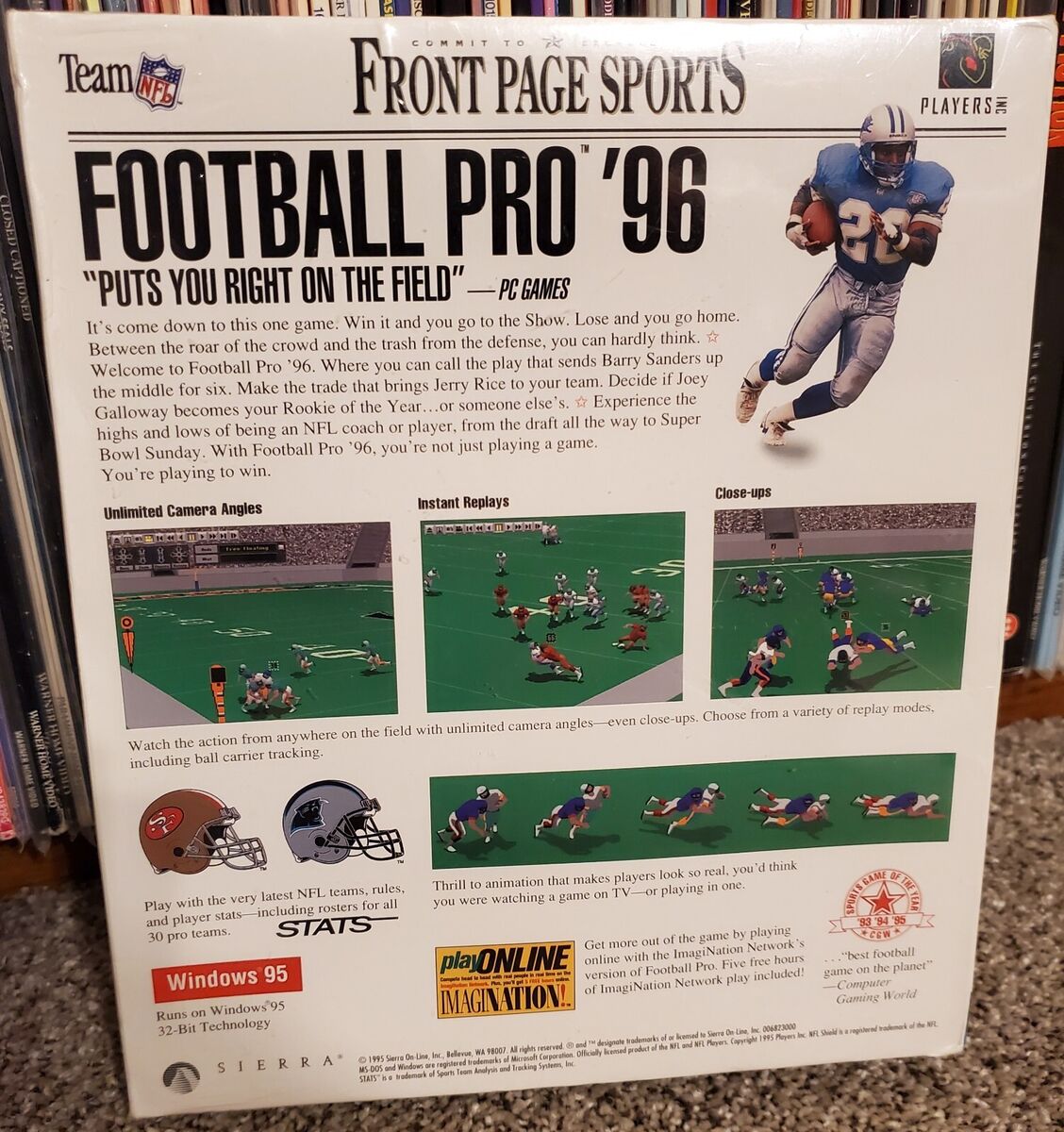
You see, that person made an awesome cover. Or that person has way to much free time on his/her hands. But it got me thinking. My connection to Madden is sparingly and not that much. It started somewhere in the 90’s with Sierra On Line Front Page Sports. 

We had a collection of players and we all played our games and then we compared statistics. I choose the San Francisco 49ers. I got nowhere near the top 3, but it was fun for all around. I then stopped playing the game until Madden NFL 2003 (I think) which I got on the original Xbox. It had the cool option to change the desktop depending on your favourite team, and as such I chose the 49ers. I got one additional version about a decade ago and that was it.

My largest issue is not on the makers, well perhaps it is. I have little to no knowledge on Football and the NFL and that results in the game not having a learning curve for those with little or no knowledge of the game. If someone objects that this is my flaw, I will accept that. But the opportunity to get a larger following on the game is lost and that is on Electronic Arts. Especially as streaming systems are starting to grow, giving players a game with a learning and educations curve will be important, that is pretty much a given and that applies to all sports (NBA, NFL, NHL, FIFA). The time to cater to merely the devoted fans comes to an end, too much needed to be vested in any game to rely on ‘self education’ to get ahead in a sports game. There is also the need to connect to others in a multitude of manners. Scores sharing (to a multi player pool) multiplayer when the two teams meet and so on. Parts can be done now, but it is (as far as I could tell) pretty limited. 

So the idea comes from the cover and that is the fat that more could be done. In this case an evolution in commentators. For example a celebrity could comment on the game. In the season there would be a 10% chance, during the playoffs 25% and the Super Bowl will have a 100% chance and there we get the larger issue. We know that Taylor Swift will have a vested interest to commentate on the Kansas Chiefs (a tall order if ever there was one), Jeremy Renner is a devoted 49ers fan, Arizona Cardinals has its own Oklahoma based fan Blake Shelton, George Clooney is a die hard Cincinnati Bengals fan and that list goes on and it would be up to EA to find the willing and right celebrity for the 32 NFL teams. I am amazed that no one thought of this before. Perhaps they did, but until the PS5 and Streaming systems there wasn’t enough options to implement that and that is fair enough. The nice part is that the next Madden is roughly 8 months, 22 days and 15 hours away. As such Electronic Arts does have enough time to consider and implement (or reject) the notion of adding to the franchise. I also believe that the personalisation that the original Xbox version had should return and a much better or enhanced educational system for those not struck by NFL devotion. There is off course a stage that this could apply to the other franchises, but that would be up for Electronic Arts to consider. 

Whether they do or don’t (it is up to them) my creative vibes remain active and now they went in a direction I didn’t count on. Perhaps all the newspapers focussing on the Gaza clambake was cause of all this. I don’t know, but whomever posted the initial Madden 25 file, thank you. It gave me something to think about and start Monday on a non work related cause.

Enjoy Monday.

Leave a comment

Filed under Gaming, sport

Two sides of fruit

There are always issues when you get to the topic of fruits. One is the question whether it applies to the members of the US congress (the members of the US Senate are usually labelled as nuts). Is it an issue with actual nutritional products or are we talking about the device that Newton used for gravity? Yes, it is the third one as Newton discovered gravity with an apple.

Yet even here we see two sides at present. The first one is seen with ‘iMac Pro: Apple launches powerful new desktop – starting at $4,999‘ (at https://www.theguardian.com/technology/2017/jun/05/imac-pro-apple-launches-powerful-new-desktop-macbook-starting-at-4999). Here we see the quote “The new iMac Pro starts with an 8-core Intel Xeon processor, but can be configured with an 18-core processor variant, as well as up to 128GB of EEC RAM, 4TB of SSD storage and Radeon Vega discrete graphics cards with up to 16GB of memory“, you see, Apple, like Microsoft, IBM and since resent ASUS have become agents of iterations, true innovation has not been on their shores for too long a time, which is why my new device is for consideration with Huawei and Google alone. Only they have shown the continued race for actual innovation. there is also Samsung, but as I had a legal issue in 1991, I took them from the consideration list, I can hold a grudge like only the Olympian gods can. Still in their defence. the question becomes how can you make a computer truly innovative? It is a question that is not easily answered. there are a few options, yet some of the technology required is still in its infancy here.

In addition, in similar ways, iWork has been unable to grow due to the restrictions (read: limitations) that the suite offers. Instead of trying to persuade the Microsoft Office users (which is not a bad path), iWork has not grown in the directions it could and they are now paying for it through reduced exposure. Still, there remains a valid opposition to my accusation of: ‘have become agents of iterations’. To see this, we cannot just state that there is a new iMac and as such they are merely iterating. There is in addition the issue of hardware versus software. So in my view, a true innovation would have been a Wi-Fi upgrade, not just a faster system, but a system that is keyed to the home and mobile devices. As we are now a little over a year from the first steps of 5G, as we are all more and more connected via different devices, Apple left out in the open a huge sales opportunity by having the options of having devices linked and interlocked. A missed opportunity. You see as bandwidth becomes more and more an issue, as we tend to have a home bandwidth that is 100 times larger, having the option of the auto upgrade manager on your desktop device (iMac). So when you come home, apps and content will be distributed to the devices you want them to placed in. So at home ‘without even thinking’ (sorry Microsoft for using your Windows 95 slogan). the devices will do what needs to be done and you need not mind. You see, as people are trying to push Block chain into every financial corner, those people forgot on how block chains can also be the foundation for users on multiple devices. Now that is not always needed, because we get mail in the cloud, data in the cloud and via the cloud, but that is not for everyone. In addition, people forget about the photo’s they took and they do not always want that in some cloud. There are legions of options here, but at time we want some of this offline. finally, as we do specific tasks (for example on a train), we prefer not to lose too much bandwidth whilst on a train. Tablet and mobile bandwidth can be expensive. In equal size we tend to forget how large some files are and as such we could rush through our bandwidth in no time. This is just one of two options and we have seen very little development in that regard. Apple might want to let others develop it first, but that also leaves them with less when they need to have that additional step forward. It was a mistake Microsoft hid behind for the better part of 2 decades. In that same approach we see how consultancy and project software could benefit a different side in their designs. Now, that is not for Apple to side with, but it could have been an opportunity to grow in new directions. Anyway this is not about starting a fight on 3rd party vs others, this is about iteration vs innovation and Apple has been reluctantly innovative.

This gets us to the other side of it and here I am not siding with Apple, but I am wondering if Apple has been treated correctly. This we see in ‘Apple ‘error 53’ sting operation caught staff misleading customers, court documents allege‘ (at https://www.theguardian.com/technology/2017/jun/05/apple-error-53-sting-operation-caught-staff-misleading-customers-court-documents-allege). Now first let’s take a look at the error 53 part. The issue is that “‘Error 53’ is a message that occurred after updating to iOS 9.0 on iPhones of people who had had their TouchID fingerprint sensor replaced by a repair shop not licensed by Apple. The phones were rendered useless because the operating system update detected a mismatch between the sensor and the phone, and locked the device, assuming unauthorised access was being attempted.

Now here we see two sides.

In the first side we see “Knives damaged by misuse, improper maintenance, self-repair, or tampering are not covered.“, this is something Buck knives has in play. By the way, this comes with a life time warranty so that remains awesome. In addition, for decades TV warranties were voided if unauthorised repairs were made (or repairs by unqualified repairman). With laptops there was Compaq, who would void any warranty if a non Compaq technician had worked on it. They even created special Compaq screwdrivers to keep a handle on it all. So when we see ‘replaced by a repair shop not licensed by Apple‘, I am not certain if the ACCC has a case, they have not acted against Philips, Sony and a few others for the longest of times.

So when I read: “accuses Apple of wrongly telling customers they were not entitled to free replacements or repair if they had taken their devices to an unauthorised third-party repairer” I remain in doubt whether they have a case.

So when we see “Australian consumer law clearly protects the right of a customer to a replacement or free repair if the product is faulty or of unacceptable quality“, which I agree with, yet the owner did not go to Apple, did they? I have had my own issue with Apple in this regard (different device), yet can we agree that when we read: “It is however important to note that if a non-genuine part is fitted to your Toyota and that part’s failure or the incorrect fitment damages your vehicle, then that damage may not be covered by your Toyota Warranty“, so how can something that applies and is valid for Toyota is not valid for Apple?

I believe that ACCC acted out with another agenda. The need for warranty protection by having repairs done by authorised service people has been in the axial of repairs for decades. In addition, when we look at the facts, why would ANYONE go to a third party for warranty repair? That is just insane. So when we read “wrongly telling customers they were not entitled to free replacements or repair if they had taken their devices to an unauthorised third-party repairer“, I am actually wondering how they could come to the conclusion ‘wrongly‘. You see when we read: “Australian consumer law clearly protects the right of a customer to a replacement or free repair if the product is faulty or of unacceptable quality” we now wonder how true that is. You see, warranty is either valid (Apple fixes it for free), or it is beyond the warranty term and you have to pay for it and then it is no longer done for free, so you might select a third party. Yet if this is not an Apple authorised dealer, don’t you have anyone but yourself to blame?

So this is the other side of the apple, what constitutes voided warranty.

You see, if Apple loses this part, I can start repairing Raytheon’s Griffin systems. You see the upgrade (from C to C-ER) and equipment alignment costs are roughly $15,000 per day (excluding parts), if you do not have the proper Service Level Agreement. I can offer to do it for $5,000 a day. so if my work is shoddy (which they will not know until they fire the device, I can be very innovative towards my income), can they apply for warranty at Raytheon, or have they voided their options? You see I will have a NDA with a ‘this repair has been completed to our highest corporate standards’, so I am in the clear and the way the world goes, with 225 upgrades, I will have a decent Christmas this year. Yet at that point the ACCC will not go after Raytheon, it will go after me (what a whuzzes). So how come that the rights of Raytheon are better than those of Apple?

It seems that people assume so much with their mobile devices nowadays, I need to wonder if people comprehend what they buy and what responsibilities come with it. In this the initial question ‘Why did you not take your device to Apple?‘ is one that is not addressed at present and as such I have little faith that the ACCC has a decent case at present (in the shape we saw presented today).

the second and first part interacts as the upcoming shifts will in equal part see new frontiers in Service Level Agreements, Customer Responsibility and the comprehension of the elements covered in a warranty. Because what is included is likely to shift a fair bit over the next 2 years. In addition, innovation is also a shifting concept. Whilst it was “a new idea, device or method”, we (read: the corporate marketing departments) have often seen it as ‘the application of a solution that allows to meet the new or altered requirement of the customer‘ which we get when we iterate with a more powerful processor, more storage, larger screen. So going from 1080i to 5K screens might be accepted as truly innovative, because that took another level of screen and electronics. Yet at times, the pass through of merely upgraded speeds are also seen as innovation, yet at what level is that? When the device remains merely the same to the largest extent, is that not merely iteration?

So here we see the two sides of the other Apple. What we see, what the maker offers and how we both interpret the presented term of innovation.


 

Leave a comment

Filed under IT, Law, Media, Military

When the offer is free

Try this for free! This is the commercial teaser we all see when we are offered a dozen of options. There is LinkedIn Premium, Spotify, Salesforce and the list goes on for a very long time. It is a way to get interested in a service or product. I myself tried ‘Today Calendar’ for free, than I upgraded, trials are to some extent a great solution. Try before you buy is a way to get into it. There are games that let you download their Demo, DLC’s that work for a week or two, then you decide, buy or fly!

It is an old marketing option that costs little and bring great reward for those employing the situation. There is however the detail. This we see in the article ‘Why are Amazon Prime customers angry?’ (at http://www.channel4.com/news/amazon-prime-charges-anger-customers-online). Several sources had the story, but Channel 4 read the clearest. The sub-line gives us the goods “Amazon defends a free trial of extra benefits, which ends in an automatic upgrade to paid membership costing £79 a year“. Amazon additionally responded with “Amazon says everyone who signs up to Prime gets an email telling them the duration of the free trial, how to avoid continuing to paid membership and how to cancel membership“. This seems clear enough. So when the guardian gave us ‘Giles Coren declares war on Amazon Prime over free trial‘ (at http://www.theguardian.com/money/2015/feb/16/giles-coren-declares-war-amazon-prime-free-trial-subscription), the impression was left with me that someone did not read their e-mail properly, now that person is crying wolf.

There is however another side to this debate. Should silent transfer be allowed, or should there be a mandatory change to an opt-in transfer? So, should the trial be auto cancelled after 30 days and in addition should we see a second confirmation after 30 days that the continuation is no longer free? This option is the one we usually see in software, when a trial is over, we see that the software no longer functions unless you start paying. On the other side we could consider that some consumers are too stupid to be allowed to have a credit card. The man considers himself an adult. He signed up for a trial, if we accept the response from Amazon that confirmation e-mails have been send, with the explanation on how to cancel it, he himself got into this scuffle by ignoring the message. The Guardian also shows another side that people seem to ignore. The two items involved is a tweet by Giles Coren “I mean, @amazon, offer a free trial in 2012, then quietly start charging £79 and never tell me. That’s what sicko porn sites do! I’ve heard“, so he has been charged for membership in 2012, 2013, 2014 and perhaps even 2015 and only now he ‘wakes up’? Now, this can happen, it has happened to many people, including me, yet 79 pounds is not a costs you easily oversee. To some it amounts to the 6 months fee from your internet provider, which should be taken into account. The second piece of information from Amazon is “Customers who sign up to a free trial of Prime receive an email informing them of the duration of the free trial and how to avoid continuing to pay Prime membership. Customers who become full Prime members can cancel their membership at any time and we will refund the full membership if the customer has not made any eligible purchases or used any Prime benefits“, which gives us the second part. So from that it would seem that Giles Coren must have used some of the services and now he is miffed on having paid for it. That conclusion I get from him not getting a refund, which means he had used the Amazon Prime services.

The article is not just an Amazon or an e-Commerce article. It is also an article that shows the unjustified demand of continued free services after the free trial ends. The two sides pulling on this are Amazon as well as pragmatic realism, as one Tweeter replied to Giles with “Shocking indictment of Oxford and private education as former student doesn’t understand the words ‘free trial’“, which pretty much sums up the ignorance people are showing when they accept free trial whilst not looking at the conditions. The one part I will also illuminate is the complaint we saw from a man called Richard Brown: “Regardless of the legality of the transaction and the stance that Amazon will take that it involves selection and a follow up email each year, the structure of this service is clearly designed to benefit from the customer’s lack of attention“. That too can be seen in two ways. I do agree with Richard on that Amazon should send a follow up e-mail on the subscription every year. These places can send you marketing mails until your hard drive has zero space left, but then shows a lack of ‘tenacity’ to inform their ‘customers’ via e-mail on the payment made, which I see should be a mandatory act in the first place (perhaps that happened, but no one mentioned it in any of the articles I saw).

It is the second statement from Richard Brown that bothers me “this service is clearly designed to benefit from the customer’s lack of attention”, not whether that is the case or not, but in regards to the consideration. This reminds me of the initial marketing when we saw the presentation from Microsoft on the launch of Windows 95. The slogan was ‘without even thinking‘, it was brilliant to some extent. Windows 95 was the first step towards people and true intuitive use of computers. Now, many (pretty much most users) are using their devices intuitive, but there is the added part we see that is at the core, marketing is all about getting a foothold, now we see part that implies (emphasize implies), is that consumers are either getting dim (not that unheard an idea), or that we are faced with two new elements, the first is ‘intuitive buying‘ and ‘intuitive marketing‘, the second one is the holy grail of achieving revenue. When used correctly it is seen as ‘Achieving influence without persuasion‘, there is an interesting article (at http://intuitiveconsumer.com/blog/intuitive-marketing-achieving-influence-without-persuasion/ ). It talks about the six mechanisms of influence used by intuitive marketing. They are ‘Trust: Intuitive marketing builds trust and relies on trust‘, ‘Consistency: Intuitive marketing is consistent and therefore communicates reliability‘, ‘Fluency: Intuitive marketing is easy on the mind‘, ‘Emotional reward: At the opposite end of the spectrum from high aspiration is the realm of small emotional rewards‘ and there are the final two ‘Aspiration‘ and ‘Aligned intent‘. As you see (especially after you read the linked article), the Amazon Prime situation seems to address 4 of the 6 elements of intuitive marketing, so when we see the Amazon Prime issue, is there deception? I personally say no! Amazon offered an agreement, one that gives you a cool down period of 30 days. The definition can be seen as “offer, acceptance, and consideration (payment or performance), based on specific terms“, this is what is at the heart of it all. The emotional response of Giles Coren with the reference to ‘that’s what sicko porn sites do!‘ which in my view holds no value, yet ‘the structure of this service is clearly designed to benefit from the customer’s lack of attention‘, the mention by Richard Brown is much better and decently more apt, but is it valid? ‘Lack of attention’ sounds nice for sure, but does that make the consumer less responsible? Especially when Amazon offers, “Customers who become full Prime members can cancel their membership at any time and we will refund the full membership if the customer has not made any eligible purchases or used any Prime benefits“, which is a decent counter offer, which was part of their offer as I see it. So first, the person gets a 30 day cool down and if the person has not used the service at all, they could get a refund. It seems to me that Amazon offers a decent service, so why do these events cause such a strong reaction?

The part I have not touched upon is ‘intuitive buying’. One vendor had this little slogan with their product ‘intuitive buying just like in an internet shop’. Now we get back to the initial Windows 95 slogan, this gives us in the end ‘buying without even thinking’. So we have a complete picture, but what neither article skates on is when will we see the accountability of the consumer. The person who was given a credit card, an adult who was supposed to be of sound state of mind. The person buying, was notified and then did not react. Intuitive buying does not make a person unaccountable, is that what the articles are steering to? No matter how many complaints we see, the clear indication is given that Amazon gave up front and it allows for correction in hindsight.

Hidden under this is the issue, not on the side of Amazon, but on our side, we consumers need to consider the clear truth that nothing is free! Should any internet offer be treated the same way trial software is? That remains valid, but if so, is that because consumers are no longer to be considered ‘adult’ or accountable, or is it because of another path of reasoning?


Leave a comment

Filed under Finance, IT, Law