Censoring – Censor out?

It is 18:11 and my assignments are done. I get one day of rest until the next batch off assignments start to twitch at the corner of my desk. No rest for the weary, so off to the Guardian I went a moment ago only to see an interesting article by James Ball. It is about Twitter. The headline ‘Twitter: from free speech champion to selective censor?‘ pretty much states it all (at http://www.theguardian.com/technology/2014/aug/21/twitter-free-speech-champion-selective-censor).

It starts with a quote that sounds good, but is actually a statement of quicksand “The social network’s decision to remove all links to the horrific footage showing the apparent beheading of the photojournalist James Foley is one that most of its users, reasonably, support“.
I actually do not support it, but I understand the action. Why not?

Well, this is all about emotion, which is fair enough, but Twitter had given themselves a precedent of censoring. Now, let us be honest, I have nothing against the censoring, but they created a position for themselves that will drain resources in many way.

Why? What about the next beheading or execution that comes next? Other video smut we can all do without. Where will it stop and how can it be managed?

James Ball actually words an interesting view I had not considered when he states “the New York Post and New York Daily News’ decision to use graphic stills from the footage as their front-page splashes. Here begin the problems for Twitter: the network decided not to ban or suspend either outlet for sharing the images – despite banning other users for doing the same“, which constitutes discrimination. So, as I stated, Twitter entered a pool of quicksand and it will get them deeper into trouble sooner then they realise. That is shown with the quote “Twitter is absolved of legal responsibility for most of the content of tweets. But by making what is in essence an editorial decision not to host a certain type of content, Twitter is rapidly blurring that line“.

So under Common Law, Twitter got themselves in quicksand and hot water all at the same time (aren’t they the efficient Eager Beavers?).

If I go by the NSW Defamation Act 2005, we see a nice escalation in section 32, where it states:

Section 32   Defence of innocent dissemination

(1)  It is a defence to the publication of defamatory matter if the defendant proves that:
(a)  the defendant published the matter merely in the capacity, or as an employee or agent, of a subordinate distributor, and
(b)  the defendant neither knew, nor ought reasonably to have known, that the matter was defamatory, and
(c)  the defendant’s lack of knowledge was not due to any negligence on the part of the defendant.

(2)  For the purposes of subsection (1), a person is a subordinate distributor of defamatory matter if the person:
(a)  was not the first or primary distributor of the matter, and
(b)  was not the author or originator of the matter, and
(c)  did not have any capacity to exercise editorial control over the content of the matter (or over the publication of the matter) before it was first published.

Until now, they had gotten a clean pass and would remain to have one until they made the change they did. Because whomever starts any defamation case, will have cause to show the beheading censoring instance of James Foley and by Twitter acting, they gave away the defence: ‘did not have any capacity to exercise editorial control over the content of the matter‘, because they just did that exact thing, which now gives them cause to see Defence of innocent dissemination melt away like snow in the sunshine.

As James Ball points out, the issue that I had taken offense to last year were the threats against Caroline Criado-Perez, who thought it would be a great idea if Jane Austen became the new face of the 10 pound note. I personally thought it was a brilliant idea. Some small minded people did not and as such, she got a dose of abuse and threats that were completely beyond belief. It is only one of many cases of bullying, trolling and harassment via Twitter. The quote we see in the Guardian is: “Twitter’s strongest, perhaps only, justification for its sluggish and minimal response was that it could only act through its harassment channels, and could not become a curator or editor of content on its site“, which in itself is perfectly acceptable, yet now, they have given that option away by acting and soon, Twitter might be confronted with other abuse and threat victims and as such their goose gets to be decently cooked (and broiled).

So, either Twitter takes a step back, which would be fair enough, or it becomes a policing entity, which might not be the worst, yet the issues from this choice will haunt them for a long time to come. That in itself seems unfair, but just moving to the plate (not arguing how justified it is), will leave them with bruises and scars. I get the issue that it is a consequence of choice, which I do not attack, but how consistent can they actually do this and more important, what issues will they open when they censored something that was lost in translation, how will they fix those mistakes at that point?

I think that they should state that the beheading intervention was a once off and not interfere again. Not because I want it, but because Twitter seems safer by remaining on the side of innocent dissemination, a side that they might not be regarded as ever again (speaking juridical), simply because the action has already taken place.

So is the censor in for censoring?

That is a question that only Twitter can answer, yet the emotional decision to intervene in this case was morally right, emotionally correct and decently good, this jurisprudential mouse will however end up having a slightly too long tail, I wonder whether Twitter considered that option, especially in regards to victims like Caroline Criado-Perez who did not get the intervening attention they rightfully deserved.

 

Leave a comment

Filed under IT, Law, Media

A time to breath

I am just now taking a few minutes (roughly 32.4) break from my UNI assignment. I have way to go and I should be OK to get it all done in time. These are also the moments when a person, no matter how driven to get the assignment done, will start worrying about the proper tense of it all. I procrastinate, he procrastinates, she procrastinates, we all look at Facebook, the Guardian, YouTube and whatever other non-University virtual place we can think of.

I do it every two hours to keep my mind slightly more alert than usual. Assignments can be dull dreary and often nerve wrecking and if we do not take a little look out of the window, we go bonkers (for Americans: that means ‘loony tunes’).

The topic of news are the beheading of a US reporter by ISIS, air strikes batter Hamas and something about Sainsbury and credit card fraud. If you do not know that ISIS is a massive threat, then feel free to hide back under your rock, if you think that there can be peace between Hamas and Israel, then please say hi to Professor Minerva McGonagall from me when you get back to Hogwarts and enjoy the ‘reality’ of magic, muggles and feast over the death of he-who-should-not-be-named.

The Sainsbury issue is however a massively different slice of pie, and I will take a bite out of that one. It is yesterday’s pie, but it seems to have the good taste of ‘are you for real?‘ whilst having a glass of ‘someone better start waking up soon there‘ (at http://www.theguardian.com/money/2014/aug/20/sainsburys-bank-security-fraud-transfer-credit-limit).

The first quote that I have an issue with is almost at the end of that article, where it states “Sainsbury’s, which has run its own banking operation since 2013, might now want to look at its security measures“. How about “Dear Sainsbury bank, in light of the information we currently have, we will feel a sense of utter joy to permanently shut you down in 48 hours if you do not wake the flip up and get your hat on straight! Kind regards the office of common sense and persecutors of dumb, dumber and the flatulently moronic”

This is not 2001 or 2003, it is 2013 and the dangers of cybercrime, identity fraud and other mismanaged works by those who acquire that what others own, has been in operation since the late 90’s and the article, if correct has all the makings of a new season of ‘the Office‘.

The quote “At no time was I asked the further security questions that only I could answer“, which implies that the security of ones birthdate is as dangerous as it is futile. Many people seem to hand over that information to Facebook (that open message and personal detail place which was created in 2004). The fact that the automation and security process of commonwealth welfare is stellar-sized more advanced above the implied security of the Sainsbury bank should give credit to levels of Howling laughter from Edinburgh (random place to the north), which the people in London would hear.

So, that’s enough rant for a few minutes!

The issue remains how ‘a bank’ had not been vetted beyond the points of common cyber sense, as well as allow certain changes (like increasing credit limit) other than in person to the place where the credit was offered in the first place. I must stress out here, that I am going by the Guardian article, so if their information is incomplete, then so will be the info you read here. Yet, if we see some place called ‘the northern echo’ (at http://www.thenorthernecho.co.uk/news/8423732.Sainsbury___s_hit_by_credit_card_scam/), then we see more issues with Sainsbury and well before 2013, which means that there is at least one watchdog that seems to be asleep at the helm. A quote from the echo is “The court heard that the scam was costing Sainsbury’s £12,000 a week in the North- East alone“, which implies that it is costing them a bundle, so we should take a step back and wonder how asleep some of these people are.

There is however WestpacSlota larger issue that is not being addressed. We have seen that ATM’s have been the target of several options. In Australia, Westpac came with a novel idea that prevents someone adding a skimming slot in front of the card reader of an ATM that is quite ingenious (see pic),
but overall the ATM has not been too overly developed. There was a time when I saw that the AMEX cards had a hologram, but the newer systems which are all about waving in front of a scanner open up many other criminal endeavours of exploitation of your bank account. The fact that seems to be implied is that Sainsbury, even today, remains a decade behind is cause for massive concern. This all will give rise to the question on how long it will take, before insurance companies take enough offense and no longer pay banks for their shortcomings, then what?

Here is see instant fortune for the one innovator that can truly show us a new way on digital transactions that allow for a new (or upgraded) system that is about safety and security, not about speed of transaction. Consider that golden idea that will keep trillions of transactions safe. Even if you only get $0.01 per transaction, you would end up wealthier then Bill Gates in less than two years (greed tends to be a great motivator).

Is there anything we can do? Well, the Sainsbury issue is a little extreme, but overall banks are getting better at upgrading security, yet there are a few things you can do. First of all, limit the location of your card, so that you can only use it national. Yes, it looks so cool that you can use it all over Europe, but if you are stuck in Stratford-upon-Avon and you have yet to write your first book, then it is highly likely that you cannot afford distant travels, which means that your card only needs to work in the UK (or whatever country you live in). Second, cyber criminals tend to spy on your computer if they can. So, when you are not using your computer, shut it down. It seems so cool to have it ready at a moment’s notice, yet that thing actually uses a fair bit of electricity and when you are not using your computer at night, it could be used to see if you have passwords and account details somewhere. Not the thing you want to leave unattended. Today, people leaving their smartphone unattended (I mean no pin or password), which is even more reckless nowadays. Even having more ‘renowned’ apps are getting to be more and more questionable (reference to my ‘No Press, No Facebook!‘ blog of August 10th), how long until someone slips in an app, to piggy onto some banks wave and pay app (a way to pay using the mobile phone by waving it in front of a scanner)? These are technologies that are possible today (whilst Sainsbury is an implied decade behind).

So, we should all take a moment to breath (except Sainsbury who apparently need to update their security) and consider the financial links we now have and when we last checked them for correctness of transactions, more important, what other card options do you have where people can too easily take your cash for a ride? I am referring to possible fuel cards, book club cards and other cards where you do not get the invoice immediately, so you might get a nasty sting when you open ‘that’ letter next week wondering when you had that complementary 50 pound dinner as a new member. It is the unspoken danger of having too much info on open social media, some banks seem not to have been updated and likely other providers could well be lacking in security procedures too.

Did you take time to breath?


Leave a comment

Filed under Finance, IT, Science

Hiding behind the bully

Again it is the Guardian the illuminates an issue that seems to hit the UK (at http://www.theguardian.com/business/2014/aug/17/sainsburys-removes-kosher-food-anti-israel-protesters). The header ‘Sainsbury’s removes kosher food from shelves amid fears over protesters‘. Let’s take a look at the sanity of this. First, about Kosher foods, if we accept this explanation: “Kosher food is food prepared in accordance with Jewish Dietary Laws“, which makes the act of Sainsbury an act of discrimination. These same protesters were actually quite busy ignoring events as Hamas was sending thousands of rockets into Israel; in addition, they seemed not to care about the acts of Islamic Jihad Movement in Palestine against Israel. No one seems to be asking the question how missiles weighing well over a ton (FAJR-5), and also not the cheapest of ordinance makes it into Gaza. The option where we suddenly see, but no serious questions are asked on how Iranian hardware gets there, in an age when there is a block on all things Iranian. It seems that big business has more than just a small hand in keeping the imbalance going. Yet, ‘these bullies’, is that even correct?

You see, Sainsbury acted preventively. There were protesters and I do believe in free speech, so there is nothing against protesters, as long as they respect the choices of others. There will always be the bullies in these places, who by their acts will escalate an issue into something more. It still makes the act of Sainsbury a discriminatory one and as such, there could be legal ramifications for Sainsbury.

The quote “Louise Mensch, the former Tory MP, accused Sainsbury’s of racism” is not incorrect, yet the information is slightly off the boil. I should also add the quote from Sainsbury “A spokesperson for Sainsbury’s said it was ‘an absolutely non-political organisation’ and said the food was returned to the shelves ‘as soon as was practically possible’“. This has a ring of truth, so basically, we can argue that the store manager in question had made a bad call, but that is something for Sainsbury to address.

So why are we looking into the issue of hiding behind the bully. There is a sound to it, that links to it, that corrupts the nature of acts, which is not a good thing either. We act according to our values, our insights and often by our direction. It makes the act of the branch manager of the store in Holborn questionable, but not necessarily wrong, evil or racist. We are confronted with dilemmas in the face of a crisis and we all at times make not the best choice, which is not saying that we made the wrong choice.

And as we look through the coloured glasses we see a pattern, coloured by the bullies. In this case the accusation by Louise Mensch, the former Tory MP and Facebook user Gavin Platman who had a much more down to earth pragmatic response. He voiced a view that “move blurred the line between a political statement and a hate crime” was that so? Perhaps the store owner feared the consequence of vandalism with possible added dangers to his customers. As stated, the act remained questionable, but there is enough evidence that this was not an act of Malice, but simple fear and worry, enough doubt to state it was absent of political issues and absent of hate.

I have my views in the matter of Gaza, some formed whilst I was there in 1982, some formed by the news and some by other information. It is also important to show another side. Even though I have spoken out against journalists often enough, there is a view you must know about. There is a headline “Journalist quits Australian newspaper after suspension over ‘offensive’ response to Gaza column complaints“, this is because of the article the journalist wrote (at http://www.smh.com.au/comment/israels-rank-and-rotten-fruit-is-being-called-fascism-20140724-zwd2t.html).

I do not agree with some of his views, but they ARE HIS views and he is entitled to them, plain and simple. The quote “Yes, Hamas is also trying to kill Israeli civilians, with a barrage of rockets and guerrilla border attacks. It, too, is guilty of terror and grave war crimes. But Israeli citizens and their homes and towns have been effectively shielded by the nation’s Iron Dome defence system, and so far only three of its civilians have died in this latest conflict” is one of the quotes I do not agree to. His facts are straight, yet this system was designed in 2005 and it had been in service since 2011. Yet, before that already hundreds of mortars and missiles had been fired upon Israel. The issue I raised in ‘Puppet on a string‘ on June 30th and in a few blogs before that. Consider the amount of missiles fired, who is supporting Hamas, because this entire mess is escalating because some people behind the screen are funding all this, the article NEVER goes into that. My issue is that the writer seems to rely on a missile defence system that is 3 years old, whilst the Israeli people had been under attack for decades. It seems that to the lesser extent, hatred for the Jews has never stopped, not since WW2. What we see now is a nation that has been under attack and in fear of extinction for 4 decades. The writer does touch on some of the events and also is adamant in calling both sides guilty, which is fair enough. The other quote is do not completely agree with is “The Israeli response has been out of all proportion, a monstrous distortion of the much-vaunted right of self-defence“, yes, from the directness of what happens now he is stating the truth, yet decades of missiles has made Israel angry and perhaps worried and in fear. More than 1300 missiles were fired upon Israel last year. Someone with a massive fat wallet is funding Hamas, yet the Iron Dome also requires funds every shell Hamas fires requires another $25.000. How long until the funds runs out for Israel? These sides are not shown or talked about. He ends in “That is why the killing and the dying goes on. Ad nauseam, ad infinitum. And the rest of the world, not caring, looks away“. That I can partially agree with. The issue is still, until funding runs out for one of them. A side no journalist seems to be looking at. It is a simple view in any analytical premise. So is there a bully here?

Yes, I speak out against certain journalism, or better stated lack thereof. Mr Carlton was ‘judged’ as we see the quote “An Australian newspaper columnist has resigned after being suspended for telling people abusing him over a column on Gaza to ‘f*** off’” Is that reason enough? How was he wrong? Have you seen some of the trolls we see in social media? So he tells an abuser to (F word omitted) off. How does that even closely justify suspension? I might not agree with the view Mr Carlton had (at least partially), yet he had a right to his view. I might counter it, but I will not abuse him for it. Here it seems that the Sydney Morning Herald was hiding behind the Bully. The question becomes, who was that bully? The fact that Mr Carlton responded to the abuse was also not the greatest idea, but it was HIS RIGHT to do so, it seems that this side was also ignored, especially as we look at the weeks of suspension result.

So as we look for the bullies and look for the result of their acts, we should also realise that we all react to some extent here, not all in the greatest way, sometimes we think it was not important, sometimes to not rock the boat and sometimes because it seems like to only act available to us. But whether we give in to the bully, or hide behind the bully, we gave the bully that what he wanted and never deserved, so does the bully have an identity? To the Palestinians it is Israel, to the Israeli’s it is Hamas, and to Hamas they are the Jews. And as the vicious circle grows we see more players pointing towards their own demons, whilst the actual bully points towards his or her own ignorance and fears.


Leave a comment

Filed under Law, Media

The cradle of Whiskey

There is a matter that is of interest to the commonwealth at large. As time progresses we see more and more in regards to the Commonwealth upcoming baby brother Scotland. For now still part of the motherland of the British Empire, our baby sibling is about to stretch its own feet. The need for junior to become its independent member is one that has been voiced (especially by the local population) for a long time. I in all honestly remain on the fence. I have nothing against this change, but as I state before, the timing is not right. However, in all fairness, it is likely never to be a great timing is it?

Yet, the Guardian will give us our daily ‘need’ for information. There are however a few issues that also rise at those events. Let’s take a look.

The first one is in regards to yesterday’s news with former PM Gordon Brown (at http://www.theguardian.com/politics/2014/aug/15/gordon-brown-independent-Scotland-neocolonial-ties-uk).

Here it is stated “An independent Scotland that kept the pound would have a neo-colonial relationship with the rest of the UK because it would have no say over key economic and monetary decisions, Gordon Brown said on Friday“. I find it had to disagree with that. And let us be fair, would we want this? Absolutely not! Yet, will Scotland start its own currency? It is the statement from Professor Ronald McDonald (yes, the economist, not the clown) which is the strongest voice “Professor Ronald MacDonald, a currency expert who advises the International Monetary Fund and the European Central Bank, said the Scottish government’s plans to use sterling after a yes vote were fundamentally flawed, even if Alex Salmond’s proposals for a currency union were accepted by the UK. The Scottish economy would shrink by up to £100bn by 2023, MacDonald said” (at http://www.theguardian.com/politics/2014/aug/14/independent-Scotland-economy-crash-sterling-ronald-macdonald).

It is in opposition to this quote “During ill-tempered exchanges in the Scottish parliament, Salmond cited evidence from Sir Donald MacKay, a former economic adviser to the UK government, that a currency union was ‘perfectly possible’ and was in the UK’s long-term interests” I am not sure how Sir Donald got to this, and his history in economy is a lot stronger than mine (my economic education level is ZERO). Yet, as an analyst I foresee several issues, logistics being the strongest but not the biggest one. If any currency union was to occur, then it can only happen as Scotland and the UK are 100% open about ALL economic events. How about (even if we ignore little issues like ego), that the chance of this happening is absolutely 0%?

There is also the small notion that independence is about, being by yourself, a currency union is not that. So I tend to agree with Gordon Brown. There are other issues where unions are to be maintained to some degree, so is there true independence or a new ‘state’ of autonomy?

This is on the front of my mind. I am pretty sure that Mr McDonald, or to take the image of the bad food clown away let us call him the Behavioural Equilibrium Exchange Rate Model Expert (BEERME for short, I need to avoid becoming too serious here), then there are several other issues that I have not even begun to comprehend and are likely secondary reasons on this man’s mind.

logUsScotland

If the professor is even half right, then a 50 billion shrinkage of Scotland’s economy would sink it, which is also extremely counterproductive, so what can Scotland do?


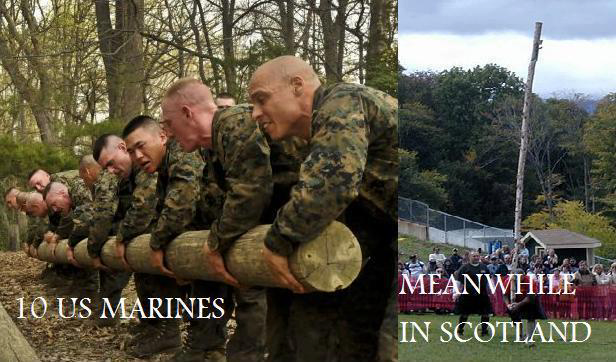
Delay for another few years? Even though this is the most likely event, Scotland would not be Scotland if it stopped without a massive fight, considering that one Scotsman tends to toss a log that requires 10 US Marines to carry is not a nation that whinges at the first hurdle.

So what if it uses the UK coin for now? Is that such a large issue, as Scotland grows its independent economic power? Consider this final quote from the article “They were already different, he said. Excluding oil revenues, Scotland had an average trade deficit of 11% over the last 15 years, which became a trade surplus of 2.7% if a geographic share of North Sea oil was included”. So the grace of Scotland is their oil reserves and what happens afterwards? This needs to be tackled first, because if Scotland is to avoid falling apart in the first setback (oil issues being just that when it happens), then Scotland must take care of its 11% deficit. In my view, that deficit must be turned to a 3% surplus (without oil) for Scotland to be a contender at the Commonwealth table, so how to go about it?

First it needs to change its political look on matters (not change its politicians). I will admit that the next part will sound a little dicey, but please hear me out. The headline “Scottish Tory leader Ruth Davidson: ‘I’m quite a cussed person’” (at http://www.theguardian.com/theguardian/2014/aug/15/ruth-davidson-interview-Scotland-tories-leader) reads nice, but there is a massive issue when we read the first part “Ruth Davidson is 35, a working-class Glaswegian, a kick boxer and a lesbian. Are these unlikely credentials just what the party needs to rescue it from 25 years of stagnation?” Why was there a reference to her Lesbianism? I personally do not care what her life’s choices are, truly I do not. But is this a political lesbian or a lesbian politician? Why could she not have been just a conservative? Did we see a headline on “Gordon Brown is a 63, working class sport less hetero sexual” Did we ever see that headline?

It seems that Ruth Davidson has supported state-funded Roman Catholic schooling in Scotland, and she also seems to believe (as far as I could tell) that the Church of Scotland should open its own faith schools as well, which seems a decently pragmatic approach to the ‘dangerous’ controversy called ‘Churches in the UK and Scotland’.

Because she is only 35, her most important events and achievements are still in front of her. She could be the inspiration the Scots need. Time will tell whether this is so. Yet there are issue with this article, there is little on her stance in regards to Scottish independence. If that is next on the agenda, should Scottish Tories not be outspoken about her views in that future? It seems to me that the journalist doing that interview kept the interview way too shallow, especially in this day and age.

There are a few other issues, like Ferguson, the last of the Scottish shipbuilders to shut down, so where are the economic options for Scotland, when we ignore oil. You see, I have nothing against the oil, yet the fact that a new nation will be totally dependent on only ONE product, such a place would need to have several alternatives if something went wrong there, so that is why it should not rely on the oil industry.

As a solution, I still believe that India has options here. As the Indian generic pharmaceutical industry grows for Europe, it will need alternatives for both manufacturing, shipping (read distribution) and perhaps to a smaller extent research. Whilst everyone seems to stare blindly to London area’s where prices are through the roof, Edinburgh offers a much cheaper and no less sturdy solution. Its harbour would allow for direct access to the Netherlands (Rotterdam), which would then grant access to Germany and Eastern Europe, there is access to Scandinavia as well as the option to nurture South American trade routes. All of them are markets that India could become the main supplier to.

It could change the Scottish deficit from 11%, to less than 3% in one blow, once the South American routes are a given, the deficit would turn to surplus. The stronger the growing need for generic medication, the more powerful this branch will grow in Scotland. After that, the tax breaks this industry could have would turn the UK into a much stronger market making for an entirely new dynamic in the pharmaceutical economy. Am I overly optimistic? Perhaps a little, yet so far, my predictions have held up and the current course is not getting us anywhere. It only takes one innovator to truly change the game, Scotland is roaring to be its own wielder of futures and India is roaring to be master of generic medication. Two innovators, a match, which is definitely not made in heaven, but as both want to make it work, the created future could be one that stands long and tall.

But is that with or without an independent Scotland? This is where the shoe starts getting a little tight for the dance floor. I personally do believe that this is not the best moment to become independent. I do believe that for now ‘better together‘ is the way to go. Consider the despair when Scotland does go it alone and within 24 months, both Japan in full and US in part become insolvent? I still believe that the US course is one that will sink its future, especially as the mention of well over 500 billion in undocumented spending in healthcare could set America well over the 18 trillion mark (the fact whether the healthcare billions were part of the deficit could not be confirmed), which makes for a dangerously unstable situation. So whether these facts stop Scotland from going independent is to be determined, yet that should not stop Scotland to become a lot more autonomic in growing its economy into the strong version it requires when the Scotland becomes one independent nation under this sky within our large Commonwealth.

Whether in the end there is a yes or no to independence, the fair question remains how to grow the Scottish economy, which will be a good thing for the entire Commonwealth.


Leave a comment

Filed under Law, Politics

We lost a giant

I was hit with waves of sadness yesterday. We lost Robin Williams. I do not claim or pretend to know too much about him. When I was young, I loved watching ‘Mork and Mindy’. I saw him in the movies and lately his star ascended again in the advertisement comedy ‘the Crazy ones‘. The thought most on my mind was ‘How can Sarah Michelle Gellar ever keep a straight face around him?’
Yesterday and today there are no happy faces, we lost a giant. I am not the only one thinking this. Twitter was buzzing with news and condolences from the famous and non-famous alike. The Guardian had a story (at http://www.theguardian.com/commentisfree/2014/aug/12/russell-brand-robin-williams-divine-madness-broken-world). It is an article by Russell Brand, and seeing him outside of comedy or from the stage of the social aware was reason to take a look at this. The article shows two clear things. The first is that there is a lot more to Russell Brand then I thought there was. He is brilliant in his own way and he is asking out loud certain questions we do not tend to ask. Basically I saw more journalism in Russell Brand in one article then several have showed this year (if you, the reading journalist are the exception, then I apologise for my generalising directness).
There is a quote at the end that gives pause to wonder “What I might do is watch Mrs Doubtfire. Or Dead Poets Society or Good Will Hunting and I might be nice to people, mindful today how fragile we all are, how delicate we are, even when fizzing with divine madness that seems like it will never expire“.
If we are all so fragile, how can we cope? If we are all sane, how can we give support to those with mental health issues? It I however this quote which strikes a nerve “Hidden behind his beard and kindness and compliments was a kind of awkwardness, like he was in the wrong context or element, a fallen bird on a hard floor. It seems that Robin Williams could not find a context. Is that what drug use is? An attempt to anaesthetise against a reality that constantly knocks against your nerves, like tinfoil on an old school filling, the pang an urgent message to a dormant, truer you“.
I am not sure if the thought is correct as such (from my point of view). It might apply to Robin Williams, Russell had met the man, I never had, so why my opposition to this?
Well, is drug use just that? I was fortunate to stay away from drugs, yet is it an anaesthetic against reality or a way to see a better reality as these users think it will, a more appealing one? You see, if Russell is right, then every famous comedian would become a drug user, I find that thought too depressing. Robin Williams once stated “Reality is just a crutch for people who can’t handle drugs“, it is just a comedy statement, but there is also the statement from another giant, a musical one who stated “When you smoke the herb, it reveals you to yourself“. The man was Bob Marley!
Before I continue, I need to add another article. It was written by Dean Burnett (at http://www.theguardian.com/science/brain-flapping/2014/aug/12/robin-williams-suicide-and-depression-are-not-selfish). Here he writes something particularly strong and interesting: “to say taking your own life because of such an illness is a ‘selfish’ act does nothing but insult the deceased, potentially cause more harm and reveal a staggering ignorance of mental health problems“.
Russell and Dean are both hitting one side of the same coin. My worry is not: ‘why this is happening to Robin Williams’, but why are we seeing it only now? Is Robin Williams the moment we start to wake up and realise that we have a massive issue which a ton of people have been hiding under the rug because it was too uncomfortable?
Dean goes on for a bit longer, but then he doesn’t just hit the nail on the head, he makes a case why the nail was never guilty and did not deserved to get hammered.
“That doesn’t mean those with reduced likelihood of exposure to hardships or tragic events are immune. Smoking may be a major cause of lung cancer, but non-smokers can end up with it. And a person’s lifestyle doesn’t automatically reduce their suffering. Depression doesn’t work like that. And even if it did, where’s the cut-off point? Who would we consider ‘too successful’ to be ill?”
I myself had that very same thought. ‘Why would a man this successful, having a beautiful daughter who is starting to have her own successful career, a massive success in his field be depressed?‘
It is a side I never really considered when having to read ‘Crime and Mental Health Law in New South Wales‘ by D. Howard. Those who try to give aid in one way or another, being it through legal aid, through psychological aid or through medical aid might have unintentionally missed a side we never considered. Russell voices it as “Is it melancholy to think that a world that he can’t live in must be broken?” But from my view the world is not broken (it is just in control by those filled with greed). The physician might note that this world can be lived in (it is just severely polluted and food is getting more and more expensive) lastly the psychiatrist wanted to talk about it but he had no sense of humour, apparently he was German.
The powerful statement Russell made in the beginning “Is it melancholy to think that a world that he can’t live in must be broken?” is now slightly changed (by me). “Is the world making me too sad to consider remaining here for another day?” I feel so sad because I lost an idol of comedy. I am certain I will get over it, but I know I am not alone, many with me remember the man who was the Genie, voicing the life of Donald Trump ‘PHENOMENAL COSMIC POWERS!!! … Itty-bitty living space‘.
We will soon enough remember again and again the famous moments that made us laugh or be silent. Yet, the issues on depression remain, not for just those Robin left behind, but for those who are still fighting this battle. A battle that is not just uphill, but for many it is a losing uphill battle and that is how they feel from the beginning of the journey they walk.
It is not new; depression has been around for at least 3 centuries, it has had many names. It was called Melancholy and Charlotte Smith wrote a sonnet to it in 1785. She wrote:

O Melancholy!–such thy magic power,

That to the soul these dreams are often sweet,

And sooth the pensive visionary mind!

Which might be better phrased as:

Oh dark dread, stopper of heart and reason

in my dreams I yearn to end

so that in my next life, I find a friend

Did the sonnet turn people away from depression as it was not a real condition?

I think that too many have never seen it for the dangerous affliction it truly is. Dean goes on and writes in his article in regards to ‘a’ selfish act “The ‘selfish’ accusation also often implies that there are other options the sufferer has, but has chosen suicide“. Was suicide even a choice? Are those on this track choosing at all? I have seen my share of people under Section 20 and Section 21 of the mental health act. Those who are hospitalised through them without and with their consent. There has been enough documentation that these people never seemed to have any choice in the matter. From their one sided view, there was only one path and only when services were too late lives were lost.

So, the medical branch seems to know the dangers, the legal branch has the knowledge that resulted in the existence of a section 20 and a section 21 of the mental health act, but these two are only 0.001% of a population, wouldn’t it be great if the other 99% catches on, on how dangerous and lethal depression really is?
Russell also wakes up to a revelation in the quote “When someone gets to 63 I imagined, hoped, I suppose, that maturity would grant an immunity to adolescent notions of suicide but today I read that suicide isn’t exclusively a young man’s game“, depression is timeless and it is ageless. We are bound to endure its dangers quite literally from the cradle to the grave, we can only hope for true friends around us to be there when it overwhelms any of us.

There is one more article that must be mentioned. It is again in the Guardian, but now it is Simon Jenkins (at http://www.theguardian.com/commentisfree/2014/aug/12/robin-williams-sadness-clown-addiction-mental-illness) that writes his view, but then he makes one ‘mistake’, perhaps it is just the observation he makes, but I disagree completely and for that I must lash out. He wrote “Therapists wander the scene like surgeons on a medieval battlefield, at a loss for what to do“.

I do not think that this is the case; it has not been the case for some time. Yet, some physicians and some psychiatrists seem to have inherited a former treatment for this, ‘have a pill, sit in a corner until the moment passes‘. There is enough evidence that this is no longer the approach and the current generation is still fixing the mess the previous generation made; but even today many are learning on how long the path to a cure is. Perhaps it is never cured, but in some cases it could be managed, as long as the patient does not do it alone. It is a personal view I have. I might be very wrong indeed and if someone lashes out to me for that same reason, then so be it.

I do know that in many places it is getting more and more the visibility it should have had, but let us not forget that depression was not generally accepted and published in the Diagnostic and Statistical Manual of Mental Disorders (DSM) until the 3rd edition in 1980. The documentation that is openly out there shows that depression was a debilitating disease long before it was made a sonnet in 1785, so people had known about it for well over 300 years, which means the adoption only 30 years ago is still a questionable issue. So, it seems that therapist are not at a loss for what to do, but there seems to be a lacking clarity of what will truly work. It does seem that medication alone will not ever be a solution.
It is clear that we are not there yet. If you think other whiles then consider that for the DSM-V the following is currently set: “DSM – V proposed (not yet adopted) anxiety symptoms that may indicate depression: irrational worry, preoccupation with unpleasant worries, trouble relaxing, feeling tense, fear that something awful might happen.”

Proposed, but not yet adopted!

We are not there yet and there is a long way to go. We can only hope that this road will have the resources needed to get there. I reckon we need to keep a view on the events that have shaped our view of the world and of those in it, for some of them will need our help. We might not be physicians or psychiatrists, but we can all do a little bit, so that they can do what must be done to find a solution for those who need help. If we keep to the cold statistics then we see that in the USA alone, 10% have it, this means that in one nation alone 30 million people are afflicted with depression, the reality is much higher because many do not seek help and some around them do not realise that depression is very near to them. Healthline (provider of health information) also reported the following: “60%-80% of all depression cases can be effectively treated with brief, structured forms of psychotherapy and antidepressant medication“.

I find absolutely nothing true in that statement, if it was then depression would have been successfully treated in so many cases and I would not have lost an idol. I think that it is time to take another true look at this without caring about budget cuts and ego’s.

If we get Keating involved, as Robin played him in Dead Poet’s Society, I would state “Thank you for playing anyway. Because we are food for worms, lads. Because, believe it or not, each and every one of us in this room is one day going to stop breathing, turn cold and die“, is that, what we, with our ‘generic’ view of mental health condemn these people to?
So I hope that politicians will take this event to sit down and proclaim that they will ‘take another true look at today’s mental health issues‘.

I will have a reason to smile, but I will say “Son of a bitch! They stole my line!“

Leave a comment

Filed under Law, Media, Politics, Science

No Press, No Facebook!

So, another day in the life of you, the reader, me the blogger and us, the victims of big business in a way that neither of us expected.

Why are we in a stage of No Press? Well, I cannot confirm this for the UK, Canada or Europe at large, yet in Australia it started last year, the second week of November.

Most did not ever bother to look at this, but one I found (at http://www.cinemablend.com/games/PS4-Doesn-t-Block-Used-Games-Game-Rentals-60480.html) wrote the following: “A new last minute reputation management troll-rumor has surfaced online in an attempt to curb Sony’s momentum leading up to their big launch later this week“.

This is a hilarious ‘sucking-up-to-Sony’ response! So what actually happened?

In the two weeks before the launch of the PS4, Sony decided to change the terms of service (at https://www.playstation.com/en-gb/legal/software-usage-terms). I gave the information to Channel 7, Channel 9, Channel 10 and the Sydney Morning Herald.

NONE!
I say again NONE of them did anything about it. There was a flaccid message (to follow shortly).

So what is so important?

Sony wanted to start putting in place several issues to enforce DRM and to end certain practices. As the PS4 had not launched yet, they could not be too vocal about it, which meant that those claiming to be journalists had a duty to look into it, especially as these changes affected well over 80 million consumers globally. So either journalists only care about the boobs of Rihanna and on how people prefer fake boobs (of course, the possible silicone in a chest is always more newsworthy then the silicon chip that holds an economy).

So what is the exact issue?

Two points from the terms of agreement

  1. 3. You must not lease, rent, sublicense, publish, modify, adapt, or translate any portion of the Software.
  2. 1. You must not resell either Disc-based Software or Software Downloads, unless expressly authorised by us and, if the publisher is another company, additionally by the publisher.

I will admit that 6.3 is badly phrased (a big no-no in any term of service agreement), but in this form it specifically targets one area of usage, which where at blockbusters one could rent a game for a week. An interesting try before you buy approach (not debating the validity or invalidity of this).

It is 7.1 that is the big issue, by agreeing to this (if you do not you lose your PSN account and online abilities) you confirm that you will not resell your games or buy second hand games. This was the big killer for Microsoft in the beginning in addition to the fact that this issue hits 80 million consumers. How is this not in EVERY newspaper? Perhaps their bosses where in the act of ‘hustle for advertisement coin’ (whoring seems like such a harsh word here).

When we look at Eurogamer (at http://www.eurogamer.net/articles/2013-11-12-sony-reiterates-you-can-sell-and-share-your-ps4-games), we see the following: “Sony Worldwide Studios boss Shuhei Yoshida added on Twitter: ‘If you are concerned about our new European TOS, we confirm that you are able to sell or share your disc PS4 products, including in EU.’” This is the flaccid response I referred to. If this is the case, then WHY make it part of the terms of agreement? Because Sony lawyers are perhaps cheap? (They really are not!)

We do not doubt the words of the Sony CEO, yet his word can be changed in a simple board meeting, the terms of service is a legally binding document between the consumer and the corporation offering the device and the service. Why am I the one person explaining this ‘oversight’ to the press?

This is a massive issue! The impact on the software industry would be felt in several countries. The fact is that many shops are in business only because they make a few extra dollars of second hand games. If not, new games would have to rise in price. Also, there is, especially in these economic times a large group depending on cheaper game solutions. A pre-owned game, which is at times at least 50% cheaper than the new alternative is one way for some to play a few games. The simple truth is that many cannot afford a $120 game, more often; their parents also are not in possession of such spending sprees, which makes the pre-owned game market an essential part to cater for a sizeable chunk of these consumers.

The second issue is the one that we see evolving now.

I was confronted with this almost two weeks ago, but something about the list of changes seemed so horrifying that I decided not to upgrade. This is still evolving and there are genuine concerns. Yet, what is the actual truth?

If we look at the Bull (at http://thebull.cbslocal.com/2014/08/07/facebook-crosses-the-line-with-new-facebook-messenger-app/) we see the following:

  • Facebook can change or alter your connection to the Internet or cell service without telling you.
  • Facebook can send text messages to your contacts on your behalf.
  • Facebook can record audio, and take pictures and videos, at any time
  • Facebook can read your phone’s call log, including info about incoming and outgoing calls
  • Facebook can read your contact data, including who you call and email and how often
  • Facebook can read personal profile information stored on your device
  • Facebook can get a list of accounts known by the phone, or other apps you use, it can connect all your accounts and Intel together.

It is in part the worry I had when I was looking through the rights I had to agree to when installing the Facebook Messenger app, which I decided against. If I lose my messenger history, so be it!

If we consider the Sydney Morning Herald (at http://www.smh.com.au/digital-life/smartphone-apps/facebook-is-forcing-messenger-app-on-users-and-they-arent-happy-about-it-20140729-zycfb.html), we see the following quote “CEO Mark Zuckerberg revealed during last week’s earnings call that the company eventually wants to monetise Messenger and the app will eventually ‘overlap’ with payments, though, as TechCrunch notes, he acknowledged the company still has a lot of work to do before users will see payments cropping up in the app“. It is fair enough that people will get to pay at some point. At that point people can return to the old Yahoo Messenger, which has forever been free!

My issue here is that there is a lot more visibility here, yet why this is not the lead with every news channel as this affects BILLIONS of people is also a little beyond me.

There is of course the other side. Is what ‘the Bull’ stated true? I am not stating that they were lying, but the android permissions are at times a little out there. This view is actually reinforced by CNBC (at http://www.cnbc.com/id/101911170).

The confusion seems to have stemmed from Android. “The app when you install it, it explains in a list what it needs permission to do, and this is the list that frightened a lot people initially,’ Simons said. ‘That doesn’t mean it sort of willy nilly goes about contacting friends or recording you as you go about your day using your phone camera,’ he added.”

I cannot disagree with this view, yet the truth is that just like with Sony, we agreed on something, we made a binding pact and that what is and that what could be are now intertwined and as such it is not about handholding, it is about clarity! When Big Business forces you the consumer, they will be precise (example: ‘we hereby charge you $11,732.34 to be deposited within the next 10 days‘). Yet when they would like something from you, they hide in ambiguity (example: ‘we can change all your savings into a fortune, deposit all today and the larger returns could be yours quite soon’). So, how large a deposit, how much larger, how soon? These answers would not be forthcoming until AFTER the deposit I reckon.

So where do we stand?

When we consider the issues that have plagued the tech savvy population, like the TPP, Sony, even government spending seems to be missing on the glasses of those ‘considering’ themselves to be Journalists. Another bash of that seems to have missed the larger view in news (at http://www.usatoday.com/story/news/politics/2014/08/05/federal-spending-transparency-money-missing/13485581/).

The first quote is “the data that does exist is wildly inaccurate, according to the Government Accountability Office, which looked at 2012 spending data. Only 2% to 7% of spending data on USASpending.gov is ‘fully consistent with agencies records,’ according to the report“, which makes me wonder who is keeping track of the deficit and how much larger could it be?

The second one is “The Department of Health and Human Services failed to report nearly $544 billion, mostly in direct assistance programs like Medicare. The department admitted that it should have reported aggregate numbers of spending on those programs“, which reads like, if we aggregate numbers, you are less likely to find anything and we can hide it under a total header. Failing to report on half a trillion is a big thing, it is well over $1000 for every resident in America.

So, does that mean that the deficit of the US is a lot larger? That would indeed be news as it would put the US in a peculiar financial position, or better a position they no longer hold. I am not stating that I am right or that I am wrong (both are an option). It seems that the papers and newscasts we get bombarded with every day seem to become more and more selective on what they consider important. One article affecting 80 million (the combined population of Australia and the UK) as well as the new issue which hits over a billion people does not seems to be important. The last news of last week is one that does bear scrutiny, yet to get something from USA Today and not the Guardian or any of the Australian news bringers does pose questions.

The Facebook issue will hit us for some time and it might result in something different. The issue linked to this is whether Android has a registration system that bears scrutiny. Android has its own faults (also not too overly reported on by journalists) and just pointing the finger at Facebook is also not entirely the right thing to do.

There is also the difference on what some will do and what some could do. It is the ambiguity that is slowly getting to more and more people.

So what should the journalists be doing and what should Facebook not be doing?


3 Comments

Filed under IT, Law, Media, Science

The second exploitation

It is always nice to see business to take a look at others and see how they can profit. As The US had to increase its Intelligence spending from 2004 onwards, many of us saw the outrageous amounts that the taxpayer had to dish out for intelligence resources. The biggest drain was not the need for more men, but the simple fact that much of the Intelligence community went private and those intelligence officers who were making on average $72333 year, suddenly in the private sector were asking for $172333. It was a simple ask and demand issue. This has gone on for some time and now we see how others are picking up the idea.

It is Sky News who informed us (at http://news.sky.com/story/1310468/nhs-hospital-paid-1800-a-day-for-nurse) on something so outrageous, that for a moment I thought they had just copied and pasted news from the Telegraph (the truth is far more shocking).

The first quote should be a massive wakeup call “On May Day Bank Holiday this year a locum agency was paid more than £1,800 to supply a nurse for a 12-hour shift, new figures show“, so a group that does not get anywhere near such an income supplies more funds for one day then most nurses will ever make in a week. Can anyone please explain that to me?

I know that I had given the answer in the beginning of this blog, yet in my blog of June 19th ‘Concerning the Commonwealth‘ I wrote “if we look at the NHS, then staffing and expertise are also a worry, which is by the way a worry in many Commonwealth Nations. Most of these nations have well over 5% unemployed; can some not be re-schooled in the healthcare sector?” Of course, that was after the event and long before Sky News wrote their article, yet overall, just as we saw on the mismanaged 111 helpline; it seems that hospital resources are not budgeted correctly either. You see, when we look at budgets, we think of coin and cost. It seems that most people think in that same way. Yet, hours and staffing is also a budget we must keep. The fact that we for some reason suddenly need to pay 1800 pound for a 12 hour shift comes down to the cost of a full day plumber (or the equivalent of two QC’s).

Yet the article is also lacking, WHY was this action taken? Perhaps there were valid (or better stated a host of) actions that resulted towards this choice. So, not unlike the Telegraph, we should ask the questions in regards to these events as they are told to us. This is why I decided to hold on to this, as it was clear that there was more to this than meets the eye. My initial response: ‘Bad Sky News, bad!‘ (Especially as the health strikes were already going on).

It is now, today August 10th that I see an article of the Guardian that does more than just put the Sky News article to shame. I am not debating whether the article was true, but it seems that there are sides that certain people are never happy to inform the others about.

This part is now seen (at http://www.theguardian.com/society/2014/aug/09/former-nhs-carers-intensify-strike-over-pay). If I read this correctly then these people are making just above minimum wage, yet these people are doing intense work, needing to keep a mind of everything (especially physicians at times), whilst making no more than the brain dead fast food counter staff tends to make. How is this even close to acceptable?

Perhaps Sky News did stumble upon something, but they ignored the other side. So at 7 pounds, a nurse makes 280 pounds pre taxation. If that person was staying at a homeless hostel, she would lose out on 105, which gives her 175 to live on for a week, which is 25 pounds a day, take in consideration underground, busses and such, which makes for another fiver down the sewage (as they would rightfully see it). So how can ANYONE live on less than 20 pounds a day? Remember, this still needs to account for food, clothing and a few other items.

There is no denying that leaving the NHS in private hands is worse than just a bad idea. It could be the first onset of death for healthcare in the UK. As politicians have wasted in excess of 15 billion pounds on failed approaches to healthcare, why think that the private sector (a greed and profit driven entity) would do better to the cost and even more disgraceful, better to the people it is supposed to take care of?

The article has a clear quote that shows the danger people face: “Once they have squeezed out the state sector, and the third sector, we will then see prices rise; then we will see profits; then we will see these tax-efficient structures working.” This is a clear ‘divide and conquer’ approach, a method, might I remind the reader of that has been around Julius Caesar, so long before Nicola Machiavelli decided to become devious. Attached to this is that as more and more cost cutting solutions are born, ‘surviving’ on tax shelter operations, then the treasury coffers will miss out on a lot more, which will just force a system of checks and balances which is no longer depending on any balance, it makes for a massively unbalanced future for both the people and the state.

The part that gets me is the people behind the strike “Fifty carers for the disabled are staging one of the longest strikes in the history of the health service to secure a living wage for staff working in privatised services formerly run by the NHS“. Have these people on minimum wage figured out what politicians, who make a lot more than that are ignoring?

The danger is that when (not if) the healthcare sector collapses, the fallout will be unimaginable. Those deciding on cutting costs (which by itself is not a bad idea), should also consider the dangers that follows. Government has health and medical options because (for now) it is not driven from a profit point of view, which is at the heart of this situation, this is not about cutting cost or making profit, this is about breaking even or losing an essential part of support for the living. When we are left to the devices of that what brings profit, we see the first steps into culling a population. It will not happen because they are killed, it will happen because services are no longer available. Then what will the government do, and who will they have to pay, or more interestingly, how much will it cost the government then?

Is that in any way a lesser form of murder?

The question becomes: ‘If a Service Level Agreement is set between government and the private sector, can any of these parties be prosecuted for murder?‘

You the reader will laugh now, which is fine, but when we see the first casualty because of these changes consider my words and consider how that person would still be alive if certain steps had not been taken.


Leave a comment

Filed under Finance, Law, Media, Politics

Talking the Walk

Yes, today is an interesting day, in a time when we all have a notion of democracy; we must all wonder how much of a democracy is left. You see the freedom of choice and the choice in options means that the freedom given is also an inherent acceptance of accountability? If we make a small sidestep at this point, then I would like to take a step towards the Media Ethics as stated at mediaethicsmagazine.com.

There in the fall of 2008, T.L. Glasser and J.S. Ettema wrote an interesting article called ‘A Philosophy of Accountability for Journalism’, it is a good article to read and well worth reading (at http://www.mediaethicsmagazine.com/index.php/browse-back-issues/135-fall-2008/3639324-a-philosophy-of-accountability-for-journalism).

The initial line, as in any good academic article is right at the beginning, when we read “The problem of ethics in journalism, we want to argue, is not the inability of journalists to know right from wrong but their inability to talk articulately and reflectively about it“. I from the my viewpoint, for the point of view that many has seen as we see the ‘junk’ articles from Murdoch publications hit us is that the point given reads to many of us (roughly 99.32443% of them non-journalists) see the second phrased as “their inability to avoid accountability by speculate on the words of seemingly non-existent sources they will never reveal“.
What we get is gossip, branded as journalism, a speculative piece where no accountability will ever be required. This is for a lot of people at the heart of the need that the Leveson report would address, which is why Journalists in many nations, especially in the UK as a trade that had lost its integrity to many.
This is however not about the article, yet, I am mentioning it as the article is an excellent piece of work and the article actually is to some extent shows the moral compass within all of us. There is however one more quote that I will not go into now, but it has bearing on what comes next “which reminds us that discourse ethics does not involve a marketplace process which aggregates individual interests but a deliberative process which brings into existence common or shared interests“.

This is about today, the first day of a new day of default for Argentina (at http://www.theguardian.com/world/2014/jul/31/argentina-government-defiant-debt-default-axel-kicillof). We seem to have been all about the banks and their evil practices. I know, because I have been one of them. The question becomes, what happens when you accept doing business with a loan shark? I wrote about it in my blog ‘Changing the rules of Democracy‘ on July 27th.

When the IMF wanted to restructure debts in 2003, USA as stated stopped the IMF; I want to know the EXACT reasons why. Perhaps they are valid, perhaps not! I also reflected on the fact that someone went to the Vulture funds and signed a deal. What was that deal exactly and who signed it. You see, Argentina is not blameless here; at some point, there is a knock on the door and at that point, the bailiff will want his coin, which is pretty much what was settled in court.

The Guardian article raises a point through the following quote “Economists at the Washington-based Centre for Economic and Policy Research called on the US Congress to intervene, warning in a letter that Griesa’s decision to uphold the holdout investors claim could cause ‘unnecessary economic damage to the international financial system, as well as to US economic interests’“.

You see, in all fairness, is that acceptable? If a system is brought and evolves devoid of accountability, how can we ever get a better world? I have pressed for accountability on many sides. On the side of Journalism as I embrace the full Leveson report, on the side of the banks as their soulless acts have diminished the value of millions of account holders, yet here in this case, are they not on the morally higher ground? No matter how despicable Vulture funds might be regarded as, these people offered a deal on conditions of risk because no bank wanted them, or in the case of Argentina, as the USA seemingly prevented the IMF offering a deal.
Now, when the deal is due, the client requesting the deal is not willing to make payment. So, as the facts are shown, I have to be (alas) n the side of the vulture fund, who offered the deal. If not, then I myself must abandon the premise of accountability, which is pretty much not an option.
If we accept the implications of communicative rationality in the sphere of moral insight and normative validity as the setting for discourse ethics, then I would like to change it (mold it) into the following statement: “If we accept the implications of agreed contract terms of rationality in the sphere of moral choices and normative acceptance of a loan” then we are getting to the part why I added the Journalism article on accountability for journalism.
This I now link to the quote I mentioned from the Guardian article. This is the cost of doing business! Sometimes you win, sometimes you do not, but to go out in response to change the game, because there is a cost, then we have a new problem. Do not misunderstand me, if there is some kind of a bail-out deal, then that is fine, but it would be understandable if it comes at a cost, more important, it might have been avoided all together if the 2003 IMF deal had gone through, so why was the 2003 deal stopped?

I understand and I do not disagree that the Argentine government is stopping it all and taking the ‘default’ path, yet, that too will come at a cost. Accountability should prevail here too. Is it for the better or for the worst? That is a discussion that is speculated upon, but for now it is one that comes without a clear answer. So, I cannot, without clearly more evidence to agree with cabinet chief minister Jorge Capitanich here. You see, who signed for this all in 2003? It is the inherent consequence of governing. The bill is pushed forward, it is a dangerous game that the US is currently excelling at and so if you wonder on why I care about another deal for 1.5 billion dollars, it is mainly because this paves the way for America when it defaults on their 18,000 billion loans, then what?

When we see people hide behind statements like ‘too big to fail‘, you should also consider the fallout when things go wrong. Consider what once happened to the Dutch SNS bank and is now happening to the Argentinian economy, both impacts were felt in large ways and they are not even anywhere near the scale of the debt the US and Japan have. And as we mentioned Japan, is that not the fear many brokers have? If we see the text from Moody’s (at https://www.moodys.com/research/Moodys-Japanese-RMBS-and-ABS-default-rate-declined-in-April–PR_302652).

Someone or something seems to be pushing Japan along, holding them on the safe side for now. Yet, this economic high-wire act is nowhere near done and it is a long walk to go for now. When we read “For CMBS deals, Moody’s outlook for the next 6-12 months is negative, as it will be difficult to refinance defaulted loans with high loan-to-value ratios“, so as refinance is now getting harder and harder, consider the US bonds. Part of the US debt is also the ‘Interest Expense on the Debt Outstanding’ (at http://www.treasurydirect.gov/govt/reports/ir/ir_expense.htm), this is set for 2014 (up to October) to be almost $355 billion dollars. This is just the interest. At Bloomberg we see “The government will reduce net sales by $250 billion from the $1.2 trillion of bills, notes and bonds issued in fiscal 2012 ended Sept. 30“, this is clearly incomplete, as there is not mention of WHEN these bonds mature, but the overall sell of bonds will hit the US at some point. If we consider the CNS headline “$2,472,542,000,000: Record Taxation Through August; Deficit Still $755B“, so taxes are coming in, they are not enough as the deficit is around 30%, now consider that the due interest is going to be 15%-20% (because two months are currently not known) of all collected taxation. When the bonds are due, how much larger will the debt become?
I have mentioned it many times, but now as we see the reaction of fear as Argentina defaults, we cannot continue without seeing the threat and fear of Japan from defaulting, which will clearly push the US over the edge of that abyss too.

Here is where the issue becomes the dangers we fear. We seem to always mention that those who talk the talk should be walking the walk too. This has not been done by large by many, so now we talk the walk but no one is really accountable, making for a massively dangerous situation. If you even consider thinking that there is no danger here, try calling a Syrian hospital by telephone and ask them how they are doing. It might open your eyes really quick.

If we are to walk the walk then Argentina will default and we have a new situation, yet the unnamed danger is that ‘some’ deal will find its way, which is great for the Argentinian people, yet it also impacts the cost of doing business for all the other players. Have you consider the costs that this will bring everyone else?


Leave a comment

Filed under Finance, Media, Politics

Puppet on a string

It is 1967; Sandie Shaw wins the Eurovision Song festival with a happy go lucky song that even today could stay in the mind of those who hear the song. It is one of these timeless songs that can echo in our minds. She wins the day after Israel shows that Russian design requires an update, the final score, Russian MIG 0 versus Israeli Mirage 7 (a design they would later borrow to make the Mirage 5). Gaza gets occupied, Moshe Dayan becomes minister of defence and shows his opponents that one good eye is all one needs to have, which is a lesson his opponents would learn the hard way. It is the year that Benjamin Netanyahu joins the IDF (he currently has a non-IDF desk job).

Just who’s pulling the strings
I’m all tied up to you
But where’s it leading me to?

Elements of the song have become a reality!

The more you read about the issues in that year, the more the clear impression is that the pre-1967 borders were not just dangerous, returning to them might ‘inspire’ elements from neighbouring countries to take advantage of these borderlines to truly start a horror offensive against the state of Israel. How can we allow this with our eyes wide open? Was one failed attempt (Germany’s European tour 1939-1945) not enough?

If we take a look at the promise, stated to have been made by the USA (at http://news.nationalpost.com/2013/07/20/u-s-promised-israels-pre-1967-borders-as-basis-for-peace-negotiations-palestinian-officials-say/) to have been anything but unrealistic? How we saw the news last year on the ‘promise‘ of a peaceful tomorrow by State Secretary John Kerry. How could such a thought be entertained? The quote “Palestinian President Mahmoud Abbas agreed to resume peace talks with Israel only after U.S. Secretary of State John Kerry gave him a letter guaranteeing that the basis of the negotiations will be Israel’s pre-1967 borders, two senior Palestinian officials said Saturday“, it makes perfect sense that President Abbas wanted to talk, but with Palestine having absolutely ZERO control over Hamas, how could Israel see this in any way then the intent of them becoming the proverbial lamb that is getting guided to the slaughter table? In hindsight, we all see and many admit that Israel made mistakes in 1967, yet overall, if you have read my blogs, where I actually suggested that Sinai returns to Israeli hands, returning the Sinai to Egypt, was perhaps a mistake.

Please understand that this is NOT against Egypt, taking them out of the equation as Sinai escalates might actually be good for Egypt in the long run. Egypt is dealing with the Muslim Brotherhood, Al Qaeda (or ISIS as this extreme Islamic arm tends to call themselves at present) is growing its presence in the Sinai, becoming a possible threat, not just against Israel, but it will also leave both Jordan and Egypt more vulnerable. This would allow for the Al Qaeda/ISIS trench, giving them a direct route of Iraq, Syria, Jordan, Sinai and Egypt. Such a route would enable Hamas in ways nobody wants and the threat to both Qatar as well as Saudi Arabia would become direct and perhaps even imminent to some extent.

So, why is this scenario ignored? I am not stating that there should not be a cease fire in Gaza, but the elements in play, as well as several refusals from Hamas, the constant attacks into Israel with well over 1300 missiles in 2013 (I keep on mentioning this as the cost goes into the many millions), which also seems ignored. Consider this incomplete quote “Out of the 1.7 million Palestinians living in Gaza, 54% are food insecure including 428,000 children. Israel’s illegal blockade has led to a massive shortage of building materials….” really? So how are they paying for all these missiles? If there was only food going through them tunnels, Israel would not be all up in arms, would they?

So when we look at the CNN interview where we read this “CNN’s ‘New Day’ asked chief Palestinian negotiator Saeb Erakat what the purpose of the tunnels were. ‘I know the situation is so much complex — I am not saying I know the picture as a whole,’ he responded. But, he said, ‘Gaza is now like a burning building. We need to get the people out, and then we need to extinguish the fire, and then we sit down and talk’” (at http://edition.cnn.com/2014/07/28/world/meast/mideast-crisis/index.html?hpt=hp_inthenews)

So the question did not get answered. In my view, Hamas has never honoured a ceasefire and any ceasefire ‘agreed’ upon seems to have been to overcome moments of low amounts of ammunition. Many of the players connected to this game have had enough and the US seems to be running out of coin and economic options, as well as increasing threats from a village east of Munich (Moscow, in case you were wondering).

I have been making light of certain moments, it is not stress or fear. I am just hoping that meeting with Benjamin Netanyahu and Vladimir Putin where I tell them “pull my finger“, they will laugh and perhaps consider solutions out of the box, because as we all bicker over issues that are truly real, we seem to ignore the quickly growing sphere of influence ISIS seems to have, the events of the last two weeks clearly prove this. If we are to continue on any path where the State of Israel remains as a nation of commerce, as well as a future truce in that region, then we alas must accept that this cannot happen as long as Hamas remains. It is here where I personally disagree with the views of Lt. General Michael Flynn (Director of the DIA, at http://www.reuters.com/article/2014/07/27/us-mideast-gaza-usa-hamas-idUSKBN0FW01F20140727).

There is enough information that the People in Gaza are tired of Hamas, Hamas who indiscriminately executed innocent Palestinians, because they weren’t shouting anti-Israel slogans loud enough. If Hamas is gone, providing Israel is then willing to sit down with the Palestinians in Gaza, there is enough information to stop the growth of ISIS in that region, providing Egypt can stop the Muslim Brotherhood members from converting to ISIS members, because that would not be good for the people of Egypt, not for its economy or the leaders of Egypt for now. Flynn’s remarks were published and stated seem incomplete to me. It is unlikely that he would spill the beans in public, but we should consider not just the ISIS visibility as it has been happening, but the speed it happened at, with the materials they seem to control. There is enough information to consider additional dangerous extremism as they become the fuse for Jordan. After that Israel will be adjacent to two ISIS strongholds, forcing Israel clearly into a corner. This is why the approach to Hamas as the General states it seems wrong to me, if they wait, Israel will be caught in a virtual vice between Hamas and ISIS. The better course of action in my book is to deal with Hamas now, and allow the Palestinians in Gaza stop the growth of ISIS, which would be more than a great bargaining chip for Gaza, it might be a first piece of evidence that Gaza is no longer the threat it was in 1967. That might be a true first step in creating a lasting peace.
Too bad Hamas was not willing to consider peace.

Tik Tok!


Leave a comment

Filed under Military, Politics

The old reasons

There are a lot of high running tensions in play at present. There is the Gaza, which has been going on since I was there in 1982 and there is the downing of MH17, which is now becoming an increasingly political hot potato involving the Russians.

Yesterday, Nick Clegg called for stripping Russia from the world cup 2018 (at http://www.theguardian.com/politics/2014/jul/27/nick-clegg-russia-world-cup-2018-stripped-mh17-ukraine). I do not think I can presently agree with this. Yes, there are issues that need to be answered, yet, there is enough evidence to clearly state that Russian separatists, not the Russian army shot the plane down. The last group might not be innocent, yet for this we need actual evidence, which is currently (for now) not available.

David Cameron seems to be in agreement with me (at http://www.theguardian.com/politics/2014/jul/27/david-cameron-russia-2018-world-cup-ukraine).

In my case there is another reason. If we are to resolve any issues, then we need to make sure that diplomats get as many options as they can to smooth things over. In three years the issues of MH17 will have been passed, yet what lies around the corner? There is not a person in the world who can give us any answer in that regard, nor should they have to. If we want options, than we need to look no further than the Olympics, especially the ‘original’ ones (you know, the ones you might have seen in 776 BC).

In those days, there was an important side to these groups of people, who were always bickering with each other using swords and spears. It was stated “During the Olympic Games, a truce, or ekecheiria was observed. Three runners, known as spondophoroi were sent from Elis to the participant cities at each set of games to announce the beginning of the truce. During this period, armies were forbidden from entering Olympia, wars were suspended, and legal disputes and the use of the death penalty were forbidden“.

It was a stroke of genius! This was a time when certain officials could off the books meet and possibly broker solutions in a way where the ego and reputation of a person was not on the line. It was a time when some people could meet and possibly longer lasting truces could be held. Even today, when the emotions run high, we need to make certain that such an option remains.

This brings me to the second part in this, which is only casually linked. It was my blog of March 19th 2014 called ‘Any sport implies corruption!‘ where I looked at some of the issues regarding the accusation of corruption by Qatar in getting the World cup 2022. There were a few views that caused me to question whether there was actual corruption, or was this a push by big business to replace Qatar for revenue reasons? What is ‘more likely than not’ is the question in this case!

Last week the Guardian gave us additional information (at http://www.theguardian.com/football/2014/jul/21/ethics-investigation-private-fifa-michael-garcia), in the article, where it states: “Former attorney expected to deliver evidence by end of July“. It is now the end of July and we see the quote “Garcia’s report will go directly to FIFA’s ethics judge Hans-Joachim Eckhart, who is not expected to make any rulings until August or September“, so there will; be another delay in finding out the truth.
Moreover, I feel at present that after that another delay will come as certain people could be offered high income positions in other places before the news comes out. Will that happen? I do not know, what I do know is that the allegations have gone on for way too long and the additional delays, whilst we see more and more press on this should anger us all beyond belief. Big Business made a try and as such they hopefully failed. Of course we will not know until the rulings are made, but I remain adamant in my view! I demand the disclosure of names and participants in these events. In addition, the quote “Shortly before the World Cup in Brazil, Britain’s Sunday Times newspaper reported that some of the ‘millions of documents’ it had seen linked payments by former FIFA executive committee member Mohamed Bin Hammam to officials to win backing for Qatar’s World Cup bid” (at http://www.reuters.com/article/2014/07/25/us-soccer-fifa-qatar-idUSKBN0FU1M720140725), I could not get the Sunday times link as people need to pay for it and it cannot be fully shown, yet the quote is seen at CNN (at http://edition.cnn.com/2014/06/02/sport/football/football-qatar-world-cup-sunday-times/) which states: “We’ve seen millions of documents that prove without a shadow of doubt that corruption was involved. There is clear evidence linking payments to people who have influence over the decision of who hosted the World Cup“.
I think we should DEMAND the display of these documents. If there is corruption, we are entitled to see it, on the other hand, if we accept that it is more likely than not that an industry that misses out on millions of dollars are behind the accusations, then we are allowed to see that as well. In that regard, if the Royal commission would prefer not to be the laughing stock regarding the press, then in my view, it should have only one response to the quote from the Sunday Times, when it is proven wrong. The Sunday Times is to cease all operations for no less than 6 months, all staff to be paid during this time, no online activities and no revenue based activities. Subscribers get an automatic 6 months extension.

Is that too harsh?

The claims here, the claims in regards to MH-370 that were made by the Telegraph, none of it founded and no actual evidence ever presented.

Why is this such a big deal?

As the Olympics evolved, the base need for honest and open competition is what allows for differences to be settled. The concept of the Olympics was also continued in other events, like the World Cup Soccer and the Commonwealth Games. These events go beyond the events on the field. It allows for trade discussions, diplomacy and other conversations that have larger impact, in some cases none of them an option in an official capacity. This is why I disagree with Nick Clegg on this.

Even now, I have been adamant about the need for President Vladimir Putin to speak out harshly against these separatists since the first day it happened. It is likely that he relied on the wrong advisers (as I see it), but to cut off options of diplomacy is NEVER EVER a good idea. Even now, we see news (at http://news.nationalpost.com/2014/07/27/vladimir-putin-facing-multi-million-dollar-lawsuit-for-aiding-separatists-who-shot-down-mh17-lawyers-say/) where the headline “Vladimir Putin facing multi-million dollar lawsuit for aiding separatists who shot down MH17, lawyers say“.

How is this even realistic?

Is there ACTUAL evidence that Putin did directly support in the act that resulted in the downing of MH17? Yes, I agree there are issues with the hardware the separatists have and I mentioned that the first day, whilst the press were all about the ’emotional stories’ (which is not journalistic out of place). The facts are there and they need to be answered, but that lawsuit is a joke. Consider the fact that Osama Bin Laden was a product of the CIA, trained to some extend and funded to a larger extent. Was President George W. Bush, Senator Charles Wilson or many others ever sued for 9/11? Both premises are equally ridiculous. I see them all as meagre attempts from certain individuals to claim income and/or visibility from where ever they can.

So, why this switch?

If any of these issues are to ever be resolved we need to keep one open path, one path no one messes with to remain. We need sports to remain to be about sports, so that those attending (not those who participate), to divert the conversation to non-sport matters. If we can keep peace through an innocent informal conversation, then by all means let us do that. Preferably without a group of bloody Murdoch’s miscreants making claims without producing the actual evidence trying to divert games towards a better ‘big business’ marketable environment. My reasoning here is twofold. First the quote as “We’ve seen millions of documents that prove without a shadow of doubt that corruption was involved”. Were these people really that stupid? The one true rule here is that if it isn’t written down, it does not exist, would people state ‘in writing’ such events (people who should be a lot more intelligent than I am), or is it just a bluff? You see, evidence (or not) did the press not have clear, distinct and utter responsibility to produce and print this evidence? The people who have been hiding behind every sleaze report with pictures stating ‘the people have a right to know’, now suddenly they hide behind innuendo and silence? That is part of the picture I have a problem with.

The old reasons are now clearly in focus.

Sport should be about sport and sport alone. The people in the field are all about that what they excel in and as such, it might be the only true entertaining excitement left to us. This atmosphere will always allow for officials who are admiring their team. What was more endearing, more powerful and more sportive then seeing the Royal Dutch family amongst the Dutch, all in Orange, cheering for their team! What a massive adrenaline jolt it must have been for those players to hear their own royal family cheer for them! Is anything more amazing in sports? Is there a chance that his royal highness, King Willem Alexander of the Netherlands shook hands with an official from another nation, perhaps starting a conversation? The fact that Angela Merkel and Vladimir Putin were there for the match and had a conversation can only be a good thing for all kinds of reasons in the long run.
We seem to forget these old reasons. We get the sports, but foremost, we get the commercials and we get clobbered to death by sponsors with their trinkets, foods and drinks. That last part is the part too many are catering to. The bringers of news (especially in paper forms) are at least one third advertisements. Income is dwindling here and papers are more and more about keeping their (possible) advertisers happy. Even though these politicians can hold talks anywhere, allowing them to hold onto as many as informal places as possible is a given need. So, as such, for now, I feel that Moscow 2018 should continue.

If not, then Moscow should have never won the bid in the first place.


1 Comment

Filed under Law, Media, Military, Politics