Tag Archives: IMF

Milestones

We all hope to make certain milestones, some through fantasy, some through luck and some through anticipation. Your first threesome, the moment you joined the mile high club and for governments they have their own achievements, for example when they join the 100% debt club. So when we realise that Japan has well over 200% of GDP in debt, the US has passed the 100% marker and it joins those they looked down on for the longest of times. Italy, Iceland, Granada, Eritrea, Greece, Jamaica and Lebanon, all members of that 100% debt club, so when we see the Arabian Business (at http://www.arabianbusiness.com/politics-economics/395741-100-debt-club-set-to-get-new-member-from-oil-rich-gulf), treat us to the facts that Bahrain will soon join Libya and the Sudan as their debt exceeds their 100% GDP. We see more and more messages at present and even the IMF is setting a different atmosphere. We see part of that in equities.com. There we see “IMF (Page 10): Against a backdrop of mounting vulnerabilities, risky asset valuations appear overstretched, albeit to varying degrees across markets, ranging from global equities and credit markets, including leveraged loans, to rapidly expanding crypto assets.
MY TRANSLATION: In the last two major bubbles, the problems were mostly contained to dot-com stocks and housing. That is 100% not the case now. Almost every single asset on the planet – from stocks to bonds to loans and more – is wildly overpriced. There is zero room for error with prices at such dizzying heights
“. This is merely one setting; the field is expanding on a larger field and in all this, the nations that are passing the debt bar. France is set at 99%, so if they cannot contain the debt growth they will pass it this following financial year, leaving only Germany as one of the four large economies that is in a containable situation and there is where we get a partial ‘I told you so!‘ You see I wrote on part of this 5 years ago. (at https://lawlordtobe.com/2013/05/15/a-noun-of-non-profit/), I made a reference in regards to Brexit, but the setting of it all was a lot larger than merely Brexit. So as you get to contemplate “Consider a large (really large) barge, that barge was kept in place by 4 strong anchors. UK, France, Germany and Italy. Yes, we to do know that most are in shabby state, yet, overall these nations are large, stable and democratic (that matters). They keep the Barge EU afloat in a stable place on the whimsy stormy sea called economy. If the UK walks away, then we have a new situation. None of the other nations have the size and strength of the anchor required and the EU now becomes a less stable place where the barge shifts. This will have consequences, but at present, the actual damage cannot be easily foreseen. Any claim that there is no consequence and they predict no issues, remember this moment! The Barge (as is), will lose stability and the smaller members thinking they are on a big boat are now thrown left to right then left again as the storm rages on. The smaller nations will get damaged and in addition, the weaker ones (Cyprus and Greece) could still collapse, especially if the UK takes a non EU gander“, this was predominantly regarding Brexit. Yet the implications are larger as I stated. The UK is taking on Brexit and now we see that the German anchor it the only anchor giving some stability, the UK is taken away, Italy has lost its footing as it surpassed the 100% debt and now France is pushing that boundary as well. All because it was easier to play the popular fool than taking a hard stance on their debts, France is not alone, Italy and the UK are all there, the smaller ones have no options to give strength to the large 4 and as the UK figured out that going it alone is much better for the economy, we see a dangerous setting.

Even now, when we merely consider Spain in all this (not the smallest economy), we see (at https://www.southeusummit.com/europe/spain/spanish-economy-returns-grade/) that Standard & Poor’s is still playing (what I personally see) as ‘their little game’. Perhaps you remember ‘S&P reaches $1.5 billion deal with U.S., states over crisis-era ratings‘ (at https://www.reuters.com/article/us-s-p-settlement-idUSKBN0L71C120150203) the one quote (one of many) needs to be considered “S&P parent McGraw Hill Financial Inc MHFI.N said it will pay $687.5 million to the U.S. Department of Justice, and $687.5 million to 19 states and the District of Columbia, which had filed similar lawsuits over the ratings“. So when I see “S&P notes that Spain’s overall economic and budgetary performance has not been hampered by political tensions in Catalonia, as many had feared. The country’s GDP increased by 3.1% in 2017 and last week the Bank of Spain raised its economic forecast for this year to 2.7%, up from a December forecast of 2.4%“, you see, the numbers are not really in question, yet when we see the image below (source: Trading Economics).
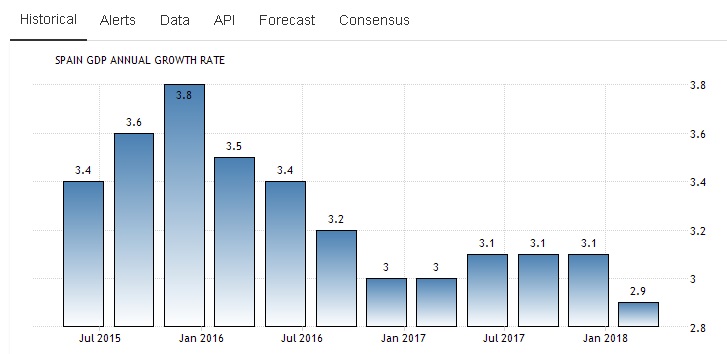
When we realise that none of the EU nations has a grasp on their debts, in addition, the GDP for Spain went down whilst it is still below the numbers of 2016 and before, there is actually no reason to see the credit rating for Spain go up. I am personally speculating that the EU will be so much more hardship when France hits the 100% debt marker. It matters, because this will soon become the academic exercise that the question: ‘What is the difference between cooking the books and creating a false positive wave through inflated credit scores?‘ I actually do not have the answer here, but I guarantee you that the quality of life in Europe is not moving forward any day soon, not until some issues are seriously reconsidered. In addition, the US-China trade war isn’t helping anyone, not even the Europeans so that will also become a factor of debate soon enough. It partially relates to “We have revised upwards our GDP forecasts, with an intense rate of employment creation and an economic model based on the external competitiveness of our companies. With this scenario, we will achieve our objective for 20 million employed people by 2020“, the issue is that it is misrepresentation, you cannot rely on the unemployment figures and then state we will have 20 million employed, because on a population of 46 million, he might be implying that the unemployment numbers will skyrocket from 17.4% in 2017 to 56%, that would be crazy, yet that is what we are told, is it not? The best lies (read: miscommunications) are done through statistics, so that the feather matches the bird one would say. Still, back to my speculation, I believe that Spain is not the only nation in this setting; I think that some numbers in pretty much every EU nation are beefed, weighted and set to make Europe (or basically themselves in the European setting) look much better, so when the UK leaves they will not look as weak and feeble as they have actually become. It is a setting that is way too dangerous. There is no way that Mario Draghi is not part of this, so when we look at the Financial Times of last week we see ‘Mario Draghi acknowledges ‘moderation’ in Eurozone growth‘ (at https://www.ft.com/content/3e20b49e-4939-11e8-8ee8-cae73aab7ccb). So with “Analysts said that Mr Draghi’s guarded language suggested that the ECB may wait until July — a month later than previously expected — to provide the markets with updated “forward guidance” on its plans to phase out the crisis-era stimulus“. I am a little less optimistic in regards to the quotes, and when we see ““Better safe than sorry was the motto of the day,” said Dirk Schumacher, economist at Natixis“. I personally tend to see that as:

Better safe than sorry
It allows for another day without worry
As we pile the worries and woes
To a stack we can blame on crows
Those at the London Tower are best
Because when they leave the EU we can make them the jest
And when our barge is no longer secure
We move to Wall Street where we can endure

You might think that I am merely making light of all this. The issue is that people in Europe seem to ignore that over €2,000,000,000,000 was printed without the validation of treasuries or consent of the people whose funds got devaluated even further. Do you think that printing money has no cost? It is money that the EU never had, so why did you think it came without consequence?

This partially (and I mean partially) is seen in different ways when we look at an article from Reuters merely two weeks earlier (at https://uk.reuters.com/article/uk-ecb-policy-draghi/stock-volatility-no-big-factor-for-ecb-so-far-draghi-idUKKBN1HG1VR) ‘Stock volatility no big factor for ECB so far – Draghi‘, now I agree that volatility will come and go, so the ‘so far’ part is perfectly fine. When we see ““While we remain confident that inflation will converge towards our aim over the medium term, there are still uncertainties about the degree of slack in the economy,” Draghi said in the ECB’s annual report“, now I can agree with that. There will always be a certain amount of uncertainty, that is all good, no issues there, but it is set on a certain premise. When we see that Spain (the only visible one) suddenly in opposition of what I see as real has its credit score increased and as such we see the start of an optional bubble, when others do the same we see the forecast on unreal values, so we see the bubble is not set to the reality of the actuality, at that point, when a lot more start realising that some numbers do not make sense, the uncertainty grows and the closer the UK is to leaving the stronger that uncertainty becomes. At that point we see a run and a total collapse, when that happens, when the people realise that pensions before 78 is no longer optional, do you think that the people will remain calm? When they realise the impact of €2 trillion printed cash is impacting the 26 nations, how much value decline will they face? When that happens, how will people react in all this? Now we get to two elements, one is the mention in the Financial Times where we see: “But the weak economic data for the first quarter have triggered increasing speculation that the first interest rate rise will be delayed until later in 2019. A smaller number of analysts are expecting the bank to continue QE into the new year“, the second is that the entire stimulus was to set the economy right, which did not happen, now set that against inflated credit scores, inflated economies and the downturn that follows, that will happen, it can no longer be contained, merely delayed to some extent. When it does hit Europe would not have a penny left to balance against and it will leave the bulk of Europe destitute. There would be no defence against the next downturn and that is when disaster will truly strike. So as the story is pushing towards ‘protectionism’ and ‘patent values’, we should also consider that impact. Now, as a University graduated Master on Intellectual Property rights, I do comprehend some of the issues, yet I am not a patent attorney, so there are parts that I will ignore or not look at. Consider that a national economy is now more and more dependent on the national patents and the represented value that they hold. Now we get European Patents, the Unified Patent Court (UPC) allows for a simpler way to get it all registered and to some extent enforced. So it is a good thing overall, there was never too much fuss about that side, yet the one strong economy (Germany) is now setting the stage to oppose the UPC, we see this (at http://www.ippropatents.com/ippropatentsnews/europenewsarticle.php?article_id=5725), where we also see “Alternative für Deutschland (AFD) has called for the repeal of the convention on a Unified Patent Court (UPC). AFD “rejects the EU patent law reform”, according to the German Bundestag, which announced the motion on 7 March“, I believe that overall the UPC is a good thing, but there will always be small interests that are not perfect, no EU setting is 100% positive, yet overall, to get one filing for all EU nations, in light that even the UK agreed (and ratified) is a good thing. So when we see “It was based on three grounds, mainly how the UPC Agreement violates EU law, the majority requirements of basic law, and does not comply with the rule of law principle related to judicial impartiality. The complaint was scheduled to be heard in 2018 by the second Senate, appearing as the 11th item on its agenda. In Germany’s 2017 federal election, the AFD won 12.6 percent of the vote and received 94 seats, the first time it had won seats in the Bundestag“, there is an academic setting, yet with 12.6 of the council in hands of the AFD, a very Brexiting minded party, or is that Berlout or Deutchleave, we need to realise that the patent issue is a lot more biting in Germany and that cannot be ignored, as they give rise to uncertainties. So when we get back to the uncertainty there, as well as other uncertainties, and whilst we saw Mario Draghi accept that uncertainty results in stagnation, how much more stagnations are required for the next downturn, even a short term one, whilst the economic reserves have been already been drained.

Now we have a much larger setting, the EU was never about everyone agreeing on everything and the economic setting that requires that to happen at present is also making the dangers of waves that sinks the barge called EU. Now, that seems like an exaggeration, but when you realise that the German anchor is the only one giving stability, you can see the dangers the EU faces and more important, the dangers of no reserves and an utter lack to keep proper budgets in place, a setting now in more danger for the reasons that I gave supported by the economic views of many others. I believe some are downplaying the impact, yet when we realise that EVERY European Union government is downplaying the economic impact (as every nation always wants to look as good as possible, which is a PowerPoint setting of the human ago) we get a much more dangerous setting. We accept that the smaller nations have a negligible impact on the whole, but on a ship that can only remain truly stable with four anchors, losing three is a much bigger disaster than anyone realises, and that downplay will hurt all the players that are part of the EU, so when the downturn starts, we will see kneejerk movements from all the nations, all the big players and we can only speculate the fear mongering speculations that the IMF will treat the European audience to. I have no idea what form it will take, but when it happens I will take a deeper look. In a setting where every negative economic milestone could lay waste to whatever reserves its citizens wrongfully thought they had in the first place.


2 Comments

Filed under Finance, Media, Politics, Science

The G30 court

There is an issue, an issue that we are all missing, more for the reason that after January 17th the media is steering clear of this with all the might and options they had. I reckon that they will spin this in a setting that it is ‘uninteresting‘, but when was it ever uninteresting to look at a group of 30 that has the alleged advantage of getting their fingers into a pool that has 0% risk worth billions?

The more important part is that there was one mention, or at least only one that was found, on July 7th 2017 and November 3rd 2017, both come from Reuters, the media has become that much of a bean flicking, pole pulling grape flocked bunch of pussies as I personally see it. Yet, the fact is that even as the impact is speculated, the setting given is that a group of 30 had an optional exclusive insight in the 3 trillion dollar ECB spending. Consider that each of these 30 got a 1% portfolio, where 75% of it was set at 0% whilst the remaining 25% might have op to 3% risk, in this setting the underwritten $31 billion for each member would set a speculated sanctified security of a multiple factors of $31 billion each. An elite group of 30 all having the top of the financial services cream at zero risk with the optional massive returns none of us ever had insight to. Now I can see that a mere 0.01% of that 1% would set me up for life, and that is merely the one source, the ‘in-crowd’, now would that be the incestuous insider towards untapped ‘considerations of investment‘ and they would all be bringing their own portfolios and economic insight on how to maximise that? Adding the man (read: Mario Draghi) spending Europe’s $3.1 trillion would happily be allowed into their midst, it is merely the setting that this rigs the game towards 30 participants whilst giving a weighted disadvantage to all other bankers is still an issue not covered by anyone.

So as we saw last November ‘ECB says not its call to publish content of Draghi’s meetings with financiers‘ (at https://www.reuters.com/article/us-ecb-banks-ethics/ecb-says-not-its-call-to-publish-content-of-draghis-meetings-with-financiers-idUSKBN1D327U) whilst we also see “At issue is Draghi’s membership of the so-called Group of 30, where policymakers meet bankers, fund managers and academics behind closed doors to discuss economic issues. He sits alongside former and current central bankers, such as Bank of England Governor Mark Carney and the Bank of Japan’s Haruhiko Kuroda, as well as Nobel laureate Paul Krugman

Yet even as we see “Ombudsman Emily O’Reilly had asked whether the ECB would “consider proactively informing the public of the content of these meetings” in response to “a complaint by activist group Corporate Europe Observatory, which said in January it was concerned about proximity at the G30 of ECB officials and bankers they are meant to supervise“, I cannot help but wonder what both Emily O’Reilly and Corporate Europe Observatory left unmentioned. It was also mentioned by the Dutch Volkskrant where the Corporate Europe Observatory (CEO) member Olivier Hoedeman added comment.

I tried to find more, so even as we have found Mario Draghi, Mark Carney, Haruhiko Kuroda and Paul Krugman as confirmed names (from the media), I initially believed that Groupe Credit Agricole (most likely Dominique Lefebvre) would be a member, I am also speculating that Peter Smith (as director of N M Rothschild & Sons) might have been a member of that group. There are a few other players, but it becomes increasingly less certain even from a speculated point of view. What does matter is that this is not merely some ‘secretive’ babble group. Even as we see last July “In a letter to Draghi that was published on Friday, European Ombudsman Emily O’Reilly said the meetings of the Group of Thirty, where central bankers, economists and financiers talk behind closed doors, are “not transparent” and questioned the ECB president’s membership of the club” as well as “Draghi has until September to reply to the letter in writing“, in that, the media and so called journalism stayed clear of this for the largest extent and the ECB did respond in October 2017 in the attached part. In my view, it all sounds nice but a select group of 30 with a pool of a number in excess of 6 trillion, where 30 people get first dibs on a risk bonus that goes beyond the comprehension of many and the media buries it on page 62 is a much larger issue, especially when the response on page 9 gives us “Moreover, Article 130 of the Treaty on the Functioning of the European Union safeguards the independence of the ECB and of the members of its decision-making bodies” whilst we all know that a mere fraction of $6 trillion has been a case for shifted morals and readjusted (read: weighted morals) in many regards, there are countless hours on C-SPAN that saw those liquid morals and settings in regards to the 2008 events, so the idea of ’30’ members ending up with golden parachute the size of Australia is not that much of a leap, speculated or not. So when we look back to the 2008 events and we see in January 2017, nine years later “The credit rating agency Moody’s has agreed to pay nearly $864m to settle with US federal and state authorities over its ratings of risky mortgage securities in the run-up to the 2008 financial crisis, the department of justice said on Friday“, whilst the damage from the 2008 crash was set to top $22 trillion, we should ask the US Justice department on where the remaining 21.991 trillion is and who was supposed to pay for that. So in all this the fact that the media is steering clear from the G30 and asking, or actually not asking anything past the Reuters articles seen should give alarm bells on many sides, not merely the media.

The EU Parliament magazine (at https://www.theparliamentmagazine.eu/articles/news/mario-draghi-under-fire-g30-membership), also gives us “CEO’s monetary and financial policy researcher Kenneth Haar said, “The Ombudsman’s decision is timely and very positive. Draghi’s involvement with the G30 was ill-advised from the start. Since 2016, when the ECB’s mandate for banking supervision was extended, the close ties between the president and the bankers’ group has become absolutely unacceptable“, or is that gave, because it is past tense and so far the media has remained silent since January 17. It seems to me (extremely speculative) that these 30 members are either connected or involved with the shareholders, stakeholders or advertisers in the media, because the media seems to be at all times protective of these three groups, whilst merely informing on those three groups in a filtered way, or to the smallest degree unless it was already out there in the field. The fact that this group has such a global hold is an issue and I might have been a lot less speculated on this, but the lack of transparency as well as the fact that we see “Tyga Gives Kim Kardashian A Hilarious Spelling Lesson On Social Media” and other Kim Kardashian on a daily basis, whilst the media remains silent on the speculated distributors of no risk trillions is a weird setting, especially when those sources have their fingers in thousands of billions. So when we see the BBC with: ‘Is it time we all unfollowed Kim Kardashian?‘, we might wonder whether it is yea or nea, yet there is a speculated 99.9999% likelihood that the G30 members will not make the cut towards monitored inclusion on following, I am certain that the first one that acts on that is has a boss who is likely (again speculated) to get a quick phone call from a shareholder, stakeholder or large advertiser to wonder if they have any grasp on their staff members and whether they want to manage or become managed.

Do you think that this is a stretch?

From my personal point of view I would give to you Sony (2012) issues, in regards to the change to the Terms of Service. The media ignored it, even as it would impact a group of 30 million consumers. Most of those players merely just trivialised it via ‘there is a memo‘ on it. The rest did even less; some even ignored it all together. With Microsoft (2017/2018) we see even more (at https://www.computerworld.com/article/3257225/microsoft-windows/intel-releases-more-meltdownspectre-firmware-fixes-microsoft-feints-an-sp3-patch.html)

You’d have to be incredibly trusting — of both Microsoft and Intel — to manually install any Surface firmware patch at this point. Particularly when you realize that not one single Meltdown or Spectre-related exploit is in the wild. Not one“, the amount of visibility (apart from marketed Microsoft Central views) is close to null, a system with no more than 17 million users is marketed and advertised to the gills, so the media seems to steer clear, merely two examples in a field that is loaded with examples.

Back to the group

So as I gave the speculated view earlier on the ‘whom’, we can see the full list (at http://group30.org/members), these members are according to the website:

  • Jacob A. Frenkel, Chairman, JPMorgan Chase International
  • Tharman Shanmugaratnam, Deputy Prime Minister, Singapore
  • Guillermo Ortiz, Chairman, BTG Pactual Latin America ex-Brazil
  • Paul A. Volcker, Former Chairman, Federal Reserve System
  • Jean-Claude Trichet, Former President, European Central Bank
  • Leszek Balcerowicz, Former Governor, National Bank of Poland
  • Ben Bernanke, Former Chairman, Federal Reserve System
  • Mark Carney, Governor, Bank of England
  • Agustín Carstens, Former Governor, Banco de México
  • Jaime Caruana, Former Governor, Banco de Espana
  • Domingo Cavallo, Former Minister of Economy, Argentina
  • Mario Draghi, President, European Central Bank
  • William C. Dudley, President, Federal Reserve Bank of New York
  • Roger W. Ferguson, Jr., President and CEO, TIAA
  • Arminio Fraga, Founding Partner, Gavea Investimentos
  • Timothy Geithner, President, Warburg Pincus
  • Gerd Häusler, Chairman of the Supervisory Board, Bayerische Landesbank
  • Philipp Hildebrand, Vice Chairman, BlackRock
  • Gail Kelly, Global Board of Advisors, US Council on Foreign Relations
  • Mervyn King, Member, House of Lords
  • Paul Krugman, Distinguished Professor, Graduate Center, CUNY
  • Christian Noyer, Honorary Governor, Banque de France
  • Raghuram G. Rajan, Distinguished Service Professor of Finance
  • Maria Ramos, Chief Executive Officer, Barclays Africa Group
  • Kenneth Rogoff, Professor of Economics, Harvard University
  • Masaaki Shirakawa, Former Governor, Bank of Japan
  • Lawrence Summers, Charles W. Eliot University Professor at Harvard University
  • Tidjane Thiam, CEO, Credit Suisse
  • Adair Turner, Former Chairman, Financial Services Authority
  • Kevin Warsh, Lecturer, Stanford University Graduate School of Business
  • Axel A. Weber, Former President, Deutsche Bundesbank
  • Ernesto Zedillo, Former President of Mexico
  • Zhou Xiaochuan, Governor, People’s Bank of China

They also have senior members, which is interesting as they are younger than at least one of the current members, as well as the fact that most of the members in the current, senior and emeritus group have multiple titles.

  • Stanley Fischer, Former Governor of the Bank of Israel
  • Haruhiko Kuroda, Governor, Bank of Japan
  • Janet Yellen, Former Chair, Federal Reserve System

And the Emeritus members:

  • Abdlatif Al-Hamad, Former Minister of Finance and Planning, Kuwait
  • Geoffrey L. Bell, President, Geoffrey Bell and Associates
  • Gerald Corrigan, Managing Director, Goldman Sachs Group, Inc.
  • Guillermo de la Dehesa, Chairman, Aviva Grupo Corporativo
  • Jacques de Larosière, Former Director, IMF
  • Richard A. Debs, Former President, Morgan Stanley International
  • Martin Feldstein, Professor of Economics, Harvard University
  • Gerhard Fels, Former Member, UN Committee for Development Planning
  • Toyoo Gyohten, Former Chairman, Bank of Tokyo
  • John Heimann, Senior Advisor, Financial Stability Institute
  • Sylvia Ostry, Former Ambassador for Trade Negotiations, Canada
  • William R. Rhodes, President and CEO, William R. Rhodes Global Advisors
  • Ernest Stern, Former Managing Director; The World Bank
  • David Walker, Former Chairman, Barclays
  • Marina v N. Whitman, Professor; University of Michigan
  • Yutaka Yamaguchi, Former Deputy Governor, Bank of Japan

So this group of 30 is slightly larger and in the group each of these members would have the power and economic impact to tell any member of the Fortune500 what to do, or better stated and more important ‘what not to do!‘ It is in that instance that we see the first impact. A game that now looks as I personally see it rigged in several ways; so even as I was allegedly wrong about Dominique Lefebvre or a direct peer, we see Christian Noyer. So in my view, in a 2015 French article on the issue of “Who will succeed Christian Noyer as head of the Banque de France?“, we see “Mario Draghi, the president of the ECB, seems to have had the idea to see his right arm go. Benoît Coeuré would be an important ally for the Italian in the Council of the Governor“, yet in the light of the G30, it seems to me that such a discussion would have been set into a pre-emptive conclusion of who would needed to have been made king in that castle. When we see that in light of a previous article, namely ‘The Global Economic Switch‘ (at https://lawlordtobe.com/2018/03/06/the-global-economic-switch/), were well over 500 billion is to be invested and grown, in addition to the fact that the SAMA has oversight to well over 2 trillion dollars, how come that they do not have a seat at the table? In the same way that the Rothschild’s are not there, but they might be ‘represented‘ through Bernanke or Frenkel, whilst it is not impossible that Mario Draghi might be giving them the low-down to some degree, yet the Kingdom of Saudi Arabia with that much money on the ladle of expansion, that they are not part of it. In a world where that group is about (according to their own website) “The Group of Thirty, established in 1978, is a private, non-profit, international body composed of very senior representatives of the private and public sectors and academia. It aims to deepen understanding of international economic and financial issues, and to explore the international repercussions of decisions taken in the public and private sectors“, where the foundation of Saudi Arabia has been the power of OPEC and the power to instil the push to be a global player in many fields, in that sight in represented value that the repercussions of decisions are set at, to see the Bank of Israel yet not some link to SAMA (Saudi Arabian Monetary Authority) makes equally less sense in the line of thinking that the ‘about‘ section gives us, which makes me wonder what these members are about. they might be all about that, yet what else they are about, or what else they have a useful value in gives rise to my train of thought on where this train with less than 55 occupants is heading off to, and more so, in light of the power that these ‘30’ members have, the fact that the G30 is not the cover talk of many newspapers, especially the Financial Times is beyond me, because anyone coming to you with ‘No News’ or outdated news, or even worse that there is no real issue in play is clearly told what not to write.

It seems to me that not only is there more in play, the personal speculated view that I have in light of learning more and more about the G30 merely confirms my suspicions, as well as the insight that I am getting (a speculated one) where the media is steering clear from all this is a much larger issue. To what and in which direction is one I am not willing to go into, because I know that the ice is wafer thin at this point and skating on water is a realistic ‘no no’, yet the feeling that these members are getting a first view and optionally the option to dip their cups on plenty into a grape juice barrel of risk-less profit is one that I feel is very much in play. This G30 group is networking on an entirely new level, one that I have never seen before. This is not some kingmaker into presidency; this is a long term group where the optional billions will keep on flowing for decades to come. And this all in a setting of non-transparency, because this goes way beyond the 3 publications in 2016 and of course all those papers published before that. In the 2016 publication ‘Shadow Banking and Capital Markets: risks and opportunities‘, (at http://group30.org/images/uploads/publications/ShadowBankingCapitalMarkets_G30.pdf), we see in the conclusion on page 49: “Moreover, growing leverage across the global Economy can create important risks to macroeconomic stability even if the financial system itself is more resilient. And two developments are particularly concerning: the growth of emerging market foreign currency debt and the rapid growth of Chinese leverage accompanied by a proliferation of shadow banking activities are ominously reminiscent of precrisis developments in the advanced economies“, which is in view of the experts would be nothing new, yet resources available and the 36 exhibits and the recommendations would have been available to the G30 group much earlier than anyone else. In that light, we need to wonder not merely on the setting, in Exhibit 36 we see mortgage losses and the fact that there is the US, Canada and Europe, so in that light the fact that the fourth one is the Netherlands, is that not odd? In light of several settings, France, Germany, Italy and the UK, any of these four would have made perfect sense, so why the Netherlands? Exhibit 33 might have been a reason for this, yet in equal measure the absence of Scandinavia and Italy in this setting now adds to the questions. I think it is not merely choice and presentation, the absence of those players give rise to questions, perhaps even speculated questions and as there are none to be given, it makes me wonder what else is missing, what other data was filtered because in the light of data and presentation there is one golden rule I have always kept in the back of my mind.

The Analyst shows you which investment needs to be made, the presentation makes you look forward to the invoice.

So what invoice is the G30 group making you look forward to and where did it need to go? Two questions with optionally very different results, and in that setting, whilst you know the impact the European economy has had over the last 15 years, whilst we also know that Mario Draghi has been spending $3 trillion, in that setting the G30 does not make the news?

Who is getting fooled by all this and who is getting fooled by making sure that you do not get to notice this?

It is a much larger playing field that is from whatever point of view you have a field of inclusion, or a field of exclusion, yet in all this there are questions that are not asked at all, questions that even I am not asking because I decided to go into technology, engineering and law whilst giving a pass on the Economic subjects. Yet the Financial Media is not asking them either and that is an issue, especially in light of that ‘secretive‘ group set to a stage of networking inclusion, or is it networking through filtered exclusion?

I’ll let you decide on that.


Leave a comment

Filed under Finance, Media, Politics, Science

A linguistic joke

The British Metro came with a hilarious article a mere 12 hours ago. The quote is not enough; it already starts with the title. With: ‘British children aren’t learning foreign languages after the Brexit vote‘ is just too funny. We can clearly state that they were not learning foreign languages before Brexit either. To be more precise, not for decades! And, why should they? Now, let’s be fair, there is a benefit to learning languages. For the Dutch it is essential, because only the Dutch (and perhaps the Flemish) can understand the Dutch. So they (me in my youth) got to learn German, French and English in our first year of secondary school. I dropped French in favour of Physics and continued. In the years that followed I learned a few more languages, and as such I can get by across the planet. It was only in Asia where I learned that English is not a language that was used much, yet until that moment, I had learned that nearly everyone spoke English (except the Americans, they have a weird variation on it). So from that point of view, and when you see “The council claims the lack of language skills is holding back international trade performance by nearly £50 billion each year and worries there could be a gulf once the UK leaves the EU“, I merely reply that I want to see evidence here! I want that the British council to show actual data proving this, because at present, the British council is showing to be a joke. This joke is personified in Schools advisor Vicky Gough who stated “At a time when the UK is preparing to leave the European Union, I think it’s worrying that we’re facing a language deficit“, well Vicky, for your information the Brits have always been language deficit since before World War 1, so we can agree that your logic is faulty at best. This is followed by “And I think without tackling that, we stand to lose out both economically, but also culturally. So I think it’s really important that we have a push for the value of languages“, I will agree that she has a case on the cultural side. There has always been a cultural benefit to knowing languages that much we can all agree on. But in this day and age, should we focus on the local languages (German, French and Spanish), or should we concentrate on the global economic area languages (Hindu, Chinese, Arabic and Japanese)? That is a much harder consideration to make. You see do you cater to your local setting or are you catering to a workforce to become global. This is not an easy question to answer, because the planet is in flux and what is now wisdom might be folly in 5 years, so after 6 years to truly have linguistic skills in some areas; those areas are no longer viable as international players, so how does that pan out? So when we see “A report by the British Council claims Spanish, Mandarin, French, Arabic and German are the top five languages the UK will need post-Brexit“, my view seems to be correct, yet in what setting? The Spanish only speak Spanish (for the most), so why adhere to that side? So why would the UK need German and French? Most of them speak English and hiring a foreign national in your company is likely cheaper and more productive, that is if you have quality business with that nation, if not, why bother? At that point, the article comes with an interesting view “One pupil studying Mandarin at London’s Alexandra Park School said: ‘We can’t just presume that countries are going to learn our language, because if we don’t do the work why should they?’” It is a good point, but those people also realise that Mandarin is one of the most complex languages in the world and if you are not born in that environment you start with a large disadvantage. Now, there are plenty of reasons to study Mandarin and learn the language, but on the premise that it might lead to a job is long term folly, taking the language up when you are to be in China, perhaps even after you arrive makes a lot of sense, perhaps more sense. Now, we can see that the only way to do business in Saudi Arabia is to learn Arabic and plenty of brits trying to make quick bucks are up to the challenge, but that nation has its own set of rules, customs and culture and those all need to be taken in, merely learning the language will not get you there, so in my view, not only is the article to some part a joke, it is merely another jab at giving stress in relation to Brexit. So, until Metro publishes clear evidence from the British council that the UK is missing out on 50 billion, the entire matter is hilarious and folly at best.

And it is merely one of several articles. the Guardian with ‘Britain’s tired old economy isn’t strong enough for Brexit‘, Computer Weekly with ‘We must avoid the Brexit risks to London’s tech community‘, and Clean Technica with ‘Current State Of Brexit Likely To Leave UK Environment Worse Off‘, all fearmongering, and Social Europe is giving the people: ‘Reversing Brexit: Legal Route Via Vienna Convention‘. Social Europe is actually setting the premise to protect bankers and the IMF. I have not seen such levels of what I regard to be deceptive and naive conduct since the British Prime Minister, Neville Chamberlain, who stated on September 30th 1938 that the British people would have “Peace in our Time“. Do you remember what happened after that? In the end, on the Allied side alone, up to 3.7% of a population of 2.3 billion ended up dead, both military and civilian, excluding 7 million Germans and 26 million Russians. I think that fearmongering and the naive approach to all this needs to stop.

It was never said that there was not going to be a hard time, but it seems to me that the financial sector has now become so afraid of losing the ability to fulfil their greed driven needs that they are using every media outlet to spread the fear and see if they can get a recount whilst getting at least 4% into the Bremain group.

In all this, the Guardian article makes a decent point, but does so by keeping certain parts unmentioned. With: “Manufacturers were unable to make things cheaply, reliably or efficiently enough against the headwind of a high-value currency, forcing many to give up. An economy that boasted 20% of its income coming from manufacturing in the 1980s found it was the source of barely 10% at the beginning of this decade” they are telling you the truth, but they do not tell you that opposing this were China, India and Japan, with almost no labour laws, whilst both India and China had no protection for child labour, so these nations made goods with 90% less costs, giving them a large advantage. Even now, in 2000 some sources gave us that there were approximately 11,500,000 children at work between the ages of 10 to 14 in China. This violates article 32 of the Convention of Rights of The Child. So if the Guardian article was being fair, why not mention these parts that clearly impact it all in a negative way?

So as we see the linguistical joke that Metro brought and the additional articles that raises questions as they go overboard not mentioning things, we need to consider why such presentations are not clearly shown by the media. Even the IMF is involved in all this, whilst their prediction have been wrong regarding the UK three times, so should they be given any level of reliability as they try to downgrade the UK, whilst upgrading the other European Nations for 2018? I know that this might be a hard year for the UK, yet as the stimulus train called ‘the Draghi Disaster‘ is running its final stage, the moment that ends, will spell even harsher environments for Europe and particularly France who could see a downturn of their economy for 0.5%-0.75%, this implies that they will barely be above 0% for the three years that follow. In this I might be equally wrong. Even as France24 (at http://www.france24.com/en/20180122-macron-hosts-140-business-leaders-versailles-investment-france-economy), predicts “Economic growth has been forecast to rise to 1.9 percent in 2018 by the central bank”, which is already slightly too positive. Even as it books the Toyota move into the positive, France will soon realise that at this point Toyota is likely to push for additional rebates beyond the 25% corporation tax (as is Microsoft for 4 new data centres), which will closer to the end of this tax year will show up in the news as ‘unfortunate bad news on the economy due to a miscalculation’, it is not the first time and the French are not the first to do this. Yet in that, we can see that the IMF boast is overly positive towards Europe, implying that the view from that point shows the UK economy as stated to be overly negative. I personally see it as another ploy to undermine Brexit that could bite them in much harsher ways down the track, if the media is actually able to show some balls standing up to large corporations.

So even if I see the linguistic joke as a large one, there is no denying that France is clearly opening its doors to certain people and in only that moment there is a sense of truth in the words Vicky Gough, yet what is equally not given is that this is the first time since I started my first job in 1979 that such a view is given by France. With the graying population they are not the only ones doing that and as such the working population will make a drastic change, I cannot predict how it will filter out for France, but at least Emmanuel Macron is making active changes to an ancient unyielding protocol and that might be the best news of all for France, that alone could spell my realistic numbers to be slightly less positive than the actual numbers will turn out to be.


Leave a comment

Filed under Finance, Law, Media, Politics

Strike a match

In Australia, an island with plenty of drought and as we go into the really nice and warm season, a match is not a thing we look fondly off, yet the strike of the match as we see it in France, where it is now uncomfortably cold is another matter. So is it ‘Strike a match!‘, or ‘Match a strike?‘, the strike called on regarding labour reforms could be the one that sets flame to that nation and set flame to whatever growth economy the French think they have. Reuters (at http://www.reuters.com/article/us-france-reform-protests/frances-cgt-calls-another-strike-against-labor-reform-others-refuse-idUSKBN1CE2CH) give us “the more moderate CFDT, now France’s biggest union, and the Force Ouvriere preferring negotiations” these two are starting to figure out that the long protected labour rights in France are to ancient. With a mobile workforce all over Europe, it will soon be about taxable products and services no matter where they are and as such France is pricing itself out of a market of workers, faster and faster. The weird part is that France has so much to offer, so the fact that the economy is barely reaching +2% for the longest time is less puzzling and is more and more about the uncertainty that the labour laws are bringing entrepreneurs. Now, I am all for protecting the workers over greedy corporations, yet the draconian shape that it has in France is stopping new waves from moving towards France. French publication ‘the Local‘ (at https://www.thelocal.fr/20171009/france-how-tuesdays-mass-public-sector-strikes-will-affect-you) is giving us “with particular reference to the pay freeze and rise in social security payments, plus the government’s controversial decision to dock pay for the first day of sick leave (jour de carence) to fight against absenteeism“, this implies that former president Hollande has been asleep at the wheel. The changes imposed are to some extent to top the coffers from taking too much of a hit and with minus 2.6 trillion Euro the French coffers need all the help they can get. In this, many newspapers are all about how the appeal of President Macron is wearing thin, yet the bulk of issues that we see in a few fields are ignored to a larger extent. So, when was the last time that a corporate CEO got time with a national ruler to discuss national taxation? Because that is exactly what Tim Cook CEO of Apple seems to have been doing in France. With one source giving us “So, when Tim Cook meets with French President Macron, the matter of taxes could make for an icy situation between the two men. Macron has said he wants to promote France as a place for tech companies to set up shop, but he has also been critical about the role internet companies, in particular, play in society. Macron has been pretty vocal lately about how France and other E.U. countries should close up the loopholes that Apple and other tech companies have been able to use to move their earnings around to more tax-friendly countries, such as Ireland and Luxembourg“, is it a first indication that the French economy is in a much worse shape than expected? The fact that Tim Cook is visiting Élysée Palace not because President Emmanuel Macron is buying his wife the new iMac Pro (an assumption from my side). I am not thinking the worst of the French president, but the issue is questionable, especially as Apple is about to open a massive site in the Battersea Power Station, so as Apple (as I personally see it) is trying to spend the money twice, once by spending it in London and the second time by getting tax deduction for the amount just spend in London so he can get a second building for free in Paris. We see too many people in charge giving in to large corporations too easy and too often. Mostly merely getting it done for their ego’s whilst they sell short the needy coffers of their own nation. They present it as the cost of doing business. Corporations like Apple can merely offer to go somewhere else and the politicians fold like wet paper backs, no hard backs amongst them. As Apple is now getting the news to invest in several nations, $10B for a plant in Wisconsin, $500M in China and as we now see (at http://appleinsider.com/articles/17/10/10/detente-possible-between-tim-cook-macron-over-apples-future-taxation-in-france-eu) “Macron’s staff report that past tax disputes weren’t discussed in any way, but Cook acknowledged a sea change in how companies should pay taxes specifically where they are earned, and not in one country to cover the entire EU” is just one side, so as we also see “Apple continues to deal with a ruling by the European Commission, which will force a $15 billion payment of back taxes to Ireland —when the Irish government gets the disbursing fund established. Ireland disputes the ruling, and says that Apple has paid all of its required taxes. The European Commission is suing Ireland for the lack of collection, and to force the issue“, an issue that has played for the longest time. And every time when I see that politicians are ‘offended’ by the lack of payments I wonder how they are selling the lack of their treasuries to the Irish people. Ireland must be the richest nation in the world when it regards a non-paid $15B as not an issue. So whilst public services are lowering in Ireland and as we see “Sinn Féin’s Finance Spokesperson Pearse Doherty said, however, that the government has failed spectacularly with today’s budget and suggested it was a lie to suggest you can cut taxes and solve the problem of the health and housing crises” (at http://www.irishexaminer.com/breakingnews/ireland/donohoe-defends-tax-cuts-despite-growing-pressures-on-public-services-809339.html) whilst there is an apparent issue with Apple’s outstanding $15 billion, we need to wonder on who the politicians are actually working for and who pays their income. Questions the media seems to walk away from. Yet this was not on Ireland, this is about France and the labour issues. It seems that Ireland and France are labour opposites. As Ireland is showing itself to be more flexible than a slinky in a hurricane, France is showing their flexibility to be zero degree Kelvin, which could remain detrimental to the financial growth of France in more than one way.

So as France is now huddled into a posing form of strikes all over the place, we see that emotions run high, so high that the French decided to release teargas, so that the people could cry over the matter. So as we see the news that 450.000 travelers are feeling the consequence of the French not agreeing with the labour overhaul, we need to consider how its impact is on the long term. You see everyone forgot about Marine Le Penn. After she was not elected, all the people thought they had evaded having to bite the bullet, yet in all this; the issue is not what had been surpassed, but what can haunt again. Instead of the media trying to figure out and illuminate what Front National had in store, with actual answers to how the issue could have been solved, the media bombards Macron again and again, the issue is not what happens when Macron fails. The issue is that when the dust settles, there would not be a long election, the labour parties would jump on the Le Penn bandwagon in a heartbeat leaving no options for France at all. The entire ‘Status Quo’ debate could quite literally blow up in their faces and when the next smear campaign starts, the people will in unity ignore the media to the largest degree. So as we see the nonstop battering of the strike and how bad Emmanuel Macron is doing, they are equally ignoring the fact that none of the other politicians have any better a clue or an idea on how to solve certain matters, which means that Front National is currently swimming free setting up whatever they want. Because the people might have shared some enthusiasm with some young sprout now President of France, but that trick only works once. In opposition, I doubt that Marine Le Pen has a clear path on how to fix the economy. The IMF is actually assisting her as we see Bloomberg with ‘Raising Taxes on the Rich Won’t Necessarily Curb Growth, IMF Says’ (at https://www.bloomberg.com/news/articles/2017-10-11/raising-taxes-on-rich-won-t-necessarily-curb-growth-imf-says), yet even as we see “The IMF report comes as governments in advanced economies face a backlash against the effects of globalization and technology. Voters from France to the U.K. have expressed frustration with what they perceive to be the unequal benefits of free trade and open borders”, the bandwagon that the IMF offers is equally a much larger problem. Even when we ignore the actions of Depardieu moving to Russia, the media has bungled the events for the largest degree. You see, as I mentioned before, whilst media is staring at the ‘super wealthy’ and giving rise to emotions of more inequality in an age where the people are pointed in the wrong direction by the media at large. Yet this group is a mere 330,000 souls large last year and less than half a million cannot supply the multiple billions (read: Trillion) that the treasury is already short of and the IMF knows this. This is the UK, in France, where less than 1% pay at the rate of 45%, we see an implied group of a little over half a million making it into that group. The reality that the IMF is selling is not realistic and everyone with spreadsheet skills can see that such a small group cannot address the trillions of debt that France has, so as we see that growth might not seem to e curbed, the issue is that the infrastructures are starting to collapse. In the UK the NHS is pretty much the most obvious example, but in all this France has a few issues of their own and none of it will be resolved until there is a fair setting of corporate taxation for the larger players who leech their zero tax vie Ireland and other options; options that the local shops can never rely on, which growth business inequality even more and a lot faster. Is it not weird that the IMF is in total denial through carefully phrased messages like “When it comes to corporate income taxes, the trend in lowering corporate tax rates is a pervasive trend overall in the last few decades. That is something which is often attributed to tax competition. There is, however, the interesting finding that this reduction in corporate tax rates has not been, in general, matched by a fall in corporate tax revenues”, which in my view means ‘corporate profit can be maximised through lesser taxation and increased production’, which is not for the corporations, but working a person to death whilst there is no quality healthcare is equally detrimental to the health of any nation. So how is that an option?

History has shown that again and again. This we see in the Guardian as it reported “Union leaders said they wanted to show a “profound disagreement” with the president’s plans to overhaul the state sector“, yet where will they go? That is the part the players are all ignoring and in this the media is one of the players. You see, we have seen quotes like “The main reason they voted for him was as a default, as a barrier against the risk of a Marine Le Pen fascist, far-right government“, yet when he does not deliver and as the failings of the left are stacking up. Where do you think the unions will go? They too require being ‘in power’ and they will align with anyone who gives them what they need to stay in power. The media has forgotten about that, or did they? That is the issue because the people at large are not in the know and when the bottle boiled over, they are in the ‘not caring’ team, which allows for a load of misinformation and the official media channels have lost the levels of reliability they need, they lost it the day after the election, especially when the failings started to show. So as the media blunders its way by blasting their current president, they forgot to notice that they have painted themselves in a corner. The question becomes: ‘Can it be fixed?‘ I am not certain, I actually do not know how some of the channels can regain the faith of their readers, that becomes the issue more and more and when that is too late, may Marianne symbol for the French people help them, because the others will not care and that is actually a lot more dangerous than any President Le Pen (should that ever happen).

So as we strike a match under the newspapers misstating our needs and matching the strike workers by educating on the dangers they are setting themselves up to, we might get some actual labour law evolution. President Macron is not wrong in the path he is taking. He is merely ignorant of the French population and their sentiment in certain matters. In that regard he has been a member of the Wall Street population a little too long, and regained his French feeling of solidarity much too short (as I personally see it). So this will not be resolved any day soon I reckon.

1 Comment

Filed under Finance, Law, Media, Politics

30 seconds until death

That is what goes through my mind right now. What happened in the last 30 seconds, whilst American Airlines Flight 11 and United Airlines Flight 175 were heading to their prospective targets? The people who got to call one more time, those 30 seconds. You see Greece seems to be in that very same place. Whilst Greece is under crushing debts and payments, we see ‘Greece eyes market return as debt dispute still simmering‘ (at https://www.washingtonpost.com/business/greece-eyes-market-return-as-debt-dispute-still-simmering/2017/06/28/3c3124c4-5c14-11e7-aa69-3964a7d55207_story.html). When you see quotes like “Now those so-called yields are tumbling, a real sign that investors think lending to Greece is a viable option. Once Greece is able to borrow markets in the bond markets to fund its debt repayments, then it won’t need any more bailout cash from its creditors” you would see that Greece has reach the end of the rope and the financial institutions are ready to make one more killing in bonuses before killing of Greece.

So as we read: “What happens in the longer term is still the subject of heated debate“, we do get introduced to the fact that Greece will be adding debt to the total crushing debt it already has. It reads nice that we see a feigned humane IMF with “The IMF has stayed out of the current program, Greece’s third bailout, arguing that European lenders are setting unrealistic targets for the Greek economy instead of considering more generous debt relief“, you see the issue is that the lenders are commercial institutions, the IMF is not getting involved because it is money down the drain. We all know that. As far as I can tell, the next two generations will still be in an atmosphere of not being able to have a decent life. The second part “if the gap had narrowed, Delia Velculescu, the IMF’s top official for the Greek program, said: “We’re not there yet.”” So, even as the debt gap is not being traversed, Delia Velculescu knows that it is not happening. Yet new bonds will get out. And as I was attacked on that my premise was wrong, we see “She said it was “simply not realistic” to have Greece run a budget surplus after debt and interest payments of 3.5 percent of annual GDP over the coming few years, and 2 percent for the decades after” a statement that is misrepresentative, yet from that we get some figure, when the last GDP was set at 195.2 Billion (2015), that means that Greece will need to cough up 6.8 billion annually and 3.9 billion, which is merely the interest on the outstanding debt, for decades annually thereafter and that is only if the elected individuals don’t take a shortcut and borrow themselves in a corner all over again. And all this is coming from a population of 10 million people. So how many of them are paying taxation? How much taxation remains for the infrastructure? Now that we see the fallout gone, we see that the Greeks would have been better off outside of the Euro the moment they had that option. Now it will soon become the anchor that drowns them. And as the population ages, the tax incomes will dwindle even further. From my reckoning, their best position was 2 years ago, now as the curve of retiring people increases, the Greek government are in a pickle with no actual solution. There is every consideration that being a politician or a governmental official in Greece is soon to be the least wanted job in that nation. As I see it, the Washington Post gives us a story with caution, one that is more than a drama about the death of a nation. In addition, there is one element we all forget about. The element is Cyprus. Now, there are no real hopes that the Cyprus edition gets resolved, for the mere reason that the Greek part of Cyprus ads to that Greek GDP, as such Greece would never allowed it to be independent. Turkey might be in a similar state, but here it is about Erdogan’s need for territory. None will budge an inch, so as both sides are talking (read clashing) in the Swiss resort of Crans-Montana, we have to consider how this plays out. As I see it, with the current president of Turkey, it is entirely likely that a replay of the 1974 events will happen. That truth is partially shown in a separate Guardian article where we read: “Overall there is a sense that Turkey does want a deal. It knows it could gain a lot of goodwill out of it,” one well-briefed source said. “It’s going to require patience. The Turks tend to stick to their guns until very late in the day“, that is a likely scenario. I am more in a state where I expect things to be quiet for 10 days and after that Turkey does a 180 degree on the policies they were considering or might have implied to agree with. They are hoping the rest will not go to war over the 180 as there are too many issues playing for too many other nations. Turkey is not known to be a considerate nation; the entire escalation of Qatar is evidence of that, as are their actions in Kurdish Turkey.

The next part is weirdly enough from the Express, it was not my first choice, yet they make an interesting claim that I have not seen brought out anywhere else. The title ‘ECB WARNING: EU on BRINK of being ripped apart as Greece, Spain, Portugal inequality grows‘ is a known event, yet this was always going to be the case. In addition, we see two quotes of the EU favourite spending person, Mario Draghi. He gives us “ECB chief Mario Draghi claims inequality driving problems across European Union” and “Mario Draghi has warned jobs must be created across the EU“, which is exactly why we wanted him to stop spending 60 billion a month, money that was for all intent and purposes created out of thin air. He sounds all nice making the claim that ‘jobs need to be created’, yet when there is no economy, jobs cannot be created and the Greek solution where nearly everyone works for the government is also not a solution. The final gasser is given with “Policies in single member states will also help to bridge the gap, he claimed, asking individual leaders to propose better income and wealth redistribution policies“, the man who has been the centre facilitator for large corporations and set the astronomical income for financial institutions to debate ‘wealth redistribution policies‘. I can compare it to a man walking into a brothel where all the girls ask him whether he saw their virginity, because they lost it somehow. As far as I can see it, he is raising these issues as factors that will instigate fresh recessions, this is why he claims that the “The ECB’s ultra-easy monetary policy, designed to strengthen Economic recovery, was defended by Draghi. He said super low rates create jobs, foster growth and benefit borrowers“, the entire mess is what keeps the banks running, not the people. In all this Greece is in corner wearing a dunce cap. The fact that Mario Draghi made the claim earlier this week that Greece will not join the Quantative Easing program (QE) shows that the ECB has no faith that the Greek issues will be resolved, so as I personally see it, Greece would be allowed to sell more bonds just to push the percentages up again, which is not the view of a restoring economy, merely the near death of one. They are getting out of Greece what they can before it is too late. As you will see the news that Greek bonds are back, consider the question, who will be receiving the 4% sales commission and walk away whether it collapses or not. 80 million over a 2 billion bond hike is still a lovely sum, it would keep me in Ouzo and Raki for the rest of my life, which is unbalanced in more ways as the Greek population will be left without such options for 2 generations to come.

The news actually intensifies as per today, the NY Daily News (at http://www.nydailynews.com/newswires/news/business/greece-planning-return-bond-markets-ecb-article-1.3287503) , the news has become this desperate for Greece and the Greeks. The quote “Greece will return to financing itself on international bond markets with or without the support of the European Central Bank’s bond-buying program, the country’s finance minister said Thursday”, this will merely create chaos and the moment the bods are sold, the percentages will go through the roof. So as we now read that the ECB is not giving any support to one of its members, does anyone out there still doubt the need for Brexit? In my view Greek Finance Minister Euclid Tsakalotos is playing a very dangerous game and the only one he will hurt for generations is Greece and the Greeks. So when I see: “What we need to do is ensure that the investment community knows there will be a program of access to the markets”, which is delusional, because Greece is no longer a player, the previous administrations made very sure of that. Unless you find the next truly new idea, Greece is no longer a player. The Greek governments (past and present) made sure of that and the weird false information we see in some cases have been false nearly 100% of the time, this is not a great track record to rely on. The entire move of upgrading Greece to ‘Caa2’ was a mistake. I wonder when other EC governments demand that Moody presents the raw data and the findings on the entire upgrade process. How many holes can we see in that assessment? Do I need to remind you all that Moody was one of the so called ‘key enablers of the financial meltdown’? At https://www.gpo.gov/fdsys/pkg/GPO-FCIC/pdf/GPO-FCIC.pdf we see: “Moody’s put its triple-A stamp of approval on 30 mortgage-related securities every working day. The results were disastrous: 83% of the mortgage securities rated triple-A that year ultimately were downgraded”, that is the same place that now upgrades Greece, whilst the last time Greece went back on the market it became a disaster and someone ended up with a 50 million bonus. So is that the source of acceptance? In all this we also see Nasdaq throwing speculative fuel on the fire with “There was some speculation about a rating upgrade, but what was really a surprise was that positive outlook, giving a chance for another upgrade” (at http://www.nasdaq.com/article/greek-10year-yields-hit-lowest-since-2009-after-moodys-upgrade-20170626-00205), so based on what is that, because Greece basically has no future, not with this debt. Can we allow the European Community to sit idly by proclaiming to be one whole continent whilst it hands out trillions of euros over these two waves of unadulterated spending? A spending that is not based on inferiority of substance, yet 100% flawed. In all that spending Greece is not considered, they must rely on the exploitative vultures of the Bonds world. As I personally see it ultimate proof that Greece is being fed to the vultures. So whilst we read about Mario Draghi mentioning ‘wealth redistribution policies‘, we see that Greece is taken out of the mix. Is that a Europe you signed up for? The United Kingdom did not and it is moving out. As France decided to trust an investment banker as president, they now lost that option to seek an actual national identity. Even as we see reports that Italy is moving away further from leaving the EU, there is no doubt that the coming year will be crucial to Italy. Apart from a collapsed banking system, the pressure due to refugees keep on upping the levels of pressure in Italy and as  such something will buckle, it is merely a question of time, yet how this will unfold cannot be stated at present, it is an unknown. No matter how this plays out, it will not make issue better for Greece, it merely will push economic opportunity down as European pressures mount, the inequality in Europe not being the smallest of issues. That view is enforced from Spain, even as the economy rises slightly, we now see reports from Madrid giving us “under-24s earned on average €11,228 gross, a 5.1% drop on the previous year. The 25- to 29-year-old range earned €16,064, a 1.6% fall on 2014, while the 30- to 34-year-old group earned €19,597, 3% less than the year before. Finally, those aged between 35 to 39 were paid €22,397, a 2.3% drop on 2014”, so as a few more people enter the work force, they end up getting less than the ones they replaced (source: El Pais). This will also drag the quality of life down more and more as the cost of living is still going up. In all this Greece is passed by on both economy and quality of life. It is another piece of evidence that the speculated foresight for Greece was wrong and incorrect and I fear for the Greeks who have to pay for the fallout that follows the next bond ‘rush’.


Leave a comment

Filed under Finance, Media, Politics

As an election looms

Finally, we get some words on the Labour manifesto, the Guardian has been on top of it and whilst they are presenting a good part, I have a few issues as they went a little light on labour as I personally see it. Again, it is a personal side and as a conservative you should take into consideration that the flaw is on my side, and I would accept it, but let me give you the goods.

The entire review is at https://www.theguardian.com/politics/2017/may/16/labour-manifesto-analysis-key-points-pledges, so you have the option to completely disagree and seek your own version of their vision. The first part “a short note on a new £250bn “national transformation fund” implies that these costs will be funded through capital borrowing” shows their intent on rail, which is a quarter of a trillion through borrowing. So off the bat we are considering electing someone who wants to add a quarter of a trillion to a debt that went off the handles due to the Labour party in two previous administrations. How is that ever a good idea? a chunk of all the other parts is supposedly coming by adding a new tax group of 50% for those earning above £123K. A marginal addition for the ‘fat cat’ group. So those making more than that will be charged for the amount above and I have a hard time accepting and believing that this will get them the ‘speculated‘ £6.4 billion. It reads more like wishful thinking in an age where rationalism will not ever get you that amount. Consider, as mentioned before, something that any excel user can check with the numbers the UK tax office (HMRC) offers, the super wealthy, those making well over a million is limited to less than 5000 people. So how is this billion pound extra achieved? Let’s not forget they only get the 5% extra over the amount over £123K, as such the income will not get close, yet after the election they will come with excuses, whilst we already knew that this was never realistic. In addition, how many are close to the threshold? In this those making £123K – £199K, they might feel safer setting apart certain investment reserves into retirement, if they get that done, the £6.4B will drop fast by a lot. In addition, the Guardian gives us: “But recent evidence from the imposition of a 50p rate in 2010 shows that the measure could spark mass avoidance by the individuals affected and raise no extra funds for the exchequer“, so there is that part too! Remember Jeremy Corbyn and his nurses? The 10,000 nurses pledge? When we consider the already announced part “Health and social care reform at a cost of £7.7bn, as part of a package that includes a guarantee of A&E treatment within four hours and the end of the NHS pay cap“, and the “Free lunches for pupils as part of £6.3bn school package“, that’s another 14 billion, where is that coming from? Remember the tax increase part? When we tally, we see that the NHS part is already leaving the tax increase at minus a billion, all the other multi billion pound parts are not even close to being addressed. This is simple tally stuff that many in their final year in primary school can achieve from their calculus lessons and Jeremy Corbyn and his ‘raunchettes’ cannot deliver, a mere exercise in lewd offensive spending. Choices without proper merit and ignoring the consequences of the deep debt they got the UK in in the first place. I am all for some level of social levy, yet any social act requires to consider the impact, something that UK Labour is clearly not doing. It is even more upsetting that simple calculus gets us to a place where this would never have been a reality to begin with. Are you seriously considering voting for such a failed attempt?

When we consider the added Cyber security, and the promise to the security agencies, we see items that are promised without any claim to the cost. Now we might accept that part, yet their own £11.2 NHS IT fiasco should clearly show that they haven’t got a clue on how to tackle it because the limitations they imposed through failed IT is part of the reason that NHS IT is not up to date in the most meagre of ways which is also exactly part of the reason that the NHS hacks were successful in the first place. In addition the entire pension part is flawed, that is a given not because of what it states, but when you compare it against the Australian need to already up the retirement point to 67, with a population of 20 million, that is a retirement change already needed now, the fact that the age wave will hit with almost 4 times the intensity in the UK and the retirement age will not significantly up for another 6 years is delusional and as I see it set so that the current Labour electorate can ignore the issue until the next election, at that point it will be way too late and they will offer some diluted solutions using capital borrowing adding another . I see it as we now need an estimated £75bn a year, it is anticipated a near doubling before 2025. You see, some of the statistics have been placing comparison of life expectancy and percentage of retirement, yet as I see it, the quality of life for those born in the 30’s and those born in the 60’s is vastly different. the difference of those two groups is that maximum life is more likely to be in excess of 20 years, so those born in the 60’s and onward have a much higher chance of requiring a pension for close to 20 years longer, on a population of millions, that would equate to an additional pile of billions that would be required. In this the setbacks that the financial meltdowns gave all the people and government institutions, it shows that the shortage will increase and the pension deficit will increase annually by a lot over the next 5 years alone, so not seeing any repair actions is just weird. So as labour proclaims to be ‘social‘ their social unawareness and unpreparedness is just a little too upsetting. Now, the Tories are not innocent either. There is a given shortage and getting rid of the debt is a first step in solving it, so as we see that Labour is now willing to add close to half a trillion to the total shortage and that is just the added shortage of what they want to do to look cool. The added deficit will go straight through the roof adding overall a lot more debt than anyone is willing to consider.

And it is Labour of all others who have no welfare support. they promise a future policy paper, but the overall issue is not that paper (it will be though), it is “There are no spare funds in Labour’s calculations for extra welfare spending. To counteract the effects of planned cuts, under Labour’s current plans it would need to increase borrowing“, so that implies even more borrowing, whilst they amount needed is already through the roof. I did voice a change, I offered a view where there might be some additional ‘fat cat’ costs, even though that is not what I call it, it was a need to increase the second tax tier by 2% and the third one by 1%, whilst increasing the 0% tax group. so basically the lowest people get £100 a month more and the highest (45% tier) loses about £150 a month (as they also have the higher 0% part, they lose a little in the end), around £100 for tier 2 and £50 on the tier 3 part which I saw as a very social thing to do. And all that without burdening towards extra debt. I am not stating that the lowest group did not deserve more, I was working from a 0 balance difference for taxation, so that the coffer would not be denied more coins to address the massive debts it has now. It was a simple exercise in Excel and perhaps my method is flawed, my intention was pure, that is a lot more than I can state for the McDonnell-Corbyn group who will happily max out the UK credit card and leave others to solve the matter after they leave office, just like the two previous labour governments did.

Yet in all this it is not just the Labour party that needs a look, the Lib Dems are also due a little concern. In that I actually like the entire ‘rent to buy‘ pledge. I cannot say if it would work because the ground materials are not a given at present. What homes would be offered? Consider what the foundation is. New houses, would b great, but when we see where, there will be an optional issue. It is of course a way to get the younger generation out of London and perhaps towards other places where a younger population would be a good thing. However, would they embrace life in Essex, Suffolk, Norfolk, Lincolnshire or Kent? What happens when that is not an option, what if the social houses in London does not get resolved? Those elements make the Lib Dems an issue that might not come to pass, yet for every person accepting a place outside of the greater London area, the pressure will go down a little, enough little’s will make for a moment of relief, yet will it work, time will tell. In all this I personally found the second ‘referendum’ offensive. So, because people did not like the outcome, because some didn’t bother voting, the people in the UK get to vote again? I wonder how the Lib Dems will be seen when the EU gets the bill of what Wall Street does, when the UK gets the pounding because the US could not get their house in order, I wonder how those second referendum people will be seen. Even as the US is ‘suddenly’ doing great again, whilst their debt is increasing by trillions of dollars a year, as well as their inability of dealing with their deficit, how will that push others? The US now with almost 20 trillion in national debt, they stated the 1st half of 2016 a collected taxation of 1.48 trillion. now, if we do something not entirely valid, but what if we double it? (the second half is never as much as the first half, yet for argument sake), this now implies that the US would collect a maximum of $3 trillion for 2016, that whilst at present, federal spending is at almost $4 trillion and the deficit is now approaching $600 billion for this year. The deficit, no matter what they report is not getting properly addressed and has not been or over a decade. What do you think will happen when that well ends? Do you think that export to the US will continue? At that point, who would be the trade partner that remains? I do not proclaim to have then answer, yet when we see that at present US total Interest paid is set at $2.5 trillion, where do you think that goes? Who is paid interest on debts that seem to be mainly virtual? Do not think it is a simple picture, because this part is as complex as anything could ever get. Machiavelli could not design something this complex. Yet at the end of the day, the taxpayer is left with the invoice. As such lowering debt is the only safety net that would allow the people in general to have any life. I have always stated and truly believed that once it collapses, it will hit whomever is in debt. I still believe that Japan is the first domino to fall, yet that also means that the US dollar gets a hit that will be a terminal one and Wall Street will falter almost immediately after that, after which the Euro will go straight out of the window, its value less than the German Deutschmark in 1923. Japan has a debt that is close to 240% of GDP, a group of nations that includes the US, Japan, the UK and several other European nations have a budget deficit that is surpassing $9 trillion, how is that allowed to continue? This is not me, this comes from Martin Weiss, PhD. Although his PhD is in cultural anthropology from Columbia University, not in economics. Yet we can agree that at least he has a few degrees which includes degrees from Columbia and NYU, so he is not the most uneducated tool we know, unlike some in politics nowadays. The problem is not the total deficit or the total debt. It is the fact that some players like the Rothschild’s, Wall Street and even the IMF are wanting this game to continue. A push it forward game that benefits the political and financial engine operators and 0.1% of the population. Would it be fair to call this a legalised form of slavery? Is the one option allowed to have the same as a freedom of choice? That is what is more and more at stake. When the people in the UK were allowed this freedom, they chose Brexit, now we see all these players trying to undo that one part, because it is the fear of the players with too much to lose. We get more and more weighted information from the press and that engine is less and less reliable. So what remains? Well, the people in the UK are about to make their selection, whilst we see certain manifesto’s that are debatable to say the least. Some parts are just not realistic at all, yet the people must elect someone. I will not tell you who to vote for, I am merely wondering if the people will ever be properly informed.

This is mainly because there is an election looming and those not governing will make whatever promise they can just to get into office. So what will happen after that? Remember Emmanuel Macron? Making all those statements on how Europe must reform, or else there would be a referendum? Well, merely an hour ago we see: “Both pro-Europe leaders were keen to show solidarity concerning the Eurozone and have broken with previous statements by discussing potential changes to EU treaties. The move is seen by both nations as a way of healing ongoing EU upheaval, combating the rise of the far right and showing a united front in the wake of Brexit negotiations” healing whom? the ECB spending spree recipients? When we see “Visiting Berlin on Monday, Macron ‘did not push for major, ambitious reforms (of the EU) because he knows the chancellor cannot deliver until the elections in September’“, I merely see the fact that the French people have been lied to again, and those people voting have elected a new Wall Street tool (as I personally see it), and the fact that he was a former investment banker was pretty much a clear giveaway. I expect to see some kind of ‘compromise’ that gets no one anywhere any time soon around the end of August or early September, implying that the European gravy train will move along with full speed ahead for another 4-5 years. When you realise this, do you still think my Brexit support was weird? If someone had effectively muzzled Mario Draghi, that might have been a first piece of evidence that reform of the Eurozone would have been a far fetched optional reality, yet so far, that has not and is unlikely to happen.


Leave a comment

Filed under Finance, IT, Media, Politics

Awaiting the next…

There is not a lot to do today, the French polling booths opened up 28 minutes ago, there is no certainty who will make it to the palace in Paris and I will not speculate at this time. In that regard, the shouting of ‘hacked’ by Emmanuel Macron seems shabby and shallow. In that same light, we see (what I regard to be) the the hilarious idiocy of Jeremy Corbyn with ‘We’ll fund spending by raising tax on £80,000 earners, says Labour’, which is a joke when you consider that it does not even get close to 20% of the spending spree he has in mind. The UK is in a state of hardship for now and that has always been a known fact. It is a hurdle that the right politicians can overcome and Jeremy Corbyn is showing again and again that he is not cut out for that position. The quotes “under the plans, 95% of taxpayers would be guaranteed no increases in their income tax during the next parliament” as well as “those earning above £80,000 should expect to pay more to enable improvements to the health service, education and other public services” show the level of lacking reality. Now, I have nothing against raising taxation just a little in high earner fields, yet that was to offset increasing the 0% tax bar so that those in low incomes would get just a little more. The improvements needed to health care alone will require billions, more than the tax increase allows for, which means that the UK Labour party is deceiving you. Would you vote for someone who actively and openly deceives you? You as UK voters, you should know this by now. In all this, these false promises from Labour UK is merely a clear sign that voting for them is voting for the downfall of the UK. UKIP is equally down, having no constituencies left and the lack of the charisma of Nigel Farage is a problem for them. Paul Nuttall is not getting it done, which is no bad reflection in him. He started as the underdog and with merely a Brexit, it is not enough. Farage was (even though everyone disagrees) a visionary, not the most diplomatically eloquent one, but a visionary none the less. Paul requires more than he has at present, more following, more issues to work with and these two are much harder to come by at present. The Lib Dems are not in a growing side either, but they already had a following and I will admit that Tim Farron did a lot better in this election than I gave him credit for. If he can connect to Theresa May and plead for essential parts of the Lib Dems message to become accepted by the Tories, he will actually have a game to play and if administered better than Nick Clegg did, he will have an advantage, one that surpasses the Labour party at present, which is saying a lot.

In all this, we have weeks to see the press give voice and give a swing to what these politicians are trying to say without sounding like Oliver Twist with ‘Can I have a little more please?

Whatever happens, it will not happen until Tuesday as Monday will all be about France and it will be about the next phase of France. In that regard I do believe that the outcome of the elections is merely a stage towards what will be opened at that time. No matter the win, a European referendum seems to be no longer avoidable. Macron is realising it and Marine Le Pen is merely waiting for Macron to screw up that one mistake is all that will be required.

That is the setting which we will see before the general elections and hen that happens it will impact the political actions in the UK. It all takes a turn when we look at the BBC with their reality Check, those claiming (read: Nick Clegg) that households would be £500 worse off is still not proven to be correct. If anything, they are 0.2% better off, yet there is a little over 6 months to go, so there is room for the end result to shift, yet by June this might be proven to be no longer a reality. It is those bog winded predictions that should be at the core of how we hold politicians accountable and in that regard Nick and Jeremy are not doing too well. Even as they hit out against Nigel Farage when he stated ‘I would much rather’, which is a preference and not a certainty, they themselves are all about ‘is likely to be’ which is actually also a prediction. It is the intonation of ‘it could be worse’ that counts. I have seen too much from certain people showing this path. It is the level of fear mongering for votes that really gets my goat.

Clegg was doing a similar thing less than 24 hours ago on how raising taxation would gain Sheffield £100 million (source: the Express). As I see it “by adding a penny onto every pound of income tax people pay. The tax, the Lib Dems say, would raise £103.7 million for Sheffield each year – £84 million for the NHS and £19.7 million for social care” the quote is merely wishful thinking, by raising taxation by even 1%, the lowest two groups could find themselves in near physical hardship, which now implies that the spike that the increase brings will result in NHS costs more than twice the amount they are gaining. By the way, that one percent addition, implies that Sheffield gets a little too much. When we get the numbers from HM Revenue & Customs, we see that in 2015 South Yorkshire the total taxation was a little over £2 billion, 1% of that is merely £20 million, so where is little Nicky getting the rest from? I am 100% certain that the quality of life in South Yorkshire did not go up by 500% in one year. Yorkshire pudding just does not give that level of taxable revenue. Which implies that Tim Farron has a problem by letting Nick Clegg babble all over the place. Perhaps Clegg was the Obi-Wan Kenobi of Jeremy Corbyn? In all this we see a need for clarity and getting the correct information to the voters, because any Clegg-Corbyn union will ruin the United Kingdom as I personally see it.

So what is next? What are we waiting for?

That is an actual issue, at times we can only wait until the results arrive and the UK will be awaiting what happens next. On this day, this Sunday, the UK will be reacting to what happens on the mainland. Even Greece is getting visibility by proclaiming to be the ally of Macron, so how are they valued at anything? Late last month we see how Greece is one target to make the debtor deal, whilst last week we see that the EU is trimming down the forecast for 2017 from 2.7% to merely 2%, in all this were the numbers adjusted? So after the deal, we get the bad news that the numbers were off by almost 26%, how is anything in Greece valued at all? (source: RTE).

So, those people who were off by well over 25% are all about engaging through the facilitation of a former French investment banker as President of France? In all this the UK will go forward in Brexit, because not doing so will have dire consequences. That risk is now coming from the US a they are trying to get the Financial Choice Act into place. So at the Guardian reported “If you want to buy a house, it will let salespeople push you into high-interest, high-fee loans because it increases their referral fees. On top of that, it makes it easier for realtors and mortgage lenders to sell you into closing services that they actually control – essentially giving themselves a kickback”, is just one of a few issues that give rise to the angers of more than the low income earners to become either a wage slave or homeless. You only need to have been there to know that you will do nearly anything to remain a wage slave. On the 15th of February of this year I wrote (at https://lawlordtobe.com/2017/02/15/pimping-the-united-states/): “If there is an upside, then it will be that the next financial event will have one enormous difference, the moment the US people see that their quality of life returns to a 2009 state, there will be 170-205 million people unanimously agreeing that the President of the United States is to be assassinated, moreover, when that angry mob runs to Washington, the army will not intervene as they will have been hit just as hard as well as their family members. So at that point the Secret Service will need to protect an idiot, whilst they have less than 1% of the ammunition required to stop that angry mob. Good luck to them I say!”, the Financial Choice Act might be the actual point that made my speculation a few months ago an actual reality. At that point we need no longer worry about either the IMF, Mario Draghi or the Euro. I reckon that once one of the players goes a little overboard for mere greed, the people will gut (quite literally) anyone working on Wall Street, at that point the people at the IMF will run for their lives, having no control over what happens next on the global market. Mario Draghi would essentially take the first flight into anonymity and the Euro would take a dive so steep that 10 EC members will take flight to their old currency overnight giving the UK and Sweden a large reason to smile for a few hours (they would still take a hit soon thereafter), pensions in Europe will become a thing of the past. Yes, this is speculation, yet when the financial services making a profit will over $150 billion a year needs more options for profit, I think we can all agree that the dangers of any future lost to the population at large will have dire consequences for anyone facilitating in that endeavour.

The weird part is that Frexit will actually increase the dangers to the Financial Choice Act to become a reality, because that is the way greed tends to go. Those wanting it are already massively rich and they will not care about the 98.4% of the population that they hurt to such an extent. So as we contemplate Brexit, Frexit, Swedone, Withdrawsaw, Czech-out, Donegary and any other fashion word for countries leaving the Euro (oh, I forgot about Beljump and Nexit), the US in their lack of foresight is about to give rise to financial fears to the global market at large. I will dig deeper into the Financial Choice Act in the near future.


Leave a comment

Filed under Finance, Media, Politics

Banking France

The last few days have seen a serious change in multiple directions in Countries all over the place (in that rugged area known as Europe). One part is not a surprise, the news that the ‘Pound jumps against euro‘, it is the second part ‘as Germany’s inflation data shocks markets‘ that is cause for concern. We should not be that surprised, because it had been known that Germany was facing a slowdown, which in light of so many events in Europe makes perfect sense. It is the by-line “as German inflation fell short of expectations to give a big setback for the European Central Bank (ECB) programme to support the Eurozone economy” which is the actual story. You see, last week I mentioned Mario Draghi and the dangers he represents, we now see the first chunk of worry that came from ‘Decoupling Draghi is hard to do‘ (at https://lawlordtobe.com/2017/03/28/decoupling-draghi-is-hard-to-do/). The mention of Reuters and how big funds are having concerns is now more than a fact. The quote “This assessment had raised hopes the ECB could perhaps cut short the money-printing programme, which injects billions of euros into the economy each month. But the fall in German inflation will be seen as a sign that money-printing will not be reined in any time soon“, implying more and longer printing of money to do something that never worked the first time around and will in equal measure fail the second time too. It is a side that the papers are not touching, not by a mile, yet it is also the reality that we face in the upcoming reality of Frexit. This is seen in two parts.

The first are the big 4 powers in the EEC Economy. France, Germany, Italy and UK. With UK triggering article 50, the stability of the Euro is now gone. Whether we have Frexit or not, the reality is that the Euro has relied on the German economy for a decade and now that there is an issue, that whilst The French economy has been stagnating since at least 2015 (actually longer than that), now with the German economy taking a dive towards no-growth, the issue changes dramatically, because the Italian lack of growth had been an issue for some time. With the German setback, the dangers of printing money becomes a lot more visible and the acts of the ECB needs to be questioned by several governments, who are actually not doing that. In equal measure the media at large seems to steer clear from the entire ECB debacle, which is a worry on another level. All this is now part of another shadow that is covering the ECB. Reuters has given view to the following quote “The documents show repeated violations of the ECB’s own rules by its executive board, chaired by Mario Draghi, and come amid staff complaints of favouritism at one of Europe’s most powerful institutions” as well as “Staff representatives complained last year to the European Parliament, which oversees the ECB, that dissent was discouraged at the bank, potentially hobbling its ability to spot the next financial crisis” an issue that should be very much on the minds of every European government, as the ECB is costing them a fair amount of money. Another Jewel from Reuters is seen in the quote “Recent comments from the ECB were misinterpreted, according to a Reuters report citing ECB officials, after President Mario Draghi dropped some of the more dovish central bank language and did not replace its bank lending facility at its latest policy meeting on March 9” as well as “adding to the slightly hawkish feeling, ECB policymaker Ewald Nowotny said a week later that the central bank would decide in the future if it would raise interest rates before ending its quantitative easing program, a comment that took market participants by surprise“. Whilst we can argue on the value of “The core inflation rate is currently running at 0.9%, not close enough to the ECB’s stated aim of ‘near to 2%’ to cause President Draghi to change anything, even rhetoric, at the next ECB meeting on April 27“, the reality is that we are facing a quarter of feigned misinformation due to what I would see a as an unacceptable level of ‘miscommunication‘ (read: misinterpretation). Especially when we consider that quote ‘comments from the ECB were misinterpreted‘, misinterpreted by whom? By the economic governmental powers, the banks, the traders? Is a major factor of the ECB not ‘clarity‘? Should clear communication not be seen as a way to thwart ‘misinterpretation‘?

The fact that the ECB is not just showing favour in the wrong places, but a level of non-clarity gives a second failing by the ECB, that whilst they are still printing billions of euro’s on a daily level. Not the place where you want to be anything less than crystal clear. It is that factor that is enabling Marine Le Pen and giving more and more concern towards Emmanuel Macron. There is a second sight to all this. You see, part of the entire election is set on what some agree ‘what is good for France’, yet who decides that? When we consider “The major candidates for the French presidential election Emmanuel Macron, Marine Le Pen and Francois Fillon all present their economic programmes to the Medef employer’s federation today. All will be hoping the influential group will give them the “business-friendly” imprimatur” (source: Reuters), It is in that light that I refer to the Saxo Group, who has an interesting article (at https://www.tradingfloor.com/posts/europe-divided-the-front-nationals-absurd-economics-saxostrats-8577141), there are too many quotes to just pick from and in the end, my version might come across warped. What does matter is the question that follows:

If we agree that the New Franc is not immune to speculation, how come that a national currency is (as claimed) so susceptible to speculative attack?

There is no clear answer, yet it is an important one, one that Marine Le Pen needs to answer. In addition, the article implies that Medef needs the ECB and that there is a link, as such we get two parts, the first is that Marine Le Pen is getting discriminated out of two economic groups, making the French elections no longer fair. The second is that the ECB has been setting up links and connections giving them unelected national powers in nearly every European nation, how is that in any way acceptable, especially when it gives them the influence over elections?

So why is it an issue?

For me, not that much, yet when we consider the actions since Brexit intent, and now that Brexit has started, we suddenly see the same panic driven media mob with headlines like ‘Study: Frexit chaos would be ‘worse than collapse of Lehman Brothers’‘, where we see the label ‘doom-mongering‘ with the quote “the population at large is in favour of the single currency and that there is little to suggest any economic benefit to doing so“, this whilst we know that leaving the Euro is almost the singular reason that Front Nationale with Marine Le Pen is this popular. Then we get ‘Why ‘Frexit’ not Brexit should top bond investors’ fears‘, with the mild claim “‘A more pressing concern [than Brexit] is ‘Frexit’,’ he said. ‘Le Pen is polling well in the run-up to April’s presidential election and looks likely to win the first round. She has pledged to lead France out of the single currency“, which is given AFTER Article 50 was delivered to the processing parties. What remains unstated is that with 2 of the 4 large players remaining, the Euro cannot survive. They are mellowing it down with ‘the Front National is unlikely to win sufficient National Assembly seats to enact her policies and such a decision would probably be subject to a referendum’, yet as I see it, when the French realise that Macron in conjunction with Manuel Valls is gaining momentum, the French are angry (according to several sources), in addition Fillon is losing ground too fast. There is no doubt that it will be between Emmanuel Macron and Marine Le Pen, even as at least three elements have decided to discriminate against Front National, her numbers are still stable. This should be a worrying factor to many as this implies that her vote will be carried by just the French voters, no tainting by Medef or pressure through foreign European leaders.

No matter who wins, there will be a powerful backlash. Even if Macron wins, France needs to realise that changes are essential to survive what comes after. Italy is up next and there the mood is also heavy. The Financial times was ‘timid’ with ‘Italy is falling out of love with Europe‘, it is however not that easy and it is getting harder in Italy on several fronts. Here is largely a blame game in session and the truth is that Europe, the ECB and others are not that guilty in the hardships that Italy faces. Its debt is far worse than Greece and the Italian banks have no way to deal with this problem. So there is a chance (not a very realistic one) that the next in power will start the Italeave signal. Even if that happens, the chance that France and Germany can keep the Euro afloat is much more realistic, but it comes with a two decade burden that any hardship or any recession (read: some kind of economic crash) would be disastrous to both the two nations and the Euro, a risk that the ECB, IMF and Wall Street are very willing to take as it gives them time to find other solutions to not get killed in the process.

So in the end, we are now 36 days away from learning whether the Euro will be dead or only near death, yet still dying.


Leave a comment

Filed under Finance, Media, Politics

Pimping the United States

I initially expected the USA to do stupid things, but this has got to be the most stupid of them all. As the talks are now increasing regarding the acts of dismantling the Dodd-Frank Act, we see the greedy banks walking out into the open making claims he will break the moment the ears of the listeners are out of range. Marcus Stanley from the Americans for Financial Reform stated: “We had experience with Wall Street self-regulation prior to the financial crisis, and it did not work out well,” Stanley said. “When you let industry determine its own rules, it’s going to create more risks. The downside of those risks is going to be pushed to taxpayers and working families”, (at https://www.publicintegrity.org/2017/02/01/20645/trump-wall-street-and-banking-caucus-ready-rip-apart-dodd-frank). The problem is that like the journalists in the Leveson trial, these two groups who proclaimed that they could self-regulate, have never been able to do so, greed gets in the way every single time.

If there is an upside, then it will be that the next financial event will have one enormous difference, the moment the US people see that their quality of life returns to a 2009 state, there will be 170-205 million people unanimously agreeing that the President of the United States is to be assassinated, moreover, when that angry mob runs to Washington, the army will not intervene as they will have been hit just as hard as well as their family members. So at that point the Secret Service will need to protect an idiot, whilst they have less than 1% of the ammunition required to stop that angry mob. Good luck to them I say!

qnbIn addition, the bankers who are behind the next collapse will end up being the most wanted man by the American people in history. They will flee to whatever nation they can afford, whilst channeling their wealth to places where the US treasury cannot get at it, so Riyadh might end up being the place of choice for American wealth. American bankers who did not oppose the Travel ban of 7 Muslim nations will be totally dependent on the goodness of another Muslim nation to keep their ill-gotten gains safe, the Irony is just staggering!

But is my prediction over the top? Let’s take a look!


The financial times (at https://www.ft.com/content/dd4a6698-efe7-11e6-930f-061b01e23655) gives us “Loan growth remains robust,” said Marianne Lake, his counterpart at JPMorgan Chase, while presenting record annual net income of $24.7bn last month. Beyond the headlines, there are signs that certain segments have been squeezed. In products such as credit cards and personal loans, for example, analysts say activity has been damped by fear of censure by the Consumer Financial Protection Bureau“, so as certain people see and feel the fear of prosecution through ‘fear of censure by the Consumer Financial Protection Bureau’ we see that this group of financial people have the inherent need for growth and the need for unadulterated bonuses. I will not be able to tell whether this is due to unreasonable revenue per deadline, or just the need to get to the revenue any way possible, unreasonable or not. That is what happened before and messing with Dodd-Frank makes that danger very realistic. In addition, with the US in 20 trillion debt, the next meltdown cannot be covered by the US and in addition, it is my firm believe that the IMF should not be allowed to intervene or hand any bail outs when this happens.

The second part of that is seen in: “In residential mortgages, too, banks and lobby groups complain about the new requirement to determine that the consumer has a “reasonable ability” to repay the loan, based on credit history, income, obligations, debt-to-income ratio, employment status and other information. That has caused a pile-up of paperwork“, The fact that banks are now ‘bitching‘ regarding ‘paperwork‘ to ‘reasonable assure the ability to repay the loan‘ gives rise to even more questions, especially as the need for these answers are needed on a global scale, the fact that we see complaints that seems to indicate that banks just want to hand out cash without clear setting of accountability. In that same article, when we read the part from Laurie Goodman “warranties they need to make to Fannie Mae, the government-sponsored mortgage buyer, and the high cost of servicing delinquent loans, among other factors. None of that was in Dodd-Frank“, so if that was not in Dodd-Frank, then why is it an issue?

This issue as you might expect it goes far beyond the Financial Times. There we read from Jonathan Westin the quote “Trump rolled out an executive order to cut Dodd-Frank, and to get rid of regulation that would protect against a financial crisis like the last time“, which gives the first clear indicator that I am stating could be the start for the first Presidential man hunt in American history. The fact that we see (at http://nypost.com/2017/02/12/battle-looms-as-trump-regime-looks-to-gut-dodd-frank/) “a 22,000-page document, could see the abolition of the ban on proprietary trading at Wall Street banks and on predatory lending” gives a clear indication that banks like Sleaze, Succumb & Snatch will be able to get back into business using Tele Marketing schemes to get people to sign up, they only have to be willing to grab those customers by the pony. Is that what America will amount to? I think that the world would be better of having Wall Street regulated by Mosseck Fonseca, who were only out to captivate the rich, because in both cases the IRS will lose out and they will lose out by a lot.

As far as I personally see it, there is a danger with some of this. One of them involve proprietary trading. The dangers is that with proprietary trading, desks were often considered internal hedge funds within the bank, performing in isolation away from client-flow traders. Yet, the danger comes when third party ‘assistants‘ runs between other ‘assistants‘. The first article gave us that with “It also would repeal Dodd-Frank’s Volcker Rule, which now prohibits banks with access to the Federal Deposit Insurance Fund from making certain risky investments“, where we see the part where Volcker also wanted to stop banks using privileged access to ‘cheap’ central bank financing offering PhD models to play the markets for personal gain. Now that model could change through the deployment of ‘disrupters‘ and ‘spark plugs‘ who will set their own circles getting people to stem the revolting tide or support waves of exploitation. Rings within rings, a chosen few to be the supporting role of the market players. It will unhinge the markets and the people at present would have no defence being in any market whilst they are around. It is like playing against the bank, who is the active gambler. Smaller players would have no chance at all, a market that would become less and less stable in a time where the US has absolutely no way of stemming the losses when they hit.

So like Adolf Hitler, Trump promised prosperity, but prosperity for whom? More important, at what expense? When the former German ruler did it, those people all got jobs, in the military industry. Trump has decided to open the financial industry sluices, yet that direction tends to only open the bowels for financial people which comprises less than 1% of the population there. In addition those profits do not make it to the US treasury, so what game is President Trump playing?

These changes have no ability to correct the economy and the 20 trillion debt is not taken care of, nor will it as things evolve the way they are now. In all this we face tough times and if the Trump administration succeeds in dropping the Dodd-Frank Act the dangers of the collapse of the Dollar is close to a certainty. The dollar going, just to set the need for greed to a previous stage unacceptable need, which will also topple the Euro to an untold low value. There is no way to stop it unless part of the Republican Party realises that undoing certain levels of protection will leave everyone in a dangerous place. This is not just me, there are several newspapers coming to the same conclusion, they just didn’t add the risk assessment of the assassination of President Trump yet (they’ll do that after the act). In that, is my prediction that off? There is a precedent. You see, the Scotsman in March 2009 reported ‘Abused in the streets, their homes under attack, will Edinburgh’s bankers ever be forgiven?‘, where we see “A group calling itself Bank Bosses Are Criminals claimed responsibility for the attack on Goodwin’s home and in a statement to the Edinburgh Evening News said: “This is just the beginning … We are angry that rich people, like him, are paying themselves a huge amount of money and living in luxury, while ordinary people are made unemployed, destitute and homeless” Scotland has a population of 5.2 million. When things went south, well over 55,000 ended up being homeless. That is over 1% of the Scottish population, there was never no homeless people, but that number went through the roof when the 2008 crash landed on the front doors of nearly every bank. So is my prophecy out of bounds, or does it make sense that the next event in the US, could give rise to millions becoming homeless. Where will at that rage be aimed at? I can tell you that it will be a bad day to be a police officer in the New York financial district at that point, not to mention wherever that Trump tower is at. Look at it from the bright side, with every banker executed a new job openings and new housing becomes available. In the end, the aggregated statistics will balance themselves. That event when it happens will also start the selling off of American infrastructure and State assets. The Russian or Chinese could end up buying these services, just like it was done in Greece. In that case, I’m willing to buy the Pentagon Cray Mainframe for $29.95. I’ll pay $50 if they throw in a functional Bell UH-1Y Venom or a Bell Boeing V-22 Osprey.

The things you can get when a financial system gets pimped, life has its upsides for all except the victims of such rash undertakings!


1 Comment

Filed under Finance, Media, Politics

Up for grabs

Have you ever considered a deal that is almost too sweet to consider. Have you ever walked straight into a room seeing that one special item thinking that the price is off, too good to be true. Yet, you look again, as inconspicuous as possible and as you do the maths in your head three times over, you start to realise that you are there, others are there but they either missed the deal, or they were looking at something else. That is where I find myself this morning. Not unlike a day in 2001, as I walked into a small obscure bookshop where I noticed the original 7 hardcover books of Tolkien’s the Lord of the rings with his autograph, the price? £39, I felt like a thief when I paid the man, he sold it with a blank expression in his eyes. I walked out shaking like a leaf and I remained in denial for at least two more days. This is how I feel now when I look at Handelsblatt Global (at https://global.handelsblatt.com/finance/goldman-sachs-weighs-deep-london-cuts-amid-brexit-concerns-685516), where I see ‘Goldman Sachs Weighs Deep London Cuts amid Brexit Concerns‘, could they actually be this stupid? Could I get my fingers on Goldman Sachs for almost literally an apple and an egg? That is a Dutch expression for selling or purchasing something for anything massively below expected price. Like buying the Ducati 1299 Panigale for only £99.95. It’s a world gone mad, and in this case Goldman Sachs will end up doing their own devaluation. Consider the facts. They move away from the central Hub London, which has been there for a lot longer than the Euro, they are now moving to Germany where there is a civil law system and the KWG (Kreditwesengesetz) is Iron Law. Whilst at the same time, its two nephews German Solvability Directive (SolvV) and German Mindestanforderungen an das Risikomanagement (MaRisk) can rock the foundations of the Goldman Sachs board in Germany in ways they have never comprehended (or so it seems). That is the move they are ‘advertising’? That article, with a picture of Lloyd Blankfein, the CEO of Goldman Sachs, like he is looking out of a window wondering where the hell his retirement is at. At that same move, we see the quote “Personnel in Goldman’s trading business who develop new products as opposed to advising customers would move to the bank’s headquarters in New York, the sources said“, so those making new products will move away from the area of the people buying it, so they either fly back and forth (impacting contribution) or work remotely alienating their customer base. So is this a serious considered move?

If so, than Goldman Sachs needs to realise fast that once their UK base is deflated to the size they claim, and when the Frexit vote passes, Italy and Germany will not have any options to keep it all afloat. More important, with logistical options diminished and having pissed off France and England, they would have to face conditions to move to France and they end up not getting a foothold into the UK to the degree they once had, because the competitors of Goldman Sachs, like Morgan Stanley would have gobbled up a few of the London links Goldman Sachs lost, in addition, CITIC who took a few body blows will be hungry for whatever Goldman Sachs left in the air as they moved to the mainland, lowering the value of Goldman Sachs overall. In that atmosphere Lloyd Blankfein needs to realise that the move is more than just a bad idea. Perhaps he does know, perhaps this is another shot over the bough to the UK telling them to play nice or else. This from a firm who in a 639-page report was accused of misleading investors and setting out to depress the US mortgage market, ensuring that it would win high stakes bets that the market would fall. That firm is playing footsie and chicken with the UK? Well, that is one that they will not just lose, it will be the act that any person with an apple and egg (preferably boiled hard) could walk into the board of directors offering that as payment for the firm. I wonder who in that board of directors will take the offer first. For the Macquarie group the move would be very nice, that group could grow a lot. They might resort to taking the small fish that Goldman Sachs left alone, but those 800 firms might not have stellar results, but they have remained stable for at least half a decade and even as we agree that stable is not sexy, it does make for a very nice secure foundation to grow on, good luck getting such results from Poland, France or Spain. and as France and Spain are founded on the local markets for language reasoning, the Frexit groups will see Goldman Sachs as a remnant of dire pasts, is that regard there is (a speculation by me) the chance that Goldman Sachs would, through the move facilitate the customers they had to port away as those clients are no longer represented through London, which still has a sizeable value to the clients they had whilst in London.

You might think that this is all untrue and that Goldman Sachs will continue in London in a diminished capacity. Well, consider that one of the largest greed driven entities is downsizing by 50%, do you think that this is merely a corporate downsize? the 50% moving away had its jobs to do, by doing it somewhere else, it is not doing in an additional location, it is doing it in another place, with a different set of admin laws and goals. If you had an accountant, and he is sacking 50% of its staff, do you think you get the same level of service, or is it possible that whomever remains in London needs to look at twice the amount of clients? And if we accept that, how much care will you receive at the same amount of annual contribution? With its posturing Goldman Sachs forgot the cardinal rule, it needs clients and clients in the UK remain, clients remain but their perception on begotten service will diminish and they will seek the firm giving them the service that they expect to receive, the time they expect to receive and GS will be only half its size with other offices in different time zones. So yes, there will be a consequence for Goldman Sachs. The offer that seems too good to be true. So as CITIC, Morgan Stanley start their campaigns, their visibility with advertisement like: ‘the firm that has been in London for the longest of times remains, and we will give the same amount of attention and resources, dedicated to you, your business and what you need‘. That firm could start up softening the Goldman Sachs clients and the moment the announcement of the move comes they just need to invite those clients to a nice breakfast meeting with a deal ready to be considered for signing. You see, the moment the move is announced and the moment Frexit will seriously start, the investors will realise that the UK market was a lot more important and when XNYS:GS hits (-4.62%), I’ll just walk in holding an Apple and an Egg seeing who in the board of directors will take the deal.

As HSBC and UBS are closing ranks with Goldman Sachs, you have to consider that I am wrong!

That is only fair. Let’s face it, I have no economic degree. Yet, when Brexit came, when it became something serious, these people were all ignoring it, they were all claiming that it would never go this far. I was proven correct and now the Financial Gravy Train is changing gears as it’s not as profitable as some expected it to remain, those people are trying to restore their Status Quo and their amount of gravy per pay check. Yet, the unfounded move, the emotional outcry of these people making no less than 50 times the average income, those people are trying to force open a dialogue and a new place of exploitation. The quote: “UBS chairman Axel Weber said that about 1000 of the Swiss bank’s 5,000 employees in London could be affected by Brexit, while HSBC Chief Executive Stuart Gulliver said his bank will relocate staff responsible for generating around a fifth of its UK-based trading revenue to Paris” is actually a lot more funny than even he realised (at http://www.afr.com/business/banking-and-finance/goldman-sachs-hsbc-ubs-all-warn-of-moving-jobs-from-london-on-brexit-20170118-gtu8cj). You see, Frexit is still growing and it is slowly becoming a realistic prospect. So when the Wall Street Journal stated 15 hours ago “A “Frexit” would likely unleash chaos across the currency union and undermine the broader EU in a way Britain’s departure wouldn’t“, we now see that those 20% revenue generating people from UBS will be on the shores of a Civil Law country  whilst the confusion is only increasing. As for the other part of me being correct, we’ll have to make this small sidestep. On May 15th 2013 (yes 3.5 years ago), I forecasted in ‘A noun of non-profit‘ (at https://lawlordtobe.com/2013/05/15/a-noun-of-non-profit) “Consider a large (really large) barge, that barge was kept in place by 4 strong anchors. UK, France, Germany and Italy. Yes, we to do know that most are in shabby state, yet, overall these nations are large, stable and democratic (that matters). They keep the Barge EU afloat in a stable place on the whimsy stormy sea called economy. If the UK walks away, then we have a new situation. None of the other nations have the size and strength of the anchor required and the EU now becomes a less stable place where the barge shifts. This will have consequences, but at present, the actual damage cannot be easily foreseen“, I made the prediction of loss of stability, in addition, a quote not from me “Movements in sovereign spreads affect CDS spreads and bond yields of Italian banks, and are transmitted rapidly to firm lending rates“, this was predicted by Edda Zoli at the IMF. Do some of you remember the issues in Italy on losing the credit rating it had is now a clear marker to consider. Even as the parameters for the Italian downturn are not matching completely the elements in play include the ones I and Zoli stated, meaning that Italy will get a few more negative bumps to deal with (not major ones though).

You still think I am that wrong? I have been involved with data cleaning for decades, I have seen the ‘weighting games‘ some played and now that the party is over, they are running for the high ground, whilst making boasts of clearing away from the market like horse traders. This is all fine, yet the players that are not as big can now shore up their levels of stability growing their overall value by a massive amount, because that is where the UK now is, its economic forecast is growing and the rash statements are doing the opposite as the competitive peers of Goldman Sachs are almost volunteering their free time to help Goldman Sachs pack up and leave the UK so that they can move in on the Goldman Sachs share, because there is no way that Goldman Sachs will not lose a fair chunk of it.

So as Frexit grows (I never expected it to be this strong at present, just a really serious factor), we now see that Marine Le Pen is now leading the polls for the first time after taking advantage of Fillon’s declining popularity among France’s working class voters. I think that this is not the only part, the increased forecast of the UK is doing equal reinforcement of the end of the Euro and perhaps even the end of the European Economic Community. Not because that was the goal, but the fact that all these small nations were too deep in debt and Italy, the third anchor is in massive problems, that large barge cannot remain afloat with only the German anchor in place. My view of 2013 is now showing to be the correct one.

Is it a done deal? No it is not. Someone with actual power in Goldman Sachs could realise that these boast fests are counterproductive and that the boasts only achieved that some doors can no longer be opened by Goldman Sachs. They would have to call, make a proper appointment and they would have to sweeten whatever deal they are hoping for, impacting their dividend in the process. Goldman Sachs played a hand that held a few Trump cards (pun intended) and without those the next few hands will need to be played extra careful and cautious. You see, they lost a little more because those playing now might not have considered 2012 Amsterdam. There we see: “De bank verloor in de nasleep van de crisis veel klanten door negatieve berichtgeving over de rol van Goldman Sachs in de kredietcrisis van 2008. De bank wil deze klanten nu terugwinnen. Het nieuwe kantoor moet vooral de dienstverlening naar klanten toe verbeteren” meaning “translated: The bank lost in the aftermath of the crises many customers through negative messaging on the role of Goldman Sachs in the Credit Crises of 2008. The bank wants to regain these customers. The new office will have to increase the service levels to clients“. This part has two sides, not only regarding clients they will lose in London, in addition, the Dutch clients had a benefit in time zones regarding London, and they will not have that with Germany. So there is more than one fish on the Barbie (read: BBQ) and the impact will be felt and smelled. You see, Amsterdam was never an option for Goldman Sachs, yet as more important reasons GS frowned at the capping of bonuses in 2013 as mentioned by minister Dijsselbloem at that time. Which is rather funny as Germany in this 2017 election year is actually moving in hard on to cap executive pay. This we got from Handelsblatt Global Edition just a week ago, so the move could potentially come with a few nasty sides for those working through the move.

OK, I will admit that Goldman Sachs might not be up for grabs, but it should be clear that if they do move, they will be receiving a few body blows and those come at a price for many at Goldman Sachs. The question however is not, if that is the hard part, the hard part comes when the winner is announced in merely 16 weeks, at that point we will see how realistic Frexit has become. You see, it is not just Marine Le Pen and Front National, Independent Emmanuel Macron, former economy minister will also hold the referendum and together they represent a lot more than a mere majority of the French population, the fact that this reverberates with the populous is an issue for too many as he is not proclaimed left or right, he places himself in the middle making the Fremainers a minority with less and less people in it. Making the move of Goldman Sachs to Germany lacking wisdom as France and the UK will have to unite in whatever trade deals they can have meaning that the UK forecast will grow faster and faster, whilst the French forecast will be less and less dire. The only one who gets to look at that label will be Goldman Sachs.

What a difference a boast makes! Could be a nice future Goldman Sachs slogan, if they survive the ordeal!


Leave a comment

Filed under Finance, Law, Media, Politics