Tag Archives: Italy

Cheese Pizza with Oregano

I love Pizza, I hardly ever get it, merely because the people here tend to rely on Domino’s and Pizza Hut and neither tends to be a true pizza (as I personally see it). As I walked through Sydney over the last week, it dawned on me just the massive lack of actual decent Pizza places in Sydney. It is almost like they are no longer in a sustainable environment. People got used to the cheap solutions two chains bring and they call it Pizza. All the people in the neighbourhood accepted it as the real deal and now, we forgot what true awesome Pizza is like. Now, I am a little off the wall here. I love my Cheese Pizza, with the 5 cheeses and loads of Oregano on top. So when I think Pizza, I always think of the Bravo Trattoria Pizza’s at Crow’s Nest, they are my favourite! Yet, is it about pizza, or the place, or what Pizza actually is? You see, it does matter when we consider the Financial Review (at https://www.afr.com/personal-finance/italys-debt-barely-sustainable-ubs-chief-economist-20180601-h10uun), we see here what I said weeks ago and last week to some degree. When we see “Italy’s debt-to-GDP ratio of 130 per cent is “borderline sustainable”, the UBS top economist says. There is a level of the primary budget surplus which keeps debt stable, and above which you can begin to pay down your obligations, Kapteyn explains. For Italy this figure is a surplus of 1.3 per cent of GDP, versus the actual surplus of 2 per cent. It’s a skinny buffer of around 0.8 percentage points which at current debt levels “doesn’t inspire confidence”, Kapteyn says“. That is merely the tip of the iceberg. The issue is not that it is Italy, it matters more that it is one of the big four. UK, France, Germany and Italy are the large economic suppliers of a 27 nation bloc where they basically represent well over 50% of the EU economy, the fact that they all are in deep debt does not help and the fact that the UK is getting out, or is that ‘was trying to get out‘? So when we see add the issues of the UK and now we see how the Italian issues are growing and France is not far behind. A 27 nation failure due to the inability to set proper budgets, deal with debt levels and add to that a failed economy jump start that is now close to 3 trillion Euro printed with no real prospects to pay for any of it. That revelation is why Italy seems to be vacating the union. The action by President Sergio Mattarella by rejecting the Eurosceptic finance minister and put in his place Giovanni Tria a pro-EU professor. This is perhaps the first setting where we see that voting is no longer an issue for any government, the holier than thou setting of protecting the Euro and the EU against all odds, whilst those in the EU commissions are massively overpaid is setting the foundation of a dangerous mindset. The issue that the AFR is bringing to light is “markets are not pricing in the risk of an Italian exit, they are repricing the risk of a Italian default“. I always rated the Iexit (aka iLeave) setting very low, the two populist parties in charge was not that realistic in 2016 and when Marine Le Pen was ‘surpassed’ by a former investment funds manager we were all wondering what would come next and I thought it would lower the chances of the populists in Italy. And the news is not getting any better. We see that with “The European economy hit a wall over the final months of last year, with growth dropping from a quarterly growth rate of 0.7 per cent to more like 0.4 per cent. Economists are unclear of the reasons for the slowdown, but broadly believed the European economy would quickly rebound“, the issue I personally see is ‘broadly believed the European economy would quickly rebound‘, not the slowdown. You see there is no evidence that there is an actual quick rebound. There is every chance that there will be a rebound, but it will not be quick. The fact that these so called experts are all thumbs when it comes to their forecasting and with 0.3% unaccounted for, we can see that they are in the dark or playing the bad news cycle. I personally believe it to be the second one. And the Italian issues are increasing. Not merely the debt settings, it is a changed political landscape. Even as Paolo Savona was replaced by Giovanni Tria, there is still “Mr Di Maio will be vice-premier and minister for labour and economic development, including trade policy. Matteo Salvini, head of the League, will also be vice-premier and interior minister in charge of immigration“. This we got from the Financial Times (at https://www.ft.com/content/79cf905c-64a8-11e8-90c2-9563a0613e56). This duo is going to be a lot more important than even I initially thought. They now have a handle on labour economic development and immigration will see larger changes. There is no way to predict whether that is good or bad. If we listen to people like George Soros we are instantly rejecting liberalism, because it is easy to be a liberalist when you are a multi billionaire, yet he had no issues to short sell US$10 billion worth of Pound sterling, earning a billion in the process during the 1992 Black Wednesday UK currency crisis. He did nothing wrong, he played the system when he could and make a billion. Things like that never go away and he must regard the EU zone as a very profitable short sell opportunity, which makes whatever he is trying to do dangerous, so in that light all his settings for “Best for Britain pushes for second referendum on Theresa May’s deal with EU“, a cause he is backing is very dangerous. In this by pushing the UK away from Brexit, the pressure on Italy decreases. The dangers become that irresponsible spending in the big four can go on for several more years and there is no way to control the ECB and their puppet masters. Unelected people deciding on the descent of financial futures in 27 nations that is how I personally see it. You can agree or disagree, yet ask yourself when was the last time that any European got a decent explanation on who of how the 3 trillion euro spend was going to be dealt with? You see over a decade in an economic setting that is close to the late 90’s, whilst keeping strict austerity in play all over Europe. There is quite literally no way that this will happen, because politicians will adjust their policy towards any speculative proclaimer of ‘the European economy would quickly rebound‘ economists, whilst not prosecuting them when they get it wrong (merely because making any claim of expectation is not a crime, is it?). A setting that the people have no chance of winning, hell, they won’t ever be able to break even on this. This shows that Brexit will be a hard, but the better way to go. When billionaires start proclaiming how bad it is and how ‘we all’ can get a better deal that is when you become afraid for your life and that is what is at stake. And we see this in the Australian Financial Review with ““creeping into the market”, Kapteyn says – “a potentially dangerous one”. After the glory days of 2017 in which investors basked in a globally synchronised upswing, markets are now faced with the potential return of the two-speed world economy: the US vs the rest“, so when we get “America’s economy is growing around 3.5 per cent; some independent analysts estimate growth as fast as 4 per cent. Europe is “at best” growing by 2 per cent“, that shows the dangers, because as George Soros is getting the winnings, the other players do not, from my point of view it is a form of leeching, leeching Europe dry for the term of a generation or better. You see again it is a personal view, it is why Best for Britain is getting the support, it is about delaying Brexit at the very least for as long as possible, merely because it stops the game people like George Soros are likely to be playing and when that stops Europe can start bringing things about, hopefully for the better, especially as the ECB will be forced to print money for all kinds of dubious reasons, dubious because kick-starting the economy after you printed 3 trillion to try it twice is just ridiculous, that money has to be paid back at some point and everyone is in denial about the latter part.

Yet this is still about Italy, not the UK. You see, Italians want what is best for Italy and I am fine with that, I believe in a healthy sense of national pride. Yet with “Italy’s debt-to-GDP ratio of 130 per cent is ‘borderline sustainable’” they are facing an ugly truth, Italy needs to face 5-15 years of Austerity, yet with the ECB trying to economically equalise Europe, at the cost of the big four, so it amounts to Italy trying on top of an economy for 60 million Italians, whilst they are weighted with invoices for close to 250 million Europeans who can’t be bothered to get their house in order. it amounts to giving an addicted gambler $500 whilst they are only allowed to use $10 for gambling, you tell me how long it takes for things to go really wrong, and that is pretty much a given on this situation. It was seen in the Netherlands 2012 and 2013, and now we see, when we look at the Dutch government statements with in September 2017 we see “The economy will grow by 3.3% in 2017 and a projected 2.5% in 2018“, we see the EU commission giving the Netherlands a ‘mere’ 3.2% last month for that same timespan. Now the 0.1% is actually pretty good, but it is still dangerous when it is a 0.1% in Italy, the issue is seen when we see that the Netherlands has a 65% debt level against Italy at 130% of GDP, and the Dutch are actually in a much better position, so the 0.1% is no actual pain level. Portugal, Spain, Greece, Belgium and Italy all have debt levels well over 100% of GDP, several other nations are somewhere between 60% and 80% of GDP, whilst France is at 99.8%. It is the debt levels that are excellent for banks and not so good for the people. You see, when the big four are required to pay €254 billion in interest each year and that is just the large 4, how do you think that this gets paid for? A decade of inability to set a proper budget and all this is before we consider the €3,000 billion that the ECB printed for what they call Quantative Easing. That is what Italy needs to get away from and at 135% they have the hardest job of all. So when you see that all that money goes all to the banks, short sold loans that they never had the money for to pay for can you see just how dangerous the George Soros setting is in all this? It all impacts Italy to some degree. These are not merely the facts; there is also presentation, representation and misrepresentation. The issue is in the Australian Review, it is the view of Arend Kapteyn. Yet where is he at when he gives us “We are only now at the beginning to find out how responsible or irresponsible [the new coalition government] are going to be on the fiscal side“, you see, the setting then becomes what is irresponsible? Being not pro Eurozone, being forced to default whilst the alternatives are just too unacceptable for the Italian people? So is he the pro greed setting, or the pro solution setting, because with such debt levels we can almost unanimously accept that these two choices are mutually exclusive. The most interesting political part is that Enzo Moavero Milanesi is now Minister of Foreign Affairs. I would have thought that the populists wanted that part for themselves, the fact that this post is now with an Italian independent is an interesting choice, if the populists can work with this setting and use it to maximise their economy by setting new option and opportunities, Italy gets an optional path where minimised immigration and maximised economy could have a setting where the Italian unemployment rates could fall to a number below 10% over the next 24 months (highly speculative on my side). If they pull that off, the entire euro sceptic setting could grow a lot faster than would have been possible with Paolo Savona in the mix.

No matter how you slice the Pizza, the factual and actual quality Italian dish is under massive amounts of pressure on several sides and any Italian thinking that their life will get better in the short run is just gobbling down a [Unnamed Franchise] Pizza, bland food that look like a UFO and tastes not as great. The fact is that like Germany did earlier this decade, Italy will know 5-10 years of hardship, yet when persevered Italy could have an actual growing economy for a much longer time, something to look forward to (if you are Italian). Can this government pull it off? That is hard to say because it has been shown that the actions of the ECB are close to non-stoppable and that will still impacts the bottom line. It is good for America and George Soros in the short term, yet after that they will not care and Europe will not be going anywhere ever soon. That danger is just ignored all over the place. Just 2 days ago the Financial Times also gave us “There are still two weeks to go before Riga, but naming an end date for QE right now would be like the ECB shooting itself in the Italian boot,” said Carsten Brzeski, economist at ING-DiBa. “The Italian situation has tilted the balance towards the doves [and] clearly calls for the ECB to keep its options open and even to make clear that they will extend QE at least until December” (at https://www.ft.com/content/dd6b5d70-6413-11e8-90c2-9563a0613e56), which is already an extension of well over a year. so when we see “The ECB has pledged to reinvest an average of €15bn a month over the first four months of next year, using the proceeds of government bonds bought under QE that have now matured” in that same article, we need to consider ‘bonds that have now matured‘, so that danger is seen in the Spanish setting where we see from some sources: “Spain will have refinancing requirements that exceed €300 billion per annum before 2022. In 2018, 41.2 billion euro, in 2019, 82.4, in 2020 83.9 and in 2021 58.5 billion euro, with 60.4 billion maturing in 2022“, so this fiscal year Spain will be required to find €41 billion, or increase taxes or cut services, and it will be twice that amount next year around, so how exactly is Spain in a setting to get the economy back whilst the debts are rising beyond normal control? Italy faces “84 billion euro maturities in 2018, 161 billion in 2019, 164 billion in 2020 and 172.5 billion euro in 2021” do the Italian people know that they are in such deep and hot waters? I wonder, and when they get confronted with that part of the bad news cycle, what will the previous and opposition then proclaim? I wonder if we will see true honest coverage on that blame game. I will order a decent Pizza to watch that unfold, because there are merely the two larger players in the EU-debt zone bloc confronted with the hardships that will hit them hard. Pushing these debts forward is just not a workable solution, not when the debt exceeded 130% of GDP, if you doubt my words, just talk to the average Greek in Athens and ask him how his quality of life is nowadays.

So as you wanted that your slice of life included a slice of pizza, consider the 99% in Italy who soon face the reality that they are no longer able to afford that for a long time to come.


1 Comment

Filed under Finance, Media, Politics

It’s a kind of Euro

In Italy things are off the walls, now we see ‘New elections loom in Italy‘ (at https://www.theguardian.com/world/2018/may/27/italys-pm-designate-giuseppe-conte-fails-to-form-populist-government), where it again is about currency, this time it is Italy that as an issue with ‘country’s Eurozone future‘. In this the escalation is “the shock resignation of the country’s populist prime minister-in waiting, Giuseppe Conte, after Italy’s president refused to accept Conte’s controversial choice for finance minister“, there is a setting that is given, I have written about the folly of the EU, or better stated, the folly it became. I have been in favour of Brexit for a few reasons, yet here, in Italy the setting is not the same. “Sergio Mattarella, the Italian president who was installed by a previous pro-EU government, refused to accept the nomination for finance minister of Paolo Savona, an 81-year-old former industry minister who has called Italy’s entry into the euro a “historic mistake”“, now beside the fact that an 81 year old has no business getting elected into office for a number of reasons, the issue of anti-Euro Paolo Savona have been known for a long time. So as pro-EU Sergio Mattarella decides to refuse anyone who is anti-EU in office, we need to think critical. Is he allowed to do that? There is of course a situation where that could backfire, yet we all need to realise that Sergio Mattarella is an expert on parliamentary procedure, highly educated and highly intelligent with decades of government experience, so if he sets his mind to it, it will not happen. Basically he can delay anti-EU waves for 8 months until after the next presidential elections. If he is not re-elected, the game changes. The EU has 8 months to satisfy the hearts and minds of the Italian people, because at present those options do not look great. The fact that the populist choices are all steering towards non-EU settings is a nightmare for Brussels. They were able to calm the storm in France, but Italy was at the tail end of all the elections, we always knew that, I even pointed it out 2 years ago that this was an option. I did mention that it was an unlikely one; the escalating part is not merely the fact that this populist setting is anti-EU; it is actually much stronger anti Germany, which is a bigger issue. Whether there is an EU or not, the European nations need to find a way to work together. Having the 2 larger players in a group of 4 large players is not really a setting that works for Europe. Even if most people tend to set Italy in a stage of Pizza, Pasta and Piffle, Italy has shown to be a global player and a large one. It has its social issues and the bank and loan debts of Italy don’t help any, but Italy has had its moments throughout the ages and I feel certain that Italy is not done yet, so in that respect finding common ground with Italy is the better play to make.

In all this President Sergio Mattarella is not nearly done, we now know that Carlo Cottarelli is asked to set the stage to become the next Prime Minister for Italy. The Italian elections will not allow for an anti-EU government to proceed to leave the Euro, Sergio’s response was that: “he had rejected the candidate, 81-year-old Eurosceptic economist Paolo Savona, because he had threatened to pull Italy from the single currency “The uncertainty over our position has alarmed investors and savers both in Italy and abroad,” he said, adding: “Membership of the euro is a fundamental choice. If we want to discuss it, then we should do so in a serious fashion.”” (at http://news.trust.org//item/20180527234047-96z65/), so here we all are, the next one that wants to leave the Euro and now there is suddenly an upheaval, just like in France. Here the setting is different, because the Italian President is Pro-EU and he is doing what is legally allowed. We can go in many directions, but this was always going to be an unsettling situation. I knew that for 2 years, although at that stage Italy leaving the EU was really small at that stage. Europe has not been able to prosper its economy, it merely pumped 3 trillion euro into a situation that was never going to work and now that 750 million Europeans realise that they all need to pay 4,000 Euro just to stay where they are right now, that is angering more and more Europeans. the French were warned ahead, yet they decided to have faith in an investment banker above a member of Front Nationale, Italy was not waiting and is now in a stage of something close to civil unrest, which will not help anyone either. Yet the economic setting for Italy could take a much deeper dive and not in a good way. The bigger issue is not just that Carlo Cottarelli is a former International Monetary Fund director. It is that there are more and more issues shown that the dangers are rising, not stabilising or subsiding and that is where someone optionally told President Sergio Mattarella to stop this at all costs. Part of this was seen in April (at https://www.agoravox.fr/actualites/economie/article/a-quand-l-eclatement-de-la-203577). Now the article is in French, so there is that, but it comes down to: “Bridgewater, the largest hedge fund (investment fund – manages $ 160 billion of assets) of the world has put $ 22 billion against the euro area  : the positions down (“sellers”) of the fund prove it bet against many European (Airbus), German (Siemens, Deutsche Bank) French (Total, BNP Paribas) and Italian (Intesa Sanpaolo, Enel and Eni) companies, among others. The company is not known to tackle particular companies, but rather to bet on the health of the economy in general“. So there is a partial setting where the EU is now facing its own version that we saw in the cinema in 2015 with The Big Short. Now after we read the Intro, we need to see the real deal. It is seen with “Since 2011, € 4 billion has been injected into the euro zone (that is to say into commercial banks) by the European Central Bank (ECB), which represents more than a third of the region’s GDP. The majority of this currency is mainly in Germany and Luxembourg, which, you will agree, are not the most difficult of the area. More seriously, much of this liquidity has not financed the real economy through credit to individuals and businesses. Instead, the commercial banks have saved € 2,000bn of this fresh money on their account at the ECB until the end of 2017 (against € 300bn at the beginning of 2011) to “respect their liquidity ratio” (to have enough deposit in liquid currency crisis).As in the United States, quantitative easing allowed the central bank to bail out private banks by buying back their debts. In other words, the debts of the private sector are paid by the taxpayer without any return on investment. At the same time, François Villeroy de Galhau, governor of the Banque de France, called for less regulation and more bank mergers and acquisitions in the EU, using the US banking sector as a model.” Here we see in the article by Géopolitique Profonde that the setting of a dangerous situation is escalating, because we aren’t in it for a mere 4 billion, the Eurozone is in it for €3,000 billion. An amount that surpasses the economic value of several Euro block nations, which is almost impossible to keep with the UK moving away, if Italy does the same thing, the party ends right quick with no options and no way to keep the Euro stable or at its levels, it becomes a currency at a value that is merely half the value of the Yen, wiping out retirement funds, loan balances and credit scores overnight. The final part is seen with “The ECB also warns that the Eurozone risks squarely bursting into the next crisis if it is not strengthened. In other words, Member States have to reform their economies by then, create budget margins and integrate markets and services at the zone level to better absorb potential losses without using taxpayers. A fiscal instrument such as a euro zone budget controlled by a European finance minister, as defended by President Emmanuel Macron, would also help cope with a major economic shock that seems inevitable. Suffice to say that this is problematic given the lack of consensus on the subject and in particular a German reluctance. The European Central Bank has issued the idea late 2017, long planned by serious economists, to abolish the limit of € 100,000 guaranteed in case of rescue operation or bankruptcy bank (Facts & Document No. 443, 15/11 / 17-15 / 12/17 p.8 and 9)” (the original article has a lot more, so please read it!

It now also shows (read: implies) a second part not seen before, with ‘The European Central Bank has issued the idea late 2017, long planned by serious economists, to abolish the limit of € 100,000 guaranteed in case of rescue operation or bankruptcy bank‘, it implies that Emmanuel Macron must have been prepped on a much higher level and he did not merely come at the 11th hour, ‘the idea issued late 2017’ means that it was already in motion for consideration no later than 2016, so when Marine Le Pen was gaining and ended up as a finalist, the ECB must have really panicked, it implies that Emmanuel Macron was a contingency plan in case the entire mess went tits up and it basically did. Now they need to do it again under the eyes of scrutiny from anti-EU groups whilst Italy is in a mess that could double down on the dangers and risks that the EU is facing. That part is also a consideration when we see the quote by Hans-Werner Sinn who is currently the President of the Ifo Institute for Economic Research, gives us “I do not know if the euro will last in the long run, but its operating system is doomed“, yet that must give the EU people in Brussels the strength they need to actually fix their system (no, they won’t). The question becomes how far will the ECB go to keep the Eurozone ‘enabled’ whilst taking away the options from national political parties? that is the question that matters, because that is at play, even as Germany is now opposing reforms, mainly because Germany ended up in a good place after they enforced austerity when it would work and that worked, the Germans have Angela Merkel to thank for that, yet the other nations (like 24 of them), ignored all the signs and decided to listen to economic forecast people pretending to be native American Shamans, telling them that they can make it rain on command, a concept that did not really quite pan out did it? Now the reforms are pushed because there were stupid people ignoring the signs and not acting preventively when they could, now the Eurozone is willing to cater to two dozen demented economists, whilst pissing off the one economy that tighten the belt many years ago to avoid what is happening right now. You see, when the reform goes through Berlin gets confronted with a risk-sharing plan and ends up shouldering the largest proportion of such a machine, that mechanism will avoid the embarrassment of those two dozen Dumbo’s (aka: numnuts, or more academically stated ‘someone who regularly botches a job, event, or situation’), whilst those people are reselling their idea as ‘I have a way where you need not pay any taxes at all‘ to large corporations getting an annual 7 figure income for another 3-7 years. How is that acceptable or fair?

So we are about to see a different Euro, one losing value due to QE, due to Italian unrest and against banks that have pushed their margins in the way US banks have them, meaning that the next 2 years we will most likely see off the wall bonus levels for bankers surpassing those from Wall Street likely for the first time in history, at the end of that rainbow, those having money in Europe might not have that much left. I admit that this is pure speculation from my part, yet when you see the elements and the settings of the banks, how wrong do you think I will be in 2019-2020?

So when we go back to the Guardian article at the beginning and we take a look at two quotes, the first “As the European commission unveiled its economic advice to member states last week, the body’s finance commissioner, Pierre Moscovici, said he was hoping for “cooperation on the basis of dialogue, respect and mutual trust”“. I go with ‘What trust?‘ and in addition with ‘cooperation on the basis of dialogue merely implies that Pierre Moscovici is more likely not to answer question and bullshit his way around the issue‘ and as former French Minister of Economy he could do it, he saw Mark Zuckerberg get through a European meeting never answering any questions and he reckons he is at least as intelligent as Mark Zuckerberg. when we see “Cecilia Malmstöm, said “there are some things there that are worrying” about Italy’s incoming government“, she sees right, the current Italy is actually a lot less Euro minded than the setting was in 2016-2017, so there is a setting of decreased trust that was never properly dealt with, the EU commissions left that untended for too long and now they have an even larger issue to face. So that bright Svenska Flicka is seeing the issues rise on a nearly hourly basis and even as we see the play go nice for now, they will change. I think that in this Matteo Salvini played the game wrong, instead of altering an alternative for Paolo Savona and replace him after Sergio Mattarella is not re-elected, the game could have continued, now they are busting head to head where Matteo is nowhere near as experienced as Sergio is, so that is a fight he is unlikely to win, unless he drops Italy on a stage of civil unrest, which is not a good setting for either player.

We cannot tell what will happen next, but for the near future (June-September), it is unlikely to be a pretty setting, we will need to take another look at the Italian economic setting when the dust settles.


Leave a comment

Filed under Finance, Media, Politics

Go with a smile

OK, I will be honest, this morning, I saw news pass by and it made me giggle. It was the title, I swear, the title was enough, because below the surface it is actually a serious matter, yet the writer/editor of Arab News gives us “‘Spy cell’ in Saudi Arabia sought foreign financing“. In my mind, I saw the image of two freshman at Berkeley University in California, walk into a wealth managing corporation like Rothschild’s and tell the CEO, that they found a way to overthrow the government and if they could please get some funding (at http://www.arabnews.com/node/1306306/saudi-arabia).

I know, you are giggling now too, but that is what they title left me with, yet it is actually a lot more serious. You see, the Kingdom of Saudi Arabia is a monarchy. Like all monarchies there are set rules and regulations on what to do and more important what not to do. Anyone with a primary school education knows this, no rocket science involved.

Yet, below the title, under the image we see a caption that is very much a serious matter. With: “Saudi Arabia’s Presidency of the State Security arrested seven people for suspicious communication with foreign entities and actions against the state“, you see there are two elements in this the first is ‘suspicious communications‘, which is optionally an element, yet ‘actions against the state‘ is actually quite clear. The question is how it all fits together, and make no mistake, there is a clear setting that it applies to a hell of a lot more people than merely those in the KSA, so you better wake up fast.

The elements of worry are seen in the first paragraph. Here we see “sought to “incite strife by communicating with foreign entities hostile to the Kingdom and to establish a false legal organization, according to information received by Asharq Al-Awsat from informed sources“, it could impact a lot more people than you think. In light of the escalations of Vision 2030 as well as the setting in Neom, we are bound to get a few cowboys trying to strike it rich (I am definitely one of them), in a setting of a total amount of close to $800 billion, or $800,000,000,000, I too will happily try to pick up a few coins, I will as the non-greedy person that I am happily settle for 0.001% or $8,000,000. I have a weapon system, an idea to make an Iranian nuclear reactor do the runaway on its own operators (by using the principle of a snow globe), which is my way of telling Steven Walker from DARPA that his behavioural sciences degree is not that useful in a nuclear physicist setting (nyuk, nyuk, nyuk), no negativity on Steven Walker though, he is slightly smarter than most smart cookies, and in addition to the earlier two ‘solutions’, I also considered a solution that I thought up to solve the UK NHS issue, which actually has a lot more applications under 5G.

I am not digressing, you see, these idea’s all need funding, now there are a few players with ideas that are all good and proper and in the 11th hour one of the backers walks away (reason is irrelevant), so now this (young) upstart needs to fix things fast to get its fingers in the Saudi Arabian treasury till of Vision 2030/Neom. In this he reaches out and he finds an interesting backer and meets with an entrepreneur in Qatar, now we have close to the same setting as we just read. Qatar and the Kingdom of Saudi Arabia are not really on good terms. Now add a few emails that skates around the funding and we have a setting that might be seen by Saudi Arabia as a worry, when we consider that Qatar has its own ‘Smart Digital plan‘ for 2030 we get a setting that some people might consider selling their idea twice. It is not far-fetched and it is definitely on the minds of close to a dozen growth driven people in Silicon Valley. Now we have a very different ballgame and that is not even considering those people who have been working as 3rd party developers for places like Palantir; anyone of those developers when they approach both Saudi Arabia and Qatar might be seen as just such a transgressor.

We forget that each nation has its own set of rules and even as some think that they are ‘shielded’ as they are American or perhaps Commonwealth citizen, they better wake up fast and realise that in national interests, it is the nation where you are where you need to adhere to settings. This works in both directions. We see this with “Dr. Ibrahim Al-Nahas, member of Shoura Committee Council on Foreign Affairs, told Asharq Al-Awsat on Saturday that the Kingdom is capable of overcoming many security challenges due to the vigilance of its security apparatus“, I do not for one moment disagree with Dr. Ibrahim Al-Nahas, for the most merely due to a lack of data, yet what he optionally forgets is that this system is going to get tested more and more over the next 5 years from all the parties who are trying to get an option to what we should consider is the largest technological jackpot in the last 25 years. We have not seen the option to such opportunities since the beginning of Windows 95, so there will be a massive flock of cowboys trying to land a deal with numbers optionally up to 9 zeroes behind a number, so you better believe that thousands of ‘innovators’ will come with their idea of a lifetime, which could potentially swamp the security apparatus.

In case of the article, it is about seven people who have been active to facilitate by acts that are considered “hostile to Saudi Arabia, to receive financial support in exchange for continuing to incite trouble”, which seems to be a decently clear setting. Yet it will not always be that clear when we see “It said authorities detected coordinated activities by a group of people, who carried out organized work to violate the religious and national principles of the Kingdom“, in the setting as quoted, there are a number of issues, religious principles being the first one that carries weight, because most cowboys seem to forget that Saudi Arabia is a Muslim state, as such it acts on religious settings. That is also the case in America where they have the pledge of allegiance, which gives us “I pledge allegiance to the Flag of the United States of America, and to the Republic for which it stands, one Nation under God“, this is important, because many nations have something similar. So when someone noticed that McDonalds in Saudi Arabia advertised “We renew our allegiance and obedience for his royal highness, the servant of the two holy mosques, King Salman the son of Abdul Aziz Al Saud, and we support Amir Mohammed bin Salman, his son, to become Minister of Defence and Prime Minister and to be nominated as successor.  God give him wisdom and equip him to rule his kingdom. With peace and prosperity, McDonald’s“, in this the response by someone who appears to be a Canadian, we see “Ads in Saudi Arabia placed by @McDonalds pledging allegiance to the new crown prince….am I the only one that finds this totally bizarre?“, I think that he did nothing wrong, even as he thinks it is weird, but when you are so far removed from a true monarchy setting, you forget small things. I too when I was in my military time had to make the pledge of allegiance, which in my case was to pledge allegiance to the monarch, obedience to the law and subject to martial law  with: “Ik zweer trouw aan de Koningin, gehoorzaamheid aan de wetten en onderwerping aan de krijgstucht. Zo waarlijk helpe mij God Almachtig“. Even as martial law no longer applies to me, I still feel that my oath obliges me to come to the aid and protection of the Dutch royal family until my dying day. It is something we accept, it matters to us, to any monarchist. So it is the same in Saudi Arabia and you better believe that (roughly) 99.99992% of these citizens will comply and enforce that oath on all those (citizens) who think they need not do that.

I feel that global businesses forget about such settings and they are optionally shooting themselves in the foot by not educating their staff members when having to go to such places. It matters because we all make mistakes and there are transgressions which are usually forgiven (unless you make an error under paragraph 322(5) under UK immigration law, then you are truly screwed), yet when you make mistake after mistake, even unintentional, merely because you come from a very different environment, you could end up burning the brand you represent permanently in that nation, which might be a nice little challenge for Apple, Google and IBM to survive. Although IBM is more business strict, but the Apple and Google mindset might find it increasingly hard to adjust and that is where losses are made, really large losses I might add.

So even if you are laughing now on the ridiculous setting I am offering, you better realise that the law in not a funny matter in Saudi Arabia. It is set to be written as “Saudi Arabia is a state built on the foundations of justice and it enshrines the principal of equality for all before the law”, you better realise that within many nations there is a consideration on what defines ‘foundations of justice‘. According to some sources Saudi law in theory allows that the ruling of a death sentence is a real setting, now we can understand that we know not to commit murder, yet in that same setting Espionage and Treason also gets your head separated from your body just like in: ‘off with their heads!‘ (Quoting the Queen of Hearts from Alice in Wonderland), now in the technological setting that is happening at present in the beginning of the article, the involvement of Qatar (fictive example), treason and espionage are actual options now coming to the surface? Now we all know that being well prepared stops such things from happening, yet who knew that Adultery and Waging war on God are equally punishable? So when you think that you have a nice option for Saturday night in your hotel room, did you realise that if you live by ‘it doesn’t count in you are in another country‘, your future might end up a little more grim than when you got out of bed that morning? And that is even before we get to Waging war on God, which is an issue on several levels. You see unless you have a clerical mind, the dangers of waging war on God is an open field, you can be transgressing this unknowingly if you are a Christian and that is something one must be prepared for so that it can be avoided.

If I understood it correctly the ḥirabah is seen as ‘enemy of God‘. The reference is seen in verse 33 of Surah al-Ma’ida of the Qur’an. It sets punishment for “those who wage war against Allah and His Prophet and strive to spread disorder in the land“, yet ‘disorder in the land‘ is a much wider concept nowadays then when what it was in those ancient days. We see that wisdom when we look back to those days as ‘banditry in open country: a uniquely destabilizing threat to civil order in a pre-modern society’. You might think of it as folly, yet in those days when towns relied on commerce and traders, banditry could have far-fetching consequences for the entire town, perhaps even the region. You only have to look at the movie ‘Kingdom of Heaven‘ a Ridley Scott masterpiece to see what a massive destabilising factor the Christian knights and people tended to be in those days. They were basically whoring and pillaging whenever possible (basically every waking hour), and no one considers the impact that left the Muslim Arabic nations?

This all matters because when you are trying to tap into the wealth that Arabia as a whole is offering, you better know what you are in for, you better be prepared and you also better leave some of your values (or lack thereof) at home. The setting of this stage seems all too appealing, yet many nations have a clear legal directive and as I have been hearing some of the conversations around me, it seems to me that some have not considered the impact they are setting their perception, what they think is happening and what is perceived. So when I heard someone say “go there, smile a lot and make a fortune. It works in japan“. Now, I am not certain whether that would work in Japan to that degree, I am decently certain that they will lose a lot more than they bargained for when they are totally unprepared going to Saudi Arabia thinking that they strike gold with a mere presentation and a smile. Because the wrong presentation can easily be perceived and what you thought was a nice idea in the end brought chaos in the land, good luck setting up your defence at that point.

I believe that good business is always available in every nation; the wisdom is to comprehend the rules of that game in that nation and abide by them, not as best as you can, but completely. In the age of compromise I think the current generation is oblivious to that danger, they have been so used to go by ‘let’s compromise’, not everyone is willing to do that. In this considering John Braithwaite’s excellent work ‘Corporate Crime in the Pharmaceutical Industry‘, it is not about the pharmaceutical part, the issue is the setting of corporations. By the time that you have gotten to chapter 4 (fraud in the safety testing of drugs) or chapter 5 (criminal negligence in unsafe manufacturing of drugs), by that setting you will have seen close to a dozen issues that could perceive you as the party responsible for creating ‘disorder in the land‘. This is merely a academic setting, I am not an Saudi Attorney, I have no experience in practicing Muslim Law, but these were the questions that formed in my mind and In all this I see a clear element missing in all the presentations that passed my eyes, seeing them scrutinised in a setting of Islamic Law seems to be important, because the law in Saudi Arabia is not set in the Crimes Act, the Data Protection Act, the Human Rights Act or the Mental Capacity Act. It is set through the Quran and that is a very important distinction.

For the most, when people are going for the jackpot, they tend to be as prepared as possible, yet in all this, more than just a few have forgotten that it is not merely a presentation, they better be aware of the legal lay of the land, as well as the social and personal norms that are required in Saudi Arabia (as with every nation you want to do business), we seem to look at the EU where almost anything is valid and not illegal, as such they forget that there are places where that approach will not work.

Did I get all this from a mere reference to a Spy Cell in the Arab News? Well, not exactly! I had been looking at parts of this for a little while, merely because some settings require investigation on any level, and the more I had to dig into certain messages the more I was confronted with people quoting the Quran, which came to a focal point when I was confronted with ‘French Proposal to Change the Quran’, which was from early may this year in the Atlantic. Apart from the blasphemy that it represents, which passages from the Bible regarding slavery or women as servants of their husbands have been removed in the last 50 years?

Opposition of such views was given by Tareq Oubrou, the prominent French imam who oversees the Grand Mosque of Bordeaux. Here we see “the notion that anti-Semitism is built into Islam is “theologically false,” he added. As monotheistic “People of the Book,” Jews and Christians enjoy a special status in Islamic law. Historically, they were considered protected dhimmi communities, which meant they were allowed to practice their own religions, although they were subject to a tax and various indignities that symbolized their subordination to Muslims”, by the way, this was an act that Christians did to the Saracens in Italy (also seen in ‘Kingdom of Heaven’), so let’s not throw mud when we know that we have done the same thing.

In the end, wherever you go, feel free to go with a smile and be prepared for what you face, knowing the legal and religious lay of the land is a rather important step that most seem to ignore, it might not matter in all places, but not preparing in places where issues like that do matter is merely the greater folly.

Leave a comment

Filed under Finance, Law, Politics, Religion, Science

Iranian decisions

At 00:10 Tel Aviv Time, roughly 07:10 here, the time of waiting was over, Iran has fired its missiles on Israel making the outstanding option of an impending war a lot more realistic. In this the Guardian gives us (at https://www.theguardian.com/world/2018/may/09/iran-fires-20-rockets-syria-golan-heights-israel) “Iranian forces stationed in Syria fired approximately 20 projectiles at Israeli military positions in the Golan Heights just after midnight on Thursday, Israel’s defence forces (IDF) said“, in addition we see “Several but not all rockets were intercepted by Israeli air defences, an IDF spokesman, Lt. Col. Jonathan Conricus, told reporters“, whatever happens, will happen soon, because if sch a barrage cannot completely be stopped, we can deduce that it will not take long for Iran to take a more targeted notion, yes, my version is speculative, yet the warmongering words from the last weeks gives rise to take it all a lot more serious than it has been taken in the past. So when we see ““The IDF views this Iranian attack very severely,” Conricus said. “This event is not over”“, we better believe that more is to come. There is an additional setting, this attack could only have been done with the approval of President Bashar al-Assad, so he is feeling secure enough with Iran and Russia backing him, so the picture changes on a few fronts, this is no longer merely settling whatever Iran thought it was settling, this could have much larger repercussions. Turkey is already voicing support for Iran and siding with Russia (they are playing their hand cautiously, yet Turkey is all in with their anti-Israel views. It gets to be worse, because as the US pulled out of the nuclear Iran accord, we now see ‘EU rushes to arrange crisis meeting with Iran over nuclear deal‘ (at https://www.theguardian.com/world/2018/may/09/eu-moves-to-protect-european-firms-from-us-sanctions-on-iran), so even as we know that there are several things wrong, even as Iran meddled in other business and now is responsible for direct missile attacks on Israel, we see that Europe is still trying to make some level of a deal with Iran. It goes even further when we see “Work on the package being coordinated by the European Union is at an early stage, but the EU is being urged to warn the US it will impose countersanctions if the US attempts unjustifiably to cripple EU firms trading with Iran“, yet the foundation is that there has been more and more overwhelming evidence that Iran has not been dealing in good faith. When we consider the earlier settings that I mentioned 3 days ago in ‘Stopping Slumber, Halting Hesitation‘ (at https://lawlordtobe.com/2018/05/07/stopping-slumber-halting-hesitation/), we can just quickly decide that they were prepping for all this, which would be incorrect, yet the fact that 20 missiles got there so quickly to be fired on the Golan heights also indicates that there was Iranian willingness to go that distance in several political branches and on pretty much all military levels, which is equally unsettling. The issue is that the EU remains a lot quieter when it comes to the involvement of Turkey. It is a personal view of mine, yet I believe that there will be diminished needs soon enough and there is a Turkey EU membership play coming. The beginning of ‘compliance delay messages‘ is merely an indicator, I believe that the fear mongering will get worse and too many parties are playing that game, that whilst the denial of Turkey into the EU should have been clearly made well over a year ago.  So when we are treated to “The European Union is scrambling to arrange a crisis meeting with Iran after Donald Trump pulled out of the nuclear agreement, as the Iranian president Hassan Rouhani said Europe had a “very limited opportunity” to save the deal“, we also need to keep in mind that terms like ‘could’ connected to ‘shut down UK’ on EU laws, this level of fear mongering is just beyond acceptable and we might all be better off in a direct war and whomever survives will suddenly demand near draconian treatment of the media, even as Leveson 2 is (for now) off the rails, the next crises will not go that smooth for whomever is demanding greater accountability of the media. That is not the only part, the entire Turkish economy and the S&P decision to regard Turkey. As it junkified its currency rating from ‘BB/B’ to ‘BB-/B’, we see a larger impact and when we consider that the Turkish lira (TRY) has fallen 7.4% this year and in that setting, including the corporate debt problems that Turkey is facing, the entire blow hard whilst they are not producing any music is more than merely wind in the air, as Turkish economic growth has been fueled by cheap international credit, we still see the need to pay for all that and now as we see (actually it was last month) with “Yildiz Holding—owner of the brands Godiva chocolate and McVitie’s biscuits requires a complete restructure of $6.5bn of its total $8.5bn of debt by the end of this week“, a cookie factory having an eight billion dollar debt? What else is in such disrepair? That shows just how desperate Turkey is at present to get into bed with almost anyone, that is what we are allowing in our midst and there is no level of fear that seems to be reflecting off the sides of EU Brussels and Strasbourg, which is also unsettling, now as they are optional diplomats in a really bad case of reconsideration by merely the EU to get the nuclear deal going, now we see the rise of mentions and soft press tapping on Turkish doors.

That alone should scare us beyond measure!

There is no case against it all and whilst Turkey is at a stage what some call ‘Hostage Diplomacy‘ whilst they are now upgrading their arsenal with the Russian S-400, the game switches and none of this will end up having a happy ending. For now we can leave Russia out of this as its focus is merely the US, or intermittent board hugging to make the US look bad via the EU, yet overall the setting here is not too negative (for now), the issue merely becomes hoe friendly it needs to remain with Iran in the mix, because there is the game on a different level. From my point of view there is a certain level of polarisation, even as Europe should stand next to Israel, it seems intent on standing ‘diplomatically‘ alone so that they need not stand opposing Turkey, that is merely one view, yet in light of its financial hardships and Turkish needs to be seen positive towards becoming an EU nation is not a good combination. So when we see the EU with “As long as Iran continues to implement its nuclear related commitments, as it has been doing so far and has been confirmed by the International Atomic Energy Agency in 10 consecutive reports, the EU will remain committed to the continued full and effective implementation of the nuclear deal“, which all might be very true, yet Iran has shown different colours in Syria and against Israel, so that stance is not merely wrong it promotes polarisation. On the one hand, the EU is not doing anything wrong from that one treaty point of view, yet in light of what we have seen in Syria, there are a lot more issues in play, not all are on Iran, some are allegedly issues for Iran to answer, but I wish to not use that in the examples, merely because they are allegedly part of anything, meaning they are part of nothing until confirmed and when we consider the utter uselessness on the last chemical attack reports, certain Syrian issues cannot be labelled to anyone but Syria itself. So as things in Syria escalates and as Iran is escalating them, or at least actively part of the escalation, the EU will need to take a stance sooner rather than later, they prefer later, yet when they are forced onto a corner and they select Turkey and Iran over Israel, the game will quickly change and not only is Europe feeling that drain, the impact that will happen in the middle East, is one that Europe will suffer for a much longer time than they bargained for and there is no quick solution for the wrong decision. That will be evident pretty soon at this stage.

So as we see one side evolve, we see in similar news from the Wall Street Journal (at https://www.wsj.com/articles/missiles-fired-at-saudi-arabia-signal-support-for-iran-by-its-proxies-1525886469) the mention “Iran-backed Houthi rebels in Yemen fired a barrage of missiles into Saudi Arabia on Wednesday, an early indication that Iran’s allies in the Middle East are likely to flex their muscles in a show of support for their patron—risking a wider conflict“, I think that these events which were apart by merely a few hours had some levels of coordination. So when we see “Yemeni army forces, supported by allied fighters from Popular Committees, have fired a salvo of domestically-designed and -developed ballistic missiles at “economic targets” in the Saudi capital city of Riyadh in retaliation to the Al Saud’s devastating military aggression against their impoverished country“, we need to keep a clear mind. The missiles are said to be Yemeni (Borkan H-2 missiles), yet the information on the H2 is that it is said to be a short range ballistic missile with normally a range of about 1,000 kilometres (620 mi) or less. Even as we see it is almost capable of making the 1,036 km to Riyadh, the setting that we see with ‘economic targets‘, whilst at the maximum distance, the chance of actually hitting what is aimed for at the maximum range is a lot less likely or possible, not without and ace rocket and ballistic expert at the missile site; the Houthi’s are a little short on both, so we have, in my personal opinion, either Houthi’s that want to hit any part (mainly civilian parts) of Riyadh and they merely claim to be aiming for a bank, or the optional more likely setting is that Iran has been directly involved in training the Houthi’s or firing the missiles themselves. Now, we can opt for option one, yet the training curve would be a little devastating on all minds involved (even if you use targeting computers and software, yet they have had the time to train the Houthi’s for months, so it is possible, yet I personally see it as less likely (again merely speculation from my side), so when we consider that Iran is waging war on two fronts, so far (as far as I can recall) only Napoleon and Adolf Hitler were that stupid and how did it end for them? There is an optional thought that Iran will be hiding behind European coat tails in the end, but that is still speculation without evidence (at present), perhaps that is why Turkey is in a desperate state to become part of the EU?

I am merely asking, because the Iranian decisions we are seeing over the last 24 hours give rise not to the US, but to other players hoping to wage ‘extreme’ solutions to make things go forward for them, whilst the opposing player has no intention of playing nice, the US can’t start another war and Iran might be hoping that the EU is too unwilling to see its economic setting dissolved through armed conflict. It would be a decent tactic to play, but for now it merely remains a setting of speculation. Yet, in all this, there is more than just saber rattling. When we look at Reuters we see “Turkey will continue its trade with Iran as much as possible and will not be answerable to anyone else, Economy Minister Nihat Zeybekci said on Tuesday, as U.S. President Donald Trump said the United States was withdrawing from the 2015 Iran nuclear deal“, so we see Turkey with an utter lack of accepting accountability for the economic paths that they are trying to get on (aka the EU gravy train). How can anyone expect Turkey to have any level of civility in the setting of economic partnerships? Because in the EU setting, we have seen more than one play where such acts would not have been allowed, yet Turkey is setting the pace to do just that. It is an important setting as it gives Iran a green light they should not have had, it is merely the outspoken voice to set the colour of options, and that colour is the one of explosive red. That is shown by others as the setting that is not to be allowed. Even as we understand that there is a setting that Italy, Germany and France do not want these sanctions to happen, we see that their voice gives “Patrick Pouyanné, the chief executive of the French energy firm Total, has already called for the EU to pass a blocking statute“, which makes perfect sense, and it is likely to happen, yet when we see the Turkish response with “Turkey will continue its trade with Iran as much as possible and will not be answerable to anyone else“, it merely shows that they are nowhere near ready to be allowed into the EU as a member state, because when they do something like this after they are admitted, the game changes by a lot and from that moment onward Turkey becomes merely the liability of the EU, not a member of the EU and there is a large distinct difference, even as we see them in the current setting for now, there is absolutely no guarantee that they will not continue on the undermining path that they are on, we have seen too many instances of Turkey acting that way that way in the last few years.

When we return to Iran we seem to be in deep water, not healthy waters by the way, the Riyadh/Golan actions are debatable at the very least and the fact that they are being mixed gives light to the dangers that are upcoming. Can they be avoided is the larger question, I am unsure of an answer, the fact that Yemen and Syria happened at almost the same time is a larger issue to contemplate and I have no factual useful response. Waiting for now is pretty much all we can do. I don’t think that we have to wait for too long as Israel has already announced retaliatory strikes a mere 15 minutes ago (source: Haaretz). So this cookie will not merely escalate, it is certainly the setting where other cookies get crumbled as well, the mere question is: “What are our options as per tomorrow, or the day after?

I do not know, when it comes to Yemen, we all (mainly the EU, NATO and USA) sat on our hands for far too long and they have made it part of the package deal. So the first act (at present) might just depend on how much Saudi Arabia feels threatened.


Leave a comment

Filed under Finance, Media, Military, Politics

Milestones

We all hope to make certain milestones, some through fantasy, some through luck and some through anticipation. Your first threesome, the moment you joined the mile high club and for governments they have their own achievements, for example when they join the 100% debt club. So when we realise that Japan has well over 200% of GDP in debt, the US has passed the 100% marker and it joins those they looked down on for the longest of times. Italy, Iceland, Granada, Eritrea, Greece, Jamaica and Lebanon, all members of that 100% debt club, so when we see the Arabian Business (at http://www.arabianbusiness.com/politics-economics/395741-100-debt-club-set-to-get-new-member-from-oil-rich-gulf), treat us to the facts that Bahrain will soon join Libya and the Sudan as their debt exceeds their 100% GDP. We see more and more messages at present and even the IMF is setting a different atmosphere. We see part of that in equities.com. There we see “IMF (Page 10): Against a backdrop of mounting vulnerabilities, risky asset valuations appear overstretched, albeit to varying degrees across markets, ranging from global equities and credit markets, including leveraged loans, to rapidly expanding crypto assets.
MY TRANSLATION: In the last two major bubbles, the problems were mostly contained to dot-com stocks and housing. That is 100% not the case now. Almost every single asset on the planet – from stocks to bonds to loans and more – is wildly overpriced. There is zero room for error with prices at such dizzying heights
“. This is merely one setting; the field is expanding on a larger field and in all this, the nations that are passing the debt bar. France is set at 99%, so if they cannot contain the debt growth they will pass it this following financial year, leaving only Germany as one of the four large economies that is in a containable situation and there is where we get a partial ‘I told you so!‘ You see I wrote on part of this 5 years ago. (at https://lawlordtobe.com/2013/05/15/a-noun-of-non-profit/), I made a reference in regards to Brexit, but the setting of it all was a lot larger than merely Brexit. So as you get to contemplate “Consider a large (really large) barge, that barge was kept in place by 4 strong anchors. UK, France, Germany and Italy. Yes, we to do know that most are in shabby state, yet, overall these nations are large, stable and democratic (that matters). They keep the Barge EU afloat in a stable place on the whimsy stormy sea called economy. If the UK walks away, then we have a new situation. None of the other nations have the size and strength of the anchor required and the EU now becomes a less stable place where the barge shifts. This will have consequences, but at present, the actual damage cannot be easily foreseen. Any claim that there is no consequence and they predict no issues, remember this moment! The Barge (as is), will lose stability and the smaller members thinking they are on a big boat are now thrown left to right then left again as the storm rages on. The smaller nations will get damaged and in addition, the weaker ones (Cyprus and Greece) could still collapse, especially if the UK takes a non EU gander“, this was predominantly regarding Brexit. Yet the implications are larger as I stated. The UK is taking on Brexit and now we see that the German anchor it the only anchor giving some stability, the UK is taken away, Italy has lost its footing as it surpassed the 100% debt and now France is pushing that boundary as well. All because it was easier to play the popular fool than taking a hard stance on their debts, France is not alone, Italy and the UK are all there, the smaller ones have no options to give strength to the large 4 and as the UK figured out that going it alone is much better for the economy, we see a dangerous setting.

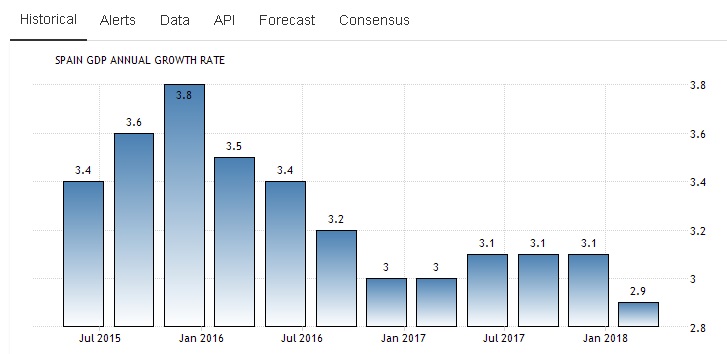
Even now, when we merely consider Spain in all this (not the smallest economy), we see (at https://www.southeusummit.com/europe/spain/spanish-economy-returns-grade/) that Standard & Poor’s is still playing (what I personally see) as ‘their little game’. Perhaps you remember ‘S&P reaches $1.5 billion deal with U.S., states over crisis-era ratings‘ (at https://www.reuters.com/article/us-s-p-settlement-idUSKBN0L71C120150203) the one quote (one of many) needs to be considered “S&P parent McGraw Hill Financial Inc MHFI.N said it will pay $687.5 million to the U.S. Department of Justice, and $687.5 million to 19 states and the District of Columbia, which had filed similar lawsuits over the ratings“. So when I see “S&P notes that Spain’s overall economic and budgetary performance has not been hampered by political tensions in Catalonia, as many had feared. The country’s GDP increased by 3.1% in 2017 and last week the Bank of Spain raised its economic forecast for this year to 2.7%, up from a December forecast of 2.4%“, you see, the numbers are not really in question, yet when we see the image below (source: Trading Economics).

When we realise that none of the EU nations has a grasp on their debts, in addition, the GDP for Spain went down whilst it is still below the numbers of 2016 and before, there is actually no reason to see the credit rating for Spain go up. I am personally speculating that the EU will be so much more hardship when France hits the 100% debt marker. It matters, because this will soon become the academic exercise that the question: ‘What is the difference between cooking the books and creating a false positive wave through inflated credit scores?‘ I actually do not have the answer here, but I guarantee you that the quality of life in Europe is not moving forward any day soon, not until some issues are seriously reconsidered. In addition, the US-China trade war isn’t helping anyone, not even the Europeans so that will also become a factor of debate soon enough. It partially relates to “We have revised upwards our GDP forecasts, with an intense rate of employment creation and an economic model based on the external competitiveness of our companies. With this scenario, we will achieve our objective for 20 million employed people by 2020“, the issue is that it is misrepresentation, you cannot rely on the unemployment figures and then state we will have 20 million employed, because on a population of 46 million, he might be implying that the unemployment numbers will skyrocket from 17.4% in 2017 to 56%, that would be crazy, yet that is what we are told, is it not? The best lies (read: miscommunications) are done through statistics, so that the feather matches the bird one would say. Still, back to my speculation, I believe that Spain is not the only nation in this setting; I think that some numbers in pretty much every EU nation are beefed, weighted and set to make Europe (or basically themselves in the European setting) look much better, so when the UK leaves they will not look as weak and feeble as they have actually become. It is a setting that is way too dangerous. There is no way that Mario Draghi is not part of this, so when we look at the Financial Times of last week we see ‘Mario Draghi acknowledges ‘moderation’ in Eurozone growth‘ (at https://www.ft.com/content/3e20b49e-4939-11e8-8ee8-cae73aab7ccb). So with “Analysts said that Mr Draghi’s guarded language suggested that the ECB may wait until July — a month later than previously expected — to provide the markets with updated “forward guidance” on its plans to phase out the crisis-era stimulus“. I am a little less optimistic in regards to the quotes, and when we see ““Better safe than sorry was the motto of the day,” said Dirk Schumacher, economist at Natixis“. I personally tend to see that as:

Better safe than sorry
It allows for another day without worry
As we pile the worries and woes
To a stack we can blame on crows
Those at the London Tower are best
Because when they leave the EU we can make them the jest
And when our barge is no longer secure
We move to Wall Street where we can endure

You might think that I am merely making light of all this. The issue is that people in Europe seem to ignore that over €2,000,000,000,000 was printed without the validation of treasuries or consent of the people whose funds got devaluated even further. Do you think that printing money has no cost? It is money that the EU never had, so why did you think it came without consequence?

This partially (and I mean partially) is seen in different ways when we look at an article from Reuters merely two weeks earlier (at https://uk.reuters.com/article/uk-ecb-policy-draghi/stock-volatility-no-big-factor-for-ecb-so-far-draghi-idUKKBN1HG1VR) ‘Stock volatility no big factor for ECB so far – Draghi‘, now I agree that volatility will come and go, so the ‘so far’ part is perfectly fine. When we see ““While we remain confident that inflation will converge towards our aim over the medium term, there are still uncertainties about the degree of slack in the economy,” Draghi said in the ECB’s annual report“, now I can agree with that. There will always be a certain amount of uncertainty, that is all good, no issues there, but it is set on a certain premise. When we see that Spain (the only visible one) suddenly in opposition of what I see as real has its credit score increased and as such we see the start of an optional bubble, when others do the same we see the forecast on unreal values, so we see the bubble is not set to the reality of the actuality, at that point, when a lot more start realising that some numbers do not make sense, the uncertainty grows and the closer the UK is to leaving the stronger that uncertainty becomes. At that point we see a run and a total collapse, when that happens, when the people realise that pensions before 78 is no longer optional, do you think that the people will remain calm? When they realise the impact of €2 trillion printed cash is impacting the 26 nations, how much value decline will they face? When that happens, how will people react in all this? Now we get to two elements, one is the mention in the Financial Times where we see: “But the weak economic data for the first quarter have triggered increasing speculation that the first interest rate rise will be delayed until later in 2019. A smaller number of analysts are expecting the bank to continue QE into the new year“, the second is that the entire stimulus was to set the economy right, which did not happen, now set that against inflated credit scores, inflated economies and the downturn that follows, that will happen, it can no longer be contained, merely delayed to some extent. When it does hit Europe would not have a penny left to balance against and it will leave the bulk of Europe destitute. There would be no defence against the next downturn and that is when disaster will truly strike. So as the story is pushing towards ‘protectionism’ and ‘patent values’, we should also consider that impact. Now, as a University graduated Master on Intellectual Property rights, I do comprehend some of the issues, yet I am not a patent attorney, so there are parts that I will ignore or not look at. Consider that a national economy is now more and more dependent on the national patents and the represented value that they hold. Now we get European Patents, the Unified Patent Court (UPC) allows for a simpler way to get it all registered and to some extent enforced. So it is a good thing overall, there was never too much fuss about that side, yet the one strong economy (Germany) is now setting the stage to oppose the UPC, we see this (at http://www.ippropatents.com/ippropatentsnews/europenewsarticle.php?article_id=5725), where we also see “Alternative für Deutschland (AFD) has called for the repeal of the convention on a Unified Patent Court (UPC). AFD “rejects the EU patent law reform”, according to the German Bundestag, which announced the motion on 7 March“, I believe that overall the UPC is a good thing, but there will always be small interests that are not perfect, no EU setting is 100% positive, yet overall, to get one filing for all EU nations, in light that even the UK agreed (and ratified) is a good thing. So when we see “It was based on three grounds, mainly how the UPC Agreement violates EU law, the majority requirements of basic law, and does not comply with the rule of law principle related to judicial impartiality. The complaint was scheduled to be heard in 2018 by the second Senate, appearing as the 11th item on its agenda. In Germany’s 2017 federal election, the AFD won 12.6 percent of the vote and received 94 seats, the first time it had won seats in the Bundestag“, there is an academic setting, yet with 12.6 of the council in hands of the AFD, a very Brexiting minded party, or is that Berlout or Deutchleave, we need to realise that the patent issue is a lot more biting in Germany and that cannot be ignored, as they give rise to uncertainties. So when we get back to the uncertainty there, as well as other uncertainties, and whilst we saw Mario Draghi accept that uncertainty results in stagnation, how much more stagnations are required for the next downturn, even a short term one, whilst the economic reserves have been already been drained.

Now we have a much larger setting, the EU was never about everyone agreeing on everything and the economic setting that requires that to happen at present is also making the dangers of waves that sinks the barge called EU. Now, that seems like an exaggeration, but when you realise that the German anchor is the only one giving stability, you can see the dangers the EU faces and more important, the dangers of no reserves and an utter lack to keep proper budgets in place, a setting now in more danger for the reasons that I gave supported by the economic views of many others. I believe some are downplaying the impact, yet when we realise that EVERY European Union government is downplaying the economic impact (as every nation always wants to look as good as possible, which is a PowerPoint setting of the human ago) we get a much more dangerous setting. We accept that the smaller nations have a negligible impact on the whole, but on a ship that can only remain truly stable with four anchors, losing three is a much bigger disaster than anyone realises, and that downplay will hurt all the players that are part of the EU, so when the downturn starts, we will see kneejerk movements from all the nations, all the big players and we can only speculate the fear mongering speculations that the IMF will treat the European audience to. I have no idea what form it will take, but when it happens I will take a deeper look. In a setting where every negative economic milestone could lay waste to whatever reserves its citizens wrongfully thought they had in the first place.


2 Comments

Filed under Finance, Media, Politics, Science

Time Magazine as a comedian

There are days when things go pear shaped, we all have them. Some go pear shaped in the best of ways, others less so. Now, I am not a big fan of Time magazine. I have nothing against them and the pictures tend to be pretty awesome. Yet, until today I had no idea that they had an interesting sense of humour. So, let’s take a look at ‘This Is What the U.S. Can Do to Help End It‘ in regards to the Syrian war (at http://time.com/5195442/eastern-ghouta-syria-civil-war-anniversary/).

It starts with “as it stands today, the U.S. is essentially a bystander. The Trump Administration has on cruise control the same ISIS-centric policies of the Obama Administration. The small contingent of U.S. troops present in eastern Syria only marginally stabilize territory liberated from the Islamic State while preventing Iranian and Syrian government forces from seizing the region. The Trump Administration has ended the CIA’s arm-and-equip program for the Syrian moderate opposition, a program which was created under President Obama, which was never sustainable or substantial“, which is true, there is nothing in opposition of that and in that regard we remain serious. That is, until we see: “Find a way to deliver aid. The U.S. must work with the international community to find an effective means of getting resources to the region. The stream of videos coming out of Ghouta shows a population subjected to the worst conditions imaginable. We should take the lead in enforcing United Nations demands for a real cease-fire to alleviate this brutal suffering. We can save lives now.” Is that so? Perhaps some can remember the ceasefire that was unanimously set in motion at the UN around the 1st of March. So, how did that pan out? Knowing that Russia and Syria hold the US in even less regard than the UN, the chances of the first part becoming reality is not that much of a reality to begin with and re-iterating that point 12 days later is a little bit of a joke at the very least. In eastern Ghouta, according to SBS, the death toll has passed the ‘thousand mark’, implying that the Ghouta region gets depopulated by close to one hundred cadavers every day. One could argue that until the culling stops, it will be too late for humanitarian aid. If the players had only acted 6 years ago, instead of waiting, sitting on ones hands and hoping for diplomatic resolution, or accept the reality that Syrian lives have no counterbalance in oil and let them pass away (it is not humane, but the reality we see here will never ever be near humane). Wasn’t it Friedrich Nietzsche who said: ‘To live is to suffer, to survive is to find some meaning in the suffering‘? So how much meaning can we find in Syria at present?

But that was merely their opening act. Getting to the main event we get “Repair relations with Turkey. In the end, U.S. policy in Syria rests on the U.S. and Turkey working together. Turkey is currently engaged in Operation Olive Branch against Syrian Kurds in the northern Syrian city of Afrin, to stabilize its own southern border and to prevent the establishment of a Kurdish state“. So, how delusional is that? Turkey only cares about Turkey, which in itself is nothing they can be blamed for, that stance is fair enough. So, how will the US continue in regards to the Armenian genocide? Let’s not forget that we might soon have the situation that Turkey could be blamed for two genocides, at that instance Turkey would in theory surpass Nazi Germany. The entire PKK issue is one that hangs around the necks of both the US and NATO. The headline ‘Kurds threatened with beheading by Turkey’s allies if they don’t convert to extremism‘, which we see in the Independent (at http://www.independent.co.uk/news/world/middle-east/syria-civil-war-assad-regime-turkey-afrin-kurds-eastern-ghouta-us-allies-militia-a8252456.html) also shows “Mr Abdulrahman, who is the leading human rights monitor in Syria with a network of informants throughout the country, says he is worried that international attention is entirely focused on the Syrian army assault on Eastern Ghouta and “nobody is talking about” the potential slaughter of the Kurds and other minorities in Afrin“, with in addition: “as many as one million Kurds may be threatened and adds that it is becoming extremely difficult for them to escape from Afrin because Syrian government checkpoints on the only road leading south to Aleppo “are demanding bribes of up to $4,000 per family to let people through.” Mr Abdulrahman points to growing evidence drawn from videos taken by themselves of militiamen claiming to be members of the Free Syrian Army (FSA) that the units advancing ahead of regular Turkish troops are extreme jihadis“, the reasoning there is “Isis recruits had been instructed by Turkish trainers not to use their traditional tactics, such as the of extensive use of car bombs, because this would identify them as terrorists. He suspected that Isis fighters would be used as cannon fodder in Turkey’s war against the Kurdish People’s Protection Units (YPG) and then discarded“.

Perhaps we should also remember the part that Time Magazine did not give us. “The Turkish military responded with a ferocious counterinsurgency campaign that led to the deaths of nearly 40,000 people, most of them Turkish Kurdish civilians, and the displacement of more than three million Kurds from south eastern Turkey“, which is seen in The Middle East by Ellen Lust. My knowledge of the PKK goes back to the days when we saw Öcalan pleading for an independent Kurdistan. I am not stating that the PKK was innocent, there are questions on both sides, yet as the Americans are so actively ignoring the Armenian issues as well as trying to please Turkey, a nation that has never proven to be a true ally, will the US and NATO remain in denial in regards to the 40,000 dead Kurdish civilians? That would be wrong on a whole new level. In that regard there is one additional part. The claim that ‘the PKK had been accusing Turkey of supporting ISIS at the time when the PKK was part of several offensives against ISIS in Iraq and Syria‘, an issue reported by Al Jazeera in 2015. Was that ever proven or disproven? You see, allowing an ISIS supporter in our midst is one part that should offend everyone, yet that too does not make it to the radar of Time magazine.

And it does not end there, the comedy gets to be better with “Only Turkey has the credibility, resources and geopolitical heft to steward U.S. interests in Northern Syria“, it is Saturday Night Life (SNL) in magazine form. Turkey has not had any credibility for close to a decade; perhaps some Americans remember how Turkey wanted all their debts wiped to allow US planes over Turkey. This happened shortly after 9/11, so when you remember that part, how dicey is their allegiance? And the only resources it clearly has are the ones they have and others pay for. That is seen with “Turkey’s continued membership in NATO means that American taxpayers subsidize the Turkish state in the form of guarantees of military defense in case of military conflict with non-NATO nations”, which implies that at least in part, the US is paying for the conflicts that Turkey is currently in. When was that going to be exposed and in that light, what resources does Turkey actually have, bought and paid for with non US supported funds? I do not know, I am merely asking.

So after the main event we get a small collection of one-liners like “Threaten additional, immediate sanctions of Russia. Putin is directly responsible for the Syrian government’s actions. Options at the U.N. have been exhausted. Accountability mechanisms are non-existent — even investigative mechanisms like the U.N. probe into chemical attacks in Syria have been undermined and curtailed by Russian veto“, sanctions have never worked (so far), Syria will never listen to Russia but will knock on their door for aid (linked to clear profitable agreements that is) and the UN options were never exhausted, in fact none were actually used in the end as none had any chance of working.

It is like me stating that my sex life with Scarlett Johansson is exhausted! That part is absolutely true, yet I never have been with her in the first place and as I never have had any Dangerous Liaisons with the youthful young lady (read: 33 years, 3 months and 21 days at present) and I am merely looking at optional non-existing future endeavours, so for that part I am completely honest (and equally unrealistic), just like the United Nations.

So as the article ends with the truth in the shape of “There will be no winners in the Syrian Civil War, and the reconstruction costs of returning the country to even a minimal level of functioning will be enormous. Neither Russia nor Iran alone can afford to support it, and the Syrians will bear the costs of this debacle for decades to come“, we all agree that this will be the case. So as the EU and US are preparing to make some good will gesture in the shape of 3-4 billion, I wonder how much of that will in the end make it to the people. I personally see it as a path that will invigorate corruption and self-indulgence of the administrations that receive such funds. UN oversight will be close to pointless and in the end a fair bit of that will go towards paying the Russian constructions firms like LLC Priceline, who had the connections to end the war by culling the opposition of President Bashar al-Assad. So in the end it is like watching the UN feeling better about themselves because they added some relief funds. When we set the entire spectre of events into a classical frame, we could be watching the reality of the Divine Comedy. When you consider that in the end well over 500,000 soul ended in eternal torment, the setting of reality is worse than the one Dante Alighieri envisioned, but then the Syrian war was no Time Magazine Comedy, or a classic Italian Poem, which is at present 700 years old. Syria will end up being the damnation of us all, we will end up being damned through our inaction to get anything done because in the end none of us got anything positive done towards the Syrians, not those in Syria and not the millions of refugees, we ended up disappointing them all close to completely.

Yet with the end of the Divine Comedy we got ‘My guide and I did enter, to return To the fair world‘ making it a fairy tale compared to the Syrian reality, the reality of the world we helped create, merely the darkness of caves and the evil we harbour in our midst. I feel certain that is how the refugees feel for generations to come, the eternal curse of inaction and those watching those remain absent of action towards their survival.


Leave a comment

Filed under Media, Military, Politics

The G30 court

There is an issue, an issue that we are all missing, more for the reason that after January 17th the media is steering clear of this with all the might and options they had. I reckon that they will spin this in a setting that it is ‘uninteresting‘, but when was it ever uninteresting to look at a group of 30 that has the alleged advantage of getting their fingers into a pool that has 0% risk worth billions?

The more important part is that there was one mention, or at least only one that was found, on July 7th 2017 and November 3rd 2017, both come from Reuters, the media has become that much of a bean flicking, pole pulling grape flocked bunch of pussies as I personally see it. Yet, the fact is that even as the impact is speculated, the setting given is that a group of 30 had an optional exclusive insight in the 3 trillion dollar ECB spending. Consider that each of these 30 got a 1% portfolio, where 75% of it was set at 0% whilst the remaining 25% might have op to 3% risk, in this setting the underwritten $31 billion for each member would set a speculated sanctified security of a multiple factors of $31 billion each. An elite group of 30 all having the top of the financial services cream at zero risk with the optional massive returns none of us ever had insight to. Now I can see that a mere 0.01% of that 1% would set me up for life, and that is merely the one source, the ‘in-crowd’, now would that be the incestuous insider towards untapped ‘considerations of investment‘ and they would all be bringing their own portfolios and economic insight on how to maximise that? Adding the man (read: Mario Draghi) spending Europe’s $3.1 trillion would happily be allowed into their midst, it is merely the setting that this rigs the game towards 30 participants whilst giving a weighted disadvantage to all other bankers is still an issue not covered by anyone.

So as we saw last November ‘ECB says not its call to publish content of Draghi’s meetings with financiers‘ (at https://www.reuters.com/article/us-ecb-banks-ethics/ecb-says-not-its-call-to-publish-content-of-draghis-meetings-with-financiers-idUSKBN1D327U) whilst we also see “At issue is Draghi’s membership of the so-called Group of 30, where policymakers meet bankers, fund managers and academics behind closed doors to discuss economic issues. He sits alongside former and current central bankers, such as Bank of England Governor Mark Carney and the Bank of Japan’s Haruhiko Kuroda, as well as Nobel laureate Paul Krugman

Yet even as we see “Ombudsman Emily O’Reilly had asked whether the ECB would “consider proactively informing the public of the content of these meetings” in response to “a complaint by activist group Corporate Europe Observatory, which said in January it was concerned about proximity at the G30 of ECB officials and bankers they are meant to supervise“, I cannot help but wonder what both Emily O’Reilly and Corporate Europe Observatory left unmentioned. It was also mentioned by the Dutch Volkskrant where the Corporate Europe Observatory (CEO) member Olivier Hoedeman added comment.

I tried to find more, so even as we have found Mario Draghi, Mark Carney, Haruhiko Kuroda and Paul Krugman as confirmed names (from the media), I initially believed that Groupe Credit Agricole (most likely Dominique Lefebvre) would be a member, I am also speculating that Peter Smith (as director of N M Rothschild & Sons) might have been a member of that group. There are a few other players, but it becomes increasingly less certain even from a speculated point of view. What does matter is that this is not merely some ‘secretive’ babble group. Even as we see last July “In a letter to Draghi that was published on Friday, European Ombudsman Emily O’Reilly said the meetings of the Group of Thirty, where central bankers, economists and financiers talk behind closed doors, are “not transparent” and questioned the ECB president’s membership of the club” as well as “Draghi has until September to reply to the letter in writing“, in that, the media and so called journalism stayed clear of this for the largest extent and the ECB did respond in October 2017 in the attached part. In my view, it all sounds nice but a select group of 30 with a pool of a number in excess of 6 trillion, where 30 people get first dibs on a risk bonus that goes beyond the comprehension of many and the media buries it on page 62 is a much larger issue, especially when the response on page 9 gives us “Moreover, Article 130 of the Treaty on the Functioning of the European Union safeguards the independence of the ECB and of the members of its decision-making bodies” whilst we all know that a mere fraction of $6 trillion has been a case for shifted morals and readjusted (read: weighted morals) in many regards, there are countless hours on C-SPAN that saw those liquid morals and settings in regards to the 2008 events, so the idea of ’30’ members ending up with golden parachute the size of Australia is not that much of a leap, speculated or not. So when we look back to the 2008 events and we see in January 2017, nine years later “The credit rating agency Moody’s has agreed to pay nearly $864m to settle with US federal and state authorities over its ratings of risky mortgage securities in the run-up to the 2008 financial crisis, the department of justice said on Friday“, whilst the damage from the 2008 crash was set to top $22 trillion, we should ask the US Justice department on where the remaining 21.991 trillion is and who was supposed to pay for that. So in all this the fact that the media is steering clear from the G30 and asking, or actually not asking anything past the Reuters articles seen should give alarm bells on many sides, not merely the media.

The EU Parliament magazine (at https://www.theparliamentmagazine.eu/articles/news/mario-draghi-under-fire-g30-membership), also gives us “CEO’s monetary and financial policy researcher Kenneth Haar said, “The Ombudsman’s decision is timely and very positive. Draghi’s involvement with the G30 was ill-advised from the start. Since 2016, when the ECB’s mandate for banking supervision was extended, the close ties between the president and the bankers’ group has become absolutely unacceptable“, or is that gave, because it is past tense and so far the media has remained silent since January 17. It seems to me (extremely speculative) that these 30 members are either connected or involved with the shareholders, stakeholders or advertisers in the media, because the media seems to be at all times protective of these three groups, whilst merely informing on those three groups in a filtered way, or to the smallest degree unless it was already out there in the field. The fact that this group has such a global hold is an issue and I might have been a lot less speculated on this, but the lack of transparency as well as the fact that we see “Tyga Gives Kim Kardashian A Hilarious Spelling Lesson On Social Media” and other Kim Kardashian on a daily basis, whilst the media remains silent on the speculated distributors of no risk trillions is a weird setting, especially when those sources have their fingers in thousands of billions. So when we see the BBC with: ‘Is it time we all unfollowed Kim Kardashian?‘, we might wonder whether it is yea or nea, yet there is a speculated 99.9999% likelihood that the G30 members will not make the cut towards monitored inclusion on following, I am certain that the first one that acts on that is has a boss who is likely (again speculated) to get a quick phone call from a shareholder, stakeholder or large advertiser to wonder if they have any grasp on their staff members and whether they want to manage or become managed.

Do you think that this is a stretch?

From my personal point of view I would give to you Sony (2012) issues, in regards to the change to the Terms of Service. The media ignored it, even as it would impact a group of 30 million consumers. Most of those players merely just trivialised it via ‘there is a memo‘ on it. The rest did even less; some even ignored it all together. With Microsoft (2017/2018) we see even more (at https://www.computerworld.com/article/3257225/microsoft-windows/intel-releases-more-meltdownspectre-firmware-fixes-microsoft-feints-an-sp3-patch.html)

You’d have to be incredibly trusting — of both Microsoft and Intel — to manually install any Surface firmware patch at this point. Particularly when you realize that not one single Meltdown or Spectre-related exploit is in the wild. Not one“, the amount of visibility (apart from marketed Microsoft Central views) is close to null, a system with no more than 17 million users is marketed and advertised to the gills, so the media seems to steer clear, merely two examples in a field that is loaded with examples.

Back to the group

So as I gave the speculated view earlier on the ‘whom’, we can see the full list (at http://group30.org/members), these members are according to the website:

  • Jacob A. Frenkel, Chairman, JPMorgan Chase International
  • Tharman Shanmugaratnam, Deputy Prime Minister, Singapore
  • Guillermo Ortiz, Chairman, BTG Pactual Latin America ex-Brazil
  • Paul A. Volcker, Former Chairman, Federal Reserve System
  • Jean-Claude Trichet, Former President, European Central Bank
  • Leszek Balcerowicz, Former Governor, National Bank of Poland
  • Ben Bernanke, Former Chairman, Federal Reserve System
  • Mark Carney, Governor, Bank of England
  • Agustín Carstens, Former Governor, Banco de México
  • Jaime Caruana, Former Governor, Banco de Espana
  • Domingo Cavallo, Former Minister of Economy, Argentina
  • Mario Draghi, President, European Central Bank
  • William C. Dudley, President, Federal Reserve Bank of New York
  • Roger W. Ferguson, Jr., President and CEO, TIAA
  • Arminio Fraga, Founding Partner, Gavea Investimentos
  • Timothy Geithner, President, Warburg Pincus
  • Gerd Häusler, Chairman of the Supervisory Board, Bayerische Landesbank
  • Philipp Hildebrand, Vice Chairman, BlackRock
  • Gail Kelly, Global Board of Advisors, US Council on Foreign Relations
  • Mervyn King, Member, House of Lords
  • Paul Krugman, Distinguished Professor, Graduate Center, CUNY
  • Christian Noyer, Honorary Governor, Banque de France
  • Raghuram G. Rajan, Distinguished Service Professor of Finance
  • Maria Ramos, Chief Executive Officer, Barclays Africa Group
  • Kenneth Rogoff, Professor of Economics, Harvard University
  • Masaaki Shirakawa, Former Governor, Bank of Japan
  • Lawrence Summers, Charles W. Eliot University Professor at Harvard University
  • Tidjane Thiam, CEO, Credit Suisse
  • Adair Turner, Former Chairman, Financial Services Authority
  • Kevin Warsh, Lecturer, Stanford University Graduate School of Business
  • Axel A. Weber, Former President, Deutsche Bundesbank
  • Ernesto Zedillo, Former President of Mexico
  • Zhou Xiaochuan, Governor, People’s Bank of China

They also have senior members, which is interesting as they are younger than at least one of the current members, as well as the fact that most of the members in the current, senior and emeritus group have multiple titles.

  • Stanley Fischer, Former Governor of the Bank of Israel
  • Haruhiko Kuroda, Governor, Bank of Japan
  • Janet Yellen, Former Chair, Federal Reserve System

And the Emeritus members:

  • Abdlatif Al-Hamad, Former Minister of Finance and Planning, Kuwait
  • Geoffrey L. Bell, President, Geoffrey Bell and Associates
  • Gerald Corrigan, Managing Director, Goldman Sachs Group, Inc.
  • Guillermo de la Dehesa, Chairman, Aviva Grupo Corporativo
  • Jacques de Larosière, Former Director, IMF
  • Richard A. Debs, Former President, Morgan Stanley International
  • Martin Feldstein, Professor of Economics, Harvard University
  • Gerhard Fels, Former Member, UN Committee for Development Planning
  • Toyoo Gyohten, Former Chairman, Bank of Tokyo
  • John Heimann, Senior Advisor, Financial Stability Institute
  • Sylvia Ostry, Former Ambassador for Trade Negotiations, Canada
  • William R. Rhodes, President and CEO, William R. Rhodes Global Advisors
  • Ernest Stern, Former Managing Director; The World Bank
  • David Walker, Former Chairman, Barclays
  • Marina v N. Whitman, Professor; University of Michigan
  • Yutaka Yamaguchi, Former Deputy Governor, Bank of Japan

So this group of 30 is slightly larger and in the group each of these members would have the power and economic impact to tell any member of the Fortune500 what to do, or better stated and more important ‘what not to do!‘ It is in that instance that we see the first impact. A game that now looks as I personally see it rigged in several ways; so even as I was allegedly wrong about Dominique Lefebvre or a direct peer, we see Christian Noyer. So in my view, in a 2015 French article on the issue of “Who will succeed Christian Noyer as head of the Banque de France?“, we see “Mario Draghi, the president of the ECB, seems to have had the idea to see his right arm go. Benoît Coeuré would be an important ally for the Italian in the Council of the Governor“, yet in the light of the G30, it seems to me that such a discussion would have been set into a pre-emptive conclusion of who would needed to have been made king in that castle. When we see that in light of a previous article, namely ‘The Global Economic Switch‘ (at https://lawlordtobe.com/2018/03/06/the-global-economic-switch/), were well over 500 billion is to be invested and grown, in addition to the fact that the SAMA has oversight to well over 2 trillion dollars, how come that they do not have a seat at the table? In the same way that the Rothschild’s are not there, but they might be ‘represented‘ through Bernanke or Frenkel, whilst it is not impossible that Mario Draghi might be giving them the low-down to some degree, yet the Kingdom of Saudi Arabia with that much money on the ladle of expansion, that they are not part of it. In a world where that group is about (according to their own website) “The Group of Thirty, established in 1978, is a private, non-profit, international body composed of very senior representatives of the private and public sectors and academia. It aims to deepen understanding of international economic and financial issues, and to explore the international repercussions of decisions taken in the public and private sectors“, where the foundation of Saudi Arabia has been the power of OPEC and the power to instil the push to be a global player in many fields, in that sight in represented value that the repercussions of decisions are set at, to see the Bank of Israel yet not some link to SAMA (Saudi Arabian Monetary Authority) makes equally less sense in the line of thinking that the ‘about‘ section gives us, which makes me wonder what these members are about. they might be all about that, yet what else they are about, or what else they have a useful value in gives rise to my train of thought on where this train with less than 55 occupants is heading off to, and more so, in light of the power that these ‘30’ members have, the fact that the G30 is not the cover talk of many newspapers, especially the Financial Times is beyond me, because anyone coming to you with ‘No News’ or outdated news, or even worse that there is no real issue in play is clearly told what not to write.

It seems to me that not only is there more in play, the personal speculated view that I have in light of learning more and more about the G30 merely confirms my suspicions, as well as the insight that I am getting (a speculated one) where the media is steering clear from all this is a much larger issue. To what and in which direction is one I am not willing to go into, because I know that the ice is wafer thin at this point and skating on water is a realistic ‘no no’, yet the feeling that these members are getting a first view and optionally the option to dip their cups on plenty into a grape juice barrel of risk-less profit is one that I feel is very much in play. This G30 group is networking on an entirely new level, one that I have never seen before. This is not some kingmaker into presidency; this is a long term group where the optional billions will keep on flowing for decades to come. And this all in a setting of non-transparency, because this goes way beyond the 3 publications in 2016 and of course all those papers published before that. In the 2016 publication ‘Shadow Banking and Capital Markets: risks and opportunities‘, (at http://group30.org/images/uploads/publications/ShadowBankingCapitalMarkets_G30.pdf), we see in the conclusion on page 49: “Moreover, growing leverage across the global Economy can create important risks to macroeconomic stability even if the financial system itself is more resilient. And two developments are particularly concerning: the growth of emerging market foreign currency debt and the rapid growth of Chinese leverage accompanied by a proliferation of shadow banking activities are ominously reminiscent of precrisis developments in the advanced economies“, which is in view of the experts would be nothing new, yet resources available and the 36 exhibits and the recommendations would have been available to the G30 group much earlier than anyone else. In that light, we need to wonder not merely on the setting, in Exhibit 36 we see mortgage losses and the fact that there is the US, Canada and Europe, so in that light the fact that the fourth one is the Netherlands, is that not odd? In light of several settings, France, Germany, Italy and the UK, any of these four would have made perfect sense, so why the Netherlands? Exhibit 33 might have been a reason for this, yet in equal measure the absence of Scandinavia and Italy in this setting now adds to the questions. I think it is not merely choice and presentation, the absence of those players give rise to questions, perhaps even speculated questions and as there are none to be given, it makes me wonder what else is missing, what other data was filtered because in the light of data and presentation there is one golden rule I have always kept in the back of my mind.

The Analyst shows you which investment needs to be made, the presentation makes you look forward to the invoice.

So what invoice is the G30 group making you look forward to and where did it need to go? Two questions with optionally very different results, and in that setting, whilst you know the impact the European economy has had over the last 15 years, whilst we also know that Mario Draghi has been spending $3 trillion, in that setting the G30 does not make the news?

Who is getting fooled by all this and who is getting fooled by making sure that you do not get to notice this?

It is a much larger playing field that is from whatever point of view you have a field of inclusion, or a field of exclusion, yet in all this there are questions that are not asked at all, questions that even I am not asking because I decided to go into technology, engineering and law whilst giving a pass on the Economic subjects. Yet the Financial Media is not asking them either and that is an issue, especially in light of that ‘secretive‘ group set to a stage of networking inclusion, or is it networking through filtered exclusion?

I’ll let you decide on that.


Leave a comment

Filed under Finance, Media, Politics, Science

Is it merely timing?

When I looked into some off the Mario Draghi matters two days ago, I made a reference to his little kart, a kart full of tricks or is it a kart of indiscretion? So let’s take a look at the alphabet, the alphabet of ABLV

A is for Actuality

You see, the European Central Bank publishes a list where all the supervised entities are and the list starts with “Cut-off date for significance decisions: 1 January 2018“, so as we are in March (way past January 1st) and that same attached list gives us on the 81st position the ABLV Bank, AS, with the mention of ‘Among the three largest credit institutions in the Member State‘, whilst there is also (non-supervised) the ABLV Bank Luxembourg, S.A. in Luxembourg, yet stated and linked to the ABLV, should we wonder if we are being had? In light of the news two days ago when we were treated to “Draghi did address a question on why ABLV Bank received emergency support from the Latvian central bank before the ECB declared it failing or likely to fail. He said that the Emergency Liquidity Assistance policy – under which national central banks rather than the ECB decide to provide support to troubled lenders – is a “remnant of a past time” and should be reformed” (Source: Australian Financial Review), whilst the bank was being supervised according to the ECB, the fact that they are grasping at the notion that the left hand does not know what the right hand is doing, is that not an indication on how massively useless and overpaid the members of the ECB are? Just so that we are all in clear and that we all understand what is going on, let’s look at ‘supervision’, which the dictionary calls ‘the action of supervising someone or something‘, and with ‘supervising’ we get ‘observe and direct the execution of (a task or activity)‘, it seems to me that the ECB was not doing any observing or directing, so if the ABLV did not inform the supervising entity, I have a hard time to comprehend the Bloomberg article (at https://www.bloomberg.com/news/articles/2018-03-02/latvia-analyzing-rimsevics-s-role-at-ecb-as-he-returns-to-work), where we see: “Latvia is still considering the ramifications of central bank Governor Ilmars Rimsevics’s status as a suspect in a bribery probe, as he returned to work this week and weighs up how to continue his role at the European Central Bank“, in my view, either the ECB knew in advance certain matters, or we have a different puppy in our midst. Now let us be clear, one is a setting of corruption, the other is the ‘receiving of emergency support from the Latvian central bank‘, yet the fact that this all happened during the oversight of the ECB makes it twice the size of the issue. The ABLV went to the Latvian Central Bank (Governor Ilmars Rimsevics) and got emergency funds, yet what was the origin of those funds? So when we see “Both ABLV and Rimsevics deny the accusations in cases that the authorities say aren’t linked“, my response would be ‘Really? So who are exactly those authorities?’ It seems like a simple question but it is one that we will never see an honest answer to I reckon. The links are not clear, but consider the following accusations.

First we have “The U.S. Treasury Department alleges ABLV engaged in institutionalized money laundering and violated sanctions put in place to counter North Korea’s weapons program

Second we get “Rimsevics has denied any wrongdoing, and Latvia’s Defence Ministry said that the allegations were part of a “massive information operation” by an external actor.” I used them in the article (at https://lawlordtobe.com/2018/03/01/the-failing-mario-draghi-kart/), yet who exactly was the external actor?

It is the second one that is weird, so how did the Defence Ministry get involved in a banking issue? Did it come from the office of Minister Raimonds Bergmanis, it would be an interesting tug of war between him and me, because I have my own centre of gravity and he is a three time Olympic contender in the category of weightlifting. I did not have all the information I needed in that piece, and I was juggling a few issues, so I moved it all along to today.

B is for Bloomberg

Bloomberg ends with “there are no signs other Latvian banks are experiencing outflows after the ECB decided to close ABLV on the grounds that it was failing or likely to fail. What happened to ABLV is a signal to other banks to follow the rules, she said“. Yet is Finance Minister Dana Reizniece-Ozola giving us the goods? Why did the Defence Ministry get involved? Was it to emphasize the weapons accusation? Clearly that would have been an issue that resides with Latvian Intelligence. So as Reuters gives us “Ainars Latkovskis, the head of the national parliament’s anti-corruption committee of lawmakers, who also urged Rimsevics to step down” as well as “Latkovskis, who is authorized to listen to reports from the heads of the Latvian intelligence agencies, dismissed hints by some local officials and politicians that a Russian campaign of disinformation might be behind the case“, it seems that the Intelligence official is either trying to stay out of this or we can see this as a sign that the SVR RF (the Foreign Intelligence Service of the Russian Federation) has been whispering in someone’s ear and the culprits have overplayed their hand. Now no matter what has happened in that tier of the industry, it still gives us that the ABLV made a deal for funds with the Latvian Central Bank and the news as shown by the media is giving us that the ECB was either unaware or was informed after the fact with ‘Good news, we solved the problem‘ and now we see that the banks who are on the oversight list are either not getting supervised or they are ignoring their supervisors, I wonder which scenario is worse for the ECB.

L is for Liable

If you think it does not matter, think again. We pump billions into the UN and it cannot arrange a ceasefire (Syria), we pump billions into the European Union and the ECB is casually unwilling or unable to do their job and those people are fetching a lot of money every year. Two entities who are now proving to be more and more facilitators for the wealthy as well as paper tigers with a fluidic agenda that merely spells ‘compromise to keep the engine going’. So when did wee surrender our tax funds to those ends?

So was this all done through the allowed whisper via Sergey Yevgenyevich Naryshkin? I am merely speculating here, but the parts and numbers currently do not add up. You see, as Reuters gives us “The ECB appears to have been blindsided by the ABLV case, highlighting how thinly it is spread in supervising Europe’s biggest lenders and raising questions about a system of euro zone supervision just three years old“, this is seen (at https://www.reuters.com/article/us-ecb-russia-vtb/ecb-drops-supervision-of-russias-vtb-arm-in-the-euro-zone-idUSKCN1GE2N8), can we say that it is that simple? It remains pure speculation from my side, yet when we see “The European Central Bank has stopped supervising the Austrian arm of Russian state bank VTB after it slimmed down its European operations, the ECB said on Friday. A spokeswoman for the ECB said VTB’s new set-up in Europe no longer warranted direct supervision, which was now in the hands of Germany’s national regulators, Bafin and the Bundesbank” I wonder if there was anything simple on this. We could argue that Sergey Yevgenyevich Naryshkin did exactly what he was supposed to do, to serve HIS country. Yet the information gives me the feeling that this looks like a line of banks with Latvia between the Latvian ECB and the Russian ‘SVCR RF‘ bank. The two outside parties agree to keep each other afloat by shaking hands and pushing at the same time the ABLV over the edge in a combined effort. What some did in primary school (the old tactics are usually the best).

Still, this is all merely speculation from my side mind you!

V is for Voter

The question that remains is how the US authorities got to that jump and where is the evidence? Apart from the fact that one accused of bribery is allowed back into his office until the dust (read: investigation) settles is also cause for concern. You see, the news (at http://www.mod.gov.lv/Aktualitates/Preses_pazinojumi/2018/02/20-01.aspx) gives a part, but when we consider it and dissect “Latvia’s security-sector personnel have raised the alarm that outside actors could be using these current financial and banking scandals against Riga. The Latvian Ministry of Defence has pointed out that the AP news agency’s reporting on Latvia’s connection to various international financial corruption schemes has been reposted with unusual frequency on numerous websites known for distributing messages supporting Russia. As such, the defence ministry has called this media blitz a possible “hybrid”-style operation within a broader information war against Latvia“, we could agree that part of this is an issue. Yet is the foundation wrong? Is the bribery a fact? If so, why the hell is Ilmars Rimsevics allowed back in his office? If we see statements that there is proof, why not give that out to the open? So who were the outside actors? You see, accusation of bribery requires evidence and it is not out of the blue that Russia would expose bribery so that their operations could profit. That is not merely Russia, American politics and Wall Street have operated on that premise for decades, so it is not altogether weird to see Russia play a similar game, if that was the case. So even if there was an ‘information war against Latvia‘, it was done under the noses of the ECB and Mario Draghi. It was not merely a “remnant of a past time that should be reformed“, it was an option where the ‘the Emergency Liquidity Assistance policy‘ was overlooked by overpaid ECB executives, especially in light of the fact that by their own reports that the ABLV was under supervision.

Bloomberg supports my views (at https://www.bloomberg.com/news/articles/2018-03-02/draghi-confronts-limit-of-his-powers-as-latvian-standoff-endures), where we see ““This reveals the impressive lack of power of the ECB in such circumstances,” said Stanislas Jourdan, the director of Positive Money Europe, an advocacy group calling for more transparency and accountability on economic policy“, which on one side is just as it should be about the sovereignty of a nation, but the fact that the ECB are confronted with their own foot in mouth protocol at the expense of millions, if not billions is a larger worry, because they already pushed a $3 trillion debt on the people of Europe. I also support the view we see at: “Draghi already expressed dissatisfaction to ECB officials in the week after Rimsevics’s detention that enough details from Latvia hadn’t been forthcoming, according to people familiar with the matter, and that may still be the case. Latvian Finance Minister Dana Reizniece-Ozola said on Friday that the anti-corruption office is “in the process” of giving the ECB all relevant information“, it is not about the ECB, it is a Latvian situation and in this Mario Draghi gets to do what most EU puppeteers do so well, they can bloody well wait (whilst still getting paid high amounts of money). Yet, in part this is not merely a waiting game, the fact that the voters are taking more notice of this mess is not helping him any, but that is the way life works and it is not always working in your favour. So when the Globe and Mail gives us “Did European Central Bank boss Mario Draghi save Italy or merely set up the world’s third biggest debtor for permanent zombie status? As Italians head to the polls on Sunday, the parties, big and small, are showering voters with promises of goodies galore“, we see the deadlines that the ECB has, it has a few and even as there is unlikely to be a stable Italian government, the fact that they won’t worry the ECB like Frexit Marine Le Pen or Brexit Nigel Farage, so they are not too worried, but the overall financial issues will remain and Latvia is not helping any with the news that they are the cause of at present. In the end, the question should become, how come that a supervised bank was able to do this? Because the answer needs to be coming from the people who are seemingly overpaid for work they basically did not achieve and that is not merely Mario Draghi; that list is a lot larger and in this case it might just exclude the one man at the top.


Leave a comment

Filed under Finance, Law, Media, Military, Politics

The failing Mario Draghi Kart

Just yesterday, the Deutsche Welle (at http://www.dw.com/en/eurozone-economy-still-requires-stimulus-ecbs-mario-draghi/a-42751327), gave us that the ‘Eurozone economy still requires stimulus‘, so after these years the stupid and the rich still will not learn and the people are about to pay for it dearly. That is, not the UK, they might have gotten out just in time, if they don’t add delay upon delay. Even as we are sussed to sleep with: “The bank is gradually reducing its bond purchase program but it may continue past September”, the people are sussed to sleep, in a situation, where they sleep on a luxury liner and it is going down. Like having a nice cabin on the Titanic and you decided to sleep in on April 15th and you did. You never woke up, you could if there was oxygen, yet oxygen is 3786 meters away, 3786 meters straight up!

So when we are pointed at the ECB’s asset purchase program, which began three years ago, and which has seen the central bank spend €2.55 trillion ($3.14 trillion) to buy government bonds and other financial assets. The people are not given clarity on where that money went EXACTLY, in other news, that news we got months ago on Mario Draghi being a member of a very exclusive 5 mile high club. So when we got 6 weeks ago: “European Central Bank President Mario Draghi should give up his membership of the opaque Group of 30 consultative body because it risks hurting public confidence in the ECB’s independence, the European Ombudsman said on Wednesday“, how come the near entire bloody media has not followed up on this? After that one day it was silenced, the ECB will not respond, Mario Draghi apparently keeps on getting away with whatever he needs and there are no questions, not even on an international level which is unsettling in so many ways as it leaves us with the indication that the media may be as unreliable as the politicians they are reporting on.

A program that has sunk 3 trillion dollars and everyone is just stating that the economy is great, yet nobody is asking the number one question and that is ‘How will we pay it back?

The theory of printing money

Mario Draghi, president of the ECB has profiled his place and his ‘bank’ as awesome, marketing on a near supreme level, like a politicians stating on how honest he is. Excellent standards, great breeding and stellar academic excellence, and you know that expression about a story being too good to be true?

So they have their ‘Quantative Easing’, they use it to buy government bonds and other financial assets. The purchases have helped keep borrowing costs low, which in turn have boosted spending and investment in the Eurozone economy. But is this true? You see, there are now two levels of problems and dangers. When we consider that the bond is a debt security, under which the issuer owes the holders (so the government that issued the bonds now owes the ECB), a debt and (depending on the terms of the bond) is obliged to pay them interest and to repay the principal at a later date, termed the maturity date.

So over $3 trillion is bought from these governments and those governments are paying the ECB interest until they pay back the amount at the date of maturity (could be up to 30 years). So basically they are pushing massive debts forward, it is almost like the Greek debt mess, but now close to 173 times more intense in regards to the outstanding amount. The current makers in charge get a free pass and leave the mess to the next person whilst they enjoy the millions they earned as well as the multimillions they got by being a member of an exclusive group of 30, as they get the results before any other publication and they get to the cream all without ever running the risks other ‘investors’ face.

So whilst everyone sees the interest only part, we are kept in the dark on the fact that an additional $3 trillion would be outstanding and with the UK out of play, the other nations will get to pay for it all, so when we consider that last week nations like the Netherlands told the EU that they want a freeze on EU contributions, so now we read: “Rutte has said he does not want the Dutch contribution to the EU to increase, despite the European Commission’s call for higher spending on climate change and border controls, and the gap left by Britain after Brexit. Like the Netherlands, Britain is a net payer into the EU’s coffers and will leave a large hole when it pulls out. The Commission wants to fill the gap through a combination of spending cuts and higher contributions, something which the Dutch strongly oppose” (at https://www.dutchnews.nl/news/archives/2018/02/dutch-prime-minister-begins-campaign-to-freeze-eu-contributions/), what no one is looking at, or mentioning is that the outstanding $3 trillion is going to be an additional matter to deal with, even if that is placed in a very separate part of the books. Payment will be due!

So as they give the mention how Brexit will be one reason to increase payment, the absence of the QA plan and outstanding amount remains unmentioned, it is an impact, but that is exactly why the UK got out in the first place. In this the contribution for the Dutch will go up by $4500 per person, so where is that coming from? Now consider that the impact of the matured bonds will be massive for the positive contributing nations, Germany, France, Italy, Sweden, Belgium, Denmark and Austria would end up getting a blow to their budgets unlike any they have had. The question becomes how intense depends on certain elements. So when we consider the bad curve. So, when the bonds bought reduce in value by 30%, the ECB is not hit, it might lose the value, but that means that the government it was bought from ends up with a smaller invoice to pay, and the losses for the investor (the ECB) loses 30% of their investment, now the EU nations as a bloc will have to come up with that money. So depending on where it was invested in, that government get to laugh as the other EU members need to pay for the ‘losses’, which amounts to the positive paying nations. This is one of the foremost reasons why I was all for the UK getting out as soon as possible. So these nations could end up paying an additional $1 trillion divided amongst them. So how was this ever going to be fair? Of course that is if the value of these bonds depreciates, if that does not happen, than there is no additional issue, but the fact that the outstanding amount is still due for payment and in light of the bulk of these EU nations not being able to keep a decent budget and almost no ability to pay such amounts does not help us in any way in raising confidence in regards to the EU moving forward. Greece is to the smallest extent some indication, even as many sources are positive, I have an issue with “The 2017 primary balance target of 1.75 percent of GDP is expected to be reached with a significant margin. For 2018 the primary balance target of 3.5 percent is considered achievable“, so there are two parts. The first is the use of ‘expected to be reached‘, margin or not, these numbers are not yet set in stone, so there could be a bad news cycle. The second part is ‘target of 3.5 percent is considered achievable‘, which means an almost 100% increase towards the positive result, which has never been realistic. Even as the unemployment numbers are down from 27% a few years ago, to 21%, this still implies that one out of 5 is without a job, that means the stresses on the Greek infrastructure remains and it will remain for several years to come. So when it comes to the larger nations, Spain, Italy and France are still a downward drag here in regards to the overall EU and their drag is draining their infrastructure and options towards pushing the EU economically forward, some others like the Netherlands and Sweden are ahead of the curve, but we forget that they are merely 26 million, whilst the three dragging us down represent close to 185 million people, in that regard we forget the weight that the larger nations have. So in that both the UK and Germany are the positive sides, but the UK is leaving and adding Germany only gets that group of 3 at 50% of the ones slowing the EU down, so even as the slowdown is a good thing, it is still a negative result in the end. So it is in that light that there is a growing risk to the entire Quantative Easing plan that Mario Draghi gave the EU and even as they are all on how ‘the economy is so much better‘, I agree that compared to two years ago, the people are more positive and jobs are getting better, yet this has been at the expense of unrealistic levels of spending and there is no given on when that will be resolved, so those people have a $3 trillion bill hanging over their heads.

You see, part of the problems is infrastructure, EU infrastructure mind you. So as the Australian Financial Review (at http://www.afr.com/news/economy/monetary-policy/mario-draghi-keeps-focus-on-monetary-accommodation-20180226-h0wos8) gave us “Draghi did address a question on why ABLV Bank received emergency support from the Latvian central bank before the ECB declared it failing or likely to fail. He said that the Emergency Liquidity Assistance policy – under which national central banks rather than the ECB decide to provide support to troubled lenders – is a “remnant of a past time” and should be reformed

Say What?

So basically a bank got support from its national bank, whilst the ECB had it as ‘likely to fail‘, so is this how Quantative Easing is ‘miss-spent’? It is not completely clear or fair to state it in that way, yet when we see Reuters with “The ECB said at the weekend that privately held ABLV is likely unable to pay its debts or other liabilities as they fall due. “We believe our bank will be able to settle with all of our clients in full,” ABLV, Latvia’s third-biggest bank by assets, said in a statement. “Voluntary liquidation is an important condition for it – the process has to be done as professionally and as transparently as possible, given the history of Latvian insolvency and liquidation processes”“, yet in all that is there any mention whether that included the emergency support funds? The text does not include that part, so that is money down the drain. That whilst it is not the only scandal that Latvia faces. If we consider the Stratfor view (at https://worldview.stratfor.com/article/what-watch-two-banking-scandals-unfold-latvia), we see “On Feb. 17, the Latvian anti-corruption agency detained the head of the country’s central bank, Ilmars Rimsevics, after Grigory Guselnikov, the Anglo-Russian owner of Latvia’s Norvik bank, accused him of taking bribes. Rimsevics has denied any wrongdoing, and Latvia’s Defense Ministry said that the allegations were part of a “massive information operation” by an external actor. Latvian Finance Minister Dana Reizniece-Ozola said that the corruption allegations would be investigated“, as well as “a report issued Feb. 13 by the U.S. Treasury Department detailing the results of its investigation that found ABLV had facilitated transactions linked to “large-scale illicit activity connected to Azerbaijan, Russia, and Ukraine” as well as activities circumventing sanctions on North Korea. In the wake of that report, significant assets were withdrawn from ABLV“. Now we can see that for what it is, yet we also get “the ECB’s Single Resolution Board has rebuffed ABLV’s efforts to seek financial assistance, determining that shoring up the bank “was not in the public interest.”“, so in light of the mention by Mario Draghi with ‘under which national central banks rather than the ECB decide to provide support to troubled lenders‘, I see it as instead of money wasted from the left trouser pocket, it came from right cheek pocket. How does that solve anything? The fact that the trousers came from the old tailor, the fact that the damage was not contained and allowed certain parties to take their cash out of Latvia is still cause for concern for those wearing the trousers.

That reflects also when we add the Greek issue that is playing right now with “the resignation on Monday of economy minister Dimitris Papadimitriou and his wife, the alternate labour minister, Rania Antonopoulou. Antonopoulou gave her notice after it was revealed that she had accepted €23,000 in housing benefits at a time of immense hardship for Greeks” (source: the Guardian). The issues playing do not seem like much, but it is like mopping the floor in a room where the water main has burst, it is close to pointless. In all this, especially when we hear Alexis Tsipras come with ‘praising the couple, in a speech late on Tuesday, for the “sensibility” they had exhibited in stepping down‘. To me it reads like ‘I am happy you vacated the premises as the people now know what you did and they are angry, thank you for that!‘ Is there any way that the Greeks are not getting fuming mad on that issue?

That is the part that does matter, because that is linked to whatever bonds were purchased, where they were purchased and how much is in play. We see none of that; merely that the invoice at present is set at 30 billion Euros per month, down from 60 billion per month earlier and 80 billion per month before that. So there is no way to tell how unrealistic my 30% loss is, it could be as low as 1% or as much as 41.3%, there is at present no way to tell. It is a long term gamble instigated by those in power now and left to solve for whoever gets to hold that seat when those spending’s mature and payment is due. Yet the chance of breaking even (best case scenario) is almost statistically impossible and no one has answers how to deal with it the moment it happens.

Can the Draghi failing be proven as a failure?

That remains the main event in all this and the fact is that the proof is nowhere near complete because the transparency in the spending and the path to repayment is missing. The fact that the money is printed and that the payment of the printed money is due at some point is not dealt with, by none of the media. Is it because it is not due now, or are we kept in silence because it stops us from asking questions? Perhaps like the elite group of 30 bankers, only initial questions are allowed and no response will be coming. That are merely factors in all of this and it does NOT sets any premise to the failure or success of the acts by Mario Draghi. Part of it is shown by Bloomberg a mere 15 hours ago, as they gave us: “The rate of price growth slowed to 1.2 percent this month from 1.3 percent, dropping to its weakest since 2016. The core measure was unchanged at 1 percent. The figures follow a series of releases that have checked the economy’s thundering momentum at the start of 2018, which had emboldened policy makers who want a faster unwinding of the central bank’s crisis-era monetary stimulus“, so even as that is not evidence, it seems to me that people are stalling and delaying stopping the QA wave, until the QA wave shows a positive. It is like watching a person throw more and more money in the pokeys until that person breaks even. In gambling terms it is watching a fool bleed dry. Even when we accept that a pokey returns 90% over its lifetime, that means that at the very least there is a loss of 10%, even if that person is getting lucky, the small wins are still used up whilst the player is trying to break even and in the end that money too is gone. That is how we could see the QA program to go and if that is true, a loss of 41.3% might have been optimistic, but it remains speculation. The article (at https://www.bloomberg.com/news/articles/2018-02-28/slowing-euro-area-inflation-helps-draghi-push-back-exit-debate) now gives the other parts I mentioned earlier too. With “consumer price growth almost halved in Italy and slowed in Germany” giving the line I had that with unemployment in Germany being an asset, but this slowing and 50% less gives rise to more without a job, or halted in economic growth for Italy, whilst Germany is halting to some degree their forward momentum, which translates in upcoming bad economic news cycles, or better stated less positive ones, so how will that impact the outstanding $3 trillion? The impact is only seen when that amount is due, but the impact will be there and those who pushed it onto us will no longer be around and they end up washing their hands off the dangers and leave us to pay the outstanding invoice, it makes for the most dangerous of market karts.

With ‘Buy now and pay when we make the most profit!‘ is an economic standard that has never been good commerce, or realistic for that matter; but that is exactly what Europeans signed up for, and the people in Europe end up not getting a say in the matter. That is the issue I opposed all that time and that is why I hope that the UK got out in time, because that part will drag the EU economy down to a degree it has not seen before. The only worry is what happens when that issue hits the European tax payers, because it will! No doubt about that!


1 Comment

Filed under Finance, Media, Politics

A changing language

Europe is in several stages of unease; there is the spending of Mario Draghi, Brexit remains on the mind of many. Yet, the one change that is now more and more in the foreground of many is the problem that Turkey seems to be. There are those set on the stage to end Turkey as a NATO member and subsequent becoming part of the EU, there are things going forward and backward, but the language involved in all this is changing, so are the settings for the meetings yet to come. In all this the latest Turkish act to double down on the Russian S-400 purchases in 2020. There is, as I stated unease and as I see it the entire EU-Turkey mess is now a dance around unclear settings. Yet the settings are founded on what some would call, clear and blatant lies.

So to recap, on March 26th in the Bulgarian port city of Varna with the attendance of President Recep Tayyip Erdoğan, there will be a summit. The given setting is “to discuss EU-Turkey relations as well as regional and international issues“, this we got from the spokesperson for Donald Franciszek Tusk. The meeting held at the leaders’ level will be hosted as a working dinner, a statement signed by Tusk and Juncker said. Yet soon thereafter it begins. With: “Ankara has been stressing that the EU fails to understand the challenges that the county faces, and calls on all sides to take Turkey’s concerns into consideration, particularly against the PKK and the Gülenist Terror Group (FETÖ), which carried out the failed July 15 coup attempt“, yet how is that true when it has been clear for the longest time “Turkey witnessed the bloodiest coup attempt in its political history on July 15th, 2016, when a section of the Turkish military launched a coordinated operation in several major cities to topple the government and unseat President Recep Tayyip Erdogan“, this is the quote from Aljazeera, but they were not the only one giving this.

The Turkish government blames the failed coup attempt on Fethullah Gulen, a Turkish preacher and businessman who has lived in self-imposed exile in the United States since 1999. So as we accept that the Gülen movement is classified as a terrorist organization by Turkey under the assigned names Gülenist Terror Organisation (Fethullahçı Terör Örgütü, FETÖ) or Parallel State Organisation (Paralel Devlet Yapılanması, PDY), we see the link offered, yet another path in this is “MIT officials admitted that they received the very first intelligence report about a possible attack on July 15, only hours before their own headquarters was under heavy artillery fire“, as well as “As of today, more than 100,000 people have been sacked or suspended and 50,000 arrested in an unprecedented crackdown. The government has deemed the crackdown necessary to ‘root out all coup supporters from the state apparatus’“. When we consider those parts, we need to realise that the Millî İstihbarat Teşkilatı (MİT) was completely out of any loop, which makes Turkish Intelligence not just a flawed setting, it would implicate that it has limited counter terrorism options and no resources to speak of (in intelligence terms).

In opposition to this, there would be enough data to offer that it was an internal issue from within the Turkish military and whatever opposes Recep Tayyip Erdoğan in Turkey got a fat target painted on them. This fills and completes the view we need to have of Turkey much better. In support of this we need to consider that one exiled cleric could not have orchestrated the military support that would have been required and that was seen in action. The width of the Turkish military acting seems to be that of an internal star chamber than a clerical imprint on the military, the latter would have given more visibility to other ranking officers within the Turkish armed forces. As this becomes more and more visible and accepted, we are treated to the view on the unacceptable acts against the Kurds yet again, which followed the Turkish official view of the coup that they ‘survived’.

So in this light the setting for March will be one that is a puzzle. You see as Turkey keeps on playing this game, their credibility will only go down further. The European Council on Foreign Relations (ECFR) (at http://www.ecfr.eu/article/essay_eu_turkey_relations_the_beginning_of_the_end_7226) gives us: “Both Turkey and the EU need the continuation of this partnership. It is a matter of definition whether this partnership will be in the form of full membership or in a different form. What is important is not to break the process and not to cause alienation. The need for sustainable EU-Turkey relations obliges both sides to take steps to honour their commitment to integration“, we can accept that, but at this point, is continuation feasible? We see the shifting language that shows that Germany is less and less taken with Turkey, now siding more and more with France on the anti-Turkey alliance. It gets worse for Turkey as we now hear: “A Turkish court on Wednesday denied entry to the German ambassador to Ankara to the hearing of Selahattin Demirtas, the former co-leader of the pro-Kurdish Peoples’ Democratic Party (HDP)“, which we get from http://www.dw.com/en/turkish-court-denies-german-ambassador-entry-to-kurdish-politicians-trial/a-42579957, even as France is trying to work with Turkey regarding a ‘diplomatic road map‘ on Syria, the sounds of accusation of Turkey violating international law was not far behind it, so there is pressures on nearly every level. Only 12 hours ago, Deutsche Welle gave us “Even NATO Secretary-General Jens Stoltenberg wouldn’t hazard a guess ahead of this week’s defense ministers’ meeting. He said Turkey needs to clarify the status of the contract” (at http://www.dw.com/en/turkish-russian-missile-deal-puts-nato-on-edge/a-42572965), as I said earlier, the language is changing. As we see ‘Turkey needs to clarify the status of the contract‘ that it is about cancelling the contract? Yet in that respect, what would Turkey demand in return? How much is that going to cost and where does that invoice end up? You see, when you consider Reuters with ‘U.S. tells NATO allies spending plans still falling short‘ (at https://www.reuters.com/article/us-usa-trump-nato/u-s-tells-nato-allies-spending-plans-still-falling-short-idUSKCN1FY013), where we see “Spain has said it will not meet the 2024 target. Belgium, the Netherlands, Luxembourg, Italy, Portugal, Norway and Denmark are also lagging. Hungary expects to meet the goal only by 2026“, as well as “France will increase its defense spending by more than a third between 2017 and 2025, but Germany, is not expected to reach the 2 percent target by 2024“, this gives us that the three large economic anchors of the European Union cannot get there. It is these elements that make me wonder on the changing language involving Turkey. From a setting that would have given a clear rejection of Turkey becoming an EU member, we see the setting of new talks, new events and more ‘collaboration’ projects. I think that France is already learning the hard way that this path leads to nowhere, but the others need Turkey to be a spender here, and Erdogan is using that tactic to his own advantage, because once they are in, you cannot throw them out anymore (the EU that is), not even willingly as the UK is learning the hard way. Even as we accept that to some extent Turkey helps to reduce an influx of Syrian and other migrants and refugees into the EU bloc, the question is to what extent and for which purpose, because once these refugees make it into Turkey, Turkey is either stuck with them or they must ‘divert’ them to another place.

In this, in an earlier blog I mentioned the Visa Free EU travel for Turkey and that they had not met the demands. So as we see “Last week, Turkey manifested determination to restart a new chapter in its ailing relationship with the European bloc by submitting a paper detailing Turkey’s roadmap for the fulfilment of the remaining seven benchmarks of 72 criteria” we need to get worried on the non-committed acts from the EU on the matter which had not been met. It seems like Brussels is trying to find any way to either delay it all or give Turkey a pass, which would be disastrous for several players. This is seen in several articles, in this case the Irish Times gives us: “Instead of formally ending EU membership talks, Dr Merkel said she would look at imposing “real restrictions on economic contact” including through the European Investment Bank, EU aid, World Bank and by blocking talks on expanding Turkey’s customs union agreement with the EU, a move that could hit billions of euro in potential Turkish exports“, whilst the EU themselves was ‘dismissive of call for end to Turkey accession talks‘, stating that this is for the heads of government, European Commission says, so the EU revels in inaction and restrictions in other ways. This is a dangerous and explosive combination.

So even as one issue was the contention in the counter terrorism benchmark which has been the definition of terrorism in the counter-terrorism law that Turkey was called repeatedly to amend in order to comply with European democratic and judicial standards. Now, according to reports, a legal provision will be added soon to the current anti-terror law stating that “any critical expression that does not exceed the boundaries of journalism does not constitute a crime“, how is that enough? As we see the Kurdish issues as shown earlier as well as a new complete failure by the Millî İstihbarat Teşkilatı (MİT) should leave anyone a clear indication that not only is the counter-terrorism failing, there is an increased worry that Turkey does not really comprehends the term ‘counter-terrorism’, in support of that fact, or evidence to that, you should talk to the journalists Deniz Yücel, Huseyin Akyol, Ragip Duran, Ayse Duzkan, and Huseyin Bektas. Oh no, you can’t they are in jail! Turkey could have had a genuine excuse, but they lost that option when they denied the German ambassador to Turkey access to the court proceedings. That alone should be regarded as evidence to dismiss the ascension of Turkey to the EU.

And whilst the entire language on Turkey seems to be in a fluid state, the Brexit noise goes on, whilst some are relying on fear-mongering with noise like: “You could have a permanent Operation Stack for 20 miles” regarding shipping between the UK and the EU, ‘could‘ being the operative word. So how large was that ‘stack’ in the 70’s and 80’s? In addition we see the Financial Times (at https://www.ft.com/content/0a8799c6-1190-11e8-940e-08320fc2a277) give us: “Brussels is urging EU leaders to consider radical options such as raiding corporate tax receipts and money raised from selling carbon emission permits to fill a €15bn a year budget hole left by Brexit“, in addition it gives us: “the need to find more money for priorities such as border control and joint defence, mean negotiations are likely to be even more poisonous than previous EU tussles over money“, whilst we see “Some member states don’t want to pay more but they want to do more. Other member states want to receive more“, these elements show the desperate state the EU is in now, that whilst Mario Draghi has printed almost 2 trillion Euro in money for ‘Quantative Easing‘. This relates directly to Turkey, because it shows the desperate EU trying to open a many doors as possible, this is how I see the impact of not dismissing Turkey as an EU member at present. So when we see “impose tougher conditions on access to EU funds as a way to force the likes of Poland and Hungary to comply with EU policies on the rule of law and on asylum” as is a given view on the two needing more money, wanting a stronger voice but cannot contribute. Add to that the earlier pressure from the US for NATO member to do more gives a shifted view of the needed activities within the EU, Turkey is seen as the one floating elements that will allow a few players to keep their heads above water, but it is as I personally see it a desperate act from certain short term viewers, that whilst they also know that it will descent EU elements into chaos. As I (again merely a personal view) see it, it would cripple Strasbourg in getting issues resolved and as Turkey fails to comply with humanitarian sides, it could in equal measure become the puppet for Russia for dislodge other item in consideration, an option honoured by perhaps negating some invoices for S-400 systems, spare parts, training and consultancy? It is merely speculative thinking, but would I be wrong? It would work out very well for Turkey, for the other bloc members a lot less so.

A danger that could have been resolved almost 2 years ago, I will let you ponder on the reasons why the EU never negated this danger.


1 Comment

Filed under Finance, Law, Media, Military, Politics