Tag Archives: Wales

Delete their asses

There are two stories that need writing. One I cannot do until late Monday, because civil servants do not work on the weekend (weird). The other one is about fraud. The CBC alerted me to ‘It’s happened again. 2nd Toronto home listed for sale without homeowner’s knowledge’ (at https://www.cbc.ca/news/canada/toronto/fraudulent-home-sale-1.6710868) and the problem is actually a lot worse than they think it is. You see, I remembered and found ‘Arrest after Luton clergyman reports his home stolen’ (at https://www.bbc.com/news/uk-england-beds-bucks-herts-59167750) in November 2021. This has been going on for well over a year and when I see “We work with professional conveyancers, such as solicitors, and rely on them and the checks that they make to spot fraudulent attempts to impersonate property owners. Despite our efforts, every year we do register a very small number of fraudulent transactions.” And when I see this my blood curdles towards psychotic. When we see “rely on them”, I understand, but in the same breath I say that if at that point the conveyancer CANNOT show proper documentations and proper diligence he gets to lose his license for life. I am so sick of this casual approach to responsibilities (you will learn on Monday or Tuesday). It is time to change this level of stupidity. If these players no matter who cannot show due diligence, they lose their licence for life. These players all want ease, they want the internet and as such people lose their houses and their stuff, we need to change that game and we need to change it by a lot. The CBC gives us “the case bears a striking resemblance to an investigation the Toronto Police Service (TPS) asked for the public’s help with last week, in which another family wasn’t so lucky”. First of all, I am not blaming the Toronto Police Service. But the stage of ease of sale and ease of buying property needs to stop. In the old days there ere actuaries and perhaps we need to revisit that stage, they were truly diligent. The world is so much about reduction of sales cycle and now we see that people are getting hurt and some excuse that it is a mere few cases does not hold water. The victims lose to much, even if the damage is undone, the damage is close to permanent and something needs to be done. Perhaps it needs to be more draconian, but I feel strong about someone losing THEIR castle. So when I see “CBC News has reported on numerous allegations of fake identifications and other documents being used to rent homes and take out fraudulent mortgages, but these attempted home thefts appear to take real estate fraud to an alarming new level” I see that the system is failing and it is failing in the UK and in Canada. So we need a new stage, we need new systems of control and the stage of “this is easier” is no longer acceptable. Easy got the grifters and the scammers in, that needs to stop and the conveyancers are a first step, but merely a first. A lot more needs to be done and it needed to be started well over a year ago. 

Perhaps I am overreacting, but the idea of my place to be sold from under me when I go on vacation is a nightmare I never want to face and if that means deleting some overly non-diligent people, then so be it.

Enjoy Sunday.

1 Comment

Filed under Finance, Law

The double check

This is at times essential, we need (at times) double check what we did. Not the double check before we speak (which tends to be essential), but after we spoke, we get the setting that we need to make certain that we had it right. There is no shame in getting it wrong, it is the non-adjusted view that follows that makes what we do (completely) wrong.

In this, I decided to take another look at ‘Cross here to die’ an article I wrote on December 11th (at https://lawlordtobe.com/2021/12/11/cross-here-to-die/), there I wrote “And there is more we get to see “a wave of infection is projected that could lead to a peak of more than 2,000 daily hospital admissions, with 175,000 hospital admissions and 24,700 deaths between 1 December this year and 30 April 2022.” And it is natural that these people hide behind ‘could lead to’, Yet the stage does not match. 175,000 admissions leading to 24,700, deaths. It goes against the numbers I have so far over a lot of nations and Omicron is stated (several sources) that it is a mild version that is more easily transmitted, yet not more deadly, so the numbers do not add up”, I stand by what I wrote, yet yesterday I was given “the UK has 78,610 new cases”, which is a massive jump from the 7-day moving average of 57,000 cases. Yet (for now) the non-living rate is still 115 per 7-day average, so my view holds up, to get to the trend of 161 deaths per 7 day average, a lot more people need to stop breathing. And in the setting of the 78,610 new cases (not specific Omicron), the setting needs to be a mortality rate of a lot (too tired to do the calculation), yet if the trend continues, the numbers shift, so there is a chance it might come to fruition, but we would need to see a continuing rise of new cases of 75,000 per day for close to a month, at which case hospitals will have collapsed and those in dire need can no longer be aided in any way. So at the current rate the mortality rate will have to increase by well over 50%, which is not logical, but with 30,000 new cases the stage might not be too unrealistic, although the original article gave us ‘Omicron could cause 75,000 deaths in England by end of April, say scientists’ requires the daily death rate to increase to 496 a day, up from 115 a day? That is a massive jump and that is why I questioned the numbers given to us. On the plus side, housing prices in London will drop dramatically, so there is always an upside to be found.

There is another side that I actually did not look at, the idea of “175,000 hospital admissions”, even over 5 months (Dec 1st – Apr 30th) that implies 1158 admissions a day, which is almost double of what is at present the case, And consider that the average length of stay in a hospital is 8-9 days for non ICU patients and 12-18 days when ICU is required. In that setting the numbers reveal that before the end of January all hospitals are beyond breaking point and no hospital in the UK will have any beds available with optional settings that London patients might have to be  be transferred to Wales, which is hilarious on a few levels. In the first their UK passport might be rejected, they will not speak the local language and after all the joke the people in Cardiff will not stomach people from England, at times life gives them a handle on humour.

DANGER WILL ROBINSON DANGER DANGER

The next is speculation and presumption. There are facts, but they were facts given to us based on what was, there is too much unknown with Omicron. 

Now consider the numbers given and the fact that the numbers are from decently reliable sources, but there is still a lot we do not know on Omicron. I still have massive doubts on the numbers given to us and there will not be any decent reliability until mid January. Yet the speed at which Omicron pushes forward and the amount of people who refuse to be vaccinated, and moreover the large amount of people who refuse to wear masks are now becoming danger factors in all this. 

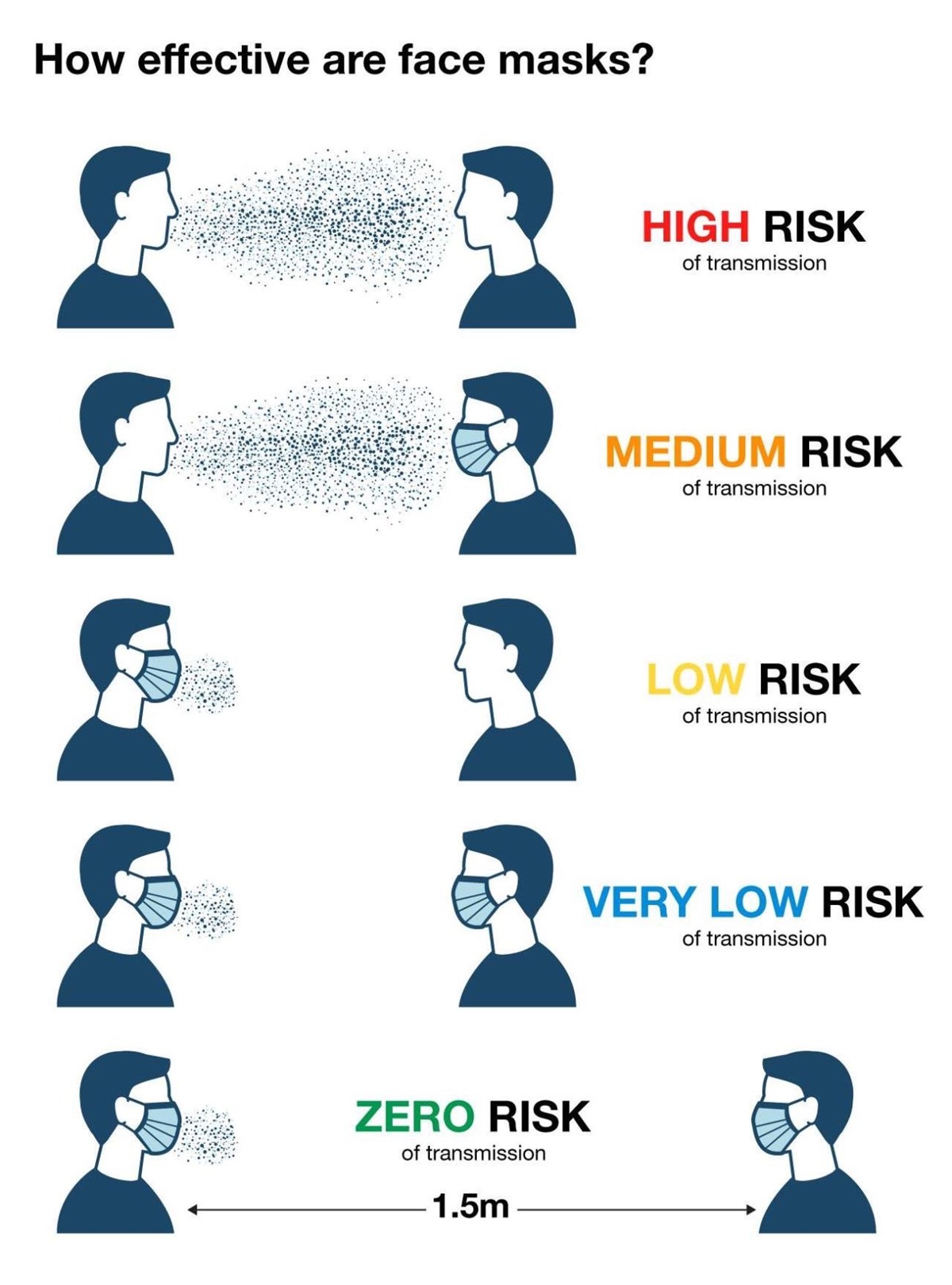
When you consider the image, it might not mean much, but the percentages (seen elsewhere) are 90%, 70%, 5% and 1.5%. A stage where mandatory masks lower the dangers from up to 90% to 1.5% is a massive decrease and should not be ignored. Yes, you can decide to ignore it but when your family members start dying (become non-living) do not cry like a husky, or blame Medicare, NHS or whatever. You did this (too)! I still have doubts and question marks regarding the numbers given to us, but the stage of other elements were out in the open and even as Omicron is a mild version, if the spread continues as we saw yesterday there is every chance that the hospitals will collapse before February 2022 starts , so if you do not have a relative who is a medical trained person, feel free to reserve your urn or coffin, because this will get bad soon enough (I still doubt the fear mongering 50% increased dead people). Yet the numbers if continues will also mean that the mortality rate exploded because no more medical help was available. 

As far as I can tell there is no data model for me to predict that, too many unknown factors and before you start the blame game, if hospital staff does walk out, it is because of the stupid people attacking and blaming these exhausted medical people in the street (as we can see in loads of YouTube videos). 

I believe in the double check, I believe it was essential to do so and so far my views hold up, but they are under scrutiny of the explosion of cases that were not known when I wrote this and that is why I did the double check, in other news, there is also the ‘missed’ cases of reporting as ABC (Australia) gives us 14 hours ago ‘Omicron spread leads to UK record of 78,610 COVID-19 cases in single day’, yes the 78,610 is correct, but we have no idea HOW MANY of them are Omicron, there will be a decent amount of them (speculation) but in the end we do not know and until that is known there is a larger stage that comes to mind. If a person gets Alpha, Beta or Delta now. Is there a chance they might miss Omicron? This is an important question because it takes us back to 1796. Then English doctor Edward Jenner noticed that milkmaids who had gotten cowpox were protected from smallpox. As such people got injected with the mild version (cowpox) to avoid and be protected from smallpox. (See https://www.cdc.gov/smallpox/history/history.html). The event was known to me (I had history in high school), but there could speculatively a case that a similar stage exists (I am not claiming it is). And scientists have made clear statements that previous covid infections may not protect against Omicron, which I tend to believe. You see, the other speculation is done on the premise of the past where was about a very different disease. So we need to be careful and rely on SCIENTISTS to give us the goods and it would really help if the media stops being a FEAR MONGER factor here. 

We have enough problems, it would be best for the media to remember that, because after whatever this was comes to a halt the people will (hopefully) DEMAND that some media outlets lose their 0% VAT rights (as they should not be regarded as newspapers). At that point we get editors crying like little Chihuahua’s that they have a right to expression, but expression and exploitation is not the same and Justice Leveson was clear bout that, was he not?

1 Comment

Filed under IT, Media, Science

One to the hospital, one to the morgue

It is not a setting, not a statement; it is merely the observation of what we see happen. Yet the question becomes who is who? It is a setting of placing Interserve next to the Cardigan Integrated Care Centre that is where we see a situation evolving. And it would not be a London project that is in danger, would it?

Why the situation? It is the timing, even as everyone is still ‘working with’ and ‘LOCAL health board officials are confident that Cardigan’s new £24m health care centre will not be affected by the financial problems of outsourcing company Interserve‘, I am less certain that this will not have an almost deadly impact on the project. The article (at https://www.tivysideadvertiser.co.uk/news/17301424.interserves-problems-should-not-affect-cardigan-integrated-health-centre-project/) gives the people none of that and as far as I read the article, there is nothing there indicating the views I have, yet the setting is already staged to become worse, much more worse I might add. That is an easily given fact as the project is not due until the end of 2019.

You see, the article also gives us: “Interserve is responsible for delivering the project but there are fears over its future after it confirmed it was in rescue talks that would see retail shareholders virtually wiped out and creditors take control. Yet that is not the directive part in all of this, and the article (through no fault of it, or its writer) gives that part to the reader. You see, that part we get when we contemplate ‘Struggling Interserve may hand construction unit to lenders‘ (at https://news.sky.com/story/struggling-interserve-may-hand-construction-unit-to-lenders-11581667). the first question that rises, if there is such a debt, why would we see: “drawing up plans to hand its £250m building materials unit to its lenders as part of an ambitious plan to secure the company’s future“, which is a choice, yet when we see another article also giving us: “Outsourcing giant Interserve is preparing to spin off its lucrative building materials division in a bid to reduce its debts“, so why would a ‘lucrative’ part get sold off? Lucrative clearly implies the part that allows for a much quicker turnaround and in absence, that lucrative part used to keep the lowest bidding in place will also (optionally) drastically increase the cost of projects when it falls away and that is where the Cardigan health centre find itself optionally soon enough. We might think that ‘RMD Kwikform makes equipment used to build concrete structures‘ is no indication, yet this equipment is often merely leased per project and a new owner implies new (or additional) fees or another destination for that equipment, changing the entire setting of the project and experience, as well as history taught us that a board in trouble does not tend to care too much about their running projects.

Am I correct?

That remains to be seen, because there are several factors in this that are unknown, yet the setting that the project is a year away implies that there are plenty of stages uncompleted and they are therefor at risk. The fact that this news is 2 hours old means that there is no given setting, yet the large impacts will be seen in the next quarter and that is when the pennies drop for several projects, the question is on how the stage will be maintained.

The fact that Interserve stock has been reduced by 45% and when we consider that the Interserve board is close to a month away from revealing its plan, as well as the fact that this thunderstorm has been looming for over a month does not help matters.

From another source

The Financial times is giving us another setting here. With ‘UK government to continue awarding contracts to Interserve‘ (at https://www.ft.com/content/03f63e62-fd41-11e8-ac00-57a2a826423e), we saw that the government last week was setting the stage for Interserve to get some deals going as these projects mean money and money coming in is always a good stage to continue the work. So when I see “Government sources told the Financial Times that it does not view the company as another Carillion— the contractor that failed in January — and that it would consider Interserve for further tenders“, we should consider it as a partial truth, when you are down in a debt that soon will be pushed towards an approaching £1,000,000,000 (as I decided to round it towards the worst case scenario), we need to realise that something has gone terribly wrong, That amount approaches to the annual income of 32,000 construction workers, and their pensions, so there is another side to investigate soon enough (although we do acknowledge that the Interserve pension is high in the green).

Are we overreacting?

That remains to be seen. The fact that this large a debt is an issue on something this big needs to be scrutinised in several ways, not merely what is to come, but how come the debt is there in the first place. Improper pricing, inefficient project management, wrongful costs are all stages here that pushes additional costs through the roof and that is where it all hurts, and without proper vetting the pain remains and we will see additional projects operating at a loss. that part was given by Construction News in April this year when we got ‘Interserve suffers £244m loss for 2017‘, the quote “an “inefficient operating model” with high overheads had left the firm “exposed to weaknesses” in the support services and construction industries” by chairman Glyn Baker is clear enough, the wrongful setting and we see an amazing growth of losses and debt. the fact that we were given the implied “Interserve said the business will need a “significant de-leveraging event” to stay viable, which would likely be an asset sale, or raising further equity before December 2020“, which against ‘cut costs by £15m in 2018, and is on course to add £40m to £50m to operating profit by 2020‘ sounds almost like a joke, to with a debt over 800 million (conveniently rounded to a billion by me), we see the mention of “limiting the cost issue by 1.8%, whilst adding debt reduction by 5% in two years’ time is exactly the message in a stage how we should read it, A Joke!“, oh and that is all whilst in those 7 months £300 million was added to the debt, is anyone waking up yet?

In all this, Interserve has gone from bad to worse from 2015 onwards, all whilst some might expect that with Carillion out of play, options for Interserve should have opened up, no matter how bad the market was, one larger player was removed.

Round 2 is worse

The audience has been avoided getting exposed to certain parts of the business, we might not have realised it, yet that part is actually given the limelight by the Investors Chronicle (at https://www.investorschronicle.co.uk/alpha/2018/12/13/interserve-the-warning-signs-were-ignored/). You see, I saw certain parts a month ago, but for me, it was partial news as I never looked at Interserve before. So when we are given certain points, and I am merely leaving the ones that matter:

  • Low profit margins.
  • A reliance on acquisitions and cost cutting.
  • High debts both on and off its balance sheet.
  • A big pension fund deficit that needed large amounts of cash flow to reduce it.
  • A difficulty in converting operating profits into operating cash flow – a classic sign of poor profit quality.
  • The need to sell assets in order to maintain and grow dividend payments.

At what point did we not consider the massive danger Interserve was in? The events that I have been able to track go back to early 2016, The Financial Times in May 2016 and the Independent in August 2016 give us some of the goods, in addition there was Forbes in 2017: “Overruns lead to £70m charge for construction and services group“, as well as “The Reading company advised that a tight control of working capital across the rest of its business last year substantially offset the adverse cash impact over at EfW. Consequently net debt clocked in at between £270m and £280m as of the end of 2016“. It is the fact that we see a clear level of inaction (or bad management) that gives rise to the situation, the fact that these issues were clearly in place almost 2 years ago, gives rise that the government had a clear duty to intervene to some degree, that level might be up for debate, yet the ‘let’s leave it for now’ and the presentation (at https://www.interserve.com/docs/default-source/investors/financial-reports/presentation-results/2018/h12018-results-presentation.pdf) now give the consideration that there is every chance that shareholders might be seeking legal counsel. You see Interserve ‘presented’ the so called facts: ‘Fit for Growth initiatives delivering savings and creating a simpler, more effective Interserve‘, as well as “Overhead reduction and efficiency measures to deliver £15m savings in 2018“, gives serious contemplation that the shareholders were not properly informed of the dangerous place that they were in at that meeting in August 2018. In addition, slide 20 gives rise to another contemplation; the fact that two posts (Manufacturing and Regulated industries) are set to a marker size of £22 billion, 2 out of 7 mind you, and we see the losses incurred, we see additional worries on management and pricing. Even at a 1% margin, we should see £220 million in the plus for these two alone, the fact that the overall is set to minus £800 million, and a mere positive move of up to £50 million is a much larger debate and as such, one might argue that there is a lot more going on in the negative of Interserve that we might think.

Baskets of fruit

In opposition to my own view, I am in several ways comparing apples, pears and oranges and merely labelling the items as fruit, which in itself is not correct either. However, from my point of view, I see a tradesman dealing in 22 billion pieces of fruit and when left with a certain minus to this degree gives clear indication that the entire business model is wrong on a few levels giving additional worries on the earlier reported premise of ‘The need to sell assets in order to maintain and grow dividend payments‘, the conceded view that selling of your land year after year just to look good implies that the farm devaluates with every year and when we see that this has happened from 2016 onwards, the signs given should have been louder by many players and that (to the best of my knowledge) has not happened.

The Coroner is in the house

When we consider the elements, we can also give rise to what needs to happen. If Interserve continues on this path, there is every indication that we see sell off after sell of, with an optional class action against Interserve, implying that the damage increases, so those projects set for delivery in late 2019 and 2020 (A Wales health centre for example) will find themselves on the coroners slab whilst the media looks at the intestines coming to the conclusion that at present there was no way to save the patient, and when we see that, how will that affect the £25 million Merthyr’s Prince Charles Hospital in Merthyr Tydfil? These two are close to £ 50 million, something will have to give and where will the government spring in when they have to? Will they do that? This does not mean that this situation explodes to that degree, but the signs of patient Interserve are not that great at present. And should there be an interception to protect these two projects, does that imply that Interserve is ready to be shipped to the morgue?

That is the foundation of it, because the stage we see now implies that you can save one, but not both. The stage to the degree as I am seeing it should not allow for it in the first place; it does open up new options that as Interserve breaks down we will see new players come to life, perhaps one per construction project, yet that too has the danger of costs going overboard in a large way really fast, that is the nature of the beast, merely because the largest players implying to have the costing down to a margin is a mere 1%, smaller players can never do good on that promise, showing us that costs will overrun on all projects by a fair bit. To see that in a much more local London setting we see places like the Aecom tower and the stage where ‘overly enthusiastic‘ contemplation was set until we got: “profit was “lower than expected due to the losses taken on an underperforming project in one of the company’s core market segments”“. This matters, there is a speculative approach to construction projects and the stage is not merely on how things are pushed, it is on how pricing models are staged and presented by all and that requires a much larger oversight, or better stated, it needs additional scrutiny on a few levels. There is a stage that clearly is part of the Interserve failure. Even if the ‘new’ model implies that we might optionally see: “the tower will now house 861 apartments of which 765 were for private sale, the adjustment now allows for a private sale of 813 apartments“, screwing over even more social housing points. If that is allowed, certain councils should be overhauled and those parts of the stage allowing for that should be required to be facing the dock and optionally dismissal of the project as well as the investment amounts to be considered a total loss. There is a lot wrong in this entire stage and it all started with optional pricing models that were seemingly not realistic in the first place. Carillion clearly showed that element as I personally see it and whilst the board of Interserve is contemplating what to do over the next few months, they to require a level of scrutiny that is a lot larger than anything we considered before. The Greenland Group and Aecom, merely illustrate that what we are seeing in the Battersea Power Station debacle as well as a much larger stage of construction jobs out there (Interserve pricing anyone?).

So when the Financial Times gave us merely a day ago: “A refinancing arrangement between its Malaysian owners has been delayed for the third time; the cost of labour and materials is increasing; the developers have more than halved their expected returns and there are disputes with Transport for London over the cost of the Northern Line Underground extension to the area“, we see that the pricing stage for construction companies (as we clearly see with Interserve) is a much larger concern, we could argue that someone is dampening the cost and margin part merely to get things started and in that trend, we might need to consider other avenues. Perhaps consider nationalising projects in this stage and those shareholders and investors will have to live with their 100% losses. Why leave this level of unacceptable pressure on taxpayers and governments?

And the fake messages of keeping Britain good for investors also required those pricing goons to consider that it comes at a cost. If the players cannot do their job, then those hurt must seek legal consideration against those firms using flaccid pricing models, making matters worse for Interserve, but should we actually care at that stage?

There is every consideration that Interserve goes to the Hospital whilst the projects in wales go to the morgue, but personally I do hope that it is the other way round, as the Battersea Power Station project implies (and a few more beside that); the entire problem on construction has been around for close to 5 years, implying in my personal opinion that these problems started long before Interserve was in the deep financial problems it currently is in, giving rise to several issues that require discussion in the House of Lords at the very least, and perhaps starting the discussion of that agenda no later than week 2 of January 2019 would not be the worst idea as I personally see it.

Do you want to see an avoided discussion on how a health centre went to the morgue no matter where it was supposed to be built?

 

2 Comments

Filed under Uncategorized

Two deadly sins

This is the second attempt to this story. I was still on the Sony horse when writing the first attempt. Yes, it will hurt us and it will have long standing consequences for many to come, but I realised that it was not really the story (even though the press remaining silent on it is).

Of the seven deadly sins (Gluttony, Greed, Lust, Envy, Wrath, Pride and Sloth) I only truly hate Greed! It is also represented in Dante Alighieri’s 14th-century epic poem ‘the Divine Comedy’, which actually introduces something I would like to call the 8th deadly sin, which is depicted in his 9th level of hell. It is Treason! These two sins are the most debilitating sins to consider. These sins are not against one, or against one’s self. These two sins are acts by one against many and we see the consequences every day. These are not just acts by people against people. They are also seen as acts by governments against people or even against their own nation. We must arms against these two, we must do so fast, because the liberties we lose as we allow this to go on will hurt billions and many care for one thing, they care for number one, they care for themselves!

Do not take the last sentence as an assault, I am not talking about selfishness perse, but we are in a life cycle where we are almost forced to survive. Greed and Treason pushed us there. The Dutch NOS showed us several parts in one newscast. It was the news of the 26th of November 2013. The first piece came from the news on the scale gas winning in the Netherlands. I had written about part of it in July 2013. The blog was called ‘The Setting of strategies‘ where we see that the Dutch are trying to get billions in gas using a technique called ‘fracking’. There were major concerns, but should you watch the issues, you will see that parties involved were trivialising it all to some extent. Now questions are called for a large investigation. The most interesting part is the quote they stated in the news [translated] “the NAM will not drill for any less gas as this is not a mandate handed by the stockholders“. In addition reported e-mails by the Dutch Gas drilling firm (NAM), which from their side, remarks and ‘interpretations’ seem to be taking a negative term. The mail showed that they knew that earthquakes in excess of 3.9 (on the Richter scale) were to be expected. This means that not only is this, the possible start of a class action in damages against the NAM, the NAM could be seen as a major contributor into damaging a unique Dutch landscape. Not just the land, but also the cultural heritage that the Dutch area of Groningen has. Many buildings, most of them predating WW2 are structurally damaged. It is an area that had been culturally unique for over two centuries, even by Dutch standards. Are you fracking kidding me? Stockholders are allowed to ruin the state of Groningen? So the government oversight knew this going back to 2012? So what were these investigations in 2013? Party favours? This is greed gone wild as I see it. The most important part is that the UK and the conservatives are facing similar issues at present. The conservatives are very willing to go this route. It was reported in the Guardian (at http://www.theguardian.com/environment/2012/nov/03/uk-dash-gas). The question becomes whether George Osborne has been properly instructed involving the risks he would place Wales in? If he is briefed by stockholders, the UK should take another look at these proceedings. I understand that heating is hard and very expensive, but can people continue when they are faced with long term, perhaps even unrepairable damage to England itself? Can that be acceptable? I am not a geologist, so there are elements I have no knowledge of, yet it might be realistic that many Walesians did not sign up for Shale Gas experiments when it could cost them both Cardiff and Swansea, both containing the largest population in Wales. Is Britain ready to pay for 350,000 damaged homes? I agree, that is an exaggeration, yet the true damage will not be known for some time. Perhaps there will be ZERO damage. I am fine with that, but the Dutch evidence shows that greed trumped safety and health easily. Can the UK afford such a mistake?

The second link to greed, are the changes that Finance Minister Dijsselbloem is trying to push within the Netherlands. He is aiming for commissions not exceeding 20% of a banker’s income. I think that this is a good idea. I also believe that he is on the right track. Greed is debilitating to say the least. The Dutch Union of Bankers stated that this law is not needed; there are enough rules in place. The interview with Chris Buijink, who is the chairman of that union, is not in agreement. He is mentioning that with specialist jobs, temperate commissions are to be expected. You see! We all agree, so make it no more than 20%, which is temperate enough (in my humble opinion). I, personally think that a group of Dutch banks, after the SNS Reaal and other banking issues, including the RABO LIBOR fixing issue, need to expect much stronger measures. Greed must be stopped!

This is not what he called ‘a black page’ (as Chris Buijink stated), the banking issues from 2008 onwards show that there is a structural issue with the banking industry. The fact that the Yanks are too cowardly to act (see the non-passed tax evasion act and the Dodd-Frank act for my reasoning in this), does not mean we should sit still. That part gains even more weight as we read more and more about the ADDITIONAL issues the RBS is now facing (at http://www.theguardian.com/business/2013/nov/26/mark-carney-rbs-deeply-troubling-serious). So on one side Conservatives are trying to get the economy going and the banks on the other hand… (You get the idea).

There was a video linked to this, which states “Bank of England’s Mark Carney ‘offended’ by Labour MP’s questioning“. Is Mr Carney for real? As Labour MP John Mann asked questions in regards to the ‘distance’ between the governor of the bank and the political wings. I do not fail to see that it is about quick economic restoration, the issue that it is now likely that small business got sold down the drain into non-viability to get this done is indeed an issue for concern. Why is there no stronger oversight on this? I think that it is time for governments to intervene in stronger measures. What they are? Not sure, but it should be somewhere between nationalising a bank and barring the transgressors from the Financial industry for life!

This issue goes on in another direction too. If we accept what was written by the independent (at http://www.independent.co.uk/news/media/press/royal-charter-on-press-regulation-may-be-redundant-says-culture-secretary-maria-miller-8919775.html), we see that in the end the Press might not ever be held accountable for the acts they did. Not only are they advocated in their need for greed (as in circulation and advertisements), we see that they are in a connected center of treason against both their readers and the audience at large, again as I personally see this.

How?

Well that is a fair question. As the big papers have steered clear from the Sony issues as they became visible just over a week ago, they seem to remain extremely taken with their advertisement needs and less with protecting the audience. “£3bn: the total price-tag for Christmas gadgets” is a nice tag to have and even though we see news on Microsoft and Sony all the time, those messages are small and do not hit the bottom dollar. The small technology hit “Cody Wilson created a gun that can be download and built with a 3D printer – is he too dangerous for Britain?” is a small article and iterates something I wrote many months ago. He is now linked to advocating bit-coin, which is another matter. I have not taken a stance on it. I think it promotes white washing and I personally do not think that virtual currency has a foundation, once it goes bust in whatever way it does; these people just lose whatever cash they had in it. I reckon that these ‘victims’ when they come will have no turn back and the first case against any government should be thrown out immediately. The story how Sony (and Microsoft too) will hurt an entire industry and how they are setting up the events that could stop local commerce is completely ignored. How quaint!

I see it as a form of treason, because this is no longer ‘the people have a right to know’, but ‘the people have a right to know when we see fit’. That same application can be made for the banks. If we take the RBS case, then the people involved could be seen as committing treason against their customers. Is that not EXACTLY the issue we saw in the US where we see banks setting up mortgages and then betting on them failing? Why is this not under control?

The Dutch examples are their own version of treason. A company that seems to be betraying the people living there by submitting them to intentional dangers is no small matter. This is not the end by a long shot. Treason can go further, from governments towards allies. I am not talking about Snowden, that loon is a simple traitor for personal gains (in my view). The damage he caused will take a long time to fix. No, I am talking about the TPP, the Trans Pacific Partnership. I mentioned it in previous blogs linked to the Sony/Microsoft issues, but that is small fry. The big price is the pharmaceutical industry. You see, America wants it passed soon, because of the powers this partnership gives. I will not bore you with the patent law details; the issue I see is that America is afraid of India. Apart from being really decent in Cricket (a game America does not comprehend), the Indian industry had made great strides in generic medication. With a population of vastly over 1 billion, they simply had to. The changes are mentioned by IP experts like Michael Geist as Draconian. The Guardian covered part of the TPP (at http://www.theguardian.com/commentisfree/2013/nov/13/trans-pacific-paternership-intellectual-property), the changes could impact this market into a damaging result which will go into the trillions. My issue is that Australia sides with America. Why?

America had been asleep at the wheel. Instead of opening a market, forcing affordability towards a population, we see segregation for industry against people. How bad is that? Canada kept its consumer driven approach, which is why Americans love Canadian medication. As America does not keep its house in order and they got passed by! Do not take my word regarding these parts; you should however take a look at what Doctors without Borders think. I reckon we can agree that they have always been about healing people. I consider them a noble breed. A group of physicians, who spend a fortune on an education, making less than the personal assistant for a middle manager in a small bank, which is not much to live on! At http://www.doctorswithoutborders.org/press/release.cfm?id=7161 they state “Five countries—Canada, Chile, New Zealand, Malaysia, and Singapore—have put forth a counter-proposal that tries to better balance public health needs with the commercial interests of pharmaceutical firms” As an Australian I state that Australia need to take the high-road with Canada and New Zealand, not follow the cesspool America is trying to force down our throats. In the end, I suspect that this is about more than just plain greed.

Consider that the Dow index is based on 30 major companies. Now consider that 10% comes from pharmaceutical giants like Johnson & Johnson, Merck and Pfizer. After the issues we had seen in the last 3 years, I started to doubt the correctness of the Dow (and I reported on that in past blogs). It goes up and up, but with JP Morgan Chase, Goldman Sachs, VISA, American Express putting pressures on those numbers, the three big boys (drugs) could rock the boat in a massive way, which scares Wall Street to no extent. India had made great strides in affordable medication; the TPP is now a danger to affordable medication for people on a global scale.

Greed and Treason, it is all connected and it hits us all critically hard sooner rather than later!


2 Comments

Filed under Finance, Law, Media, Politics