Tag Archives: WHO

Just like in the movies

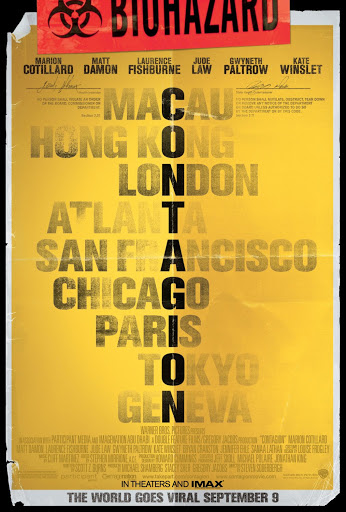
Steven Soderbergh made an interesting gamble in 2011, he took a collection of all cast stars and wrote about a fictive disease and the issues that the would would have dealing with it. Today less than 10 years later we see ‘death toll jumps to 170 amid evacuation delays for foreign nationals‘, as well as ‘returning Britons could be kept in quarantine for 14 days‘ and many more. This morning I saw a staggering amount of people with face masks. All fearing what could come next. Steven Soderbergh was an optimist. 

Frances Mao (BBC, https://www.bbc.com/news/world-asia-china-51290312) writes “For over a week now, the Australians trapped in Wuhan – many of them children – have been calling on their government to help get them out. But the announcement of a two-week quarantine on Christmas Island have given many pause for thought.” It is a nasty thing, especially for Australians and their view (as well as the UN view) on Christmas Island, a place where you go when you stop believing in any form of Christmas. 

For the UK (the Guardian) we see “Planners earlier looked at holding returnees at a hotel or military base. But, after an emergency Cobra meeting on Wednesday afternoon chaired by the health secretary, Matt Hancock, it is understood that they will be flown into RAF Brize Norton in Oxfordshire and taken to an NHS facility to be monitored and treated if symptoms develop“, the issue is not who gets treated and who gets flagged, the issue is actually all the people who circumvent the flags and who avoid scruples as they claim that they are not sick. In this case it is a much larger issue, most people become spreaders even before they realise that they are sick and that is a decently rare occurrence in medical matters. The fact that we saw Yesterday ‘The death toll from the virus has risen to 170‘ is only part of the problem. The optional fact that we see less than an hour ago the simplified facts that ‘the number of infections jumped by nearly 30 percent‘ as well as ‘China Now Has More Cases Than It Had of SARS‘ (source: NY Times) implies that it will not merely hit healthy people, it will be the foundation of fear mongering, which the movie Contagion showed was counterproductive.

And my case of ‘the people who circumvent the flags‘ was not academic, Japan reported 30 minutes ago that they had 11 cases, so how long until that one person overlooked has infected their whole neighbourhood? The issue is not fear mongering or academic, there is every chance that this is happening and there will be a larger issue following that. CNN gave a link to the Coronavirus map in China and it shows that it is confirmed in 20 locations ALL OVER China. This implies that there are in addition to this at least 5 more locations unconfirmed and optionally a dozen cases on the run (read: travelling) with no indications where to and how many that they will infect. And even as most will herald the Johns Hopkins University’s Center for Systems Science and Engineering for this map, how many are afraid to be on this map? Because their fear will propel the disease to healthy regions. It is hard to continue because of the fear that I become the fearmonger. I also want to be clear that my response is not as a critique on the China’s National Health Commission or the CCDC. the fact that we were seeing 6,000 cases (infected) on Wednesday and that we see a global number that surpasses 7,800 cases one day later gives rise to the thoughts I am having. Now we need to be certain that we also accept that there will be a percentage which are false positives, those with a normal flu, giving rise to a larger boost to the numbers. Even as I accept that this percentage is not to be speculated upon and that we need to be savvy of all cases, there is still a growing chance that people avoided being flagged and flew just before the curtain thinking that they were clear and that they would deal with their flu over the weekend. That is the stage we need to fear and the escalation of thousands of cases. 

Even now as we are told that Tibet has its first case, how many did this person infect? We see countries and numbers, but the truth is that there are cases in Hong Kong, the United States, Taiwan, Australia, Macau, Singapore, South Korea, Malaysia, Japan, France, Germany, Canada, Vietnam, Nepal, Cambodia, Finland, Sri Lanka and the United Arab Emirates. Each country where one person stated ‘Not me, I merely have a cold‘, that person will infect dozens more each day. That is how a pandemic starts. Let’s be clear, the term pandemic means an epidemic of disease that has spread across a large region (including multiple continents). In support we should also see that  a widespread endemic disease that is stable in terms of how many people are getting sick from it is not a pandemic. With the Coronavirus, there is still no vaccine, there is no cure and its growth is almost like wildfire because of panicking people getting away from this disease whilst they spread it, most importantly they were carriers even before they were sick, so fear was not the instigator. In all this there is one additional fact that the New York Times gave us “Taiwan, Germany, Vietnam and Japan had patients that had not been to China“, which gives rise to the fact that unflagged people were involved, or even scarier, as this started with animals, we need to consider that the issue is larger than we thought. It needs to be clear that this Coronavirus is NOT new, it was discovered half a century ago but in all these cases, it was animals that infected humans. In several cases we see the fingers pointed at the Huanan Seafood Wholesale Market, yet Science Magazine published on the 26th (Jon Cohen) that ‘Wuhan seafood market may not be source of novel virus spreading globally‘, there we see “a description of the first clinical cases published in The Lancet on Friday challenges that hypothesis” this comes from a large group of Chinese researchers and here we see “In the earliest case, the patient became ill on 1 December 2019 and had no reported link to the seafood market, the authors report. “No epidemiological link was found between the first patient and later cases,” they state. Their data also show that, in total, 13 of the 41 cases had no link to the marketplace“, and here we see that Daniel Lucey, an infectious disease specialist at Georgetown University seems to agree with the assessment, 13 out of 41 is too large a group to ignore. In my personal view it is not impossible that there is a covariant, if we consider that spreading happened before the personal marie celeste’s realised that they were sick, would it be possible that a busdriver was the link that was missing?

And it is here that we see the part where I went for and Science Magazine (at https://www.sciencemag.org/news/2020/01/wuhan-seafood-market-may-not-be-source-novel-virus-spreading-globally) gives us “the virus possibly spread silently between people in Wuhan—and perhaps elsewhere—before the cluster of cases from the city’s now-infamous Huanan Seafood Wholesale Market was discovered in late December“. A silent interference on data. When we realise this we need to consider and agree that this is not fear mongering, it is almost hard chiseled facts that lead us here and as such watching the movie Contagion a little late is not the worst idea to have. 

And it is that same magazine that gives us another part “Earlier reports from Chinese health authorities and the World Health Organization had said the first patient had onset of symptoms on 8 December 2019—and those reports simply said “most” cases had links to the seafood market, which was closed on 1 January” a situation that slowly took hold all over the world and this is the stage we now have and whilst officials are all about positive influence and flying home the ‘healthy’ people, they will optionally be the group spreading a much larger foundation of the disease. I say optionally, because there are clear foundations for testing, yet it is Bin Cao of Capital Medical University,a pulmonary specialist, wrote ““Now It seems clear that [the] seafood market is not the only origin of the virus,” he wrote. “But to be honest, we still do not know where the virus came from now.”” and there is the killer in all this ‘we still do not know‘ in a stage where we are given ‘a common source—as early as 1 October 2019‘ that is the foundation that eludes many of us and in hindsight when we consider the international infected, how many escaped a flagged view and how many did they infect? That is the question that officials need to have (and they might), yet we do not know and whilst we are all about ‘How can UK citizens leave Wuhan amid the coronavirus outbreak‘ yet the damage is optionally already done.

I do believe that there is no solution in fearing and burning at the stake anyone who has a cold (I have a cold at the present) yet the foundation of fear must be stopped in any way we can. For the simple reason that ‘My anxiety is increasing day by day‘ is not merely a Wuhanian expression, it is soon optionally to be a global one until we can give rise to clarity on where the disease is and until the vaccine is ready, the bulk of all people will be gripped by fear, just like in the movies.


1 Comment

Filed under Media, movies, Politics, Science

Mental health or Medication

We have seen the premise in a few stages in the last decade and for the most people lean towards one or the other and that is fine, it is a hard choice to make and there is no real evidence which of the two is better in the long run. Mental health needs treatment, medication is at times not a cure, merely a way to create a timeline for treatment, or to minimise the impact of the situation. Yet there is also a medial state that is not mental health based, for example treating people with cystic fibrosis who have two copies of the F508del mutation, for them there is Orkambi. Yet, what is the status when this involves a politician? How delusional is a public speaker allowed to become before he is considered unhealthy and unable to perform his function?

That question came up when the Guardian gave me ‘Labour pledges to break patents and offer latest drugs on NHS‘ (at https://www.theguardian.com/politics/2019/sep/24/labour-pledges-to-break-patents-and-offer-latest-drugs-on-nhs). So not only is he making claims, he is basically pronouncing war on the World Trade Organisation, abolishing the TRIPS agreement and throwing it all overboard. As we realise that the World Health Organisation gives us: “As of February 2005, 148 countries are Members of the WTO. In becoming Members of the WTO, countries undertake to adhere to the 18 specific agreements annexed to the Agreement establishing the WTO. They cannot choose to be party to some agreements but not others“, the UK and the EU are both signatories, so Jeremy Corbyn is stupid enough to set a stage of war that endangers millions. To give a little consideration to the metrics, we get the numbers on Cystic Fibrosis, not merely those with these two mutations (a specific subset), we see that more than 70,000 people worldwide are living with cystic fibrosis. Approximately 1,000 new cases of CF are diagnosed each year. More than 75 percent of people with CF are diagnosed by age 2. More than half of the CF population is age 18 or older. Now this is not a good thing, we admit, yet we are looking to a population that is less than 0.001% of the entire population, more important the people that need Orkambi are a mere subset of that. And for the UK it would linearly mean that it affects only 0.1% of the 0.001% that optionally have it. That is his ‘limelight’; can someone please kick this idiot out of the Labour party (preferably out of UK politics altogether)?

And in the second part, no political party has any business being in the pharmaceutical industry, there is a reason why industrials should never have any political power (well, we lost that one ages ago, but still). His voice giving us: ‘party will create company to make cheap versions of drugs‘, whilst the metrics give us that it will be a population less than a 100 that have this version of Cystic Fibrosis that is what he is fighting for? He cannot even properly represent his constituency and now he is starting patent wars as well as a war with the World Trade Organisation on abolishing or severely changing The Agreement on Trade-Related Aspects of Intellectual Property Rights (TRIPS)? Not only does it not make sense, the impact could be devastating for the UK. This is a person screaming ‘election’ and then spinning silent when it was offered.

It is my personal view that UK labour is better off getting the clown Ronald McDonald to do the Labour party bidding, and it will do a better job than Jeremy Corbyn ever could. His promises are no longer empty, they are now right-out dangerous.

Pharmaceuticals

There is a larger pharmaceutical issue and it has been going on for well over a decade, the issue that patents are reapplied well over 30 years after date, often in a slightly changed form, only barely passing the innovation line is the largest concern for generic medication, yet there are dozens of examples and Orkambi is nowhere near the top 10 in this. Lyrica (Pfizer), Rituxan (roche), Cialis (Eli Lilly), Xolair (Roche/Novartis), Restatis (Allergan) are 5 of the top 10 expiring patents with a value of a little over $16 billion in total, and those owners would like a little longer exclusivity, because the expiration will hit their bottom line in a real hard way. In that list Orkambi does not even stack up to any decent degree and we have larger issues gaining patents with a generic option and Corbyn’s need to make war with TRIPS, whilst the NHS has larger issues, especially as it was Labour who botched the NHS IT project losing £11 billion and small change to the degree of several millions is not one who should be casting voices on ending patents.

The sentiment is not wrong, but the chosen field is a little beyond stupid, making us wonder whether the man is personally dealing with mental health issues. We all have had that moment where we wanted to stand in front of Dwayne Johnson calling him Tinkerbell, not really wise, but we all have those inflated moments of self, to do what Jeremy Corbyn does worse hiding behind one 9 year old with: “Luis is denied the medicine he needs because its American manufacturer refuses to sell the drug to the NHS for an affordable price“, so this is not some Cystic Fibrosis case, this is a very specific case and the medication required many millions to create and pass FDA approval. A medication for CF patients with a rare mutation. With two specific mutations in a disease that knows more than 1,700 mutations that had been found in the CFTR gene. Orkambi works for patients with the F508del mutation in both copies the CFTR gene, the most common mutation in people with cystic fibrosis worldwide. So even if it is the most common, there are 1700 mutations meaning that his war on one medication to a specific subset that comes down to a lot less than 100 patients in the UK. So this idiot (read: Jeremy Corbyn) goes to war, promising to abolish TRIPS and leaving the WTO, all for a subset of people, too small to fill a village? Now consider that the UK has Pharmaceutical interests as well, the top two players in the UK are GlaxoSmithKline and AstraZeneca representing almost £132 billion pounds, because if he does what he does, then those two will vacate as well, this is how stupid Jeremy Corbyn is, but he is hoping that you will not notice this as he is in feigned tears for one nine year old child. I only mentioned the top two, the field is larger than that, but Jeremy Corbyn is willing to throw it all in the air.

Can you please explain to me how the government budget will be met when two companies representing a taxable £100,000,000,000 leave the UK? This is the kind of short-sighted, BS carrying ventures that Jeremy Corbyn is handing its constituents. His claim is ‘In England about 5,000 young patients could benefit, but the NHS said it could not afford to pay the bill‘, if there are worldwide 70,000 Cystic Fibrosis (CF) patients the UK cannot have that many, the claim of “US drugs company Vertex priced Orkambi at over £100,000 per patient per year” might be true and for 100 patients that is still serious money, but we need to recognise that we cannot hand every working person a Ferrari, we do not have the money, and it is that extreme. We are in a position where until a patent ends, the maker gets to set the price, or not sell the product. In light of the numbers I see, I want Jeremy Corbyn to give us an exact list of these 5,000 patients and what medication they need. I reckon that the picture shifts a lot faster at that point. And we agree that larger changes are required, yet making a direct case to the WTO that patents cannot be extended above the 35 years is a lot better than abolishing the WTO. Yet Jeremy Corbyn has no options to do that, so he comes with a delusional plan to start a company that ‘create company to make cheap versions of drugs‘, whilst there are plenty of companies doing that, the case remains that patents hand exclusivity until they expire, this year 26 drugs are facing patent expiration and yet, Orkambi is not among them, but 26 patents will become generic, before 2022 42 patents will expire and that is good for a lot of people, yet this system is already in place, we do not need some delusional politician to add his need to become a rich pharmaceutical cat as well.

To be honest, I have never had such a low regard of UK Labour ever before, the fact that I have twice the regard towards LibDems than towards Labour at present is something I never thought possible in the age of Ed Miliband, whomever thought that Corbyn would be a worthy successor deserved the title ‘Joker of the Year‘, as I personally see it, it is actually that bad at present.

So whomever is happy that this optional mental health case is running the UK labour party is in desperate need of some medication (generic NHS funded options will be available).


Leave a comment

Filed under Finance, Media, Politics, Science

Borderlines are not borders

Yes, that is the setting we seem to forget at times. You look at google Maps, look at the country/location and at times you forget that one country is not limited to the borderline you witnessed. Some will Google ‘boobies’ and ‘bikini’ and look in amazement on how good thing seem to be North of the border. Yet, we forgot that there is still a trap. That it is for the most an imaginary line. Birds never seem to see one and diseases notice it even less, so as we got exposed to Cholera this week, we see “RIYADH: Saudi Arabia confirmed one cholera case and said three others were suspected in an area bordering Yemen, where an epidemic has killed more than 2,000 people, Saudi state TV said, citing a health ministry official” (at https://www.channelnewsasia.com/news/health/saudi-arabia-reports-cholera-infection-in-southern-province-10727266), yet do we comprehend the danger that is evolving? You see, we can rely on numerous sources and accept: “Cholera is an infectious disease that causes severe watery diarrhea, which can lead to dehydration and even death if untreated. It is caused by eating food or drinking water contaminated with a bacterium called Vibrio cholerae“, we seem to forget too often that ‘infectious disease‘, ‘leads to dehydration and even death if untreated‘. The treatment is actually simple. We are also given: “you can protect yourself and your family by using only water that has been boiled, water that has been chemically disinfected, or bottled water“, that part is important right now. You see, antibiotics ‘reduce the duration of diarrhoea by half and also reduce the excretion of the bacteria, thus helping to prevent the spread of the disease‘, yet the true treatment is Hydration and that is where the problem starts. Yemen is in a state of famine and shortage, so not only is there almost no water, there is in addition no way to boil that water, continuing a cycle of symptoms and a spread of the bacteria (and so the disease). At that point, dehydration becomes the killer leaving death in its wake and in Yemen that is unlikely to be mere dozens or hundreds; it will be killing thousands of people. So they are not too fearful of bombs and war slaughter, cholera is much more certain to kill them and do it at a slower pace, ensuring that suffering is maximised. So even as one case is found in Saudi Arabia, it is in my personal view running rampant in Yemen where more than 2,000 people have died of cholera at present and the estimated 5.2 million children that are in danger of dying of hunger, measles, or diphtheria are at present more than likely on the death list of cholera. Making the Battle of Al Hudaydah not merely an essential one, but making it imperative that it is won by the Saudi-coalition as soon as possible.

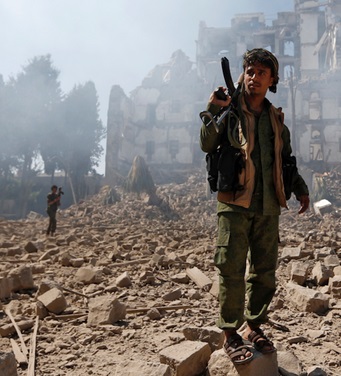
As we see the outspoken lies of the Houthi’s claiming that they are defending Yemen from a ‘US backed invasion’. That whilst they are knowingly, willingly and intentionally letting the Yemeni population die in the most horrible way imaginable, we need to wonder how much humanity we need to show the Houthi’s in all this. You see, the alleged Houthi in the image, an image merely 16 hours old (if the source it to be believed) does not seem to look that hungry, making the issue of who gets fed more important, and beyond that, if the Cholera treatment (hydration) is not made openly available Yemen could become the biggest graveyard in history. It is there that the setting of the Battle of Al Hudaydah is clearly shown and it is about to get worse. You see, as more and more refugees flee Yemen into Saudi Arabia with their malnourished and dehydrated children and babies, they will also push Cholera into Saudi Arabia. Even as we know that Antibiotic treatments for one to three days shorten the course of the disease and reduce the severity of the symptoms, and therefor lessen the dehydration, the setting is now also that there are sources that have given view that resistance against antibiotics have been reported, making matters less easy to resolve and therefor more water is needed to remain hydrated, and that is not even including of the backlash of other diseases in younger children because of the Cholera impact. DA Sack, RB Sack, GB Nair, and AK Siddique in their January 2004 paper in The Lancet “Cholera” give us the frightening part: “If people with cholera are treated quickly and properly, the mortality rate is less than 1%; however, with untreated cholera, the mortality rate rises to 50–60%“. Here we have the larger setting, you see cholera does not give a hoot about borders and now that the first cases have been reported, we see not merely the danger of the disease, we see the dangers that if any of these refugees would make it to a city like Khamis Mushait they would have passed half a dozen smaller places like Al Masgi, that is if they even maker it that far. For me 80 Km is a stroll, for a lot of others it is a mountain and refugees, even if given assistance, caring Muslims, giving them a ride on their trucks towards a decent hospital, or even trying to treat these people (especially when it was not clear that it is Cholera) might see a larger problem evolve. Even as we accept that Cholera is rarely spread directly from person to person, which is a good thing. I wonder how dangerous the disease is when we accept that bodies are working in a state of lowered hydration. You see the Arabian continent has dealt with water shortages for the longest of times. Over generations these people learned to deal with less hydration (personal assumption), yet in that light does cholera not become a lot more dangerous and could that optionally make these people more susceptible to cholera? I am not stating that this is so, I a merely asking (as I never qualified for a medical degree).

It also gives us the setting that as cholera cases grow, the issue around the Battle of Al Hudaydah will show to have a nasty aftershock. it will no longer be a mere case of humanitarian aid and treatment, there will be a much larger need to set up emergency treatment posts, especially North of Saada. In my personal view, a place like Baqim is directly connected to Saudi highway 15 after you pass the Saudi port of Warcraft, going directly to both Al Hayat National Hospital as well as AlKhamis Maternity and Children Hospital giving Baqim a possible lifeline for treatment, medication and most important clean water (food too). Even as we accept that antibiotics are essential for the younger children, the reported resistance against antibiotics might become a much larger complication down the line and realising that danger now is important too.

We need to see on how we can stop all the diseases but Cholera is now the most impactful. That is shown when we realise that the WHO reported in 2016 a total of 132 121 cases, with 2420 fatalities. We now see that with the Yemen fatalities, we get to report that close to 50% of all cholera fatalities were in Yemen, how does that go over with you all? That is besides the setting that Yemen alone will be likely the reason that cholera cases will more than double and if something is not done soon, with well over 200% additional fatalities, which is not a good statistic to work with. We can argue on where the treatment needs to be and i merely took a look at the map, yet the idea of getting as many children as far away from Sanaa and Sadah seems to make perfect sense. I am also very accepting of the statement “The WHO said on Monday the origin of the current cases was not yet known but the outbreak was not expected to spread given Saudi Arabia’s infrastructure“. I get that, Saudi Arabia has a good infrastructure and is equipped for matters like these, especially when you consider the Hajj and the fact that the Kingdom of Saudi Arabia is always prepared for that. Yet, when it is not a mere handful, when the sick refugees are not merely a few, but a few hundred, we will see more complications and moreover an increasing amount of people hiding in fear, fear of disease, fear for their families and fear of others after they witnessed nears of Houthi brutality. Setting up something sooner rather than later on the Yemen side of the border is becoming increasingly pressing as I see it and not merely for the cholera risks. Diphtheria is a much larger problem if it gets a foothold, not merely from the infectious of the disease, the fact that Diphtheria grows its population through coughing, sneezing and sharing water bottles makes it a much nastier issue. It is fatal in 20% of cases in certain age groups, and guess what, children up to 5 are definitely in that risk group making the issue bigger and even as it can be treated with antibiotics, the reports of resistance become a much larger issue at this point. In addition its symptoms are easily mistaken by non-medical professionals as merely a sore throat for too long making matters worse faster than anticipated. with the fact that it spreads easily we get the state where every day not acted is one that is basically too late and we have seen the inactions in this regard for months now making matters not merely worse, it sets the stage where famine is merely the final straw that could get the largest child population in history killed. So at what point did we think that indifferent from the 22nd March 2015 was a good idea?

It makes for the saddest epilogue of the modern era: ‘We merely did not care enough to achieve something in Yemen‘.

So when you see the news and you feel that the EU is doing OK as it talks with Iran via: “Iranian Foreign Minister Mohammad Javad Zarif has urged European countries to take practical steps to keep Tehran in the nuclear deal“, consider that Iran is directly involved and responsible for this by making Yemen a proxy player, arming them and supplying them, prolonging this war, the last missile Iranian sponsored missile was fired by Houthi’s at Jizan city almost 6 hours ago.

You should wonder on how the EU could even contemplate continued talks with Iran under these conditions. Where was the borderline there?


Leave a comment

Filed under Finance, Media, Military, Politics, Science

A sickly gamer?

The Guardian had an interesting article on Monday. It took me a while to get there, because I am intricately familiar with the subject and the issues. The name of the game is gaming, and in the article titled “‘Dangerous gaming’: is the WHO right to class excessive video game play as a health disorder?” has the interesting question.

So as we read (at https://www.theguardian.com/games/2018/feb/05/video-gaming-health-disorder-world-health-organisation-addiction), which holds: “included “gaming disorder” in its draft for the next edition of its diagnostic manual, the International Classification of Diseases (ICD-11), which is due for final release this year“, we need to wonder. In the first what constitutes a disease, when is something actually a disorder and more important, is it the first step in getting this label added to The Diagnostic and Statistical Manual of Mental Disorders, version 5, with an update which is supposed to come out at the end of the year. Even in the academic field there is doubt, which Netta Weinstein, a senior lecturer in psychology at Cardiff University voiced with: “I just feel like we don’t know enough yet and we feel we know a lot“. This is merely one voice. This part is important, as we see the following that matters: “the WHO was initially exploring excessive use of the internet, computers, smartphones and similar electronic devices, but determined that the biggest concern was gaming“, in addition we see: “The authors write: “These features clearly have their parallels with substance disorders and recognised behavioural addictions, such as gambling disorder“. They decided to make a dangerous step. As I personally see it, they are comparing apples with oranges, dumping the load into a basket named fruit and walk away. That view is not just supported, by others; Nena Weinstein gives us (paraphrased): “we found very small correlations, if at all, of symptomology with broader life wellbeing. So we actually didn’t find, for example, that symptoms correlated with health directly. It might be that something that we think of as addiction is actually just engagement and enthusiasm“.

That is the part that matters, gaming is about engagement and enthusiasm, now we can agree that some people go overboard. I for one have spent 5000 hours (not all at in one sitting mind you) in the Fallout universe and close to 3000 hours in the Elder Scrolls universe, I just love my RPG’s. The fact that this comprised a total of 5 games makes this the best value for money ever. I have played plenty of other games, and they were fun too. The fact is that the world is changing in several ways, a fact that the researchers are also ignoring. I also like the opposing view given by Prof Mark Griffiths of Nottingham Trent University. With: “The bottom line is problematic gaming. Whether you call it ‘gaming disorder’, whether you call it ‘gaming addiction’, there is a small minority of people out there where gaming has completely taken over their lives“, he has a point there. I have more than once gone so deep and enthusiastic into Minecraft, so when I suddenly realised that I was really hungry and getting tired, I looked up to notice that it was 03:50 in the morning and I remember the sun being up when I started to play. This happens, and it rarely happens, but still it happens. The fact is that the body reminded me and I did not ignore it. I was less positive about his remark: “in extreme cases some people have played themselves to death, though such incidents are extremely rare“, this is a case I remember, some league of Legend player, high on energy drinks playing 23 hours in one stretch. When it happens once, or perhaps less than half a dozen times on a population of 8 billion, it is not a case, it is an extreme outlier. We could in the worst case state that the proprietor had a duty to set a maximum usage of lets state 12 hours per 24 hours. Was that point ever raised?

Weinstein goes on in the debate on why few get addicted. Well, because there are many types of players and there are in equal measure many types of games. We can argue that in my case one style could lead to addiction, but I have a life with other elements too and even as I might spend a large chunk of my weekend on my console, I have lived for the longest time requiring no more than 5 hours of sleep per day, these days are now alas over (hence less gaming), but choosing the fun of a game over wasting money on alcohol in a bar, wasting it on fake smiles in a casino seems that I have taken a healthier life style. The entirely other side is that I even had more time in the kitchen, making my life even better by making myself a nice steak with a salad, a pasta salad or even a nice Bambi-burger or sourdough. I would not go hungry. My only little squandering would be to ignore my Nespresso and go to the Coffee place up the hill (roughly 723.4 metres) and get myself a yummy cappuccino, extra-large of course, sometimes even splash out and have a big breakfast there on Sunday. A walk in the fresh air, sunshine optional and preferred, good food, caffeine for the veins and after that groceries on the way back and the rectangular entertainment from console or Blu-ray, a life of relaxed bliss!

The package could be seen as addictive, gaming is merely one element in all of that. So as people then go with the mention of ‘all that gaming‘, tell me to just watch some TV. So how does that work? Constant badgering from advertising whilst you get hammered by two screwed up reality settings from places like ‘My Kitchen Rules’, or even worse some ‘married at first sight’, so it’s not that the divorce ratings weren’t high enough, we now get some reality TV show where ‘experts’ know what we need, want or desire? How fucked up is the TV nowadays? It is the second part where I oppose her view. With; “at least some elements of modern video games are closer to gambling. The newly popular and increasingly controversial implementation of “loot boxes”, where players pay real money for unpredictable rewards, is increasingly drawing the attention of regulators“, she only has a partial point. As far as I can tell, this was introduced in gaming by the Mass Effect series (I apologise if I am incorrect). You see, that is an option, but the game gives clear warning that you can earn these boxes by playing. Yet some people cannot go that distance. So like Ubisoft who allowed you to unlock all elements of Assassins Creed multiplayer for less than $10, people had no interest to unlock the abilities, they want it all from the start, a level 1 steroid character. So yes, you can buy chests for real money, but the ones I saw have always allowed you to get those chests by playing the game, it merely takes a little longer to get them. The second element that she is not lingering on is what is in such a loot chest. The loot chest is very much like a CCG (Customisable Card Game), each package will cost you around $5 and the 10 cards will give you 1 rage (or legendary), 2-3 uncommon and the rest are common items. So basically after the first 10 packages you only buy them to get the remaining uncommon, rare or even the legendary cards. Loot boxes work in the same way. That origin actually comes from a CCG game called Magic and was introduced by mathematics professor Richard Garfield and introduced to consumers in 1993 by Wizards of the Coast. So, now as it is in video games 25 years later, now they want to regulate it? Oh please, go cry me a river, will you?

Yet Weinstein raises a gem of a point with: “concern about comorbidity (when a person has more than one condition): “We need to know that it is about the gaming itself, or we’re treating something that’s not the actual problem.”“, she poses an excellent issue. You see if we accept that gaming is escapism, knowing what it is escapism from, that becomes the golden question and that is not easily explained.

Prof Mark Griffiths brings another side to the table. With: “I can’t think of a single [case of] addiction where there aren’t any other comorbidities. The addiction is usually symptomatic of other underlying problems. If you’re depressed and therefore you drink heavily, then you treat that with antidepressants“, you see, in that view, if these people escape into gaming, they still might not have a gaming addiction, they merely escape to it and we see the dangers of a wrongful diagnoses. So in the time where the depression is not seen and as these people ‘are cured‘ by gaming less the depression could take over leading to additional harm and even fatality. The problem (as I personally see it) is where is the trigger, the threshold where ‘addiction’ is set at. It is a grey area that cannot be correctly quantified as there are other elements in play. As I see it, it too often relies on what others think is ‘too much’ and that is equally dangerous. The parent who grew up playing outside and as such, junior should be outside, not playing on his console. Do they realise he was playing with school friends in an online 4v4 battle? They are talking to one another on the headsets, so they are still communicating were they not? Our comprehension of several elements is shifting, as a gamer I see the shift, but the people around me do not (want to) comprehend that. It is icky, it is geeky, they do not care.

That part is equally ignored and that is a worry too.

You see social media made the bucket of issues larger, but the level of comprehension beyond using the tool has not increased. That is the danger, usage without knowing what it implies, means or ratifies. Consider the articles like: ‘5 Ways to Generate More Exposure for Your Content Through Social Media‘, to improve your personal PR, or ‘How to Scale Your Social Media Exposure‘, that whilst the people trying to grow followers and to be ‘cool’ have no concept of ‘engagement’ and the use of common sense for that matter whilst exposing themselves to all kinds of risks. Those people will happily sit in any ‘gathering place‘ and remain in negative judgement of a gamer. I remember a nice issue in 1996 in the UK. I was in a bar taking a rest from the ECTS (7 morning presentations on newly released games will do that), so as I was sipping coffee and nodding to someone I knew in the business. He was talking to some girl who was way too good looking for her own good. So when he mentioned he was into gaming, she walked away as he was nerdy. So as she walked away, she had no idea that this was the guy who just made 1.5 million pounds ending with 4 times that much at least over the 3-5 years that followed. You see, even as more and more people are no longer stigmatising ‘gaming’ and ‘gamers’, the issue is that most do it because it is now a $120 billion market and money is money, no matter how you slice it. The actual issue of ‘addiction’ cannot be set for various reasons because it relies on other elements on how you still function when you are not gaming. How you see the world when you are merely shopping for groceries, enjoying a movie, setting in a corner chumping down on ice-cream or engage in conversation with friends. Those are elements that matter and if you can still relate to non-gaming issues with enthusiasm (like how ambulances in Kabul are an excellent way to move C4 from one place to another), we might wonder about the scepticism in all of it, but for the most that person is still OK and unlikely to be a true game addict.

Wasn’t that what mattered?

You see, it is actually the end of the article that had the truffle that mattered; no pig was going to get that one! With “The significance of the WHO’s decision will depend on your point of view. Griffiths admits it’s “a vindication for three decades of research”. Trade bodies such as Ukie naturally resist suggestions that anything their industry produces could be harmful“, this part could actually become the invalidator to his work. Prof Mark Griffiths of Nottingham Trent University seems to forget a few parts. In all this, I have been connected to games and gaming from before that. Gaming had several triggers over the last 30 years. First there is the arcade machines versus the home consoles (and home computers), there is an issue with any emerging technology and the PlayStation and Nintendo 64 are just over 20 years, before that it was all about home computers and the lasting time of a game was no more than one day of game time with only Loderunner to be a larger exception. Even in PC’s larger computers with larger games would be able to get finished in no more than 50-70 hours, and again there is an exception now, it was Diablo. Longer lasting games did not really get to the surface until multiplayer came out and it was not until the Unreal engine took off that people hid for a lot longer behind their computers (overly generalised). Now we can argue that those collecting games were indeed addicted, but were they? What data was there on them? I reckon that it was not until the sixth generation of consoles came out that we have the foundation for some level of actual addiction. Yet when we got back, we forgot the arcade machines. How much money did you pour into those machines? Was it to complete Donkey Kong? Was it to be in the top mention of Space invaders or Pac-Man? Does that make you addicted to gaming, or merely a person trying to pass time or dealing with OCD? I am not sure if I can give the right answer, but between generations 4 and 8 (1989-2012) the market has been in technological turmoil and that is disregarding the massive technological leaps PC’s had made over those years. I feel uncertain that with so many changes in a market that has not stopped running, how can anyone be correctly seen as addicted? For example, who would not spend their entire weekend finding the secrets that Tombraider brought in the first instalment? Who did not run to the shop (and claimed a sickie) the day that Tombraider 2 was released? Who did not drop their jaw the day Metal Gear Solid 4: Guns of the Patriots started on their PS3? That game can still hold up to the most that the PS4 brings to the table today. One view was: “The game has been considered one of the best games of the seventh generation of console gaming and among the greatest of all time“, a view I very much agree with. When perfection, art, challenge and achievement come to the table, the view we have changes, because exceptional quality keeps us at the screen. Just look at all those 4K nature movies Bing Lee sets on the TV’s they really want to sell, that’s not addiction, that is admiration/amazement. So in that all, I think that there is a case that Prof Mark Griffiths might not make the mark on this ‘addiction’ addition, there are just too many variables. And even if we recognise that an unhealthy devotion to games might be worth investigating, it would be to find the underlying cause to it all as Dr Netta Weinstein justifies. In that she is completely correct, so as we realise that Jo Twist, the UK Interactive Entertainment (Ukie) states the correct part with “We are very concerned about the inconclusive nature of the research and the evidence that WHO is using to base this potential classification on“, she could have (as not seen here) stated the matter a little better than what we got to read.

That is merely $0.04 on the matter (due to the FTSE Crash my $0.02 devaluated whilst writing this).


Leave a comment

Filed under Gaming, IT, Media, Science