Category Archives: Finance

On this Friday 13th

There have been a few events going on, with all the hustle and bustle from America we are moving towards a possible point that this nation will be officially renamed, when that happens other domino stones will be pushed into a different direction. Yet there is still time, so we can ignore it for now. What was interesting for me, was a Facebook mail that has all the elements of becoming a flame, a wave of emotions, intentionally set in that way. Yet the part that was actually interesting were the facts that it had. Those facts were indeed interesting to look into, yet not by themselves. At this very moment I am digging to confirm certain numbers and see if they hold up.


Income 2013 Income 2014 Change

Aetna, Mark Bertolini

$30.7M $15M -50%
Centene, Michael Neidorf $14.5M $28.1M 93%
Cigna, David Cordani $13.5M $27.2M 101%
Humana, Bruce Broussard $8.8M $13.1M 48%
United Health, Stephen Hemsley $12.1M $66.1M 546%
Wellpoint Joseph Swedish $17M $8.1M -47%

These are health insurances and their CEO’s. This group of 6 have in their hands the health options of the bulk of Americans. Now, before we act in outrage, which we might still do, we see that two of them lost half their income, which in the worst situation, that person (Joseph Swedish) makes in 2 days the same I make in a year. In opposition, there is Stephen Hemsley, who makes in a day, the same I would make in 6 years. Now, we can make this about the imbalance, yet that is not what this is about.

Let’s not forget that these are manages health carers. In September 2016 we saw CNN report “A recent report by Kaiser/HRET Employer Health Benefits forecasts that the average family health care plan will cost $18,142, up 3.4% from 2015. That’s faster than wage growth in America“, and “Premiums on the Obamacare exchanges are expected to rise by double-digits this year“. Now, we need to tread carefully here, health care systems require more work and they need to look to what happens in the future, not just what happens now, So when we see Aetna report in 2016 a total revenue of 60 billion, yet an operating earnings of 2.7 billion, we see that there is a margin, yet not an overly exaggerated one. This is part of a system for 23.5 million members. In this on page 7 we see that the revenue is comprised of commercial and governmental premiums totalling 51.5 billion. Yet it goes further, when we see the growth that Aetna has had, the merger deal with Humana, which is interesting as it is set as a 37 billion merger, yet when we see the quarter of quarter growth of 3 years at least, does it make sense to see this as a mere 37 billion dollar merger when the operating revenue has been in excess of 58 billion for well over 3 years? In addition, Aetna reported an operating gain against costs of over 30%, so when we see the CNBC quote on November 10th 2016: “The Affordable Care Act was built on a flawed model that required getting as many people as possible into the insurance system, Bertolini said. And he said he thinks the Republican Party will make good on its promise to repeal it“, we wonder with their operating profits, a managed health care system no less, what are we not seeing? As stated, compared to the revenue, the profits are not outlandish, yet the entire Obamacare issue seems to give another view, one that clashes with the view that we see at Aetna. Now consider another quote, one we see on December 13th 2016, in bizjournals.com. Here we see: “As one of its arguments against the acquisition, the U.S. Justice Department says the deal would drive up prices on health insurance exchanges in 17 counties where Aetna (NYSE: AET) and Louisville-based Humana (NYSE: HUM) now compete“, you see where there is competition, prices are pushed down, so how come I suddenly see an increase in health insurance exchanges? The final part is one that strikes a sting on the violin of chaos too. Consider the quote: “Bertolini also testified that Molina Healthcare Inc., which has agreed to buy Medicare assets from Aetna and Humana for $117 million if the merger is approved“, now let’s be honest that $117 million is nothing to sneer at, yet what are these Medicare assets exactly? Where is the write-off? You see, two companies with a total revenue exceeding $100 billion annually over the last 3 years, in that light $117 million is close to no blip on the radar (0.11%). So why was it mentioned, why put Molina Healthcare Inc. in the picture? Well, like the other two players, they have had quarter on quarter growth for 3 years too, more important, even as their revenue is not as impressive of the two others, we see that annual on quarter, 2015 brought close to 50% growth, whilst 2016 is expected to surpass the 30% mark, those are operating revenue growths nearly unheard of in this day and age. And this is not the adult media sales, this is healthcare, so as we expect that there will always be growth, we need to see where the interests are of these players. Let’s not forget that the picture is changing. Humana Inc. is a for-profit American health insurance company, they clearly state this, so what will become of Aetna when that merger goes through? How will the picture change and how will that impact the members? They are both Managed health care, yet Aetna is not outspoken ‘for profit’, the numbers do bear this out to some degree. Yet in all this is not about the members or patients. This is about the shareholders and both have plenty, the question becomes what direction will Aetna take? Will we see a board of directors that find themselves in agreement with the senate under Emperor Tiberius Claudius Nero, when in 19 AD they proclaimed: ‘Puer Pauper‘ (fuck the poor), which by the way coincided with the expulsion of the Jews from Rome, life is full of irony at times. The reason to make mention of this is because Israel has a health care system not unlike the Netherlands. A compulsory plan where all Israeli citizens are entitled to basic health care as a fundamental right. There a person can sign up with one of four official health insurance organizations which are run as not-for-profit organizations, this is where we see the massive difference. ‘run-for-profit‘ comes at a price and that price is the additional dividends that the members must pay the shareholders. It is not that simple, but you get the idea. In all this the fact that this approach made Israel 4th in terms of efficiency and Israel was ranked 6th healthiest country in the world by Bloomberg rankings. These are numbers any government could be proud of. Neither the US nor the UK make that top 10, according to the article in Bloomberg, the UK doesn’t even make the Top20. So as we realise a few numbers and this all leads to a lot of questions, we can agree that there is nothing against ‘for-profit’, yet who remains in the US with the option to afford this? Perhaps that is why the link to Molina Healthcare Inc., just a small token proclaiming to remain ‘for the people‘, whilst relying on tax deductions and write offs to remain ‘for the shareholders‘. However, let’s face it, these two (Mark Bertolini and Bruce Broussard) are almost the lowest ones on the Health Care CEO list of incomes, still making per day about what I make per year. Yet even as their incomes drew the attention, it is the coverage, the operating profits and the for-profit sides in some of these Managed Health Care groups, whilst we see places like fortune.com inform its upcoming ‘victims’ that the costs will go up: “costs are expected to grow 6.5% through next year. While costs have finally reached a point of equilibrium after years of double-digit growth” as well as “36% of employers are even considering a defined contribution strategy where they would provide a set sum of money to each employee to pay for health care, and if a health care plan exceeds that sum, the employee is on the hook for the remainder of the cost“, so whatever increased quality of life the Americans did not get, there is information that well over 10% of the employers have adopted this strategy. Such plans, especially with the for-profit health care managers will see a shift in costs, from employer to employee. Fortune.com gives as reason: “There’s two primary factors that affect health care costs: how much is being consumed and the price for services and drugs. As it turns out, prices aren’t what’s primarily adding to the rising trend. It comes down to more people consuming more care“. I personally believe that the truth is somewhere in the middle lane. Both the needs of an aging population and the pharmaceutical patents driving up prices as pharmaceutical patents are chomping down on maximised profit per pill. In this Forbes reported two days ago that the pharmaceuticals are not happy. Here we see the quote “Much of Medicare is now run by private sector insurers like Humana or Aetna, who already bid on drugs to get lower prices (this is known as Medicare Advantage)“, Yet President elect Donald Trump stated: “I worry today that the pharmaceutical industry has a very false sense of relief or security because of a Trump administration and a Republican Congress. I think we should recognize that the drug pricing issue is a populist issue. Americans are rightfully angry. The fault is not, surely, on the pharmaceutical industry’s shoulders, but we bear that because we make the drugs. We innovate the drugs, and as a result of that, whether we like it or not, or we want to try to explain it or not, we have to deal with it.” As stated more than once in the past, I do believe in capitalism, yet at what point does capitalism become plain greed? When we look at the top 20 pharmaceuticals, they are hiding behind a 2% growth, yet these 20 companies which include Novartis, Pfizer and Johnson & Johnson were making 547 billion in 2014, whilst we see that 13 of them are turning a profit with one of them 127%, these are only the 2014 numbers, the profits have been steadily increasing, at the expense of those requiring medication, at the expense of a health care system that can afford less and less. In all this we see that places like Pfizer kept a gross profit of well above 38 billion and they weren’t even the best scoring one. Yet, the connection go on a lot further. You see, with Pfizer we see James C. Smith who is also on the public board of Thomson Reuters, Suzanne Nora Johnson is also on the board of American International Group, Inc. (insurances). James M. Kilts serves on the board of MetLife Inc. as well as Nielsen Holdings N.V. The list goes on. A group of board members already on a massive income, adding the incomes from other boards where they serve with incomes most people dare not dream of. What is more interesting is how we see an almost illuminati sized cloud of interaction with media, insurances and other interactions. All essential and profitable for Pfizer. When we look at Novartis that list of directors takes an even more interesting turn. Ann Fudge who also serves on the board of the US Council on Foreign Relations, with additional functions at Unilever as well as the Northrop Grumman Corporation. Pierre Landolt, Ph.D. who is also the chairman of the Swiss private bank Landolt & Cie SA, a Financial Institution in Brazil and a few other enterprises. Andreas von Planta, Ph.D, linked to HSBC, Moller Finance, and the regulation board of the Swiss stock exchange and finally Srikant Datar, Ph.D., who goes beyond mere Novartis, with additional board placement with ICF International Inc., Stryker Corp. and T-Mobile US. The pharmaceutical boards read like a weave of corporate interaction with links all over the Fortune 500. A conspiracy theorists wet dream.

For us it is not about who they are connected to, but how such links could be used to maximise profits. The idea that the Pharmaceutical industry has its representation, and on the other side we see an optional Novartis with its board member Ann Fudge who also serves on the board of the US Council on Foreign Relations, how is that for hedging your bets on both sides of the profit sandwich?

On this Friday 13th we see news in the Guardian mention of the NHS winter crisis, we have been seeing from all directions the Obamacare and how Obamacare Premiums are expected to Increase by ‘Double Digits‘ in 2017, one can only hope that the first digit is a ‘1’. With pharmaceuticals and insurances both on the maximisation of profit, the people in several places are pushed in a corner with no place to go see about any options.

Only the superstitious will think that the health care news will be better tomorrow, it is Friday 13th after all.
Leave a comment

Filed under Finance, Politics, Science

Grasping change

We all tend to avoid change. Not because it is a problem, but we all believe in the expression: “When it ain’t broke, don’t fix it”. You, me all of us tend to go forward in our small circles, because for most comfort is king. Yet where is the moment when continuing the same is no longer an option? There is a lot of consideration in that because we tend to be like the frog in such manner. When you throw a frog in boiling water, he’ll jump out. Yet when you put a frog in a pot of water and put a flame below it, the frog will willingly boil to death. We are like that frog in many ways. Yet this is under normal circumstances, when we see an attack on our quality of life, we tend to get active real fast.

This is seen when our lives revolve around greed. When that happens the numbers go wildly out of control. This we see in the Guardian (at https://www.theguardian.com/business/2017/jan/10/hard-brexit-threatens-global-financial-system-city-chiefs-tell-mps), where we see people like Xavier Rolet, chief executive of the London Stock Exchange end up being connected to statements like ‘could spark more than 230,000 job losses‘. In all this the people involved are (as I personally see it) scared for their life filled with mistresses, large bank accounts and an overly rewarded quality of life ask questions like ‘clarity on the UK’s future relationship with the EU‘. You see, those people were lulling the masses around them into a false sense of compliance, but the people have lost too much, the gap of incomes too large and what no one was willing to accept is that Brexit became a reality and as the implementation is starting to move forward, those people are scared, their large incomes based on inaction is now in recession, it scares them, so they go into blame mode and flame mode. As Xavier Rolet called for a five-year transition period for the UK to exit the EU, possibly for additional reasons like a maximisation of retirement portfolios, is now confronted with ‘the Treasury select committee were told the triggering of article 50‘, which officially initiates the departure from the EU. Another Fat Cat, namely Douglas Flint has admitted a more playful response in this. “The ecosystem in London is a bit like a Jenga tower: you don’t know if you pull one small piece out whether nothing happens or whether it has a more dramatic impact”, is his statement and as he is allegedly fetching £7.6m a year (Compared to that, I am merely making 0.3% of that), we can feel secure in calling the man a fat cat of the finance industry. Yet he is not alone, the triplets of finance is completed with Anthony Browne, who is adding to all this ‘the preservation of the status quo‘ is the best solution.

You see, these people (some call them numbskulls) refused to listen for well over 4 years pushing everything forward and they all forgot that a nation is not them with their 322 friends who are all living the gravy train, it is the 68 million voters, who all for the longest time have lived a raw deal, they voted and there was enough to make a majority, too many had lost too many levels of comfort. If we push back to the frog in scenario 2, too many were getting too uncomfortable and the announcements from Mario Draghi on more Quantative Easing programs that can now be extended beyond 2017. The people see the debt growing and more important, the second time now has enough evidence that it will not be any better, almost certain that it will be worse. In all this we remember the action of an insane person. A person who does the same thing twice and expects different results. The people have had enough of fat cats drowning banks with cash whilst only the banks and the financial sector see the fallout bonus of those events. The people wanted Brexit and certain people in the English Financial Sector now see that the good times are ending, a few years too soon when they look at their retirement portfolios. In that they do not realise that the bulk of the population will have to work until the day they die, for well over 30% retirement is no longer a viable option. They all forgot about the people. In my personal view, the sooner the UK is out of that mess, the sooner can it actually grow its national value, the value of the British people! The fat cats all forgot about that, because for the most, their fortunes are all set in some mobile ‘currency’ that ‘avoids’, or is that ‘voids’ taxation in legal ways.

So even as some of these Fat Cats will grasp towards statistics like “median disposable income for the poorest fifth of households had risen by £700, or 5.1%, in the year to April 2016, while the richest fifth of households saw their incomes fall by £1,000, or 1.9%, over the same period” (source: the Guardian), yet what is left out in the shadows is that the poorest group is making less than £10,000, whilst the richest is making in excess of £55,000, with the top exceeding well over £275,000, so we can honestly state that those losing out of £1,000 should for the most not feel its impact and the top won’t even notice it. Change happens and only when it impacts our comfort levels (those not impacted by greed), that part has been ignored and now when the die is cast do we see levels of fear mongering, where a small group is hoping if they can get away with it a little longer. Almost like that little girl Beverly Hills Twist going to the front of the Crystal shop asking for a little more. Charles Dickens would roll in his grave is he witnessed this. I particularly like the Guardian Quote (at https://www.theguardian.com/uk-news/2017/jan/10/uk-inequality-working-people-pensions-ons) “it calculated that the average FTSE 100 boss earned more than £1,000 an hour, meaning it took less than three days to earn the UK average salary“, the start of a new Beatles hit ‘three days a year’, greed run amok. Let’s be fair, I am for the most a capitalist. I have never objected to bosses making more than me, yet when their incomes with bonuses sets my income (me with two University degrees) at 0.3%, we can state that the imbalance is too far out of control. In that regard, I will need to be slightly less diplomatic and refer to the joke that is ONS senior statistician, Claudia Wells who said “a strong rise in pensioner incomes was behind much of the increase in incomes, especially of those in the bottom 40%“, perhaps she would like to show us evidence, especially when we see places like ageuk.org.uk give us:

  • 1 in 7 pensioners (1.6 million or 14% of pensioners in the UK) live in poverty, defined as having incomes of less than 60% of median income after housing costs.
  • A further 1.2 million pensioners have incomes just above the poverty line (more than 60% but less than 70% of median income)

So in all this, when she hides behind that ‘increase in income‘, how much increase? Because the bulk is not getting any place anywhere soon, too much data shows that. In all this they also tend to miss out on entitlements like Housing benefits because of several reasons. I expect that a lack of social housing is likely to be a first reason.

In this we need change. We will need to consider how business in maintained. The clamp down on tax avoidance was a first, yet the EU borders are too open and too many facilitators for lower taxation remain. With Brexit squarely in place the banks will need to reconsider, try to avoid taxation a little longer by moving, or in light of the European changes stay and pay a fair amount of taxation, at that point only the fat cats lose out, which gave us the three wise crackers at the beginning. When the tax comes rolling in, we will also see a change for the NHS and other parties who have been ransacked due to full infrastructures without properly taxed representations.

In this we need to face a few facts, not just from the HMRC, we see that the Diplomatic Corps needs to take a close look at themselves in the mirror. When we get quotes from the Guardian like ‘Ed Llewellyn told MPs his staff were making contacts with other French presidential candidates‘, whilst stating ‘his embassy will not be forging links with far-right presidential candidate Marine Le Pen because the UK government has a policy of not engaging with her party, the Front National (FN)‘, he better get his head in the game real fast, unless that order came from Her Royal Highness directly. Apart from these people engaging in discrimination, should Marine Le Pen be elected (not a guarantee at present), the UK will have no options but to sit at the table with France, France is one of the economy pillars for Europe and even as the UK is also one, there is enough indication that player number 4 (Italy) will be entering a very deep valley of recession for some time to come. At that point only Germany remains as a sizeable business partner. Perhaps Ed Llewellyn would be so kind on informing the people of England how often an option of one worked really nicely for the UK, like ever? In this Crispin Blunt is asking questions as should we all, Llewellyn’s response “would be a matter for ministers” will in my humble opinion not hack it as they are making connections to the other political players in France. The consequence of these choices could potentially be expensive for the UK, in a time when the required policy of turning every penny is squarely in place.

That wisdom was given by Natalie Nougayrède of the Guardian in September last year with ‘Angela Merkel and Marine Le Pen: one of them will shape Europe’s future‘. Their visions are opposite and there is no clear evidence where the future of Europe is going. Whilst stating that, we do know that Merkel is in seriously warm waters (read: wibbit, wibbit), as Sigmar Gabriel is challenging Chancellor Merkel, there will be an age of polarisation within the German SDP. This will intensify as my earlier blog now gets a new side to it all. Thomas de Maizière a member of the CDU will have options to influence this polarisation, especially if Sigmar Gabriel is willing to offer a better centralisation deal on German intelligence, which is a dangerous reason to change to say the least. So having France in the UK preference side is going to be rather essential, alienating the current number two in that race is not the best actions, in that regard, the anti-Trump actions within the UK are equally not the good an idea, at some point we get to be thankful for Nigel Farage taking open positive interest in the inauguration of Donald Trump. In this we need to realise the ‘blunder’ Sir Kim Darroch made when he decided to dismiss him as “an outsider and an unknown quantity“, I am not a diplomat (far from that) and even I could have phrased that better. So as the UK diplomats bungle one side of the Atlantic river (that narrow brook between the USA and the UK), blundering on the other side of the North Sea might not be the best action to undertake. This when we look back at a leaked telegram by Sir Kim Darroch, making it interesting why a telegram? How encrypted was it? A little embarrassing that this is happening to the former national security advisor, it could just be the irony of the universe.

So as we are trying to grasp change, the people around us are doing the same. In fairness, like you they are catering to the needs of themselves, we cannot fault anyone for that, yet when their incomes is in excess of 300 times your income, how much leeway should they get? I have never opposed differences of income. Someone made Facebook and got wealthy beyond all means. So did the person who came up with Windows, with Oracle, with Google and a few others, yet those who merely ‘facilitate’, those who live of the vulture principle, those who do not actually create anything, how should they be seen? I cannot claim to know the answer, but there is a massive difference.

What changes do you grasp and who is making them for you?


Leave a comment

Filed under Finance, Media, Politics

No Health Statements

This is not the first time that we see a level of anger non-management in regards to the NHS and the medical staff. The proclaimed shortages and a government in denial over these elements. Whilst the DMG Media papers (among others) have had their fun day. The messages concerning the NHS are increasing all over the place and when we start reading about the  ‘The worst conditions in memory’, we know that we have come to that place also known as rock bottom.

This in contrast of messages like: ‘Hospital pays £1,800 for an agency nurse to work a single shift‘, April 5th 2014 (at Read more: http://www.dailymail.co.uk/news/article-2597442/Hospital-pays-1-800-agency-nurse-work-single-shift-thats-163-hour.html), Paul Dacre and ‘his’ DMG media. It is not the only case, there was a similar story on July 30th of that same year. The Telegraph gives us a similar story on January 19th 2013. This in contrast with real newspapers, namely the Guardian who voices (at https://www.theguardian.com/society/2014/nov/01/nhs-spending-agency-nurses-cuts) ‘NHS spending on agency nurses soars past £5.5bn‘, with the second line giving us ‘Government accused of ‘truly incompetent planning’ after years of training cuts push cost of temporary staff way over budget‘, this is a situation that affects both sides of the isle as it wasn’t started by this conservative government, it started before 2010. Neither side of the political isle has given proper vision to the pressures building, and this current government is now watching from the sides as they need to find £25bn. That number is actually pretty easy to see.

Staff shortage, overhaul of equipment, shortage of infrastructure and an overhaul of the infrastructure to protect it from this ever happening again. In this we have two elements. The first is that the press is partial to blame in all this. Consider the speech by Paul Dacre “a kind of show trial in which the industry was judged guilty and had to prove its innocence” (source: betterratailing.com). I like the news in the Spectator even better with “unremitting pressure of fighting what I have no doubt was a concerted attempt by the Liberal Establishment, in cahoots with Whitehall and the Judiciary, to break the only institution in Britain that is genuinely free of Government control – the commercially viable free press“. Yet, Paul Dacre sold out his readers in an instant as he kept quiet on the changed user agreements PSN users were forced to agree to, just a mere 10 days before the release of the Sony PlayStation 4. In that, as I personally see it, he kept the people out of the loop. So as the commercially viable free press is betraying its readers. Possible because he had to orally please the ears of Sony? How can we have any faith on anything we read regarding the NHS, especially when it is coming from DMG Media? You see, the issues are very much linked. The people have been made aware again and again that people like this cannot be trusted. It is Stephen Fry who brings the best definition of the Daily Mail “the only good thing to be said about his Mail is that no one decent or educated believes in it“, which is pretty much spot on, and the news the Guardian gives us regarding: “Paul Dacre steps down from the post of Chairman of the Editors’ Code of Practice Committee, which he had held since 2008” (at https://www.theguardian.com/media/2016/dec/01/paul-dacre-to-step-down-as-chair-of-journalists-code-of-practice-committee) is only the smallest of positive messages, even as he attacks it on the way out. Yet the Mail Online, which is owned by the mother company DMG media has had a long line of issues, among others with Tom Cruise as he was identified in a relationship between ‘Tom Cruise and the head of the church of scientology, David Miscavige‘, which might or might not be a big thing, what was the issue that the publishers were unable to defend themselves and even as we see ‘diplomatic’ responses like ‘Mail Online had failed to demonstrate that it had complied with its obligations under the first clause of the editors’ code on accuracy’, and as Editors’ Code of Practice Committee is part of IPSO, and they administered ‘penalties’ on a DMG Media sibling, the news that the Guardian gave “Regulator to reconsider whether the editors’ code, and its rules, can apply to a global digital publisher” (at https://www.theguardian.com/media/greenslade/2016/jul/19/ipso-review-after-mail-online-fails-to-defend-tom-cruise-story), so at this level of ‘contemplation’, something I personally tend to see as ‘inbreeding’, they are contemplating ‘a commercially viable free press‘. Are you freaking kidding me?

This sidestep is essential, because if it does not come from the Guardian, the Independent or the Times, we cannot be certain of anything nowadays, so as we lash out against the NHS, its governance and the consequences its patients face, we seem to be spurred into a false sense of righteousness as we kept on reading regarding those £225 an hour nursing jobs, which should be seen as misrepresentation of the highest order! The Telegraph isn’t helping any as they publish that the NHS now has access to Artificial Intelligence (at http://www.telegraph.co.uk/technology/2017/01/05/nhs-trials-artificial-intelligence-app-place-111-helpline/).

The part that the Telegraph does show that is important is “Joyce Robins, from Patient Concern, said: “I find this quite frightening. People who are ill want a person they can speak to. Typing in your own symptoms and waiting for a result is just ridiculous – what happens if you make a mistake?”“, which is just the tip of the iceberg.

The issues seem to escalate and there are a few players in this dramatic comedy that have to explain their reasoning. I am clear in ‘explain’ because there are sides that I am unaware of, to boast not being unaware of anything is utterly irresponsible. Before I go into the separate points. I did make a case on several levels with ‘The UK NHS is fine‘ (at https://lawlordtobe.com/2016/09/20/the-uk-nhs-is-fine/), and an even stronger case with ‘Is there a doctor on this budget?‘ (at https://lawlordtobe.com/2016/02/15/is-there-a-doctor-on-this-budget/).

Staff shortage.
It is the easiest one to solve, but cannot be solved overnight. Yet the shortages have been known for close to 4 years, so what has been done over the last 4 years to address these shortages?

Overhaul of equipment, Professor Angus Dalgleish has been outspoken in the past in several ways, mentioning the budget of the NHS not in the smallest way. We know that George Osborne had cut the budget by 1 billion, which in light of the shortages was a bad idea, the question is, was it avoidable, if not, how can the NHS move forward? With the current unemployment levels, how come it is still so hard to recruit nurses and doctors? I myself have had a lifelong interest in Radiology and Anaesthesiology. I am not alone in this, although in the 70’s when I was initially studying, getting into law or medicine was only possible if your parents were wealthy or if they were in law or medicine (meaning that they were wealthy). Now consider what the governments have done over the last 2 decades. I am giving that frame because we have known for at least 20 years that there was an aging generation coming up. Now the press at large seems to be blaming the immigrants, they might be as factor, yet they are not the main cause. A UK parliament going all the way back to Tony Blair should be seen as responsible for this. Those words are very specific. You see, when we look at the NHS expenditure history (at http://www.nhshistory.net/parlymoney.pdf), we see that in 2004/5 and 2006/7, Under Labour Tony Blair, the expenditure takes a massive hit, it is after that during Conservative David Cameron that expenditure goes straight into the basement, both sides fell short whilst both groups knew that the increased pressure from 2013 onwards would be strangling any budget as the NHS gets to deal with an aging population moving into retirement and an increased need for health care. None of it got properly dealt with by any parliament. In this, a rough estimate would be that the UK needs to hire no less than an additional 2,000 students a year for no less than 7 years to get anywhere near the numbers we will need in 8 years’ time, because the current shortage will increase. Perhaps parliament should take additional looks at places like the Royal College of Physicians (https://www.rcplondon.ac.uk/), we can agree that quality needs to be high, Yet when your annual tuition fee is set at £23,190 with an additional college Fee of £7,350 there will not be much appreciation on an international level, unless it is for private practice and that is where the NHS luck runs out, in addition, for the ‘locals’, £9,250 annually is still a big ticket, especially in today’s financial uncertainty. Consider the fact that this goes on for 4 years (the NHS is mentioned in several places to cover years 5 and 6), still, the average student will end up owning over £37,000 before they are actually earning anything and by the time they start earning enough to pay some back, the houses and their prices come across the corner, so these people too will try to find a commercially viable place. Perhaps they will go into journalism? Which is an issue as Paul Dacre of the Daily Mail (read: DMG Media) and Jane Dacre (President of the Royal College of Physicians) are related to one another, so I can only speculate with the question whether the Daily Mail news and Mail Online and others are setting a stage that is leaving a foul taste in my mouth. Now we all know that there are plenty of other sources making statements in the open, yet I cannot wonder if there is a sorted wave of misrepresentation of information is going on. We all know that there is an issue and that the NHS is in serious trouble, yet it requires drastic changes and a vocation that attracts many yet nearly null can afford is still a vocation with no staff.

Shortage of infrastructure.
This is seen in two sections, the people and the technology. Both are in a failed state. Even as plenty of people are looking for jobs, it seems that the infrastructure is under pressure as well. A cut budget as George Osborne had put in place is in addition incrementally debilitating to the NHS infrastructure shortage. Now in this I am not placing blame on George Osborne. The UK got themselves into a £1.7 trillion debt, the NHS is only one side of a national infrastructure that needs a budget, whilst the previous administrations have been burning their budgets like there is no tomorrow, the point has been reached where government credit cards are all maxed out, so finally budgets get cut hard all over the place. The NHS was not the first and will not be the last to suffer near death symptoms for some time to come. Unless parliament takes drastic steps and starts to change the way things are done and perceived there won’t be anything left.

Overhaul of the infrastructure.
The NHS infrastructure requires a massive overhaul, the NHS has to some degree failed itself. This isn’t just about cut budgets, this is about the essential need for hospitals to be lean and mean (read: not average). Processes need to change, the objectives of hospitals need to change. Larger implementations are required that deals a blow to the posts that have too large a cost. One if the implementations would be that alcohol and/or drug related injuries are no longer treated unpaid and only treatment when upfront payments are placed. It will be the first harsh response to binge drinking. It was stated a year ago that binge drinking is costing UK taxpayers £4.9 billion a year, which boiled down to almost £13.5 million a day. Now the researcher set that it equates to £77 per person, so in my view, any alcohol and drug related treatment will be set at £60 per treatment up front. Those who cannot afford it (spent their money on booze and drugs) simply get to wait outside until that bad feeling is gone (or they can die and decrease the surplus population, source: Charles Dickens). It is my personal view that it will take no more than 1000 deaths for people to realise that binge drinking needs to get to an end. This is actually small fry compared to Australia where the annual tally of costing is set to $36 billion and when we accept that the currency is only slightly below 2:1, whilst the population is set to 1:3 (only 23 million in Australia) we can honestly state that Australia is in a much bigger mess than the UK and if the UK adopts certain policies, Australia is likely to follow quite quickly.

If these three parts can be addressed, there will still be a dangerous time for the NHS, but there is also the option that the NHS will move away from near death to extremely sick and hopefully the death of the NHS will be averted. The alternative is to put faith in the aging population to throw their numbers in another direction. You see, at present, the death rate is down. Over the last 10 years it went down on average by almost 14%, so if the elderly could be so nice to do an about face and start dying more increasingly (like an annual average of 2,500 elderly per year), we would see a diminished drain on the NHS, housing prices more affordable, you see the benefit, right? Now, if you feel that this is so inhumane, than this is the lesson you now get to face.

To have a social civil society, or a civil social society, you need to be certain that you can afford to maintain it. As the political parties gave the keys of non-taxability to large corporations, the first step in having no budget was reached, as these players had no taxation, they still would try to find every corner to cut costs. So the car industry moved, fashion production went to places like Malaysia and Indonesia and sales went online via places like Ireland. It does not take a rocket scientist to work out that jobs would decrease and governments would no longer have a budget to play with, this is what we see in nearly EVERY nation on the planet, whilst the senior management places in corporations on a global scale left those few with more money than ever before and they do not need health statements, their incomes allow for their private physician with a nurse for the happy ending.

In all this, is this a story of hope? I am not certain, you see, unless draconian drastic changes come along, it might actually be too late for the NHS, merely because of the oldest triangle in existence. I am referring to the triangle of Places, Provisions and People. Any government and corporation can undercut one element for a longer time without consequence, for a short time you can undercut two elements with minimum consequences, yet there is no chance for survival when you undermine all three for anything longer than a really short amount of time. This is what has been done to the NHS for no less than 10 years, that whilst all the players knew that the pressure and needs of the NHS would increase and will continue to do so for no less than 10-20 years. What did you expect would happen to the NHS under those conditions?


Leave a comment

Filed under Finance, Media, Politics

The German mirror that does not show

Ever since the event took place, the news, the gossip and the untold stories that are set without direction have been all over the internet. Der Spiegel (at http://www.spiegel.de/international/germany/germany-knew-terrorist-was-dangerous-but-failed-to-stop-him-a-1128423.html) start their version with ‘Why Did Germany Fail to Stop Terrorist?‘ with the by-line ‘authorities identified Anis Amri as a potential terrorist threat months ago‘. This sounds nice and plenty accusing yet on what premise? Der Spiegel gives a timeline. Wanted in Tunisia for stealing a truck (2011), convicted for battery and arson. Yet at this point Der Spiegel ads the threat he gave ‘I’ll cut your head off. That is pretty much all they have on him. He had changed his identity to Ahmad Zaghoul. The German view is after this shown to be flawed as some substitute papers ID papers came without a photo. Still, none of this screams terrorist, because the amount of teenagers shouting similar words go into the 7 figure numbers, especially on Friday night. There was too much superficial information, so when we see: “Germany’s interior ministry is seeking to overhaul the country’s security apparatus“, I am very willing to state: “an overhaul when there is no clear evidence that it could have been prevented, whilst the intelligence players know the issues with lone wolves and with mere loons is a matter of greater concern than the German interior ministry realises“, I wonder if Thomas de Maizière, the minister mentioned in the Guardian has other motives in this, because he has been around long enough to know this. It is not the question Der Spiegel posed in the headline, it is the fact that they knew that the entire matter is staged in a ludicrous notion. So when we look at the quote: “chain of errors led to the deaths of 12 innocent people in Berlin shortly before Christmas” seems to have been inserted for dramatic reference. Yet the opposite comes to light. You see even with my limited knowledge could have acted and caused a lot more casualties than 12 death and 48 wounded. This brings out the issue that is in play, as I personally see it Der Spiegel is leaving its readers with a story, a fairy tale, a scary one, like the Grimm brothers would tell it. The second part is given by the Financial times with ‘De Maizière calls for German security overhaul to counter terrorism‘ (at https://www.ft.com/content/2c03bed2-d1ad-11e6-9341-7393bb2e1b51). The Financial Times are not the ones trying to bring you anything deceptive, yet the quotes: “an overhaul of the country’s security apparatus, centralising more powers in a contentious response to last month’s Berlin terrorist attack“, “The reforms put forward by Thomas de Maizière would take power from the regions, replacing their domestic intelligence services with a single national agency” and “But Mr de Maizière’s plans follow renewed concern that Germany’s security network is too fragmented and allows potential terrorists to avoid surveillance, including possibly the chief suspect in the Berlin assault“. So in this day and age, a system that actually works in Germany is now overhauled because of one incident? This reads like the resetting of limelight positions. I personally believe that the 16 fragments had a good view on what was happening in their region. Now Germany would need centralisation, data systems that are centralised meaning that cyber security would be a rather large issue and the 16 fragments would not get the access they had in the past, if so there are additional cyber concerns. All these amounting issues because of one case and the clear evidence is given in the shape of ‘ISIL released a video of Amri pledging allegiance to the terror group’s leader, Abu Bakr al-Baghdadi‘, the fact that the Islamic State of Iraq and the Levant had the video gives rise to Anis Amri being a terrorist, yet with the fact that there were only 12 fatalities, was this a failed attack? Consider another fact. The one part that makes sense is the question Der Spiegel gives “How he became radicalized under the eyes of German security officials“. The question becomes, did he become radicalised, or was he self-radicalised? A failed person, a small time criminal (car thief) who seems to have grown on the lower edge of the crime scale. After all that hopping around a mere 11 casualties. The amount of travelling he did to get into Milan is equally a question. Now, I started by giving rise to the question whether he was a terrorist. I had to get through the motions with you. I needed to create some doubt. That doubt is still there, yet another part of this is not in question. For this we need to take a look at what Sky News got from the German police. The quote “A police official says German authorities knew of 14 different identities used by Berlin Christmas market attacker Anis Amri” (at http://www.skynews.com.au/news/world/europe/2017/01/06/police-say-berlin-attacker-used-14-identities.html). The question here is whether he went by 14 different names, like some teenagers do so that they can bed more women from the same college (or a fence dealing with different clients)? Did he have papers for these 14 separate identities? The second one is now the issue, you see, this now implies that there is a support structure in place. Not unlike the video on Heavy.COM, which I discussed in my blog ‘Homerun by UKIP‘ (at https://lawlordtobe.com/2016/05/01/homerun-by-ukip/) where we see ‘a music video directed to recruit ISIS’ Turkish sympathizers‘.

Now we have the new situation, as the video could be made with a simple smartphone, forwarded to a place where the minions of Abu Bakr al-Baghdadi could download it and show it if such a wannabe or lone wolf makes a successful run. Mass marketing on an explosive ‘no cure, no acknowledgement’ foundation; the new methodology! In all this we need to recognise that Der Spiegel was all about the emotion and in some cases some of the information was made visible after the article was published, still plenty of facts have been missing and some statements are questionable. Were the speculated trips he took via Nijmegen and Lyon planned? Were they desperation or were they guided? In fact that part is extremely important, especially if it turns out that people like him have a support system that stays far behind the screens. The speculation becomes a lot more reliable if Anis Amri had papers for some of those 14 identities. Too many unknowns and more important, there is absolutely no evidence that the overhaul of German security and Intelligence will get any better with centralisation and there is plenty of experience around to see that the data quality take a massive dive as data systems get merged.

As I see it, the German political objective is getting in the way of the requirements of an efficient system and even if we accept that some level of centralisation is needed, until there is a clear path of how to resolve the refugee issues, align the logistics of a million refugees all over the place, making larger changes does not seem to be any solution. That is a given certainty. with Thomas de Maizière giving his ‘desires‘ to the Deutsche Welle we see the following: “more responsibilities for Germany’s federal police force“, “central tracking and investigation responsibilities“, “supplementary enforcement jurisdiction for residency termination” as well as “capable of truly recording all movement across the external borders“. There are a few more but let’s look at those another day. The first one makes perfect sense, as does the third one. It is the second one that seems to be not the greatest idea when we consider the issues involved, the path of changes and as stated the data. The fourth one makes sense to some degree, yet there are too many issues with that one, and I am not taking that one apart here.

In all this the German mirror (Der Spiegel) is not showing us all the parts and more important the reflection they bring is very incomplete, some parts make sense, but not all the missing parts, with all the ‘honest’ revelations we saw Der Spiegel bring regarding Edward Snowden and Julian Assange, they seem to be off their game a fair bit this time. I wonder why!


Leave a comment

Filed under Finance, IT, Media, Military

An audited symphony in Green

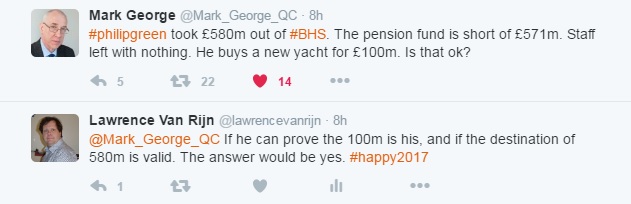
twitterfeed_0101aThis all started yesterday when the honourable Mark George QC sent a tweet (see picture), which was followed by my answer, and that one was given because I was feeling frisky. When you are done killing people in Constantinople as Ezio Auditore, I relied on Twitter to see some of the news messages on the air. His was one of the first ones I saw.

Was he wrong, was I? At that point it did not matter, the image that is given was based on three different matters and they could very well be valid, so I decided to dig today and see what is exactly going on. The first thing I am noticing is how much emotions are going all over the place, it is all about the wealthy getting bashed. Now, this might not be wrong, but what is actually happening? First was the Week, who referred to an article in the Guardian, so I am looking at that one (at https://www.theguardian.com/business/2016/dec/21/sir-philip-green-bhs-mps-pension-schemes). The title is catchy enough ‘Sir Philip Green could face £1bn BHS fine under MPs’ plan‘, yet is this going anywhere? The first quote is “BHS collapsed into administration in April, leading to the loss of 11,000 jobs and leaving a £571m deficit. The regulator has started legal proceedings against Green and Dominic Chappell, the former owners of BHS, in an attempt to fill the deficit. They collected millions of pounds from the retailer“. You see, the issue behind all this goes a little further and of course, the red cloth of the bull became very visible. The Accountant Online (at http://www.theaccountant-online.com/features/comment-bhs-and-the-silence-of-the-auditors-4923573/) gives us the news that the Guardian was unwilling to give us here. When the Accountant gives us “The Accountant magazine professor Prem Sikka painstakingly analyses PwC’s role as auditor of UK failed retailer BHS“, so the same group of less capable reviewers (read: idiots) connected to the entire Tesco disaster are also linked to BHS? Can anyone explain to me why Pricewaterhouse Coopers is still accredited to work anywhere in the UK at present? The additional quote gives us “Recurring losses and negative equity should have encouraged auditors to issue an emphasis of matter type of audit report which might have alerted employees, pension scheme members, pension regulators and others of the possible inability of BHS to correct deficits, but PwC did no such thing“, is that not odd? The fact that everyone is in emotional state, including the one person that should feel the strike of shame too. You see the right honourable Frank Field, Labour MP for Birkenhead and Chairman of the Work and Pensions Select Committee makes no mention of the PwC side either. I find that very odd, the fact that such large companies do not get red flagged by the auditor should actually have been higher on his list than Philip Green was. So Frankie’s response in the Guardian on £1000 million instead of £350 million is (as I personally see it) merely a load of rubbish, something to set at ease the engine of anger from the 11,000 people without a job, because if he had actually cared PwC would have been on his list in that interview in massive 350 feet letters, sending shock-waves through that decrepit organisation of abacus users.

This is not nearly the end of it. When we look at the Guardian in November, We see (at https://www.theguardian.com/business/2016/nov/02/philip-green-may-be-forced-to-pay-money-into-bhs-pension-scheme) that Graham Ruddick and Kevin Rawlinson have more to say on the matter (at an earlier stage) as we see ‘Pensions Regulator begins legal proceedings against Sir Philip Green‘, still the PwC stays unmentioned. Is that not weird? When I see ‘regulator‘ and ‘legal proceedings‘ I see, in my mind, in equal measure the need to look at the books and at that point the auditors. You see a £571 million deficit should not have been unnoticed, more interestingly anything over £100 million should have instantly called for a pension check, the fact that the Accountant online gives us “Page 1 of BHS Limited 2011 accounts stated that “The directors believe that preparing the financial statements on the going concern basis is appropriate due to the continued financial support of the Company’s ultimate parent company Taveta Investments Limited”. This statement is repeated on page 1 of the 2012 and 2013 accounts. Page 1 of the 2014 accounts stated that “during the year, the company was a wholly owned subsidiary of Taveta Investments Limited“, this should have been more than one moment where the senior abacus users at PwC should have been ringing the bells of red flags, the quote “BHS and its controllers had persistently failed to eradicate pension scheme deficit. In the light of that why did PwC have confidence in management assertions that it would provide financial support to ensure that BHS would remain a going concern“, shows what I personally believe to be a massive level of negligence, one that at this point is missing from the Guardian and several other news media. Can anyone explain how PwC seems to be receiving this level of non-accountability? Is this the price of hiring cheap graduates in places where seniors need to work? So as we see the massive amounts of deficits in place, we see that “since 2009, PwC collected £2.282 million in audit fees and £9.04 million in consultancy fees from Taveta Investments Limited, which included BHS“, which gives me the fact that in total (including Tesco), PwC received £25 million for what I personally regard to be overly negligent, that whilst I over my life for being capable and overly service oriented have never received anywhere near 0.3% of that amount annually pre taxation. So we can state that whilst the emotional and feigned state of anger by Frank Field sounds nice, but it is merely charades and the man should remain quiet until he actually achieves anything in regards to the pension schemes.

Now let’s get back to the original part, because there is a lot more than PwC in this matter. The quote “As part of any deal, it is understood that Green wants the regulator to ensure that Chappell pays into the pension scheme as well. The billionaire tycoon believes he was misled by Chappell about his track record in business and the money that Retail Acquisitions was paid by BHS“, which can easily be rectified, because if this was done properly there would have been records, like mail messages with attachments (resume amongst others), there would have been reference checks with phone numbers and annual statements showing the track record of Dominic Chappell, who according to some is seen as a former racing driver lacking 100% of retail experience. I cannot vouch for that, yet simple investigation should be able to set that one straight in mere minutes. If Philip Green cannot show any mail messages with evidence, my message to him would be “If it isn’t written down, it does not exist“, one of the oldest golden rules in administration, I reckon a billionaire should know small things like that. In this there is a third side of the problem. This side comes in the form of Lesley Titcomb, who is the current Chief Executive and former COO of The Pensions Regulator (TPR), in the shape that “it was yet to receive “sufficiently credible and comprehensive offer” to bail out the BHS pension scheme, which has more than 20,000 members, despite Green pledging to fix the problems facing it“, she too remains mindlessly numb on any mention of PwC. A pension hole this big should have raised questions years ago. They all remain silent on the auditor which gives pause as to why the hell that firm is:

1: Allowed to be in business in the first place; and

2: Able to cash in on 25 million (including Tesco).

We see that continuation in “The regulator said that after a “complex investigation” and months of talks with Green about a rescue deal for the pension scheme it was sending warning notices to the billionaire tycoon, Chappell and their companies“, the auditor that facilitated for all this remains out of sight, out of mind and out of mention in all this. I have a massive problem with that part, especially as the Guardian has stated more than once to be such an ‘investigative entity‘.

In all this we now see the final part leading to the wise tweet that the honourable Mark George QC made and it makes him a lot more honourable than anything that the UK Labour party has to offer. In my view, I questioned whether the £580 had been a valid destination. The Guardian quote gives “Green controlled BHS between 2000 and 2015, during which time his family and other shareholders collected more than £580m“, so he did not get all the cash, so there is the smallest of discrepancies here on the statement of the Honourable Mark George QC, yet he only had 144 characters to make it. I would want to see 15 annual statements of all the payments towards the Green family and shareholders. Because in that regard, a firm that had a pension scheme in deficit for 11 years and negative equity for at least 7 years, how would it have been possible for shareholders to get anything at all, in addition, how much did Philip Green actually receive as payments from the BHS side of his businesses?

There is a growing list of concerns, concerns that should also be used against PwC, the TPR as well as HM Revenue & Customs. I think that it is safe to say that the days of ‘Walk softly and carry a beagle‘ (Charlie Brown) are over and we need to look at ‘Shout loudly and carry a machine gun with the safety off‘ (Rambo) as an actual deterrent for the non-actions of all these players. In addition, I think we need to put Lord Grabiner in the spotlight who was a former Chairman of both Taveta companies. You see, what Frankie Fields did carefully avoid to mention is that Lord Grabiner is linked to the Arcadia group, also owned by Taveta Investments, as is his family member Ian Grabiner, in all this Baron Grabiner might be seen as an academic administrator, but there is nothing academic about this half a billion pound mess and with Labour members remaining very silent on their peers, it seems that the 1 billion pound levy threat is merely a hollow action giving the implied value of £0 towards Frank Fields and his valued point of view, especially when we look at a non-actioned and non-mentioned gap of 11. One person (@the_MourningSun) gave me the answer to my tweet that this was down to a difference between the letter and the spirit of the law. I think both have failed miserably for well over half a decade when the larger players get to play the game the way that the BHS was played. In the end, it will be for a court to decide whether Philip Green broke any laws or failed anyone he cares for (read: implied view he only cares for himself). What is overly clear is that too many parties are leaving the auditors in the shadows, away from the peering and prying eyes of the public, which is a massive failure on every level.

So as you think that the TPR is currently on the ball, you all better take notice of the Guardian quote “By the standard measure used by the PPF, 4,272 defined benefit schemes are in deficit and the size of the black hole is £195bn“, so as we see that part, I wonder when we get a list of those 4000+ schemes, who is auditing them. I wonder when we look at 2 pie charts, one based on the deficit amount against the auditors involved, and one based on the number of schemes against the auditors involved. I wonder which auditor will end up being the most prominent one. Would you like to hazard a guess?

Let’s see if we can revisit this part somewhere this quarter and see how many spins the media and Lesley Titcomb (Executive Officer TPR) will end up doing.


Leave a comment

Filed under Finance, Law, Media, Politics

This last day

This last day should be a day of reflection, a day of consideration. I feel none of these things as I am observing the mistakes that Marine Le Pen is now making. I get why she would get the referendum vamped up and get stronger waves towards Frexit, yet her call to leave NATO makes a lot less sense. For one, NATO still does mean the North Atlantic Treaty Organisation, France is part of that North Atlantic, she has a duty of care there (a lot less so for the EC, the EEC or the Euro for that matter). She does make a point when we look at the expansion into Eastern Europe. Let’s face it, when we look into the original line, there was Germany which goes a lot to the south, then basically it is Italy. Getting into Eastern Europe makes a lot less sense. Let’s not forget, the Americans at present no longer have the means to play this game. A fact Lockheed needs to take into consideration, even if the price of the F-35 is given without an engine ($133 million, without engine), making it basically the most expensive paperweight in history. In addition, it came with a truckload of issues in 2014, whilst the 2015 report states “the majority of the fixes and for capability deficiencies being discovered are being deferred to later blocks rather than being resolved“, with new items of concern added. I found the additional quote form the 2015 report “inherent design problems that are only becoming more obvious and difficult to fix” most amusing, so if Marine Le Pen has in mind to not go anywhere near a Lockheed design, that would make sense. Now I do not want to brag, but with all my flying hours in the Microsoft Flight Simulator (2004), I might actually beat that latest flawed Lockheed F-35 with my experience in a Mikoyan MiG-35 (OK, I am bragging a little as I have never flown ANY jet in my life). What is the issue is that the politicians have not kept a good accord on the military abilities of the armed forces, not the people mind you, but the equipment they get stuck with. As such we see a 1.5 trillion dollar project showing more holes than an IKEA Pasta insert (named ‘Stabil’, which is hilarious as it is also means stable in Swedish). A project $160 billion over budget and 7 years behind schedule, and these were the numbers in 2014. A defence project that was too big to kill and that is what the NATO partners have to content with?

So why these topics? The world is changing, it is changing faster than ever before and the minders of the store have been so selfish in regards to their own personal needs (read: visibility of self via ego) and achievements that the duty they had was pushed under the rug. This is how I personally see the F-35 project.

The financial sector in the UK alone these financial boys (girls also) had the bulk of the £44bn in bonuses this year, so did your quality of life increase any (the topic jump will make sense in a few moments)? Now, even as wealth increased, it did not do so to that extent. It is not that fair to just have a go at the financial sector, apart from the fact that they ended up with bonuses of 1900% more than the amount all the others got, so balance is not that much in play. That view is shown stronger as we look at Forbes this week (at http://www.forbes.com/sites/francescoppola/2016/12/28/greece-the-game-is-on-again/#2585dbd946e5), the quotes that matter here are “Euclid Tsakalotos, the normally mild-mannered Finance Minister, accused the IMF writers of “economizing on the truth”. He pointed out that the main reason why so few Greeks pay income taxes is that their incomes have crashed, and that nearly half of Greek pensioners are living below the poverty line” and “The IMF’s case is that pension cost as a proportion of GDP is now unsustainable, and further, that the creditors are not going to agree to debt relief while pension cost remains so high. It is probably right on both counts. But once again, what really matters is the psychological framing“, in that regard I will be on the side of the Greeks, but not on the side of Greece. You see when their previous governments got loans and misrepresented their value, they had zero consideration on what pensions were in regards to the loans that they were getting under false pretense, in that regard, did any of those politicians go to jail? Did they refund 90% of their incomes? I am certain that the answer to both is ‘No!’, in addition those elected officials are sitting pretty and nowhere near the poverty line. Yet in all this the hardship is not over, in addition, the facts (as I personally see them) requires a little more digging, especially when I read “Attica Bank, the country’s fifth-largest lender, was poised to install a new management team he thought was capable of turning round the struggling lender” which were the thoughts of Yannis Stournaras, the governor of the central bank of Greece, which was followed by “While he was in the air, the government in Athens reversed the decision to award the job to Mr Pantalakis. It was his introduction to a web of allegedly related events, ranging from a raid on his wife’s business to an unsuccessful bid for TV rights backed by Attica loans“, this gives the implied issues on Yannis Stournaras, which gives more cause concern when we see “A confidential report on Attica carried out this year by the European Central Bank, the Eurozone’s top bank supervisor, and seen by the Financial Times, cited “severe findings” of poor governance and inadequate controls on lending. With some 70 per cent of its loans rated as non-performing, Mr Stournaras and others believed Attica urgently needed a professional banker at the helm. Government sources denied any intervention in the process to select Attica’s CEO” (at https://www.ft.com/content/aab0aaba-c6db-11e6-8f29-9445cac8966f). The implications are on a few levels especially in the light of ‘government sources denied‘, there is a mess on a few levels and the idea that personal needs were adamant in decisions is not without probable cause. The levels that are in question cannot be set because too much information is missing, but there are issues, make no mistake about that.

These issues connect, not directly but in the view of national voters, governments have made absolute shambles of their nations giving power to those with key wealth management options, in that need those who need to be at the helm are politicised and set to markers that are off the table and outside of the scope of visibility to scrutinise, whilst the presentations are showing markers that do not fit the person best suited for the job, in that Greece is not the only place with such issues. In the UK Mark Carney is facing similar issues, yet in the opposite direction. The best person for the job is the one the elected government seems to have an issue with. The independent (at http://www.independent.co.uk/news/uk/politics/bank-of-england-mark-carney-theresa-may-attack-monetary-policy-tory-conference-speech-a7380016.html) gives us “Mr Carney argued that the monetary policy pursued by the Bank in recent years has had a positive impact that is “without parallel”, despite the Prime Minister using her speech to claim it had led to “bad side effects”“, in addition we see “Since quantitative easing was first introduced in the economy in 2009 … there’s been 2.6 million jobs created, GDP is up 16 per cent, per capita income is up 9 per cent and this is following a trauma in the economy“, we might see this as good news, but the good news is in the UK not dripping down to the other people just yet. In addition, the dangers will change if sharp budgets are not maintained. Getting the debt down is an absolute first, it will have additional benefits down the road, yet the initial benefit is that money could go to other destinations than paying for the interest of the debt, the interest of a debt amount that is currently in excess of 1.6 trillion. This was not the first attack, Michael Gove had a go at England’s Marky Mark in October. It is always nice when a person is called arrogant, especially when that person has proven to be amongst the very best in his field on the planet. I myself had had some issues in the past with Mark Carney, yet not against the man, but the economic issues that the UK faced because of actions (read objectives) pushed for by politicians, however his speech in the House of Lords showed him to be the expert he is and he nearly got me away from the Brexit team. Yet Mark Carney himself states it very well when he said: “Politicians have done a very good job of setting up the system. Where it can be difficult, sometimes, is if there are political comments on our policies as opposed to political comments on our objectives“, in this we see the issue that is part of the problem. as the politicians set up the objectives, they are then confronted with the policies from technocrats and those two groups do not see eye to eye, so friction goes back and forth, the Lockheed F-35 lightning is an excellent example here, in addition that part got an extra iteration as the military requirements were added by yet another group (read: the military). In all this the political objective is hampering the essential need against ‘it needs to be done by date X for no more than amount Y‘, which gives us the political joke that the NHS IT project was. A present from the Labour government which boiled down to a £11.2 billion wrapper around an empty box. Two projects set through objectives that ended up being off the wall and the back and forth friction that resulted in something unmanageable and non-functional. I reckon the political side of both events needs a new level of scrutiny, one that we have not considered before. In that regard having people like Mark Carney around is essential for the wheels of a state to remain functional, because if there is one clear thing, it is that America lost that oversight some time ago, before this Democratic Administration, the previous republican one lost sight of the needs and the accountability of the intelligence network and data processing side no later than 2006, we can all agree that the 2007-2012 total budget of $435 billion was money massively spent in all the wrong ways. This was shown in a Foreign office document that was quoted in an article stating “Army officials, though, said Palantir wasn’t up to the job. Now, a 57-page report by the Pentagon’s acquisitions arm basically says the Army was wrong to dismiss the Palantir system. The study instead gives Palantir high marks on most of the Army’s 20 key requirements for the intelligence system, including the ability to analyse large amounts of information, including critical data about terrorist networks and the locations of explosive devices, and synchronize it in a way that helps troops on the ground combat their enemies more effectively“, so there too billions were spent when millions could have sufficed. When the EGO of an individual with the power to decide is on the line, the results could be disastrous. In my personal view, if we accept the wrongful spending of 25 billion, how many extra troops could have been saved by adding fire support groups to those in IRAQ in those years? How many of the 4486 fatalities could have been prevented?

Politicians, advisors and ego are a really dangerous combination in many ways, even as we look at what is coming now, we need to be mindful of the changes that some are pushing for. Even if we are in favour of dropping the EC altogether, pushing NATO boundaries might not be the best solution. France might be privy to one of the better intelligence machines, that machine is also dependent on the intelligence it is fed from allies, an essential element that will fall away when NATO does, Marine Le Pen should be very mindful of that.

Yet this year and more important 2017 will go beyond Frexit. There is still a large debate on the Netherlands making any move away from the European Community, the numbers require people to be realistic on what will happen, yet those numbers are nowhere near the numbers Brexit had, so it is still unlikely that this will happen at present, no matter how certain Frexit will be. Italy might not have any manoeuvring space, it requires a massive infuse of funds, when we see the Reuters quote “An Italian government official told Reuters on Tuesday that €20bn earmarked for the rescue of the Italian banking system should suffice“, we need to wonder in how much trouble Italy is. This question is raised as we see Banca Monte dei Paschi di Siena will issue €15 billion of debt next year (source: RTE). So we see another iteration where “The Treasury may have to put up around €6.6 billion to salvage the lender, including €2 billion to compensate around 40,000 retail bond holders“, so, how exactly is it acceptable that people ‘invest’ with a risk, yet when that risk comes calling, they still get compensated? How did any of us ever sign up for that?

Anyone who mentions that it is for the good of all is of their rocker plain and simple. Here too we see connection between France and Italy, mainly that the Natixis Global Asset Management (NGAM) thought it was a good idea to list Banca Monte dei Paschi di Siena as a major purchase right next to Ubisoft. I reckon a little less ‘lack of nationalism’ and putting all of that cash in addition to the other amount into Ubisoft might have been a decently better idea. I feel certain that next year when we see the ‘Top Ten Holdings’ in the Natixis report will not make mention of Banca Monte dei Paschi di Siena, which could just be me though.

So in this last day we see that we have quite the collection of choices to deal with, some good and many bad ones. Yet no matter what is happening, no matter what will fall, there is a decent indication that unless changes are made 2017 will not be a good year. I might be too negative to see some level of collapse in Q2 (no later than Q3) in the next year, yet the proper setting and if the key players are willing to forego ego and focus on cooperation, they would be setting the stage for a lucrative 2018, that is beside the initial technological presentations of the new age of G5. G5 will be the pushing power in IP, especially Trade Marks, yet that path is also loaded with new growth opportunities for IT and developers as they start setting the tone of what 5G could personalise, it will be the first firm push to switch providers to SaaS. That is almost without question, the degree to it happening is very much depending on actual cooperation. In that the Telco providers need to realise as per immediate that thinking SaaS whilst selling Paas and charging IaaS, which sounds nice on bonus day. Yet the boomerang effect is that clients will walk away a lot faster and they will also automatically entice 10 personal connection to not seek the services of the telecom provider being that stupid. Infrastructure as a Service is almost a thing of the past. It seems weird, because there should be space for it, yet in our new outfits we see that infrastructure is a long term commitment and with annual mobile purchase the people have learned to be as flexible as possible, so the limited mobiles that some sell (32Gb instead of 64Gb editions) is why people are realising to walk away from those offering limitations instead of solutions. It is at times harder with Platform as a Service. You see, PaaS might sound nice when we see Apple and SAP connecting, yet the bulk of the revenue will be the smaller fish in the pond, the small players will be 80% of the revenue, one can argue the actual taxable cake of government will be largely depending on those players and for them IaaS is a laughable solution when they are trying to get as much as possible in the first few years and those smaller players want as much flexibility as possible taking to some extent PaaS from the table. SaaS will be solution of choice and those now adhering to that need will fall short in 2018 and they are unlikely to be part of anything in 2019. In that we see the government need of objectives that cater to what the SME’s need. A mere application of supply and requirement. You might think that this is not connected to the previous parts, but it is. When we see the NHS, Banks and government, their needs to address their audience, they need to consider that no matter the infrastructure or platform for communications, they all need to see that their clientele is no longer rigid, no longer bound to certain paths for the simple reason that the infrastructure of places like the NHS can no longer deal with. It is by definition a mobile customer base that needs addressing, this means, or at least implies that the SaaS solutions require a wider setup, other paths of non-repudiation and a very different approach to data, its quality, its controls and the application of the results in any report or estimation towards costings and profit. It is a path of contribution, which is set as revenue minus costing.

For the better part an entirely new path in a setting that has for too long been about a rigid collection of data, which when compared to a setting in a flexible framework no longer holds a candle and will come with the implied death of data quality. in these places there will be a growing need for a data team that has the sole purpose of managing the quality of data, this path is one that IT has never worked on to the degree it had, because in the past systems were set in concrete and after the correct data pass had been made, the data usually would not require ‘resetting’ it in another framework, a change that will be almost evident in the systems we will see start in the next 4 years. There, for some the problem becomes that they have never contemplated the changes, which now also means that once they go into the deep of it all, the time required and the resources required will be a lot more draining than ever before. It is in that path that we see the danger of politicians and technocrats in the required path of objectives and policies. As there is plenty of evidence that so far this track record is not that great, we will see a squandering of funds and a dangerous curve of unprotected data whilst no one will be actually held accountable for the transgressions against those consumers aka victims.

So on this last day there is no way that any solution will be found, just take in the information and next week wonder what on earth is about to hit you, there is some speculation in this, yet I believe that the ‘objective callers’ (read: politicians) will rely on the word ‘glitch’ a lot more than ever before, it might just become the most popular word for 2017.


1 Comment

Filed under Finance, IT, Media, Military, Politics

Back to the Future politics

I have nothing against Jeremy Corbyn, I just don’t think he is particularly well at what he does, which as a conservative is pretty good news for me. Yet, when he loses the plot to the extent the Guardian implies he is, we need to worry about the minimum quality of politicians. Could it get any worse (I so hope Labour proves me wrong). The article that sets it off is ‘Corbyn says May must come clean over UK-made cluster bombs‘ (at https://www.theguardian.com/world/2016/dec/22/jeremy-corbyn-theresa-may-cluster-bombs-uk-saudi-arabia-yemen). Now, normally it might be an issue, yet the actual issue is set in the following quotes and lets dissect them one at a time: “why it took so long for the government to establish that British-made cluster bombs banned by an international treaty were dropped by Saudi Arabia in Yemen“, so the Prime Minister of the UK is required the explain the acts of a sovereign nation that is not the UK? The missing part is given in the next quote “cluster bombs sold from the UK in the 1980s had been deployed in the current conflict in Yemen“, so Corbyn isn’t wasting everyone’s time with the particulars of another sovereign nation, no, he’s doing it in regard to weapons sold 30 years ago. Basically, he is advertising that the Labour party has no actual real issues to deal with, so they go back to the age when the labour party was a lot better than now, yet we all still felt safer with Margaret Thatcher being in charge, at least that is still a consistent truth today. So it is at this point that we see the reason why the Labour party might have hit rock bottom. The quote “The use of the cluster bombs is particularly controversial because the UK is a signatory to the Ottawa convention banning their deployment or assistance with their deployment, although Saudi Arabia is not“, Some might state that it is a big thing, yet realise that it was signed in December 1997 and it became effective from March 1999. So we see the mention of a treaty that came in effect close to 15 years AFTER the items were sold. This implies a few things, like retroactive things on sold items. So how stupid is this?

By the way, the one who fired the weapons never signed the treaty, so there is that too.

Now for the part that matters. There are over 30 nations that produce cluster munition. So, there are now two issues. One, did Saudi Arabia fire weapons sold 30 years ago? Were the weapons retrofitted for the planes that Saudi Arabia is using at present? If not, can we agree that there is a chance that more up to date bombs have been used, possibly not made in the UK? By the way, the issue given is that the US is also not part of the Ottawa treaty and the fact that the US has been supplying the planes (read: F-15). Is there any chance that the US would have been delivering the boom stuff too? No idea whether this would have been a Raytheon or Northrop Grumman item perhaps? I do not know, but I do know that asking Theresa May would not be on my list, mainly because she is likely to know sod all of weapon systems. There would have been the tiniest spark of intelligence if the question had been addressed towards Sir Michael Fallon, even if 30 years late, he could have looked into this. So, as we agree that the use of cluster bombs would have been known for some time, the fact that it is not up to the UK to speak on the actions of Saudi Arabia makes equally sense.

Even if we agree on the sensibility of the quote: “Even the US has suspended some military supplies to Saudi Arabia. Why can’t we do the same?” Well is that actually true? Don’t forget that the suspension could be lifted on January 21st after a new president is in office. So, the UK is now requested to cut the outstanding 22 planes (read: Eurofighter Typhoon). How stupid in this day of economies is that? First Labour squanders 11.2 billion on NHS IT that never worked and now they want to stop the UK economy to pick up? An act the French would love, but it seems to be really weird to stop one nation to get a plane that well over half a dozen nations are getting. Yet, in all this, I personally get the feeling that Jeremy Corbyn is not the most logical thinker of all time. He reminds me of the expression: “He’s stupid, but he’s not stupid, you hear what I’m saying?

Oh and the connected quote in this is even more hilarious “there has to be a political process to bring about a ceasefire as there does in Syria“, we can ignore the typo here, as I am more interested in the event of a ceasefire in Syria, when was there one and for how many minutes was it ever honoured? I think we can see the wind blow from an anal direction, smelly, unwelcome and extremely unhelpful, except for the person who is doing the farting, especially if it was after a few bowls of chili and cheesecake. The quote “They said the reported use of cluster bombs “calls into question the coalition’s wider respect for the rules of war”” is actually quite interesting. It is so for two reasons.

In the first, the Saudi Arabia never ratified the Ottawa treaty and neither did America for that matter, which makes me find the entire matter moot to say the least. In addition, I have been to the Middle East, not to Yemen mind you, yet the issues as seen in Libya, Yemen, Gazah and Syria shows that the lines of war are blurry to say the least, whilst not inaccurate, or improper, the ‘rules of war’ tend to be a bit of a ghost reading when we consider any war in the middle east. Even when fully part of a government, distinction of combatant and non-combatant quickly goes blurry, Beirut is equally a nice example in the 80’s. And what does that mean ‘wider respect for the rules of war’, he did not state the articles of war, giving way to a few more issues that bubble to the surface. More important, which accords (read: treaty) did Saudi Arabia sign? So as everyone is accepting the blind accusation of the use of British munition, which could be valid, the fact that the deal was made 30 years ago takes it all from the table. From my side, there is no clear evidence that if this stems from the 80’s that it is those delivered bombs (if they were of the cluster type) has no way of actually knowing what origin the used cluster munition had. And after they went boom, it might be impossible to show the original maker of the device that went boom. The last is a speculation from my side, yet overall, how wrong am I?

So as we see that Labour wants an early election and on how Jeremy Corbyn will hold nationwide ‘economic policy conferences’, will he also be raising issues that are 30 years old? Will we hear the story of the squandered 11.2 billion pound NHS funds? Or will he get united support by the financial industry on how important the single European market is? You know, those people who have everything to lose when they need to become competitive instead of having a 27 nation agreement where all get the maximum charge out of pension funds everywhere? I am merely asking. In addition, perhaps we will get info how the British economy is so much better served by not charging Saudi Arabia 2.3 billion Euro, so that France can. Let’s be honest here, I have no issues with the vote to halt delivery of weapons to any nation, yet to do it on a delivery done 30 years earlier is equally disturbing, especially as there still unanswered questions regarding the amount delivered and more important when the cluster bombs were delivered, for which plane were they meant?

Jeremy Corbyn should be making a lot of people really nervous. A person that is too little regarded in his own party is likely to be removed from his own office within a week of winning, so as we then see infighting and no results whatsoever, we see a stagnant economy fold and it will only benefit those who want to increase their stranglehold on the British Economy. The UK cannot afford this. In that regard having UKIP run the nation might even be safer, a bolt and dangerous statement to say the least. What we can see is that Labour no longer has what it takes. Let me just ask one last question to Jeremy Corbyn: “The £11.2 billion squandered on a non-working NHS IT project. Can we have it back please?” There is unlikely an answer forthcoming and more important, he has absolutely no clue where that kind of money from. Oh and let’s be clear what is starting all this, an event that is 30 years old! #JustSaying


Leave a comment

Filed under Finance, Military, Politics

How misinformed are the French?

This is what today’s article in Reuters brings to mind. The article (at http://www.reuters.com/article/us-france-election-frexit-idUSKBN1420HF) gives the following information: “But unlike Britain, France has a written constitution, which states that “the Republic is part of the European Union”. So a “Frexit” would require a constitutional change which experts say is difficult, but not impossible“.

You see, we are being bombarded by the media regarding the European Union, yet what about the European Economic Community, which was later renamed into the European Community?

More important, the fact that we see this: “France has a written constitution, which states that ‘the Republic is part of the European Union’“, this might not be in question, yet when a system is intentionally made complicated, is that a valid system? (We see that happening right now in the UK), in addition, when we consider the utter lack of accountability that the EC has shown in the last two years alone, gives rise to the imbalance and the unjust path the EC has been on. There is also the part where we see that Mario Draghi and his ECB are now feeling more and more the loud voices of political opposition. Which is likely the reason why we see (at http://www.europeanceo.com/finance/ecb-opts-for-longer-but-leaner-quantitative-easing/), that the title now reads ‘ECB opts for longer but leaner quantitative easing‘, yet the fact that this might lower the quantitative easing by €20 billion a month, yet the extension until December 2017 now implies that the French and the United Kingdom end up getting a massive part of an additional €830 billion in debt, that is almost a trillion more. Bloomberg had already given its view that the expected results were never met, more important, some critical voices give rise to a failing QE program as the debt increases, yet no economy was actually kick-started, there was a lack of results. By the way, when we add the €700bn of QE reported in April 2016, the debt goes well over the additional trillion, giving multiple headaches to France, the UK and Germany. In addition, it will with certainty drive the Frexit group stronger. Even as we saw in the Reuters article “A poll published by Ifop in July found that 67 percent of French voters who expressed a view would vote to stay in the EU. Only 33 percent were against“, which is the opposite from what was seen in February 2016, we need to realise that the upcoming message that France will inherit their share of a 1.3 trillion Euro additional debt through quantitative easing, that will fuel a possible drive of those 67% Fremainers into the Frexiteers Garrison that Marine Le Pen desires at the drop of a hat (any hat). The fact that a failed plan that keeps on getting prolonged reduces Mario Draghi to a one trick pony, or a one trick Wall Street Mule as some economists rumoured regard him to be after the October 8th IMFC meeting. This might have been in regards to the statement “until the Governing Council sees a sustained adjustment in the path of inflation towards levels below, but close to, 2% over the medium term“. By the way, that paper reads like it requires the United Kingdom not to succeed its exiting path, which might just have been my interpretation of it. In addition, the quote mentioned earlier is also stated in regarding the TLTRO-II actions. So, lets realise that I am no economist, yet in the lighter side of all of it, consider that a bank owes amount x. Now we add the TLTRO-II and suddenly the banks debt becomes x+(x*0.3), so we get a 30% increase in debt, this would be a consideration when it wasn’t part of the quantitative easing already happening. In addition, we get “if a bank sufficiently improves its lending to the real economy, instead of having to pay interest, it can receive interest by ‘paying’ a negative rate. This rate can be as low as the deposit facility rate, currently at -0.4%“, so how much fraud (read: apologies I meant accidentally misreported numbers) will we face now? ‘Lending to the real economy‘ is like finding a virgin with nymphomania and 12 service of years in a brothel (read: Really?). In addition to this, the banks get extra money. So When we go to any bank stating we want to add to the economy, so we all borrow 50 million, because we add to the economy we receive $200K a year. Which we spend on food, bills and other things, so we get money and spend that on a real economy (butcher, baker and pastry maker) whilst getting money for spending it. How weird is that? Of course what they see as ‘real’ economy and my view of that are widely apart I reckon.

Yet in all this, we see another game being played, one that I speculatively ‘accused’ the ECB to play almost a year ago. The fact that they are raising the debt to such an extent that it becomes impossible to leave the EC, the UK is getting dangerously close to that point (France might have surpassed that point already, mainly because their economy has been flat for a lot longer). And in all this we see news cast after newscast on how things are slow, too hard and impossible. This almost makes me wish for the age of Alexander the great, where he dealt with the Gordian knot. In today’s version we are almost at the point where the UK only needs to cut off the heads of Jean-Claude Juncker and Mario Draghi and that problem is solved too. #SubtletyRulezOK

In addition, the document seems to set up hidden traps, traps that if adjusted will hurt many in the long run. The quote “prioritising public investment and reducing the tax burden on labour“, so this is not a reduction on taxation for the workers, it is a reduction on taxation on the cost of labour, meaning that corporation taxation will go down even more, yet the ignored definitions that governments face are the results of those reduced forms of taxation, because that money goes to the boardrooms and if the feelings of reduced enthusiasm for Apple, Google and Amazon were low earlier, wait till you see the feelings in several nations when the American policies are stronger enforced towards the US and where the golden rules for the auditors become that corporate contribution (revenue minus cost) will shift and the money trails push all that contribution towards the US. This is a reality I saw in the late 90’s with American companies. As well as a push that senior positions were to be held (for the majority) by Americans. Now, a company must do what it think it needs to do, yet with lower corporate taxation, unbalanced taxation where the bulk of revenue is not taxed and tax laws are still lacking in efficiency as well as holding corporations accountable for certain tax values, we will see a growing imbalance of cost of living and what I would call the implosion of governing budgets because the money isn’t coming in from several sides as all sides are etched to the needs and desires of corporations. And people are still debating that Brexit is a bad deal and that a one market world is a good thing. Now take the 30 largest corporations add what they paid in taxation and add what their revenues were. After which you go to the tax office and demand a similar deal. How hard will these tax employees laugh in your face?

You still think a one market deal is anything but an engine to enable the non-taxability of global corporations?

It gets to be an even stronger issue when we consider the Guardian article (at https://www.theguardian.com/business/2016/nov/29/new-cars-imported-from-eu-may-cost-10-more-if-uk-leaves-single-market), which is two weeks old. You see, why would we care? Why get a foreign car? In Australia, the makers didn’t like the deal they had, they wanted more and more tax breaks making the car industry pretty much the first one with legalised slave labour. Why would we want to support this? Why would the UK support this? Consider the UK with 68 million people, now if only 50% had a car, than that would still be a massive amount of consumer goods. If the UK stops importing cars, those in charge behind the screens will then suddenly look for a solution whether a car could be made in the UK. They currently have 4 cars made in the UK, but those are high end cars and too expensive for those usually needing one. This is how VW started its empire, in 1932 it started the people’s car project. A car for every person, Volkswagen, which pretty much translates the German brand. The Australians are not in such a good spot in that regard, but it is still a 20 million citizen market, with plenty of 4 wheel needs. Those car exploiters forgot about the consequence when a market on a national level states, we no longer need you. That is why the single market is so important to them (mostly those in the boardrooms). And as Toyota reported a drop of 40% compared to last year, the consequence of nations no longer needing their brand must be a massive nightmare for those getting a bonus based on sales results. In that regard they will feel the pinch and they will feel it a lot harder than ever before. They are however feeling good because ‘Toyota’s earnings performance is improving, mainly because the yen is now weakening‘, which sounds nice on an Abacus, but the massive debt that the Japanese people face ($9 trillion at present), how long until the Japanese stop to consider how much interest that actually is; considering that Japan only has 123 million people. At 0.1% interest, if it even could be that low, implies an interest of 9 billion a year, this sets the interest to $73K per person per year. So how is that going for the Japanese budget, especially when you consider that the average man in the land of the rising sun makes up to $20K a year? So how is that formula working and how much worse is Mario Draghi making it for Europe? You see, it is my personal speculation in this that the US and Japan are pushing parties in equilibrium, when the debts equalise there will be no way back for Europe. Europe will be at the mercy of the incompetence of America and Japan. At that point, as a member of UKIP would state it: ‘I don’t want some bloody yank telling us how to keep our debt, I don’t want any debt‘, but at that point it will be too late and we will be left without options on a global scale. Did any of us sign up for that? In addition, do the French realise that my speculation is not that far off?

This is a path that I have stated before and in earlier blogs I have clearly stated that we are in for a bumpy ride, I actually expect a new crash late 2017, early 2018 at the latest, so when we see that this article by Pension and Investments (at http://www.pionline.com/article/20161213/ONLINE/161219969/natixis-survey-investors-turning-to-active-management-amid-expected-2017-volatility) gives us the title ‘Natixis survey: Investors turning to active management amid expected 2017 volatility‘, by the way, that is a group of people where the lowest income would be close to 30-50 times my income, so these people have serious cash to play with. So the quote “As a result, asset owners plan to reset their portfolios, relying on active management and alternative assets as they seek to manage risk and boost returns” seems a little bit of an issue when we realise that Mario Draghi and his quote “as part of our expanded asset purchase programme (APP)” gives a whole new light in all this. It almost amounts to a speculated shift in ownership of assets, where governments are buying assets via the ECB (intentional or not) and in addition, these portfolios get to reset themselves and get rid of what would soon be new bad debt. Whilst the Guardian reported in November 2015 that the European banks were sitting on €1 trillion of bad debts and the quote “The increase in lending has been accompanied by a very gradual improvement of asset quality, although levels of non-performing exposures in EU banks remain a concern and a potential impediment to lending growth and profitability” now reflects on Mario Draghi as he basically has been adding more than €1 trillion more (making it a total of €2.3 trillion) by the time we get to December 2017. When the upcoming volatility shit hits the fan, all our financial futures will go straight into the sewer.

So, when the French realise that, do you really thing that there will be any non-illegals left in that country considering to remain in the European Community?

More important, when some of these factors start hitting the UK, its population could end up demanding a sledgehammer hard Brexit almost overnight. Yet, again, that is pure speculation from my side. In the meantime, I should apply for a job at Natixis, facilitate for people who will actually end up having some money left from January 2018 onwards. I have to eat too and I would love some French grub, even if I have to Join Legion Etrangere for that part (do not worry readers, I no longer meet their standards).

So as you now wonder how informed the French are, I need to wonder in equal measure if they are the only ones not getting the full picture (read: awareness), the fact the Dutch move out of the EEC is now getting a lot more realistic, even more realistic than I ever thought it would be, gives additional light to the title and topic in this blog. Yet so far there is a decent indication that Frexit will drive the decision of plenty and Frexit will come to a referendum before the Dutch get that chance, meaning that the French vote will clearly influence the Dutch one, yet to what extent cannot be said or stated. In addition, the Rhine and the Rotterdam harbours would not get the economic punch as hard because of German needs, meaning that these ties will remain strong for the need of both, but that is no guarantee that the Dutch will not feel the initial hardship of change, to what extent cannot be stated with any degree of reliability.


Leave a comment

Filed under Finance, Law, Media, Politics

The double sided blade

I stumbled upon a situation last night that gives food for thought. You see, I am the first one to give way to those who are growing an actual business, those who are there to be true captains of industry. Yet what defines a captain of industry nowadays? What if the person is stated to be an entrepreneur, investor, and philanthropist; yet, the information given to us makes that person a mere oppressor, a borrower and an antagonist or opposer? In this case I am talking about Jeff Bezos, the man behind Amazon. Multi billionaire before he became half a century old, making him more successful than Bruce Wayne without the cape and the niceties.

So where does my view come from?

That is an important part, because other whiles it would just be envy, which in my condition isn’t entirely untrue either. The part that set it off yesterday was in the Guardian (at https://www.theguardian.com/technology/2016/dec/11/amazon-accused-of-intolerable-conditions-at-scottish-warehouse). We could agree that the subtitle is merely an emotional part, yet the consideration it gives when we read ‘Willie Rennie claims workers are paid so little some camp outside warehouse in tents to cut commuting costs’, depending on the distance, we can agree that alternative solutions would be found and it is not up to an employer to decide how any employee is deciding on their budget.

Yet when we see the following elements:

  1. All permanent and temporary Amazon workers start on £7.35 an hour or more and earn at least £11 an hour for overtime (The new national living wage is £7.20 for workers aged over 25).
  2. Amazon has been accused of creating “intolerable working conditions” after allegations that workers have been penalised for sick days and that some are camping near one of its warehouses to save money commuting to work.
  3. A Sunday Times investigation found that temporary workers at the warehouse were being penalised for taking time off sick and put under pressure to hit targets for picking orders.

So are my impressions founded? You see, point one gives way that the Amazon is acting within their right and as such Amazon does nothing wrong, as stated before is there an issue as we see point two? There are clear labour laws, you get a number of sick days, but you need to build up that right, so again is there a wrongdoing? Item three repeats item 2, giving additional questions when an article seems to rehash a point, yet in addition the requirement for targets and pressure are a clear issue. The question becomes are these targets realistic? If they are not then there is an issue.

Yet this is not the only side in all this. In addition there is the part we would have seen in the Daily Record (at http://www.dailyrecord.co.uk/news/scottish-news/politicians-union-leaders-urge-snp-7235948), more important that this news was from January 2016, so the issue is not really new. The issues in that part is: “Rennie clashed with Sturgeon over the issue at Holyrood on Thursday, highlighting a £1 million grant given to Amazon in the past year alone. The UK arm of the business paid just £11.9 million in tax in 2014, despite taking in £5.3 billion from British shoppers“, which implies that a company making £5.3 billion, only pays £11.9 million in tax in 2014 and got a £1 million grant last year. Now, we can see that three could be an issue, but where are the direct links? You see, Revenue is one, profit is another and after that there is taxation. We can put a straight argument that 5 billion would require more than 10 million in taxation (11 million minus a grant), yet what possessed the giving party to give that 1 million grant? Why was only 11 million in taxation paid? None is this reflects on Jeff Bezos, this is not a failure of the maker of Amazon, but a failure from the governing parties giving out cash where the requirements in light of revenue was nowhere near any justification of any grants, especially when we consider Forbes, who stated that Amazon boss Jeff Bezos ‘added $20 billion to his net worth over the 12 months through late September 2016‘, so, based on how much revenue and profit brought the increased net worth? The newspapers are extremely non-revealing on this. Now consider the two sources, the fact that some was known for nearly a year, we could ask questions from these agencies hiring, we could ask questions at the HR offices of Amazon in the UK and Scotland, yet in all this, were any errors, any transgressions made? Amazon is a business and its concern is profit plain and simple. The fact that according to the initial part that Amazon pays £0.10 per hour above a living wage, we could consider the firm to be Scrooge like which is not a crime! Now we need to look at two elements. The first is the definition of a living wage, which is regarded by several sources as ‘a living wage is the minimum income necessary for a worker to meet their basic needs’. Yet what are basic needs and where does that end? In addition we should consider that the living wage should be substantial enough to ensure that no more than 30% of it needs to be spent on housing. Which is interesting, because that is nowhere near realistic in many places. In larger places, we either need to consider growing cost of commuting or consider that £144 pw is not the cheapest in Scotland and not that sizeable. So at a working week of 40 hours the rent is 48%, implying that the living wage is far below expectations or realism. The only way to get near a living wage is to work a full day extra in overtime, yet in all this the cost of living is not considered, so we have a CEO who is getting demonized here (by yours truly), yet what wrong has he done? From the parts I can see, there seems to be enough evidence to see that there is no wrongdoing on the surface, yet we can in equal measure debate whether he can call himself a philanthropist. If you are spending money on one side by being a ruthless almost cutthroat like business man on the other, they should be cancelling each other out. Is he validly under the same conditions really an investor? If he is using the guise of tax deductibility, is he actually investing or is he relocating funds that were due to HM Revenue & Customs? Relocating some (read: most) of these funds so that they benefit the ‘personal goals‘ of Amazon. Is that really investing? Lastly there is the title of entrepreneur. If we accept the definition: ‘a person who sets up a business or businesses, taking on financial risks in the hope of profit‘, well Amazon has been here for a while, so setting up? We could see it in light of franchises, does that count? And as for taking on financial risk? With the league of tax write offs and grants, should he be allowed to call himself an entrepreneur?

So perhaps the titles or entitlements given to Jeff Bezos are no longer valid, is that a valid view, does this warrant demonization? Off course is does not, because that would be unjust. Yet, we seem to focus on the ‘stamps’ we are giving a successful person, whilst in the cold light of day we overlook the non-repayable funds given to Amazon. In addition, when we look at the independent (at http://www.independent.co.uk/money/tax/revealed-amazon-earns-more-through-government-grants-than-it-pays-in-tax-8617919.html), where in May 2013, the following was given to the public: “Amazon paid less in UK corporation tax last year than it received in government grants, its official company accounts have revealed – sparking condemnation from MPs around the country“, which happened in 2013. We now get another side that is not with Jeff Bezos, but with parliament and elected officials. Yet that news did not really make it to the massive forefront (other than Willie Rennie who seems to shout for attention). You see, if I can be harsh on Jeff, I need to be equally be harsh on Willie and in that regard the fact that the Amazon issues have been on the papers for the longest of times, implies equally that there either is no political issue, or that the most in charge have not committed to anything towards the workers who feel wronged, yet are any laws broken? That is the issue we need to address. What is valid and what is of concern is the labels we seem to bestow on people. For what reason? We can argue that enabling through tax laws does not make a person an investor and the £5.3 billion gains against £11.9 million taxation is equally incomplete more important, how much was exactly invested by Amazon and where? Even if we accept certain labels and certain values, we need to equally accept that the old values entrepreneur, investor, and philanthropist are no longer what they seemed to be. In a world of constants, we see the change and evolution of entitlements on a nearly daily basis giving us less to hold onto and even less than that to consider as the stability of an impression in a constantly changing world.

How is that fair on those who truly were philanthropists, investors, and entrepreneurs?

So until the true investigation, if it happens at all, Jeff Bezos might not be seen as a borrower, an antagonist or opposer. Yet at this point there is in addition nowhere near the clear evidence available to see him as an oppressor, that part would only be seen in the eyes of the workers who decided to stay in tents, to avoid travel costs that does not make him an oppressor. In addition, what scrutiny have the agencies been going through? The smallest quote in the Guardian stating: “Staff have to pay to catch an agency-provided bus to the Dunfermline site” gives us the part where we need to ask how much people have to pay and was this clearly communicated to them in the beginning?

In the end, we need to take a look at what is going on at the Dunfermline site. Is it merely Liberal Democrat shouts for attention via Amazon?  If not, considering that this has been going on for quite some time, how have officials failed and in addition, who signed off on the grants for Amazon? All valid issues and without clear answers we can only see Jeff Bezon as a shrewd business man, which is not a crime and not a valid push for demonization of him in person.

And the hidden messages we now see regarding the whistle-blowers and Google taxation? The independent is giving a nice line, in between the lines of Amazon, yet why is this not seen in a clear tax audit? If there is an issue not reported or not seen by Ernst and Young, it means that either the tax laws are not clear enough, or that Ernst and Young is shown to be unable to do its job. This would be a valid discussion with PwC, yet is there any clear indications with E&Y? And who were those whistle blowers? What many are ignoring is that the benefit of a global company means that you have global options, which is the clear benefit that Amazon is using as well. The fact that politicians have been unwilling to make changes to tax laws makes them negligent and possibly incompetent, not the large corporations, a part clearly not seen in any of the articles. So like Ed Balls, we see another politician shouting for the limelight, yet is there clear wrongdoing?

It seems that this is sidestepped by several parties and when we consider that the sources I mentioned are news sources, perhaps they are missing the plot too, but that just a small speculation from my side. We look at a double sided blade, Amazon and Google alike will slice from the revenue on one side, yet they will in equal measure slice from entitlements within legal limits from the other side of the blade because the option was given to them. Given to them, not taken by them, there is a clear difference and politicians are at the core of that largely diminished roast being presented.


Leave a comment

Filed under Finance, Media, Politics

When everyone is a winner

You have heard of these special schools? The school where everyone wins, no one has a bad grade and everyone is special. Yes, we are talking about the Eurozone, the one school where lessons are not learned, where those who posture (read: all) win a prize, or perhaps they fetch a price. What matters is that this social path does not get us anywhere.

You see, I am not some anti-social person, I understand that we can be compassionate, but I do have a problem when grown men, all making 7 figure incomes are given that level benefit of doubt. Mainly because I could do a better job for half the price. We see the first issue a few days ago when Wolfgang Schäuble makes the statement (source: the Guardian) “Greece must implement economic reforms if it is to keep its place in the Eurozone“, and when we see the degrees that this man has, we might consider that he is not a demented toddler, so when we consider the knowledge that we have obtained over the last year:

1. A nation can only voluntarily leave the Eurozone.
2. Considering the UK and the hassle it is facing just to get past article 50.
3. The fact that Grexit was not a possibility, which drove the UK towards Brexit and France towards Frexit.

Can we sincerely ask the question why this man is opening his mouth posturing some level of adulthood (or adultery for those with a sarcastic look at the EU charter), whilst all know that this is basically an empty statement?

So, if the statement “If Greece wants to stay in the euro, there is no way around it – in fact completely regardless of the debt level”, the entire Brexit could have been avoided when the children of the EEC commission had acted when they should have (read: all the way back in August 2014), so because the denied ‘status quo group‘ who tried to keep the gravy train going we all had enough and most Britons decided that going it alone is just the best solution, now that we see that this same group is realising what they are about to lose, it is only now that we see the first noises to make the hardest decisions, all because they are about to lose trillions. The fact that this comes from Germany is not a surprise and it isn’t linked to the hardship the Deutsche Bank faces. Yet, the people behind Schäuble (Wall Street and the IMF, which is my personal speculation), we now see desperate steering towards alternative solutions hoping to find an option to thwart Brexit and perhaps steer Frexit away from a referendum course. It might work, but we all need to realise that French pride has already been dented, so there is no way to accurately tell how that part will pan out.

We see a diversionary tactic in the quote “With his own popularity plummeting in the face of fury over creditor-mandated cutbacks, the prime minister, Alexis Tsipras, had hoped to wrap up a second review of policy measures in time for Monday’s meeting as part of a broader strategy to secure short-term debt relief and participation of Greek bonds in the European Central Bank’s quantitative easing programme“, yet this is all true. So why do I call it a diversion? You see, the players behind the screens are about to lose thousands of billions (read: trillions), so Greece and their 300 billion really do not add too much on the entirety of the big picture. Even as the US is heralding such huge achievements in unemployment figures, most will not realise that in February, after thanksgiving, after Christmas and after January sales, the shops will downsize by a lot. There is a lot of speculation on Black Sunday and the other shopping spree numbers, but as too many speculations are given here from too many sources, we actually will not know the actual outcome until mid-January and after that any action and all numbers will get quietly hushed to page 23 of newspapers. That is done because the Democrats really do not want anything in that regard to receive too much visibility until January 20th when all eyes will be on the start of the Blame Trump campaign.

What is a given is that the American administration is facing dire moments and their only fortune is that this impacts Wall Street, the IMF and the Rothschild’s, so their all uniting in finding any solution that keeps their Status Quo. They might not be related to the band, but the tour that these players have been preparing for will include hits like ‘Whatever I want‘, ‘Roll over stay down‘ and ‘Rocking for all that I own‘. Now, what is the link between the IMF and the Rothschild banks? Well, it is not what some conspiracy theorists states like: ‘Rothschild Bankers Looting Nations through World Bank/IMF‘ or ‘Hungary Becomes First European Country to Ban Rothschild Banks‘, what is of principle matter is the claim that ‘The International Monetary Fund is an international development banker. It makes loans to governments. It gets its funding from member governments‘. Yet, when you consider the debt these members are in, with the top 5 having a total debt that surpasses 35 trillion, can anyone explain where their money is actually coming from? The short answer is that the funds are fictive and virtual, and basically as I personally see it based on fraudulent economic settings to say the least; which now implies that only the larger (read: largest) players with the Rothschild family at the very top are included as behind the screen underwriters (for a percentage of course, they are not philanthropists), that is the reality of banking and those underwriters want to see their money. So at this point losing 300 billion is nowhere near the issue as losing an amount surpassing 5 trillion. So there is every issue in play and the German Wolfgang Schäuble is doing the ‘kick off’ whilst everyone is slightly less interested in economy and more into the Christmas parties with the office assistant in a horny accommodating outfit that in the mind would include transparent Red Santa lingerie, willing to engage in activities of a ménage-a-troy kind.

Welcome to the holiday season they will think, whilst on the other side the economy is decided for the largest players in a setting of debt by those not elected but enabled. The mere consequence of governments and the corporate contracts. The debt must flow, the debt must grow and the UK moving out of the EEC is the first step into giving the UK its true independence from these financial institutions. That part is now also under attack as the ‘British Balls’ (read: Labour Party Ed Balls, former Economic Secretary to the Treasury) is at the core of that part, as was shown (at https://www.ft.com/content/2616611e-a665-11e6-8b69-02899e8bd9d1), on November 17th in the Financial Times. You see, even as I have had a few disagreements with its Governor (aka Marky Mark of the British bank), the man has steered it correctly in the direction the United Kingdom required it to go. Yet now as this does not pleases the non-governing parties at large, well Balls, let’s make a deal, shall we? If we agree to reign back the independence of the Bank of England, you must agree and sign a decree per immediate that any politician squandering treasury money due to any level of negligence (or incompetence), will have to go to prison for 10 years without the option of parole. Would you sign that Ed? Consider the NHS IT issue of 11.2 billion, how many of your friends will be set to prison? How many negligent programming contracts were signed off on? Are you willing to make that leap, because the only ‘friends’ you end up having are those of the non-UK kind and many of them mere graduates that were on your every word in that Harvard building where you made that speech and a few more in financial institutions who didn’t much care for the independence of the Bank of England. So how about it Eddy, you got the Balls for that one? I would expect some kind of other proclamation soon enough. You see what he wants is not any accountability in a setting where all is squandered away. The British people have had more than its share of that one. So as we read: “The paper comes after vehement attacks on central banks and their policies in the US, UK and Germany; criticism that would have been unthinkable in the 1990s and pre-crisis 2000s, when the fashion for central bank independence was at its peak“, where I would see that the idiotic notion of the Bank of England should be forced to fund infrastructure projects, whilst we know where 11.2 billion didn’t get the job done and there wasn’t enough money to get it sorted due to negligence and what I would regard after 20 years in IT as ‘steps of utter stupidity’, well worth of getting those decision makers in prison for the longest of time (read: while I am aware that the maximum prison term would be 10 years), a term that others would call too light, especially those who are now due to no fault of either party are getting less from the NHS that can no longer meet the high standards it gave for the longest of times.

So when we read in that same paper “Carney says politicians ‘deflect blame’ by attacking central banks’ Rising inequality is driven by more fundamental factors, argues BoE governor“, my response would be: “Right you are Marky Mark!“, although I would speculate that some of these fundamental factors would be the ignorance of the decision makers whilst relying on people trying to get the maximum they can out of the deal offered and the connections relying on them. That would a fundamental first to consider and solve. Which gets me to the point that those politicians will be held accountable for the support to these projects and they need to be dealt with if they fail. So the special prize for these non-kids is the one that every winner wants, 120 months of hotel accommodation in places like Holiday resort Wakefield, or Wandsworth Garden retreat in South West London? Would that perhaps up the game of a few politicians, or will they suddenly decide to be less enabling to those who see the independence of the Bank of England to be more than an eye sore and a factor that stops their maximum profit to continue? I am merely asking, not making a claim of any kind.

The Financial Times article has a few other sides and makes fair statements, even though the initial source is questionable from my point of view. The writer Chris Giles adds at the end “For the Fed, the problem is reversed and while it has in its Financial Stability Oversight Council sufficient political legitimacy for macro prudential policies, the US central bank does not have sufficient tools to do the job and cannot request new tools from the administration, it adds“, you see, the British and US systems might seem the same, but they are not. I would surmise that there is a Federal and State level of these issues that the UK does not have to the extent the US has them. It is not just the differences in approach and connections, I and most of us see the Bank of England as the pulse of the health of the British economy and as such, its independence, especially from a boatload of politicians, is essential to this view. Now, I might certainly be wrong, yet overall, how many would agree that many politicians seem to spend in what they truly believe to be for the best, whilst not having a clue on how proper debt levels need to be and they will happily push that bill to the next cycle, the NHS IT is not the only, but definitely one of the clearest and largest examples of mismanaged spending on several levels, having someone independent in charge of the Bank of England making sure that the tap gets closed before it is too late in this term with a clear look at what comes next and what else is due now. A view many politicians on a global scale are lacking. And as the US system has a much more isolated view regarding the economy enablers, the economy and the US treasury gives another shine on their view and their lacking demand for independence and accountability (again, as I personally see this).

You see, there is a lot more in play, this isn’t just on what is due to Greece, the UK or the Banks wanting there coin. The fact that left and right have to some degree social values and of course, the left tends to have a little more of that. Yet, when we look at ‘Greece under fire over Christmas bonus for low-income pensioners‘ (at https://www.theguardian.com/world/2016/dec/09/greece-under-fire-over-christmas-bonus-for-low-income-pensioners), we need to question certain responses. The quote “A goodwill gesture to ease the plight of those hardest hit in Greece by tax increases and budget cuts has backfired spectacularly on the prime minister, Alexis Tsipras” is one that is of great concern. Consider that this is about retirees that get less than €800, so, when we consider that rent in Greece is €450 or more, with added monthly utilities of no less than €140, this means than they get to live of €310, which is abysmally little. A week of food and clothes and other things at €75 per week is the nightmare scenario for even the best miser in town. Now consider Christmas is around the corner and these Greeks and those getting even less are getting a one-time bonus for Christmas. It is a social smallest act by the Greek government and after the issues that the retirees have gone through clearly the act that should be done as soon as possible. So I would really like to know the names of these ‘International creditors pour scorn on prime minister Alexis Tsipras‘, in addition, I would like to see what their functions were and their incomes from 2004 onwards. You see, I want those people and I want to see if they were in any way enabling the imbalance that Greece developed between 2004 and 2009. Mainly because the Greeks suffering now would really like to get those names and addresses. For those following a little longer, I have had plenty of criticism towards what I used to label ‘rock band Tsipras & Varoufakis’, in addition I have had additional issues with what was done over the time period, yet I had never had issues with any solution that could be found resolving the issue, in addition, when Greek was playing hard to get, I was first in line to throw them out of the EEC and the Euro, yet the power players behind all this, and possibly the people holding onto the debt markers were equally accountable. Yet, I have never had anything negative to state over the Greek people at large (apart from the stupidity of all these strikes), so I would have no issue with Tsipras giving a little release in the one month when that makes perfect sense and likely matters the most. Yet in this social climate, we see in equal measure the debatable view by Labour people wanting central banks to be more dependent on the politicians who cause a lot of these issues to begin with. How freakin’ crazy do you need to get here?

So when we consider that special school where everyone is a winner, can we actually accept or even entertain the thought of hiring someone who is on that school of thought? How much damage must Europe endure before the people at large gets a clue? There is accountability, which I have always supported, yet in equal measure, the strain on the Greek people have been unjust been brought by those who have been facilitators of a system that should never allowed to continue to this degree, meaning that Greece should have been removed from the Euro at least 2 years ago. Doing it now, could only be done if the debt of 300 billion would be forgiven, a step that the players are unwilling to give, yet in the light of all that is passing, they are now considering certain steps, only so that they can hang onto an optional 35 trillion, that is the game in play and now, as they realise that the UK has had enough and that France is on the same side of that seesaw, now those creditors are considering the consequence of pressure so now they will divide the EEC and conquer whatever funds they can, for as much as possible. In that light the one off payment is scorned on, so how inhumane have some players become and should we even consider tailoring to their needs?

The scenario where everyone is a winner is a long time away and it is unlikely that Greece and a few others feel this way any day soon, giving even more caution to the words of a president who is on the way out. And who are Greeks creditors? What is the full list, is it not interesting how the press has the detailed specifics on the knickers (read panties) of a Kardashian and the Greek government creditors list gets trimmed to the aggregated list that serves themselves and no one else. In that I believe that Yanis Varoufakis is only scratching the surface when he states “the UK referendum was a “symptom” of a series of mismanagements from EU leaders“, in that he is right and it seems that now he is less of the rock star he presented himself to be, now we see another Yanis, one that is not just driving the nails on the head, he is quickly realising that certain players are preparing for even more issues to be added to the exit of nations from the EU. Even as some is by part to smear the cogs of Germany’s needs, the quote “To take a trip down the Danube to discuss the formation of a European army – pure irrelevance. There is no evidence unfortunately that the political class on the Continent is capable of even sitting down to address the right questions, let alone, deliver the right answers“, which is at the core of failure of any created European army. The biggest issue is not how it is formed, we will see soon enough that once Frexit is a reality, what would actually be left to actually form any decent European army with? It could be a revolutionary new Disney. As we redesign Snow White and the Seven Dwarves into Germany & the 7 minions who cannot agree on anything, will we now see new polarisation in several ways being added to the list of negative plights? In addition, if Italy remains as the larger player, the mere concept of language will be the hilarity of many. I would be willing to wager that the concept as it is failing will derive laughter from 2400 Route de Pexiora, 11452 Castelnaudary Cedex, so loud that it can be heard in both Berlin and Rome, which should make for an interesting news cycle to say the least.

I have spoken against the ideas of several people mentioned in this article, I thought that they went the wrong way about things and they got bit, which I would call ‘serves them right‘, yet I have never applauded or agreed to the level of pressure the Greek people are currently under, in addition, the German finance ministers views, as I personally see them, are not about Europe and not about what would be best for Europe or the United Kingdom. I believe some are starting cycles of facilitation and enabling that will in the end be really bad for Europe, for the United Kingdom, for France and for Europe as a whole. I will let you contemplate how wrong I could be and if that is not the case why the clear outspoken opposition against these proclaimers aren’t coming from more sides, more people and more media. Is that not weird either?

A game where everyone is a winner only knows losers, a truth that goes back to ancient Greece, they were the founding fathers of the Olympics after all!


Leave a comment

Filed under Finance, IT, Law, Media, Military, Politics