Tag Archives: Scotland

An Olympic steeplechase

Greece is at it again (or still might be a better word)! Let’s turn back the clock a mere month! On April 28th we get the following news (via several sources): “Greece has decided to pull Finance Minister Yanis Varoufakis back from bailout negotiations, a move it describes as ‘clipping Varoufakis’ wings’ and ‘reining him in’ after three months of debt talks failed to produce an agreement”.

That move made perfect sense, several people (including me) saw him in some rock star presentation which was good for his ego and not too good for the Greek people. Of course, reining in does not mean ‘keeping him quiet‘, which I would not do (for the shear entertainment value alone), but also because he is the selected spokesperson of the Greek economy. So when we see the news in the Guardian a few hours ago stating: “Greek bond weaken after Varoufakis blames creditors“, my first thought was ‘can’t the man shut up?’

The quote given is “The problem is simple: Greece’s creditors insist on even greater austerity for this year and beyond – an approach that would impede recovery, obstruct growth, worsen the debt-deflationary cycle, and, in the end, erode Greeks’ willingness and ability to see through the reform agenda that the country so desperately needs. Our government cannot – and will not – accept a cure that has proven itself over five long years to be worse than the disease

In my own view I state that he squandered 95% of the time he had with posturing, he forfeited the game buy thinking that Greece is too big to be ‘Grexitted’. Guess what Yanis! The Dutch SNS bank thought that very same notion! It did not pan out too well for them either!

Now we get the second quote, this one from Dimitris Stratoulis. He states “If we decide that there is no money left for the IMF, we have repeatedly said that our priority is to pay salaries, pensions, health, and education”. To be honest, I cannot completely oppose that! Although my priority should state Pension, Salary and Health, with a question mark to what salaries are to be paid, but I understand that the people should normally go first. I do not oppose this! Yet Syriza has been playing what I regard to be a pissing contest with people who did not need to play that game and had no interesting in playing that game. There is additional evidence. Perhaps you remember the case of Leonidas Bobolas, who got arrested in April 2015 for 1.2 million in tax evasion? That short term theatrical play just as the ‘negotiations’ were going on. I reported it in my blog on April 27th in the article ‘Finding inspiration‘ (at https://lawlordtobe.com/2015/04/27/finding-inspiration/).

How many arrests since then?

The news is awfully quiet around it. There has also been zero visibility on praising Kostas Vaxevanis on his findings and his reports. It seems to me that the members of Syriza have absolutely no intent of doing anything constructive at all towards their creditors. So when we see the statements “Greek finance minister Yanis Varoufakis has apparently pledged that Greece will meet its €305m repayment to the International Monetary Fund” by Yanis Varoufakis as well as “Tsipras instructed officials to act speedily as his government sought to defuse tensions saying it would do its best to honour its debts – even if it failed to reveal how, exactly, it would find the money to pay €1.6bn in loans to the International Monetary Fund next month” (Helena Smith, the Guardian).

Yet these two parts are already ignoring the 750 million pushed forward because the invoice of May 12th was not ‘paid’! It was settled using the IMF emergency funds, which means that this money is also due. In addition on May 12th, 16th and 19th are the amounts of 348, 581 and 348 million due. That is just the IMF, the maturing bonds as well as the ECB have not been taking into account in this matter. In addition, more bailouts are already known to be needed, so as Varoufakis is boasting, threatening and claiming, I notice that many are ignoring the observation some made “the creditors’ insistence on even more austerity, even at the expense of the reform agenda that our government is eager to pursue“. This is at the heart of the matter, because Greece is facing a 22 billion annual interest invoice, which it has no way of paying. A fact many are simply ignoring. So as non-actual payment of three quarters of a billion were made, we must wonder where that comes from. Let’s not forget that on June 12th 3.6 billion in T-bills mature!

Another non-reality comes from that same Guardian when we see: “Traders are also blaming Klaus Regling, the head of the European Stability Mechanism, for today’s euro selloff“, which is specified in “There is little time left… That’s why we’re working day and night for an agreement. Without an agreement with the creditors, Greece will not get any new loans. Then there’s a threat of insolvency. There are a lot of risks contained in that”, which is a reality I have pleaded for, for some time now. The funny part is that the New Democracy HAD it for the most sorted and the Greek people were suffering, no one denies that! Yet the courts have not made any attempt to hold previous administrations accountable, the tax evasion schemes had one trial so far and 1.2 million does not go far.

There is one final part that is an additional danger. It is not reported on, because in all honesty, the actual danger is not known yet. But did you consider how tourism will do this year? How many thousands of tourists will consider avoiding Greece (the Germans being a first nation that comes to mind)? You see, no matter how we regard the Germans, they for the most had jobs, had incomes and will desire a warm vacation. The Greek approach will work out nicely for Spain, Portugal and Italy I reckon, but with the acts of alienation Greece is cutting itself in the fingers. In addition, the dangers of drying ‘wells’, like the fear of empty ATM’s and other means not operational give added fear to the tourist population. Even though Crete should remain reasonably safe, the reality is that no part of Greece might be safe if clear progress is not booked within 2 weeks. I do hope that it will not pan out to be too bad for Crete, Stavros Arnaoutakis has been an active fighter for the prosperity of Crete for a long time and it was his birthday yesterday, so: “Happy belated birthday Stavros!” He was born in Archanes, due South of Iraklion. You might wonder why I bring this up. I will repeat the issue I voiced well over a year ago. It is becoming more and more visible that the power of Crete might reside in its independence. Crete has a founded tourist base, it has a functioning harbour for commerce and functioning airports for commercial ends too. This independence would not break their Union with Greece, but unlike the independence of Scotland, Greece has a much better chance to setup its independence at present, without too many nasty negative sides. Whatever options Syriza is currently destroying, Crete could set up a working base of minimal credit and continue for now. It will be hard, no one will deny that, but if Crete can sway a few services towards the Cretan island, it would for the better part be decently self-reliant.

This is a much better position than the position Greece had in the past, which team Tsipras/Varoufakis efficiently destroyed as I personally see it.

I also believe that the dedication Stavros Arnaoutakis has shown for a strong Crete could go a long way with whatever creditor conversation might be needed. As Crete moves straight into the Drachma, which would then be called the Cretan Drachma, would start to build on a future for both social enhancements (within Crete) as well as built on the decent foundations that Cretan housing has as well as a shift towards a services oriented future. Consider the mild climate Crete offers with water views all around that island, how long until 2-3 retirement villages would rake in jobs, commerce and income from retirees who would like their last few years in decent sunshine?

It is not enough to warrant full independence, but it is a start, if only to make the reliance on tourism 10%-20% smaller. Consider call centres that could work in that time zone and the better weather conditions. Before too long, students from all over Europe will seek a call centre all day and party all night vacation. I admit it is not the business call that matters here, but good commerce is where you built it!

Now, this might not be a great idea (perhaps not even a good idea), but I am trying to find a solution! I hope that there will be options for the Greek people, because Syriza is quickly and as I see it possibly intentional discarding whatever solution is left for the Greek people. If you doubt this, then consider the following facts:

* Less than an hour ago, I see in the Guardian, the following release: “Mujtaba Rahman, analyst at Eurasia Group, reckons that Greece will probably reach a deal with the Eurozone in time” (I am not convinced), in addition we see “We continue to believe Tsipras will lose around 5-10 lawmakers from his coalition when the package is presented to parliament (potentially attached to a vote of confidence). But we suspect he will lose less than 12 MP’s allowing him to keep his parliamentary majority“. As I see it, this should be about protecting the Greek people, now we see the cold reality (not an invalid one) that this seems to be more about playing with votes and keeping a ‘parliamentary majority‘!

This is why I felt that Antonis Samaras was the better option. He was trying to find solutions, not be ‘the popular guy’! You think Antonis Samaras was making friends when he was in office? No! He inherited a 400 billion invoice (very rough estimate) with no way to pay for it. With floating the credit ceiling and pushing non actions, Tsipras in his short time (with of course support by Varoufakis) has added close to 20% to that total debt. Now, in all honesty, he did not cause that 20% directly, but by sitting on his hands and playing theatrics he has not helped resolve any of it.

But we must also adhere to reality. The following we get from Bloomberg if Greece misses a payment: “A missed payment date starts the clock ticking. Two weeks after the initial due date and a cable from Washington urging immediate payment, the fund sends another cable stressing the “seriousness of the failure to meet obligations” and again urges prompt settlement. Two weeks after that, the managing director informs the Executive Board that an obligation is overdue. For Greece, that’s when the serious consequences kick in. These are known as cross-default and cross-acceleration“. This is a true reality, yet is that per payment?

Consider that this happen on June 5th and we get to June 19th? At that point two T-bills will have matured for the total amount of 5.2 billion, the second one of 1.6 billion on the 19th itself. When the 5th is missed, what will the markets do then? In addition, on June 19th a total of 910 million will be due too (16th and 19th of June IMF payments). In addition, what will happen to the interest levels when the two week term passes?

No one denies that the payment pressure is too unreal, but the Greek government themselves was cause to all of this (not Syriza)! That is at the heart of the ignored facts (read: unmentioned). These facts are exactly why Crete should consider protecting the Cretan population if at all possible. In addition, the separation could give additional credit to the Greeks on Crete and it might (not a guarantee) instil a lesser negative impact on tourism, which would be a massive plus. A few extra options could be set up there, but that would be up to Stavros Arnaoutakis and his peers to decide.

So how will we see this steeplechase unfold?

The ‘die hard’ positive proclaimers are singing the same song again and again, the doomsayers are hammering on what cannot be and both are interestingly avoiding key issues. Whether they feel repetitive on them is beside the point. I try to remain on the fence (which is hard with Syriza), yet I do try to find solutions. Will they be useful? Not for me to decide, but at least as a non-Greek, I might be one of the few trying to find a non-exploitative solution, which puts me ethically, morally and spiritually ahead of the pack.
 

1 Comment

Filed under Finance, Media

The Labour Manifesto

Ed Miliband presented his Manifesto Res Rei. In light of what we here in Australia laughingly refer to as ‘the Labour party’, it seemed like a good idea to take a closer look at the speech. The full speech can be seen here http://labourlist.org/2015/03/miliband-launches-labours-business-manifesto-full-speech-text/.

So let’s take a dip into the claims pool.

‘Playing by the rules and paying the taxes that support our public services’, Really Mr. Miliband? So how will you solve the issues involving Apple, Google, Amazon et al? What measures are currently in play, what measures did Labour in its previous governing term put into play. I say naught!

The second part is found soon thereafter ‘With a government that balances the books, invests in infrastructure and works with you to improve skills and open up more competitive markets‘. The Tories are trying to get the books balanced, which means austerity. Labour had a massive hand in giving the UK that debt, so we can offer that Labour has no ability to balance books and the investment that they talk about will drive the UK into deeper debt.

Then the story changes a little and Ed Miliband goes into waffle mode. We see ‘despite the odds‘, ‘too many obstacles‘, ‘the lack of certainty about the long term‘ and my favourite: ‘Our productivity gap is at its highest level for nearly a quarter of a century‘. That last one is full of fun, because what is it based on? Weighted numbers, a lack of insight or the added anchor of virtual corporations?

Now he gets to the promise: “So we’ll balance the books and cut the deficit every year“, yes, how will you do that by investing and balancing the books at the same time? The current debt spring is loaded, because the UK has to come up 23 billion every year to pay the interest of the current deficit, so good luck with that statement, you do remember that your predecessor was cause to a massive slide in debt Mr. Miliband?

The struggle to find the workforce they need‘, which sounds nice in theory, but many corporations hire young unexperienced people to get away with what some want to slide under that table, when we see the issue where Ross Etherson, who admitted 21 counts of making or supplying articles for use in fraud, cost the NHS more than £37,000, Isleworth Crown Court heard, we clearly see that there are other issues at play, when we take the info from the BBC at http://www.bbc.com/news/10604117, we see that unemployment has steadily dropped under the Tory government. Now, I will in all fairness state that labour was confronted with the 2008 problems, but that mess was not properly dealt with under labour either. The mess left from their debacle 1997-2010 is still getting cleaned up half a decade later.

Now we get to the fishy side of it all: ‘It is a partnership for a purpose. We will give you control of the money for apprenticeships and in exchange we will say that any firm that gets a major government contract will have to provide apprenticeships to the next generation‘. How is this even realistic? Giving control of the money means that all kinds of accounting irregularities are likely to surface, then what? And in regards to ‘major government contract‘ and ‘provide apprenticeships to the next generation‘, how is that not discrimination towards the current aging workforce? In addition, we see that there are situations where apprenticeships are not a solution in the first place, which is just the reality. Consider a new frigate that is getting build with 500 engineers and 10 apprentices on the job, how many delays and what security breaches could the new frigate face? So not apply this rule to all fields? That is just a mess waiting to explode in the faces of those proclaiming it to be a solution.

Then we get (after another wave of waffling by Ed Miliband) ‘the priority for business tax cuts‘, yes, that has always been a good idea, especially as Google and Apple seem to pay 0.1% in taxation. How about infrastructure? Ah, that is next, where we see: ‘That’s why we’ll follow the recommendation of Sir John Armitt and set up a new independent National Infrastructure Commission‘, yes, spending more money on something that will not prove to be a solution, whilst the UK is down a trillion, so at this point, after we saw tax cut and infrastructure and invest, let us remember the earlier promise “So we’ll balance the books and cut the deficit every year“, which I see as:

  1. No balancing the books
  2. Increasing, not decreasing the deficit.

Now we get to the ideological part, which Ed Miliband is of course entitled to: “There could be nothing worse for our country or for our great exporting businesses than playing political games with our membership of the EU“. that is partially true, yet as the EU is unable to muzzle Greece with their flim flam rock band approach of not dealing with their debt and whilst several players are now willing to push Greece into deeper debt, both the UK and Germany need to realise that Greece is getting their credit for nothing and their luxuries at the expense of the other EU nations. How long until it is just safer to let the rest of the EU drown in their inactions against Greece? Which by the way has every likelihood of pushing both Italy and France over their maximum debt threshold, which has massive implications for any member remaining within the EU, all because no one was willing or able to stop Greece?

Now we get back to part of the speech that is an issue ‘Two years of uncertainty in which businesses will not be able to plan for the future‘, how about the fact that most of Europe in a denied recession, due to massive debt dealing is not the way to get any level of certainty? In the Netherlands, unemployment is at 7.2%, In Belgium it is 8.5% and in France it is at 10.4%, so when we look at what business options there are in Europe, we will see a cold turkey that comes home to voluntarily roost in the oven at 190 degrees, because the crispy warmth is loads better than the cold outside, even if the turkey is about to get eaten in the process.

If there is ONE business plan, that that would be the one, where the UK gets by for now, trying to grow, but most importantly is reducing the debt it has, so it does not have to fork out +20 billion in interest to banks for money the Labour party had spent.

So as he goes on reminding us on ‘We need to be a country that rescues our NHS with more doctors and nurses‘, yes, we all remember the NHS 12 billion computer scheme, that did not go too well for all parties involved, perhaps listening to others would have helped the Labour party heaps, but that was in those days never an option, so why trust them now? so the phrase ‘Not what we have seen over the last five years where the NHS slides into crisis‘ is a little misplaced as it was Labour who did messed up 12 billion, an amount that could have kept loads of nurses into jobs and grown the NHS. It was not meant to be!

So when we see the following quote: ‘To carry on with a Conservative plan based on the idea that as long as the richest and most powerful succeed, everyone else will be OK, or a Labour plan, a better plan, that says it is only when working people succeed that Britain succeeds

We ought to consider another option. To cut drastically on medical services for those on drug and alcohol based events. These people only get treatment if they can pay in advance for treatment.

Let’s take on the binge drinking issue heads on!

Those who fail the first two parts are thrown into a drunk tank like in the old days. If they die, well that is just too bad, we can blame the parents, we can rejoice on a growing number of available housing (the deceased do not need them) and the nations has even more jobs available and the cost of the NHS goes down.

Now, it will be fair if you disagree with me on this and I admit that this step is hugely inhumane, but consider: these people cost the society 21 billion on an annual base, which includes the 3.5 billion to the NHS. To protect the victims of their crime and violence, they will be remanded into prisons/work houses. So, you see, production will be better off if we change that workforce too!

Yes, I agree it is inhumane, but why must the people at large suffer for those who think that the rules do not apply to them? I have no issue with these people receiving treatment, however, if you are so willing to binge yourself for £39-£69, you can either fork out the £78 for treatment, or sleep it of in a drunk tank, either way, we reduce spending on NHS, which helps towards the actual spending balance Labour is actively ignoring.

So as I ended the look at the Speech of Ed Miliband, I must conclude that it reads political and in addition, decently devoid of realism. Which is a shame, because UK Business is in dire need of realism, which means the solution will come from somewhere else.

Which now gets us to part two of this event. It seems that Nicola Sturgeon is all about getting Labour into No10. It sounds nice, but how is the Scottish National Party any help there? Now, it is fair that they feel a lot more comfortable with their future if Labour is in charge. It is a valid call to make and it is theirs to make it to begin with. Yet, we must not forget the issues that Scotland is already short 11% on their budgets and with oil prices the way they are, their independent future is a lot less certain. This is a shame and I mean that. I was all in favour of Scotland attracting all kinds of Businesses from all over the Commonwealth to grow their economic footprint. I am still reasonably certain that Indian generic medication could grow all over Europe if they have a foothold in Scotland, which allows easy access to places all over Europe. With Oil being a problem and not a solution, other fields must be tackled to grow Scottish interest and the Labour party is nowhere near able to help Scotland there. If we revisit the issue of balancing the books, it will take less than 6 months for Ed Miliband to find way to move business out of Scotland, just to make his side look better, I wonder if Nicola Sturgeon is realising the trap she is setting herself up for.

So if we look at the Guardian article, which is less than 24 hours old, we see ‘Scotland’s SNP revolution terrifies the main parties’ (at http://www.theguardian.com/commentisfree/2015/apr/05/scotland-snp-revolution-terrifies-main-parties), which is an interesting light to see after the Labour-SNP link. There is one debatable quote that caught my eyes was: “Underpinning these analyses is a barely concealed narrative of contempt, which says they will all come to their senses when they realise there will be no land of milk and honey in a Scotland under the absolute control of the SNP“, this is fair enough, but I do not think that this is due to the SNP, I firmly believe that independence too late saved Scotland, if Scotland had been independent whilst the oil prices went into the basement, the damage would have been unimaginable. I remain in faith that growing business in England and Scotland is the only solution, it will be important for both (mostly Scotland) to look at fields they had not considered before. The Indian generic medicine growth is only one branch. The open remoteness (hence securable locations) Scotland has to offer, could spell interesting times for any manufacturing option that does not require the pressure of London, with added benefit of the lower costs that Scotland brings. Consider the Ferry from Scotland to the Netherlands, opening additional paths of revenue. Scotland can grow options, it is just the question whether the Labour party is truly a solution here.

So as we all get to ponder the choices the voters face for England and Scotland, I do hope that they will all look seriously at these flimsy speeches that rattle on all sides. This applies to all parties, not just Labour!


1 Comment

Filed under Media, Politics

The dangers of freedom

I am all for freedom, I reckon that anyone growing up in Western Europe, USA or the Commonwealth has that same feeling. We love our freedom. There is however a dangerous downside. As I see it, freedom comes with the granted option to become an idiot, a moron or any other type of person that we usually find revolting to some extent. There is another group. There is nothing wrong with hem. They seem to be nice, they seem to be honest, and usually are portrayed as fair and they believe in fair dinkum. This is all good, no negative word on that part, they also exercise their right to free speech and they do just that. They believe in certain change, which is all good, but now these people are pushing us all into a dangerous area, where the consequences could be dire. This is not so good, yet they believe that they are doing the right thing. Some might state that the road to hell is paved on good intention. I think that this is too strong a statement, I believe that those people are getting on a bandwagon that goes into a foul direction, because they do not foresee the dangers that lie ahead. This is the issue!

We see this side in the Guardian (at http://www.theguardian.com/commentisfree/2015/mar/03/australian-republicans-we-can-no-longer-afford-to-wait-for-the-monarchs-passing). The title ‘Australian republicans: we can no longer afford to wait for the monarch’s passing‘ gives a hint of what some might regard as treason, but I am still willing to see it as people, devoted to Australia, but not seeing the dangerous currents of that journey. That excuse is not valid, when we consider the article with Bill Shorten (at http://www.theguardian.com/australia-news/2015/jan/25/move-to-a-republic-would-show-australia-is-modern-and-inclusive-bill-shorten-says), ‘Bill Shorten: move to a republic would reflect a modern and inclusive Australia‘. Here we go on dangerous grounds.

You see, the politicians are all about self-preservation! No matter who gets hurt in the process!

My reasoning? I had highlighted them on earlier events, the list is long. One link is found with the ABC (at http://www.abc.net.au/news/2014-02-10/shorten-says-car-manufacturing-shutdown-was-not-inevitable/5250834), Where Bill Shorten stated: ““All of a sudden, all the car component makers (in Australia) for Holden don’t have enough work,” he said. Mr Shorten says “government subsidies for car makers are essential for keeping manufacturing alive”“. Well, we have seen the use of subsidies, in that same article we see the statement: “”Australia subsidises its car manufacturing in the order of about $17 (per car), whereas the Germans do it at about somewhere between $65 and $90 and the Americans, $250″”, yet, when we see the Australian (at http://www.theaustralian.com.au/opinion/columnists/lies-damn-lies-and-car-subsidy-statistics/story-fnbkvnk7-1226824091831), we get: “Reworking the figures, it turns out that Australia has subsidised the manufacturing of vehicles to an extraordinary extent — $US1885 per vehicle, compared with Sweden ($US297), Germany ($US206) and the US ($US166). In other words, Australia has the highest rate of budgetary assistance of the seven first-world countries listed“. We could argue that this amounts to slave labour, as the subsidies is so large that the factories end up with prepaid labour. How is this not regarded as slave labour? Because people are allowed to go home and the money comes from somewhere else? Why should car be subsidised to SUCH extent? In addition, we get the quote “We now know that Toyota Australia has received nearly $500 million in the past four years. Given that there are some 2500 Toyota employees, this works out at $50,000 a worker a year“, so we have car manufacturing plants which seem to come with prepaid labour. How can a nation survive when these factories bend over backwards to avoid taxation and in addition, they received well over $100 million a year?

The next part comes from the Courier mail (at http://www.couriermail.com.au/news/opinion/opinion-the-nations-budget-is-broken-but-bill-shorten-and-labor-wants-to-stop-us-fixing-it/story-fnihsr9v-1227143768045), “The Budget deficit blew out to an astonishing $48 billion last financial year, largely because the previous Labour governments went on a massive spending binge and left nothing but IOUs in the kitty come the next global financial crisis“, by the way, the Labour party has NEVER given any clear explanation on how that money was spend, on what it was spend, and who signed for it. I reckon that is why the Labor party decided on the three party stooges approach (I wonder who plays Curly), namely Kevin Rudd, Julia Gillard, and now Bill Shorten. There was additional bad news, there is NO WAY that the drop in Iron was to be predicted. Neither Labor nor Liberals saw that coming. It cut export with an additional amount surpassing 30 billion, when the coffers are empty, that is not a good thing.

Now we get to the Bill Shorten Republican view. Here we see the following: ““Let us breathe new life into the dream of an Australian head of state,” he said. “114 years ago Australians found the courage and goodwill to transform this continent into a commonwealth. In the 21st century let us live up to their example. Let us declare that our head of state should be one of us.”“, you see, the article reads nicely unrealistic. There are parts that are not mentioned at all. I will get to them soon.

In the same light that Labour overspend us into massive debt, as Labour wrongly ‘illustrated’ the car industry, he also sees his option to get a little ahead as a possible first head of state (odd, do we not have a prime minister?), as he fantasises himself to become. You see, becoming a republic comes with a massive amounts of additional debts we cannot even fathom. As part of this Commonwealth, we are not alone, our army is a joke compared to Russia or China (65000 soldiers do not add up to much against the other large players), even against Indonesia, which might not have state of the art equipment, but they outnumber us 4 to 1, not the best odds to have. Together as one Commonwealth, the United Kingdom, Canada and Australia, we do wield a massive bat, we are part of a whole. So if China wants to play rough (or Russia for that matter), we have a few big brothers in our corner. Now, we could rely on New Zealand to give aid as soon as needed (they would never back down from helping a neighbour), but as Air Vice-Marshal Gavin Turnbull might confirm, the Sopwith Camel really does not have the range to make it to Australia, meaning we need to rely on our own planes alone.

This is only one element and not the most important one when we need to rely on our freedom. You see, I believe that Labor is squarely in the pocket of the US Democratic Party (the one who nearly bankrupted the US), the US is playing too many dangerous games, enabling big business, not holding big business accountable and overall not having the ability to manage its budget. Labor is on the same footing, and how long until the Labor party dances to the song of the White House, making us lose our choices, our freedoms and our value of fair dinkum. Is that what we desire?

What is so bad on being part of what we used to regard the British Empire? I believe that the core values that this Empire had, which were moved into this Commonwealth of ours is still good, it is still strong and it is every bit as Australian as it is British. When the lower classes here lose it all as business no longer deems these people to be of marketed value, who will they cry for? Labour? No, that lot just gave their rights away. In this the Liberal party is not without faults either, but they are not on the republican horse, giving us heaps more options.

This economy is in a bad state, no one denies that. I myself am hurting as much as many others, but like the harsh methods of Germany in 2009, their Austerity saved them and got them on top, I feel that the same will work here, Labor overspending by spending each annual budget twice is too dangerous for us. This is at the heart of the issue.

It is all directly linked to us remaining part of the Commonwealth, the one part that Labor SHOULD have been doing, they are not (or so it seems)! I voiced more than once that our future is on finding strong interactions with other Commonwealth members and offer what we have in surplus, whilst getting what they have in surplus. With Nurses here looking for jobs and the UK having such a massive shortage, why are we not seeking solutions together? Not just the medical industry, we need to put our commonwealth heads together, solving them together, not playing politics on who looks better in a pissing contest, which leaves us with a smelly floor and no actual solution. In this we should also look at what we could mean to Scotland and vice versa. Scotland will at some point be more independent, would it not be great if our message of fair dinkum and our workforce could help this stability, because a stable and prosperous Scotland helps all members of the Commonwealth, including the UK.

So as the Honourable BS talks about some republic, he should realise that unless the deficits and the bad economy are solved, we have no future ahead, other than one as someone’s vassal, a path we evolved from long ago, so whatever story he spins on how the republic gets a better business profile would soon be dead, as soon as people realise that it only opted for one goal, to give large corporations a place to get by on 1-3% taxation, how would that ever be fair dinkum?


Leave a comment

Filed under Finance, Law, Military, Politics

From faith to fate

Yes, this is a story that comes after the fact. This is not about what has been proven or what has been established. I did not win because the Nay’s for now have it in Scotland and I was in the ‘stronger together’ park. I will only feel victorious if we make the referendum about the next stage. It is clear that the economy remains a Scottish issue, it is clear that the current deficit of 11% is not going anywhere, but the new dangers about less oil will be an issue, so it is up to all of us, not just Scotland, to find ways to make us all stronger as a whole. I truly believe that in light of current escalations, this is the one thing that ALL Commonwealth politicians need to take home. In response to the article in the Guardian (at http://www.theguardian.com/politics/2014/sep/19/david-cameron-devolution-revolution-uk-scotland-vote), I say “Shame on you Prime Minister!“, yes, we do not deny the issues on “We have heard the voice of Scotland and now the millions of voices of England must be heard“, the final count has not even been completed (as far as I know). The next general Elections are 8 months away. Would it truly hurt THAT much to take a few moments and recognise the need to build a stronger Scotland? In light that Scotland is still part of the UK; that issue should matter a great deal.

To Alex Salmond, first minister of Scotland I say “you may not have won now, but change is a certainty! How can the other members of the Commonwealth help in making the Scottish economy stronger?” Where is there shortage and where is their surplus? I have more messages, especially after the statement from the Spanish Prime Minister stating: “Mariano Rajoy has said an independent Scotland would have to apply from scratch for EU membership and the application process could take eight years“. Perhaps it is time to recognise the fact that the European deficit as it is set at half a trillion for 2013 has shown what an abysmal failure their budget keeping has been (I will accept the fact that 25% of that deficit is the UK), yet overall, we have seen an abundance of non-UK issues, which is why UKIP has grown the way it has. David Cameron will need to consider a clear tactical approach, not only towards the current economy, but especially on how to reduce the debt, which is a heavy chain for the Britons to carry, if they had been sins, then Jacob Marley could not have fathomed the weight, size and the number of shackles they represent.

It is only now that I hear that Alex Salmond has resigned. I believe it to be a mistake, but it is his choice to make. He was not a bad person, he did not let Scotland down, and he did however put a clear need of many changes on the table, in that he has left a strong legacy. As stated, I remained in the ‘better together’ camp, but Alex had on several occasions drawn on my doubts, which means he did not just talk to the hearts of man and woman, he talked to the rational of the people too. I feel certain that Alex Salmond will be missed; he was a politician and a gentleman, which is a rare combination to find in any person.

David Cameron has a few other issues to consider and UKIP is only one of the factors. There is a clear sign that too many actions have been about the status quo, whilst we know that these changes will not get us anywhere at present. We must acknowledge that the economic course taken two years ago has resulted in a better positioning of the UK, but more needs to be done. I believe that it is time to take another look at the Commonwealth Business Council and include the function to set a task of ‘preferred job exchange’ where it will be easier to get a quick track of working VISA’s for commonwealth nations. If social expenditure is so high, would a solution for exchange be so far-fetched? When social services pays for one unemployed person in Canada and one in the UK, if there is an option to find work for both in the other nation, to allow for that? Work permits for 6-12 months that can easily be prolonged if the work is there is not a stretch. In the 90’s, several corporations started to implement the ‘think global, act local‘ approach to the situation, in several cases it became too much about travelling all over the world and meeting virtually everywhere. I do not think that this is what the term defines, yet overall this approach will work in a workforce under these economic conditions. We all need to be a lot more fluidic in our approach of work, especially where we work. When we see the shortages of IT in Scotland (at http://www.bbc.com/news/uk-scotland-19529703), one must wonder why there are so many people in Sydney and London without a technology position. Important to note that this BBC article was from 2012, but the overall need for certain skills have been proven again and again. It is time to take a different look at these options and more important, find additional ways to solve them.

How does that relate back to Scotland? It does not specifically point to Scotland, yet if we pool all the resources, Scotland would be added to this, which has long term repercussions for all the linked nations, not just Scotland. What if we take the words of Work and pensions secretary Iain Duncan Smith, using his 6% and we could lower this by another percent? What if the shortage of medical personnel in Scotland could be filled by people from Australia and Canada? If we have forward momentum, it will always impact an economy in a positive way.

This approach shows two things, one, the fact that the status quo approach has not worked for a long time and the fact that ‘better together’ and ‘stronger together’ will actually work if we focus on the ‘together part’, I just think that ‘together’ is more than the UK and Scotland, I think it is linked to ALL Commonwealth nations.

It is now Sunday; I decided to let things simmer for a little as we have seen a few changes, it is important to see that this one article is not a static one, based upon the information of a moment. I have seen the disgrace under which some act (at http://www.theguardian.com/uk-news/2014/sep/19/violence-glasgow-scotland-loyalists-attack-independence-supporters), that what describes themselves as loyalists, are nothing of the sort. Violence whilst singing ‘Rule Britannia’ does not make you a loyalist, it makes you a goon with the ability to retain sentences. But the positive part of this article is that as an Australian (with British and a wee bit of Scottish blood) had never heard of the song ‘flower of Scotland’ (the sing-along version is found here https://www.youtube.com/watch?v=RPaJhlIIYjM).  The article showed another side, the quote “The city is divided by religion already and to be honest I think the union jacks and saltires are a bit of an excuse”, was from an engineer. Which is shown by the passage: “Sam Tonks, an engineer from Uddingston, said he had driven into the city with his wife and daughter because he wanted to celebrate the referendum victory with other no supporters, but had been greeted by something much uglier”. This is perhaps the part of the aftermath we all hope will go away soon, small issues are now huge chords of discord in a place that has been a proud heritage seeking an independent nationality. I feel that no one debates this, but at present, in this economy, that independence will be short lived, until we strengthen the bonds between all brethren of the Commonwealth.

Yet in all this, I also (as a conservative minded person) speak out against Gordon Brown (at http://www.theguardian.com/politics/2014/sep/20/gordon-brown-scotland-labour-party-strategy). Let’s face it, he made a good presence and he had an excellent show, but let’s not forget the fact that he is a politician. The promises he makes do sound nice, but what happens when he is back in power?  This is at the centre of the entire issue. The only massive reason why the ‘stronger together’ and the ‘better together’ got the majority that we all see the economic disaster heading our way and there would be no survival if Scotland faced it as an independent nation. You see, one part of the article is an issue: “It is, perhaps, of no surprise that the Scottish media now calls Brown the “fourth man” of British politics, alongside David Cameron, Nick Clegg and Ed Miliband. In the past week, events and the force of his personality have made this the case.” The intent sounds nice, but the article makes Gordon Brown a running mate with Ed Miliband, whilst they would both be contending for the same group. There is more and more evidence that Ed Miliband has made its share of mistakes which will lead to Gordon Brown returning to his old post. The actual fourth person is Nigel Farage. The press made the mistake at least TWICE already in underestimating Nigel Farage, yet the abundance of mistakes and choices which led to the current economic weakness is at the heart of the strength of Nigel Farage. That what stopped Scottish independence is also fuelling the UKIP machine. The press making light of that is exactly why too many people are voting for Farage. We have given up hope on the Murdoch machine ever becoming a respectable paper, but I am strongly advising Alan Rusbridger to not make that same mistake. Having Nigel Farage written off at present is the biggest mistake you can make at present. I saw the same mistake in the Netherlands in the 90’s. The man Hans Janmaat was ignored. He was discriminatory in his conviction against all immigrant matters and was called racist on several occasions, which in the end gives us: “Meindert Fennema, Emeritus Professor of Political Theory of Ethnic Relations at the University of Amsterdam, argued in 2006 that Janmaat was convicted for statements that are now commonplace due to changes in the political climate”. The Dutch newspaper article (at http://www.trouw.nl/tr/nl/4324/Nieuws/archief/article/detail/1784000/2003/05/21/Met-excuses-aan-Janmaat.dhtml) shows a shifting cultural issue, by ignoring these factors the British newspapers are making the same fatal (and as I consider it a ‘dumber then dumb’ approach) to an actual issue people are confronted with, the press and political silence towards Nigel Farage only contributes to his untimely success. Linked to this is the fact that Nigel Farage had been bringing forth actual issues, which had been ignored by both Labour and Tories alike and they need to be properly addressed within the next few months before the Nigel campaign truly takes off, after which, half-baked carefully phrased words of denial will only hurt whomever speaks them.

This reflects in several ways. If we are not careful in this environment, we are all in danger of segregation though polarisation. That what Scotland is currently dealing with is something they need to get past, true loyalists will need to accept that Scotland will remain Scotland, whilst realising that over time it will be their ‘new’ neighbour Scotland. How you aid them now will reflect on your future later. Shine light on the actual matters and we will all prosper through it all.

If we keep the faith in a stronger Commonwealth and if we actually act on doing so, then we will end up with the fate of the Commonwealth being a lot stronger then it currently is. We have several heavy seas ahead of us and if we are as strong as our weakest link, then we need to make all commonwealth nations a lot stronger then they currently are.


Leave a comment

Filed under Finance, Law, Media, Politics

About that drink?

It has been a week now and I have to wonder how paranoid the week had made me. You see, the revelations of Natixis and how large its financial power is, still boggles the mind for now. This also has a lesser effect on my sanity. Whenever I see any political ‘advice’ from a bank, I wonder whether there is a Natixis link and for the top banks they are all linked. So, when I saw the article of the RABO show up, I just had to wonder (at http://www.theguardian.com/business/2014/sep/16/scotch-whisky-scottish-independence).

So, how does yesterday’s news affect Scotland? Well, the issue now is how trade affects a new nation when it becomes independent. The first issue is “Whisky is Scotland’s second-largest export behind oil and gas and is worth £4.3bn a year to the local economy, but sales could be hit if the country loses access to the EU’s free trade area and to markets in the rest of the world where Brussels has forged trade deals“. First of all is that information true and/or correct? You see, we the people (most of us) want to drink Whiskey and real Whiskey comes from Scotland. If it does not come from Scotland, it is called bourbon (at http://www.woodfordreserve.com/)! The rest tends to make it to the menu as an ‘alternative’, as some might say.

So, should we have a go at the Rabo?

It is never a bad idea to have a go at a bank, but they do have a point here. What is a major issue is the fact that we see these 11th hour messages, of feigned pressure. Why is Scotland (if they select independence), not immediately allowed a temporary membership into the trade agreements the UK is already a member of? The quote “A new Scottish government would face ‘a mountainous task’ in striking trade deals beyond Europe. Scotch is exported to about 200 countries, with major markets in the US, Singapore and South Africa, while Chinese consumers are also getting a taste for it“. You see, this article sounds nice, but the term ‘Chinese consumers are also getting a taste for it‘ means that if they get the bulk of the shipment, European customers will not be happy at all. Instead of embracing a new European adult as it left the arms of mother Britannia is just good business. Legally seen, the Rabo is absolutely right; Scotland will be its own master now and as such will have to apply for trade agreements. Yet, if we look at several sources, we see that the US is the number one destination and Singapore (with all over Asia) is on number three, if these two markets could be ‘enticed’, we would see a shifting balance. With France in second place, Spain in fourth (but due to economic issues decreasing vastly and Germany in fifth position, we see a market in motion. The spirited market is not an easy one and the Chinese changes on ‘gifts’ would also hit the drinkable gifts department and as such Whisky will get a painful dip. So, is there an option for the golden juice of the highlands? I believe that if an economy is truly about improving then this unique situation should receive its own merit. The BBC view (at http://www.bbc.com/news/uk-scotland-26987262), which they made last April shows that this ‘stalling’ need is partially on economy and partially on events and none of them are linked to the independence of the Saltire.

But I am also a person who needs to take a step back. The issues for Scotland are not small and several are out in the open, but these issues should have been resolved or at least addressed to some extent long before the vote was days away. When I looked at the initial facts and wrote the blog ‘The cradle of Whiskey‘ the issues discussed and read from both Professor Sir Donald MacKay and Ronald McDonald show no issues on trade agreements whatsoever. With their golden ambrosia so high on the export list, I feel uncertain why there was no more visibility on this. I do not remember seeing it on any decently regarded news site. Now in the 11th hour a Dutch bank comes with this? Is this intentional demoralisation or is this a case of clear cut evidence that Scotland is not ready to be independent? I remain on the fence. I have been in the ‘stronger together‘ camp for several reasons, but that has always been for pressure from outside economic issues. This is a first clear internal reason for not going independent.

So, as we see the articles piling up in the papers in the UK, the Guardian foremost, how come that several serious issues did not get the forefront until now?

It is nice to see quotes like “Alex Salmond urged tens of thousands of yes activists to ‘get to it’ by seizing the extraordinary chance for a “new dawn for Scotland”, as the final batch of polls before the vote confirmed the referendum hung on a knife-edge” (at http://www.theguardian.com/politics/2014/sep/17/scottish-independence-alex-salmond-david-cameron-resign), yet the issues of trade as well as the 11% deficit Scotland could face in year zero are no laughing matters. There are other issues that come to mind too. What happens to Scottish students in tertiary education? What of their international placements? If we look at the legal ramifications of trade, then we should also look at any long term plans that were there for the Scottish students, if they fall away, then Scotland will soon face economic bashing on more than one level. It is possible that these issues were looked at, yet the guardian piece as the Rabo bank is quoted implies that these matters seem to have been ‘stalled’ until after the elections, yet this impact has not clearly be shown on several fronts, which beckons the question, ‘why not?’.

Forbes have been active too (at http://www.forbes.com/sites/chriswright/2014/09/15/if-scotland-goes-a-mistake-as-big-as-the-great-depression/), they are showing other sides that did not make the news in several ways. One massive point is one that has definitely been kept from the Scottish voters: “Deutsche says the symbiotic relationship between Scotland and the rest of the UK is older and deeper than the Yes camp dares to admit. Five, it says that the idea of replicating something like Norway and Denmark – similar population sizes, links to oil (particularly in Norway) – is disingenuous. Norwegian oil and gas fields are deeper and expected to last much longer than Scotland’s which are already in decline, and Norway has its own currency; Denmark’s economy is totally different, and has a better fiscal position”, so not only is Scotland depending on oil, which still keeps them 11% in deficit, but the decline of their fields will soon become a more visible issue, then what happens? So, I remain in favour of Scotland becoming one nation (just not now), but in light of these mounting issues, we must ask the question, why is Alex Salmond not openly dealing with the issues we see here and as such, why are these facts kept from the voters?

This gets me to the final point and perhaps the only truly unacceptable view that the Guardian is giving us (at http://www.theguardian.com/politics/2014/sep/17/scots-final-call-rallying-political-engagement-votes). The headline “Scots’ final call: can rallying beneath the radar save the day?”, first of all, as this massive change hits 5.3 million wavers of the Saltire, this should be out in the open. Below the radar implies dealings for the benefit of a few, which is the one thing the Scots should not allow for. There is genuine anguish in the article as we see a few emotional turns, yet it is the end of it that should grip us all. “As Patrick Harvie, the Scottish Green party co-convenor, told Wednesday morning’s rally: ‘Nothing is going to be the same again, whichever way it goes.’”, I disagree,

I think that it is out in the open in new ways that Scotland is getting ready to be the new adult at the Commonwealth table, we the other members Australia, Canada, India and New Zealand should aid in setting in motion that transition, by allowing Scotland to sign trade agreements with all the perks of growing their economy to become solid. In addition, I still believe that India could be a large key player here, as I stated in my blog ‘the Cradle of Whiskey’ on the 16th of August. “As a solution, I still believe that India has options here. As the Indian generic pharmaceutical industry grows for Europe, it will need alternatives for both manufacturing, shipping (read distribution) and perhaps to a smaller extent research. Whilst everyone seems to stare blindly to London area’s where prices are through the roof, Edinburgh offers a much cheaper and no less sturdy solution”. This could still be a long term option for Scotland and if there is any truth in the statement that Scotland’s oil production was in decline, it is no longer a maybe, it is a given and an essential step to get several industrial changes going as well as opt for a few new ones. We just need to make sure that those ‘new’ players are not coming in under the flag of ‘friendship’ whilst collecting under the banner of greed, because that will never be a solution.

We have looked at shortages and surpluses for so long; it is time to see how those two can be connected to find the balance leading to progress. There has however been too many drum beating under the ‘honest’ statements on how bad it all is for others and how bad it is for Scotland, even the IMF weighed in on that. I think these people were slightly off the boil and I feel that the wording in Forbes was better, more sincere and a lot more correct “But if it happens, economies and investment patterns will adjust as they always have done. Deutsche is right that there are greater challenges facing the Scottish economy under independence than most people there have probably understood. But the idea of national pride is a powerful one, and some people are prepared to compromise a great deal to achieve it”. This is definitely true and it feels more sincere. It also seems to indicate how ‘flawed’ David Folkerts-Landau was when he stated “A ‘Yes’ vote for Scottish independence on Thursday would go down in history as a political and economic mistake as large as Winston Churchill’s decision in 1925 to return the pound to the Gold Standard or the failure of the Federal Reserve to provide sufficient liquidity to the US banking system, which we now know brought on the Great Depression in the US”, is that true Mr DFL? (the fact that he was stated in the Urban Dictionary was just a coincidence). We could see him, not as ‘flawed’, but as ‘shoddy’, ‘scant’ or ‘lacking’, but I leave that up to the readers. There were several issues involving the Great Depression of the US, and gold was there too, yet it was the inaction of President Herbert Hoover that were at the centre of this, he did set up the groundwork that led to the acts by President Roosevelt that would create the new deal and fix a lot of the issues that were around then. Now, as economies are a lot more intertwined the issue of trade pacts and the delay in signing up nations seem to be at the centre of this, so as Scotland ends up in the ‘stronger together’ field, we must acknowledge the need for change, the need for an independent Scotland, it is a side of freedom we all deserve. Is it so bad to help our sibling into becoming the stronger partner? That is what I find missing at the core of all the newscasts, the option to enable Scotland to become independent, preferably when economies are moving in a better direction, as to ensure the long term health of the land below the waving Saltire.


Leave a comment

Filed under Finance, Law, Media, Politics

The cradle of Whiskey

There is a matter that is of interest to the commonwealth at large. As time progresses we see more and more in regards to the Commonwealth upcoming baby brother Scotland. For now still part of the motherland of the British Empire, our baby sibling is about to stretch its own feet. The need for junior to become its independent member is one that has been voiced (especially by the local population) for a long time. I in all honestly remain on the fence. I have nothing against this change, but as I state before, the timing is not right. However, in all fairness, it is likely never to be a great timing is it?

Yet, the Guardian will give us our daily ‘need’ for information. There are however a few issues that also rise at those events. Let’s take a look.

The first one is in regards to yesterday’s news with former PM Gordon Brown (at http://www.theguardian.com/politics/2014/aug/15/gordon-brown-independent-Scotland-neocolonial-ties-uk).

Here it is stated “An independent Scotland that kept the pound would have a neo-colonial relationship with the rest of the UK because it would have no say over key economic and monetary decisions, Gordon Brown said on Friday“. I find it had to disagree with that. And let us be fair, would we want this? Absolutely not! Yet, will Scotland start its own currency? It is the statement from Professor Ronald McDonald (yes, the economist, not the clown) which is the strongest voice “Professor Ronald MacDonald, a currency expert who advises the International Monetary Fund and the European Central Bank, said the Scottish government’s plans to use sterling after a yes vote were fundamentally flawed, even if Alex Salmond’s proposals for a currency union were accepted by the UK. The Scottish economy would shrink by up to £100bn by 2023, MacDonald said” (at http://www.theguardian.com/politics/2014/aug/14/independent-Scotland-economy-crash-sterling-ronald-macdonald).

It is in opposition to this quote “During ill-tempered exchanges in the Scottish parliament, Salmond cited evidence from Sir Donald MacKay, a former economic adviser to the UK government, that a currency union was ‘perfectly possible’ and was in the UK’s long-term interests” I am not sure how Sir Donald got to this, and his history in economy is a lot stronger than mine (my economic education level is ZERO). Yet, as an analyst I foresee several issues, logistics being the strongest but not the biggest one. If any currency union was to occur, then it can only happen as Scotland and the UK are 100% open about ALL economic events. How about (even if we ignore little issues like ego), that the chance of this happening is absolutely 0%?

There is also the small notion that independence is about, being by yourself, a currency union is not that. So I tend to agree with Gordon Brown. There are other issues where unions are to be maintained to some degree, so is there true independence or a new ‘state’ of autonomy?

This is on the front of my mind. I am pretty sure that Mr McDonald, or to take the image of the bad food clown away let us call him the Behavioural Equilibrium Exchange Rate Model Expert (BEERME for short, I need to avoid becoming too serious here), then there are several other issues that I have not even begun to comprehend and are likely secondary reasons on this man’s mind.

logUsScotland

If the professor is even half right, then a 50 billion shrinkage of Scotland’s economy would sink it, which is also extremely counterproductive, so what can Scotland do?


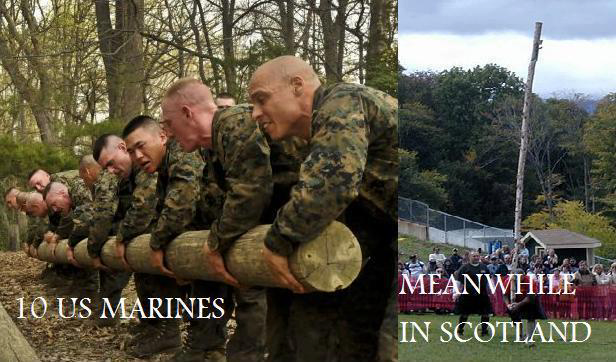
Delay for another few years? Even though this is the most likely event, Scotland would not be Scotland if it stopped without a massive fight, considering that one Scotsman tends to toss a log that requires 10 US Marines to carry is not a nation that whinges at the first hurdle.

So what if it uses the UK coin for now? Is that such a large issue, as Scotland grows its independent economic power? Consider this final quote from the article “They were already different, he said. Excluding oil revenues, Scotland had an average trade deficit of 11% over the last 15 years, which became a trade surplus of 2.7% if a geographic share of North Sea oil was included”. So the grace of Scotland is their oil reserves and what happens afterwards? This needs to be tackled first, because if Scotland is to avoid falling apart in the first setback (oil issues being just that when it happens), then Scotland must take care of its 11% deficit. In my view, that deficit must be turned to a 3% surplus (without oil) for Scotland to be a contender at the Commonwealth table, so how to go about it?

First it needs to change its political look on matters (not change its politicians). I will admit that the next part will sound a little dicey, but please hear me out. The headline “Scottish Tory leader Ruth Davidson: ‘I’m quite a cussed person’” (at http://www.theguardian.com/theguardian/2014/aug/15/ruth-davidson-interview-Scotland-tories-leader) reads nice, but there is a massive issue when we read the first part “Ruth Davidson is 35, a working-class Glaswegian, a kick boxer and a lesbian. Are these unlikely credentials just what the party needs to rescue it from 25 years of stagnation?” Why was there a reference to her Lesbianism? I personally do not care what her life’s choices are, truly I do not. But is this a political lesbian or a lesbian politician? Why could she not have been just a conservative? Did we see a headline on “Gordon Brown is a 63, working class sport less hetero sexual” Did we ever see that headline?

It seems that Ruth Davidson has supported state-funded Roman Catholic schooling in Scotland, and she also seems to believe (as far as I could tell) that the Church of Scotland should open its own faith schools as well, which seems a decently pragmatic approach to the ‘dangerous’ controversy called ‘Churches in the UK and Scotland’.

Because she is only 35, her most important events and achievements are still in front of her. She could be the inspiration the Scots need. Time will tell whether this is so. Yet there are issue with this article, there is little on her stance in regards to Scottish independence. If that is next on the agenda, should Scottish Tories not be outspoken about her views in that future? It seems to me that the journalist doing that interview kept the interview way too shallow, especially in this day and age.

There are a few other issues, like Ferguson, the last of the Scottish shipbuilders to shut down, so where are the economic options for Scotland, when we ignore oil. You see, I have nothing against the oil, yet the fact that a new nation will be totally dependent on only ONE product, such a place would need to have several alternatives if something went wrong there, so that is why it should not rely on the oil industry.

As a solution, I still believe that India has options here. As the Indian generic pharmaceutical industry grows for Europe, it will need alternatives for both manufacturing, shipping (read distribution) and perhaps to a smaller extent research. Whilst everyone seems to stare blindly to London area’s where prices are through the roof, Edinburgh offers a much cheaper and no less sturdy solution. Its harbour would allow for direct access to the Netherlands (Rotterdam), which would then grant access to Germany and Eastern Europe, there is access to Scandinavia as well as the option to nurture South American trade routes. All of them are markets that India could become the main supplier to.

It could change the Scottish deficit from 11%, to less than 3% in one blow, once the South American routes are a given, the deficit would turn to surplus. The stronger the growing need for generic medication, the more powerful this branch will grow in Scotland. After that, the tax breaks this industry could have would turn the UK into a much stronger market making for an entirely new dynamic in the pharmaceutical economy. Am I overly optimistic? Perhaps a little, yet so far, my predictions have held up and the current course is not getting us anywhere. It only takes one innovator to truly change the game, Scotland is roaring to be its own wielder of futures and India is roaring to be master of generic medication. Two innovators, a match, which is definitely not made in heaven, but as both want to make it work, the created future could be one that stands long and tall.

But is that with or without an independent Scotland? This is where the shoe starts getting a little tight for the dance floor. I personally do believe that this is not the best moment to become independent. I do believe that for now ‘better together‘ is the way to go. Consider the despair when Scotland does go it alone and within 24 months, both Japan in full and US in part become insolvent? I still believe that the US course is one that will sink its future, especially as the mention of well over 500 billion in undocumented spending in healthcare could set America well over the 18 trillion mark (the fact whether the healthcare billions were part of the deficit could not be confirmed), which makes for a dangerously unstable situation. So whether these facts stop Scotland from going independent is to be determined, yet that should not stop Scotland to become a lot more autonomic in growing its economy into the strong version it requires when the Scotland becomes one independent nation under this sky within our large Commonwealth.

Whether in the end there is a yes or no to independence, the fair question remains how to grow the Scottish economy, which will be a good thing for the entire Commonwealth.


Leave a comment

Filed under Law, Politics

View to the North

It is again the guardian that calls my attention to events happening (at http://www.theguardian.com/politics/2014/jun/22/independent-scotland-startup-costs-200million). It is important to know that I have nothing against Scotland becoming independent. I think that the timing is not great as we are in a massive economic downturn, but the Scots will correctly ask when would be the right moment? Anyway, as this independence is becoming more and more of a reality, we all need to look at what happens after.

The Scots have a few advantages. As the Scots seem to be members of a conservative party with its motto “Let’s not trust a computer farther then we can throw it“, we are set with the positive part that not trusting computers is not at all bad (Yes, as an IT person I am stating this). The downside is that the average Scot can throw a log really far, so tossing a computer might not be such a challenge after all. The issue is in the headline of the article. “Independent Scotland’s start-up costs ‘could be as little as £200m’” and “Leading academic says that could cover duplicating core Westminster functions, but millions would be needed to build necessary IT systems“. I have an issue here. There is an underestimation of requirements here. Yes, overall the costs might seem low, but when Scotland realises that the costs go beyond initial costs and they get to deal with infrastructures, at this point the costs will not be contained that easily.

Why do I care?

Caring is not the best word here. I think that in this case it is more that I like to see goals succeed, even if I do not completely agree with them. Only a real loser is trying to do what they can to make others fail, making others fail is fair when you are at war and we are not at war with the Scots, or with Scotland. The fact that about 3-4 generations ago, my family was from Perthshire (as far as I could tell) does not work in either direction either.

The other quote is “the final tally would be decided in a ‘poker game’ of post-referendum negotiations, according to the leading economics professor who last month criticised the UK government for inflating his figures on the subject“. Since when would anyone decide certain matters in a poker game, is also beyond me. Becoming independent is either tactical or on principle and one should not gamble on the Achilles heel that the people could create in this manner. In that same matter I am not sure if I can agree with the setting that this professor sets. The reference is towards Professor Patrick Dunleavy at the London School of Economics. A person who very likely knows more than 10 times more about economics then I ever will, even if I started to study economics full time at this point.

As stated, I have issues. Scotland will need an infrastructure, services and other matters. Several Scotland, as part of the UK already has and I think they should just be given them, yet Scotland will now need a proper economical system and set up. A national bank, a defence structure and these things all cost money, often a lot more than most imagine. There is however the ‘other’ side. The quote “In May, the Treasury published a detailed analysis of the financial risks of independence which claimed that a previous report by Dunleavy put Scotland’s start-up costs as high as £2.5bn” feels equally overstated. In my view the truth is in the middle and leaning to the cheaper side. In my untrained mind the costs are well over 500 million, but remain steadily under 700 million. This all makes me wonder why the numbers of the treasury are so far off as well (remember, me is a non-economic).

It is this quote that gives a few insides into the views that are shaping within me “In a leaked Scottish cabinet memo, the finance secretary, John Swinney, estimated the costs of a new Scottish tax authority alone at £650m. The Institute of Chartered Accounts Scotland had put those costs at £750m, while other experts suggested a new welfare system would cost £560m“. Is this about independence, or is this about certain people getting ‘their’ greedy fingers in the Haggis called ‘the Scottish economy‘. This is the part I do partially get. We all seem to forget that Scotland represents an economic power in the books of someone, when that falls away into independence, some people will not feel too comfortable and they are all looking for keeping themselves involved.

My question becomes, what can be done and does not cost?

In the age of computers and millisecond decision, I at this time remember my old dentist. He was a Dutch dentist called ‘van Charante’. In the age of computers, this man had the most advanced filing system I ever saw. He had used folders and colour indicators that opening his drawer showed a multidimensional top line table in colours. He saw in seconds something half a dozen tables produced in any analytical system would not tell him in 5-10 minutes. I had heard some IT wannabe’s wanted to convert him. I do not think anyone ever succeeded there. Perhaps that is the direction Scotland should face. It might not be done within the 200 million imagined, but perhaps they could steer well clear of the 2.5 billion someone speculated.

What if the Scottish system reverted to the old systems, not just becoming one Scotland, but in many cases reverting to the 33 counties? Thirty-three areas of ‘almost’ self-management, with a few exceptions, like one police system. They would get a buddy system where the area does what it needs to do and the neighbours come to aid when needed (emergency services). In that case Orkney and Shetland would feel a little isolated, but that might be business as usual for them. The question will remain how to IT some of this, but a system consisting of 33 self-regulating satellites are likely to be more effective, then systems like taxation, healthcare and welfare trying to become three Scottish national systems. If my train of thoughts are correct, then once this is approach is solved, the Scottish system could be an actual WORKING template to fix the failed IT NHS system that has currently costed the UK 10 billion and counting and still not working that well.

Yes, in all this I left out Scottish defence. By the way, has anyone seen what they do with logs and hammers? You really want to run up their hills whilst they smile at you and throw you a gauntlet or two? I for one ain’t that stupid to begin with, but that might be just me.

A final quote from the Guardian is “The debate with Darling, which broadcasters say privately has been tacitly agreed for some time, is now expected to take place sometime after the Commonwealth Games, which end on 3 August. It would potentially be a defining moment of the campaign“, no matter what will be discussed on that day, the truth remains that with two approaches being so far apart, both sides have unresolved issues, without a proper light on both sides these talks will not be the marker of any beginning independence, it could end up being an acceptance on how far views leading to independence are still apart.

So, is my view the correct one? I honestly cannot tell, but I am in all honesty looking for solutions, like any puzzle, an independence remains a logistical conundrum with plenty of loose ends, solving the puzzle is at times the best challenge that can be faced. Getting others to see the puzzle the way I did is the next challenge and implementing that puzzle is another challenge still. Three links in a chain that leads to a solution. Micromanaging these events like the BBC did with their 5 questions (at http://www.bbc.com/news/uk-scotland-scotland-politics-26836126) seems a little too trivial an approach. Yes, these questions will need a solution and it will be up to Scotland to find them. I reckon the views we seen in regards to the disagreements between Theresa May, the current Home secretary and the European Court of Human Rights shows that the UK has its own puzzles to figure out and they have been at it a lot longer than Scotland.

May we all be one Commonwealth, supporting each other, fighting for each other and at times disagreeing with one another, especially when Scotland is playing England, at that time the disagreements must be loud, jolly and with a few better Scottish players on the Rugby field.

Go Wallabies! 😉


Leave a comment

Filed under Finance, IT, Politics

Values of a debatable side

OK, it is 23:30 at the moment and I am finding out the hard way that life in a hospital as a patient can be different from your daily life in the corporate world with fluent internet and then some, go figure!
So when I initially listened last weekend to a few newscasts in regards to a team of devoted UK MP’s I was not completely on the ball. Yes, they were having a go at the dude from Google, but alas, it was not the price fight we might have seen when some have a go at Lawrence Ellison, and the MP’s go home crying like Charlie Brown after an encounter with Lucy.

So there they are, Amazon, Google and their margins of non-taxation. Those MP’s dressed like bankers and charging like Don Quixote.
It is almost like a new disney ‘fairy-tail’. The pot calling the kettle brokered. Is it not a little on the hypocritical side, that AFTER they bail out RBS, when RBS reports a 2 billion loss, that personal ‘acquaintances’ still go home with a bonus total of almost 400 million? That was not stopped was it?
But Amazon and Google, after they did everything legal (not unlike the bankers of a fat-cat persuasion), and used exactly those correct steps in their order processing that now certain MP’s cry Havoc and slip-up the dog of stores.

This situation does bring back memories of my previous blog where I accuse members of the EU thinking too local in certain cases, this tax front reads the same way. Now, if you think that I will advocate one version of taxation for the EU, then think again. That is just not realistic! That is like putting 22 toddlers in one room, asking them to all select the same piece of chocolate, good luck with that one!
Yet, the idea to streamline certain forms of taxation to ease businesses in an optional situation where web stores will have equal rules, rights and burdens is not that bad. Of course not all EU nations have the same powerful internet, so more issues will arise.

In the end, is it about web stores and taxations? Let’s face it, a political grilling that was senseless and pointless to begin with? And let us not forget, no legal transgressions seem to have been made (if I am incorrect, then this blog WILL be updated). It is also interesting that the chair person of the committee Margaret Hodge, and her family connection to Stemcor seems to be in the same class of fishing pond. How revealing! What was that about a pot and kettle I mentioned earlier? By the way a special thanks to Helia Ibrahimi of the Telegraph who had several of these facts before I did (4G in a hospital is not that realistic, hence my delays).

Yes, it seems that a elevated level of lesser taxation does exist, like an additional income support class for billionaires. Hoo-de-la-lay, as Prince John would say (Copyright: Disney).

So looking at these issues, and these facts, then what is this really about? Will this be the kick-off for a ‘simpler’ tax system? (like billionaires do not get enough deductibles as is). Is this about uniting into one tax system? The latter part would be a nice idea, however with many EU nations in desperate shape to get revenue, not realistic. There is also the slight humorous thought of PM Cameron calling Dublin asking them to do him a favour and not process Google’s non taxable issues there. What are the odds that Irish laughter will reach the shores of Sydney? #JustSaying

Make no mistake, there is more going on here. Do not be fooled to think that this is just visibility. The honourable Margaret Hodge for Barking is one clever cookie. She has been around for a long time and when it comes to the disciples of Machiavelli, she is up there with the league players, which beckons the thought what is this the start of?
The only part that comes to mind is that this is a two edged sword. On one side this is only partially about the tax lessening that Google, Amazon, a few others and the family firm (Stemcor) are enjoying. This might be in one part, a nice little jab to raise the topic of raised taxation during the G8. Consider the issues that the EU needs revenue, now consider that 1% of something remains better then nothing, and that plays nice to the Stemcor business family too, All these EU items play in her/labours favour. If David Cameron does nothing, he will look weak, any act by the PM will economically hit back and gives chance for an overwhelming victory for labour next election. The UKIP issues do not help much either, but at least in that part they are not on the side of labour.

Still, whatever pressure is applied to increase the billionaires tax bill, Westminster must be careful not to be too harsh with their ‘scare’ tactics. Scotland is only 725 km to the North and Stemcor already has an office there.

Leave a comment

Filed under Finance, Media, Politics