Category Archives: Finance

A Syrian Reality

Another day, another mention of Aleppo, Syria and events. Hilary Benn speaks of the shame we all should feel. Yet, here we have an issue. Not with his sentiment, but with the clarity of who or what is in charge. Now that the UN has another meeting, labelled as ’emergency’, it is time for people to realise that labels are no longer things to see You see, CNN states ‘descent into hell‘, I say ‘the reality of choice‘. As we now see that Assad, with Russian aid secures the news like ‘Syrian Government Forces Are Close to Full Liberation of Aleppo City’ and ‘Syrian army gaining control of Aleppo eastern quarters’ we need to realise that America is no longer the leader of the free world, that it is too bankrupt to be calling any shots other than commercial deals (read: trade agreements) to feed its own greed. The fact that Libya has now asked Russia to intervene on its behalf. As General Khalifa Haftar is meeting with Russian minister to seek help, we now all need to realise that we are chasing the consent from an empty bag names America. Only now, well over a year too late are pundits all over the media field considering a change. Those who some consider to be half baked evangelical procrastinators of social sciences are now considering that Frexit ‘might’ happen. The data was clearly there for well over 26 weeks. Just like they were trying to stay buddies with those running the gravy trains, Brexit was ignored for too long and Frexit is very nearly a given next. When you consider the quote two weeks ago in the Guardian “Kenny’s administration in Dublin to strongly back any French attempt to gain more concessions from Brussels to prevent a possible ‘Frexit’“, we can now start quoting South Park (Oh my god, they killed Kenny) whilst Ireland is considering the dangers it is manoeuvring itself in.

What about Syria?

Yes, that is the question, because for the most, no one gives a dams about Syria! This is a harsh reality. When you look at the cold reality for Syria, you will consider that the natural resources of Syria include iron ore, crude oil, phosphate rock, manganese ore, asphalt, marble, rock salt, and gypsum. Most can be gotten in many places, whilst oil value is in the basement and iron ore is in an even worse place. The large corporations do not care for any of these substances, so as such The American Congress is speaking a lot, not saying much and acting even less. The evidence is all around you. This outgoing Democratic failure has done next to nothing substantial. We see mention of weapon support. It is less than it should be and likely done to write off old equipment or get some parties a tax breaks (personal assumption), it never amounted to anything serious. The same could be stated for the United Kingdom, who with the US was involved with Combined Joint Task Force – Operation Inherent Resolve, because the growth of ISIL is scary for both of them. In my view, if there is any hero to be laureled in this mess than it would be the doctors who despite this level of ignoring are still trying to aspire the best the medical profession has to offer, in my view, most of these doctors are worth of any recognition that equals the Victorian Cross (American equivalent: Medal of Honor).

The grim reality of life set to value is that the morality of the things that President Assad was accused of. Perhaps some people remember how a little over 5 years ago, the unrest of the 2011 Arab Spring escalated to armed conflict after President Bashar al-Assad’s government violently repressed protests calling for his removal. Soon thereafter we had the issue that the government of a sovereign nation retaliated against those who were seeking to overthrow that government. This is the issue, you see, many of these nations had to deal with massive gaps in quality and quantity of life. There was a great deal of dissatisfaction that led to opposition and uprising against these governments and as such things escalated. There have been widely distributed claims that the US government’s support of the uprisings fuelled actions, funded largely by the National Endowment for Democracy (www.ned.org). This in an age where people in non-governmental places seem to think that whatever they do the US government had its back. Yet the outgoing Democratic Party had no money left, even worse, the total national debt is expected to hit 20 trillion just when President-elect Donald Trump gets into office. He gets a building to temporary live in and a debt that will take more than 3 generations to remove. Whatever happens, their choice will be American based, American focussed and there will be no space for any military action of any kind unless it is due to a direct attack on America. In all of this Syria is not mentioned, because for the players at large, it has no value, not the living, the dead or the national resources. For the next 8 years at least there is every indication that Russia will get a near cart blanch to grow its influence and after this December 2016 there is plenty of evidence that this will come with full Syrian backing, and likely Libyan backing too.

So this now ups the ante for Israel and in addition, it will require the allies and friends of Israel to up their game by a lot, because this game implies that the next cold war comes with one player short, an empty intelligence coffer and a much wider supported Russia. I reckon that Alexander Bortnikov will be having some very comfortable lunches with Sergey Lavrov. I can only assume that black bread and borscht will not be on the menu, Pancake! (Internal FSB translation joke).

These events are very much at the core because the US security council has the US and Russia in opposition, so that part is not expected to get into action, the only benefit here is that China could side with US, not because of any Syrian humanitarian need, but if the US gets committed here, the US economic prospects go down further, which would suit China just fine. In my view, if there is anything to be salvaged, than it needs to be Jordan, not Syria. If we actually have any regard for lives, than the support for Jordan, for its infrastructure and resources is essential as it has been trying to give support to 1.4 million refugees (Syrians and officially registered refugees).

Let this sink in readers, we are bickering all over the world on how many refugees we should take and Jordan has added 25% of its entire population from refugees and Syrians. That whilst Jordan has always had a shortage of water and a few other resources. In my view, the actions of King Abdullah II of Jordan seem to me to be more worthy of a Nobel Peace prize a lot more than the one given to President Barack Obama ever was. I am not ignoring the issues at the Jordanian border, the given fact by Al Jazeera et al that there tens of thousands of refugees stuck in no man’s land. Yet Jordan already has 1.4 million, 25% of its entire population, they have done more than most nations have considered. That part, will be opposed and countered by nearly every nation, but that is the grim reality. I feel certain that Jordan was not working with open arms, yet when we see the few thousand that are in Greece (OK, a little over 10% of those in Jordan), the fact that Syrians (as reported by Ekathimerini) have been quoted that compared to life as a refugee in Greece, they would have preferred to have stayed in Syria. Tell me, when a person prefers to take their chances and live in an active war zone, how bad are you as a nation? Now, we can agree that Greece was in a really bad place before the Syrian refugees arrived, so that did not help the Greeks any, also their lack of any infrastructure to deal with these amount of refugees must also be accepted.

In all these matters discussed, big business have remained silent, inert and lacking actual action that make a difference. In addition, as Donald Trump is stated to make a policy change that it will be ‘America First’, which under their economic climate is fair enough, when the dust settles and President Bashar Hafez al-Assad sits on his ‘throne’ as victor, how many nations will move forward trying to do ‘business’ with Syria? How many will enter the quote ‘moving forward’ in their speeches and statements? You see, the reality of any nation has forever been that those with empty coffers do not govern, the US is figuring that out the hard way, because its actions and messages on a global scale are ignored by too many players for it not to be the case. In the end, these trade deals have a one sided benefit for American companies. They would still get to sue other governments, whilst the President-elect is moving towards the tactic of: “Instead, we will negotiate fair, bilateral trade deals that bring jobs and industry back onto American shores“, and here I will be honest, it is pretty much the only option that the US has and no one can fault America for that, just realise that those who would have enacted the TTIP/TPP would have learned the hard way that American corporations would have sued governments for the mere profit of it. That too would bring money to America, and their board of directors. In all this, in light of Brexit/Frexit and now these trade deals, we see a massive lack of national legal protection in these ‘deals’, this whilst these corporations have only consented to continue certain factories when the tax breaks are juicy enough. When that falls away, those claimed economic national benefits fall away too and even today, certain taxations that wold have been seen as fair as those places took away billions, now that the economic weather changes, nations at large need to consider where to move to next. It is that weather that made me evangelize stronger bonds with the Indian pharmaceutical industry. Most nations have a growing need for generic medication and places like Syria, Jordan and Greece even more. Yet the people who should have realised this seem to be pushing for any pharmaceutical deal with America, whilst the players all know that there will be no local benefit, none at all, so again we see now that the Trump thinks like a business man, which is what the social left is not getting (read: comprehending), whilst they ignored the tax reform essentials, they keep on giving money from empty coffers, that party is over and those not adjusting their view will be in the cold soon enough. This also means that certain values change. This is the grim reality for Syrians, their value is none and have been so for some time. Not on a humanitarian scale, but the nations at large have no funds there, so we see that we turn our backs on a situation we cannot change and we cannot influence, in my personal view, mainly because some lawmakers were asleep at the wheel in setting up trade deals and certain tax loop holes (read: these loopholes were purely incidental and coincidental, not in any way orchestrated). Now we have to choose between economic hardship and humanitarian ‘sound’ suicide, how is that a choice?

So here we are, seeing another iteration of ‘boo hoo hoo’ Syria, we all know it, we all agree and we cannot do anything, mainly because those who could, gave away the keys to the castle and the executive washroom. Those who are now in charge are setting the pace and none of them want a war where they get nothing out of. This is the mere reality of an economic driven political society of elected officials. No monarchy would ever abide by that. Should you see that the Libyan and Syrian deal have no influence, when you hear someone preach just that, and how America will get on top soon enough, also feel free to investigate the connections that are now happening between Egypt and Russia. A new air base on the Mediterranean close to the Libyan border, so as America moved out, Europe is getting surrounded by Russian bases, if we include the now permanent Russian Naval base in Syria. This is why Israel needs to change its game, because it is not outside of the realm of issues that Mossad now needs to refocus their attentions to foreign operations and data gathering. A field that the Russian have been decently good at. They do have one advantage, Sergey Yevgenyevich Naryshkin might be highly intelligent; he lacks experience and is relatively new to the job. If he ends up relying on the heads of Political Intelligence and Illegal Intelligence, the game changes, because those two are not the newbies we would want them to be and the Middle East desk will be the new hot potato for Intelligence Officers with a scent for promotion for at least 5 years (read: Mossad will have to deal with Intelligence ego’s from all over Europe). My weird sense of humour would try to push those two into the marching path of General-Lieutenant Igor Valentinovich Korobov, a proud man and as per 2016 the new head of the GRU, pride is something that often be used against that very same person.

Why mention these matters, what is their impact on Syrian refugees?

No matter what happens in the coming 3 weeks, when the dust settles, most nations would want these refugees to return to Syria, many Syrians want to return to Syria, but that place is in rubble and those people have nothing left. Syria will be a construction heaven for Russian entrepreneurs for decades to come, also meaning that the economic times will change and the Middle East picture we had of it will have changed more than many understand or want to take for granted. The Arab spring will soon be seen as a temporary thing that was not the success people wanted and proclaimed it to be. Some in those fields will object and counter with all kinds of manipulated data, in addition the press will give a few more articles on how the Arab spring was the only way and it was a good way, yet when we see that Russian influence is rising all over the Mediterranean, and now with Morocco raising the tourist numbers for China and Russia, it could be interpreted that a first signal is given to Sergey Lavrov that a conversation of interest is soon to be an option. In my personal view, one of two corridors of travel for ISIS ends up being in Russian hands. If not correctly countered we will see a radically shifted view of northern Africa with America no longer being any form of player there. This also reflects on Syria, because these nations will allow Russia to set up an empty trade house where they are merely the middle man in commerce between Syrians and Northern African partners, so suddenly there will be large economic growth (moving from zero that will always be the case) and it will push a shift in other ways too. It is the Grim reality we face, because the actual culprit was greed and we have seen how both America and the European Economic Community was unwilling and unable to act against it, which is why we will only see a stronger push for Frexit and Brexit. A move that scares the US, because the Euro and the Dollar are too closely tied and this dissolving action will be seen as the nightmare scenario by the IMF and Wall Street, where the question now becomes: who is speaking for whom?
 

Leave a comment

Filed under Finance, Law, Media, Military, Politics

The cost of free trade

There is a side in me that is a little beyond angry. When I see these politicians whine like little bitches on how good ‘Free Trade‘ is, on how it is so good for all. I wonder if they remember the days when slavery was an actual solution for commerce. How these people look and praise Chiwetel Ejiofor (aka Baron Mordo) for playing a slave in ‘12 years a slave’. When we see “Mexico, Japan, Australia, Malaysia, New Zealand and Singapore aim to continue with TPP with or without the United States, Mexico’s economy minister, Ildefonso Guajardo, said on Friday” (Source: SBS), we need to wonder on how the TPP is seen as anything but evil, a mere apparatus of convenience for large corporations to keep a stranglehold on those around them and to minimise the number of opportunities for smaller businesses.

The Evidence?

The Economic Policy Institute gives us: “This paper does not include an exhaustive review but cites as an example Capaldo, Izurieta, and Sundaram (2016), who noted that studies claiming that the TPP would have a positive impact on the U.S. and global economy are based on unrealistic assumptions, including no change in the U.S. trade balance with the TPP countries and full employment“, which is only the top of the iceberg. You see, in addition we have “Currency manipulation is the most important cause of the large and growing U.S. goods trade deficit with the group of countries in the Trans-Pacific Partnership. Coupled with the fact that the United States is the largest and most reliable trading partner for many of the TPP countries, this is a recipe for U.S. pain at others’ gain“. This is not the USA, it would also hit Australia in other ways, not the people who secretly arranged all that they get top dollar in a few other ways. Yet, before we move on, let’s take one more part, because that will have connecting issues. The quote “Many members of the proposed TPP, including Malaysia, Singapore, and Japan, are known currency manipulators. Others, namely Vietnam, appear to be following the lead of currency manipulators by, for example, acquiring excess foreign exchange reserves to depress the value of their currency. Currency manipulation explains a substantial share of the large, persistent U.S. trade deficit with the 11 other TPP countries that has not only cost millions of U.S. jobs but also increased income inequality and put downward pressure on American wages“, and although this paper focuses on US consequences, it will in addition have a speculative negative impact on Australia, Canada and New Zealand.

The Dutch Financial Times (at https://fd.nl/economie-politiek/1176922/tpp-opzegging-holt-voorbeeldfunctievs-uit) gives us: “Donald Trump heeft de wereld deze week een belangrijke boodschap gegeven. Door te stellen dat hij de Verenigde Staten op de eerste dag van zijn presidentschap terug zal trekken uit het Pacifische vrijhandelsverdrag TPP, geeft hij het signaal af dat hij de relaties met andere landen puur vanuit de blik van een zakenman zal zien. Hij wil bilateraal met landen gaan onderhandelen ‘over eerlijke handelsafspraken die ertoe leiden dat banen en industrieën terugkeren naar Amerika’. Internationale relaties moeten voordelig zijn; anders hoeft het niet“, which paraphrased gives us: “Donald Trump will be withdrawing from the TPP on day one of his presidency. He will be looking at relationships with other countries from a business point of view, international relations need to be advantageous, or need not be“. Is that a bad thing? You see for exploiters it is, which gives us the Malayan Times (at http://www.themalaymailonline.com/what-you-think/article/tpp-aint-over-till-its-over-firdaos-rosli). Last week they had the headline ‘TPP ain’t over till it’s over‘, the article is a decent legal view of getting the TPP ratified, which only gives additional cause for concern in a few ways, yet that is not the issue for now. The one quote at the end that matters is “The government must proceed with its top-down reforms agenda and these are direly required to make Malaysia great again” This is fair enough on one side, Malayans are there to make Malaysia strong, there is no cause more just, yet in what ways are they doing this?

This is where the other side gets to show us the dangers. You see the headline ‘Malaysia workers speak of their despair: ‘Samsung only knows how to take’‘ (at https://www.theguardian.com/global-development/2016/nov/21/malaysia-workers-speak-of-their-despair-samsung-only-knows-how-to-take), shows that large corporations are at the heart of the problem. Tax shelters, exploitation and what cannot be seen as anything else than intentional slavery are at the heart of the matter. The Samsung Port Klang factory as mentioned shows how Samsung is growing its business by massively reducing costs whilst maximising customer exploitation at almost the same time.

When we see “In total, Bhandari says he paid £750 to secure his job in Malaysia – more than the average annual salary in his home district” as well as “There are an estimated 2.1 million documented migrant workers like Bhandari in Malaysia, many of them hired through third-party labour supply companies who recruit foreign workers from Nepal, Indonesia, India and Bangladesh to drive Malaysia’s industrial boom“. Implying that Samsung has no HR to speak of, it is arranged through third party affairs that are buttering their bread on both sides of the isle with a labour population in slavery. So when we rethink the Malayan Times with ‘TPP ain’t over till it’s over‘, we get that they (those making the profits) need the TPP, because slaves tend to be free (read: really cheap) and too many people seem to be filling their pockets in a few ways. So when you see “Now he’s in Malaysia, Bhandari’s recruitment debt – and the 60% interest loan he took to pay it – has a stranglehold on the teenager“, you know that this is how slavery is created and how it is maintained. Not through shackles that bind you, but debts that stop you from moving and breathing. I reckon that the old southern ‘solution’ was a lot more humane. At least you knew that there was slavery, now the boat load of governments remain in denial and the large corporations can claim to remain negligently unaware. Which of the two is the larger hypocrite remains to be seen. The fact that Australia signed this, whilst they had to be aware that this was happening to some degree is an issue on many fronts, not just the slavery part, but the fact that the TPP has the largest option of being a negative influence. You see, those who had walked away wanted to do so via the TPP, there is absolutely no guarantee that whilst in the TPP jobs are not lost to areas where labour laws are a lot more flexible.

Consider the quote “Many of the group now want to leave, if only they could. They say their passports were all confiscated on arrival in the country, an illegal but pervasive practice, and they have been told they will have to pay £740 if they want to go – the equivalent of four months’ basic salary“, which translates to a little over 4 weeks of Australian welfare. Which in light of “A Samsung statement said: “As a committed member of the Electronics Industry Citizenship Coalition (EICC), we comply fully with the EICC’s Code of Conduct and have found no evidence of violations in the hiring process of migrant workers hired directly by our manufacturing facility in Malaysia. Once there is any complaint, we take swift actions to investigate” as well as “When asked whether Samsung had repaid any worker debts at the factory, one man employed directly by Samsung instead of through a labour supply company says he hasn’t received any compensation. “Samsung doesn’t know how to give,” he says. “It only knows how to take.”” which to some degree shows that not only is Samsung not doing too much about it, it is also intent towards reaping the benefit of these trade deals for as long as they can. More important, even though Samsung is the visible one, the fact that from several sources we see “Malaysia’s trade volume is booming“, implies that there are other brands exploiting this way of cutting costs. So from that part, the evidence that Slave labour is again a ‘valid’ form of cost cutting towards commerce is given.

Should any government object that I reckon it is time that clear labour requirements are added to the TPP, I wonder how many would suddenly oppose such actions, because as I see it it is clear that Japan and USA, the two direct requirements for the TPP would not oppose it, unless Sony decides that their margins would dwindle, but that is just pure speculation from my side.

What to do?

Well, I do not think it is too far-fetched that those linked to these unacceptable labour practices are required to have a specific import license for their good, which is at a price, FTA or not! I wonder what will happen when Samsung gets a 23% surcharge on slave labour goods import. Will that suddenly make them see the light? I do not mind if they decide to make them in Malaysia, but I reckon we all agree that these workers are due decent pay and no slave labour conditions. At that point, when the margins are hit, how good was the TPP and how beneficial were factories in Asia? I do not proclaim to have the answer, I am merely asking the question. When slavery is dealt with, we will suddenly see that there is no benefit in some of these places and that other places like Argentina, Texas, New Zealand, Australia, Canada, the UK and Belgium are decent places where goods can be produced whilst the company still has a margin. And perhaps there is no need for a $229 Samsung Microwave when a $129 Sharp version would suffice. So, a $100 more expensive whilst ‘depending’ on slave labour (to at least some degree), seems odd doesn’t it?

Consider: “it promised only £268 a month, including overtime“, whilst “a payslip seen by the Guardian shows Bhandari worked 29 out of 30 days in September, including 65 hours of overtime“, so we get 65 hours a slave every month and an income of £9.20 a day, which amounts to 25% of what you get in Australian Centrelink and the cost of living in Sydney is actually high. So the next time you see those Samsung advertisements, consider that they can afford these billboards thanks to slave labour. Look at your Samsung phone and admire how you got that great deal, if you are lucky only one person literally worked himself/herself to death to make you one. Feel better now?

It is also important to realise that Samsung is not alone here, one firm does not make for “Malaysia’s trade volume is booming“, it takes a lot more than one firm and if only Samsung was involved, those people would apply for every other place on day two of their arrival. This makes the issue a lot larger and this also makes the unbalanced use of what we now laughingly call ‘Free Trade Agreements‘. So when we get another load of Bill Shorten and how the TPP isn’t costing jobs, we see a clear case that the man needed to be tarred, feathered and walked through George Street whilst a person behind him clanks the bell shouting ‘Shame!‘ It might be a little too much Game of Thrones, yet in that place they are only now abolishing slavery on the East side of that place (read: Essos), in addition, Malcom Turnbull is not free of any moral harm either. The fact that the TPP was supposed to implement stronger protections and the fact that Malaysia is still very much on the TPP ball, whilst as the Guardian shows, that what amounts to Slave labour is still going strong to me implies that those involved have either loop holes in place or that there are alternative options for those enjoying the fruits of their exploitation.

You see, the TPP Labour summary gives us: “In addition to commitments by Parties to eliminate forced labor in their own countries, the Labor chapter includes commitments to discourage importation of goods that are produced by forced labor or that contain inputs produced by forced labor, regardless of whether the source country is a TPP country“, this implies that those involved at Samsung have either a Chinese wall in place or a system of deniability. The fact that The Guardian received evidence (payslips) and had testimonials of multiple workers should suffice as evidence.

The fact that Huawei has the option to expose issues with Samsung, whilst not seeming to act, gives also pause for concern. China is not part of the TPP, it is trying to seal its own trade agreement. Even though we have no evidence on how China works in certain matters, the existence of China’s State Owned Enterprise’s (SOE) is another circle of issues and it will be so for both Australia and New Zealand, yet to what extent cannot be stated by me (read: ignorant of such levels of government rules). In that regard Huawei might have an unfair advantage (read: when compared to Samsung) and of course, Huawei could impact the booming Mobile business Australia has (read: Exchange rate of sarcasm towards giggles). As many see that China has been non-enthusiastic when it comes to dealing with corruption, the shown evidence gives us that several other nations aren’t that much better and corporate greed tends to trump government requirements. So there!

No matter how we slice it, the trade agreements only truly benefit large corporations and no one else, which is an issue on a few fronts and in that President Elect Donald Trump might be the clearest American patriot when he states “international relations need to be advantageous, or need not be“, for the simple truth is that for the most and agreement signed that was not advantageous was an agreement best not signed at all.


Leave a comment

Filed under Finance, Law, Media, Politics

Batches of three days

After a Law conference of three days and a case of the flu, it is time to get back into the saddle. For the speculative people amongst you, I needed 8 boxes of tissues, so if you invested in Kleenex, their forecast is very expected to be up, so you are all good! There are a few things to deal with, but let’s get into the deep end, with ‘Trump cabinet appointments will ‘undo decades of progress’, rights activists say‘ (at https://www.theguardian.com/us-news/2016/nov/18/trump-cabinet-appointments-sessions-pompeo-flynn). Yes, from their point of view that might be, but you do not get to cry wolf over Syria, whilst leaving a pussy to deal with the situation. This is now a Republican administration and as such, there will be a change of hearts, minds and a few tactical directions. The first one to look at, director Pompeo is an interesting choice. He has earned his stripes in several events. A thorn in Clinton’s Benghazi disaster and a member of the Tea Party. However, this is not same Jasmine flavoured variety, this member from Kansas is more like gunpowder tea. An acquired taste that is likely to turn a few stomachs in Iran. As I see it, one of the most likely to receive a high Israeli award for keeping them safe from Iran’s bile as some would quote it. My issue has always been no matter how liberal this elected official is, we have seen that the next elections could bring another Ahmadinejad, not something anyone is waiting for.

But let’s get back to nominated director Mikey. The one part that was part of the Wichita Eagle (link lost) was that Mike Pompeo predicted a new energy bill would cost millions of jobs and make the United States a net food importer. There are two sides to all this, the first the energy part. There are too many question marks (apart of the change to make it realistic), the net food importer is another matter, and it also drives at the core of national security. You see, NAFTA, opened up a whole range of options in regards to the trade with Mexico and overall there is a benefit, yet when we realise that this opens up regional security options (as stated by s Col. Michael Dziedzic, USAF), we see that in light of multiple sources stating that the Mexican Cartels have been assisting ISIS members to get into the US to explore targets. The fact that ISIS sleeper cells are reported by a few sources to be close to the US border gives cause to consider certain new avenues for the CIA to consider. That is, if they aren’t already doing that, because we can all agree that yours truly isn’t being kept up to date by Langley for reasons that need no clarification.

The Wichita Eagle also gives us: “Pompeo ended up co-authoring a separate report from the main committee investigation, which accused former U.S. Secretary of State Hillary Clinton, the 2016 Democratic nominee for president, of downplaying the attack to boost President Obama’s re-election efforts” (at http://www.kansas.com/news/politics-government/article115756373.html), which is only half the truth I reckon. I mentioned earlier that the intensely wrong acts by people in the US Department of State in 2012 was centre in all this and the events since have only shown that they were utterly negligent in several ways (not only the office of State Secretary Clinton), the downplay has been beyond that office and as such left too many concerns, especially when you do not react strongly to such an event, should you be considered President of the United States?

I reckon that once confirmed, Mike Pompeo might be one of the strongest members of the Trump government and could possibly be one of the better CIA directors of these last three administrations, which is speculative, and time will tell. Jeff Sessions is another interesting pick, although the President elect could have taken several extreme options, which in light of following Eric Holder, the only cabinet member in history to be held in contempt of congress (there will always be a first one), the President Elect had a few options, yet those were basically taken off the table when Loretta Elizabeth Lynch, the 83rd United States Attorney General decided

On June 27, 2016, Lynch and former President Bill Clinton met privately aboard Lynch’s Justice Department jet which was parked on the tarmac in Phoenix. ABC15 Phoenix reporter Christopher Sign broke the story on June 29, citing unnamed sources. (at http://www.abc15.com/news/region-phoenix-metro/central-phoenix/loretta-lynch-bill-clinton-meet-privately-in-phoenix), in light of Benghazi, when we see the quote ““Our conversation was a great deal about grandchildren, it was primarily social about our travels and he mentioned golf he played in Phoenix,” said Lynch Tuesday afternoon while speaking at the Phoenix Police Department“, now we can agree that if you have 35 things to do before lunch, having a social meeting on the tarmac of an airport in a jet is rather odd, to say the least. It is true that it might not have been about Benghazi, it might have been about future careers, yet the event on the tarmac and not in some closed of 1st class business lounge implies that this was about deniability, not something that is required when Golf is on the menu of conversation. The image of Benghazi remains, whether just of unjust, when you decide to do a Deep Throat (read: Woodward, Bernstein & Washington Post), you set yourself up for all kinds of gossip.

So when we see Jefferson Beauregard Sessions III, a former senator of Alabama, we have to wonder what America will get this time. The media is already all over it. The Guardian stated: “The hawkish trio have made inflammatory statements about race relations, immigration, Islam and the use of torture, and signal a provocative shift of the national security apparatus to the right“, the subsequent quote is “For liberals they appeared to confirm some of their darkest fears about the incoming Trump administration“. To them I have this message. ‘Over a period of 8 years, this administration has done absolutely nothing to reign in corporate accountability, the financial sector can go its own sweet way and this American administration turned 180 degrees around on corporate taxation. Their acts, together with the IMF is why Brexit is now a fact and is also still the driving force for Frexit. Those who are now fear mongering in the direction of France better realise that a second bad estimate (like Brexit) will be regarded as clear evidence to dismiss their services’. Columbia Threadneedle was quoted in Reuters on what a catastrophe it will be. Yet, who would it be disastrous for? The quote “Mark Burgess, chief investment officer for the firm in EMEA, said that unlike the positive or even ambiguous market reaction to the British vote on an EU exit or Donald Trump’s win last week, a win for avowedly anti-euro, anti-EU party in one of the many euro zone elections next year could spell disaster for the still-undercapitalized European banks“, the banks have had more than enough time to get their affairs in order. We have seen bail-out after bail-out and we have been all subject to a large loss of quality of life, whilst the financial sector played and gambled living on incomes that most people have never seen, not even before the financial crash. This has driven anti-European Union sentiments. The sentiment of all talk and no achievements, no forward momentum for anyone but the large corporations. This is what the Democratic Party left America with, no real future and a 20 trillion dollar debt. It is now up to the Republican Party whether they can return the USA towards a status of less debt and a healthy economy. This will take a years to achieve, but no matter how far it is taken, America seems to realise that the party is over, they only have themselves to blame on how they got to this point.

So how did I get from these three to Frexit and Greed? Let’s face it, the President-elect is part of a system of greed and Frexit is pretty much next on the agenda. All those ignorant economists and media that have been ignoring these events for over two years, all with comments on how this was never a reality now have faced Brexit and after that, they played anti-republican for 8 years, they now see their options cancelled and they are left in the dark regarding events in the White House. How many wrong predictions does it take for the media to realise that reporting is not the same as speculative empowering?

As the world is now setting the stage of how the first three picks of the President-elect is to be regarded. We need to realise that the world is a lot larger than America and our choices are indeed diminishing when we side with only one group of governing people. For those who seem to be focused on how bad this upcoming president will be, perhaps we need to take a look at a little place like Syria and how this current administration has not achieved anything at all. With bombings increasing and the Non-Assad supporting Syrian population getting closer to zero, we need to ask questions that no one is asking and even less are willing to answer.

The last part in all this is the IMF, as mentioned before. When we see the Australian, we get: “The IMF has given powerful backing to Labor’s call for a crackdown on negative gearing saying Australia’s tax rules are encouraging people to take on too much debt to invest in the housing market, pushing prices higher. The IMF’s annual mission to Australia has also criticised the Turnbull government’s May budget, saying it is trying to narrow the budget deficit too rapidly and risks hurting the economy.” Can anyone please explain what the fuck (pardon my French), the IMF is doing telling a sovereign nation on how we prefer not to be in deep debt and that is not OK with them? Consider in what state the debt driven economies are when it can be endangered by one economy removing its deficit. Consider on how many papers have given proper attention to debt driven economy (read: meaning almost none have done so, apart from those ridiculing the issue), this in light of the IMF quote in the Australian “The IMF says the government has been right to allow deficits to blow out over the past few years, saying the shortfalls have been mainly due to weak revenue, not excessive spending. The fund suggests that if the government spend more on infrastructure, it would generate enough economic growth that there should be little impact on the ratio of debt to GDP“, we need to wonder on how we were all kept in the dark when the media at large ignored calls for clarity, when we were (as I see it) intentionally misinformed, now we see that ‘right to allow deficits to blow out‘, which was never OK, even as Australia is getting out of that dark valley, other nations are still fighting their own battles. This is one of the driving sides to France, who have been pushed into a $2.4 trillion dollar debt. Perhaps President Hollande will have the same excuse that it was ‘mainly due to weak revenue‘, so the French people get to live with consequence of the IMF driven ‘equalising’ of debt. Now this last part is purely speculative from my side, yet how wrong is my train of thought? And as other nations realise that these debts are orchestration and the governments refused to tighten belts, spend irresponsibly regarding the need of other nations, keeping debt at a maximum. How do you think people will react when they realise that irresponsible behaviour will keep their quality of life down, perhaps for more than one lifetime? Are you still wondering whether Frexit will happen, or are you realising that Frexit not happening is no longer being considered?

Now, events differ from nation per nation, yet there is clear evidence that nations have been overspending for well over a decade and none had the idea to tighten the belt (except Germany in 2009). This is how Europeans feel and all this to enable big business, whilst they get more and more deals offered. This is the setting in which President elect Trump finds himself. The three nominations are not part of any of it, but they give rise to the question, who will be the elected officials in the departments, of State, Interior and Commerce, these three subsequent nominations will be at the core of what will happen next. No matter what the pressures are for the upcoming American Administration, they will be at the core of events that will take centre stage in 2017 and 2018. So many eyes, not just in America will be on those nominated for these three fields. We will have more and more questions, we only need to await the first results.

In that light we get to look at some of the issues I predicted two years ago. Last Saturday I got the Quote “European leaders have come to a 27-nation consensus that a “hard Brexit” is likely to be the only way to see off future populist insurgencies, which could lead to the break-up of the European Union” (at https://www.theguardian.com/politics/2016/nov/19/europes-leaders-force-uk-hard-brexit-farage-le-pen). The subtitle gives us even more ‘Fears grow about impact of populist surge as Nigel Farage predicts Marine Le Pen could win French presidential election’. I got there a year earlier, even now there is still some doubt as Sarkozy is making an about turn move on French National issues, yet Marine Le Pen remains a contender. Slightly stronger than before Trump got elected and there is where the issue for Europe now resides. Their indecisiveness in certain matters is driving people towards nationalism, with President elect Trump now approaching office, those issues will polarise and the shift will move stronger towards the right. The additional quote: “The latest intervention by Farage will only serve to fuel fears in Europe that anti-EU movements have acquired a dangerous momentum in countries such as France and the Netherlands, following the precedent set by the Brexit vote”, is one that is not correct as I see it. You see, Brexit was always a risk, yet those working behind the screens were so intent on the Status Quo that they forgot sight of the effects of the actions that they caused, Greece being the first and strongest elements. By trying to hang onto a non-realistic 300 billion, they now stand to lose 14.5 trillion, you tell me how stupid this was. The Netherlands is not the strongest influencer and at present, the Dutch PVV might be strong, twice as many seats as the number three (CDA) and leading by merely 4 seats on number 2, the reality is that this party became the largest fast and as they were only regarded as something not to be taken serious, the size they are now does not warrant such consideration, they are the largest player. Yet in all this, the issue is that 150 seats are there and a majority requires 76 seats, which cannot be done without some coalition that will require the PVV. In this the PVV is the only clear anti-EU party. The example as given by me in ‘A noun of non-profit’ (at https://lawlordtobe.com/2013/05/15/a-noun-of-non-profit/), where I state: “Consider a large (really large) barge, that barge was kept in place by 4 strong anchors. UK, France, Germany and Italy. Yes, we to do know that most are in shabby state, yet, overall these nations are large, stable and democratic (that matters). They keep the Barge EU afloat in a stable place on the whimsy stormy sea called economy. If the UK walks away, then we have a new situation. None of the other nations have the size and strength of the anchor required and the EU now becomes a less stable place where the barge shifts. This will have consequences, but at present, the actual damage cannot be easily foreseen”, What I predicted on May 15th 2013 is not just coming to pass, finally others are admitting that this is the future, a future they kept you in the dark about, consider that when you realise that this had been known for some time. They played their ignorance and fear mongering game and those who have done so are now considering what one more bad prediction will bring them. I still believe that it required the second of four to truly collapse the EU barge, but that reality is now getting closer, with the Republican push we see, the chances for Marine Le Pen getting elected as President is now an actual reality. I knew that there was a chance just within France and as President Hollande failed again and again her chances increased, now with the Republican view of nationalism, the French view only enhances that view for themselves, enabling Marine Le Pen as a possible President of France. This links to Jefferson Beauregard Sessions III and his conservative views. He plucks the same chords on the musical loom of government as Marine Le Pen will when it comes to immigration. In that regard, the choices that still have to come will make even stronger impressions for European nations as they unite or dissent from that view. You see, we still need to realise that America is 20 trillion down, which implies that if Europe decides to exit hard for the second European nation (France most likely), the economic view for America changes, especially as it has been a net importer of food and a few other materials. It would need to strengthen ties with Canada and Mexico by a lot, allowing those two to get a better overall deal, increasing the cost of living for Americans. At this point, we see that Wilbur Ross is now the strong favourite for the Commerce position. It is CNN that gives us a quote, which seen in a different light implies the issue I had for a long time. The quotes “Pritzker strongly supported free trade, traveling to 38 countries over her tenure. She advocated clean energy partnerships and the Trans Pacific Partnership deal” as well as ““Free trade is like free lunch: There is no free lunch,” Ross told Lou Dobbs of Fox Business in August. “Somebody wins and somebody loses. And unfortunately, we’ve been losing with these stupid agreements that we’ve made””, Here we see that someone visited 38 countries, which sounds like an office paid world tour and we know that is NOT the case, but all that travelling must be nice. Following that, we see Wilbur Ross stating that there is no such thing as a free lunch. That we have all learned, many of us learned it the hard way and the TPP was a bad deal from the get go for several nations. These quoted came from CNN (at http://money.cnn.com/2016/11/20/investing/wilbur-ross-donald-trump/index.html) and are at the core of changes for commerce, which will reverberate in both the English and French minds as well. So 4 of the 6 main nominees are also powering the European Exit. I believe that one of them is in for quite the challenge. Michael Flynn is a veteran on several levels, as a retired General he knows the military and as former director of the DIA he knows the intelligence whip. Yet, the premise he faced will start to change dramatically in 2019, as such the America he will be the National Security Advisor for will have new challenges, some none have seen before. Time will tell how realistic those challenges are, yet we are already faced with the limitations of dealing with 4G and the next wave is now less than 365 days away. The funds needed for cyber security and cyber development were never forthcoming, giving nations at large new challenges and totally new issues in Criminal law. All fields untouched to the degree they needed to be. Another reason why W. Ross and J.B. Sessions need to sit down sooner rather than later. In that regard, the UK needs to clearly revisit some of the protocols that never worked in the first place.

There are many changes coming towards us, some will drive others, some will just be met with complaints, and others will just drive the Democratic Party insane, which will be used to the entertainment of the media at large.

Leave a comment

Filed under Finance, Law, Media, Politics

Matt Damon’s Quote

You could wonder what Matt Damon has been up to, there will always be reason to do this, not because he is an exceptional actor, even a celebrity on Mars. No, the reason here is his connection to documentaries. He was the narrator on ‘Inside Job‘, which got a well-deserved Oscar in 2011. I personally feel that this is the best documentary on the financial crises ever created. So let’s get started. Today, we see a number of news items reach the twilight of dawn.

The first one (at https://www.theguardian.com/world/2016/nov/08/panama-papers-22-people-face-tax-evasion-investigations-in-uk), gives us ‘Panama Papers: 22 people face tax evasion investigations in UK‘, with the added text “Philip Hammond also said a further 43 wealthy individuals were under review while their links to the offshore files were investigated further. He made the comments in a written answer to the House of Commons explaining what had happened since the offshore tax files emerged“. Now we might go all huffy and puffy on these tax evaders, yet when you consider the news from August (at http://www.bloomberg.com/news/articles/2016-08-31/ex-tesco-finance-chief-mcilwee-probe-closed-by-u-k-regulator), where we see “The U.K. accounting regulator closed an investigation into Tesco Plc’s former Chief Financial Officer, Laurie McIlwee, saying there wasn’t a “realistic prospect” that misconduct would be found in the case“, with the added “The Financial Reporting Council closed its case into McIlwee Wednesday, according to a statement from the regulator. It is still investigating the grocer’s auditor, PricewaterhouseCoopers LLP, and other individuals involved in Tesco’s accounts“.

This has been going on since 2014, they have not been able to find anything after two years and now you are going after ‘simple’ tax evaders?

My initial message (with all due respect) to the Chancellor of the Exchequer is “Mr Philip Hammond, are you out of your bloody mind?” You are still trying to get anything real on PwC, or were you ordered to let it die down?

When a company suddenly loses billions in value (also due to their own stupidity) and you cannot find anyone to prosecute and go to jail for overstating profits by £263 million ($345 million), whilst we also know that for that year PwC gave Tesco a 10 million pound invoice for auditing (annual) with an additional 3 million pounds for consultancy that year (Source: the Guardian). You cannot find anything and now you are going after people, where you cannot state whether they broke the law and you will rely on illegally obtained papers. How stupid is this?

How about you making the following change as per immediate!

a. Until the Tesco case has been satisfied, PwC and its senior employees cannot undersign any accountancy venue, or corporate balance for any UK corporation for 2016, 2017 and 2018 until the matter is solved.
b. In case wrongdoing by PwC employees is proven beyond reasonable doubt, PwC will not be allowed to operate within the UK.

How about them apples?

So far we have seen massive leeway by the press and the SFO has not achieved anything at all regarding Tesco. So it is time to adjust regulations and legal premises, until that point comes PwC will have to operate on non-British companies. Now, we can all understand that when we see the quote “McIlwee resigned as Tesco’s CFO in April 2014, prior to the discovery of the accounting errors, amid reports of disagreements with then-Chief Executive Officer Philip Clarke” seems to imply that McIlwee was not privy to, and not guilty of any wrongdoings, yet the fact that the SFO got nowhere in two years means that there is something massively wrong. When we know that so many millions were overstated, we seem to have a decently clear case of fraud, yet no one goes to jail. In addition, we also know that PwC was in on it (at least to some degree) and in addition, the subsequent Deloitte investigation showed more than initially was found means that there is no scenario where PwC can be absent from guilt in the first or second degree.

The SFO gave that Carl Rogberg, Christopher Bush and John Scouler were charged (source: BBC), they pleaded not guilty and at present the court dates are set for September 2017. It is my opinion that until all that is settled, the Chancellor of the Exchequer has no business whatsoever to dig into cases based on illegally obtained papers, whilst his branch as well as the SFO has no flipping ability at present to close a 2 year old case for at least another year (if ever). And as reported by the Times in September (at http://www.thetimes.co.uk/article/tesco-auditor-slips-back-into-retailers-aisles-0gm9xt8md) that “Tesco has appointed PwC as an independent adviser, despite replacing it as auditor with Deloitte“, which gives my emotional and slightly inappropriate response “Are you fucking kidding me?

So, whilst the PwC issues were kept very low key by nearly all the press, whilst there is no condemnation on a daily basis by the press and even less success by the SFO, we should agree that PwC has no business being in the UK to begin with, especially as “Last week the FRC cleared Laurie McIlwee, Tesco’s former chief financial officer, of wrongdoing over the scandal, but added that its investigation into PwC and other unnamed individuals continued“, we could go by once bitten twice shy, or we could go by the fact that as the SFO is either unable or unwilling to prosecute PwC, why would we even consider their presence? In case some are considering a specific rebuttal, to them I would respond with the April article (at https://www.theguardian.com/business/2016/apr/14/brexit-could-lead-to-loss-of-100000-financial-services-jobs-report-warns), where they stated ‘PwC report estimates 70,000-100,000 fewer jobs in 2020 compared with estimated number if Britain stays in EU‘, so let’s start with theirs and let smaller accountancy firms continue and allow for growth. In addition, when we accept the news by the BBC in Feb 2015 (at http://www.bbc.com/news/business-31147276), where we see “We believe that PricewaterhouseCoopers’s activities represent nothing short of the promotion of tax avoidance on an industrial scale,” said Margaret Hodge, chairwoman of the Public Accounts Committee (PAC)“, so in that light, we could just send PricewaterhouseCoopers (PwC) packing, giving light that the facilitator of tax evasion have been dismissed from the country and as such the UK will see a decline in Tax evasion, no need for illegally held papers, no long and expensive investigation and the thorn in the UK economies side is equally removed. It will not mean that tax evasion is a thing of the past, but if PwC is send packing now, the other three might do a 180 degree on that clientele, which would at that point make the tax evasion issue moot, or at least deprive it from many options, which would amount to the same in the end.

So, you like apples?

If I am accused from persecuting PwC, then I would plead that I am not entirely innocent in that regard. I would bring the defence that the SFO has not gotten anywhere in 2 years and they are supposed to have the ability to find those culprits. Yet, as John Crace pointed out in the Guardian on April 5th that “Only last year, the public accounts committee reported that the accountancy firm PricewaterhouseCoopers (PwC) was promoting tax avoidance on an industrial scale. To make things worse, it was first in the frame to benefit from administering the windup of Tata’s steel operations in the UK. So where was David Cameron? At PwC’s offices in Birmingham. Some might call it a brave choice“, in that light, there is an additional reason to give PwC their walking papers.

In all this the exchequer has one final issue to deal with, you see, accountant at large, including (read: especially) those at PwC are really clever with what they do, meaning that there could be no broken laws to begin with, making the actions from certain parties from 2014 until 2018 even more questionable, with a strong need to truly scrutinise the rules that accountancy firms applied and how they were applied. As I see it, there is nothing worse than to paint a lovely target on a person only to learn that the laws fell short and none were ever broken. If you question that, then consider the following two options.

  1. The SFO has, as it embraced corruption onto a new level decided not to dig into PwC on the levels needed to secure evidence for the prosecution regarding Tesco.
  2. The SFO has found that even as it is clear that PwC assisted in these levels of Fraud and Misreporting, yet when the books and memos were investigated for these transgressions, there was more than a reasonable doubt that PwC was not fully aware, in addition, there are no papers filed by PwC to implicate them in any way in fraud or misrepresentation. As well as the established fact that no laws were broken at present.

When you look at the two options, which one is more likely than not the situation regarding PwC?

In my book, the fact that a person is not guilty, does not mean that they are innocent. I remain of mind that shutting PwC down in the UK is not the worst idea at present, yet is that point of view valid when we consider premise 2, which is actually the most likely scenario? When we consider that the spirit of the law has been violated by PricewaterhouseCoopers, at that point we still have the issue that no literal laws were broken. Here we could set forth that the government (read: parliament) created the foundations and the setting where industrialised tax evasion and fraud became legalised options. Even as we saw that there was a clear case for fraud, the law has been altered to the degree that the facilitators cannot be held accountable, as such, an issue was created and until that is resolved, and PwC cannot be prosecuted (which is wrong in many ways from the point of a simple taxpaying labourer).

So, we now have the issue of the letter of the law versus the spirit of the law, which should be seen as grammatical opposites, not just in grammar, it is that they are also opposites of the soul (read: soul of the law). When one obeys the letter of the law but not the spirit, one is obeying the literal interpretation of the words (the “letter”) of the law, but not necessarily the intent of those who wrote the law. Which is what black letter lawyers (and accountants) tend to do, because a nation of laws is about a nation with rules of playing the game. In our case, in Common Law, until a case is set as a precedent in law, there will be no adjustment and this can go on ‘ad infinitum’ and Intentionally following the letter of the law but not the spirit may be accomplished through exploiting technicalities, loopholes, and ambiguous language (at times a mere comma does the trick too).

Yet, when one obeys the spirit of the law but not the letter, one is doing what the authors of the law intended, though not necessarily adhering to the literal wording, which could get them automatically prosecuted if the District Attorney woke up on a Monday morning with a really foul mood.

So, whilst we might agree with Margaret Hodge, stating “We believe that PricewaterhouseCoopers’s activities represent nothing short of the promotion of tax avoidance on an industrial scale“, the fact that they are not breaking the law, implies that no corrections to the law have been made to correct for this. As such, you only have yourself to blame and admittance of this failure to the public at large is an essential second step. As I see it, making a lot of noise going after people who might have done something like this, whilst papers are absent and whilst all parties know that this is because of illegally obtained papers from the law firm Mossack Fonseca is even less intelligent, as the people behind this have leaked these papers for their own personal interest and ‘late taxation’ was not their goal, so to adhere to the promotion of such crimes is not the best way to get results.

Now that we see claims rising towards Tesco for misrepresentation from their investors for the amount of £100 million, which comes on top of the diminished value, so I feel that no matter what, there should be a negative impact on PwC one way or another, yet within the confines of the law of course. This takes us to ‘The letter versus the spirit of the law: A lay perspective on culpability‘ by Stephen M. Garcia, Patricia Chen and Matthew T. Gordon (paper here). The part that gives us the cakes are found in study 5 on page 486. “Study 5 sought to examine another instance in which the letter of the law is not broken but the spirit of the law may have been violated“, which is where I for the most stand with PwC in the Tesco matter as stated “We also wanted to control for various counter-explanations that underlie culpability such as violations of social and moral norms“, with references to Bicchieri & Chavez, 2010 as well as Mazar, Amir, & Ariely, 2008. Yet in the first there is Tonry, 2010, where he argues that “the foundations for disparity causing policy choices lie in the cultural and social forces that combined historically to shape U.S. society“, which is interesting as this implies that the policymaker and not PwC is the actual culprit and my rage was misguided. Yet, is that actually true? The spirit of the law is not equipped, or better stated should not be equipped to manage the input of self-interest, because the spirit of the will assume the setting for all people and as such will force the text and derail the letter of the law (as I see it). Tonry goes on into the racial destabilising side, yet in my view the racial part is not the real instance, I believe that the division is that we see two groups One is the (white) social enabled group who is set to the game with preparation (read: legal advice) to break the spirit of the law and not the letter of the law as long as self-interests are served. This setting will at that same time destabilise the (black) group, a group that is suffocating on the lack and lapse of social options and opportunities, where without proper and affordable advice the letter and the spirit of the law will be adhered to, yet at a massive cost through loss of opportunity. This now makes PwC a facilitator for the wealthy to avoid breaking the letter of the law and to optionally, when unavoidable adhere to the spirit of the law. From one point, can the facilitator be held to account? I believe so, yet the area is slightly too grey for my comfort. It is the policymaker that requires to shift the grey area, so that breaking the law is a more clear setting and as such the SFO could actually create a situation where conviction (let alone prosecution) becomes a reality.

I still believe that PwC has done great wrongs, yet as far as we can establish, not in the letter of the law. I find them guilty of knowingly set the stage for managed ‘breaking’ of the law. The spirit is as much a factor as the letter, either should be seen as breaking the law. Yet there is diminishment as the policymaker is seemingly also guilty, yet the reasoning for that flaw can never be easily determined, so we can tell it was wrong, yet to what degree is not a given, but an essential issue to address. When we look at the policymakers, we need to ascertain the application that the paper discusses. “This framework broaches a new language to understand complex situations such as those that are not technically illegal but seem wrong“, we can see that this applies to multiple incidents. In those cases it needs to be clear that these levels of protection do not make the cake edible. It makes for a sour venue where those with legal advice can abort too many payments whilst the underprivileged groups end up without support, protection and options. I am speculating here that this is the (read: speculated intentional) creation of the haves and have not, which is a policy drip down effect when you implement a prismatic system, which policymakers from business and sociological fields seemed to have resorted to as they (tried to) implement laws, on the premise of a non-legal mind. Which is what is pushing the issues. The political field needed the business view of opportunity and the resulting laws are toothless against larger corporations who end up getting a free pass here with PwC as the facilitating office.

In the end I am more correct than even I thought I was, yet this should not digress from handing out the penalties that are needed to give a clear signal that the party is over. We have learned the hard way from 2004 onwards that unless we make a massive shift, this will continue a few more decades, as such stronger language and harsher penalties are required, because continuing on this path is far too rewarding for all the players that can afford to play this game, which gave me the idea to give PwC their marching orders out of the UK. I don’t believe it is too harsh, especially as they made 35 billion last year alone. So the question to you becomes, do you have any idea how much taxation they paid? I have no idea how much exactly, but we do know that PwC was elemental in avoiding Lehman Brothers to pay an addition £1.2 billion in taxation, due to inconsistencies, we see the quote by Mr Justice Hildyard: “It is of real importance, both in terms of good governance and a fair market, that HMRC should make every effort to ensure that this sort of thing does not happen again“, (at http://www.theweek.co.uk/lehman-brothers/77510/lehman-brothers-creditors-to-avoid-12bn-tax-bill) giving rise that larger changes are needed to bring back fairness to all tax paying people, who have not seen a whole lot of fairness in that regard these last 12 years.

Judges will soon have to science the shit out of these tax laws, making them actually fair to all, not just large corporations, who seem to be judged on ‘the Principle of least accountability’.


Leave a comment

Filed under Finance, Law, Media, Politics

The editor in question

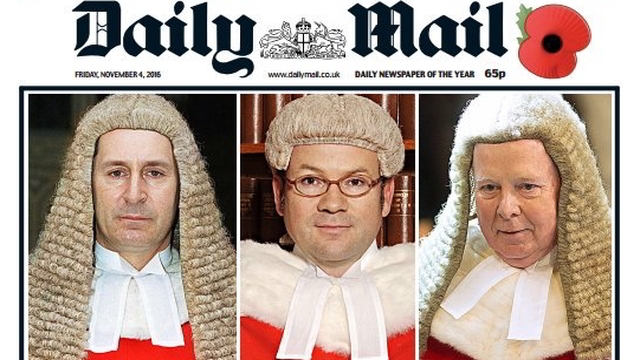
It started to be such a fine morning. I got up at 5:45, got onto the business for the day. Which started by sending a fax to Abu Bakr al-Baghdadi regarding the pressure points of the Dow Jones. It was then that I realised that Mario Draghi has been in office for exactly 5 years. In addition, there is still my anger with Paul Michael Dacre regarding last Friday’s front page, with the mention “The judges who blocked Brexit: One founded a EUROPEAN law group, another charged the taxpayer millions for advice and the third is an openly gay ex-Olympic fencer”. It makes me want to ignore the law and slap the man silly on Trafalgar Square with a 25 inch pink coloured rubber dildo! This side of me wants to make it clear that I do not completely oppose the subtitle ‘journalists are free to complain about Brexit ruling, as Labour confirms it will not block article 50‘ (at https://www.theguardian.com/politics/2016/nov/06/labour-will-not-block-article-50-jeremy-corbyn-allies-confirm), however, when I read the trivialised version of demonising three judges, who have served the nation and were instrumental in pushing (read: evolving) Common Law forward, we need to remind readers, politicians and most others, that it was the daily mail that stated “Leveson law ‘is worst threat to free speech in the modern era'”, for him I have the message: “No, Pharisee Mountebank Dacre, we wanted to hold people like you and Murdoch accountable for the things you write!“, which pretty much sums up my anger and in that regard, I tend to blame the person at the top.

516393-daily-mail-enemies-of-the-state

I do agree with the Prime Minister when I read “the prime minister said she believed the high court had every right to deliver its verdict but argued that journalists were similarly free to complain about it“, she is right, there should be freedom of the press, that was never in question, yet the reference ‘an openly gay ex-Olympic fencer‘ is to be regarded as sexual discriminatory as my view goes. Let’s face it, the Daily Mail is no Jimmy Carr sketch, although, that reference should also come with the warning that Jimmy Carr has a lot more class than the Daily Mail ever had or likely will have.

Let’s face it, those who read my blog know that I have been pro Brexit, although the well-known Marky Mark of the British Bank (read: Mark Carney, Governor of the bank of England) pulled me back on the fence, almost changing my direction regarding Brexit. His address to the House of Lords was that good and gave the clarity all Britons needed before the votes. You see, my move towards Brexit was driven to some extent towards the idiotic spending spree by Mario Draghi. The fact that many nations were losing their national identity was also a factor, but for me that was not the largest one (which is the larger issue for Frexit, if we accept the view of Marine Le Pen). You think I am digressing, but I am not. Yet, we will take a few steps back for the next part.

At [5] we see “in these proceedings is only dealing with the purest question of law” as well as “whether the executive government can use the Crow’s prerogative to give notice of withdrawal“. These are the issues that needed addressing, mainly because the UK remains a monarchy, even as the bulk (51%) wanted to withdraw from the EU, it still needs to be done legally correct. The added issue for the three man wearing wigs that would usually be found caressing the skull of Lady Gaga is that this situation has never happened before, so Common Law needed to focus on Constitutional Law as well as the national (read: domestic) effect of EU law.

In the final paragraph we get “For the reasons we have set out, we hold that the Secretary of State does not have power under the Crown’s prerogative to give notice pursuant to Article 50 of the TEU for the United Kingdom to withdraw from the European Union“, this gets us to that place where the ‘parlour minties’ live, meaning that an Act of Parliament (i.e. passing through both the House of Commons and House of Lords) is needed to actually (and legally correct) invoke Article 50.  MPs would to a certain degree vote according to the referendum result, but several will seek to influence the type of exit agreement from the EU to be sought (read: an implied alteration for what they perceive to be the common good). Moreover, the Bremainians will now seek that time to sway as many MP’s as they can to prevent Brexit. This is a perfectly valid political path, because it also treads the path that some need for their opportunity to serve the ‘masters’ that were never elected, some of them not even British. So as we see this document regarding R (Miller) -V- Secretary of State for Exiting the European Union (PDF here), we can now look at the response from the paper of PM Dacre:

1 ‘The judges who blocked Brexit‘, they did not, they ruled based on the Law that exiting the EEC will require a decision by parliament.

2 ‘One founded a EUROPEAN law group‘, this is a ‘nice’ statement. The truth is that the ELI is “an independent non-profit organisation established to initiate, conduct and facilitate research, make recommendations and provide practical guidance in the field of European legal development with a goal of enhancing the European legal integration“, so basically, Wiki pages are more eloquent in stating the identity of a European Law Group, designed to enhance legal integration than the Daily Mail is, or ever was!

3 ‘another charged the taxpayer millions for advice‘, well, the legal profession has pricing, so if that taxpayer hired a judge for a summary and consultancy of 1600 hours, then an amount well over 2 million would be due (making the statement ‘millions’ true), yet if taxation was paid, no crime was committed and proper advice was given, what value does the statement have? Especially when we see the statement that PM Dacre, by his own admission “had used the private detective Steve Whittamore, who was jailed in 2005 for illegally accessing information, but claimed that the rest of the British press had done so too” (Source: BBC News), so who needs more scrutiny?

4 ‘the third is an openly gay ex-Olympic fencer‘, so the fourth judge is not just legally able, he is also an Olympian, which might be a nice extra, yet showing a judge to be a superhuman athlete seems to be counterproductive on many fields, there is only the issue with the fact that he is depicted as gay. How does this give any indication of either academic or athletic ability?

So, 4 parts of a statement, one part inaccurate, two parts irrelevant and one part utterly incomplete and substandard.

Let’s take a look at another headline from the Daily Mail “ANZ bank chief Mike Smith paid $9.7 MILLION for just three months’ work – or 123 TIMES the average Australian wage” (at http://www.dailymail.co.uk/news/article-3914880/Former-ANZ-bank-chief-executive-Mike-Smith-received-9-7m-three-months-work.html), which now gives us the question regarding that ‘expensive judge’, what were the tax costs for this person and were all taxations paid? I reckon when it comes to ‘costing the taxpayer’ the Daily Mail needs to revisit what certain values and definitions encompass. Yet when we take a look at the Guardian, we see “The Mail editor has claimed £460,000 in subsidies since 2011” (at https://www.theguardian.com/commentisfree/2016/mar/31/paul-dacre-eu-subsidies-hypocrisy-daily-mail-euro-lies), in addition we see in a 2014 article “Paul Dacre’s pay and bonus package soared by 25% during 2014, taking the total remuneration of Britain’s best-paid newspaper editor to £2.4m” (at https://www.theguardian.com/media/2014/dec/22/paul-dacre-earnings-up-annual-report-reveals-daily-mail), whilst his peers got marginally more, including Lord Rothermere, and the CEO of DMGT, that poor man (read: Martin Morgan) got cut down for an amount close to a million, no, Dacre went up by a lot. Now, this might all be fine and ‘correct’, yet when we see the ‘accusation’ on judges and taxpayer, whilst the man getting £460,000 in subsidies and personally getting a car allowance of £10,000 with added fuel benefit of £6,500. So can we agree that the shoddy description from the Daily Mail should be getting a better editorial in light of the news (read: in 2014 it was news), regarding its own chief editor.

In addition, the fact that the Daily Mail has a financial interest in opposing Brexit was also (as far as I know) never revealed by the Daily Mail in any way. So, as I see it Pharisee Mountebank Dacre is a worthy name of mention when regard the hypocrisy I personally categorise it to be. Of course accusation should in addition towards the Guardian by insulting Paul Dacre for being called the ‘Nigel Farage of Newspapers‘, so far Nigel Farage seems to be so much better and more a man than the Chief Editor of the Daily mail is regarded to be at present.

When we get back to target D (Mario Draghi) we see that the Daily Mail is less ‘insinuating’, it merely hides behind the words of Reuters. Isn’t it interesting that a person, whom I believe could be regarded as criminally negligent, is given wave after wave of consideration, even now, less than a day ago, so many, so eager to support another stimulus package, all written out as verbose as possible in the Wall Street Journal. In that I voice that Mario Draghi could be seen as criminally negligent, especially when the next Stimulus ends up not bringing home the bacon at which point he is still not seen as accountable.

When I see “Most European economists disagree with the conclusions of a recent report by the German Council of Economic Experts, which argued that the ECB’s easy monetary policies were no longer appropriate” (at http://www.wsj.com/articles/european-economists-back-ecb-stimulus-1478514545). So consider the following quote “The definition of insanity is doing the same thing over and over again, but expecting different results“, it comes from Albert Einstein and it could aid Mario Draghi in his insanity plea. America has been funding labour through tax breaks leaving it currently 20 trillion in National debt. Mario Draghi is spending trillions, not stimulating anything, which is the massive reason why Brexit got pushed. Why does the British population in the end has to pay for some Italian, spending trillions with the (as I personally see it), lack of actual economic growth, fictive lowered unemployment numbers by paying for their cost of labour and in the end of that cycle, just more and more debt.

So how will this be solved? I think it is time to take another look at the Leveson report and consider the full implementation of it. Even if it merely gets us better and more accurately informed, that by itself would already be a great victory, if it cuts down certain editors by a notch, stopping them from doing the unacceptable act of assaulting three judges the way they were, that would just be the icing on the cake. I never opposed freedom of the press, I just want them to be held accountable for what they publish, in this I am seeing a large population that is in support of what I wrote, that because the outrage they created is shown nearly global. So even as Dacre is pulling a Murdoch out of his hat stating that all publicity is positive publicity.

We need to see it for hat it is, a statement that is currently as far from the truth as it could possibly get and it is time to hold the Media accountable, we sit by for too long. It took the events surrounding Milly Dowler to get the ball on the road and the outrageous statement on three judges is no less a reason to re-consider the Leveson report.


Leave a comment

Filed under Finance, Law, Media

I know a Japanese joke

An Englishman, and Irishman and a Japanese industrial walk into a bar, which could be the start of a joke, yet there is a very serious issue behind it. You see, when we see (at https://www.theguardian.com/politics/2016/oct/31/nissan-assurances-over-brexit-cannot-be-published-says-business-secretary) on how “the stark warning from Haruki Hayashi, president of the Japanese chambers of commerce in Britain and the European CEO of Mitsubishi, who said businesses needed more than “general reassurances” if his country’s investment presence in Britain was to be maintained” needs to take a little lesson from a firm called ‘Hypocrisy Inc.‘, when we see (at http://www.thisismoney.co.uk/money/news/article-2230999/Nissan-sells-UK-cars-Switzerland-tax-ruse.html), which is from 2012 “Nissan Motor Manufacturing, which has received tens of millions of pounds in Government grants to build cars in the UK, is a contract manufacturer for another Nissan company based in Rolle, Switzerland. The Swiss company buys the raw materials and owns the finished cars. It pays the UK business a fee that is slightly higher than the manufacturing costs, limiting the amount of profits that are declared in Britain

In addition, this is a game that Japanese car makers have been playing on a global scale, including Australia, getting millions in grants, getting what was calculated as a $2,000 discount per manufactured car, whilst shipping tens of thousands for sale overseas. The comedy team Kim Carr and Bill Shorten (the honourable BS) from the Australian Labor party were on that merry-go-round, that whilst in week 3 of the new government blaming the Liberal party for ‘losing‘ the automotive industry. I discussed this in May 2016 (at https://lawlordtobe.com/2016/05/22/tuesday-evening-quarterback/), the UK is facing a similar situation, basically, Japanese firms are trying to strongarm a better deal, which is business minded and all fine, yet the Brexit scaremongering thing is getting on my nerves because I am fed-up with this category of ‘wanker‘ (or is the term ‘tosser‘ more correct?) that they represent. For those people I state, there was no Brexit in Australia, Japanese firms will do whatever they can to broker an increased profit any way possible, Brexit is just their latest excuse (whilst we admit that some raised items are a valid concern, there is still no certainty whether the set changes will actually impact). In interesting side that was not mentioned in this comes from Reuters (at http://www.reuters.com/article/britain-eu-nissan-support-idUSL8N1CY3QI). “The support that the UK government has promised carmaker Nissan in return for building new models in Britain could prove expensive, but the Japanese carmaker’s complex structure makes it hard to estimate“, so like Australia, whatever grant the Japanese receive, could be seen as legalising slave labour, for that is basically the setting when the grants add up to work whilst having no cost for the manpower employed. The Reuters article lights up a few additional issues, yet it also gives view that the Bremain group is still playing and pulling lines to scare the population in making them believe that Brexit was a bad idea and as such trying to swing a way to undo Brexit.

So whilst you contemplate those elements, think back to my September article (those who read it) ‘For Only the Messenger‘ (at https://lawlordtobe.com/2016/09/05/for-only-the-messenger/), where we see the Japanese Prime Minister making demands, whilst we also have the added information that he is making demands for companies that funnel sales through Switzerland, so that paying taxation is kept to an unrealistic minimum. Having cars built in the UK, whilst the grants exceed the cost of labour, whilst in addition, sales are funnelled through Switzerland giving them a 10% taxation option, gives voice to the findings of Reuters. The prestige of having cars build in the United Kingdom does not seem to bring the bacon home, the cost for this prestige is a lot more than the UK governments bargained for. So, when I see the quote “The strong intervention from the Japanese came as the business secretary, Greg Clark, claimed the government’s letter to Nissan cannot be published because of commercial sensitivity“, or is it actually a simple reason? Mainly that any person with an abacus or calculator could work out that government administrations have been giving in to car makers for too long a time at way too high a cost to both the consumer and the taxpayers?

This debate on Japanese demands is actually interesting, because the French political left is now more and more on the side of Frexit, so with Frexit now a realistic issue for 2017, we see that 128 million consumers could fall out of reach to these car makers, should they push for certain options. If Japan wants to play around and endanger an optional 18% European consumer base, that’s fine by other car builders. In my view, the push for non-taxability at any cost could be the more expensive one for Japan in the end and with their economy even more on the edge than America is, it is a gamble that they could actually end up losing. The question becomes, how scared are the UK politicians at present and have they done the clear and correct calculations on what the costs are, because paying for people to be employed is not what job creation is about.

We see similar issues with Honda, from the Wall Street Journal (at http://www.wsj.com/articles/honda-net-profit-jumps-39-1477896050), where we see net profits to $1.7 billion for the last quarter, whilst we see that tax breaks are on the clear side of delivery here. The Wall Street Journal also states “The party may grind to a halt once those tax incentives go away“, in my view the question should be, why on earth are we giving tax breaks to any player making 1,700 million dollars of net profit on a quarter?

In addition, when I see “net profit is expected to increase by ¥25 billion yen to ¥415 billion yen as a result of lower costs“, I ask here: ‘How much tax breaks represent the annual 25 billion in increased profit?‘, which is a question we should all ask, especially when we see unrealistic demands from an industry, where a single player in this industry is expected to be making 2 billion a month more. Would you not agree?

This all intersects with the exit strategies from the EU. Brexit is actively an issue, Frexit is currently a realistic change, yet the silent player in this is now Italy with a December 4th vote coming up. This vote is regarding a constitutional referendum regarding the appointment and powers of the Parliament of Italy. In the background however, the changes could also simplify any referendum on leaving the EU if that becomes an issue. The Italeave group is currently not that big, yet grew when Brexit became a reality, also the right wing groups are not that strong at present in Italy, a change that could become a lot more intense when Frexit becomes real, because it would push Germany as they, together with Italy would be the only two anchors leaving the Euro in a somewhat stable state. As I stated before, two currencies will not be able to do that, making Germany and Italy run for the hills soon and fast. Beware! I stated when Frexit becomes a reality! So there is no given, merely an increased level of likelihood, which is no less threatening.

This now strikes back to the Japanese side, because with these changes over the coming two years, any change the Japanese market makes will have other consequences as well. Consider that they suddenly get that ‘special offer’ from Slovenia or Poland. What will happen when France and the UK are out of that single market? They could make a deal together where the UK and France markets support one another whilst pushing other markets to the left. Suddenly certain Japanese dignitaries will need to explain to certain bosses of the Japanese International Trade that their hand of poker backfired, that whilst they only had 3 of the 5 cards to play. That should make for interesting newscasts in Tokyo, I just hope that NHK News will be airing those news cycles with English subtitles.

Are my thoughts realistic?

Well, that is part of the issue. The other part is that politicians on a global scale are always willing to give away the kitchen sink to be able to boast that they secured 100,000 jobs. The fact that nobody is asking what the costs were makes it even easier for them to do this. Yet overall, the consideration of cost is actively being pushed to the foreground by others, giving me a stronger case, but is it strong enough? I honestly cannot tell, but time will tell as we see the publications of concessions given to the car industry.

The question now becomes, who offered what and for what reason, because at this stage, the Bremain group and especially those with political power are eager to make certain promises (within the office they hold), whilst knowingly undermine the continuation of Brexit at the same time, so that hurdle is one we will see a few times more soon enough. So when we get back to the statement that several newspapers reported on ‘Japanese companies have already begun receiving offers to relocate elsewhere in the EU‘, isn’t it interesting that no one is making any claim that they made the offer and no one is making any report on where they might go to. In this place where ‘leaking’ reports is at the core of scaremongering, that fact does not see the light of day. The clarity is, is that the only place where there is a clear benefit to go to apart from the UK, is the Netherlands, because in the end, manufactured cars need to get delivered somewhere, so as the infrastructure goes down, the costs go up by a fair bit. That part is not given consideration to the extent it needed to have. As 50% of the created cars go into export, consider when the factory is in (for example) Germany, what additional jumps would be needed to get the cars to the same location? Sweden has a similar deal, however with out of control weather 3 months a year and additional issues with extreme cold and an additional delivery distance of 1100 miles, what costs would Japan face in addition?

Just questions that impact the decision, there might be answers, or not. What matters is that people are suddenly demanding decisions, taking away the rights that the British voters had. Is it not interesting that this all happens, whilst Wall Street is in absolute fear that Donald Trump might win? The reason to mention this (at http://www.wsj.com/articles/investors-consider-a-brexit-times-10-trump-win-1478111985) is very applicable as the Japanese profit needy corporations rely on stability, something we see here “In the past week or so, the Vix index of volatility has risen from around 13 to just under 20 points; the S&P 500 has fallen for six trading days in a row, for the first time since February 2015; and the Stoxx Europe 600 has fallen for seven days, for the first time since February“, under these conditions, Japanese car makers will resettle somewhere else?

So these three men were in the bar, the Englishman orders an English Chapter 6, the Irishman a glass of Paddy and the Japanese gentleman ordered tea. As all three look at the tea, the Japanese states: ‘If you are not drinking alcohol, then neither am I!‘ (a reference to Awamori)


Leave a comment

Filed under Finance, Media, Politics

The risk of androgynous automation

Today we see another message, another prediction and another approach to make people nervous. This time it is a combined effort from the fields of Oxford University and Deloitte, they find that ‘77% probability of ‘repetitive and predictable’ roles being automated‘ (at https://www.theguardian.com/society/2016/oct/25/850000-public-sector-jobs-automated-2030-oxford-university-deloitte-study).

So how true is this?

Actually, there is a lot of truth in it. The truth is not just a given, it is an essential need. Yet the headline ‘Study says 850,000 UK public sector jobs could be automated by 2030‘ is a problem, not one of disaster, but one of opportunity possibly missed. The article gives us a few things, including links to the full report (indirect), which is a good thing and let’s be honest, Deloitte is no PwC; they stand miles above that group of Excel users. My first issue is with page 2. Not because it is incorrect, but the difference from my view is as I see it more than semantics. You see, they state “eliminating the budget deficit – into an era of parallel challenges as it moves towards Brexit“. I believe that Brexit will enable over time a speedier recovery of the deficit, it will be no picnic, but it will happen. Which is why I in earlier writing opposed the view the independent had. They wrote “Britain’s largest banks are planning to move business overseas due to uncertainty over the Brexit process, the head of the British Bankers’ Association has warned“, where my response in a decently diplomatic tone was “So, let them fuck off! The moment they feel the initial 2018 collapse of the Euro and the US Dollar, which will be voiced as ‘our currency will face a temporary contraction of value’, then they will see the cost they face and the revenue they are now missing out of. So, feel free to consider to return after learning that mistake under conditions of massive administrative fees for consideration of inclusion into the UK economy“. This is not an empty view, when the UK returns to strength, those moved away will see contracting economies in Germany, where the Deutsche Bank will be desperate to retain business out of fear of the damage of ‘written off’ collapsing corporations. France will be in a similar state, but there Crédit Agricole and Natixis are the Powerbrokers and neither will consider some ‘grocery bank’ that is relocating to ‘new shores’, so these moving banks will not be too welcome there. And several other nations are in a similar setting. So what is left? Italy? Greece? Good luck with that idea!

So as the UK is facing new issues and new challenges, Deloitte is showing that it is not all roses. The report shows on page 12 “The OECD and IMF views are backed up by OBR analysis that suggests spending on investment, public services and benefits are the interventions most likely to provide rapid economic boosts while providing a platform for medium and longer term growth“, this illuminates an earlier issue that has been mentioned by yours truly (aka: me) more than once. It isn’t just the £11.2 NHS IT failure the UK Labour party gave its citizens. The bigger issue is that governments at large have had a failing grade in managing such projects. Over micro-managing made these projects too massive and in the end no longer feasible or realistic. If this is the path, than it needs to precede an altered adjustment in procedures on how to manage and set these projects. The issue we see that still is required for the NHS, also clearly shows that the political interference tends to be a hindrance rarely a solution. However, the political part cannot be removed, but the entire setup can be altered in another way. A clear definition of what is required, that would after this point be scrutinised by proper IT specialists working for the government (to keep that part of the costing down), only then when that part has been dealt with, can the project move into a new field. If this was the Law and Mental Health, it might be best phrased that the government needs an IT version of a Diagnostic and Statistical Manual of Mental Disorders (DSM-5). Such a manual would need a data requirement part, and application part, a data networking part and a security part. Until such an approach is made, the need that we see, will end up being a massive expenditure towards the Exchequers chest, with the risk of no result and no alternative. These paths make sense in two ways. In the first there will be a lot more clarity on what is requested, required and delivered. There will be less contractual mud and as such whomever took the project will be responsible for the delivered bad boy and it would show a clear path of adjustment and repairs (where needed).

There is even a new side in this, it will shape the required need of technical universities. Because as they become involved, delivering the hours and manpower towards these projects, the costing will be reduced, the Universities will also gain an income and their students would end up with a partial career and years of work and subsequent income. You see, the need to move away from these ‘conceptual consultants’ and selling concepts not products is an essential need to make it all work. There is even an additional benefit that larger IT corporations will lose their grip on governmental budgets and it will serve a wider audience, a change that has been overdue for at least 10 years.

The report gives on page 20 the public’s attitude. My issue is number 2. “More people expect public services to get worse because of Brexit“, I am not sure if that is complete. It is not incorrect, but the point of focus would reset really quickly when we consider the Guardian where we read “Deloitte’s previous work has shown that all sectors will be affected by automation in the next two decades, with 74% of jobs in transportation and storage, 59% in wholesale and retail trades and 56% in manufacturing having a high chance of being automated“, any automation where we see the change from personal towards an automated androgynous system, tends to cause waves of rejection and stress. Even today, we still have an automated irritation when we hear ‘press 1 for sales‘. Until we can upgrade these systems into a much better evolved system, automation will fluctuate into people seeking other avenues in acquiring that what they need. In addition, there is still an aversion to automated sales in some areas as distribution misses the quality marks the recipient demands in some cases. Now, we can all agree that there is plenty of evolution in this field and the evolution is growing in many directions and in long before 2030 we will have systems that are vastly superior to the systems we have today, that is the way the beast tends to work. There is also a given that we cannot yet predict how that will be in 5 years, yet all this requires a solid foundation between sales, services and facilitation/distribution and that part is currently still missing.

Now we get to the part that is a little bit of an issue with the report. We see that the top issue is ‘Better public transport‘, but better how? We see it on page 21 of the full report, so when we see ‘What things would you say would most improve public services in your area?’ Here, I miss a part where we see what the audience now feels is missing or failing. Is it prices, the amounts of times the public transport comes in, how busy it is (no sitting options), you see, they all come with extra costs. More busses means more costs. The solution that seemingly addresses all three mentioned, but is that the failure, the flaw or is it something else? I think that this issue remains subserving to the public’s personal issues ‘Poverty, inequality and low pay‘ as well as ‘Housing‘, which is all about the quality of life for most people. How to address that part is also an issue and automation does not address these policies in any way. Which is respectively 20% and 18% of an asked population of 1099 adults, which in my view is a population way too small to set this ‘State of the State‘ to. For a decent level of reliability, especially as the UK is a mere 65 million people, having a response quota 5,000-10,000 on a national level would have been an essential first. If the results were weighted towards the UK demographics, than it is likely that this report will have additional ‘flaws’, making me wonder who signed off on the requested paper?

There is another side the Guardian gives “However, in contrast to the doomsayers who predict mass unemployment, the firm has argued that over the last 140 years automation has created more work than it destroyed“, I am on the side of Deloitte here. In addition to creating more work, from the issues I raised earlier when considering that 10%-20% is moving towards retirement, the new jobs that are brought will be largely long term jobs and as the setting from tertiary IT education focusses on the governmental automation needs it already has as well as those we will likely see over the next 5 years, the overall quality of the workers in this field could rise almost exponentially when set this against the prepared workforce in the last 10 years. The result of better and more focussed workers will also increase the curve of automation as well as the quality of it. Part of the new data world is discussed on page 34 of that report. the quote “A police and crime commissioner compared data security challenges in the public sector to those in banking, concluding that banks “have secure information and have got away with it”” reads a little weird, yet the foundation of it is a requirement factor that will grow immensely. That field will grow in two ways. The first is the growing field of non-repudiation, a clear register that a certain person accessed certain data and only that person could have done it. This field especially if a cause for concern because there is a gap in technology here and especially in the case of NHS data, that gap needs to be filled (as well as several other fields). Should you doubt that, or prefer to trivialise this, then look towards Ashley Madison, the Office of Personnel Management, Anthem, Hacking Team and Premera. In effect totalling the endangered personal details of up to 150 million people. And this is only the hacks of 2015. When we see the upcoming move towards domotics, the overall danger of personal data getting out has the option of growing the number of people exposed by 1000%, basically a lot more than the complete UK population, at that stage even the sheep, sheepdogs and pony’s on Shetland could find their personal details online. This industry will grow, with a large club of international career opportunities in IT and the growing niche of Data Security.

In the end, we can agree with the numbers, or we can disagree. No matter how the meat is sliced, the recommendation on page 49 are in the end what matters. That part reads a little too diplomatic, but in all fairness they are points that count. Yet, as I personally see this, especially when set against page 2, I am missing something. You see, in my view, there is an item 6. I would state “This state will need to grow into a different dynamic (Government, Non-Profit and Commercial), it requires to grow its government policies by actively engaging and hiring the final year students into its governmental workplace and make them part of the IT evolution“.

It is my view that corporate needs will always exist, yet by preparing these students, graduating them and for them to adhere to corporate policies as they sell their innovations to government is all good for those corporations and I am not against that, because they will get a massive dose of that throughout their careers. There is nothing wrong by having these places of education create part of the engines of solution for the UK government. It falls directly in line with the thoughts in recommendations 2, 3 and 4.

The paper is a lot more than just about IT, even though IT takes the forefront here. When we look at the Guardian quotes “Interactive roles, which require “a high degree of personal interaction, including jobs such as teachers, social workers and police officers”, face a 23% chance of automation“, “senior staff in “cognitive roles that mostly require strategic thinking and complex reasoning, including finance directors and chief executives”, 14% have a chance of being automated” as well as “but the number of health service staff in this “interactive” job is expected to fall to 266,000 by 2030“. This grows another side in the IT business. Over the next 10 years we will see evolution and change as we see CRM systems and the interpretation of ‘What is a CRM system?’

The interpretation of ‘manage and analyse customer interactions and data throughout the customer lifecycle‘ has gone through massive change due to places like Google and systems like Facebook. This is an ongoing path and the inclusion of 5G and domotics over the next 5 years will create even more waves. It is starting to be almost essential that governments at large (not just the UK) are grabbing these changes by the proverbial balls before we see another iteration of lagging adapted technology. It is not the requirement to be ahead, but to be ‘inclusively ready’ will turn the tables on many issues. To be ready to include within the current technological iteration would give an additional decade of data and opportunities, whilst not adhering to these large changes could become increasingly costly over time. In an age where we move towards automation the need to be ahead is not the most essential one, it is staying behind where the danger lies. In that regard, you end up having to adhere towards whatever the commercial technologist brings, instead of shaping technology in ways where it is most useful for you.

A lesson most have learned the expensive way in this generation.

If there is one part I have to disagree with, than it is “Our wider research on automation also shows that while jobs are displaced by automation, new, higher-skilled and better paying jobs are created as a result“, the issue is not the need for these people, but as governments are no longer able to afford certain pricing plans (as those commercial managers hope they could price them at), it becomes a market where the cheapest provider is willing to offer it on, meaning that junior staff gets to be under higher scrutiny for less money, in a place where unemployment is relatively high, these hiring managers will get away with it. I reckon that the market will positively adjust by 2021, but that is still 5 years away. Unless you are a niche specialist, it will be your fate, but overall the quality of life would start to go up by 2019 (due to rising cost of living, aka rent), that is if you have the right degrees.

A slightly gloomy picture that is absent of doom and still a lot better than the issues the EU population overall is facing over the next 3 years.


Leave a comment

Filed under Finance, IT, Politics

For those doubting Brexit

There have been a few issues with the EU, some are petty and some only seem petty. You see, many are all in arms and all about the issue on how Canada is a good place, and it really really is. Yet, we have to understand that a trade agreement tends to be an agreement where one is better off than the other. That is a simple fact of life. A trade agreement, when completely balanced equally to all parties is a figment of the imagination of the visionary who wanted it, for the simple reason that it was in their interest. Now, that does not make the person evil or greedy, it is merely the reality of any trade agreement. Yet, when the trade agreement is done in secret, there will be additional issues. This is not such a case, but in the case of CETA (at https://www.theguardian.com/business/2016/oct/24/belgium-eu-ultimatum-canada-trade-deal-ceta-wallonia), there is the image that French speaking Belgium (aka Wallonia) will miss out too much in this EU-Canada deal, so they are all about not letting it happen. The article gives us ‘Paul Magnette, the leader of the Wallonia region, says the deal is bad for Europe’s farmers and gives too much power to global corporate interests‘, which would give ample voice to the justification of Wallonia trying to scuttle this deal. It does not make Canada bad or evil, it only gives voice to the European side that Wallonian farmers lose out, from their point of view too much. This shows partially the justification of Brexit; yet in equal measure it shows how the Bremain group feels scared and scarred as well as their justification that together the UK would be stronger. On one side they have a point, on the other side, we see here that if Wallonia gives in, the EU basically sells their future short and away from them. The quote “One European diplomat said that the reassurances “responded to all of Mr Magnette’s concerns”” implies that Magnette is unreasonable as reassurances were given, yet we have all seen how politicians can roll on their backs when the wind turns, so is he wrong? In this case I very much doubt it, as does politico (at http://www.politico.eu/article/meet-monsieur-paul-magnette-the-man-killing-ceta-deal-trade-agreement/). Here we see two mentions. The first is “Wallonia did its homework” as well as “In particular, he protested that CETA would leave European governments vulnerable to court action from unscrupulous multinational companies“, these are issues raised in both the TTIP and the TPP. In the TPP it was New Zealand that showed backbone, whilst Australia folded like a tissue in front of a hair dryer on high, it was not a pretty picture. We have had several issues with the US in the past, yet not with Canada. It is my personal believe that large corporations are dictating the trade agreement language to governments at large, which is cause for concern in two ways.

In the first it means that the governments are not enough about governing and a little too much regarding the status quo of the Fortune 500 they have connections to and in the second it implies that they overall quality of government legislators is dwindling too much and as such national interests are not being met, which now implies that proper taxation laws are about a decade away and nations at large cannot afford to work that way.

In that light the quote in Politico seems pretty decent: ““This treaty affects the lives of 500 million Europeans and 35 million Canadians for years and years,” Magnette told La Première channel Wednesday. “We can take a few weeks, a few months to analyse the problems and overcome them.”” Is that such a bad idea? The fact that a decision is demanded in less than 12 hours gives additional cause for concern. Why the speed?

Canadian Global Research had this quote “The CETA agreement –presented to public opinion as an innocuous “bilateral” EU-Canada trade deal– constitutes a TTIP in disguise, which would eventually evolve towards the integration of NAFTA and the EU, i.e into what might be described as a giant “North Atlantic Trade and Investment Area”. Those who are involved in the negotiations are fully aware that CETA is a back-door mechanism which would would create the underlying conditions for the formation of a North Atlantic Trading Block, i.e. a US “Imperial Project” controlled by Washington“.

This now implies that this is a new approach to TTIP, a backdoor. The part where we see “US “Imperial Project” controlled by Washington“, gives voice to the part that I have given for close to two years. The United States of America is broke and bankrupt. This is the only path that the US has left to remain in the game for a little while longer, whilst giving 98% of American power to large corporations, which n my humble opinion was never a working or acceptable solution. The fact that pressures are applied to get this done quicker and quicker only gives rise to the fact that this American Democratic administration could end up being the worst in American history and this administration needs a clear ‘win’ to be less regarded as less of a failure. What a legacy President Obama brings, no matter how this goes, it will make progression for the next US administration near impossible, so we can see why the Clinton campaign was against the TTIP to begin with. In addition, the Canadian Tyee (at http://thetyee.ca/Opinion/2016/10/22/CETA-Failure-Reflects-Public-Rejection-Trade-Deals/), gives us “Leaving aside the odd reference to how nice Canada is, this is remarkable language that lays bare the obvious frustration and disappointment for the government, which prioritized the CETA agreement above all trade deals“, in that my personal response becomes: ‘drop the option to large corporations to sue governments‘, first they get tax breaks, now they get to sue for missed alleged profits? When did we get ourselves so retarded that this: “Currently, the US Lone Pine energy company is using ISDS provisions in NAFTA to sue the provincial government of Quebec for $250 million because it suspended shale gas mining pending an environmental study in response to community concerns“? How on earth was the mining of Shale Gas ever allowed before clear environmental studies were made?

Environmental regulations are there for a reason. When the environment is damaged, these companies tend to get really far and away when the invoice is due, trying all kinds of loopholes not to be held accountable. The Australian Newspaper The Age gives us “The high cost of ISDS makes the threat of arbitration a potent tool for the tobacco companies“, meaning that in not so wealthy countries, Tobacco, Soda drinks and alcohol companies can hold a nation over a barrel when they can find an option to apply the ISDS. Australia Spend $50 million to defend its plain packaging requirement in cigarettes. A system that allows for Investor-State Dispute Settlement (ISDS), where we see the issue of alleged discriminatory practices is too dangerous. In addition, the proven dangers of tobacco, how many people died and were not compensated? How discriminatory is that?

Yet the Australian Department of Foreign Affairs and Trade gives us “Is ISDS a threat to Australia’s sovereignty? No. ISDS does not prevent the Government from changing its policies or regulating in the public interest. It does not freeze existing policy settings. It is not enough that an investor does not agree with a new policy or that a policy adversely affects its profits”, yet this is the opposite of what we see when we the Australian case of Philip Morris. The fact that only 5 days ago, News.com.au (at http://www.news.com.au/national/breaking-news/govt-wont-reveal-tobacco-case-costs/news-story/7a81f7003241d0290685b5ce1d83f6db) gives us “Nick Xenophon wants to know what it cost taxpayers to defend the case, but the department insists it needs to be kept secret“, it gives light to the danger that the ISDS poses, it shows that Paul Magnette, the leader of the Wallonia region seems to be a lot more clued in and a lot more on the ball than those trying to get this dangerous trade pact passed and in addition, the fact that court costs are kept secret means that the taxpayer is not getting properly informed. The ISDS is more than just investors feeling safe, it is a secondary tool to get revenue up when the forecast gets downgraded by (amongst others) environmental needs and governmental freedom to set policy, although some deny that this is happening now (like the Australian Department of Foreign Affairs and Trade), yet the fact that the cost is kept in secret gives indication that the sum is likely to be running towards the 9 digits, whilst it was about opposition on a health policy. Two cases like this could make most Eastern European EU nations bankrupt overnight, so there is cause for concern and in that Paul Magnette has a clear mindset in requiring more time.

In all this, the one part that is not making sense is that the ISDS could be seen that this is to protect non-visionary investors, investors that aren’t doing their homework, to give an additional option to get their money’s worth. Why on earth are we facilitating for corporate losers? If for example a UK company decides to cut corners and go for places where they learn that they are blocked, why would we give them any allowance for suing the UK government? If this example seems fair fetched, consider Philip Morris Asia Limited (Hong Kong) v. The Commonwealth of Australia. They might have lost, but the costs were really high. And this was whilst plain packaging was already in place. So getting rid of parts, or better the ISDS as a whole, would be a decent idea. Let’s not forget that if these companies were truly wronged, most common law nations have the option of proceeding through Torts.

Giving them additional options seems too far-fetched and in the end only counterproductive. No matter how many tears Chrystia Freeland, Canada’s trade minister brings to the table. In that part I wonder, why she had not considered removing the ISDS. Let’s face it, if investment is too dicey or dodgy, those companies should not go there to begin with, would that not be common sense? So why drive the ISDS? Perhaps I am oversimplifying the problem. I know that the ISDS makes sense, yet the Australian Philip Morris case shows the ISDS parts to be flawed and in light of how American and Chinese companies play the game, it is time to face the harsh reality that facilitation is becoming the lesser healthy alternative. In the end if there is profit, these companies will come.

So in the end, this was not about Brexit, but here we see in clarity, that this one market deal is not as great for the people at large as they think it is. For those only iterating that a one market deal is the only way, consider Wallonia, no matter how you slice it, people will lose out and if the court case is strong enough, you could lose a lot. A side that the Bremainers are not giving a clear view to, which is equally disturbing. There are elements on both sides, yet the disturbing one that Paul Magnette is bringing to light is one that too many have ignored. Brexit might end up giving the UK options and protections, that the EU trade agreements are currently trying to remove from the UK.


Leave a comment

Filed under Finance, Law, Politics

Gimme some Sugar

In the week where we saw the disgraceful act by Sam Gyimah, a British Conservative, who made sure that the wrongs against gays in the past remain, he filibustered the meeting, so that the Gay population will be stigmatised a little longer. Hiding behind “We have developed a way to do this without giving any perception that the pardon covers perpetrators of sex with a minor or non-consensual sex“, whilst it has been known quite clearly that there is no pardon for acts that are still criminal. We could ask if he has had non-consensual sex lately, because that might give cause for confusion. As I see it, this seems to be nothing more than the shameful act by a homophobic government representative. Yet that is actually not the worst what is happening. You see, George Osborne has had a few decent ideas and one of them was the Sugar Tax. The information that we get to some extent (at https://www.theguardian.com/lifeandstyle/2016/oct/21/soft-drinks-industry-lobbies-government-dilute-scrap-sugar-tax), shows the information that “Research has found that drinking more than two sugary or artificially sweetened soft drinks per day greatly increases the risk of diabetes“, which would be worrying enough for most parents on the best of days. In this age of obesity, something needed to be done and the Sugar Tax would be one way of doing it. Is it the best path?

That is a fair enough question, and it could have been debated if the large corporations had actually done something, but they did not. They were in it to maximise profits. One could argue that the soft drinks companies are the new cigarette companies. The information that we get from all kinds of debatable sources is because the media at large refuses to properly inform the people. It is the old story of what I regard to be ‘whoring for advertisement‘ that is part of all that. The initial news (at https://www.theguardian.com/uk-news/2016/mar/16/george-osbornes-sugar-tax-economic-fears-budget), gave us the goods that when we see the Sugar Tax as “eventful by any standards”, you better realise that there will be plenty of opposition.

But that is not the biggest issue in this. The article that drew my attention gives us the following parts. “Health campaigners in favour of the proposed soft drinks industry levy said they are concerned that neither Theresa May nor Philip Hammond has personally spoken out in support of the tax since coming to office“, the fact that this gets delegated to junior ministers gives rise to the fear that things will get bungled and that implementation will be delayed or just blatantly rejected. This article also has a few issues. One of them is “At a drinks party at the Tory conference sponsored by the industry, a spokesman for the British Soft Drinks Association pleaded with Greg Clark, the business secretary, and MPs on the Conservative Reform Group to drop support for the levy, saying it would harm small businesses and cause job losses at a difficult time for the economy“. The first clear issue is who exactly was this spokesperson?

So, I decided to take another look and my first impression is that this BSDA reads like a joke (I have an evolved sense of humour, often intensely inappropriate). It starts with Health ‘Helping our consumers reduce their calorie and sugar intake‘. It comes with the picture of a woman you want to fuck six ways from Sunday on a daily basis. So we see nameless products with labels like Product Innovation Sugar Reduction and Smaller pack sizes. At this point you wonder what you are in for, in the ‘UK Economy section’ we see how £11 billion was added to the economy. This sounds so nice, but where was it added to the economy? Being THEIR revenue? That is aid to them, but is it truly aid to the UK economy? This site just reeks like corporate marketing in what they call a ‘non-profit coat’ and it is high time some changes are made.

From my point starting by adding to the sugar tax would be a great idea.

You see, the executive council of the British Soft Drinks Association (BSDA) includes Pepsi, Lucozade, Coca Cola, Red Bull, Tropicana and a few others. Many of them not paying heaps of taxation in the UK, Coca Cola avoided £102 million in the UK in 2012 (I have no clear numbers from the years following that) and was mentioned recently as one of the 50 stashing a total of 1.3 trillion off shore. It is time to stop enabling these large corporations, because this is one of the main reasons the NHS can no longer continue the way it did. If there was no large scale tax evasion, the sugar tax would never have come into existence.  In addition, stories on what Diet Coke apparently seems to do to the human body and the relentless support from the media through not illuminating it, because of the advertisement they represent. So for the most, many people, perhaps even better stated most people are unaware of certain cause and effect issues seen due to the usage of what we now laughingly refer to as the ‘diet fuzzy drinks’.

So now we get back to the lady on page one. You see, if the members of the BSDA are not doing their part other than hiding behind statistics, changes will be required. So if we need more physical exercise the BDSA can send their fitness/yoga outfitted lady to my address where I can lose 15,000 calories a day through consensual sex (when doing it 3 times a day that is).

Is this thought too inappropriate?

I think the BSDA is a hatchet job in this age of marketing to serve the interest of large corporations and their needs. Their needs being profit and only profit. The issues of the BSDA is just like the acts of Sam Gyimah. They are legal and part of the political life that needs to be frowned upon. The fact that the BSDA a non-profit organisation is bombarding advertisements with added twitter stories from a ‘Tunbridge Wells newsagent‘ whose business will be ruined by sugar tax. If that is truly so, perhaps they should try to sell newspapers. The fact that their business survives on sugary drinks is a bit of an issue, as they tend to be over 150% more expensive then the nearest supermarket. Just a thought!

These levels of marketing require a lot more scrutiny and no one is stepping to the plate to do so. A harsh reality of big business in charge. Yet, there is more, the BSDA reports on one of their pages “‘We are pleased that the latest NDNS data shows a decline of over 8% in teenagers’ sugar intake from soft drinks between 2012 – 2014“, which is a statement that might be true, but where is the data? The second statement is one I have a definite issue with. The quote “Soft drinks companies have taken significant action to help their consumers reduce their sugar intake since the NDNS data was collected over 2 years ago. Independent analysis confirms that sugar intake from soft drinks has been reduced by over 16% in the last four years“, I believe this to be incorrect. You see Coca Cola is as ‘sweet’ as it ever was, so were most other drinks. So here we see the switch from ‘sugar’ to these ‘diet’ drinks and the dangers there have been avoiding visible presentation and scrutiny from the media at large, because they are nowadays too much about circulation and advertisement. Then the page goes one step further and states “we understand there is more to do and only last year we set ourselves a 20% calorie reduction target by 2020“, now it is suddenly about calories? calories are mostly from sugar, meaning that this is about alternative ‘additives’, they might not show up on the calorie list, but there is enough worry to consider that it will show a long term effect on the human body. No one can know for sure, which is a truth in itself, but the fact that there are long term considerations and the fact that the almighty US FDA is suddenly way too quiet and we see certain aspects, we now also see that the FDA is now no more than a valve of corporate discrimination as to what is considered safe, set by who is bringing it to market. Is that not an interesting development? The fact that we see in this place that “A 2010 Yale Journal of Biology and Medicine review of the literature on artificial sweeteners concludes that, “research studies suggest that artificial sweeteners may contribute to weight gain”” (at https://usrtk.org/sweeteners/diet-soda-fraud/), whilst the media is too quiet is equally disturbing. The fact that the BSDA is all about promoting the biggest ‘dealers’ in sugary substances (with the clear exception of the British Sugar at http://www.britishsugar.co.uk/), seems to be pushed slowly into the background of the issue. The issue was the sugar tax!

So what economy is brought into danger? When we see Coca-Cola Coke 1.75L £1.71 and Any 2 for £2.00 (Source: Tesco), either the margins are astronomical, or Coca Cola is giving away their profits, what do you think is more likely to be the truth? So when we include taxation and Cola becomes 2 for £2.20-£2.40. Considering they are giving the second bottle for only £0.29, are they really in danger? Are any of those soft drink manufacturers in actual danger? No they are not, because in the end, there is a group that will stop getting the second bottle, yet in my pragmatic view, it is more likely that families will now only get this article twice a month instead of weekly. Which would reduce the sugar intake by a massive amount. Also, in light of the BSDA statement that teenagers were reducing intake by 8%, now consider that we see that Coca-Cola Coke 1.75L contains 29.0% sugar. How likely is that the 8% is just a weighted average and that the numbers are not that positive? I am using Coca Cola as an example, yet when we see that regular Pepsi contains 31.0% sugar, it seems clear that I have a case here. Now Pepsi might come with the response that their revenue comes from the Pepsi Max drinks, yet here we see ‘Low Calorie Cola Flavoured Soft Drink with Sweeteners‘ and ‘Contains a Sourced of Phenylalanine‘, with twice the sentence: ‘contains no sugar’. Yet the mention made me search and WebMD has this (at http://www.webmd.com/vitamins-and-supplements/phenylalanine-uses-and-risks). The warning is “Doses higher than 5,000 milligrams a day can cause nerve damage“, which sees like a really dangerous issue (and a massive dose is needed), yet there is no mention at all how much is in Pepsi Max, only that it has 0% sugar (on the website). In addition, the risk mention is “And use caution in taking phenylalanine if you have: High blood pressure, Trouble sleeping, Anxiety or other psychiatric problems, Also, it is unknown whether this supplement is safe in women who are pregnant or breastfeeding.

That is a lot of risk groups, knowing that high blood pressure is a risk group here and also considering that “Approximately 16 million people in the UK have high blood pressure” (source: NHS UK) gives us that 24% of the population is a risk factor, so in my view, at that at this Conservative Tea Party (where tea is unlikely to be served), it seems to be sound advice that representing Pepsi, Mr Mark Elwell – PepsiCo International, remains quiet as a mouse. It seems to me that his conscience is better served with the Sugar tax in place, but that is just me speculating.

So here we see that those fueling the NHS customer base, are mostly all about not having to pay any bills in this matter. I think that the people forgot the 2004 movie Super-Size Me. Even as this was mostly about McDonalds, the fact that we are supersizing ourselves with that second bottle at a mere £0.29, we are doing the harm to ourselves. It is more than just taxation by rescuing us from ourselves. The Soft Drinks industry has the ability to throw millions in advertisement on a playful and sporty youth, yet they are not representative of this healthy life style, not to the degree it should be and that is the real danger. The fact that the BSDA spin machine is running at full power and that the image at present is that Prime Minister Theresa May is not taking this as serious as she should (by setting this agenda on the collar of a senior Conservative) is equally disturbing. You see, if the sugar tax is watered down or stricken off, she has absolutely no rights to deny the NHS the funds they need and she will have to order the current Chancellor of the Exchequer, The Right Honourable Philip Hammond to find those needed funds. In my view, good luck to that tall order, because there are almost no margins left to play with, the Sugar Tax was the first real step in creating some level of margins (to the smallest extent).

We have to admit that the BSDA has a right to do the things they are doing, they aren’t breaking any laws, yet the linked issues are there and the press overall for one isn’t doing its job to the extent they should be. When we see the end of the initial Guardian article, we see “The charity Action on Sugar has said the tax will have an impact on intake because people respond to price, but the government has said it wants the cost of the tax to be borne by the industry and not consumers“, there is truth in that and there is misleading parts in that. That is, when we widen the statement ‘the tax to be borne by the industry‘. You see, tax law overhaul is the only way to do this, the sugar tax will have an impact to the margin of profit making the industry increase the prices. That seems just mere logical. However, if we can make people reduce the purchase of these drinks, that too would be a positive effect. Any chance in lowering the intake of sugar and artificial sweeteners would be a massive win for the population of Britain. The fact that the government saw raising prices as a solution for the tobacco industry and not for the soft drinks industry is also worrying. You see, there is a direct health risk, so making these lemonades unaffordable would make sense, the fact that this isn’t treated as the dangers they represent, just like the denial we saw in the 80’s on tobacco is cause for distress and reason for debate. The only interesting ‘coincidence‘ is the quote in the Guardian, which is “The link between sugary drinks and obesity has been well documented with evidence suggesting they account for 29% of 11- to 18-year-olds’ daily sugar intake” and this is exactly the amounts of sugar that Coca Cola has in its bottles. Life is full of little coincidences, isn’t it?


Leave a comment

Filed under Finance, Law, Media, Politics

Non iudicium tuum

This telling is a little overdue. You see, when you are looking at one aspect, when the aspect is blended into the frame, it tends to be a larger puzzle to decipher where the colours have ended up. You see, when you start the painting, you work with blue, yellow and perhaps a little red. So before you know it, you have in addition purple, Green, Orange and at times brown appears. Yet, how much of yellow is in each of the blends? Do not think it is a black and white path, it is tainted in contrast and the one trying to decipher it all is in the largest of dangers by letting his or her ego speak in the extent that the amount of yellow that made green is used. It isn’t always science, it is at times art. This is the path of intelligence analyses and whomever is pointing its finger at a mere correlation table of SIGINT (or Business Intelligence) will for the most never have a clue what got themselves into that number and they end up painting themselves into a corner, the deadliest of actions in any given analytical equation.

So when I initially got to the fact that the foundation of the Huawei revenue was down 4.25%, I was looking at the base of it. You see, like the blending of colours, Huawei is also getting blended. Samsung would be the strongest indicator why their profits are up by a fair share. In addition as Apple disappointed to the smallest equation is an equal measure of the impact, yet Google is about to hit the revenue ball out of the park with the Pixel and Pixel XL, where it now seems that filling the initial US and UK orders is no longer feasible, the demand for this communication jewel is crushing all expectations raising the bar by a sizeable amount, something we have not seen since the early days of the Apple iPhone.

You see, in July the Financial Times reported on operating margins shrinking, even though revenue surged 40% (for Huawei), the quotes aren’t too ‘informative’, you see the answer isn’t always easy when a brand is global. Yet this quote will help “But while revenue surged, picking up from 30 per cent growth in the same period last year, Huawei’s operating margin shrank from 18 per cent to 12 per cent, the privately owned company said on Monday“, yes the revenue went up by a lot, mainly because over the previous year Huawei was very aggressive offering the P7 at such discounts that in its league it was almost the only choice to make. Other models were sold at very sharp prices, giving shoppers clear reasons to select something that seemed too good to be true. The rest at the Financial Times is pretty spot on, but incomplete. (at https://www.ft.com/content/12a427e2-5232-11e6-befd-2fc0c26b3c60).

It is the next quote I have an issue with “Sabrina Meng, Huawei’s chief financial officer, predicted the strong sales would continue through the year: “We are confident that Huawei will maintain its current momentum, and round out the full year in a positive financial position backed by sound ongoing operations”“, as stated before, people are getting more and more clued in on what is required in a smartphone, as they went the way of Samsung and others in limiting what was available the market is slowing down for them, it will slow down faster and faster as they ignored to comprehend their mobile customers. The lesson Apple knew and Google comprehends at presale is the reason that the Huawei and other markets will slow down even further. Don’t get me wrong, they will still make a profit, but their mobile share will take a hit (when we exclude the Samsung shift). By listening to the wrong analysts and not realising that their production path could have been optimised by not giving in to fragments, the margin was kept low. This is a choice you can make, and it comes with consequences.

Huawei is following Microsoft, Motorola, Sony and a few others in this. And as we see the news in the corner on how others are following the P9 dual lens, they are all ignoring the main element in all this, it is storage plain and simple! That is, for the consumer users, in addition, when we see Ericsson dive deep down into a 94% drop, we need to consider the quote that IT News gave (at http://www.itnews.com.au/news/ericsson-profits-plunge-94-percent-439317) “Acting CEO Jan Frykhammar was confident Ericsson could fight back, noting it had faced a similar situation in 2007-2009 when it was waiting for demand for 4G technology to kick in“, you see, ‘waiting’ is the issue, you either take the lead and jump or let the revenue slide by, that was the consequence. They gave up the mobile smartphone a long time ago, as there was no way to compete with the market. In addition, Ericsson has been dropping the ball on a few telecom fronts.

I think it is relatively safe to state that there is a lull in the Telecommunication market (in general). The final quote “Our result is significantly lower than (what) we expected, with a particularly weak end of the quarter, and deviates from what we previously have communicated regarding market development,” said acting Ericsson CEO Jan Frykhammar” this sounds like an answer, yet it is not.

Is he showing that he had no way to forecast what the market was doing?
Is there no correct focus on ‘market development’?

The Ericsson case is showing us that there is more than one issue. In the same state we have to see that Huawei is a lot more than just mobile phones, as it is with Ericsson, yet as I personally believe it to be, some places aren’t thinking through, at l;east not to the extent that they should be thinking it through. They are trying to get back to the ’98 time when they were getting rich by selling concepts. I see it as backward thinking. Ericsson states on their website “Opportunities in 5G! We asked 650 executives from 8 industries how they use communications technology today, which use cases are likely to dominate their industry, and what business reasons are driving them to move to 5G“, which is not untrue, but as we see the PR machine waking up 4 years early on the biggest opportunities that are eligibly coming, whilst there are still 4 general meetings and as I see it no less than 8 shareholders meetings, so focussing on the now is extremely essential (don’t you agree?), this is why Ericsson got to drop 94%, the ‘now’ is not covered and we only have yesterday’s technology to compare it to. If you wonder about 5G, look here:

https://5g.co.uk/guides/what-is-5g/

what-is-5g-euroWhat is important is “Huawei is planning to launch the first 5G pilot network with its partners in 2018. Interoperability testing is to be completed in 2019 ahead of a commercial launch in 2020. Ericsson is planning to demonstrate 5G at the Winter Olympics in South Korea (as is Samsung) and at the World Cup in Russia, both in 2018“, this sounds nice, and it actually is, but consider that the devices that need to be there are not created yet, so they are dealing with old tech that is soon no longer interesting, whilst todays needs that shows clear forward momentum thinking is not shown by either and relying on 32GB mobile devices is definitely not it. So the consumer at present is looking at buying at least 2 more mobiles in the next 5 years, so having one now that last 3 years is a massive requirement as I see it. In addition, lowering the upcoming threshold is an initial requirement. The image on that page, shown here, is the first step. The image shows two elements. In the first we see ‘smart mobility‘ and ‘smart wearables‘ in the second we see ‘domotics‘ and ‘Entertainment, apps beyond imagination‘. This gets us now back to ‘Viewpoint to a point of view‘ (at https://lawlordtobe.wordpress.com/2016/10/05/viewpoint-to-a-point-of-view). Google wasn’t just ‘on the ball‘ they are now leading the game and are the new game deciders in the field where everyone wants to play. In that presentation on Google Home they showed to be active in all four elements, and they are now leading in at least two of them. That is the part Huawei ignored. And as so called 2018 G5 partners they had the option to lead the field, they just decided not to do so. By using the initial Apple approach, the Pixel and Pixel XL offer the 128 GB solution for $150 more. Meaning that your phone could last you until 2020 and only when the 5G requirement is actually needed, the current Google solution will give you some of what 5G is supposed to offer, so you will only be upgrading the centre of the hub of your domotics, namely your mobile phone. The rest will most likely already be there, so that is why we see the shift.

So is my view tainted?
It is!

I look at a lot more elements than the consumer will, yet in all this, the consumer is already getting exposure to these elements and as such we see a level of contrasting within the consumers choice that we haven’t seen before, that elements needs to be taken into account as well. Whasun Jho who has published works regarding building Telecom markets. As he sees it and I agree we see a contrasting in the Telecom markets where we see the growth of facility based competition versus service based competition, I believe that the second is only a field of combat if your hardware isn’t up to specs to deal with the wave that will follow over the next 5 years, so in that Huawei, as I stated in the past had the option to grow the market to rule as they went with sharp competition in 2015, they now gave it away by seeking margins instead of overpowered ruling through superior options. In my view as we see where limitations were the only options, it was about competition between providers of the same or similar services (in Australia Telstra versus Optus) and by giving in, they are now losing market share that I stated is a base drop of 4.25% and could rise to 11% before Christmas, almost literally depending on the power of Google’s devices as accepted by the global consumers. In this situation, it is not a given that Google would switch to a Software As A Service path, but by offering the path on corporate whilst leaving the consumers with open and negligible costs, the image as shown implies that ‘smart’ elements and ‘domotics’ will give us Google at number one, with a massive advantage for the longest of times, that is, unless the players change their ways and right fast. Because when proven to work, customer loyalty will soon be the most important metric in this telecom shift. Samsung gambled and got hit hard, yet they are not out. One burning battery does not stop a company the size of Samsung and a lot of burning batteries makes for a fun roasting of Marshmellows (pun intended).

So here we see the use of colours. Which colour is what is not a given and does not matter, what matters is what the consumers and what the corporations need, in the next 3-4 years it will all be about what will last longer, not some hardware as a service that requires annual replacement. Ericsson shows us what happens when you are not proactive on the ball and there will be the licking of wounds for some time there, in addition, as we see the mobile iteration (Experia Z to Z5), actions that I call to be an iterative market that has no chance to survive. sweetening deals like a couple of movies has no place here as I see it, it seems like a quick fix and it is, yet in that Sony has made that mistake a few times too often and Huawei should have learned from those failures. They were all options that could have been avoided and it will hurt Huawei, yet in all this they too are not down or out. Just a little bruised as I see it. So we will see a market that will shift over the next 4-6 weeks. Yet in the end there is no certainty on how matters are impacted. What is clear is that the Telecom market will shift in a massive way, those who do not shift with that market are most likely the players that will not make it to 2019, an extreme prediction, yet will I be wrong?

Consider what the market is trying to imbue to us between 2017 and 2021/2022. As per 2018 you should only consider a device that will last that initial transition (software without the 5G speed), and the one after that will have the speed if you want to play on that level. So buying with clear common sense could save you $1000-$1800, that is for most people serious money, for those relying on a new plan with a new phone, you better remember that soon such a solution might not be that easy to get, or that cheap. The Telecom providers will remain facility based competition, yet the market we swim in is more and more becoming service based, so we need the right device that can deal with this and for telecom companies to keep on playing a ‘this will do for a year‘ isn’t thinking forward, or at least just limited short term. A game we cannot go along with and there are enough people to realise this danger, which is what is pressuring the Huawei market as I personally saw it.

There is more to all this, but a market that revolves on ‘We decide your choice‘ is not a choice, it is a limitation, something that Google is building awareness on by showing us what is possible and then offering the overkill device for a mere $150 extra, like Apple did, but Apple didn’t come with the shown benefits of actually showing us that part. As you realise that you already knew most of these elements as you YouTubed your way through the internet universe, consider the options your phone don’t allow for at present. There is no reason to suddenly update the phone at present, but you should realise that these limitations will hinder you in the future and realising what you need in three years is more and more important in today’s mobile market. It is something you only need to be aware of at present, when the shift comes you will be ready with the right phone and with the options to do it all (without getting pushed into spending $1000+ overnight), as well as the option to keep your movies, your photos, your Pokémon’s, as well as whatever the domotics apps universe brings to your mobile.


1 Comment

Filed under Finance, IT, Media, Science