Tag Archives: Bank of America

A Peter Sellers world

That is what hit me when I saw ‘How I Learned to Stop Worrying and Love the Bubble’ (source: Bloomberg) which comes from Dr Strangelove where we get “How I Learned to Stop Worrying and Love the Bomb” it started a larger set of thoughts. 

I didn’t use that article as Bloomberg uses a paywall. And it starts with yesterdays article in FXLeaders (at https://www.fxleaders.com/news/2025/12/07/oracles-ai-bubble-bursts-peak-glory-at-345-now-a-217-hangover/) where we see ‘Oracle’s AI Bubble Bursts: Peak Glory at $345, Now a $217 Hangover’ we are given “ORCL ended the week at $217.58, up 1.52 percent, but it still had a 37 percent hangover from its 52-week high of $345.72. This is a microcosm of growing concerns about debt loads, AI infrastructure spending, and whether the “infinite demand” narrative for AI compute can withstand real-world economics.” As well as “Oracle’s recent decline in stock value reflects broader market concerns regarding the high valuations of AI-related companies, as its forward price-to-earnings (P/E) ratio exceeds 33. The company projects revenues of $166 billion from cloud infrastructure and $20 billion. Investors adopted a “sell the news” mentality, raising questions about the sustainability of these forecasts. Oracle’s fundamentals remain solid. The company experienced  52% growth in cloud infrastructure and has $455 billion in remaining performance obligations (RPO), largely due to its partnership with OpenAI. Currently, the stock is trading at 13.9 times projected earnings for the end of this decade, leading some investors to view the decline as a potential buying opportunity.

As I see it Oracle passed their burst bubble setting. And whilst we see ups and downs, I would unreservedly trust the Oracle stock to be a beacon of steadiness. It might not be sexy, but it is a trustworthy sign for those who need a decent return on investment.

Or as Peter sellers would say:
As long as the roots are not severed, all is well. And all will be well in the garden. Yes! There will be growth in the spring!” (Source: Being there) it was a better time and weirdly enough the age of Peter Sellers applies to the days that 2025 brings. And from that setting we get to MyNews (at https://sc.mp/ihj4g) where we see ‘Why 2026 will be the year AI hype collides with reality’ an opinion piece that gives me “The reckoning ahead for the AI bubble promises to reprice expectations, force economic trade-offs and call out circular deals” but the stronger setting is given with “Speculative assumptions guiding trillions of US dollars in AI investments are colliding with real-world obstacles. Escalating costs, stratospheric stock valuations, tenuous collaborations and energy bottlenecks are compounding the inevitable challenges when new technologies struggle for profitability. Many are worried the bubble may be bursting. Morgan Stanley projects that the cumulative amount spent worldwide on data centers could exceed US$3 trillion by year-end 2028. China’s AI investment could hit 700 billion yuan (US$99 billion) this year, 48 per cent more than last year, according to Bank of America, with the government supplying US$56 billion.” There is a setting for both ‘AI investments are colliding with real-world obstacles’ and ‘worldwide on data centers could exceed US$3 trillion by year-end 2028’ the weird feeling I have that it will not get this far, this entire setting will implode before the end of 2027, investors will stop feeling lovingly towards the boom that is not coming and will start feeling pressured that the terms required that will grow erratic setting for the need for greed and that is the setting that comes along long before 2027 is reached. 

Then we get to AOL who gives us (at https://www.aol.com/finance/goldman-sachs-issues-warning-ai-103249744.html) where we are given ‘Goldman Sachs issues a warning to AI stock investors’ where we are given ““Our discussions with investors and recent equity performance reveal limited appetite for companies with potential AI-enabled revenues as investors grapple with whether AI is a threat or opportunity for many companies. While we expect the AI trade will eventually transition to Phase 3, investors will likely require evidence of a tangible impact on near-term earnings to embrace these stocks. Unlike Phase 2, there will likely be winners and losers within Phase 3,” Goldman Sachs US equity strategist Ryan Hammond wrote in a new note on Friday. Hammond thinks AI investment as a percentage of capital expenditures could be nearing a climax. In turn, that sets the stage for overly upbeat AI investors to be let down if earnings don’t come in strongly in future quarters.” As I see it, when we are given these settings everyone seems to get concerned, so when we get in addition “Salesforce (CRM) and Figma (FIG) got drilled on Thursday after their earnings reports didn’t wow. It’s clear that the hype on their earnings calls wasn’t enough to paper over soft areas of the earnings reports. Growing concern on the Street centers around the pace of AI demand by corporations, given what looks to be a slowing US economy.” As I stated this before, the need for greed overwhelmed everything. When the setting of NIP (Near Intelligent Parsing) is not clearly laid out and it is caught in the waves of board of directors and Investors believing that they have the AI solution everyone is looking for you gets a larger setting, consider that and consider what happens when OpenAI “fails to wow” the investors, or even a delay and it all comes to a large shutdown and that is even before we see 9 News giving us “A Sydney data centre that will host ChatGPT is being hailed as a win for Australia, but an expert warns the country lacks the energy supply needed to power it reliably” I gave a few months ago that there would be an energy problem on numerous levels and now we are seeing that whilst we are dealing with the the fallout of other settings. And less than an hour ago Deutsche Welle gives us ‘Google raises AI stakes as OpenAI struggles to stay on top’  with “Given those strengths, Adrian Cox sees “a very high probability” Google will have the leading model at least into next year — not OpenAI. OpenAI’s priority, he says, is identifying a business model capable of funding a user base that could soon approach a billion people per week.” This is not about OpenAI, I did that already, the larger frame is set in the perception of whatever the bubble is and I believe that there are two factors that the media doesn’t want or is avoiding to include. First there are the doom sayers trying to early burst confidence in favor of short gains and then there are people trying to short on whatever they can so that they can get another jolt of profit and they are all out trying to set social media on their side. 

So if this is the prologue of what is about to unfold we are in for a jolly good time, and as I see it, there is a chance that Christmas for some will be a disaster.

I wanted to include more of Peter sellers, like the Party or the Pink Panther but I am running out of juice. But there was one more thing and I got it from the Independent about an hour ago. It states ‘OpenAI rushes out new AI model in ‘code red’ response to fears about Google’ (at https://ca.news.yahoo.com/openai-rushes-ai-model-code-105822611.html) that was the snippet I was hoping for. With “The ChatGPT creator will unveil GPT-5.2 this week, The Verge reported, after OpenAI CEO Sam Altman declared a “code red” situation following the launch of Google Gemini 3 last month. Google’s latest AI model surpassed ChatGPT in several benchmark tests, including abstract and visual reasoning, as well as advanced knowledge across scientific disciplines.” But that comes in a setting, you see, I stated in ‘TBD CEO OpenAI’ two days ago (at https://lawlordtobe.com/2025/12/06/tbd-ceo-openai/) “in a software release any of a hundred things can go wrong and they all need to go right at present.” And when things are rushed out things will go wrong. But there is a snag, for this to happen The Independent article had to be correct and as they are the only one giving us this, there is no real verification available. But when you are in a stage when bubbles go boom (or plop) all the available facts become important. And I massively wish that a Peter sellers setting would help me out. And perhaps in view of this, his classic phrase “It’s no matter. When you’ve seen one Stradivarius, you’ve seen them all.” Especially when looking at NIP software. But that is also the snag. I have seen excellent applications and I have seen lesser ones. I reckon that it amounts to who plays the violin, if it is a creative person that person will find new life in whatever that person. applies NIP to, if it is a salesperson it will be about maximizing greed and that setting tends to have limitations on several degrees. In addition we are given “The new model was originally scheduled to launch in late December, but will now be released as early as 9 December.” I understand the pressures that come with this but they better understand that early launch bring dangers and investors don’t really like to be spooked (they also don’t like them) What we see is open to interpretation and it is a valid thought that my views are also open to interpretation. 

So in this I leave you all with a presenting view not unlike Peter sellers would say “To see me as a person on screen would be one of the dullest experiences you could ever wish to experience” and 

As you I have never been in a movie (at least I don’t remember being in one) you are spared that dull experience. So have a great day and don’t forget to love the bubble (if you haven’t invested your wealth there).

Leave a comment

Filed under Finance, IT, Media, Science

Laughing Out Loud

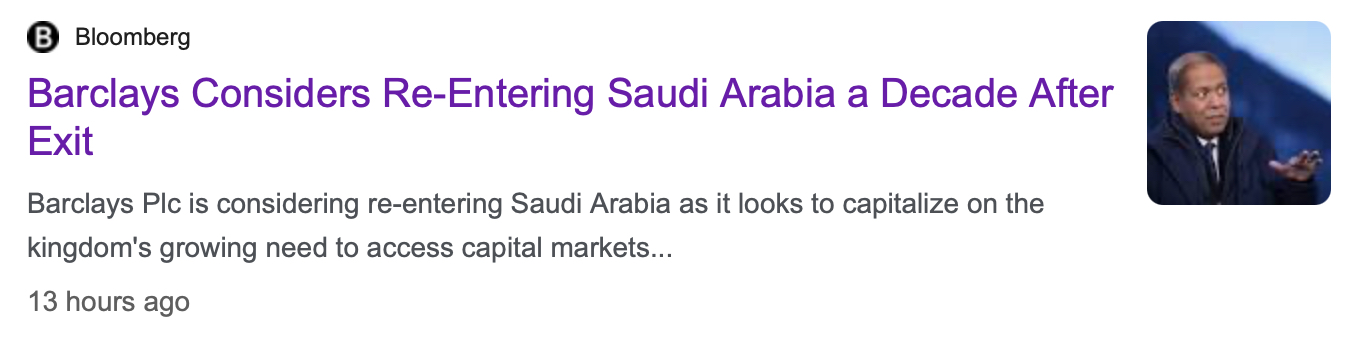
Yup this happens too and in this case it was an article that Bloomberg showed its paying customers. I am not one of them. As such I am attaching the image that made me laugh.

I saw it about 8-10 hours ago and it had me rolling with laughter. So what gives? First the setting of ‘Consider Re-entering’ as I see it Barclays and other banks are strapped for capital and bleeding a client dry (service fees and commissions) is a tell tale story towards any bank trying to make a living. There is no consideration, there is merely the trap they put themselves in 10 years ago. As for the “capitalise on the kingdom’s growing need to access capital markets” is even more hilarious. The Kingdom of Saudi Arabia has options to consider HSBC, JP Morgan, Bank of America and the 5 largest banks in China. All stronger and more able than Barclays. There is also Credit Agricole and the Citigroup. All in the top 12, Barclays stands at 18. So there is the first part. In addition I can hand you Rothschild & Co. The one bank no one mentions. It’s value was around €18.1 billion a year ago, as such I reckon it is pushing well over €20 billion at present. Barclays has nowhere near that capital or those connections. I reckon that Rothschild can access around 20% more clients than Barclays can (a casual speculation by little old me). 

So why this action?
Well it started in 2012 when we were given “Barclays is fined for manipulating the benchmark Libor interest rate in 2012, after revelations stretching back to 2005” It’s CEO C. S. Venkatakrishnan didn’t forget about that, did he? Then we get 2014 when Reuters gave us ‘Barclays sued by Saudi developer for $10 billion’, so how did that end? We got “A Saudi real estate company has sued Barclays for $10 billion (6.24 billion pounds), claiming the bank ceased pursuing lease payments due from the Saudi government on military complexes in the kingdom in order to obtain a lucrative banking license there” when we were given (source: Reuters) “The company, Jadawel International, a unit of London-based MBI International Holdings Inc., claims Barclays “hatched a fraudulent scheme” to secure the rare Saudi banking license, selling out Jadawel in the process, according to the lawsuit filed in New York state Supreme Court on Tuesday” One says potato and the other claims tomato. In the end as far as I can tell Barclays won the dismissal. It doesn’t make them innocent, but the claimant could not prove guilt (as far as I can tell). And last but not least only this year we were given that Barclay was one of the players in getting Andrea Orcel “derivatives linked to Commerzbank for the Italian lender in the weeks before Berlin sold a stake earlier this month, sources familiar with the matter said. Barclays and Bank of America subsequently helped Orcel to effectively expand UniCredit’s holding in Commerzbank to the current level of about 21 per cent, they said asking not to be named discussing the private information” now, this last bit does not seem to be illegal, but the stakes against Barclay (all over Europe) are increasingly high and now they hope that Saudi Arabia gives them a chunk of business before they are forced to hand over their bank to any of the upper 15 banks. I say good luck to them. Yes there is all kinds of banking issues I am not familiar with, but governments need to work with banks that are cleaner then clean and as such I am entertaining howls of deriving laughter if Barclay thinks they are that. The LIBOR scandal took care of that. 

And lets be clear Barclay didn’t (as far as I know) hand the statement “Mistakes were made in the past and we have sanitised our structures and people to meet the challenge that a customer the size of the Kingdom of Saudi Arabia brings”, nope, none of that. We were given “Barclay plc is considering re-entering Saudi Arabia as it looks to capitalise on the kingdom’s growing need to access capital markets”. I actually wonder if they would be allowed in the country at present. There are seemingly better viable candidates and that is before you consider Rothschild as a contender. 

I get it. I also tried to access Saudi Arabia as a partner (read: future owner) of my IP. I merely wanted 50 million, a Canadian passport and 2% of the revenue for 20 years. With my believe (a presented believe) that the idea would give them 6 billion annual and their investment to that would be 50 million (for happy old me). And this is about as decent as it gets. A mere 0.8% risk and that is at the time of the presentation. A mere trivial amount and I feel certain that this would have worked. There was one condition Microsoft was not allowed near it. Amazon would be OK, but Microsoft is a no go.

This is why I contacted Kingdom Holdings and Tencent Technology as well. They can drive the innovation I brought. As such I feel a stronger contender than Barclay ever could be (Yes, I am blowing my own horn).

So as I see it, re-entering a market when the others have seemingly had enough of you isn’t re-entering. It is running for the hills to avoid being taken over. But I am not a banking person, so what do I know.

Have a fun day.

Leave a comment

Filed under Finance, Law, Media, Politics

The premise of danger

That is what I feel is in play, but there is a word of warning, my premise is speculative. To see this we need to take a look at two new articles, both from the BBC. The first one is ‘First Republic makes last ditch bid to find rescue deal’ (at https://www.bbc.co.uk/news/business-65441302). I will go into details shortly. The second one is ‘US Fed admits failure to take forceful action on SVB’ (at https://www.bbc.co.uk/news/business-65428206) which came in a day earlier, but it all links to ‘I honestly don’t get it’ (at https://lawlordtobe.com/2023/03/12/i-honestly-dont-get-it/), which I wrote on March 12th. As such we have a growing concern that stretches well beyond 6 weeks and now we get “According to reports, the Federal Deposit Insurance Corporation (FDIC), a US financial regulator, sought bids for First Republic by the end of last week and has been assessing them over the weekend. Investment banking giant JP Morgan Chase is believed to be one of the banks invited to bid for First Republic, according to news agency Reuters. Bank of America is also understood to have been approached.” And in those six weeks I made a few clear presumptions/speculations. Yet NONE of the media looked into any of that, not even by their own accounts. The setting is that slippery and as such the media has shown that it can no longer be trusted. You see, there was a clear premise that some banks have too many US Bonds, but no one is willing t report on it and now people are withdrawing cash. The global setting becomes that putting your wealth in your mattress (or in a Saudi or Dubai bank) tends to be safer and that is not a good thing. No one is willing to look into the bulk of the US bonds and where they are, more importantly, no one is looking into which banks have US Bonds and how may they have of them, but the journalistic joke (ICIJ) was willing to play the NSA game (Credit Suisse leak) and emotionally speculate away whatever they could. The media is failing us all, because many are driven to ‘governmental’ needs. Yet, this is speculative, but look at what was published and what we are told, the numbers do not add up (neither do the topics). And in the second article we get “The US central bank has said it failed to act with “sufficient force and urgency” in its oversight of Silicon Valley Bank”, as such they didn’t learn in 2008 and they are seemingly not learning now. I use the word seemingly because of the Bonds issue, as I personally see it, some aren’t willing to report on connected matters and that is a whole different kettle of fish, but it is my view and if there is decent evidence proving me wrong, I will accept that. 

So when we are given “Michael Barr, the Federal Reserve’s vice chair for supervision, who led the review, said the US central bank should toughen its rules in response to what it had learned from SVB’s demise” we need to consider a few things. Basel III was created in 2010 (13 years ago) and in the US it was named the “Dodd-Frank Act” which was supposed to stop banks from taking excessive risks, which was partially repealed on May 24, 2018 by former President Trump. And now we have several new messes that could (in a most dire setting) bring about a new age of poverty in the US. Yet the larger setting that pushed for this is how many banks have US Bonds and how many do they have? 

And there is enough evidence out there, but for some reason the bulk of the media will not go near it, why not? If you follow the timeline and you start digging into 

Silicon Valley Bank (SVB)
Signature Bank
First Republic Bank
Credit Suisse
UBS Group AG (they bought Credit Suisse)

A weird setting starts to evolve and I am not an economist, as such someone will tell me I am wrong, but when you start comparing where $20 trillion in US Bands are, the picture shifts. Some are well established ‘banks’ like Rothschild & Co, as such plenty will have bonds, but some took a chance on getting rich quick and the partial repealing of the Dodd-Frank act allowed them, as such several are now in problems and there are more in this level of problem, but someone is brushing these facts under the carpet (and the banks themselves are hiding issues), as such I expect to see more revelations like this over the next 2 quarters. I recon the US Central banks are doing whatever they can to douse that fire before a full baking meltdown is on the horizon and the media is assisting, because if they were not, we would see a lot more facts come to light. Or as my grandfather would say ‘the best secret keeper of an adulterer is a brothel’, to state that someone is getting rich of keeping the secret at present and as I personally see it, the media is assisting them. Why is that? It is (again as I personally see it) because you are no longer entitled to getting the actual news. You get filtered information. News that is censured and approved by share holders, stake holders and advertisers.

Take notice of that small fact and enjoy Monday, only 112 hours until the weekend.

Leave a comment

Filed under Finance, Media, Politics

In This War!

We look at the news that is now taking on a she said, she said path, whilst he said is ignored towards what another he is stating. This is not a battle of sexes (which is a nice change). No this is almost like the US Senate versus Congress (also known as the fruits and nuts department of US politics), this is British politics in the Brexit phase that is now following. People dragging their feet, people going over simple narrow-minded seeding of statements whilst throwing the custard pies in as many faces as possible. It is like watching toddlers getting off the rocking chair. In all this there are also corporate players who have been hiding behind others whilst spreading unsolicited memo’s leaving them in the open to read with a ‘top secret‘ stamp on it. It almost feels like the GCHQ soap that we saw in Cheltenham 1991 (could be 1989 or 1990).

Anyway, when we hold people to account for their statements we will get these ‘miscommunication’ issues which will waste everybody’s time and it will not get anything done. That first part is seen in the Guardian in an opinion piece by Toby Helm (at http://www.theguardian.com/politics/2016/sep/10/brexit-camp-abandons-350-million-pound-nhs-pledge). My issue started with “dropped their pre-referendum pledge of a £350m-a-week spending bonanza for the NHS“. Let’s be clear here! Nigel Farage has stated on several occasions that the 10 billion pounds (34 million a day), should not go towards the EU, it should be spend in the UK on people for the UK. In addition, he stated on Good Morning Britain that he could not guarantee that it (£350 million a week) would go to the NHS. That was months ago! Even earlier (at https://www.youtube.com/watch?v=bkr_Qjey8s8), we see Nigel Farage talking about the debate that is required around NHS. I believe he is right, in all this the debate he opened is one that the Tories and Labour aren’t stating they are slinging mud. In that part we see that Nigel was promising to put 3 billion (out of the 10 billion) towards the NHS. It was an intent to do!

He literally said ‘we could put 3 billion pounds‘ (around 5:55 into the story). Means it was not a given, just an option! In this Nigel Farage was right. Labour and Conservatives had ideas which meant borrowing more money. Also, let me remind the readers that it was Labour who stuffed up the NHS IT program costing the tax payers 11 billion pounds. It was a complete failure and large loss, one of the largest the NHS ever faced.

Now of course we can sling mud all over and as a Conservative I guarantee you that you will lose at that point. The NHS is on the verge of collapse and neither side has done anything to truly take care of business. UKIP sees it as a disgrace and so it should be, because it has been known for over 15 years that the UK is largely an aging population, meaning the pressures on the NHS will only increase, that while it is being drained. In this we also need to take a look at the TTIP and the dangers it poses. We can try to have faith in the marketing joke the EU is when we see the focal point that is useless (at http://trade.ec.europa.eu/doclib/docs/2015/january/tradoc_153010.4.7%20Pharmaceuticals.pdf). This is especially seen when we see the elements around protecting Intellectual Property:

– Companies to profit from their research and remain amongst the most competitive in the world- Patients to benefit from new medicines.
We won’t negotiate anything in TTIP which would:

– Upset this delicate balance, or
– Increase costs for EU countries

The TTIP is about profit, especially for American Pharmaceutical companies!

Places like EFPIA are not lying to you, they are just misrepresenting the needs. Because a strong TTIP is not what they state ‘How a Strong Pharmaceutical Chapter in TTIP will Benefit the EU‘, it gives massive powers to the Pharmaceutical industries, whilst stopping generic medication from getting in. And here is the crux for the NHS, to get part of their budgets to meet up with reality, there will be a massive need for generic medication. For over 2 years I have pleaded to get stronger ties with India that has a growing market of generic medical solutions. A partial solution can be found here! Now, it will not solve all, there are still patented medicinal solutions we need and they will be bought, yet the fact that pharmaceutical industries want another 20 years of exclusivity is just not proper, not realistic and not acceptable. The US should have cleaned house in that market decades ago, but they were only focused on flaccid politicians requiring Viagra. Now that the game is up they all want a little more (read: twice as much). This is not how patents are supposed to work, they never were!

Consider the following two quotes: “The EU and India are taking steps to end a trade row sparked by an EU ban of 700 Indian pharmaceutical products after New Delhi cancelled talks on a free trade accord earlier this month“, which was in August 2015 by the way! As well as “Modi personally argued that the long-stalled talks on a free trade accord should be revived, India’s turnaround puzzled the 28-nation bloc, which insisted the ban was a minor, technical issue unconnected to trade“, it was all about the product, not about trade, the issue that the EU licking the heels of Washington gives us “the delays risk leaving India isolated. While Modi is trying to double India’s global exports to $900 billion in five years, Europe’s top negotiator now spends more time on the Transatlantic Trade and Investment Partnership (TTIP) with Washington“, you see, this 900 billion market is stopping an almost 2 trillion market of US pharmacy. Even if it is not all UK, what would you rather see? The NHS spending 90 million, or 2 billion on the same amount of medication? Let’s not forget it is down for over 13 billion at present. The NHS needs this generic solution and at present having strong ties with India makes a lot more sense than the ties with the US that are bringing the UK down, all because they would not clean their own stables!

This is and remains the foundation of Brexit, so when we see the Guardian quote “Anna Soubry, the pro-Remain Tory MP and former minister for small business, said it was outrageous that the Leave campaigners had “peddled that lie” during the campaign and were now quietly abandoning it“, we need to tell Anna Soubry that she needs to stop whining like a politician and start giving out papers that clearly define on how the NHS can be stopped to collapse, because as a fellow Tory she does know that from the moment the Tories came to power in 2010, too little has been done to revive the No Holy Sanctum, so actions are required. The fact that the previous administration from 1997 onwards also made its shares of mistakes as well as waste an additional 10 billion, means that massive effort needs to go into the NHS, having to listen to a whining Anna Soubry (in this matter) is a waste of everybody’s time. I am actually not happy to phrase it this way, because Anna has had quite the political career. Not into the limelight for too much, but I always saw her as upcoming House of Lords material, mainly because she has been outspoken on more than one occasion, at times this is how we hope our Lords would be. I never minds whether a person was right or wrong, just that they would be an evolving wisdom. Those vague stating politicians (as too many are) would never be Lords material, Anna still is in my eyes. This does not mean I will agree on her, or on my party. Things need to get done and too many aren’t getting it done.

In addition, we see all these financial doomsayers who are now resetting the view of Brexit in less negative ways. It is not as bad as they thought it was. This is their view on managed bad news. Another piece of the puzzle, where too many people were trying to demand that the Status Quo remain. When spending has not had the incentive of growth and managed bad news was used to dim the impact, now we see the opposite where their doom is not happening and now they are revising the numbers upwards (at https://www.theguardian.com/business/2016/sep/09/city-banks-revise-brexit-doom-and-gloom-forecasts). Here we see the ‘bitches’ of Wall Street: Goldman Sachs, Morgan Stanley and Credit Suisse revising their numbers as the trade deficit is now falling for the UK and that gap is now optionally turning into the momentum of a better economy. So, is my view too extreme when we see the quote “Morgan Stanley initially forecast the economy going negative by 0.4% in the third quarter of 2016, but this week changed that to expectations of 0.3% growth“. This makes me state ‘How stupid or non-comprehending is your staff?‘ I would like to add personally to James P. Gorman: “You now have 7 quarters of data showing that managed bad news is never a real solution and that the Status Quo of finance is a mere illusion. So will you in the near future clean house and start being a visionary instead of remaining a facilitator?

I know, diplomacy has never been my forte, yet as Apple is likely to lose up to a 2% market share over the coming tax year, he needs to wake up and kick the right people into gear before he has to do a negative 2 trillion dollar speech, and perhaps I might just have oversimplified the problem for both you and him!

These are only parts of the solution, but we need to tackle them one at a time. Because the intricate mess both sides of the isle is trying to make them will not solve anything. I will go one step further, I am almost driven to get one additional degree in Medicine, move to the UK and work at the NHS trying to resolve the problems! You see, one of my lifelong idols is Lord Baden-Powell. I was never a boy scout (in more than one way), but I have always taken one of his quotes to heart “Try and leave this world a little better than you found it!” It is the master of all thoughts, because it does not make you solve things, it is not my burden, just leaving it a little better, a little cleaner is all we all need to do. The simplicity is that if all 68 million Britons do just that, we could all turn the UK into the paradise it once was and can be again in almost no time at all.

The simplicity of any solution is the one step you actively take! Because when it is done you take the next step! This is what happens when we are not stopped for too long by too many managers trying to figure out WHAT to do, just to start doing it. That is the brilliance of Brexit. That step has been taken, now we take the next step and the one after it. So many politicians have been too worried about looking good that they forgot about actually doing anything good. I reckon that the inactions towards the NHS and housing are ample pieces of evidence to show that I am right, and the Mud Ladle of Blame goes to both sides of the isle.

In all this the one massive reason for me to remain towards the Brexit side is the one no one seems to discuss, or perhaps the press is being told not to dig too deep into that side. You see, one of my major issues has been and still is Mario Draghi. Bloomberg gets close with the quote “About three months ago, the Draghi-led European Central Bank started buying corporate bonds in the region for the first time. The results have been dramatic and, at times, alarming” (at https://www.bloomberg.com/gadfly/articles/2016-09-07/companies-are-getting-paid-to-be-rated-junk-in-europe). You see, the simple clarity is that you cannot use a credit card spending over a trillion thinking it will have no impact of your credit score. The quote “Investors are now literally paying European companies to borrow. Sanofi, a French drug maker, just became the first nonfinancial private company to issue debt that yields less than zero” as well as “Bonds of some investment-grade European companies now carry negative yields” are just two examples of the mess and the nightmare that will soon hit too many places. Then there is “Less clear is how investors are justifying purchases of junk-rated bonds that promise nothing and come with big risks“, which is what we saw on Cyprus and in Greece. No one is held accountable and those screaming for more money have no idea and no option to pay it back. It was never a solution! So Draghi spending a trillion plus leaving the credit card to be added to the workload of his successor is not ever a solution. Moreover, the EU nations have to come up with paying it back somehow, so leaving this collection of spenders seems much better than to play possum and ignore that credit card, because that debt comes with interest and there is not one government in the EU who doesn’t have their own national credit card maxed out, which means that our children will have to work of this debt. That is not a world I ever accepted to be in!

Now consider the last quote “Does this mean risky debt in Europe getting less risky? No. Fundamentals are, in fact, deteriorating, according to the Bank of America strategists, with investors recovering less from defaulted debt than they have in the past“, which is partially the problem and the issue I have with the USA. Wall Street is setting up a scenario that is reminiscent of the old Pyramid schemes, with the difference that they quickly want to cash in one more time and breaking free from whatever remains. It is wrong on many levels, so as there is one more round of bonds and stimulus, the previous instigators cash in and get out with as much as possible, knowing that they will survive in the next two decades whilst the ones not getting out drown and lose all. This is why the Draghi method is so dangerous and we need to get away from it Brexit was part one, although Frexit (part two) is not a guarantee, the fact that Sarkozy is now ready to set a referendum if elected should be ample warning for the US (read: Wall Street) that the status quo route is no longer acceptable and too many nations are willing to let it all fall back to nationalism if pushed, should be more than enough for Wall Street to find a ‘live with the loses solution‘. Something we all know will never happen!

So in this war there is the immediate need to stop misinformation and above all get something done, in this case fix the NHS, it should be the only issue on the agenda of both isles for the rest of the year, that whilst Brexit moves forward. It is a tall order to deliver no matter how you slice it, but whomever does will have the support of the people for a long time to come, because that aging population will still hold the majority for well over a decade.

 

Leave a comment

Filed under Finance, Media, Politics

Start making sense

I have been tossing and turning for most of the night. Something has been bothering me all day, and as it seems most of the night. You see, the Dutch NOS reported on Saturday 9th of March an interesting footnote in their newscast. They suddenly had this short part on the news on how this is possible. (Source: NOS http://nos.nl/artikel/482586-record-op-record-voor-dow-jones.html)

This is interesting, as I asked pretty much the same questions in an earlier blog called “It hurts every time, but we love it”, which I published on Feb 6th, so slightly more than a month earlier. The Dow index is currently at 14,397 (which was a 2007 record). The issue is that we had the crash of 2008; one in six in the US lost their house. So, the economy is not in a good place. There was also the mention in their radio cast (English and Dutch). They seemed to focus on two parts. First was the fact that Economic recovery is gotten through revenue recovery without staffing (so 5 do the work of 10, and they are happy to have a job). Second is that the Dow is based on only 30 companies. Yet, when we look at the number I wonder what game is being played as I look at a 2 year index graph. This graph is Stellar. My issue is twofold. One I am NOT an economist, but a data miner. Second is that the given ‘excuse’ feels wrong. Especially given that the news had this production line backdrop of cars, and none of the 30 seems to be in the car industry. So why not present this with a pharmaceutical backdrop?

So let us take a look at some of these Dow Jones Index companies.

1. Bank of America. A bank, and after 2008, we could wonder in what state it is in. This quote comes from Forbes and was written by Halah Touryalai, one of the Forbes Writers “No bank knows that better than Bank of America which has agreed to pay a jaw-dropping $42 billion, settling credit and mortgage-related legal battles in just the last three years“.

OK, if we take that into consideration, then seems a little weird that their stock graph has the same shape as that of the DOW. (As one of the 30, it would make sense that the graphs are shaped similar, however, such confidence after such a legal fee settlement bill?)

2. JP Morgan Chase. Another Bank! It had two more dips then BofA, yet overall it is in an upwards movement as well. It was also mentioned in the same Forbes article as before on settlement fees, but those fees were a lot lower. The Bank of America had to chew on 66% of the total settlement fees by itself, so for the other 5 big banks, the damage was relatively small in that regard. However, In April and May 2012 they had lost more than six billion dollars on derivative trades that had gone bad. There was a report of 9 billion in total, which also involved Bruno Iksil for part of the mentioned amount, he is also known as ‘the London Whale’. The numbers and the names vary when we look at UK and US papers, but overall they pretty much tell the same story. It is interesting that JP seemed to bounce back within 6 months to stock values higher than before the June 4th 2012 dip. Last on my list is Boeing. It is a giant, but we have all heard of the 787 issues and it’s now named ‘Nightmare liner’. The issue is all about batteries, yet the news from January as reported by Reuters : The new production forecast raised some eyebrows. Russell Solomon at Moody’s Investors Service was forecasting 100 787 deliveries and said Boeing’s forecast of more than 60 was “significantly weaker than we had expected.” Interesting that what analysts expect and what the vibe says Boeing will be delivering is off by almost 40%. Suddenly NOT meeting expectations has almost no impact? 40% less on a firm the size of Boeing should have a very visible effect (imho).

Now the DJI is about 27 other companies and there are only two banks in it. It is also a fact that these banks work with securities and values in the hundreds of billions, so are my concerns just a storm in a teacup?

It is a valid question, and I also ask myself this question. Let us take a look at the two following thoughts.

1. US debt. It is set at 16.6 TRILLION dollars. The total US debt is a lot higher. That one is $59.1 TRILLION.
Can anyone even imagine those numbers? Now consider that someone has that kind of money. To be honest is that really true? Is there a group of nations with that level of wealth? the only nation capable of owning that much is one with an abundance of oil, so basically the United Arab Emirates (UAE) is the only one that wealthy. Either the US is labelled UAE-west, or my thoughts are not that correct in this instance. So perhaps I am wrong (I will be the first one to admit that).
We know that most value trades are now done digital. It is the only way for the market to move such amounts of wealth. However, who checks this?

I have seen my share of digital forms of miscommunication by loads of people in several fields. Often they seem connected to the corporate headquarters of Bloated, Botched, Bungled and Baboon. An always newly formed enterprise, coming to a local public stock market near you. Consider that this is done on the electronic super highway. Now consider that Hackers come at a dozen a dime and greed is eternal, these last two are given facts. Also realise that ANY system can be gotten at. DARPA and the NSA proved that more than once.

The valid question loudly remains: “Who truly checks the validity of trade and the numbers they are traded at?”

2. LIBOR scandal. I wrote about it, the news has talked about it in abundance. Last week in an article by Mark Scott in the NY Times on March 5th the following was stated “The review published by the Financial Services Authority, the country’s regulator, said there had not been a major failure of oversight by local authorities, but it added that officials had become too focused on containing the financial crisis to analyse information connected with the potential rate-rigging

This is a fair enough statement (it did seem shallow in relation to the handed fines), and them be hefty fines, so why are these two events related? Well, in my mind there are two parts of the LIBOR that were in play. From my point of view there are two variables that might be played with. The first one we know. It is the interest rate; the second one is the bigger issue. You see, those percentages are linked to a total sum of $350 trillion in UK registered derivatives. That is 20 times the US national debt. If people play with one, there is every reason to suspect that they might have played with the other. So again, who controls those totals that are being traded in? If derivatives include hedge funds, swaps and forward rate agreements then we should be worried. Consider as well that the US Bank for International Settlements holds almost twice the value the UK seems to be registering.

So, we are now confronted with just in excess of 1000 TRILLION dollars. How can this even be monitored? Now let us add one more part. The US LIBOR rate is set by 18 banks. The two banks in the DJI are members. Are we all on the same page now? The third bank (Citi) is to be given a fine in regards to percentage ‘tweaking’. According to Reuters, later this year, a new set of settlements will be ‘delivered’. In their publication of March 8th by Kirstin Ridley and Philipp Halstrick it states that: “Deutsche, Citi and JPM are the banks named in regulatory circles as those candidates near the next settlements,” said the second source. So now we have both a DJI member and libor member in this illustrious ‘donation’ scheme. What else is at play?

What if the total value is not correct? What if they did not just play with the percentages, but the total package of the trade able amount? Let’s just take a fictive 5%. Mainly because I feel not so comfortable with the value they say they have and in part because I cannot even comprehend that much, as we get above the $200 trillion range. So, if 5% is taken off the total amount of over $1000 Trillion, would mean that we might all be devaluated by a total of 50 trillion dollars. That comes down to $8400 for every citizen on the planet. Did we sign up for that invoice?

It might be just be me (and I can happily live with that notion), but can bankers and financial corporations be allowed to continue on this track? We have seen clear evidence that those places cannot be trusted with even a small speckle of such amounts. Even though they NEVER broke any laws initially, LIBOR shows that some are very willing to do that. With the US on the edge of bankruptcy (or on the wrong side of a fiscal abyss), with the financial industry in such disarray, what can be done?

So when this all falls over (not if it falls over), what will we be left with?

Leave a comment

Filed under Finance