How the mighty fall

For some the E3 is still in the front of their minds. For some it is the confirmation of things to come and of things about to happen. For some it is also the start of a nightmare.

When it comes to gamers, we often see the start of name calling. We might hear words like Nerds, Geeks and a few others. It makes the people who do not understand gamers happy and comfortable. There is however the group that thinks of them as exploitable. That group is about to see the light in ways thy have never experienced it before. In this I am talking about Microsoft.

You see Microsoft had a good name, for some this good name remains. The Xbox and the Xbox 360 are good consoles. I have a 360 and I have enjoyed gaming. I will enjoy gaming a while longer, but no matter how good it could be, the X-Box One (XB1) is currently not on that list. You see, Microsoft wanted too much, too quickly and now they are at risk to pay dearly. There were these large thoughts of charging pre-owned games for usage, to be online at least once every 24 hours. This has nothing to do with gaming. This is all about keeping tabs. I wonder if the scare the NSA PRISM issue gave many has anything to do with it.

The truth is that the gamer group wants to play games pure and simple. I belong in this group. I can afford a new game with some regularity and I have been part of Gaming and the Gaming Industry since 1986.

I know plenty of people, many mothers who want to give their kid a nice game, but $109 is just not in their budget. Even for some it is over the top for a birthday present, which is very understandable in this economy. These people RELY on pre-owned games, and in this economy that group will grow exponentially for a little while longer. So when Microsoft enabled the chance to go after gamers, I revolted! The reason is simple, if we gamers do not unite, we get taken for a data-collection and money grabbing ride.

Some will not care about not being online, about privacy and they just buy games and play. That is fair enough. Buy your XB1 and game. Many of those will keep on gaming happily and all. I feel for those unable to buy new games, and even though they would face a season-pass fee to play multiplayer online (which in my mind is fair enough). they end up paying a lot less than the $100+,  to play.

So as gamers feel betrayed by the issues raised by Microsoft (or M$ as some now call them), they will move away and run towards the PlayStation 4. So Sony is more than the big winner, they are likely to leave Microsoft with their XB1 (or X-Bone as some call it now) far behind them and no longer see Microsoft as a contender in the gaming industry.

This also opened a door for others. Even though this market has had a long time 3 player supremacy, Microsoft has opened the door for Google to enter in the low class with their OUYA and open up for a new form of gaming. Even in old Roman days (not the one shown by the new game RYSE), we know that the people want bread and games. Even if everything goes down, political and industrial power remains where the people have bread and games. So as OUYA enters the field, as Sony strengthens its pure gaming power core, Microsoft is about to lose a serious amount of market share.

They will deny this and over time they are likely to show on how the ‘home-entertainment’ market is so up in revering the XB1, the gamers will see a shift in the balance of power. Nintendo has always been a gaming world and as such it has a unique family based following. Yet, the others will feel their markets. Sony will be up and Microsoft will go down.

I thought about this, and should I win the $25M jackpot (extreme wishful thinking), then I know exactly where to go. You see, Microsoft is about to leave a quarter of a billion dollars up for grabs for those who know how and where to take charge. It is very certain that Sony will grab part of that, yet they remain high end. Especially if we look at countries like Spain, Italy, Greece, the Netherlands, France, US and the UK. These nations are saturated with people who just cannot afford the high end gaming market and a $99 Google AUYO with a Google play approach of less than $10 games might sound small, but when you consider a market of 30-50 million gamers that is now up for grabs, that market will amount to serious coin.

Will Microsoft fade? No, they are too big to fade and when the Microsoft Lawnmower man comes in to trim the size of MS management and reshape their entertainment side. When they see the nightmare they themselves created, they will refurbish their share and they might even regain some of their lost market share. However they are unlikely to regain it all until the economy gets a whole lot better. This is not likely to happen before 2015. Until then Google gets a chance to get into a market they did not expect to have. A multi-Billion dollar market the got opened to too many factors of greed and they tried that in a place where greed gets stopped real fast.

Consider a count of games that consoles offer at launch date. In fairness all systems have start-up issues sith games. It comes with the territory. The Google OUYA at prelaunch (today) has registered 146 games for purchase. That is the biggest start EVER (ps1 games on ps2 launch date do not qualify, neither do NGC games on Wii). If this ends up about timing, then Google’s timing was perfect.

More info at http://www.ouya.tv/

1 Comment

Filed under Finance, Gaming, Media

Has the case of UKIP been made stronger?

It seems that the EU is starting to hand out slightly less restricting measures. Commissioner Olli Rehn is removing for a short time the 3% deficit limit. This is a slippery slope to say the least. Yes, it is correct that the economy is a fact that needs to be fought. Yet all (including the UK) are spending money that they do not have. UKIP is riding on the waves of these fears, where we the taxpayers will end up footing that bill no matter what. And in the European picture the ‘we’ is simply any citizen paying tax. Governments writing checks, for which they have no money. However the difference of that small point that they can no longer cut is still amounting to billions. In the UK with a vastly over the 1 trillion pound deficit such sliding numbers will really add up. Like me, Nigel Farage saw this coming from a mile away and now he is ready to play his move to start walking towards a landslide victory.

If these driving reasons are not dealt with then both Labour and Conservatives who are currently nowhere near changing the economy are heading to a legendary defeat. There is however a comical side to this. (One should always find reason to smile) It would be the first time in history that the opposition could get crowded by both Labour and Conservatives, with day one likely becoming quite the show. How would that fall in the House of Lords? In that case Black Rod (the Usher) will have a field day! A role currently assigned to Mr David Leakey, former Lieutenant General in command of European Union Military Staff. He was awarded ‘Companion of the order of St. Michael and St. George’. Take it from me that when the members of Club Carlton and the Reform Club are on the same side of the isle, the Usher might need a little back-up to break up slight differences of opinion and he better bring a bigger Dragon then the one St. George slew to aid him.

Yet, the shortage is the issue. How to stem the tides? It is clear that spending more and more is not making it happen. I personally think that it is time to join hands together (not singing Kumbaja). As Commonwealth nations we have a duty to stand together. We have always seen the US as a brother, yet when it comes to accountability, their actions have a massive bearing on our situations, yet they just shun accountability, they have remained absent in stemming the tide of the economical Tsunami, they themselves are creating. My suggestion is that we the United Kingdom, Canada, Australia and New Zealand start uniting economic solutions together. Being parked in London, Sydney or Melbourne is no longer an option. All three have to deal with shortages on one hand and unemployment rates on the other. What if we seriously start to change that? What if we push for a preferred partner in solutions? I myself experienced last week the answer from Canada, that they (one consultancy firm), when it comes to foreign workers limit themselves to US citizens. Perhaps our English is not good enough? There might have been a very valid reason in this, yet I cannot stop to wonder whether we are ignoring possible options to make the Commonwealth economically great again.

We are under such pressures to adhere to ‘corporate’ standards, and the bulk of all those companies are American. This is not about pointing fingers, but to restart an economy. If we look at the gaming industry nowadays, then that war, which was a former war of innovation, which is now diminished to a war between Microsoft who is about to hurt low income gamers and Sony, who is true to the gamers. The interesting side is that they for the most come with the same titles. There is still Nintendo, yet they seem to be lagging way behind. This is a multi-billion dollar industry and the shares are almost 40-40-20 with Nintendo in the 20% group. What is stopping us to take the Google OUYA Android Gaming Console into that market and start growing a market that is now, but has massive potential. Let’s face it, getting 10% of that market is still serious money and the economic downturn to people will remain at least another 3-4 years. So with a play to a cheaper solution is one they would love. It also forces the other three to become innovative and competitive again.  Smaller playable games at less than £ 5 makes it possible for starting developers to make many millions. Consider that families can afford 4-5 games instead of 1 Microsoft game with a £5 surcharge. It does not end there.

Europe is outsourcing customer care centres, technical care centres and we cannot find a way to get 100,000 a job? We need to rethink corporate thinking that is smaller based, makes money and pays taxation. That makes those places 3 times a winner for all parties involved. It does not matter who gets to be in office, in the end we need to fight to make sure that this office survives!

And as we go back to that multi-billion dollar gaming industry, when these people get a pre-owned game surcharge where will that be taxed? It is time to put a stand and make these chargeable items taxed in the gamer’s nation, not in a virtual server location where no taxation is due. When these companies move into the nations of the world, demand rights, protection and support, yet walk away from taxation that is due as they receive all those rights, then we should look at the abundance of non-accountability and make it an accounting matter.

We need to start moving. It is nice and essential to fight over the GCSE A-levels, but without an economy they have no future, and we must fight for both!

Leave a comment

Filed under Finance, Gaming, Politics

The Hunchback of the NSA

We have been hearing information in this regard for some time now. I added my thoughts in my last blog, and as this is such a growing story, let me see if I can add some details to this by looking at a few issues from another side. (Source: www.NOS.nl , www.Guardian.co.uk , et al).

Edward Snowden, His view is that it is up to the people to decide what is to be done. Is it?

2003: Edward joins the Army to deploy to Iraq. He suffers injuries during (basic) training and cannot continue the training.

200?: Edward has been selected into the sanctum and becomes an IT specialist with the CIA, placed in Geneva. Well, that is a nice handle up from basic training isn’t it. Some people dream of opportunities like that all their life.

He gets a dose of disillusionment. (Not my words, just quoting here). The CIA methodology does not sit well with him. As a data analyst with a few decades of experience, including some not to mention data depositories, I can tell him now, that there is method to their madness. I know where he is at this point, because when it is all about data cleaning, integrity checks and verification, whatever you do feels like carrying a bucket of water towards the ocean, but hey, that is what it is. He then decides to quit. That is fair enough! Not all are meant for that lifestyle (including unappreciative bosses that we see by the container load in the commercial world), and as such we should recognise that some of these jobs have a decidedly larger chance of burning out.

2009: He joins the NSA. Really? After he left the CIA? That is an interesting step. Especially knowing that one worries you, the other would not?

Well Edward, this is what you signed up for! But fair enough, you wanted to give it a go. He then becomes NSA’s own Arnold Benedict. Oh joy! (I say in a slightly sarcastic voice) and he ends up feeding the information to the PRESS. I will add that this is slightly better than dumping all this on Wiki-leaks. I will also applaud him for going to the Guardian as I personally see these people as slightly more devoted to Ethics then anything Rupert Murdoch has at present in my humble opinion. Still, Arnold, oops, I meant Edward goes out into the limelight. Consider that his job was to make sure that the American people remained safe. Did he? Many people including terrorists knew this was likely to happen. Now they have confirmation and they might employ new methods, making it harder for the NSA to find them. So who did Edward Snowden actually service? From my point of view it was not the American people. Oh, and Hong Kong of all places? It seems to me that he preferred to be bankable to several potential donators. (But that is just my view).

The NSA has an uncomfortable job that must be done. The terrorist (or perhaps better stated the extremist) threat is real, and as such organisations like NSA, GCHQ and DSD need to look at information as it flows to keep its citizens safe. There is an ugly looking sterile approach to information. It has no emotion; it is simple collection of data. Yes, if anyone gets the wrong phone call we could be checked. Yet, the data is up to a point so complete that these organisations can easily see whether this is a fluke, or if there is more. Is that not the best solution? Most people have this illusion that we have some kind of privacy. The reality is that our information had been collected and data mined by large corporations well over a decade before governments started to collect data.

Do you think that I am kidding?

Take a day in your life. You fill up the tank at a gas station. You use your tank pass to get the 3% extra discount. You pay with either ‘their’ card, or your card. Nowadays it is rare that people pay cash. You go to work. Lunch means that you get lunch at some place. You get a snack and you get 1-2 extra items. Anything at these points that have a pass, or card is in 70% of the cases collected data. Now you go home, get dinner, use your customer loyalty card and you go home. Whenever you did not use cash (and in some cases even if you did) your details were recorded. EVERY day of your life! Whenever you use your mobile, your mobile carrier knows roughly where you are (with some smart-phones they know exactly where you are). All that data has been collected in one way or another.

Yes, even beyond what Orwell contemplated, you are a data collection point, you are marketable!

This is the ugly reality that has been happening since even before 2001. The big problem for you is that many of these companies need to survive, they need revenue, so to survive and you are for sale. Whatever you did is for sale. No matter the amount of cleaning you think they do. It takes but one linkable fact to your raw data details to know exactly who you are, where you are and where you are likely to go. People like the NSA only want to know whether you are a danger to the nation and the people around you. Are you? The others want to make money off you? Only you know how ‘dangerous’ you are, the others want you to spend cash where they like it. It is a never-ending story of greed. So who do you really need to worry about?

So when we see the news on how politicians are all about worries, all about what was done, then ask yourself, what questions have they been asking, investigating and contemplating when it came to the data handed by all to commercial facilities.

Getting back to Edward, whatever his views are. If he was TRULY for the people, and TRULY doing something to make the world better, then he would have done something about the real issues and all those e-mails from bankers and so on. That did not happen, did it? Didn’t Julian Assange ‘vanish’ to Ecuador before he could make good on that promise? So when people are driven by who hold the usage of their credit card, what do we call them then? As for bankable matters, seems that his move to Hong Kong could be all about bankability, but who is banking who?

Leave a comment

Filed under IT, Media, Military, Politics

Privacy and (fake) fears

It has been all over the news. The US government has access to your email and your details. It was quite the show to read this all yesterday and the issues this morning was set in a nothing less than A-level theatre play. A play that would make Robert Ludlum envious I might add.

The issue is that the US Government (NSA in this case) is reading your e-mails. They have been doing that for some time. Basically, it was the Patriot act that opened the (back) doors for them to get access to all this information. As they were dealing with data on a lower level in those days, their task was simple. Find Terrorists! Find those who attack America and deal with them. So readers, here is your fake fear! This is one moment where I agree with President Obama 100%. You cannot have 100% security and 100% privacy. Anyone claiming different is lying to you.

The NSA is not interested in you soliciting erotic acts from a recipient on the other side of the e-mail track. They are not interested in the deals you make offering a quick buck! So those in fear (roughly 99.8932353%) you have nothing to fear but fear itself. The part you are not afraid of is the part that SHOULD scare you. You see all that data that you ‘surrender’ to Facebook, Google, MySpace, and Friendster and so on. All THAT data you gave can be crunched, marketed and sold to companies, corporations and all who would buy them. THAT is an interesting part. That is the fear people need to have when they looked at the dangers that Dutch Equens represent (as reported in the earlier blog: ‘You might soon be sold by the banks!‘).

It is not just that part, it is the possibility that data miners offer as they combine data files in one coherent file that could be a personal ‘danger’ to you.

The NSA issues are not that. They need these abilities to fight the existing and growing threat called ‘the lone wolf terrorist’. These people are guided by sources like ‘Inspire’ magazine, which is created by AQAP (al-Qaeda in the Arabian Peninsula). It is however not that simple. The real lone wolves get their ‘guidance’ remotely from sources most do not know and all that under the eyes of the Intelligence Community. To have a grip on stopping these people, monitoring the internet is essential to keeping us the common people safe. If you think that reading mails was enough, then you are wrong. The further going plans by some to monitor the internet is going to be an essential part. Do not think that this is a fun exercise for those involved. It is pricey, it drains resources and it is never ending. As people move to the cloud the need to monitor upcoming dangers will only increase.

Most readers will have heard of the soldier killed in Woolwich UK. Home Secretary Theresa May was quoted when the mention came that this attack was not from a ‘Lone Wolf’ terrorist. I am not opposing this thought. Yet, it cannot be denied that magazines like Inspire might be central to these events. As such it is no wonder that GCHQ wants to peek over the shoulders of the NSA to see if dangers are hitting their small island (I meant the UK, for those who wonder).

There were additional issues that are growing on several grounds, which give weight to the need of monitoring and in all of these cases people like you and me are not an issue.

For most of you feeling fear of this, your fear is unwarranted. Your fear should be how Microsoft and Sony are very interested on squeezing your details out of you as they are preparing and implementing their Next Gen consoles. That will affect you a lot sooner than the security services ever will. (Blog: ‘Government ministers, be warned!‘)

It looks almost sanctimonious that people are so shouting at these government actions and after that spread their visions with pictures and reveal all they can (and sometimes with way too much info) using Shutterfly/Instagram and Facebook. When their identities are stolen they will whine that it is ALL the fault of the government on how their identity was not safe.

Seems almost laughable doesn’t it.

When we sit on the fence we do see that there is a responsibility to hold parties to account for what they do. In case of the NSA this is Judge Roger Vinson. So, yes, someone does take a look at what is done. When did you last hear a loud scream on what Facebook is doing with your details? How about never? Only when Facebook had certain plans involving Instagram did the inner demon of personal greed scream out stating that the pictures were not to be open for business. Again we see a show of double standards. Judge Roger Vinson, born in the state where the delicious Forest Reserve Bourbon is from (Kentucky). He is the Federal Judge for the state famous for Pina Colada and cool Mojito’s (Florida). He approved the data request that the NSA made. So, yes there is oversight on this. It is however not needed for foreign requests. Is that bad? We give it freely to Facebook, so why are they stopped from sharing that with the government. Are you having that drink yet?

The NSA, GCHQ, DSD, CSE and a few others need these data streams. They would like to prevent people who are eager to get other people blown up. For you and me to stand on ‘principle’ on one side and then we give away our identity to be marketed and spammed to commercial content is just way too weird.

The world is now visibly changing. It is in my mind a little frightful as we are soon to become part of something different. As the finance markets were not contained, and soon no longer can be contained ever, we see a move away from nations and nationalities. We are about to be reduced to a metadata tag. With an added weighting that is soon to be set to ‘useful’ or ‘waste’. This was not instigated by governments and not even by the intelligence community. It was instigated by corporations behind Social media; and as we openly surrendered our details we are now placed in boxes where we can be approached. When we have moved through all the boxes and we are no longer an asset in any box we will be given the ‘waste’ tag. Then what?

These are my words, but funnily enough I was not the first one to mention this. In the Netherlands there was a New-Age entrepreneur called Luc Sala. Even from the late 80’s he evangelized the dangers of the groups “have” and “have not” and how we were allowing ourselves to be placed in these boxes. I wonder if he ever realised that not only was he correct, but that it could even fade national borders? Consider what you heard over the last months, what we will see in the next 13 months. Prime Minister David Cameron was strong about keeping the UK identity safe, to protect it. He was not willing to step out of the EU for this. That step is now being sought after by UKIP and their leader Nigel Farage.

How are these related? This is a valid question that is forming in your mind. And I have been fighting with these thoughts and especially evidence around this. Without evidence all this is nothing more than a bad level of Conspiracy Theory. You see, all these messages we read in the last few days and the next week are in my mind a smokescreen to some level. We are all so shouting about privacy. Yet, who was up in arms when MySpace started to sell their data in 2010. (Source: http://www.pcworld.com/article/191716/myspace_selling_user_data.html).

Did you stop to think about your data on Facebook? Did you think ‘whatever’? So what other ‘evidence’ is there? In that case I point to several blogs I wrote, but more important you should look at more reputable sources like the Guardian and the Wall Street Times, where we faced stories in regards to the pay outs by all towards Greece, Cyprus and other nations to keep the economy ‘alive’. Whilst now we read how the IMF made errors. How a train line sucks up over 7 billion and is presently still not operational in the way it should be. This is a time and place where other nations are now giving aid as budgets are not met in various degrees by nearly all EU nations. So is it such a far stretch to see National borders fade as these issues are ‘resolved’ (read: ‘put on hold’) by group driven options. All this happens whilst we hear ‘voices’ that seem less and less aware of consequences or claim ignorance and error afterwards.

For this train of thought we need to see three parts

In the first part there is last year when this was quoted “The slight uptick is largely due to Europe, which is expected to return to very slow growth of 0.3 percent after the -0.2 percent contraction in 2012” (Source: http://www.conference-board.org/data/globaloutlook.cfm). Yet the guardian in two articles where the 2012 version stated in: http://www.guardian.co.uk/world/2012/nov/07/eurozone-growth-next-year-ec the following “with the 17-nation Eurozone eking out expansion of just 0.1% in 2013”. However 6 months later we read in: http://www.guardian.co.uk/business/2013/jun/06/ecb-eurozone-recession-deepen, where it states “European Central Bank says the Eurozone economy will shrink by 0.6% in 2013 as it considers unconventional policies to kick-start growth”. Numbers change and get adjusted, but the game can only be one of profit by those who have the right numbers (read the better data source). This game is played and replayed, again and again. This has bearing on all the privacy issue in the form of the collected data these predictors require. If the power of voicing the future is based upon data then your privacy is a thorn in the eyes of commerce as they do react to data, but whose data and created how? So as companies are making less, as economic values go down, other paths to revenue must be found and this does have bearing on your privacy, as you are data. This means you are commercial currency, not government currency as such.

This is the other side of data. Many corporations decided to ‘store’ their backup data in some High-Tech solution off-site facility, not unlike the hosting solution Peer1. Peer1 is a Canadian corporation with hosting locations in for example San Antonio (when they acquired ServerBeach). That is corporate data and as such there is an issue in this place. There had been soft voices of concern in those early days on who gets to access these data servers. American linked companies implementing off-site storage options in America from all over their European locations. Was local management realising that they gave their customer base and (financial) details to US insight?

There is NO; I say again NO evidence that these data files were ever ‘violated’ for commercial gain. If we consider the dangers of greed and in the light of what we read earlier, can we be certain that this did not happen, or even whether this is not likely to happen in the near future?

It had been clear that parties like the NSA had access. There is however a side we do need to take proper heed of. If they have access, then who else has access? From corporate documents from these hosts, corporations would have likely read how impossible access was, and how they never give out access. If that part was shown to be ‘violated’, then what other dangers lurk that these companies did not expect? (In this concept violated does not mean a legal violation as the data storage company would have been adhering to their government rules, yet the fact that corporations might not know this is a question for many and as such legal questions should be asked).

So think again, as social media is in their right to sell the data they have in some shape and that it is the price you paid for all these ‘free’ abilities that these places give you. Most do not worry, but then worry about information the government has/looks in to.

For private individuals all this is simply a fake fear.

Leave a comment

Filed under Finance, IT, Law, Media, Politics

The freedom to misdirect?

We see all kinds of information and misdirection, almost at any given day. If one good thing is mentioned, another bad thing is swallowed into silence. So when I saw the message on Sky News that “Latvia to join EU”, I had a look.

So Latvia is now to become the 18th Euro state. That part is however you take it. The average Brit will see this as a fearful motion for another few hundred thousand to seek out the London Limelight on a permanent basis. Others might have their own thoughts and reservations. Not all of them will be negative, as Latvia has a decent record in the shipping industry.

Three parts got my eye, and they are at least worrying, infuriating might be a slightly better word. The first quote was from the European Commission that ‘Latvia is ready to adopt the Euro in 2014‘. An interesting quote, especially as well over 60% of Latvia is fiercely against the Euro. Let us be fair, why adopt a sinking ship. Would you buy the Titanic if you found it parked against an iceberg? At worst it is a 3800 meter walk back to the boat (straight down).

It is the quote from the Latvian Prime Minister that is the second quote of concern: “Prime Minister Valdis Dombrovskis welcomed the news, saying in Riga that ‘joining the Euro will benefit Latvia’s economy by removing currency conversion costs and raising Latvia’s credit rating’.

Really? You want to adapt even more credit option whilst you are already in a position to drown in current debts? How clueless does that seem? It will take five years to get past the weakness gained by Cyprus, and at least 15 years to get a grip on the financial vise that Greece is giving the rest of the EU. Is this a ploy to remove the option for the UK to remove itself from the EU? If that is so, then the current administration is not just heading towards failure at the next election, at that point we look at a total overwhelming victory by UKIP next election. I have nothing against UKIP, but I do not think that to be a particularly good idea. Mostly, as a large part of UKIP would be seated at senior position whilst having little more than junior levels of experience. (I just call them how I personally see them). They would be elected in charge, whilst becoming a real danger to create an unresolvable mess for two administrations to come (again a personal view of mine). I will here and now state quite clearly that this is an assumption on MY side. I will also happily add information proving me wrong when and if the time comes.

Back to Latvia!

The second quote is nothing compared to the third one. “We think Euro membership will increase investment activity. We need only to look at the Estonian example where investment in the non-financial sector doubled.” (Source: http://www.skynews.com.au/world/article.aspx?id=877664 ).

This I see as a massive misdirection. The only reason that this looks this way is because Skype was an Estonian invention (a brilliant one). It comes from the people who initially came up with Kazaa. So yes, even though their mention might be correct, the fact that one product is the major reason behind the non-financial investment is thrown into the deep left field of unmentioned factors. Of course Tallinn is also famous for the Beer ferries to Stockholm. It is indeed a pretty city to see, uncannily picturesque and of course it has some visibility for the hourly lady rental services (some are extremely good looking and it is perfectly legal in Estonia). So which of these options give that reason for investments? Also interesting is that this newscast from Sky News did not come with the identity of a writer. You see, here is where we take a look at a few things. Especially when we consider the mention by Leveson and in regards to Ethics. I think that this article is missing a lot of facts and some are too far out of context. However, this is again my personal view on the matter at hand.

Danger 1.
The EU economy is as fragile as it gets. I will not debate here whether it is a good idea to add Latvia to the list. It is important to consider the Latvian addition to the Euro. Especially, when we read statements from their PM is strong at mentioning of the option of upping their credit rating. That part will hit back to the Euro sooner rather than later and as such the other Euro nations as well. It only makes a stronger case for the UK to get out of the EU (I am not convinced it is the right option at present), and get out fast. Even if they do not, additional reasoning for better and more complete regulations is required for all kinds of banks and financial institutions. That would be needed BEFORE nations get added to the Euro as it allows for a gap for re-managing all kinds of financial packages, that would require those government to need additional IMF support. We all know where that leads the rest.

Danger 2.
Looking at Estonia? Why, because these nations are neighbours? Tallinn has a direct ferry connection with Helsinki and a ferry connection with Stockholm (amongst others). Non-financial investments are nice, but how many and who? Skype (invented in Estonia) got a strong influx by Microsoft and twice the amount of what? Another nation getting a few taxable Billions for Skype does not put Latvia in the clear (also much of that amount went to a small group of private developers) as Microsoft bought it. There is every chance that Skype will be phased out of Estonia, then what? This does not reflect badly on Estonia as it has several economic options. Latvia does not have those in equal measure. It has options, but which ones exactly? It seems that the initial article does not bear that out clearly at all.

Another quote to mention is “Latvia is a small, open economy” the Latvian Prime Minister said. Anyone remember Iceland 2004? Similar words were spoken then. That did not pan out to well for that island, as well as many of their inhabitants (and a massive amount of places after that). This is exactly why those banking reforms I pleaded for in many situations are needed and needed fast. There is NO indications that this is about to happen here, but it is proven that greed is eternal; people in power have been willing to sell away what they can and remain unaccountable after that. It is clear that the open market industry cannot be trusted the way it is. It is even proven that too many in charge are passing the buck and letting those who are innocent pay for the hardships created by the greedy (Greece and Cyprus are clear evidence of that).

These elements give additional strengths to the UKIP mission to get out of the EU, which also gives inevitable strength to the German group under Bernd Lucke, who will get the power for the last push out of the Euro. With these two elements the UK and Germany, the EU will have more than two little problems floating their way. Should this come to pass then the German chancellor Merkel will end up getting a new job and as things go, there might be a reasonable ‘danger’ for an Early UK election. At that point it will be the EU segregation of coin or nation through possible future Chancellor Lucke of Germany and Prime Minister Farage of UK that will change the EU and possibly even sink it completely. The simple reasoning is that the Euro cannot survive without both. It might survive the departure of one, but no way will it survive both leaving their support to the coin.

So, is this just speaking doom?

I will always agree that these are thoughts (non-positive ones) from me and my way of thinking. Experts will speak out on how wrong I am. Those experts also predicted that the economy was already on the rise in 2013. This has been proven wrong in most EU nations. Where their predictions were right, they were between ½% and 1½% too optimistic. For the EU it is not just about the economy, it is about getting a handle on the current massive debts. Debts so massive that it is likely to take in some cases up to three generations to get back on the horse. To add nations to a coin is one thing, but when we read about raised credit ratings it comes down to pushing many further down a debt driven society. That in a society where on average in the EU nation’s 1 out of 8 do not have a job, in some cases it is 1 out of 4. That is no place to be in a debt driven society. That is not a social structure, that is in my humble opinion seen as the population gnawing on the remaining scraps called ‘their nation’ before those nations become some industrialised economic ownership, where you either work at THEIR leisure, or you perish.

It would be fair of you the reader to dismiss this thought. Before you do, consider that Greece had been holding a fire sale of what is still in their name (for now). This act is to reduce a debt of millions, out of a total debt which surpasses several hundreds of billion. No more than a drop of water on a hot plate. That happened last year (Source: http://www.guardian.co.uk/world/2012/sep/19/debt-ridden-greece-firesale)

So what happens when a nation has nothing left? Is my reasoning that outlandish? Those sales might get them somewhere near 2 billion, whilst 15 billion is due in 2015. Even if ALL savings from the entire Greek population is nationalised (confiscated). It might just be enough to get the 15 billion. So what to do about the other 300 billion not paid? I am not going after Greece; this is not about the Greek debt. This is about OTHER new members not adding to this, and for that certain precautions are needed. Certain regulations for banks and financial institutions need to be in place. Even if the IMF now admits that the damage through Austerity was ‘miscalculated’. (Source: http://www.guardian.co.uk/business/2013/jun/05/imf-underestimated-damage-austerity-would-do-to-greece) In all honesty, I saw that one coming a mile away. It has been known at least since the early 1600’s that a plucked chicken has little feathers left. (And boy did that chook get itself plucked!)

As messages of rephrasing ‘the message‘, it has been clear that there is a real danger that the Euro is way too close to a non-successful triple bypass.

If a new member dumps their domino on the EU and Greece falls, which will topple Cyprus and then the effect will topple France, Italy, which in turn will topple the Dutch and remaining domino stones (read weak economic countries). What will be left? I will keep one eye on the Guardian the next few weeks as people like Larry Elliott and Phillip Inman, who are excellent financial correspondents, add their views to the internet.

If there is any chance of surviving, then it is only possible if credit limits are frozen and debts are lowered. So far no one is on top of that approach and the EU will change as team Lucke/Ferage might remove the little options the EU had left. Are they wrong? I am not sure, but I do not blame these two for getting their nations out of a collision whilst the others keep on failing to successfully manage their budgets.

Leave a comment

Filed under Finance, Politics

Multi billion Euro train ride

Most of us have taken a train before. Most of us on normal trains and possibly also on a special train here and there as a tourist. Yet, in Europe, many rely on the use of fast trains. One of the most famous one is the Thalys from Amsterdam to Paris and the Eurostar from London to Paris. It takes a few hours, yet the combination of comfort and locations make this option more interesting then grabbing the plane.

As a business solution, the Thalys has a few setbacks (it seems to be around the pricing mostly) and as such an alternative fast train was needed between Amsterdam and Brussels. As this track, for business reasons requires a few extra stops the Thalys was not regarded as a solution (they use the same tracks). The Dutch and Belgium delegation looked for an alternative and the Italian Fyra from AnselmoBreda was chosen.

So why the cost?

The entire track could not be used, so additional tracks were required. This little caper costed the taxpayers 7 billion and was delivered one year early. Many would ask why this is an issue. Well, on an annual 3% interest, a 7 billion track one year early will gain an additional 210 million euro in interest cost. Yes, questions should be asked! Now follow this up with the trains not working, well over 50% cancelled and additional flaws and security issues has delayed this option and is now out of commission as these weak spots are added and added. A parliamentary commission is now arranged to look at these flaws.

Choices?

The Dutch have a record of achievement in trains, and even though they have been running intercity trains for decades, none of them were designed for the 250Km speeds (neither is Fyra as now seems the case). Why this need for speed? Let us not forget that the distance between Amsterdam and Brussels is only 175Km. With the additional stops made, other options could be implemented; some of them would actually work and not require billions in additional tracks.

For example there is the Swedish X-2000 train (now called the SJ 2000). The train can get up to 276Km/Hr, yet is implemented to go no faster than 210Km/hr. The reason for this is that the Swedish signal system was not designed for trains with higher speeds. An issue that is not in play with the Dutch High Speed lines. Another option was the French Thalys already in use for Amsterdam – Paris. Was it such a leap to order a few more for the Amsterdam – Brussels track? There are additional thoughts. Several nations have had their share of successes. Germany (a nation the Dutch want to do business with) has its options and so does the UK, Denmark, Sweden, China and Japan (more options exist). So why choose the Italian solution? There is the Finnish Allegro, which was built by the French. So we see several operating solutions that have proven themselves. Again the question of choice remains, why Italy?

Well, in honesty, AnsalmoBreda does have a track record. There is the Bombardier Zefiro and a few other options with speed options of 250 and 300Km/hr. So it was not a far-fetched solution at first. So why is it such a failure? That is the question that will haunt Dutch Parliament for months to come. It will also have consequences for both AnselmoBreda and Italy itself too. If a solution is not found, in addition to the upcoming bankruptcy of AnselmoBreda, we will see additional consequences for Italy as a branch of implemented technology will have no option to survive in regards service and maintenance in addition to the costs of hundreds of millions in trains. Trains, in such a condition, that the fyra has been regarded by both Belgium and Dutch experts as utterly non saveable.

Is that true?

The blame game has started in full today and as such fingers are pointed at one another. The Italians mentioned too much speeding in regards to snowy conditions. This is interesting as the Thalys seems to have no real issues with that. In addition the Swedish trains seem to roll along with rails covered in snow almost 40% of the time. The Belgium and Dutch report are damning to a degree not often seen. If accepted as true then it will be years to repair, redesign and implement changes to the current train. Why not exchange these trains for the Bombardier Zefiro?

I am not judging AnselmoBreda as such. I am however wondering how all this ‘poohaa’ can be condoned to offer a train service that is only up to 17 minutes faster. Let us reiterate that! They spend billions to get somewhere up to 17 minutes faster. Time most will waste on coffee, chats and so on. That would be an optimised time; not taking into account the stops and so on, in the end 15 minutes might be saved. Any business that seems to be in that kind of savings should move towards video conferencing is my idea!

I know, there will be loads of issues that cannot be resolved through video, and I will grant that, but the issue of losing up to 17 minutes is a joke! Especially considering the time people waste EVERY DAY! If we compare this to current Dutch materials, the time difference does become 22 minutes. That is current rolling, proven and active materials. This is a solution that would not have required the high speed track solution (and one that has proven to be quite comfortable). From that we can come to the question “Who has been buttering the bread of these deciding politicians?

Consider that 7 Billion could have done heaps for Dutch housing, Business and employment rates. I would wonder what other spending were this overly enthusiastic. It seems that some took the Dutch taxpayer for a ride (and then some).

From what I see at present a choice of investment was made which was debatable to begin with and not all blame will/should fall with AnselmoBreda.

1 Comment

Filed under Finance, Media, Politics

Government ministers, be warned!

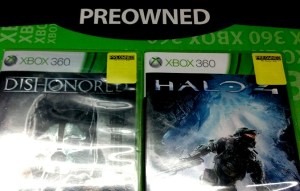
Preowned_GamesB

This is a call, not to the gamers, but to the finance and Justice Ministers in those nations. Whatever plans you have to boost your economy/security, as present indicators go, Microsoft and likely Sony too, are uniting to make it a lot harder for you.

They will come with all kind of presentations, half-baked spins and flat out misrepresentation. The goal is for some of the fat-cat executives, who are already on 6 and 7 figure incomes to get more bonuses. Guess what! They will not pay taxations, and your economy will become harder challenge if you do not act NOW!

So, here are the facts.

Currently game shops buy games and resell them. This is called the sale of pre-owned games. There is nothing illegal; the original purchaser is getting rid of his/her game. Often this does not even go for money, but for credit in the same store. This has been going on for at least a decade. With game shops living on the minimal margins as is, this boosts their shop enough for them to get by a little better. If this falls away, these shops will have to let go of more staff members and as such it will hurt the economy. This is what some would call: ‘the margin of the little guy’.

The last one is almost literal. Most kids, and at times also their parents cannot afford to buy new games all the time, many not even some of the time. A new console game is often between AU$80 – AU$139 (or equivalent). So, to be able to buy their kids a pre-owned game is a way to stop piracy. Personally I think it is a good solution.

This has been a thorn in the eye of some game makers as they imagine that their revenues are down because of this re-selling of games. Simply put, they are slightly nuts (yes, they might lose a little revenue, but nowhere as much as they claim). The overwhelming part CANNOT afford the amounts charged for new games. They will often buy 1-3 new games a year, but that is it. So if they want to play a little more they will have to rely on a few pre-owned games. That market is now more under threat. In addition, the solutions that will come into play, is that these people must buy an ADDITIONAL fee to unlock such a game. Interesting enough, that fee part is likely to be nicely arranged through a non-taxation nation, which means YOUR economy will not gain an inch, it will lose a mile.

There are two parts to this issue. 90% is the simple pre-owned game that is played by one person. The other part consists of games like Mass Effect 3, Call of Duty, Assassins Creed and a few others. They have a specific additional option to play online. Now often, these games have a voucher to freely unlock the multi-player part. This is only for the original buyer. Whoever buys a pre-owned game would need to buy such a seasonal pass. I do not object to that part. I think it is fair that these resources (server connections) are intended for the original buyer. This option often also affects the sport games. Information has been spread all over the gaming sites that indicate that Electronic Arts, Microsoft and likely Sony are now price arranging certain affairs to force people to such fees. This is an arrangement that is so unacceptable that Finance ministers need to step in.

Their intervention is required on two fronts!

1. In your own benefit, if these fees are forced, they are to be arranged, not only on a local level, but these fees are to be TAXATED! That means that Microsoft will start paying tax on every unlock they charge, in addition they will have to mandatory report all numbers in this regard. It might make the price of a game unlock a $3-$5 more expensive, but it is the only way to force these numbers out. These three companies are bleeding people dry and no-one is stepping up to the plate to protect them from this entertainment Cartel, because, simply put, that is pretty much what they are now.

1b. for decades the console industry has been numbered away in the margins whilst this is a multi-billion dollar industry (on a global scale). People get taxed, taxed and taxed again, whilst those big companies are taxed less and less, because it is all virtually done somewhere else. It is time that if new Digital legislation is passed in their favour, then it will not be allowed until the rights and duties on the consumers site is agreed upon, including setting the transaction location at the BUYERS location, not at some vague transaction point. Any minister looking at a deficit, well here is a possible option for more taxable revenue.

2. All the indication point to a certainty that these two companies are now expanding into data collecting on a massive scale. Soon, people will have no longer a private identity, but a digital one at the mercy of Microsoft/Sony, to use as they see fit. I think it is now becoming essential to protect your local business environment that also depends on collected data to prevent 2 companies to freely have access to hundreds of millions of records with no accountability to anyone. I feel that it is important that a digital identity must at any given time be free from all identifying marks before it is collected, not when it is cleaned. In 2011 Sony lost millions of account details including credit card details. The moment these events allow massive data files to come into the hands of cyber criminals, we will experience additional dangers to identity theft, large scale fraud and banking hazards. I regard that legislation in these fields are not ready on a global scale. When this happens it would quickly escalate to a point where the banks will no longer be able to take such damaging hits. What happens then? What happens when people lose all their money because their safety is now in the hands of 2 companies whilst the consumer has almost nothing to control in the matter?

Microsoft and Sony are both playing on hypes and marketing to unleash a sincere danger up on the world. Many will trivialise this, but when these consoles start to link to the social media, an abundance of data will be collected, including all kinds of personal details, including banking details. Should you the reader think it is all a joke, then question why Microsoft announced a growth from 15000 servers to over 200000 servers? This is a cost unlike any company has ever seen, and Microsoft does not do things from the goodness of their hearts (Neither does Sony for that matter). Whatever the business purpose it has, we can be certain that several segments of business all over the world will feel that result. It is important that business or not, it is the individual that has the right to switch these intrusions off without that hurting the option of playing a game.

It must be stated clearly that not all is known yet, however as both companies will release these systems on a global scale within 6 months, it is clear that not doing anything now, will mean that these companies will get free reign soon enough. Issues that must be properly investigated and it must be made clear to the consumer what they are in for.

First Source Gamespot (http://au.gamespot.com/news/xbox-one-has-preowned-fee-report-6408671): “Microsoft today confirmed with Wired that all Xbox One game discs must be installed to the HDD to play and that while installs to other hard drives are allowed, users will need to pay an unspecified fee to do so.

– In this scenario a person cannot give an old game to a family member as a present. This is unacceptable. In the scenario I mention it is clear that only ONE system can access this game (as it should be). Again, I must underline that this is for single player option only. It is fair that the second person has no free access to an online option, options that cost resources and it is not fair to make these providers give away such resources for free.

In addition, as Microsoft calls their system an ‘all in one entertainment system’, whilst only adding a 500Gb drive, with all these installations and downloads, it becomes a debate whether such a system is properly equipped to deal with customer requests without forcing people to download under expensive broadband plans. An issue I raised in a previous blog (Source: https://lawlordtobe.com/2013/05/24/spin-dryers-by-microsoft).

Second Source (source: http://au.gamespot.com/news/german-commission-calls-out-xbox-one-privacy-issues-6408935): “Speaking with news site Spiegel (translated by Games Industry International), Germany’s federal data protection commissioner Peter Schaar likened the next-generation console to a ‘monitoring device.’

– There are several issues involving the privacy of a person. If this is no longer a gaming console, but an all in one entertainment system, then this system is supposed to go to a much larger audience, and as such, monitoring activities of these advanced nature where all our actions are registered on the cloud (as some vaguely report) should raise a lot more questions then they currently are. In this case it was the German magazine Spiegel that had the inside track, yet it seems that many options to evade privacy remain possible. In another article the following quote was placed “a Microsoft representative said that the machine ‘is not always watching or always listening.’” So who decides this? Many people will not know the intricacies of such settings and as such we can paraphrase Nietzsche by “And the data collectors, they collected on”.

I did mention in the very beginning that Electronic Arts is involved. How so? (Source: http://au.gamespot.com/news/ea-killing-online-passes-for-existing-games-6409065). In this article titled: “EA killing Online Passes for existing games” it was stated that EA was no longer charging for online gaming. I do not see this as an act out of the kindness of their hearts. I read this personally as an act to smooth the way for pre-owned charging. EA needs these two consoles and it is playing nice to smooth the way for certain people to charge in the field discussed earlier. That is my personal vision. The quote read: “We heard the feedback from players and decided to do away with Online Pass altogether.” This sounds great, but those online services cost money. Normally a new game gives access; so again, it seems to me that these passes are all about the pre-owners. This is likely to evade a future discussion of double dipping the credit card of this consumer group.

The question remains, what exactly will Sony do? Until the biggest console point in the year (the E3 in America) happens, we will likely stay in the dark. It is however likely that Sony and Microsoft have completed deals; as such an advantage would not be given to any competitor to avoid a massive global shift of the console market. Such an agreement could be seen as evidence to price fixing and a Cartel approach to a consumer market. Since when has that EVER been an acceptable step?

So, now it is time to get personal in this blog.

Australia
To Mr Wayne Swan, our current treasurer and Mr Joe Hockey, our current shadow Treasurer. Australia has a deficit and we are always looking at a solution that allows for the growth of our nation. Should these issues be allowed as they are? We all pay taxation, and as such it is in all our interests that if businesses get hurt in the way they are by charging for pre-owned gaming. No matter what solution Microsoft comes up with in regards to these charges, it is revenue, and as such it should be taxed in Australia. To Mr Prof John McMillan, Australian Information Commissioner (OAIC), how protected are we from this level of data collecting? I would like to raise the case R and Credit Reporting Agency [2011] AICmrCN 12. Specifically Section 18G(a) of the Privacy Act 1988 (Cth). Even though this is not just about credit information. These consoles will hold all kinds of information as well as in many cases Credit Card details. Specifically “(b)  ensure that the file or report is protected, by such security safeguards as are reasonable in the circumstances, against loss, against unauthorised access, use, modification or disclosure”. There is no way that this can there is any reasonable case of security and as such a case could be made that many levels of data collection should be controlled. I would like to add that this goes beyond normal safeguards to allow the case where an option of “Feely handed over details” is to be allowed as a defence by the collecting companies. If we consider that I showed from past events that these details can be obtained, then a clear option to block access to all these data segments should be clearly documented and should initially be switched off on all levels, so that access must be specifically allowed. However, apart from the normal credit card option, these systems should allow for alternative forms of payment (like the prepaid credit vouchers as they are currently sold by Microsoft and Sony).

United Kingdom
As our good old Australian point of historical origin, the UK also embraces the Common Law, and as such the financial parts would fall into the laps of The Rt Hon George Osborne MP and The Rt Hon Ed Balls MP. I reckon with well over a trillion pounds in debt and the additional issues they had with Google and Amazon they might be interested in a group that would not be able to get away with this. Consider that the UK has 400% more people living on an island decently smaller then Australia, the amount of revenue that this affects would be interestingly more than the numbers Australia has to deal with.

In the UK, data privacy falls in the lap of Christopher Graham who is the Information Commissioner. His office keeps eye on many issues, including Data Protection Act 1998 and the Privacy and Electronic Communications Regulations 2003. Both might have issues with these new next gen consoles and the information they could be gathering. How complete has these checks been in regards to the privacy of UK citizens?

Netherlands
Even though the Netherlands is based on Civil law (not common Law), they have their own issues with deficits. In addition, a massive source of revenue in the past from a national icon called the Free Record Shop (which is now bankrupt and also sold games) is no more, so it is even more pressing to keep a balance of affairs as they lost to all kind of on-line traders, many not operating within the Netherlands. Even at only 0.5% the size of Australia, it has the same size of population and many of those play games. They too deal with deficits and several issues where people are just too intensely taxed, whilst loads of online revenue gets away from them. In this case it involves funds that Jeroen Dijsselbloem loses as Finance minister. A man who likes the Dutch treasury coffers to be filled a lot more then they currently are. This is the man we all know as the Chairmen of the Euro group. As such he could even make a case that this is an issue that floats far beyond the Dutch borders.

The issues involving their privacy is set in “Wet bescherming persoons gegevens” (translation: “Law to protect personal details”). The law came in effect on September 1st 2001. Their Article 76 comes close to what we have in our privacy act as states in Section 18G (a). The question that rises again is on protection and security of these facts. We have learned in more than one occasion that the required level of security falls in the range of illusionary, hence again the question becomes, why allow it in the first place. (Did I oversimplify the issue here?)

In the Netherlands these issues seem to fall with the Justice department and as such it falls on the plate of Minister of Security and Justice Ivo Willem Opstelten. Another interesting fact is that his wife is Judge Mariette Opstelten-Dutilh. So these issues might make for an interesting conversation on more than one level. The second reason for adding the Netherlands in this regard is that their minister of Justice is also responsible for the coordination of counter-terrorism policy, which again gives thought to these data collection issues on another dimension. If these levels of collection enable an easier access to identity theft, then each of these members would need to take a stronger look at a danger they are trying to prevent on one side, and ignore them almost completely on the other side.

As mentioned earlier in this article. What Microsoft claims on their stated security measures comes from their ‘marketing and sales’ divisions. Their stated interest is never what we need it to be, do these politicians realise that?

Sweden
Sweden is one of the most liberal nations in the world, with a quality of life that is second to none. Civil law gets a new level of comprehension as you experience the politeness of the Swedish police officer (beyond the mass riot times we saw recently). What is interesting there is that it is regarded as one of the Nanny states (US expression), yet when we consider the Swedish Minister of Finance, Mr Anders Borg, we see a slightly different view. He is seen as the man who has been slowly dismantling the social democratic welfare state, giving it a more business like character. I think it is fair that he takes a look at this as well. Like the other nations, Sweden is dealing with unemployment rates. If we see business going the way it is on-line, whatever they have must be protected. In addition, Sweden like the UK has a sizeable segment on video games. Sweden has produced its share of games and is after the UK one of the larger producers in Europe. They have over 2 dozen developers, in a nation with a population less than half of either the Netherlands or Australia. So keeping that industry safe is in their interest, and personally, with the unacceptable steps currently under review, that industry could feel pressure.

When it comes to data matters you can see why I mentioned that if we take the previous mentioned issues. For Sweden there is the following statement in regards to data matters “Generally, it is prohibited to transfer personal data that are being processed to a country outside the EU/EEA that does not have an adequate level of protection for personal data, unless the data subject has explicitly consented to the transfer.” It is the ‘unless’ part that becomes interesting. So in these nations we have seen broadly similar, yet specifically different issues that are affected with personal data.

The Swedish data inspection board is run by Mr Hans-Olof Lindblom, Director General. Their public office takes into account the Personal Data Act (1998), the Data Act (1973) and the Credit Information Act (1973). It is important to note that these acts are at least 15 years old. There is decent question rising on technological issues that were not even an option until 5 years ago. So it stands to reason that there are concerns on issues when it involves security and cloud. Some parties have stated long before these consoles became an issue that the expressions ‘data cloud’ and ‘firm data security’ should not be mentioned in the same sentence.

In the end, this is not about just a pre-owned game. We seem to be embracing new hypes and new technologies without thinking through the danger we burden ourselves with. These new systems are about to set new levels of digital rights and new forms of data collection, where we become the marketing product on several levels. In addition, there is more and more moving towards some cloud we know not of how secure. In an age where identity theft can have a debilitating factor on us for a long time, serious questions must be asked to several companies and a non-marketing answer must be coming our way publicly, long in advance of any official hardware release. With their release dates now less than 26 weeks away, several parties on levels of government, commerce and Justice should be asking questions.

Perhaps they are, but apart from Microsoft Marketing we hear much spin and decidedly little final details. And what will Sony do?

Leave a comment

Filed under Finance, Gaming, IT, Law, Media, Politics

The Data Intelligence bill

GCHQ_StampBThe events that occurred in Woolwich have sparked more than just one debate. The new debate is involving the additional powers that Home Secretary May wants to hand to the intelligence branch. It involves a data bill that was vetoed by the Deputy Prime Minister Nick Clegg. He stated that it was too much of an invasion of privacy.

Is he correct?

Initially I would side with that part. Yet, you cannot have it both ways. There is a plain and simple need to keep England’s citizens safe from radicalised attacks. The issue of Home grown terrorism had been an issue going back to Sir Jonathan Evans reign of MI-5. He was more than just a little concerned with outside influences on the British way of life. This now falls firmly on the shoulders of both Andrew Parker, who is well aware of the issues as well as the needed response and Sir Iain Robert Lobban of GCHQ. As this is Signal intelligence and as such it falls in his lap as the data would be needed for MI-5, MI-6 and some parts of local law enforcements.

I would think that part of this bill will start with Lord Carlile. His involvement in this goes back to the Terrorism Act of 2000. Current issues are ‘tainted’ by two reports and as such they both are important. First there is the National council of Civil Liberties that drafted a response to the definition of terrorism, which seems to have been the work of Gareth Crossman and Jago Russel. You should take a look at it (source: http://www.liberty-human-rights.org.uk/pdfs/policy06/response-to-carlile-review-of-terrorism-definition.pdf). It is an interesting work, and important to read is how they see this all. Part of the weakness is the approach on page 3 where they state: “It is vital that the definition of ‘terrorism’ is drawn as tightly as possible“. It is a decent stance to have, yet in the light of fear against home grown/lone wolf terrorism it is actually counterproductive. Terrorism is a shifty acre of quicksand and the strict approach is not only going to fail, it will get the people involved stopping this drowned. Not a good thing me thinks!

I feel uncertain to the point 6 they make on page 5. Yes, they do state that it is outside of the scope of the document, and as such they only raise the comments made that Terrorism should be dealt with under Criminal law. Here is where I might be the dissenting voice. The law should cover all, I do believe in that, however, what part of law? We are dealing with a group that does not seem to be categorised as such. These people are not transgressing in a way where we approach a normal person, or even the average person. Whilst we approach these transgressors in one way or another, even when if possible their defence starts going into the Mental Health act we will see a case where the court is drawn into years of litigation and dealing with a case that as such should be seen as a non-combatant involved in hostile military actions against civilians with no allegiance to any nation and as such it becomes a mess where each case locks down the justice system more and more. Consider the American situation (Foreign Intelligence Surveillance act). This comes from a special report by their Justice department stated in June 2005.

This allowed the use of FISA information in a criminal case provided that the ‘primary purpose’ of the FISA surveillance or search was to collect foreign intelligence information rather than to conduct a criminal investigation or prosecution. The seminal court decision applying this standard to information collected in intelligence cases was issued in 1980. See United States v. Truong Dinh Hung, 629 F.2d 908 (4th Cir. 1980). In this case, the Fourth Circuit Court of Appeals ruled the government did not have to obtain a criminal warrant when ‘the object of the search or the surveillance is a foreign power, its agents or collaborators,’ and ‘the surveillance is conducted primarily for foreign intelligence purposes.’ Id. at 915. However, the court ruled that the government’s primary purpose in conducting an intelligence investigation could be called into question when prosecutors had begun to assemble a prosecution and had led or taken on a central role in the investigation.

This shows that the narrowness of the scope would be the obstacle we should be trying to prevent. The issue is NOT our privacy at that point; it is all about them having access to go after the right people. This requires them to blanket us with collection of data. Even though the data is all collected, it will turn out that 99.9% might never be accessed. Having it is however essential for their success of stopping terrorist attacks. So when the Sky News UK reporter Stephen Douglas mentioned “are they playing politics with fear” then he is in my humble opinion incorrect. This data bill has been needed for a long time. It can even be safely speculated that MI-5 could have intervened with the Kenyan involved in the Woolwich murder at an earlier stage as more flags would have been raised. Their interview with him would have led to other questions, confirmations of danger. That seems to not have happened at this stage.

So from the civil liberty document we move to document cm7058 from June 2007 which holds “The Government Reply to the Report by Lord Carlile of Berriew Q.C. Independent Reviewer of Terrorism Legislation The Definition of Terrorism“. (Source: http://www.official-documents.gov.uk/document/cm70/7058/7058.pdf). My issue is with point 5 on page 5. Idiosyncratic terrorism imitators should generally be dealt with under non-terrorism criminal law. This is the point that shows the need of the data bill. Especially when we consider Lone wolf or Home grown terrorists there will be the issue whether the person was a mental health wannabe, or a more intelligent individual being allowed a second go at harming groups of people, after civil rights protected him the first time.

So even if we want to give strength to both Nick Clegg and the National council of Civil Liberties. They are there speaking out to protect your rights. Yet, in that process, they are giving strength and freedom to terrorist attacks like the one in Woolwich (not intentionally). This issue is like a seesaw. These two viewpoints are utterly opposing and as we give power to one, we remove it from the other. The interesting part is that the information we surrender will not harm us unless we support terrorism. Should that not convince you then please remember that you have already given away your privacy to most market research and financial institution data centres. They only want your money, or in a product driven way bank you. The intelligence community wants to keep you safe. In my mind, there is no debate. The data bill is likely to come and should be there, if only to prevent a second Woolwich.

Leave a comment

Filed under Law, Media, Politics

You might soon be sold by the banks!

I have heard often, in many situations the ‘that is not how it works’ was stated. How it was all in my mind. No, this morning issues were not just confirmed, I reckon that things are even worse than you think they are.

You see, for the most I do not trust ‘Financial Institutions’. They came in a time when there was an abundance of all, when people, as they were turned away from banks, they were willing to take a ‘chance’. For one part, this is Capitalism at its best! (Or at least that is how it was in the beginning.) Now they have grown, more margins more abilities and as we saw them grow in many fields they gained perspectives the banks in their conservatives states did not.

So, whenever I can, I stay away from financial institution. The main reason, they do not have the muzzle to keep them in place when needed. You think this is strange? Well, read on and prepare for the rudest awakening in a long time.

In the Netherlands there is a company called Equens. Today they temporary abstained from a plan to sell on their financial information. Equens is a payment provider. It processes pass (credit cards, bank cards and so on) transactions. They do so all over Europe and they are not the smallest. With 15 BILLION transactions they own well over 10% of the market. The plan is indeed decently brilliant, but dangerous as hell. They almost pulled in the banks to take their transaction data to market. It would have been quite the revenue, but it is the most dangerous one you will ever personally experience, and the issue with ‘temporary’ means it remains a danger. The initial report on this matter drew too much criticism, even though RABO and SNS Nationalised were interested, they crawled back when certain legal issues rose. It had been raised by the Dutch consumer society and the Dutch political party Democrats 66. I feel certain that this delay is a temporary one, as the issues involving legalities might be resolved over time. This is exactly the issue with financial institutions. Banks have power, but as such they were limited in freedom of movement (as it should be). Their commercial corporate brother named ‘Financial institution’ does not have these strict limits, which gives many of us the dangers currently at play.

Even so, Equens did make the promise that the sold information could not be tracked to any individual. This is where they are (intentionally) wrong in my mind.

You see, this goes beyond their system (and that is how they ‘focussed’ their view. Let me show you how. You buy an item at your usual store. That store processes your payment. You remain anonymous. Yet, your usual store has given you a discount/loyalty pass. NOW there is a connection between the bank card and your personality. So, as Equens data is sold on and on and on, more information can be added as the shop cash register (and therefor their data) has your bank pass and your personal details in the form of a loyalty card. Two numbers that could be connected with the greatest of ease and these cash registers have been collecting numbers for years and years. Now the link of two numbers separates their claim of anonymity and total financial and personal classification.

So look at those facts, now check your wallet and look at those cards you have. Are any of them for the Cinema? A book store? A game store? A fashion store? Do you get mail to your home from any of them? You’ll likely have at least one, and with every addition, you will get classified more and quicker. Soon you are nothing more than a product number. This is the ultimate marketing move! Availability of products, per person, per location. This is not such a future event; this is about to happen to us all.

I reckon that whatever happens will happen fast, and not just in the EU. If Equens is so willing to make this leap with only +10% market share, then who are the bigger players? This is a mega million market and if the Netherlands with 19 million people are so desired, then what about the UK with 68 million? Consider the meeting Equens had and a document they presented in June 2011 (source: http://www.paymentscouncil.org.uk/files/payments_council/npp2011_-_consultation_docs/22.06.11_equens_se.pdf).

The statements like: “However, the single largest criticism of the NPP is that it lacks an overarching business vision on which to drive a coherent strategy that delivers the various elements of the Plan.

So, the National Payment Plan was even more in need of a business vision? To consider those consequences we would need to look at Q42 of that document on page 14. Single Euro Payments Area (SEPA) is under scrutiny where it was stated that ”The adoption of SEPA standards and formats should be introduced as quickly as possible. Whilst this will impose a cost on Corporate UK, the benefits of these new standards will take some time to reach fruition if standards migration is done on a phased basis.” So what adoptions exactly, and as such, which ones are less documented but not prohibited? From an IT point of view ‘formats’ reads as changes to interact data on more levels more easily. Why? Costs on Corporate UK! When have they EVER been willing to accept costs without tenfold falling back into their laps? It is simple basic capitalism. I have nothing against it, yet the part where most others get sold is not in those papers, yet it is not prohibited either. Welcome to the open world of financial institutions where we are about to become their product. Even though Equens is now visible, I wonder where a big boy like Schlumberger (Axalto) is at this point, who has a sizeable share.

The NOS reported on their website (www.nos.nl) today that these moves are for now of the table. Quoted was “Aanleiding voor dit besluit is de maatschappelijke onrust die is ontstaan.” (translation: ‘reason for this decision is the social unease that rose‘). I think that they have business concerns which will not allow them to endanger their 10% market at present. Yet, if they thought of it, then so did the other players and as such the next step is only a matter of time, and I reckon that we do not have that much time left before we are part of a sold system.

From there our world of what we need will be transformed into our world as THEY see we need. A small change will become a world of difference for us all.

Leave a comment

Filed under Finance, IT, Law, Media, Politics

Spin dryers by Microsoft

Some might have heard the news and some might not. Microsoft will be launching their new console by the end of this year. Sony will come with one too, but about that more at a later time.

So, I did watch the presentation, and it is not unlike an American based company to take on so much more than they are likely to chew when they go up against a population of gamers. This has been proven in several occasions and as such this moment was no different.

The new system is called Xbox One (sounds like a Star Wars episode copy).

This system is supposed to be the new revelations that evangelical gamers will pray too. Yet, this is no longer a gaming console. They now call it an all in one entertainment system.

It is a fair step to extend boundaries. Any business minded person will do that whenever possible. Yet, at this time, with the current available information, many wonder why things were not thought through on many levels is slightly baffling.

Even though Microsoft is releasing information on many planes, I would be in remiss if I did not mention that Gamespot (www.gamespot.com) is a massive centre player when it comes to console information, so they are an important source of information for all readers.

There is one part where Microsoft is right, and it is only fair I mention it. Microsoft’s Don Mattrick stated “If you’re backwards compatible, you’re really backwards.” I grant him that one. Even if I was opposed in the past, in combination with statements made from those who made the ‘promise’ at that point (a promise both Microsoft and Sony royally broke). Where we saw the Xbox 360 and PlayStation 3 to be required to be backwards compatible to PlayStation 2 and Xbox, is just not realistic to expect at this time. So, as such, I will agree on that, even if several gamers might not agree with me.

My first issue is with the hardware that is central to the new Xbox One. If this is supposed to be an all in one entertainment solution, always connected, always cloud ready for downloading of Movies, TV, Games and so on, then whomever lacked the synapses to decide on a 500 Gb drive had clearly been watching a little too many Xbox-Files (like the TV series from the 90’s with Box Mulder and Data Scully). Then 500 Gb would then have been mucho alien. Now, the difference between 500 Gb and 1 Tb is about $20, so when they state it cannot be upgraded, in a time when we are all overloaded with data, we should start asking serious questions. Their statement that we can add a USB3 drive just does not hold water. Consider that they called it an all-in-one entertainment system; consider that a Blue-Ray can contain up to 50 Gb and consider that the operating system and temporary files for this system takes up some space too. Then this system has space for 9 movies in high res (worst case scenario). Even less if we consider the need for our music on MP3, out private photo collection(s) and a few games, then this drive will be choc-a-block stuffed full really quickly.

In opposition, as a start, I might not object to a 500 Gb start. Yet, the non-upgrade limit means that we will need extra external drives; so in addition needing power, needing cables and one young player accidently yanking the wrong cable might make things go wrong fast. This is also the first of many points where your internet data plan will cut in (or cut out might be a better phrase). You see, data plans cost money, and considering the plans some are on now, then the added changes would also mean you might on average pay $30 a month extra to keep being online. So that goes towards $400 in extra costs each year (not including the annual fee for Xbox live). Mind you, this is the INCREASE, not the bare cost. In some cases some would go from $69 to $99 a month. That should go over well with the millions of students all over the globe who are already in dire need just to make ends meet. If you think that this is an exaggeration. Think again. The system that now boasts on 3D gaming possibilities will need data to get this all rolling out. So either you accept time for a dozen DVD’s to install, or you’ll have to get to the cloud. In addition, they might offer the ‘normal’ version on 1-2 DVD’s and the rest needs downloading. This is a bigger deal then you realise. For example, consider the option of starting World of Warcraft on the PC as a new gamer. It is really nice that they offer it for free to new gamers to try. I am honest; it is a really nice gesture. Yet the initial download is 22 Gb. For some that is almost half their monthly download allowance. The second part of their entertainment boast is that they will support 4K. 4K is a resolution for TV meaning 4000 pixels per line. In all fairness there was a mention that this is for photos and movies only, not for games, yet, the 4K trailer of Spiderman (trailer, not movie) was said to need almost 500 Gb. That much for a 3 minute trailer? Is anyone waking up considering the ridiculous limitation of a 500 Gb hard drive?

Realistically, we are not ready for 4K resolution, as this goes beyond the ability of Blu-Ray, which of course makes me wonder why the 4K mention was such an effort? 3D is more and more added to the consumer’s home, yet at this point, we see an unbalanced situation between the offered hypes and the offered hardware. Not a good thing Microsoft!

So let us take a gander in the second division of MS issues (This applies to Sony too by the way). This new-gaming wave seems to cross several borders. What is advertised as new gaming, what others call entertainment, what few see and should see as the end of privacy! Microsoft is now offering a solution that is always on, always connected and remembering and learning from you all the time. Most laws are not ready.

The one thing that we hold dear, that we protect, we seem to give away when playing a game.

The new systems are all about data collecting. They call it ‘trending’, it is in reality a ‘personalised’ form of mass-advertisement. The abundance of hype created whilst stating interaction through the cloud is in fact nothing less than a new form of data collection as Skype, TV, movies and your choice of gaming is at all times stored and saved on the cloud. A system that interacts as per now on multiple levels, unhindered by privacy laws as we surrender to that extra little ‘benefit’ where we forget that others get access too.

Their on-line system is now getting grown from the initial 15000 servers now that Xbox 360 uses, to 300,000 servers from the moment the next Xbox is launched. It is a 2,000% growth in data collection and over 200,000% storage capacity. If foundations of business are set to return-on-investment, then ask yourself why a gaming system requires that level of growth. Intellectual property that is no longer bought, but rented on a temporary basis as the cloud keeps what we buy, yet we will pay more per hour and hand over our identity in the process.

Most laws are not ready, with these new systems starting to get pushed out as per this year. Consider this; the presentation had a quote in relation to the collected information “Game developers can take advantage of our data centres“, is anyone else getting access?

As Justice continues a losing battle against cybercrime, corporate entertainment is about to hand the keys over to a group that can really use all that input. Should you consider that this would not happen, then remember how Sony lost the security of a few million accounts which included credit card information, affecting many in Australia. When this level of collection happens, when consumers connect devices, then consider the added interest cybercrime will get as many will want these amounts of data for several reasons and most laws are not ready.

In less than 6 months we will see a new age where many willingly, unaware of the consequences will give out their details, their personality and their identity to a data cloud where we can all be statistically weighted. The haves and have nots will see their private lives classified into moments of targeting, some of it likely questionable. The laws are not ready, the justice system is not ready and law enforcement is not even close to ready.

So we are faced with the cloud, space and privacy. Consider that the new console was announced to be cheaper than the 360 initially was. Consider that Microsoft is adding hundreds of thousands of servers. Then consider that thy need to make a profit. So how will this happen? More important what extra costs will you the consumer get when their marketing will start making statements like the one we heard when the 360 was about to be launched “Each console has a variety of games. Most games released on the original Xbox are backwards compatible and can be played directly on its successor, Xbox 360” This did not pan out so well. Sony was just as bad, if not worse as millions signed up for the PlayStation 3, selling (or trading in) their PlayStation 2, only to learn that this backward compatibility was not ever working correctly.

Now, as stated earlier, the new consoles will NOT be backward compatible, yet Marketing is making all kinds of statements again. The Telegraph reported in (Source: http://www.telegraph.co.uk/technology/video-games/Xbox/10075540/Xbox-One-gamer-backlash-over-fee-for-pre-owned-titles.html) that gamers will see a fee coming their way when they are playing pre-owned titles. How fun is that? I admit, I am not yet aware what Sony does, yet this could tip the scales in a major way. I all honesty Microsoft Marketing did state that there will be pre-owned possibilities, yet they have not officially stated how this EXACTLY will play out, so we await clarity by Microsoft (be really really patient)

Personally I am on the fence in this regard. I never liked pre-owned games. And as such it never really hit me. When we look at off line gaming, my thoughts are that this is none of Microsoft’s business. If I give a game I am done with to a niece, a nephew, or even the neighbours so their kids can play a game without having to pay for it, then so what? I do agree with Microsoft that the one who buys the game gets access to on-line gaming. If someone else wants to go on-line, then they should by an access pass for the on-line part. They reserved the gaming server for me the buyer, the next person will need to pay for that service. So off line gaming, patching and so on, they should stay away from charging. That is my personal view.

So here we are, Microsoft marketing spinning their party lines fast enough to get your clothes dry, it does however gives more and more pause to the quality of gaming we have to look forward to. This is how I currently see the gamers market go backwards. A business approach to a consumer world, pushing through all kinds of idea’s the youthful player never signed up for.

So Microsoft calls it an entertainment system. Entertainment? For who?

2 Comments

Filed under Gaming, IT, Law, Media