Tag Archives: Channel 9

Realisation

This happens, at times we realise something AFTER the fact and for some reason not before. The BBC gives us (at https://www.bbc.com/news/business-62158936) ‘Netflix and Microsoft team up for cheaper plan with adverts’, apart from the setting that they decided to trust Microsoft on this, the setting of movies or TV series with advertisements is called TV, The Dutch have channels one, two and three. The Brits have the same but they call it BBC One, Two and oh, four is ITV. And so every nation has its own version of TV, so why would we want Netflix when we can get the others for free? It comes with “It lost 200,000 subscribers between January and March, compared to the 2.5 million analysts had been expecting the firm to add in the period. Netflix also now expects to lose a further two million subscribers between April and June.” And this is a surprise? How? The covid era ended, people are expected to be back in the offices and do actual work. And those who decided to quit their jobs to be at home for whatever reason will soon be in a space where they CANNOT afford Netflix. Instead of offering an 8 hour segment (when they aren’t working) for less, and as such create 3-6 timezones to capture the bandwidth pressures, they decided to compete with local TV stations at a price, whilst local TV is free. I reckon (and that I merely my view) that the people will stop subscription TV, especially as some favourite series are spread over several providers. And these people will return to Channel 7, Channel 9, ITV, RTL+, Sjuan, TMC, TFX and the list goes on for a while. I reckon that they will not be too happy with Netflix and they will demand local based sanctions against Netflix. In addition, some will demand that the bandwidth usage of Netflix users will be capped or even surcharged to avoid congestion on several levels. It is not whether it happens, it will soon be on WHEN it happens. Especially when the Amazon and Google group could stick it to Microsoft, they will be enthusiastically motivated to do just that. 

Do I care?
Not really, I sometimes get a month subscription to load up on missed things and I have to as we all have budgets. I reckon that the UK is facing a much harder time. When they get to decide on two of the items (Food, Rent and heating) Netflix will be the first to go, and after that cheaper internet deals. The cost of living bites everywhere and Netflix should have seen this coming. I think they did not, because in all my dealings with Americans, they always avoided any discussion on market saturation, it was always the fault of the bad salesperson. This time around there is no escaping it, and I saw this setting in 2020 when I was clear about saturation, and they were all in the stage of ‘We never heard that’ but the stage was clear and Covid ended as such the good times were gone and now Netflix with their desperate act decided to rely on Microsoft. Whether these two are in bed because of the Netflix game streaming is unknown to me, but it would not surprise me. And that too will backfire on them when Tencent comes out to play. Tencent could muscle in on both Amazon Luna and Google Stadia as well if these two did not adjust their way of thinking. 

These players are all realising that there is one population and they can no longer afford EVERYTHING. These people have to make choices, some of them hard and depending on what TV brings instead of Netflix comes with $10 a month savings, for a lot of people it will be a simple choice. It is this realisation that governs the global population. If EU inflation is up by 8.6% (last month), how long until people have to select what food they can afford? This is not out of consideration at present, the UK seems to be going back to the daily fish and chips. In the Netherlands some vegetables went up between 29% and 34%, that is HUGE! It is in this setting that Netflix makes a move the way they did and at some point people will realise that they get the same by watching TV, which does not cost them $10 a month, and that was the only reason keeping them on Netflix. Realisation is a dangerous and ugly thing. Yes, we can continue to watch Netflix, but how long until those prices go up? Which will drive a lot of people towards their normal local TV stations again, some already did. 

1 Comment

Filed under Finance, IT, movies

When perception is the brand

Yes, this sounds confusing, but it actually is not. It started with a simple article on the BBC, the article ‘Chloe Khan and Jodie Marsh rapped by watchdog’ caught me by surprise. The idea was given to me “The Advertising Standards Authority has named and shamed four influencers it said repeatedly failed to disclose when their Instagram posts were actually advertisements”, now I do not are about influencers, I tend to stay away from them and I do not use instagram. But the people that do follow these influencer tend to do so for very specific reasons. It comes to blows (to coin a phrase) when we compare this to Twitter. So when we see these two tweets, we do see the ‘promoted’ mention at the VERY bottom and these pages go towards photo’s and text surrounded by massive amounts of advertisement, some of these providers will try to get one photo per page with a next mention and the next page will show you even more advertisements. So is this not deceptive? What is the setting of the Advertising Standards Authority at that point? Is the creation of what I call ‘click bitches’ not deceptive? This has been going on for years, the in game advertisements on Android, and iOS devices have all kinds of deceptions, what have they achieved there? 

And now we get to the first part, when is perception the brand. What is the perception? Are the tweets safe? Is the word ‘promoted’ enough? When we look at “Promoted Tweets are ideal when you want to increase your Twitter audience reach and engagement. When you have a big announcement, a new blog post, a marketing campaign, or an upcoming event you’d like to reach more people than you would organically, Promoted Tweets is the better strategy. This is because your Promoted Tweets will appear in users’ live feeds and search results” we see and accept that, yet when we see promotion emphasised by large breasts, is it advertisement, or deceptive conduct? Some people might not be able to tell the difference, and I believe that it becomes more and more about the ambiguity of perception. So, as such is the ‘shaming of people like Chloe Khan and Jodie Marsh warranted? As the Advertising Standards Authority is failing people, millions of people on Twitter, on iOS and Android games, is going after smaller players not merely hypocritical? As such, is the advertisement of 23 camping pictures deceptive? Perhaps the overload of advertisements is merely a side effect? As such, does the inability to act against Twitter, Facebook and Mobiles games not merely make the act against the influencers slightly overkill? And all this is before we take notice of “The ASA was responding to the #filterdrop campaign that called for it to be compulsory for influencers to state when they use a beauty filter to promote skincare or cosmetics”, this is what magazines have been doing for years, where was the Advertising Standards Authority then? 

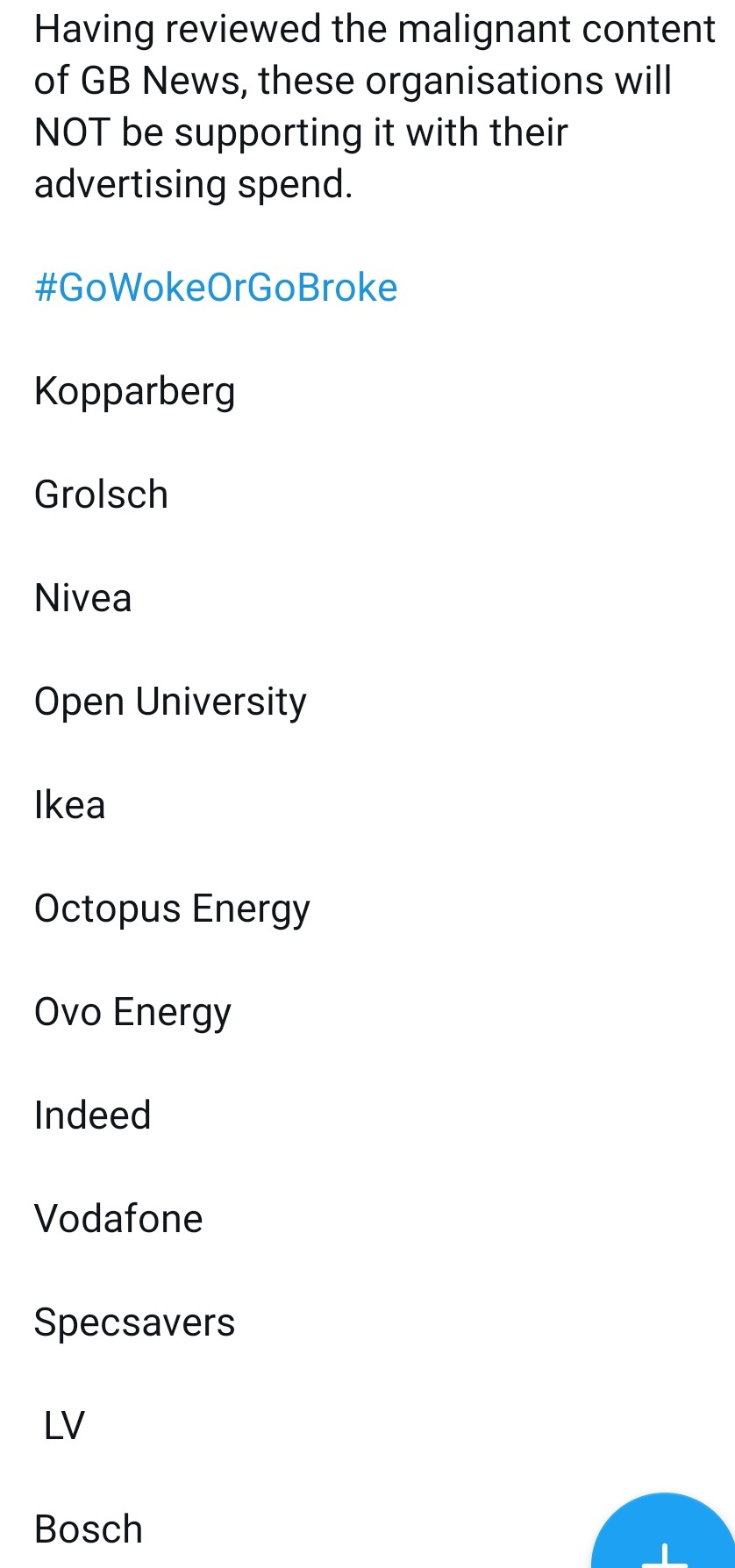
It all takes another turn when we take a look at the freedom of speech, this is shown in the last tweet. 

First of all, the person gives the names and they are seemingly correct, but it is “Given that anti-rationality, anti civil rights (anti-woke) channel GB News is losing major advertisers already, due to the crap they are peddling, suggest some alternative advertisers” that makes me wonder. You see filtered information is handed to us by the bulk of the news channels. The evasion of news regarding Houthi missile and drone attacks against Saudi civilian targets is the most visible one, but not the only one. If the left filters to the left, is the right not allowed to filter to the right? And so far I saw three GB news articles on Youtube there was a view I might not agree with, but should they be attacked as such? So when we are given “I’m excited to tackle difficult subjects with voices you haven’t heard before”, so what is the problem here? And GB News matters, you see perception comes in two sizes, the perception we see and detect and the one that sneaks up unnoticed, but they are both filter forms that aid the perception that the transmitter wants to give us, so where these advertisers leaving through peer pressure, or is there a case of actual evidence? Consider that Andrew Neil has been working as a journalist since 1973, meaning he optionally has more experience than the sum of some news channel cast members. In addition, when we see “due to the crap they are peddling”, do you think that other breakfast TV shows are not peddling crap? Is one side better than the other? No, I do not think so, but there is a chance that if both exist I might get a decent balanced central view. In the end this is not merely about the news, you see if it was about the news, people would simply not watch it and if no one watches it the channel dies, but there is a larger need, the need for advertisers and there is the crux, saturation demands that advertisers choose where they are and they are wherever the masses are, the Express gives us “Despite the complaints from some viewers regarding the sound, the show pulled in thousands of viewers as according to BARB data, 164,500 people tuned in to watch between 7pm and 11pm on Sunday night”, which accompanies ‘Launch show beats BBC and Sky despite ‘technical difficulties’’ and that would scare any news channel, the fact that there might be a market for GB News and that is where these advertisers are soon to be, where do I get the best reach? It is a business decision and that decision is what other media fear, Fox grew to greatness and the news channels are scared of that, and whilst they TOO adhere to shareholders, stake holders and advertisers. The bulk of the advertisers can only afford one place, not all places and that is the fear of filtered information. The news is too much on shareholders and stake holders, all whilst the advertisers play (at times) a dubious role in this setup. Am I a fan of GB News? I do not know, I have not been able to make up my mind yet. I get it, a 24 hour channel needs it human interest stories, but when I see news of a cremated cat, I wonder who will cover the Yemen events. Consider that the BBC gave us on the 8th of March “The UN says the war has caused created the world’s worst humanitarian crisis and caused an estimated 233,000 deaths”, yet the UN gave us on December 1st 2020 “UN humanitarian office puts Yemen war dead at 233,000”, so do you think that in 4 months in slaughterhouse Yemen ZERO deaths occurred over a period of 4 months, or is someone not doing their job? And when we realise the answer to that, do you really think I give a toss on the premise of a cremated cat from either GB News, Fox News, CNN, BBC, Channel 7, Channel 9, Sky News, ITV, CNN, Euronews, or CNBC? You have got to be joking. Does it make GB News bad, lousy or useless? No, but they are slightly to the right and the left does not tolerate any channel on that side of the aisle, they thought that Fox News was enough, but if Andrew Neil gets his way, the European channels will get nervous soon enough and no matter what the advertisers do, when someone bails ship others will try to get a slightly sweeter deal, when that comes out GB News will get its share of advertisers, I have no doubt, what remains is the perception created and it takes a little more time to see how GB News will fare and how the people will perceive it.

Leave a comment

Filed under Finance, Media, Politics

The Australian Catastrophic Colliding Canine

I tend to keep my eyes on Europe, mainly because what impacts the UK today will have an impact on Australia a week later; in addition to that, what happens in Japan today when it comes to consumer electronics and mobile events will get to Australia 3-5 years later. In that respect having a larger view on matters is essential to keep an eye on what could become an impact tomorrow.

Yesterday was different, with ‘Regulation needed to save Australian journalism from Facebook and Google, watchdog says‘ we see the impact for Australia now and to be honest, I can’t stop laughing at present. The article (at https://www.theguardian.com/media/2019/feb/11/regulation-needed-to-curb-facebook-and-google-competition-watchdog-says)

When I read: “Rod Sims, said the digital platforms inquiry, which delivered its preliminary report in December, reveals that the market power enjoyed by the digital behemoths is weakening Australian media“, the giggles increase. Especially when we consider ‘the platforms are not creating any original, quality Australian news’, well we could consider that the Australian media is for the most not doing that either. For the most Australian media is weakening Australian media plain and simple. To name but a one issue, October 2012, I alerted the media to an issue impacting 30 million gamers within the commonwealth. I directly alerted Channel 7, Channel 9 and the Sydney Morning Herald; the all ignored it to the largest degree. There were clear screenshots on how the impact was given, yet the left it on the left of what was important. A change by Sony for their gaming community 3 weeks before the PS4 was released, they all (except for the Australian Guardian) ignored it for the most, and perhaps it was not news? What they (as I personally see it) intentionally ignored is that the Sony Terms of Service is a legally binding contract, the mention of a memo is merely a piece of paper that could be ignored the very next directors meeting. The press needed advertisement dollars and Sony is high on that list of needs, PlayStation 4 was big bucks, plain and simple. In addition there were debatable reviews of Microsoft for the period of two years and the least said about Apple the better, as I see it Australian Media is its own worst enemy. It is my personally view to size up global media as a collection of prostitutes with a priority towards the shareholders, the stake holders and the advertisers, the audience comes in 4th position at best. So when I see: “However, while taking the lion’s share of advertising revenue, the platforms are not creating any original, quality Australian news“, we need to wonder where Australian quality news is found. I will agree that this is found at SBS and ABC, but they are the two exceptions to all this.

When the British Daily Mail gives us on the 9th of February “Respected Channel 7 news reporter Emily Angwin (pictured) was said to be furious at a number of work emails questioning the integrity of the newsroom in Melbourne” is anyone actually surprised? Is it true? We cannot tell because in many ways most of the Australian media is no longer that reliable. And from my vantage point it becomes worse when we go to https://au.news.yahoo.com/. Here we see above the fold ‘Hero pitbull breaks out of home to find help for owner during gas leak‘, ‘Restaurant blames waitress for ‘incredibly racist’ receipt‘, and ‘‘Whoah!’ Man’s breath test returns ‘biologically impossible’ result‘. This is the kind of emotional reporting that gives news a bad name. Compare that to abc.net.au where we see: ‘Global drug trafficking operation run out of Villawood detention centre, phone taps reveal‘, ‘Missing persons expert slams investigation of young mother’s suspected homicide‘, as well as ‘Why the AWU wants to question Michaelia Cash in court over union raids‘. So one is clearly about news, the other is about creating emotional events. I let you decide which is which, and as we take notice of: “Given all this, it is also vital that media businesses are not disadvantaged through the exercise of market power or other mechanisms that make it difficult for them to compete on their merits” We see that the there is another case in dispute. The dispute is ‘media businesses‘ versus ‘journalism‘, so I hope that the ACCC realises that not only are they not the same, they are at present mere dimensions apart.

And questions need to be asked at the Channel 9 address as well. We can agree that the headlines are better than those of Channel 7 when we see: ‘Exclusive: Vampire Killer Tracey Wigginton’s disturbing new posts‘, ‘Man found with gunshot wound to his stomach in Melbourne’s north-west‘, as well as ‘Snorkeller found dead on sea floor off Mornington Peninsula‘, yet there too we have issues as every news item gives us headers and banners of advertisement. News is news and the main players have resorted to self-indulgence of advertising, reloading at every page. The journalism is merely second best at best.

It becomes a different puppy when we look at the mention “The financial viability of these businesses is also not assured as demonstrated by BuzzFeed and Vice recently announcing redundancies in Australia, as well as worldwide“, you see from my point of visibility, we see the Wikipage part (for mere illustration) where the visible information is: “Originally known for online quizzes, “listicles”, and pop culture articles, the company has grown into a global media and technology company, providing coverage on a variety of topics including politics, DIY, animals, and business.” Now, I have seen those buzzfeeds on my Facebook page and I decided not to give them any consideration (as a news source). Even as we now see (I was honestly not aware) “In late 2011, Buzzfeed hired Ben Smith of Politico as editor-in-chief, to expand the site into serious journalism, long-form journalism, and reportage.” We can accept and appreciate that Buzzfeed was taking a serious gander into journalism, yet when people are not aware (or another part of them has created more awareness), we get the impact of consideration versus awareness and non-awareness loses clicks, it is that simple, and the same applies for Australian sources. For the most, the only Australian sources I give consideration to are: ABC, SBS, the Guardian (Australian edition) and that is pretty much it; the rest is too often a waste of time. When we are serious about news, we go to the places where they offer it, not where they claim to offer it. That is how I personally see it and I use the Guardian as a source (as it is free) and I neglect the Times (most often) as I am not a paid subscriber and I feel it is money not greatly spend when I am, like most others on a budget, as such it is not money I have available to do that. It is an important factor as I am merely one of many that need to get by on a budget, that too impacts the news and the ACCC is a little ignorant on that part as well.

They might want to strike out at Google and Facebook. Yet Google News gives us ALL the headlines, from almost every source and that links to the local news articles. So when we see “The preliminary report recommended a powerful new authority to oversee the commercial activities of Google and Facebook” My question becomes ‘How is that going to make a difference?‘ In the end this is not about journalism, but about media and they are not the same, if the ACCC wants to make an actual impact, looking at the quality of journalism we will see that Australia will be left with the Guardian, ABC and SBS. When we were introduced to: “The Turnbull government has announced a funding freeze for the ABC but a boost for the Special Broadcasting Service“, whilst the boost is a mere $14.6 million over two years, when we realise that this all reads like a joke, how useless is the ACCC in all this and whilst we see the decimated pool of journalists, what are they doing (apart from wasting our time on something that the seemingly see as a waste of effort and budget), it is from my point of view a mere article on the foundation that reads: “Australian media is seen as irrelevant, we do not know what to do“, and it is shown against the likes of Facebook and Google, where we need to realise that they are also two different dimensions. Facebook is a mass advertisement channel, a channel that assumes that they know what their granular population wants through scripted likes and the scripted likes of the connections of that person, and Google shows the news in directions that the people searched in, or searched for. One is budget based, the other is user keywords based and the ACCC is seemingly in the dark on the fact that for the most people no longer see Australian media as relevant. That is shown a mere 34 seconds ago when I searched for “Channel 7 News” in the News tab, I was treated to: ‘Channel 7 presenter makes heartbreaking plea‘, ‘Ripped bodybuilder ends TV interview on a wild note‘, as well as ‘Caesarean birth to be broadcast live on Channel 7‘. As I see it, when it comes to visibility is seems to me that Channel 7 has a lot to learn as to the bidding on keywords as well as their methodology on how to properly position news, as well as their approach on how they want to present the ‘news’ (https://7plus.com.au/seven-news-sydney), for most people a 44 minute newscast is not the way to go (having one is still important for many though).

In the end, as I see it, the ACCC is up against the image of certain channels, their digital policies, as well as the approach they have towards news and advertisers. It is becoming less about journalism and merely about the positioning of media which is done tremendously below average. If you want to see how it should be done, watch The Guardian (UK) and BBC News (also UK), for those with language skills, the Dutch Volkskrant (at https://www.volkskrant.nl/), as well as The Swedish SVT (at https://www.svt.se/). As I personally see it Australian media has a lot to learn and that lacking part is not up to the ACCC, apart from them bashing the Australian media from drowning people in advertisements to a level that is just making them irrelevant. It is merely my point of view and I might be wrong, yet I personally do not think so. The foreign amount of visitors to the Guardian, the NY Times, the LA Times, the Washington Post, and the French Le Monde (at https://www.lemonde.fr/) are indicative of my views.

So in all that, how are regulations going to solve anything in any near future?


Leave a comment

Filed under IT, Media, Politics, Science

No Press, No Facebook!

So, another day in the life of you, the reader, me the blogger and us, the victims of big business in a way that neither of us expected.

Why are we in a stage of No Press? Well, I cannot confirm this for the UK, Canada or Europe at large, yet in Australia it started last year, the second week of November.

Most did not ever bother to look at this, but one I found (at http://www.cinemablend.com/games/PS4-Doesn-t-Block-Used-Games-Game-Rentals-60480.html) wrote the following: “A new last minute reputation management troll-rumor has surfaced online in an attempt to curb Sony’s momentum leading up to their big launch later this week“.

This is a hilarious ‘sucking-up-to-Sony’ response! So what actually happened?

In the two weeks before the launch of the PS4, Sony decided to change the terms of service (at https://www.playstation.com/en-gb/legal/software-usage-terms). I gave the information to Channel 7, Channel 9, Channel 10 and the Sydney Morning Herald.

NONE!
I say again NONE of them did anything about it. There was a flaccid message (to follow shortly).

So what is so important?

Sony wanted to start putting in place several issues to enforce DRM and to end certain practices. As the PS4 had not launched yet, they could not be too vocal about it, which meant that those claiming to be journalists had a duty to look into it, especially as these changes affected well over 80 million consumers globally. So either journalists only care about the boobs of Rihanna and on how people prefer fake boobs (of course, the possible silicone in a chest is always more newsworthy then the silicon chip that holds an economy).

So what is the exact issue?

Two points from the terms of agreement

  1. 3. You must not lease, rent, sublicense, publish, modify, adapt, or translate any portion of the Software.
  2. 1. You must not resell either Disc-based Software or Software Downloads, unless expressly authorised by us and, if the publisher is another company, additionally by the publisher.

I will admit that 6.3 is badly phrased (a big no-no in any term of service agreement), but in this form it specifically targets one area of usage, which where at blockbusters one could rent a game for a week. An interesting try before you buy approach (not debating the validity or invalidity of this).

It is 7.1 that is the big issue, by agreeing to this (if you do not you lose your PSN account and online abilities) you confirm that you will not resell your games or buy second hand games. This was the big killer for Microsoft in the beginning in addition to the fact that this issue hits 80 million consumers. How is this not in EVERY newspaper? Perhaps their bosses where in the act of ‘hustle for advertisement coin’ (whoring seems like such a harsh word here).

When we look at Eurogamer (at http://www.eurogamer.net/articles/2013-11-12-sony-reiterates-you-can-sell-and-share-your-ps4-games), we see the following: “Sony Worldwide Studios boss Shuhei Yoshida added on Twitter: ‘If you are concerned about our new European TOS, we confirm that you are able to sell or share your disc PS4 products, including in EU.’” This is the flaccid response I referred to. If this is the case, then WHY make it part of the terms of agreement? Because Sony lawyers are perhaps cheap? (They really are not!)

We do not doubt the words of the Sony CEO, yet his word can be changed in a simple board meeting, the terms of service is a legally binding document between the consumer and the corporation offering the device and the service. Why am I the one person explaining this ‘oversight’ to the press?

This is a massive issue! The impact on the software industry would be felt in several countries. The fact is that many shops are in business only because they make a few extra dollars of second hand games. If not, new games would have to rise in price. Also, there is, especially in these economic times a large group depending on cheaper game solutions. A pre-owned game, which is at times at least 50% cheaper than the new alternative is one way for some to play a few games. The simple truth is that many cannot afford a $120 game, more often; their parents also are not in possession of such spending sprees, which makes the pre-owned game market an essential part to cater for a sizeable chunk of these consumers.

The second issue is the one that we see evolving now.

I was confronted with this almost two weeks ago, but something about the list of changes seemed so horrifying that I decided not to upgrade. This is still evolving and there are genuine concerns. Yet, what is the actual truth?

If we look at the Bull (at http://thebull.cbslocal.com/2014/08/07/facebook-crosses-the-line-with-new-facebook-messenger-app/) we see the following:

  • Facebook can change or alter your connection to the Internet or cell service without telling you.
  • Facebook can send text messages to your contacts on your behalf.
  • Facebook can record audio, and take pictures and videos, at any time
  • Facebook can read your phone’s call log, including info about incoming and outgoing calls
  • Facebook can read your contact data, including who you call and email and how often
  • Facebook can read personal profile information stored on your device
  • Facebook can get a list of accounts known by the phone, or other apps you use, it can connect all your accounts and Intel together.

It is in part the worry I had when I was looking through the rights I had to agree to when installing the Facebook Messenger app, which I decided against. If I lose my messenger history, so be it!

If we consider the Sydney Morning Herald (at http://www.smh.com.au/digital-life/smartphone-apps/facebook-is-forcing-messenger-app-on-users-and-they-arent-happy-about-it-20140729-zycfb.html), we see the following quote “CEO Mark Zuckerberg revealed during last week’s earnings call that the company eventually wants to monetise Messenger and the app will eventually ‘overlap’ with payments, though, as TechCrunch notes, he acknowledged the company still has a lot of work to do before users will see payments cropping up in the app“. It is fair enough that people will get to pay at some point. At that point people can return to the old Yahoo Messenger, which has forever been free!

My issue here is that there is a lot more visibility here, yet why this is not the lead with every news channel as this affects BILLIONS of people is also a little beyond me.

There is of course the other side. Is what ‘the Bull’ stated true? I am not stating that they were lying, but the android permissions are at times a little out there. This view is actually reinforced by CNBC (at http://www.cnbc.com/id/101911170).

The confusion seems to have stemmed from Android. “The app when you install it, it explains in a list what it needs permission to do, and this is the list that frightened a lot people initially,’ Simons said. ‘That doesn’t mean it sort of willy nilly goes about contacting friends or recording you as you go about your day using your phone camera,’ he added.

I cannot disagree with this view, yet the truth is that just like with Sony, we agreed on something, we made a binding pact and that what is and that what could be are now intertwined and as such it is not about handholding, it is about clarity! When Big Business forces you the consumer, they will be precise (example: ‘we hereby charge you $11,732.34 to be deposited within the next 10 days‘). Yet when they would like something from you, they hide in ambiguity (example: ‘we can change all your savings into a fortune, deposit all today and the larger returns could be yours quite soon’). So, how large a deposit, how much larger, how soon? These answers would not be forthcoming until AFTER the deposit I reckon.

So where do we stand?

When we consider the issues that have plagued the tech savvy population, like the TPP, Sony, even government spending seems to be missing on the glasses of those ‘considering’ themselves to be Journalists. Another bash of that seems to have missed the larger view in news (at http://www.usatoday.com/story/news/politics/2014/08/05/federal-spending-transparency-money-missing/13485581/).

The first quote is “the data that does exist is wildly inaccurate, according to the Government Accountability Office, which looked at 2012 spending data. Only 2% to 7% of spending data on USASpending.gov is ‘fully consistent with agencies records,’ according to the report“, which makes me wonder who is keeping track of the deficit and how much larger could it be?

The second one is “The Department of Health and Human Services failed to report nearly $544 billion, mostly in direct assistance programs like Medicare. The department admitted that it should have reported aggregate numbers of spending on those programs“, which reads like, if we aggregate numbers, you are less likely to find anything and we can hide it under a total header. Failing to report on half a trillion is a big thing, it is well over $1000 for every resident in America.

So, does that mean that the deficit of the US is a lot larger? That would indeed be news as it would put the US in a peculiar financial position, or better a position they no longer hold. I am not stating that I am right or that I am wrong (both are an option). It seems that the papers and newscasts we get bombarded with every day seem to become more and more selective on what they consider important. One article affecting 80 million (the combined population of Australia and the UK) as well as the new issue which hits over a billion people does not seems to be important. The last news of last week is one that does bear scrutiny, yet to get something from USA Today and not the Guardian or any of the Australian news bringers does pose questions.

The Facebook issue will hit us for some time and it might result in something different. The issue linked to this is whether Android has a registration system that bears scrutiny. Android has its own faults (also not too overly reported on by journalists) and just pointing the finger at Facebook is also not entirely the right thing to do.

There is also the difference on what some will do and what some could do. It is the ambiguity that is slowly getting to more and more people.

So what should the journalists be doing and what should Facebook not be doing?


3 Comments

Filed under IT, Law, Media, Science

Protecting Consumers!

I am still on the Sony horse! It is interesting to see how consumers are do not seem to be protected and how little visibility some cases seem to get. I seem to have found what I consider to be severe consumer injustice!

This injustice is on two levels. The first level is on the side of ‘the small print approach’, the second side is on the consumer side through the shops. So as discussed in my previous blog (pricing a Sony game), where they changed the user agreement to make illegal the reselling of games and on the other side the TPP will allow them big companies to charge us more.

At the DPP, no one was willing to take any calls (they apparently do not take any calls ever). They referred me to the ASIC and the Law society of NSW. They were little help, however the Law Society did what it service minded does, and they would be able to refer me to private solicitors. This is what they do (and what they are supposed to do), so there is no case here, other that they were willing to give all the assistance they could. From there I ended up with the fair trades commission who listened and explained on how I had to go to the ACCC.

The ACCC logged the issue and it is now investigated internally.

I also talked to Channel 7, Channel 9 as well as the Sydney Morning Herald. They were all interested, but seemingly unaware to the issues that are going on at present. In my view I have always be loudly outspoken against this and I did so against the acts of Don Mattrick when he was with Microsoft. It seems hypocrite not to speak out against Sony when they try to hide in the weeds not quaking!

I am all for protecting gamers, if the little time I have left on this earth is to get some protection for them against injustice and greed, then this is a fight worth fighting. The gamers are now swiftly placed between the TPP (Trans Pacific Pact), raising the price of entertainment even further and the forces crushing the options of pre-owned games for those not being able to afford full priced games, something must clearly be done.

It is also interesting how the government and the Fair Trade commission remain silent on these matters. Shops rely on pre-owned games to survive after the margins of new games are reduced to an absolute minimum. The pre-owned games keep them into business. As large companies are paying less and less corporate tax as their offers go to downloaded revenue (which often goes via non-commonwealth tax shelters). We see that they are paying less and they are the cause of shutting down local shops with these new arrangements. I believe in fairness and at present there is no fairness in any of this.

Too squeeze a population already in hardship, to hurt them even further with these events is beyond acceptable!

In case you see some response on ‘generic’ or some party line response how this is not the intent of the Sony User agreement, then consider one other piece of information. PlayStation Home offered an amazing private space for sale. It was by loot and it is a graphic and technological highlight. You buy the private space where you can walk around. It is so amazing as this is a new form of private space. Not only is it graphically superior on many levels, it has a new level of interactivity. The private space allows you to monitor twitter via a light bar in your apartment. It offers LOOT™ Radios (music) and EOD TV (movies, TV shows). This is a new era in entertainment, yet not everywhere available. They were very clear in communicating that part. I get that part! Yet, consider that Loot is part of Sony, and that the TPP is about to limit retransmissions of broadcasts even further, how long until consumers ‘lose’ those options? In addition some places cost US$2.99, whilst in Australia the same places cost AU$4.99 and in the UK GBP 2.39. So, when we set this all to the same (US) currency we see:

United States $2.99, Australia $4.61 (+54%), United Kingdom $4.19 (+40%). So not only do we pay on average a lot more, we get less for the overall package. Interesting how this lacks the visibility it deserves!

I wonder how much visibility the press and the news casts will give all this in the coming days. In my eyes it might be an interesting stretch to see how much power they have over the press, in case of the UK we should look at how much visibility they give all this. They claim that they could regulate themselves? Well, if this is true, how come that NO ONE (of the big newspapers in the UK) has had any visibly outspoken view on these matters by Sony? I saw a few sources like ‘reddit’ and other bloggers pick this up, but that is about it. If you are wondering on the size of these matters, I am not a journalist, I am not some high powered media mogul, I am just a blogger who knows games. The gaming industry encompasses a market in extent of 20 billion dollars a year. That is a market big enough for ALL newspapers to keep one eagle eye on any news that impacts it. No visibility seems to have been given at present. A questionable turn of events!

Who is looking out for the consumers, especially those who do not have that much to spend?

Leave a comment

Filed under Finance, Gaming, IT, Media, Politics