Tag Archives: Federal reserve

Lost thoughts

The is where I am, lost in thoughts. Drawn between my personal conviction that the AI bubble is real and the set fake thoughts on LinkedIn and Youtube making ‘their’ case on the AI bubble. One is set on thoughts of doubts considering the technology we are currently at, the other thoughts are all fake perceptions by influencers trying to gain a following. So how can any one get any thought straight? Yet in all these there are several people in doubt on their own set (justified) fringes. One of them is ABC who gives us ‘US risks AI debt bubble as China faces its ‘arithmetic problem’, leading analysts warn’ (at https://www.abc.net.au/news/2025-11-11/marc-sumerlin-federal-reserve-michael-pettis-china/105992570) So in the first setting, what is the US doing with the AI debt? Didn’t they learn their lesson in 2008? In the first setting we get “Mr Sumerlin says he is increasingly worried about a slowing economy and a debt bubble in the artificial intelligence sector.” That is fair (to a certain degree) a US Federal Reserve chair contender has the economic settings, but as I look back to 2008, that game put hundreds of thousands on the brink of desperation and now it isn’t a boom of CDO’s and stocks. Now it is a dozen firms who will demand an umbrella from that same Federal Reserve to stay in business. And Mr. Sumerlin gives us “He is increasingly concerned about a slowdown in the US economy, which is why he thinks the Fed needs to cut interest rates again in December and perhaps a couple more times next year.” I cannot comment on that, but it sounds fair (I lack economic degrees) and outside of this AI bubble setting we are given “US President Donald Trump has recently posted on his social media account about giving all Americans not on high incomes, a $US2,000 tariff “dividend” — an idea which Mr Sumerlin, a one-time economic adviser to former US president George W Bush, said could stoke inflation.” I get it, but it sounds unfair, the idea that an AI bubble is forming is real, the setting that people get a dividend that could stoke inflation might be real (they didn’t get the money yet) but they are unrelated inflation settings and they could give a much larger rise to the dangers of the AI bubble but that doesn’t make it so. The bubble is already real because technology is warped and the class cases we will see coming in 2026 is base on ‘allegedly fraudulent’ sales towards the AI setting and if you wonder what happens, is that these firms buying into that AI solution will cry havoc (no return on AI investment) when that happens and it will happen, of that I have very little doubt. 

So then we get to the second setting and that is the clam that ‘China has an arithmetic problem’, I am at a loss as to what they mean and the ABC explanation is “But if you have a GDP growth target, and you can’t get consumption to grow more quickly, you can’t allow investment to grow more slowly because together they add up to growth. They’re over-invested almost across the board, so policy consists of trying to find out which sectors are least likely to be harmed by additional over-investment.”

Professor Pettis said that, to curry favour with the central government, local governments had skewed over-investment into areas such as solar panels, batteries, electric vehicles and other industries deemed a priority by Beijing.” This kinda makes sense to me, but as I see it, that is an economic setting, not an AI setting. What I think is happening that both USA and China have their own bubble settings and these bubbles will collide in the most unfortunate ways possible. 

But there is also a hindsight. As I see it Huawei is chasing their own AI dream in a novel way that relies on a mere fraction of what the west needs and as I see it, they will be coming up short soon, a setting that Huawei is not facing at present and as I see it, they will be rolling out their centers in multiple ways when the western settings will be running out of juice (as the expression goes). 

Is this going to happen? I think so, but it depends on a number of settings that have not played out yet, so the fear is partially too soon and based on too little information. But on the side I have been powering my brain to another setting. As time goes I have ben thinking through the third Dr. Strange movie and here I had the novel idea which could give us a nice setting where the strain is between too rigid and too flexible and it is a (sort of) stage between Dr. Strange (Benedict Cumberbatch) and Baron Mordo (Chiwetel Ejiofor) the idea was to set the given stage of being too rigid (Mordo) against overly flexible (Strange) and in-between are the settings of Mordo’s African village and as Mordo is protecting them we see the optional settings that Kraven (Aaron Taylor-Johnson) get involved and that gets Dr. Strange in the mix. The nice setting is that neither is evil, they tend to fight evil and it is the label that gets seen. Anyway that was a setting I went through this morning. 

You might wonder why I mentioned this. You see, Bubbles are just as much labels as anything and it becomes a bubble when asset prices surge rapidly, far exceeding their intrinsic value, often fueled by speculation and investor orgasms. This is followed by a sharp and sudden market crash, or “burst,” when prices collapse, leading to significant rather weighty losses for investors. And they will then cry like little girls over the losses in their wallets. But that too is a label. Just like an IT bubble, the players tend to be rigid and whole focussed on their profits and they tend to go with the ‘roll with it’ philosophy and that is where the AI is at present, they don’t care that the technology isn’t ready yet and they do not care about DML and LLM and they want to program around the AI negativity, but that negativity could be averted in larger streams when proper DML information if given to the customers and they dug their own graves here as the customer demands AI, they might not know what it is (but they want it) and they learned in Comic Books what AI was, and they embrace that. Not the reality given by Alan Turing, but what Marvel fed them through Brainiac. And there is a overlap of what is perceived and what is real and that is what will fuel the AI bubble towards implosion (a massive one) and I personally reckon that 2026 will fuel it through the class actions and the beginning is already here. As the Conversation hands us “Anthropic, an AI startup founded in 2021, has reached a groundbreaking US$1.5 billion settlement (AU$2.28 billion) in a class-action copyright lawsuit. The case was initiated in 2024 by novelist Andrea Bartz and non-fiction writers Charles Graeber and Kirk Wallace Johnson.” Which we get from ‘An AI startup has agreed to a $2.2 billion copyright settlement. But will Australian writers benefit?’ (At https://theconversation.com/an-ai-startup-has-agreed-to-a-2-2-billion-copyright-settlement-but-will-australian-writers-benefit-264771) less then 6 weeks ago. And the entire AI setting has a few more class actions coming their way. So before you judge me on being crazy (which might be fair too) the news is already out there, the question is what lobbyists are quieting down the noise because that is noise according to their elected voters. You might wonder how one affect the other. Well, that is a fair question, but it hold water, as these so called AI (I call them Near Intelligent Parses, or NIP) require training materials and when the materials are thrown out of the stage, there is no learning and no half baked AI will holds its own water and that is what is coming. 

A simple setting that could be seen by anyone who saw the technology to the degree it had to. Have a great day this mid week day.

Leave a comment

Filed under Finance, IT, movies, Politics, Science

My Bond is my word

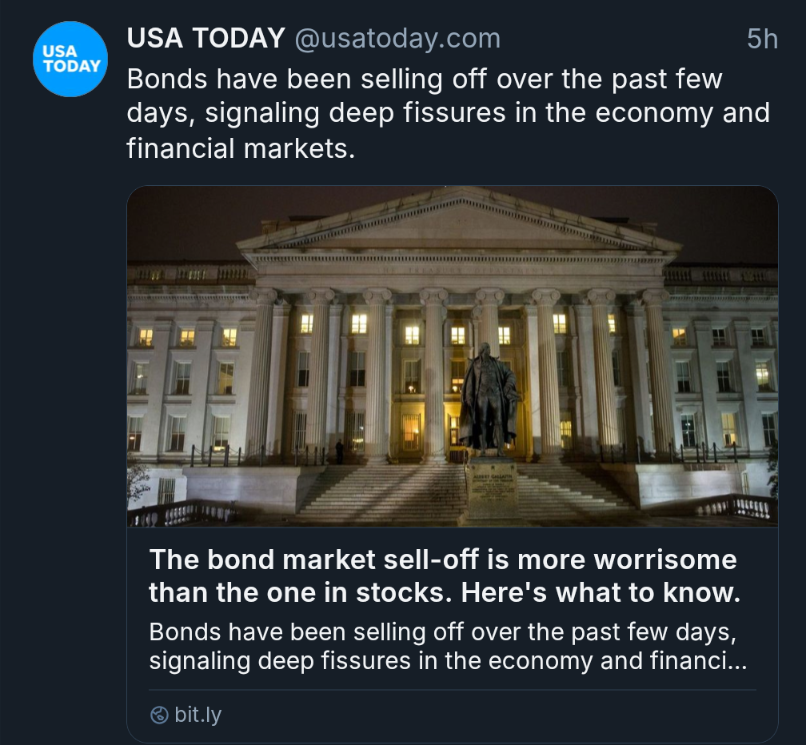
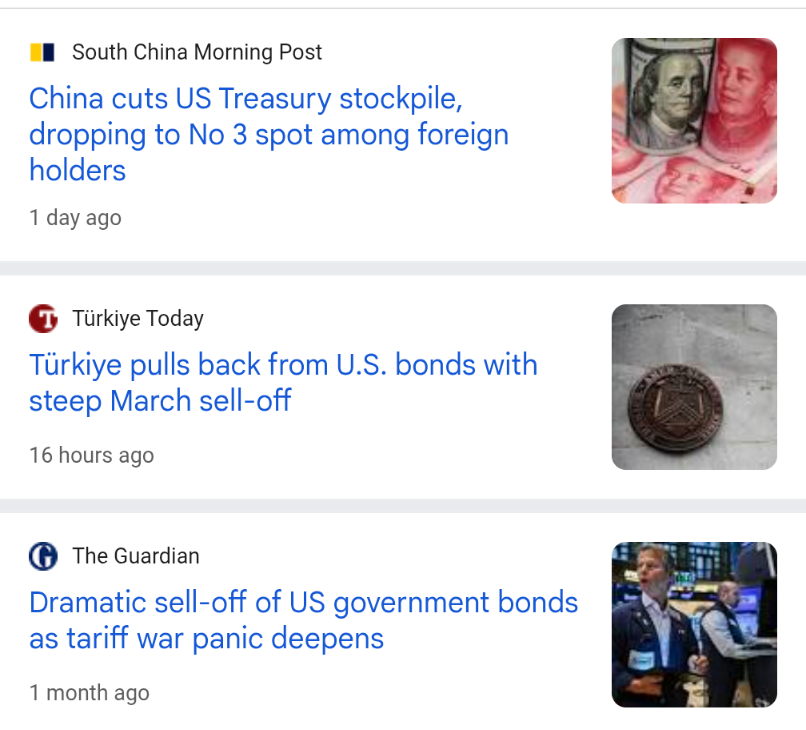
That is the expression, but it came from a time when a word meant something. Far before the idiom of marketing and business practices. That word is a temporary setting towards to goal to do no harm to the shareholders and the business need of the few. In essence, the old “is an idiom that means a person’s promise or word is as good as a formal agreement. It suggests a commitment to honesty and reliability in one’s dealings, and is frequently used to signify that a person’s word is a reliable substitute for a written contract” it is said that a word is merely a mirror of the intent of the person speaking it. And when you look at bonds, we see “A bond is a form of debt security, essentially a loan made by an investor to a company or government for a set period of time in return for regular interest payments. When you invest in bonds, you are lending money and receive back your principal plus interest at a specified future date” Now here we get the problem. You see, as it stands “an investor to a government for a set period of time in return for regular interest payments” and now as it seems that government (America) can soon no longer make these “regular interest payments” and the investors are backing away. We saw last week

and we have seen a few of these settings and again today we see a continuance of these messages. The stage is not really as clear. As bonds are sold before maturity the investors are losing money and you know how they lose money. Yet the setting for that is when will we lose it all? And there is the crunch. Lose some now or a lot later and these happy wuzzes are weaseling out before it is too late. So as such we see

If you think that I feel sorry, you would be wrong. I saw this as early as 2018, but the people called me and idiot, a fool and a cowardly weasel. That’s fine, they are merely words. As we see the dumping of bonds these high and mighty wannabe’s will get the limelight shining on them and as they hide like the little cockroaches shouting “it’s more complex then I thought” and I giggle because all I needed was an abacus, this contraption (which preceded the computer and the slide ruler) was invented somewhere between 2700 and 2300 BC, so there was time to learn the essentials.

I don’t know how much the damage is at present, but with every sell off, the burden of America deepens, which as of April 30, 2025, there were $28.575 trillion in outstanding U.S. Treasury securities. So we do not know how much is sold of and I doubt America will divulge that information and as I stated in March 2023, when I speculated that the SVB had too many bonds in there possession and could not deal with a bank run, I asked whether the media would ever look into how many bonds they had and they never did (I wonder why), but a more large setting was seen in the movie The Big Short (2015), an American biographical comedy-drama where we see the implied setting of Janet Yellen in her role at the federal reserve. Now, this is a mere movie, but when movies get to close to reality, there is the chance that there might be correlation. And as the Federal Reserve kept close eyes on the SVB bank, my thoughts wondered whether there wasn’t anything more going on. It is merely one bank, but was it? This also set my mind in a certain direction. The media was no longer to be trusted and they are too often a spokes vessel for stakeholders with political and personal plans. This time around the gap is a lot larger, a lot more than merely one bank. So how many bonds are being sold off (read: dumped)? We don’t know and the investigating party (read: the media) is being told to stand down as I see it. There is no way they are all being sold but to which amount of the $28.575 trillion is being sold off, we just don’t know. In the end America will face a brunt of invoices due to be paid. Yet consider that a bond is a certainty of income through interest and now these investors are bailing. How much is being bailed on is unknown to me and to many others.

But the media isn’t asking the hard questions, isn’t that interesting? They are so busy to chase digital dollars for their own good, whilst at the same time pleasing the shareholders and stake holders  making the audience a distant fourth or even fifth party. So how do you feel about getting actually informed? 

Don’t ask me for the information because I have close to none. I can merely see the issues, but the actual facts are not visible to me and to many others. But there is an issue and the idea of weaponized bonds is decently new, it came after the settings that these foundations are based on and as the bottom line is now marketed for the needs of the investors, we might not know in time what needs to be done. Will it be done in time? I have no idea, the people in charge of the information have their own game to play and usually it is for the betterment of themselves, not the audience at large.

I reckon that the tariff war set a few cogs in motion. Did the current administration consider this when they named the Golf of America and cast Canada into hostile party by calling it the 51st state? Did they consider the impact of a possible annexation of Greenland? It pissed off Europe and the Commonwealth and now their actual enemies is seeing the optional setting of selling off a huge part of the bonds and as such America sinks under their own debts, no actual war required. Didn’t the Art of War teach us (approximately 500BC) that “The supreme art of war is to subdue the enemy without fighting. If you know the enemy and know yourself, you need not fear the result of a hundred battles” I wonder, how clever it was to set a chicken stage of tariffs when these people wrote this book over 2500 years ago, seems folly to me. The best the west has to offer in contemplation is On War by Carl von Clausewitz (1820), which is called a decidingly lesser work 2300 years later. Isn’t that the opposite of evolution? Both books on the philosophy of war, but called “a lesser setting”, so what is the stage and what is missing? Both miss out of the war setting of economies. There was a setting of economic in the application of logistics in WW2, but a rather slimline one. Now there is a need on the war on the economics of any enemy and when as deeply in debt as America is, they are quite literally fighting against the edge of an abyss and that abyss does not give way to anything, it is not the premise of an abyss. 

I have no idea what comes next, or what could be done next. This requires clear and reliable data and we do not have any, or aren’t given even the indication of clear data. That is the result of a media that is no longer to be trusted. So how bad is the news? It is dependent on the actual amount of bonds being sold off, because that is the hard setting of the decreased revenue that America faces in 2025 (and 2026). 

So this is one day that I don’t go for the casual ‘have a great day’ but a much larger setting of make sure your families are safe, because when the dollars stay away there will be a price to pay.

Leave a comment

Filed under Finance, Media, Military, Politics

Mere numbers

Yes we all have mere numbers, and it is nice that some are advocating the lack of numeric connections on the news. Consider that we are being confronted with a disease with an optional  death rate of 3.4%, however the news is being brought like that is not the death rate, it is the survival rate. From ‘Murder inquiries could be hit if coronavirus reduces police numbers‘, to ‘WHO says coronavirus death rate is 3.4% globally, higher than previously thought‘, in all this we see a massive level of overreaction by all (including media), why? Lets face it, it is a flu and 3.4% in fatalities is still lower then your chances to cross the road whilst the crossing light is red in Manhattan, Regent street London or Parramatta road in Sydney. The overreaction I see is just staggering, even now we see ‘Wall Street slides after Federal Reserve makes emergency US rate cut‘, all as we see the numbers that give us “Coronavirus Cases: 92,880 Deaths: 3,168” and this is all before you realise the slight side factor “Recovered: 48,589“, so as the amount of people are restoring it and as we see a level of fear mongering whilst the amount of people not alive is a mere 3.4%, in addition, as we see the small realisation that in a group of thirty including me, i would feel that I was the one not making it, that is until I realise that one of the other thirty is Rupert Murdoch, which would make him the unlucky fellow, age is apparently a factor, the young have a much better chance, so there you have it, playing Russian roulette with thirty others and one gun, making it one out of the thirty not making it, and when you realise that a pistol has 6 options, we see the overreaction. Age is a factor, making it a setting where the bulk of the people will end up having to pay their taxes. I did have fun last week, as i was in a train I stated on my mobile (with no one at the other end) “I’ve had the sniffles ever since I came back from China“, within a few minutes I was alone in that carriage, that will teach people lo listen to other people’s phone calls. Over reaction can work for you, I learned that a long time ago and I do have a flaky sense of humour to boot (every now and then I should just kick myself).

Even in the UK with now 51 cases, the UK still has no fatalities, we get it, it is a disease with an optional not happy ending, but we need to realise that so far the death toll is a mere 3.4%, some nations have a larger death population by drinking water. When you consider “Contaminated drinking water is estimated to cause 485 000 diarrhoeal deaths each year” and you consider that this flu virus has only taken the lives of 3,168 people, the overreaction by others is just a little too much. So as we are treated to adjustment in interest levels and we see US rate cuts all whilst the death toll in the US is so far 9 people, we see a massive overreaction, and it is time to call the media and governments to attention. In the US Heart disease will kill 165,000 people, cancer 152,000, no one cares, yet this flu that has killed 9 shows an overreaction that is uncanny, it is lower than diabetes, yet we overreact, all whilst sugar intake is off the charts.

Caution and the wind

We all need to take caution, I am not stating that this is the case, but the overaction seen all over the media is just stupid, a disease milked for circulation through the use of implied danger, not shown danger. The best headline is seen with ‘Corona Causes Stupidity To Go Viral‘ (at https://townhall.com/columnists/derekhunter/2020/03/01/corona-causes-stupidity-to-go-viral-n2562371), here we see “the United States has excellent care everywhere. While there is no “cure” for a virus, we have the ability to treat the symptoms more readily available than any other country in the world. And we also care to administer that care. Most of the rest of the world: not so much” for the most, the issue is spot on, even as we now see that the US has 9 fatalities, the media is all to happy about keeping people in the dark on the 3.4% fatality rate (at best), 

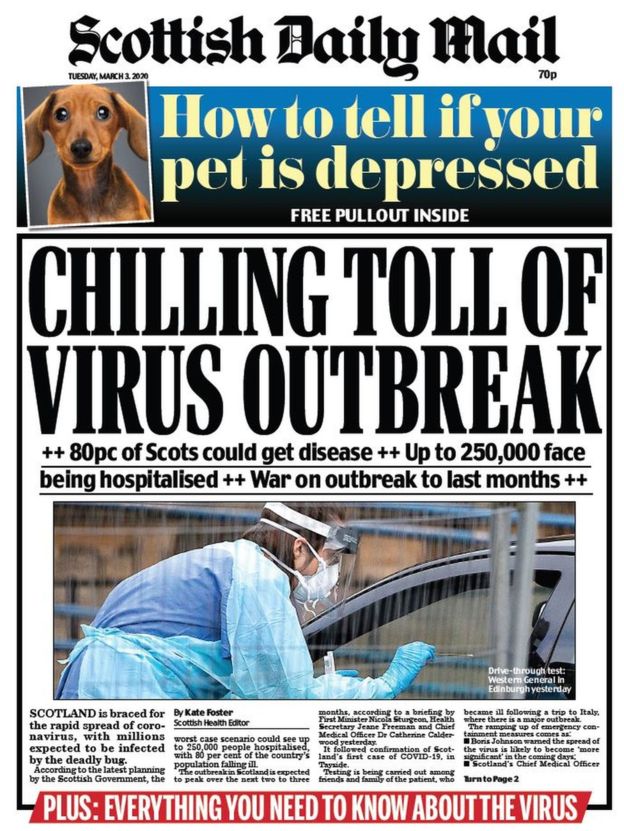
Still, we should not throw caution in the wind, yet between that status and the mediated one where we see “80pc of Scots could get disease“, all whilst no national numbers in any country show any numbers that could give rise to such a blatant form of miscommunication. I think that the danger of Scots becoming British nationalists is a lot higher, if you catch my drift.

Even if we for whatever reason ‘hide’ behind the numbers, we all take a position, the media as mostly fear mongering, the governments in easing whatever economic pressures there are and even me, as to the overreaction of so many others. A disease with a death rate of 3.4% gives a different optimistic side, my survival rate on most cardiac options I could get hit with is a lot lower than 96.6%, so I have a better chance to live longer if I get the Coronavirus, how sic is that?

China, South Korea, Italy and iran, all  have thousands of actual cases and there we see that ONLY China and Italy have a percentage of non-living that is at the 3.4%, South Korea has a fatality rate that is less than 1%, so 99% survives there, 32 deaths in 5,328 cases, as such Australia with one kill out of 39 is not in any danger of being an issue, especially as 21 cases have made a full recovery. Yet the media does not give us that part, does it? And when we see how it hits the places where poverty is a danger, is that because there are no cases in Monte Carlo? (fingers crossed), or perhaps it is because Saudi Arabia currently only has one case? 

No matter how we slice it, we need to sit down and take a sober look at the numbers, in the first it already is a pandemic, in the second we see the cold numbers give us that 96.6% will merely get sick and recover without dying of the disease. There were 4 flu viruses in the past, the avian version (1957) killed around 2 million, the manana virus (Spanish flu) killed 50,000,000. the other two killed a million each, this Coronavirus does not add up to anything serious, the numbers prove me right. There is a massive overreaction, especially when you consider serious diseases like Ebola, or HIV. Their death rates are indeed serious, this Corona event does not add up to much at all and it is time that we take that into consideration.

By the way what was the rate cut by the federal reserve when HIV became an issue? It seems to me that this is an event that the media, especially the financial writers seem to have forgotten (read: ignored). So whilst the media is giving us ‘Washington state residents frustrated over obstacles to get coronavirus tests‘, or even ‘WHO warns of protective gear shortage as global recession fears mount‘, in a case where we see proven that 96.6% will not endure any fatalities, the overreaction is clearly seen, yet the lack of governments making sure that all people realise that there is too much overreaction in the midst of a generic flu season is a little staggering. All whilst the headlines are spiked with phrases like “its battle against the deadly virus“, I personally believe that the fatality rate needs to be a lot larger than 3.4% before we have a viral publication of “the deadly virus“, at least that is my take on it, call me crazy, but a situation where a virus optionally kills 3,200 all whilst traffic kills 1,250,000 people annually is a stretch, especially when you realise that the virus could have been a mere complicating factor in several deaths, the elderly die for all kinds of non-natural causes, the virus is a given complication here, but there will be some debate whether the complications, or the virus was the killer remained to be seen and the elderly will get hit harder, no doubt about that.

When we consider the mere numbers, the ado about Corona becomes much about nothing, even if it does kill, 3,200 deaths does not amount to anything when we compare it to the lack of life through survival in Syria (Idlib, Aleppo) or all over Yemen, did you consider that?


Leave a comment

Filed under Media, Politics, Science

What is an economy?

Yesterday we saw all kinds of movement in the markets. The start of this was a violent sell off in almost direct answer to a message be Ben Bernanke (Source:  http://www.guardian.co.uk/business/2013/jun/20/stock-markets-violent-sell-off ). It is a name that ‘shines’ to some extent when we watch the movie ‘Inside Job’. Mr Bernanke has been involved with the Federal Reserve for over a decade and has been the chairman of the Federal Reserve since 2006. Bernanke’s message that started a whole lot was to end QE (Quantitative Easing). Is it wrong? That is the debate that many want to start, yet we are currently in a phase where this approach to bond buying must stop, the question is not just why, it is also current to ask why not sooner, or why would this have such a strong effect on global markets to this effect.

Does this event show that the US is actually getting stronger, or is the rest of Europe’s so much weaker? My initial voice goes to the second part and I will explain why. If we consider the outstanding debts then we must agree that the US remains now and for some time to come on the utter brink of bankruptcy. The total US debts are well over 120 trillion (almost 17 trillion national debt), which is so much outside of the reach of repaying for a long time to come. There is the valid question why the US should support Europe to the extent it is doing at present. Europe is so not getting a handle on their spending and many nations are showing more and more delay to getting it all under control. This is not just fuelling UKIP and the reason that the UK population is more and more intent on leaving the European Community, parties within the US are validly asking, why are we paying for all this? As the US pays the IMF and they keep on pouring money into bottomless pits like Greece, more and more are asking questions as to why this should continue.

It gets even better. If we add the sums of payments by the different parties into getting the economy going (jump starting was the label they used) , we end up with an amount well over the sum of all outstanding mortgages in US and Europe. So if we consider that amount, then consider the option of paying of the mortgage of EVERY household making less than $70K. That amount would be less than the amounts paid to get the economy started. In effect, no mortgage means that people would be spending money everywhere and the US (and also the European Community) would have an economy that is up and running.

So as Ben Bernanke stops QE and as the US is buying back the outstanding bonds the markets will not suffer, but they will reflect the poor position everyone is in.

If we see the past of Rothschild we see: “Amschel Rothschild’s (1773–1855) definition of economy saw this as financing national projects such as wars, goods and infrastructure”. Economy would be defined as a national economy as a classification for the economic activities of the citizens of a state. So our view of economy (you and me in general) sees this in relation to the citizens. As such, the US economy is seen as extremely poor as one out of six lost their house; one in ten had no job. This has now improved to one in 12 (which is really not that good yet), yet the overall considering healthcare (or lack thereof) and other topics mean that the economy is not yet in a state of health. It is only barely starting to be on a road to recovery. The Federal Reserve is considering that dropping QE would enable a stronger wave of recovery. Is that wrong? When we read about the economy in many places, and how much better the economy is doing, we feel we are being lied to, yet, is that true?

that point of view only hangs on what the definition of economy is. In a global market where we look on how corporations are doing in their markets we see a definition devoid of citizens as they only consider the consumers. I think that their definition is wrong, yet it is not incorrect. Many of us seem to look with at the same picture with wrong (different) standards and values.

If the market drops (as it did yesterday) because these sellable items are no longer there, then this is another matter. If a shop loses one item and it drops to such an extent, then we see evidence that are (or have been) living for the most of the ROI of one successful item. Today’s message on the Guardian (source: http://www.guardian.co.uk/global/2013/jun/21/global-markets-stablise-crisis-euro) only gives strength to my views. It shows on how Greece needs another 3 Billion, how can this continue?

The article shows the following quotes that are important for the next part: “EU leaders in Luxembourg are holding a day (and probably night) of talks to create rules that force losses onto large savers when banks fail.

So like Cyprus, those who saved money for their retirement will see it dwindle? Because in Cyprus those over 100K Euro lost a bundle. After working up to 45 years, their retirement all based on joy of working hard is getting cut because no one has either the guts or the insight to actually deal with the banks and the governments behind these events?

Sweden’s Finance minister Anders Borg emphasised on the dangers of those moves. Also stated in the article by the Guardian was “A draft bill has suggests bank shareholders should suffer first, followed by bondholders and then savers. A new fund could also be set up to oversee new tighter rules.

Now, I get the shareholders suffering side of this. When you invest in shares, you invest in risk. Yet the one part that needs an overhaul, the banks and their board of directors are still not properly dealt with. So whatever draft will be created on dealing with banks and their path of recovery is still not laid out in full. However, with the promotion of bad bank separation only gives pressure on taxation and tax payers. Who wants to live in such an environment, where what I see as unacceptable levels of risk-taking remaining undealt with. To me it seems that it is more humane to legalise drunk driving as that will only kill of a few people, the fact that banks and risk-taking financial institutions can dump these levels of risk on a population group many times the size over is just absurd.

We see all these ideas and patch jobs, yet the instigators of the harm we witnessed since 2004 keep on getting a pass by ‘the deans of industry’ to walk, talk and deal wherever they want. Especially after Cyprus, where we now see the legal proposals to force losses somewhere, seem to be less vocal on jailing the board of directors of banks when these levels of loss become visible. They apparently did not break any laws. If being drunk in traffic is no defence in court, how can irresponsible short-sightedness in financial institutions be legal? This level of high stakes poker where losses are not punished and winnings go to the individual must stop. In that same regard where the European Community (EC) is adding nation after nation, and when these places start to overspend as banks and politicians that the EC stamp is a free for all for name and fame making is short term and the outstanding debts are all dumped on the tax payers in the end. Perhaps it is no longer about saving failed banks. Perhaps any failing bank should be nationalised. The members of the board are investigated for negligence, whilst their belongings are sold at auction and they are scrapped from the banking and financial industry where they may never work again on any level of authority.
Yes, I agree this is equally an overreaction.

Yet, currently nothing seems to be effectively done. Greece remains a slice of evidence in that regard. It is nice for the Greek population to blame others (especially Germany), yet these levels of non-control into the Greek debts come from Greece. It is their own previous government being so utterly irresponsible, not to mention some of the financial institutions who were residing there. From Bloomberg this quote came: “Let’s begin with the observation that irresponsible borrowers can’t exist without irresponsible lenders“. There is logic in that statement. Can we however also mention that Goldman Sachs had given the assistance to hide the levels of Deficit in Greece? So there were more elements in play. Perhaps, when the Greek banks do go into a toxic bank solution, they should consider adding their entire Greek mortgage portfolio and add that to the bad bank. If you truly want to start an economy, taking away their fear of homelessness will go a long way. Especially when the monthly mortgage could then be spend on items that truly jump start an economy.

When nations and conglomerates are talking about the economy, then you should ask them ‘what is YOUR definition of an economy’. It is the same issue as companies hiding behind revenue. Revenue sounds nice, but the reality is profit and contribution. It is what is left after the costs are removed. You will see that many places are not in a good position and they are not getting better any day soon.

Leave a comment

Filed under Finance, Politics