Tag Archives: PS4

How the mighty can fall

You see, I’ve have had a few issues with Ubi-Soft (or you be soft) in the past. After 5 iterations of glitches and increasingly less reliable accounting of that what they claim, we can see that the floodgates are opening. I wonder if anyone ever explained to Yves Guillemot that relying on marketing and shareholders equals screwing your company value over, those who push for short term gains, will long term destroy a company, in that view the danger of the existence of Ubisoft grows. They are in sizeable company IBM, Microsoft, Electronic Arts, WordPerfect and that list goes on. The first part you see can be found here http://www.forbes.com/sites/insertcoin/2014/11/14/ubisoft-responds-inadequately-to-assassins-creed-unity-embargo-and-performance-issues/Obviously, they can handle this situation however they want, but there has been close to zero diplomacy throughout this launch. This statement simply reads as “we are fixing the things you are yelling about.”“, but there is insincerity in that past. It reminds me of a Beta version that was launched, just to keep with dividend expectations. Unity as I personally expect it to be is nowhere near ready. The glitches seen should be caught by a decent QA team, so either it was skipped, or this was about setting shareholder expectations. It is short-sighted and dumbfounded as I see it.

The second term is one I really have a problem with “It’s now a significant, highly uncommon event to have a major game launch without issue“, how about doing your job right? How about proper game testing, how about not being the bitch of marketing (for the shareholders)? These issues are central in the entire debate on quality software. I wonder why a billion plus company did not figure that out, or is this the bad side of the image they accepted?

There are even criminal charges to consider at present “To say that this one aspect of the game mandated a 12-hour-post-launch review embargo time is nonsensical” is more dangerous than people realise. You see, for that time, people buy a product which the company knows to be faulty, that by itself constitutes fraud, which might be seen as ‘an act commonly understood as dishonesty calculated for advantage‘, is that not the case here? The fact that it was shipped broken seems to be enough of an indication.

I will take it one step further: ‘A party who has lost something due to fraud is entitled to file a lawsuit for damages against the party acting fraudulently, and the damages may include punitive damages as a punishment or public example due to the malicious nature of the fraud‘, now let’s take a look at this. Consider that the gamer lost time, which is a given, now consider that many gamers can only afford one game until thanksgiving, now they bought Assassins Creed, whilst they might have bought Sunset Overdrive of the Evil within. So it might be considered that they defrauded the others whilst keeping knowingly the lid on faulty merchandise.

I foresaw this coming roughly three years ago, when we heard about a new Assassins Creed ‘every year’. Good gaming does not come on command and innovation takes time, which means that the gamer gets sold short right of the bat!

Forbes brings a good tone, but they remain soft on Ubisoft. Looking at YouTube and searching “Unity sucks” will get you a massive list of rants, which is only in the second day of release. Can we agree to some extent that Yves Guillemot needs to get a grip on his company unless he ends up being found liable on a near global scale (this game is apparently not played in North Korea)?

Gamespot seemed a little ‘softer’ on the makers as they are their primary sponsor, but likely they will claim that it had nothing to do with that, yet the fact that Gamespot gave the game 7 out of 10, should be indicative that the game has massive issues beyond the glitches and bugs as well. Yet Gamespot had good things to say as well “I had that roof approach licked, jumping into the building through an open window and blending into a crowd of bourgeois loyalists before sneaking up on my target and making the kill. With multiple options of attack available, the replay ability factor here is huge, giving you more of an incentive to go back and nail those bonus conditions for completing a mission“, this truly sounds like the old Assassins Creed many loved, yet then they state “These excellent sandbox-style assassinations make up the bulk of Unity’s missions” followed by a few negative notes. You see, the only true sandbox style I have seen is with Bethesda and both Elder scrolls and Fallout. The rest are often scripted to force you in a direction in the main story (for a larger part). Unity does take additional leaps when we consider the quote “I’m all for giving people the option to extend the experience onto mobiles and tablets, or on the web, but those things should offer standalone extra content; locking stuff out of a game you’ve just dropped $60 on is infuriating“, this I felt in the past as well with other games, so seeing it here is not a good thing. I personally think that this is about the data collection side of it all, as they get the information of the player, added with PC and Console information, we become targets in a very real sense. A view I do not treasure.

So as I had decided to let AC Unity slip by (a lack of funds will do that), I feel happy to miss out on the bugs and the glitches. There is one issue in hindsight of this, this is definitely strike two for Ubisoft, I reckon that Far Cry 4 will be their Waterloo in a very real sense. Gamers are more than just a little angry and their end might come harsher then they think. If we consider the quote by Play4Real (at http://www.p4rgaming.com/ubisoft-to-release-eight-assassins-creed-titles-in-2015/) stating “With the release of both Assassin’s Creed Unity for the PS4, Xbox One and PC plus Assassin’s Creed Rogue for the PS3 and Xbox 360 this year, Ubisoft knows that the demand for Assassin’s Creed will never die“, if we believe Ubisoft CEO Yves Guillemot, then they have 8 releases planned from now until 2016. I reckon he needs to revisit quality before even attempting one next one. When we see “but will wait for reviews as AC unity was a bug fest” in regards to Far Cry 4, which was supposed to be the big thing for Ubisoft, we see that gamers are about done with Ubisoft

  1. Watchdogs fell short of expectations (rated 8 out of 10)
  2. Bug fest (we mean Assassins Creed Unity) launched on all major platforms. (7 out of 10)
  3. ? (X out of Y)

Strike three might come next week, so we will hold out fairly for Far Cry 4, especially as number 3 was a decently good game.

This is the first true indication of the sliding levels of quality in gaming. As developers (likely more precise would be marketing and shareholders) are pushing deadlines, we see a lowering standard of gaming. The approach, ‘we’ll patch it on day one’ is more and more the standard, whilst this tends to lower the joyous gaming we all anticipated, it also sets a dangerous precedent, because as proper QA is more and more ignored, the overall quality of the game tends to falter too. I do not ignore, that with size comes glitches, yet when we see an overall lack of care, then it is something entirely different and stringing gaming fans along seems almost too criminal. It might be regarded as criminal as people bought a finished game, which is not what this game seems to be, not by a long shot!

1 Comment

Filed under Gaming, IT, Law, Media

How to (un)screw an MP

We have seen a fair collection of choices and changes that adds up towards the life and makings of a situation. If diplomacy fails, you extend it into war. If the statistical answer does not match, you change the question and when you are unable to remain a journalist, you create it through entrapment.

This is what we are confronted with today as we see the header “Sunday Mirror under pressure to reveal details of Tory minister ‘sexting’ sting” (at http://www.theguardian.com/politics/2014/sep/28/sunday-mirror-pressure-reveal-details-tory-minister-sexting-sting-brooks-newmark). So as labour sees their political chances fall further and further, we see a labour based paper having a go at the Tories. Now, to be fair, having a go at Tories from a newspaper point of view is not wrong (I am one for the most myself), conservative publications have a go at labour, so I reckon when it is news, then we can state that all is fair in love and political envy. Yet, when the Lloyd Embley machine starts creating it through entrapment, we get another thing entirely.

So what happened?

The reporter, who is not on the staff of the Sunday Mirror, created a fictional account of ‘Sophie Wittams’ on Twitter, which has since been deleted, and appears to have contacted at least six Conservative MPs including the latest Ukip defector, Mark Reckless“. So the Lloyd Embley machine seems to have played a game involving an exchange of explicit photographs. The quote “Newmark, who owns the investment firm Telesis Management and whose wealth was estimated at £3.2m in 2009, was contacted by ‘Sophie’, before engaging in a series of flirtatious messages and photograph exchanges“, so if this is exchange, whose photos were used?

It seems that the press still cannot get a grip on accountability. I personally think that it is time for the Lloyd Embley machine to feel the brunt of their utter ignorance (or let’s just call it greed based bashing). Instead of going just for a fine, how about shutting down the paper for let’s say three weeks? This means that those with subscriptions will get an alternative paper for three weeks (paid by the Trinity Mirror group). Now let’s see when money stops in its tracks, whether the editors get a firm wake up call.

There is more to this. It seems that even after the phone hacking scandal and after some of these so called journalists claimed that they can police themselves, we see more and more evidence that they can do nothing of the sort. These transgressions just show the essential need for the entire Leveson recommendation to be passed, which makes this new event upsetting to a fair amount of people.

So how about looking at this from the other side using a series of articles that the Mirror MUST publish on page one and it has to be an independent journalist chosen by the Conservative party. That journalist will get the ENTIRE page one, so no ads anywhere on that page.

Wouldn’t that just ‘sting’ the labour paper?

It is the last quote that is actually the most upsetting “A spokesman from Ipso said: “Ipso will look into any complaint about the story concerned if any such complaint is submitted.”“. This seems to clearly indicate that IPSO is utterly toothless (as implied by me in a previous blog) and as such might end up not being of any use, which was pretty much what the people of hacked off claimed IPSO to be. Now consider that IPSO starts their own webpage with this statement “IPSO is the new independent regulator for the newspaper and magazine industry in the UK. We uphold the highest standards of journalism by monitoring and maintaining the standards set out in the Editors’ Code of Practice“. Is that so?

Consider the Crimes Act 1900 for NSW, where we see at Part 5A False and misleading information, which holds section 307b/307c.

A person is guilty of an offence if (partial extraction as these parts seems to have been proven already):

(a) the person makes a statement (whether orally, in a document or in any other way), and
(b) the person does so knowing that, or reckless as to whether, the statement:
  (i) is false or misleading, or

  (ii) omits any matter or thing without which the statement is misleading, and
(c) the statement is made in connection with an application for an authority or benefit

The result is: Maximum penalty: Imprisonment for 2 years, or a fine of 200 penalty units, or both.

So why is the so called ‘reporter’ not arrested?

What was the name of the ‘journalist’?

Is the paper now obstructing justice? All fair questions I would state. Now, I used the Australian version of the Crimes Act, yet I feel at present decently certain that the UK has similar rules.

Whilst getting creative I considered the issues of consent, even though it reflects on sexual assault, we could argue that the MP got screwed by a journalist. So was there consent? Well Section 61HA (5) tells us ‘A person does not consent‘, where ‘(a) under a mistaken belief as to the identity of the other person‘, which is proven as the woman in the images was never part of this. In addition there is subtopic c, which states ‘under any other mistaken belief about the nature of the act induced by fraudulent means‘, well fraudulent means is certainly the case here, so again the paper loses out. In reality, these parts do not apply as there was no real penetration (as described in the Crimes Act 1900), yet the MP got screwed then he got hosed, so I reckon we can be flexible here as IPSO seems to have little intent of keeping the highest standards, just me observing those who do not meet them, which we get from their own quote.

As the Criminal Act 1900 NSW talks about penetration, there are a few issues here, yet as this is the UK, they have a few other sides, as they will use the Sexual Offences Act 2003. I will not go into it, because Matthew Scott, who has the ‘Barrister Blogger’, has quite the article on it (at http://barristerblogger.com/2014/09/28/tricked-sex-fraud-sunday-mirrors-sting-brookes-newmark-criminal/)

I see news coming in regards to monitoring on how we have a right to speak, how we should have privacy, but what about accountability? If the press cannot be held accountable whilst they engage in unadulterated entrapment, should we even be allowed an internet? So, how does that relate? We seem to think that we can do whatever pleases us in a form of freedom of opinion, no matter how false the statements are. We are all de-evolving into a state of anarchy and chaos. If there is a path that leads somewhere then it might be open to debate, but that is not the case. Whilst we ‘bicker’ over how we can speak about everything, we leave big business unchecked to do what they want and leave us without anything.

I have made several observations on a failing press, whilst no one is taking notice on how we never had any rights in the first place. How these ‘holier than though‘ editors seem to regard harlotry above integrity, my evidence in this? The User agreement changes Sony pushed through a week before the release of the PS4 ‘Pricing a Sony game!‘ on November 20th 2013, the list goes on, but this is not about advertising my blog, or revisiting too many old articles.

Because as we see the events unfurl, we now have a new iteration of information as the daily mail is mulling over all that information and these photographs again. It is there where we find these two final quotes: “And criminal barrister Matthew Scott wrote on his blog yesterday: ‘What conceivable public interest was served by tricking Mr Newmark in this way?” Well in my opinion there was no public interest, it is a clear cut slam bash from a labour based paper to have a go at a conservative.

And “Lloyd Embley, editor-in-chief of the Daily Mirror and Sunday Mirror, defended the story after former BBC journalist Sue Llewellyn claimed it was ‘unethical’. He tweeted: ‘1) it wasn’t a Mirror sting 2) there’s a nailed-on public interest.’“, my response? It was a mirror sting. From the current information this came from a reporter not employed by the Mirror, which means that in my view you Lloyd Embley are directly responsible and accountable! You see, if you are not, then this means that you are not really an editor (they tend to know EVERYTHING that happens at their newspaper), which makes you redundant! In the second, there is at present direct indication that these events follow from criminal activities. In that we get a nice last issue as presented by the Press Complaints Commission “iii) Preventing the public from being misled by an action or statement of an individual or organisation“.

Yes, now consider that it is the press themselves that is knowingly misleading the public in the most intentional way!


Leave a comment

Filed under Law, Media, Politics

Sony customers deceived?

It is not a new story. We have seen delay after delay on several titles. It is however time to look at the issue surrounding this. First, the game many people will not care about, but it is one of the largest played franchises. The title is Minecraft and it was said to be a launch day title. It has shown itself too be a massive hit on PC and Xbox360, so the fact that it was going to grace the shores of Sony was good news. It was delayed on the PS3, and when it came just before Christmas it showed that the graphic improvements as we saw the shading on the PS3 it gave us a clear indication that the game on NextGen would be well worth it. It has not come yet and it is now said to be delayed until June 2014. That gives it a delay of 3 quarters. That same delay is now shared with Watchdogs and Driveclub. The game Watchdogs has at least a little amount of excuse as it clearly stated the delay a week before the launch of the PS4. But these delays show a deeper issue. Either Sony marketing is not managing their issues correctly and in fear of desertion are willing to keep the gamers for too long in the dark, or we see a level of miscommunication between console and software houses that should not be acceptable in any way, shape or form. Which is the correct one?

I leave that up to the reader, but consider how this list of delayed games is growing. Witcher 3 was announced for later this year. Now it will not be seen until February 2015. In this case, like with Watchdogs the gamer gets a timely announcement, yet the amount of delays are now adding up and gamers should consider themselves as investors into a new gaming system, yet they get no return on investment. Is that fair?

If we consider the quote “This is the list of games planned to launch for the PlayStation 4 between Day 1 and the end of March 2014” and we see the delays of Oddworld: New ‘n’ Tasty (spring 2014), The Witness (mid 2014) and Wolfenstein: The New Order (may 2014) then you can understand how we should get worried. This all is even worse for Oddworld, which is a revamp of the original PS1 game, now for the PS4, which means that most issues of this game would have been known long before the console came out. So it all adds up. These last few titles are not that much delayed as they were launch window titles, but the delay still counts towards to overall lack of games. Infamous is still on track and Thief got released on time, it is the bad rating of Thief (in my view slightly undeserved) that still ends up having a negative impact, which is not to be ignored.

I must also admit on the other side of the scales that Sony has been trying to offer a level of overkill for the members of PlayStation Plus. They are throwing everything but the kitchen sink in that direction. Even though not all on PS4 (some on PS3), the amount of quality games (including Killzone) that could be freely downloaded must be acknowledged. I think that this is what gives them a little more time for now.

In the end we will see more delays. The Crew (a racing game) is also delayed, but then on all platforms, so it is not just a Sony ‘issue’. So why is this all such a massive issue for gamers?

Consider the ‘advertisement’ we all saw on the game Drive club. Sony has been beating us to death with it and it did look really good. Now, the way it was shown and the fact that it was a launch day title was not just an error. It was in my view a blatant form of intentional misrepresentation. If we consider the path of any game; development-testing-alpha-testing-beta-testing and then the gold master, the fact that a game has 3 quarters delay means that they were in a place long before the alpha stage. This means that it had been known for some time that there was no way to get this game out in time, so how was the ‘demo’ arranged? Consider the ‘implied’ votes on the score in the rolling demo. All this points getting back to ‘utter deception’ show us that the hands of Sony are not clean in this regard either.

So even though I am (and remain for now) a huge Sony fan, we must hold them to account for both their actions and in-actions, if not, then indeed some gamers might consider that the safest move is to move towards the Xbox One (even with the architectural flaws it currently has). In some cases the games have been delayed on both systems, but consider that Titanfall has a 90% rating and as Forza also got rated that high, shows that racing fans can at least get their racing freak on with an Xbox One, something currently not possible on the PS4. Those who have read my other blogs might know that I have been highly criticising against the XB1, I have also stated more than once that a console can only survive if it releases top games. At present the scales of balance are moving away from Sony as the games are more and more getting delayed. This is the lesson that was imprinted into the heads of members of the board of directors of Sony with a sledgehammer when we saw the issues on PS2 and PS3. It seems that they still have not learned this lesson. It is hard to blame them for the failing of other software houses, yet the fact that it is happening again with the PS4 should turn on many red lights in Sony HQ. I reckon it takes one more delayed top title for the PS4 to start making a sales shift and start changing the balance of power for NextGen consoles. No matter what hype some acclaimed ‘experts’ throw at you for 1080i resolution and frame rate. The first is that this level of quality is rarely offered by games, and in the end a good game is a good game, no matter what resolution it runs on. It does not matter if the PS4 shows graphic superiority, not having the games is what stops people buying the console in the first place.


Leave a comment

Filed under Gaming, Media

A body blow to gaming

We are about to start Q2 of 2014 and the news is not good for Sony. Thief is about to be seen as below average by several reviewers (a score of 60 from Gamespot at http://www.gamespot.com/reviews/thief-review/1900-6415675/). Now, Thief might be an acquired taste, but its following has been fierce fully loyal. The issues and the ‘good’ looks that were given at the E3 are now getting slammed on several levels by several review sites; in this regard I gave it a score of 75%. I initially gave it 80%, but as the blatant levels of sloppiness became visible after completing the game, the score dwindled a little.

People might think that it does not matter, but consider the game release claims that Sony made for 2014. It only takes up to 4 games under achieving the gamer’s expectations, for a console to lose a massive following. Yes, Sony is at present happy with the fact that 6 million are sold, but how long will that continue when the released games do not hold up to scrutiny?

I personally thought AC4 was a lacking game on several fronts, and thief might have given pressure and serious nervousness to UBI-Soft. This is however no longer the case considering the score Thief got. Yet, they are not out of the woods yet. Watchdogs was initially a first day console game, which is now supposed to be out by the end of Q2. If they do not meet expectations, Sony will enter Q3 with its PS4 having several flops, that is a massively bad result for something that is supposed to save Sony. Before you think I am Sony bashing with some Xbox-One motive, then think again, I willingly choose Sony and I am hoping that they will get their ‘game’ in order, as one more flop could have an majority of ‘console undecided’ people running towards Microsoft’s Xbox-One. When we see quotes like “Thief’s main story ultimately goes nowhere” and “Thief rarely captures the right sense of risk, however, which in turn reduces the sense of reward” should give many gamers cause for concern, especially with an icon title like Thief.

This is in my mind however, the consequence of a larger issue. I have noted it before on several occasions and again I state that the addition of what some laughingly refer to as ‘Business Intelligence‘ to the gaming industry might be seen as the main cause of several failed titles in the last year alone. Whether it was to hatch onto an established branding, because a certain deadline had to be met or because budgetary needs (which is actually a more valid reason), outstripped in the end the legendary status a game could have gotten, is now left with score like ‘average’ or ‘fair’ and many will now try to solve the revenue issues through subscriptions and micro transactions.

So, we could in the near future see the status: “Gaming is dead, long live……whatever!

This is no way for gaming to go down. This is not just about setting up the IP of a brand, or just branding in general; this is about the pure lack of visionaries in gaming!

Is it a fair statement to make, even if it is only my view?

Consider what a game costs, for that we want to see something pretty spectacular, but overall, the value for money is no longer given by the creator, but by an analyst and a marketeer, who both seem to be oblivious to the gaming condition of the gamer. They look at branding, profitability and in the end it will all be about micro transactions.

In the gaming industry, I am a devoted RPG fan. So, I have little interest in HALO, GTA and a few other games, which is fair enough. There are plenty of gamers liking them, but overall, consider how many hours you actually play a game. Will it be worth it? Make no mistake, I do enjoy a decent multiplayer and I have played many many hours on Mass Effect 3 multiplayer mode. In my view it is the best multiplayer experience I have ever had. God of War Ascension is another game where the multiplayer is a great experience. There we see the additional part that these levels are quite unique, so that just adds to it. These games have a certain level of playability which makes multiplayer a delight. Something UBI-Soft never figured out. When I start on level 1, and Assassins Creed (2/3/4) gives me a ranked match where I end up against people from level 51, something is definitely wrong and the fun to play multiplayer is soon diminished. Another mess they did not solve in 4 iterations of the game.

So as we see Sony move forward on PS4, they will depend on good games to remain the top player. Many of the games we expected in Q1 2014 (as mentioned in Nov 2013), have been delayed. That makes for unhappy gamers. Now, in all honesty, every game is likely to have some delay, but when we see a delay of three quarters (Watchdogs) there will be cause for alarm. Now, we see that not just the delay, but the diminished power punch that a disappointing game brings is still a fear on the mind of many. No matter what Sony does, if Titanfall truly delivers on the Xbox-One, then Sony will have a first fear to deal with, because it takes one good game to make a gamer reconsider. That was clearly shown when Metal Gear Solid: Guns of the Patriot was released on the PS3. Even now, 6 years later it can still be regarded as one of the most perfect games ever to be released on the PS3. Here I agree with Gamespot who named the game as ‘technically flawless‘! It sold almost 6 million copies, which is an impressive result, especially as the action adventure is not for everyone. Analysts stated that this game would be the reason for increased console sales, so as high scoring PS4 games remain absent; will Titanfall be a first step changing the direction of gamers? For me it is hard to say. The first worry is that Gamespot had no preview, or review on their site, which is weird as the game will be released in one week time. Titanfall is not my cup of tea, so I have no view one way or the other, yet overall as the next-gen consoles are supposed to be the hot item, the absence of top games on the PS4 will have an impact.

Should you have another view (which is fair enough), then also consider the following, when you go to a site like EB games, with the ‘top’ titles at the top of the screen on the PS4 page, only one is for sale now (Thief) the others are all preorders, is that not a little weird?

Personally I do hope that PS4 will win the console war (I am slightly biased here), but they will need the games to make it work and the next possible top game is still 2 weeks away.


Leave a comment

Filed under Gaming, Media

Control and Censorship

I am a simple person. I use an iPad, and I use it in a standard way. I synch, I play, I read, I listen! (Yes, I know such a selfish user I am). So when I read about the jailbreak issue I was actually surprised. Most of us never bothered with 3rd party software or other solutions. Yet, overall I do understand that some people might want to. I also do not see the issue for Apple or others to intervene. Some valid reasons might exist, and some might want this to develop their dreams, all valid reasons why a jailbreak system might be needed.

So the issue I read about today was that a game (Deus Ex) would not function on a jailbroken system. This might have been a simple issue with compatibility. No, this was not the case, as it was stated in the article the non-functionality was intentional. The person gets the message “We are sorry but you can’t fire on jailbroken devices.” So it is not just a bug but an intentional act to ‘sift out‘ certain users.

This does not make sense to me. So a person wanting the freedom to do certain things is now punished? I think it is high time that both Apple and Enix have some explaining to do. (Source: http://au.gamespot.com/news/deus-ex-the-fall-disables-firing-on-jailbroken-devices-6411343) the reader should especially accept the idea that there is a group of ‘legally jailbroken devices’ and they are in the same predicament.

It seems that the IT field is changing. This field is now more and more about personal data collection, discriminating groups and limiting the freedom of choice. At least, that is how I see it. But is this true?

When we see the jailbroken system then the following had occurred. The IOS has been modified. When we look at Apple support we see the following at http://support.apple.com/kb/ht3743. This is fair enough. It is nothing short of a person disassembling a television, then wanting it fixed under warrantee. So, I cannot fault apple for not fixing it. Yet the software gave us another issue. This is intentional intervention against those who ‘altered’ their system.

There are two sides to these events. On one side, I can understand why a system might be jailbroken. The immediate reason is that I was in the past the victim of Apple’s short-sightedness and their own party line flaws. It actually costed me thousands of dollars, so at that point, I feel that I am justified when I state ‘Apple Get Fu$#d!‘ (In regards to the lost $$$$).

The first part is the one some might remember from the PlayStation and PlayStation 2. Because some people were unacceptably greed driven, they forced many in a place where they decided what we were allowed to have and when. In the early days, games would appear in US and Japan almost a year early. To circumvent this, a ‘mod chip’ was available and as such people could order their games on Amazon in the US. Not only were the games up to a year early, in addition these games were 40%-65% cheaper, which was a massive benefit for many. Weirdly enough, the first reason was to many gamers more important than the price issue, but they happily took that benefit on board.

The second part of the ‘mod chip’ was alas less noble. It allowed people to copy original games and they would work on any modified system. For the most on the PlayStation 1, yet it had a large following in the PlayStation 2 as well. In my mind the second part was mainly due because of greed driven marketing, to exploit every person, wherever they lived to the fullest. The same was evident in the DVD market, however, there was a valid issue that Asian copyright violation was so strong that something needed to be done, yet overall the events seemed to have made little difference.

Are these dangers the same for jailbroken systems?

Because of the term ‘legally jailbroken devices’, I wonder what those were. The answer was found at the core of all hardware knowledge, a magazine called wired (at http://www.wired.com/threatlevel/2010/07/feds-ok-iphone-jailbreaking/). This is the interesting crux! This verdict came out in 2010. So the fact that Enix had been adding a certain ‘limit’ could be read as intentional discrimination.

In the end, the quote I personally cannot disagree with Natalie Kerris said Apple won’t change its policy that voids iPhone warranties if a phone has been jail broken. “It can violate the warranty and cause the iPhone to become unstable and not work reliable”, this is fair enough, and should a jail broken system be used to play games people did not pay for, then this would be a violation, yet that was not the case in the game Deux Ex ‘the Fall’.

There is a new side to all this. Even though no longer an issue (likely only temporarily), the Xbox One with their need to connect, the Apple with jail breaking and all kinds of likely issues the PS4 will have (because even though we do not know at present, they will have their own issues), we are looking at new developments involving Digital Rights Management (DRM), deployment on the cloud via UltraViolet and the Keychest system. You the users are about to get hit by levels of user-based licensing and limitations unlike any w have ever experienced. More important, users are likely to get hit a lot harder on user license agreements then companies have ever faced over the last 15 years. In my view 99% of the population will press an ‘I agree‘ button and have no clue what they agreed to. The fact that the users who signed the apple user license and then ‘jailbroke’ their system should be ample proof of that.

Leave a comment

Filed under Gaming, IT, Law

Discrimination or Segmentation in gaming? (UPDATED!)

Some might have heard of the issues that gamers are about to get. It has been blogged and it made all kinds of media. The console war have begun, but there are more then a few indications that the was has been decided even before the consoles launched.

The war between Xbox One (XB1) and PlayStation 4 (PS4) kicked off during the E2 in the beginning of June, now it is on in earnest.

The story as it came to me was that a new game, to be launched on both systems called the Witcher 3, will not be playable in Poland, the country that is developing it, piqued my curiosity.

My initial thought was that it would be some kind of censor rating. Yet, that was not the case. It turns out that the XB1 will launch in 21 countries. You must log into the XB1 once a day, so if you are not one of those 21 countries, then you cannot play games. Is this an overly dumbfounded form of control utterly stupid?

So Poland did not make that list, neither did Japan (not that Japan was ever warm for the Xbox anyway), Greece, Portugal, Monaco (where the truly wealthy are), Czech republic, Hungary, Several South American nations, India, Pakistan and a few others, all missing! Now there could be the issue that those markets are not big, yet to cut them off in all ways means that questions should be asked. I found that CNet reported the fact that Asia will get the machine late 2014 (source: http://news.cnet.com/8301-10805_3-57588702-75/xbox-one-asia-launch-set-for-late-2014-no-word-on-japan/), so almost a year after Europe. Reason enough for them to not consider a Microsoft product in the first place, especially as many games will come to both.

The Playstation 4 does not have these restrictions.

For gamers the clear impression is that Microsoft has lost the plot. However, Microsoft is not painting this as a gaming console, but as a ‘home entertainment system’. It is about TV, Movies and Games. The question then becomes how stupid, or how clever they are (depending on their intent, either or even both might apply). You see, the gamer states that Microsoft acts are stupid, the rest does not know. Yet, if the reports in regards to project PRISM are true, then what to make of the XB1? All that information moving through 200,000 servers Microsoft mentioned that they were setting up for the XB1. Did they not comply with the NSA requests? If so, how much registration are you adding by watching via their box? Even if the NSA does not care, all that data, all that information, so how secure is your privacy? Will these machines be an ‘opt in’ device, where you must give permission before anything starts, or an ‘opt out’ where they collect until you say no.

Questions that have been an issue before and Microsoft have stated that you can set the privacy you are comfortable with. Yet, we do and should wonder about security breaches that could impede your privacy. If windows requires almost daily updates, then what about the XB1? A system this large in architecture will have flaws; this is unlikely a big deal as any system this complex has them. Sony will likely have them too. If we must register every new game, then certain data will be there, so how secure is that? This is however not about privacy (at present). It is more about the cyber criminals. How long until a security breach gets game lists wiped or scrambled. Then what? Wait days or even weeks for things to get fixed? Remember the issue Sony had with credit card details? What happens when your game list is the target?

Microsoft stated in the wall street journal on the 11th June: “that the device would only be available in select Asian markets in 2014. They are pegged as high-growth markets for the region’s booming gaming industry“. Really? But it is not a gaming console, but a home entertainment system according to Microsoft. So, these emerging markets are better off with a PlayStation 4.

This has every notion that at Microsoft the left hand has no clue what the right hand is doing. That is the conclusion I get when I see these ‘conflicting’ messages from Microsoft. No matter what it is labelled as, it leaves us with a load of questions. The important one is ‘What on earth does Microsoft think it is doing?’

1. There are questions on the hardware

a. Ridiculous small internal drive considering the market it is supposed to be supporting.
b. Mandatory daily login. Consider that even in Australia hundreds of thousands (even in the capital cities) do not have quality broadband. (Source: Sydney Morning Herald, March 7th 2013).
c. possible additional charges for pre-owned games.

With the last one I hope that the governments keep in mind that Tax laws must be altered on a global scale as this fee should be corporate taxable at the location of the consumer, not in the non-taxable location where their servers reside. (personally the excuse that this is an issue for the publisher of the game just does not hold water with me).

2. Possible issues with software

a. Censoring. Interesting here is that an example became visible just last week on the Xbox 360. An arcade game called ‘State of Decay’ for the Xbox 360. Apparently it missed some review board, even after so long of hassles to get an 18+ rating in Australia. The result was that this game which is a sort of ‘walking dead’ kind of survival game cannot be purchased in Australia at present. This might be a minor title and many might not care. Will we get this with major releases on the XBox one because one of the following was missed: Review, Server registration, release lists, database part number check, release codes per nation and time zones?

Those issues could lead to the point that the $120 you spend on a new game, will have to wait until after the weekend, as someone ‘forgot’ to do one of the aforementioned things. That is a daily risk in the Gaming industry, even more in gaming products then other software forms. So, why should we have to accept these risks?

We can speculate for all we care, but if this is all about saving costs, then how long until buying an XB1 game is nothing more than buying a credit card with a license number at EB Games (or some other game store)? Then we end up having to download 5 – 50 Gb depending on the game, which means broadband costs could go up between $30 – $50 a month. That is an additional $350+ a year. Will that happen? Many do not know at present, but the level of registration Microsoft is forcing on us has a definite reason, and I do not believe it is about piracy. My speculation was countered by Microsoft at E3 where they did mention that they will continue with discs. For how long is the question from my side. You see, the simplicity is that all these efforts would not be an issue they started with, unless there was a long term plan. Several futurists are all about the cloud. The cloud provides, the cloud refines, the cloud defines. No product to sell, no tax-ability for many and games are no longer a product you buy, but a license you rent until the conditions change. It is a business future; it should never be an entertainment future.

Is this just my view? Well, not sure how most felt about the XB1 before. I, like many other gamers enjoy my 360 a lot. I was already in the know about some facts, so I remained cautious during the E3. Yet, soon after, as we saw confirmation, many gamers moved loudly swearing on the internet away from the XB1. I feel the same way. For now, if only one system will be my choice, then the PS4 will definitely be on my Christmas list and I am not alone with that sentiment. Currently

What is important is to know is that this field could still change. I am still hoping that Microsoft might get a clue about the market they are about to lose for one.

However, should nothing change then it will be my prediction that 2014 might be an amazing good year for Sony.

On June 19th, Microsoft made public the following anouncement. In light of what I wrote, it would be utterly incorrect not to inform you!

An internet connection will not be required to play offline Xbox One games – After a one-time system set-up with a new Xbox One, you can play any disc based game without ever connecting on-line again. There is no 24 hour connection requirement and you can take your Xbox One anywhere you want and play your games, just like on Xbox 360. (source: http://news.xbox.com/2013/06/update)

There is the one question whether that one time set-up requires you to be on-line, but that seems to be minor compared to the huge step that Microsoft made towards its current extremely upset customer base.


An internet connection will not be required to play offline Xbox One games – After a one-time system set-up with a new Xbox One, you can play any disc based game without ever connecting online again. There is no 24 hour connection requirement and you can take your Xbox One anywhere you want and play your games, just like on Xbox 360.

1 Comment

Filed under Gaming, IT

Government ministers, be warned!

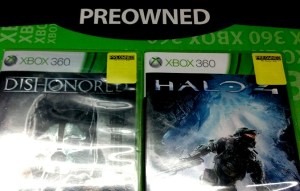
Preowned_GamesB

This is a call, not to the gamers, but to the finance and Justice Ministers in those nations. Whatever plans you have to boost your economy/security, as present indicators go, Microsoft and likely Sony too, are uniting to make it a lot harder for you.

They will come with all kind of presentations, half-baked spins and flat out misrepresentation. The goal is for some of the fat-cat executives, who are already on 6 and 7 figure incomes to get more bonuses. Guess what! They will not pay taxations, and your economy will become harder challenge if you do not act NOW!

So, here are the facts.

Currently game shops buy games and resell them. This is called the sale of pre-owned games. There is nothing illegal; the original purchaser is getting rid of his/her game. Often this does not even go for money, but for credit in the same store. This has been going on for at least a decade. With game shops living on the minimal margins as is, this boosts their shop enough for them to get by a little better. If this falls away, these shops will have to let go of more staff members and as such it will hurt the economy. This is what some would call: ‘the margin of the little guy’.

The last one is almost literal. Most kids, and at times also their parents cannot afford to buy new games all the time, many not even some of the time. A new console game is often between AU$80 – AU$139 (or equivalent). So, to be able to buy their kids a pre-owned game is a way to stop piracy. Personally I think it is a good solution.

This has been a thorn in the eye of some game makers as they imagine that their revenues are down because of this re-selling of games. Simply put, they are slightly nuts (yes, they might lose a little revenue, but nowhere as much as they claim). The overwhelming part CANNOT afford the amounts charged for new games. They will often buy 1-3 new games a year, but that is it. So if they want to play a little more they will have to rely on a few pre-owned games. That market is now more under threat. In addition, the solutions that will come into play, is that these people must buy an ADDITIONAL fee to unlock such a game. Interesting enough, that fee part is likely to be nicely arranged through a non-taxation nation, which means YOUR economy will not gain an inch, it will lose a mile.

There are two parts to this issue. 90% is the simple pre-owned game that is played by one person. The other part consists of games like Mass Effect 3, Call of Duty, Assassins Creed and a few others. They have a specific additional option to play online. Now often, these games have a voucher to freely unlock the multi-player part. This is only for the original buyer. Whoever buys a pre-owned game would need to buy such a seasonal pass. I do not object to that part. I think it is fair that these resources (server connections) are intended for the original buyer. This option often also affects the sport games. Information has been spread all over the gaming sites that indicate that Electronic Arts, Microsoft and likely Sony are now price arranging certain affairs to force people to such fees. This is an arrangement that is so unacceptable that Finance ministers need to step in.

Their intervention is required on two fronts!

1. In your own benefit, if these fees are forced, they are to be arranged, not only on a local level, but these fees are to be TAXATED! That means that Microsoft will start paying tax on every unlock they charge, in addition they will have to mandatory report all numbers in this regard. It might make the price of a game unlock a $3-$5 more expensive, but it is the only way to force these numbers out. These three companies are bleeding people dry and no-one is stepping up to the plate to protect them from this entertainment Cartel, because, simply put, that is pretty much what they are now.

1b. for decades the console industry has been numbered away in the margins whilst this is a multi-billion dollar industry (on a global scale). People get taxed, taxed and taxed again, whilst those big companies are taxed less and less, because it is all virtually done somewhere else. It is time that if new Digital legislation is passed in their favour, then it will not be allowed until the rights and duties on the consumers site is agreed upon, including setting the transaction location at the BUYERS location, not at some vague transaction point. Any minister looking at a deficit, well here is a possible option for more taxable revenue.

2. All the indication point to a certainty that these two companies are now expanding into data collecting on a massive scale. Soon, people will have no longer a private identity, but a digital one at the mercy of Microsoft/Sony, to use as they see fit. I think it is now becoming essential to protect your local business environment that also depends on collected data to prevent 2 companies to freely have access to hundreds of millions of records with no accountability to anyone. I feel that it is important that a digital identity must at any given time be free from all identifying marks before it is collected, not when it is cleaned. In 2011 Sony lost millions of account details including credit card details. The moment these events allow massive data files to come into the hands of cyber criminals, we will experience additional dangers to identity theft, large scale fraud and banking hazards. I regard that legislation in these fields are not ready on a global scale. When this happens it would quickly escalate to a point where the banks will no longer be able to take such damaging hits. What happens then? What happens when people lose all their money because their safety is now in the hands of 2 companies whilst the consumer has almost nothing to control in the matter?

Microsoft and Sony are both playing on hypes and marketing to unleash a sincere danger up on the world. Many will trivialise this, but when these consoles start to link to the social media, an abundance of data will be collected, including all kinds of personal details, including banking details. Should you the reader think it is all a joke, then question why Microsoft announced a growth from 15000 servers to over 200000 servers? This is a cost unlike any company has ever seen, and Microsoft does not do things from the goodness of their hearts (Neither does Sony for that matter). Whatever the business purpose it has, we can be certain that several segments of business all over the world will feel that result. It is important that business or not, it is the individual that has the right to switch these intrusions off without that hurting the option of playing a game.

It must be stated clearly that not all is known yet, however as both companies will release these systems on a global scale within 6 months, it is clear that not doing anything now, will mean that these companies will get free reign soon enough. Issues that must be properly investigated and it must be made clear to the consumer what they are in for.

First Source Gamespot (http://au.gamespot.com/news/xbox-one-has-preowned-fee-report-6408671): “Microsoft today confirmed with Wired that all Xbox One game discs must be installed to the HDD to play and that while installs to other hard drives are allowed, users will need to pay an unspecified fee to do so.

– In this scenario a person cannot give an old game to a family member as a present. This is unacceptable. In the scenario I mention it is clear that only ONE system can access this game (as it should be). Again, I must underline that this is for single player option only. It is fair that the second person has no free access to an online option, options that cost resources and it is not fair to make these providers give away such resources for free.

In addition, as Microsoft calls their system an ‘all in one entertainment system’, whilst only adding a 500Gb drive, with all these installations and downloads, it becomes a debate whether such a system is properly equipped to deal with customer requests without forcing people to download under expensive broadband plans. An issue I raised in a previous blog (Source: https://lawlordtobe.com/2013/05/24/spin-dryers-by-microsoft).

Second Source (source: http://au.gamespot.com/news/german-commission-calls-out-xbox-one-privacy-issues-6408935): “Speaking with news site Spiegel (translated by Games Industry International), Germany’s federal data protection commissioner Peter Schaar likened the next-generation console to a ‘monitoring device.’

– There are several issues involving the privacy of a person. If this is no longer a gaming console, but an all in one entertainment system, then this system is supposed to go to a much larger audience, and as such, monitoring activities of these advanced nature where all our actions are registered on the cloud (as some vaguely report) should raise a lot more questions then they currently are. In this case it was the German magazine Spiegel that had the inside track, yet it seems that many options to evade privacy remain possible. In another article the following quote was placed “a Microsoft representative said that the machine ‘is not always watching or always listening.’” So who decides this? Many people will not know the intricacies of such settings and as such we can paraphrase Nietzsche by “And the data collectors, they collected on”.

I did mention in the very beginning that Electronic Arts is involved. How so? (Source: http://au.gamespot.com/news/ea-killing-online-passes-for-existing-games-6409065). In this article titled: “EA killing Online Passes for existing games” it was stated that EA was no longer charging for online gaming. I do not see this as an act out of the kindness of their hearts. I read this personally as an act to smooth the way for pre-owned charging. EA needs these two consoles and it is playing nice to smooth the way for certain people to charge in the field discussed earlier. That is my personal vision. The quote read: “We heard the feedback from players and decided to do away with Online Pass altogether.” This sounds great, but those online services cost money. Normally a new game gives access; so again, it seems to me that these passes are all about the pre-owners. This is likely to evade a future discussion of double dipping the credit card of this consumer group.

The question remains, what exactly will Sony do? Until the biggest console point in the year (the E3 in America) happens, we will likely stay in the dark. It is however likely that Sony and Microsoft have completed deals; as such an advantage would not be given to any competitor to avoid a massive global shift of the console market. Such an agreement could be seen as evidence to price fixing and a Cartel approach to a consumer market. Since when has that EVER been an acceptable step?

So, now it is time to get personal in this blog.

Australia
To Mr Wayne Swan, our current treasurer and Mr Joe Hockey, our current shadow Treasurer. Australia has a deficit and we are always looking at a solution that allows for the growth of our nation. Should these issues be allowed as they are? We all pay taxation, and as such it is in all our interests that if businesses get hurt in the way they are by charging for pre-owned gaming. No matter what solution Microsoft comes up with in regards to these charges, it is revenue, and as such it should be taxed in Australia. To Mr Prof John McMillan, Australian Information Commissioner (OAIC), how protected are we from this level of data collecting? I would like to raise the case R and Credit Reporting Agency [2011] AICmrCN 12. Specifically Section 18G(a) of the Privacy Act 1988 (Cth). Even though this is not just about credit information. These consoles will hold all kinds of information as well as in many cases Credit Card details. Specifically “(b)  ensure that the file or report is protected, by such security safeguards as are reasonable in the circumstances, against loss, against unauthorised access, use, modification or disclosure”. There is no way that this can there is any reasonable case of security and as such a case could be made that many levels of data collection should be controlled. I would like to add that this goes beyond normal safeguards to allow the case where an option of “Feely handed over details” is to be allowed as a defence by the collecting companies. If we consider that I showed from past events that these details can be obtained, then a clear option to block access to all these data segments should be clearly documented and should initially be switched off on all levels, so that access must be specifically allowed. However, apart from the normal credit card option, these systems should allow for alternative forms of payment (like the prepaid credit vouchers as they are currently sold by Microsoft and Sony).

United Kingdom
As our good old Australian point of historical origin, the UK also embraces the Common Law, and as such the financial parts would fall into the laps of The Rt Hon George Osborne MP and The Rt Hon Ed Balls MP. I reckon with well over a trillion pounds in debt and the additional issues they had with Google and Amazon they might be interested in a group that would not be able to get away with this. Consider that the UK has 400% more people living on an island decently smaller then Australia, the amount of revenue that this affects would be interestingly more than the numbers Australia has to deal with.

In the UK, data privacy falls in the lap of Christopher Graham who is the Information Commissioner. His office keeps eye on many issues, including Data Protection Act 1998 and the Privacy and Electronic Communications Regulations 2003. Both might have issues with these new next gen consoles and the information they could be gathering. How complete has these checks been in regards to the privacy of UK citizens?

Netherlands
Even though the Netherlands is based on Civil law (not common Law), they have their own issues with deficits. In addition, a massive source of revenue in the past from a national icon called the Free Record Shop (which is now bankrupt and also sold games) is no more, so it is even more pressing to keep a balance of affairs as they lost to all kind of on-line traders, many not operating within the Netherlands. Even at only 0.5% the size of Australia, it has the same size of population and many of those play games. They too deal with deficits and several issues where people are just too intensely taxed, whilst loads of online revenue gets away from them. In this case it involves funds that Jeroen Dijsselbloem loses as Finance minister. A man who likes the Dutch treasury coffers to be filled a lot more then they currently are. This is the man we all know as the Chairmen of the Euro group. As such he could even make a case that this is an issue that floats far beyond the Dutch borders.

The issues involving their privacy is set in “Wet bescherming persoons gegevens” (translation: “Law to protect personal details”). The law came in effect on September 1st 2001. Their Article 76 comes close to what we have in our privacy act as states in Section 18G (a). The question that rises again is on protection and security of these facts. We have learned in more than one occasion that the required level of security falls in the range of illusionary, hence again the question becomes, why allow it in the first place. (Did I oversimplify the issue here?)

In the Netherlands these issues seem to fall with the Justice department and as such it falls on the plate of Minister of Security and Justice Ivo Willem Opstelten. Another interesting fact is that his wife is Judge Mariette Opstelten-Dutilh. So these issues might make for an interesting conversation on more than one level. The second reason for adding the Netherlands in this regard is that their minister of Justice is also responsible for the coordination of counter-terrorism policy, which again gives thought to these data collection issues on another dimension. If these levels of collection enable an easier access to identity theft, then each of these members would need to take a stronger look at a danger they are trying to prevent on one side, and ignore them almost completely on the other side.

As mentioned earlier in this article. What Microsoft claims on their stated security measures comes from their ‘marketing and sales’ divisions. Their stated interest is never what we need it to be, do these politicians realise that?

Sweden
Sweden is one of the most liberal nations in the world, with a quality of life that is second to none. Civil law gets a new level of comprehension as you experience the politeness of the Swedish police officer (beyond the mass riot times we saw recently). What is interesting there is that it is regarded as one of the Nanny states (US expression), yet when we consider the Swedish Minister of Finance, Mr Anders Borg, we see a slightly different view. He is seen as the man who has been slowly dismantling the social democratic welfare state, giving it a more business like character. I think it is fair that he takes a look at this as well. Like the other nations, Sweden is dealing with unemployment rates. If we see business going the way it is on-line, whatever they have must be protected. In addition, Sweden like the UK has a sizeable segment on video games. Sweden has produced its share of games and is after the UK one of the larger producers in Europe. They have over 2 dozen developers, in a nation with a population less than half of either the Netherlands or Australia. So keeping that industry safe is in their interest, and personally, with the unacceptable steps currently under review, that industry could feel pressure.

When it comes to data matters you can see why I mentioned that if we take the previous mentioned issues. For Sweden there is the following statement in regards to data matters “Generally, it is prohibited to transfer personal data that are being processed to a country outside the EU/EEA that does not have an adequate level of protection for personal data, unless the data subject has explicitly consented to the transfer.” It is the ‘unless’ part that becomes interesting. So in these nations we have seen broadly similar, yet specifically different issues that are affected with personal data.

The Swedish data inspection board is run by Mr Hans-Olof Lindblom, Director General. Their public office takes into account the Personal Data Act (1998), the Data Act (1973) and the Credit Information Act (1973). It is important to note that these acts are at least 15 years old. There is decent question rising on technological issues that were not even an option until 5 years ago. So it stands to reason that there are concerns on issues when it involves security and cloud. Some parties have stated long before these consoles became an issue that the expressions ‘data cloud’ and ‘firm data security’ should not be mentioned in the same sentence.

In the end, this is not about just a pre-owned game. We seem to be embracing new hypes and new technologies without thinking through the danger we burden ourselves with. These new systems are about to set new levels of digital rights and new forms of data collection, where we become the marketing product on several levels. In addition, there is more and more moving towards some cloud we know not of how secure. In an age where identity theft can have a debilitating factor on us for a long time, serious questions must be asked to several companies and a non-marketing answer must be coming our way publicly, long in advance of any official hardware release. With their release dates now less than 26 weeks away, several parties on levels of government, commerce and Justice should be asking questions.

Perhaps they are, but apart from Microsoft Marketing we hear much spin and decidedly little final details. And what will Sony do?

Leave a comment

Filed under Finance, Gaming, IT, Law, Media, Politics