Tag Archives: reuters

Milestones

We all hope to make certain milestones, some through fantasy, some through luck and some through anticipation. Your first threesome, the moment you joined the mile high club and for governments they have their own achievements, for example when they join the 100% debt club. So when we realise that Japan has well over 200% of GDP in debt, the US has passed the 100% marker and it joins those they looked down on for the longest of times. Italy, Iceland, Granada, Eritrea, Greece, Jamaica and Lebanon, all members of that 100% debt club, so when we see the Arabian Business (at http://www.arabianbusiness.com/politics-economics/395741-100-debt-club-set-to-get-new-member-from-oil-rich-gulf), treat us to the facts that Bahrain will soon join Libya and the Sudan as their debt exceeds their 100% GDP. We see more and more messages at present and even the IMF is setting a different atmosphere. We see part of that in equities.com. There we see “IMF (Page 10): Against a backdrop of mounting vulnerabilities, risky asset valuations appear overstretched, albeit to varying degrees across markets, ranging from global equities and credit markets, including leveraged loans, to rapidly expanding crypto assets.
MY TRANSLATION: In the last two major bubbles, the problems were mostly contained to dot-com stocks and housing. That is 100% not the case now. Almost every single asset on the planet – from stocks to bonds to loans and more – is wildly overpriced. There is zero room for error with prices at such dizzying heights
“. This is merely one setting; the field is expanding on a larger field and in all this, the nations that are passing the debt bar. France is set at 99%, so if they cannot contain the debt growth they will pass it this following financial year, leaving only Germany as one of the four large economies that is in a containable situation and there is where we get a partial ‘I told you so!‘ You see I wrote on part of this 5 years ago. (at https://lawlordtobe.com/2013/05/15/a-noun-of-non-profit/), I made a reference in regards to Brexit, but the setting of it all was a lot larger than merely Brexit. So as you get to contemplate “Consider a large (really large) barge, that barge was kept in place by 4 strong anchors. UK, France, Germany and Italy. Yes, we to do know that most are in shabby state, yet, overall these nations are large, stable and democratic (that matters). They keep the Barge EU afloat in a stable place on the whimsy stormy sea called economy. If the UK walks away, then we have a new situation. None of the other nations have the size and strength of the anchor required and the EU now becomes a less stable place where the barge shifts. This will have consequences, but at present, the actual damage cannot be easily foreseen. Any claim that there is no consequence and they predict no issues, remember this moment! The Barge (as is), will lose stability and the smaller members thinking they are on a big boat are now thrown left to right then left again as the storm rages on. The smaller nations will get damaged and in addition, the weaker ones (Cyprus and Greece) could still collapse, especially if the UK takes a non EU gander“, this was predominantly regarding Brexit. Yet the implications are larger as I stated. The UK is taking on Brexit and now we see that the German anchor it the only anchor giving some stability, the UK is taken away, Italy has lost its footing as it surpassed the 100% debt and now France is pushing that boundary as well. All because it was easier to play the popular fool than taking a hard stance on their debts, France is not alone, Italy and the UK are all there, the smaller ones have no options to give strength to the large 4 and as the UK figured out that going it alone is much better for the economy, we see a dangerous setting.

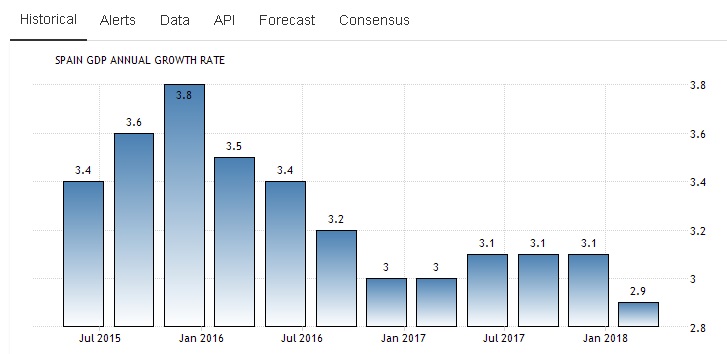
Even now, when we merely consider Spain in all this (not the smallest economy), we see (at https://www.southeusummit.com/europe/spain/spanish-economy-returns-grade/) that Standard & Poor’s is still playing (what I personally see) as ‘their little game’. Perhaps you remember ‘S&P reaches $1.5 billion deal with U.S., states over crisis-era ratings‘ (at https://www.reuters.com/article/us-s-p-settlement-idUSKBN0L71C120150203) the one quote (one of many) needs to be considered “S&P parent McGraw Hill Financial Inc MHFI.N said it will pay $687.5 million to the U.S. Department of Justice, and $687.5 million to 19 states and the District of Columbia, which had filed similar lawsuits over the ratings“. So when I see “S&P notes that Spain’s overall economic and budgetary performance has not been hampered by political tensions in Catalonia, as many had feared. The country’s GDP increased by 3.1% in 2017 and last week the Bank of Spain raised its economic forecast for this year to 2.7%, up from a December forecast of 2.4%“, you see, the numbers are not really in question, yet when we see the image below (source: Trading Economics).

When we realise that none of the EU nations has a grasp on their debts, in addition, the GDP for Spain went down whilst it is still below the numbers of 2016 and before, there is actually no reason to see the credit rating for Spain go up. I am personally speculating that the EU will be so much more hardship when France hits the 100% debt marker. It matters, because this will soon become the academic exercise that the question: ‘What is the difference between cooking the books and creating a false positive wave through inflated credit scores?‘ I actually do not have the answer here, but I guarantee you that the quality of life in Europe is not moving forward any day soon, not until some issues are seriously reconsidered. In addition, the US-China trade war isn’t helping anyone, not even the Europeans so that will also become a factor of debate soon enough. It partially relates to “We have revised upwards our GDP forecasts, with an intense rate of employment creation and an economic model based on the external competitiveness of our companies. With this scenario, we will achieve our objective for 20 million employed people by 2020“, the issue is that it is misrepresentation, you cannot rely on the unemployment figures and then state we will have 20 million employed, because on a population of 46 million, he might be implying that the unemployment numbers will skyrocket from 17.4% in 2017 to 56%, that would be crazy, yet that is what we are told, is it not? The best lies (read: miscommunications) are done through statistics, so that the feather matches the bird one would say. Still, back to my speculation, I believe that Spain is not the only nation in this setting; I think that some numbers in pretty much every EU nation are beefed, weighted and set to make Europe (or basically themselves in the European setting) look much better, so when the UK leaves they will not look as weak and feeble as they have actually become. It is a setting that is way too dangerous. There is no way that Mario Draghi is not part of this, so when we look at the Financial Times of last week we see ‘Mario Draghi acknowledges ‘moderation’ in Eurozone growth‘ (at https://www.ft.com/content/3e20b49e-4939-11e8-8ee8-cae73aab7ccb). So with “Analysts said that Mr Draghi’s guarded language suggested that the ECB may wait until July — a month later than previously expected — to provide the markets with updated “forward guidance” on its plans to phase out the crisis-era stimulus“. I am a little less optimistic in regards to the quotes, and when we see ““Better safe than sorry was the motto of the day,” said Dirk Schumacher, economist at Natixis“. I personally tend to see that as:

Better safe than sorry
It allows for another day without worry
As we pile the worries and woes
To a stack we can blame on crows
Those at the London Tower are best
Because when they leave the EU we can make them the jest
And when our barge is no longer secure
We move to Wall Street where we can endure

You might think that I am merely making light of all this. The issue is that people in Europe seem to ignore that over €2,000,000,000,000 was printed without the validation of treasuries or consent of the people whose funds got devaluated even further. Do you think that printing money has no cost? It is money that the EU never had, so why did you think it came without consequence?

This partially (and I mean partially) is seen in different ways when we look at an article from Reuters merely two weeks earlier (at https://uk.reuters.com/article/uk-ecb-policy-draghi/stock-volatility-no-big-factor-for-ecb-so-far-draghi-idUKKBN1HG1VR) ‘Stock volatility no big factor for ECB so far – Draghi‘, now I agree that volatility will come and go, so the ‘so far’ part is perfectly fine. When we see ““While we remain confident that inflation will converge towards our aim over the medium term, there are still uncertainties about the degree of slack in the economy,” Draghi said in the ECB’s annual report“, now I can agree with that. There will always be a certain amount of uncertainty, that is all good, no issues there, but it is set on a certain premise. When we see that Spain (the only visible one) suddenly in opposition of what I see as real has its credit score increased and as such we see the start of an optional bubble, when others do the same we see the forecast on unreal values, so we see the bubble is not set to the reality of the actuality, at that point, when a lot more start realising that some numbers do not make sense, the uncertainty grows and the closer the UK is to leaving the stronger that uncertainty becomes. At that point we see a run and a total collapse, when that happens, when the people realise that pensions before 78 is no longer optional, do you think that the people will remain calm? When they realise the impact of €2 trillion printed cash is impacting the 26 nations, how much value decline will they face? When that happens, how will people react in all this? Now we get to two elements, one is the mention in the Financial Times where we see: “But the weak economic data for the first quarter have triggered increasing speculation that the first interest rate rise will be delayed until later in 2019. A smaller number of analysts are expecting the bank to continue QE into the new year“, the second is that the entire stimulus was to set the economy right, which did not happen, now set that against inflated credit scores, inflated economies and the downturn that follows, that will happen, it can no longer be contained, merely delayed to some extent. When it does hit Europe would not have a penny left to balance against and it will leave the bulk of Europe destitute. There would be no defence against the next downturn and that is when disaster will truly strike. So as the story is pushing towards ‘protectionism’ and ‘patent values’, we should also consider that impact. Now, as a University graduated Master on Intellectual Property rights, I do comprehend some of the issues, yet I am not a patent attorney, so there are parts that I will ignore or not look at. Consider that a national economy is now more and more dependent on the national patents and the represented value that they hold. Now we get European Patents, the Unified Patent Court (UPC) allows for a simpler way to get it all registered and to some extent enforced. So it is a good thing overall, there was never too much fuss about that side, yet the one strong economy (Germany) is now setting the stage to oppose the UPC, we see this (at http://www.ippropatents.com/ippropatentsnews/europenewsarticle.php?article_id=5725), where we also see “Alternative für Deutschland (AFD) has called for the repeal of the convention on a Unified Patent Court (UPC). AFD “rejects the EU patent law reform”, according to the German Bundestag, which announced the motion on 7 March“, I believe that overall the UPC is a good thing, but there will always be small interests that are not perfect, no EU setting is 100% positive, yet overall, to get one filing for all EU nations, in light that even the UK agreed (and ratified) is a good thing. So when we see “It was based on three grounds, mainly how the UPC Agreement violates EU law, the majority requirements of basic law, and does not comply with the rule of law principle related to judicial impartiality. The complaint was scheduled to be heard in 2018 by the second Senate, appearing as the 11th item on its agenda. In Germany’s 2017 federal election, the AFD won 12.6 percent of the vote and received 94 seats, the first time it had won seats in the Bundestag“, there is an academic setting, yet with 12.6 of the council in hands of the AFD, a very Brexiting minded party, or is that Berlout or Deutchleave, we need to realise that the patent issue is a lot more biting in Germany and that cannot be ignored, as they give rise to uncertainties. So when we get back to the uncertainty there, as well as other uncertainties, and whilst we saw Mario Draghi accept that uncertainty results in stagnation, how much more stagnations are required for the next downturn, even a short term one, whilst the economic reserves have been already been drained.

Now we have a much larger setting, the EU was never about everyone agreeing on everything and the economic setting that requires that to happen at present is also making the dangers of waves that sinks the barge called EU. Now, that seems like an exaggeration, but when you realise that the German anchor is the only one giving stability, you can see the dangers the EU faces and more important, the dangers of no reserves and an utter lack to keep proper budgets in place, a setting now in more danger for the reasons that I gave supported by the economic views of many others. I believe some are downplaying the impact, yet when we realise that EVERY European Union government is downplaying the economic impact (as every nation always wants to look as good as possible, which is a PowerPoint setting of the human ago) we get a much more dangerous setting. We accept that the smaller nations have a negligible impact on the whole, but on a ship that can only remain truly stable with four anchors, losing three is a much bigger disaster than anyone realises, and that downplay will hurt all the players that are part of the EU, so when the downturn starts, we will see kneejerk movements from all the nations, all the big players and we can only speculate the fear mongering speculations that the IMF will treat the European audience to. I have no idea what form it will take, but when it happens I will take a deeper look. In a setting where every negative economic milestone could lay waste to whatever reserves its citizens wrongfully thought they had in the first place.


2 Comments

Filed under Finance, Media, Politics, Science

Are there versions of truth?

It is a question that has haunted plenty of people, you see there is just one truth, although, is that ‘there is your side, my side and the truth’; it comes from Robert Evans ‘The kid stays in the picture‘, a 2002 documentary. We have seen the quote is several works including the famous Sci-fi series Babylon 5. The fun part of this is that the three parts are all based on honesty, yet it is more than just a matter of perspective. I have always known that, although the interaction of perception and observations is something that needs to be in a book, not on a blog. So when I was confronted with the site ‘Seeking Alpha‘, which was described by the Wall Street journal in 2014 as “SeekingAlpha.com predicted stock returns, as well as earnings surprises, above and beyond what was evident from Wall Street analyst reports and financial news articles” is from the article more than just that. The article (at https://seekingalpha.com/article/4168001-investors-face-moral-dilemmas-investments-saudi-arabia) gives us ‘Investors Face Moral Dilemmas with Investments in Saudi Arabia‘, can be countered with ‘every investment has a moral dilemma’, so that is not much to go by. Yet the setting of a 500 billion market where we see the foundation with “A component of the Saudis’ Vision 2030 is to create an indigenous defense industry one that will promote volatility, not stability, in a region on perpetual warfooting“, gives me not the shivers, but the contemplation of what game is played. You see there is no doubt that Saudi Arabia wants to create an indigenous defence industry; every nation wants that, especially when it has been under threat for many years. I would have told Crown Prince Mohammed bin Salman if he would respectfully consider buying Remington as it is bankrupt and going cheap. The excellence of its weaponry, weaponry that have made it to the most elite parts of the global national defence forces is not just a matter for defence, hunters and others revere the weapon for its standard of excellence and it is not a bad place to start. You see, that is merely one path, in all this the setting of ‘one that will promote volatility‘, is not only not a given, I wonder where Seeking Alpha got the data in the first place to make that assumption. When we accept that there is an optional truth, there should be a look at the antagonising party, namely Iran as well, in that regard we see (at https://seekingalpha.com/instablog/776842-investorideas-com/5152941-cryptocorner-iran-developing-cryptocurrency-japan-s-sbi-launch-exchange-australia-cracks-icos), “Iran is progressing with its own crypto currency project despite having banned crypto trading in local banks according to a report at Reuters. Information and Communications Technology Minister Javad Azari-Jahromi said the ban from Iran’s state bank would not apply to development of a domestic crypto currency“, as well as “Equally, if not more importantly, investments by Russia’s oil and gas companies in the development of oil fields in Iran may exceed $50 billion, presidential aide Yuri Ushakov told reporters in early April” (at https://seekingalpha.com/article/4167229-effect-unilateral-u-s-sanctions-irans-crude-oil-production?page=3) and in finality we see “On Sunday, pro-Iranian Shiite rebels in Yemen launched a missile attack on Saudi Arabia targeting four cities. The Saudi air defense intercepted the missiles, however, one person died and two others were hurt by shrapnel. Saudi Colonel Turki al-Malki made it clear who Saudi Arabia thought was to blame: “This aggressive and random act by the Iran-backed Houthi group proves that the Iranian regime continues to support the armed Houthi group with qualitative capabilities…”“, which we get from the article (at https://seekingalpha.com/article/4159016-7-missiles-closer-iran-war-100-oil) called ‘7 Missiles Closer To Iran War And $100 Oil‘. So now we see two parts, we see Saudi Arabia accused of volatility and ion all this the aggressor Iran is not painted in any way in any of these mentioned articles merely defined as ‘Pro-Iranian rebels‘, the fact that those rebels cannot afford any missiles and for the most they lack the ballistic skills as well as deployment and knowledge of GOLIS firing solution systems, issues like deployment, missile calibration and beyond that there is setting the precision of the missile by making sure that the electronic settings are correctly tweaked and calibrated to interact with the information that the targeting hardware offers. All that requires skills, skills that the Yemeni do not have, but Seeking Alpha is all over that and, oh, actually they are not!

So in the $500 billion setting of growing the Saudi industry, one valid component is now the stuff of moral discussions and the setting of unproven volatility, can anyone explain why Seeking Alpha has released 7 articles in the last 24 hours on Iran, where one shows opposition between the Iranian judiciary and the President on ‘disrupt national unity‘ in the setting of ‘Rouhani opposing banning social media networks, as he attempts to open up the country to the outside world‘, there is not a moral dilemma here? Or perhaps it is not a setting for volatility whilst the growing of Iranian civil unrest is currently seen as a given. So how do we not see in more articles that for the speculative person investing into Iran is facing all kinds of risks from Iranian civil unrest?

Yet it is that setting that we can all easily check on how certain paths are played. We can see this in another way as well, when we see the French visit; we see “Macron had come to Washington in a bid to convince Trump to remain in the deal. He proposed “pillars” for adding to the existing deal, including extending it for the long term, limiting Iran’s ballistic missiles, and dealing with Iran’s involvement throughout the region“, whilst in the article regarding Crown Prince Mohammed bin Salman we see “Regardless of his charm, offensive MBS will continue his extreme ruthlessness, admittedly a de rigueur requirement in a tough country and even tougher neighborhood especially because his radical changes have created many internal enemies“, we also saw “Saudi crown prince Mohammad bin Salman (MBS) wrapped up his well-orchestrated and unprecedented “meet & greet”, “press the flesh” two-week April tour of the US with the icons and titans of three primary industries in his effort to diversify the Saudi economy as part of the ambitious Vision 2030 plan“, yet nowhere do we read an optional: “Success can only come from a vision, brought by a visionary. We are a nation with resources, with options and opportunities. We are more than the oil that is acquired from our soil, we can and will harness resources as well as investment opportunities to stimulate our economy and diversify our revenues. Our nation sitting central between Africa, Asia and Europe should have been more about growing that advantage and now we will, we have the foundation to grown in technology, in minerals and in services to be a global player, we must take that opportunity before it is lost to us forever. It’s not a fast path, and to do this properly we must grow over the next 12 years to be able to become that global powerhouse“. Well, there is one place where something like that can be read, it is the introduction (at http://vision2030.gov.sa/en/foreword), where we also see a lot more on the Islamic part on Saudi Arabia, which is perfectly valid. So when we go to http://vision2030.gov.sa/en/node/125 we see a massive amount of programs all set to push Vision 2030 forward and the interesting part in that is that there is not one mention of the words ‘defence’, ‘Army’, ‘Navy’ or ‘Air force’. Even as I am convinced that growing national defence is part of that, my wonder is that with all these options and opportunities, Seeking Alpha resorted to the Moral part of a defence structure that is nowhere near a central part of the Vision 2030 brief. We know that Saudi Arabia has the option to go full G5 from day one and the investment options there are massive opportunities not to pick up millions, but billions. Yet the issue becomes larger when we see that the writer Albert Goldson has plenty of experience and should be well aware of commodities (read: he is a bit of an expert according to sources), so when we set this against the view of Bengt Nordström, CEO of consultancy Northstream who gave us last year “growth in the industry has disguised not only the fact the telco industry is largely a commodity, but also that it has not been hugely innovative for a number of years“, that in light of the upcoming 5G, where ‘first in, soaring profits’ could surely be a given, none of that is shown, merely the fact that Saudi Arabia is allegedly about ‘volatility‘, so whose buttering the bread and who is that sandwich being made for?

Another part not shown was ‘Advancing pharmaceuticals and patient safety in Saudi Arabia: A 2030 vision initiative‘ (at https://www.sciencedirect.com/science/article/pii/S1319016417301780). Here we see “A recent conference in Riyadh, sponsored by King Saud University, sought to discuss these issues and develop specific policy recommendations for the Saudi 2030 Vision plan. This and other efforts will require more and more creative educational programs for physicians, pharmacists, hospitals, and patients, and, most importantly evolving regulations on quality standards and oversight by Saudi health authorities“, let’s not forget that we are in the beginning of all this, there is 12 years, which will go quickly I’ll grant you that, yet in all this the opportunity to grow Patent Law, Law firms, and set proper markers in place would be an essential step before such a level of patent bearing change comes. The option for Pharmaceutical investment was not shown in the article, or the mention of the issues shown at https://ncusar.org/programs/17-transcripts/2017-06-20-burton.pdf (attached). So, I am not opposing that there is optionally a need to grow the national defence industry, but is that set in the right light? In the light he gives the investors (which is his right to do), we see “However, for the moral implications mentioned with respect to the development of an indigenous defense industry, check your moral compass. From my perspective, it’s a financially profitable but morally bankrupt undertaking“, yet what morally bankrupt idea is there on growing the pharmaceutical and mobile network industry? they are highly profitable if it is achieved and there is moral question, my moral compass is setting on the field asking Albert Goldson, a member of the Association of Former Intelligence Officers (AFIO) and an Associate Member of the Foreign Policy Association (FPA) why he missed on those options. Also in the view of two dozen projects that are openly stated, why would he focus on a part that represents merely 10% and focus on those two dozen programs, where the investors would find the gems that the investors would want to find in a $500 billion layered cake called ‘Vision 2030‘. Oh, as for that military part, the attached Burton presentation ‘Opportunities in Saudi Arabia – Vision 2030 and Beyond‘ spends two slides on it and the most important part shown is “Vision 2030 calls for 50 percent of military equipment purchases from domestic suppliers instead of imports“, whilst also mentioning that the Kingdom of Saudi Arabia (KSA) “spent a total of over $63 billion on defense and security in 2016, including off-budget spending“, so when we see that, we see that for the smart investor there is an optional $30 billion a year available for those who might not have a moral issue working on a government set national defence program. That in light of Iran delivering missiles hardware and support to non-combatants, which are rebels at best, yet terrorists might be more apt when we consider “Nasrallah’s letter is proven evidence of Iran’s involvement in the Yemeni civil war, since it shows that Hezbollah, which is financed by Iran, is taking part in the fighting in Yemen” (source: Jerusalem Post). So where exactly does Seeking Alpha stand? Let’s be fair, they can be in any place they like as they are merely advisors towards their investors in all this, yet even with my high moral (or is that outspokenly oral) I would not turn away from a $32 billion market, especially if I had that level of cash. Oh, and whilst you consider on where morality needs to be, Boeing, Lockheed and Raytheon have already signed up, so the delay you took made that cake a hell of a lot smaller, but even if there is still $2 billion up for grabs, would you walk away? Let’s not forget that next month’s rent is due!

So in all this, I never stated or implied that Albert Goldson lied to anyone. Yet when we consider there is your side, my side and the truth, what did we see? You see, I get back to perception versus observation. Through perception he is focussed on the defence part, but why? The shifted setting towards Saudi Arabia will impact something else, but what else is impacted? That is the question, is it the Iranian setting (when considering the other articles), is it something else entirely, or is Albert Goldson focussed on something beyond all this? It is a speculation from my side, yet the absence of the Pharmaceutical and Mobile Industry absence implies just that, yet in equal measure I will state that this would merely be my perception, based on all my observations. That is part of the setting. In the realm of ‘there is your side, my side and the truth’, it becomes more and more about observation versus perception. In a case like this, when there is $500 billion on the table, is the perception the amount on the table, or the observation of whom else is at that table that matters. Is that merely an observation or does the perception become: where is MY opportunity? Because in the end that is what the investor cares about, and moreover, where and what size their slice of the cake becomes.

In addition, my observation will be that the changes mean that there are new players and some of the old players have been so well fed for such a long time, in this ‘parting might be such sweet sorrow’ (Romeo and Juliet Act 2, Scene 2), yet for the previous players it will be over their dead bodies, that tends to be the gist of it. The change needs to be observed because it shown also where the pressures of the players will be and that pressure can be seen as cost and risk. It is the wiser player that makes it through and gets the slice of the $500 billion layered cake; it is merely the question on the size of the slice and the perception of the profit it allegedly holds.


2 Comments

Filed under Finance, IT, Law, Media, Military, Politics, Science

The rocky road of Congress

There are issues all over the Middle East, and whilst saying that, we see that the UK and the US are now ‘caught’ with their fingers in the big pork pie.

The setting is best seen when we start with the Israeli Haaretz. The article (at https://www.haaretz.com/middle-east-news/top-three-stunning-admissions-from-the-top-u-s-general-in-the-region-1.5910066) gives an initial view.

The title ‘Iran, Syria and Saudi Arabia: Top Three Stunning Admissions from the Top U.S. General in the Middle East‘ sets the pace to the smallest degree and sets the topics to a much larger degree. So let’s take a look.

  1. Assad has won
  2. Iran deal should stand
  3. Saudis use American weapons without accountability in Yemen

Each of these three settings are partially a given. In the first we see that as Lt. Col. Dmitry Utkin has been successful in setting the pace and the plays that are about to follow. Yevgeny Prigozhin, who is linked in all this gives the push for Concord Management and Consulting as well as its subsidiary LLC Megaline, a large push for optional multi-billion dollar contracts. It is yet unconfirmed what exactly will happen, but the setting of the end of the Syrian war will have long lasting repercussions in the Middle East. It is also the first setting where there is a very clear indication that the influence of the US is declining. It will quite literally need to cater to the needs of Saudi Arabia for a much longer time to undo the damage that inaction has brought to the US. So whilst the world is getting torpedoed by news, fake news and gossip regarding to the US and the Internet Research Agency (IRA), there are more and more indications that LLC Megaline is moving beneath the radar to start setting up their infrastructures to grow close to 500% and become the construction facilitator primarily for Syria and after that who knows. Let’s not forget that the $500 billion required for NOAM will go a lot further than Saudi Arabia by its self can currently facilitate for. So as America has been making gruesome steps towards optionally fumbling the collaboration it had created and grown over 75 years. As we were treated earlier this week (at http://thehill.com/opinion/national-security/378132-us-must-push-saudi-arabia-away-from-the-chinese-model-of-governance), so when we see “The widespread concerns are that Saudi Arabia simply won’t meet the stated targets set by Vision 2030. Facing a demographic tidal wave — nearly 45 percent of the population is under the age of 25 — Saudi Arabia needs to generate millions of new jobs to absorb a growing workforce it can no longer afford to subsidize through generous government handouts“, that whilst the US has been unable to even closely set its own agenda for, at times, no more than a quarter in advance at each stage and ending up missing their own forecasts by a lot, we see here that the vision that requires another 12 years is already set to fail, according to the Hill. Now, there is a clear setting that things have to change and there are changes coming, there are even more optional changes in the works as the EU has been playing the wrong settings to cater to the wrong people, in addition, the stress settings between Turkey and several European nations are now impacting a little wider than before. You might see this as separate and as acts they are, but the impact is much wider. France is getting less and less obliging towards Turkey in regards to the Afrin offensive, and the Turks are also getting less and less warm receptions from the Netherlands, so there are political stress situations all over the place. So as we now hear (at https://www.reuters.com/article/us-swiss-turkey/swiss-investigate-alleged-turkish-attempt-to-kidnap-businessman-idUSKCN1GQ2UD) that allegedly accuses that “Turkish diplomats planned to drug and kidnap a Swiss-Turkish businessman as part of a crackdown after the 2016 coup attempt in Turkey“, we see a new iteration of cooling notions. These matters have an impact to a larger degree. You see, there is not just the Saudi issue, issues 2 and three all include Iran, not merely the nuclear deal, but the Houthi support that Iran is giving with the supply of missiles and other goods is still largely ignored by too many players. It is a setting of filtered views, trying to isolate the players and deal with one sided responses. It is the Yemeni setting that makes that utterly impossible. So as we see on one side “The Senator followed up, citing reports that U.S. munitions have been used against civilians in Yemen, she asked, “General Votel, when you receive reports like this from credible media organizations or outside observers, is CENTCOM able to tell if U.S. fuel or U.S. munitions were used in that strike?” “No, senator, I don’t believe we are,” he replied“, we are shown a one sided part in all this that a significant amount of acts was to act against the Iranian missiles as they were targeting civilian areas. That part remains unasked. So in all this, as we realise that Democratic Senator Elizabeth Warren is one of the smarter cookies in the US Senatorial jar of cookies, we need to wonder on her actions and her reasoning. The idea that the US (especially the democrats) needs the nuclear deal to hold, whilst we get (at https://www.ft.com/content/22845a20-27d2-11e8-b27e-cc62a39d57a0) an accepted view from the Financial Times with “The US will on Thursday ramp up pressure on European countries to “fix” a landmark Iran nuclear deal that president Donald Trump has threatened to scrap“, with in addition “A state department spokesperson said: “This is a last chance.”” we know that the end is nigh for that bad situation. It is more than Israel wanted, the additional settings that we see is that the US has played a very dangerous game on the Turkish, the Iranian and the Saudi side, whilst there is enough indication that they never had the Trump cards to make it happen. That view is given more strength when we see “The senior US official said “it was diplomatic malpractice to exclude missiles from the original deal”, adding that long-range missiles are inherently associated with a nuclear weapons programme“. In that regard, it is not just the acts of the US, but the EU and UK players in all this will also be given the spotlight. As we see that things were missing, the hasty excuses like ‘there was no time‘, or ‘this was as good as we were going to get it‘ will hit back with enormous force as it gives more and more view that the initial views of Israel were correct. Now as there is an increased escalation with Iran, it is the view we see (at http://www.bbc.com/news/world-middle-east-43419673) where we see “Crown Prince Mohammed bin Salman told US network CBS News his country did not want to acquire nuclear weapons. “But without a doubt, if Iran developed a nuclear bomb, we would follow suit as soon as possible,” he added“, which now gets us in that stage that comes with the Hollywood phrase ‘This shit is getting real!‘ It was the setting that Israel had dreaded for the longest of times and whilst that shit is getting real we see, or better stated, we should see that the escalated and unbalanced pressures are showing the EU as well as the UN to be set as paper tigers that have no power and in the end no options. It is like Reuters stated in regards to the Council of Europe Commissioner for Human Rights, merely “a 47-nation human rights body that has no legislative powers“, yes that was a setting that really helped it all along, were they not?

It goes further than this

You see, some of the players are waking up (or so it seems), with ‘GOP leaders want to put off Yemen war powers vote’, (at https://edition.cnn.com/2018/03/15/politics/yemen-war-powers-vote-congress/index.html), they realise that the setting is less clear, there are intricate settings that have been ignored by some of the players (read: Democratic Senator Elizabeth Warren), the issue is not how, what, when, where or why it was done. With “GOP leaders would prefer to put off a final vote on the divisive issue until after it can be more closely studied in committee” it is not merely a stalling tactic (stalling might still be a factor). The issues that Democratic Senator Elizabeth Warren danced around are still very much on the table for the governing party and in all this it is also squarely on the plate of Mike Pompeo, who, if confirmed, as Secretary Of State, will need to make sure that his office does not become the SOS signal that breaks the loom before the strings in all this have been separated, untangled and isolated so that the matters do not become some Gordian knot that ends up pushing Saudi Arabia, Iran, Egypt, Qatar and Turkey over some edge, because these connections will set flame to the threads connected to others on the loom of diplomacy. Even as we are ‘treated’ to news items like ‘Iran-Qatar alliance deepens, says Iranian naval official‘ and ‘Iran stands with Qatar, says Guards official‘, the truth remains that a direct head to head with Saudi Arabia is one that Iran is reluctant to have, because when it comes to making choices between Saudi Arabia and Iran, there is clarity that the US, many European nations as well as Israel, pretty much none of them will support Iran, as the deepening cliffs are drawn between the EU nations and Turkey, the support it had with Turkey could essentially fall away further, and in that Turkey has been famous for merely supporting whatever pleases Turkey, getting in bed with Iran that deep is a choice Turkey will not be willing to chance. In all this Iran requires players like Qatar to make the blunders of setting themselves into a light of harm whilst Iran plays the ‘I know nothing‘ card.

A game that ends even before it starts in all earnest. So in that regard, the second and third setting we saw in Haaretz will have stronger impacts and the entire Yemeni setting will not be played out the way some would like that to be. that part was seen merely an hour ago when Reuters (at https://www.reuters.com/article/us-usa-yemen-mattis/mattis-dont-restrict-u-s-support-to-saudi-led-forces-in-yemen-idUSKCN1GS00N) gave us “Defence Secretary Jim Mattis defended U.S. military support to Saudi Arabian-led coalition forces in Yemen on Thursday as he explained a personal appeal to lawmakers who are considering whether to end Washington’s involvement in the devastating conflict“, and it is not merely in regards to support. When it comes to appeasing Turkey or Saudi Arabia, having strong ties with Saudi Arabia would be roughly 1,000% more important than anything else and not in the smallest regard for economic reasons. So as we earlier (in previous bog) saw that what is now stated by Reuters as “A bipartisan group of senators, Republican Mike Lee, independent Bernie Sanders and Democrat Chris Murphy, are attempting to take advantage of a provision in the 1973 war powers act that allows any senator to introduce a resolution on whether to withdraw U.S. armed forces from a conflict not authorized by Congress“, we see that congress might be having the right cap on whilst considering this, the cap would prove to be a massive blowback for Saudi-US settings in the Middle East for the longest of times. So as we might to some degree agree with “Lawmakers have argued for years that Congress has ceded too much authority over the military to the White House. Under the Constitution, Congress – not the president – has the authority to declare war“, we need to also see that the US has not declared war against Yemen, it merely is seeking to stop the Iran-aligned Houthi rebels, a group has been firing missiles into Saudi Arabia as well as target commercial vessels off Yemen’s coast, 2 acts that should never have been allowed for in the first place. The US could have a clear setting in those two parts and as such a larger repair of status would be to be more vigorous in countering merely those two dangers anyway possible.

And in all this there is one final danger that the US desperately needs to negate and they do not have a lot of time to achieve it. You see as the Syrian issues are drawing to a close, it is not impossible that PMC Wagner would be growing its influence by offering support to Saudi Arabia against Yemen. You see, Iran painted itself in a corner by denying the weapons shipments to Yemen. In this the strategy becomes that either Iran walks away, or locks horns with Russia too. So as we see “The Iranian Minister of Defence Amir Hatami has denied the allegations about the presumed shipment of weapons to Yemen“, the door has been opened and now Yevgeny Prigozhin as well as Lt. Col. Dmitry Utkin could end up visiting Crown Prince Mohammad bin Salman, in his role of Minister of Defence and offer to solve the Yemeni issue. Should that happen, which is largely speculative from my side, the Russian delegations would receive a much larger opening of the door of opportunity in the Middle East as well as optional access to offer services towards NOAM, a situation that must be the stuff of nightmare legends for the US (as well as for the UK to some degree).

If that happens, it is expected to happen before the end of July, so we will know then and I could be wrong, but when it comes to business opportunity we have seen Yevgeny Prigozhin take the lane of opportunity in the quickest way and there is no way that he does not want a slice of that $500 billion Lemon Meringue Pie, or as he would be calling it the: Kremlin Profit Sharing Money Supply, a refreshing desert that is as rhymed as the Kremlin could get it with the available Horn of Plenty for all who agree there.

Do you still think that my speculation is that far off? I do not hope to be right, but knowing how the souls of greed move; the chance of me being wrong is declining really fast.

All because some of the players have (as I personally see it) their own ego’s and personal needs in the play and not the national needs they had to serve, the long term needs that is, because there is no doubt that some of these sparks are the direct consequence of short term thinking.


Leave a comment

Filed under Uncategorized

The Global Economic Switch

There is a shift going on, now this shift is still in the planning stages, but the switch is very real and as we see the crumbling switch from enabler and entrepreneur, the US is moving towards becoming a mere consumer and dependent user. That is a switch some might have seen coming, others have not seen it at all and some are still in denial, claiming it is a short term inconvenient stage. I have no idea which is true, but the events that are a given are showing to be more than a mere short term event and the diplomatic impact will equally show to be a long term impact on what the US had and what it will become. Now there are indicators, but the image is not seen in a single view, so let’s paint this picture for you whilst adding the sources.

Saudi Arabia

The Saudi Arabian announced investment (at https://www.cnbc.com/2018/03/05/saudi-arabia-and-egypt-agree-to-a-10-billion-deal-to-build-a-new-mega-city.html), is actually a lot more than the $10 billion forecasted, because the value as I showed in over the last year is more than becoming a reality, it is now in a planned stage, and planned much larger than I foresaw it going. It starts with “Saudi Arabia and Egypt have agreed to create a $10 billion joint fund to develop a mega-city in Egypt’s southern Sinai Peninsula, with both countries committing more than 1,000 square kilometres (386 square miles) of land to the new project“, you see, depending on the distance from Sharm-El-Sheikh the infrastructure will grow much faster and even as they will rely on what Sharm-El-Sheikh has, the growth of this new Mega-city could be the start of the tech-hub that benefits both Egypt and Saudi Arabia. As the technology hubs grow, so will the economy. It is also the first part to start getting combined 4G/5G preparation in place, because as this technology becomes available Saudi Arabia now has a first advantage in both upgrading its services and that gives optional access to 23-32 million out of a 95 million population. With the tech hubs, both the Sinai one as the half a trillion dollar NEOM, there will be a massive growth in dependency and requirements for technology. There is in addition, the Barcelona World Mobile Congress where on February 26th Huawei announced its full range of end-to-end (E2E) 3GPP-compliant 5G product solutions, now the other players will be following, yet Huawei has an advantage for now. With “The featured products are also the only available options within the industry to provide 5G E2E capabilities” we see that Huawei has chosen a path that allows them to grow and they will not be alone, but for now they are ahead of the crowds, so even as we see now “Huawei partnered with Zain Saudi Arabia, signing a Memorandum of Understanding promising to develop a new network strategy in the Kingdom. The aim of the MoU is to accelerate the realization of 5G networks and assist Zain in building the most advanced end-to-end networks in the region. The two companies will work together to accelerate the deployment of 4.5 to 5G networks, make further advances towards full cloudification, and produce additional strategy and planning in the field of ICT Synergy Cloud” (at https://www.arabtimesonline.com/news/huawei-outlines-vision-5g-future-co-unveils-latest-innovative-products-solutions-mwc/) merely a day ago. I gave that indication almost two weeks earlier, so how is that for a prediction. So even as the US is setting the bar at “Chicago, Los Angeles, Dallas, Atlanta, Washington, DC and Houston” to be the first with 5G at the end of the year, what happens when you need to reach out to Wall Street and Manhattan? Will that be merely 4G, or will you suddenly experience other issues (between providers, reception issues and so on; oh, and as you go from protocol to protocol switching per cell tower on the move, watch that battery power drain as the battery percentage goes down like a timer in seconds 75, 74, 73, 72, 71 and so on. Please do not take my word on this, it is much better when your own eyes see the battery counter go down, it adds to the dramatic effect when you hear me howl with laughter (stating: ‘I told you so’). So even as the article ended with “Ken Hu, Huawei Rotating CEO, said: “The intelligent world is drawing near, filled with potential and possibilities. Ground-breaking technologies like 5G and IoT promise to solve complex business challenges and improve the lives of the population. Yet challenges remain on our path before these dreams are realized. MWC 2018 was an excellent opportunity for us to meet with other leading companies and discuss how together we can overcome these obstacles, achieve sustainable business growth, and Build a Better Connected World.”“, I will admit that I have an issue with that part, you see with ‘IoT promise to solve complex business challenges‘, we see the implied solution, but the IoT (Internet of Things) is merely the applied hype word in a solution that has not been designed yet. It is true that the application of IoT is a solution in itself towards a whole shoal of options and challenges, but as we consider that the 4G smartphone brings solutions, it requires the apps to be there and solve actual settings and that takes time, like all other needs. In that regard I see the IoT as the old sales technique of selling a concept before the product exists and I always thought that to be a broken non resolving approach to the greedy salespeople coming with a ‘pay it forward’ solution that is paid for before the product has been completed. It is a dodgy need, because in the end the (business) consumer needs and actual product to work with. Yet that might just be me imagining things.

United States of America

The view here starts with the Financial Times, who brought us ‘Currency markets send a warning on the US economy‘ (at https://www.ft.com/content/de57a6a2-1e32-11e8-a748-5da7d696ccab). So even as this is about the financial markets, there are a few points to take away from that. First there is “The pattern of higher interest rates and a weakening currency suggests that on multiple dimensions US assets now have to be put on sale to convince foreigners to hold them or induce Americans not to diversify into overseas assets. This pattern is relatively uncommon in the US though it happened in the Carter administration before Paul Volcker’s appointment as chair of the Federal Reserve and in the Clinton administration before Treasury secretary Robert Rubin’s invocation of the “strong dollar” policy. It is fairly ubiquitous in emerging markets where it reflects anxiety over a country’s policy framework“. The dangerous part here is ‘convince foreigners to hold them or induce Americans not to diversify into overseas assets’; you see it is a move of limitation, either the non-American buyer holds onto the for a much longer time, which needs convincing (usually with higher yields), as well as stopping Americans to go overseas into other markets, so it is not actually an ‘or’ situation, it is actually an ‘and’ setting where the inclusion needs to be both to remove doubt and volatility. The article ends with “The confidence of global markets is much easier to maintain than to regain. Currency markets are sending a signal that the US is not on a healthy path. Its time for the US to strengthen the strong fundamentals on which a strong dollar and healthy economy depends“, you see that view is set not merely in the war of tariffs, it is set where the global markets have been seeing a decline in US activity and more important acts that show that the US economy is feeble and the US infrastructure is not in strength, it is merely getting by and that is a dangerous place to be in. Even as I predicted that the inactions and the inability to act against Russia will be felt when Russia calls the bluff of America, it is now showing that the US on a larger scale is showing to be set towards a series of hurdles that will stagnate its economy and over the long haul (within two years) will show the danger of another recession, so when that happens and projects get halted, how will Sprint and other players pay for 5G? Entrepreneurial innovation tends to demand buckets of cash, cash that is not available, certainly not readily. Protectionism is merely the first hurdle and one of at least three in the setting of the tariff war. The Financial times gave the people the biggest fear and doubt on February 21st with “US ‘too big to fail’ regime set for Trump overhaul“, that ‘too big to fail‘ has been used before and a whole bunch of billionaire grapes got bitten rather badly in Europe. It is not merely the Chapter 14 implementation with the by-line ‘to shield the tax payers’, it is the text “Both Wall Street and overseas regulators have warned the administration over the dangers of dismantling the system but the Treasury said it wanted to narrow its use so it could serve only as a last resort“, the fact that ‘narrow’ and ‘Wall Street’ imply that the Chapter 14 will lack the teeth it needs and as such it is another parachute for the 1% bankers, banks and those making upwards of $253 million a year. So how much will this marker cost the tax payers in the end? Even as there is an abundance of recession fear articles and announcements by the media at large, that part even as it is likely to happen, it is not certain to happen and that fear needs to be removed (by other means than the Chapter 14 messages). You see, the problem is that the 1% has enough wealth to survive the next two recessions, whilst the quality of life of the other 99% has not been pushing forward towards the level it needed to be. So they will get hurt really bad if another recession happens within the next 16 months, which is close to all speculated views by the media at large. Whilst that is not much of an indication, the events in Saudi Arabia is only one element, the other elements is the one we will see next

Other players

There is more than one player in all this. The first is seen by CNBC (at https://www.cnbc.com/2018/03/05/saudi-russia-oil-deal-leads-to-bigger-russia-role-in-middle-east.html), where we are treated to “The partnership with OPEC, led by Saudi Arabia, allows Russia to strengthen its hand in the Middle East at the same time the U.S. role has been diminished“, the diminishing of the US as stated by other sources closes doors to the US on several shores, a dangerous change that comes at one of the least fortunate times. The quote “it is now the foundation for a broader relationship that has the potential to reduce already waning U.S. influence in the Middle East” is foremost set to the chilling friendships with Syria and Iran, it is not merely there. Turkey has been out of control for the longest of times and now that Turkey is smelling blood, it is trying to get much more out of the US, making them a very expensive ‘friend’, more so, the question becomes was Turkey ever a friend? In that whatever bites there could hinder the US with its access to the Middle East at large. Should Incirlik and Izmir become an issue, the economic print of the US would drastically change, because that would require the US to find a way to grow the option to get a base in Saudi Arabia and optionally in Israel. Whilst neither is a given, the costs of that will be staggering and the economic footprint of the US will equally become an issue down the road. Even if there would be an option to get one in Western India (who would like that economic windfall in their region), it would be a drastic fund pressuring move for the US.
Another option would be in Egypt and if that becomes an option it would in the longer term benefit both Egypt and Saudi Arabia, whilst Egypt gets to grow its stability in the Sinai, the US would become a much larger target in Egypt, wherever its base would be placed. So that too would come at a cost for the US in a time it needs to turn over every dollar it spends. Another is Jordan, but there is no way to tell the impact, the costs and the options in that regard as I have no clear information or sources to give at this time. You see, the memorandum of understanding was signed with Jordan with Rex Tillerson a mere 3 weeks ago, so adding a conversation of adding a US base there might not be the one that would work (pure speculation from my side). In addition, the EU News (and others) who gave us “Commissioner for Trade Cecilia Malmström added: “These US measures will have a negative impact on transatlantic relations and on global markets. In addition, they will raise costs and reduce choice for US consumers of steel and aluminium, including industries that import these commodities”” gives rise that there is a cooling of ‘friendliness’ between the EU nations and the US to some degree, so there is that impact as well. I am not talking about the tariff, I am talking to the diplomatic language where Dutch Prime Minister Mark Rutte gave us “Relations with the United States can no longer be taken for granted“, which is not a good thing as the Dutch port of Rotterdam is the gateway to Germany and its industrial heart, in addition the US pressures on France regarding the Iran nuclear deal could impact the two, but that is not a given, even better, it is unlikely to be an issue, which is a plus point, for the US for now as the Italian elections are over and the anti-EU parties made a massive gain (from 4% to 18%, whilst they surpassed the Berlusconi party) is still an issue in play. I agree with the Guardian that stated that the EU-issue is not in play, but as we see (at https://www.theguardian.com/commentisfree/2018/mar/03/italian-elections-european-union-populism), the need for Berlusconi was the man to save them from populism has now become a non-reality, the impact will grow and in that matter the US would need to play nice, very nice with Italy. You see there was always going to be an issue with Matteo Salvini, yet the fact that they became the largest party with 37% was unforeseen. There is no issue with iExit as the Italian version of Brexit is called, but its anti-immigration policies will give headaches for many EU nations and as the impact of US-EU nations is cooling, becoming an enabler for Italy might be the wiser of solution for the US. The BBC (at http://www.bbc.com/news/world-europe-43294041) gives much more, but the power is at the end with “Voter frustration here in Italy but evident and ongoing in Germany too surely shows it’s time for Brussels to sit up and really pay attention“, the shown fact that Brussels have not been doing that is the anchor around the neck for the EU and that will impact the US numbers as well. Even as Germany was the biggest friend of the US in the EU, the tariff and, the EU army and the need by America for Germany to play a larger role in the EU borders (taking some pressures from the US) are all elements that put more and more pressures on the US, even as some of the needs by the US are very valid, we need to realise that Newsweek gave us “Germany’s top diplomat has told foreign policy experts that his country’s relationship with the U.S. has suffered irreparable damage under the administration of President Donald Trump“, even as the damage began in the previous administration (to a small extent), the chosen path by the Trump administration has been adding negativity to it all. Syria must be seen as the largest of catalysts in that regard, it is merely my sense of humour that the Germans see the forced ‘friendship‘ with the French as a larger issue than the actual absence of the US in all that, but that is just my take on humour.

All these elements are part of the economic switch in all this, in support of this, there are sources that show that Saudi Arabia wants to grow its arms industry and as SAMI (Saudi Arabian Military Industries) is sitting down with the Russian who are eager to accommodate, I need to wonder why the hell Raytheon and Northrop Grumman were asleep at the wheel, or decided to remain vacant from that setting. So even as Remington (American outdoor Brands) has a product of sheer excellence, they are now not at the middle Eastern table, but in a novel mentioned in Chapter 11 and seeking a quick sale, perhaps someone can tell me how much could have been gained at the Riyadh SAMI conference table? So even as we read (at http://www.business-standard.com/article/international/saudi-arabia-wants-to-make-their-own-weapons-russia-eager-to-help-118030300622_1.html) that “likely to alarm American policy makers, who worry about losing ground to Russia and China in the Middle East“, where we see that this is understated to the largest degree. With “They’re already planning to buy the Russian S-400 air-defense system, under a deal that would let them manufacture related products at home” as well as “Half of Saudi procurement is supposed to be done locally by 2030, from about 2 per cent today” we see the extent of the market lost for both Raytheon and Northrop Grumman as two of the largest players in that field. Someone (more than one player) was asleep at the helm and by playing the card of exclusivity the ended up playing the card of exclusion, which takes them out of the game as such and that is the issue in this, because as far as I see it we have not seen such a large shift of plays optionally towards Russia and away from the US since before WW2, perhaps it might be more correct that this has never happened to this degree in history, that too is a factor that must be considered; so, suddenly the extended play changes. I mentioned part of this on Feb 24th (at https://lawlordtobe.com/2018/02/24/losing-values-towards-insanity/) in ‘Losing values towards insanity‘, yet I only had some unconfirmed parts and no idea why I had some parts, I had these parts a week ago, yet all these parts came to me over the last 24 hours with 1-2 exceptions, now we see a shifted picture. When we consider LLC Megaline (as well as Concord Management and Consulting) where Yevgeniy Prigozhin and Dmitry Utkin allegedly have been preparing to grow an ICT/Mobile infrastructure in Syria, that whilst construction fortunes would be coming their way too, the entire growth with Saudi Arabia as an optional side allows those two to split a few billions between the two of them, whilst at the same time growing the other fields they have access to and get a seat at the Saudi Arabian table at the same time. A side I never saw as I did not have the information I have read over the last 24 hours. To get any additional part in that play could set me up for life within 3 years, to get a 400% better lifestyle in 36 months than the 36 years of hard work allowed me to get is what would get any person to change their pupils to dollar signs and that is merely in their need for ICT, Data farms, Mobile facilitation, Data systems, forecasting, reporting and logistical infrastructures. In all this we see the clear evidence as given by several players that is now on route in a place where the US has a setting that is diminishing, so as those currencies go elsewhere, do you think it will not impact the US economy. That is apart from the greedy pharmaceuticals that are now pushing on India for the longest time. It is an additional place where non-US players will have options to gain market share. All that because certain players in the patent field were enablers towards the few greedy US pharmaceuticals as they increasingly ‘demanded‘ more and more outside of the patent scope that was once given (the attempted Trans Pacific Partnership was clear evidence of that), now we see hat impact and the US is at the axis of an economic switch where someone else will soon decide whether that switch will be switched on or off, no longer as the setting where the US sets the status, which is something the US has not faced before ever as far as I can tell, even the 2004 and 2008 events did not remove that option from them, but that is now a reality from sources like Bloomberg, Reuters, the Financial Times, CNBC, BBC and other players are setting the view that we are getting now. Even as none as saying it outright, the news as given provides a speculated picture where that may become a reality. I do believe that it could be prevented to some extent, but at the current course of the US ‘Kingmakers’ and ‘Wall Street regents’, that reality is slowly being removed from the US table of decision makers and once that reality hits, when they have to report that the Switch is set to ‘OFF‘, the impact will hit pretty much every market where the US is policy maker.

A world where the US player involved goes from being exclusive to excluded!

I wonder how the media will then cover it and who will they blame, because they will always be about laying the blame.


3 Comments

Filed under Finance, IT, Media, Military, Politics, Science

SW2, not WW2

Is there a Syrian War 2 brewing? That was the initial thought I had when I got exposed to the ridiculous claims from Turkey this morning. There are two parts. the first comes from the Guardian (at https://www.theguardian.com/world/2018/feb/19/turkey-warns-assad-not-intervene-kurdish-enclave-afrin), the quote is “Turkey warned the Syrian government of Bashar al-Assad that it risked a military confrontation with Ankara if it intervened in an ongoing war in the Kurdish enclave of Afrin, in a further escalation of tensions that hint at the possible widening of an already complex conflict“, now, just to make sure you get this. Turkey invaded Syria for the alleged reason of coming to aid towards Assad, or perhaps merely to ‘fight ISIS‘ in a presentation attempt to silently start the second genocide, the genocide of the Kurdish people. So Turkey goes invades Syria and now states: “Turkey warned the Syrian government of Bashar al-Assad that it risked a military confrontation with Ankara if it intervened“, so how is optionally opposing an invader ‘intervening‘?

The second part comes from the BBC (at http://www.bbc.com/news/world-middle-east-43107013), where we see basically the same with ‘Afrin offensive: Turkey warns Syria against helping Kurds‘. So when we read “Deputy Prime Minister Bekir Bozdag said Turkey’s operations were going ahead as planned and it would be a “disaster” if Syrian troops were to intervene“, should we deduce that a failed introduction to genocide is a ‘disaster‘?

Even as we see the similarities, we see that the issue is larger than merely a scuffle between the Turks and the Kurds, the way we see the quotes and the way that they are reported give rise to the fact that there are other issues below the waterline. It is not merely semantics, it is the interaction that Turkey has been having with several nations gives that rise and the optional viewing of that should make plenty of people worried at the very least and decently nervous in the nominal setting of international relationships.

The BBC article ends with “President Recep Tayyip Erdogan told Russia’s Vladimir Putin that Damascus would face “consequences” if it struck a deal with the Kurds, CNN Turk reported on Monday“. So, Erdogan, President of Turkey, a person with not much diplomatic skills or powers outside of Turkey for that matter, is telling Putin….? Oh, sorry, I nearly lost my breakfast laughing myself into several layers of bellyaches. It is almost as impactful and powerful as me calling Alexander Bortnikov, telling him to give me access to all his data, or he is going to hear ‘stuff he will not like‘ (most likely me calling him a pussy). Yes, people like the President of the Russian Federation, or the director of the Federal Security Service of the Russian Federation (Федеральная служба безопасности Российской Федерации (ФСБ)) getting told by the likes of President Erdogan (or me for that matter) is something they should take extremely serious (sorry, second laughing attack, I will be back shortly). So, after I had my second laughing attack that lasted close to 611 seconds, I got back into my seat and decided to take another gander at a few parts. You see, the nice part of such short sighted actions is that it alienates the players Turkey actually desperately needs. Which in turn is making Iran more and more nervous, which is good news for several countries in the Middle East. The interesting part in all this that he BBC reported “During the course of the Syrian war, pro-government forces have largely avoided direct conflict with the YPG, but they have had sporadic clashes“, which now gives the optional food for thought that Syria might actually set some resources that way with the optional thought that they will not be targeting the YPG, because if we agree that direct conflict was never a real necessity, the Turkish forces changing that by sticking their short stick in a hornets nest, that part would be the greater threat to Syria, which now gets them into hot water is a few places and on several ways. In addition, it will also change the conversation that is going to happen in Kazakhstan in two weeks, giving more questions if there is still going to be a summit in Istanbul on Syria. The changing pressures are by no means a way to get things talked about and smoothed over. Even as Reuters gives us: “The three countries are working together to try to push the troubled Syrian peace process forward“, we need to also consider the mandate that Tehran gave to Foreign Minister Mohammad Javad Zarif as the outbursts from President Recep Tayyip Erdoğan is pushing its own agenda whilst at the same time causing chaos towards the plans that Iran seemed to be having in all this, his self-serving hatred of Kurdistan is making the creation of coalitions next to impossible. With the Netherlands adding fuel to the fire of Turkish non-diplomacy, as they have now voted to recognise the Armenian genocide of 1915, pressures are growing there too, at a time when Turkey needed every European nation to be on his side regarding the non-realistic approach to becoming an EU nation, we see that the gap is increasing beyond the chance of that ever becoming a reality. The Turkish parties kicking every hornets nest in the Middle East is not very useful. On the other hand, Turkey could decide after Kicking both the US and Russia, to see if this level of craziness is useful in Beijing, which it is unlikely to be unless they open up all kinds of open trade paths which might actually be a lot less interesting to Turkey, especially at a time when Turkey is trying to get increased Cherry exports to China in time for the next harvest, the need to grow their export which according to some is in excess of 80,000 tons, they are now in a stage where they can no longer afford to get on anyone else’s wrong side, which must be a novel experience for the Turkish Diplomatic Corps.

All this whilst the issues in Greece and Cyprus are at present still unresolved, with the Ekathimerini making a connection between the report published on March 28, 1897 in Empros newspaper where we get: “referred to a foreign diplomat who described Greeks’ behaviour in relation to Turkey as that of a dog that barks, but does not bite. We all know what followed, but we still tend to forget how bad it is in international affairs when you bark, but no one really feels any threat“, and the escalations on gas resources at present, that whilst there is a certain logic to make the statement, especially when we consider Europe, NATO and the UN is seen in relation to: “where tensions broke out between Greece and Turkey, these organizations never really offered anything more than carefully worded statements“, that is the situation when we rely on the paper tiger to get things done. So when we read: “Athens must be very careful in weighing its next moves. It’s a balance of terror. If it shows compliancy, one can’t be certain where the other side will stop“, whilst we all know perfectly well that Ankara will not stop until forcefully halted. As the article ends with the absence of emotion in the Turkish-Greek debates, the issue is that the theatre is getting prepared to get very emotional from more than one side. Turkey almost has no options left after kicking all the wrong shins. In my view, when Syria escalates and escalates in one wrong direction we will get a flood of orchestrated news (whilst journalists have been sentenced to life in prison) and from there onwards it becomes a long winded marketing campaign, because Turkey seems to be realising that the US, the UN and Europe are all about statements and statements alone. Which is a dangerous game as it could press towards a second Syrian war where the Syrian Kurdish area could get annexed into Turkey and its population would optionally somehow mysteriously vanish.

So, how should we see the optional threat of a second Syrian war? that is hard to see, with too many high level meetings, with the latest addition being one with the Russian President Vladimir Putin, Turkish President Recep Tayyip Erdoğan and Iranian President Hassan Rouhani to meet in April in Turkey, there is no telling what it will actually be about. Even as we have seen from enough sources that it will be about Syria, there is in my personal view absolutely no way that it will just be about Syria, especially as the meetings are going to be behind closed doors. That view is made stronger when we consider the news merely a few days ago when Kirill Dmitriev, the chief executive of the Russian Direct Investment Fund (RDIF), told CNBC “We’re at the breaking point in positive territory of this relationship … We really embarked on an amazing positive journey“, that in light of Iranian issues and the fact that President Putin’s face is on the homepage of the RFID gives enough indication that nothing happens there without the explicit approval from more than one key member of the Kremlin and there lies the complication, The meeting around Syria is set in a stage where all three have separate agenda’s. Turkey has the Kurdistan region, Russia has a truckload of billions it can win with Saudi Arabia and Iran is extremely opposing anything pro-Saudi Arabia, as well as having a few additional issues regarding Yemen, who would really like Russia to become a mediator here, so the Syrian talks will come with close to half a dozen unscheduled stress points. So, when we see these issues in the lights that can be confirmed, will Syria see more or less stability?

Less stability is not a given, but the premise of it happening is actually more realistic than I would have foreseen less than a year ago.


Leave a comment

Filed under Media, Military, Politics

They had been warned

Only hours ago, the NY Times gives us a part that wants to makes me want to go ‘I told you so!‘, but I will not. With ‘The U.N.’s Uncomfortable Truths About Iran‘, Nikki Haley gives us the goods from a report published a week ago (at https://www.nytimes.com/2018/02/17/opinion/nikki-haley-united-nations-iran.html). The quote: “A panel of experts found that Iran is violating a United Nations weapons embargo — specifically, that missiles fired by Yemen’s Houthi rebels into Saudi Arabia last year were made in Iran“, part of these issues I raised in ‘Disney’s Yemeni Cricket‘ (at https://lawlordtobe.com/2018/02/04/disneys-yemeni-cricket/) two weeks ago. The part I had not looked at is seen in Nikki’s article. She captures it perfectly in: “The mullahs in Iran don’t want to hear this news, because it proves Iran is violating its international agreement. Die-hard defenders of the Iran nuclear deal don’t want to hear it because it proves, once again, that the Iranian regime can’t be trusted. And some members of the United Nations don’t want to hear it because it is further proof that Iran is defying Security Council resolutions, and the pressure will be on the U.N. to do something about it“. Yet, the UN is not acting, is it? The Guardian on Jan 11th gives rise to the ‘need’ that the US is not tearing up the Iranian nuclear deal. With “the three EU signatories to the deal insisted that Iran was respecting the agreement signed in 2015” they are making a reference to the UK, France and Germany. The fact that we see: “Federica Mogherini, said the deal, denounced by Trump as the worst ever made, had in reality “made the world safer and prevented a potential nuclear arms race in the region”“, which might hold some truth in regards to the fact that it was the worst deal, but that is pretty much it. In addition she gives us “any doubts the EU harboured over Iran’s development of ballistic missiles, or its overall policy of interference across the Middle East, were separate from the nuclear deal – also known as the JCPOA“. Now the part in the Guardian happened a week after the actual attack. I think that the entire event is a sham. I think that the three nations had been clearly briefed on the entire Houthi matter, as well as the fact that the three parts that Nikki Haley gives us is on par, the EU is merely in denial, because after all the wasteful blunders and failures they had signed up for, another failure is a lot more than any of the three could handle. The intelligence services did what they needed to do, but here it is again short-sighted side in all this, whilst they remain nationally protective, for now that is.

So is that true?

Well that is the issue. Apart from e not having the original texts, there are a few issues that Nikki is completely correct in, yet in the end she is not (not completely at least). When we look at United Nations Security Council Resolution 1929, we see “The resolution updates and adds to the list of technical items related to nuclear and missile proliferation that are banned for transfer to and from Iran“, which makes the view of Nikki Haley correct, then there is “Iran is subject to a new regime for inspection of suspicious cargo to detect and stop Iran’s smuggling. States should inspect any vessel on their territory suspected of carrying prohibited cargo, including banned conventional arms or sensitive nuclear or missile items. States are also expected to cooperate in such inspections on the high seas“, so is this enough, can we state that the arming of Houthi’s in Yemen is a ‘smuggling operation’, or ‘a classified shipment’ in support of Houthi’s? You see, the classification is everything in this limelight.

The resolution holds a lot more, yet most of that is directed at shipments to Iran and/or nuclear materials. Yet now we get to United Nations Security Council Resolution 2231, which makes the view of Nikki Haley wrong. Here we see: “Resolution 2231 calls for Iran to refrain from activity related to nuclear-capable missiles (“Iran is called upon not to undertake any activity related to ballistic missiles designed to be capable of delivering nuclear weapons, including launches using such ballistic missile technology“, however, the Deutsche Welle give us: “according to diplomats the language is not legally binding and cannot be enforced with punitive measures“, so basically, Nikki is in spirit very correct, yet in black letter law, there is no clarity and more important, no punitive option. In all this, we see that top EU diplomat, Federica Mogherini was correct.

In the spirit of it all, Iran seems to become a bigger player and a much larger danger to any level of Middle Eastern stability. Nikki ends the article with “Today, armed with this evidence, we have the chance to rein in Iran’s behavior and demand that it live up to its international agreements that discourage conflict. But if action is not taken, then someday soon, when innocent Saudi civilians are killed by Iranian weapons, the chance for peace will be lost.

I am not sure of that, you see, just like Turkey, Iran will do whatever it pleases and the US knows that, as did the three players (UK, France and Germany), who are desperately trying to hold on the JCPOA (Joint Comprehensive Plan of Action) like it is the golden fleece.

However, only 4 hours ago Reuters treats us to: “Britain, the United States and France want the United Nations Security Council to condemn Iran for failing to stop its ballistic missiles from falling into the hands of Yemen’s Houthi group and commit to take action over the sanctions violations, according to a draft resolution seen by Reuters“, with “The U.N. Security Council has banned the supply of weapons to Houthi leaders and “those acting on their behalf or at their direction.” It can also blacklist individuals and entities for threatening the peace and stability of Yemen or hindering aid access” we see the other part the Nikki mentioned and here she is proven right. Even as Iran claims that it is fabricated, there is enough evidence, that the parts are indeed from Iranian missiles, which invalidates their side in all this. The most striking part is the part that both Nikki Haley and Reuters are giving us and that part seems to be ignored by too many. The mention of: “Some members of the United Nations don’t want to hear it because it is further proof that Iran is defying Security Council resolutions, and the pressure will be on the U.N. to do something about it” is a much larger issue. Is it because they are unwilling to act, or has the coin toppled in the many outstanding issues in play and the UN is now unable to do anything?

That part is more important, because that means that the UN has no longer options to set issues against rogue nations like Iran, it could be a renewed signal for North Korea to do whatever it pleases as well and that could give more worries regarding stability in Far East Asia as well.

The question becomes can the situation be diffused? Should Iran comply and seize all missile shipments, it will change the Houthi field. They will not win (they never could) but a larger consideration to remove Houthi forces and start larger humanitarian aid would become increasingly more realistic. The bad side is that the Houthi’s would go underground so the humanitarian aid groups would have to deal with sabotage and armed strikes on a daily basis if no green zone can be established. That part is also no longer a real issue as we got only a few days ago that civilian life in Aden is safe, stable and calm, with all signs of life returning to normal, almost three years after diplomats and UN staff fled Aden. Saudi Ambassador to Yemen Mohammad Al Jabir also mentioned that recent demands made by a single social strait, which later led to clashes, have been calmed and resolved. We get this from the Asharq Al-Awsat Newspaper (at https://aawsat.com/english/home/article/1170916/saudi-ambassador-yemen-says-arab-coalition-proved-efficiency-resolving-aden), the issue now becomes, will Iran back off, or continue in its actions to remove stability from the Middle East, that alone gives support to Nikki Haley and her view regarding Iran, If she is proving correct and Iran remains on the path they are now, we should consider that soon enough, the JCPOA will not be worth the paper it was printed on, because if Iran can play games to this extent, there will be absolutely no guarantee that Iran will not break word and move on their path to enrich Uranium, I have no doubt in that regard, the issue has been diminished to a mere when they will start, there is no longer an ‘if’ in the matter.

In my view, these matters are only increasing stresses and pressures between Israel and Iran, they were never cordial, but now they are at an all-time high on the volatility aggressive response scale and that is mainly due to the Syrian issues in play. This now gives more and more rise to the dangers of escalations and the moment this happens all bets are off. The Guardian gives us: “Emboldened by a belief that Assad is winning, Iran is turning its eyes, and guns, on Israel – or so Israeli leaders believe. Their “red lines” – forbidding a permanent Iranian military presence in Syria and the transfer of advanced weapons to Hezbollah – are being ignored”, Another source gave us much earlier (November 2016) that “the Chief of Staff of the Iranian armed forces announced to commanders of the Iranian fleet that Iran may establish naval bases in the future far from its shores”, which was Major general Mohammad Bagheri at that point, in that address both Syria and Yemen were raised as options. Now, if this is happens in Syria the IDF would reacts and Iran will plunge the Middle East in another war, if it is in Yemen, there is every indication that this will set off the legitimate Yemeni government as well as Saudi Arabia optionally starting a war with those players, giving again full support to the views Nikki Haley gave earlier, more important, at that point any UN representative avoiding that discussion better give up their seat quick and proper as the fallout of that discussion will impact the confidence levels of the UN on an almost global scale and it again would open the door for North Korea to do whatever it pleases. A scenario that roughly 98.4% of the UN nations who are currently part of the UN will not be too happy about either.

As I personally see it, too many issues have become interconnected, it has become a mess that several nations want to steer clear off, they want to ignore it and/or they remain in denial. It would make for an excellent front page though, when the moment comes and we get to read ‘UN in denial of Iranian actions’, how will you react?


Leave a comment

Filed under Law, Media, Military, Politics

The desperate just won’t stop

We have seen so much about Brexit, it is getting ridiculous. Even the Guardian is giving us loads of fear mongering articles. Now, their partial valid defence is that this is what is being said, so that is fair enough, but have you all considered the sources?

For example ‘No-deal Brexit would cost EU economy £100bn, report claims‘ (at https://www.theguardian.com/politics/2018/jan/15/no-deal-brexit-would-cost-eu-economy-100bn-report-claims). Here we see “lack of trade deal would cost UK around £125bn“, so lets take a look at the source ‘Oxford Economics’, from their own claim: “Oxford Economics was founded in 1981 as a commercial venture“, which is fair enough, there is nothing wrong with a commercial venture. Yet now also consider “Our worldwide client base now comprises over 1,500 international organisations, including leading multinational companies and financial institutions“, this is an issue because none of them want Brexit, their need for greed is fuelled best when they have open borders and no tax accountability. In addition, it has been shown that the small businesses would thrive a lot better when the large corporate advantage is taken away and the smaller players are on an equal playing field. Small Business (at http://smallbusiness.co.uk/smes-see-brexit-opportunity-trade-rises-2540071/), gives us “Of the 500 SME owners and senior managers surveyed, two-thirds say they feel confident about doing business overseas (67 per cent). Since the EU referendum, almost half have increased international sales (48 per cent), while 36 per cent expect to start or increase exports in the next twelve months“, now this is merely one source, so this is not gospel, yet the clarity that we have seen is that all large corporations are pushing for Bremain, is because of the singular market, the part where these large corporations have an advantage over all other players.

We see this even today in the Guardian. With “Britain will not be allowed full access to European Union markets, including financial services, unless it pays into the EU budget and accepts all its rules” it is playing a dangerous game. So why exactly should the UK buy into the stupidity of Mario Draghi? The European system that is flawed and discriminatory towards the larger players. In addition there is “Asked whether France would seek to “punish” Britain, by insisting financial services should not be included in a UK-EU trade deal after Brexit, Macron said, “I’m not here to punish or reward”” (at https://www.theguardian.com/politics/2018/jan/18/macron-rebuffs-city-deal-after-brexit-unless-uk-pays-into-eu-budget). You see, France is on the abyss, so they want any advantage they can get. Yet, in equal measure these nations, not just the UK can no longer allow the utter irresponsibility that the EU has been dealing. Governments did this to themselves. With France at €2.1T, a debt that is 32,360 times its population. Italy at €2.2T, with 37,000 times its population and Germany with €2.0T, with 24,750 times its population. In all this the debts are beyond normal and Europe is not listening. We get excuse after excuse. It is unable to stop corporate greed and we see nations giving larger corporations tax exemption after tax exemption, whilst the population have been and is still living on a lowered quality of life, that whilst the current situation is forcing people to live and work more and more until in their deep 70’s, because retirement before 70 is now no longer a feasible option, the cost of the present quality of life has increased by too much. The UK is not in a better state, but is trying to deal with the mounting debts. You see, the quote “The alternative was a Canada-style trade deal, he said, which could include financial services, but would not include access “on the same level” as existing EU members” is actually true, is was always a reality, but the larger corporations do not want that, they need their mistresses, their wealth and their non-accountability with Brexit that is no longer an option and these people could face serious consequences in the UK, they do not want that, but in equal measure leaving 60 million consumers and leaving those people to the small enterprises is equally dangerous, because the moment the UK shows success, the EU will almost instantly fall apart. When we look at Full Fact (at https://fullfact.org/europe/our-eu-membership-fee-55-million/) we see: “The UK pays more into the EU budget than it gets back. In 2016 the UK government paid £13.1 billion to the EU budget, and EU spending on the UK was forecast to be £4.5 billion. So the UK’s ‘net contribution’ was estimated at about £8.6 billion. Each year the UK gets a discount on its contributions to the EU, the ‘rebate’ worth almost £4 billion last year. Without it the UK would have been liable for £17 billion in contributions“, so there are consequences, yet who EXACTLY would be liable for those contributions? How many corporations are doing business with Europe? How much in taxation was paid? Those clear lists are not coming forward are they?

Then we see: “A membership fee isn’t the same as the economic cost or benefit. Being in the EU costs money but does it also create trade, jobs and investment that are worth more?” Here we see a truth on one side, but who exactly gets the trade benefit? Where are those jobs exactly? And these investments, how do they pan out in wealth and taxation?

So, you see, these so called Financial Services which are they? Hedge funds, Banks, Wealth management, crediting firm and debt collection? So which Financial Services are the ones YOU enjoy? At which point do you think that they should enjoy lessened fees? The NY Times is giving us ‘Britain and France Agree on Deals to Limit Brexit Fallout‘ (at https://www.nytimes.com/2018/01/18/world/europe/britain-france-brexit-meeting.html), it is one point of view. I see it in a different way. When you consider the quote: “Mrs. May agreed to pay an additional $62 million to help reinforce security around the French port city of Calais, which has been a gathering point for migrants seeking to enter Britain. That money will be spent on fencing, CCTV cameras and infrared detection technology” it is merely to cost of governing and would have been required no matter what. Today’s events on a global scale show that. To set a strong defence is an essential need for both players, even as it is merely shown as a benefit for the UK. The truth is that these people went through France, for the longest of times and they were not seen as a threat, a disaster and are actually a failure for the DGSE and the French intelligence at present. With the need for that data the DGSE can push forward, yet both nations have stretched budgets and France is in a far worse state than the UK is. The Financial Times gave that in 2016 when we saw: “The Cours des Comptes found the likelihood of pegging the deficit at 2.7 per cent of gross domestic product for 2017 was “very uncertain”, pointing at new spending commitments in 2016 and the use of overly optimistic growth figures when planning public finances” (at https://www.ft.com/content/0d83afca-3e3d-11e6-9f2c-36b487ebd80a), the use of overly optimistic growth figures are a global failure and partially the reason why Europe is in such a dismal state. So as we are ‘treated‘ to a presented ‘bettered economy‘ we still see that the people forget that the team of Mario Draghi is printing $60 billion euro’s a month and spending this money. Yes, if I get to do that, my economy would look good too and this has been down with much higher figures for over two years. Now we see (at https://www.reuters.com/article/ecb-banks-ethics/eu-ombudsman-urges-ecbs-draghi-to-leave-g30-club-of-financiers-idUSL8N1PB5FC) that Mario Draghi is being told to “give up his membership of the Group of 30 talking shop of financiers, as it risked hurting public confidence in the ECB’s independence, the European Union’s ombudsman said on Wednesday“. It is not merely the lack of independence, I would like to see a list of the 2 trillion Euro and how many of these 30 got a part benefit in this. This puts the issue of Mark Carney, Governor of the Bank of England in a dangerous place, because if there is enough evidence and the Governor of the Bank of England did not advice parliament, we get an issue on parliament getting slapped on the European fee’s on Brexit, whilst on the other side 29 bankers directly benefited on the advance knowledge as to where the benefits went to and how optionally up to 39 people directly benefited in growth of wealth here. A European machine where the driver sees what’s coming and had the benefit of diminishing the dangers and damage for him and the 29 people in first class, a dangerous premise to say the least.

And again and again we see how the larger corporations are now desperate to unfold Brexit as much as possible so that their gravy train continues just a few stops more, so until their reign ends. Whatever comes after this is the problem for the next player, they will not care.

So when UKIP stated: ‘let’s spend it on healthcare‘ they were not wrong, the problem is that there are too many powerful players trying to prevent this, because their maximised golden parachute depends on stopping that. So basically, their good intention was folly from the very beginning. Now we see that the bankers were always leading conversations with the one group that was ‘presented’ to be independent.

Now I am taking a step back. I found a paper called ‘SME Performance: The Role of Networking, Innovation Breadth, and Business Model Design‘ which I will try to attach at the end. It gave me a few things, but the paper, which is an amazingly good read, gives us something that I had not initially considered. On page 97 we see some considerations, yet as we realise the descriptive around it “Nine measures were created to test hypotheses: innovation breadth, firm performance (including efficiency and effectiveness), networks, age, size, market concentration and competition. Four of the measures were presented as categorical data in the dataset, and used as such in the regression analyses. These include age (number of years the business have been in operation regardless of 96 changes in ownership), size (number of employees), market share and number of competitors. The other five measures had to be calculated. Figure 4.2 provides an overview of the measurement operationalisation and includes descriptive and frequency statistics“, now consider “Networks 2005 (Nine Variables) (0.738)” with the following setting:

  1. External Accountants (0 = 20.95%; 1 = 41.01%; 2 = 38.05%)b
  2. Financial advisors or banks (0 = 53.03%; 1 = 31.29%; 2 = 15.69%)b
  3. Solicitors (0 = 59.3%; 1 = 28.1%; 2 = 12.59%)a
  4. Business management consultants (0 = 85.95%; 1 = 9.15%; 2 = 4.9%)b
  5. Others in same industry (0 = 53.78%; 1 = 27.44%; 2 = 18.78%)b
  6. Industry Association/Chamber of commerce (0 = 77.64%; 1 = 14.41%; 2 = 7.95%)b
  7. Australian Taxation Office (0 = 64.21%; 1 = 28.1%; 2 = 7.69%)b
  8. Other government organisations (0 = 76.31%; 1 = 17.1%; 2 = 6.58%)b
  9. Other (0 = 98.98%; 1 = 1.02%; 2 = 0%)

Where: 0 = Never, 1 = 1-3 times, 2 = More than 3 times

Now consider that there is a group of 30 bankers go are allegedly getting the heads up of certain changes and directions. So the large corporations are getting an additional boost to maximise their standing whilst those not in the ‘friends group‘ are actually in a disadvantaged position. In Discriminant analyses it is sometimes seen as the Independent variable that via the intervening variable gets us to the dependent variable. So the intervening variable is setting the stage for tolerance towards the dependent variable. In that same light, we can see the group of 30 as the intervening variable, now not as a level of tolerance, but as the intervening factor that takes the cream of the complete load, so as one would expect the financial sector to get milk, where 15% is the milk is cream, the 85% is accepted because it comes with 15% cream, which is the valued profit, or what some would call the ‘easy money’ in all this. Now we see the alleged situation of a group of 30, so consider the European Banking Federation with at the beginning of 2017 with 6,596 bankers. Now consider that the cream is optionally diminished by 30%-60%, so now we see a disjointed amount of cream and decisions are getting made on overly optimistic figures. Is that not an interesting view? So yes, one can argue that any quality debt collector is looking at an optional golden age, where in all decent and ethical levels they would be acting correctly, whilst the people were given a misdirected setting from the beginning. It does not absolve them from responsibility, but as we see on how the people at large were presented the implied 4% growth, whilst certain players knew that it would never go beyond 1.2%, the game looks to have been rigged from the very beginning.

So when we read at Reuters that there are issues of ‘maladministration‘ and a request for ‘stricter rules‘ the fact that this has optionally been going on for 15 years comes a little late, and now we see people complaining on Brexit? Why would anyone want to be in a game that is this rigged? So in this view, the response “An ECB spokesman said the central bank had taken note of the ombudsman’s recommendations and would respond in due course“, is a joke at the smallest setting and a huge betrayal of the European population at the most marginal of settings.

So when we now consider the Finews dot Asia (at https://www.finews.asia/finance/26317-hna-desperate-to-find-cash), we should see ‘HNA: Desperate to Find Cash‘ in a different light. With “HNA Group, the Chinese conglomerate that is also the largest shareholder of Deutsche Bank, is using all its imagination to service the ballooning mountain of debt“, as well as “HNA Group, which has about $100 billion in debt, has been scrambling for months to raise cash to service the burden“, we start to see the dangers that the banks are facing. They have gone past the safe point and in this the people are about to get a really rude awakening. With “as Citigroup, Bank of America, Morgan Stanley and Goldman Sachs either cut business relations or told their bankers not to write new business with the Chinese firm” we see the mention of New Business, but how much is outstanding? And when this collapses and hits Europe and the Deutsche Bank to the degree it could, we now see the truth of what I stated two years ago that the delays of Brexit had taken too long. We are running out of time, we see slowly how my predictions are coming to pass one by one. When the Deutsche bank gets hit with this the impact of Germany will be beyond what they expected and that will directly hit France and Italy, Italy will not recover, France just might, but at great expense. So that large barge I discussed in ‘A noun of non-profit‘ (at https://lawlordtobe.com/2013/05/15/a-noun-of-non-profit/) on the 15th of May 2013, could come to pass less than 5 years later (two years after I expected it though). With “They keep the Barge EU afloat in a stable place on the whimsy stormy sea called economy. If the UK walks away, then we have a new situation. None of the other nations have the size and strength of the anchor required and the EU now becomes a less stable place where the barge shifts” I made a setting that has been proven correctly, yet the sea was kept stable by pouring large amounts of oil on it (the ECB stimulus, which is now about 2.5 trillion Euro). So as time was gained, the situation was never resolved as nations could not get their debt under control. Now we see that the presented situation was never correct because 30 players had access to a shortcut. What a life the Europeans get to live in!

The desperate will never stop, because they have too much to lose, so until the people revolt into an election that takes these greed driven players out of the game, the UK remains a lot better of outside of that single market and they better be fast about it, because as long as they are into that group the UK has a responsibility to pay for the damages that the ECB is pouring onto its population.

So when the voters decide to keep the desperate in business, they better realise that they will have no rights to complain when it collapses, and they only have themselves, not their government to blame when it does.

SME Performance: The Role of Networking, Innovation Breadth, and Business Model Design

Leave a comment

Filed under Finance, Law, Media, Politics

Into the fire we walk ourselves

Are we in a state where we cannot tell what actually matters? That is the question that I wonder upon. Now, we all have different states of focus, that has always been a given. Some are linked to what we desire, some to what we fear. The issue goes beyond that as the media fuels one or the other, yet they seem to do so for the direct intent of making us look where they want us to look. In Australia there are the morning shows with Channel 7 and 9. In the UK there is the breakfast show and other nations have similar views. It is when we see BBC News, the Dutch NOS, Swedish RTL as well as ABC in Australia. They tend to focus on actual news, yet often very national as one could accept. On a larger scale there is BBC World News, Al Jazeera (to some extent), whilst Fox News and CNN are no longer quality players. So where are we getting the news from, the news that matters? It seems that either we start looking for it or we lose out.

Should I care?

It is the question many might ask themselves, which is fair enough. For many we all have national needs, we have national questions and as those are satisfied we do not look further than that. Many have this setting. Some don’t even have the national curiosity and that is fine, it is whatever you choose. Yet, I have travelled for too long, to too many places. So I tend to look further. I still miss the life I had in Sweden, which like Australia is an amazing place to be in (the weather is less warm though). So when I got confronted with some news, I wondered how others saw it. What is interesting is that none of them gave any clear levels of attention to it.

The news, (at http://english.alarabiya.net/en/News/gulf/2018/01/11/Saudi-Arabia-intercepts-a-ballistic-missile-launched-by-Houthis-at-Najran.html) gives part of what does require attention. Al Jazeera covered it, so did Reuters and BBC as well as Australia’s ABC looked at it, yet the rest? You see, the issue is larger than you think. In Yemen, in the Najran area a ballistic missile was intercepted. Now this is not that big a story, but the missile might have been ready to be fired on Riyadh, like the missile fired a month ago. Is this coming into focus? Missiles that are fired on the civilian population of the capital of Saudi Arabia! This is a threshold that should have been regarded as unacceptable; it is globally ignored by others. In that same setting we see the mention from Al Arabia that Houthi leader Saleh al-Samad is also threatening to threaten international navigation in the Red Sea, which will impact the Suez Canal, which in turn changes the profit margins for all cargo bound to Europe for the most from Asia. So is it now more important? That is the dangerous question but not the most important one. You see, as the Houthi militias have gained access to the Qaher M2 missile, the game is no longer the same. These cuddly little toys pack a punch and have the ability to reap plenty of souls in Riyadh if it hits the right structure. A tactic that has been old and condemned for the longest of times, yet for the most, the west tends to focus on Yemen and cholera (which is really bad too). Over the last year 50,000 children died of disease and starvation, which is of course its own atrocity, no one denies that, yet what was the foundation? President Abdrabbuh Mansour Hadi was trying to get some level of union in Yemen between factions (which is an achievement) in a landscape that was under threat by Houthi militias and AQAP (Al-Qaeda in the Arabian Peninsula). Things went from bad to worse and soon thereafter the deposed Yemen leader started to undo what happened from Saudi Arabia.

Now, I have skipped a few iterations, mainly because it is not part of the issue. The issue is the missiles. Now I am not stating that the Saudi’s are beyond some blame. Civilians have been hit in Yemen; yet is that from intentional events? Are they (as stated by the Saudi government) ‘technical mistakes‘? The fact is that there is a civil war going on and EVERY civil war in history came with civilian casualties, more often than not from human or technical error. The Houthi events are different as they are intentionally targeting a civilian population in Riyadh and are also intentionally targeting all commercial options that use the Red Sea as a route to get to where they have always been travelling. The Houthi’s are in a desperate setting, one that they themselves created and in this regard, we see very little coverage, too little in fact, mainly because this is a powder keg waiting to go wrong. If even one missile hits Saudi Arabia, the lives of every Yemeni could be regarded as forfeit. The Saudi population would demand reprisals unlike any we have seen for decades and in this the Saudi pride will not be content with mere diplomatic discussions, at that point serious skin is in the game and if the world is lucky only 100,000 will die of starvation and disease in 2018. The Syrian war has led to 400,000 casualties in 2012-2016, this Houthi insurrection could spell a lot more and the dangers are that the extremists tend to get profit out of such situations. In fact here is no evidence that they are not already dipping their toes in the Yemeni armouries and as such there would be a dangerous escalation if some of these weapons get transported to other extremist zones. Now, I am trying to steer clear of the Iranian-Houthi rebel links. The issue is that I did not read or inspect the evidence. Also, we should consider that the US has had tainted glasses for the longest of times regarding Iran and they have lost massive credibility ever since the Saddam Hussein WMD presentation. In this U.S. Secretary of State Colin Powell with his silver briefcase destroyed credibility for decades to come. In this Colonel Turki al-Maliki has a much easier job. The evidence that the Houthi rebels are firing missiles on the Saudi civilian population has been clearly established on an international level.

So into the fire we might go!

You see, this keg needs one missile to hit target and the flames start. If any other nation can verify that Iran was involved, Iran will have no options left because at that point it is not impossible that Israel will get the keys to the German and French Squadrons to use those planes for bombing Iran as well, at that point WW3 will be a factual situation. The Saudi air force will not only get the blessing of the Arabian league nations to stop Iran, it will get its ammunition at cost price from several sides. At that point, Hamas and Hezbollah will go into hiding so deep that we will forget that they exist, but Israel will not. Perhaps it might be a good thing, as the extremist groups are dealt with, those who think that extremism is a good thing will decide to hide and wait for the fires to stop. Only at that point will they realise that as Hamas, Hezbollah, ISIS and AQAP are gone that all eyes will move on them. You see these people feel good as extremists because no one is taking notice, when they become the limelight, they will ‘suddenly’ prefer a diplomatic path, one where they have no valid claims and no standing whatsoever.

It is an optional resolution to a bad situation for all other players.

And there is a second side to all this that I have not seen any publications on. The Burkan-2 which was fired at Riyadh airport is also an issue in another direction. It is related to the Scud, it comes from Yemen. So when we consider that the first recorded launch was on 22nd July 2017, how did the Houthi’s get this knowledge? This is not something you put in a clip. You need a mobile launch platform, aiming skills, ballistic knowledge that does not come with a bottle of mineral water. These skills are taught and trained. Someone gave them access and I feel strongly that these skills were not all in Yemen. There is a taskmaster, a coach in that equation and it seems to me that this is also the Houthi militants Achilles heel, because if these skilled are dealt with (the people who have them), that this weapon gets to be diminished to an ugly truck with a couple of steel cigars on top.


So when we see militia rebels, we do not think ‘academics’, we tend to think that they are more likely to be members of the ‘dyslexic-R-us‘ foundation (عسر القراءة، هي، لنا), not the qualified electronic user experts that they need to be, so someone is getting them trained. The fact that these missiles were completed after the insurrection began is equally a worry. With the economy in the basement as the one in Yemen is supposed to be, someone is fuelling funds and knowledge to these militants and when did you see any reliable news on that level?

So we are thrust into the fire in some method where we are left unaware on how large some issues have become and for anyone thinking it is not on their turf.


Think again!

Because those elements with those level of skills will go where ever the money is taking them. In WW2 Russia and the US saw that and took the scientists as quickly as possible. Now we seem to skip that part and as we see extremist move from theatre to theatre there will be a shift of activity as the skill levels are placed in other places where the going was slow, they become catalysts of additional escalations. We can argue whether Iran is playing that card or not, but there is a longer term danger and the people are left unaware of those events. I think that this is the second danger that both Saudi Arabia and Israel face. Not on who is attacking them, but on the realisation that it is happening whilst these extremists have been given additional skill levels, some they would never have had. That evidence can be seen when we consider the Hamas rockets, or as it goes the ISIS players who replaced Hamas in Gaza. When the missile hit rate goes from 0.2% to 2%, there will be a much larger escalation, as well as the additional danger that the people in the state of Israel will face. As the knowledge gets deeper into Syria, what will happen after that? Will Iran be shown to be the player behind the screen or will Saudi Arabia merely face 3-4 additional factions, who when much better trained become a much larger issue for Saudi Arabia. There is a much larger game in play and the fact that the people are left in the dark to a much larger degree is a much bigger issue than you (and I) think it is. It is still the beginning of 2018 and already we see: “Thirteen attack drones were launched against the Khmeimim air base and a naval facility in the city of Tartus on Syria’s western coast, the Russian defence ministry said“, so who was behind that? “the ballistic missile attack by Houthi militia on the city of Najran” is one we looked at as well as “The Syrian Arab Army has discovered another massive Islamic State weapons stockpile that was abandoned by the terrorist group“, the last mention was merely shoulder based rocket launchers (M72 LAW, RPG). Now the learning curve of that one is low. The instructions are on the launcher and as it is used by the US infantry, it should be regarded as close to idiot proof, yet we also see the alleged M72 Dragon in Syria as well as the FGM-148 Javelin, which was in ISIS hands in late 2017. Now we do not know how those were acquired, but the M47 Dragon and the Javelin are a lot more sophisticated and not for anyone to easily wield. The Javelin requires a launch unit and training. This is not something you get included in a ten step leaflet with a package of butter.

So we step into the fire unknowing that someone is fuelling the fire by keeping too many of us uninformed. Now from an intelligence point of view I have no issues with that part. It happens, but the fact that the media is not asking certain questions is a much bigger issue. The fact that most nations are loudly condemning the missile attack on Riyadh makes sense, yet the fact on how the skill levels were handed to the Houthi’s remains unanswered.

I wonder if the most interested party in this (Al Arabiya) will soon be asking this question out loud, more important. If the Saudi Defence Forces are successful in taking out the coaching element, would that suddenly largely cripple Houthi elements and if they were supported by Iran, would that push them into the limelight?

All questions, all speculation!

The question that becomes evident is how within these extremist elements their balance of power is maintained? You see, extremists have logistical needs that part is clearly seen in Yemen. Yet, who provides their needs and what is in it for them? The usual culprit is money, lots and lots of money. Yet it also gives power to the one providing the victor. That part is not seen too often. Most often we think of those are mere weapon merchants, dealers of the tools of death, but the fact that the cost of billions in 2 years, that is without the UN relief needs close to a billion is not taken into consideration. If we have learned anything than it is that plenty will forsake loads for a few million, so what are they willing to do for a few billion? Can you even imagine that, or the fact that the pool of those who gets access to that pool of funds is actually quite small and the media remains in the mindset of not informing any of us!

Should they?

That is a good question, because if the media is about the news, should we limit to the amount of news that we should be exposed to? For the most people in Sweden, the Netherlands and Australia might not be too eager to learn about it, but the impact that we are currently facing hits these places too, was not informing us the right thing to do?

Consider that we are impacted by the red sea and that the cost of living would increase by 20% if the Suez Canal becomes unavailable, does it matter then? Suddenly the preface changes and suddenly the Houthi actions are more important than we considered. At this point the media might change its position on the air time and what to focus on, perhaps not.

Time will tell!

Yet I feel that there are other sides and we are all kept in the dark, so where are these journalists? Well, if we can believe the Sun, they were all mesmerised by the tits of Kim Kardashian, the same day Houthi Missiles were fired. Which of the two ‘news’ articles do you remember of that day?


Leave a comment

Filed under Media, Military, Politics, Science

View from a balcony

On one side I feel like I am missing out on certain matters. On the other side there is the view that is not comprehended by me in light of certain revelations. Now, this is not a new feeling, I have always had certain issues with certain dilemma’s. Mostly they do not make common sense, so I write about them and let you decide. In a western world we get to see the illuminated part and as such we give light to the BS matters that politicians and media cling to. Yet, it is not always that simple. I would like to state that this is always the case in every matter, but that is stretching several levels of truth.

Now, I get shown a Reuters story on CNBC that gives equal doubt. Not on CNBC or Reuters mind you. The setting that is given to us is somewhat of an issue and it needs to be exposed.

With ‘Saudi Arabia, Arab allies in Cairo talks on Iran, Hezbollah’ (at https://www.cnbc.com/2017/11/19/saudi-arabia-arab-allies-in-cairo-talks-on-iran-hezbollah.html), we might consider certain matters, but it is the quote “Discussions will focus on confronting Iran and its Lebanese Shi’ite ally Hezbollah, who the Arab allies say are interfering in their internal affairs” that sets the matter. The second quote makes sense and is equally important the quote “Saudi Arabia’s Foreign Minister Adel Jubeir told Reuters last week the kingdom’s actions in the Middle East were only a response to what he called the “aggression” of Iran“. We can agree that Iran might be an issue, yet when looking at the first part. How does Hezbollah have the pull to get any decent level of interference up and running in places like Saudi Arabia, the UAE and Kuwait? Iran yes, there is no denying that part. But in all this Hezbollah seems to be a facilitating annoyance at best, with their power-base remaining North of Israel. Now, some might wonder why it matters, why we need to look into this. You see, it does matter, if we cannot properly categorise and analyse the actions of Iran and the more extreme parts of the Iranian military, clergy and VAJA, we cannot paint the opponents in the right colour and classes they need to be in. Do you think for one moment that the youthful Gadi Eisenkot is unaware of not merely who the actual players are, and to what degree they are active? Now, we can argue that we do not need to know (and that might be very valid), but as others are painting the image differently, we are being misled. Not misled in the way that we are sold the wrong package, but misled that we are not told just how dangerous the situation is. As I forgot where I saw the original image, lets take the example. There is a 40×60 portrait that shows an estate by the fields, the actual image is 60×60 and shows that the ocean on the right side was cut off for ‘aesthetic’ reasons, but the tragedy is that this shows that the person living there has no escape, if the fields catch fire, he is literally with his back to the water, he might live but the water will not safe his house, there will be no aid coming from there.

Iran is painted in the same way now. Iran is shown to be moderate and that view cannot be dis-proven by the views the media gives on President Rouhani. You see, there is a slowly growing hill of evidence implying that Rouhani has less power than we think he has and behind the curtains the less moderate generals in Iran are beefing Hezbollah and other elements up to be more and more aggressive against the state of Israel as well as the Arabian Nations that are not willing to sing the song of extremism that they want to hear. This is becoming more and more an issue. And as Iran is willing to use the PKK as cannon Fodder they are getting more and more support from Turkey, which now makes Iranian extremism a European issue as well. We might now ‘suddenly’ decide to hide behind the UK Telegraph ‘truths’ (at http://www.telegraph.co.uk/news/2017/11/19/irans-growing-military-threat-blind-spot-british-politicians/), yet that is equally simplifying an image that has been pushed and tweaked for the longest of times by all kinds of parties (and the UK intelligence branch is not innocent in that part either, most notably GCHQ and MI6). You see they might come out with guns blazing stating: “British MPs have a “blind spot” when analysing Iran’s growing military powers and destabilising influence through it support for terrorism in the Middle East, a senior Conservative politician has warned“, but that is short sighted as some layers of filtering will always be there, some for essential security reasons, some for other reasons and only the second one should bear scrutiny and the media themselves have been part of the second layering for the longest of times, so there!

Yet the issue remains, the painting we see and the one that is a viewing of framed reality are exceedingly different. As we tend to expect something like a ‘Edouard Cortès Pont Au Change Au Crepscule‘ to give a certain view of reality of what we see, it becomes more of a worry when the image shown is something resembling the works of Albert Gleizes and that is what we are starting to face more and more. As Hezbollah is shown as a lot more than a facilitator because Iran played it that way and we are not shown the evidence as such, we tend to get pushed into a mindset that is starting to question a few more items than we should and that is how I saw myself trying to see the light in the Reuters article. Now, the article is not wrong and not inaccurate. Yet the view pushed by the parties in these Cairo talks are making a similar mistake by not colouring the opposing parties in the right light, at the right size representing them as the annoyance they actually are. It is almost like there is a play where Iran is the bogeyman and as soon as the facilitators have been taken care of, we can focus on the real evil, yet there is the issue! As the players have been shown as less evil, too many other players who want to try and sit at the grown up table will suddenly come with political options that will only make things worse. Even as we are wiling to see Iran as not evil, we need to acknowledge that the moderates have a vacuum where others dictate strategies and tactics, and there is the danger. The danger for Saudi Arabia, the danger to a much larger extent to the state of Israel and as the European players are unwilling to face up to the dangers we see, they end up facilitating for Iran through Turkey sooner rather than later which will be disastrous for a few more reasons than most are willing to face the reality of and that is a much larger danger. It is a much larger danger not just to the PKK (regardless of their validity and political play wherever they are). The danger is seen in the Sunday Times with ‘President Erdogan: Let Turkey join to save EU’s reputation‘, so when we see: “President Erdogan has told the EU that allowing Turkey to become a member could save its reputation in the Muslim world“, so is that the story, or should they have stated “Europe ready to embrace the Iranian tool into the EEC for Europe“. The Times of all places might report one side, but the dangers that we are not seeing printed at present are still up for debate, because as I see it, at present, if we need to see a decent approach towards Turkey, we might best call the Butterball hotline, you know, as Thanksgiving is an upcoming event after all.

In all this we still see the same old polarisation. As newspapers report on the Arab nations uniting calling Hezbollah a threat and a terrorist organisation, we see the same response we expected. With “Kuwaiti daily Al Rai reports that terror group Hezbollah has raised its alert level in all of Lebanon for fear that Israel will start a war” we see the sad reality of what is happening in the Middle East, players like Hezbollah can always blame the state of Israel, that whilst we have it on good authority that this youthful young chief of the Israeli Defense Forces (read: Gadi Eizenkot) has not even flexed his muscles at present. How easily and ill prepared can Hezbollah get? in that I will avoid going deep in on the the Dahiya Doctrine that shows how to deal with terrorist organisations in an asymmetrical war. What is important is that there is a conflict between Gadi Eizenkot and Richard A. Falk, the American professor emeritus of international law at Princeton University. I take Gadi’s side when we see Professor Falk’s side of “the civilian infrastructure of adversaries such as Hamas or Hezbollah are treated as permissible military targets“, which he opposes, yet the truth is that a terrorist organisation has no ‘civilian infrastructure‘, it is a plain occupied target that can be destroyed if need be, collaborators and all. In this by colouring ‘parts’ of any terrorist organisation as out of bounds is just not on. If an organisation can indiscriminately fire hundreds of missiles on civilian targets, all bets are off and as such whatever infrastructure they have becomes part of the terrorist organisation and a valid option for targeted killing and/or demolition.

So as we are looking at the view from whatever balcony we think we are on, we need to consider what we think we see, what we are told to see and what the actual size of the frame is supposed to be, three elements, all of them in flux through media, our own perception of what we think we see and the mirror image of what we comprehend we are shown. It is a biased view and we are all (me inclusive) part of what we perceive to see. That is often more troubling than we realise, but as long as we are aware that we cannot see the whole picture, we would be able to set our minds to consider what an actual represented danger is, which is a good first step.

Leave a comment

Filed under Media, Military, Politics

Two streams, one view

As I see the news pass by, events shown on separate media, I notice myself wondering if my life had any meaning at all. I was young and I went to the Middle East in 1982, I would return in 83 and 84 only to learn that there was change. Terrorists like Hezbollah and Hamas were only small and Hamas rose as I would see in 1984, yet I thought that change would be inevitable. I saw Hezbollah as nothing more than pesky small minded terrorists, a tool to be used by Iran and Syria. Yet even as Lebanon was trying to move forward, there were signs in media and some places that the US needed Syria too much, in their case dealing with Saddam Hussein and as such many of us thinking we would fight for peace, we only fought for the borderlines that the US decided needed to be in place. It must have been the late 80’s, I was not longer in the Middle East and not all clued in towards the events of the day there. You see DARPA had not rolled out the internet at that point; ARPANET was not available for the audience at large. So today I see that the more things change, the more they stay the same. Now we see another push against Hezbollah. You see Saudi Arabia has had enough of those terrorists and is pushing back hard, it is also willing to push against Iran. I see two issues. One is that this issue will be bloody and even as we hope for the victory of Saudi Arabia there, there are more than just a few markers showing us that the three largest players (US, Russia and UK) are not completely in agreement whether the Middle East should have one clear dominant party. The issues in Iran, Egypt, Saudi Arabia, Libya and Kuwait that have been going on for half a century should show that. If that had not been the case Hezbollah and Hamas would have been little more than an inconvenience and they would have been dealt with a long time ago. So even as I see certain steps being taken I need to wonder if Saudi Arabia is pushing for a resolution, what will the larger picture show as it shifts. As that unfolds where will the US and Russia stand? What actions, or inactions will they use to leave the Status Quo in the middle east in a place called ‘as is’? The evidence for the longest time has shown that they pronounce whatever allies they have, but in the end, they only care for their needs and options. Now, this is not wrong or immoral, it is merely the way any nation plays its game. It is not a new game, it goes back even before Nicola Machiavelli thought it was a god idea to write down certain options for politicians to be.

As per Friday morning, we see: ““Due to the circumstances in the Lebanese Republic, the kingdom asks its citizens who are visiting or residing there to leave immediately,” a Foreign Ministry source quoted by the news agency said, adding that Saudis were advised not to travel to Lebanon from any country“, so even as we can merely speculate on what comes next, the onus is now pushed on Iran and what it is going to do with its terrorist ally Hezbollah. There is one opposing side which was shown by Reuters (at http://www.reuters.com/article/us-yemen-security-saudi-insight/deep-in-yemen-war-saudi-fight-against-iran-falters-idUSKBN1D91UR). With: “The dysfunction is a reminder to Saudi Crown Prince Mohammed bin Salman that his campaign to counter arch-enemy Iran in the Middle East, including threats against Tehran’s ally Hezbollah, may be hard to implement” we acknowledge that Iran has resources and skills and they are driven, both sides clearly are. In my mind, is the additional theatre (read: change of scenery) a workable factor? It does put larger pressures on Iran to get the logistics and goods underway, which will be their weakness to some extent. It is equally an issue how Russia will react. They might not openly act in this placement, yet the clear support to Hezbollah and as the times of Israel states: “the truth is that since Russia began its open military activities in Syria, Hezbollah fighters are also learning Russian methods of war, becoming familiar with advanced Russian weaponry, coming to understand the latest Russian technologies, and in some cases, actually fighting alongside Russian special forces“, we might comprehend the skills and training of the Spetsnaz Malcheks, or the ‘Войска специального назначения’ as they call themselves. In one part Avi Issacharoff omitted or decided not to implement one view in his story. In the end when the Spads are not holding their hands, Hezbollah remains what they were trained enthusiastic terrorists, they are only an army in the smallest sense of the total concept, this also means that as logistics falters, as support dwindles the armed Saudi forces will be more than a match and should gain the upper hand. Now, this can only play out if there is a stalemate between Russia and USA, because if the USA backs down and Hezbollah gets open on the ground Russian support, it becomes an entirely different slice of cake and all bets are off at that point. Only the Russians could push Hezbollah in way that the Iranians could never do. You see, if Iran enters the theatre the game changes as they become a clear and present danger to the state of Israel, their vocal insinuations made that so, so as Iran is trying to get a foothold whilst Israel has a few ways to counter them, we will see a more underground event of escalations where Iran is unable to counter a war they never have faced. You see their words (Iran that is) might look good on the news and on PowerPoint presentations, yet in the true data parks there is no setting, because in the end, this generation of Iranians have never faced anyone like Israel before and their faith in their own internal governmental presentations will make them even less prepared. So at that point it is merely a scuffle between Hezbollah and Saudi armed forces and in that equation there is no option of even a remote stalemate for Hezbollah. Is that the goal? I believe that Russia saw Hezbollah as a tool for what they needed, the US has always been hostile and Europe requires high earnings, so the ECB is very much not in favour of any outspoken hostilities against anything that can downgrade their earnings, so they are seemingly steering away from these events as much as they can, yet I will admit that is just me speculating on European events in this case. Even as London is more and more outspoken anti-Hezbollah. Amsterdam and Stockholm are not taking that path. In my mind it is the liberal multicultural flag that they embrace, in that atmosphere a group like Hezbollah can easily hide under this ‘veil’ whilst hating multicultural events as much as possible.

This again has speculative sides, but it is based on solid data and events. You might think that it does not matter, but it does. As more and more nations in their liberal mindset hold off on an actual war on terror, being it for economic or philosophical reasons. Not being part of it is equally a problem down the track. So as we move back towards Lebanon and Hezbollah, we need to realise that not only will this become ugly to a larger degree, there is every chance that unless certain actions are taken the issues seen in Aleppo will be seen in Aleppo too, there is just no way to tell to what extent. In this we can look at Survival Analyses (or listen to the song ‘as time goes by’), where the point in time and the prolongation of all this is the setting on just how much Beirut will look like Aleppo in the end, time is the only factor required here and the people in Europe know this. So as we see the news prepare on how there should be talks and there should be armistices, they all better remember that it was their need for status quo that is pushing the consideration for a terrorist organisation.

Who in Europe would have ever thought that support of a terrorist organisation would be the cool thing to do on September 12th 2001? So consider that and now wonder why Europe is, for now, again sitting on their hands or even contemplating siding to the larger extent with Hexbollah? Yet there is also good news because with the actions by JP Morgan to push into large chunks of the Middle East and more notably the push towards the Kingdom Holding Company. You might think it is not related, but it is. It gives the view that JP Morgan is a facilitator for setting maximised profits and these profits are not to go towards France. There has been a thought that the US is not commitment, but as there is profit in war, the clear fallout of any war is opportunity. It seems to me that the US wants to get as much profit out of that as possible, so as the dominoes are pushed into place, we see a situation where the media proclaims JP Morgan to be a mere financial advisor. I believe that to be incorrect. Even as Reuters reported “JPMorgan is in early talks with Saudi Arabian companies about overseas listings“, that might be true, but JP Morgan has been pushing itself and its ‘friends’ into powerful places where lucrative revenues are not set in millions, but in billions. I cannot answer whether Credit Agricole did the right or wrong thing, they are pretty clever all by themselves. I think that the Saudi issues in play now are pushing for polarising fields of options and opportunity on a global scale. In this case my view will be proven over the next 2 years as we follow the money. They question is where the source will be set and who gets to fill their bucket list from that well. when the options are returned in billions there will be plenty of players, although in this instance I believe that the outside opportunities (non-Saudi based companies) are offered to the friends of JP Morgan and them only, which is again a speculation. Whether I am right or wrong will be initially shown in the next 20 weeks.

There are however facts available to see that there is a direction in place. Reuters show on part (at http://www.reuters.com/article/us-jpmorgan-saudi/jpmorgan-sees-more-saudi-firms-looking-at-overseas-listings-after-aramco-idUSKBN1D7107), some might think that “He said listings in New York, London, Hong Kong or Singapore might help increase the liquidity of these companies and make them attractive for international investors, he said” is the part that gives the goods, yet it is the part not seen and more interestingly not implied that gives power to it all. The implied part is seen with “Commenting on the anti-corruption drive, Pinto said: “If it is done in the right way and for the right reasons it is good to do for the future of the kingdom.”” It is however only the first part. The news given with ‘Saudi Arabia detains 201 princes, businessmen in $100 billion corruption probe’ (at http://www.abc.net.au/news/2017-11-10/saudi-anti-corruption-probe-finds-$100-billion-embezzled/9136608). This was not a sudden part, this had been in play for some time. It was not merely the fact that at present 201 people are now in custody. Even as we see mention of Iran and the Lebanon pressures, we see that there is a larger play. His Royal Highness King Salman bin Abdulaziz Al Saud and Crown Prince Mohammad Bin Salman Al Saud have been on a path to get the nation reformed and moved away from oil dependency. In this the pool of plenty does not last too long when 100 billion get lost one handshake at a time as more and more people are connected to unlimited resources and wealth. As the press seems to be focussing on the crown prince and the ‘wild ride’ he created, there is a larger issue that is not too much in focus. No matter what the sceptics state, There is a clarity that Saudi Arabia is seriously considering that the age of oil is dwindling, as this happens they need to be able to push into other directions and they do have the wealth to create vested interests in pharmaceuticals, consumer goods, consultancy services and educational advantages. Forbes has had its share of articles on the matter, and whilst some look at ‘Saudi Arabia Looks To The Private Sector To Meet Growing Healthcare Demands’ it seems to me that 5G facilitation has much larger and more profitable sides as other providers are considering what to do, Saudi Arabia has the option to facilitate to the largest 4 cities and exceed in opportunity what Sweden has for its entire nation. When there is such a population (9.5 million) in 4 cities, there is an option to grow and grow fast. Now we know that there is a lively market already, but the idea that other services could be added grows the Saudi options to add markets and manufacturing opportunities through investment. I all this JP Morgan is potentially the spider in the centre of the web, growing in value and wealth from all sides at the same time. There is no way to state why Crédit Agricole walked away from those opportunities, but I feel certain that they did not walk away, the merely moved to a place around the corner. Even as the Financial Times (at https://www.ft.com/content/0e629bab-494c-34d0-8fe0-f71c8b089118) show mixed results, yet I believe that this French bank is moving into different fields, acquiring other banks and setting new goals. I have no way to tell on the why of it but I feel that moving away was only one as the clever people in this bank have agreed on a strategy that allows to grow faster and on larger fields. How?

We will learn this over the next 20 weeks. Yet no matter what is done and how the banks react is not a given, the direct dangers on how things escalate in Lebanon and with Iran seems to be crucial in all of this and I reckon that we will see the shifts quite soon. These shifts will not be through armed conflict, but will rely on the pressures and stresses that exist at present. In this Europe seems to take a ‘diplomatic’ stance (at http://www.ecfr.eu/article/commentary_destabilising_lebanon_will_only_strengthen_hezbollah_7235), yet with “Europeans should veer the other way, taking measures that aim to preserve Lebanon’s stability and governance structures, and to prevent wider conflagration. Iran is clearly a key source of regional instability, and Hezbollah has become increasingly assertive in Lebanon” it seems to advocate a path of inaction, 3 decades of inaction have shown that there is no solution on that path, a stream of casualties, of non-actions and broken promises. Saudi Arabia (and the USA) both had enough, and as Iran seems to be an annoying thorn in the side of Saudi Arabia, they have seemingly decided to take Hezbollah out of the equation. This will be interesting, because the moment Hamas and Iran realise that the gig is finally up, I wonder how must tearful pleads of ‘negotiations’ will be shown on nearly every soft hearted news channel on the planet. Perhaps a recollection of March 2016 is needed. With: “Hamas on Sunday sent a delegation to Egypt in an effort to beseech Egyptian security officials to stop destroying its tunnels out of Gaza. These terror tunnels, employed by the terrorist group for nearly a decade, are used to store weapons, smuggle supplies, and infiltrate enemy territory – Israel – as well as carry out surprise attacks in which people are killed and soldiers abducted.” (source: Breaking Israel News). It reads like “please let us be terrorists a little longer, we need the tunnels to do naughty things”. There is every chance that this falls on deaf ears, because as Israel is optionally no longer pressured in possible two front wars, they can fully focus on Hamas whilst Saudi Arabia will only have to deal with Iran after that. It will truly change the Balance of Power in the Middle East with Saudi Arabia as the only true power in that region, all because to a larger extent, Europe decided to remain in a self-imposed state of inaction. After three decades they still haven’t learned that inaction against terrorists will never ever lead to any solution.

Yes, there are a few elements of speculation from my side, but it is based on gathered facts and it I do not believe it is less likely on the balance of probabilities, it is merely one optional setting in a larger game that has been played for much too long.


1 Comment

Filed under Finance, Media, Military, Politics