Tag Archives: SoftBank

The wrong focus

Two messages passed me by today. The first one was given to us by CNBC (at https://www-cnbc-com.cdn.ampproject.org/c/s/www.cnbc.com/amp/2025/12/17/oracle-stock-blue-owl-michigan-data-center.html) with the headline ‘Oracle stock dips 5% as Blue Owl Capital pulls out of funding $10 billion data center’ and I wonder why the headline wasn’t ‘Blue Owl Capital pulls out of funding $10 billion data center’ with the optional added “the project remains “on schedule” but that Blue Owl was out of funding talks.” And as we see “Blue Owl had been in talks with Oracle about funding a 1-gigawatt facility for OpenAI in Saline Township, Michigan, according to the Financial Times.” And when we see “the plans fell through due to concerns about Oracle’s rising debt levels and extensive artificial intelligence spending, the FT reported, citing people familiar with the matter. This comes as some investors raise red flags about the funding behind the rush to build ever more data centers. The concern is that some hyperscalers are turning to private equity markets rather than funding the buildings themselves, and entering into lease agreements that could prove risky.” I am wondering why the focus is Oracle and not Blue Owl Capital. Even as others give us ‘Blue Owl Capital (OWL) Is Down 7.1% After Liquidity And BDC-Merger Lawsuits Surface – What’s Changed’ (at https://simplywall.st/stocks/us/diversified-financials/nyse-owl/blue-owl-capital/news/blue-owl-capital-owl-is-down-71-after-liquidity-and-bdc-merg/amp) with “Blue Owl Capital has faced multiple securities class action lawsuits alleging that it misled investors about liquidity pressures tied to redemptions and the planned merger of its business development companies, following weaker-than-expected third-quarter 2025 results and contentious merger terms for OBDC II shareholders.” As well as “Beyond the legal claims, the controversy has highlighted how liquidity constraints, redemption limits, and potential valuation “haircuts” inside key private credit vehicles can affect confidence in Blue Owl’s broader fee-based asset management model.” So the setting could be “Oracle dips because Capital Asset Management cannot get their settings right” it is a speculative statement, but it does hold water in light of what we are shown, so why CNBC focusses on Oracle and not on Blue Owl Capital is beyond me. Is it because kicking a true innovator is more sexy than a Capital Asset Management player? I feel slightly protective of real innovators and as far as I can tell Oracle has been a power for innovation for over 45 years (yes I am that old).

So when we see “Blue Owl Capital’s narrative projects $4.2 billion revenue and $5.1 billion earnings by 2028. This requires 17.5% yearly revenue growth and about a $5.0 billion earnings increase from $75.4 million today.” And there is the real culprit, players like Blue Owl need to make money and the entire setting for what they call ‘AI’ will not show revenue for over 2 years and that is what is hampering these players (as I personally see it).

So when we see “The person added that Blue Owl was also concerned that local politics in Michigan would cause construction delays. Oracle later responded to the FT report, saying the project was moving forward and that Blue Owl was not part of equity talks.” I reckon that Blue Owl will move out of at least one other project, as such some players need to step up and it goes without saying that these ‘money makers’ will see stretch marks in their projected revenue womb and it will be a nasty setting for those that are relying on profit per quarter and that was the setting I foresaw almost a year ago and a setting that will bare scrutiny because there are trillions invested and some makers of money will start to realise that as they aren’t making enough money for their shareholders, they will become nervous and as I see it, Google has the inside track now and those relying on OpenAI and Sam Altman will start to see their revenue falter, it is no longer a one player game and that is before we consider where Huawei is going in all this. 

The second article ‘Amazon Set to Waste $10 Billion on OpenAI’ (at https://247wallst.com/technology-3/2025/12/17/amazon-set-to-waste-10-billion-on-openai/) the question becomes. Is it really wasted? We see the first setting “OpenAI, which until recently has been the leading artificial intelligence (AI) company in the world, has raised money from a long list of investors. Some are venture capitalists who are simply writing checks to get returns. However, another list consists of money or strategic deals with Microsoft, Oracle, Softbank, Nvidia, and, soon, Disney.” This part raises a question “Some are venture capitalists who are simply writing checks to get returns” the question is part of a timeline. When they get the money is another part of this equation and time is  the factor that holds these money loving parties in check, or not as the timeline shifts towards 2028/2029. So as we consider “Bloomberg reports, “OpenAI is in initial discussions to raise at least $10 billion from Amazon.com Inc. and use its chips, a potential win for the online retailer’s effort to broaden its AI industry presence and compete with Nvidia Corp.” Amazon is a tiny player in the AI chip business. Nvidia Corp. (NASDAQ: NVDA) dominates, with a market cap of $4.33 trillion, which makes it the most valuable company in the world. Put plainly, the Amazon deal is part of the dangerous “round tripping” that goes on in the industry. One company invests in another. The company that gets the investment uses the money to buy products or services from the investor.” I see something else. Whilst we get that $4.33 trillion is an important part, the larger setting is becoming “Amazon deal is part of the dangerous “round tripping” that goes on in the industry” this implies that “a company selling “an unused asset to another company, while at the same time agreeing to buy back the same or similar assets at about the same price.”” I see it as double dipping, so we have now (apparently ) arrived to the point where the double dipping is greedily seen on 10 billion, whist the invested setting is over 900 times larger. I personally see that as a new venue towards the bottom of the creamy barrel that everyone wants to dip their wallet in, the setting is spend and the money is gone (or at least locked into a set stage of non-revenue) and that is the second setting I see breaking the economic settings apart in 2026, because this will erupt into something a lot less nice long before we reach 2027 and that is close to 2 years ahead of incoming revenue. Do you still think I am boasting? This is not a boast. It is disappointment, because that setting was clear to me almost a year ago when I wrote ‘And the bubble said ‘Bang’’ (at https://lawlordtobe.com/2025/01/29/and-the-bubble-said-bang/) So I saw this coming a mile away and the others were in the dark? I am not that intelligent, I am pretty clever sop these high paid economists should have see this long before me, or were they hoping that THIS time they could outsmart others? Greed is a vicious circle and will only propagate further greed a game without winners and all who play it lose, or they sell others down the river to get their goods. So how did that end in 2008? The movie Inside Job has a few markers, but who ended the game with a full purse tended to be awfully little and they wasted trillions on that idea and now we get a setting more intense and with more money at play all whilst the previous setting is still hurting a lot of people. Now, the impact will be a lot more dangerous with too many people relying on the setting others give whilst not giving them the full story. How does that usually go over?

A stage that could sink America as I see it, but perhaps I am just a radical depressed individual. Have a great day you all. My Friday begins in less than 5 minutes.

Leave a comment

Filed under Finance, IT, Media

SYSMIS(plenty)

Yes, this is sort of a hidden setting, but if you know the program you will be ahead of the rest (for now). Less then an hour ago I saw a picture with Larry Ellison (must be an intelligent person as we have the same first two letters in our first name). But the story is not really that, perhaps it is, but i’ll get to that later.

I will agree with the generic setting that most of the most valuable data will be seen in Oracle. It is the second part I have an issue with (even though it sounds correct), yes AI demands is skyrocketing. But as I personally see it AI does not exist. There is Generic AI, there are AI agents and there are a dozen settings under the sun advocating a non existing realm of existence. I am not going into this, as I have done that several times before. You see, what is called AI is as I see it mere NIP (Near Intelligent Parsing) and that does need a little explaining. 

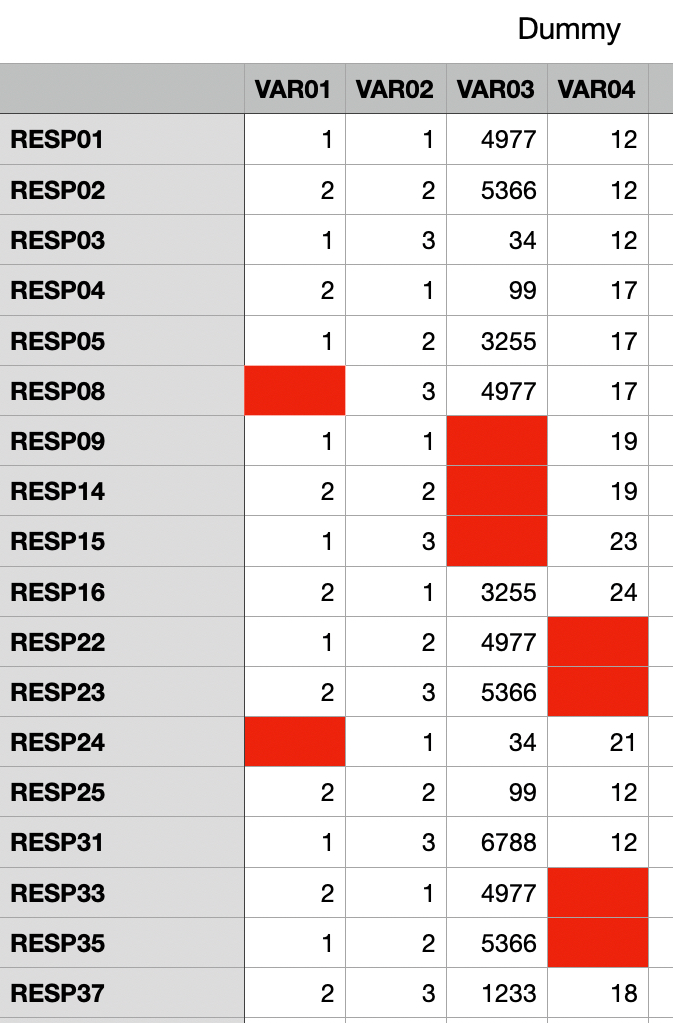
You see, like the old chess computers (90’s) they weren’t intelligent, they merely had in memory every chess game ever played above a certain level. And all these moves were in these computers. As such there was every chance that the chess computer came into a setting where that board was encountered before and as such it tried to play from that point onwards. It is a little more advanced than that, but that was the setting we faced. And would you have it, some greed driven salesperson will push the boundary towards that setting where he (or she) will claim that the data you have will result in better sales. But (a massive ‘but’ comes along) that is assuming all data is there and mostly that is never the case. So if we see the next image

You see that some cells are red, there we have no data and data that isn’t there cannot be created (sort of). In Market Research it is called System Missing data. They know what to do in those case, but the bulk of all the people trying to run and hide behind there data will be in the knowing nothing pool of people. And this data set has a few hidden issues. Response 6 and 7 are missing. So were they never there? Is there another reason? All things that these AI systems are unaware of and until they are taught what to do your data will create a mess you never saw before. Sales people (for the most) do not see it that way, because they were sold an AI system. Yet until someone teaches them what to do they aren’t anything of the sort and even after they are taught there are still gaps in their knowledge because these systems will not assume until told so. They will not even know what to do when it goes wring until someone tells them that and the salespeople using these systems will revert to ‘easy’ fixes, which are not fixes at all, they merely see the larger setting that becomes less and less accurate in record time. They will rely on predictive analytics, but that solution can only work with data that is there and when there is no data, there is merely no data to rely on. And that is the trap I foresaw in the case of [a censored software company] and the UAE and oil. There is too much unknowns and I reckon that the oil industry will have a lot more data and bigger data, but with human elements in play, we will see missing data. And the better the data is, the more accurate the results. But as I saw it, errors start creeping in and more and more inaccuracies are set to the predictive data set and that is where the problems start. It is not speculative, it is a dead certainty. This will happen. No matter how good you are, these systems are build too fast with too little training and too little error seeking. This will go wrong. Still Larry is right “Most Of The World’s Valuable Data Is in some system

The problem is that no dataset is 100% complete, it never was and that is the miscalculations to CEO’s of tomorrow are making. And the assumption mode of the sales person selling and the sales person buying are in a dwindling setting as they are all on the AI mountain whilst there is every chance that several people will use AI as a gimmick sale and they don’t have a clue what they are buying, all whilst these people sign a ‘as is’ software solution. So when this comes to blows, the impact will be massive. We recently saw Microsoft standing behind builder.ai and it went broke. It seems that no one saw the 700 engineers programming it all (in this case I am not blaming Microsoft) but it leaves me with questions. And the setting of “Stargate is a $500 billion joint venture between OpenAI, SoftBank, Oracle, and investment firm MGX to build a massive AI infrastructure in the United States. The project, announced by Donald Trump, aims to establish the US as a leader in AI by constructing large-scale data centers and advancing AI research. Initial construction is underway in Texas, with plans for 20 data centers, each 500,000 square feet, within the next five years” leaves me with more questions. I do not doubt that OpenAI, SoftBank and Oracle all have the best intentions. But I have two questions on this. The first is how to align and verify the data, because that will be an adamant and also a essential step in this. Then we get to the larger setting that the dat needs to align within itself. Are all the phrases exact? I don’t know this is why I ask and before you say that it makes sense that they do but reality gives us ‘SQUARE-WINDOWED AIRPLANES’ 1954 when two planes broke apart in mid-flight because metal fatigue was causing small cracks to form at the edges of the windows, and the pressurized cabins exploded. Then we have the ‘MARS ORBITER’ where two sets of engineers, one working in metric and the other working in the U.S. imperial system, failed to communicate at crucial moments in constructing the $125 million spacecraft. We tend to learn when we stumble that is a given, so what happens when issues are found in the 11th hour in a 500 billion dollar setting? It is not unheard of and as I saw one particular speculative setting. How is this powered? A system on 500,000 square feet needs power and 20 of them a hell of a lot more. So how many nuclear reactors are planned? I actually have an interesting idea (keeping this to me for now). But any computer that leaks power will go down immediately and all those training time is lost. How often does that need to happen for it to go wrong? You can train and test systems individually but 20 data centers need power, even one needs power and how certain is that power grid? I actually saw nothing of that in any literature (might be that only a few have seen that), but the drastic setting from sales people tends to be, lets put in more power. But where from? Power is finite until created in advance and that is something I haven’t seen. And then the time setting ‘within the next 5 years’ As I see it, this is a disaster waiting to happen. And as this starts in Texas, we have the quote “According to Texas native, Co-Founder and CFO of Atma Energy, Jaro Nummikoski, one of the main reasons Texas struggles with chronic power outages is the way our grid was originally designed—centralized power plants feeding energy over long distances through aging infrastructure.” Now I am certain that the power-grid of a data centre will be top notch, but where does that power come from? And 500,000 sqft needs a lot of power, I honestly do not know how much One source gave me “The facilities need at least 50 Megawatts (MW) of power supply, but some installations surpass this capacity. The energy requirements of the project will increase to 15 Gigawatts (GW) because of the ten data centers currently under construction, which equals the electricity usage of a small nation.” As such the call for a nuclear reactor comes to mind, yet the call for 15 GW is insane, and no reactor at present exists to handle that. 50MW per data center implies that where there is a data centre a reactor will be needed (OK, this is an exaggeration) but where there are more than one (up to 4) a reactor will be needed. So who was aware of this? I reckon that the first centre in Texas will get a reactor as Texas has plenty of power shortages and the increase in people and systems warrant such a move. But as far as I know those things will require a little more than 5 years and depending on the provider there are different timelines. As such I have reasons to doubt the 5 year setting (even more when we consider data). 

As such I wonder when the media will actually look at the settings and what will be achievable as well as being implemented and that is before we get to the training of data of these capers. As I personally (and speculatively) see it, will these data centers come with a warning light telling us SYSMIS(plenty), or a ‘too many holes in data error’ just a thought to have this Tuesday. 

Have a great day and when your chest glows in the dark you might be close to one of those nuclear reactors. 

Leave a comment

Filed under Finance, IT, Media, Science

Lap Time

Yes, we heard the term; we see it in athletics, in Formula 1 (and all the other formula races, except baby formula). How did we go after one lap, will lap two be on par, better or are we sliding. The 5G global race is on and even as the US and others are in denial, some facts are open for viewing, so as I got to the page (at https://www.eureporter.co/frontpage/2019/06/26/huawei-dominates-global-race-to-5g-despite-pressure-from-washington/) I was not surprised. The headline ‘Huawei dominates global race to 5G despite pressure from Washington‘ is not really a surprise. Yet one element is a nice verification. when we see: “Currently, two-thirds of global existing 5G networks are powered by Huawei technologies” and that is after a year of BS and fear mongering by the US, if they had not done that the picture would be different, it would be considerably worse for all non-Huawei contenders. So even as Ericsson is building a plant in the US so that they can become the courtesan of choice, reality is a very different stage.

The issue (at https://lawlordtobe.com/2018/11/10/the-heart-processes/) in ‘The Heart Processes‘ where we see: “This now links it back to Huawei (5G barred), the iterative actions of technology whilst we are being surpassed on every technological side. The full article (at https://www.crn.com.au/news/telstra-fault-takes-down-eftpos-and-atms-515080) gives a few more question, yet I will get to them in another article when I give you all a few more technological jabs against certain Telco players as they presented their ego and not their actual capability“, there are references that go back to 2017 where we saw that the non-Huawei players were already behind. There is Forbes Last April with ‘Huawei’s 5G Dominance In The Post-American World‘, or ‘Huawei’s new Wi-Fi routers solve a serious first world problem‘ in January 2018, Huawei have been showing to be the stronger innovator for well over three years and has been leading the 5G market, now that they even under discriminatory environments are achieving a 66% market in current 5G shows just how warped the situation is, so as I stated it before and do so again, ‘America will soon no longer matter’ and that is the true nightmare that the US is facing, when the silver bullet to survive a $22 trillion debt is meely a dud in your own armoury, you end up with a massive problem.

So as we see the Lap Time, with 5G going commercial in the Middle East, and now optionally Germany as well, we will see the blind followers of Europe, who follow the misguided voice of America, we will see them melt like snowflakes in the summer sun (or the current European heatwave), the economy is their Achilles heel and they will all fold.

And the battle will alter its course even further; the advantage that the Middle East is now showing over America is getting teeth and talons. A month ago we saw that Softbank selected Nokia over Huawei, and that is fine, weren’t it for the fact that we also got ‘Nokia Winning 5G Contracts Despite Delivery Delays, CEO Says‘ two weeks ago. Bloomberg gave us that one, so when Nokia gets pushed to cater to American needs, will they lose their Softbank deal and a cornerstone to the Middle East? It is not a given, but it is a valid question. So even as there is truth in the quote: “A few weeks of delays “is not really much” in the context of a 15-20 year cycle, Suri said. In the first quarter, the Finnish company struggled to book revenue from the contracts it had signed“, we accept that these things happen, yet weeks tends to become one month, then a second month and in a race where being there fast matters, Nokia cannot afford to remain delayed, they had to be ahead of the curve and they are not, they are merely on par at best, this now implies that 42 global contracts will be under scrutiny and not delivering on time will constitute pressures that Nokia will be unable to fully deal with and Chief Executive Officer Rajeev Suri knows this.

Even as we see that Nokia is still on the financial fence regarding booking profits (they will do so, no doubt) Huawei was able to secure a lucrative deal with Russian telecoms company MTS. It might be all under the guise of ‘the enemy of my enemy‘, but in the end ‘gold is gold’ and it is in the end about the acquired currency. So as they get Russia and as the EU buckles towards Huawei, we see a market that is a lot stronger for Huawei and every win in the Middle East will tip the European seesaw in favour of Huawei.

For the most after we check the lap time, there is a clear benefit for Huawei, yet Ericsson and Nokia remain strong competitors, Ericsson made the optional flaw of moving part of their base towards America, it sounds good, but their infrastructure will be undermined in several places more and more, so either Ericsson will push American employment to a much higher degree (Customer Service centres, Customer royalty programs and product infrastructure), or they face a massive blow-back more likely than not before EOFY 2020, a setback that will cost them a whole lot more than they bargained for. There is no given on Nokia at present, they had a strong firm presence in Europe and they can do so again, whilst these rules apply to Huawei as well, when you consider the places they were, they have built strong teams all over the place and with the winning strategies in the Middle East they have grown their ambassador places all over the Middle East, something Nokia and Ericsson did not do to such degrees.

So it is not only the 2/3rd advantage that Huawei has, it shows that their infrastructure is still a lot stronger and in the second hour (59:59 after a mobile phone is sold) the systems of Nokia and Ericsson will be tested and I personally believe that they are not ready, more importantly, the people will not be ready for waves of questions that will hit these centres and that will hammer the successes that Nokia and Ericsson have at present.

As lap time goes, it is a strong race from all three, yet a race is only as strong as the team, the car and the track. Yet in a normal race the track is set, in this race we have seen that America has been considering detour after detour and as such some teams will not be ready for what happens after that and in that race Huawei gets the much stronger advantage as America is not considering them, so that pressure falls only on Ericsson and Nokia. And that is where the issues start to count. When players like Softbank get pushed to the back, they will reconsider and anyone changing its order has the danger of taking more than one other player with them, that is the stronger danger that the other two face as they try to gulp down whatever US contract they can get.

There is supporting evidence for that. In Australia NBN showed the need (source: SMH) “NBN Co spokeswoman said the network was committed to “continuously improving the service provided as internet demand and data needs evolve” including a recent $800 million investment into customer service on the fixed wireless network“, the problem is that to a much larger degree Australian NBN is (diplomatically speaking) a $51 billion failure, the only way to save face is to overhaul it to a much larger degree and in light of ‘9.6 million homes and businesses were now connected to the network with 62 per cent of those customers choosing speed plans of 50Mbps or more‘, all whilst this could grow by another 30% if Microsoft and Google had their way, giving us levels of unparalleled congestion soon enough after that.

The moment that ANY vendor needs to acknowledge 5G and congestion in the first year will be the point that turns the customer base into a churn tidal wave and that will happen if the infrastructure is not in place. The US and some others are massively in denial there, it might be argues that this risk is also present in the Middle East and I would expect this to be the case, yet Huawei has had time to prepare and the others are merely jumping on the revenue wagon as the US pushed for a ‘no Huawei zone’ preferably one that is global.

That is the impeding risk, not that Huawei is out of the race, but that the others get stretched too thin. I have seen this happen again and again over the last 20 years and then we get some delusional VP giving their staff an elastic band reference on stretching resources a little more. They ultimately never learned that time is not a factor that can stretch like an elastic band, it is a rigorously set standard that does not budge and against that merely better and larger man power will solve it and Nokia just got rid of a boatload of them, all to cater to 5G, so when they need staff and training them, they will be under the gun 24:7, I do not believe that they are ready at that point and the increased presence in America implies that Ericsson is nowhere near ready, they need well over 500 additional support staff for what comes and they have nowhere near those numbers.

That is all available to the eager eyes and they have not altered that path yet. In their defence, it will not be needed before August 2019, yet there is already enough indication that their growth plan is not set in that direction. As I developed my own IP, I noticed that the Cybersecurity needs for 5G are still in the basement whilst it had to be through the roof almost 3 months ago, so the first cyber security issue will be a devastating one for each of these players. That is merely on a consumer level, on a commercial level the setting is even worse, it is a Nightmare on 5G street waiting to happen and in this there will be no miracle dream weaver, merely some Freddy Kruger that will show now regard for the lives of those victims, as the rewards were just too appealing. An almost perfect cyber storm in the shaping, a stage no likely seen before January 2020, yet even then there will already be victims and loads of insurances that are more likely than not eager to find a loophole not to pay any of them.

As I see it, it is a lap time that is good for all three, yet the setting of lap time is no longer a valid one. When the track definition becomes a flexible one, detours change the stats of everything, changed requirement in mid race will also hamper issues and none are ready, Huawei merely had more time to get ready giving them an additional advantage in this race.


1 Comment

Filed under Finance, IT, Media, Politics, Science

The ethical threshold

When is it too much? That is the initial question I had. I am a tweeter, I love my twitter, I will be honest on that. I tend to merely be nice there, with all the negativity in the world thinking only positive there is merely a choice. Also, why would you want to waste time attacking a person there? OK, I have to admit, when Jimmy Kimmel decided to take the mean tweets as a segment, I ended up laughing out loud, especially the Marvel cast ones. Why would anyone do this? Why would Chadwick Boseman (Mr. Black Panther himself) get confronted with: “Okay, how did the coolest blackest dude in the galaxy end up with a whitebread-a– name like Chadwick” It was fun and he laughed too, but why do that? OK, if it was just a little friendly jab, I would get it, but why would you state to Scarlett Johannson: “emotional range of a f–ing celery”? It makes no sense to me. Sometimes we have an aversion to an actor, or perhaps more direct to the role that an actor portrayed, which makes perfect sense, but why vent it? I loved her work in many movies, and if there is one I did not like, then it is ‘The Other Boleyn girl‘, I personally believed it fell flat after the Tudors, which had nothing to do with her, Natalie Portman, or Eric Bana. In the end, it might not be the actors at all, merely the vision and choices of the director. It does not matter, I was no fan of that movie, yet to go out and tweet to her (or any of the other two) on how bad they acted seems like a waste of time and totally uncalled for. Many people feel that way, when we consider she gets hundreds of (optionally mean) tweet, yet each of them has tens of thousands of fans. Is it an ethical choice not to lash out? It might be, or it is merely good manners. Whatever it is does not matter, it is a visible part in all this.

In opposition, when do you professionally make choices based on morality or ethicality? We all do them and even as my threshold there is slightly higher than the Eifel tower, I do have them. I also believe in loyalty (even as some of my bosses have never shown that distinction themselves). There we have another setting do we not? So even as some might rage on how we need to make choices, as some rage against certain settings like playing hide and seek with the corpse of Jamal Khashoggi, whilst some claim to have evidence of recordings, that recording still has not been revealed to the world, these sources have now stopped mentioning that claimed piece of evidence, so when you seek political opportunity over a cadaver, how does that go over with some people? When you are merely an Iranian tool making claims and then leaving the accusation in the dirt, how does one ethically consider that person to have any intrinsic value or reliability?

So as Reuters gives us: “CIA Director Gina Haspel, in Turkey to investigate the death of Saudi journalist Jamal Khashoggi, has sought to hear a purported audio recording of his torture and murder, four sources familiar with her mission told Reuters on Tuesday” and now a week after the claims, the evidence is not forthcoming, why consider that government to be any level of ally?

Yet that is another matter, the ethicality of this is part of it all, not the rest of that stage. The entire stage of ethicality is seen in fortune as we are faced with: ‘SoftBank’s CEO Won’t Speak at ‘Davos in the Desert‘ Even Though Saudi Arabia Put $45 Billion Into His Vision Fund‘. There we should have some issue, when you get $45B invested in, should there not be some ‘tit for tat’, or is that what they sometimes call in the UK ‘tits for dad’?

So when we see: “However, according to a Tuesday report, Son has now cancelled his speaking appearance, though he may still show up at the conference“, how does that go over? I had the idea for an alternate information system that is based on something that does exist, but now on a much larger scale, a new way of driving 5G data forward, a new information system. I even came up with a new 5G device type called the ‘dumb smart device‘, not only did I not get any penny of $45 billion (which would have been way too much), I also did not get an invitation of speaking option at “Davos in the Desert”, which in hindsight makes perfect sense as I never gave my email and phone number to Saudi Crown Prince Mohammed bin Salman, so it all partially makes sense. So as we see that list of important people like Jamie Dimon of JPMorgan Chase, Stephen Schwarzman of Blackstone and AOL founder Steve Case had pulled out in protest, we need to also realise that they are part of a setting where the pot is calling the kettle black. Remember JPMorgan’s and their $12 Billion Bailout? They want to talk morality? And in the end, we know that Jamal Khashoggi met his death in the consulate, we do not know the details, yet the people claiming to have evidence are not showing it and in addition those people are allied with Iran who is in a proxy war with Saudi Arabia. I know I have said that perhaps a little too often, yet the newspapers and online media REFUSE to add that truth to their articles, is that not strange? Yet this is about certain poor choices, however they were not the poor choices of those behind ‘Davos in the Desert‘. When I see the highlighted Softbank CEO Masayoshi Son and how he is not speaking at a multi-billion dollar event, is he merely proclaiming that he has ethical boundaries? Let’s not forget that apart from the fact that a journalist died under weird conditions, we have seen no actual evidence of ANY kind. We have seen actions that imply a cover-up, yet there is still not one clear piece of evidence that Saudi Crown Prince Mohammed bin Salman did any of it, or even order it. That evidence was never shown and the Turkish claims have never been supported by evidence, was it? That part is more important than you know, because when we take ethical and morale based evidence from equity people like Jamie Dimon or Stephen Schwarzman we truly have gone off the deep end. So whilst he might be there, he is now optionally missing out on opportunities that go beyond merely Saudi Arabia, when we see that Sheikh Mohammed bin Rashid Al Maktoum, Vice President of United Arab Emirates, you better believe that you are selling your investors short and how does that usually go over with those ‘return on investment chasing accountants‘?

He is important in more than one way. You see, he has been very active in growing the impact of the UAE on a global scale, the vice president is using LinkedIn at every option there is and his industrious nature gives rise to forwards momentum for the UAE and that means more investments and more optional profits, so why walk away from the opportunity to speak out, whilst the cold light of evidence has shown doubt on events, no evidence is presented, not even claimed evidence; when we abandon innocent until proven guilty in light of business we merely set the stage for bias, discrimination and abandonment of good business. That is the actual reality and the media is steering clear from that one as well. Even as everyone knows that the US is broke, it claims industrial momentum, yet it is not taxed momentum, hence where ever that profit goes is beyond the US government. They are desperate to get the money flowing their way, not the other way and we see now that the demise of the US is closer than we thought it was, as Saudi Arabia and its neighbours are steaming ahead, their footprint is pushing in positive technology ways and the rest is lagging behind. The ethical threshold is not who we do business with, it is becoming, what are we willing to accept as a norm and that is the baseline that follows us to a much larger degree, especially when you realise that the baseline of this norm is slowly moving towards an Islamic one. That part is scaring the people way too much, so even as these same people ignore the fact that the Vatican has no women in places of power and that the Reuters quote “Sister Sally Marie Hodgdon, an American nun who also is not ordained, cannot vote even though she is the superior general of the Sisters of St. Joseph of Chambery” gives clear indications that the Vatican is still as backwards as it was 920 years ago when it decided to take over the Middle East in a setting that we called the Crusades. So how far has our faith taken us? Even as we see that members of the clergy get off on Luke 12, Matthew 10 and John 11 (boys, not passages), we claim to protect children, yet the prosecution of the church members never got there, did it? So as most pushed for agnostic and atheist values, which makes sense to some, there is still a large part that drives their forward momentum through their inner faith and is there any evidence that Islam is evil? We get the ‘terrorist’ claim left, right and centre, yet how many are Muslims are truly evil? Now take the members list of the Ku Klux Klan, the member list of the IRA, White power and Neo-Nazi’s and set that in the scale against the names of terrorists that actually acted, suddenly Islam is not that evil anymore is it?

It is not important that we become Muslim, but would it hurt to learn about Muslim law and customs? If we embrace the next age of technology drive, having that knowledge makes us more and more valuable in places where the next trillions are actually spend, is that anything but our willingness to embrace some cultural change and adapt ourselves to the work sphere that we are ultimately confronted with?

How does our moral and ethical boundaries shift as we accept the religion of others, not to become Muslims, but to merely know enough to not cause offense, is that not a good first step? The BBC gave us less than a week ago the setting that we are now too poor to consider being ethical. They did that whilst posing the question: “Would you quit your job on ethical grounds?“, we are presented with Google employees who did that, yet the jackpot was gained with: “Research by Triplebyte, a start-up which recruits technical talent for technology companies, found 70% of those who get two job offers choose the highest paying one – exactly as our parents’ generation would have done“, if we accept that income is the driver, when we realise that ethics are almost no consideration in a job, would it matter if we embrace an Islamic employer? As we see that the answer is one we can live with a lot more than a job by ethically coloured and filtered Christian employer, can we truly ignore the optional long term life and security that some growing employers are giving us. That will be the driving factors to many and as such we will see that the Middle East influence will grow straight into the Common Law nations. When we realise that last year we were confronted in the UK with the notion that ‘Just one in five Muslims are in work as report finds they are held back by racism‘, what happens when the Muslim corporations see that this could be the driving force to open shop in a much larger audience all over Europe and even in the US. It is merely another facet in ‘the cost of doing business‘ versus ‘the cost of being in business‘. We have forfeited a large option by being choosy on who we choose, often on race, age and looks and that is how the cream evaded the corporations for a much longer time. Now as we see that the momentum is no longer in their corner, the work sphere will change a lot more than we ever could have realised.

A change we started in 1095 when Pope Urban II gave us: “calling all Christians in Europe to war against Muslims in order to reclaim the Holy Land, with a cry of “Deus vult!” or “God wills it!”“, now that we are entering an age where the roles are reversed because we decided to focus on profit and greed, we have no one else to blame but ourselves and the people we ourselves elected. So when we accept the history channel with: “between 60,000 and 100,000 people responded to Urban’s call to march on Jerusalem. Not all who responded did so out of piety: European nobles were tempted by the prospect of increased land holdings and riches to be gained from the conquest. These nobles were responsible for the death of a great many innocents both on the way to and in the Holy Land; absorbing the riches and estates of those they conveniently deemed opponents to their cause. Adding to the death toll was the inexperience and lack of discipline of the Christian peasants against the trained, professional armies of the Muslims. As a result, the Christians were initially beaten back, and only through sheer force of numbers were they eventually able to triumph“. How does our morality fare at this stage? In the end, whether we call them nobility or captains of industry, how many of them walked away with the setting that the benefit of all was merely their bottom line, and after all these years are you still accepting that excuse of as their profit drive?

When we see that a mere 12 hours ago we were given a Microsoft issue through: “But there’s evidence that Windows Insiders knew about and reported this problem, and Microsoft didn’t follow up on it, apparently not realizing the severity of the issue.” (at https://www.extremetech.com/computing/279368-windows-10-1809-may-have-another-file-deleting-bug-problem), another setting of profit and time pressure over quality and reliability, and this is not merely one of a few issues, this have been going on for well over two decades and in the end we end up in the same place, with a more expensive device making no headway. That part alone is part of the success that Google and Huawei gave them the forward push via their vision, driving forward momentum, so why would we want to stay in a place where the ‘status quo’ (not the band) is considered sexy?

So if my views are evil, then I am the Ifrit, the rebellious spirit that yearns for change and momentum, something that has been lacking in technology for too long, as profit boundaries has replaced ethical ones and therefor iteration trumped advancement a race that is now pushing the advantage to the Middle East and let’s not forget that Israel is part of the Middle East and they are also pushing technology boundaries through a whole range of tech start-ups, another reason to accept a much larger range of changes in our lives.
In the end, it is not where we need to go, it is where the opportunities are grown, and when we consider that “Diane Green, the chief executive of Google Cloud, also pulled out on Monday, according to the company” and gave that ‘Davos in the Desert’ a miss, whilst in the end, no evidence was given on several parts of the now accepted act of manslaughter by unknown parties, so not murder as the legal difference is proven intent, we need to ask more questions, not on merely the guilty parties, but those acting on alleged accusations that have not been met with evidence three weeks later is a much larger failure by those same people who kept quiet on years of endangered data safety (The Google+ issue), those needing a dozen billion dollars for bailout (and therefor their poor judgement) all clearly shown and proven, they are claiming some level moral high ground whilst evidence of the other act is still not given, where is our fake sense of ethical borderline now?

I call to some degree that the ethical threshold is one we live by; it is one that others call us on; that distinction is large and ignored by a lot of players. So when Al Jazeera gives us: “Fadi Al-Qadi, a Middle East human rights advocate and commentator, also denounced the photo-op as “ruthless”“, as well as “And here is the video. Salah (#JamalKhashoggi son, banned from travel) had to shake hands with who is believed to be his dad’s killer. Ruthless. Ruthless. Ruthless #Khashoggi pic.twitter.com/EKS9UZQ8Jc” that whilst evidence of ‘his dad’s killer‘ has not been given in any way shape or form, mere accusations from one of the tools that Iran employs, and until the evidence is clearly brought, that is how I will remain to see it. I feel for Salah Khashoggi, I truly do, and the pain of losing his father would be there, but is he merely in pain because of the hundreds of unsubstantiated accusations in almost all the large media? Is that not an important question in all this?

So as we see the impact of the accusations on so many levels, yet all in a setting where no evidence is handed out and whilst the global media is still using the extensive news leaks alleging that Turkey has audio recordings documenting Khashoggi’s demise and even dismemberment, no evidence has been given to the people. Claims of handing out the evidence were knocked back again and again, so how long until we make the ethical demand: “Hand over the evidence now, or be ignored for all time“, that will not happen, will it. The EU is too desperate to keep any talks with Turkey and Iran going and Turkey is taking advantage of that situation, whilst many claims by the Turkish government are a joke on many levels, even legal ones.

When will we learn that ethical, moralistic and emotional considerations are not merely different coins, they tend to be different currencies as well.

We can only choose out own path and make it the best path as we can, we need to realise that the high ethical and moralistic path is not a comfortable one and for the most, we are all about comfort, we have been so for much too long and through that we forgot what true values are, the media merely made it worse.

 

1 Comment

Filed under Finance, IT, Law, Media, Politics, Science