Tag Archives: SVB

My Bond is my word

That is the expression, but it came from a time when a word meant something. Far before the idiom of marketing and business practices. That word is a temporary setting towards to goal to do no harm to the shareholders and the business need of the few. In essence, the old “is an idiom that means a person’s promise or word is as good as a formal agreement. It suggests a commitment to honesty and reliability in one’s dealings, and is frequently used to signify that a person’s word is a reliable substitute for a written contract” it is said that a word is merely a mirror of the intent of the person speaking it. And when you look at bonds, we see “A bond is a form of debt security, essentially a loan made by an investor to a company or government for a set period of time in return for regular interest payments. When you invest in bonds, you are lending money and receive back your principal plus interest at a specified future date” Now here we get the problem. You see, as it stands “an investor to a government for a set period of time in return for regular interest payments” and now as it seems that government (America) can soon no longer make these “regular interest payments” and the investors are backing away. We saw last week
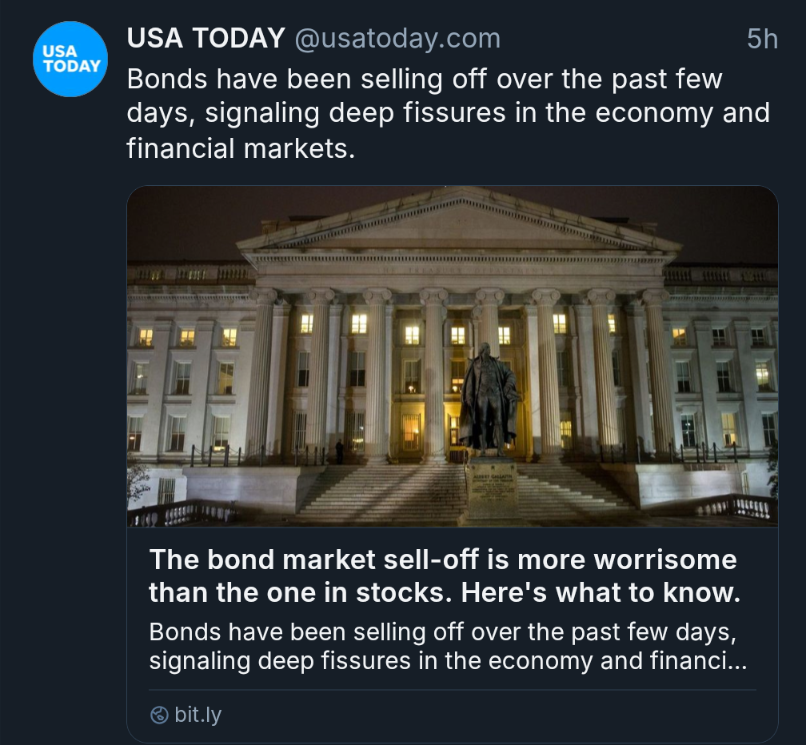
and we have seen a few of these settings and again today we see a continuance of these messages. The stage is not really as clear. As bonds are sold before maturity the investors are losing money and you know how they lose money. Yet the setting for that is when will we lose it all? And there is the crunch. Lose some now or a lot later and these happy wuzzes are weaseling out before it is too late. So as such we see
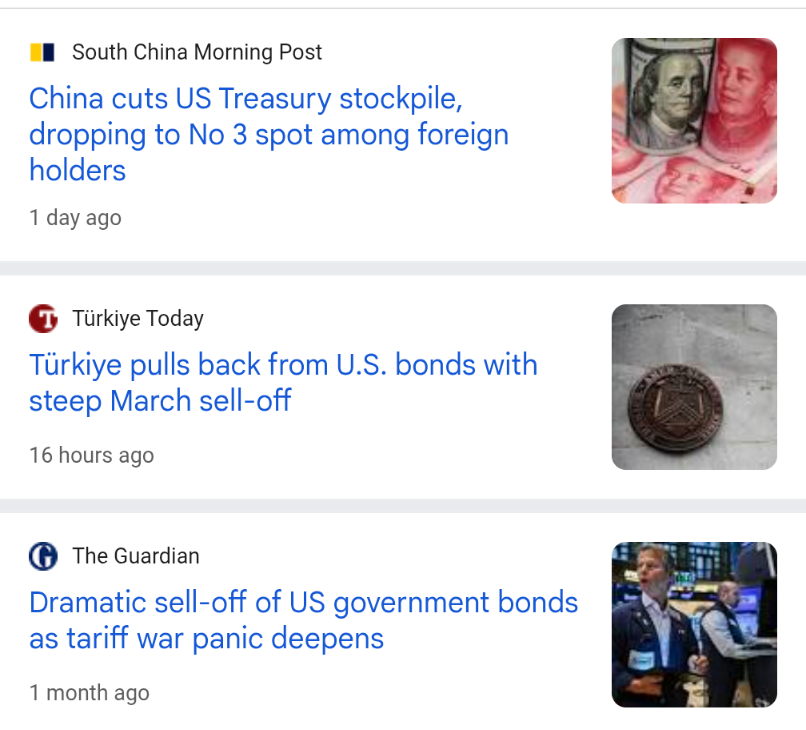
If you think that I feel sorry, you would be wrong. I saw this as early as 2018, but the people called me and idiot, a fool and a cowardly weasel. That’s fine, they are merely words. As we see the dumping of bonds these high and mighty wannabe’s will get the limelight shining on them and as they hide like the little cockroaches shouting “it’s more complex then I thought” and I giggle because all I needed was an abacus, this contraption (which preceded the computer and the slide ruler) was invented somewhere between 2700 and 2300 BC, so there was time to learn the essentials.

I don’t know how much the damage is at present, but with every sell off, the burden of America deepens, which as of April 30, 2025, there were $28.575 trillion in outstanding U.S. Treasury securities. So we do not know how much is sold of and I doubt America will divulge that information and as I stated in March 2023, when I speculated that the SVB had too many bonds in there possession and could not deal with a bank run, I asked whether the media would ever look into how many bonds they had and they never did (I wonder why), but a more large setting was seen in the movie The Big Short (2015), an American biographical comedy-drama where we see the implied setting of Janet Yellen in her role at the federal reserve. Now, this is a mere movie, but when movies get to close to reality, there is the chance that there might be correlation. And as the Federal Reserve kept close eyes on the SVB bank, my thoughts wondered whether there wasn’t anything more going on. It is merely one bank, but was it? This also set my mind in a certain direction. The media was no longer to be trusted and they are too often a spokes vessel for stakeholders with political and personal plans. This time around the gap is a lot larger, a lot more than merely one bank. So how many bonds are being sold off (read: dumped)? We don’t know and the investigating party (read: the media) is being told to stand down as I see it. There is no way they are all being sold but to which amount of the $28.575 trillion is being sold off, we just don’t know. In the end America will face a brunt of invoices due to be paid. Yet consider that a bond is a certainty of income through interest and now these investors are bailing. How much is being bailed on is unknown to me and to many others.

But the media isn’t asking the hard questions, isn’t that interesting? They are so busy to chase digital dollars for their own good, whilst at the same time pleasing the shareholders and stake holders  making the audience a distant fourth or even fifth party. So how do you feel about getting actually informed? 

Don’t ask me for the information because I have close to none. I can merely see the issues, but the actual facts are not visible to me and to many others. But there is an issue and the idea of weaponized bonds is decently new, it came after the settings that these foundations are based on and as the bottom line is now marketed for the needs of the investors, we might not know in time what needs to be done. Will it be done in time? I have no idea, the people in charge of the information have their own game to play and usually it is for the betterment of themselves, not the audience at large.

I reckon that the tariff war set a few cogs in motion. Did the current administration consider this when they named the Golf of America and cast Canada into hostile party by calling it the 51st state? Did they consider the impact of a possible annexation of Greenland? It pissed off Europe and the Commonwealth and now their actual enemies is seeing the optional setting of selling off a huge part of the bonds and as such America sinks under their own debts, no actual war required. Didn’t the Art of War teach us (approximately 500BC) that “The supreme art of war is to subdue the enemy without fighting. If you know the enemy and know yourself, you need not fear the result of a hundred battles” I wonder, how clever it was to set a chicken stage of tariffs when these people wrote this book over 2500 years ago, seems folly to me. The best the west has to offer in contemplation is On War by Carl von Clausewitz (1820), which is called a decidingly lesser work 2300 years later. Isn’t that the opposite of evolution? Both books on the philosophy of war, but called “a lesser setting”, so what is the stage and what is missing? Both miss out of the war setting of economies. There was a setting of economic in the application of logistics in WW2, but a rather slimline one. Now there is a need on the war on the economics of any enemy and when as deeply in debt as America is, they are quite literally fighting against the edge of an abyss and that abyss does not give way to anything, it is not the premise of an abyss. 

I have no idea what comes next, or what could be done next. This requires clear and reliable data and we do not have any, or aren’t given even the indication of clear data. That is the result of a media that is no longer to be trusted. So how bad is the news? It is dependent on the actual amount of bonds being sold off, because that is the hard setting of the decreased revenue that America faces in 2025 (and 2026). 

So this is one day that I don’t go for the casual ‘have a great day’ but a much larger setting of make sure your families are safe, because when the dollars stay away there will be a price to pay.
Leave a comment

Filed under Finance, Media, Military, Politics

Is it reality?

That is the question I am faced with as I saw the article at CBC which I cannot continue as CBC screwed up its site giving us advertisements every inch of the article, as such Brodie Fenlon clean up your freaking site, and fire the idiot responsible for this. Yet the BBC came to the rescue and gives us (at https://www.bbc.com/news/articles/cx2v37z333lo) ‘Trump deep sea mining order violates law, China says’ in earnest, that article is three days old and I preferred the CBC article as it shows a little more clearly how desperate America has become for funds. I reckon that the interest on 36 trillion of debt is gnawing on the bones of America, more prevalent that gnawing has gone beyond the bones as it is starting on the bowels of America. The BBC article gives us “Donald Trump has signed a controversial executive order aimed at stepping up deep-sea mining within US and in international waters. The move to allow exploration outside its national waters has been met by condemnation from China which said it “violates” international law.” I tend to agree with China, but merely as it allows a setting where the desperate poor countries who cannot counter America and these nations are left with baubles. A setting they learned from the slave traders around 1768. You have to hand it to trump. He is giving the old scriptures a chance to prove themselves. The issue I partially have a problem with is “The administration estimates that deep-sea mining could boost the country’s GDP by $300bn (£225bn) over 10 years and create 100,000 jobs”, in the first there is no clear setting for the $300,000,000,000 revenue. If they ‘mine’ in a few wrong sports, the price if mining and the revenue of staff will cost them an easy $50,000,000,000 which implies a lost revenue base of 16%, the second part is that these jobs are mostly given to people they just evicted. Only the higher levels will get a nice dime, the rest will be done by Americans who didn’t want the job anyway and that breeds errors and often mistakes. A non-committed employee screws up the daily routine a lot more than you are happy with and that will be dozens of people. The part that I never gave the right attention is seen in ““The harm caused by deep-sea mining isn’t restricted to the ocean floor: it will impact the entire water column, top to bottom, and everyone and everything relying on it,” he added in a statement released on Friday.” The he in that quote is Jeff Watters of Ocean Conservancy, a US-based environmental group. The fact that Jeff merely got one quote implies that he has a whole lot more to say and I wonder if we will ever see that part of the equation. The larger setting is that America is now ready to start bullying its way through international waters. So what will they call those who want to intervene on their waters (or too close to it), will they suddenly be branded pirates? A larger setting that America has lost the plot and I warned for this a decade ago. Deal with your debt unless it deals with you and that seemingly seems to be happening now. It also opens a new setting. These little nations will now be ready to side with China, which is another headache for America. And that setting will give China (as a protector or these nations) an options to scuttle these miners. So $300 billion largely lost and American lives lost (at present no one cares about those). Now we get the added cost of these mining platforms and as such America gets into deeper waters. 

So the end of the BBC article gives us “A recent paper published by the Natural History Museum and the National Oceanography Centre looked at the long term impacts of deep sea mining from a test carried out in the 1970s. It concluded that some sediment-dwelling creatures were able to recolonise the site and recover from the test, but larger animals appeared not to have returned.

The scientists concluded this could have been because there were no more nodules for them to live on. The polymetallic nodules where the minerals are found take millions of years to form and therefore cannot easily be replaced.” As such we have a (non proven) stage for the desperation of Americans. This was shown half a century ago. And the fact that America is willing to ignore “larger animals appeared not to have returned” as well as “polymetallic nodules where the minerals are found take millions of years to form and therefore cannot easily be replaced”. As I personally see it, to ignore these two facts implies that America doesn’t care (or cares less) about marine life and that it will act like a carrion eater in regards to the ocean floor and take now what needs millions of years to form whispers (to me) that America is decently beyond broke and it falls to President Trump to default the larger part of 36 trillion of debt. I’m pretty sure that I made mention of that chance in the past and as I am likely proven right yet again, the question becomes why didn’t economics signal clear levels of dangers? The news now, as the Times writer (and American economist) Irwin Stelzer gives us that the economy of America is in rather good shape. So is it really? Please give us the goods on how America is doing well? It might be that the America Economy is seemingly hanging tough, but they lost billions of revenue all over the field from retail to defense contracts. They might be in denial, bit as I see it only two years ago we would never have seen ‘Italian defence and aerospace giant Leonardo has signed a new Memorandum of Understanding (MoU) with the Kingdom of Saudi Arabia’ a mere three months old. So how much did America lose here? I cannot set the valuer of that contract, but the quote “multiple areas of collaboration to include space industry, airframe MRO (Maintenance, Repair and Overhaul), localisation of electronic warfare systems and radars and assembly of helicopters, a focus on Combat Air and Cross-Domain Integration fields, industrialisation processes and human capital development, national supply chain in the Kingdom of Saudi Arabia and the country’s role for Leonardo in the region as well as the global value chain.” (Source: www.leonardo.com) leaves me to believe that it is a serious amount of money, now add the new European slices and with the tariffs the loss of America is now on a threshold to fuel a larger recession than ever speculated on before, the larger players (read: Bloomberg) set this chance at the moment at 40%, as America scuttled their own retail houses (like Walmart) of cheaper goods, they need to continue without the goods, you might think it is nothing, yet 1% of the American population works there, now take out the thousands of shoppers (read: immigrants) and that 2025 revenue of US$680.99 billion will topple by at least 10%, 30% if they are not careful and what remains of that Net revenue of US$19.436 billion? You see, they either fire a whole lot of them or lose close to 40% of their business. These are personally considered numbers, so I might be wrong here to the amount of loss, but not the intention of loss and this is merely Walmart. There are several other chains facing this setting. So how good is that shape of the economy? 

I wrote a few years ago that we need to see where all these bonds are, no serious journalist ever looked into that matter it was the time around the collapse of Silicon Valley Bank in 2023. I wondered how the could have happened and it was a much bigger thing. The acquisition of Credit Suisse by UBS gave me pause to ponder, I figured that several banks had over swallowed on bonds which left them not dissolvent, but left their funds largely frozen as such I speculated that Credit Suisse and SVB had too many bonds and at that time the loss of value of these bonds were crippling them. At present no one really looked at this, even to debunk my train of thought and now we also see some are selling their debt of the US. The BBC touched on that on April 10th (at https://www.bbc.com/news/articles/c5yrr0e7499o), so feel free to think I am crazy (always a decent stance to have) but there is ruffling in the economic oceans and the stage that the economic times are decently horrendous is not a bad thing. 

I just thought of something, did America rename the Gulf of Mexico for mining purposes? Now a bad stance, if it not for the tiny fact that the Bermuda Triangle is there too, as such how many mining platforms will operate in that region and what remains a few weeks later is anyones guess. Just me having fun with the situation. 😛

Have a great day and feel free to enjoy a coffee, it leaves you with a warmer feeling than a US bond at present will. 

Leave a comment

Filed under Finance, Law, Media, Politics, Science

Two issues caught my attention.

The first issue is given to us by the BBC (at https://www.bbc.com/news/articles/cx002795738o) The article starts with ‘‘I had to downgrade my life’ – US workers in debt to buy groceries’. In this I have a few speculations. You see Groceries are also set by ‘Permanent Price Adjustment’. This is what the producers of milk, bread and pretty much all items do. You see as they have costs and increased costs for whatever reasons. They pass on these cost to the shop, which in turn passes it onto you, the consumer. In the last 3 years things got to be more expensive and as such you feel that brunt. Per nation this varies. In Australia meat went up in total by 20% (over the last 3 years). Milk less so, but plenty of goods did go up and many have not seen an increase in income for years. So as we see “But after four years of rising prices, her support has worn thin – and every time she shops at the supermarket, she is reminded how things have changed for the worse. Ms Ellis works full-time as a nurse’s assistant and has a second part-time job” So in this case (as a republican minded person) I say that this is not on President Biden, not even on former president Trump. You see this is the consequence of having a $34,000,000,000,000 debt. As such businesses are taxed and as I see it, annually any administration will have to come up with $680,000,000,000 in interest alone. In 2023 the USA received (or allegedly received) $4,440,000,000,000. This implies that 15% of all taxed income goes towards interest on the outstanding debt and I have merely set that to 2%, Now consider that all costs that the government pays for is now down graded by 15% (more likely a higher percentage as the interest is also higher than 2%). Now consider that dairy, bread, meat and other options do not get incentives anymore (or at least a lot less). So there two items alone will be a lot more expensive. Then there is the operations of shops. It goes around again and again and that sets the price in many ways. There are more elements, but I am not privy to them. I warned on this several times over the last 8 years. There was going to be a problem and now people are seeing this happen and that is the beginning of draconian changes. So as Stacey Ellis and others see this happen, they go into ‘blame mode’ but they are blaming the wrong people. This is a failing of the entire administration and it started with former president George W. Bush in 2001. Former president Bill Clinton was the last president where green ink was gracing the US books of accounting. In 24 years all presidents have been pushing the debt forward. There was no exit strategy, just the wishful thinking that ‘tomorrow would be a better day’ and now after 24 years it is close to over. Not just in the USA, Europe is in a near similar place. That is what China had been hoping for so as they set the pressure even higher by getting the better deals, the west and others see the unfolding of economic disasters. And I am no economist! So there is the setting that plenty of others (real economics) should have known this and should have pushed for changes and taxing the rich was never an option. When government overreach with their Credit Card for 10%-20% more annually, at some point the card decline point is reached and that is where we are now. The USA, EU nations and others are getting their cards declined. Banks aren’t able to extent loans and whilst some are creative to pass credits via other nations. The banks are realising that the game is almost over. They might have a few options left but that will depend on how creative they can get. For this (also my speculative view) I point at Silicon Valley Bank (SVB), Silvergate Bank and Signature Bank. Three banks in 2023 with failures. Yet the media never looked at the abundant government loans they had in their books, it was my speculative view that their bonds were an overreach. So else did Janet Yellen keep a close view? At this point we were given ‘US prosecutors probing collapse of Silicon Valley Bank’ which was March 2023 and after that? Nothing as I can tell, as such spokespeople for the SEC, SVB and the Justice Department declined to comment. That was more than a year ago. So why isn’t the media doing their job? These are all elements of a nation that is running out of money and they are afraid to give out the real deal. I get it, it makes sense but it also means that life in the USA will be getting more and more expensive and when small farmers are breaking with the usual trend and start merely supplying their villages and their ‘friends’ the game changes even further. The big players cannot make claims they downgraded small farmers too often so that will have increased pressures to life in the city. And before you classify that this does not matter, be aware that 90% are small farms in the US. So when they hold back 10% of their farmed good for personal settings prices will be driven up even further. There is a setting where the old times could come back. I remember in the 60’s that I went to the potato farmer in a small shop in the street. That time could be back and it will implode most supermarkets. The stage is almost there that the supermarkets will be too expensive for potatoes, vegetables, fruit, dairy products and meat. When that happens the implosion that it sets off will be seen all over the US, especially in the metropolitan regions. Europe will not be far behind that. 

They are all intertwined so the first one to go will push the others over the edge. And when super markets go, where will you get your shopping? I reckon that California will hold out the longest, but in the end they too will have a problem. For the EU nations, France and Germany will hold out the longest. The UK will hold out, but how they will fare is anyones guess. I reckon that London will be the larger problem. The other cities are closer to rural regions, but for them I cannot say how it will evolve. 

So whilst the BBC gives us the partial goods. We need to see that the Stacey Ellis is but an element of a much larger problem and the media had the information for the longest of times. So why did they not inform you? Which stakeholders were part of the problem? All questions that too many are afraid to ask about. 

Have a great day (Second issue in next story).

Leave a comment

Filed under Finance, Media, Politics

Changing gears

This is something I have seen an I have been confronted with in some form. Yet when the NY Times reported on ‘Why Banks Are Suddenly Closing Down Customer Accounts’ (at https://www.nytimes.com/2023/11/05/business/banks-accounts-close-suddenly.html). I was taken aback a little. This is not some case of criminal activity, that I would accept. Here we see “Bank customers get a letter in the mail saying their institution is closing all of their checking and savings accounts. Their debit and credit cards are shuttered, too. The explanation, if there is one, usually lacks any useful detail” with an additional “the telltale pause and shift in tone. “Per your account agreement, we can close your account for any reason at any time,” the script often goes”. There are two settings that come to mind (of the top of my head). The first one comes via Dutch journalist and entrepreneur Luc Sala “the world will have two types of people, those who have and those who do not” it is a statement he made 30 yeas ago and we have been moving towards that setting. A stage of enablers, consumers and others. The second thought that came to mind is seen with “Individuals can’t pay their bills on time. Banks often take weeks to send them their balances. When the institutions close their credit cards, their credit scores can suffer. Upon cancellation, small businesses often struggle to make payroll — and must explain to vendors and partners that they don’t have a bank account for the time being.” I see this as the case that to some degree saw with the SVB bank in march. They are so close to the edge that they are closing down all accounts that are not labelled as enablers or consumers. The algorithm is set to what in some circles would be called platinum or gold customers, the rest is cut as a liability. It is all so that they can continue a little longer. As long as they stay away from the edge they will be ‘safe; for another week (or two). And the explanation by Jerry Dubrowski, a spokesman for JPMorgan Chase, the nation’s largest bank with 80 million retail customers and six million small-business ones does not help. The stage where we are given “whose former account holders sent nearly 200 complaints to The Times” is a metric. So how many complaints did The Times get in the preceding 6 months? How many in 2022, 2021 or 2020? These are metrics that we can use and they would give me something to go on, most likely that the two reasons I just mentioned are not merely the most likely ones. It shows that I got it right. The second excuse “We act in accordance with our compliance program, consistent with our regulatory obligations” is seen by me as equally bogus. You see in June 2023, we were given “JPMorgan Chase is fined by SEC after mistakenly deleting 47 million emails” with the added text “The deletions occurred after JPMorgan’s corporate compliance technology department, which had been trying unsuccessfully to delete some communications from the 1970s and 1980s, sought help from an outside vendor managing the bank’s email storage”. Now consider that an additional 40TB for storage costs $2,899. Now consider the two parts “According to the SEC, JPMorgan has been unable in at least 12 civil securities-related regulatory probes to comply with subpoenas and document requests for communications that had been permanently deleted.” Is the first part. The second part is seen when you consider that these activities required the cost of an external deleter (this is not a free skill) and the fact that they tried to delete 53 year old emails implies that the setting was on shaky grounds to begin with. So where was the side of “our regulatory obligations” then? Then we return to 2020 where we see ‘JPMorgan Chase & Co. Agrees To Pay $920 Million in Connection with Schemes to Defraud Precious Metals and U.S. Treasuries Markets’ which amounts to another setting of ‘obligations’ as such the spin is turned back to JP Morgan Chase. This is about (my personal view) algorithm and the ‘dangers’ that these numbers represent. It makes my mind turn to a movie called Margin Call (2011) with Kevin Spacey, Paul Bettany and Zachary Quinto. At some point we get the quote “Fuck me… Once this thing gets going in the wrong direction. The losses are greater than the current value of the company…?” I do not think that the banks are there yet, but with my view on US treasury bonds several banks are now on the edge and they are trimming all the liable fat they have, so those who are not enablers or consumers are cut. I doubt it is only JP Morgan Chase, but they are the first to visibly twitch. If this is right those who saved ALL THEIR LIVES are about to lose a hell of a lot. 

Am I wrong?
That remains the question and it is a fair question and it can be debunked by giving the people (all of us) a clear list of where all those bonds are and who (especially banks) owns more than $50,000,000 in bonds. I reckon that several banks have way more than that and they relied on the quote ‘too big to fail’, but that myth has been taken to bed and treated to the medicinal use of a 12 gauge. 

As such my view could be dispelled easily enough and I made that same request around the SVB bank months ago, even as the media NEVER looked in that direction (for unknown reasons).

The second mistake by Jerry Dubrowski was “the vast majority of closures are correct, consistent with the regulatory obligations we are required to follow” it comes with the realisation that ‘vast majority’ implies that plenty are wrongfully cut and when was there a bank that relied on “You could be wrongfully culled, but that is how regulatory obligations work” said no one ever. It is the relying on ‘vast majority’ that gives the edge to the victims of this. And now JP Morgan will either be required to give full explanation to EVERY ACCOUNT (as I personally see it) or cop another fine of millions, but they are tax deductible and that is the most likely path they will be on. But that could merely be me and I could be wrong.

In this article Ron Lieber and Tara Siegel Bernard give a good account and I could have looked at it earlier, but I did not. This happens and I have no regulatory obligations. And it was only 6 hours ago when we saw ‘Analyst view: Goldman Sachs rates Polycab as ‘Buy’, JPMorgan still bullish on Reliance Industries Limited’ with the added “JPMorgan (NYSE:JPM) has maintained an “Overweight” rating for Reliance Industries Limited (RIL)” I see no “impressive retail sector performance” I see a reliance on algorithm to get every penny away from the ‘edge’ as possible. I could be wrong there too, but there is every chance that JP will have to call itself ‘JPMorgan Edging’ soon enough. There is another side, but that is an icky one (always wanted to have a reason to use the word icky). It takes me back to the shores of the Dutch SNS bank. Several sides and they might be the first bank in Dutch history that gives a view that white collar crime pays. One got 12 months, 4 got suspended sentences and the Dutch government is down €804,000,000. This relates to the JP case because of the algorithm. How was the bad bank script invoked? How was it ‘allowed’ on paper to fraud and corrupt? Where were the ‘regulatory obligations’ there? It is what the law allows for and as such we see the hardship on the people who are cut (and optionally merely hit hard times). So now consider that the banks cut all those who hit hard times, and still all non-cut customers of that bank are due their fees. So where was the risk management there? The risk has become too great and they are all cut now. That is how I (optionally wrongly) see it.

The last ‘issue’ is that only the NY Times has this, none of the other newspapers have it. The NY Times has enough credibility, but my mind races. There is absolutely no way that JPMorgan Chase is alone here, so why is the NY Times the only one that has this? I doubt it is merely algorithm. This makes me wonder (yet again) how much in US Treasury bonds does JPMorgan Chase has at this moment? 

Just a question. Enjoy the day. I am two minutes from Thursday, Vancouver is only just starting Wednesday.

Leave a comment

Filed under Finance, Media

The thin ice

We all know the expression, no skating on thin ice. Yet when you think of it, when was the last time you saw thin ice? We all hear it, but when did you yourself, with your own eyes see a case of thin ice? We tend to think it is a danger avoided, but when no one sees that danger, is it a danger? Don’t get me wrong, I am not doubting that thin ice exists, before ice is thick enough to carry our weights it will be thin ice. A lot of thin ice seeing is assumption. We see ice and we see no one else skating on it, as such we take it for granted that THAT part is thin ice. Hold on to that thought because I am about to give light to two very different articles.

Arab News
The first was Arab News (at https://www.arabnews.com/node/2395561/business-economy) where we see ‘Saudi banks’ residential loans surge in August as apartments gain prominence’. This article seems nice, but when you read it we are given two parts. The first one is “Mortgage lending to houses, apartments and lands rose to SR7.14 billion in August from SR5.43 billion in July” This is a 30% rise in a month and that is huge. Now there are other factors on play like trends. How was that last year versus this year and a few other things, but 30% matters. In addition we are given “The increase in apartment financing by Saudi banks compared to house financing is due to the increase in prices of houses and private villas compared to the prices of apartments, which has made villas and houses unaffordable to average-income individuals,” and this comes from Talat Zaki Hafiz, an economist and financial analyst. There is the added “Notably, financing of houses still dominates Saudi banks’ new residential mortgage landscape, constituting a 70 percent share in August. While apartments comprised 25 percent of the pie, land financing held the remaining 5 percent.” It seems that the Saudi banks have things well in hand. We can also infer that people are in a better state, the Kingdom of Saudi Arabia is in a better state and the people are setting their lives accordingly. Now, this is speculative, but if the economy was really bad real estate would not skyrocket by 30%, so something is going right there. 

The Guardian
The guardian gives us a very different story in the UK (at https://www.theguardian.com/business/2023/oct/21/mortgage-debts-and-bust-firms-put-uk-banks-profits-under-pressure) there we are given ‘Mortgage debts and bust firms put UK banks’ profits under pressure’. Now we can argue that the UK has twice the amount of people and that is true, yet as I personally see it, banking is banking. If a bank has a certain margin, having twice that margin implies that bank is twice as rich. Now, I get it, it is not that simple, but read me out.

We are given “Bosses watched in horror as a mini-banking crash led to the collapse of a string of US lenders including Silicon Valley Bank (SVB), and later Switzerland’s largest lender, Credit Suisse.” Here we have a problem, what I speculated all along and I saw one part revealed in April was “SVB had few traditional banking uses for the cash that piled up, it instead invested $91 billion in Treasury bonds and U.S. government agency mortgage-backed securities between 2020 and 2021. This brought SVB’s investments to roughly half its total assets.” You see, this was stupid greed and I warned in advance of it, more than once actually and the Guardian does not mention treasury bonds once, there is a whole engine spinning news and misdirecting news all over the media. The speculative setting is that owners of US treasury bonds will auto renew or lose a lot of money, so what would you do if you were the idiot relying on a 2% payday of $91,000,000,000? That amounts to a $1.87 billion payday. I would do the same thing, but these banks used their clients money to hedge that bet and the US government was eager to cater to that level of greed. I reckon that this is why Janet Yellen kept a close eye on this. In addition, I wonder how deep Credit Suisse was involved. 

Yet the setting is housing and “By July, the former Ukip leader Nigel Farage went to war with NatWest over plans to close his accounts at its private bank, Coutts.” Really? One account has that much impact? You see ‘Coutts bank boss quits in row over Nigel Farage’s canceled account’ some might see this as a joke, but for Peter Flavel the boss in question it is not a joke. There is something wrong with banking and banks all over the west. Don’t ask me what, but all these events are part of a larger problem, a problem that involves stake holders blending the message for banks and as I personally see it, the Guardian has been catering to these stake holders. It is highly speculative but even as this truth is given “Speaking to broadcasters Thursday, Prime Minister Rishi Sunak said it “wasn’t right for people to be deprived of basic services like banking because of their views.” I think it wasn’t the views (alone). I reckon that some views opposing the current need is a larger setting and people like Farage could be able to spot that in the documentation handed to them, moreover certain banks have been skating on the thin ice for too long and at some point someone will sink through the ice. That is the danger of the thin ice. For the longest time the thin ice was an urban myth at best, because we never aw cases. But the British banks are in a spot of bother and people like Nigel Farage would shine a big light on that problem, better to get rid of these people and when banks do that, when banks do that to politically A-listers, how much trouble are they really in. You see in March 12th (at https://lawlordtobe.com/2023/03/12/i-honestly-dont-get-it/) I raised a few questions regarding bonds and the eager beavers in the media never looked at that part, not the Times, not the Guardian, not any respectable newspaper as I personally see it. So why not? What trouble is America trying to pass over thin ice? What are we not told and isn’t that the duty of banks to inform their customers? I reckon that Saudi Banks are doing a lot better because they do not cater to anything else but their goals and the goals of THEIR customers. I could be wrong, but considering that we are left in the dark for over 6 months, all whilst Saudi banks are doing 30% better in a month implies something. It implies that they are doing something right.

 Enjoy the last day of the weekend, Monday is soon here, here it will arrive in less than 300 minutes.

Leave a comment

Filed under Finance, Media, Politics

It started with television

To get the entire mess I will start with a television episode.

The line was “Not that I don’t appreciate the sentiment behind your nightmare scenario” it was linking a conversation between President Bartlett and Dr. Takahashi. The episode was ‘A good Day’ season 6 episode 17. Yes, this part is fiction and some of the mentioned elements were too, but not all and that is the striking part. This episode aired in March 2005. You think that would be the end of it, but you would be wrong. Lets take a look at reality.

The Financial Times gave us ‘Saudi Arabia cuts holdings of US Treasuries to 6-year low’ on august 17th (at https://www.ft.com/content/2925952d-1e20-4748-8fa4-05b3605fc46a). There we are given “Saudi Arabia sold down its holdings of US Treasuries in June to the lowest in more than six years, as the kingdom directs more funds to foreign equity and domestic investments. The kingdom held $108.1bn of Treasury securities in June, down $3.2bn from May and below the $119.7bn it held at the end of last year, according to data from the US Treasury department.” This is merely part one, the second part is seen with ‘China likely to cut more US debt holdings’ (at https://www.chinadaily.com.cn/a/202308/16/WS64dce79ba31035260b81c880.html) this is not the end, this is merely the beginning of what was described in the West Wing as the nightmare scenario. You would think that the EU and Japan would come to the aid of the US, but you would be wrong. Mario Draghi overspend trillions in the past and now the EU credit card is stretched to the max. Japan had in March 2023, a Japanese public debt is estimated to be approximately 9.2 trillion US Dollars, or 263% of GDP. Japan has no place to go and that is the beginning of systems collapsing. The US is in its endgame towards becoming an economic third world nation. 

Yet there is more tom come. We also get (at https://finance.yahoo.com/news/death-entire-financial-monetary-social-180841464.html) ‘‘It’s The Death Of The Entire Financial, Monetary And Social System’: This Market Expert Warns The U.S. Dollar Is Quickly Losing Its Reserve Status.’ I do not know Jing Pan and I do not know whether she is correct, but she gives us one part that struck a nerve. She gives us “In March, the collapse of Silicon Valley Bank grabbed major headlines. After the bank sold its Treasury bond portfolio, it incurred a substantial loss, causing depositors to question its liquidity and leading to a bank run. Amid this market upheaval, Silvergate Bank, First Republic Bank and Signature Bank failed as well. “This banking crisis is not over,” she said. “Maybe they’ve been able to paper over it, and so everybody is calm, and you have consumer confidence going up and all of this other kind of garbage. But it’s built on a house of lies.”” It struck a nerve because I got there through different means. You see when the SVB issues was playing out, we suddenly get a news article with Janet Yellen who is keeping tabs on the situation. Janet Yellen, United States Secretary of the Treasury. Not some governor from California, not someone from the banking industry. No, it was El Jefe from the treasury herself. It was overkill. I had issues and I wrote about them earlier (not sure when). I wondered why the SVB was in that setting and why Yellen personally took notice. I wondered who was holding the US bonds. Because banks had some of the bonds, but no one had a list of how much and no one had a clue (or remained silent) on how much the SVB was holding. 

As such I had an issue, things weren’t adding up. And now the two largest finders of the planet are shedding the US debt. As I see it the US has painted themselves in a corner and things will go ugly soon enough.

This is where the next article comes in. The article (at https://tickernews.co/u-s-credit-card-debt-levels-just-surpassed-1-trillion/), which is not the only source gives us ‘U.S. credit card debt levels just surpassed $1-trillion’, as such 300 million people have a collective debt of over on thousand billion. This amounts to the degree that every American has a debt well over $3,000. So how will this unfold when the dollar drops? Now, I am generalising but the larger stage is now set. Bonds are going nowhere and in 2022 long-dated U.S. notes lost 39.2% in value. So how safe are those bonds now? We know about the inflation and that it is rising, but CNN reports that ‘US banks sitting on unrealised losses of $620 billion’. This came to us in March, as such the SVB issues are rising, are they not? So where are those bonds? Who is reaping the losses on that one and the nightmare scenario that a television series gave to us in 2005 is about to become a very real issue in 2023 and 2024. 

We might have thought 20 years ago that bonds were the safest place to be, but only 20 years later and this is no longer a reality and moreover the allies of the USA are shedding them, or cashing in to reduce the damage from them. This leaves America in a very vulnerable position. As I personally see it, they painted themselves in a corner and the windows on the two adjacent walls are soon out of reach to anyone in that corner. To add to this, the paint is red and massively toxic (as I see it), so no release unless someone can find a little over 20 trillion to help the US, the usual suspects are out of cash and I reckon Russia will not offer help either. Consumers have a total accumulated debt that surpasses a trillion and the bad news keeps on stacking up. All because politicians were playing the ‘screw it’ card. Now that the ledgers are up for grabs the US is sitting in the worst spot it has been in in well over a century and corporate and business America is looking for any way out of the US at present. 

When you see that image and you add the failures of Microsoft a different image comes to mind and it is not a pretty one. So why Microsoft? Because it is part of the Dow Jones Index. It might only be for 4.9% but when that goes south the DJI will see a much larger problem. You see it is not merely Microsoft, it becomes an issue for Goldman Sachs as well and when the dollar collapses. What do you think that places like UnitedHealth Group, Johnson & Johnson, VISA, American Express and Walmart will be left with? When over 150 million will have no money left the consumers pushing the aforementioned companies up will also fade pushing rates and results down. All things that could have been seen will over 2-3 years ago. And there is no blaming the Russian-Ukrainian war, this would have happened no matter what. Optionally it happened sooner, but not much sooner. 

Even if ‘A good day’ was the start, the settings have been in place for years. I believe the media merely looked the other way, because the other view was sexy and optionally offered more digital dollars, another funny money business. 

So am I wrong?
That is the question. I could be and relating articles like I am is to some degree folly, but it was all I had at the time. And if there is an economic person (I am not one) giving us a clear answer why I am wrong, I would accept that, but there are too many issues in the field and there are too many issues out in the open. I wonder if anyone could counter them all. But I will keep my eyes open to see if someone goes that way.

Anyway, have a great day and I am about to start the final day of the weekend.

Leave a comment

Filed under Finance, Media, Politics

The premise of danger

That is what I feel is in play, but there is a word of warning, my premise is speculative. To see this we need to take a look at two new articles, both from the BBC. The first one is ‘First Republic makes last ditch bid to find rescue deal’ (at https://www.bbc.co.uk/news/business-65441302). I will go into details shortly. The second one is ‘US Fed admits failure to take forceful action on SVB’ (at https://www.bbc.co.uk/news/business-65428206) which came in a day earlier, but it all links to ‘I honestly don’t get it’ (at https://lawlordtobe.com/2023/03/12/i-honestly-dont-get-it/), which I wrote on March 12th. As such we have a growing concern that stretches well beyond 6 weeks and now we get “According to reports, the Federal Deposit Insurance Corporation (FDIC), a US financial regulator, sought bids for First Republic by the end of last week and has been assessing them over the weekend. Investment banking giant JP Morgan Chase is believed to be one of the banks invited to bid for First Republic, according to news agency Reuters. Bank of America is also understood to have been approached.” And in those six weeks I made a few clear presumptions/speculations. Yet NONE of the media looked into any of that, not even by their own accounts. The setting is that slippery and as such the media has shown that it can no longer be trusted. You see, there was a clear premise that some banks have too many US Bonds, but no one is willing t report on it and now people are withdrawing cash. The global setting becomes that putting your wealth in your mattress (or in a Saudi or Dubai bank) tends to be safer and that is not a good thing. No one is willing to look into the bulk of the US bonds and where they are, more importantly, no one is looking into which banks have US Bonds and how may they have of them, but the journalistic joke (ICIJ) was willing to play the NSA game (Credit Suisse leak) and emotionally speculate away whatever they could. The media is failing us all, because many are driven to ‘governmental’ needs. Yet, this is speculative, but look at what was published and what we are told, the numbers do not add up (neither do the topics). And in the second article we get “The US central bank has said it failed to act with “sufficient force and urgency” in its oversight of Silicon Valley Bank”, as such they didn’t learn in 2008 and they are seemingly not learning now. I use the word seemingly because of the Bonds issue, as I personally see it, some aren’t willing to report on connected matters and that is a whole different kettle of fish, but it is my view and if there is decent evidence proving me wrong, I will accept that. 

So when we are given “Michael Barr, the Federal Reserve’s vice chair for supervision, who led the review, said the US central bank should toughen its rules in response to what it had learned from SVB’s demise” we need to consider a few things. Basel III was created in 2010 (13 years ago) and in the US it was named the “Dodd-Frank Act” which was supposed to stop banks from taking excessive risks, which was partially repealed on May 24, 2018 by former President Trump. And now we have several new messes that could (in a most dire setting) bring about a new age of poverty in the US. Yet the larger setting that pushed for this is how many banks have US Bonds and how many do they have? 

And there is enough evidence out there, but for some reason the bulk of the media will not go near it, why not? If you follow the timeline and you start digging into 

Silicon Valley Bank (SVB)
Signature Bank
First Republic Bank
Credit Suisse
UBS Group AG (they bought Credit Suisse)

A weird setting starts to evolve and I am not an economist, as such someone will tell me I am wrong, but when you start comparing where $20 trillion in US Bands are, the picture shifts. Some are well established ‘banks’ like Rothschild & Co, as such plenty will have bonds, but some took a chance on getting rich quick and the partial repealing of the Dodd-Frank act allowed them, as such several are now in problems and there are more in this level of problem, but someone is brushing these facts under the carpet (and the banks themselves are hiding issues), as such I expect to see more revelations like this over the next 2 quarters. I recon the US Central banks are doing whatever they can to douse that fire before a full baking meltdown is on the horizon and the media is assisting, because if they were not, we would see a lot more facts come to light. Or as my grandfather would say ‘the best secret keeper of an adulterer is a brothel’, to state that someone is getting rich of keeping the secret at present and as I personally see it, the media is assisting them. Why is that? It is (again as I personally see it) because you are no longer entitled to getting the actual news. You get filtered information. News that is censured and approved by share holders, stake holders and advertisers.

Take notice of that small fact and enjoy Monday, only 112 hours until the weekend.

Leave a comment

Filed under Finance, Media, Politics

Oh boy, there was more

It all started 4 days ago when I wrote ‘I honestly don’t get it’. I comprehended the stage just fine, it is the lack of comprehension of greed, what people will do to fill their own pockets at the expense of everything and everyone. You see Basel III was published in 2010 after the first meltdown, it was extended to 2015 with extensions going as far as January 2023. So 13 years and the whining bitches (aka banks) still will not learn. SVB is merely one example and the actions by congress made perfect sense. Now we have Credit Suisse and the setting changes.

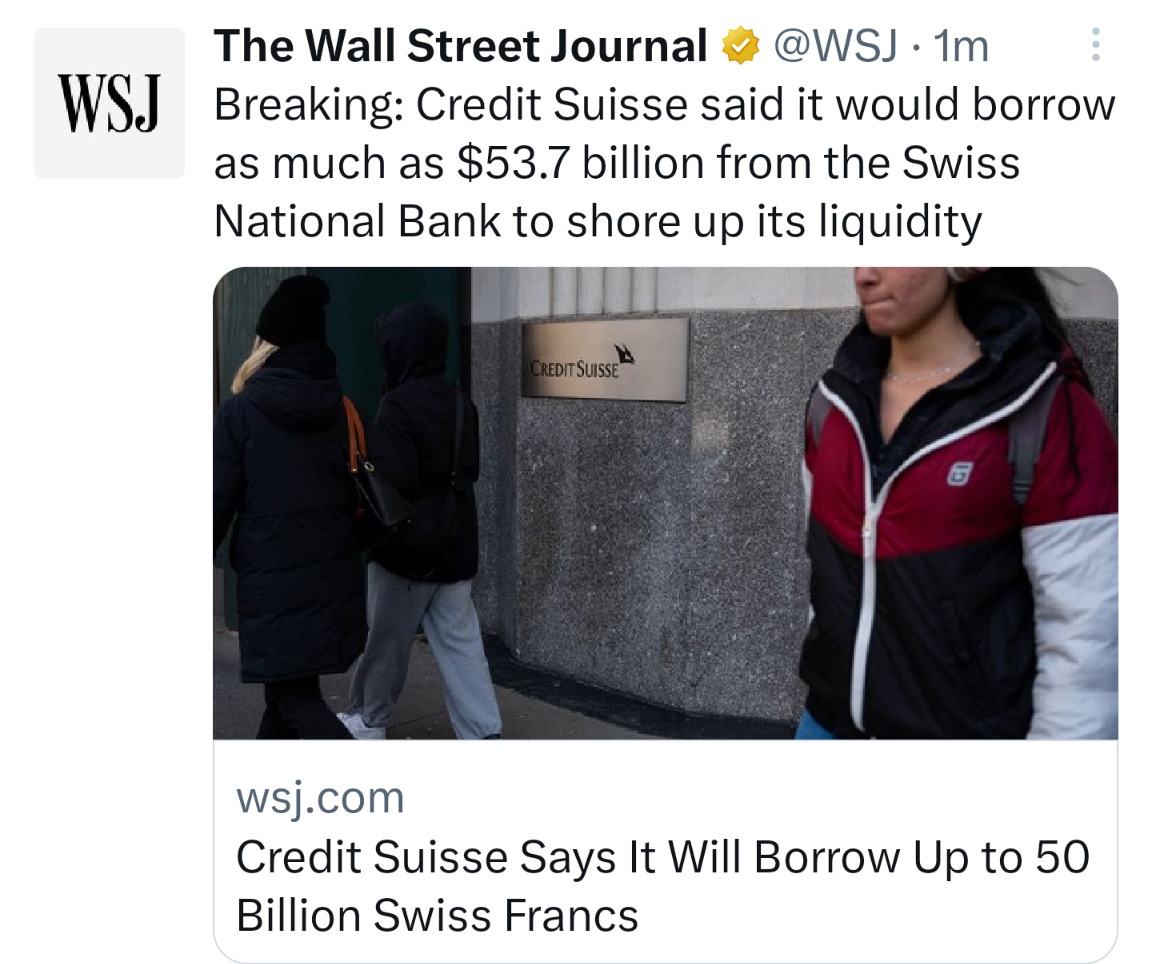
It now needs (and apparently just received) 45 billion to be ‘secured’. This is a little more than the national budget of Qatar which is 53rd on a list of national budgets with 228 nations with on last place Wallis and Futuna. To give you a better picture, it is twice the amount Oman has for its citizens, they are in 68th position. They need THAT MUCH money. The issue is that big and do not talk to me about journalists or those clowns at the ICIJ. They are all about their Pandora papers and what a joke they are. 

You see, I stated in the first article the Common Equity Tier 1 (CET1) and now we see the BBC give us (at https://www.bbc.co.uk/news/business-64964881) giving us “After Credit Suisse shares plunged on Wednesday, a major investor – the Saudi National Bank – said it would not inject further funds into the Swiss lender”, it matters and I will get back to this. In the mean time The Guardian gives us “The bank had been forced to delay the publication of its annual report last week after a last-minute call from the US Securities and Exchange Commission relating to what Credit Suisse described as the “technical assessment” of revisions to cashflow statements going back to 2019. The bank said those discussions had now been concluded” I believe it is more, I personally believe that was why Yellen got involved in day one. I think the SVB and others have too many bonds and they are not ready to mature yet and with interest up these things are making banks bleed money and they are bleeding a lot. You see, there is an estimated total of TWENTY THREE THOUSAND BILLION DOLLARS in US government bonds floating around and I reckon the SVB and Credit Suisse are now in levels of pain, they had too many of those. As such the outstanding part, not merely these two represent $23,000,000,000,000 and no one can cover it they are all stretched beyond thin. This is what I expect is happening and I warned for this as early as 2016, there is a point of no return and the banks are way past that. Putting your IP in the USA is about to become one of the most expensive jokes tech firms have faced in well over half a century.

Could I be wrong?
Yes, that is the case, but that can be tested quite easily. You see, if you make a tally of where all these US government bonds were and you set that tally in a mineable solution especially with pre 2016 and past 2016 when Dodd-Frank got cancelled you will learn a few things and this is what I saw on day one, but weirdly enough the media is not going there (neither is the ICIJ), so you get to wonder why.

Oil in the family
now we get back to the Saudi National Bank. In this I agree with Saudi Energy Minister Prince Abdulaziz bin Salman. Oil is a commodity, there is no cap, if you need oil more and more, you are working from the wrong business plan and if that relies on exceeding your budget by over 30 trillion dollars you get what’s coming to you. In addition I would add the Republican Party making small talk stating that they need to pull away from Ukraine, I lose the little sympathy I had left for them. The US has slammed Saudi Arabia again and again, in some cases with the assistance of a United Nations essay writer. There is only so much people will take. They had the option to help Saudi Arabia create a nations defence strategy, they bailed out and now China is there. They made fake promises and most were not kept and now we see banks asking Saudi Arabia (in Oliver Twist style) can we have some more please? 

As such we see event after event and now that things are on the rails, the train has speed and they just ran out of rails. This is early and before I expected it, but I never considered the impact of Russia being stupid and attacking the Ukraine, it merely escalated things. 

America has two options, does it become part of China or part of Russia. It seems that the Republicans want to be part of Russia, the rest I do not know, but we are now in the process of the final financial act. And my evidence? Investigate the CET1 setting of EVERY bank (especially the two in trouble) and then look at where the bonds are and how many of these bonds are/were with the SVB and Credit Suisse. I have no doubt they both have too many. Then consider Basel III and see how many banks hold up at that point. They were warned for 13 years, so let them rot, let them collapse and let the investors and share holders take the fall and live life in minimum wage. 

And in all this, too many of the media are all about flaming and not doing too much about it, merely pushing towards bailouts. That time has gone as I personally see it. 

All whilst the Australian Financial Review gives us a mere 45 minutes ago “The failure of Silicon Valley Bank has exposed fresh divisions on Capitol Hill over banking reform, as US lawmakers from both parties trade blame for the lenders’ collapse and squabble over future legislation to shore up the financial system” squabble on something that was shown 13 years ago. Still think I am wrong? 

Enjoy the money you have, there might be a lot less soon enough.

Leave a comment

Filed under Finance, IT, Media, Politics

An actual surprise

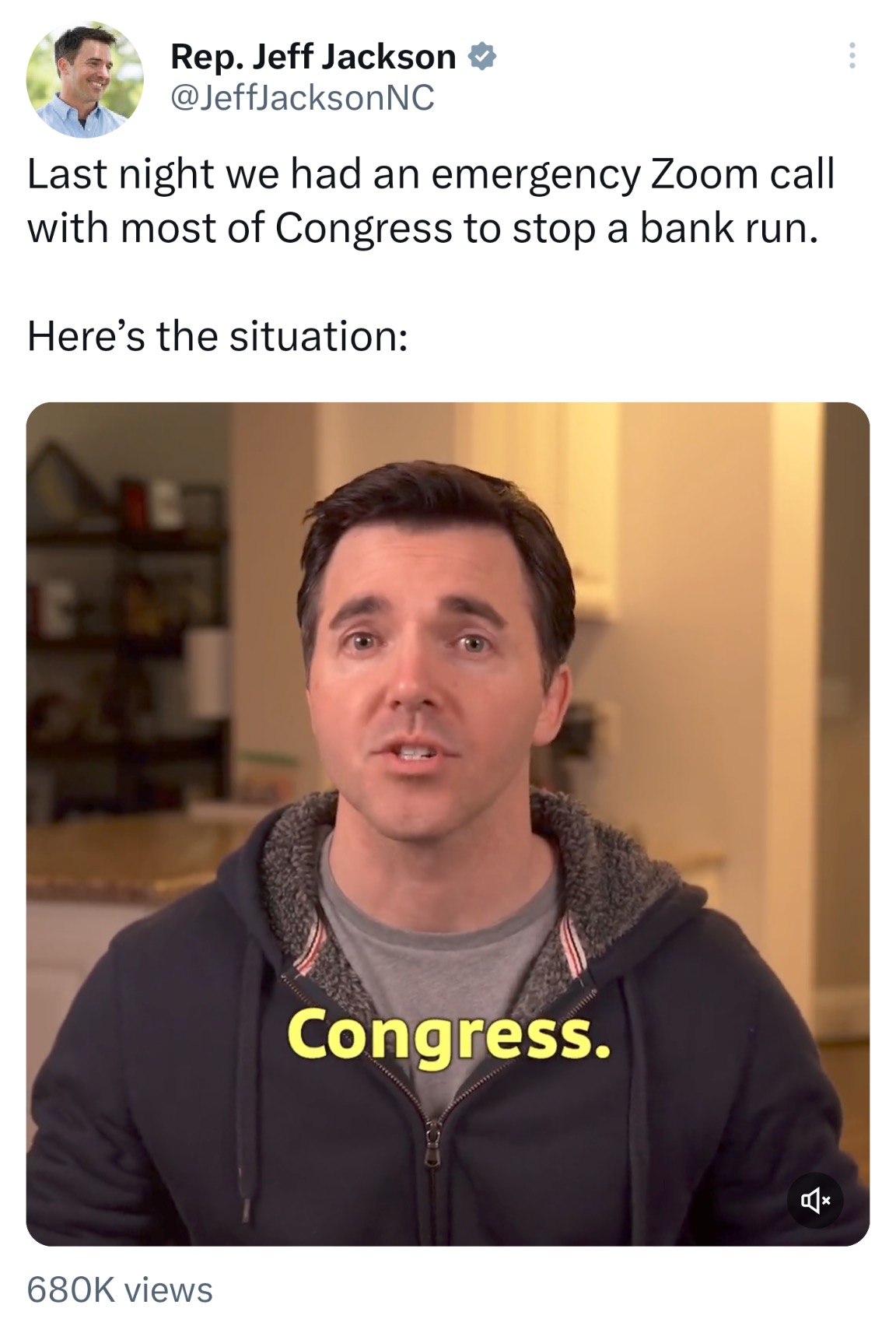
That happens to us all and to me about an hour ago when I was about to go imitate a sawmill when a tweet reached me. The Tweet came from Democratic Jeff Jackson, United States Representative since 2023 for North Carolina. And the tweet was worth it, I would call it the best political video I saw in years. 

It gives a clear concise and brief overlook of the Silicon Valley Bank situation and the actions that are in play. Now, I do have questions but not on the video, everyone should see that one. The video can also be seen on YouTube (at https://www.youtube.com/watch?v=VFo-AQ5aQm0), so watch this. 

This was about soothing and assuring people and that is a good thing. It was a one of the best surprises I have seen in years. Then we get to the Guardian (at https://www.theguardian.com/us-news/2023/mar/14/first-thing-global-markets-gripped-silicon-valley-bank-collapse) there we see
The bank’s parent company, SVB Financial Group, and two top executives have been sued by shareholders over the collapse of SVB. The bank’s shareholders accuse the group chief executive, Greg Becker, and the chief financial officer, Daniel Beck, of concealing how rising interest rates would leave its SVB unit “particularly susceptible” to a bank run”, for this we have a few items and it is not the Simpson illustration even as that was a hilarious one (at https://www.youtube.com/watch?v=Ovfap2VtpHM) and even to some degree on point even as Bart Simpson never went to the Silicon Valley Bank, the run shows that something set it off, in the case as I saw it, the bank trying to raise 2 billion dollars. Yet I still have questions. You see, I comprehend what happened, I merely do not understand it. I never understood greed (as I personally saw it). I raised the issue (at https://lawlordtobe.com/2023/03/12/i-honestly-dont-get-it/) with ‘I honestly don’t get it’, there I made mention of the European phrase CET1 (Common Equity Test), it was an essential step into Basel III. When the US (under non-leadership of the town clown Donald Trump) lifted the Dodd-Frank act which stopped banks take unnecessary risks, without that act these dangers are back and now it comes to the question as I also gave you in the previous article “mainly US government bonds” that is the setting of the question which is:

How many US government bonds did EVERY US bank buy since the Dodd-Frank act was lifted and I reckon that the SVB bought too many, but they are nowhere near the only ones and as such the US needs to look at these stages and what is required to set a decent level of footholds in place so that the US banks can pass some level of Common Equity Test. Now, there is every chance that this list of banks are limited and that is OK, but remember that a run on two banks nearly started a new financial crises, which would close to immediately sink their economy. And make no mistake, I was a Republican once and I cannot stand this level of stupidity, so the Republicans get to wear that cloak of shame, all thanks to the Trump disaster creation team. He took such great pride of dwindling down Dodd-Frank, now let him face the fallout too.

The action was great, the question remains, but that is for another day, for now this administration needs to avert a new financial crises, and they seem to be doing just this. The end will not be known until early next week I reckon, but that is a pure speculative timeline.

Have a great day!

Leave a comment

Filed under Finance, Media, Politics

I honestly don’t get it

It started early this morning when I saw ‘Silicon Valley Bank: Regulators take over as failure raises fears’ (at https://www.bbc.co.uk/news/business-64915616), now I have never denied my lack of economic knowledge and these Simple Voluptuous Bobo’s should know a hell of a lot more than I do. So when I read “a key tech lender, was scrambling to raise money to plug a loss from the sale of assets affected by higher interest rates. Its troubles prompted a rush of customer withdrawals and sparked fears about the state of the banking sector. Officials said they acted to “protect insured depositors”.” You see, this left me with questions. Bankers should know this stuff, they should know about margins and leave room to spare to take a breather when things tenses up. So when I read “The collapse came after SVB said it was trying to raise $2.25bn (£1.9bn) to plug a loss caused by the sale of assets, mainly US government bonds, which had been affected by higher interest rates.” When one bank needs to cover losses to the effect of more than 2 billion dollars things go south fast, yet it was that one part “mainly US government bonds” that send my non-knowledge off flying. You see the US has a debt of well over $30,000,000,000,000. Is this the first signal that the US debt is buckling banks? I honestly do not know that, I am asking. You see, the fact that I see “Concerns that other banks could face similar problems led to widespread selling of bank shares globally on Thursday and early Friday” supports this. That does not make me right, I simply do not understand this setting and the setting that it merely happening to one bank. Then we get “US Treasury Secretary Janet Yellen said she was monitoring “recent developments” at Silicon Valley Bank and others “very carefully”.” One bank goes the way of the Dodo and she wakes up? This does not make sense to me. Especially when other banking Bobo’s (read: fat cats) are not responding to this. Then we get “The firm, which started as a California bank in 1983, expanded rapidly over the last decade. It now employs more than 8,500 people globally, though most of its operations are in the US.” Now this makes it not the smallest bank, but we also see that HSBC shares fell 4.8% and Barclays dropped 3.8% that ain’t hay. This implies that either the Silicon Valley Bank (SVB) is a lot larger, or the bonds are taking a massive dive and I wonder is this the beginning of the end for the USA? 

I am not telling it is, I am asking if it could be. We see the sleep sussing by people like Alexander Yokum and we get that, but consider that this hits one bank that needs to secure over 2 billion. Did they buy up way too much bonds and how many banks have bonds and how much bonds do they have? So when I see “Silicon Valley Bank would not have lost money if they hadn’t run out of cash to give back to their customers” did we not see a similar setting in 2016 in the wake of the LIBOR scandal? Perhaps they are two different things, but I remember something on Basel III, it was about stress testing and liquidity requirements. It was something with CET1 (Common Equity Test). I only know about it because it was a big thing in a program called Clementine, people were all over this and a program called Clementine was bought by SPSS and it became SPSS Modeler (later bought by IBM). So I saw the emails pass by, but it was not on my plate and this was a decade ago. So in a decade someone ignored the Common Equity Test? That is what it looks like to me and I will admit that the article has limited information and this is not the case, but this landed on the desk of US Treasury Secretary Janet Yellen? One bank? She wouldn’t even read my love letters (her glasses are too thick), so this one bank has her attention? Things do not add up, but that is my take and there is every chance I am wrong. Yet I saw a few articles and no one seems to be asking questions and that seems weird to me. 

Still my brain is asking, is this merely the first sign that banks are anchored to the titanic as American bonds are dragging these banks down. And the SVB is merely the first one as it had too many of them. I am ready to be called wrong, but the media isn’t looking very active. I do not care, I have been in a haze of achievement with my 8 IP’s and the fact that both Gucci and Tiffany are driving in my IP minefield 9 months after I published my stories on Augmented reality. I was in a daze of happy feelings and a bank that is not on my continent did not worry me, but HSBC is, so the puzzlement came back and the surprising nature was that one bank should not see the reactions of Janet Yellen, she is too big for one bank, as such my worry started. Was this the beginning of a lot more?

4 Comments

Filed under Finance, Media, Politics