Tag Archives: the Guardian

As the costs come

There is an issue that we see floating at Pressnet. Actually it’s an issue that started last week. I got the news from Retail Week (at https://www.retail-week.com/companies/bhs/bhs-admin-costs-spiral-as-mps-demand-answers/7017777.article), yet it came from several directions, so there is ample visibility. Yet, what is going on? This is an important part and even as there is great benefit to anyone’s soul to blame PwC for this, yet is that fair? The question becomes, is it in the books? When we look at the previous audits, was the quote “BHS administration costs have come in at £1.3m more than expected as MPs question a £35m ‘floating charge’ paid by Arcadia” a fair question? In all this, are these floating costs in the books? I actually do not know, yet I equally question why certain parties aren’t openly asking these questions at the PwC desk. Is that not equally odd?

The two quotes that matter are “If it was such a completely standard move, as Duff & Phelps claim, one wonders why it was reversed by the co-administrators as one of their first acts upon being appointed, and why the PPF seems to take a rather different view.” and “Meanwhile, Field questioned the transference of a “floating charge”, put in place at BHS by Green’s Arcadia Group. Duff & Phelps transferred the charge to Linklaters last October“, this now gives us the parts:

  1. If we accept the bankruptcy announcements of April 2016, how come that this is done in October 2016?
  2. If we accept that a floating charge is ‘a liability to a creditor which relates to the company’s assets as a whole‘, than the part that this is a credit to the Arcadia group should be in the books, and should have been in there for some time I gather, so why are there no questions asked at the address of PwC, in addition, why are MP’s not asking certain questions from Linklaters? Now, we should accept that Linklaters cannot divulge too much (read: any) information, yet when this was all set up could be seen as mere administration and that needs to be logged, which means that either Arcadia or BHS could release that information, if they choose not to do that, the question that follows should be a lot more serious and we need to wonder what else is in play.
  3. When we look at the quote “If it was such a completely standard move, as Duff & Phelps claim, one wonders why it was reversed by the co-administrators as one of their first acts upon being appointed, and why the PPF seems to take a rather different view“. In that I look at another issue, the quote found in Professional Pensions gives us “A spokesman for FRP Advisory declined to comment, adding all that needs to be said is covered in creditor reports“, yet if it is there, should it not also be in the accountancy audit? That is an assumption from my side, and I could be wrong, yet the amount of £35m moved via Linklater in April 2016, if none of the audits has this on paper, questions should be asked, if it is there, questions should still be asked, yet it seems that questions are asked in such a late stage. In all this, City A.M. gives us: “Tension has been building between the PPF and Duff & Phelps throughout the administrative process. In November, the PPF voted against Duff & Phelps’ request to increase its fee. Malcolm Weir, head of restructuring at the PPF, said BHS pension scheme members deserved “value for money”“, which sounds fair enough, yet in all this, even if Arcadia hasn’t received the funds at present, the fact that we see “The £35m was never paid to Arcadia. It was always held in an account to our order. Our legal advisers have confirmed that the floating charge is valid. However, I understand that the liquidators and their legal advisers have made comments concerning its validity, but, I nor my legal advisers, have received any evidence to support their view.” In that regard, we now see that legal advisors are on opposite sides and both sides claim their version of validity, as legal advisors would. This is not in question at present, what is interesting is that the media at large have not included PwC in any of this, as they have been seen as the auditor of BHS. Oh, and there was a reason for me mentioning: “if none of the audits has this on paper, questions should be asked”, be aware that I have no experience on corporate taxation. However, would it not make sense that a £35m invoice would impact next year’s taxation significantly and as such, should it not be mentioned?

In this let me take you back to the previous article, where I discussed the Financial Times (at https://www.ft.com/content/4c3965f2-3c4e-11e6-9f2c-36b487ebd80a). Here we see “The Financial Reporting Council said its investigation related to PwC’s audit of BHS accounts in the year before the retailer was sold by Sir Philip Green’s Arcadia Group, in a deal that wrote off £215m of debts“, which is fair enough. In addition we see “At a committee session in May, PwC partner Steve Denison was asked by MPs to explain why the firm was prepared to sign off BHS as a “going concern” just days before its sale for £1“, which is fine too, yet where in all this is the £35m transfer to Linklater for the Arcadia group? If Duff & Phelps took control in April, would the accountant not have been aware of the thirty-five million, as such should PwC have been aware? (Read: not implied, yet questioned).

Let’s not forget that the Financial Times article was from June 27th, which means that the £35m should have been on many minds at that time, yet for the longest time there was little to no mention. I would think that if a firm is sold for the price of a mere Tesco Sliced Wholemeal Batch Loaf, would a question not be ‘What else needs to be paid for?‘ at that point the entire £35m transfer should be on the top of everyone’s mind, especially as there was a decadent pension gap issue many times that size? Perhaps it is just me, but that would be on my ‘media’ mind. Not just the actual newspapers, a few other publications (like TV and morning shows) would have had a field day with the mention that pensions will remain short, but the bosses will get squared for that thirty-five million. Emotions would be running high that day, let me guarantee you that emotions will run high on that topic!

In that regard, some MP’s are starting to ask additional questions as we see a fees increase £500,000 for Duff & Phelps’s. I wonder how many additional man years of work have been spent that warrants a £500K increase. The week gave the quote: “When they were appointed last April, initially at the behest of Green and then approved by the BHS board, the company estimated its costs would be around £3.5m“, now I imagine that an insolvency comes with all kinds of complications, but how much work, how many months of full day activities warrants £3.5M? I do not know, I am merely asking, especially as the pensions have been for the most unpaid for years now. The site this is money gives additional connections in the shape of Goldman Sachs, where among the top earners at the investment bank’s London office will be the former co-chief Mike Sherwood, who faced questioning from MPs last year over the bank’s role in the BHS scandal. He landed a $21 million pay and bonus package last year, worth £15 million at the time (at http://www.thisismoney.co.uk/money/news/article-4120336/Now-bankers-bonus-Brexit-Goldman-staff-BHS-probe-donate-pension-fund-says-MP.html).

Now a lot of this news is between 1-2 weeks old and a few items are merely days old. Yet in all this we see a massive drain to less than a dozen people, where including Arcadia a syphoning through invoicing has surpassed £50M if we include the Arcadia bound payment, yet all is not well as several sources give large payments in their report, yet the exact part of what represents BHS is not given, but implied to be a large part. As such Mike Sherwood might have ended up with 21 million dollars, yet what part is though or because of BHS is not given, in his position, with his amount of accounts, the BHS part could be less than 1%, and as there is no clarity, the Week who gives us in addition “Huge payments to bankers who worked on the BHS deal could prove particularly controversial“, only if the bulk of these payments were regarding BHS, but that is not a given, I would add, it is exceptionally unlikely. By the way, those people did not really bother reporting that when Greece got back onto the markets In April 2014. In my article ‘Are we getting played?‘ (at https://lawlordtobe.com/2014/05/18/are-we-getting-played/), where we saw the disastrous act of Greece getting back on the bonds field selling 5 billion in bonds. Yet the media at large was very very eager not to mention that the few bankers connected to this ended up with a total bonus of $50 million for what amounts to 3 days of work. So on one side they refuse to give the info, now we see incorrect (or at least incomplete info), with a reference of 21 million, the package of Mike Sherwood.

Yet there is more, the part I find hilarious is “Frank Field MP, chairman of the Work and Pensions Select Committee which quizzed the Goldman bankers on the deal, said: ‘This gives them an ideal opportunity to donate something to the pension funds, to make partial amends for the failure to give effective advice“, you see in that, he didn’t make any such reference to PwC. Pricewaterhouse Coopers, has been seen on the minds of a few as we see (in the Telegraph of all places) “select committees have also said that they have welcomed the Financial Reporting Council’s investigation into why PwC audited BHS’s accounts as a going concern when it was evident the high street chain was dependent on support from Arcadia Group, Sir Philip’s empire which includes Topshop, Dorothy Perkins, Miss Selfridge and Burton” in that the red flags of pension deficits we see a £571m pension deficit and kindly audited by PwC, so who else are they auditing in the Empire that is (or was) part of Philip Green?

Yet in all this, at present there is, just like with Tesco very little noise regarding the Financial Reporting Council and PwC, it seems like the press walks away when these two are mentioned in one sentence. After June 2016 there is abysmal little to see, which after Tesco and BHS that should be a little weird. Even when we look at the BHS elements now, overall the Auditor is left unseen in more serious ways, other than that Tesco is now hiring PwC again for other services, which after the shortfall and the DeLoitte results is a little bit weird to say the least.

You see, last year Aditya Chakrabortty in an opinion piece wrote: “Cameron warned of “the slow-motion moral collapse that has taken place in parts of our country these past few generations”. He was right. It’s just that it’s been led by those at the top – the ones at the boardroom tables, their expensive helpers – and their mates and supporters in politics using taxpayer money to wave them on” is not a wrong view, it comes three years after I made pretty much the same claim, so we can see that some players are a little late to the party. What is linked that when it comes to the matters as happened with BHS, crime literally does pay. It does for the auditor, the business men who own the place and sell it for £1 as well as the politicians who threaten with a £1,000,000,000 fine which will never happen (that pesky thing called the law gets in the way). You see, for many of us and for the victims it is a crime, yet from a legislation point of view that is not certain and it seems that no crime took place, because the people are not in jail, not in the dock and not in court. They are refurbishing their £10 million estates, whilst the working victims cannot make ends meet and where the auditor gets rehired by those they seemingly wronged for even more high priced consultancy.

As the costs are handed to the corporations in the shape of invoices, we see that crime seems to pay and it does so at a lower tax bracket than normal incomes. It can be stopped, you could be on the other side of the equation. You only have to be willing to do the one thing others did not anticipate and you have to be willing to be utterly ruthless. Basically you have to become a businessman like Sir Philip Nigel Ross Green and hire and firm like Pricewaterhouse Coopers to advice on your endeavour and audit it.
 

Leave a comment

Filed under Finance, Law, Media, Politics

Haystack, meet Needle!

There is a lot of emotions out on the social networks and in the open air. It is fair that this is the case. Those who are genuinely smitten with emotion through a connection, there is not shame and no blame. On March 8th 2014 Malaysia Airlines Flight 370 left Kuala Lumpur never to be seen again. Yesterday after groups of people dedicated to finding any evidence of what happened to this flight, spanning a timeline of a little more than 2.75 years, the search has now been halted. The family members of the 239 casualties (227 passengers and 12 crew) are beside themselves. No grave to remember, no answers to what happened. The first piece of MH-370 was discovered on 29 July 2015 on Réunion Island. As the place where it was found is 180 degrees away from the destination it was headed to, we have no idea what happened. There have been many speculations, including one on a suicidal pilot. That issue I discussed in ‘Bad Journalism‘ (at https://lawlordtobe.com/2014/03/25/bad-journalism/), to counter these speculations, I added one myself that was not based on malice and not that far-fetched. Consider that there was an issue with the cabin pressure, this might have been disastrous, by the time the pilot realised in what danger he was, he changed the autopilot by 180 degrees knowing that he would crash in the ocean, knowing he would not crash into a city or in any place that could cost the lives of so many more. It was not an original idea, but at least there was no malice. We can speculate even further, but it would remain speculation. There will be no answer for the families of the lost.

I made my prediction long before the piece on Reunion was found, which makes it not more credible, only less incredible. Yet in this haystack that is called the Indian Ocean, finding one plane is not a realistic option.

Yet, why is MH370 still an ‘issue’. You see what happened is rare and unlikely, yet in all this, the black box would have been instrumental in getting answers. What is interesting is that the Black Box is technology that has been obsolete for a long time, in this age when we have flights with in-flight movies, internet and inflight mobiles, can anyone explain why the black box is not mirrored to a secure cloud location? Let’s face it, the plane is already there, so why not save it on the spot? By the way, this black box obsolete thing is not new, it is a discussion that has been going on for well over a decade. With the ability of internet on flights for even longer than that (not for passengers though), how come the airlines did not adjust their technology? Greed? Budgets? Complacency? Your guess is as good as mine, I actually do not know. In their defence, we can agree that the events of MH370 are so rare that the act of one flight should not impact on the roughly 104,000 flights that happen every day. The math does not bear this out. Yet, with ships one ship changed everything. It was the Titanic, who on April 10th 1912 got a little more ice in their bucket lists than they bargained for (Too soon?).

You see that disaster started the establishment in 1914 of the International Convention for the Safety of Life at Sea (SOLAS), and they still govern maritime safety today. So, perhaps MH370 will also become the foundation of an essential change that will spark changes too. There might be too much luggage to deal with the black box, yet having an additional system that cannot be interrupted, one that pushed a data line every 600 seconds so that the log will show essential data no more than 20 minutes from the last location, which in this case would have been invaluable. A 1024 character blip with the most important data of location, heading, speed and flags. The Black box will have all the high level details, but the people would never end up in the dark like this ever again. A simple solution whilst the bulk of the required hardware is already in place. It seems like such a waste not adding such functionality, more important, with the proper technology available for well over a decade, why was this not done sooner?


The fact that something like this has not been the show stealer at the aviation trade shows is a little beyond me.

When we get back to the Guardian, we see as reasoning ““It has been a costly exercise but it hasn’t been a factor in the decision to suspend the search,” he said. “We’re in a position where we don’t want to be providing false hope to the family and friends.”“, I cannot disagree (at https://www.theguardian.com/world/2017/jan/18/malaysia-airlines-flight-mh370-australia-says-cost-didnt-force-suspension-of-search). 2.75 years is a long time, I reckon we can state that the ‘costly’ side was surpassed well over a year ago. In this haystack called the Indian Ocean, which is 73.56 million km² in size, even as part of that pond can be ruled out, this ocean is still equal in size of Africa and Asia together. The fact that something this big has swallowed the MH370, a place not just the size of two continents, it has an average depth of 3,890 meters with places where the maximum depth is 8,047 meters. To find anything in such a place, with canyons, crevices and on top of that current speeds that can get up to 5 miles per hour. In this haystack, the size of Mount Everest, a group of dedicated people have dedicated well over 2 years to fine a needle. Anyone claiming it needs to continue should not look at the cost, they need to look at the fact that you are asking dozens of people to commit their life and the size of their career to look for something that does not have a lot of chance to be found. If it is found it will be nothing short of a miracle, especially with the lack of facts available. The people who have been doing this know all this and still they committed to this. An exceptional collection of people!

So even as I implied certain matters, last June, the Guardian (at https://www.theguardian.com/business/2016/jun/30/uk-satellite-firm-inmarsat-helped-track-mh370-fit-sbs-on-airbus-jets) gives us ‘Inmarsat’s SB-S service renders conventional black boxes obsolete and could prevent air crashes‘, I am actually not certain whether that is true. You see, the quote “It beams flight information via a satellite to an airline’s control centre within seconds, capturing real-time data about what is happening on board the plane“, which sounds like nice marketing, yet when we consider that there are 105,000 flights every day and that some areas have atmospheric conditions that make data transfer not that reliable, or at the very least an issue, now consider that ‘real time’ data would need to be analysed. The math doesn’t add up and as for preventing a crash, when that happens it is usually too late. The best we can hope for is that the cause is detected, comprehended and prevented in the future, which is fair enough, and in addition the updates with locations would have prevented the ordeal of the family members of the MH370 victims.

So, as I see it, this is an interesting piece, even though it is mainly about marketing and in that, the quote “A former pilot, captain Mary McMillan, who is Inmarsat’s head of safety, said SB-S technology could not only help identify the cause of accidents but could even prevent them“, it is the ‘prevent’ claim that I have a small issue with. Not because of my abilities as a pilot (which is limited to the PC (Flight Simulator 2004), the Xbox One (Elite Dangerous) and the PlayStation 4 (No Man’s Sky). Yes, with all that knowledge I make this claim. You see, my reasoning is that no matter how fast the data comes, it comes as the event is already taking place. Taking into consideration that the Pilot in place is the actual expert with support of a co-pilot and engineer, this pilot gets many times the information than is transmitted. It is a mere reality that does not make the solution invalid, incorrect or useless. It merely gives more information that after the fact will be invaluable. So as such Inmarsat is bringing a solution, perhaps even an innovation, one that could perhaps at some point replace the black box. It sounds cold, but yesterday’s news on the halting of the search for MH370 could be a big break in visibility of Inmarsat and the product line they offer.

With the MH370 search suspended, we will see more and more questions regarding these decisions and more and more emotional rebuttal on the halting of the search. I will not oppose that, especially against the people who are dealing with the loss of friends and family, yet in my mind, I see the resources needed and the chance of any level of success. In that I accept the end of the search, I just wished that there was something that could be achieved for those who lost anyone on MH370.

Perhaps a better way to use the Lenz effect to find a chunk of airplane, a submerged drone with a different kind of scanner? Perhaps a nice challenge for engineers with a massive dose of imagination?

Leave a comment

Filed under Media, Politics, Science

The rights of one person

Where does the rights of a person stand? Where do we draw the line of reason? These two questions came to mind when I saw the partial readable news in The Times with ‘Asbo woman fears eviction for moving bins‘ It could be seen that there is something amiss, but where does the problem lie? You see, when I was looking into Brexit dangers, the quote “A 61-year-old woman who has been warned about antisocial behaviour claims that she is facing eviction after neighbours made 15 complaints about her for “offences” including moving bins and supporting Brexit“, in addition we see:

  • Over the past seven years, Anne Maple has been sent eight antisocial behaviour notices by Lewisham council.
  • Three ordered her to stop interfering with dustbins.
  • She was warned against displaying “inflammatory” notices after putting pro-Brexit and Conservative election posters in her window.

In this my first response would be that Jim Dowd, the MP there wakes up and takes a personal look at this very case. In the first, is there a law against putting a conservative poster in her window? What kind of people are there in Lewisham to take such offense, Labour minded people perhaps? That is off course as long as there is no housing law against it, which would actually be a breach of the freedom of speech! Now, there is no case I can make against the dustbin issue as I have no idea what actually happened and to what degree. Yet the fact that this is about a 61 year old woman, who is actually making these complaints? In addition the fact that more than 3 anti-social notices were given by the council themselves, I think it is time for Jim Dowd to do a little less posturing, especially when sauce bottles are looking very distinctively different! Mr Dowd should actually take the morning to visit Ms Maple and have an actual conversation. That is, unless he is too busy posturing towards his next election. And the threat of eviction because a person was in favour of Brexit? Is that area filled with sore losers perhaps?

It is nice that The Times is stating that there have not been any conviction, yet these acts against Ms Maple could be seen as Psychic Assault. Perhaps the people making the registration, should inform those complaining that in light of the number of instances, that they could face the consequences of Psychic Assault (although the UK doesn’t really have proper protection in place), which is for now a little bit of an issue. Still the situation remains that the Lewisham Council seems to be no more than a convenient portal for harassment. (Read: taking offense to Brexit and Conservative posters pretty much qualifies), in addition, if no offense was given to Labour Posters in windows anywhere in Lewisham, it now becomes a council act of discrimination as I personally see it.

Yet, even as we see this, the Miss Maple case was not the one that this was going to be about, but it is actually closely related to the matter at hand. You see, the papers are full of deportation articles, it is the Barclay brothers spreading fear. Sir David Rowat Barclay and Sir Frederick Hugh Barclay own these papers, so I call them in charge, even as I know that Aidan Barclay is actually managing pretty much anything they have in the UK (several billions worth I might add). You see, Owen Bowcott at the Guardian stated it perfectly when we see “Mass deportations of the estimated 2.9 million EU nationals living in the UK would be impractical and they should not be used as a “bargaining chip” in Brexit negotiations, the government is being warned“, this is where I see this happen. Emotional reports and statements from Bremainers getting desperate that any alternative is null and void. First of all there is the Immigration Rules on Family and Private Life (HC 194), which the Home office has here: (attachment).

When we get to the best interests of the child, we see: “arrangements are in place to ensure immigration decisions are made having regard to the need to safeguard and promote the welfare of children who are in the UK“, now when I reflect that in regards to the Guardian article (at https://www.theguardian.com/politics/2016/dec/28/dutch-woman-with-two-british-children-told-to-leave-uk-after-24-years), where we see “A Dutch woman who has lived in the UK for 24 years, and has two children with her British husband, has been told by the Home Office that she should make arrangements to leave the country after she applied for citizenship after the EU referendum“, yet when we consider the Home office paper, the interest of her children and Section 55 of the Borders, Citizenship and Immigration Act 2009, where we see in section 55(6): “children means persons who are under the age of 18;“, both children fall into that category, we can argue that the Home office as presently interpreted failed in that assessment, in addition, that this family for 24 years have paid their taxation, have become a part of British society, it is there that we see the notifications from the Home Office seem to be either a careless failure or an intentional attempt to raise fear. I feel that no other direct impression remains. Even if we accept: “European citizens marrying Britons do not automatically qualify for UK citizenship under current rules“, the Borders, Citizenship and Immigration Act 2009 clearly provides in case of underage children which was applicable from the earliest moment on. We can also raise the issue that the 85-page application form for “permanent residency” will become an issue a few hundred thousand times more, so we can state that there will be a blooming business for immigration agents in the UK soon enough.

In all this the rights of one person are currently in danger because certain elements have been left out of too many media outlets for too long, we have forgotten where the media itself was. The Conversation gives us (at http://theconversation.com/hard-evidence-analysis-shows-extent-of-press-bias-towards-brexit-61106) a much clearer view, where we see the Bremain tainted side in blue and the UKF*ckOff (read: Brexit) in red. The fact that the Times is by far the most balanced one yet remains slightly Bremain is pretty awesome to some extent. In all this we all forget that as the least reputable sources (the Sun, Daily Mail and Daily Express) are more widely read and reaches a much larger audience. My view is not incorrect, yet massively incomplete. You should take a look at the Conversation article by David Deacon, Dominic Wring, Emily Harmer, James Stanyer and John Downey because it is an amazing piece of work, and nearly all of them professors (oh, whoop di do). The end result that we see is “when weightings for circulation are factored in, the fact that the highest circulating newspapers have tended to support Brexit means that the gap between the two positions widens into a substantial difference of 18% pro-Remain and 82% pro-Leave“, which is scary!

My reason for remaining ever so slightly in the Brexit field was not on any of those merits and it is perhaps the one part missing here, mainly because it is perhaps not part of the view these people looked at. My view grew based on the actions of others, the inactions of several others and the denial of even more people. The actions of Mario Draghi gave view that Bremain would be too dangerous. The invoice that he would instill on all would debilitate too many, making all mere slaves with implied false freedom. We all become the cogs of the engines of financial institutions and big business whilst the wealth is removed from the people more and more. Servitude to Wall Street! That would be the result and I never signed up for that and I know most Europeans have never signed up for that. In that regard, it is equally interesting how the spokesperson (Prime Minister Joseph Muscat of Malta) considers that “Britain should be made to answer to the European Court of Justice (ECJ) during the process in order to smooth the path for leaving“, it is my question to what regard. You see, the European Court of Justice has clearly intentionally skated away from the issue of a nation leaving for 2 decades. Mainly because no one believed it could ever happen and it is there where we see that the European Court of Justice (ECJ) has utterly failed! When we see “Any member state may decide to withdraw from the union in accordance with its own constitutional requirements”, checks and balances should have been put in place. Perhaps people remember on how ‘Grexit’ was such a big deal. Perhaps you all remember 2012 when people like Roubini stated that Grexit would be possible in 2013. So when I published the paper I found by Phoebus Athanassiou, stating that expulsion from the EU and the EMU wasn’t even legally possible (published in 2009), how betrayed did you feel? All in the media we were led like sheep, and as I saw it intentionally misinformed by those around us. Is it even a surprise that the UK wanted out? It might have started with Nigel Farage, but the issue has grown so much larger, all because the people in charge needed the gravy train to continue, the continuation of the wealthy demanding their Status Quo to remain to grow their fortunes. It is that foundation that is now very much in play. Even as this is all known, even as we have seen that the European exit must be voluntary, we see the BBC give us in June 2016 (at http://www.bbc.com/news/world-europe-36629145), the quote “the risk remains of Brexit precipitating the departure of Greece from the Eurozone and therefore possibly the EU“. At no point do I see the Greeks or the article state clearly that it must be voluntary, no legislation has been put in place ever since this started in 2012. Now we know that laws take a long time to set, but the effort regarding the trimming of the EU tree has been massively absent, why is that?

In all this we see that the rights of one person no longer seems to matter, which is weird because Common Law was clearly set to remain fair in that regard. Even for the most in Europe where civil law was key, the people had a fair amount of rights. Here now we see that the people remain uninformed, the media seems to be unable or unwilling to inform the people where their rights and what their rights are. It is my personal belief that the people are restoring a need for nationalism hoping that local laws will advocate a better level of informing the people, not tailoring to the needs of large global corporations. It sounds weird, yet this is what I believe to be the fear of many. The tax events on large corporations like Apple, Amazon, Google and IBM seem to be catalysts in all this. If you think that I am kidding in this matter, you should see “The discontent with legal tax avoidance, in the UK at least, is clear. A YouGov survey last year found that 59% of people think legally reducing your tax liability is wrong and make no distinction between evasion and avoidance“, which we got from Forbes in August last year (at http://www.forbes.com/sites/jaymcgregor/2016/08/31/apple-falls-victim-to-rapidly-changing-public-mood-around-tax-avoidance), this doesn’t just impact the branding, there are indicators that this also fueled the anger of Brexit voters. In addition, the 180 degree view that President Obama made in The Hague (2012) as he gave a speech on responsibility and then sent senior officials to oppose the tax reformation / tax accountability was no help here. So Brexiteers had a large stack of ammunition that they could hand to the people again and again. Misguiding and misinforming have been instrumental indicators in all this. There are too many sources to name, many are just mongering, yet a large amount came from reputable sources and Forbes has pointed out more than one issue in all this.

As I see it there is an abundance of work to do, some of it should have been addressed a long time ago. Even if I admit that I have not yet filled out my permanent residency papers for the UK, the fact that this is an 85 page booklet is still cause for concern. It is linked to the situation we saw earlier this week regarding the NHS, especially the Coventry ‘issue’. It has become clear that a logistical overhaul is needed in the UK. It is the hardest and most debilitating of overhauls, yet at present it could be seen as the most essential one. Consider the cost for civil servants having to get through 1,000,000 applications, which now implies that 850,000,000 pages get reviewed and decided upon. If a person is really focused and on the ball, that person will make an error once in every 50 pages, this now gives rise to the risk that every submission will have at least one error in its assessment. How efficient is that?

There are steps that can be taken to minimise this, yet it will cost in staff or technology and in both there is still the added flaw that items will be overlooked. That is the mere nature of the beast in all this. The application right of a person will be diminished, not on purpose and not with malice, but the danger is absolute and the scars that soul is left with is pretty much for a long time, perhaps even for life. How is any of it a solution?

In this we can argue that on the middle ground that automated residency is equally not an option, but the middle ground is not trotted on and that is where the solution is to be found, somewhere in the middle, which is turf that the polarised extremists (Brexiteers and Bremainers) are currently not looking, yet neither is the Home Office, or so it seems.


Leave a comment

Filed under Law, Media, Politics

Grasping change

We all tend to avoid change. Not because it is a problem, but we all believe in the expression: “When it ain’t broke, don’t fix it”. You, me all of us tend to go forward in our small circles, because for most comfort is king. Yet where is the moment when continuing the same is no longer an option? There is a lot of consideration in that because we tend to be like the frog in such manner. When you throw a frog in boiling water, he’ll jump out. Yet when you put a frog in a pot of water and put a flame below it, the frog will willingly boil to death. We are like that frog in many ways. Yet this is under normal circumstances, when we see an attack on our quality of life, we tend to get active real fast.

This is seen when our lives revolve around greed. When that happens the numbers go wildly out of control. This we see in the Guardian (at https://www.theguardian.com/business/2017/jan/10/hard-brexit-threatens-global-financial-system-city-chiefs-tell-mps), where we see people like Xavier Rolet, chief executive of the London Stock Exchange end up being connected to statements like ‘could spark more than 230,000 job losses‘. In all this the people involved are (as I personally see it) scared for their life filled with mistresses, large bank accounts and an overly rewarded quality of life ask questions like ‘clarity on the UK’s future relationship with the EU‘. You see, those people were lulling the masses around them into a false sense of compliance, but the people have lost too much, the gap of incomes too large and what no one was willing to accept is that Brexit became a reality and as the implementation is starting to move forward, those people are scared, their large incomes based on inaction is now in recession, it scares them, so they go into blame mode and flame mode. As Xavier Rolet called for a five-year transition period for the UK to exit the EU, possibly for additional reasons like a maximisation of retirement portfolios, is now confronted with ‘the Treasury select committee were told the triggering of article 50‘, which officially initiates the departure from the EU. Another Fat Cat, namely Douglas Flint has admitted a more playful response in this. “The ecosystem in London is a bit like a Jenga tower: you don’t know if you pull one small piece out whether nothing happens or whether it has a more dramatic impact”, is his statement and as he is allegedly fetching £7.6m a year (Compared to that, I am merely making 0.3% of that), we can feel secure in calling the man a fat cat of the finance industry. Yet he is not alone, the triplets of finance is completed with Anthony Browne, who is adding to all this ‘the preservation of the status quo‘ is the best solution.

You see, these people (some call them numbskulls) refused to listen for well over 4 years pushing everything forward and they all forgot that a nation is not them with their 322 friends who are all living the gravy train, it is the 68 million voters, who all for the longest time have lived a raw deal, they voted and there was enough to make a majority, too many had lost too many levels of comfort. If we push back to the frog in scenario 2, too many were getting too uncomfortable and the announcements from Mario Draghi on more Quantative Easing programs that can now be extended beyond 2017. The people see the debt growing and more important, the second time now has enough evidence that it will not be any better, almost certain that it will be worse. In all this we remember the action of an insane person. A person who does the same thing twice and expects different results. The people have had enough of fat cats drowning banks with cash whilst only the banks and the financial sector see the fallout bonus of those events. The people wanted Brexit and certain people in the English Financial Sector now see that the good times are ending, a few years too soon when they look at their retirement portfolios. In that they do not realise that the bulk of the population will have to work until the day they die, for well over 30% retirement is no longer a viable option. They all forgot about the people. In my personal view, the sooner the UK is out of that mess, the sooner can it actually grow its national value, the value of the British people! The fat cats all forgot about that, because for the most, their fortunes are all set in some mobile ‘currency’ that ‘avoids’, or is that ‘voids’ taxation in legal ways.

So even as some of these Fat Cats will grasp towards statistics like “median disposable income for the poorest fifth of households had risen by £700, or 5.1%, in the year to April 2016, while the richest fifth of households saw their incomes fall by £1,000, or 1.9%, over the same period” (source: the Guardian), yet what is left out in the shadows is that the poorest group is making less than £10,000, whilst the richest is making in excess of £55,000, with the top exceeding well over £275,000, so we can honestly state that those losing out of £1,000 should for the most not feel its impact and the top won’t even notice it. Change happens and only when it impacts our comfort levels (those not impacted by greed), that part has been ignored and now when the die is cast do we see levels of fear mongering, where a small group is hoping if they can get away with it a little longer. Almost like that little girl Beverly Hills Twist going to the front of the Crystal shop asking for a little more. Charles Dickens would roll in his grave is he witnessed this. I particularly like the Guardian Quote (at https://www.theguardian.com/uk-news/2017/jan/10/uk-inequality-working-people-pensions-ons) “it calculated that the average FTSE 100 boss earned more than £1,000 an hour, meaning it took less than three days to earn the UK average salary“, the start of a new Beatles hit ‘three days a year’, greed run amok. Let’s be fair, I am for the most a capitalist. I have never objected to bosses making more than me, yet when their incomes with bonuses sets my income (me with two University degrees) at 0.3%, we can state that the imbalance is too far out of control. In that regard, I will need to be slightly less diplomatic and refer to the joke that is ONS senior statistician, Claudia Wells who said “a strong rise in pensioner incomes was behind much of the increase in incomes, especially of those in the bottom 40%“, perhaps she would like to show us evidence, especially when we see places like ageuk.org.uk give us:

  • 1 in 7 pensioners (1.6 million or 14% of pensioners in the UK) live in poverty, defined as having incomes of less than 60% of median income after housing costs.
  • A further 1.2 million pensioners have incomes just above the poverty line (more than 60% but less than 70% of median income)

So in all this, when she hides behind that ‘increase in income‘, how much increase? Because the bulk is not getting any place anywhere soon, too much data shows that. In all this they also tend to miss out on entitlements like Housing benefits because of several reasons. I expect that a lack of social housing is likely to be a first reason.

In this we need change. We will need to consider how business in maintained. The clamp down on tax avoidance was a first, yet the EU borders are too open and too many facilitators for lower taxation remain. With Brexit squarely in place the banks will need to reconsider, try to avoid taxation a little longer by moving, or in light of the European changes stay and pay a fair amount of taxation, at that point only the fat cats lose out, which gave us the three wise crackers at the beginning. When the tax comes rolling in, we will also see a change for the NHS and other parties who have been ransacked due to full infrastructures without properly taxed representations.

In this we need to face a few facts, not just from the HMRC, we see that the Diplomatic Corps needs to take a close look at themselves in the mirror. When we get quotes from the Guardian like ‘Ed Llewellyn told MPs his staff were making contacts with other French presidential candidates‘, whilst stating ‘his embassy will not be forging links with far-right presidential candidate Marine Le Pen because the UK government has a policy of not engaging with her party, the Front National (FN)‘, he better get his head in the game real fast, unless that order came from Her Royal Highness directly. Apart from these people engaging in discrimination, should Marine Le Pen be elected (not a guarantee at present), the UK will have no options but to sit at the table with France, France is one of the economy pillars for Europe and even as the UK is also one, there is enough indication that player number 4 (Italy) will be entering a very deep valley of recession for some time to come. At that point only Germany remains as a sizeable business partner. Perhaps Ed Llewellyn would be so kind on informing the people of England how often an option of one worked really nicely for the UK, like ever? In this Crispin Blunt is asking questions as should we all, Llewellyn’s response “would be a matter for ministers” will in my humble opinion not hack it as they are making connections to the other political players in France. The consequence of these choices could potentially be expensive for the UK, in a time when the required policy of turning every penny is squarely in place.

That wisdom was given by Natalie Nougayrède of the Guardian in September last year with ‘Angela Merkel and Marine Le Pen: one of them will shape Europe’s future‘. Their visions are opposite and there is no clear evidence where the future of Europe is going. Whilst stating that, we do know that Merkel is in seriously warm waters (read: wibbit, wibbit), as Sigmar Gabriel is challenging Chancellor Merkel, there will be an age of polarisation within the German SDP. This will intensify as my earlier blog now gets a new side to it all. Thomas de Maizière a member of the CDU will have options to influence this polarisation, especially if Sigmar Gabriel is willing to offer a better centralisation deal on German intelligence, which is a dangerous reason to change to say the least. So having France in the UK preference side is going to be rather essential, alienating the current number two in that race is not the best actions, in that regard, the anti-Trump actions within the UK are equally not the good an idea, at some point we get to be thankful for Nigel Farage taking open positive interest in the inauguration of Donald Trump. In this we need to realise the ‘blunder’ Sir Kim Darroch made when he decided to dismiss him as “an outsider and an unknown quantity“, I am not a diplomat (far from that) and even I could have phrased that better. So as the UK diplomats bungle one side of the Atlantic river (that narrow brook between the USA and the UK), blundering on the other side of the North Sea might not be the best action to undertake. This when we look back at a leaked telegram by Sir Kim Darroch, making it interesting why a telegram? How encrypted was it? A little embarrassing that this is happening to the former national security advisor, it could just be the irony of the universe.

So as we are trying to grasp change, the people around us are doing the same. In fairness, like you they are catering to the needs of themselves, we cannot fault anyone for that, yet when their incomes is in excess of 300 times your income, how much leeway should they get? I have never opposed differences of income. Someone made Facebook and got wealthy beyond all means. So did the person who came up with Windows, with Oracle, with Google and a few others, yet those who merely ‘facilitate’, those who live of the vulture principle, those who do not actually create anything, how should they be seen? I cannot claim to know the answer, but there is a massive difference.

What changes do you grasp and who is making them for you?


Leave a comment

Filed under Finance, Media, Politics

No Health Statements

This is not the first time that we see a level of anger non-management in regards to the NHS and the medical staff. The proclaimed shortages and a government in denial over these elements. Whilst the DMG Media papers (among others) have had their fun day. The messages concerning the NHS are increasing all over the place and when we start reading about the  ‘The worst conditions in memory’, we know that we have come to that place also known as rock bottom.

This in contrast of messages like: ‘Hospital pays £1,800 for an agency nurse to work a single shift‘, April 5th 2014 (at Read more: http://www.dailymail.co.uk/news/article-2597442/Hospital-pays-1-800-agency-nurse-work-single-shift-thats-163-hour.html), Paul Dacre and ‘his’ DMG media. It is not the only case, there was a similar story on July 30th of that same year. The Telegraph gives us a similar story on January 19th 2013. This in contrast with real newspapers, namely the Guardian who voices (at https://www.theguardian.com/society/2014/nov/01/nhs-spending-agency-nurses-cuts) ‘NHS spending on agency nurses soars past £5.5bn‘, with the second line giving us ‘Government accused of ‘truly incompetent planning’ after years of training cuts push cost of temporary staff way over budget‘, this is a situation that affects both sides of the isle as it wasn’t started by this conservative government, it started before 2010. Neither side of the political isle has given proper vision to the pressures building, and this current government is now watching from the sides as they need to find £25bn. That number is actually pretty easy to see.

Staff shortage, overhaul of equipment, shortage of infrastructure and an overhaul of the infrastructure to protect it from this ever happening again. In this we have two elements. The first is that the press is partial to blame in all this. Consider the speech by Paul Dacre “a kind of show trial in which the industry was judged guilty and had to prove its innocence” (source: betterratailing.com). I like the news in the Spectator even better with “unremitting pressure of fighting what I have no doubt was a concerted attempt by the Liberal Establishment, in cahoots with Whitehall and the Judiciary, to break the only institution in Britain that is genuinely free of Government control – the commercially viable free press“. Yet, Paul Dacre sold out his readers in an instant as he kept quiet on the changed user agreements PSN users were forced to agree to, just a mere 10 days before the release of the Sony PlayStation 4. In that, as I personally see it, he kept the people out of the loop. So as the commercially viable free press is betraying its readers. Possible because he had to orally please the ears of Sony? How can we have any faith on anything we read regarding the NHS, especially when it is coming from DMG Media? You see, the issues are very much linked. The people have been made aware again and again that people like this cannot be trusted. It is Stephen Fry who brings the best definition of the Daily Mail “the only good thing to be said about his Mail is that no one decent or educated believes in it“, which is pretty much spot on, and the news the Guardian gives us regarding: “Paul Dacre steps down from the post of Chairman of the Editors’ Code of Practice Committee, which he had held since 2008” (at https://www.theguardian.com/media/2016/dec/01/paul-dacre-to-step-down-as-chair-of-journalists-code-of-practice-committee) is only the smallest of positive messages, even as he attacks it on the way out. Yet the Mail Online, which is owned by the mother company DMG media has had a long line of issues, among others with Tom Cruise as he was identified in a relationship between ‘Tom Cruise and the head of the church of scientology, David Miscavige‘, which might or might not be a big thing, what was the issue that the publishers were unable to defend themselves and even as we see ‘diplomatic’ responses like ‘Mail Online had failed to demonstrate that it had complied with its obligations under the first clause of the editors’ code on accuracy’, and as Editors’ Code of Practice Committee is part of IPSO, and they administered ‘penalties’ on a DMG Media sibling, the news that the Guardian gave “Regulator to reconsider whether the editors’ code, and its rules, can apply to a global digital publisher” (at https://www.theguardian.com/media/greenslade/2016/jul/19/ipso-review-after-mail-online-fails-to-defend-tom-cruise-story), so at this level of ‘contemplation’, something I personally tend to see as ‘inbreeding’, they are contemplating ‘a commercially viable free press‘. Are you freaking kidding me?

This sidestep is essential, because if it does not come from the Guardian, the Independent or the Times, we cannot be certain of anything nowadays, so as we lash out against the NHS, its governance and the consequences its patients face, we seem to be spurred into a false sense of righteousness as we kept on reading regarding those £225 an hour nursing jobs, which should be seen as misrepresentation of the highest order! The Telegraph isn’t helping any as they publish that the NHS now has access to Artificial Intelligence (at http://www.telegraph.co.uk/technology/2017/01/05/nhs-trials-artificial-intelligence-app-place-111-helpline/).

The part that the Telegraph does show that is important is “Joyce Robins, from Patient Concern, said: “I find this quite frightening. People who are ill want a person they can speak to. Typing in your own symptoms and waiting for a result is just ridiculous – what happens if you make a mistake?”“, which is just the tip of the iceberg.

The issues seem to escalate and there are a few players in this dramatic comedy that have to explain their reasoning. I am clear in ‘explain’ because there are sides that I am unaware of, to boast not being unaware of anything is utterly irresponsible. Before I go into the separate points. I did make a case on several levels with ‘The UK NHS is fine‘ (at https://lawlordtobe.com/2016/09/20/the-uk-nhs-is-fine/), and an even stronger case with ‘Is there a doctor on this budget?‘ (at https://lawlordtobe.com/2016/02/15/is-there-a-doctor-on-this-budget/).

Staff shortage.
It is the easiest one to solve, but cannot be solved overnight. Yet the shortages have been known for close to 4 years, so what has been done over the last 4 years to address these shortages?

Overhaul of equipment, Professor Angus Dalgleish has been outspoken in the past in several ways, mentioning the budget of the NHS not in the smallest way. We know that George Osborne had cut the budget by 1 billion, which in light of the shortages was a bad idea, the question is, was it avoidable, if not, how can the NHS move forward? With the current unemployment levels, how come it is still so hard to recruit nurses and doctors? I myself have had a lifelong interest in Radiology and Anaesthesiology. I am not alone in this, although in the 70’s when I was initially studying, getting into law or medicine was only possible if your parents were wealthy or if they were in law or medicine (meaning that they were wealthy). Now consider what the governments have done over the last 2 decades. I am giving that frame because we have known for at least 20 years that there was an aging generation coming up. Now the press at large seems to be blaming the immigrants, they might be as factor, yet they are not the main cause. A UK parliament going all the way back to Tony Blair should be seen as responsible for this. Those words are very specific. You see, when we look at the NHS expenditure history (at http://www.nhshistory.net/parlymoney.pdf), we see that in 2004/5 and 2006/7, Under Labour Tony Blair, the expenditure takes a massive hit, it is after that during Conservative David Cameron that expenditure goes straight into the basement, both sides fell short whilst both groups knew that the increased pressure from 2013 onwards would be strangling any budget as the NHS gets to deal with an aging population moving into retirement and an increased need for health care. None of it got properly dealt with by any parliament. In this, a rough estimate would be that the UK needs to hire no less than an additional 2,000 students a year for no less than 7 years to get anywhere near the numbers we will need in 8 years’ time, because the current shortage will increase. Perhaps parliament should take additional looks at places like the Royal College of Physicians (https://www.rcplondon.ac.uk/), we can agree that quality needs to be high, Yet when your annual tuition fee is set at £23,190 with an additional college Fee of £7,350 there will not be much appreciation on an international level, unless it is for private practice and that is where the NHS luck runs out, in addition, for the ‘locals’, £9,250 annually is still a big ticket, especially in today’s financial uncertainty. Consider the fact that this goes on for 4 years (the NHS is mentioned in several places to cover years 5 and 6), still, the average student will end up owning over £37,000 before they are actually earning anything and by the time they start earning enough to pay some back, the houses and their prices come across the corner, so these people too will try to find a commercially viable place. Perhaps they will go into journalism? Which is an issue as Paul Dacre of the Daily Mail (read: DMG Media) and Jane Dacre (President of the Royal College of Physicians) are related to one another, so I can only speculate with the question whether the Daily Mail news and Mail Online and others are setting a stage that is leaving a foul taste in my mouth. Now we all know that there are plenty of other sources making statements in the open, yet I cannot wonder if there is a sorted wave of misrepresentation of information is going on. We all know that there is an issue and that the NHS is in serious trouble, yet it requires drastic changes and a vocation that attracts many yet nearly null can afford is still a vocation with no staff.

Shortage of infrastructure.
This is seen in two sections, the people and the technology. Both are in a failed state. Even as plenty of people are looking for jobs, it seems that the infrastructure is under pressure as well. A cut budget as George Osborne had put in place is in addition incrementally debilitating to the NHS infrastructure shortage. Now in this I am not placing blame on George Osborne. The UK got themselves into a £1.7 trillion debt, the NHS is only one side of a national infrastructure that needs a budget, whilst the previous administrations have been burning their budgets like there is no tomorrow, the point has been reached where government credit cards are all maxed out, so finally budgets get cut hard all over the place. The NHS was not the first and will not be the last to suffer near death symptoms for some time to come. Unless parliament takes drastic steps and starts to change the way things are done and perceived there won’t be anything left.

Overhaul of the infrastructure.
The NHS infrastructure requires a massive overhaul, the NHS has to some degree failed itself. This isn’t just about cut budgets, this is about the essential need for hospitals to be lean and mean (read: not average). Processes need to change, the objectives of hospitals need to change. Larger implementations are required that deals a blow to the posts that have too large a cost. One if the implementations would be that alcohol and/or drug related injuries are no longer treated unpaid and only treatment when upfront payments are placed. It will be the first harsh response to binge drinking. It was stated a year ago that binge drinking is costing UK taxpayers £4.9 billion a year, which boiled down to almost £13.5 million a day. Now the researcher set that it equates to £77 per person, so in my view, any alcohol and drug related treatment will be set at £60 per treatment up front. Those who cannot afford it (spent their money on booze and drugs) simply get to wait outside until that bad feeling is gone (or they can die and decrease the surplus population, source: Charles Dickens). It is my personal view that it will take no more than 1000 deaths for people to realise that binge drinking needs to get to an end. This is actually small fry compared to Australia where the annual tally of costing is set to $36 billion and when we accept that the currency is only slightly below 2:1, whilst the population is set to 1:3 (only 23 million in Australia) we can honestly state that Australia is in a much bigger mess than the UK and if the UK adopts certain policies, Australia is likely to follow quite quickly.

If these three parts can be addressed, there will still be a dangerous time for the NHS, but there is also the option that the NHS will move away from near death to extremely sick and hopefully the death of the NHS will be averted. The alternative is to put faith in the aging population to throw their numbers in another direction. You see, at present, the death rate is down. Over the last 10 years it went down on average by almost 14%, so if the elderly could be so nice to do an about face and start dying more increasingly (like an annual average of 2,500 elderly per year), we would see a diminished drain on the NHS, housing prices more affordable, you see the benefit, right? Now, if you feel that this is so inhumane, than this is the lesson you now get to face.

To have a social civil society, or a civil social society, you need to be certain that you can afford to maintain it. As the political parties gave the keys of non-taxability to large corporations, the first step in having no budget was reached, as these players had no taxation, they still would try to find every corner to cut costs. So the car industry moved, fashion production went to places like Malaysia and Indonesia and sales went online via places like Ireland. It does not take a rocket scientist to work out that jobs would decrease and governments would no longer have a budget to play with, this is what we see in nearly EVERY nation on the planet, whilst the senior management places in corporations on a global scale left those few with more money than ever before and they do not need health statements, their incomes allow for their private physician with a nurse for the happy ending.

In all this, is this a story of hope? I am not certain, you see, unless draconian drastic changes come along, it might actually be too late for the NHS, merely because of the oldest triangle in existence. I am referring to the triangle of Places, Provisions and People. Any government and corporation can undercut one element for a longer time without consequence, for a short time you can undercut two elements with minimum consequences, yet there is no chance for survival when you undermine all three for anything longer than a really short amount of time. This is what has been done to the NHS for no less than 10 years, that whilst all the players knew that the pressure and needs of the NHS would increase and will continue to do so for no less than 10-20 years. What did you expect would happen to the NHS under those conditions?


Leave a comment

Filed under Finance, Media, Politics

An audited symphony in Green

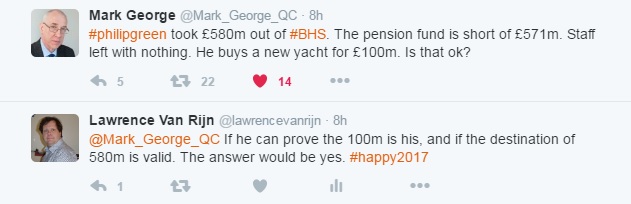
twitterfeed_0101aThis all started yesterday when the honourable Mark George QC sent a tweet (see picture), which was followed by my answer, and that one was given because I was feeling frisky. When you are done killing people in Constantinople as Ezio Auditore, I relied on Twitter to see some of the news messages on the air. His was one of the first ones I saw.

Was he wrong, was I? At that point it did not matter, the image that is given was based on three different matters and they could very well be valid, so I decided to dig today and see what is exactly going on. The first thing I am noticing is how much emotions are going all over the place, it is all about the wealthy getting bashed. Now, this might not be wrong, but what is actually happening? First was the Week, who referred to an article in the Guardian, so I am looking at that one (at https://www.theguardian.com/business/2016/dec/21/sir-philip-green-bhs-mps-pension-schemes). The title is catchy enough ‘Sir Philip Green could face £1bn BHS fine under MPs’ plan‘, yet is this going anywhere? The first quote is “BHS collapsed into administration in April, leading to the loss of 11,000 jobs and leaving a £571m deficit. The regulator has started legal proceedings against Green and Dominic Chappell, the former owners of BHS, in an attempt to fill the deficit. They collected millions of pounds from the retailer“. You see, the issue behind all this goes a little further and of course, the red cloth of the bull became very visible. The Accountant Online (at http://www.theaccountant-online.com/features/comment-bhs-and-the-silence-of-the-auditors-4923573/) gives us the news that the Guardian was unwilling to give us here. When the Accountant gives us “The Accountant magazine professor Prem Sikka painstakingly analyses PwC’s role as auditor of UK failed retailer BHS“, so the same group of less capable reviewers (read: idiots) connected to the entire Tesco disaster are also linked to BHS? Can anyone explain to me why Pricewaterhouse Coopers is still accredited to work anywhere in the UK at present? The additional quote gives us “Recurring losses and negative equity should have encouraged auditors to issue an emphasis of matter type of audit report which might have alerted employees, pension scheme members, pension regulators and others of the possible inability of BHS to correct deficits, but PwC did no such thing“, is that not odd? The fact that everyone is in emotional state, including the one person that should feel the strike of shame too. You see the right honourable Frank Field, Labour MP for Birkenhead and Chairman of the Work and Pensions Select Committee makes no mention of the PwC side either. I find that very odd, the fact that such large companies do not get red flagged by the auditor should actually have been higher on his list than Philip Green was. So Frankie’s response in the Guardian on £1000 million instead of £350 million is (as I personally see it) merely a load of rubbish, something to set at ease the engine of anger from the 11,000 people without a job, because if he had actually cared PwC would have been on his list in that interview in massive 350 feet letters, sending shock-waves through that decrepit organisation of abacus users.

This is not nearly the end of it. When we look at the Guardian in November, We see (at https://www.theguardian.com/business/2016/nov/02/philip-green-may-be-forced-to-pay-money-into-bhs-pension-scheme) that Graham Ruddick and Kevin Rawlinson have more to say on the matter (at an earlier stage) as we see ‘Pensions Regulator begins legal proceedings against Sir Philip Green‘, still the PwC stays unmentioned. Is that not weird? When I see ‘regulator‘ and ‘legal proceedings‘ I see, in my mind, in equal measure the need to look at the books and at that point the auditors. You see a £571 million deficit should not have been unnoticed, more interestingly anything over £100 million should have instantly called for a pension check, the fact that the Accountant online gives us “Page 1 of BHS Limited 2011 accounts stated that “The directors believe that preparing the financial statements on the going concern basis is appropriate due to the continued financial support of the Company’s ultimate parent company Taveta Investments Limited”. This statement is repeated on page 1 of the 2012 and 2013 accounts. Page 1 of the 2014 accounts stated that “during the year, the company was a wholly owned subsidiary of Taveta Investments Limited“, this should have been more than one moment where the senior abacus users at PwC should have been ringing the bells of red flags, the quote “BHS and its controllers had persistently failed to eradicate pension scheme deficit. In the light of that why did PwC have confidence in management assertions that it would provide financial support to ensure that BHS would remain a going concern“, shows what I personally believe to be a massive level of negligence, one that at this point is missing from the Guardian and several other news media. Can anyone explain how PwC seems to be receiving this level of non-accountability? Is this the price of hiring cheap graduates in places where seniors need to work? So as we see the massive amounts of deficits in place, we see that “since 2009, PwC collected £2.282 million in audit fees and £9.04 million in consultancy fees from Taveta Investments Limited, which included BHS“, which gives me the fact that in total (including Tesco), PwC received £25 million for what I personally regard to be overly negligent, that whilst I over my life for being capable and overly service oriented have never received anywhere near 0.3% of that amount annually pre taxation. So we can state that whilst the emotional and feigned state of anger by Frank Field sounds nice, but it is merely charades and the man should remain quiet until he actually achieves anything in regards to the pension schemes.

Now let’s get back to the original part, because there is a lot more than PwC in this matter. The quote “As part of any deal, it is understood that Green wants the regulator to ensure that Chappell pays into the pension scheme as well. The billionaire tycoon believes he was misled by Chappell about his track record in business and the money that Retail Acquisitions was paid by BHS“, which can easily be rectified, because if this was done properly there would have been records, like mail messages with attachments (resume amongst others), there would have been reference checks with phone numbers and annual statements showing the track record of Dominic Chappell, who according to some is seen as a former racing driver lacking 100% of retail experience. I cannot vouch for that, yet simple investigation should be able to set that one straight in mere minutes. If Philip Green cannot show any mail messages with evidence, my message to him would be “If it isn’t written down, it does not exist“, one of the oldest golden rules in administration, I reckon a billionaire should know small things like that. In this there is a third side of the problem. This side comes in the form of Lesley Titcomb, who is the current Chief Executive and former COO of The Pensions Regulator (TPR), in the shape that “it was yet to receive “sufficiently credible and comprehensive offer” to bail out the BHS pension scheme, which has more than 20,000 members, despite Green pledging to fix the problems facing it“, she too remains mindlessly numb on any mention of PwC. A pension hole this big should have raised questions years ago. They all remain silent on the auditor which gives pause as to why the hell that firm is:

1: Allowed to be in business in the first place; and

2: Able to cash in on 25 million (including Tesco).

We see that continuation in “The regulator said that after a “complex investigation” and months of talks with Green about a rescue deal for the pension scheme it was sending warning notices to the billionaire tycoon, Chappell and their companies“, the auditor that facilitated for all this remains out of sight, out of mind and out of mention in all this. I have a massive problem with that part, especially as the Guardian has stated more than once to be such an ‘investigative entity‘.

In all this we now see the final part leading to the wise tweet that the honourable Mark George QC made and it makes him a lot more honourable than anything that the UK Labour party has to offer. In my view, I questioned whether the £580 had been a valid destination. The Guardian quote gives “Green controlled BHS between 2000 and 2015, during which time his family and other shareholders collected more than £580m“, so he did not get all the cash, so there is the smallest of discrepancies here on the statement of the Honourable Mark George QC, yet he only had 144 characters to make it. I would want to see 15 annual statements of all the payments towards the Green family and shareholders. Because in that regard, a firm that had a pension scheme in deficit for 11 years and negative equity for at least 7 years, how would it have been possible for shareholders to get anything at all, in addition, how much did Philip Green actually receive as payments from the BHS side of his businesses?

There is a growing list of concerns, concerns that should also be used against PwC, the TPR as well as HM Revenue & Customs. I think that it is safe to say that the days of ‘Walk softly and carry a beagle‘ (Charlie Brown) are over and we need to look at ‘Shout loudly and carry a machine gun with the safety off‘ (Rambo) as an actual deterrent for the non-actions of all these players. In addition, I think we need to put Lord Grabiner in the spotlight who was a former Chairman of both Taveta companies. You see, what Frankie Fields did carefully avoid to mention is that Lord Grabiner is linked to the Arcadia group, also owned by Taveta Investments, as is his family member Ian Grabiner, in all this Baron Grabiner might be seen as an academic administrator, but there is nothing academic about this half a billion pound mess and with Labour members remaining very silent on their peers, it seems that the 1 billion pound levy threat is merely a hollow action giving the implied value of £0 towards Frank Fields and his valued point of view, especially when we look at a non-actioned and non-mentioned gap of 11. One person (@the_MourningSun) gave me the answer to my tweet that this was down to a difference between the letter and the spirit of the law. I think both have failed miserably for well over half a decade when the larger players get to play the game the way that the BHS was played. In the end, it will be for a court to decide whether Philip Green broke any laws or failed anyone he cares for (read: implied view he only cares for himself). What is overly clear is that too many parties are leaving the auditors in the shadows, away from the peering and prying eyes of the public, which is a massive failure on every level.

So as you think that the TPR is currently on the ball, you all better take notice of the Guardian quote “By the standard measure used by the PPF, 4,272 defined benefit schemes are in deficit and the size of the black hole is £195bn“, so as we see that part, I wonder when we get a list of those 4000+ schemes, who is auditing them. I wonder when we look at 2 pie charts, one based on the deficit amount against the auditors involved, and one based on the number of schemes against the auditors involved. I wonder which auditor will end up being the most prominent one. Would you like to hazard a guess?

Let’s see if we can revisit this part somewhere this quarter and see how many spins the media and Lesley Titcomb (Executive Officer TPR) will end up doing.


Leave a comment

Filed under Finance, Law, Media, Politics

This last day

This last day should be a day of reflection, a day of consideration. I feel none of these things as I am observing the mistakes that Marine Le Pen is now making. I get why she would get the referendum vamped up and get stronger waves towards Frexit, yet her call to leave NATO makes a lot less sense. For one, NATO still does mean the North Atlantic Treaty Organisation, France is part of that North Atlantic, she has a duty of care there (a lot less so for the EC, the EEC or the Euro for that matter). She does make a point when we look at the expansion into Eastern Europe. Let’s face it, when we look into the original line, there was Germany which goes a lot to the south, then basically it is Italy. Getting into Eastern Europe makes a lot less sense. Let’s not forget, the Americans at present no longer have the means to play this game. A fact Lockheed needs to take into consideration, even if the price of the F-35 is given without an engine ($133 million, without engine), making it basically the most expensive paperweight in history. In addition, it came with a truckload of issues in 2014, whilst the 2015 report states “the majority of the fixes and for capability deficiencies being discovered are being deferred to later blocks rather than being resolved“, with new items of concern added. I found the additional quote form the 2015 report “inherent design problems that are only becoming more obvious and difficult to fix” most amusing, so if Marine Le Pen has in mind to not go anywhere near a Lockheed design, that would make sense. Now I do not want to brag, but with all my flying hours in the Microsoft Flight Simulator (2004), I might actually beat that latest flawed Lockheed F-35 with my experience in a Mikoyan MiG-35 (OK, I am bragging a little as I have never flown ANY jet in my life). What is the issue is that the politicians have not kept a good accord on the military abilities of the armed forces, not the people mind you, but the equipment they get stuck with. As such we see a 1.5 trillion dollar project showing more holes than an IKEA Pasta insert (named ‘Stabil’, which is hilarious as it is also means stable in Swedish). A project $160 billion over budget and 7 years behind schedule, and these were the numbers in 2014. A defence project that was too big to kill and that is what the NATO partners have to content with?

So why these topics? The world is changing, it is changing faster than ever before and the minders of the store have been so selfish in regards to their own personal needs (read: visibility of self via ego) and achievements that the duty they had was pushed under the rug. This is how I personally see the F-35 project.

The financial sector in the UK alone these financial boys (girls also) had the bulk of the £44bn in bonuses this year, so did your quality of life increase any (the topic jump will make sense in a few moments)? Now, even as wealth increased, it did not do so to that extent. It is not that fair to just have a go at the financial sector, apart from the fact that they ended up with bonuses of 1900% more than the amount all the others got, so balance is not that much in play. That view is shown stronger as we look at Forbes this week (at http://www.forbes.com/sites/francescoppola/2016/12/28/greece-the-game-is-on-again/#2585dbd946e5), the quotes that matter here are “Euclid Tsakalotos, the normally mild-mannered Finance Minister, accused the IMF writers of “economizing on the truth”. He pointed out that the main reason why so few Greeks pay income taxes is that their incomes have crashed, and that nearly half of Greek pensioners are living below the poverty line” and “The IMF’s case is that pension cost as a proportion of GDP is now unsustainable, and further, that the creditors are not going to agree to debt relief while pension cost remains so high. It is probably right on both counts. But once again, what really matters is the psychological framing“, in that regard I will be on the side of the Greeks, but not on the side of Greece. You see when their previous governments got loans and misrepresented their value, they had zero consideration on what pensions were in regards to the loans that they were getting under false pretense, in that regard, did any of those politicians go to jail? Did they refund 90% of their incomes? I am certain that the answer to both is ‘No!’, in addition those elected officials are sitting pretty and nowhere near the poverty line. Yet in all this the hardship is not over, in addition, the facts (as I personally see them) requires a little more digging, especially when I read “Attica Bank, the country’s fifth-largest lender, was poised to install a new management team he thought was capable of turning round the struggling lender” which were the thoughts of Yannis Stournaras, the governor of the central bank of Greece, which was followed by “While he was in the air, the government in Athens reversed the decision to award the job to Mr Pantalakis. It was his introduction to a web of allegedly related events, ranging from a raid on his wife’s business to an unsuccessful bid for TV rights backed by Attica loans“, this gives the implied issues on Yannis Stournaras, which gives more cause concern when we see “A confidential report on Attica carried out this year by the European Central Bank, the Eurozone’s top bank supervisor, and seen by the Financial Times, cited “severe findings” of poor governance and inadequate controls on lending. With some 70 per cent of its loans rated as non-performing, Mr Stournaras and others believed Attica urgently needed a professional banker at the helm. Government sources denied any intervention in the process to select Attica’s CEO” (at https://www.ft.com/content/aab0aaba-c6db-11e6-8f29-9445cac8966f). The implications are on a few levels especially in the light of ‘government sources denied‘, there is a mess on a few levels and the idea that personal needs were adamant in decisions is not without probable cause. The levels that are in question cannot be set because too much information is missing, but there are issues, make no mistake about that.

These issues connect, not directly but in the view of national voters, governments have made absolute shambles of their nations giving power to those with key wealth management options, in that need those who need to be at the helm are politicised and set to markers that are off the table and outside of the scope of visibility to scrutinise, whilst the presentations are showing markers that do not fit the person best suited for the job, in that Greece is not the only place with such issues. In the UK Mark Carney is facing similar issues, yet in the opposite direction. The best person for the job is the one the elected government seems to have an issue with. The independent (at http://www.independent.co.uk/news/uk/politics/bank-of-england-mark-carney-theresa-may-attack-monetary-policy-tory-conference-speech-a7380016.html) gives us “Mr Carney argued that the monetary policy pursued by the Bank in recent years has had a positive impact that is “without parallel”, despite the Prime Minister using her speech to claim it had led to “bad side effects”“, in addition we see “Since quantitative easing was first introduced in the economy in 2009 … there’s been 2.6 million jobs created, GDP is up 16 per cent, per capita income is up 9 per cent and this is following a trauma in the economy“, we might see this as good news, but the good news is in the UK not dripping down to the other people just yet. In addition, the dangers will change if sharp budgets are not maintained. Getting the debt down is an absolute first, it will have additional benefits down the road, yet the initial benefit is that money could go to other destinations than paying for the interest of the debt, the interest of a debt amount that is currently in excess of 1.6 trillion. This was not the first attack, Michael Gove had a go at England’s Marky Mark in October. It is always nice when a person is called arrogant, especially when that person has proven to be amongst the very best in his field on the planet. I myself had had some issues in the past with Mark Carney, yet not against the man, but the economic issues that the UK faced because of actions (read objectives) pushed for by politicians, however his speech in the House of Lords showed him to be the expert he is and he nearly got me away from the Brexit team. Yet Mark Carney himself states it very well when he said: “Politicians have done a very good job of setting up the system. Where it can be difficult, sometimes, is if there are political comments on our policies as opposed to political comments on our objectives“, in this we see the issue that is part of the problem. as the politicians set up the objectives, they are then confronted with the policies from technocrats and those two groups do not see eye to eye, so friction goes back and forth, the Lockheed F-35 lightning is an excellent example here, in addition that part got an extra iteration as the military requirements were added by yet another group (read: the military). In all this the political objective is hampering the essential need against ‘it needs to be done by date X for no more than amount Y‘, which gives us the political joke that the NHS IT project was. A present from the Labour government which boiled down to a £11.2 billion wrapper around an empty box. Two projects set through objectives that ended up being off the wall and the back and forth friction that resulted in something unmanageable and non-functional. I reckon the political side of both events needs a new level of scrutiny, one that we have not considered before. In that regard having people like Mark Carney around is essential for the wheels of a state to remain functional, because if there is one clear thing, it is that America lost that oversight some time ago, before this Democratic Administration, the previous republican one lost sight of the needs and the accountability of the intelligence network and data processing side no later than 2006, we can all agree that the 2007-2012 total budget of $435 billion was money massively spent in all the wrong ways. This was shown in a Foreign office document that was quoted in an article stating “Army officials, though, said Palantir wasn’t up to the job. Now, a 57-page report by the Pentagon’s acquisitions arm basically says the Army was wrong to dismiss the Palantir system. The study instead gives Palantir high marks on most of the Army’s 20 key requirements for the intelligence system, including the ability to analyse large amounts of information, including critical data about terrorist networks and the locations of explosive devices, and synchronize it in a way that helps troops on the ground combat their enemies more effectively“, so there too billions were spent when millions could have sufficed. When the EGO of an individual with the power to decide is on the line, the results could be disastrous. In my personal view, if we accept the wrongful spending of 25 billion, how many extra troops could have been saved by adding fire support groups to those in IRAQ in those years? How many of the 4486 fatalities could have been prevented?

Politicians, advisors and ego are a really dangerous combination in many ways, even as we look at what is coming now, we need to be mindful of the changes that some are pushing for. Even if we are in favour of dropping the EC altogether, pushing NATO boundaries might not be the best solution. France might be privy to one of the better intelligence machines, that machine is also dependent on the intelligence it is fed from allies, an essential element that will fall away when NATO does, Marine Le Pen should be very mindful of that.

Yet this year and more important 2017 will go beyond Frexit. There is still a large debate on the Netherlands making any move away from the European Community, the numbers require people to be realistic on what will happen, yet those numbers are nowhere near the numbers Brexit had, so it is still unlikely that this will happen at present, no matter how certain Frexit will be. Italy might not have any manoeuvring space, it requires a massive infuse of funds, when we see the Reuters quote “An Italian government official told Reuters on Tuesday that €20bn earmarked for the rescue of the Italian banking system should suffice“, we need to wonder in how much trouble Italy is. This question is raised as we see Banca Monte dei Paschi di Siena will issue €15 billion of debt next year (source: RTE). So we see another iteration where “The Treasury may have to put up around €6.6 billion to salvage the lender, including €2 billion to compensate around 40,000 retail bond holders“, so, how exactly is it acceptable that people ‘invest’ with a risk, yet when that risk comes calling, they still get compensated? How did any of us ever sign up for that?

Anyone who mentions that it is for the good of all is of their rocker plain and simple. Here too we see connection between France and Italy, mainly that the Natixis Global Asset Management (NGAM) thought it was a good idea to list Banca Monte dei Paschi di Siena as a major purchase right next to Ubisoft. I reckon a little less ‘lack of nationalism’ and putting all of that cash in addition to the other amount into Ubisoft might have been a decently better idea. I feel certain that next year when we see the ‘Top Ten Holdings’ in the Natixis report will not make mention of Banca Monte dei Paschi di Siena, which could just be me though.

So in this last day we see that we have quite the collection of choices to deal with, some good and many bad ones. Yet no matter what is happening, no matter what will fall, there is a decent indication that unless changes are made 2017 will not be a good year. I might be too negative to see some level of collapse in Q2 (no later than Q3) in the next year, yet the proper setting and if the key players are willing to forego ego and focus on cooperation, they would be setting the stage for a lucrative 2018, that is beside the initial technological presentations of the new age of G5. G5 will be the pushing power in IP, especially Trade Marks, yet that path is also loaded with new growth opportunities for IT and developers as they start setting the tone of what 5G could personalise, it will be the first firm push to switch providers to SaaS. That is almost without question, the degree to it happening is very much depending on actual cooperation. In that the Telco providers need to realise as per immediate that thinking SaaS whilst selling Paas and charging IaaS, which sounds nice on bonus day. Yet the boomerang effect is that clients will walk away a lot faster and they will also automatically entice 10 personal connection to not seek the services of the telecom provider being that stupid. Infrastructure as a Service is almost a thing of the past. It seems weird, because there should be space for it, yet in our new outfits we see that infrastructure is a long term commitment and with annual mobile purchase the people have learned to be as flexible as possible, so the limited mobiles that some sell (32Gb instead of 64Gb editions) is why people are realising to walk away from those offering limitations instead of solutions. It is at times harder with Platform as a Service. You see, PaaS might sound nice when we see Apple and SAP connecting, yet the bulk of the revenue will be the smaller fish in the pond, the small players will be 80% of the revenue, one can argue the actual taxable cake of government will be largely depending on those players and for them IaaS is a laughable solution when they are trying to get as much as possible in the first few years and those smaller players want as much flexibility as possible taking to some extent PaaS from the table. SaaS will be solution of choice and those now adhering to that need will fall short in 2018 and they are unlikely to be part of anything in 2019. In that we see the government need of objectives that cater to what the SME’s need. A mere application of supply and requirement. You might think that this is not connected to the previous parts, but it is. When we see the NHS, Banks and government, their needs to address their audience, they need to consider that no matter the infrastructure or platform for communications, they all need to see that their clientele is no longer rigid, no longer bound to certain paths for the simple reason that the infrastructure of places like the NHS can no longer deal with. It is by definition a mobile customer base that needs addressing, this means, or at least implies that the SaaS solutions require a wider setup, other paths of non-repudiation and a very different approach to data, its quality, its controls and the application of the results in any report or estimation towards costings and profit. It is a path of contribution, which is set as revenue minus costing.

For the better part an entirely new path in a setting that has for too long been about a rigid collection of data, which when compared to a setting in a flexible framework no longer holds a candle and will come with the implied death of data quality. in these places there will be a growing need for a data team that has the sole purpose of managing the quality of data, this path is one that IT has never worked on to the degree it had, because in the past systems were set in concrete and after the correct data pass had been made, the data usually would not require ‘resetting’ it in another framework, a change that will be almost evident in the systems we will see start in the next 4 years. There, for some the problem becomes that they have never contemplated the changes, which now also means that once they go into the deep of it all, the time required and the resources required will be a lot more draining than ever before. It is in that path that we see the danger of politicians and technocrats in the required path of objectives and policies. As there is plenty of evidence that so far this track record is not that great, we will see a squandering of funds and a dangerous curve of unprotected data whilst no one will be actually held accountable for the transgressions against those consumers aka victims.

So on this last day there is no way that any solution will be found, just take in the information and next week wonder what on earth is about to hit you, there is some speculation in this, yet I believe that the ‘objective callers’ (read: politicians) will rely on the word ‘glitch’ a lot more than ever before, it might just become the most popular word for 2017.


1 Comment

Filed under Finance, IT, Media, Military, Politics

Rephrasing a Minder

Politics tends to be filled full of weird and crazy people, from my point of view those people tend to be members of the Labour party. That view got a new light in the article ‘Labour calls for closer scrutiny of tech firms and their algorithms‘ (at https://www.theguardian.com/business/2016/dec/18/labour-calls-for-regulation-of-algorithms-used-by-tech-firms). Now, there are two sides to any equation, so let me give you the two that I have.

1. I believe that tech companies have been facilitators for too long, many will not accept any responsibility for way too much. On the other side, I do believe that the only working internet is a free one. So when I read the words from Shadow minister Chi Onwurah, I honestly did not regard her to be anything more than a person seeking the limelight. It is equally important to realise that she is using last week’s amazon debacle in Scotland, with questions how that relates to regulating algorithm, it’s a mere application of employment law, is it not?

From the quote: “The outcomes of algorithms are regulated – the companies which use them have to meet employment law and competition law. The question is, how do we make that regulation effective when we can’t see the algorithm?” I feel slightly cautious to call Chi Onwurah a joke, there is a chance that some of this was lost in translation, if not, she has a larger problem to deal with. That problem will be clearly visible when she decided to look into a mirror. So why to look at my point of view?

You see, there are no regulations on algorithms, they are basically formulas with a solution. In addition she states: “greater scrutiny of the mathematical formulas that now control everything from the tailored news served to Facebook members to the speed at which workers are required to move around an Amazon warehouse“. I think that we need to look a little closer at the last statement. You see, it is highly likely that any staff members would need to meet a certain amount of jobs for shipment and delivery. Yet how feasible is that requirement? I can’t tell from the description that was given a week ago, too many variables missing, that does not make the approach regulated. Yet like in any job, workers have ‘responsibilities’, yet more important, they have rights. These are clearly set in most countries of the Commonwealth, so how does that equate to apparent regulated algorithms.

2. The openness of any system will silently advocate the abuse of it. A not so good example was given by the Guardian (at https://www.theguardian.com/technology/2016/dec/04/google-democracy-truth-internet-search-facebook), where we see ‘Google, democracy and the truth about internet search‘. We get Carole Cadwalladr with the quote ‘and this was Google’s answer: Jews are evil. Because there, on my screen, was the proof: an entire page of results, nine out of 10 of which “confirm” this‘, which started with typing 7 letters ‘are Jews’, which is an issue from character one onward. She then tries to dilute the issues by setting the image of the search of ‘are women evil’, probably to ease the tension, but the damage is done, short-sighted (as I see it) she continues. So whilst she wastes two paragraphs on titles of the slightly anti-Semitic nature, which she then sets in an atmosphere as “I feel like I’ve fallen down a wormhole, entered some parallel universe where black is white, and good is bad. Though later, I think that perhaps what I’ve actually done is scraped the topsoil off the surface of 2016” and she ends with “This isn’t a secret Nazi cell lurking in the shadows. It’s hiding in plain sight“. As I personally see it, she is the person who has been standing behind an iron for most of her life and now she sees her first microwave, a cliché if I ever saw one.

You see, the article goes on for some time and there are really good parts in it too, although the spatial map is a bit of nerdy space we could have gone without, the issue I never see properly addressed is that the term ‘are women evil’ and on number one is a WordPress blog, literally with the link ‘sheddingoftheego.com/2015/06/25/are-women-evil/’ and the title ‘Are Women Evil?‘ literally a perfect match for what the person was seeking. Google worked perfectly. What is ignored and what influences many sights, especially on how Google Rankings are influenced. Now Google has a way to counter it, yet this is not immediately done and it is not perfect either. Places like Reddit are actively working on posting whatever they need to raise their ranking and the rankings of their customers. It is interesting that the Guardian, the Huffington Post and Forbes take absolutely ZERO time to explain the games that SEO’s are playing to influence ranking through scripts. because it is in the end what someone was seeking for, yet the fact that this is the direct value for SEO’s and terms like ‘Tips on how to improve your website’s ranking on Google’s search engine results’ were also ignored in these articles giving rise to the one sided and unbalanced view the press is giving, whilst those in the digital media all know that this is done and those who are doing it usually have a massive tag list ready to add to EVERY story they write.

So when we see the quote “Many search results are now reinforcing extreme views, with articles denying the holocaust or disparaging women increasingly appearing at the top of the rankings“, we need to wonder Chi Onwurah should even be allowed to be Shadow Minister of Department for Business, Energy and Industrial Strategy, or Just the elected MP for Sesame Street. By the way, what I did not know is that this department is also responsible in the area of Intellectual Property, so if Labour ever wins, we need to get scared fast.

So getting back to the MP in my sights, it is important for her to realise not just what a google search does and what it shows, but the elements that influence it and what happens under the real guise and the influenced guise of what people are looking for. By the way, her article acted for possible millions of additional clicks, because she raised the issue, whilst not raising the alert of how the numbers get influenced. So, as we go down the article, we do need to stop at a part that matters a lot. This is seen in the quote “Social media platforms are being blamed for allowing the spread of misinformation and online abuse, conditions which some argue are fuelling the resurgence of extreme politics in America and western Europe“, which is a fair point, yet as bullies and trolls can hide behind the freedom of speech without accountability, there is little chance of this changing, in addition, this isn’t a transgression from 68 million people in the UK, it is the search result and interaction of billions of internet users on the planet, so as there is no localised situation, misinformation and online abuse remains. In addition, as Chi Onwurah should clearly realise, when we see webpages with quotes like ‘Millions of People Are Cancelling Their Netflix Account Because Of This One Site‘, whilst the link looks like a cookie 2 miles long, all set to improve visibility. The media at large, including the UK make use of professional cookie, tags and ranking strategies and all kinds of advertisement counters, so when she is talking about regulations, setting anchors against the exploitative use of cookies might not be the worst idea. In addition to that thought, whilst labour was in office, they did zero to get the tax accountability rolling on corporations, so to see this quote “need to take responsibility for the unintended consequences of the algorithms and machine learning that drive their profits” in the reality of the law (the act of facilitation), she needs to realise that her statement is empty and hollow to say the least. So when we see “we need a tech-savvy government to minimise the downside by opening up algorithms to regulation as well as legislating for greater consumer ownership of data and control of the advertising revenue it generates“, she is not unreal, she is utterly unrealistic for even considering to open up that tar pit, because once we see that regulation come to ground, the economic algorithms are the first one we will have a go at and at that point, when that reality comes knocking, she will soon be the loneliest politician in the history of the UK. In addition, is it not interesting how Bing was not mentioned once in all of this? Why is that Chi Onwurah? Basically this is an act of discrimination, however let’s not nit-pick in an article that is already shoddy in several ways.

The software engineering reality (historically speaking) is that the Google search results and Google ranking was filed in 1998 with a priority in 1997. Lawrence Page realised that the content on the internet would be growing exponentially and as others were concentrating on corporations and corporate views the founders of Google looked at a much bigger picture, so finding anything would sooner rather than later become a massive issue.

In an age when the ‘great’ internet companies were about image and looking cool, Google started to get professional. In the days of Yahoo, Yahoo was the search engine of choice. Alta Vista, later Excite and a few others were garbage from week 1 whilst never catching up in any novel way. Yahoo started in 1994 and they were leaders for a while, and in the 90’s as Yahoo grew its value, they started to lag behind. Now the irony is that Yahoo got started at Stanford and the Google rank patent was designed and invented at Stanford too. By the time someone started to ask the right questions it was already too late and the Google patent for ranking gave them exclusivity which will last a little while longer, but others are now considering the consequence that Google Rank patent will still be in effect when G5 starts, as the issue of ranking is still growing near exponentially as more and more files are added and with G5 it will take on an additional dimension.

now we see the issues that are brought to the foreground in what I regard as a half-baked shadow ministers approach, asking ‘questions’ and implying regulations, all this whilst a below par informed level of knowledge is shown in the articles they set to press. One of the issues is actually shown in one paragraph in the Huffington Post “Finally—and this is the key point—even without human intervention, Google’s algorithm, while doing exactly what it’s supposed to do, routinely boosts one candidate higher in search rankings simply because of normal “organic” search activities“, which is the cornerstone. As we know, organic search (what you type in the google search bar) is used, yet what happened when this is done through scripting? What if a few of the 200 parameters gets influenced from outside though scripted actions, again and again? That part was never clearly mentioned, but it is the bread and butter of nearly every SEO, to get the position and ranking of their clients to the very top, in every possible way and method and the shadow minister does not give any visibility to it, the visibility it requires and deserves.

That is the flaw in all this and this is the need to rephrase a minder, a minder who as I saw it never understood the plot, or she did know and she was misinforming the readers to some extent, yet how much requires misinformation and was that not what she was accusing social media of? So as we await Labours industrial paper, we will have a few more options to have fun of labour especially as they define supervision whilst again not getting any results in proper corporate tax legislation, not even as suggested proper corporate tax legislation.

taxformulaSo should we see the taxation algorithm for large firms where x is the taxable amount, b is revenue and a is tax deductible options, you know that it is not just the regulations of algorithms she got wrong.


I’ll let you decide.


Leave a comment

Filed under IT, Law, Media, Politics

The mental state of health

This all started two days ago when I got alerted to one news issue and shortly thereafter to something entirely different. Let’s start with the news, you see, the news I got was rather extreme, even for the average judgement in criminal law. You see, it all started with the mere headline ‘Prisoner jailed for 45 years over letters threatening to kill people‘ which was a bit much. For example in the Netherlands when you drive and kill a 2 year old and in addition kill the grandparents, you get 120 hours of community service. At 8 hours a day that is a mere 3 weeks, if you work the weekends too, 2 weeks is all you have to suffer. So when I read 45 years I tend to wake up and really wonder what a person needs to do to get 45 years. Mainly because killing children or committing treason no longer gets you anything to that degree.

The issue was given in the Guardian (at https://www.theguardian.com/uk-news/2016/dec/14/inmate-jailed-for-45-years-over-letters-threatening-to-kill-people). The issue is clearly seen in the quote: “A prison inmate who wrote a series of letters from his cell threatening to kill 10 people, including prison staff and police officers, and then have sex with their corpses has been jailed for 45 years“. Consider the following two quotes; the first one is “Heath said the maximum sentence for an offence of making a threat to kill was 10 years’ imprisonment“, the second one is “The judge said he was trying to balance the need to protect and the need to ensure that the sentence was not “wholly disproportionate to your criminality”“, which it clearly seems to be. You see, no matter what the convicted man wanted. Either never to leave prison or to get the limelight. Basically the man committed psychic assault and there would be a consequence to that, yet the line between 10 years and 45 years is massive. You see we have no idea what that person would have been like after 10 years. So how come that 45 years is suddenly an option? Only because of the quote “The judge Michael Heath, passing sentence at Lincoln crown court on Monday, described the long jail term as highly unusual and said the case had caused him “very considerable anxiety”“, so the judge got anxious? That makes the case clearly a loaded canon on several fronts, not to mention the dangers of after overturn costs when the appellant court would consider the verdict to be disproportionate. So what makes this case such an issue for me? You see, the quote I overstepped earlier was “Ford wrote a series of letters from his cell at Nottingham prison in which he identified people – including prison officers, a fellow inmate, a district judge, a police officer and a former partner“, what if the letters to the police officer and the district judge were the reason for the over inflated verdict? If that is regarded and those from the established order of jurisprudential would be the reason our verdicts become a lot more severe, we would be walking a very dangerous tightrope, one with long term consequences. Now do not get me wrong, the man is guilty, that was established, yet from 10 to 45 years is a massive leap. So now we get to the good stuff, because there is more, there always is. The fact that we need to consider “he had been assessed by a number of psychiatrists but there was no recommendation he receive hospital treatment“. So why not? The fact that the psychiatrists did not recommend hospital treatment implies that either he is not that crazy or other elements are not getting the illumination they need. Would that be a fair assessment of the situation? It might be even darker and the man has a split personality, all complications that might divert from a successful diagnoses, all still giving pause to the need of 45 years, no matter the level of creepiness that this mental health case is showing to be.

You see, this issue and it is a real issue is only part of it. In almost the same timeframe I got news of something entirely different. It is something fresh and new from Cornell (at https://tech.cornell.edu/news/this-smartphone-keyboard-app-can-read-your-emotions). The headline ‘This Smartphone Keyboard App Can Read Your Emotions‘ is a lot more interesting than you think it is. The quote “Keymochi uses data like typing speed, punctuation changes, the amount of phone movement, distance between keys, and a user’s rough sentiment analysis to detect emotions“, might seem to be an average achievement, it is not. I think it is an optional invention for something a lot bigger than the makers envisioned. The quote “To protect privacy, Keymochi does not store what is typed, just how it is typed—the physical cues and the sentiment analysis from PAM” gives us the initial goods, the larger prize is given by “So far, the app is able to predict emotions with 82 percent accuracy“, now consider that this is not on a smartphone, but on a tablet. What if this app is adjusted to aid the psychiatrist that possibly failed in this case and now gets to deal with additional data and evidence? What if this app could enable additional emotional data? Consider that this is the first generation where the bulk of action is no longer done with goose feather and ink jar, but with the keyboard. Our auto acceptance of pretty much every keyboard gives an interesting consideration on the valid honesty that we give our as we take out our frustration and denied inner considerations to a keyboard. Let’s not forget that an initial 82% accuracy is not a bad result at all.

Yet the original intent as it was designed by the three Cornell Tech students, Hsiao-Ching Lin, Huai-Che Lu, and Claire Opila was to detect emotions, which is what we knew, yet their application is that as a user is typing out a text message or email via smartphone, each movement adds to an emotional profile of the user. In addition, users can select one of 16 pictures to indicate their mood by using a photographic affect meter. Which is brilliant in its own right, so that the issue we have seen for too long in auto fix and auto correct in android so as we see “even when a message is communicated in complete sentences, we often misjudge the author’s intentions and current emotional state” it makes perfect sense, because the bulk of us, have all experienced the weird response when we were trying to type something funny, or just a little sarcasm, which got the response like we had slapped that friend with a 9-Iron at maximum effort. So the pictures would be a great help, especially as the receiving party gets the message “you doing the munchies again?” with a picture of a laughing chipmunk. Yet as I read the article, I just saw a whole range of possibilities growing from within the system itself. The upcoming art/science of digital diagnosis might be in the early stages, yet as we see the overload of data and responses we face in the 5G universe that is about to arrive, these tools will present an exponential need, not just on a consumer level, but on the level of the tool creators who want to give their consumer that little bit extra. In that regard the timing of these three students could not be better and I feel certain that they have a decent clear path towards exceptional growth. Yet as stated before, I feel equally certain that the scope of applicability of this tool goes a lot further then perhaps even they realised, which is just a lovely layer of icing on the cake.

In addition, when we look at one final part, the part on how their app could interact with domotics and automated mood parameter transfer as Google Home envisions it, is only the start of the large cake they could be serving a massive interested audience.


Leave a comment

Filed under IT, Law, Media, Politics