Tag Archives: India

What was once America!

This story will go into a very different direction, it also holds several values that might not be agreed with and several are debatable to begin with.

You see, we are allies of America and I am fine with that. I think we need America in the free west, but the actions of America makes them more and more ‘unwanted’. As we see changes on the global scape that is all over the field, we see an America that has become unjust, unequal and desperate for political points on a sliding slope for governmental bankruptcy.

Perhaps some remember this: “We hold these truths to be self-evident, that all men are created equal, that they are endowed by their Creator with certain unalienable Rights, that among these are Life, Liberty and the pursuit of Happiness”. It is in the constitution, a tourist attraction, currently on display north of the National Mall at 700 Pennsylvania Avenue, Northwest, Washington, D.C. Most Americans have forgotten it, we might state that the bulk of Americans, might remember it, but they do not know exactly what it is any more.

I did make a few accusations, here is the reasoning (without it, an accusation is just hollow).

Unjust

Injustice is harder to state, we see it, many feel it, but where is the injustice? There is social injustice, economic injustice, racial injustice? As American is a nation of laws, there is also a part that is not covered by laws. Yes, there lies the injustice, consider the enabling of wealth as I wrote about it on September 29th in the article ‘Vindication‘, how “Sens. Elizabeth Warren (D-Mass.) and Sherrod Brown (D-Ohio) are both calling for Congress to investigate the New York Federal Reserve Bank after recently released secret recordings show the central bank allegedly going light on firms it was supposed to regulate” which came from the Huffington Post. We see an enabling force to those swallowed by greed and wanting ever more. Racial injustice remains, as it always has. This is not meant to be an attack, but a mere statement of fact.

Unequal

This is seen in the Business Week article of last April (at http://www.businessweek.com/articles/2014-04-03/top-tenth-of-1-percenters-reaps-all-the-riches), it boils down to the fact that the top 1% owns the same wealth as the bottom 90% of the entire American population. The wealthiest 85 persons on the planet (not all Americans) have more wealth then the sum of the bottom half of the planet, if we consider this as an iceberg, then we see 9% above water, the rest is just drowning. This sliding measurement of equality is even more visible in America, whilst the Walton Family gains billions each year, the bulk of its entire full time staff is on food stamps and requires additional government support. Some would argue that workers value is where we value it at, but in this age of exploitation we see that as people are numbered into spread sheets, we see how people are numbered out of existence. We see large places (not just Wal-Mart!) sell at ridiculous low prices, which gives us “at least two of the factories on the list have continued to send massive shipments of sports bras and girls’ dresses to Wal-Mart stores in recent months, according to interviews and U.S. customs records“. Consider getting three sport bra’s from Wal-Mart at $8. I took that article as it requires a little more work than a boxer short. How can you make any profit on something that seems to be cheaper than the bare materials required; now it needs to be made, packaged and shipped? How dim is the person thinking that things are truly made that cheap? When we read on how some clothes from Wal-Mart comes from Bangladesh, where ethicality is out the window and the children get to work for a living and a future they will never have. How surprised can you even be?

Desperate

Now we get to the good stuff, here is where the connected danger lies. There is a presumption that you must take into account, much of this is directly from news sources, I have tried to focus on certain parts, but as any analyst can tell you, the better the data quality, the more reliable the information and the assessment of that what is in play. The first part is ‘Binyamin Netanyahu ‘chickenshit’, say US officials in explosive interview’ (at http://www.theguardian.com/world/2014/oct/29/binyamin-netanyahu-a-chickenshit-say-us-officials-in-explosive-interview), of course, there are questionable issues with this, or was the ‘slip of the tongue’ literally applied. The quote “The other day I was talking to a senior Obama administration official about the foreign leader who seems to frustrate the White House and the State Department the most” (at

http://www.theatlantic.com/international/archive/2014/10/the-crisis-in-us-israel-relations-is-officially-here/382031/), you see, this has been discussed by me before, however, until now, most of it was debatable (as I would readily admit), and in light of these two articles we get a new vision. I wrote about all this in ‘Selling Israel‘ on October 3rd and ‘Puppet on a string‘ on July 30th. These were about the side of Israel, now here we see the side of America. America is in a bad way, it needs to show resolve, it needs to show success. This current administration has bungled more than once and as the tally comes, they are seeing that their balance is not good. “Israel has rebuffed those requests and demands in ways that have been very embarrassing to Obama administration” from US News, as well as “Kerry, who made pursuing Middle East peace a cornerstone of his time leading state, was a part of the peace process that collapsed earlier this year, and relations between Netanyahu and President Barack Obama have long been chilly further complicating any hope for a resolution to the region’s strife“. I foresaw several of these points never working in July, so why did some think it was ever going to work? Israel is surrounded by people who want them dead, ever since WW2, they still want to wipe Israel from the face of the earth. That will NEVER ever be the setting of success. An interesting article can be seen in the LA Times (at http://www.latimes.com/opinion/op-ed/la-oe-makdisi-israel-apartheid-20140518-story.html) in regards to Israel and apartheid, with the link to the International Convention on the Suppression and Punishment of the Crime of Apartheid, adopted by the U.N. General Assembly in 1973. I do not completely agree with the article, as Israel has been the victim of apartheid, pretty much since Germany European Tour 1939-1945, so as we see the term apartheid, are we certain that it is correctly applied? When we see the quote: “While overcrowded Palestinian schools in Israel crumble, Jewish students are given access to more resources and curricular options“, which sounds nice, yet consider the no-stop attacks on Israel, in August 2014, the numbers if even partially correct, implies that the funds required to fire these missiles in one month exceeds ten times my average annual income of the last 15 years. So, perhaps not firing missiles and using the cash for upgrading schools might be an idea?

Yet, this was all about America, why the side step? America needs success stories, John Kerry came up short, which we knew was going to happen, yet this is not the only issue. If Donald Trump is even only partially correct, then we will see no later than march 2015, that the US will get an enormous fall in economy, a large rise of the jobless population and the cost of living will go through the roof making America not that great a place to be. In addition, as we see in Moneynews (at http://www.moneynews.com/Outbrain/Trump-Aftershock-American-Economy/2012/11/06/id/462985/), in addition In 2006, Robert Wiedemer and a team of economists foresaw the coming collapse of the U.S. housing market, equity markets, private debt, and consumer spending, and published their findings in the book America’s Bubble Economy. Now we have ourselves a party, as the US is losing ground, as they are losing the economy and as they are again in some dispute with ISIS (one that they should have dealt with some time ago) we see a nation with bills, no real production other than virtual events and one with an aging population that needs an almost exponential need for healthcare and social security. In that field we now see a faltering democratic party that needs to score, which gets us back to the Israel debacle. The quote at the end states “Instead of attacking Israel and forcing it to accept suicidal terms, it should be strengthened. I call on the US administration to renounce these coarse comments and to reject them outright“, here we see the crux. America lost out to Israel on selling missile technology to India. It is only half a billion, but there is prestige on the line, in addition to long term additional orders we see that Israel has taken a step forward. The fact that they also got drone technology from Israel gives pause to wonder, is Israeli merchandise better, or is the US too expensive? That debate is up in the air as I have none of the facts, but in an age where any bit of good news counts, losing 0n these two orders just does not help, insulting the Israeli Prime Minister might have additional consequences, I personally see it as a consequence of not getting a grip on the deficit for half a decade, more and more players in the field are now seeing that America WAS a great nation, its future however remains for now extremely uncertain, a possible legacy that the Democratic party is desperate to prevent. It is not just my voice here, to some extent we can see similar issues in the Washington post, which does not suddenly make my revelation fact, but it does show that there is an issue of leadership, on that is showing to be unable to do what actually needs to be done.

It is also important to give notice to one element that was not within their control, Wiki-leaks, when it released the diplomatic cables instigated waves of hardship that were equally unjust. Not because of what they published, but because they published only one side, the American cables, which means that America was continuing a poker match whilst all their cards were in the open and the others remained hidden. This is not the largest issue, but it is an issue. We see ‘attempts’ to get another peace talks in the works, we see America now talking to Iran, Gaza is not going their way and Russia remains a hot potato, these are all reasons for concern, but to what extent?

That is at the heart of the matter, yet it is also an unknown, we might decide to trust the IMF, the DOW and other proclaimers of good news, yet in the last two years, most predictions were missed and overly positive.

Consider these two texts: “After a temporary setback in the first quarter of 2014, the U.S. economy has rebounded. Temporary constraints—an unusually harsh winter and a sharp correction to an earlier inventory build-up—have now receded. Growth reached an annualized 4.2 percent in the second quarter. Improving housing activity, stronger on residential investment, and steady payroll gains suggest that the rebound is becoming more sustainable (Figure 2.2). The unemployment and labor participation rates stood at 6.1 percent and 62.8 percent, respectively, in August” From the official World Economic Outlook for the IMF.

The second text are two texts from the same article: “The third-quarter gain in output outstripped economists’ expectations, but growth in domestic demand braked to a 2.7 percent pace after a brisk 3.4 percent gain in the April-June period, giving the report a softer tenor” and “A slowdown in inventory building weighed on growth, and economists warned that pressure would likely persist into the fourth quarter“, the second source is Reuters (at http://www.reuters.com/article/2014/10/30/us-usa-economy-idUSKBN0IJ0A020141030).

The people are bombarded with several DIFFERENT sets of results (which look like statistical results); we see a massive push for reports on a restoring economy, which is in all matters not exactly true. Yes, the economy is picking up, but the only ones truly seeing that happen are those who are a member of the top 9%, also known as those not drowning at present. There is no real solution until America changes and I mean truly changes the way they operate and the way they hold people to account. Their solution of taxing the rich is equally unwise (stupid seems so harsh a label). I am not against holding the rich accountable, but that there is a difference, holding the rich accountable is not the same as taxing the rich, the latter looks, reads and smells like discriminatory injustice, which is what we do not want either. Yes, they must pay their fair share, but the emphasis is on fair. There is no real fairness at present, instead of designing ‘custom’ tax deductibility’s where only the top 2% gets a joy out of, why not tax EVERYONE and every business at 15% and make every tax deductible program obsolete, no hiding, no off-shoring and no complications. The current path is not working, it only works for the top 3% and they do not want change, so is adhering to them in an age of democracy not plain treason? Is America not for ALL the people (in America mind you).

By not acknowledging cycles and cold years of industry, all got sentenced to an autumn of life with only winter to look forward to, with every cycle, the autumn got longer, whilst captains of industry avoided winter, yet what came, the spring and summer are now shorter and shorter, whilst the autumn is getting longer and longer, which is doing no one any good.

This is what once was America, past summer in mid-autumn with as we see it now, 5 years of autumn ahead and possible no spring after that. When a nation is about the time past summer and only 1% gets to see the sunshine, life for a democratic option becomes less and less likely. This now gets us to the final part of the Israel debacle. As we watch USA Today (at http://www.usatoday.com/story/theoval/2014/10/29/obama-benjamin-netanyahu-israel-iran/18106253/) we see how the White House is distancing itself from insulting comments that unnamed officials made about Israeli Prime Minister Benjamin Netanyahu in a new magazine article. Distancing, not investigating, and not prosecuting, but mere distancing! The man who spoke is taking one for the team I reckon, a team I might add that once spoke so highly and still claims to speak highly on the USA – Israel bond, yet at present we see the quotes “US officials, while not confirming the reports, have recently said there are multiple combinations of ways that Iran’s breakout time could be extended, and the focus should not only be on the centrifuge numbers in a deal. The goal, US officials said, should be a deal that closes off all possible pathways for Iran to make fissile material for a nuclear weapon, either through producing weapons-grade uranium, plutonium or through a covert facility” (at http://www.usnews.com/news/articles/2014/10/28/the-endgame-for-iran-nuclear-talks) and “Discreet, low-level intelligence sharing: The United States can degrade Islamic State from the air, but Iran is crucial to root out and destroy them on the ground, at least on the frontlines. Since Washington doesn’t talk to Tehran directly, the Pentagon still presumably coordinated airstrikes with Kurdish and Iraqi intermediaries” (at http://blogs.reuters.com/great-debate/2014/10/28/the-u-s-iran-non-alliance-alliance-against-islamic-state/) all these events (including calling Benjamin Netanyahu a ‘merda di pollo‘, I used Italian to make it sound at least the tiniest fraction of diplomatic), now we see the links, as the implied brotherhood between Israel and USA is under strain, other parties seem to be brokering deals with Iran so that the current political democratic wind can leave the boots on the ground to Iran and the Obama administration is left with the statement ‘we kept OUR promise, no boots on the ground!’, a promise that was never realistic until they left that part to someone else. So how good are relations between Israel and USA as we see these developments?

This is open to debate, but as this economy continues, that what was once a great America is now for sale at Wal-Mart on isle 5 and its going cheap.

 

Leave a comment

Filed under Finance, Law, Media, Military, Politics

About that drink?

It has been a week now and I have to wonder how paranoid the week had made me. You see, the revelations of Natixis and how large its financial power is, still boggles the mind for now. This also has a lesser effect on my sanity. Whenever I see any political ‘advice’ from a bank, I wonder whether there is a Natixis link and for the top banks they are all linked. So, when I saw the article of the RABO show up, I just had to wonder (at http://www.theguardian.com/business/2014/sep/16/scotch-whisky-scottish-independence).

So, how does yesterday’s news affect Scotland? Well, the issue now is how trade affects a new nation when it becomes independent. The first issue is “Whisky is Scotland’s second-largest export behind oil and gas and is worth £4.3bn a year to the local economy, but sales could be hit if the country loses access to the EU’s free trade area and to markets in the rest of the world where Brussels has forged trade deals“. First of all is that information true and/or correct? You see, we the people (most of us) want to drink Whiskey and real Whiskey comes from Scotland. If it does not come from Scotland, it is called bourbon (at http://www.woodfordreserve.com/)! The rest tends to make it to the menu as an ‘alternative’, as some might say.

So, should we have a go at the Rabo?

It is never a bad idea to have a go at a bank, but they do have a point here. What is a major issue is the fact that we see these 11th hour messages, of feigned pressure. Why is Scotland (if they select independence), not immediately allowed a temporary membership into the trade agreements the UK is already a member of? The quote “A new Scottish government would face ‘a mountainous task’ in striking trade deals beyond Europe. Scotch is exported to about 200 countries, with major markets in the US, Singapore and South Africa, while Chinese consumers are also getting a taste for it“. You see, this article sounds nice, but the term ‘Chinese consumers are also getting a taste for it‘ means that if they get the bulk of the shipment, European customers will not be happy at all. Instead of embracing a new European adult as it left the arms of mother Britannia is just good business. Legally seen, the Rabo is absolutely right; Scotland will be its own master now and as such will have to apply for trade agreements. Yet, if we look at several sources, we see that the US is the number one destination and Singapore (with all over Asia) is on number three, if these two markets could be ‘enticed’, we would see a shifting balance. With France in second place, Spain in fourth (but due to economic issues decreasing vastly and Germany in fifth position, we see a market in motion. The spirited market is not an easy one and the Chinese changes on ‘gifts’ would also hit the drinkable gifts department and as such Whisky will get a painful dip. So, is there an option for the golden juice of the highlands? I believe that if an economy is truly about improving then this unique situation should receive its own merit. The BBC view (at http://www.bbc.com/news/uk-scotland-26987262), which they made last April shows that this ‘stalling’ need is partially on economy and partially on events and none of them are linked to the independence of the Saltire.

But I am also a person who needs to take a step back. The issues for Scotland are not small and several are out in the open, but these issues should have been resolved or at least addressed to some extent long before the vote was days away. When I looked at the initial facts and wrote the blog ‘The cradle of Whiskey‘ the issues discussed and read from both Professor Sir Donald MacKay and Ronald McDonald show no issues on trade agreements whatsoever. With their golden ambrosia so high on the export list, I feel uncertain why there was no more visibility on this. I do not remember seeing it on any decently regarded news site. Now in the 11th hour a Dutch bank comes with this? Is this intentional demoralisation or is this a case of clear cut evidence that Scotland is not ready to be independent? I remain on the fence. I have been in the ‘stronger together‘ camp for several reasons, but that has always been for pressure from outside economic issues. This is a first clear internal reason for not going independent.

So, as we see the articles piling up in the papers in the UK, the Guardian foremost, how come that several serious issues did not get the forefront until now?

It is nice to see quotes like “Alex Salmond urged tens of thousands of yes activists to ‘get to it’ by seizing the extraordinary chance for a “new dawn for Scotland”, as the final batch of polls before the vote confirmed the referendum hung on a knife-edge” (at http://www.theguardian.com/politics/2014/sep/17/scottish-independence-alex-salmond-david-cameron-resign), yet the issues of trade as well as the 11% deficit Scotland could face in year zero are no laughing matters. There are other issues that come to mind too. What happens to Scottish students in tertiary education? What of their international placements? If we look at the legal ramifications of trade, then we should also look at any long term plans that were there for the Scottish students, if they fall away, then Scotland will soon face economic bashing on more than one level. It is possible that these issues were looked at, yet the guardian piece as the Rabo bank is quoted implies that these matters seem to have been ‘stalled’ until after the elections, yet this impact has not clearly be shown on several fronts, which beckons the question, ‘why not?’.

Forbes have been active too (at http://www.forbes.com/sites/chriswright/2014/09/15/if-scotland-goes-a-mistake-as-big-as-the-great-depression/), they are showing other sides that did not make the news in several ways. One massive point is one that has definitely been kept from the Scottish voters: “Deutsche says the symbiotic relationship between Scotland and the rest of the UK is older and deeper than the Yes camp dares to admit. Five, it says that the idea of replicating something like Norway and Denmark – similar population sizes, links to oil (particularly in Norway) – is disingenuous. Norwegian oil and gas fields are deeper and expected to last much longer than Scotland’s which are already in decline, and Norway has its own currency; Denmark’s economy is totally different, and has a better fiscal position”, so not only is Scotland depending on oil, which still keeps them 11% in deficit, but the decline of their fields will soon become a more visible issue, then what happens? So, I remain in favour of Scotland becoming one nation (just not now), but in light of these mounting issues, we must ask the question, why is Alex Salmond not openly dealing with the issues we see here and as such, why are these facts kept from the voters?

This gets me to the final point and perhaps the only truly unacceptable view that the Guardian is giving us (at http://www.theguardian.com/politics/2014/sep/17/scots-final-call-rallying-political-engagement-votes). The headline “Scots’ final call: can rallying beneath the radar save the day?”, first of all, as this massive change hits 5.3 million wavers of the Saltire, this should be out in the open. Below the radar implies dealings for the benefit of a few, which is the one thing the Scots should not allow for. There is genuine anguish in the article as we see a few emotional turns, yet it is the end of it that should grip us all. “As Patrick Harvie, the Scottish Green party co-convenor, told Wednesday morning’s rally: ‘Nothing is going to be the same again, whichever way it goes.’”, I disagree,

I think that it is out in the open in new ways that Scotland is getting ready to be the new adult at the Commonwealth table, we the other members Australia, Canada, India and New Zealand should aid in setting in motion that transition, by allowing Scotland to sign trade agreements with all the perks of growing their economy to become solid. In addition, I still believe that India could be a large key player here, as I stated in my blog ‘the Cradle of Whiskey’ on the 16th of August. “As a solution, I still believe that India has options here. As the Indian generic pharmaceutical industry grows for Europe, it will need alternatives for both manufacturing, shipping (read distribution) and perhaps to a smaller extent research. Whilst everyone seems to stare blindly to London area’s where prices are through the roof, Edinburgh offers a much cheaper and no less sturdy solution”. This could still be a long term option for Scotland and if there is any truth in the statement that Scotland’s oil production was in decline, it is no longer a maybe, it is a given and an essential step to get several industrial changes going as well as opt for a few new ones. We just need to make sure that those ‘new’ players are not coming in under the flag of ‘friendship’ whilst collecting under the banner of greed, because that will never be a solution.

We have looked at shortages and surpluses for so long; it is time to see how those two can be connected to find the balance leading to progress. There has however been too many drum beating under the ‘honest’ statements on how bad it all is for others and how bad it is for Scotland, even the IMF weighed in on that. I think these people were slightly off the boil and I feel that the wording in Forbes was better, more sincere and a lot more correct “But if it happens, economies and investment patterns will adjust as they always have done. Deutsche is right that there are greater challenges facing the Scottish economy under independence than most people there have probably understood. But the idea of national pride is a powerful one, and some people are prepared to compromise a great deal to achieve it”. This is definitely true and it feels more sincere. It also seems to indicate how ‘flawed’ David Folkerts-Landau was when he stated “A ‘Yes’ vote for Scottish independence on Thursday would go down in history as a political and economic mistake as large as Winston Churchill’s decision in 1925 to return the pound to the Gold Standard or the failure of the Federal Reserve to provide sufficient liquidity to the US banking system, which we now know brought on the Great Depression in the US”, is that true Mr DFL? (the fact that he was stated in the Urban Dictionary was just a coincidence). We could see him, not as ‘flawed’, but as ‘shoddy’, ‘scant’ or ‘lacking’, but I leave that up to the readers. There were several issues involving the Great Depression of the US, and gold was there too, yet it was the inaction of President Herbert Hoover that were at the centre of this, he did set up the groundwork that led to the acts by President Roosevelt that would create the new deal and fix a lot of the issues that were around then. Now, as economies are a lot more intertwined the issue of trade pacts and the delay in signing up nations seem to be at the centre of this, so as Scotland ends up in the ‘stronger together’ field, we must acknowledge the need for change, the need for an independent Scotland, it is a side of freedom we all deserve. Is it so bad to help our sibling into becoming the stronger partner? That is what I find missing at the core of all the newscasts, the option to enable Scotland to become independent, preferably when economies are moving in a better direction, as to ensure the long term health of the land below the waving Saltire.


Leave a comment

Filed under Finance, Law, Media, Politics

The cradle of Whiskey

There is a matter that is of interest to the commonwealth at large. As time progresses we see more and more in regards to the Commonwealth upcoming baby brother Scotland. For now still part of the motherland of the British Empire, our baby sibling is about to stretch its own feet. The need for junior to become its independent member is one that has been voiced (especially by the local population) for a long time. I in all honestly remain on the fence. I have nothing against this change, but as I state before, the timing is not right. However, in all fairness, it is likely never to be a great timing is it?

Yet, the Guardian will give us our daily ‘need’ for information. There are however a few issues that also rise at those events. Let’s take a look.

The first one is in regards to yesterday’s news with former PM Gordon Brown (at http://www.theguardian.com/politics/2014/aug/15/gordon-brown-independent-Scotland-neocolonial-ties-uk).

Here it is stated “An independent Scotland that kept the pound would have a neo-colonial relationship with the rest of the UK because it would have no say over key economic and monetary decisions, Gordon Brown said on Friday“. I find it had to disagree with that. And let us be fair, would we want this? Absolutely not! Yet, will Scotland start its own currency? It is the statement from Professor Ronald McDonald (yes, the economist, not the clown) which is the strongest voice “Professor Ronald MacDonald, a currency expert who advises the International Monetary Fund and the European Central Bank, said the Scottish government’s plans to use sterling after a yes vote were fundamentally flawed, even if Alex Salmond’s proposals for a currency union were accepted by the UK. The Scottish economy would shrink by up to £100bn by 2023, MacDonald said” (at http://www.theguardian.com/politics/2014/aug/14/independent-Scotland-economy-crash-sterling-ronald-macdonald).

It is in opposition to this quote “During ill-tempered exchanges in the Scottish parliament, Salmond cited evidence from Sir Donald MacKay, a former economic adviser to the UK government, that a currency union was ‘perfectly possible’ and was in the UK’s long-term interests” I am not sure how Sir Donald got to this, and his history in economy is a lot stronger than mine (my economic education level is ZERO). Yet, as an analyst I foresee several issues, logistics being the strongest but not the biggest one. If any currency union was to occur, then it can only happen as Scotland and the UK are 100% open about ALL economic events. How about (even if we ignore little issues like ego), that the chance of this happening is absolutely 0%?

There is also the small notion that independence is about, being by yourself, a currency union is not that. So I tend to agree with Gordon Brown. There are other issues where unions are to be maintained to some degree, so is there true independence or a new ‘state’ of autonomy?

This is on the front of my mind. I am pretty sure that Mr McDonald, or to take the image of the bad food clown away let us call him the Behavioural Equilibrium Exchange Rate Model Expert (BEERME for short, I need to avoid becoming too serious here), then there are several other issues that I have not even begun to comprehend and are likely secondary reasons on this man’s mind.

logUsScotland

If the professor is even half right, then a 50 billion shrinkage of Scotland’s economy would sink it, which is also extremely counterproductive, so what can Scotland do?


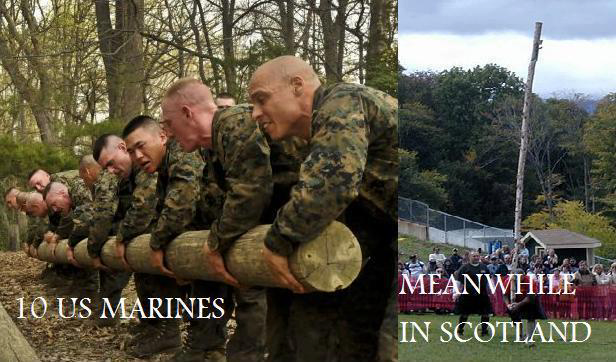
Delay for another few years? Even though this is the most likely event, Scotland would not be Scotland if it stopped without a massive fight, considering that one Scotsman tends to toss a log that requires 10 US Marines to carry is not a nation that whinges at the first hurdle.

So what if it uses the UK coin for now? Is that such a large issue, as Scotland grows its independent economic power? Consider this final quote from the article “They were already different, he said. Excluding oil revenues, Scotland had an average trade deficit of 11% over the last 15 years, which became a trade surplus of 2.7% if a geographic share of North Sea oil was included”. So the grace of Scotland is their oil reserves and what happens afterwards? This needs to be tackled first, because if Scotland is to avoid falling apart in the first setback (oil issues being just that when it happens), then Scotland must take care of its 11% deficit. In my view, that deficit must be turned to a 3% surplus (without oil) for Scotland to be a contender at the Commonwealth table, so how to go about it?

First it needs to change its political look on matters (not change its politicians). I will admit that the next part will sound a little dicey, but please hear me out. The headline “Scottish Tory leader Ruth Davidson: ‘I’m quite a cussed person’” (at http://www.theguardian.com/theguardian/2014/aug/15/ruth-davidson-interview-Scotland-tories-leader) reads nice, but there is a massive issue when we read the first part “Ruth Davidson is 35, a working-class Glaswegian, a kick boxer and a lesbian. Are these unlikely credentials just what the party needs to rescue it from 25 years of stagnation?” Why was there a reference to her Lesbianism? I personally do not care what her life’s choices are, truly I do not. But is this a political lesbian or a lesbian politician? Why could she not have been just a conservative? Did we see a headline on “Gordon Brown is a 63, working class sport less hetero sexual” Did we ever see that headline?

It seems that Ruth Davidson has supported state-funded Roman Catholic schooling in Scotland, and she also seems to believe (as far as I could tell) that the Church of Scotland should open its own faith schools as well, which seems a decently pragmatic approach to the ‘dangerous’ controversy called ‘Churches in the UK and Scotland’.

Because she is only 35, her most important events and achievements are still in front of her. She could be the inspiration the Scots need. Time will tell whether this is so. Yet there are issue with this article, there is little on her stance in regards to Scottish independence. If that is next on the agenda, should Scottish Tories not be outspoken about her views in that future? It seems to me that the journalist doing that interview kept the interview way too shallow, especially in this day and age.

There are a few other issues, like Ferguson, the last of the Scottish shipbuilders to shut down, so where are the economic options for Scotland, when we ignore oil. You see, I have nothing against the oil, yet the fact that a new nation will be totally dependent on only ONE product, such a place would need to have several alternatives if something went wrong there, so that is why it should not rely on the oil industry.

As a solution, I still believe that India has options here. As the Indian generic pharmaceutical industry grows for Europe, it will need alternatives for both manufacturing, shipping (read distribution) and perhaps to a smaller extent research. Whilst everyone seems to stare blindly to London area’s where prices are through the roof, Edinburgh offers a much cheaper and no less sturdy solution. Its harbour would allow for direct access to the Netherlands (Rotterdam), which would then grant access to Germany and Eastern Europe, there is access to Scandinavia as well as the option to nurture South American trade routes. All of them are markets that India could become the main supplier to.

It could change the Scottish deficit from 11%, to less than 3% in one blow, once the South American routes are a given, the deficit would turn to surplus. The stronger the growing need for generic medication, the more powerful this branch will grow in Scotland. After that, the tax breaks this industry could have would turn the UK into a much stronger market making for an entirely new dynamic in the pharmaceutical economy. Am I overly optimistic? Perhaps a little, yet so far, my predictions have held up and the current course is not getting us anywhere. It only takes one innovator to truly change the game, Scotland is roaring to be its own wielder of futures and India is roaring to be master of generic medication. Two innovators, a match, which is definitely not made in heaven, but as both want to make it work, the created future could be one that stands long and tall.

But is that with or without an independent Scotland? This is where the shoe starts getting a little tight for the dance floor. I personally do believe that this is not the best moment to become independent. I do believe that for now ‘better together‘ is the way to go. Consider the despair when Scotland does go it alone and within 24 months, both Japan in full and US in part become insolvent? I still believe that the US course is one that will sink its future, especially as the mention of well over 500 billion in undocumented spending in healthcare could set America well over the 18 trillion mark (the fact whether the healthcare billions were part of the deficit could not be confirmed), which makes for a dangerously unstable situation. So whether these facts stop Scotland from going independent is to be determined, yet that should not stop Scotland to become a lot more autonomic in growing its economy into the strong version it requires when the Scotland becomes one independent nation under this sky within our large Commonwealth.

Whether in the end there is a yes or no to independence, the fair question remains how to grow the Scottish economy, which will be a good thing for the entire Commonwealth.


Leave a comment

Filed under Law, Politics

Concerning the Commonwealth!

There is no easy news. The Commonwealth is having several issues that are not easily solved. There is always blame, but who to blame and more important, will it get us anywhere to begin with? I also believe that the Commonwealth has its share of solutions, but in that regard we will have to make some drastic changes. Some will be good, many will not be good and a lot of them will have to be different.

It is the last one that is likely the strongest salvation we might hope for, but we can no longer think the way we are, as we currently end up planning to go nowhere.

First of all, one member will need to step up to the plate and the others must protect this part. They started being regarded as a simple land, this land became a colony and later part of what would be known as the British Empire. It became independent and it is now a Commonwealth nation. Now, India must step up to the plate and become a Commonwealth leader. We (Australia, Canada, New Zealand and United Kingdom) must stand firmly and strongly next to India.

India has basically become the world leader in generic pharmacy and many are so eager to take up the Trans Pacific Partnership that we ignore the part that this US and Japanese conclave is not just about ‘trade‘ or ‘fairness‘, the indications are that it will give even more power to the US companies. A level of power they should not have to this degree.

They were complacent; they were lazy and became the facilitator for flaccid economists (yes, that was a Viagra joke).

If we accept a Canadian source, we see the following: “One proposed TPP provision would require governments to grant new 20-year patents for modifications of existing medicines, such as a new forms, uses or methods, even without improvement of therapeutic efficacy for patients. Another provision would make it more expensive and cumbersome to challenge undeserved or invalid patents; and yet another would add additional years to a patent term to compensate for administrative processes. Taken together, these and other provisions will add up to more years of high-priced medicines at the expense of people needing treatment, who then must wait longer for access to affordable generics. Meanwhile, provisions in the proposed investment chapter would give pharmaceutical companies the right to sue governments for instituting any regulation that reduces their expected profits, using private tribunals that circumvent a country’s judicial process.” (at http://www.msf.ca/en/article/negotiators-must-fix-most-harmful-trade-pact-ever-access-medicines).

This is not what we signed up for in any way shape or form (nor should we ever). It had been stated in several sources that Australia was one of the least objecting partners. The fact that this would be done and through this ensure the consequence that a large part of the Commonwealth will then have another decade of expensive medication to look forward to is just too absurd. when we read the additional quote “U.S. pharmaceutical company Eli Lilly is using similar provisions in NAFTA to demand $100 million from the Canadian government for invalidating one of its patents, claiming, among other things, that the company’s expected profits were “expropriated” when the patent was overturned“, we see a pattern where the use of such a partnership is not a partnership at all, it feels more that America is applying republican dictatorship, through arranged courts in order to thwart almost two decades of laziness and stupidity. Them overspending their treasury by well over 17 trillion is not helping them either and is at the centre of the current push we see.

India is proving slowly to be the leading authority on generic medication, even now in the last two years we see players like Kroger, Axium, Pfizer and Wyeth in multi-billion dollar mergers. They are setting up shop to have their own corners, which will grant them stability and income for the next decade. Guess what! We cannot afford that. The UK NHS is in shambles, healthcare all over Europe is unaffordable and the other Commonwealth nations see the cost of medication go up and up and up. These costs forced upon governments are the new way to get the maximum revenue, whilst in the end not being taxed on it (or for the ultimate minimum). India as a Commonwealth leader in generic medication can step up to the plate. We will not go to India, no, it seems that under these conditions India comes to the UK, Australia and Canada to build their places for generic medication to be produced. India would become a leader here. I wonder if President Pranab Mukherjee had ever envisioned that, to visit the other nations, including the UK as a leader, paving the way for a solution to the other heads of states of the Commonwealth.

If you think that this is ludicrous, then think again. In the Independent we see at http://www.independent.co.uk/news/uk/politics/government-accused-of-losing-grip-on-nhs-as-58-failing-trusts-now-have-241m-debt-9544181.html the following headline “Government accused of ‘losing grip on NHS’ as 58 failing trusts now have £241m debt“. Australia is feeling the pinch of healthcare hard and Canadian healthcare will soon be a sizeable chunk of a 2.2 trillion dollar debt. This must change!

We need to pull our resources. We need to think of other ways. Medication from India is only a first step. How about the option for healthcare graduates to work off their debts in a few years overseas in the UK or Canada? They’ll have a place to live, some income and over a period of 5-10 years (depending on the degree) their debt is settled. These are but a few of the options we can resort to. The old ways are not working and the few that do are drowned into costs of a faltering IT system. We need to group ourselves together and build a new system on different scopes. The old way has not worked and the more we delay the deeper the debt becomes and the less solvable the problem becomes.

This is no longer Labour versus Conservatives; this is now finding a way to avoid deaths through inaction. I agree that simply starting something new is not the way to go, the Labour IT systems of the NHS have proven that ten billion pound invoice, and yet doing nothing is another non-option. The heads of the Commonwealth must come together and find surpluses on one side to stop drainage in other sides. We are one commonwealth and we must save us! From there we will have the stability to come to the European aide, especially with affordable medication.

This side was ignored by the USA as the cash was flowing so nicely. Guess what, we are all broke and we need to find WORKABLE alternatives. The ones we claim to have at present do not work!

Let me also take a step back. This is not an anti-American thing, they are welcome to be part of this (even as a non-Commonwealth nation) and the issue is that they have been blocking affordable solutions through the FDA for a long time. What was good for Canadian was apparently not good enough for Americans and cheaper medication. The information from RxRights.org stated: “Threats to Economic Creativity and Theft of Intellectual Property Act of 2011 (PROTECT IP Act). This new act moves far beyond COICA’s blacklist of pharmacy websites. It would categorize all non-U.S. based online pharmacies as a risk to public health. It would require that Internet service providers and search engines block these sites that credit card companies stop their payments. Even worse, under this new law, Canadian and international pharmacies would be prohibited from defending themselves against those who shut them down“. This situation is even more ridiculous as this is instigated by a president claiming to bring ‘affordable‘ healthcare. If that were true, then why not let people find the cheapest option? Is a Canadian less than an American? No, it is all about a Democratic party with minus 17 trillion and they are firmly in the pockets of big pharmacy! That is the part and the Commonwealth cannot afford this shallow minded greed based approach. We must entertain the best option for the Commonwealth. As General Motors left Australia for cheaper options in China, so we must find our cheaper options in India and the TPP will not help us here. Signing it would be a massive mistake. By the way, all them Americans spamming my email for cheap Viagra was legal? Interesting double standard the FDA has.

We can see more in regards to Indian patents (at http://timesofindia.indiatimes.com/home/stoi/all-that-matters/Changes-to-Indias-patent-law-will-impact-prices-of-life-saving-drugs/articleshow/32519848.cms), of course, as it is the Indian Times, it would be all in favour of India, but are the facts incorrect? That part is in debate on several issues. One question that has not been answered over a term of at least two years is “Access to Medicines – Will the Trans-Pacific Partnership FTA allow governments to produce and/or obtain affordable, generic medications for sick people?

That is not just the question which is not answered; it is one if the questions that seem to be actively avoided whilst the TPP is continued behind closed doors. The response from Doctors without borders is “Governments have a responsibility to ensure that public health interests are not trampled by commercial interests, and must resist pressures to erode hard-fought legal safeguards for public health that represent a lifeline for people in developing countries.

This is at the heart of the issues for the Commonwealth, because if these steps stop affordable medication, then there will be no healthcare at all, the Commonwealth nations will be broke as they are decimated through age and sickness, after that what will be left of Western Europe?

It is only a first step; if we look at the NHS, then staffing and expertise are also a worry, which is by the way a worry in many Commonwealth Nations. Most of these nations have well over 5% unemployed; can some not be re-schooled in the healthcare sector? In the UK many IT trained staff are without a job, can they not help rebuild the NHS IT systems? Too many issues that are overlapping and someone threw away 10 billion. It is time to rewrite the tactical guide and start building a solution that will work. Sitting at home will not help anyone, not even one’s self.


Leave a comment

Filed under Finance, IT, Law, Politics, Science

Lessons not learned

As I look back at the end of a lifetime and I wonder whether I am just nuts (which is always a fair assumption), or that others are just unwilling to see the implied fact that we have stopped evolving. Many lives are basically based upon bread and games, a term that goes back to the Roman Empire and seems to be at the very core of what is happening at present in many areas when we compare ourselves to people in the Ukraine. The ‘free’ west seems to be focused on sustenance (a basic need for surviving) and TV. The TV is even showing some gladiatorial show, where people do some kinetic steeplechase for the glory of fame and fortune. I have nothing against the game. I have seen it; it was fun to watch up to a point; and when we switch to some cable channel we are likely to see a TV series that we saw before, a series that is rerun again and again, whilst not showing the latest seasons, but leaving us 2 or more seasons short (depending on the station and the series). We get to see those episodes, whilst the rerun is not giving us the last 3 seasons of NCIS, the last 4 seasons of the Big Bang Theory and so on (it is a very long list).

The top of this consumer pyramid scheme (politicians, board of directors and so on) goes on planning for additional wealth, whilst the rest is getting outdated TV and they are just trying to make due.

That view is getting stronger and stronger as we are confronted with the escalations in the Ukraine. There are two sides that propagated these thoughts. The first was something President Obama stated when he addressed the press. The quote “this week to implement the IMF plan to stabalise the Ukrainian economy“. That part got to me. The US is getting all huffy and puffy about more and more sanctions and actions to get the Ukrainian ball rolling, so that the IMF can spend billions upon billions in some way. WHY?

Chancellor Merkel, like many European spokespeople are trying a softer approach. This is not about which method is better, but about the fact that this is more about the IMF and that what we might laughingly regard as the Ukrainian economy then about anything else. Does anyone remember a place called Syria, where even today people die by the dozen in a civil massacre between the forces of President Assad and their opponents? The ‘crossed‘ red line, even after the second chemical attack is not getting too much visibility is it? Did the powers that want to control forget about those events?

Even more important, the fact that the separatists took out 2 helicopters with missiles (not clear which exactly), is not a reason for stronger concern? I am not accusing Russia at present, but where did these separatists get the weapons to shoot down two helicopters? As I see it, pushing billions into an area that has no stability is just a really bad idea. It seems to me that these issues are not really focussed on. In addition, the NOS news showed us small video bytes of news moments where we see members of US Congress, where they seem to advocate stronger measures and stronger responses. More sanctions, against whom? It seems that the people outside of that circus are ignoring an economical and political play which could hinder their own futures for at least another decade. The fact that Europe will go for another round of dealings for cheap Russian gas seems to elude many people. The US might really like the idea that Russia Gas is turned off, it will give the US the economic option of selling gas to Europe, which will hike the power costs of Europeans by a likely 15%-20%, did the people on both sides of the Atlantic River realise that these events could have long lasting consequences.

Getting back to the Ukrainian issue, I have stated before that the Crimean people were the pushing power to the annexation of Crimea back to Russia. In my mind the Ukrainian government only had itself to blame there. This view is not one I have when we look at the issues in Eastern Ukraine. I cannot deny that Russia is playing a game here, but what game are they playing? Whoever is playing out these events in Eastern Ukraine is doing so on a few levels. First, these are not just all Russians or Pro-Russian separatists. There is equipment, there are droves of people in their support and the events in Kharkov (where a mayor got shot and we see a change of those in charge) also imply that there are levels of orchestration in play, but those behind the screens are not shown.

So why is it so important to get the IMF in there at this point? I am not stating that the Ukraine should not get support, but the EEC and the IMF are so busy getting in there as quick as they could, that we should consider the history on Greece and Cyprus as well. The IMF came in after the fact (which is fair enough). It seems to me that the Ukraine is about something more then ‘just’ the Ukraine and as such questions should be asked. This will all take several other cycles of information crunching when we see that Serbia is also voicing on their upcoming EEC membership. How is Serbia’s economy and how are their balance books?

Is this all about the economy or are the political power controllers in the US not telling us all (the use of political controllers was intentional for those who missed out on a few events). I have stated in the past that from my viewpoint, the US is past its point of bankruptcy (but what do I know), the link here is that the analysts and power brokers downplayed UKIP in the UK and Front Nationale in France. This economic nightmare that Wall Street said could not happen is currently no longer that unthinkable, which makes me wonder why those analysts are on a high 6 figure income. The Farage party is still a strong contender at present and Front Nationale has already made a first sweep in France and the party under President Hollande is now seriously worried. When these two do achieve the drastic change they want, the bang that will sweep the European economy will have a massive impact on the US as well. Perhaps they want to add Ukraine and a few others as soon as possible to soften the blow and to keep alive what will then soon thereafter be known as a puppet currency, which requires the IMF to step in, in as many places it can, so that whatever crash the economy makes then, it will be supervised by one voice that is not the US, the IMF (with the US having the most powerful voice within it).

So in my view, these events are not directly linked, but they have bearing on each other. Is this why Eastern Ukraine is so adamant about no longer being part of the Ukraine? That last part is pure speculation on my side as I have not read any quality reading on why the Easters Ukraine is so militant at present, but it is not just about someone else running Kiev parliament. The reasons are far too militantly played for that. This does not mean that Russia is innocent here, but considering just how much intelligence is gathered on several levels for so many years and on how ‘silent’ the CIA and other players are in that regard. We see the news and we see all those references to keyhole satellites and even as we all knew that Syria was such a powder keg, no one saw anything in Syria. Now we see these escalations in regards to Eastern Ukraine and again, no one seems to see anything here either. So what are those keyhole satellites doing and why are they staying silent. Did no one consider asking that 143 billion dollar funding question?

So why do I care so much about this?

If the Commonwealth is to remain a top economic player, then we must see, acknowledge and consider the options we have and as the UK was never part of the Euro, their currency is safe, but their economic position less so. The UK cannot keep on paying these outrageous amounts, whilst for the most; the EEC members do not keep their budgets in order (they overspend close to 600 billion too much in 2013 alone, this is including the UK). When the Euro tumbles and the Dollar gets the pounding of a lifetime, we must consider what is right, correct and the best for us. Within the Commonwealth those options might be limited to some extent. I always believed that if we as Commonwealth nations (Australia, Canada, India, New Zealand and the United Kingdom) as the top economic nations of the Commonwealth pull together, we can weather all these economic storms and help ourselves to a larger and faster recovery to something better then it is at present. Should Nigel Farage pull of the referendum the way he wants it to end, these levels of cooperation would become vital to the UK. I speculated in the past that the crumbling of the US as a super power would instigate a new coalition of perhaps Russia, China and India (purely speculative on my side), then the Commonwealth link would become even more important. These events go further then just some super power game. The US remains so eager to push the TPP (Trans Pacific Partnership), in there the changes they were considering to Patent Law and Intellectual Properties in general are a concern to many. The face that Australia seems to have blindly accepted it, whilst New Zealand asked the questions and had the reservations both should have had to begin with are also a fact. America fears the abilities that India now has in Generic medication. India sits on a goldmine in an age of faltering health care and the overwhelming need for lower cost solutions in an ageing population. The US pharmacy was dormant for too long, new solutions are delayed again and again. Not unlike the IT where American superiority was boasted and whilst the American Industry embraced iterative evolution, was equalled and now to some extent even surpassed by Asian engineers, the Pharmacy field is in a similar, but not the same predicament. So whilst they focussed on the erectile need of Wall Street, India grew its generic enabling markets. Now America has a problem and the 14 year patent edge will no longer suffice and in the time several players went for the greed driven iterative plan, now slowly are finding themselves on the outside looking in.

This is exactly why the US is in such a state to drive these issues. I reckon that they never expected to be so linked to the Euro and their consequences. I personally feel that not keeping their financial house in order was at the centre of these reasons and like Crimea, it returning to the Russian fold is the worry of the US as the Euro could ‘collapse’ when nations decide to reject the Euro and return to their original local coin. The UK kept the Pound, but when France moves back to the French Franc, the currency that is no longer supported by two major economies will entice others to follow suit. The Dutch PVV has had several investigations to dump the Euro and return to the Dutch Guilder, when that happens party of Geert Wilders (even though the Dutch economy is small in comparison to the large four), the German corner could end up panicking and could move out to preserve itself, is that all such a long leap of faith?

This all will hurt the US in many ways. Now, it no longer aligns it’s maximum borrowing power to one currency, but to well over half a dozen, which should collapse their spending spree for at least two decades, more if the US defaults on even one loan. Consider in the second degree what happens when S&P will have to return to the comparison approach it employed before the Euro was adapted by many European nations, the impact could be massive.

So as the bulk of the people are asleep, relying on bread and games, the powers that would like to remain in control are playing high stakes poker as it is others peoples money and they will not pay the bill when the deal goes sour. We all must do what is best for us. The UK, the Netherlands, the Ukraine and the US. They all have to make their own decisions, whether they are valid for others or not. That is what many forgot as they all were trying to play a game on a global scale, with them all having themselves in focus. Crimea did what they consider to be best for Crimea. Most people forgot about that part, even Kiev forgot about that side of the equation, which makes the entire escalation part even sadder. So, should you consider my view to be invalid (which might be fair enough), consider the amount of actions, many debatable on both sides of the Ukrainian aspect. Consider the amount of NON-actions that were taken during 3 years of Syrian slaughter (on both sides). In my view, just focussing on one part of getting chemicals out of Syria (which is essential), whilst a second chemical attack took place (which had almost no coverage) looks like a joke to me.

Even now today (less then an hour ago), we see Ukrainians acting out against Ukrainian tanks, does that remind you of other similar events?

What lessons are we not learning?

Leave a comment

Filed under Finance, Military, Politics

The reality of decimation

This is not an academic piece, I would personally state that to some extent this is not even a sane piece, but is it an incorrect piece? That is indeed the question we must ask ourselves. Consider the events as they have plagued us for a little over 20 years.

This piece partially started with the UN report on the environment, but some of the elements have been on my mind for some time now. This is not about the War in Iraq or Afghanistan; this is about something a lot more basic.

Let us start with the UN report on Climate Change 2014 (at http://www.theguardian.com/environment/2014/mar/31/climate-change-threat-food-security-humankind)

It is also good to take a look at the policy maker’s summary titled Climate Change 2014: Impacts, Adaptation, and Vulnerability (at http://ipcc-wg2.gov/AR5/images/uploads/IPCC_WG2AR5_SPM_Approved.pdf )

We should consider the quotes that the Guardian article gives us.

First there is “The summary mentioned the word ‘risk’ more than 230 times, compared to just over 40 mentions seven years ago, according to a count by the Red Cross“.

My first counter is that this is not an event that has grown for only 7 years, these events and risks have been in place for well over two decades, the people in governmental power and the power players of big business are no longer aligned. Money only gets you ‘alignment’ to a certain degree. If you doubt this, then consider the power Big Tobacco had from the 70’s until the early 90’s. In the Northwestern Journal of International Law & Business (at http://scholarlycommons.law.northwestern.edu/cgi/viewcontent.cgi?article=1606&context=njilb) we see the quote “tobacco companies argued that plaintiffs assumed the risks of smoking. They also capitalized on the fact that they could afford the best lawyers to defend against generally under-funded plaintiffs“.

This is only the first quote where government has been holding its hands over the heads of big business for far too long. It is nothing short of treason against your own population (a slight exaggeration, I admit). It is not just their best lawyers against the plaintiffs, there has been a host of events where political powers had been ‘softly motivated’ to take a stance for the economic growth of a nation, whilst selling its people straight down the drain.

The second quote to consider from the Guardian is “Other food sources are also under threat. Fish catches in some areas of the tropics are projected to fall by between 40% and 60%, according to the report” (the part I saw did not specify the size of the area, or the exact locations).

Consider the amount of nations depending on their livelihood on fishing for themselves and their families, not to mention for whatever income from selling it to others in villages and cities. The claim ‘some areas’ is a loosely placed term I reckon. Consider the massive requirements for Japan alone. There is no evidence what so ever that this will lighten up any day soon. The events of fish shortage will grow above the mere population. A change to that effect will have a massive yield on the oceanic biosphere and as such mass extinction events on our fauna are almost a given certainty. So as we see the events there, we will see that the impact will soon thereafter hit waterbirds which will affect another chain of feeders. The third quote is “Almost everywhere you see the warming effects have a negative effect on wheat and there is a similar story for corn as well“.

Even though, to some part there is a claim that longer warm timeframe might yield some positive benefits, the overall consequence is that the events will be negative. Hunger will soon be an issue that stretches far beyond the third world nations, did anyone consider this?

The report is massive, so digging into this will take some time (after I get it downloaded, which is never easy from the UN document server), in the meantime, follow the next link to take a look at a document now released from the US State Department (at http://www.state.gov/documents/organization/219038.pdf)

Now let us go into the deep end. We have seen how being nice, how ‘finding’ a compromise will not get us anywhere. If you doubt this, then consider the fact that several nations are now, after giving us some ‘good news management’ additional grief will soon be gotten by the Dutch (at https://www.nvm.nl/nl-nl/actual/maart_2014/asscher_in_zomer_kijken_naar_lastenverlaging.aspx). They will be looking at lowering the costs for the Dutch population. Consider that the Dutch debt is currently in excess of 25,000 euro’s per citizen. Again, politicians will be trying to spend money they do not have. Even more hilarious, is the fact that they will not have that money for at least half a decade. If we consider this in regards to the UN FCCC report, where we see that climate is not just hitting us, many nations will have to pour billion upon billions into places to prevent flooding’s and other climate calamities. In this light, we will not have any lightening of economic pressures before 2018. The Dutch are not alone in this. The UK, France, Spain, Italy and to some effect even Germany will have to spend large amounts of money. If there is truth to the downward spiral of the climate, what will happen to France when their wine economy takes a 20%-30% tumble? (This is not a found number, that percentage is a mere estimation from other numbers in the UN FCCC report). Such a tumble will devastate the France GDP, which means that their debt will almost literally drown them.

So what is a solution?

Well, to safe our planet we might have to become drastic. The fact that politicians will not act and at the first sign of good news (managed or not), they will try to keep the status quo so that they look good (and leave it to the next person in office). This has been going on for some time and it has been happening in nearly every nation. So, we could rig the game and get rid of 4.7 billion people. It is not a happy act and if it happens I will unlikely to remain (or be allowed) in the ‘surviving’ group.

You see, healthcare, retirement shortages and lesser productivity (in the eyes of big business), would mean that we are to be removed from life. There is additional evidence for that. When we consider the words of the BBC (at http://www.bbc.com/news/health-26818377), where it is quoted “Risk of death by any cause over the course of the study was reduced by 42% for seven or more (up to around 10 portions a day)“.

Are they for real? When I was growing up, I had three meals a day. My lunch could include a sandwich with sliced cucumber and tomato and there were greens at dinner. That makes for two helpings. My grandfather lived to a ripe old age on those meals. So, who is paying these people to state 7-10 portions a day? Let us not forget that the UN FCCC report will have something to say about that. The IPCC report stated (at https://www.ipcc.ch/publications_and_data/ar4/syr/en/spms3.html) “Productivity of some important crops is projected to decrease and livestock productivity to decline“. This is not a global thing, but overall the population is still rising and food would be getting scarcer.

So, that option of decimation, which would be unfortunately for me, is starting to make sense. So how will we go about it? Will certain groups get targeted? When we see the HealthCare and retirement options as they dwindle then getting rid of anyone over 45 makes statistical sense (not morally). Alas, we are not that fortunate. If we consider the population numbers, as shown by the UN, Dept. of Economic and Social Affairs, Population Division (2011), we would also have to shed a little over 75% of the population that is between 15 and 44. How to go about that? If we take the people over 30, our population will face the reality that we saw in the movie ‘Logan’s Run‘. We could of course use the classic ‘Soylent Green‘ as an example, which also solves the food issue for all non-displaced citizens. Perhaps the list will be diminished in the way it was sung by Gilbert and Sullivan in ‘the Mikado‘ through the song ‘As some day it may happen’, “none of them would be missed”, I do however request and require that Nigel Farage will not be allowed to make that list (#JustSaying).

So, if you are currently extremely nervous about what will happen next then do worry, I definitely do! No matter how we will be dealt with (through hunger, war or just permanent removal). The consequence will be a global one. If we can rely on statistics is that within 40 years, if untouched through war, two civilisations remain, the Indian and the Chinese one. It is a simple consequence of the numbers as these two represent 36% of the planet, which means that no matter how much we get ‘culled’, either natural or unnatural, they would then be the only two remaining governments with the size that would places them in power.

All this reads like a joke, but it is far from it. As we have seen governments go into the acts of managed good news, whilst slowly giving us the bad news little by little (as the economic meltdown has shown), we will soon see similar acts by ‘spokespeople’ on how soon crops are grown with almost no water, how we see the use of Genetically Modified crops. The Economists had an article, which is not that relevant, but the quote in there “genetically modified (GM) crops pose health risks” is. The truth is that this is not true as I see it. Actually, we just do not know what the true dangers are. I feel that there is a risk, but there is no actual evidence (at present) that there is a danger. There is in my view indeed a risk, but no long term evidence exists. We are then in the same place as people were with Big Tobacco in the 70’s onwards. Big Tobacco had too much ‘protection’ and as such governments remained idle for far too long. Genetically Modified foods are likely to go into a similar field, but this time governments cannot stand idly by. The cost will be too great when it goes wrong. So am I against GM foods? I feel uncertain, until the long term dangers are known we should not proceed, yet if the shortages in food, space and water are truly coming, what can we do then? Consider that the global population grows by the size of the population of Germany every year, which is the 16th largest nation. Also consider that children 0-6 have the highest need for good food and clean water to survive, now see these items diminish as there is less, there are more mouths to feed and the climate change is soon making it harder on all of us.

The next two generations will likely be the hardest ones in the history of our planet. Never before was mankind hit by so many elements all at once. They will inherit a polluted planet, they will inherit debts unlike anything we ever faced and if the Status Quo does not change really fast, they will walk this world in an environment that could be near extinction on land, in the sea and in the air.


Leave a comment

Filed under Politics, Science

Setting the stage

The Ukrainian escalation is slowly seeing some events, but not in a good way. We have seen several speeches as well as actions against certain heavy weight big wigs in-crowd at the Kremlin. Will these actions hold weight? Time will tell. I went over several facts in the blog article ‘Strongarm, Intimidate, Terrorise‘ which I published on March 18th. I also made a coalition mention in my blog article ‘Foreign and Domestic‘ on September 12th 2013, where I stated at the very end “that view might partially depend on the steps the growing New World Order coalition of Russia, China and India will take“. In the last two days we saw the following events.

1. India, Russia to sign deal for anti-tank ammunition (source: The Indian Express, et al) for $2.4B.
2. Crimea Crisis Pushes Russian Energy to China from Europe (source: Bloomberg) for $350B.
3. Private Chinese firm to buy 100 regional Sukhoi jets (source: Reuters, et al) for $3.5B.
4. ONGC, Russia’s Rosneft may join forces on oil flows (source: Reuters).

This is just in the last two days. So, yes, we might think that we are putting economic pressure on Putin, but are we?
The last mention is that if we persist, there is every chance that the cheaper gas meant for Europe could be redirected to the Indian consumer. That is exactly the fear I voiced in the story involving the Crimea (Strongarm, Intimidate, Terrorise). The Reuters article also states “Rosneft said it had also agreed with ONGC they may join forces in Rosneft’s yet-to-be built liquefied natural gas plant in the far east of Russia to the benefit of Indian consumers”, which implies that Russia will get additional Dineros (aka loads of money) to build that plant, or at least parts of it.
Europe basically has agreed to a spitting contest which could cost them. There are still moral sides to consider, both sides states that they are correct and Crimean’s who saw a loss of income for thousands of households and desperately tried to save them to remain with Russia. The Ukrainian top really did not think that part through (as I see it). Did they think that forcing Russia to Novorossiysk, leaving the Crimea without one of their biggest consumers would not have an impact? I still have questions on the legality of the ‘transfer’ from Ukraine to Russia of the Crimea region, but I do not have a proper view on the legitimacy of the referendum as such (from a pure legal point). The fact that this is what the Crimea people themselves want (for a massive part) is largely ignored by the press. I will state that the NOS at least tried to talk to a few of these people and many wanted to return to their Russian past (they were also very assertive in not letting others talk on their Ukrainian view).
So what will happen next? Let’s face it, 4 deals do not make for a Chinese, Indian and Russian summer party, but these are massive deals and this shows that the coalition growth I expected is now showing more rapid growth, likely because of the Ukrainian events. For me, I am a business man and as such, I have downloaded the Sukhoi S-100 PDF’s and see if I can start a trainings company to train the Chinese crews on using the flight and navigation instruments of the Sukhoi S-100 (just me trying to get creative). 100 planes mean at least 400 crews, which is 800 pilots and 400 engineers, so 1200 prospective trainees to train. At $750 a day, I could be employed for at least 3 years. So that might be an option as life in Sydney is pretty expensive. People might snipe at this thought, but consider the ego contest we see growing in west versus east. There is every indication that energy prices are likely to rise by unacceptable amounts soon enough. We see that governments are more and more selling off their healthcare and other services to meet budgets, which means more costs for the consumer soon enough. A step by the way for which a government cannot get faulted, but we the consumer still get to pay the bill.
As unemployment rates are still growing to the extent it does, we will have to look at alternatives. If we are willing to work hard, then it is not the worst idea to consider Russian companies like Sukhoi and Chinese companies like Huawei. The next wave is for those who are willing to put in the hours and as several businesses want to grow into several domestic markets, which they will one way or the other.
So getting out there and set the wave so you can be there at the beginning and get to the higher level of the pyramid when it grows above the others is never a bad idea.
Should you get questioned on basis of morality of choice then consider the powerbrokers of Wall Street who got millions after the 2008 crash, The events around Silvio Berlusconi (not the intimate ones), Karolos Papoulias, President of Greece who was in office when the Goldman Sachs creative accounting event was discovered. It is not the question whether he knew what was going on, as president the Euro will stop at his desk in the end. The Finance ministers over that period were Georgios Alogoskoufis, Yannis Papathanasiou and Giorgos Papakonstantinou. Giorgos Papakonstantinou was the person revealing what had happened before he took the office and negotiated the initial 110 billion Euro loan, which makes his acts the one of high moral fibre. The list goes on and on and on. So, consider that many high elected holier than thou politicians have often taken the coin road as this was not illegal or criminal, it is just the cost of doing business. When it comes to businesses there are even more questions. When we see the bad deal the people at Boeing got, as reported by several media outlets in January 2014 as well as the technical issues we see popping up with the Boeing 787 Dreamliner. We have been looking at American companies for too long, perhaps it is time to look at areas where the runner up is hungry to become the biggest one, as they could be the source of your next good meal. So several elements are slowly setting the economic stage for 2014 and 2015.
If your livelihood is in jeopardy, where will you look next?


Leave a comment

Filed under Finance, Law, Military, Politics

Year of the last Euro?

Wednesday’s news on ‘George Osborne lays down ultimatum‘ seems to have remained a little quiet. So, was it all hot air, or are there silent runners under the waterline? The situation reminds me of a poster I once saw. It was a photograph of water, with the by-line ‘Submarine racing, a spectator sport!‘ I thought it was quite funny. Whilst scanning for the latest on this event, I find several people mentioning it, but no real update for a day. The Guardian article was quite informative (at http://www.theguardian.com/politics/2014/jan/15/george-osborne-reform-eu-quits-tory-dismantling ). However, I regard the BBC version of it a little better (at http://www.bbc.co.uk/news/uk-25740462)

The BBC article does however have two items I do find interesting, but they are slightly debatable.

The first one is “I believe it is in no-one’s interests for Britain to come to face a choice between joining the euro or leaving the European Union.” Why is it one or the other? In my view, the only part keeping the EU from collapsing is because the United Kingdom DID NOT embrace the Euro coin. I will get back to this a little later.

The second part is “The 28-member group also had to do more to ensure economic competitiveness with rivals like India and China, he added.

I feel that the UK could become a lot stronger if the Commonwealth brethren embrace each other as family and as mutual protectors. This means that the UK should become the centre force in group that includes Canada, Australia, New Zealand and India.

In my view, the issue is that Chancellor Osborne is too adamant to sing-a-long with the American tune. I view this like a game of musical chairs. An iteration game of leave one out! The problem is that this game includes one chair that is only meant for the rear end of America, so it will always have a chair to sit on. They should not even be included in this game, but there you have it, for some reason they are part of the EU game.

So let us get back to the first part as promised. The EU (or EEC if you prefer), has 28 nations. In the GDP rankings the UK is at number three. The issue is that the top 7 has Germany, France, Italy, Spain, the Netherlands and Sweden (these 7 are 79% of the entire EU GDP). Only Germany is in a good position, The Netherlands is on the thinnest ice imaginable, whilst Sweden in its economic state seems to remain skating on the ice it has (for now). The rest has gone through the ice and are in a bad place. So, why should the UK risk it all and add themselves to a currency that is drowning itself because the local politicians refused to stop spending when they could, they kept on spending when they should have stopped and now they are in that bad place. Many should be thankful that the UK and Sweden are not part of the Eurozone at present.

In addition, Greece, according to Finance Minister Yannis Stournaras does not need any more austerity (Nov, 2013). Spain stated “The budget is based on a forecast that the Spanish economy will grow 0.7 percent next year, up from the government’s previous forecast of 0.5 percent.” (at http://www.nytimes.com/2013/09/28/business/international/spanish-budget-avoids-austerity-measures.html). Yet Bloomberg noted on September 5th “Spain’s bid to meet its budget-deficit target for the first time in five years is running into trouble, fuelling concerns that increased financial stability is masking deeper economic problems.” So, what is actually happening here? Are we witnessing new waves of creative accounting?

In light of all the bad news, it must also be noted that France is at least still fighting to keep the austerity in place, even though President Hollande is slowly becoming the least popular president in French history. I applaud him for standing firm and I do hope he will not share the fate of Louis XVI (a one-time treatment at ‘La Guillotine’). Italy is for now also on the Austerity track, but internal developments are not good and there are signs that Italy cannot continue the course it currently is going. So out of the 6 (not including UK) one is doing decently well, two are on the edge and the rest is for now in a bad place. This is not the time to switch currency, especially as the UK is slowly recovering, to add their heads to a block whilst the Axeman is spending the night away. It is more than just bad politics to do so.

So, we see percentages all over the place, but in the end, what does it mean? Well, let’s take a look at the numbers (as far as I found them, and a stern warning, the numbers are unverified and not from the best sources). In my defence, the numbers do not seem to be clearly presented anywhere.

Sweden, the smallest and not in the worst state is a little over 1 trillion debt at over 180% of GDP, Spain at 2.3 trillion, which is over 150% of GDP, Italy at 2.4 trillion, but interestingly seems to be at almost 100% of GDP, the Netherlands at 2.6 trillion, however the numbers I found place them at almost 350% of GDP, France is at a whopping 5.1 trillion and like Sweden around 180% of GDP, lastly Germany owns over 5.5 trillion at a ‘mere’ 140% of GDP.

Whatever some of these so called economists are trying to tell you (they are hoping you do not revolt against additional borrowing), the current nightmare is far beyond the issues you can imagine. the populations of Sweden is almost 10 million, the Netherlands is at almost 17 million, Spain 47 million, Italy 60 million, France 66 million and Germany at well over 80 million. You see, in the end, the taxpayer gets to deal with these trillions. So, a large nation might seem safe, but consider France, where austerity seems unbearable and with that sizeable population, the debt comes to over 74,000 euro per person. The average income for a Frenchmen is almost 32,000 euro a year (before taxation), which makes the debt more than 2 annual incomes from every implied French resident. So, when people get angry, they need to get angry at previous government administrations that had spent to such a degree that the current debt is unbearable! (Something I have mentioned in several previous blogs.)

This is also the danger of UKIP! I am against the UK moving out of the EU for several reasons, yet the changes could be forcing the current British government to consider the one step that UKIP desires most, what a mess that will make!

Part of the issue I am struggling with is actually in another article in the Guardian (at http://www.theguardian.com/commentisfree/2014/jan/15/europe-welfare-spending-george-osborne). I do not agree with parts of it, but the article is well written and the writer Alex Andreou does set out his position very well. So, please do read it for yourself. My issues is with “The fact that as a continent we have embraced values of social security and solidarity, a high standard of education and health for all, and dignity in old age, should be celebrated.” I am all for that and I am in favour of that too, yet governments all over Europe (including the UK) have overspend by such a massive amount that cutbacks in these times are extremely painful. I get it, but previous administrations lived under some umbrella with the picture of a sun, which they took as an eternal summer! Instead of caution, they ignored basic rules and just went all out on a spending spree. Now that all the money is gone, the coffers are instead filled with ‘I OWE U’ notes. When every nation spends more than they are receiving, no one will have any money left, yet governments started to borrow to one another. So, those in debt were borrowing massive amounts to one another, even though no one had any money, is no one catching on? This is my issue! I am all for social security, but if we do not have the money, how can we get it done? In addition, Latvia, the newest member of the Euro states (at http://www.bbc.co.uk/news/world-europe-25567096 ) “The former Soviet republic on the Baltic Sea recently emerged from the financial crisis to become the EU’s fastest-growing economy.” Is that so, in that regard we can read the following at http://www.baltic-course.com/eng/finances/?doc=83279The state budget is projected to have a deficit in 2014, 2015 and 2016, according to the medium-term budget framework that Saeima approved in the final reading yesterday, informs LETA.” so the newest member already goes into deficit from day 1? This is quoted in the following way in the article “The medium-term budget framework is based on the following GDP growth forecasts: 3.7% in 2014, 4% in 2015, 4.1% in 2016, 4.1% in 2017 and 3.9% in 2018.” so already above the limits as stated by Brussels. Compared to the top 7, the amounts they refer to seem peanuts in comparison (al 35 billion of them), the issue is moving forward and gaining economic strength, not add to the massive debt. As I see it, the Latvians have plenty to worry about and in my view; the UK and Sweden would remain well warned and not join the Euro.

Time to get back to issue 2!

I stated earlier “the UK could become a lot stronger if the Commonwealth brethren embrace each other“. As the issues evolve, the Commonwealth should revert to a new British Empire, but only in an economic way (undoing the work of Ghandi looks wrong on way too many levels). One of the big dangers is the Trans Pacific Partnership. Australia and New Zealand are in my view to eager to add their names to an approach that is all about keeping America in ‘power’! Why do I have this view?

There are several articles, but at http://www.businessspectator.com.au/article/2014/1/14/technology/tpp-trades-us-clout-expense-innovation we see some of the issues that will bug many in the Commonwealth.

The quote that starts to scratch the surface is “in 2009, total patent applications made through the patent co-operation treaty process from applicants in these nations also exceeded those from North American applicants for the first time.

This is the fear America has, which is why they are so eager to get all the autographs. You see, as I see it, Americans became (or were in the eyes of some) complacent, lazy and greedy (the American industry, not the people). For example, as I see it, the IT industry took a page from the arms industry and stopped true innovation and replaced it with iteration. A disastrous step as you will soon see. The powers at IBM and Hewlett Packard, as I see it, decided to listen to military giants like Raytheon and Northrop Grumman. So, America went from the innovation based, which brought the leaps from the 386 through to the Pentium II, and we ended with iterations like I3, I5 and I7. Newly coated computers, which now move forward in stepwise motion. The issue is that Asia had a huge delay keeping up and this all changed as their comprehension improved, in addition, it is for technology insiders relatively easy to learn the path of an iterative technology. This is the first step of fear as America is now facing it. Asia has its own group of innovators and in my personal view the passing of Steve Jobs took away one clear path of innovation. When Apple moves in that same iterative path, the last true American innovator will be lost! Now Asia has a massive advantage and as such America needs to clamp down on whatever they can, with the massive debt and no clear future path their world will all be about Intellectual Property! The article touches on it with the following quote “But what if the real motive of one or more parties was to isolate, control, enrich, deprive, penalise and stifle? In effect, to put a toll on the drawbridge.

This is at the centre, but not at the core of all this. That is why we see the mention that India is seen as a competitor, because for America, they truly are the new competitor. That deadly error was made by the American administration in 2011. Forbes tells us about it in http://www.forbes.com/sites/henrychesbrough/2011/04/25/pharmaceutical-innovation-hits-the-wall-how-open-innovation-can-help/. They published it in April 2011. That story shows only part of it. The quote “The patents granted to these drugs last for 20 years from the date of filing, and since most drugs take 7-10 years to get to market, the pharma companies have known that this moment was coming for the last 10-13 years. It is the logical outcome of a deeper problem, which is that pharma R&D spending has been less and less productive for many years.” gives us two parts. One is that there are clear indicators that the pharmaceutical industry has been working on borrowed time. The second is that the ROI has been dwindling down and that these corporations will face the horror of generic medication as several patents hit the end date in 2015. That means in just over a year, the largest maker of generic medication (India, in case you were wondering) will get to have a go at several extremely lucrative prescriptions. Perhaps you remember news messages on how the FDA was so against Canadian medications. I personally considered that entire issue to be a joke, but the underlying horror for America was already there. I mentioned in other blog articles on the issues I have had with the Dow Jones index (‘Start making sense’, 11th march 2013). Now consider that the three large pharmaceuticals Johnson & Johnson, Merck and Pfizer represent 10% (3 out of 30) of this index, so America is plenty nervous here. Now take into account that these three will have several expiring patents by December 2015 and that means that within months India could have a quality generic alternative, which is likely to be more than 70% cheaper. Now, be aware that a generic medicine is often less effective than the original. Still, the price difference is huge. It is not just the US; the UK has its own share of pharmaceutical makers, so the knife does cut in two ways in this case. Still, when we need to cut back again and again, India could be a good thing for the Commonwealth at large. So, even though some see the TPP as an option, there is implied evidence that the TPP could strongly block innovation.

How does this link to the Euro? No matter how we twist or turn it, the hard times America will face as it has been facing them for the last few years will intensify as innovation remains absent. That will hit Europe in several ways. The Netherlands already saw that as Merck shut down activities like Aspen Pharmacare. The intertwining of corporations on that level are all over Europe, and as such as American Pharmacies are hit, their European links will suffer a lot more because of it. So, yes, India is a competitor there, but the UK together with Canada and Australia could look for a cooperative solution with India and not see them as the competitor (as America currently does).

So is this all linked to the end of the Euro? Yes! It does however depend on the actions of the UK. If is stops membership, the run on the markets and the panic Germany faces could be catastrophic for the Euro, especially as Germany cannot rely on the pillars named France, Spain and Italy. The other nations are either too weak or too small.

Could George Osborne be wrong?

That depends on your point of view and your allegiance. The latter is implied as I noted the reference to the musical chairs with the one reserved seat. News messages like “the call to end austerity by ‘insiders’ from Brussels”. Yet, in the other light governments must reduce their spending and they need to get clever about it fast. The UK non-working military recruitment solution at 1.3 billion is just one clear example. Pretty much every EU country has its own skeletons. I see that the UK could be stronger as the Commonwealth nations take a route of preference to strengthen their economies, it is clear that such a path in Europe would remain stagnate until late 2015. That does not make George Osborne right, it only means that a European route might work, however it will be a long term path and switching to the Euro (at present) does not seem to be a stable solution for the UK to implement.


Leave a comment

Filed under Finance, Law, Military, Politics

Scolding Labour’s Energy call

In the UK Ed Milliband is at it again. Of course, as Labour is getting closer to the elections, more interesting offers will be made to the electorate in a hope to get the votes up by a lot. As Mr Milliband is not polling to strong, more is needed.

Sky News reported on the notion that Ed Milliband has voiced options to freeze energy prizes, should Labour make it as the new tenant, getting the keys to that famous door on Downing Street (I think it was number 10).

Yes, freezing prices. It is an option to offer, but as Sky news showed in more than one way, it is not a very realistic one. I reckon that all parties need to realise that the next 3 terms will be about cutting the deficit. If the economy is to have ANY kind of a chance to get stronger and to get the UK back on some level of forward momentum, then the deficit and the debt need to go. Not realising that this is to be the number one priority is the party that has self, not the nation in mind.

The Dutch are dealing with this in a bad way. They have to cut 6 billion, or face a billion in fines. The survival of ALL the European players is to cut outstanding debts. It is a lesson the USA is currently not willing to face and it is about to get a lot harder for them.

Labour has more issues, but about that more soon. If we focus (not just UK) on these options, then we have options to strengthening all our economies. When we consider the option to unite the labour surplus and shortage of Australia, Canada, New Zealand and UK then we might cancel out a few shortages. If the world is a global workforce then the Commonwealth has one of the most global covering work force on the planet. Why is this not more strongly investigated? if we can get work flowing, then we get revenue moving and the reduction on welfare could be the start of it all. If we believe the news then there are many young workers looking for a job. Why not enable that workforce to work in any of these nations in certain areas? Even, if it is only for 1-2 years. That means hundreds of thousands could end up having an income. And the nice part is except for Quebec they all speak English (in Quebec they speak an additional language, so you could end up learning a second language there).

Anyway, this is not about language. Or is it?

The language of Labour has been off in several nations. In the UK the language is stretched for the votes, yet that could change sooner rather than later. In Australia Labour lost on message and on a public getting sick to watch the labour bickering. First there was Kevin Rudd, then Julia Gillard, then Kevin Rudd again and now after the Labour defeat the new ringleaders are in a rope pulling match between Anthony Albanese and Bill Shorten. Watching the ‘who gets to be in charge fight’ is immensely less entertaining to the labour supporters, if nothing (I mean way too little) is getting accomplished.

Ed Milliband has a different power struggle. His is about energy and the non-reality that these prices can get frozen. The margins are not that great when investments and infra structures are considered. If we believe the Guardian, then the energy moguls are in the market for cold blooded profiteering, which came from an article they published in April 13th 2013. Is this about profit? Who pays for the investments? We all are so nice about carbon emissions, getting green energy and such, but how does that get paid for?

Let us not forget that these are Commercial energy providers and they live on that pesky little thing called profit. British Energy is part of EDF, a combination that pays for almost 20,000 people. So if the income in Pounds is set to an average of 26,500, then they need to make a profit of over half a billion to just pay the average income (and this is only one of the six providers). Where will all that money come from?

So, apart from the workforce there are the plants, which need gas, oil, Uranium or other materials to create the energy. Not really a high yielding profit margin. I know about those ‘cheaper’ options, but for now a water powered fusion reactor remains a non-reality.

So as Ed Milliband makes this vow to freeze prices and as we know everything gets more expensive and these workers want a raise at some point. How can this promise be met? I do apologise for playing the realistic focussed pragmatist. It is just not a reality to see that happen. Not without adding to the debt by large steps, which in the end will be the UK downfall, missing whatever small curve of industry they could get.

So I remain, to be honest, as a conservative in a mindset that the UK alone might not hack it (not because they do not want to), but because the negative waves are too strong. Yet, the UK does not stand alone, we are all together the commonwealth. I prefer the old name, we ARE the British Empire. If Australia has such shortages in engineering (Western Australia), and healthcare in the UK is falling short, can we not slam our hands together? There is also Canada. With these three, we cover the entire global timeline. So many companies promise 24:7 support and then outsource it to India (also a Commonwealth nation), which gave many all kinds of language issues at times (not all the time mind you).

If labour needs a strong message, then why not focus on solutions, especially those not in the box. That part is shown with the NHS that does not fit into any box (apart from a coffin it might soon end up in, if nothing gets done right quick).

We should not rephrase messages, we should not change messages and we all need to look into new messages. Not doing so is a disservice to all constituents. The US to some extent still goes for the message “In god we trust all others pay cash“, Let our message not be some political clarion call, but a message that reverberated strongly throughout India, driving it to independence and turning it into a world power in less than 65 years. Not the worst example to follow! We all need to embrace both Mahatma Ghandi’s and Jawaharlal Nehru’s call for Global Cooperation. As they were both honourable members of the Inner Temple, we could see their view as one that had British foundations (that’s me thinking wishfully) and remains one that is worthy of pursuing.

Leave a comment

Filed under Uncategorized

Foreign and Domestic

America is under attack. The question becomes whether this is a new one, or one that has been ongoing. There are several thoughts and they all, too some extent link together.

FOREIGN
The foreign groups ‘attacking’ America include both China and Russia. They are both using to some extent their own puppets. Let us call them Syria and Iran for now. Russia’s pulling the strings of Iran. No matter how the strings are pulled, no matter how acts are ‘begotten’, the issue is that Iran has been given the one carrot it cannot ignore. It is the support to get a nuclear power plant placed within Iran. Russia gets a string of benefits; this includes making America look bad, making their claims fall short, which according to the speakers in the Kremlin will look pretty good on the front page of Izvestiya (Известия). China is now giving support to Syria as Syria in a last moment of desperation plays the ‘oversight on my Chemical Romance stockpile’ card. The question becomes, whether it is just last minute, or certain cards were offered during the G20 to be played, because any of this, must seemingly be cast on making the US President to not look bad (the view projected after the fact will be an entirely different issue).

To support certain new options goes decently further than just the ad-hoc statement by United States Secretary of State John Kerry. These issues have been playing for some time and most issues started to accelerate as we all saw in the news. Many of the top tier papers reported these events. So how come that these events are still seen as a foreign attack?

That would be a fair question!

China and Russia had been blocking many of the events needed to make any stance against the indecent slaughter of the people of Syria (on both sides). I could cleverly state that Russia and China removed the ‘s’ and used laughter to block the US and other nations to get anything done there. The fact that the Bushehr plant is announced to get a new baby brother as reported by Polina Garaev “Putin will present Rohani with new deal worth $800 million for new batch of S-300, construction of new nuclear reactor at Bushehr” gives additional weight on the Iranian ‘support voice’ in regards to the Syrian question. Whether this will become the Alice Cooper nightmare remains to be seen, it is however clear that the S-300 additions do mean that they fear the response by Israel towards this new billion dollar baby. Trust me when I say that there will be well beyond $200 million in additional fees for consultancy, education and other requirements. The one part I do like about this all is that Iran seems to not trust their own propaganda on the ‘advanced’ Mershad from 2010 and prefers to rely on solid Russian technology as it was developed in 1978 (sometimes life throws you a nice juicy steak to blog about). Still, if Israel cannot get there via the air, I think I have found a way to super charge the fuel rods to melt them down all by themselves (pretty much stopping both reactors from ever working again). It should take only three elements and I got the idea from a snow globe, go figure!

All four players in this parade are anti-American; their union is not because they like one another, but because of their individual needs united in non-American likes. That does not make for an attack. That does not mean they are attacking America. That part had been shown in http://www.bbc.co.uk/news/world-us-canada-23845800, which is only one of many newscasts on that topic. In addition there is http://www.nytimes.com/2013/09/06/world/middleeast/new-us-envoy-to-un-strongly-condemns-russia.html. This could be seen as a first level of evidence that the United Nation Security Council (UNSC) was nothing more than a political tool to stop any kind of condemnation and the lowest forms of support for the victims of the chemical attack.

Are there doubts?

Yes, even though some claims came that there was ‘evidence’, I am still having certain doubts in regards to the actual attacker. When a State secretary goes on a world tour visiting heads of state showing ‘secret’ evidence, parts are not right. It is shown to a group that is too large. Instead of giving it all to the media letting EVERYONE publish it would have been a much better policy, it could have had the result that the UK would have been in favour of actions. The delays, the Intel that WOULD have been there from those big boxes high in the sky, (commonly known as satellites), could have shown much of the evidence. Yet, personally, I am not completely convinced that they were attacks ordered by Assad (directly or indirectly), which I admit is a personal view and based on gut feeling more then anything else. Is it possible that some misguided Assad supporter did this? Yes, that is a definite possibility. I dealt with these thoughts in a previous blog called ‘tactical choices of inactivity‘. I have always believed that Al-Qaeda is only about Al-Qaeda and their goals. It was never about Syria for them (I personally believe this). The theatre of war in play gives them ample opportunity to get to USA and Israel. There is a chance that the number of military opposition leaders, who knew about chemical caches seems larger than most considered, which means that others knew too. This entire new play is as I see it is not about the fear from Syria AND Russia that unwanted elements might want to get things going out of hand. It is likely that this is already the case and a USA offensive would stop any chance of that part getting a certain level of control. It could be that this danger is in play, meaning that both Russia and Syria want to get out of the way fast, allowing the new diplomatic play to proceed, whist the US gets left holding the bag.

No matter how this plays out in any diplomatic way. We will see soon enough that Syrian victims will get overly victimised soon enough with added by-lines on how America never intervened.

DOMESTIC
In my view, I see that the domestic enemy of America seems to fit into three distinct categories. First of all, this is not about lone wolf terrorists, or any terrorist groups, they fall in the foreign enemy group. No, the Americans do not get to be that lucky as such.

The first enemy group are those libertarians hiding behind ‘freedom of information‘. This group is for the most the direct one we see, receiving all kinds of media support and protection. They do not need to fear the House of Lords and some Leveson report, but they do ‘fear’ what the NSA had been doing. The electronic Frontier foundation did instigate a case which they won. Sky News covered this at http://www.skynews.com.au/world/article.aspx?id=905204. My issue is the quote “as part of the agency’s effort to track potential terror plots

In my mind, when (not if) the next attack on America succeeds, then the EFF (Electronic Frontier Foundation) should MANDATORY in the light of ‘freedom of information’ reveal the names of all their supporters in this case to the family members of the victims the next attack has. There will be no carefully phrased denials; there will be no talk about ‘we so sorry’. I want to see those names clearly shown on-line. In addition, the EFF board members John Perry Barlow, Brian Behlendorf, John Buckman et al will have to visit all the funerals of those victims and look the survivors and family members of the deceased straight in the eyes. I wonder how ‘ideological’ they will feel at that time. Interesting that they (as far as I could tell) have not been too active in protecting people from places like Microsoft and others when we see articles like http://rt.com/usa/yahoo-microsoft-campaign-political-862/

That is another matter, which is ALL about personal gain (by those corporations) and not about keeping the American people safe. Another article is http://tv.msnbc.com/2013/06/13/gamers-fear-microsofts-xbox-one-could-be-future-of-prism-after-nsa-revelations, I do not agree with that article. That is not about some PRISM project, it is about Microsoft making sure that Microsoft gets more and others less. That is about greed and spawning INACTIVITY to the future new developers (unless it is in the hands of Microsoft). With gaming as a hundred billion dollar market, and as the gamers market surpassed the porn industry as a revenue group, did you expect these events not to happen?

I personally see the EFF as a sanctimonious group at best, of course others have their own view which are quite opposite of mine and as such they are very welcome to have that view, because I do believe in freedom of speech. I do have an issue with it when you endanger the safety of a nation.

The second group are the economic leprechauns (‘leper cons’ might be a better term). These are not the good and fiddledy diddledy types walking around with a cauldron of 100 gold coins. These are greed driven monsters in need of more and more at the expense of everything and everyone. They will enable their voice to whatever keeps them playing the game. The attack on Syria would have meant that their profits go down, so they would do whatever they could to stop it by forcing a diplomatic solution view. It seems such a humane view, yet, they will avoid taxation by moving funds offshore, they avoid taxation by becoming a virtual entity and they will prolong their game by removing your rights and your future. I personally believe that in many cases banks are on that side too. Did you forget on how in the lowest moments over 3.5% of mortgages are added to the foreclosure listings? Why are THEY a domestic enemy of America? Are sound business strategies suddenly outlawed? No, they are not, yet there have been too much personal and corporate gain preferences in the past and war is usually bad for business, unless you sell ammunition. In that regard my words might seem to be empty in the view of certain people, yet consider that America is an ideal by the people and for the people. How come that those views are so often drowned out by corporate greed, to give view to what is good for corporations and their stakeholders?

The third group is the most dangerous of all, it is a wild-card called ‘the self-centred person’. They are traitors, manipulators, journalists and/or politicians. The reader could even see me as one of these types of people. This group is dangerous as they could also be members of the first or second group. Yet, whilst wearing one of the other two cloaks they are only in it for the good of self. Edward Snowden falls in this group. Too much ‘evidence’ showed that he was all in it for himself. This was never about freedom of information or the security of America, it was about his life style, his future, his fortune and he was so willing to sell America down the drain in the process. The evidence? If that was truly about some level of honour, he would never have gone to Hong Kong or Russia. Several countries do not have an extradition treatment with USA, the fact that he ran to nations who are direct opposed to the American way of life should be seen in that light. Bradley Manning basically does not fit this group very well. There is a valid concern that he was misguided in his choices, when the choice was there he just gave it all away to Wiki-Leaks. In the smallest of defence of Manning, it seems that he at least was never out for personal gain; his ideology was, as I see it utterly misguided, which makes him the odd duck out. The recipients were however very willing to push his buttons for what they believed was a ‘righteous cause’, manipulative steps to say the least.

The problem with my own view (I will admit to that), is that my view has evolved from information given to me from journalistic and other sources, whilst I know that many in this ‘game’ have their own agenda to maintain. That means that it is about a target they have. The time of truly neutral journalism has been over for some time and I fear it will never return, which makes for an interesting view of the first amendment. The freedom of speech would become the freedom of representation of those we service, because the board of directors in a media group are often linked to other endeavours, making their freedom of speech a lesser item.

America is in my humble opinion under attack, and Syria is just the new stage where the American chess pieces are about to be moved, whilst some of them will be removed. I wonder where we all stand on the 1st of January 2014. That date will be soon upon us and that view might partially depend on the steps the growing New World Order coalition of Russia, China and India will take.


Leave a comment

Filed under Media, Military, Politics, Science