Iranian decisions

At 00:10 Tel Aviv Time, roughly 07:10 here, the time of waiting was over, Iran has fired its missiles on Israel making the outstanding option of an impending war a lot more realistic. In this the Guardian gives us (at https://www.theguardian.com/world/2018/may/09/iran-fires-20-rockets-syria-golan-heights-israel) “Iranian forces stationed in Syria fired approximately 20 projectiles at Israeli military positions in the Golan Heights just after midnight on Thursday, Israel’s defence forces (IDF) said“, in addition we see “Several but not all rockets were intercepted by Israeli air defences, an IDF spokesman, Lt. Col. Jonathan Conricus, told reporters“, whatever happens, will happen soon, because if sch a barrage cannot completely be stopped, we can deduce that it will not take long for Iran to take a more targeted notion, yes, my version is speculative, yet the warmongering words from the last weeks gives rise to take it all a lot more serious than it has been taken in the past. So when we see ““The IDF views this Iranian attack very severely,” Conricus said. “This event is not over”“, we better believe that more is to come. There is an additional setting, this attack could only have been done with the approval of President Bashar al-Assad, so he is feeling secure enough with Iran and Russia backing him, so the picture changes on a few fronts, this is no longer merely settling whatever Iran thought it was settling, this could have much larger repercussions. Turkey is already voicing support for Iran and siding with Russia (they are playing their hand cautiously, yet Turkey is all in with their anti-Israel views. It gets to be worse, because as the US pulled out of the nuclear Iran accord, we now see ‘EU rushes to arrange crisis meeting with Iran over nuclear deal‘ (at https://www.theguardian.com/world/2018/may/09/eu-moves-to-protect-european-firms-from-us-sanctions-on-iran), so even as we know that there are several things wrong, even as Iran meddled in other business and now is responsible for direct missile attacks on Israel, we see that Europe is still trying to make some level of a deal with Iran. It goes even further when we see “Work on the package being coordinated by the European Union is at an early stage, but the EU is being urged to warn the US it will impose countersanctions if the US attempts unjustifiably to cripple EU firms trading with Iran“, yet the foundation is that there has been more and more overwhelming evidence that Iran has not been dealing in good faith. When we consider the earlier settings that I mentioned 3 days ago in ‘Stopping Slumber, Halting Hesitation‘ (at https://lawlordtobe.com/2018/05/07/stopping-slumber-halting-hesitation/), we can just quickly decide that they were prepping for all this, which would be incorrect, yet the fact that 20 missiles got there so quickly to be fired on the Golan heights also indicates that there was Iranian willingness to go that distance in several political branches and on pretty much all military levels, which is equally unsettling. The issue is that the EU remains a lot quieter when it comes to the involvement of Turkey. It is a personal view of mine, yet I believe that there will be diminished needs soon enough and there is a Turkey EU membership play coming. The beginning of ‘compliance delay messages‘ is merely an indicator, I believe that the fear mongering will get worse and too many parties are playing that game, that whilst the denial of Turkey into the EU should have been clearly made well over a year ago.  So when we are treated to “The European Union is scrambling to arrange a crisis meeting with Iran after Donald Trump pulled out of the nuclear agreement, as the Iranian president Hassan Rouhani said Europe had a “very limited opportunity” to save the deal“, we also need to keep in mind that terms like ‘could’ connected to ‘shut down UK’ on EU laws, this level of fear mongering is just beyond acceptable and we might all be better off in a direct war and whomever survives will suddenly demand near draconian treatment of the media, even as Leveson 2 is (for now) off the rails, the next crises will not go that smooth for whomever is demanding greater accountability of the media. That is not the only part, the entire Turkish economy and the S&P decision to regard Turkey. As it junkified its currency rating from ‘BB/B’ to ‘BB-/B’, we see a larger impact and when we consider that the Turkish lira (TRY) has fallen 7.4% this year and in that setting, including the corporate debt problems that Turkey is facing, the entire blow hard whilst they are not producing any music is more than merely wind in the air, as Turkish economic growth has been fueled by cheap international credit, we still see the need to pay for all that and now as we see (actually it was last month) with “Yildiz Holding—owner of the brands Godiva chocolate and McVitie’s biscuits requires a complete restructure of $6.5bn of its total $8.5bn of debt by the end of this week“, a cookie factory having an eight billion dollar debt? What else is in such disrepair? That shows just how desperate Turkey is at present to get into bed with almost anyone, that is what we are allowing in our midst and there is no level of fear that seems to be reflecting off the sides of EU Brussels and Strasbourg, which is also unsettling, now as they are optional diplomats in a really bad case of reconsideration by merely the EU to get the nuclear deal going, now we see the rise of mentions and soft press tapping on Turkish doors.

That alone should scare us beyond measure!

There is no case against it all and whilst Turkey is at a stage what some call ‘Hostage Diplomacy‘ whilst they are now upgrading their arsenal with the Russian S-400, the game switches and none of this will end up having a happy ending. For now we can leave Russia out of this as its focus is merely the US, or intermittent board hugging to make the US look bad via the EU, yet overall the setting here is not too negative (for now), the issue merely becomes hoe friendly it needs to remain with Iran in the mix, because there is the game on a different level. From my point of view there is a certain level of polarisation, even as Europe should stand next to Israel, it seems intent on standing ‘diplomatically‘ alone so that they need not stand opposing Turkey, that is merely one view, yet in light of its financial hardships and Turkish needs to be seen positive towards becoming an EU nation is not a good combination. So when we see the EU with “As long as Iran continues to implement its nuclear related commitments, as it has been doing so far and has been confirmed by the International Atomic Energy Agency in 10 consecutive reports, the EU will remain committed to the continued full and effective implementation of the nuclear deal“, which all might be very true, yet Iran has shown different colours in Syria and against Israel, so that stance is not merely wrong it promotes polarisation. On the one hand, the EU is not doing anything wrong from that one treaty point of view, yet in light of what we have seen in Syria, there are a lot more issues in play, not all are on Iran, some are allegedly issues for Iran to answer, but I wish to not use that in the examples, merely because they are allegedly part of anything, meaning they are part of nothing until confirmed and when we consider the utter uselessness on the last chemical attack reports, certain Syrian issues cannot be labelled to anyone but Syria itself. So as things in Syria escalates and as Iran is escalating them, or at least actively part of the escalation, the EU will need to take a stance sooner rather than later, they prefer later, yet when they are forced onto a corner and they select Turkey and Iran over Israel, the game will quickly change and not only is Europe feeling that drain, the impact that will happen in the middle East, is one that Europe will suffer for a much longer time than they bargained for and there is no quick solution for the wrong decision. That will be evident pretty soon at this stage.

So as we see one side evolve, we see in similar news from the Wall Street Journal (at https://www.wsj.com/articles/missiles-fired-at-saudi-arabia-signal-support-for-iran-by-its-proxies-1525886469) the mention “Iran-backed Houthi rebels in Yemen fired a barrage of missiles into Saudi Arabia on Wednesday, an early indication that Iran’s allies in the Middle East are likely to flex their muscles in a show of support for their patron—risking a wider conflict“, I think that these events which were apart by merely a few hours had some levels of coordination. So when we see “Yemeni army forces, supported by allied fighters from Popular Committees, have fired a salvo of domestically-designed and -developed ballistic missiles at “economic targets” in the Saudi capital city of Riyadh in retaliation to the Al Saud’s devastating military aggression against their impoverished country“, we need to keep a clear mind. The missiles are said to be Yemeni (Borkan H-2 missiles), yet the information on the H2 is that it is said to be a short range ballistic missile with normally a range of about 1,000 kilometres (620 mi) or less. Even as we see it is almost capable of making the 1,036 km to Riyadh, the setting that we see with ‘economic targets‘, whilst at the maximum distance, the chance of actually hitting what is aimed for at the maximum range is a lot less likely or possible, not without and ace rocket and ballistic expert at the missile site; the Houthi’s are a little short on both, so we have, in my personal opinion, either Houthi’s that want to hit any part (mainly civilian parts) of Riyadh and they merely claim to be aiming for a bank, or the optional more likely setting is that Iran has been directly involved in training the Houthi’s or firing the missiles themselves. Now, we can opt for option one, yet the training curve would be a little devastating on all minds involved (even if you use targeting computers and software, yet they have had the time to train the Houthi’s for months, so it is possible, yet I personally see it as less likely (again merely speculation from my side), so when we consider that Iran is waging war on two fronts, so far (as far as I can recall) only Napoleon and Adolf Hitler were that stupid and how did it end for them? There is an optional thought that Iran will be hiding behind European coat tails in the end, but that is still speculation without evidence (at present), perhaps that is why Turkey is in a desperate state to become part of the EU?

I am merely asking, because the Iranian decisions we are seeing over the last 24 hours give rise not to the US, but to other players hoping to wage ‘extreme’ solutions to make things go forward for them, whilst the opposing player has no intention of playing nice, the US can’t start another war and Iran might be hoping that the EU is too unwilling to see its economic setting dissolved through armed conflict. It would be a decent tactic to play, but for now it merely remains a setting of speculation. Yet, in all this, there is more than just saber rattling. When we look at Reuters we see “Turkey will continue its trade with Iran as much as possible and will not be answerable to anyone else, Economy Minister Nihat Zeybekci said on Tuesday, as U.S. President Donald Trump said the United States was withdrawing from the 2015 Iran nuclear deal“, so we see Turkey with an utter lack of accepting accountability for the economic paths that they are trying to get on (aka the EU gravy train). How can anyone expect Turkey to have any level of civility in the setting of economic partnerships? Because in the EU setting, we have seen more than one play where such acts would not have been allowed, yet Turkey is setting the pace to do just that. It is an important setting as it gives Iran a green light they should not have had, it is merely the outspoken voice to set the colour of options, and that colour is the one of explosive red. That is shown by others as the setting that is not to be allowed. Even as we understand that there is a setting that Italy, Germany and France do not want these sanctions to happen, we see that their voice gives “Patrick Pouyanné, the chief executive of the French energy firm Total, has already called for the EU to pass a blocking statute“, which makes perfect sense, and it is likely to happen, yet when we see the Turkish response with “Turkey will continue its trade with Iran as much as possible and will not be answerable to anyone else“, it merely shows that they are nowhere near ready to be allowed into the EU as a member state, because when they do something like this after they are admitted, the game changes by a lot and from that moment onward Turkey becomes merely the liability of the EU, not a member of the EU and there is a large distinct difference, even as we see them in the current setting for now, there is absolutely no guarantee that they will not continue on the undermining path that they are on, we have seen too many instances of Turkey acting that way that way in the last few years.

When we return to Iran we seem to be in deep water, not healthy waters by the way, the Riyadh/Golan actions are debatable at the very least and the fact that they are being mixed gives light to the dangers that are upcoming. Can they be avoided is the larger question, I am unsure of an answer, the fact that Yemen and Syria happened at almost the same time is a larger issue to contemplate and I have no factual useful response. Waiting for now is pretty much all we can do. I don’t think that we have to wait for too long as Israel has already announced retaliatory strikes a mere 15 minutes ago (source: Haaretz). So this cookie will not merely escalate, it is certainly the setting where other cookies get crumbled as well, the mere question is: “What are our options as per tomorrow, or the day after?”

I do not know, when it comes to Yemen, we all (mainly the EU, NATO and USA) sat on our hands for far too long and they have made it part of the package deal. So the first act (at present) might just depend on how much Saudi Arabia feels threatened.

 

Leave a comment

Filed under Finance, Media, Military, Politics

A Marvel Time

So we heard the news, we read the stories and they are all beyond what most expected it to be. Not only is Black Panther in 9th position at present, it is still on the course to get to 8th position within 2 weeks, surpassing Harry Potter and the Deathly Hallows part 2. It is unlikely to catch up with his brother on 7th (Age of Ultron), which now implies that within the coming week 4 Marvel movies will be set in the register of the 10 most successful movies of all time. These are The Avengers, Age of Ultron, Black Panther and upcoming racing to number 4 or higher is Avengers: Infinity War. some of the players saw this coming (I was one of them), yet I was late to the party, merely because I never looked at some of the other numbers, for me it is and will remain the joy of watching a movie on the screen, preferably the big silver one. I expected this to some extent, as I mentioned it in my blog ‘the successful and the less so‘ last week, still seeing that the movie made a global $1,166,407,350 in 10 days is still hard-core awesome. And Netflix is picking up on it, and has been for some time. You see there is a good, an evil and a dangerous side to all this. When we consider the ones in Netflix Marvel’s Agents of S.H.I.E.L.D., Marvel’s Agent Carter, Marvel’s Inhumans, Marvel’s Daredevil, Marvel’s Jessica Jones, Marvel’s Luke Cage, Marvel’s Iron Fist, Marvel’s The Defenders, Marvel’s The Punisher, Marvel’s Runaways and Marvel’s Cloak & Dagger they might think it is all good and dandy, but the danger is that there will be too much Marvel on the retina’s and they will learn the one lesson that Paramount learned too late with Star Trek, too much of it is also not a good thing. I accept that like comic books I never read them all. I was nuts about Batman and the X-Man, and my youthful best friend was all about the Avengers and the Fantastic Four, so on Saturday we read the ones we bought and quickly exchanged them on Sunday to give back on Monday, a ritual that went on for years because as younger people our budgets were limited. The fact that we can let ourselves go on Netflix like a teenager who ‘accidently’ gets locked in the pastry shop all night long has several issues which we will not go into. The evil side (yes it is), is not how the approach is made, it is how it is translated to the screen, the fact that the social roles of Tandy Bowen and Tyrone Johnson are reversed, because in this day and age it would fit either way, but the darkness of the original comic books is lost when we see “acquire superpowers while forming a romantic relationship“, the actuality is lost, because in the actual story it was not some “superhero love story”, they were captured and experimented on to make drugs more efficient in creating addiction, the experiment went wrong and they acquired superpowers, they were set together in a deep bond because of the rage and violence, drawn together as they needed to rely on one another. That darkness that was the appeal for many who loved the comic and it all got a little more interesting as police detective Brigid O’Reilly became Mayhem. So we have a switched setting, that darkness gone and I am uncertain that ‘watering down’ American issues is any way to get anything done, that darkness held an appeal, that appeal is now lost. The danger is also escalating as more series take a ‘lighter’ setting to the visualised darkness that some readers embraced and watering down remains a bad thing.

We acknowledge what Marvel has achieved and we are in awe and in desperate need to view of what comes next, but by saying that, we need to see that some of the darker parts have their own appeal, it was voiced many times with Logan (2017), the darker side was well captured and it was widely regarded as the best Wolverine movie of the lot, Wolverine basically left on a high and that should have been comprehended by those in charge of the Marvel IP.

I believe that to some extent, the Rotten Tomatoes score seem to indicate my version of deviation from the comic books when we see the Punisher with a mere 62%, yet as I am extremely unaware with the some of the comic books, I cannot explain Iron Fist (18%) and the Inhumans (10%), I am willing to wager that the oddity of the Inhumans is more like the Guardians of the Galaxy (little exposure to either comic book), yet the movie got it just right, whilst the Inhumans on the TV series might have (speculative) faltered there.

I reckon that we all have our guesses on that; I am merely telling you that my guess will be as good as yours. It is actually a shifting situation, as the fans got introduced that the Marvel series are moving to Disney, there is a side of me thinking that this is a bad move, not that they move to Disney, but that they move away from Netflix, you see, Netflix has massive momentum and Marvel alone cannot create that momentum for Disney overnight. They need to realise that they are poisoning their own well, they are setting the stage where they decrease momentum. Netflix has 118 million paying viewers, there is definitely space for a second channel and by the time Disney resets its brand to ‘include’ the mature watchers, they will optionally have lost 3 years and many millions, so whilst we see nearly a dozen series take hit after hit on amount of viewers, how do you think the future for all these productions are set? It is not merely the advertisers who take a back gander in all this, whomever is making that decision at Disney needs to realise that they are undersigning close to $200 million loss for longer than a short term, so by the time the momentum is back on the road half a billion is gone, with almost no option to recapture that, do they not realise that?

And no one is insensitive to the Marvel Universe, most of us have been exposed (beyond the comic books) through animation series, TV series and other means of exposure like video games and we all know it works, yet in that light being extra careful, not brazenly blunt is the way to go for a long term setting with a fickle viewing audience, because DC is just one step behind. They had several fumbles and whilst the relaunch series started their successes with Smallville (2001-2011), they still have the same issues that Marvel has. I believe that Constantine showed part of that flaw. It has the goods, yet in my personal view was not willing to be dark enough, it is a view that Europeans and former Europeans share and in all that it is an important side, because they are 50% of Netflix at present and they represented 61% of the Avengers: Infinity War revenue (actually the non-Americans are that), but a massive part is Europe and in the equation of revenue that is a lot more important than the producers realise. You see Cate Blanchett, Hugh Jackman, Chris Hemsworth, Benedict Cumberbatch and Tom Hiddlestone are not just excellent actors, they are non-American actors and that ‘non’ part is equally important. Europeans seems to be identifying themselves easier to these actors which is becoming more and more of a factor. And that is nothing negative on the quality of any of the American actors, which is of the highest quality. So as we realise that non-American parts are increasingly important, why is the embrace of the story so often too deeply soaked in American ‘value setting‘? It is not merely that a person like Mark Wahlberg was in Boogie Nights, he was awesome as an actor, it was merely the setting and directness of Boogie Nights that captured the global heart, the fact that this movie was American in origin was even more astounding. That is the captured emotion Marvel (DC also) needs and I believe from my side that going deeply dark on some of the series will not be negative, most will see it as a refreshing side to a comic book universe that has many colours. I believe that in that regard Witchblade was made too early, it merely got through 2 seasons, like the Darkness (also a Top Cow production) it was deeply dark and as special effects could not match the comic books (it pretty much can today) as well as the need to be dark as hell (pun intended) showed over 20 years a setting embraced by many readers and mostly appreciative of the amazing illustrations. Marvel still has a few option (they have loads actually), yet the setting of a darker presence they have the series Moon Knight, which ultimately led to the Secret Avengers (how secret can a comic book actually get?). Even as it started with the inclusion of Captain America, Black Widow, Ant Man and War Machine, it would also give us temporary people that have been in several comics like the Avengers and Thor (Valkyrie), X-Man (Beast) and New Warriors (Nova), Moon Knight, even as you might have seen him in a comic or two with Spiderman, remains unknown to a much larger audience. It would also grace presence from Hawkeye (played presently by Jeremy Renner) and Venom (agent Venom), the Flash Thompson version. So not only are a few characters darker, the interaction might allow for a level of darkness, or perhaps better stated ‘living via less legally accepted values’ to interact with the greater good. It is a part that Civil war scratched on, yet as we know that it had been in the central side of many comic books for the longest of times (the DC Azrael series as well as Knightfall), the acceptance that we have that by the book never gets us anywhere and going overboard to the extremely other side is also accepted as ‘existing’, those who are in denial of that existence, please look up ‘mercenary’, ‘Blackwater’ and ‘Aegis Defence Services’, so there is that to consider. We are already seeing the reality of certain places and the issues they provide and solve (and create). So part of Moon knight is already fraught with examples that go back to the Congo and as present as Syria (some Russian corporation), the absence of that darkness is in the end not a good thing, things become ‘too vanilla’ is perhaps not the right tone, but when we consider the near impossible achievement that Avengers: Infinity War created, we need to see that staying on that exact course is not achievable as it started with almost a dozen other movies (3 Iron Man, 3 Thor, 3 Captain America, 2 Guardians of the Galaxy, 1 Dr Strange, 1 Black Panther and several Spiderman’s), so that foundation was well designed and part of the creation of the hype, but pulling that off again might not be possible to that degree. Now it becomes a melting pot of settings between light and dark, good and wrong, evil and optional.

Philosophically we could speculate that we are shaped as people through the interaction of extremes, so ignoring the other side, or perhaps trivialising it through caricature characters like MODOK (Mechanized Organism Designed Only for Killing), we can giggle on it in the comic books in an obsolete episode (read: one off), yet when it becomes the main boss in a TV series, the people will change channels to watch the late news pretty quickly. I believe that making Constantine much darker, by adding these options and by not making Cloak and Dagger some love story, momentum could have been gained. There are plenty more opportunities there, yet I feel that the overall package might at some point become lesser. I feel that the evidence shown in the movie Watchman, the darkness that Rorschach represented was perfect, overall the exposed darker side was what made the movie an absolute gem and of course there was no lack of evil when we saw a blonde version of Matthew Goode playing Ozymandias (nyuk, nyuk, nyuk).

So if that one side of Marvel can get addressed they will optionally be having an even bigger marvellous time than they are already having. there is larger premise to my consideration, we see this over the ages as Marvel has had its share of ‘darker’ characters, it is seen in Spider Woman, who is originally set as “In her first appearance, Spider-Woman was to be an actual spider evolved into a human as imagined by writer/co-creator Goodwin. Her debut was shortly followed by a four-issue story arc in Marvel Two-in-One in which Wolfman presented a different origin retcon as he felt her original origin was too implausible for mid-1970s readers“, it was the sales of Marvel Spotlight#32 that took it to a new level. Even now as we see gene splicing, we see the setting of adding to the human gene, yet the setting of adding human sides to the other gene is still a little far-fetched, yet in 40 years we have gone from ‘too implausible’ to merely ‘implausible’, so there is progress. In all this we have the presented setting like the movie Ex Machina, Kirk Langstrom (man bat character from Batman), Venom, my favourite Alex Mercer from the Prototype series and last but not least the original X-man Beast both the Kelsey Grammer and the Nicholas Hoult edition. There is a league of settings that Marvel (as well as DC) already offered and it seems they are stepped over (read: partially ignored), not merely in one part as they weren’t as successful as the Asgardian characters or the billionaires Bruce Wayne and Tony Stark, we can debate that all day, but the American setting is getting more and more ‘wrong’ ((less accepted might be a better term), implying that darker series will be a lot better received that most American producers can fathom, I merely need to point at the success of American Gods to make that point.

So let’s see that we can all have a marvellous time between now and 2020 (when the Infinity War hype passes), because after that we still want to go to the movies, watch Blu-ray and Netflix (those who have not passed away by then that is).

Was that dark enough? Have a fun day today!


Leave a comment

Filed under Finance, Gaming, Media, movies, Science

Stopping Slumber, Halting Hesitation

I woke up this morning at 03:30, you see I have messaged that Iran has an impeding missile strike on Israel. Now, in all fairness, ehhh, actually there is none. I got woken up with the prospect that Northern Israel would end up getting hit by missiles. Haaretz gives us some news, yet the validity and value are still in question. Even as we see “Israel has detected unusual involvement by Hezbollah in Iran’s preparations for retaliation, even though the organization has been trying to keep its activity low-profile so as not to affect its position within Lebanon“, as well as “operational planning, however, is being done by members of the Revolutionary Guards’ Quds force” and finally “Iran seeks to settle its open account with Israel, but wants to do so without sparking a war. One possible solution to this dilemma is trying to fire a limited barrage at military targets in northern Israel“. All valid and there is no real arguing on it, but the validity has been hard to confirm. I do understand that the start, which was the attack on April 9th, the airstrike on Syria’s T4 airbase, which killed seven Iranian military advisers and members of the Iranian Revolutionary Guards.

This now opens up the second door. You see, these so called ‘advisors’, shall we call them ‘instructors’? Have been doing a lot more than most realise. I personally belief it to be one of 3-4 places where Hezbollah was being trained, one of them would be to train the Hezbollah and optionally Houthi’s in firing missiles towards Riyadh. Iran can shrug its shoulders at accusations of Iranian missiles being fired, should one of the Saudi bombings hit pay dirt and Iranians are found, then the game changes, Iran has been careful to play its cards, it is a game of plausible deniability which they probably got from an episode of the X-Files.

The Haaretz article (at https://www.haaretz.com/israel-news/.premium-israel-braces-for-iran-missile-attack-from-syria-over-t4-airstrike-1.6060719) gives us a little more than that, especially at the end when we see “Netanyahu will reiterate Israel’s opposition to Iran’s continued military consolidation in Syria and ask Putin to work to prevent it“, that part really works for Russia as they are not happy on the growing influence Iran could get as President Bashar al-Assad needs every friend he can find, yet in Russia’s view they like their ‘friends’ to be singularly focussed on what those ‘friends’ can receive in the form of payable services towards Russia, not handing that cash to Iran. The question is what Russia would want in return. I have no idea. There is little I can offer on that side of Iran, there is no Iranian navy there and my solution was based on sinking their navy (a Saudi issue to be resolved), even as the deployment system is now coming to fruition, I see that there are increasing options to stop Iran in its track. That is the ball game, not on how Israel gets optionally hit (which would be regrettable), but the issue on stopping Iran from playing the game it is.

The India Times had an interesting piece yesterday (at https://economictimes.indiatimes.com/markets/commodities/views/slippery-slope-why-opec-may-struggle-with-new-iran-sanctions/articleshow/64051168.cms). Here we see the article ‘Slippery slope: Why Opec may struggle with new Iran sanctions‘. The quote “President Donald Trump has to decide by May 12 whether to extend waivers on Iranian sanctions, and all the indications are that he won’t. The drop in supply could easily exceed a million barrels a day, if the president decides to impose extra-territorial sanctions on anyone doing business with Iran — would-be buyers could decide that the safest course is to shun the country’s oil“, it sounds nice, yet in the end, Iran could still sell oil to Russia and when that happens, China will open up to receive their share (at premium discount that is), so even as Iran ends up selling at a discount to these two players, they will get the financial relief that they need and in that Iran can keep on playing its games and that is the part that needs to stop. We have seen the ‘regard’ President Putin has for President Trump, so there will be little to stop them there and when that happens and the oil market gets flooded with the optional 5 million barrels per day that Iran can produce, the oil prices would tumble again, which is nice for some, but the consumer tends to not see those benefits, so there will be a growing issue on the players who are pushed into a pressure setting. Even as we see “Crown Prince Mohammed bin Salman told Bloomberg in April 2016 that his country could raise output to 11.5 million barrels a day immediately; lifting it to 12.5 million barrels would take six to nine months” and their willingness to produce more, especially in light of moving away from oil dependency, we much wonder how it will fare. You see as Russia, China, Turkey and optionally South Korea end up with the additional oil, oil that Iran will pump into the industry, the US ends up having no stick to work with and that is where Iran ends up in an partially optional win- win situation, one that both Israel and Saudi Arabia are not happy with. Yemen has no vote in this as the Houthi’s are watching that population die. So when we saw “Nearly a third of Yemen’s population – 8.4 million of its 29 million people – rely completely on food aid or else they would starve” last week, we seem to feel impervious to the needs there, we merely watch the news as it is one of the two most horrific settings of humanitarian disasters in history. The mere news of another ‘cholera epidemic’ hits us, but it somehow does not register. As we vaccinated our populations seeing cholera near extinction, we forget that it is still a global issue, the fact that it causes massive dehydration as a side effect makes it a lot worse anywhere in the Middle East. It is in that setting that the Iranian backing of the Houthi’s needs to be seen and even as they go all Italian with ‘I know nothing‘, the issues are growing and the games that Iran is playing will have repercussions, the moment one missile actually hits a populated part of Riyadh and the camera’s show the scores of casualties, that is when all bets are off and it will be a full scale war in the Middle East, whatever Iran states then will fall on empty ears and the bombing of someplace called Tehran will not be out of the question, the good news is that there are only 8 million Iranians there, so the number of casualties would be contained, the other 90% might not have anything to fear.

Apparently that is what Iran is hoping for, it is the price of playing the game via puppets.

All these sides matter, because one successful strike on Northern Israel will change the game, Iran forgot that the puppet game comes at a price and even as they are all in denial by calling instructors ‘military advisors’, the setting is that they were training terrorists to be more ‘effective’ in their job. The last part can only be argued to some part, the impact in the changing timelines and the thousands of Yemeni’s near dying constitutes as evidence here and that needs to be taken into account. The NY Times gave us a mere hour ago https://www.nytimes.com/2018/05/06/world/middleeast/israel-iran-nuclear-deal.html. Here we see a few issues and most of it has been seen in other news, yet with “The country’s currency, the rial, has lost around 35 percent of its value since his re-election in May last year, and his popularity has slipped among the middle classes for having failed to achieve some of the economic and social changes he promised“, we do not see the failure of President Rouhani, we see the optional opportunity for the more extremely outspoken military leaders to take control and do exactly what we need to not happen. When we realise the US setting “Ayatollah Ali Khamenei, has forbidden his diplomats from engaging with American officials on any subject outside of the nuclear talks, but at quarterly meetings on the deal’s status, U.S. and Iranian diplomats have used the opportunity to conduct sideline discussions on matters of shared concern. These meetings are currently the only points of direct and official contact between the governments” that the US needs, we need to understand that there are two versions in play. Al Jazeera (at https://www.aljazeera.com/indepth/opinion/military-coup-iran-180424144510759.html) gives one view with “It is amid these heightened tensions that the possibility of a coup against the current government, whose term expires in 2021, has arisen. There are already some signs that the Iranian Revolutionary Guard Corps (IRGC) could be moving in that direction if Ayatollah Khamenei orders them to do so“, I believe that part to be incomplete (read: inaccurate). The part I see is not merely the defensive based words that Ayatollah Ali Khamenei is speaking, which are valid for any politician to speak when they are speaking out in regards to their nation in defence. Al Arabiya gave us “A video surfaced of Iranian Supreme Leader Ayatollah Khamenei’s top adviser for international affairs, Akbar Ali Velayati, in Syria’s Ghouta on Wednesday getting a report on the developments of the war-stricken area from an Assad military official” a month ago, yet in all this, there is a supporting view from the Tasnim News agency, the Iranian news agency that the quote “According to the Iranian Tasnim news agency, the Syrian foreign minister, Walid al-Muallem, received Velayati on Wednesday morning and they discussed the political developments in the country. Velayat confirmed Iran’s support for the Assad regime during the discussion, the news agency reported” is also linked to the impeding strikes on Syrian bases with Iranian Revolutionary Guard members. Even as the reference was towards the US at the time, I am certain that the discussion had been on how Iran would be retaliating at that time. So the setting of their actions, whilst they were knowingly preparing and training terrorists on the responses in both Israel and Yemen gives rise that the connection between Ayatollah Ali Khamenei and the Iranian military is closer and stronger than either of them ever had for President Rouhani, that is the setting and even as both ‘tolerated’ the elected president, they have been ready to go it alone (read: without the current president) and as such, whomever replaces that person will be either deeply religious or massively military, either path does not bode well or either Israel, Yemen and optionally Saudi Arabia. Now it is in that setting we return to the setting with former president Mahmoud Ahmadinejad. I actually warned on this danger a year ago, not a week or a month, no, a year ago (at https://lawlordtobe.com/2017/05/30/the-hard-line-path/) where the setting as stated in the article ‘The hard-line path‘, is now becoming a reality, even as the details might differ a little, it is exactly as Dr. Majid Rafizadeh, a leading expert on Iran and US foreign policy and president of the International American Council predicted. I saw that same danger. It is actually the same General Amir Ali Hajizadeh that I mentioned then who is now implied in all this by the Times of Israel with “Israel believes Iran’s retaliatory effort is being led by Major General Qassem Soleimani, the head of the IRGC’s Quds Force, which operates around the world, with assistance from the head of the IRGC air corps, Brig. Gen. Amir Ali Hajizadeh“, it reflects on last year with the quote “the commander Brigadier General Amir Ali Hajizadeh, is the very same person who boasted rocket aid to Hezbollah as well as the mention that the Iranian missiles can reach Israel“, so after a year it has all come to fruition, in all this was President Rouhani merely the accepted play toy of these two ‘extreme Iranian nationalists’? We cannot make the leap that this has been in preparation for over a year, but the model fits awkwardly well and as such we need to set the need of what to expect and how to counter that. That brings me to the issue I had, you see Iran feels safe because of its navy and air force, both are nothing to be sneered at, but if we remove their navy, they might just open the door for actual real talks and alleviate the pressure against both Israel and Saudi Arabia. It would even be better if Israel removes that threat called Hezbollah, even if merely for the reason that when a puppet is removed, we might actually achieve something in Yemen and get true humanitarian aid up and running, in that we are still confronted with the UAE presence, but there are too many question marks on the reasons there (read: I actually did not read up on that part of the equation).

We need to stop dozing off, the largest extent of the Middle East is that we idly stood by and did nothing, the Syrian people as well as the Yemeni ones are not happy, because they suffered needlessly for years. The EU all talk and no action has been regarded as one that merely acts on economic needs, that part can be accepted as gospel. Yet that will never be a suitable solution and that is why we need to change, we need to get awake and become hungry for solutions, a hunger we have not seen since 2004, when the bulk of greedy CEO’s saw their income/fortune diminish by 72.6%. Would it not be great if that hunger exists for humanitarian welfare?

So even as it is 7:45:32 later, there is still no strike at present, or it is perhaps in mid-flight, no matter what, we have mere hours to find an actual solution in all this, and it needs to start by stating beyond mere sanctions that Iran is in a stage where it is invoking anger through what should be regarded as clear acts of war. We have played the ‘diplomatic game‘ for far too long with some of the players, it is time to change the game and let people know that in the end when talks are proven to be useless, action must be taken, we merely have no options left, because when this escalates it will truly be an escalation that will end up far beyond Iranian and Middle Eastern borders, that is the greater evil we must now prevent.

Even as the Jerusalem Post is now giving us (a mere 30 minutes ago) that ‘PM Netanyahu Will Be Judged By How Israel Confronts Iran Militarily‘, yet that article also gives one light that is perhaps not the one we wanted to see. With “The spies (Mossad) in February 2016 reportedly discovered a warehouse located in the Shorabad district of the Iranian capital where the documentation was being stored; kept the building under surveillance for two years; and, recently, devised an operation to break into the structure and smuggle back to Israel half a ton of material in less than 24 hours“, in addition we see “This was perhaps the greatest intelligence operation in history, as I do not remember any instance when a complete archive was moved from one part of the world to another“, you see that is the one part that makes no sense, it gives rise to the Iranian defence when we see ““Anyone who says there is nothing new in the material we showed has not seen the material,” Mr. Netanyahu said, days after exposing Israel’s acquisition of a huge archive of stolen Iranian nuclear plans, mostly relating to a covert bomb-making project that was halted in 2003” (source: NY Times), which is still partially an issue, yet if it was halted in 2003, it makes sense to be in some archive after 15 years, so unless there is clear evidence in those documents that nuclear technology is still worked on covertly at the present, we need to give way in both directions. I do not oppose any actions against terrorists, yet going to war over 15 year old documents without proper intelligence on any clear and present danger from Iran, nuclear or not is also a fools path into the sleepy village of ‘no resolution ever‘, we need not become mayor to that place and even as we might lower dangers with firm actions against Iran, it needs to be proportionately or we are not asleep at the wheel, we are merely comatose re-actionists to a situation that does not actually exist, which might end up being more dangerous beyond the short term.

So as we are awake we need to take firm action, I am still in mind of removing Hezbollah permanently of the tactical board. It would be good for Lebanon to find its own way, not poised at the pointing of a gun, it would be good for Yemen and when Iran cannot use Hezbollah it needs to do things out in the open, something that they are very unwilling to do, so tactically that first move makes perfect sense. It lowers the national stresses in both Israel and Saudi Arabia, I see no down side at all (which is a fortunate rarity) from there we can see what happens next, because without the puppet in the game, Iran might actually consider true talks, not merely delays during a missile convoy, which would please the diplomats all over the region.

Am I correct in all this? I believe I am as I have supporting evidence going back a year, yet there remains the interactions of perception, principles and presentation. I merely show my side, and I have never claimed that I do not make mistakes and in light of the actions I illuminate that needs to remain at the very front of the line, in the end I might just be wrong.


1 Comment

Filed under Media, Military, Politics

The truth that kills you

It started in a setting that I observed and wrote about for the last few years, every now and then the NHS rears its ugly head. My look into this started when the Labour party has created a £11.2 billion fiasco that involved IT. When it comes to governmental IT issues, the UK does not score that high. In addition, when you drain a resource in one path, the other path tends to fade away and there were always politicians who claim they could do better, yet experience for over 20 years have shown me that they tend to remain clueless on the matters at hand. The moment they accept it, they go have lunch with friends who all see opportunities and before he/she knows it, the required scope has grown by 250% and soon thereafter it becomes too large to manage. From there onward it goes from bad to worse and that is how the NHS got sliced and diced (just one of many issues plaguing it).

So when I saw ‘Shock figures from top think-tank reveal extent of NHS crisis‘ (at https://www.theguardian.com/society/2018/may/05/nhs-lowest-level-doctors-nurses-beds-western-world) I was not convinced that the Guardian had even ruffled the top layer of feathers here. So I took a look. Now, the article is linked to the King’s Fund that has the numbers (at https://www.kingsfund.org.uk/publications/spending-and-availability-health-care-resources). The work by Deborah Ward and Linda Chijiko is actually really insightful, and an amazing read. So let’s take a look and they do not disappoint, the start gives us “Although it can be difficult to find data on health care resources on a comparable basis across countries, international comparisons can still provide useful context for the debate about how much funding the NHS might need in future. There is also precedent for this approach – for example, when Tony Blair famously pledged on the ‘Breakfast with Frost’ programme in 2000 to get health spending up to the European Union average“, I have to consider the value of adding flair of Blair, but it is fair enough (or was that flair enough). Yet, data is everything and proper data rules the setting, this paper recognises that and that is a massive victory.

It is important to add (pasted) the following, because it shows the value to a much larger degree.

“Alongside the UK, we have chosen to look at a selection of 20 European or English-speaking countries drawn from across the OECD. For some analyses, data was available for only a subset of these countries. For some indicators, data was only available for services delivered by the NHS and did not include resources in the private or voluntary sectors.

List of UK comparator countries in this report

Australia Czech Republic Germany New Zealand Slovak Republic
Austria Denmark Ireland Norway Spain
Belgium Finland Italy Poland Sweden
Canada France the Netherlands Portugal Switzerland

Unweighted averages and medians have been used throughout this report to summarise data for the collection of countries as a whole. The amount of people who relied on weighted data cannot be underestimated on stupidity to some degree, as we get raw numbers we see that weighting would look better, yet less accurate. In this we do recognise the danger we see with ‘each country is given equal importance regardless of the size of its population‘, especially when we consider that non-rural Denmark tends to me limited to Copenhagen, and rural Netherlands (if there is any rural part left) tends to reflect Birmingham population numbers on average, so when we also take into consideration the truth of ‘The median and unweighted average are often very similar across these analyses, though the median will be less affected by extremely low or high values‘, we know that we are looking at something serious, but in the micromanaged parts (bordering rural/non-rural), there will be the sliding of values at times, not on a national scale, but where we consider certain parts per nation do not properly reflect internationally (the Netherlands vs France or Canada vs Germany).

Now we take a look at certain segments. The first one is “Under the Organisation for Economic Co-operation and Development (OECD)’s new definition of health spending, the UK spends 9.7 per cent of gross domestic product (GDP) on health care. This in line with the average among the countries we looked at but is significantly less than countries such as Germany, France and Sweden, which spend at least 11 per cent of their GDP on health care“, Sweden stands out as it has a much more refined social based system, so there is a shift there, yet as Sweden has 3 cities (Stockholm, Goteborg and Malmo), whilst the rest are basically villages some no larger than 1600 people (2 of them), the rest are between 2,500 and 140,000 in size, so in that regards, the population spread required an approach that differs from several nations, especially when you consider a place like Skellefteå and Lulea in the north. To give a little more reflection Skellefteå has 33,000 people over 8.39 square miles another 40,000 live outside of the ‘city’ limits. So it is 3,900 persons per square mile that in comparison against Birmingham that has 10,391 Ashton Villa fans per square mile. Different solutions are needed, and more often it the hardware (ambulance/helicopter) is very different especially in the winter season (in Sweden) where they actually have a white Christmas and often a white Easter as well.

Now we get to what initially was considered an issue by me, but that was because Denis Campbell Health Policy Editor of the Observer messed up a little (likely unintentionally). You see the article in the Guardian gives us “They reveal that only Poland has fewer doctors and nurses than the UK, while only Canada, Denmark and Sweden have fewer hospital beds, and that Britain also falls short when it comes to scanners“, now what is stated here is true, yet by stating “Britain falls short in several ways, especially when we compare ourselves to the Unweighted average. When we do that when it comes to nurses, only Spain, Italy and Poland have a less fortunate situation“, the Unweighted average gives a proper light per 1,000 population and that is where we need to look at the start and the King’s Fund research is doing that splendidly and shows that ‘spendingly’, the UK falls behind. It falls behind more and more is still speculative, yet if the coming 3 Financial years do not show a massive increase (read: change to the NHS approach) that will become a worsening situation for the population requiring nurses, doctors and equipment.

In the reports, I find one thing missing, that is, it would be a good idea to have that, you see, in the part Medical Technology, the CT Scanner part is partially flawed, Australia scores massively high, which is nice as I am on that island, but I also recognise the part missing there, even as there is a proper notice given with ‘Data for the UK only includes MRI and CT units in the public sector, so these comparisons should be treated with particular caution‘, the missing element is not the numbers, but the distance. As Australia is an ‘island’ nearly the size of Europe, it has its own problem, most of Queensland is rural territory and when you consider that Australia is twice the size of India, the amount of technology they have is often a burden on the size of that nation and the mere fact that the 5 large villages (Sydney, Melbourne, Brisbane, Adelaide and Perth) merely represent 65% of the population, the rest is rural.

Yet the more I read on this report, the more I respect it, it clearly shows issues that the NHS UK has, partially due to its own flaws (the report does not show that). It shows at the end that there is space for jobs “There are approximately 100,000 vacancies for clinical staff in the English NHS, and nearly half (49 per cent) of nurses do not think there are sufficient staff to let them do their job effectively“, but it does not show the ‘elitist’ approach the UK has had for decades into allowing transference of other nurses (from other nations) to become part of this workforce, yet the impossible standards that the UK have used to stop that falls short of the shortages and lack of services now thrust upon the people in need of medical services. The second part is seen (at https://improvement.nhs.uk/documents/2471/Performance_of_the_NHS_provider_sector_for_the_month_ended_31_December.pdf), here we see: “Providers have not met ambitious cost improvement targets and it is critical that these plans are recovered before year-end

Providers set out plans to deliver a total of £3.7 billion savings this financial year. The sector has outperformed the wider economy by delivering an implied 1.8% productivity improvement. This was supported by cost improvements of 3.3% – equivalent to £2,139 million of improvements in the first nine months of the year, £97 million higher than the same period in 2016/17“, so how to read that? They need to show better for the same amount, they were unable to deliver and they still got paid? Is that how it reflects, because that is merely the setting of a disastrous business model, in that the elitist overkill hire approach of nurses will never be in a proper setting in that way, or solved which would be nice too.

So when we see: “By Q3 the sector had achieved 65% of the forecast efficiency savings for the year – to meet the forecast outturn, providers will need to significantly step up the delivery of CIPs in the final quarter. However, the same pattern was seen in 2016/17, so there is evidence to support the increased delivery in the final quarter“, which sounds nice, but they would still come short by no less than 20%, so even as we complement them by getting better in the home stretch, they still did not make the delivery they promised and no matter how ‘ambitious‘ the goal is, a goal not met remains a failure. So when we do address the shortages on all levels and the setting on how ‘some top think-tank‘ gives us ‘shock figures‘, it still revolved around a much larger mess that has not been addressed for the longest of times and is still nowhere near up to scrap.

The goods we need we see on page 51, with the setting of ‘Nursing vacancy position‘ we see how most other failures are shown to fail merely due to shortages, the fact that the NHS has 35,000 vacancies also shows on how timelines cannot be met, when we see that in regard to the shortages nurses to the job of 1.4 nurses, there will be more burnout and more delays on every field. Throwing money at it will not really solve the issue, because this is the one field where we see the direct impact of service levels versus the impossible demand of nurses. So when we accept that the nurses program requires a larger overhaul in setting the stage we see that this is te first field where the military are actually becoming part of the solution.

How speculative can we get?

Here is a warning that matters, because the changing of settings is essential to shaping the future. Consider two places the first (at https://www.army.mod.uk/who-we-are/corps-regiments-and-units/army-medical-services/queen-alexandras-royal-army-nursing-corps/) where we are introduced to Queen Alexandra’s Royal Army Nursing Corps (QARANC), as well as the recruitment (at https://apply.army.mod.uk/roles/army-medical-service/army-nurse). Now consider that the army is charged with the setting of training all applicant nurses to serve the NHS. So immigrants and optionally their children get a short access path to serve the UK on medical terms and it comes with complete processed nationality (after initial screening is passed). So families get the option to become British and part of the society they moved to. Now, this will not always work, yet if you see a 35,000 shortage and you get to lower that by 1,000 each year? Let’s not forget that the shortage is not going away any day soon, so any approach we can take we should consider. Now this is not for everyone, and more importantly an army nurse is still a military function, yet in this setting, there will be training in English, UK values, medical training, language and more importantly the years to come will show whether they have what it takes, in the end we use a structured system to infuse the NHS in operational ways, in addition, as the there is a growing need at the NHS, we see other parts where such reflections would grow the power of the NHS indirectly.

Both logistical and engineering sides of the Military could spell equal options to grow the NHS, or at least grow the ability of taking care of itself sooner rather than later. When we consider that the cost of agency nurses are close to astronomical (at http://www.kentonline.co.uk/medway/news/trust-spends-11m-on-temporary-nurses-180427/) gave us “Medway NHS Foundation Trust spent more than £11m on temporary nursing staff last year, a Freedom of Information request has revealed“, so when we consider that, is calling the army to aid in setting the boundaries back by a fair amount that much of a farfetched call? When we also see “There is a shortfall of 40,000 nurses across the UK, which has been driven by a lack of nursing training places in recent times“, is my call to call in the army and its instructors that much of a leap? Now we can all agree that it does not work on all fronts, but we can either stare at the missing beaches we have now, or start creating our own beachheads and see if we can see how new solutions could be implemented. There is no certainty, only the certainty that at the present course there will never be a solution that is what needs to be addressed. We need to accept that the current approach towards solving the NHS issues is not realistically set. When we look at merely one source (at https://www.nurseuncut.com.au/how-australians-can-get-nursing-jobs-in-the-uk/), we see the language that is given even after you get the NMC (the Nursing and Midwifery Council), you passed the tests, you have shown that you are who you are, your medical knowledge has been assessed, we then see “The hard work isn’t over after this point though, as you will obviously still need to find an actual job within the NHS. Fortunately, there are places designed to help – such as agencies like Nursing Personnel, where you can find a range of jobs across different disciplines and in different UK cities“, so we see that the agencies are set as a buffer, filling their pockets, so they never ever want to see that changed. In addition there is “Following this, you must apply for and then receive a valid work visa to ensure you can legally work in the UK. Finally, when all the pieces are in place, you can begin your new nursing role. Good luck!“, So even after that path is taken, after you get your NMC pin, there are still two iterations to get through, even as the Army, or even directly via QARAN, we could see that the entire path, towards the NMC, especially by those who have a nursing degree. That was never an option? Not even as I discussed such a path almost 4 years ago? When we see the shortage and the non-actions in this, can we even have faith that those around the NHS want anything fixed? It seems that they get ‘rewarded’ no matter what, especially the agencies, so when we see the money in that, why would they want to fix it? I say start by fixing this for the nurses first, which will get delays down and will give additional rise to finding as the agencies get less work, it also states that the invoices form them disappear meaning that millions become available. More staff and alternatively also more equipment could be the beginning to solving two issues to a larger degree. After that we can start looking into addressing the shortages on doctors, yet I also feel that once the nurse shortage is addressed, the doctor shortage might partially take care of itself. Even as the Financial Times reported last year that almost 400 GP’s a month quitted the NHS, addressing the nurses shortage will lower that number and when there are enough nurses we will see that it might lower to almost zero (speculative), yet as one fixes two other issues, we will suddenly see that when nurses reach above the unweighted number of 10, other numbers are guaranteed to shift too, because as agencies make millions less, those millions will shift to optional beds, medication and technology. Suddenly the UK will not look so bad overall. Now, let’s be clear this is a path that would take no less than 3 years to see certain parts turnaround, but it is a realistic path with a realistic curve of improvement. So even as we get served “Portsmouth Hospitals NHS Trust has 9,264 4 hour breaches (25.5%)“, we can also see from the other numbers that a larger extent is due to a shortage of nurses, so when we accept that they could climb to 85%-90%, we see that the entire setting suddenly looks less grim, so even as we need to realise that there is a setting (based on location) that the overall need of 95% performance is ideal, the question becomes is it a realistic setting, when all matters are equal it might be, yet at present all things are not equal and that is the part that requires attention, it is not the top 5% made that sets the standard, it is the acceptance of those in the 90%-95% range that requires merely some scrutiny, the question becomes, which one alteration might get those in the 90%-95% range there? I believe that nurses are merely one part, technology is the second part and as we deal with nurse shortages, there is a setting that technology gets fixed to some degree in the process. This paper (Spending on and availability of health care resources: how does the UK compare to other countries?) does not answer it, but gives light to the path that requires attention, the paper gives a path to investigate and that is equally massively important, so when we consider figure 2, can the change between New Zealand (10.3 nurses) versus he Netherlands (10.5) above the unweighted average of 10.4 show that difference of attaining the ‘revered’ 95% score or higher? Because of ‘irregularities’ that national needs tend to have, it is a cautious approach, yet the idea that it solves it is one thing, yet the one part not shown here (hence I took these two reports) is that even a we accept that they cannot be used in comparison, the setting of getting the 95% mark is still an essential statistic (by some) and if so, we accept that we go by the Unweighted average as a mere indicator, is that the right indicator to use (read: rely on), or is there a number missing? Is there a ‘Nominal Coverage‘ missing that is an indicatory number that aids us towards the A&E 4-hour standard setting and the attainment of the 95% score? Now it remains indicatory as there will always be a shift towards nominal nurses and actual nurses, but we need to start somewhere and if additional nurses are the first requirement to start turning this around, these numbers will become a lot more important, that part is not addressed (which was never the setting for Deborah Ward and Linda Chijiko), yet it is an issue for the NHS and the writing and results by these two ladies, might be a first step in actually getting there. When we look at the simplicity of it, was it really that far-fetched? I am merely asking, because my flair for oversimplification can be overwhelming for a lot of ‘experienced analysts’.

Yet, my mere focus has always been, how can we fix/improve the current NHS?

It is the path to solution that we need to care for, how it can be fixed, if it can be fixed. I have forever opposed the Jeremy Corbyn approach to throw money at it, because in the current setting the only one getting a better deal are the agencies and they are already cats that are way too fat. Hence I look at the directions where training and education sets the pace and in that pace we need to find opportunities for the NHS to pick the fruits form the yard, it is merely a different set of spectacles, the spectacle is not merely about the presentation, it is about setting the right focus, because focus shows us where the flaw is and where we can initially start the focal point of repairing the situation.

The weird part is that Canada, the UK and Australia have similar issues, so there is a foundation of repair missing which is equally a worry. In all this someone is getting rich, is it so hard to look at those getting rich and why that is? The fix could have been underway as early as 2014, the fact that it is nowhere there is worthy of many more questions, yet the bulk of those who could ask them, do not seem to ask them visible enough for all people to wonder how certain matters could be fixed and when one is fixed how much the other problems diminish, an equally important question. Even if it is merely for the reason that not finding these answers could kill you, either in an ambulance, or in a corner of a hospital awaiting a nurse to get you to the proper place for treatment, would that not be nice too?


Leave a comment

Filed under Finance, Media, Military, Politics, Science

Milestones

We all hope to make certain milestones, some through fantasy, some through luck and some through anticipation. Your first threesome, the moment you joined the mile high club and for governments they have their own achievements, for example when they join the 100% debt club. So when we realise that Japan has well over 200% of GDP in debt, the US has passed the 100% marker and it joins those they looked down on for the longest of times. Italy, Iceland, Granada, Eritrea, Greece, Jamaica and Lebanon, all members of that 100% debt club, so when we see the Arabian Business (at http://www.arabianbusiness.com/politics-economics/395741-100-debt-club-set-to-get-new-member-from-oil-rich-gulf), treat us to the facts that Bahrain will soon join Libya and the Sudan as their debt exceeds their 100% GDP. We see more and more messages at present and even the IMF is setting a different atmosphere. We see part of that in equities.com. There we see “IMF (Page 10): Against a backdrop of mounting vulnerabilities, risky asset valuations appear overstretched, albeit to varying degrees across markets, ranging from global equities and credit markets, including leveraged loans, to rapidly expanding crypto assets.
MY TRANSLATION: In the last two major bubbles, the problems were mostly contained to dot-com stocks and housing. That is 100% not the case now. Almost every single asset on the planet – from stocks to bonds to loans and more – is wildly overpriced. There is zero room for error with prices at such dizzying heights
“. This is merely one setting; the field is expanding on a larger field and in all this, the nations that are passing the debt bar. France is set at 99%, so if they cannot contain the debt growth they will pass it this following financial year, leaving only Germany as one of the four large economies that is in a containable situation and there is where we get a partial ‘I told you so!‘ You see I wrote on part of this 5 years ago. (at https://lawlordtobe.com/2013/05/15/a-noun-of-non-profit/), I made a reference in regards to Brexit, but the setting of it all was a lot larger than merely Brexit. So as you get to contemplate “Consider a large (really large) barge, that barge was kept in place by 4 strong anchors. UK, France, Germany and Italy. Yes, we to do know that most are in shabby state, yet, overall these nations are large, stable and democratic (that matters). They keep the Barge EU afloat in a stable place on the whimsy stormy sea called economy. If the UK walks away, then we have a new situation. None of the other nations have the size and strength of the anchor required and the EU now becomes a less stable place where the barge shifts. This will have consequences, but at present, the actual damage cannot be easily foreseen. Any claim that there is no consequence and they predict no issues, remember this moment! The Barge (as is), will lose stability and the smaller members thinking they are on a big boat are now thrown left to right then left again as the storm rages on. The smaller nations will get damaged and in addition, the weaker ones (Cyprus and Greece) could still collapse, especially if the UK takes a non EU gander“, this was predominantly regarding Brexit. Yet the implications are larger as I stated. The UK is taking on Brexit and now we see that the German anchor it the only anchor giving some stability, the UK is taken away, Italy has lost its footing as it surpassed the 100% debt and now France is pushing that boundary as well. All because it was easier to play the popular fool than taking a hard stance on their debts, France is not alone, Italy and the UK are all there, the smaller ones have no options to give strength to the large 4 and as the UK figured out that going it alone is much better for the economy, we see a dangerous setting.

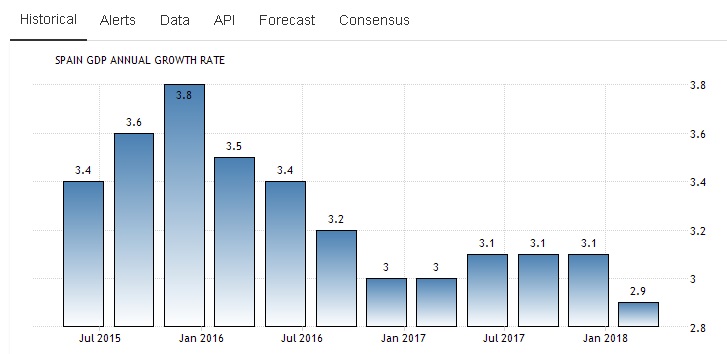
Even now, when we merely consider Spain in all this (not the smallest economy), we see (at https://www.southeusummit.com/europe/spain/spanish-economy-returns-grade/) that Standard & Poor’s is still playing (what I personally see) as ‘their little game’. Perhaps you remember ‘S&P reaches $1.5 billion deal with U.S., states over crisis-era ratings‘ (at https://www.reuters.com/article/us-s-p-settlement-idUSKBN0L71C120150203) the one quote (one of many) needs to be considered “S&P parent McGraw Hill Financial Inc MHFI.N said it will pay $687.5 million to the U.S. Department of Justice, and $687.5 million to 19 states and the District of Columbia, which had filed similar lawsuits over the ratings“. So when I see “S&P notes that Spain’s overall economic and budgetary performance has not been hampered by political tensions in Catalonia, as many had feared. The country’s GDP increased by 3.1% in 2017 and last week the Bank of Spain raised its economic forecast for this year to 2.7%, up from a December forecast of 2.4%“, you see, the numbers are not really in question, yet when we see the image below (source: Trading Economics).

When we realise that none of the EU nations has a grasp on their debts, in addition, the GDP for Spain went down whilst it is still below the numbers of 2016 and before, there is actually no reason to see the credit rating for Spain go up. I am personally speculating that the EU will be so much more hardship when France hits the 100% debt marker. It matters, because this will soon become the academic exercise that the question: ‘What is the difference between cooking the books and creating a false positive wave through inflated credit scores?‘ I actually do not have the answer here, but I guarantee you that the quality of life in Europe is not moving forward any day soon, not until some issues are seriously reconsidered. In addition, the US-China trade war isn’t helping anyone, not even the Europeans so that will also become a factor of debate soon enough. It partially relates to “We have revised upwards our GDP forecasts, with an intense rate of employment creation and an economic model based on the external competitiveness of our companies. With this scenario, we will achieve our objective for 20 million employed people by 2020“, the issue is that it is misrepresentation, you cannot rely on the unemployment figures and then state we will have 20 million employed, because on a population of 46 million, he might be implying that the unemployment numbers will skyrocket from 17.4% in 2017 to 56%, that would be crazy, yet that is what we are told, is it not? The best lies (read: miscommunications) are done through statistics, so that the feather matches the bird one would say. Still, back to my speculation, I believe that Spain is not the only nation in this setting; I think that some numbers in pretty much every EU nation are beefed, weighted and set to make Europe (or basically themselves in the European setting) look much better, so when the UK leaves they will not look as weak and feeble as they have actually become. It is a setting that is way too dangerous. There is no way that Mario Draghi is not part of this, so when we look at the Financial Times of last week we see ‘Mario Draghi acknowledges ‘moderation’ in Eurozone growth‘ (at https://www.ft.com/content/3e20b49e-4939-11e8-8ee8-cae73aab7ccb). So with “Analysts said that Mr Draghi’s guarded language suggested that the ECB may wait until July — a month later than previously expected — to provide the markets with updated “forward guidance” on its plans to phase out the crisis-era stimulus“. I am a little less optimistic in regards to the quotes, and when we see ““Better safe than sorry was the motto of the day,” said Dirk Schumacher, economist at Natixis“. I personally tend to see that as:

Better safe than sorry
It allows for another day without worry
As we pile the worries and woes
To a stack we can blame on crows
Those at the London Tower are best
Because when they leave the EU we can make them the jest
And when our barge is no longer secure
We move to Wall Street where we can endure

You might think that I am merely making light of all this. The issue is that people in Europe seem to ignore that over €2,000,000,000,000 was printed without the validation of treasuries or consent of the people whose funds got devaluated even further. Do you think that printing money has no cost? It is money that the EU never had, so why did you think it came without consequence?

This partially (and I mean partially) is seen in different ways when we look at an article from Reuters merely two weeks earlier (at https://uk.reuters.com/article/uk-ecb-policy-draghi/stock-volatility-no-big-factor-for-ecb-so-far-draghi-idUKKBN1HG1VR) ‘Stock volatility no big factor for ECB so far – Draghi‘, now I agree that volatility will come and go, so the ‘so far’ part is perfectly fine. When we see ““While we remain confident that inflation will converge towards our aim over the medium term, there are still uncertainties about the degree of slack in the economy,” Draghi said in the ECB’s annual report“, now I can agree with that. There will always be a certain amount of uncertainty, that is all good, no issues there, but it is set on a certain premise. When we see that Spain (the only visible one) suddenly in opposition of what I see as real has its credit score increased and as such we see the start of an optional bubble, when others do the same we see the forecast on unreal values, so we see the bubble is not set to the reality of the actuality, at that point, when a lot more start realising that some numbers do not make sense, the uncertainty grows and the closer the UK is to leaving the stronger that uncertainty becomes. At that point we see a run and a total collapse, when that happens, when the people realise that pensions before 78 is no longer optional, do you think that the people will remain calm? When they realise the impact of €2 trillion printed cash is impacting the 26 nations, how much value decline will they face? When that happens, how will people react in all this? Now we get to two elements, one is the mention in the Financial Times where we see: “But the weak economic data for the first quarter have triggered increasing speculation that the first interest rate rise will be delayed until later in 2019. A smaller number of analysts are expecting the bank to continue QE into the new year“, the second is that the entire stimulus was to set the economy right, which did not happen, now set that against inflated credit scores, inflated economies and the downturn that follows, that will happen, it can no longer be contained, merely delayed to some extent. When it does hit Europe would not have a penny left to balance against and it will leave the bulk of Europe destitute. There would be no defence against the next downturn and that is when disaster will truly strike. So as the story is pushing towards ‘protectionism’ and ‘patent values’, we should also consider that impact. Now, as a University graduated Master on Intellectual Property rights, I do comprehend some of the issues, yet I am not a patent attorney, so there are parts that I will ignore or not look at. Consider that a national economy is now more and more dependent on the national patents and the represented value that they hold. Now we get European Patents, the Unified Patent Court (UPC) allows for a simpler way to get it all registered and to some extent enforced. So it is a good thing overall, there was never too much fuss about that side, yet the one strong economy (Germany) is now setting the stage to oppose the UPC, we see this (at http://www.ippropatents.com/ippropatentsnews/europenewsarticle.php?article_id=5725), where we also see “Alternative für Deutschland (AFD) has called for the repeal of the convention on a Unified Patent Court (UPC). AFD “rejects the EU patent law reform”, according to the German Bundestag, which announced the motion on 7 March“, I believe that overall the UPC is a good thing, but there will always be small interests that are not perfect, no EU setting is 100% positive, yet overall, to get one filing for all EU nations, in light that even the UK agreed (and ratified) is a good thing. So when we see “It was based on three grounds, mainly how the UPC Agreement violates EU law, the majority requirements of basic law, and does not comply with the rule of law principle related to judicial impartiality. The complaint was scheduled to be heard in 2018 by the second Senate, appearing as the 11th item on its agenda. In Germany’s 2017 federal election, the AFD won 12.6 percent of the vote and received 94 seats, the first time it had won seats in the Bundestag“, there is an academic setting, yet with 12.6 of the council in hands of the AFD, a very Brexiting minded party, or is that Berlout or Deutchleave, we need to realise that the patent issue is a lot more biting in Germany and that cannot be ignored, as they give rise to uncertainties. So when we get back to the uncertainty there, as well as other uncertainties, and whilst we saw Mario Draghi accept that uncertainty results in stagnation, how much more stagnations are required for the next downturn, even a short term one, whilst the economic reserves have been already been drained.

Now we have a much larger setting, the EU was never about everyone agreeing on everything and the economic setting that requires that to happen at present is also making the dangers of waves that sinks the barge called EU. Now, that seems like an exaggeration, but when you realise that the German anchor is the only one giving stability, you can see the dangers the EU faces and more important, the dangers of no reserves and an utter lack to keep proper budgets in place, a setting now in more danger for the reasons that I gave supported by the economic views of many others. I believe some are downplaying the impact, yet when we realise that EVERY European Union government is downplaying the economic impact (as every nation always wants to look as good as possible, which is a PowerPoint setting of the human ago) we get a much more dangerous setting. We accept that the smaller nations have a negligible impact on the whole, but on a ship that can only remain truly stable with four anchors, losing three is a much bigger disaster than anyone realises, and that downplay will hurt all the players that are part of the EU, so when the downturn starts, we will see kneejerk movements from all the nations, all the big players and we can only speculate the fear mongering speculations that the IMF will treat the European audience to. I have no idea what form it will take, but when it happens I will take a deeper look. In a setting where every negative economic milestone could lay waste to whatever reserves its citizens wrongfully thought they had in the first place.


2 Comments

Filed under Finance, Media, Politics, Science

Tubing it along

There is news, news that has been about a few weeks and I have kept an iLook on it. In one part it is as techofreak as it gets, so I should be on board the moment it launches, it is so versatile that it has no other option than to change lives on a global scale, yet there is the issue that it is so new that it is a little scary. That is the reality of all new technology; consider the first 10,000 Facebook accounts, the first 100,000 internet users. It all starts in a small geeky way and this will be no difference. It had more presence in the Saudi Arabia Vision 2030, so that is why I took another look. You see, the entire matter is not merely where it is, but it is how the technology is adapted, that is the first part in all this. To set this in the proper light, we need to take a step back. In the UK they have the HS2. So when we see the BBC (at http://www.bbc.com/news/uk-16473296), we see “The initial plan is for a new railway line between London and the West Midlands carrying 400m-long (1,300ft) trains with as many as 1,100 seats per train. They would operate at speeds of up to 250mph – faster than any current operating speed in Europe – and would run as often as 14 times per hour in each direction“, so when we consider London – Birmingham we see ‘1 h 25 min’, as their fast option at present, which at 117 miles, makes the HS2 a 45 minute saving, so how many billions is that going to cost? Now consider that each one technical glitch will cut the 45 minutes. Now, I am all for progress, now when we go by two numbers we see “a projected cost of £56 billion, up from the initial cost of £32.7 billion in 2010“, we see that 8 years ago, they had it wrong by close to 100%, so we see a waste of £56 billion plain and simple. The UK could fix its schools for that amount of money and overall, there is absolutely no reason to go that distance, it is just too short. Now we get to the next stage of travel.

Welcome to Hyperloop!

Now as we see this in the Saudi Arabian setting it changes, you see when we look (at https://www.tahawultech.com/news/virgin-hyperloop-one-unveils-vision-2030-pod/) we see ‘Traveling from Riyadh to Jeddah would take 76 minutes (currently over 10 hours) utilising the land bridge for both passenger and freight movement, positioning KSA as the gateway to 3 continents‘ as well as ‘Traveling from Riyadh to Abu Dhabi would take 48 minutes (currently over 8.5 hours)‘, so here we see a clear forward momentum. Not merely 45 minutes gain, but gains that take away 90% of the travel time, now we are talking improvements! I never quite understood the HS movement, not in the UK (where there is some benefit) and even less in the Netherlands where the improvements are as shallow as it gets, all this ‘good for the economy‘ whilst I think it greased the careers of certain people, and in the end nothing for the citizens, and the less stated on the Dutch government joke called Fyra at a mere €11 billion loss, it is not a lot if you say the amount fast!

So even as we are burning ourselves all over Europe on high speed trains Hyperloop technology is different, you go by tube (as literally as it gets) and within that tube you have the option to truly accelerate, the nice setting that this will reflect on cargo and passengers alike, so it is also versatile. So when we read “The hyperloop-enabled transportation sector in the Kingdom of Saudi Arabia will stimulate economic growth and diversification of Saudi industries, according to Virgin Hyperloop One. It will also nurture the manufacturing and innovation sectors, and spur job growth in support of the country’s Vision 2030 plan increasing the GDP 1-2 percent across the Kingdom“, we are not seeing the whole picture. You see it is almost a lot bigger than that. The currently planned £380 billion mega city Neom would be an optional first as well, so Riyadh would be linked to Neom, which now is set to connect Egypt and Jordan, it also opens the doors almost directly to Sharm-El-Sheik as well as the Israeli city of Eilat, all golden opportunities which allows Saudi Arabia to grow the economy in Riyadh on a much larger foundation than ever before. In all this Cargo and passengers are set to near exponential growth, especially in the short term. So we have near direct connections between Bahrain, Egypt, Israel, Jordan, Oman, Qatar and Saudi Arabia in the centre of all this. It will not take long for these nations to grow all kinds of alliances and commerce will flourish like nothing we have seen before and Virgin, with its Hyperloop One is in the centre of this growth. Even as Europe is trying to get something similar rolling, we see that France is alas out of cash for such an endeavour (at present) ‘Hyperloop gives cash-strapped French cities hope‘ (at https://www.thenational.ae/business/economy/hyperloop-gives-cash-strapped-french-cities-hope-1.726967), it is a stretch, but it makes a lot of sense for France to get involved in all this, in their setting Hyperloop makes sense, especially regarding cargo (cheese and wine settings anyone). So when I see “TransPod’s technology is based on magnetic propulsion and electrified tracks, moving pods through a vacuum tunnel designed to reduce friction. As with most Hyperloop projects, the bulk of the estimated costs are for deploying infrastructure. Co-founder Sebastien Gendron estimates his company needs €20 million (Dh88.1m) in financing to complete the Limoges project at the current stage, and says he’ll raise half of that from private investors“, in all this, I am surprised that no one there called Ubisoft (more specifically Christian Guillemot, Claude Guillemot, Gérard Guillemot, Michel Guillemot or Yves Guillemot), they have the cash and more important, to be the founders of something this futuristic that will be moving through France with the Ubisoft symbol would be worth its weight of a train in gold I’d imagine.

So back to Saudi Arabia, the one part I do disagree with is ‘in support of the country’s Vision 2030 plan increasing the GDP 1-2 percent across the Kingdom‘, you see, once the line is in place, it will spur the economy in more ways, beyond tourism and beyond cargo, for close to double that prediction. A system that far ahead will also spur infrastructures growth as the rest of the world will be lagging behind, especially where engineering is concerned. They all claim they have ‘the technology‘ yet at present there is a lot more reliability that under these settings it will only be running in the KSA in a more serious setting in the foreseeable future and that is where the advantage grows, in addition, when the travel times are shifted to those degrees, emergency surgeries, medical disasters when Hyperloop technologies transfers and adjusts in more than one perk, we will see both the King Faisal Specialist Hospital and Research Centres in Riyadh and Jeddah grow abilities to attain options because they are now less than 2 hours apart. That transfers to all manner of services, when they are no longer separated by time to that degree, it will drive a lot more than the ones we see at present. and let’s not forget, this is merely the first degree of Hyperloop, as the engineers figure out a lot more than is currently possible, the growth will blossom further, and as we see forward momentum on this scale, we understand that there are risks, you when the gain is not 45 minutes, but 90% travel time is reduced the picture shifts a lot further on a larger scale. Even as we were introduced to ‘tube’ transport in Logan’s Run in 1976, we never imagined that it would be an actual solution, not until now do we see that there are places where it is more than a solution, it is the drive to move forward on nearly every field.

So even as I accept that we are not there yet and there are all kinds of issues down the line, movement is now a given, and even a some used the London underground map and added some Hyperloop fun to it, the setting is not that impossible on some part of those tracks. It is a part where all technology can move forward, we merely have to adapt parts of it. Consider that change as new venues of technology open will up, and there is serious cash to be made for all the players in this field, you merely have to find the niche where your solution fits.

That is where Vision 2030 is now becoming a driving force, not merely because there is $500 billion to be found, but because those who do get their working solution in place, for those there is a lot more to be made over time, Saudi Arabia is merely the pilot, it is the global setting where profit becomes a very serious opportunity, it will drive the now nearly born new Nouveau Riche generation to a very new level with amounts the previous generation never ever dreamed of.

When you sit down and consider the map, we do not merely see Africa, Asia, and the Middle East, we see that Saudi Arabia has the opportunity become the axial for those three continents, an option we never would considered as realistic when Vision 2030 launched 10 years ago, now that picture is shifting and with the growing technologies as Saudi Arabia is embracing these new opportunities we see a shifting picture, even as oil might be funding this, the reliance on it is fading a lot faster than we thought possible, not merely through Hyperloop, but through the changes all the technologies enable one another with and that also gives new directions, because it is no longer about volatility  (as Saudi Arabia was accused of by others in a previous blog), it is about stability and the enabled stability that these solutions bring.

For in the end making money will always win over waging war, that has been proven for the longest of times.

Leave a comment

Filed under Media, Politics, Science

A Bill of Goods

So when was the last time that you were sold a bill of goods? Have you ever been in that place? Some people avoid most of it by never purchasing 2nd hand materials to avoid that, I am for the most one of those people. I tend to inform myself before I go into anything, like a good person should. Now there is a level that we should attend to and after that it is overkill, paranoia and optionally a few other things. So there is a basic check we all should make. You get that don’t you? So when I looked into Cambridge Analytica in previous articles, I was a little late to the party (4 hours late), but that was because I wanted to look into a few things. So on the 18th of March, I got a few issues that made me wonder, and off course the first question I had was “Here I wonder (for a mere moment) if something wrong was done at all“, you see not having that question makes it all emotional and useless. It is all about the facts. So when we see the utter inactivity of the police and other elements for close to 10 days, I knew that this was about something else and there was even the premise that Cambridge Analytica was not the only player in town. So when I went “Robert Mercer has found a business model that works. The question merely remains on how that data was captured“, I had a little more than you all bargained for. This continued whilst ‘my emotional‘ side also added “for years I have spoken out clearly that these users are all about stating ‘privacy’ no the NSA whilst at the same time sharing indiscriminately on social media like Facebook, whilst not comprehending the system because it was ‘free’. This is the direct consequence and these users will be used again and again because that is what they signed up for“, the evidence (a slightly overstated word), had seen parts of this going back to 2014. The quotes were from ‘How Facebook data flows‘ (at https://lawlordtobe.com/2018/03/18/how-facebook-data-flows/amp/). Yet today’s article ‘Cambridge Analytica closing after Facebook data harvesting scandal‘ (at https://www.theguardian.com/uk-news/2018/may/02/cambridge-analytica-closing-down-after-facebook-row-reports-say) leaves us with a lot more questions. Consider the following quote “The company has started insolvency proceedings in the US and UK. At Cambridge Analytica’s New York offices on an upmarket block on Manhattan’s Fifth Avenue, it appeared all the staff had already left the premises“, yet this is in direct opposition to “Although Cambridge Analytica might be dead, the team behind it has already set up a mysterious new company called Emerdata. According to Companies House data, Alexander Nix is listed as a director along with other executives from SCL Group. The daughters of the billionaire Robert Mercer are also listed as directors” and that is not where it stops. You see Metro (at https://www.metro.us/news/the-big-stories/cambridge-analytica-backers-new-data-company-emerdata) gave us 3 days after the news “Emerdata was incorporated in the UK in August 2017, reports Business Insider“, this puts a spin on the previous statement, because as the first liner sinks, the Rigid Inflatable Boat (pun intended) was already prepared for the main cast of it all to vacate the premises onto a different vessel, yet were they visited by the police and other digital forensic instances? No they were not! It seems that when you are backed by a billionaire, the machines of prosecution tend to maul extremely slowly, or the machines is inhabited by cowards that are not willing to press any buttons until they can blame someone else. Whatever the reasoning will be, it is about to get a lot more juicy!

That is seen with “The data was collected via Facebook’s permissive “Graph API”, the interface through which third parties could interact with Facebook’s platform. This allowed Kogan to pull data about users and their friends, including likes, activities, check-ins, location, photos, religion, politics and relationship details“, not only was the Facebook team extremely lazy, the setting of the app could have potentially made things worse. They could have been accumulating data and reset the data against aggregated statistical margins, that means that EVERY market research company on the planet had optional access to additional data they never ever had before, it would have optionally increased value of any dashboard by 400%, now consider that I saw part of this flaw (I never knew that Facebook had made it THIS easy) from 2014 onwards. Even if the system was less able, there was a flaw and there is absolutely no chance that this merely involves Cambridge Analytica. So when we consider this, and add the quote “He told an undercover reporter: “We did all the research, all the data, all the analytics, all the targeting. We ran all the digital campaign, the television campaign and our data informed all the strategy.” He also revealed that the company used a self-destruct email server to erase its digital history. “No one knows we have it, and secondly we set our … emails with a self-destruct timer … So you send them and after they’ve been read, two hours later, they disappear. There’s no evidence, there’s no paper trail, there’s nothing.”” this changes the game on a few levels, this is no longer merely data capturing, or data analyses, this is tradecraft, deleted things cannot be acted on, a truth that has existed even before Facebook existed (ask the horse Pegasus). So when we think that James Brien Comey Jr. esquire, who served as the seventh Director of the Federal Bureau of Investigation from September 4, 2013, until his dismissal on May 9, 2017. The dismissal is part of it all because, as I personally see it, he never had a chance, this is not some commercial app; this was tweaked on a much higher level (to where will never be proven, and unless someone kept a printed email, the evidence is gone forever). That part shown that this was no small operation, this was tried and tested on several levels and if there had been no whistle-blower, we would never have known, even if the metropolitan police decided not to sit on their hands for about a week, it still would not have mattered.

It does not stop there, this is a lot bigger and I think Mark Zuckerberg knows this, he must have realised this in the first hour the mess landed on his desk, the question is what he would have been able to do after the fact, I think it would have been very little. The fact that the Guardian had part of this in 2015 also counts, even as there is a large lull in activity, a journalist hands are tied to some extent, no evidence, no setting and even as I knew parts of this earlier, I could not prove it and Facebook was certainly not going to be much help there, because the value of their treasury is their data and someone telling them it is overstated by 70% is not what they are willing to hear or give attention to.

The next part is Cambridge University researcher Aleksandr Kogan, when we see “My view is that I’m being basically used as a scapegoat by both Facebook and Cambridge Analytica. Honestly, we thought we were acting perfectly appropriately. We thought we were doing something that was really normal“, really? Capturing private data is perfectly normal? We see that part in “Aleksandr Kogan, a Moldovan-born researcher from Cambridge University, admits harvesting the personal details of 30 million Facebook users via a personality app he developed. He then passed the data to Cambridge Analytica who assured him this was legal, he said“, he had no clue on Intellectual Property rights? Because that was already an issue when I attended University years before that, there are Facebook documents on what can and can’t be done, none of that rings a bell? And this statement now completely opposes the mention by Cambridge Analytica that there was never any data. In addition, his title, where he is boasting his title as a Data Scientist, he should be aware of Loshin (2002), Loshin, D. (2002). Knowledge Integrity: Data Ownership, June 8, 2004. Here we see “Researchers should have a full understanding of various issues related to data ownership to be able to make better decisions regarding data ownership. These issues include paradigm of ownership, data hoarding, data ownership policies, balance of obligations, and technology. Each of these issues gives rise to a number of considerations that impact decisions concerning data ownership” the fact that the information came from a protected source, should have been clear indication that Aleksandr Kogan should have clearly known that what he did was illegal to the larger extent, or he could remain in denial and just hand in his degree and title (Cambridge University might like that a lot better too).

All simple points that seem to have been looked over or is that looked past).

Now let’s get back to my previous promise ‘it is about to get a lot more juicy!‘ and go just there. So you all have heard the one truth, ‘If you don’t want your naked selfies to make it to the internet, do not make any!‘ So there is this girl who thinks she might be a photo model, so she goes ‘tits out’ and shows that she is photo model material, she sees the results and realises that she is not, so she makes her boyfriend promise to delete them and he does. At home he undelete’s the pictures, posts them online and he looks for a new ‘fuck of the week’. For her it all goes tits up which is worse that tits out and that is where we are now, Facebook has ‘shared’ the data and now it is out, so when we see the link to Emerdata, and the mention that Alexander James Ashburner Nix has the following company appointments

  • SCL GROUP LIMITED (05514098), as Director since Jan 2016
  • SCL ANALYTICS LIMITED (09838667), as Director, since Oct 2015
  • CAMBRIDGE ANALYTICA(UK) LIMITED (09375920), as Director, since Jan 2015
  • SCL DIGITAL LIMITED (09375055), as Director, since Jan 2015, DISSOLVED
  • SCL SOVEREIGN LIMITED (09375809), as Director, since Jan 2015, DISSOLVED
  • SCL COMMERCIAL LIMITED (08840965), as Director, since Jan 2015
  • SCL SOCIAL LIMITED (08410560), as Director, since Feb 2013
  • SCL ELECTIONS LIMITED (08256225), as Director, since Oct 2012
  • EMERDATA LIMITED (10911848), as Director, since Jan 2018, RESIGNED, Mar 2018
  • FIRECREST TECHNOLOGIES LIMITED (11238956), as Director 2018, RESIGNED same day

This is all form one address in one instance he resigns the day he is hired? How weird is that? Don’t answer, the options are all overwhelming, but in all these instances he would have had access to infrastructure allowing the passing through of terabytes of data, it is also so interesting that they were all called Alexander, perhaps a fluke! Yet when we look at Alexander Bruce Tayler, we see that he is also a Director at Emerdata limited, so the plot does thicken. In addition, these places are all linked to PKF Littlejohn, the chartered accountants, now that last part makes sense as a director might seek one accountant for all companies, nothing weird about that. The issue is that there is a whole web of connections that allow the data to have been moved to Hong Kong and New York with no options to securely obtain the data and have it wiped. So this is not an accusation, this is the realistic setting that the data could (I do say ‘could’) have been spread all over the planet, until proven that the data was illegally obtained there is no crime and no option to get anything done, Facebook should have known this from day one. Even in the mid 90’s it was clear that Intellectual property and Data ownership was the hard-core central point for any corporate setting. If not, why would there have been such a booming business in transferring legacy systems?

Data has value, ask any salesperson!

So are we sold a bill of goods, because that is what it looks like? Let me also add that this is not sold by the Guardian, I think that the players in this game has been a lot more clever than most players and the paraphrased suggestion that the rats pretty much walked away with a whole wheel of cheese (ask any sinking ship) is not the strangest notion in all this. The final part we see (at https://www.theregister.co.uk/2018/05/02/cambridge_analytica_shutdown/) with ‘Cambridge Analytica dismantled for good? Nope: It just changed its name to Emerdata‘, yet is that information valuable? I cannot tell because I am not an accountant. You see, I found it interesting that even as PKF Littlejohn, the representative of PKF International was seen in all the registrations, it is “the boards have applied to appoint insolvency practitioners Crowe Clark Whitehill LLP to act as the independent administrator for Cambridge Analytica“, there might be a valid reason for that yet when I seek into PKF international I see: “PKF International member firms lead the world in Insolvency services, we can help you through financial misfortune and the recovery process globally” (at https://www.pkf.com/services/advisory/insolvency/). In this it is merely my speculation that this is the start of a Chinese wall, a level of isolation regarding information and reporting. It protects all the players in the house. It remains speculative, yet is it an optional truth? When was the last time you saw an accountancy firm walk away from revenue? Tesco lunch anyone?

So whilst someone might cry for the people involved, I wonder how much tears an executive deserves when you realise that 2 hour mail deletion systems were in place, what else were they hiding and who else is playing that game, because when we see the 2 hour deletion setting and the police sitting on their hands for around a week (as I personally see it), I have little faith that the actual truth will ever be found through any level of evidence. The whistle-blower Christopher Wylie E Coyote is the one clog in the cog that set this all to an open investigation status; so whilst the rest is doing the ‘meep meep’ roadrunner we are left wondering how many other social media corporate settings are filled with stupid people. The numbers rarely add up, but I never expected the books to be this out of balance, not when we realise that this partially implies that Mark Zuckerberg has been doing open heart surgery on himself with a butter knife (a stupid idea for at least two reasons).

That is what it looks and feels like and it is as I personally see it as the result of being sold a bill of goods by all the reporting players, most of them unaware that they were doing just that (I am referring to the actual newspaper reporters in this instance).


Leave a comment

Filed under Finance, IT, Law, Media, Science

Are there versions of truth?

It is a question that has haunted plenty of people, you see there is just one truth, although, is that ‘there is your side, my side and the truth’; it comes from Robert Evans ‘The kid stays in the picture‘, a 2002 documentary. We have seen the quote is several works including the famous Sci-fi series Babylon 5. The fun part of this is that the three parts are all based on honesty, yet it is more than just a matter of perspective. I have always known that, although the interaction of perception and observations is something that needs to be in a book, not on a blog. So when I was confronted with the site ‘Seeking Alpha‘, which was described by the Wall Street journal in 2014 as “SeekingAlpha.com predicted stock returns, as well as earnings surprises, above and beyond what was evident from Wall Street analyst reports and financial news articles” is from the article more than just that. The article (at https://seekingalpha.com/article/4168001-investors-face-moral-dilemmas-investments-saudi-arabia) gives us ‘Investors Face Moral Dilemmas with Investments in Saudi Arabia‘, can be countered with ‘every investment has a moral dilemma’, so that is not much to go by. Yet the setting of a 500 billion market where we see the foundation with “A component of the Saudis’ Vision 2030 is to create an indigenous defense industry one that will promote volatility, not stability, in a region on perpetual warfooting“, gives me not the shivers, but the contemplation of what game is played. You see there is no doubt that Saudi Arabia wants to create an indigenous defence industry; every nation wants that, especially when it has been under threat for many years. I would have told Crown Prince Mohammed bin Salman if he would respectfully consider buying Remington as it is bankrupt and going cheap. The excellence of its weaponry, weaponry that have made it to the most elite parts of the global national defence forces is not just a matter for defence, hunters and others revere the weapon for its standard of excellence and it is not a bad place to start. You see, that is merely one path, in all this the setting of ‘one that will promote volatility‘, is not only not a given, I wonder where Seeking Alpha got the data in the first place to make that assumption. When we accept that there is an optional truth, there should be a look at the antagonising party, namely Iran as well, in that regard we see (at https://seekingalpha.com/instablog/776842-investorideas-com/5152941-cryptocorner-iran-developing-cryptocurrency-japan-s-sbi-launch-exchange-australia-cracks-icos), “Iran is progressing with its own crypto currency project despite having banned crypto trading in local banks according to a report at Reuters. Information and Communications Technology Minister Javad Azari-Jahromi said the ban from Iran’s state bank would not apply to development of a domestic crypto currency“, as well as “Equally, if not more importantly, investments by Russia’s oil and gas companies in the development of oil fields in Iran may exceed $50 billion, presidential aide Yuri Ushakov told reporters in early April” (at https://seekingalpha.com/article/4167229-effect-unilateral-u-s-sanctions-irans-crude-oil-production?page=3) and in finality we see “On Sunday, pro-Iranian Shiite rebels in Yemen launched a missile attack on Saudi Arabia targeting four cities. The Saudi air defense intercepted the missiles, however, one person died and two others were hurt by shrapnel. Saudi Colonel Turki al-Malki made it clear who Saudi Arabia thought was to blame: “This aggressive and random act by the Iran-backed Houthi group proves that the Iranian regime continues to support the armed Houthi group with qualitative capabilities…”“, which we get from the article (at https://seekingalpha.com/article/4159016-7-missiles-closer-iran-war-100-oil) called ‘7 Missiles Closer To Iran War And $100 Oil‘. So now we see two parts, we see Saudi Arabia accused of volatility and ion all this the aggressor Iran is not painted in any way in any of these mentioned articles merely defined as ‘Pro-Iranian rebels‘, the fact that those rebels cannot afford any missiles and for the most they lack the ballistic skills as well as deployment and knowledge of GOLIS firing solution systems, issues like deployment, missile calibration and beyond that there is setting the precision of the missile by making sure that the electronic settings are correctly tweaked and calibrated to interact with the information that the targeting hardware offers. All that requires skills, skills that the Yemeni do not have, but Seeking Alpha is all over that and, oh, actually they are not!

So in the $500 billion setting of growing the Saudi industry, one valid component is now the stuff of moral discussions and the setting of unproven volatility, can anyone explain why Seeking Alpha has released 7 articles in the last 24 hours on Iran, where one shows opposition between the Iranian judiciary and the President on ‘disrupt national unity‘ in the setting of ‘Rouhani opposing banning social media networks, as he attempts to open up the country to the outside world‘, there is not a moral dilemma here? Or perhaps it is not a setting for volatility whilst the growing of Iranian civil unrest is currently seen as a given. So how do we not see in more articles that for the speculative person investing into Iran is facing all kinds of risks from Iranian civil unrest?

Yet it is that setting that we can all easily check on how certain paths are played. We can see this in another way as well, when we see the French visit; we see “Macron had come to Washington in a bid to convince Trump to remain in the deal. He proposed “pillars” for adding to the existing deal, including extending it for the long term, limiting Iran’s ballistic missiles, and dealing with Iran’s involvement throughout the region“, whilst in the article regarding Crown Prince Mohammed bin Salman we see “Regardless of his charm, offensive MBS will continue his extreme ruthlessness, admittedly a de rigueur requirement in a tough country and even tougher neighborhood especially because his radical changes have created many internal enemies“, we also saw “Saudi crown prince Mohammad bin Salman (MBS) wrapped up his well-orchestrated and unprecedented “meet & greet”, “press the flesh” two-week April tour of the US with the icons and titans of three primary industries in his effort to diversify the Saudi economy as part of the ambitious Vision 2030 plan“, yet nowhere do we read an optional: “Success can only come from a vision, brought by a visionary. We are a nation with resources, with options and opportunities. We are more than the oil that is acquired from our soil, we can and will harness resources as well as investment opportunities to stimulate our economy and diversify our revenues. Our nation sitting central between Africa, Asia and Europe should have been more about growing that advantage and now we will, we have the foundation to grown in technology, in minerals and in services to be a global player, we must take that opportunity before it is lost to us forever. It’s not a fast path, and to do this properly we must grow over the next 12 years to be able to become that global powerhouse“. Well, there is one place where something like that can be read, it is the introduction (at http://vision2030.gov.sa/en/foreword), where we also see a lot more on the Islamic part on Saudi Arabia, which is perfectly valid. So when we go to http://vision2030.gov.sa/en/node/125 we see a massive amount of programs all set to push Vision 2030 forward and the interesting part in that is that there is not one mention of the words ‘defence’, ‘Army’, ‘Navy’ or ‘Air force’. Even as I am convinced that growing national defence is part of that, my wonder is that with all these options and opportunities, Seeking Alpha resorted to the Moral part of a defence structure that is nowhere near a central part of the Vision 2030 brief. We know that Saudi Arabia has the option to go full G5 from day one and the investment options there are massive opportunities not to pick up millions, but billions. Yet the issue becomes larger when we see that the writer Albert Goldson has plenty of experience and should be well aware of commodities (read: he is a bit of an expert according to sources), so when we set this against the view of Bengt Nordström, CEO of consultancy Northstream who gave us last year “growth in the industry has disguised not only the fact the telco industry is largely a commodity, but also that it has not been hugely innovative for a number of years“, that in light of the upcoming 5G, where ‘first in, soaring profits’ could surely be a given, none of that is shown, merely the fact that Saudi Arabia is allegedly about ‘volatility‘, so whose buttering the bread and who is that sandwich being made for?

Another part not shown was ‘Advancing pharmaceuticals and patient safety in Saudi Arabia: A 2030 vision initiative‘ (at https://www.sciencedirect.com/science/article/pii/S1319016417301780). Here we see “A recent conference in Riyadh, sponsored by King Saud University, sought to discuss these issues and develop specific policy recommendations for the Saudi 2030 Vision plan. This and other efforts will require more and more creative educational programs for physicians, pharmacists, hospitals, and patients, and, most importantly evolving regulations on quality standards and oversight by Saudi health authorities“, let’s not forget that we are in the beginning of all this, there is 12 years, which will go quickly I’ll grant you that, yet in all this the opportunity to grow Patent Law, Law firms, and set proper markers in place would be an essential step before such a level of patent bearing change comes. The option for Pharmaceutical investment was not shown in the article, or the mention of the issues shown at https://ncusar.org/programs/17-transcripts/2017-06-20-burton.pdf (attached). So, I am not opposing that there is optionally a need to grow the national defence industry, but is that set in the right light? In the light he gives the investors (which is his right to do), we see “However, for the moral implications mentioned with respect to the development of an indigenous defense industry, check your moral compass. From my perspective, it’s a financially profitable but morally bankrupt undertaking“, yet what morally bankrupt idea is there on growing the pharmaceutical and mobile network industry? they are highly profitable if it is achieved and there is moral question, my moral compass is setting on the field asking Albert Goldson, a member of the Association of Former Intelligence Officers (AFIO) and an Associate Member of the Foreign Policy Association (FPA) why he missed on those options. Also in the view of two dozen projects that are openly stated, why would he focus on a part that represents merely 10% and focus on those two dozen programs, where the investors would find the gems that the investors would want to find in a $500 billion layered cake called ‘Vision 2030‘. Oh, as for that military part, the attached Burton presentation ‘Opportunities in Saudi Arabia – Vision 2030 and Beyond‘ spends two slides on it and the most important part shown is “Vision 2030 calls for 50 percent of military equipment purchases from domestic suppliers instead of imports“, whilst also mentioning that the Kingdom of Saudi Arabia (KSA) “spent a total of over $63 billion on defense and security in 2016, including off-budget spending“, so when we see that, we see that for the smart investor there is an optional $30 billion a year available for those who might not have a moral issue working on a government set national defence program. That in light of Iran delivering missiles hardware and support to non-combatants, which are rebels at best, yet terrorists might be more apt when we consider “Nasrallah’s letter is proven evidence of Iran’s involvement in the Yemeni civil war, since it shows that Hezbollah, which is financed by Iran, is taking part in the fighting in Yemen” (source: Jerusalem Post). So where exactly does Seeking Alpha stand? Let’s be fair, they can be in any place they like as they are merely advisors towards their investors in all this, yet even with my high moral (or is that outspokenly oral) I would not turn away from a $32 billion market, especially if I had that level of cash. Oh, and whilst you consider on where morality needs to be, Boeing, Lockheed and Raytheon have already signed up, so the delay you took made that cake a hell of a lot smaller, but even if there is still $2 billion up for grabs, would you walk away? Let’s not forget that next month’s rent is due!

So in all this, I never stated or implied that Albert Goldson lied to anyone. Yet when we consider there is your side, my side and the truth, what did we see? You see, I get back to perception versus observation. Through perception he is focussed on the defence part, but why? The shifted setting towards Saudi Arabia will impact something else, but what else is impacted? That is the question, is it the Iranian setting (when considering the other articles), is it something else entirely, or is Albert Goldson focussed on something beyond all this? It is a speculation from my side, yet the absence of the Pharmaceutical and Mobile Industry absence implies just that, yet in equal measure I will state that this would merely be my perception, based on all my observations. That is part of the setting. In the realm of ‘there is your side, my side and the truth’, it becomes more and more about observation versus perception. In a case like this, when there is $500 billion on the table, is the perception the amount on the table, or the observation of whom else is at that table that matters. Is that merely an observation or does the perception become: where is MY opportunity? Because in the end that is what the investor cares about, and moreover, where and what size their slice of the cake becomes.

In addition, my observation will be that the changes mean that there are new players and some of the old players have been so well fed for such a long time, in this ‘parting might be such sweet sorrow’ (Romeo and Juliet Act 2, Scene 2), yet for the previous players it will be over their dead bodies, that tends to be the gist of it. The change needs to be observed because it shown also where the pressures of the players will be and that pressure can be seen as cost and risk. It is the wiser player that makes it through and gets the slice of the $500 billion layered cake; it is merely the question on the size of the slice and the perception of the profit it allegedly holds.


2 Comments

Filed under Finance, IT, Law, Media, Military, Politics, Science

The Update

This is not about specifics; this is about the latest updates on a few sides. First we get back to ‘The successful and the less so‘ (at https://lawlordtobe.com/2018/04/26/the-successful-and-the-less-so/). We had the rundown on the Marvel movies and Spielberg’s Ready Player One. My view remains the same, the three movies were awesome and there is no denying that. What is however a shift is the impact that the Avengers: Infinity War had, I knew it was going to be big, but a 3 day global total up to April 29th of $640,000,000 (rounded down) is beyond what I would have ever expected (read: imagined). The total revenue of Ready Player One was surpassed in 3 days with 20% to boot. It will get worse (depending on your point of view). You see, I am hearing all around me that people want to see it again. There was so much to see. So not only will it surpass the one billion dollar marker in a 10 day stretch, the revenue of Infinity war on 4K and Blu-ray will surpass most records to date. It could even spell a drive for people to look for a 4K TV and a HD 4K player merely for this movie alone. So if there is a Christmas release planned, it will likely be a $999 deal for the 4K TV, the 4K Player and the movie, all neatly gift wrapped. Those who do not have a 4K TV at that time might leap at the option offered. Techspot gave us “the movie’s Sunday box office performance – Infinity War reportedly raked in a whopping $69.2 million, breaking yet another domestic record“, implying in part that the movie is set to break the records that the number 3 top placed movie has, as Infinity war is likely to surpass it. I don’t think that it will make the current number three sad, it took three years for a movie to do that and records were always meant to be broken at some point.

The second update is on ‘Flames of the blame game‘ (at https://lawlordtobe.com/2018/04/27/flames-of-the-blame-game/), you see, the Financial Times (at https://www.ft.com/content/c532579a-416d-11e8-803a-295c97e6fd0b) has an issue with data sharing and the Kensington and Chelsea council has been fined £120,000. Now we can have all kinds of thoughts yet the quote “the perception that a large number of properties were left unoccupied by wealthy foreign owners — provoked greater scrutiny of the borough’s housing situation amid calls for empty homes to be used to house evacuees, and criticism of the approach of the Conservative-run council to public housing provision and maintenance” implies that there is a much larger issue in Kensington and Chelsea and that certain steps are being taken. They got an opening to make a shift and the Grenfell disaster gave them an option. The interesting part is that this goes back to 2017. The Guardian (at https://www.theguardian.com/uk-news/2017/aug/02/revelations-about-empty-homes-in-grenfell-area-simply-unacceptable) reported “Labour has condemned as “simply unacceptable” the 1,652 unoccupied properties in the London borough where the Grenfell Tower fire took place, calling for government action to bring them back into use“, which is as I see it, hypocrisy at best. You see the previous Labour government under Tony Blair was very eager to call in the investors, yet down the line no one wants to pay for the fallout. This did not start recently, this has been going on since the late 90’s, the EU reported in a paper  (at http://ec.europa.eu/economy_finance/events/2003/workshop/woodetal.pdf) by Forrest Capie, Geoffrey Wood and Frank Sensenbrenner by the City University, London: “confirmation is provided by the complete absence from mainstream political discourse is the notion that “multinationals” have somehow taken over, or impeded the actions of, national government. All this exemplifies, we conjecture, the relaxed attitude of a major foreign investor. At least at present levels, no-one much worries about “who owns” British industry, so long as British residents have savings somewhere. Foreign ownership is a non-issue in Britain“, a non-issue? Really? This was given in February 2003, so this has been going on for a while and yes the short term gain was clearly seen, millions upon millions, yet the long term play starting 5 years ago, when we see that 1650 unoccupied properties in one council alone is costing the infrastructure, 1650 households not needing energy, not needing food, not needing services, so those services in place is one thing, the fact that this group should be supporting half a dozen shop chains is now off the table. The UK did this to them self when they forgot basic math. So when we learn the setting of ‘a man’s home is his castle‘ and ‘trespass is actionable per se’, we see that these people have painted themselves in a corner. So even when we saw last year “London’s mayor, Sadiq Khan, said he would make proposals this year to find a more effective way to tackle the issue” he basically doesn’t have a leg to stand on and now the council might have given it to the press, so that the journalists, in the light of the Grenfell disaster can up the ante by emotional reporting, and it only costs the council £120,000 to allegedly start using the press as a tool of convenience. This allegedly setting is seen in the Financial Times quote ““at the time of the security breach, the feeling of social inequality was running high in this wealthy borough. Such disclosures therefore required guidance and oversight,” the ICO said“, it seems to me that someone decided to play judge and jury on a setting that the government, especially the previous Labour government enabled in the first place. It is not a fluke; there is a whole range of insurances that are covering this. UKinsuranceNET is merely one of many examples. Most are immediately covered by ‘Owner is working away‘, ‘Non-UK residents are accepted‘ as well as:

  • Ensure that you have a friend or family member inspect the property regularly. A minor continual escape of water left for a period of months can devastate a property. This is why escape of water is not usually covered with unoccupied insurance policies without terms and conditions applying.
  • Home emergency cover, should a plumbing or electrical fault occur the person who is looking after your house will appreciate this. Remember standard home insurance will not provide cover as extensive as an unoccupied insurance policy.
  • Speak to your local council; you may be eligible for a reduction in your council tax.

So there is not just an issue, it is a much larger market, you see Huw Evans director general of the Association of British Insurers could have told them that when he had that large issue on the Grenfell building when he was talking about inadequate fire testing.

Yet in all this, these people will not learn. Now, I will accept that Mayor Sadiq Khan cannot be blamed in any way for the latest issue, oh yes, you see with: “London Mayor Sadiq Khan has already given his approval for the scheme“, yet the clarity (that in a very rare instance, the Sun brought), by giving us “Chelsea stadium plans hit by £1b sale of England home to Fulham and NFL owner Shahid Khan“, so even as we accept that ‘Shad Khan, is a Pakistani-American billionaire and business tycoon. He is the owner of the Jacksonville Jaguars of the National Football League‘, he is still a foreign investor and whatever happens next (besides the setting that if the sale goes through), billionaires tend to be modestly serious people and spending £1,000,000,000 on a building implies he can do with it what he wants. If he wants to turn it into a fabulous new Mosque (merely a speculative thought), there might be little to stop him. You can’t play your games on whining games regarding empty house penalties, whilst you are willingly, knowingly selling to a foreign investor. It seems that the slippery legislative slope they put themselves on could be the start of a lot more court proceedings and when you have a large number, followed by 9 zero’s and only after that a decimal point, you could hire 5 lawyers and give them one clear job description: ‘rain proceedings on these councils‘ and you’ll get £400 an hour for as long as you can do that. It could lock a council in legal proceedings for decades. Now that is merely my speculation, but there is a precedent. The ICBA reported a variant in 2016 with “Unlike the patent troll problem that ICBA fought all the way through Congress, however, this new crop of law firms is relying not on flimsy patent claims, but on detailed arguments that are already making headway in the courts“, when you consider that part, how vulnerable would any council or borough be? A dozen cases per council would lock up their legal division for up to two years at least. It ends up that close to nothing could be achieved. Now this is all merely speculation, but it is not that far-fetched with the Guardian reporting on “The number of solicitors qualified to work in England and Wales has rocketed over the past 30 years, according to new figures from the Law Society. The number holding certificates – which excludes retired lawyers and those no longer following a legal career – are at nearly 118,000“, so with 118,000 of them having hungry mouths to feed and the need to get revenue, do you still think that my view is far-fetched?

The Grenfell disaster is making all kinds of issues a lot more visible, one of them has been not to rely on foreign investors and their impact to such an extent, it has been an issue for close to well over a decade and not these birds have gone home (outside the UK) to roost, or is that to roast in the sunny sun at a tropical beach?

So in this, when I saw John Healey, Labour’s shadow housing minister state ““there were about 200,000 long-term vacant homes around the country, “including those bought and left empty by speculative investors”“, as well as “Labour would allow councils to charge a 300% empty-homes premium on properties that have been empty for more than a year and ask them to prepare empty-homes strategies to bring homes back into use in each area. We would also reverse the Conservatives’ weakening of councils’ powers to introduce empty dwelling management orders to bring homes back into use“, at what point would he also state that the previous government under Tony Blair got much (if not most) of  that damage done by opening the flood doors of foreign investors? In this, the end is nowhere in sight and even the councils realise that they are fighting an uphill battle against foundational legislation as the UK has had it for generations. It was part of the sales pitch that sold it so well, unravelling that would end up being devastating to the UK economy and these players know that (read: should truly be aware of the hazards) very well.

In finality there is the update on ‘Ferrari Mario (2018)‘ (at https://lawlordtobe.com/2018/04/28/ferrari-mario-2018/). This is a larger one, because Phil Spencer according to several sources is setting the stage that Microsoft is having its own JRPG on the Xbox One. This is not something to sneer at. In one set of minds it is almost ludicrous and suicidal to go that way, but it is not anyone making that play, this comes from Phil Spencer and he knows games. So there is a play and it is about to be made. Now JRPG games tend to be a real game changer, it is a niche market that has a massive following. If Microsoft pulls that off, it would be such a blow to gaming (to their benefit), one that no one saw coming to that degree, this is the kind of victory shot that Microsoft desperately needs and if they do pull it off it will be a massive one! With that one ‘rumour’, one that came in several ways from Phil Spencer, towards several medium we see that Microsoft is starting to fight back, they will still take massive damage over the coming year but as to the options that limits deadly damage to the Xbox console this is certainly one that will have a large positive impact for Microsoft. Now, I refuse to go into the ‘what if it is a bad game‘ shot, because in the first I haven’t seen it, we will in 5 weeks see either something playable or a serious trailer/teaser that could bring the house down. In the second because JRPG are a vast setting of options and they are not all alike, what is a given is that when it does come it needs to be on a level of excellence that the JRPG fan expects, in story, in user experience, in graphics and atmosphere, to pull it off outside of ‘excellence driven Japan‘ has never been seen as an option, so the pressure will be on for Microsoft. If they do, then it will be one of three essential niche victories they will need, not to stop Nintendo, because that is a lost race. What will matter that three to four of these games would allow Microsoft to optionally regain the number two spot in the future, yet my personal forecast (speculative prediction is more accurate) is that they will need 3-4 of these games to be released in the next 18 months to pull that off, if they haven’t started on the additional 2-3 games at present, they might be too late, but let’s wait to see what the E3 brings before locking that gate, it is only fair that Microsoft gets that option to present that to us.

Three updates that needed to be made as the issues I talked about earlier are getting more traction and they are showing us the change that will come, even as the hearing into Grenfell aren’t seen for close to a month, the media is looking at many sides, many issues and Grenfell will be pulled into every emotional issue these politicians need, Jeremy Corbyn seems to live off that vibe, even as his co-players are not that enthusiastic to mention the previous Labour blunders that caused some of the damage we are seeing now.

Leave a comment

Filed under Finance, Gaming, Media, Politics

Num, Num, Num

There is a large following that is very appreciative of Jamie Oliver. I was for a long time unsure about the man. I do not mean that in any negative way, I just didn’t know the guy. Literally, my only knowledge of him in the beginning was this ad (at https://www.youtube.com/watch?v=gPiNeIV_WY8). I thought it was funny, I was doing consultancy in the UK for a while and that is what I saw, I would remain unaware of his actions for a few more years until I saw one of his cooking shows. It looked nice, and tended to make me hungry watching it. So I reverted to my famous Bambiburger (whilst watching Bambi, because that’s how I roll) and switched to another movie afterwards. I had noticed a few of his cooking books and they looked OK, but beyond that I moved on, no negativity implied here.

My first real exposure to the man was when I was introduced to his McDonald crusade, or perhaps better stated the fast food crusade. A sample is shown in the Rubin Report (at https://www.youtube.com/watch?v=nSoJzuUgO6c, as well as CBS at https://www.youtube.com/watch?v=YC0jMeGTJmA), so when I was aware of just how bad it was I stopped going there, I haven’t set foot into Macca’s for a long time, I might get a lemonade on a hot Sunday morning, yet that is as much as I got. I stopped going to Macca’s. He showed a part I never stopped to ponder. He became a silent hero, like my University friend and fellow student Jerome Doraisamy, how started the Wellness Doctrines and showed to be a true visionary. With his second book The Wellness Doctrines for High School Students, he is showing the younger students the path that every young person should read. With “self-help guide for secondary students struggling with academic rigours, vocational concerns and teenage issues“, we see a path that allows those who had given up, that there is a path, there are options and they can make it, there can be success. As Jerome attends to the mind of the younger person, Jamie Oliver has the physical side in mind. In the Guardian we see the goods (at https://www.theguardian.com/lifeandstyle/2018/apr/29/jamie-oliver-criticism-affect-me-childhood-obesity), with “His transformation from cheeky-chappy Essex boy chef to single-issue crusader, facts and figures to hand, about to appear in front of a select committee, is complete. You would think he would have enough going on – he closed several of his restaurants recently and restructured his business“, in all this Jamie Oliver is focused on the issue of childhood obesity. Two silent hero’s making the world a better place, because if they can tend to the upcoming generation, we would as a humanity move forward too. Now even as we, at times might question “It is not only the food industry that Oliver has targeted. He also champions better nutritional training for GPs and other health professionals“, there is a spoken truth that we ignore, we seem to go to the GP for every useless flu shot, and really useful vaccines, but the setting is that the GP has a narrow focus, he needs to be, he might tell us to see a dietician, yet will we? I know that I eat reasonable healthy, less and less Bambiburgers (the price of venison is near murder nowadays), yet I have my decent mixes of greens, pasta’s (with fresh greens) and the optional spinach stew with beef, all easily made and full of the good stuff. This came with the revelation that even as I am still the size of Dwayne Johnson (yet not in the chest section), I eat a lot better for a long time now and I walk nearly everything I do every day. I also noticed that I eat a lot less, so there is that benefit too, but overall, I could still eat better and that is where Jamie Oliver is making the difference “Oliver seems to be coming at obesity principally as a diet problem, rather than a social one, although it may be too much to ask even someone as energetic and ambitious as him to fix society. Obesity disproportionately affects children in deprived areas“. You see, even when we accept that the lifestyle choices in places like London for some is massively limited, where most are still relying on their daily fish and chips, of if fish is too expensive friend spam, we need to acknowledge that the two people are working pre-emptively. If the children are heating healthier, it could reduce NHS needs by at least 10%, which is a massive saving, when we consider the counselling and other issues that some children face in the light of pressure the writings (the second book) of Jerome Doraisamy could also impact the NHS in a positive way, as well as avoid a whole range of other issues, so making sure that every secondary school in the UK (Australia and Canada too), has at least a few copies of this book (as well as some of the Jamie Oliver solutions), we could set the next generation much better equipped on a future path, one that is healthier and ever so likely pointing towards personal success. In that we have seen so little for such a long time that the visibility of these two crusaders (not caped ones, because I still claim the title of Batman), is becoming more and more essential. Yet Jamie does not proclaim to have all the answers and all the solutions, one would be very unfair to demand that. When we see “he does not entirely understand what it is like to live in relentless, grinding poverty: to be unable to afford fresh vegetables (healthy food is three times more expensive, per calorie, than unhealthy food – Oliver has suggested that the government should subsidise healthy food); to be too tired to cook from scratch every night; to take the financial risk on a lentil recipe that your kids may refuse to eat“, now we can go that children who are really hungry will eat nearly anything, is only partially true, the addictiveness to some foods (read: food groups), especially sugar loaded ones is too tempting as the short term sugar rush is there, so it is like getting them to fight a sugar addiction seems to be more and more prevalent. Yet as it is not a narcotic, the large brands can push sugar onto everyone until it quite literally kills them (usually via some form of diabetes). This gets us to the timeliness of it all. You see, when I was young (I know a really long time ago), diabetes was something almost unheard of. Now in the US, the CDC reported that 9.4% has some form of diabetes. That is up from 8.3% 5 years earlier, so the statistics are screaming danger. Yet we remains unable to act and the fact that Jamie Oliver is pushing for larger changes so that the UK (actually the whole world) improves the stats so that we can avoid a nasty and expensive trap is more than just good thinking, it is the stuff of well-deserved knighthoods. It is in that same range that we should see the efforts of Jerome Doraisamy. The body and the mind are two parts of us, needing equal attention and the fact that we get the next generation on top of it all is massively needed, because the mind can too often work out that the rope to hang yourself with versus the rope that will snap under the weight of the 17 year old as he/she weighs 17 stones takes a mere 25 neurons (speculative), me making fun of this is how it needs to be seen, but in a very deadly serious way. Some issues we can avoid, but if healthy food elevates your mood, makes you feel more energised, and thus empowers that person, making changes to your lifestyle on both the physical and mental front become increasingly important. Not because you are saving the NHS thousands of pounds, but because the next generation could suddenly end up having worked and lived for decades in a healthy and happy way only to receive a letter, to which that person asks “What on earth is the NHS?” They didn’t know, because they were never sick. That is what we hope we could strife for and these two crusaders are making it an optional future. So even when we see in the Guardian “he will be accused on Twitter of being the “fun police”; a column in the Sun will call it a nanny-state initiative that penalises poor people“, even as we see the taken step “It calls on the government to ban junk food advertising before 9pm and unhealthy buy-one-get-one-free offers, among other things. Oliver is proud of it. He looks relaxed, sitting on one of the sofas in his industrial, vintage-styled head office – although he knows the attacks will come“, we see that there is a lot to be done, but he has started the path, and even when we recognise that “addressed to the prime minister and signed by Jeremy Corbyn, Nicola Sturgeon and other party leaders” those undersigning is are not in government, yet when we look back to 2005, we see “In a response to the plea from TV chef Jamie Oliver for a ‘school dinner revolution’, the Prime Minister will say that school kitchens will be rebuilt and equipped so dishes can be cooked from scratch, while dinner ladies are given ‘culinary skills’ to help them create appetising menus“, it was a success as the Telegraph reported “A £280 million initiative to improve the nation’s school dinners was unveiled by Tony Blair yesterday following a campaign by Jamie Oliver, the celebrity chef. Mr Blair and Ruth Kelly, the Education Secretary, produced the money just as Oliver arrived at Downing Street with a 271,000-signature petition demanding better meals“, so what happened to that initiative, the fact that there is a second round, how much success did the £280 million get the UK schools, what was achieved and what was not is also equally a question. You see throwing money at a problem does not make it go away, it merely gets the front page for a week at the most, So when we look at briefing paper 3336, Obesity Statistics called SN03336, attached, we see that the increase from 53% to 61%, and from 15% to 26% is shown on page 3, yet it also shows that the curve on overweight or obese is also leveling from 2005 onward, so there is a shown success, what is less shown is the improvement rate among the young population, we see the statistics and total statistics, but as we cannot see if the those obese have become less obese cannot be determined in such an aggregated state.

Another path shown is that when we compare to the mindset in Japan, where only 4% has obesity, we see that studying the Japanese culture on healthy foods is becoming a lot more interesting. I did see an excellent video by Joanne Lumley on Japan, where we actually get to see two culinary sides, the first is that Japanese prison food is better looking and healthier than anything we can get in any fast food place, second was a visit to a primary school having lunch. They were eye openers, so there is still much to be learned for all the dietary players in the world. The one fact that we do clearly see is on page 12 with “obesity rates in the most deprived areas have risen by almost five percentage points but were unchanged in the least deprived areas“, we could go by the need of income, but more importantly we need to find other ways to solve the food system on a parental level, because giving in the screaming kids demanding sugar and chips will not work. Some might want to give in, but the price down the line will be extremely high. Some have no means to afford decent food and when we see that £36 a day is needed when you are on the basic standard, yet this includes rent, utilities, food and clothing. So when we consider that number, we get a lot less to live on, so when we consider rent increase, energy price hikes and other elements not much is left and that amount is actually decreasing. That is part of the ballgame and even as Jamie does not have all the answers, he is giving us a path to consider. If the school kitchens become better equipped and gives better food, the health risks will decrease as they decrease and the children’s physique improves through sports and actual activities (we don’t all like sports), we get to consider a lot more options and now we merely have the mental option remaining, but that is part of Jerome Doraisamy’s The Wellness Doctrines for High School Students, which is not part of this discussion today.

We can argue on how good or how bad Jamie Oliver is doing it, but the one part that no one can deny is that he is actually doing something and that he is at least on the right path and trying to work on the solutions that could work is why he is one of several silent heroes of choice. A crusader who is not playing Don Quixote, he is trying to do good, not chasing windmills. when I see the Guardian article, I see there is plenty of mentions of failure, his failures, yet in all that there was not one mention of greed, or of some basic exploitation setting, merely, as I personally saw it, he tried too much in too many directions and seemingly all at nearly the same time, I am partially amazed that he was able to avoid a heart attack and a stroke in the process. So when it comes to trusting the health of your children, would you listen to Jamie Oliver or to the Marketing CEO of a fast food chain? Now consider that one of the two will get your child killed 20 years earlier, now who do you trust? Are you scared yet, you actually should be!

That is becoming the ballgame, because when there is no NHS, which with the current crises is not merely a speculative possibility, how will you get treatment for your child when diabetes becomes a fact of life? Oh, and in addition, when you are still on that £36 a day (if you are that lucky), how will you afford the medication and other needs?

These few steps alone show that not only is Jamie Oliver on the right path, we need to think the long term impact that are limiting the options we remain to keep, because the list of those options are falling faster than you think. When we accept that in the most deprived areas where child obesity went from 27% at the age of 5 to 41% at the age of 10, when you consider that danger for a mere 2 generations, how will you see the economy where part of the labour is no longer being done because those jobs can no longer be done in 3 generations because the health of that workforce will not allow that to be done, so who will do those jobs? Perhaps the kids who are currently growing up in Beaconsfield, Buckinghamshire or Ascot, Berkshire? You have got to be joking!

We must accept that the previous labour did make steps and we need to see what was not done, why it was not done and what needs to be done, not just done as a mere ‘because we have to‘, but because we desperately need to move away from the downward spiral that too many nations are currently on in the first place.


Leave a comment

Filed under Media, Politics, Science