Tag Archives: predictive analytics

See Tea or else

Yes, I promised you a story full of intrigue, filled with bad Jedi and happy Sith only 20 hours ago. And here it comes (I’m watching Star Wars episode 2 at the moment). You see, there is a setting where we can watch the unfolding of what some laughingly call ‘Artificial Intelligence’ (it would be if it was designed by the CIA, but the American Administration is now in shutdown). To get there there are three parts. 

In part 1 we look at the ‘disinformation’ and here we see the parts that do not match. You see, Dab Mashed potatoes with unions were discontinued in both Coles and Woolworths. The IGA still has it as I was able to verify in person (I had to travel to Summer Hill for that). So this is part 1.

Now we get to the slightly better stuff. You see, some might think that combining DML with Predictive Analytics (some think it is AI) is a solution. You merely set this in a massive database and voila (a theatrical of ‘here it is’) and that was that. This is merely my version of what I think it is happening. 

You merely set the model on all the articles you have and you take settings of ‘minimum order size’ ‘estimated margin per item’ and a few other things and there you have a matrix showing the items that just don’t make the cut for your ‘predicted margin of profit’ model and they are ‘discontinued’. And it goes on for nearly all retail models, and it might be a consideration that this is a speculated idea of why PM Albanese invited Lulu into the mix against Coles, Woolworths, IGA and Aldi. I have no data on this, but I reckon it might be a reason that it stops the DML/Predictive Analytics madness. You see, there is a setting that it is folly to get any customer 100% happy (it really is), so these giants are heading for a mere 90% and they throw out the least margin articles out of their consideration, but there is a flaw, thrown out 10 articles is a start, but that leaves one less at 90% and 9 less at 1%, as such you have a base of 81%, so now we are off to the races. And as there is no substitute for added pressures, Lulu gets invited to Australia (in case the others went the way of the dodo, I meant Coles and Woolworths). There is no supporting evidence, so this is (highly) speculative. But there is another setting. You see, this solution requires programming skills and that is where ‘Accenture plans to boot staff it can’t train to use AI, 12,000 already culled’ comes in. This solution will require hundreds, if not thousands of people being reskilled and places like Accenture cannot do that, unless they trim the staff they have in several places. And 12,000 were ‘culled’ because it hinders their bottom line. To support this I give the following thoughts ‘What time was taken to assess a person whether he/she could be re-skilled?’ Who had the knowledge to assess this and what time frame was developed here? If this goes through it will mean a lot of engineers will be required in a short term setting.

And I merely used the Deb potato mash as an example, but what happens when it this pattern is released on pharmacy or other items? So whilst we might think that Accenture is dabbling in greed, the plain setting is that this is the direction that commerce is driving itself into. 

And this setting is about to be set on unverified data. Consider that Gemini AI had it wrong on Coles and Woolworths (see image), so what else did they get wrong and when that data is unverified how will the Predictive Analytics work with any level of accuracy? Mere simple questions at the top of my mind. And that was the setting of that ‘so called’ AI. 

Now, the setting is that parts of this are speculation, but does this make it wrong? It might be unverified, but the setting of the 12,000 culled into joblessness is recorded all over the media, and it is for the reason of ‘reskilling’ but what makes it impossible to reskill a person? As I see it, it is merely time and that is as I see it, time Accenture seemingly doesn’t have. And the setting of DML and Predictive Analytics? I see that as a limit towards viable data and that is the setting that plenty are ignoring. Some will ‘embrace’ the customer telling them that their data is awesome, but that is the second folly in this. Most of them are merely at the tally stage and their systems tend to come from legacy data, implying it is filled with holes and holes of non-data.

So think of this what you want, but the larger setting is about limiting YOUR ability to choose because it affects THEIR profit margins. Come to think of it, when was the last time you saw Sarsaparilla on the shelves of your supermarket? I remember a few years back there was Black knight licorice, where did that go? So think of all the things you liked and it is no longer there, why is that? Some are unviable as they cater to hundred of thousands of customers and they need to ‘adjust’ their stock accordingly. But what was denied to you? And the setting of adding predictive analytics to their profit mix is only making that worse for you. So what about part 3? Well that is where you the consumer comes in, it is what defines you, not what ‘their’ unverified data says you are. 

So have a think about what you are about to lose and have a great day and enjoy your next coffee, if only to force you to their brand of Nescafe.

Leave a comment

Filed under Finance, IT, Media, Politics, Science

SYSMIS(plenty)

Yes, this is sort of a hidden setting, but if you know the program you will be ahead of the rest (for now). Less then an hour ago I saw a picture with Larry Ellison (must be an intelligent person as we have the same first two letters in our first name). But the story is not really that, perhaps it is, but i’ll get to that later.

I will agree with the generic setting that most of the most valuable data will be seen in Oracle. It is the second part I have an issue with (even though it sounds correct), yes AI demands is skyrocketing. But as I personally see it AI does not exist. There is Generic AI, there are AI agents and there are a dozen settings under the sun advocating a non existing realm of existence. I am not going into this, as I have done that several times before. You see, what is called AI is as I see it mere NIP (Near Intelligent Parsing) and that does need a little explaining. 

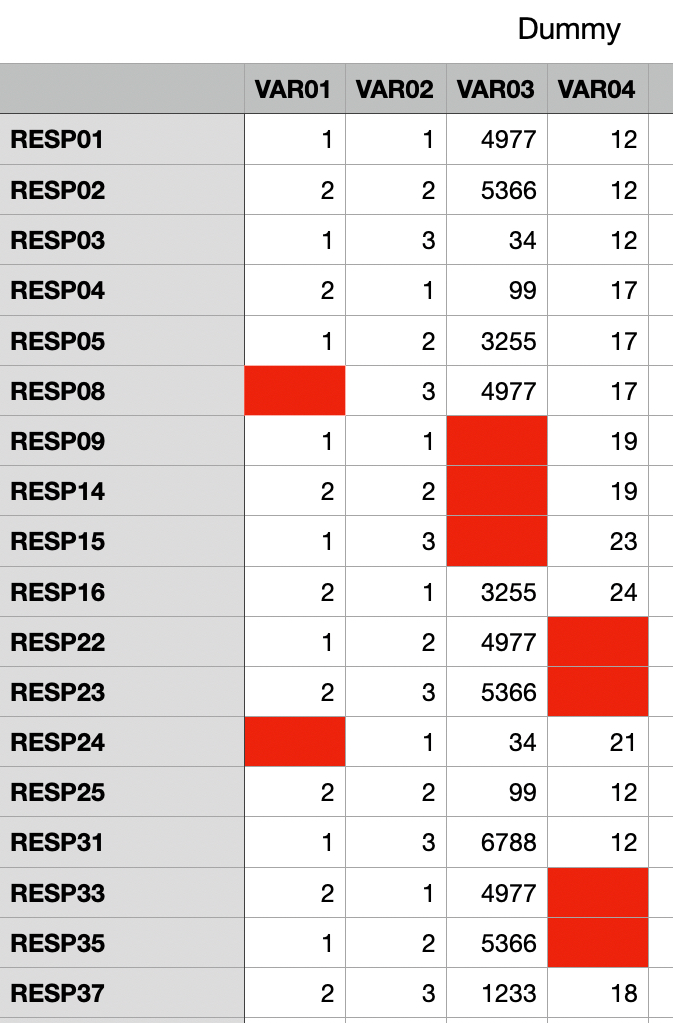
You see, like the old chess computers (90’s) they weren’t intelligent, they merely had in memory every chess game ever played above a certain level. And all these moves were in these computers. As such there was every chance that the chess computer came into a setting where that board was encountered before and as such it tried to play from that point onwards. It is a little more advanced than that, but that was the setting we faced. And would you have it, some greed driven salesperson will push the boundary towards that setting where he (or she) will claim that the data you have will result in better sales. But (a massive ‘but’ comes along) that is assuming all data is there and mostly that is never the case. So if we see the next image

You see that some cells are red, there we have no data and data that isn’t there cannot be created (sort of). In Market Research it is called System Missing data. They know what to do in those case, but the bulk of all the people trying to run and hide behind there data will be in the knowing nothing pool of people. And this data set has a few hidden issues. Response 6 and 7 are missing. So were they never there? Is there another reason? All things that these AI systems are unaware of and until they are taught what to do your data will create a mess you never saw before. Sales people (for the most) do not see it that way, because they were sold an AI system. Yet until someone teaches them what to do they aren’t anything of the sort and even after they are taught there are still gaps in their knowledge because these systems will not assume until told so. They will not even know what to do when it goes wring until someone tells them that and the salespeople using these systems will revert to ‘easy’ fixes, which are not fixes at all, they merely see the larger setting that becomes less and less accurate in record time. They will rely on predictive analytics, but that solution can only work with data that is there and when there is no data, there is merely no data to rely on. And that is the trap I foresaw in the case of [a censored software company] and the UAE and oil. There is too much unknowns and I reckon that the oil industry will have a lot more data and bigger data, but with human elements in play, we will see missing data. And the better the data is, the more accurate the results. But as I saw it, errors start creeping in and more and more inaccuracies are set to the predictive data set and that is where the problems start. It is not speculative, it is a dead certainty. This will happen. No matter how good you are, these systems are build too fast with too little training and too little error seeking. This will go wrong. Still Larry is right “Most Of The World’s Valuable Data Is in some system

The problem is that no dataset is 100% complete, it never was and that is the miscalculations to CEO’s of tomorrow are making. And the assumption mode of the sales person selling and the sales person buying are in a dwindling setting as they are all on the AI mountain whilst there is every chance that several people will use AI as a gimmick sale and they don’t have a clue what they are buying, all whilst these people sign a ‘as is’ software solution. So when this comes to blows, the impact will be massive. We recently saw Microsoft standing behind builder.ai and it went broke. It seems that no one saw the 700 engineers programming it all (in this case I am not blaming Microsoft) but it leaves me with questions. And the setting of “Stargate is a $500 billion joint venture between OpenAI, SoftBank, Oracle, and investment firm MGX to build a massive AI infrastructure in the United States. The project, announced by Donald Trump, aims to establish the US as a leader in AI by constructing large-scale data centers and advancing AI research. Initial construction is underway in Texas, with plans for 20 data centers, each 500,000 square feet, within the next five years” leaves me with more questions. I do not doubt that OpenAI, SoftBank and Oracle all have the best intentions. But I have two questions on this. The first is how to align and verify the data, because that will be an adamant and also a essential step in this. Then we get to the larger setting that the dat needs to align within itself. Are all the phrases exact? I don’t know this is why I ask and before you say that it makes sense that they do but reality gives us ‘SQUARE-WINDOWED AIRPLANES’ 1954 when two planes broke apart in mid-flight because metal fatigue was causing small cracks to form at the edges of the windows, and the pressurized cabins exploded. Then we have the ‘MARS ORBITER’ where two sets of engineers, one working in metric and the other working in the U.S. imperial system, failed to communicate at crucial moments in constructing the $125 million spacecraft. We tend to learn when we stumble that is a given, so what happens when issues are found in the 11th hour in a 500 billion dollar setting? It is not unheard of and as I saw one particular speculative setting. How is this powered? A system on 500,000 square feet needs power and 20 of them a hell of a lot more. So how many nuclear reactors are planned? I actually have an interesting idea (keeping this to me for now). But any computer that leaks power will go down immediately and all those training time is lost. How often does that need to happen for it to go wrong? You can train and test systems individually but 20 data centers need power, even one needs power and how certain is that power grid? I actually saw nothing of that in any literature (might be that only a few have seen that), but the drastic setting from sales people tends to be, lets put in more power. But where from? Power is finite until created in advance and that is something I haven’t seen. And then the time setting ‘within the next 5 years’ As I see it, this is a disaster waiting to happen. And as this starts in Texas, we have the quote “According to Texas native, Co-Founder and CFO of Atma Energy, Jaro Nummikoski, one of the main reasons Texas struggles with chronic power outages is the way our grid was originally designed—centralized power plants feeding energy over long distances through aging infrastructure.” Now I am certain that the power-grid of a data centre will be top notch, but where does that power come from? And 500,000 sqft needs a lot of power, I honestly do not know how much One source gave me “The facilities need at least 50 Megawatts (MW) of power supply, but some installations surpass this capacity. The energy requirements of the project will increase to 15 Gigawatts (GW) because of the ten data centers currently under construction, which equals the electricity usage of a small nation.” As such the call for a nuclear reactor comes to mind, yet the call for 15 GW is insane, and no reactor at present exists to handle that. 50MW per data center implies that where there is a data centre a reactor will be needed (OK, this is an exaggeration) but where there are more than one (up to 4) a reactor will be needed. So who was aware of this? I reckon that the first centre in Texas will get a reactor as Texas has plenty of power shortages and the increase in people and systems warrant such a move. But as far as I know those things will require a little more than 5 years and depending on the provider there are different timelines. As such I have reasons to doubt the 5 year setting (even more when we consider data). 

As such I wonder when the media will actually look at the settings and what will be achievable as well as being implemented and that is before we get to the training of data of these capers. As I personally (and speculatively) see it, will these data centers come with a warning light telling us SYSMIS(plenty), or a ‘too many holes in data error’ just a thought to have this Tuesday. 

Have a great day and when your chest glows in the dark you might be close to one of those nuclear reactors. 

Leave a comment

Filed under Finance, IT, Media, Science

Altering Image

This happens, sometimes it is within ones self that change is pushed, in other cases it is outside information or interference. In my case it is outside information. Now, let’s be clear. This is based on personal feelings, apart from the article not a lot is set in papers. But it is also in part my experience with data and thee is a hidden flaw. There is a lot of media that I do not trust and I have always been clear about that. So you might have issues with this article.

It all started when I saw yesterday’s article called ‘‘Risks posed by AI are real’: EU moves to beat the algorithms that ruin lives’ (at https://www.theguardian.com/technology/2022/aug/07/ai-eu-moves-to-beat-the-algorithms-that-ruin-lives). There we see: “David Heinemeier Hansson, a high-profile tech entrepreneur, lashed out at Apple’s newly launched credit card, calling it “sexist” for offering his wife a credit limit 20 times lower than his own.” In this my first question becomes ‘Based on what data?’ You see Apple is (in part) greed driven, as such if she has a credit history and a good credit score, she would get the same credit. But the article gives us nothing of that, it goes quickly towards “artificial intelligence – now widely used to make lending decisions – was to blame. “It does not matter what the intent of individual Apple reps are, it matters what THE ALGORITHM they’ve placed their complete faith in does. And what it does is discriminate. This is fucked up.”” You see, the very first issue is that AI does not (yet) exist. We might see all the people scream AI, but there is no such thing as AI, not yet. There is machine learning, there is deeper machine learning and they are AWESOME! But the algorithm is not AI, it is a human equation, made by people, supported by predictive analytics (another program in place) and that too is made by people. Lets be clear, this predictive analytics c an be as good as it is, but it relies on data it has access to. To give a simple example. In that same example in a place like Saudi Arabia, Scandinavians would be discriminated against as well, no matter what gender. The reason? The Saudi system will not have the data on Scandinavians compared to Saudi’s requesting the same options. It all requires data and that too is under scrutiny, especially in the era 1998-2015, too much data was missing on gender, race, religion and a few other matters. You might state that this is unfair, but remember, it comes from programs made by people addressing the needs of bosses in Fintech. So a lot will not add up ad whilst everyone screams AI, these bosses laugh, because there is no AI. And the sentence “While Apple and its underwriters Goldman Sachs were ultimately cleared by US regulators of violating fair lending rules last year, it rekindled a wider debate around AI use across public and private industries” does not help. What legal setting was in play? What was submitted to the court? What decided on “violating fair lending rules last year”? No one has any clear answers and they are not addressed in this article either. So when we get to “Part of the problem is that most AI models can only learn from historical data they have been fed, meaning they will learn which kind of customer has previously been lent to and which customers have been marked as unreliable. “There is a danger that they will be biased in terms of what a ‘good’ borrower looks like,” Kocianski said. “Notably, gender and ethnicity are often found to play a part in the AI’s decision-making processes based on the data it has been taught on: factors that are in no way relevant to a person’s ability to repay a loan.”” We have two defining problems. In the first, there is no AI. In the second “AI models can only learn from historical data they have been fed” I believe that there is a much bigger problem. There is a stage of predictive analytics, and there is a setting of (deeper) machine learning and they both need data, that part if correct, no data, no predictions. But how did I get there?

That is seen in the image above. I did not make it, I found it and it shows a lot more clearly what is in play. In most Fintech cases it is all about the Sage (funny moment). Predictive inference, Explanatory inference, and decision making. A lot of it is covered in machine learning, but it goes deeper. The black elements as well as control and manipulation (blue) are connected. You see an actual AI can combine predictive analytics and extrapolation, and do that for each category (races, gender, religion) all elements that make the setting, but data is still a part of that trajectory and until shallow circuits are more perfect than they are now (due to the Ypsilon particle I believe). You see a Dutch physicist found the Ypsilon particle (if I word this correctly) it changes our binary system into something more. These particles can be nought, zero, one or both and that setting is not ready, it allows the interactions to a much better process that will lead to an actual AI, when the IBM quantum systems get these two parts in order they become true quantum behemoth and they are on track, but it is a decade away. It does not hurt to set a larger AI setting sooner rather than too late, but at present it is founded on a lot of faulty assumptions. And it might be me, but look around on all these people throwing AI around. What is actual AI? And perhaps it is also me, the image I showed you is optionally inaccurate and lacks certain parts, I accept that, but it drives me insane when we see more and more AI talk whilst it does not exist. I saw one decent example “For example, to master a relatively simple computer game, which could take an average person 15 minutes to learn, AI systems need up to 924 hours. As for adaptability, if just one rule is altered, the AI system has to learn the entire game from scratch” this time is not learning, it is basically staging EVERY MOVE in that game, like learning chess, we learn the rules, the so called AI will learn all 10(111) and 10(123) positions (including illegal moves) in Chess. A computer can remember them all, but if one move was incorrectly programmed (like the night), the program needs to relearn all the moves from start. When the Ypsilon particle and shallow circuits are added the equation changes a lot. But that time is not now, not for at least a decade (speculated time). So in all this the AI gets blamed for predictive analytics and machine learning and that is where the problem starts, the equation was never correct or fair and the human element in all this is ‘ignored’ because we see the label AI, but the programmer is part of the problem and that is a larger setting than we realise. 

Merely my view on the setting.


Leave a comment

Filed under Finance, IT, Media, Science

Waking up 5 years late

I have had something like this, I swear it’s true. It was after I came back from the Middle East, I was more of a ‘party person’ in those days and I would party all weekend non-stop. It would start on Friday evening and I would get home Sunday afternoon. So one weekend, I had gone through the nightclub, day club, bars and Shoarma pit stops after which I went home. I went to bed and I get woken up by the telephone. It is my boss, asking me whether I would be coming to work that day. I noticed it was 09:30, I had overslept. I apologised and rushed to the office. I told him I was sorry that I had overslept and I did not expect too much nose as it was the first time that I had overslept. So the follow up question became “and where were you yesterday?” My puzzled look from my eyes told him something was wrong. It was Tuesday! I had actually slept from Sunday afternoon until Tuesday morning. It would be the weirdest week in a lifetime. I had lost an entire day and I had no idea how I lost a day. I still think back to that moment every now and then, the sensation of the perception of a week being different, I never got over it, now 31 years ago, and it still gets to me every now and then.

A similar sensation is optionally hitting Christine Lagarde I reckon, although if she is still hitting the party scene, my initial response will be “You go girl!

You see with “Market power wielded by US tech giants concerns IMF chief” (at https://www.theguardian.com/business/2018/apr/19/market-power-wielded-by-us-tech-giants-concerns-imf-chief-christine-lagarde) we see the issues on a very different level. So even as we all accept “Christine Lagarde, has expressed concern about the market power wielded by the US technology giants and called for more competition to protect economies and individuals”, we see not the message, but the exclusion. So as we consider “Pressure has been building in the US for antitrust laws to be used to break up some of the biggest companies, with Google, Facebook and Amazon all targeted by critics“, I see a very different landscape. You see as we see Microsoft, IBM and Apple missing in that group, it is my personal consideration that this is about something else. You see Microsoft, IBM and Apple have one thing in common. They are Patent Powerhouses and no one messes with those. This is about power consolidation and the fact that Christine Lagarde is speaking out in such a way is an absolute hypocrite setting for the IMF to have.

You see, to get that you need to be aware of two elements. The first is the American economy. Now in my personal (highly opposed) vision, the US has been bankrupt; it has been for some time and just like the entire Moody debacle in 2008. People might have seen in in ‘the Big Short‘, a movie that showed part of it and whilst the Guardian reported ““Moody’s failed to adhere to its own credit-rating standards and fell short on its pledge of transparency in the run-up to the ‘great recession’,” principal deputy associate attorney general Bill Baer said in the statement“, it is merely one version of betrayal to the people of the US by giving protection to special people in excess of billions and they merely had to pay a $864m penalty. I am certain that those billionaires have split that penalty amongst them. So, as I stated, the US should be seen as bankrupt. It is not the only part in this. The Sydney Morning Herald (at https://www.smh.com.au/business/the-economy/how-trump-s-hair-raising-level-of-debt-could-bring-us-all-crashing-down-20180420-p4zank.html) gives us “Twin reports by the International Monetary Fund sketch a chain reaction of dangerous consequences for world finance. The policy – if you can call it that – puts the US on an untenable debt trajectory. It smacks of Latin American caudillo populism, a Peronist contagion that threatens to destroy the moral foundations of the Great Republic. The IMF’s Fiscal Monitor estimates that the US budget deficit will spike to 5.3 per cent of GDP this year and 5.9 per cent in 2019. This is happening at a stage of the economic cycle when swelling tax revenues should be reducing net borrowing to zero“. I am actually decently certain that this will happen. Now we need to look back to my earlier statement.

You see, if the US borrowing power is nullified, the US is left without any options, unless (you saw that coming didn’t you). The underwriting power of debt becomes patent power. Patents have been set to IP support. I attended a few of those events (being a Master of Intellectual Property Law) and even as my heart is in Trademarks, I do have a fine appreciation of Patents. In this the econometrics of the world are seeing the national values and the value of any GDP supported by the economic value of patents.

In this, in 2016 we got “Innovation and creative endeavors are indispensable elements that drive economic growth and sustain the competitive edge of the U.S. economy. The last century recorded unprecedented improvements in the health, economic well-being, and overall quality of life for the entire U.S. population. As the world leader in innovation, U.S. companies have relied on intellectual property (IP) as one of the leading tools with which such advances were promoted and realized. Patents, trademarks, and copyrights are the principal means for establishing ownership rights to the creations, inventions, and brands that can be used to generate tangible economic benefits to their owner“, as such the cookie has crumbled into where the value is set (see attached), one of the key findings is “IP-intensive industries continue to be a major, integral and growing part of the U.S. economy“, as such we see the tech giants that I mentioned as missing and not being mentioned by Christine Lagarde. It is merely one setting and there are optionally a lot more, but in light of certain elements I believe that patents are a driving force and those three have a bundle, Apple has so many that it can use those patents too buy several European nations. IBM with their (what I personally believe to be) an overvalued Watson, we have seen the entire mess moving forward, presenting itself and pushing ‘boundaries’ as we are set into a stage of ‘look what’s coming’! It is all about research, MIT and Think 2018. It is almost like Think 2018 is about the point of concept, the moment of awareness and the professional use of AI. In that IBM, in its own blog accidently gave away the goods as I see it with: “As we get closer to Think, we’re looking forward to unveiling more sessions, speakers and demos“, I think they are close, they are getting to certain levels, but they are not there yet. In my personal view they need to keep the momentum going, even if they need to throw in three more high exposed events, free plane tickets and all kinds of swag to flim flam the audience. I think that they are prepping for the events that will not be complete in an alpha stage until 2020. Yet that momentum is growing, and it needs to remain growing. Two quotes give us that essential ‘need’.

  1. The US Army signed a 33-month, $135 million contract with IBM for cloud services including Watson IoT, predictive analytics and AI for better visibility into equipment readiness.
  2. In 2017, IBM inventors received more than 1,900 patents for new cloud technologies to help solve critical business challenges.

The second is the money shot. An early estimate is outside of the realm of most, you see the IP Watchdog gave us: “IBM Inventors received a record 9043 US patents in 2017, patenting in such areas as AI, Cloud, Blockchain, Cybersecurity and Quantum Computing technology“, the low estimate is a value of $11.8 trillion dollars. That is what IBM is sitting on. That is the power of just ONE tech giant, and how come that Christine Lagarde missed out on mentioning IBM? I’ll let you decide, or perhaps it was Larry Elliott from the Guardian who missed out? I doubt it, because Larry Elliott is many things, stupid ain’t one. I might not agree with him, or at times with his point of view, but he is the clever one and his views are valid ones.

So in all this we see that there is a push, but is it the one the IMF is giving or is there another play? The fact that banks have a much larger influence in what happens is not mentioned, yet that is not the play and I accept that, it is not what is at stake. There is a push on many levels and even as we agree that some tech giants have a larger piece of the cake (Facebook, Google and Amazon), a lot could have been prevented by proper corporate taxation, but that gets to most of the EU and the American Donald Duck, or was that Trump are all about not walking that road? The fact that Christine has failed (one amongst many) to introduce proper tax accountability on tech giants is a much larger issue and it is not all on her plate in all honesty, so there are a few issues with all this and the supporting views on all this is not given with “Lagarde expressed concern at the growing threat of a trade war between the US and China, saying that protectionism posed a threat to the upswing in the global economy and to an international system that had served countries well“, it is seen in several fields, one field, was given by The Hill, in an opinion piece. The information is accurate it is merely important to see that it has the views of the writer (just like any blog).

So with “Last December, the United States and 76 other WTO members agreed at the Buenos Aires WTO Ministerial to start exploring WTO negotiations on trade-related aspects of e-commerce. Those WTO members are now beginning their work by identifying the objectives of such an agreement. The U.S. paper is an important contribution because it comprehensively addresses the digital trade barriers faced by many companies“, which now underlines “A recent United States paper submitted to the World Trade Organization (WTO) is a notable step toward establishing rules to remove digital trade barriers. The paper is significant for identifying the objectives of an international agreement on digital trade“. This now directly gives rise to “the American Bar Association Section of Intellectual Property Law also requested that the new NAFTA require increased protections in trade secrets, trademarks, copyrights, and patents“, which we get from ‘Ambassador Lighthizer Urged to Include Intellectual Property Protections in New NAFTA‘ (at https://www.jdsupra.com/legalnews/ambassador-lighthizer-urged-to-include-52674/) less than 10 hours ago. So when we link that to the quote “The proposals included: that Canada and Mexico establish criminal penalties for trade secrets violations similar to those in the U.S. Economic Espionage Act, an agreement that Mexico eliminate its requirement that trademarks be visible, a prohibition on the lowering of minimum standards of patent protection“. So when we now look back towards the statement of Christine Lagarde and her exclusion of IBM, Microsoft and Apple, how is she not directly being a protectionist of some tech giants?

I think that the IMF is also feeling the waters what happens when the US economy takes a dip, because at the current debt levels that impact is a hell of a lot more intense and the games like Moody’s have been played and cannot be played again. Getting caught on that level means that the US would have to be removed from several world economic executive decisions, not a place anyone in Wall Street is willing to accept, so that that point Pandora’s Box gets opened and no one will be able to close it at that point. So after waking up 5 years late we see that the plays have been again and again about keeping the status quo and as such the digital rights is the one card left to play, which gives the three tech giants an amount of power they have never had before, so as everyone’s favourite slapping donkey (Facebook) is mentioned next to a few others, it is the issue of those not mentioned that will be having the cake and quality venison that we all desire. In this we are in a dangerous place, even more the small developers who come up with the interesting IP’s they envisioned. As their value becomes overstated from day one, they will be pushed to sell their IP way too early, more important, that point comes before their value comes to fruition and as such those tech giants (Apple, IBM, and Microsoft) will get an even more overbearing value. Let’s be clear they are not alone, the larger players like Samsung, Canon, Qualcomm, LG Electronics, Sony and Fujitsu are also on that list. The list of top players has around 300 members, including 6 universities (all American). So that part of the entire economy is massively in American hands and we see no clear second place, not for a long time. Even as the singled out tech giants are on that list, it is the value that they have that sets them a little more apart. Perhaps when you consider having a go at three of them, whilst one is already under heavy emotional scrutiny is perhaps a small price to pay.

How nice for them to wake up, I merely lost one day once, they have been playing the sleeping game for years and we will get that invoice at the expense of the futures we were not allowed to have, if you wonder how weird that statement is, then take a look at the current retirees, the devaluation they face, the amount they are still about to lose and wonder what you will be left with when you consider that the social jar will be empty long before you retire. The one part we hoped to have at the very least is the one we will never have because governments decided that budgeting was just too hard a task, so they preferred to squander it all away. The gap of those who have and those who have not will become a lot wider over the next 5 years, so those who retire before 2028 will see hardships they never bargained for. So how exactly are you served with addressing “‘too much concentration in hands of the few’ does not help economy“, they aren’t and you weren’t. It is merely the setting for what comes next, because in all this it was never about that. It is the first fear of America that counts. With ‘US ponders how it can stem China’s technology march‘ (at http://www.afr.com/news/world/us-ponders-how-it-can-stem-chinas-technology-march-20180418-h0yyaw), we start seeing that shift, so as we see “The New York Times reported on April 7 that “at the heart” of the trade dispute is a contest over which country plays “a leading role in high-tech industries”. The Wall Street Journal reported on April 12 that the US was preparing rules to block Chinese technology investment in the US, while continuing to negotiate over trade penalties“, we see the shifted theatre of trade war. It will be about the national economic value with the weight of patents smack in the middle. In that regard, the more you depreciate other parts, the more important the value of patents becomes. It is not a simple or easy picture, but we will see loads of econometrics giving their view on all that within the next 2-3 weeks.

Have a great weekend and please do not bother to wake up, it seems that Christine Lagarde didn’t bother waking up for years.


Leave a comment

Filed under Finance, IT, Law, Media, Politics, Science

Room for Requirement

I looked at a few issues 3 days ago. I voiced them in my blog ‘The Right Tone‘ (at https://lawlordtobe.com/2016/09/21/the-right-tone/), one day later we see ‘MI6 to recruit hundreds more staff in response to digital technology‘ (at https://www.theguardian.com/uk-news/2016/sep/21/mi6-recruit-digital-internet-social-media), what is interesting here is the quote “The information revolution fundamentally changes our operating environment. In five years’ time there will be two sorts of intelligence services: those that understand this fact and have prospered, and those that don’t and haven’t. And I’m determined that MI6 will be in the former category“, now compare it to the statement I had made one day earlier “The intelligence community needs a new kind of technological solution that is set on a different premise. Not just who is possibly guilty, but the ability of aggregation of data flags, where not to waste resources“, which is just one of many sides needed. Alex Younger also said: “Our opponents, who are unconstrained by conditions of lawfulness or proportionality, can use these capabilities to gain increasing visibility of our activities which means that we have to completely change the way that we do stuff”, I reckon the American expression: ‘He ain’t whistling Dixie‘ applies.

You see, the issue goes deeper than mere approach, the issue at hand is technology. The technology needs to change and the way data is handled requires evolution. I have been in the data field since the late 80’s and this field hasn’t changed too much. Let’s face it, parsing data is not a field that has seen too much evolving, for the mere reason that parsing is parsing and that is all about speed. So to put it on a different vehicle. We are entering an age where the intelligence community is about the haulage of data, yet in all this, it is the container itself that grows whilst the haulage is on route. So we need to find alternative matters to deal with the container content whilst on route.

Consider the data premise: ‘If data that needs processing grows by 500 man years of work on a daily basis‘, we have to either process smarter, create a more solutions to process, be smarter on what and how to process, or change the premise of time. Now let’s take another look. For this let’s take a look at a game, the game ‘No Man’s Sky’. This is not about gaming, but about the design. For decades games were drawn and loaded. A map, with its data map (quite literally so). Usually the largest part of the entire game. 11 people decided to use a formula to procedurally generate 18 quintillion planets. They created a formula to map the universe with planets, planet sized. This has never been done before! This is an important part. He turned it all around and moreover, he is sitting on a solution that is worth millions, it could even be worth billions. The reason to use this example is because games are usually the first field where the edge of hardware options are surpassed, broken and redesigned (and there is more at the end of this article). Issues that require addressing in the data field too.

Yet what approach would work?

That is pretty much the ‎£1 billion question. Consider the following situation: Data is being collected non-stop, minute by minute. Set into all kinds of data repositories. Now let’s have a fictive case. The chatter gives that in 72 hours an attack will take place, somewhere in the UK. It gives us the premise:

  1. Who
  2. Where
  3. How

Now consider the data. If we have all the phone records, who has been contacting who, through what methods and when? You see, it isn’t about the data, it is about linking collections from different sources and finding the right needle, that whilst the location, shape and size of the haystack are an unknown. Now, let’s say that the terrorist was really stupid and that number is known. So now we have to get a list of all the numbers that this phone had dialled. Then we get the task of linking the information on these people (when they are not pre-paid or burner phones). Next is the task of getting a profile, contacts, places, and other information. The list goes on and the complexity isn’t just the data, the fact that actual terrorists are not dumb and usually massively paranoid, so there is a limit to the data available.

Now what if this was not reactive, but proactive?

What if the data from all the sources could be linked? Social media, e-mail, connections, forums and that is just the directly stored data. When we add mobile devices, Smartphones, tablets and laptops, there is a massive amount of additional data that becomes available and the amount of data from those sources are growing at an alarming rate. The challenge is to correctly link the data from sources, with added data sources that contain aggregated data. So, how do you connect these different sources? I am not talking about the usage, it is about the impaired data on different foundations with no way to tell whether pairing leads to anything. For this I need to head towards a 2012 article by Hsinchun Chen (attached at end), Apart from the clarity that we see in the BI&A overview (Evolution, Application and Emerging Research), the interesting part that even when we just look at it from a BI point of view, we see two paths missing. That is, they seem to be missing now, if we look back to 2010-2011, the fact that Google and Apple grew a market in excess of 100% quarter on quarter was not to be anticipated to that degree. The image on page 1167 has Big Data Analytics and Mobile Analytics, yet Predictive Interactivity and Mobile Predictive Analytics were not part of the map, even though the growth of Predictive Analytics have been part of BI from 2005 onwards. Just in case you were wondering, I did not change subject, the software need that part of the Intelligence world uses comes from the business part. A company usually sees a lot more business from 23 million global companies than it gets from 23 intelligence agencies. The BI part is often much easier to see and track whilst both needs are served. We see a shift of it all when we look at the table on page 1169. BI&A 3.0 now gets us the Gartner Hype Cycle with the Key Characteristics:

  1. Location-aware analysis
  2. Person-centred analysis
  3. Context-relevant analysis
  4. Mobile visualization & HCI

This is where we see the jump when we relate to places like Palantir that is now in the weeds prepping for war. Tech Crunch (at https://techcrunch.com/2016/06/24/why-a-palantir-ipo-might-not-be-far-off/) mentioned in June that it had taken certain steps and had been preparing for an IPO. I cannot say how deep that part was, yet when we line up a few parts we see an incomplete story. The headline in July was: ‘Palantir sues investor Marc Abramowitz for allegedly stealing company secrets‘, I think the story goes a little further than that. It is my personal belief that Palantir has figured something out. That part was seen 3 days ago (at http://www.defensenews.com/articles/dcgs-commentary), the two quotes that matter are “The Army’s Distributed Common Ground System (DCGS) is proof of this fact. For the better part of the last decade, the Army has struggled to build DCGS from the ground up as the primary intelligence tool for soldiers on the battlefield. As an overarching enterprise, DCGS is a legitimate and worthwhile endeavour, intended to compute and store massive amounts of data and deliver information in real time“, which gives us (actually just you the reader) the background, whilst “What the Army has created, although well-intentioned, is a sluggish system that is difficult to use, layered with complications and unable to sustain the constant demands of intelligence analysts and soldiers in combat. The cost to taxpayers has been approximated at $4 billion“, gives us the realistic scope and that all links back to the Intelligence Community. I think that someone at Palantir has worked out a few complications making their product the one winning solution. When I started to look into the matter, some parts did not make sense, even if we take the third statement (which I was already aware of long before this year “In legal testimony, an Army official acknowledged giving a reporter a “negative” and “not scientific” document about Palantir’s capabilities that was written by a staff member but formatted to appear like a report from the International Security Assistance Force. That same official stated that the document was not based on scientific data“, it would not have added up. What does add up (remember, the next part is speculative), the data links required in the beginning of the article, have to a larger extent been resolved by the Palantir engineers. In its foundation, what the journal refers to as BI&A 3.0 has been resolved by Palantir (top some extent). If true, we will get a massive market shift. To make a comparison, Google Analytics might be regarded as MSDOS and this new solution makes Palantir the new SE-Linux edition, the difference on this element could be that big. The difference would be that great. And I can tell you that Google Analytics is big. Palantir got the puzzle piece making its value go up with billions. They could raise their value from 20 billion to 60-80 billion, because IBM has never worked out that part of analytics (whatever they claim to have is utterly inferior) and Google does have a mobile analytics part, but limited merely as it is for a very different market. There have always been issues with the DCGS-A system (apart from it being as cumbersome as a 1990 SAS mainframe edition), so it seems to me that Palantir could not make the deeper jump into government contracts until it got the proper references and showing it was intentionally kept out of the loop is also evidence that could help. That part was recently confirmed by US Defense News.

In addition there is the acceptance of Palantir Gotham, which offered 30% more work with the same staff levels and Palantir apparantly delivered, which is a massive point that the Intelligence groups are dealing with, the lack of resources. The job has allowed NY City to crack down on illegal AirBnB rentals. A task that requires to connect multiple systems and data that was never designed to link together. This now gets us to the part that matters, the implication is that the Gotham Core would allow for dealing with the Digital data groups like Tablet, mobile and streaming data from internet sites.

When we combine the information (still making it highly speculative) the fact that one Congressman crossed the bridge (Duncan Hunter R-CA), many could follow. That part matters as Palantir can only grow the solution if it is seen as the serious solution within the US government. The alleged false statements the army made (as seen in Defence News at http://www.defensenews.com/articles/dcgs-commentary) with I personally believe was done to keep in the shadows that DCGS-A was not the big success some claimed it to be, will impact it all.

And this now links to the mentions I made with the Academic paper when we look at page 1174, regarding the Emerging Research for Mobile Analytics. The options:

  1. Mobile Pervasive Apps
  2. Mobile Sensing Apps
  3. Mobile Social Networking
  4. Mobile Visualization/HCI
  5. Personalization and Behavioural Modelling

Parts that are a given, and the big players have some sort of top line reporting, but if I am correct and it is indeed the case that Palantir has figured a few things out, they are now sitting on the mother lode, because there is currently nothing that can do any of it anywhere close to real-time. Should this be true, Palantir would end being the only player in town in that field, an advantage corporations haven’t had to this extent since the late 80’s. The approach SPSS used to have before they decided to cater to the smallest iteration of ‘acceptable’ and now as IBM Statistics, they really haven’t moved forward that much.

Now let’s face it, these are all consumer solutions, yet Palantir has a finance option which is now interesting as Intelligence Online reported a little over a week ago: “The joint venture between Palantir and Credit Suisse has hired a number of former interception and financial intelligence officials“, meaning that the financial intelligence industry is getting its own hunters to deal with, if any of those greedy jackals have been getting there deals via their iPhone, they will be lighting up like a Christmas tree on those data sets. So in 2017, the finance/business section of newspapers should be fun to watch!

The fact that those other players are now getting a new threat with actual working solutions should hurt plenty too, especially in the lost revenue section of their spreadsheet.

In final part, why did I make the No Man’s Sky reference? You see, that is part of it all. As stated earlier, it used a formula to create a planet sized planet. Which is one side of the equation. Yet, the algorithm could be reversed. There is nothing stopping the makers to scan a map and get us a formula that creates that map. For the gaming industry it would be forth a fortune. However, that application could go a lot further. What if the Geospatial Data is not a fictive map, but an actual one? What if one of the trees are not trees but mobile users and the other type of trees are networking nodes? It would be the first move of setting Geospatial Data in a framework of personalised behavioural modelling against a predictive framework. Now, there is no way that we know where the person would go, yet this would be a massive first step in answering ‘who not to look for‘ and ‘where not to look‘, diminishing a resource drain to say the least.

It would be a game changer for non-gamers!

special_issue_business_intelligence_rese


Leave a comment

Filed under Finance, IT, Military, Politics, Science

Where we disagree

There is another article in the Guardian; it was published almost 12 hours ago (at http://www.theguardian.com/business/2014/dec/14/deficit-problem-crisis-productivity-george-osborne). It is a good story, it gives a decent view, but I feel that I cannot agree. It must be said that this is all in the eyes of the beholder. The article is good and sound and many will adhere to this idea. Yet, I do not completely agree. Yes, all the facts are right, the view is not incorrect, but it feels incomplete. The first quote “The most important issue is the poor performance of the nation’s productivity, which, far from being improved, has almost certainly been exacerbated by the constant emphasis on the putative need for austerity”, now this is a decent view to have, it is an optional view, yet in my view the following com up:

  1. Productivity relies on orders; the UK is competing with its baby brother India where daily labour rates are decently below the hourly rate of a UK worker. That in itself is not enough, the EEC overall is pretty broke, no less than one in 10 has no job, it is driven up by Spain and Greece, yet after a long term most Europeans are very careful about where money is spend on. So which manufacturing industry is getting the few coins that do get spend?
  2. There is no reputed need to austerity; there is an overspending in excess of 1 trillion that needs to be addressed. We can bark high and low on the reasoning for it, but that water passed the bridge a long time ago, now the debt needs to be taken care of. The US, Japan and UK have a combined debt of 30 trillion of national debt, the UK is a little over 3% of all this, let’s make sure that when the two behemoths stumble into nothingness, the UK does not end up being the biggest debt of all (again just my view), yet I feel certain that the banks will be in charge of a nation with such debts.

Yes, productivity will take care of all it, but I believe that the debt needs more then productivity. It needs innovation and IP. They will drive true productivity. People forget about the innovators. Alan Turing is still regarded as the man behind the concept of Artificial intelligence. What was a fab in the 40’s became the driving power for the planet from the 90’s onward; let’s not forget the foundations for the computer. We seem to herald IBM and others, yet Professor Sir F.C. Williams was at the foundation of the driving force that became the behemoth for almost half a century and this wave is still going strong.

The new currency will be IP; innovation will drive the places of work, the places of sales and the filling of coffers (the empty bags currently in a corner of George Osborne’s office).

People keep on ignoring the need for innovation; I tried it twice in a previous job. The response remained almost the same ‘it works as it is, so leave it‘, that is the drive stopper that ends a future, although the early 1900’s did not have the need for IP, consider the history of the paperclip and Gem Manufacturing Ltd, a British company. They had the better design, but never registered the patent, which is why Johan Vaaler is often seen as the inventor. I am not debating the validity, yet he registered his patent. In those days the rights were approached a lot more liberal then now. Nowadays our lives are all about IP, patents and who it is registered to. Haven’t we learned anything in 115 years? No matter that we now enjoy an article that is not patented, in nice contrast to people who enjoy a life because the man behind finding a cure (read vaccine) for polio did intentionally decide not to patent it (Dr Jonas Salk, who deserves a sainthood for that act), our future for certain, our survival to some exaggerated extent is depending on IP. Need drives production, but who owns the article that is needed? That part I see ignored again and again.

William Keegan does not look at the IP side, because he focuses on the steps following it, yet those in this real rat race seems to silence the need to look at it as they talk about productivity and manufacturing, but the innovator behind it, the one designing the IP, that person is worth gold. Consider Microsoft paying 2 billion for a piece of IP called Minecraft. A simple game, looking the way Minecraft does, is worth the revenue the high end looking GTA-5 made. It is all about IP in gaming; it should be the same in nearly any industry, not just the one that got kicked off by Alan Turing and Professor Sir F.C. Williams. IP drives every computer industry, it became the centre piece in the jewel that is now called ‘Business Intelligence‘ and ‘Predictive Analytics‘, but we broke the system after that.

Why was the system broken?

It is a broken system that is now illuminated in its flaws by people like Sir Kenneth Robinson and Brian Blessed. We ignored for too long that IP and innovation requires creativity. As Universities have been pushing logic and business, they forgot that the future tends to be created in the arts. Creativity is the driving force for any future, whatever is produced after this required a need for IP. It is a chicken and the egg issue, will the thought create the idea or is the idea the drive for creation? As I see it, this drive needs an artistic side, a side I was never any good in, but the best futures will need an artistic hand. It is shown into the massive amounts of IP the gaming industry manages. People might wonder why I keep on coming back to the gaming industry.

The answer is simple Games have driven a trillion dollar industry (totalled). Commodore Business Machines (C-64, Amiga) Atari (2600,800, ST), Creative Labs (soundcard), The consoles that followed by Nintendo, Sony, SEGA and Microsoft and the list goes on and on, all from creativity. Even the military sees the essential need of creativity. Consider the text “Space-based Missile Defense: Advancing Creativity“, it is at the heart of everything, so many forgot about that, those in charge forgot about that part. It is why my vote for Cambridge chancellor would not have been for Lord Sainsbury of Turville, but for Brian Blessed. Lord Sainsbury is not a wrong person, or a bad choice. As I see it, all our futures require a much stronger drive towards the arts and creativity. In my crazy creative view photography was invented in 1642 by a Dutchman named Rembrandt van Rijn; his visionary view came 200 years before the chemicals were invented, if you want evidence? It is in the Rijksmuseum and they call it ‘the Nightwatch’.


Leave a comment

Filed under Finance, Gaming, IT, Science

FISA? Gezundheit!


In a column for ‘all things D‘ (democratic I guess), Arik Hesseldahl wrote an article called ‘Microsoft and Google Will Sue U.S. Government Over FISA Order Data‘. A decent article! I did not completely agree with it, but the man wrote a decent story of his view and he was not playing the ‘spin’ game. I can respect that, even if I do not agree. The same could be said for Bill O’Reilly. I do not always agree with him either, but his clear and clear outspoken views are valuable to hear. So, in the case of Hesseldahl I responded.

The response (from another reader), which was “Your analogy is accurate, but your point is misguided. The government was afforded specific rights by the people via FISA laws. Not only were those rights abused, but activities outside the scope afforded them were taken, and are therefore illegal.” was interesting to read. There was more than that, but basically I was the misguided one.

Fair enough!

So let’s take a legal look at this Foreign Intelligence Surveillance Act (FISA), especially the amendments which are extended until July 2015. It is the work of Edward Liu, who is currently the Legislative Attorney at the Congressional Research Service.

The initial find where this all starts can be found on page 4 of that work “National security letters, which are analogous to administrative subpoenas and are authorized by five federal statutes, require businesses to produce specified records to federal officials in national security investigations.

I will ignore the footnotes, as they will just delay. The important one for this quote refers to “Legal Background and Recent Amendments, by Charles Doyle“. The person not agreeing with me relied on the quote “but activities outside the scope afforded them were taken“. Was it? Let us not forget, this is about Foreign Intelligence. Google, Facebook, MSN are global organisations. Collecting and servicing billions (with 330 million US citizens, we can clearly state that there is a massive amount of foreign involvement).

The next part is how this is about transgressions on US citizens. Is it really? These Americans, mostly innocent people, include a fair amount which are playing fake identities, often trying to impress women showing the sexiest outfits. This is not wrong, illegal or questionable (actually, that might be a case), yet many of those profiles are linked to people not being those people at all. Some are criminals collecting identity details, some are simple scammers and possibly 1 out of roughly 734 will really be that woman, 1/734 is not that good an odd. The alphabet groups do not really care about these parties, but when we consider that some of these tactics are employed by the very terrorists and the supporters they are trying to find it becomes a new ball game.

Page 5 of that document gives us the next little snack “During the examination of the events leading up to the attacks, it was reported that investigations regarding Moussaoui’s involvement were hampered by limitations in FISA authorities.“, so accepting that, then finding these dangers require a little more than they are now getting.

That gem is presented on page 9 of the aforementioned document.

In United States v. Petti, the U.S. Court of Appeals for the Ninth Circuit was presented with a challenge to a roving wiretap under Title III alleging that roving wiretaps do not satisfy the particularity requirement of the Fourth Amendment. The court initially noted that the test for determining the sufficiency of the warrant description is whether the place to be searched is described with sufficient particularity to enable the executing officer to locate and identify the premises with reasonable effort, and whether there is any reasonable probability that another premise might be mistakenly searched.
Applying this test, the Ninth Circuit held that roving wiretaps under Title III satisfied the particularity clause of the Fourth Amendment. The court in this case relied upon the fact that targets of roving wiretaps had to be identified and that they were only available where the target’s actions indicated an intent to thwart electronic surveillance.

The latter part was also a footnote link to United States v. Bianco, 998 F.2d 1112, 1124 (2nd Cir. 1993) (similarly holding that a provision authorizing roving bugs under Title III was constitutional)

So why are Americans so set upon claiming illegality?

My initial response was about people bragging on Facebook the 243.1 ‘stupid’ things they do to every Tom, Dick and Harry and then nag about the fact that the government takes a look. It was never about them, but about finding those attacking America. It seems to me that many of these people are way too eager to complain when they are asked to help keep their nation safe.

From my point of view all Americans should hand their on-line ‘data’ to the NSA.

Why?

Well, consider the field of predictive analytics. If we are to flag a terrorist, then we need to know the data that makes for non-terrorists too. Whether this profile data concerns a horny student, an adulterous husband/wife, a fence not the one in the garden), a carjacker, a geek or an average parent. If the system has ALL the facts, the more we know, the more pronounced an identifying flag becomes. If predictive analytics is about finding the odd one out, then basing the search on grey people alone will not do, or at least will result in many flags that need more checks. So if we accept that this is about the need to analyse current and historical facts to make predictions about future or otherwise unknown events, then we must have all the data. If we know what a US Apple Pie eating and cuppa Joe drinking person does, then we can see many more elements. This all reflects on our acts on-line and off-line. They will give us a line that raises flags. Flags based upon things we do and even more flags on things we are not doing. That results in a picture!

Now wonder, why are you against helping your nation?

Is this about your privacy? If so, then why are you on Facebook/Google+? These places are to share with friends and THEIR friends (so often your data is shown too many more then you anticipated/expected. In addition, many seem to incorrectly use Facebook a lot more often then they think, which in turn means that your birthday party invitation went to 17 million connected people (it happened in the US, the Netherlands and a few other places, and it happened more than once).

And those so called ‘criminals’ claiming privacy? Well the previous case actually left those in power as Amendment 4 transgressions were about “intent to thwart electronic surveillance.” we are not talking about the level the ordinary criminal goes through. This is avoidance on levels that require highly advanced router hacking skills. Can it be used by both? Yes it can, but let us not forget that the court judge could throw some of these facts out in court at a moment’s notice, giving the alleged bank robber a free out of jail card on the spot. The NSA (and peers) know this and they have ZERO interest in these types. They care about the next attack that will come at some point. They just want to figure out when, where and by whom!

If you are still worried about all this, then consider the amendment as discussed on page 14. “a statement of facts showing that there are reasonable grounds to believe that the tangible things sought are relevant to a [foreign intelligence, international terrorism, or espionage investigation.]” So in case of those ‘excited’ students fearing privacy, when was the last time you tried to C-4 her lingerie drawer so that your date arrived without panties? If not, then why worry? (Apart from the small fact that you should not be having access to C-4 to begin with).

So, I disagreed with the assessment made on my response, which remains fair enough. I believe that intelligent people on both sides of the isle can come to wisdom. Whether you stand next to the NSA council, or you side with a civil-libertarian. The origin of UCLA proves the need for civil liberties in no lesser degree. I personally believe that the wisdom is somewhere in the middle. The only part that I never agree with are those blindly hiding behind the quote from Benjamin Franklin “They who can give up essential liberty to obtain a little temporary safety deserve neither liberty nor safety.” The quote is wise, but based on another age where there were clear nations, clear missions and where life did not revolve around greed. Because considering the events from the past few years we see more and more correlation with terrorism enabled through desired greed than anything else, for the greedy will only remain loyal to the currency they worship, a simplistic life without true values.


Leave a comment

Filed under Law, Media, Military