Tag Archives: Tehran

The Iranian escalation

We know that their nuclear accord is not worth the paper it got printed on. We also know that the involvement in Yemen is a lot larger than anyone has been able to illuminate on (especially the media). Yet the cupcake of the day goes to the Times of Israel (not the most neutral party in all this). they gave us mere hours ago ‘We bought spares for nuke equipment we agreed to destroy‘ (at https://www.timesofisrael.com/irans-nuclear-chief-we-bought-spares-for-nuke-equipment-we-agreed-to-destroy/). It is ‘supported’ with the by-line Ali Akbar Salehi says supreme leader was convinced West would renege on 2015 pact, so replacement tubes for nuclear reactor were secretly purchased‘. We get this part, whilst a mere 4 days ago the Financial Times give us: ‘EU seeks to keep Iran nuclear deal alive despite US pressure‘, a policy state of mind that I called reckless and not too bright close to 5 months ago. So now we see that not only did Iran have no intention to keep its word, it is actively setting the stage of being a danger to a lot more than merely Israel. Has anyone considered the dangers when one of the warheads goes missing, gets an added dirty load and both elements miraculously in the hands of Hezbollah?

This is not a fictive danger!

Consider the following ‘facts’:

  • Article 151 of the Constitution obliges the government to “provide a program of military training, with all requisite facilities, for all its citizens, in accordance with the Islamic criteria, in such a way that all citizens will always be able to engage in the armed defense of the Islamic Republic of Iran.
  • General Qasem Soleimani is in charge of the IRGC army, his direct inner core has direct control of the Basij and they protect and reinforce several locations where nuclear materials can be found. In addition there have been several pieces of evidence that the support of Hezbollah by the IRGC goes beyond simple funds and hardware, hence the danger I am illuminating is not the weirdest one, or the least likely one.

So when the Financial Times gives us: “We need to accept that the [nuclear deal] is important and it has been a signal achievement“, we also need to consider that this is merely what Iran wants you to think. It is a stage that is too dangerous for some ‘peace for our time‘ moment as the UK thought to have in 1939, it did not end well then and it will equally not end well this time either. The trouble here is not merely what is in store for Israel, the defeat that they currently face opposing Saudi Arabia in Yemen (via Hezbollah), it also implies that there is every indication that proxy strikes against Saudi Arabia are not out of the question. I am not talking about the two fired on Saudi Arabia 4 days ago (source: Al-Masdar Al-‘Arabi). The quote “According to the official media wing of the Houthi forces, their rocket battalion fired two Badr-1 ballistic missiles towards the Asir and Jizan provinces of southern Saudi Arabia. The Houthi forces said that one of their ballistic missiles managed to hit a Saudi military gathering near the Yemeni border with the Jizan province.” gives is that Houthi forces are upping the game. Whether Hezbollah is directly involved is unknown at present, yet the danger is that Hezbollah makes for a decent Iranian mule and as such a dirty payload is not out of the question at present. The part that none are giving is that both the Asir and Jizan areas are predominantly civilian and that with the lousy aiming abilities of both Houthi and Hezbollah forces we can speculate that the only way for these two to hit a military target was done by aiming for civilian targets. No matter how it turns out, Houthi (and optionally Hezbollah) forces are waging war on Saudi civilians which is a big no-no and as the Western media stays out of it (to a larger degree) the Saudi coalition will be forced to strike hard and harsh against the enemies of Saudi Arabia. The important part here is that this is no longer merely Yemen, at some point in the near future a meeting and decision will be made to actively engage Iran and that is when all bets are off for Tehran. the evidence shown in regards to the Nuclear deal as well as their involvement in Yemen, we see that both the EU and the US have no other option but to stand by Saudi Arabia in all this, decency would demand it from them and by not doing so, we will see a very different stage and Russia is only one step away from enabling themselves into a political stage of becoming best friends with Saudi Arabia. So as we saw three days ago the statement “Iran has not been invited to a global conference on the Middle East in Warsaw next month and Russia has declined the invitation“. The question in my mind becomes, is that truly the reason for declining, or is Russia playing a larger game? I will emphasize at this point that this is pure speculation from my side, yet if there is chance to get a much closer relationship with Saudi Arabia and get that achieved by ‘seemingly remaining friendly with Iran‘, we see a Russia that has plenty to win with this path. Unlocking the ties between Saudi Arabia and the USA would be one of the greatest wins of the decade for Russia and that danger should not be underestimated.

In the end Saudi Arabia and the Saudi coalition needs to do what is best for them and the events of the last two years give rise to the stage that America has merely been thinking of their own needs in the last 3 years and most allies have had enough of that.

What will happen in the end is not to clear, not whilst there are gaps in either path of allies and whilst Russia is playing its own cards close to their chest, the Americans have been too clumsy for close to two years. The Khashoggi and Yemeni events have clearly shown that part. The media gives us even more when we consider Al Arabiya. There we see: ‘Orchestrated media, political campaign to damage Saudi-US ties, says analyst‘. The quote “I strongly believe that Qatar, Turkey, and certain Muslim Brotherhood proxies in the West are involved in funding a media campaign and political operations to discredit Saudi reforms and the government in general” by Irina Tsukerman (at http://english.alarabiya.net/en/features/2019/01/10/Orchestrated-media-political-campaign-to-damage-Saudi-US-ties-says-analyst.html) is as I personally see it incomplete. She is looking at one part, but there is a second stage. Not unlike the UK actions in the 70’s against the Cairo-Tel Aviv attempts for a peace, we see another stage here too. You see, the events from Saudi Arabia regarding Neom City have been so overwhelmingly progressive that larger US industrials are now worried, they cannot live with the fact that they are soon to be less impressive than the Saudi advances in 5G, it goes further, large players like AT&T are now openly deceiving the people with their 5G Evolution, a product that has been heralded all over the media as a fake product. The Register, USA Today, Android Police, TechCrunch and many others are seeing this as deception. The idea that Saudi Arabia beat them to the punch was too unacceptable to these people. They are increasingly worried that every win towards Neom City will be regarded as a loss towards their own economy, which is the America the allies of America face. It also fuels the entire recession mess that is upcoming, merely because corporations can fund one place and whatever goes towards Saudi Arabia is not going towards other places and in all this, the UAE will benefit to some degree as well. As Saudi Arabia is facing down it’s not so hidden enemy Iran, Saudi Arabia will face opportunities as well as challenges and its allied neighbours will have positive waves of economy going their ways too.

Yet before there can be a positive outlook on it all, the global players will have little choice but to put down Hezbollah as soon as possible. No matter how they try to commit to peace, there is enough evidence that Hezbollah is still committed in wars against Israel and Saudi Arabia. Even as we see “Tens of millions of Iranian dollars have gone to Yemen“, we see that this image is also incomplete. That part is seen when we consider the BBC (at https://www.bbc.com/news/world-middle-east-46958455). When we consider the fact that ‘Pro-government forces removed 300,000 landmines laid by the Houthis between 2016 and 2018‘, the numbers do not add up. the value of the mines, the time required to place them as well as the manpower required to place them we get the clearer picture that the entire funding goes well beyond ‘Tens of millions of Iranian dollars‘. That part as well as the missile costs, the Hezbollah support and other goods imply a financial support that implies close to 1000% of the support that is claimed by some. The found number of mines implies that Yemen required placing 200+ mines a day every day. That require a much larger workforce and support engine (including some form of logistics and communication) than anyone could possible consider. That requires no less than two regiments placing mines 24:7. That is the number that does not make sense in all this and Yemen is not known for soft sands, there are plenty of rocky surfaces to content with. The numbers do not add up and it seems to me that the media has been ignoring those facts to a larger degree, making the Iranian involvement a lot larger than anyone expected, which also implies that the commitment by Hezbollah was a lot larger making them a more essential enemy to get rid of and that part is not limited to Israel and Saudi Arabia. Europe and America have every interest in dealing with Hezbollah with extreme prejudice. Well, that is if they ever want to see true peaceful balance in the Middle East, because with Hezbollah (and Hamas) that will never happen.

In all this Iran has been the catalyst to escalation and it is high time that the global media is taking a very serious look and openly reports on the actions that Iran has been an active participant in, do you not think so?


Leave a comment

Filed under Finance, Media, Military, Politics

Hezbollah, an ignored danger

It has been around for a while. There has been a clear view on how we perceive things, it is in part fuelled by the media and in part through governments that use the flim flam artist approach of ‘watch here‘ whilst the action has been ‘there‘. We have seen a larger growth of anti-Semitic and even anti-Saudi ‘presentations’ and articles. Even though there has been a clear issue with several sides towards the ‘unnatural ending’ of Jamal Khashoggi, the media was way too eager to merely use Turkish innuendo, whilst to a larger extent no verifiable evidence has been produces, even some of the claims have been contradictive. This does not mean that Saudi Arabia is innocent in this, but the critical questions had remained absent to a much larger degree and that too is being swept under the carpet. Yet there is a lot more in all this and it’s important to look at one of the larger puppets Hezbollah. You see, they are very much connected in all this.

Historical

For me personally there is history, I was never part of UNIFIL, yet I was part of the United Nations Security Council and I knew people who were part of UNIFIL, so when I was exposed to ”One year later, following a comprehensive operation by the institute and due to growing international attention to UNIFIL’s failures – and despite EU pressure to prolong the UNIFIL commander’s term – his term was discontinued“, as well as ““The European continent has turned into the lifeline – the oxygen line – for Hezbollah’s terrorist activities,” said Prosor. “If Germany, and then the European Union, would designate all of Hezbollah as a terrorist entity, it would suffocate part of the organization’s ability to function.” For more than a year, the institute researched and produced an investigative documentary on Hezbollah activity in Germany. The film was produced entirely in the German language and with German and international experts“, I was decently shocked. The Jerusalem Post gave us in addition: “the lack of professional background of the commander who was leading the force and his blind eye toward Hezbollah’s violations on the Israel-Lebanon border, deeming them as activities of “shepherds and hunters.”“, the fact that there was this level of complacency was just unheard of. The fact that the other media is seemingly ignoring parts of this is just way too weird. Now, we can consider that the Jerusalem Post is biased, yet when we consider both The documentary was first shown at the 2018 International Conference on Counter-Terrorism and at the presentation to the German Parliament at the end of this month, we should realise that this is a much bigger issue, in addition UN Nikki Haley publicly criticized UNIFIL at the UN, one would think that this is due more visibility then we have so far seen, and when we also see: “while it seems obvious in Israel and America that Hezbollah’s military and political arms are both sponsors of terrorism, in Europe this is not so obvious. There, they make an artificial differentiation between the military arm – a designated terrorist group – and the political arm“, It is almost like the entire IRA issues we saw in Europe in the 80’s and 90’s and whilst Europe remained cautious in regards to the IRA, it is seemingly willing to embrace the political arm of Hezbollah that is every bit as dangerous as its military counterpart.

A facilitating gravy train

There are two additional parts here. The first is less than a day old when we are ‘treated’ to: ‘Hezbollah money laundering has a ‘safe home in Germany”, again from the Jerusalem Post, that even whilst we are given “Lax German illicit terror finance policies permitted Hezbollah to run a vast enterprise to raise funds through a money laundering operation in Europe and South America. French prosecutors put 15 members of the criminal organization on trial last week in Paris. According to three German media outlets – NDR, WDR and the Süddeutsche Zeitung – two of the accused men lived in the German state of North Rhine-Westphalia and an additional two men who were charged lived near the city-state of Bremen in northern Germany“, I could not find any references in other large media (outside of Germany and France). If they have it, it was hidden pretty efficiently. It seems to me (very speculative) is that there is optionally a growing link between the political branch of Hezbollah and the secular press as the Americans call it and that is pretty dangerous. When we consider that Hezbollah is directly engaged in Yemen, the ignoring of such events is a lot more damaging than you could imagine.

There are additional sides in this, yet most of this is given in opinion pieces, which is a factor that we must take into consideration. The first comes from the Khashoggi family (aka The Washington Post), who (at https://www.washingtonpost.com/opinions/global-opinions/to-rescue-yemen-the-us-must-end-all-military-support-of-the-saudi-coalition/2018/11/12/aca29358-e6ad-11e8-b8dc-66cca409c180_story.html) gives us ‘To rescue Yemen, the U.S. must end all military support of the Saudi coalition‘, now, it is a viewpoint that a person should be allowed to have. I do not think it is a realistic one, apart from the fact that ‘Houthi’ is mentioned twice and Hezbollah does not get any mention and they are both firing missiles into civilian areas of Saudi Arabia (and that is all besides the absence of Iranian activity fuelling it all). Yet the passing of a ‘blogger aficionada‘ (aka Journalist) takes front seat to a setting where that person should not really be an issue to the degree he is shown. The stage gives us “in which more than 16,000 civilians have been killed or injured“, yet the mention of 50,000+ deaths from disease, famine and other means where Houthi’s are allegedly using Hezbollah tactics does not get any mention either.

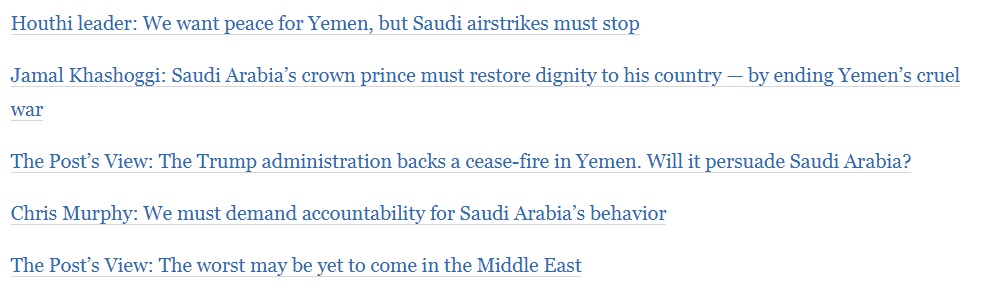
It is that filtered view that is giving light to a behind the curtains support setting to Palestine and Hezbollah. Now, to be fair, a person should be allowed to be pro-Palestinian, if people are Pro-Israel, the other should not be denied, yet Pro-Hezbollah, to be in support of a terrorist organisation is a much bigger issue and that hidden part is becoming a lot more visible, especially when the news is shown to be so unbalanced, even when it is ‘fronted’ as an opinion piece. so when we see the links (as an image), whilst it is almost all openly ‘anti-Saudi’, yet the fact that the atrocities that Houthi and Hezbollah have been largely the cause of, that absence is making the news not democratic, but a shadowy version of niche events presented as factual truth, whilst the given view on the larger scale shows this absence to be close to utterly unethical, especially for a paper like the Washington Post, whether they are now staff-1 or not.

1982 kilometres from Beirut

So how should we react to: “Even U.N. Secretary General Antonio Guterres submitted evidence to the Security Council that Iran was supplying ballistic missiles to Houthi rebels in defiance of U.N. resolution 2231“, which links to a 2014 article, yet the truth is that this has been ongoing and even as Western Europe is puckering up towards Iran to a much larger degree, leaving the political response against Hezbollah unanswered and more important Mohammed Ali al-Houthi is not seen as the guilty party he should be seen as. It is often stated that any aspiring tyrant will consider peace on the eve of defeat and that is what we see now. Even as we are treated to ‘Arab coalition to allow Al Houthi medical evacuations from Yemen: UK‘, we also see ‘Wounded Al Houthi rebels to be evacuated‘, yet what about the 80,000 children on the brink of death due to famine? Even as some might applaud the Saudi Coalition victory, seen though: “Recent high-ranking defections among erstwhile allies of Al Houthis signal further such splits as the Iran-aligned militia suffers setbacks at the hands of the Saudi-led coalition, experts said. This week, Abdul Salam Jaber, who had served as the information minister for Al Houthis, defected from the militia and fled the Al Houthi-controlled capital Sana’a for Riyadh. He said the rebels were “breathing their last”“, the biggest responsibility should be to the Yemeni civilian population in such distress through famine and disease alone. Even Deutsche Welle reported ‘Yemen Houthis seek truce with Saudi coalition‘, yet nothing on those starving to death and even as the Deutsche Welle gives us “The three-and-a-half-year-war has pitted forces loyal to President President Abed Rabbo Mansour Hadi, backed by the Saudi-led bombing, against Houthi rebels associated with Tehran. Saudi-led coalition has recently intensified the bombing in the key strategic area of Hodeida. A blockade of the port city could trigger unprecedented famine“. Even as the blockade might be tactical, the fact that food has been withheld from the civilian population to a much larger degree through the Houthi whether or not employing Hezbollah tactics is also absent here.

For me the problem is a lot larger, as we clearly see the impact of Hezbollah and the absence in the media, the media is becoming less and less reliable, especially as the stories remain one sided. There is a larger part in all this. Personally I am not convinced that this is the complete picture, and I need to make it clear that this is speculative. It is my personal belief that when we consider The National (at http://www.thenational.ae) and some of its unconfirmed articles, some might have seen: ““This was no rogue operation but, rather, a function of Hezbollah’s “financial apparatus,” which “maintained direct ties” to both Hezbollah commercial and terrorist elements,” he wrote in a report published by the Washington Institute of the US Treasury designation of Nourheddine, which preceded the arrests. “Within days of this designation, Noureddine was arrested in France along with several other accused Hezbollah operatives“, as well as ‘Operation Cedar—of which the Treasury designation was just one part‘. I am amazed that the Netherlands were not more visibly mentioned in all this. It seems weird, almost unfathomable that this was all achieved without the use of Rotterdam as a point of transit. Even as transitional cargo is not really looked as, as the Netherlands was not the end destination, it is the biggest world hub in getting containers and bulk cargo from anywhere in Europe towards Asia and the US (and vice versa). This implies that Hezbollah political players are seemingly active there too. The article does mention the Netherlands, yet in a much more ‘timid’ capacity. We see: “Cash was dropped off at hairdressers in Antwerp in Belgium, a large hotel in Paris, a restaurant in Montreuil or a café in Enschede in the Netherlands. Transcripts showed that Mr Noureddine would hand out orders for the collection of as much as 500,000 euros at a time. Six figure sums were often delivered in small note denominations” and that makes sense for the German part (Enschede – Germany) is a distance you can walk (4.5 km) with a highway to Gronau, so that is a place to easily get into Germany (and the opposite direction), hundreds of containers a day take that route. when we consider the news a month ago, when the Dutch were confronted with: ‘Dutch politician praises pro-Palestinian kite show featuring Nazi symbols‘, my assumptions and speculations might be shown as correct, yet is that the actual part in that? So when the Dutch were treated to: “Rens Reijnierse, a lawmaker from the southern city of Vlissingen” and his Pro-Palestinian view “Kites at Pool Beach. Beautiful autumn day in Vlissingen. No wind so the kites won’t fly but the project for Palestine still succeeded,” he wrote” as it was tweeted gives light to not merely a Pro-Palestinian view (which should be allowed) to an optional facilitating Pro-Hezbollah view (a speculative view by me), which is another matter entirely, if that would prove to be true, and even as I mention one person, I am convinced that the anti-Semitic vandalism as shown 6 months ago in Amsterdam was recorded to have risen by 40%. From my speculative mind, there is no way that this does not include a wave of Pro Hezbollah people giving light to a much larger danger on a global scale.

The size does not matter here, the fact that the media is allegedly shuffling this part to the bottom of the news pile is an issue and the few parts I have shown here, should also give rise that the media to a much larger extent is seemingly doing this. Merely Google ‘Hezbollah‘ for the last 24 hours and I see an absence of The Guardian, The Independent, the Times, and several other large newspapers in Europe. Do you really think I was making that up? It is not merely what we see; it is what we do not get to see that shows us that there is a much larger problem. Optionally there is a hidden danger, which is nothing to speculate or allege to. Those who are not in the news are often quickly forgotten and that is the true danger that Hezbollah is representing on a global stage. You merely have to view the thousands of images that show the nightmare that Hezbollah has been part of to see the danger that they pose, the fact that Iran is willing and has been shown to fund this is the icing on the cakes of Iran and Hezbollah, the fact that the media skates around it makes the cake more delicious for both these players as they are not given the limelight of their actions.


Leave a comment

Filed under Finance, Law, Media, Military, Politics

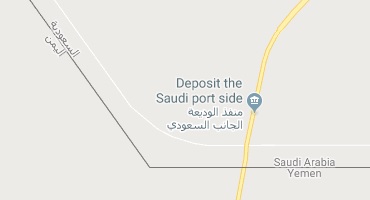
Borderlines are not borders

Yes, that is the setting we seem to forget at times. You look at google Maps, look at the country/location and at times you forget that one country is not limited to the borderline you witnessed. Some will Google ‘boobies’ and ‘bikini’ and look in amazement on how good thing seem to be North of the border. Yet, we forgot that there is still a trap. That it is for the most an imaginary line. Birds never seem to see one and diseases notice it even less, so as we got exposed to Cholera this week, we see “RIYADH: Saudi Arabia confirmed one cholera case and said three others were suspected in an area bordering Yemen, where an epidemic has killed more than 2,000 people, Saudi state TV said, citing a health ministry official” (at https://www.channelnewsasia.com/news/health/saudi-arabia-reports-cholera-infection-in-southern-province-10727266), yet do we comprehend the danger that is evolving? You see, we can rely on numerous sources and accept: “Cholera is an infectious disease that causes severe watery diarrhea, which can lead to dehydration and even death if untreated. It is caused by eating food or drinking water contaminated with a bacterium called Vibrio cholerae“, we seem to forget too often that ‘infectious disease‘, ‘leads to dehydration and even death if untreated‘. The treatment is actually simple. We are also given: “you can protect yourself and your family by using only water that has been boiled, water that has been chemically disinfected, or bottled water“, that part is important right now. You see, antibiotics ‘reduce the duration of diarrhoea by half and also reduce the excretion of the bacteria, thus helping to prevent the spread of the disease‘, yet the true treatment is Hydration and that is where the problem starts. Yemen is in a state of famine and shortage, so not only is there almost no water, there is in addition no way to boil that water, continuing a cycle of symptoms and a spread of the bacteria (and so the disease). At that point, dehydration becomes the killer leaving death in its wake and in Yemen that is unlikely to be mere dozens or hundreds; it will be killing thousands of people. So they are not too fearful of bombs and war slaughter, cholera is much more certain to kill them and do it at a slower pace, ensuring that suffering is maximised. So even as one case is found in Saudi Arabia, it is in my personal view running rampant in Yemen where more than 2,000 people have died of cholera at present and the estimated 5.2 million children that are in danger of dying of hunger, measles, or diphtheria are at present more than likely on the death list of cholera. Making the Battle of Al Hudaydah not merely an essential one, but making it imperative that it is won by the Saudi-coalition as soon as possible.

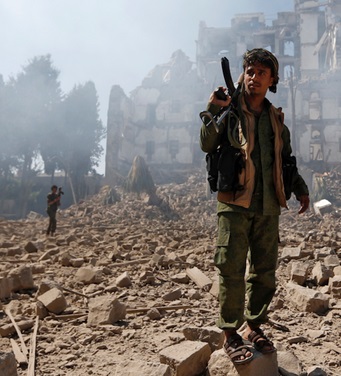
As we see the outspoken lies of the Houthi’s claiming that they are defending Yemen from a ‘US backed invasion’. That whilst they are knowingly, willingly and intentionally letting the Yemeni population die in the most horrible way imaginable, we need to wonder how much humanity we need to show the Houthi’s in all this. You see, the alleged Houthi in the image, an image merely 16 hours old (if the source it to be believed) does not seem to look that hungry, making the issue of who gets fed more important, and beyond that, if the Cholera treatment (hydration) is not made openly available Yemen could become the biggest graveyard in history. It is there that the setting of the Battle of Al Hudaydah is clearly shown and it is about to get worse. You see, as more and more refugees flee Yemen into Saudi Arabia with their malnourished and dehydrated children and babies, they will also push Cholera into Saudi Arabia. Even as we know that Antibiotic treatments for one to three days shorten the course of the disease and reduce the severity of the symptoms, and therefor lessen the dehydration, the setting is now also that there are sources that have given view that resistance against antibiotics have been reported, making matters less easy to resolve and therefor more water is needed to remain hydrated, and that is not even including of the backlash of other diseases in younger children because of the Cholera impact. DA Sack, RB Sack, GB Nair, and AK Siddique in their January 2004 paper in The Lancet “Cholera” give us the frightening part: “If people with cholera are treated quickly and properly, the mortality rate is less than 1%; however, with untreated cholera, the mortality rate rises to 50–60%“. Here we have the larger setting, you see cholera does not give a hoot about borders and now that the first cases have been reported, we see not merely the danger of the disease, we see the dangers that if any of these refugees would make it to a city like Khamis Mushait they would have passed half a dozen smaller places like Al Masgi, that is if they even maker it that far. For me 80 Km is a stroll, for a lot of others it is a mountain and refugees, even if given assistance, caring Muslims, giving them a ride on their trucks towards a decent hospital, or even trying to treat these people (especially when it was not clear that it is Cholera) might see a larger problem evolve. Even as we accept that Cholera is rarely spread directly from person to person, which is a good thing. I wonder how dangerous the disease is when we accept that bodies are working in a state of lowered hydration. You see the Arabian continent has dealt with water shortages for the longest of times. Over generations these people learned to deal with less hydration (personal assumption), yet in that light does cholera not become a lot more dangerous and could that optionally make these people more susceptible to cholera? I am not stating that this is so, I a merely asking (as I never qualified for a medical degree).

It also gives us the setting that as cholera cases grow, the issue around the Battle of Al Hudaydah will show to have a nasty aftershock. it will no longer be a mere case of humanitarian aid and treatment, there will be a much larger need to set up emergency treatment posts, especially North of Saada. In my personal view, a place like Baqim is directly connected to Saudi highway 15 after you pass the Saudi port of Warcraft, going directly to both Al Hayat National Hospital as well as AlKhamis Maternity and Children Hospital giving Baqim a possible lifeline for treatment, medication and most important clean water (food too). Even as we accept that antibiotics are essential for the younger children, the reported resistance against antibiotics might become a much larger complication down the line and realising that danger now is important too.

We need to see on how we can stop all the diseases but Cholera is now the most impactful. That is shown when we realise that the WHO reported in 2016 a total of 132 121 cases, with 2420 fatalities. We now see that with the Yemen fatalities, we get to report that close to 50% of all cholera fatalities were in Yemen, how does that go over with you all? That is besides the setting that Yemen alone will be likely the reason that cholera cases will more than double and if something is not done soon, with well over 200% additional fatalities, which is not a good statistic to work with. We can argue on where the treatment needs to be and i merely took a look at the map, yet the idea of getting as many children as far away from Sanaa and Sadah seems to make perfect sense. I am also very accepting of the statement “The WHO said on Monday the origin of the current cases was not yet known but the outbreak was not expected to spread given Saudi Arabia’s infrastructure“. I get that, Saudi Arabia has a good infrastructure and is equipped for matters like these, especially when you consider the Hajj and the fact that the Kingdom of Saudi Arabia is always prepared for that. Yet, when it is not a mere handful, when the sick refugees are not merely a few, but a few hundred, we will see more complications and moreover an increasing amount of people hiding in fear, fear of disease, fear for their families and fear of others after they witnessed nears of Houthi brutality. Setting up something sooner rather than later on the Yemen side of the border is becoming increasingly pressing as I see it and not merely for the cholera risks. Diphtheria is a much larger problem if it gets a foothold, not merely from the infectious of the disease, the fact that Diphtheria grows its population through coughing, sneezing and sharing water bottles makes it a much nastier issue. It is fatal in 20% of cases in certain age groups, and guess what, children up to 5 are definitely in that risk group making the issue bigger and even as it can be treated with antibiotics, the reports of resistance become a much larger issue at this point. In addition its symptoms are easily mistaken by non-medical professionals as merely a sore throat for too long making matters worse faster than anticipated. with the fact that it spreads easily we get the state where every day not acted is one that is basically too late and we have seen the inactions in this regard for months now making matters not merely worse, it sets the stage where famine is merely the final straw that could get the largest child population in history killed. So at what point did we think that indifferent from the 22nd March 2015 was a good idea?

It makes for the saddest epilogue of the modern era: ‘We merely did not care enough to achieve something in Yemen‘.

So when you see the news and you feel that the EU is doing OK as it talks with Iran via: “Iranian Foreign Minister Mohammad Javad Zarif has urged European countries to take practical steps to keep Tehran in the nuclear deal“, consider that Iran is directly involved and responsible for this by making Yemen a proxy player, arming them and supplying them, prolonging this war, the last missile Iranian sponsored missile was fired by Houthi’s at Jizan city almost 6 hours ago.

You should wonder on how the EU could even contemplate continued talks with Iran under these conditions. Where was the borderline there?


Leave a comment

Filed under Finance, Media, Military, Politics, Science

Price of freedom

What is exactly the price of freedom? We hear it all the time. Certain things must be done so that we can remain free. You can hear it in the US, the UK, France, the Netherlands, Australia even in New Zealand it can be heard (not just from the sheep). No, it is that currency, freedom that is the question. You see, what exactly is that price and what does every nation have to pay, so that they can be free. When was the last time you considered that part?

When was the last time you got a clear instruction on how to launch a missile so that it lands EXACTLY in what the Houthi’s call “Two ballistic missiles were fired on Saturday evening from Yemen into Saudi Arabia, allegedly targeting Khamis Mushait, a city in the south-west of the country, the coalition forces announced“, whilst in the Saudi Gazette we see: “the other failed to target any populated areas of the city after landing in a desert area“. Now consider the claims we have seen in the past weeks on how they were targeting specific places in Riyadh, which is several times the distance that we saw approached now and the Houthi’s cannot get that right 50% of the time. So when we see “Missile launched at Saudi capital, Houthis claim responsibility“, what are they actually targeting, are they targeting anything? I believe that there are two kind of teams working in Yemen, an Iranian and a Houthi; the better shots were clearly Iranian and with the quote ““This hostile act carried out by the Iranian Houthi militia proves that the Iranian regime is still providing the terrorist Houthi armed militia with qualitative capabilities…with the main objective of threatening the Saudi Arabian, regional and international security,” Al-Malki stressed in the statement.”, the statement is not wrong, but it is not correct either a I personally see it. I think that the Iranians are actively training Houthi troops, so when we realise that they are intentionally firing into dense populated civilian areas. Why is there not a much stronger response from Europe? It was only yesterday that the independent reported (at https://www.independent.co.uk/news/world/middle-east/iran-nuclear-deal-latest-eu-donald-trump-sanctions-miguel-arias-canete-a8359126.html), that ‘it remains committed to accord despite Trump’s withdrawal‘, so that is the price of freedom, a nuclear deal with a nation committed to act in terrorist ways via puppets. The question becomes, what is this so called freedom worth to you, because when you are called on the accountability of what your politicians are doing, are you ready to pay that bill?

In this regard, the Conversation (at http://theconversation.com/trumps-high-stakes-gamble-on-the-iran-nuclear-deal-could-work-96449), offered an interesting thought. With “Though Israel provided a great deal of proof that Iran had lied about its nuclear program in the past, no evidence was offered that Iran was continuing the past record of deceit. The vast majority of experts agree that there is a greater likelihood of an arms race in the Middle East without the agreement than with it“. The statement is more important than you think. You see in the first we get ‘Iran had lied in the past‘, we also get ‘with a nuclear deal there is a smaller chance of nuclear arms acceleration‘ and ‘there is currently no evidence that Iran is currently acting in falsehood‘. They are important because if they lied then, what is stopping them from lying now? There is evidence of Iran acting in falsehood when we look at Yemen, now we have a ballgame, because any evidence of any level of nuclear advancement is a signal for Saudi Arabia to do the same thing, they clearly stated that. The conversation is in the belief that a nuclear deal is better, yet they call this not on the setting it is in, they are now about: ‘There is a chance the re-imposition of sanctions could work. However, it is a high-risk gamble‘, it is set as ‘a possible defence of withdrawal’, it was not about the withdrawal, it is about the nuclear setting where Iran will do what it pleases as it has done so in the past, allowing Uranium into Iran, whilst all players agree that monitoring precise Uranium numbers is not an actual reality, and with both Saudi Arabia and Israel on the firing line, it is not a high stakes gamble that they are willing to make. And leaving the decision of such a gamble with people who are not on the firing line is folly, because they pretty much have nothing to lose, in the worst case, their ego’s get to take on for the team. Explain to me how that was ever going to be a good idea? It gets even worse when we consider that President Rouhani is only in charge as long as the clergy and military agree on his actions, how exactly is that called being in charge? We get this from the NY Times on May 9th, where we see “Iran’s supreme leader on Wednesday hinted that his country might step up its nuclear program, signalling a possible escalation in an already volatile relationship with Washington after President Trump announced he was pulling the United States out of the 2015 nuclear deal”. So that is an outcome that the clergy decided on (apart from their advanced degrees on nuclear physics)? The stated issue by Ayatollah Khamenei is a dangerous one, in light of other materials, there is an increased issue that this deal was not a good idea from the very start.

I still believe that removing the Iranian navy is a first move, not only does it hurt their morale, it sets the Iranian clergy directly in opposition against the military, merely because the clergy thought their side to be invulnerable, there is nothing as uncommunicating as a clergy that knows that they are a direct target. They become the axial in a blame game, a good place for Iran to be in internally (for us). The biggest Issue I saw was not on some Iranians, merely on that a future president could end up being another Mahmoud Ahmadinejad and as such the escalations begin again, yet now that person has nuclear options not a thought you would ever be willing to give any extreme Iranian president.

The issue is not merely the nuclear deal, it is Europe as a whole. When we see “Miguel Arias Canete, the European commissioner for energy and climate, said the 28-nation bloc, once the biggest importer of Iranian oil, also hoped to boost trade with Tehran“, they are ‘hoping‘ to boost trade. This is merely an economic necessity, the European economy is reported to be good, but now consider, it is 1941 and you are willing to deal with Nazi Germany, just to look economically better. Make sure you see the 1941 reference; this is no reflection on today’s Germany. Boosting trade with Iran comes at a price. Now consider that this has been going on for a year and now Iran states: “I would love to do this another three years, yet my good friend Turkey should be allowed in the EU“, now what will happen? A nation that should by the EU’s own standard never be admitted is now optionally a new EU nation. In that part when we consider the quote: “Mr Salehi said Iran had several options, including resuming its 20 per cent uranium enrichment if the European countries failed to keep the pact alive. He said the EU had only a few weeks to deliver on their promises“, this alone is an issue, because it is feasible that Russia has been delivering the hardware needed to an undisclosed location, now setting a different stage. In all this the EU is so willing to set the price of freedom in the basement, whilst knowingly endangering both Saudi Arabia and Israel.

The nightmare scenario

The nightmare scenario is not that Iran becomes nuclear; no it is the same issue when we look back to the era of Nazi Germany. I still personally believe that the State If Israel got created in an effort to get the blood rage that would have haunted Europe for decades off the streets, that danger was very real in 1945-1948. The Dutch NSB members, the Germans in general, we also get the quote “This was a time of often enthusiastic collaboration with the Third Reich, as French police and paramilitary organisations were among the many who rounded up ‘enemies of the state’ and sent them to Germany for extermination.” (I think that this was merely part of occupied France), or what we get from historian Jan Grabowski “‘Orgy of Murder’: The Poles Who ‘Hunted’ Jews and Turned Them Over to the Nazis“, at this point we have 4 countries where a people in utter rage could have persecuted Europeans for decades, that ugly reality alone and not even considering Belgium, Denmark, Italy and a few other places, on how long restorations would have additionally lasted. I am close to 100% certain that it would still be going on by the time I was born, so that image is part of all this.

The reason is that once this goes wrong, when we are optionally going to be a witness to a lynching unlike we have seen for 350 years. When this goes pear shaped and it is close to a certainty that it will go wrong, those who politicised this to happen, might in person feel what it was to be like Cornelis and Johan de Witt, who both got lynched and mutilated by the angry mob on August 20th 1672. These politicians will hide behind complications and mere uncertainties, but so did those who opposed the house of Orange, it did not end well for them.

When that happens, Europe will fall into anarchy, it will happen not because it is destined to do so, but because too many politicians have been trying to sell a bill of goods and there will be escalating levels of mistrust and anger. In this it will not matter whether Saudi Arabia or Israel will get hit, the hit will be enough to make every European politician a valid target for hunting and lynching. Their entire approach to keep every deal going whilst there is too much overwhelming evidence of the unacceptable acts by both Turkey and Iran will be the fuelling cause for it all.

After that I have no way to make any predictions, some politicians will take a long vacation in a nation without extradition the moment things go massively wrong, or try refugee status in America, but those who do not get out in time, will not have any options, they will, due to their own stupidity get hunted down.

Why?

That question is actually a lot more important than you might think. There has been an interaction of politics and media, that has never been a secret, yet in the past there was a level of balance, now, in the age where it is all about commerce and circulation, we see a different setting, the media at large are for the lack of a better term no more than a concubine, who splits her attention between the advertiser, the shareholder and the stakeholder. None of those three are the reader by the way; they merely get introduced to what we now call ‘stories of eventuality‘, which is different from actual news. Most papers merely use what Reuters offer and work with that foundation in any way that they can. This is not a national issue; it is a global one, so when something is not actually nationally set (apart from big events), we do not get the news we get some paraphrased context. Now consider that we have had that for 3-4 days and suddenly there is a nuclear explosion in Riyadh, Jeddah, Tel Aviv or Eilat. When that happens, do you think that the people will remain calm? No, they will be scared out of their minds and all the pretty stories that the news gave, and all the politicians who hid behind ‘we do not expect this to happen’ or ‘it could be so good for us all if it works out’ will not stop a group of people who will add up to many millions, their fear will catch on and they will hunt down anyone related to the Iran Nuclear deal and the messages that they handed out. Like Johan de Witt, they will be trying to get away, but an enraged crowd of that many people cannot be avoided, the only issue is, can those who signed it see that danger in time?

Is there real danger?

That is the part no one, especially me can predict. There is too much not known and even more at times misrepresented, so it is not likely but that merely is set to the foundation of facts, and we are often not given facts, merely speculations (even I am to some degree speculating), I am trying to stay as real as possible, but in light of what I just gave, based on the founding facts that we all have been able to see around us for a few years now. When the fears of nuclear events become reality, which person will not go into fear driven panic? All that, because the politicians of today are set in a battle arena where it is all about the economy and anything that can contribute to that economy must be embraced no matter how the political setting is. That is the setting and even as there is no real stability in that setting, as we see pressure on more than one currency, we will also see the need for intense economic growth and some will give representation that Turkey give options in this, that is the first moment where failure will translate to pressure, when that happens all bets are off and in light of those sliding values, should Iran (yes, I stated ‘should’) do one stupid move in any nuclear setting we will see a different kind of fallout, we will see the kind where the bulk of 740 million Europeans will all pretty much lose it on the spot, that is the moment where we will see on how ‘speech making’ will be a hangable offense to those people, no courts, no judges, millions of hysterically enraged (enraged through fear) who will seek people to hold accountable (the blame game), that is the wrong day to be a politicians, let me tell you that much.

Now, I do not think the danger is that big, although it is directly linked to the acts of Iran, so it is not zero. The real danger is grown with the moral setting of both Iran and Turkey, the fact that some want to keep the discussion going, whilst it should have been discontinued a long time ago will also count. We are heading into murky shallow waters and the end game cannot be predicted, merely because of the amount of players and they all have their own needs. Yet the one part that I do not fathom is that some are willing to add the ‘price of freedom‘ as a currency to calm both political and economic waters with people who have no regard for either element in that setting, a dangerous precedent I think, but that might merely be me.


Leave a comment

Filed under Finance, Media, Military, Politics

Your GCC resume

Qatar remains in the news, some are looking at the $5.9 billion deal in Italian dinghy’s, others look at the cancelled deal to become an American Airlines stake holder and others like me are focussing towards the GCC futures. According to the Defence minister Khalid bin Mohamed Al Attiyah this setting is not in an increasing danger. The problem is not merely the GCC in itself, it is what you will not see in many newspapers, it is the overhanging impact on OPEC. The news given by Oilprice.com is “All GCC countries depend on stability in the oil and gas markets, which is evident from the recent OPEC deal. A full-fledged confrontation will, without any doubt, put pressure on the current compliance rate of OPEC members to production cuts. Doha will be able to sabotage the current 6+3 production cut agreement between OPEC and non-OPEC members. If Doha decides to join the ranks of Iran and Iraq, OPEC’s future will be in doubt” it is at the very end of the article (at http://oilprice.com/Geopolitics/International/Clash-Between-Qatar-And-The-Saudis-Could-Threaten-OPEC-Deal.html), yet that in itself is not the bacon maker, or if pork is taboo, it is the lamb to the slaughter. When we see: “The Arab criticism may have been less harsh if U.S. officials would not have put oil on the fire. U.S. Secretary of Defense James Mattis openly warned Qatar that it should change its support of the Muslim Brotherhood. Mattis also stated that U.S. president Trump is considering classifying the Brotherhood as an international terrorist organization, which could have a very negative impact on the U.S.-Qatar economic-military cooperation in the coming months“, this reflects right back to the pressures that the American players where trying to establish through pressuring the WTO issues as written yesterday (at https://lawlordtobe.com/2017/08/02/a-big-tree-in-the-desert/). Another source (Leaprate.com) gives us the links to Iran and re-elected Hassan Rouhani. Here we see “America’s new-found protectionist outlook and open contempt for the JCPOA, has put a question mark against its future, while Iran’s ties with Qatar, currently the subject of embargos by many neighbouring states, is a further concern for investors“, this is the part that most do not get informed about. Partially the US has a valid point as the previous president of Iran was openly waging war towards the US and against the state of Israel. The dangers as I gave them years ago, especially in the light of the nuclear treaties is not how good or how reforming the newly elected President Hassan Rouhani was, it is the issue about the next person, who will get the presidential trophy in 2021 and what happens then? This is the long term worry, most will agree that one extreme leader on the edge of insanity is good enough and keeping that person in North Korea is for now the best place.

Yet, that was not what this is about, when we consider that the JCPOA (also known as Joint Comprehensive Plan of Action), we see the given by Ali Akbar Salehi with ““After JCPOA, our oil production has soared from 1 million barrels per day to 3.9 million bpd,” IRNA quoted Salehi as saying on Sunday, two days after the two-year anniversary of the action plan. This marks a success for Iran’s oil-based economy in reclaiming its market share lost over the years of sanctions“, the issue is that this directly opposes OPEC with “All GCC countries depend on stability in the oil and gas markets, which is evident from the recent OPEC deal. A full-fledged confrontation will, without any doubt, put pressure on the current compliance rate of OPEC members to production cuts” for the UAE and Saudi Arabia that is a problem, as Iran has increased its production by nearly 3 million barrels a day, the other players have to decrease even more, which means that they are hurting well $150 million a day or we will see the pressures shift all over the Middle East, which is not good for America (or the UK for that matter), because that impacts what Saudi Arabia can buy, and the monthly $4.5 billion is partially for the hardware delivered and expected before December 2017, so as these sales paths are impacted, we will see a level of hurt all over the weapons of mass consumer requirements market.

So we have valid and greed driven concerns regarding Iran, in this the Qatar issue does not help and the play that the US is making as we see it should not be considered as a beneficial path. No matter how valid the present situation is as we see it given through the Russian Academy of Sciences, Stanislav Ivanov is giving a present truth with “The main line of Tehran’s policy is to get out of sanctions and gradually restore its economic and financial potential“, we do not deny this, yet the past decades was about setting the pressures to Iran as the western nations had to deal with extremism, in addition to the funding that Iran gave Hamas as it kept on attacking the State of Israel, there are ample issues in all this as the strategic setting before 2021 (Iranian general elections) could face the US, Israel and Western Europe with an economic revitalised Iran, which will be pushing the players back to square one if that seat will become the sitting arrangement for another Mahmoud Ahmadinejad, which is not out of the question.

When that happens, those with a GCC resume, with or without references to OPEC might wonder where their employability resides. Now, if they have been smitten with a 7 figure annual income, they might not care, yet those without that part for at least 4 years might need to scrape by, having to live on $40K a month for the rest of their lives. I can advise these people that it can be done, if they shed the 4 luxury cars (Ferrari, Lamborghini, Maserati and Bentley), give up their membership in the Yas Links Golf Club, Almouj Golf and The Majlis, Emirates Golf Club as well as their 4 bedroom apartment in Riyadh and they are already half way there. So how serious is this? Well, it is actually a lot more serious than most people realise. When we consider that the GCC is a realistic target for cyber-attacks and cyber terrorists, Raytheon is setting up technological barriers to thwart to some degree these plans. the issue is not what the presentations give, whilst we do not oppose of attack the stance that CEO Thomas Kennedy has, the quote (source: Raytheon) “It has since reinforced its cybersecurity capacity with the purchase of 14 companies. In 2015, it acquired a company called Forcepoint (previously known as Websense and Raytheon|Websense) to enhance its commercial presence. This is now the world’s second-largest privately-held cybersecurity firm. Raytheon recently secured a five-year, $1bn contract for the US Department of Homeland Security to help defend “.gov” websites from cyber-attacks. Now the goal is to bring that working knowledge to the Gulf” is merely showing a deficit in the technology. Acquisition is a partial solution to any cyber given industry, the given premise to survive is not what can be bought today, but what must be developed for tomorrow. You see the firms that have that focus tend not to be for sale in the first place. Whilst Raytheon’s focus is very valid to catch up, it is much less a solution for those who are arming themselves for tomorrow, their own missile system department can teach them that part. It is not merely about the technology, it is the development of new systems in cloud and non-repudiation that will give the GCC and other gulf places the edge to be ahead of the cyber-attack curve. A partial issue is found with “We have one of the best data-leakage protection systems in the entire cybersecurity field, and we combine this with our insider-threat behaviour system, which detects suspicious activity and ensures IP and data is not compromised“, which might be non-false, yet the events as Sony has seen shows that the reflective comments are from a behind the wave assessment, with HBO being an example as they were hacked a few days ago. The one provider that relies on cyber security as it sells its value through Netflix is now giving Vanity Fair “When Netflix was hacked earlier this year, the cyber-criminals behind the attack demanded a ransom. But there was no such demand in the hack that struck HBO over the weekend, and the sheer amount of compromised data has led some to believe that video footage, internal documents, or e-mails could be leaked next. The premium-cable giant is working with the F.B.I. and cyber-security firm Mandiant to investigate the breach, in which hackers claimed to have stolen 1.5 terabytes’ worth of data“. This is what Raytheon is up against, not some access issue, but stopping the drain of terabytes, basically every part of the GCC removed in mere hours, whilst the cyber minders were in the dark until after the event and the quote that follows (at https://www.vanityfair.com/hollywood/2017/08/hbo-hack-seven-times-larger-sony) “A traditional business-grade D.S.L. link would take about two weeks at full blast to exfiltrate that much data,” Farsight Security C.E.O. Paul Vixie told T.H.R. “If not for video and sound, a corporation the size of HBO might fit [entirely] in a terabyte, including all the e-mail and spreadsheets ever written or stored.” Another expert added that the entire Library of Congress contains an estimate of 10 terabytes of print material—so it is almost certain that video and/or audio were stolen“, this directly reflects on Raytheon. It is not what we know it is what others have figured out that is the issue. Whether it was through frame leaking, through cloud replication, there are issues that remain non-secure, even as security is at the top of the salespersons mind. There is a need for a new designed system no longer merely on access, but on ‘bio wired’ non-repudiation that is driving the need for evolution and these sales forces have remained in denial as it is something that they cannot offer at present, so they reflect on it as being a non-solution, a non-reality. They stick to the solutions that they can sell now and that is where the GCC finds itself, the lack of visionary evolution of data systems.

So when Raytheon gives their next presentation and someone at the GCC asks “How can we assure that the Bolero electronic Bills of Lading are not stolen or corrupted?” what happens then? Will that person at GCC need to write his resume tout suite, or will his superiors realise that the question was valid and that this situation is an immediate threat to the GCC members? Because in this day and age where extremists are all about the attack on infrastructures, the Bolero Title Registry, the repository and application that manages the transfer of title of the eBL is a clear weak point. Ones the recipients are scrapped and the cargo gets locked down, the ship will have two issues. The first being that the ownership cannot be transferred, you might think that this could be solved in a few days, and that would be right. The direct consequence is that the transfer of oil stop would cost an additional $578,000 in port charges, twice the amount in addition for pilots and towage fees. And as they are moved around additional costs will be incurred, that is apart from the issue that the delays bring and when a visionary does find the way to reset ownership, the delivery of 1 million barrels comes down to a nice $50 million fee, that optionally went somewhere else.

The one place where cyber security was essential is as given in indications running behind and not catching up; the only way to do that is to get ahead of it all. Now, as stated, this is not an attack on Raytheon, this is merely the direct issue on the business need to set serious cash into evolving the new systems to be ahead of the curve and be in a state where the hackers learn that it is not merely about access, the nice part of adding a new ‘language‘ to the plot is not to delay their invasion, it become to take away their comprehension of what they see (hopefully for longer than short term). You see, I have loved Cisco solutions, but they all talk the same language and their precise documentation have been a real assist on those with no-good intentions, we merely need to ask Google ‘what does a cisco frame look like?‘ and we get so much information, enough for too many to get to the heart of the matter and in the early stages of the internet that was a really good thing, we need to move beyond certain settings and push towards dedicated systems that have additional layers of protection, now that might be a mere delay, yet consider what is being protected. How willing are you to keep data safe? Not merely oil data of ownership, in the age of Netflix whilst hackers are streaming the episodes by the dozen, depriving places like Sony and HBO from valid revenue, revenue they invested in, the game needs to be changed. We have seen the uselessness of some governments as they were facilitating towards the communication sellers on bandwidth; we need to change the game regardless of those players. One way to do that is remove their existence to impact. Google did that to some extent, but not to the extent needed. As we realise that providers are 15 dimes to the dollar, we need to set a different scope, not merely in the cloud, but in the need for dedicated non-repudiation. Only then can we make a first effort to push the boundary towards a safer zone. And perhaps Raytheon will bring that to the table, the fact is that we do not know the player that delivers the need of tomorrow today, we merely know that it will not be Beaker bringing it (a Muppet Show reference). In this the ‘evidence’ can be seen when we realise that Raytheon gives us John D Harris II and his view on how forward thinking Talon laser guided rockets are. Yes John this was really the need for Cyber safety! As we consider the issue beyond point-to-point communication. In addition the $100m development program reads sexy for your bonus, yet the issue is data, both at rest and in transit. There are the issues, not in the rocket man shooting by a member of the UAE air force. So as we moved from certain parts of the GCC, via Iran to other providers, we need to see and comprehend that there are several players, all with their own agenda, a perfectly sound and valid situation, yet when we see that stability is centre in all this, destabilisation will impact both the GCC members, the OPEC members and when the overlap is shown (those in both), we need to realise that Iran and Iraq will not care about the needs of the GCC, they are not part of that, which ties hands of the six GCC players and in that Qatar is the centre of the seesaw that the 6 members prefer to have in some level of balance, yet the issues as we are seeing them escalate will impact all the given needs for all the players having their ‘own’ needs to satisfy. None of that is likely to happen any day soon. We could see the US and both their needs towards JCPOA and the WTO as an opposing issue, one that is not beneficial to the GCC or the Qatar issues as they are playing. I cannot say what the GCC members should do next, but it seems to me resolving some parts and creating a new initial balance is the best way forward. This gets me back to the question phrase yesterday. If each of the 4 members could phrase one issue to resolve by Qatar, what would that be? If Qatar can get the conversation started on that, as merely a first show of good will, yet from my point of view, if they Promise to have a good look at Al-Jazeera and do some immediate reforms there as a first step of good will towards the four opposing parties, it might just be enough to reduce tensions and give time for non-escalations to settle and as such forward momentum in resolving issues will be found. In my view it would leave Qatar in a much better view by all other players and global non players. It will open the doors and perhaps that is a good beginning, merely a good beginning, but more than we have now.

And none of this, none of my views were set to painting any of the players as the bad people, merely a path to find the track towards profit and growth, profit for all the players and economic growth for all of them. In all this the one question that is forming in my mind is that Oman has been the one GCC member that is outside of the equation to some extent, could they be a mediating party in all this? I actually do not know the answer; I am merely voicing the question that I have not seen in the news. You see when you realise that Crown Prince Mohammed bin Salman has been the driving force behind Vision 2030, the economic diversification strategy. Is that something that a nation like Oman could see benefits in, when we consider diversification, when we realise that this impacts range of products as well as field of operation. Would it not be interesting how this view could be beneficial to the Middle East as a whole? In all this, as the driving force surpasses boundaries, is that not a field of economic diplomacy to see it grow? To push forward momentum is to find a place and subject of discussion, in my view it would be to find a topic many can agree on, a topic that is always a hard sell in most occasions and it seems to me that oil dependency is always a good option for those realising that it is the only thing they offer, by adding more options, any nation connected is merely opening paths to more stability and more opportunities, especially when these paths can be sold to nations seeking more than oil, which is close to every nation on the planet. Finding a place of stabile growth is the best product any player is ever likely to sell. In this stability is a lot more sexy than quick gain, especially on Wall Street and they are having too often too much to say on that matter. As we need a different language in the cyber world, it is clear that outside of that world a common language is the only solution. The question becomes what language and how to start the conversation, even those setting up their GCC resume right now. That is a fact as it is a resume that they want everyone to read, a comprehensible common ground is the first step in this.


Leave a comment

Filed under Finance, IT, Media, Military, Politics, Science

United we classify others

Two articles hit me a few days ago. One of them was an article describing a survey by the Reputation Institute. The news article titled ‘Tel Aviv ranked among least reputable cities‘. The article was found at http://www.timesofisrael.com/tel-aviv-ranked-among-least-reputable-cities/. This was an issue for me, because I have been to Tel Aviv. Why would it not be reputable, or at least one of the more reputable cities. In all that I wonder, because the top 600 cities (by population) are larger than Tel Aviv with its 425,000 people. So coming in at 92 whilst 600 are larger is still a good achievement. What puzzles me in all this is the part ‘least reputable cities‘. What makes a city reputable? I did not see the research or the questionnaire, but when we see “the Reputation Institute, asked 19,000 residents of France, Germany, Italy, the UK, Japan, the US, Canada and Russia to rank the world’s top 101 cities based on their levels of trust, esteem, admiration and respect“.

Trust, “In a social context, trust has several connotations“, which is nice yet did the interviewees realise that? The paper (at http://misrc.umn.edu/workingpapers/fullpapers/1996/9604_040100.pdf) gives a nice view on how trust is not an easy thing to tackle. at Page 43 we read “one can develop a good relationship with another person by gradually increasing Trusting behaviour, while at the same time decreasing any minor control measures directed at the other person. Decreasing controls includes less ‘checking up’ on the other person. It also includes moving from a formal relationship to a more personal, informal relationship

Which is nice when we consider that Russia, land of GRU and FSB gives way to ‘decreasing any minor control measures directed at the other person’, so do the interviewees from Russia consider trust the way a person from Sweden, the Netherlands or even Uruguay does? I can go on for the other nations, but in all, many have a feeling towards Israel, their view is biased from day one. Plenty with an anti-Israeli view, some with an anti-Jewish view, the probability of a mean will not apply here.

Then we get ‘esteem’, are they looking upon Tel Aviv in a particular way? Are they confusing esteem with ‘self-esteem’? All questions that go through my mind. We could state that Bagdad in last position is validly there, but over what level of reasoning? Because it is in a warzone?

Yet, do my thoughts invalidate the results? The paper as shown does give a solid foundation, the methodology sounds sound. In that I state ‘sounding sound’ is not entirely on the ball. You see, the heart of the respondent, how does that come in? The study overview states “G8 general public (only people who were ‘somewhat’ or ‘very’ familiar)” Yet what makes you somewhat or very familiar? How many Non-Jewish people who have been to Tel Aviv answered this? How many know this place. I was there, and I felt safer there than in Budapest (and Budapest is a decent and safe city). Tel Aviv scored less than Johannesburg, Hanoi, even Cape Town, known for its high crime ended up with a score better than Tel Aviv.

So what gives value to this report? This is not the setting of my view, it is a question. The question exists in my mind because if we give reputation and value to a place we must know and agree to the standards given here. That is the question that should be on your mind too. Now, you might not care about Tel Aviv for many reasons. The bulk of us will never visit the city, visit the country or end up anywhere near it. So how do we give value to a place, even when we are somewhat familiar? Yet there is more than just the result as given in the Times of Israel. Slide 22 when you get the 2015 reputation report (at http://www.reputationinstitute.com/), shows a very interesting part. Familiarity versus Reputation. So how about the places with low familiarity? How come their reputation is so high? Is it the media, because there again we see that Tel Aviv gets in the news when there are rocket attacks and terrorist issues towards Israel, so how can we consider reliability in this report? Beware my words, I am not stating that the methodology is in question, I am wondering how the validity of vision from the interviewee is correct. In a similar way, we can understand that Baghdad is graded poorly, but why is Tehran graded so bad, it is because of our impression of Iran? In that same context we might understand why Sydney, Stockholm and Melbourne are graded so high, yet in all this, what makes Zurich more reputable than Amsterdam or Oslo, perhaps because FIFA is placed there? With the FIFA news Zurich got a lot of visibility, but is that visibility correctly graded in the mind of the beholder? The issue here is the colouring by the media, that influence cannot be countered, which is why I think that Tel Aviv got placed so badly (in this 101 list). Behind all this is a bigger issue. It is the one reason why I object to some of these studies.

In my personal view this list caters to presentations and to some who need to see a national interest, it also places my own view in debate (as it should), not because my view is too shallow, but as we go through the iterations of reasoning behind this as we see in slide 24. The Advanced Economy gives view to the question ‘why is an advanced economy part of reputation or familiarity?‘ This connect on more than one level, which got me to ‘The Economics of Developing Countries‘, what makes for an Advanced Economy? In that view Peru, Chile and Uruguay are not amongst them, so with close to 1/3 of the measurement absent, in that case, how come Montevideo scored so high in that list? If it is the state of peace, we see something a lot more linking, Tel Aviv, Karachi and Abu Dhabi together, a pattern seems to emerge. In that view we must wonder as Tel Aviv is not in war, but under near constant attack. Now when we add Rio to all this, we see another pattern emerge, those not relying on ‘stability of peace’ we see the need for positive reinforced publications, Rio is certainly getting that. In all this we do not question the reputation institute or their methodology, it is all about the people giving their vote. It is that view which gives voice to my worry. Slide 24 is descriptive in all this. ‘Appealing environment’ is one, which give the view to ‘non war torn places’, Effective government is the second one. Yet, why is ‘effective’ government part of all this? You see, in my view, the most effective government is a corrupt one, a humane based government (like Norway and Sweden) tends to be expensive and not that effective. Perhaps effective government and humane government are terms that are interchangeable? I am just asking. In all this we see the four earlier words at the core of this. ‘Trust’, ‘Admire’, ‘Esteem’ and ‘Feeling’, so how does this all link?

Slide 25 gives us ‘Social, Economic & Environmental Policies’ in regard to ‘Effective Government’, are they for real? Environmental policies can be made more effective, but they do not, I say again absolutely not make for an effective government. In addition when an Advanced Economy relies on ‘Financially Stable & Future Growth’ we can state that Wall Street took care of that not happening in the last decade and in addition not for many more years to come, so when we acknowledge that the elements of attributes are an issue, does that not add question marks to the stated foundation of this report? In all this the summary from page 28 onwards makes sense. I do not disagree, I do not oppose it, but in all this, it is a view brought to us on the premise of a flawed view, the influenced view of the interviewee, that part is missing, which gives the question mark within me. This gets me to slide 34, a good reputation might influx tourism, yet in all this, the tainting influence of media becomes a colouring issue, discriminatory and revoking as we ignore or forget that perception is tainting and the press factor seems to be uncorrected for. So how is that not an issue in all this, or at least a non-correcting influence? This all gets me to the final part “living or working in the city, or deciding to invest in the city” might be deciding factors for anyone when the reputation is an issue, but on what foundation? Still overall the report remains an interesting piece of work, the supportive behaviour slide gives fuel to that.

My views do come to fruition in slide 40 where we see the two quotes “Communication is required to capitalize on good reality and overcome poor perceptions” and “Change is required to alter ‘reality’ and minimize reputational risk“. In my mind, this states that opportunity and risk are influential factors that can be pressed on by the media, the media sets perception and alters reality in a hundred ways, so does this paper show true reputation, or does this show how the media is too large a factor to ignore and in all this a place like Tel Aviv got introduced to the less reputable score than they should have gotten? The question is how we see a true score on reputation and perhaps that list is not completely incorrect, but in my personal view, the idea that Bangkok is more reputable than Tel Aviv remains an issue, one of perception and I have actually been to both places.


Leave a comment

Filed under Media, Politics, Science

A traitor as an ally

This was the first thought I had when I saw the news on the Iranian nuclear deal as it is being ‘stamped’ out. First let us take a look at some of the information, so that you all can see how I got to the conclusions I got to. The first one is the Guardian (at http://www.theguardian.com/world/2015/apr/02/iran-nuclear-deal-negotiators-announce-framework-agreement).

So let’s take a look at the miscommunicated truths we can clearly see. The first one is “In a joint statement, the European Union’s foreign policy chief, Federica Mogherini, and the Iranian foreign minister, Mohammad Javad Zarif, hailed what they called a “decisive step” after more than a decade of work“. There has not been a decade of work, the ‘work’ has been no more than 20 months. Before that, Mahmoud Ahmadinejad was in office, the man was such a sociopath, that he makes the average British skinhead sound like a docile conservative. So, this is not a plan of a decade, this is, as I see it a situation that has been a bad idea for well over a decade. Now we get to the Kerry sound bite: “The test is whether or not it will leave the world safer or more secure than it would be without this agreement. And there can be no question that the comprehensive plan that we are moving toward will more than pass that test” You see, as I see it, it will not leave the world safer and it currently puts Israel in clear and present danger, in addition, the danger to Europe will be illustrated as well.

The quote from the New York Times is “The president promised to increase security consultations and cooperation with Israel to “remain vigilant in countering Iran’s threats”“, when? You see, the issue is not just Iran, it is the Iranian military, who have been openly supporting Hamas. The news (at http://www.haaretz.com/news/diplomacy-defense/.premium-1.646624), shows us the title ‘Hamas and Tehran boost ties as Meshal meets Iran’s Larijani in Doha‘, this is not a secret, the quote “Meanwhile, Hezbollah leader Hassan Nasrallah said in an interview two months ago that Hamas sought to re-join the Iranian-Syrian axis” could be discusses in how good those relations are, but in this there is one non mentioned fact. The fact that these officials are talking is also a clear path that military officials will have been able to meet with them too. It only takes one ‘misplaced’ shipment for many houses to come crashing down. You see, some will state on how weird it is that only Israel is reporting on this, my issue is that the meeting between these parties was open, there were photos taken on March 10th through March 12th, which implies (no evidence), that they had all the options to meet with some of the ‘assisting’ military too. Is that such a far-fetched assumption? That news was shown by RT, IB Times and a few others, including American, yet the American sources all stopped around July 2014. It seems that freedom of information comes at a price there too. Now, there are plenty Israeli sources, all with photographs. It includes Debka (http://www.debka.com/), who had additional news recently regarding arms deals, but in light that one localised source is always debatable, I am willing to remain cautious on this. Let’s not forget that Israel also has a political path to walk, to state America has one and Israel does not have one is just ludicrous.

As for the current situation, I have no doubt that Hassan Rouhani is a decent person, who has the best intent for Iran in mind. Yet, in this situation, we must not forget that Iran has a ‘democratic’ election system, which means that in no more than 5 years a new president shall be elected. There is no guarantee that the next elected person will be a former diplomat and a moderate. If the next elected president is an extremist like Mahmoud Ahmadinejad, than the future of Israel will move from debatable to non-existent in soon thereafter. Is it not interesting how a proclaimed axis of evil is suddenly an optional choice for between the sheets? Is that what American bankruptcy is getting us?

Now consider the Guardian quote: “Iran will cut its nuclear infrastructure to the point that western governments are satisfied it would take a year to ‘breakout’ and build a bomb, if Tehran chose to follow that path“, so this American administration is willing to be on a one year deadline, whilst they know that whatever hits next will be on the plate of the next administration? How is that anything less than treason? Are you the reader not aware that Iran got more done while it is a clear threat, whilst thawing between Cuba and America took decades, which in light of other events calls for additional questions!

So now we get to the good stuff, because I made a claim and it is important that I show reasoning, if not, it is just noise. You see, the danger from Iran goes a lot further then just Israel. Until recently, my mention would have been ‘If Hamas’, but now, as things escalate, we get ‘When Hamas successfully detonates a dirty bomb’, we get a different picture. What do you think will happen? If the wind is towards the west, which it most likely would be, we get a radioactive cloud that will hit all over the Mediterranean. Now we get a direct danger to the fishing industry for Greece and to a smaller Italy too. Greek tourism will be non-existent for decades to follow, the ‘glow in the dark scare’ will do that to tourism, which might be nice for Portugal. Turkey will also see the fall out here, but not as much as Cyprus and Crete. Once the current spread the radioactive love, there might be larger implications. Then we will suddenly see all kinds of phrased denials, but then it will be too late for Israel and America will get its low cost oil for decades. They only had to be willing to sell their ally Israel down the river.

So is my view too extreme? Not if we believe the New York Times (at http://www.nytimes.com/2015/03/30/world/middleeast/arab-leaders-agree-on-joint-military-force.html). The first paragraph is already a clear notion “The Arab states said on Sunday that they had agreed to form a combined military force to counter both Iranian influence and Islamist extremism“, in addition to this we see “While the Houthis have received financial support from Tehran, the Iranians do not seem to exert a strong influence over the group as they do, for example, with Hezbollah in Lebanon“. It is in part all about the financial support, the Arab league needs to counter extremism, that is getting support from Iran, and now, in the same breath America is seizing the pressure that could have made a real difference. I reckon we all have the same question, ‘what gives?’ which is a statement that is not asked my many in press positions. Is that not odd?

Yet, these thoughts alone are not enough and the facts are not all in my favour. You see, many (including me) would see the previous president Hojatoleslam Mohammad Khatami as a moderate too, but the danger that another Mahmoud Ahmadinejad gets elected is too great to suddenly ease on any nuclear deal. Instead of the Cuban approach that is all about reducing tension, we see an unacceptable willingness to just cast it all aside, hoping that Iran keeps a decent form about it all and as such, Israel is placed in immediate harm. That, in my view is not an acceptable act from a true ally. The linked truth to this is that the pressure also includes to the other Arab nations, so what game is America playing, what does it have to gain and why, as such is it willing to risk its ally Israel? No one has a clear answer here!

Another linked statement from the Guardian is “The smiles in Lausanne are detached from wretched reality in which Iran refuses to make any concessions on the nuclear issue and continues to threaten Israel and all other countries in the Middle East“, the person speaking this was Yuval Steinitz, as both Minister of Strategic Affairs and Minister of Intelligence. I wonder what former Mossad director Nahum Admoni would think of all this? He was at the helm when Israel had its ‘lunch’ displayed all over the British press through Mordechai Vanunu. There is however another side to this, one quote from Yuval was “Israel cannot place its security in the hands of international forces instead of relying on the presence of IDF soldiers“. I partially have an issue there too, even though I very much understand the position Mr Steinitz has, the European community at large has felt diplomatically negative about that statement, diplomatically speaking it was the wrong thing to say, tactically speaking, it is an understandable quote, as in the last few decades parties all over all Israel’s neighbourly borders have been single minded regarding the annihilation of Israel.

These are all clear facts, we know that Iran, might be on an improved path, but there is no guarantee passed 2020, so why so eager to give them nuclear freedom? That is a plain reality, the information stated “There is a very rigorous transparency and inspection regime with access for international inspectors on a daily basis, high-tech surveillance of all the facilities, TV cameras, electronic seals on equipment, so we know remotely if any equipment has been moved” sounds nice in theory, but remotely, errors, failings and other issues would not be unheard of, in that ‘confusion’ many acts and miscommunications could and with some degree of certainty WILL happen, then what?  What options would be left to Israel? As stated, my issue is less with Iran and more with the willing extreme military officers that have been and are still supporting Hamas and as I see it, any other linked party willing to go against Israel. That path will become a lot clearer as the Arab axis becomes more visible against Iran, let’s not forget that Egypt is next to Israel so a dirty bomb would most definite have the consequence of a panic attack on Egypt too.

Even in America there are sides that to some extent agree with my views. The guardian had this quote “Republican senator Mark Kirk compared the agreement to Neville Chamberlain’s appeasement of Adolf Hitler” (at http://www.theguardian.com/us-news/2015/apr/03/obama-republicans-iran-nuclear-deal). Now if you think that Mark Kirk is so out of centre, then think again. He is Senator of Illinois, a state, where the Daley family stands strong, two of them former Mayors of Chicago for almost half a century, in addition to several other high placed governmental officials, so we can state with certainty that the Daley family does not suffer fools on any side of the political isle; In that environment Mark Kirk survives, so he is no loon! Another quote is “Tehran would have to remove the core from its heavy water reactor in Arak, making it inoperable. It would have to dilute or export at least eight tons of low-enriched uranium, leaving it with only 300 kg“. Here is my issue, at least 8 tons, means that numbers this inaccurate allows for a few hundred kilo’s to be shipped or stored in non-visible places, one of the fears that Israel validly has. In addition, Iran has played fast and loose with lives in the past. What happens when someone figures out to shift the core from steady state to mobile? Yes, the core can be removed, but the supporting system, the steam system and the cooling system will still be there. So what happens when someone MacGyver’s a removable mobile solution? Is that so far-fetched? It took me 10 minutes to come up with that idea, so is Israel that far out of bounds? When we look at the info from http://www.world-nuclear.org/info/Nuclear-Fuel-Cycle/Conversion-Enrichment-and-Fabrication/Uranium-Enrichment/, where we see “the centrifuge process uses UF6 gas as its feed and makes use of the slight difference in mass between U-235 and U-238. The gas is fed into a series of vacuum tubes, each containing a rotor 3 to 5 metres tall and 20 cm diameter. When the rotors are spun rapidly, at 50,000 to 70,000 rpm, the heavier molecules with U-238 increase in concentration towards the cylinder’s outer edge. There is a corresponding increase in concentration of U-235 molecules near the centre. The counter current flow set up by a thermal gradient enables enriched product to be drawn off axially, heavier molecules at one end and lighter ones at the other“. A tank engine is mobile and has the power to get the power shifted, it just needs to get shifted into a carbon coated caboose. Of course it is in reality not a simple 44 minute episode of MacGyver solution, but the overall view of static equipment is relied on too eagerly. My issue remains not with what is now, but what comes next in Iran and it seems to me that Israel is keeping that in mind, but why Is America and why are the European partners at large ignoring that?

So here we get the title, as Israel sees it, the nuclear changes pushed through, with so much ‘enthusiasm’ are more than dangerous and I reckon, when it goes pear shaped, in hindsight, when the event does actually happen, Europe at large will turn away from America for ever allowing such a dangerous event escalate to begin with. Then what will happen? Well, I can speculate on that (remember, pure speculation), whatever Global corporations that would like to remain in business will leave the United States, Google and Apple will announce themselves to be global and move to other shores. So Apple represented by 187 billion will move away, because the bulk of that is not coming from America, in addition Google’s 66 billion comes from all over the world. So a quarter of a trillion dollars will move away, whatever ‘deal’ America thinks it have will become obsolete and whatever economy it has will collapse overnight. I have not even considered another half a trillion that IBM, SAS and Microsoft represent. In a world of over 7 billion, 325 million do not add up to that much in the view of revenue eager corporations. When Europe sees the consequence of any fallout (pun intended) from this deal, how will they react? Nicely? 500 million that makes up the EEC and the Commonwealth that makes up for 2.3 billion, how incompetent, are the politicians pushing for this deal end up willing to be seen as?

Part of me, in all honesty would hope for the Iranian deal to work. All indication of Hassan Rouhani are positive. It is the person after this that is the problem. I am all for a better deal less restriction with Iran, as long as they are non-nuclear for the upcoming decades. That would already be progress. So as I see it, the administration on the way out, an administration that could go into history as one of the worst in recorded American history is playing a dangerous game, a game they will leave to others to pay for.

How is this the responsible act from any ally?


Leave a comment

Filed under Finance, Military, Politics, Science

Fur ball?

OK, I thought I was done for the year, you know, the last article when I threw a little lob ball in a less serious approach to reporting events. However, that part threw me a little fur ball, almost like coughing up the Cheshire cat.

It all started with the Jerusalem Post today, at least that is when I noticed the message. The title states: ‘Israel expects world community to oppose Palestinian efforts at UN, Netanyahu says‘ (at http://www.jpost.com/Arab-Israeli-Conflict/Israel-expects-world-community-to-oppose-Palestinian-efforts-at-UN-Netanyahu-says-386058), true, there are issues with the entire UN debacle to some extent; my emphasis is regarding the use of ‘some’. You see, as much as I oppose the entire anti-Semitic approach towards Israel. Having a strong anti-Palestinian view seems equally wrong; however, Palestine has created this issue whilst condoning whatever Hamas did to the largest extent, which is completely unacceptable either, none of those actions make sense. The quote “Israel will oppose conditions that will endanger our future” is very much central into this. Prime Minister Benjamin Netanyahu is very correct in that statement. Hamas has always and remains ‘dedicated’ to wiping out Israel, which beckon the thought why the EEC courts would rule against giving Hamas the ‘terrorist’ label. We could argue and speculate on how this is even acceptable. Did this grow out of fear on the Islamic state presence in both Gaza and Sinai? The fact that they are growing in Libya and even in other parts of North Africa is a nightmare scenario coming true (at http://www.washingtontimes.com/news/2014/nov/27/islamic-state-opening-front-in-north-africa/). There have been unconfirmed reports of Islamic State in Algeria, but if so, if they could start getting any level of hold in Morocco, then they are just a footstep away from Spain. That should scare the EEC plenty, they have no funds left to manage any event, and giving up Israel means that they get a little time to ‘clean up’ their border issues. This would be a step that is delusional in many ways. You see, Israel remains essential to balance in the Middle East. The Economic Judges took little notice of that part of the equation; just on the formality of what a terrorist is, (apparently blowing up Sbarro filled with civilians is not a terrorist act). By the way, did anyone notice how there dos not seem to be any paper explaining the formality in that legality? Just the fact that is was ‘a formality’.

The second quote is the one that seems to be a little debatable: “Netanyahu said that Israel and western civilization were under attack from Iran and Islamic radicals, and that this attack also included Palestinian efforts to impose a solution that would endanger Israel’s security and place its future in danger“, one part should be (as I see it): “under attack from extreme supporters within the Iranian government and Islamic radicals“, which would be more correct. I do not believe all Iranian (at present) are like that, yet open support from Iran towards Hamas has been seen, these military elements seem to get some political protection, which proves my point (to some extent), yet I am not certain (or there is at least a decent level of doubt) that it does not blanket all political Iran as I see it. The fact that President Obama announced the possibility of an American Embassy in Tehran is not a bad thing, but these developments should be closely watched, because there is an issue. It is not the fact that this meeting was with Indiana Governor Mike Pence. The act that he is a Republican and that this meeting was absent of Democratic heavy weights might be fuel for speculation were the current Democratic administration stands. Especially as the White house was unwilling to confirm or deny it stance towards Israel. This has all the makings of a political issue that should be a moral one. Israel remains under siege from rockets on a nearly daily basis, it seems that people forget how the US reacted when there was some demolition going on in New York close to the corner of West Street and Liberty street. Let us not forget that this was ONE event. Israel has remained under attack for decades. Israel now has two generations under attack from rocket fire. These events cannot be compared, but perhaps the Americans can remember their anger on September 12th, which is the feeling Israel has had for a long time. It wants to survive plain and simple. It’s neighbour will continue to attack Israel, whilst Israel wants to survive, yet, in fairness, I must look towards the other side too. I believe there can be a Palestine WITHOUT Hamas. That is an option, but Hamas does not want it, it wants to lead and to do that, it must remove Israel. It is not a puzzle, it is a simple equation, one denies the existence of the other solution, so I must side with Israel and as such, as long as there is Hamas, there can be no Palestine. A situation now worsened with the existence of Islamic state in that area.

There is another view that I must bring forth. I am not sure if I can agree with it as there are a few parts that touch on items I never looked at (it is not a small document at http://www.academia.edu/5145129/Gunning_-_The_Conflict_and_the_Question_of_Engaging_with_Hamas_in_EUISS_CP124_European_Involvement_in_the_Arab-Israeli_Conflict), but it has views that are not invalid. As such, I call to attention to the following part “They could, for example, spell out the rewards that would be forthcoming for a new unity government that would share responsibility for delivering basic services and the rule of law in both the West Bank and Gaza“, this is found on page 41. I am not stating that this is happening, but when we consider the events, it is not that far a stretch to see that this might be part of a path that the EEC is currently treading. If so, they will soon see the other side of a terrorist organisation. It remains nice and talkative as long as steps in their direction are made; when that stops when THEY need to show progress there will be delays, miss-communication and other events. Then those big business judges will see innuendo towards ‘give us the rest or else‘, then what? When THEIR ego is in play, what will they decide then? Let us not forget that they are gambling with the existence of the state of Israel. When they are told, there are 10 solutions to this and ‘no’ is not an option, whilst they contemplate what the other 8 options are, when they suddenly realise it was a binary question with a ‘no’ and a ‘yes’, the other 8 solutions never existed in the first place, then what? They might not have pulled the trigger, but they are skating towards the end of Israel for the simple comfort of mind that never existed. You see, terrorists are extremists, they only cater to the view of ‘self’, with no regard of any other view. Israel is trying to survive, plain and simple, a war that continued from 1945 onwards.

Yet, there was also a spark of visibility (in other areas), that gave me pause to consider other dimensions. Not in regarding to what goes boom, but in another direction. In the same way that we look at the EEC decision of Hamas, there is a Jewish issue that the Jerusalem post shows, which gives us another part of this cloak. It is seen at http://www.jpost.com/Israel-Elections/Rabbi-Meir-Mazuz-responds-to-Rabbi-Cohens-attack-on-Yishai-385989. As we see a needed separation of politics and Law, we see an equal need to separate state from church (as many have always seen it in the US and other places). The quotes were “Rabbi Shalom Cohen, he should be well, is a great Torah scholar, a righteous man and a great intellectual, but he does not come down to the people and, therefore, he does not understand the common people”, “He has never held public office and served most of his career as a rabbi in yeshiva and a yeshiva dean, not as a halachic arbiter dealing with the questions of Jewish law that are brought to senior rabbis for a ruling” and “Mazuz seemingly referenced one of Cohen’s recent outbursts in which he said during a prayer service at the Western Wall for the welfare of IDF soldiers during Operation Protective Edge that Israel did not need an army because “It is God almighty who fights for Israel.”“. Now I am not debating the issues as they are, I feel not qualified to do so, but there are issues as they have always been in almost any religion. I would not elect a Rabbi to political office, for the same reasons I would not vote for the election of a Catholic in that same category, each having a slight radical, absolute view. A woman’s ‘right to choose’ abortion would end pretty much immediately, also, there would be a diminished view for defence and an increase or humanitarian needs and diplomacy. Yet, Diplomacy without military power could be regarded as either pointless, or useless. Diplomacy requires a stick to fight with when ‘the’ word is ignored. It is counterproductive when we know that the stick remains ignored and the diplomatic view is ignored completely when we know that there is no stick in the first place. This is the damage that Julian Assange created, which too many ignored. The anti-American league had a field day when they saw WHERE the US had made commitments, knowing where the stick was, toppled many American diplomatic endeavour, whilst they remained in the dark where the other sticks were. That view is only emphasised when we see the Jewish elections. How can the people be served without their military need for defence? Is that not counter to the Torah? If we know that the IDF abides by what is seen as “The Torah establishes the boundaries of what is permitted and forbidden in war for both individual and for society“, which gives us how Hamas waged war, yet the ‘legalised’ view of the EEC disregarded that overall view and reacted to, what I regard to be an economic view of judgement, which gives us the escalating issues. The added incentive here is that no one has actually give any visibility on how the ruling was made, on what legal premise is was founded, is this not strange too?

So, as we consider on who makes rulings on how judiciary choices are made, we must consider that the players have their own agenda. Whether we should consider how the law is seen (by some) and when we see how economies ad terrorists make decisions, in a morally biased way how, is any of it regarded as legal? Is there a boundary between those who fell from a rocket and those who fell through economic ‘treason’? How does that reflect differently on the victim? There is a famous quote we see Lee Marvin make in the movie ‘The Big red one’ (one of my five all-time war movies). There he states “We don’t murder; we kill“, I am certain that it did not matter to the one whose live we end, only to our own morality to pull the trigger. A morality a terrorist or a stockbroker for that matter does not seem to have.

You see, the sniper kills (or murders) for the protection of others, the terrorist and stockbroker acts for the wealth (or survival) of self at the expense of (all) others, elements of the same sides of two different coins.

So as the fur ball coughs up a Cheshire Cat, we must worry for the future, we all seem to disregard certain values and adhere to choices of our own survival, even if that requires us to realign our morality, just the slightest. As Saruman the White becomes Saruman of many colours, we see the fading of white, the finding of what was actually right and we lose ourselves into a world where we remove the fences that were there to protect us all. What happens next? I do not know, or even pretend to know, but I do worry, because 2015 is likely to be a year of turmoil, a year where we had to focus on a better economy, a side that might be pushed aside for whatever escalation comes next.

Leave a comment

Filed under Finance, Law, Military, Politics