Tag Archives: entertainment

Retrospectively the media

That is what is happening, but how did it start? Around In 2007, News of the World royal editor Clive Goodman and private investigator Glenn Mulcaire were convicted of illegal interception of phone messages. According to the News of the World, this was an isolated incident, but The Guardian claimed that evidence existed that this practice extended beyond Goodman and Mulcaire. It started a whole mess which was shown to the world and as such the media was no longer any reliable source. Several cases hit the limelight, but for the largest setting, it was the media that was largely the problem. At some point (after Leveson) Hacked off was created with amongst them Hugh Grant Board member, actor (famous for comedies like Love Actually and Heretic) as well as one of the phone-hacking victims. I do not want to skip the Leveson enquiries. Yet that part is the larger issue, not the inquiry as much as the blatant support of the media by political players and basically the larger stage of a corrupt media. Hacked off gave us “In March 2013, the three main political parties supported the implementation of Leveson’s reforms, and so did the public. In fact more than 175,000 people signed our petition calling for immediate implementation. 10 years later however, this has still not happened. Press abuse continues and in the place of the PCC, the majority of newspapers in the UK are ‘regulated’ by another toothless complaints-handling body, IPSO.” Yet a week ago in ‘A letter from Hugh’ (at https://lawlordtobe.com/2025/03/20/a-letter-from-hugh/) I got a letter from Hugh Grant giving us all the option to write to our MP’s and today I received 
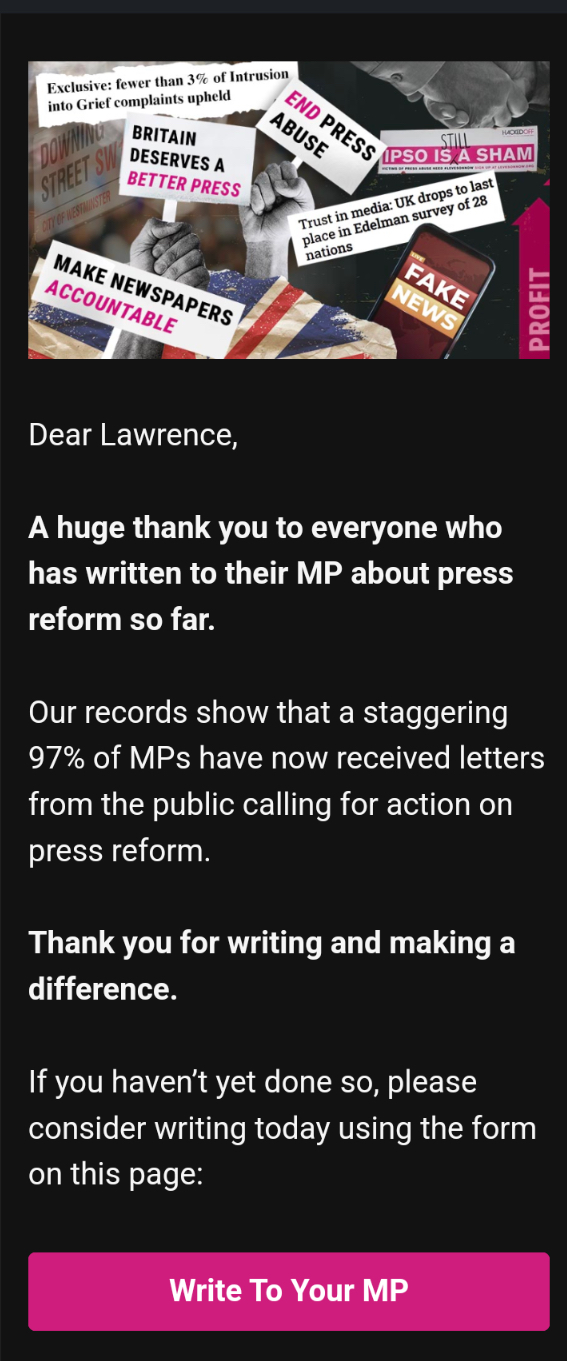
Here we see that “Our records show that a staggering 97% of MPs have now received letters from the public calling for action on press reform.” Now, we get the larger view. You see, the media doesn’t want the Leveson papers implemented and the people do. So what will the politicians do? That is the larger setting because the Media will see its visibility crumble when this happens. So what will the politicians do? I have set this stage in my blog several times over the last few years. The media is no longer reliable to any level and the pro-Hamas stories from the BBC is showing too many that the media is basically done for. Consider the fact that the UK is characterised by a comparatively large national press with 11 national daily newspapers, and 10 Sunday sister titles (this is more than France, Germany and USA). Seven of these titles publish special editions for Scotland, and these compete with three Scottish dailies. National newspapers are typically divided into three sectors which relate to their physical size, as well as the quantity of news, values and quality of content: broadsheet (also known as quality), mid-market, and tabloid. They are (mostly) all vying for the attention of the 69 million people in the UK. The turnaround is with “Print newspapers are read by 1 in 4 adults over 15 every day (13.6 million daily) and reach larger audiences weekly (24.9 million) and monthly (30.8 million). Print Circulation has fallen approximately 40 percent between 2010 and 2018.” And all these newspapers have advertising and that is the larger issue. That is money for the publications and as that 40% is cutting deeper and deeper. The media will resort to larger non-news steps, mostly to gain digital dollars from their audience. And with 97% off the MPs are getting requests to act, there is not much to do and I reckon that action will follow. Perhaps we will see another episode from some editor in chief stating like a little cry bitch that they can be trusted, that they will give a tooth to IPSO, but the larger setting of people are over the stage of misbehaving. Oh, and before you all think I am exaggerating, on March 14th 2014 I gave you all ‘Bad Journalism’ (at https://lawlordtobe.com/2014/03/25/bad-journalism/) where we were shown “Flight MH370 ‘suicide mission’“, so where is the evidence? Was any evidence ever given to us? The media is done for and I see it as places like the Khaleej Times, the New Arab and Al Arabiya are now more reliable than the western press has been for over 10 years.

So now the wait starts for action from British political parties. I wonder how long they can sit on their hands before the people have had enough. I wonder how many editors will cry like the little bitches they have been for years. And IPSO? Well they are soon to be under a microscope too.

Have a great day. 
Leave a comment

Filed under Media, Politics

Out of the blue

That is what happened. I had a stream of ideas out of the blue. I do not know what fuelled this. Was it reading about the failures of Ubisoft? Was it another setting? My mind went racing and I went back to 1995 and Tia Carrere. In that year she was part of The Daedalus Encounter. It was a fun game and I had fun laying it. But then a thought came to me. That game in 2024 could open other doors. Doors opened through machine learning and deeper machine learning (AI does not yet exist). The track my mind went through was interesting. You see, the movie world made rules for (what they call) AI. But this setting might not completely apply to games. 

Now consider the first stage of creating these kind of games using the technology complemented with Unreal Engine 5. We can make new versions of Rama, Infocom games, but now not as text games. More like Zork nemesis, with actors and actresses. Infocom created more than 20 games and they could now entice a much larger following. As the games develop new technology would also develop in creating games. The larger fun of this is that many more developers will get a handle on this form of game development. 

That brought me to the next level. In 1984 The Dallas Quest was developed. As such Datasoft created “one of the best games out on the CBM 64” and it held sway over pretty much the entire gaming community, even those who didn’t follow Dallas (example: me). We now have the technology for streaming systems to hold the sway of all who love this level of games. That wasn’t the only setting. You see players like Netflix could optionally create a new level of games using these technologies. The setting of of these new options could set in motion a new form of gaming. Consider what was. And now take another direction. Creation of these kind of games using TV series. Grimm, Babylon 5, Charmed, Buffy, Doll House and several other series that have been discontinued. Now consider the implementation of ChatGPT, and with a library for every character of that series. Now we get a new technology. A game where the player can be any character in that series and the interactions will shape the ‘episode’ of that game. That trend could be pushed forward. Now consider another venue of these games. Egyptian Musalsalat: A Social Construction of Reality has strength all over the Arabic world. Now take these elements and build the new template. An interactive game where the player decides on the route of the episode. In The Dallas Quest we needed to make choice, like finding the football tickets in the lobby, if not you get stuck in the game. Now machine learning will be able to avoid getting stuck. And the game can evolve even further. Consider the setting that Grimm has, millions of fans still love this series. Now they can continue their TV fling in this new direction. Consider the streaming solution and consider that I gave the option of 200 million consoles with the directions before I came up with this. Now it could become a whole new dimension of gaming. 

Oh, and whilst you contemplate how Ubisoft blew game after game and delay after delay I came up with this new idea (within two hours). Don’t get me wrong, this will be a complex undertaking and the idea to use the Infocom and the Dallas Quest first enables this technology to grow and to adapt to some sandbox approach. I believe this could entice millions more to the gaming population and it has options over time. There is even the idea that former adventures could be evolved into new versions on a new template in a new shape with new possibilities. What a difference a few hours make.

Have a great day.

Leave a comment

Filed under Gaming, IT, movies

Co inky dink

Yup, my previous article on comic films preceded a BBC article. Or perhaps better stated I saw the article after I wrote my article. As coincidences, go a nice one. The BBC article (at https://www.bbc.com/news/articles/cj6er83ene6o) gives us ‘Hollywood’s big boom has gone bust’, I have some issues here. The first is seen with “the good times ground to a halt in May 2023, when Hollywood’s writers went on strike” I resent the implied status that this was up to the writers going on strike. And as we are given both “The actor and aerial cinematographer turned his hobby of flying drones into a profitable business in 2012 just as the streaming wars were taking off. For a decade, he was flying high above film sets, creating sleek aerial shots for movies and TV shows on Netflix, Amazon and Disney” and “But rather than roaring back, in the one year since the strikes ended, production has fizzled.” This story isn’t giving us the goods. You see there are a few elements. One is saturation of business. First there was Netflix, and not we have in addition Disney plus, Hulu, Paramount, YouTube TV, Sling, Fubo and Amazon prime. Several more to follow but these are the better ones. What was one is now eight and it doesn’t end there, there are all kinds of digital boxes who keep tabs on it all. The problem is that income levels are still the same as they were in December 2019, pretty much in synch with the first Covid setting. In 5 years most incomes are either the same or ridiculously close to that and in the meantime the cost of living has gone through the roof. Housing has been raised in many places by as much as 50%, that is hundreds of dollars a week. Food has risen by about 5% per year. There is the larger set that most people can at best afford 1 digital channel (if at all), as such all eight channels competed for the same customer at the same time. As such it isn’t merely that production fizzled, or that projects were cancelled. There is a dwindling population that cannot even afford one channel. And to relate that to the present, Disney projected it would spend between $8 billion-$9 billion on content for its premiere streaming service. Now see that investment all whilst less people could afford that TV channel. This isn’t merely America, this is a global problem. Hollywood has relied on the old Roman principle “Give the people bread and games” and now the people cannot afford the games and more and more of them are falling short for buying bread and this is happening all over the world. So whilst we get “Projects have been cancelled and production was cut across the city as jobs have dried up, with layoffs at many studios – most recently at Paramount. It had a second round of layoffs this week, as the storied movie company moves to cut 15% of its workforce ahead of a merger with the production company Skydance.” We see that there is a lull in the setting of projects and the attainment that people are in the mindset of “things will go better soon” but that is not the case. America and Europe wasted at least two years on their ego all whilst the ‘customers’ who had the cash have vacated to China. I saw this happen two years ago, which is why I created a script that could entertain the Muslim population. And I was right that SBA (Saudi Broadcasting Authority) and Dubai media are growing like crazy, all whilst the American players are merging and buying each other out. I saw the same happen in the IT in the early 90’s with a Dutch company called Infotheek. On the edge of bankruptcy, they bought the smaller players and take that revenue as your own. It didn’t work then, I doubt it will work now. And in that light America has a second problem. Many players will divert to Canada as it could be an option. Many actors and actresses are Canadian, so that works for some. Vancouver is a new powerhouse in this and the more the capture the smaller the American pie becomes. As such the article is right, Hollywood big boom has gone bust, as could be the case for Hollywood fairly soon. And there lies the problem, an over bubbled industry, A premise of channels that ned to invest billions, all whilst there is doubt that the revenue in 2026 could have diminished by 20% (at least), as such who gets the money? Then in the past 300% on investment was achievable, soon it will merely be between break even and perhaps 50%, so how many investors will leap the fence to optionally Arabic channels? I made it clear in 2020 that you cannot bite the hand that feeds you, but did the American defense industry listen? Nope and now the Chinese defense industry reports a growth of 25% year-on-year. That is money that is not going to America and now the streaming channels are optionally seeing a similar move towards Arabic nations and India. So how long until the boom turns into a gap that implodes implodes? 

All things that have been out in the open, but the BBC overlooked it. It is a good story and it gives some of the goods, but it overlooked the attached factors and these are a lot more disastrous. Well, that’s it for now. It is almost lunch time for me, have a great morning wherever you are.

Leave a comment

Filed under Finance, IT, Media, movies

Free IP for John Cena

Yes, it is a different story this time around. It is IP, and it is free for John Cena. He actually inspired the IP. You see, I first saw him in the Wall, a most excellent movie. I did not know the man, other than that he served, which I read somewhere. Then I saw him in the movie Blockers. A bit over the top, it is so American those Prom movies, but I saw it, mostly because Leslie Mann was in it. It was a few weeks later when I was working as a volunteer in a Salvo’s shop when I saw a 3 DVD pack with the John Cena experience. That was the moment I saw he was originally a wrestler. And whilst watching the first DVD I also had an idea. There is an option for John Cena to get an Oscar, but not the one he might have ever banked on. He could stand a chance to get the Oscar for Best Documentary Feature.

How so?
You see, what I never knew (as I never served in the US army) is that the WWF has done things for the USO, and there is the story. The USO, or United Service Organisations is a setting that provides entertainment for the armed forces. The USO has been around since WW2. So there is material from WW2, Korea, Vietnam, Desert Storm and many other places. It has over 30,000 volunteers and it has remained (outside of the US) highly invisible. I had heard of the USO, but when you consider just how much they have done, I am surprised that no one else has taken the time to create a movie on what they have achieved. A show about a show, optionally with the special effects on the people who were there, with the morph to what they are now. Interviews with the people behind the entertainment going all the way back to WW2 (if any of them are still around). I think that it is important that this movie is made, because these people should not be forgotten. 

Why John Cena?
That is a fair question. He is a lighthouse of attention, this time the attention should fall on the people who make the USO run. He could optionally even finance the move (and reap the rewards). A movie that could lead to global visibility and global recognition of a people who worked from the shadows for far too long.  And he is but one entertainer that would most likely be willing to shine a torch on the achievements and activities of the USO, there are plenty of others, yet I believe that he gave light to the USO and would willingly do it again.

It could be anyones show, but the greats were Gary Sinise, Bob Hope, Danny Kaye and a few more. And until the JC experience I did not even know that the WWF does its part to entertain the troops via the USO, so there are plenty of people, but who can make the movie? Not me, I am neither a producer or a director, so I am handing it over in the blog. If my writing sets (in part) ownership of the IP, I will happily hand it over to John Cena. Perhaps he can make it work and end up with an Oscar in the process. It seems simple. But is it?

An Idea I have never seen anywhere else, so why not? Why are people not looking around anymore? Why are they all settled on the quick run to cash? As far as I can tell, most of these runs merely shorten their lives and leaves them with nothing, but that is my take on the matter.

Leave a comment

Filed under movies

FACT on piracy?

There is a newscast that got to me in the middle of the night (at http://www.bbc.co.uk/news/technology-25575298).

Now, let me start that I am not in favour of digital piracy in any way. I have had a fortunate live, so for the most, I could go to the cinema and enjoy the big screen. At times I got to buy a DVD/Blu-ray, so I could enjoy the quality of the movie at home.

What gets to me is this quote “A spokesperson for the Federation Against Copyright Theft (Fact) said that piracy puts jobs in the entertainment industry at risk and prevented future investment in entertainment.

This spokesperson needs to take a hard look at himself/herself in the mirror in regards to the ‘BS’ (as I personally see it) that is proclaimed by said spokesperson! Why?

The 25 most profitable movies represented in the US alone $5.2 billion dollars. At the top is Iron Man 3 which did $400 million in the US, but did an awesome $1.2 billion worldwide. So, there is no future danger to investments, there is a truckload of money to be made there and greed is trump. An additional interesting fact is that the second Hobbit movie is on that top 25 too. It made over 200 million in one week, so lighten up FACT!

Perhaps FACT needs to take a new look at the message they are proclaiming. What angers me is that this is pretty much the same BS Sony ‘voiced’ gave when all that music was shared in the early 90’s (when the US had similar poverty numbers) on how much damage they had.

These people do not realise that a large portion of the US and the EEC is in such a recession that the people cannot afford the luxury of going to the cinema (or buying a DVD for that matter). In the US the poverty line now hits 1 for every 7 Americans, so it is time for FACT to wake up! In the UK things are slightly better, but only 1.1% better, making it 1 in 7 as well. So, perhaps FACT would like to take that into consideration before blaming dangers to piracy?

Who downloads movies?

Well, the main group here in my view remains the student population (who can hardly make ends meet as school fees go up and up). In addition I must state that this does not OK the transgression, but consider that these people have little options to see anything. Prices go up, yet students end up with less and less. The second group is the poverty group, who likely have no internet, but rely on a friendly neighbour to burn them a DVD. I am not saying that this is good, legal or acceptable! I am just saying that perhaps setting the right dimension might help ‘comprehension’ for those who cannot afford any of it anyway.

the second quote that the BBC gave “Piracy threatens the livelihoods of over 1.5 million people whose jobs rely on the continued success of films, TV programmes and other forms of entertainment that are created in the UK.” reads a little better, but I fear that this is slightly disjointed. We dealt with films, but we did not deal with TV programs. There we see that the big ‘winner’ is Game of Thrones (HBO) the quote that another site gave me “It also seems that those involved in Game of Thrones are not too worried by the levels of piracy around their show.

This does not make it OK, but consider that these series can only be watched with a subscription and that in the UK and the US 1 in 7 is below the poverty line. The financial situation in many European countries is not that much better, then perhaps those involved should realise that they, for the most are not doing that bad. Forbes showed an additional side to the HBO dilemma (at http://www.forbes.com/sites/erikkain/2012/05/10/international-audiences-have-few-choices-to-legally-watch-hbos-game-of-thrones/). Consider that the three pirated TV series that truly jump out are all HBO series. Can FACT explain how these poverty driven families can shell out $50 a month for cable? And, even those making minimum wage (which is only marginally better than poverty) can often not afford any of the choices FACT would deem acceptable.

So, and your truly (meaning me!), did I ever watch an illegal movie version? (I never downloaded it!) Yes, I did once. It was Star Wars Episode One and I only watched it because the Movie was launched 4 months later in the Dutch cinema then in the US (an unacceptable time-lag for such a movie). I still watched it in the cinema, I bought the DVD and later the Blu-Ray and so they got more than their money’s worth!

So, is there a real issue?

Depends on how you look at it. From my point of view, the bulk of those downloading the movies and/or TV series cannot afford them in any way, which means that there would never have been a sale to begin with. Those who are above that mark are a decreasing population. As TV series and movies are offered via iTunes, consoles and other digital media for just a few dollars, getting the series (or movie) in that way would be preferable to many viewers, especially as those versions tend to be of better quality. The growth in sales as claimed by some (an increase of 40% in digital sales), means that the tide is shifting. The biggest group that remains has no way of buying it ever under the economic pressures they face.

Yes, you might have a case against these people, but consider how movies claim to make so many billions. Do they really want to go on a hunt for those who live below poverty? Has it truly come to this?

How about we use all that effort to get these people a ‘decent’ income?

1 Comment

Filed under Finance, Law, Media

About Entertainment

I stumbled upon an article by Gilbert Cruz called “The Lone Ranger Represents Everything That’s Wrong with Hollywood Blockbusters” (at: http://www.vulture.com/2013/07/lone-ranger-is-everything-wrong-with-hollywood.html). It is actually quite a nice read and the conclusions that I personally do not completely agree with are still well supported and seem to make sense.

His ‘unease’ with franchises are well accepted by many including me, as we read and have spoken out against these reiterations often enough. when addressing the origin story problem he states “Give us a story that works and then, if you’re lucky enough to earn a sequel, you can give us flashes of an origin tale down the road, as opposed to weighing down your first movie.” That is one view, yet it is the view of the director that counts. It should be about the vision of the director. Perhaps it is less about the origin story and more about having a visionary director. My view is supported by mentioning the hidden gem ‘Margin Call‘. I think that this is a movie any economic student should watch. It watches like a story, yet there are layers of events that give it all an actual strength. The fact is also about a story portraying the initial stages of the 2008 financial crises are set in a movie.
Can anything be more dull then that? And even though this movie is pretty much all star, it required a visionary director to pull it off. That is how I see the origin story as well, without vision it is a presentation. It does not matter whether we watch a movie containing a Wild Wild West version of Sparrow, or the start of the lone ranger. the same for Thor, Spiderman and so forth, how they ‘became’ is part of the movie, but how to address it?

This dilemma is approached within the slogan of TV channel ‘FX’. “The story is everything!” I think when it comes to TV channels; it is the most brilliant slogan ever. Yes, we remember the special effects, we see the stars we love and idolise, but without the story…. (Imagine the sound of a flop!).

This is also why (for now) I stayed away from the Hobbit. I loved the lord of the rings. I have been a fan of Tolkien since long before I was at the legal drinking age. So seeing the movie was a massive moment in my life for me. Like many fans I did mentally object loudly when the freeing of the shire was missing (as this is the moment the hobbits experience what those around them went through), yet to see the book on the big screen was a moment I loved. To see the Hobbit was indeed something I was looking forward to, yet to see a 320 page book in 3 movies of around 3 hours each is stretching it all a bit thin.

So as most might agree with, is the fact that a good story requires a visionary. Perhaps this is why James Cameron has been so successful? 2 movies bringing in almost 5 billion is just insane! We should not forget that timing is also extremely important. I feel that this is shown when looking at ‘Dances with Wolves’ and ‘a man called horse’, which was a shining moment for Richard Harris. Perhaps the world was not ready for the ‘going native’ view in the 70’s.

The article stamps out a side I actually never gave much notice of. He states “So in order to ensure sequels and appeal to the maximum number of people, it must be rated PG or PG-13. Good luck finding an R-rated summer blockbuster.” He makes a fine point here. I want to see a movie that is good; I am not all in favour of bloody or bloodless movies if they hinder a sense of realism. Although I was never a fan of zombie films, the ‘realistic’ view ‘the Waking dead’ brings, is why I am eye locked to the small screen. So, the ratings requiring certain lack of levels of gore would be counterproductive to me. I do not believe that it is about gore and blood-letting. This is why I enjoyed the movie ‘the A-team’, where with 17,000 bullet you see no one gunned down (keeping in pace with the original TV series), yet the opposite of ‘Act of Valor’ is a gem as it is about the efficiency of making every bullet count (Navy Seals apparently are not about wasting time). So my stance floats a little with the movie I am watching, again, the story makes it happen.

This is why the hammer on ‘The Lone Ranger’ feels a little harsh to me. If it is about entertainment, then the Lone Ranger provides, yet the points the article brings up should not be ignored either. This is a Disney movie and Disney factor is important as that brand has a following with an audience they need to protect. Consider that the (Grand) parents, with younglings on a day out will see the protection that the Disney logo brings and as such a gore driven Zombie film with a Disney logo is unlikely to ever happen.

The final part where I slightly disagree with the views Gilbert Cruz offers, is when he mentions The Phantom and The Shadow. These 90’s movies failed because there was a lack of vision (as I see it). The characters are well established through the radio shows and the comic books. If we consider the slogan of FX and if we consider a slightly more Frank Miller themed view, then consider Howard Chaykin’s ‘The Shadow: Blood & Judgment’. That was more than just a mere piece of comic book. That was graphic art on an entirely different level. As much as Baldwin failed to portray the Shadow, the blame should fall to the lack of vision the director showed (perhaps with a small degree of ‘technology lacking’ options). Consider what Tarsem Singh achieved with ‘Immortal’, now let him have a go at ‘The Shadow: Blood & Judgment’. The result could be a lot more than a cult movie that we will remember for a long time. The result could be a blockbuster R-rated movie. Again, it is about timing and for 2013-2015 the timing seems right to take these old ‘heroes’ off the shelves and give them to visionaries, not to the directors that come from the ‘Hollywood blockbuster template machine’. In that regard we all hope that Luc Besson will achieve to revive the French hero that should be seen as an international landmark. As he is remembered for the Fifth Element, this visionary could make the heroes Valérian and Laureline truly immortal. As franchises go, a trilogy of these two characters could reshape the way people see comic book heroes. The only sad fact is that this movie arrives almost 40 years after I read the comic books. Even now, I still remember the art of Jean-Claude Mézières. What is also intriguing is that the art you see in ‘The City of Shifting Waters’ had a lot of similarities that the TV-Series ‘Revolutions’ showed almost 35 years after the comic book came.

It is also interesting that, considering the success of the lord of the rings and the implied upcoming blockbusters that the Hobbit seems to become, that not a larger net was cast on the type stories that have this epic view. We all remember Flash Gordon. Some trough the view of Ted (a McFarlane sense of humour), some through the exquisite music by Queen, however I still think back to the comics as drawn in the 60’s and 70’s. In that same style there are the stories of the ‘Trigan Empire’. It seems so strange that these successful works of art still have not made it to the big screen.

So I believe that there are plenty of options out there, it just takes faith (and funding) in one visionary to take that step forward.


Leave a comment

Filed under Media